EDITOR’S INTRODUCTION. (continued 3)
Reading edition
I said I guessed I knew. Like enough ’t was a ghost of something.
I said like enough of a robin or some kind of bird.
“Of what?” then they all asked me.
“That he’d stolen the eggs of,” says Dorry.
“O yes!” says Old Wonder Boy. “It’s easy enough to laugh, in the light here, but I guess you’d ’a’ been scared, seeing something chasing you in the dark, and going up and down, and going tick, tick, tick, every time it touched ground, and sometimes it touched my side too.”
“For goodness gracious!” says Dorry. “Can’t you tell what it seemed most like?”
“I tell you it didn’t seem most like anything. It didn’t run, nor walk, nor fly, nor creep, nor glide along. And when I got to the Great Elm-Tree, I cut round that tree, and ran this way, and that did too.”
“Where is it now?” Dorry asked him.
“O, don’t!” says W. B. “Don’t open the door. ’T is out there.”
“Come, fellers,” Dorry said, “let’s go find it.”
Benjie said, “Let’s take something to hit it with!” And he took an umbrella and I took the bootjack, and Bubby Short took the towel horse, and Mr. Augustus took a hair-brush, and Dorry took his boot with his arm run down in it, and first we opened the door a crack and didn’t go out, but peeped out, but didn’t see anything there. Then we went out a little ways, and then we didn’t see anything. And pretty soon, going along towards the stairs, Bubby Short stepped on something. “What’s that?” says he. And he jumped, and we all flung our things at it. “Hold the light!” Dorry cried out.
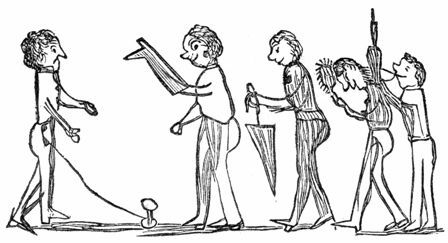
Then W. B. brought out the light, and there wasn’t anything there but a carpenter’s reel, with a chalk line wound up on it, and they picked it up and began to wind up, and when they came to the end of it—where do you s’pose the other end was? In W. B.’s pocket! and his ball and some more things held it fast there, and that chalk-line reel was what went bobbing up and down behind Old Wonder Boy every step he took,—bob, bob, bobbing up and down, for there was a hitch in the line and it couldn’t unwind any more, and the line under the door was why ’t wouldn’t latch, and O, but you ought to ’ve heard the fellers how they roared! and Bubby Short rolled over on the floor, and Dorry he tumbled heels over head on all the beds, and we all shouted and hurrahed so the other fellers came running to see what was up, and then the teachers came to see who was flinging things round so up here, and to see what was the matter, but there couldn’t anybody tell what the matter was for laughing, and W. B. he looked so sheepish! O, if it wasn’t gay! How do you like this story? That part where it touched his side was when that reel caught on something and so jerked the string some. Now I must study my lesson.
Your affectionate brother, William Henry.
P.S. When you send a box don’t send very many clothes in it, but send goodies. I tell you things taste good when a feller’s away from his folks. Dorry’s father had a picture taken of Dorry’s little dog and sent it to him, and it looks just as natural as some boys. Tell Aunt Phebe’s little Tommy he may sail my boat once. ’T is put away up garret in that corner where I keep things, side of that great long-handled thing, grandmother’s warming-pan. I mean that little sloop boat I had when I’s a little feller.
W. H.
Georgianna’s Letter to William Henry.
My Dear Brother Billy,——
Kitty isn’t drowned. I’ve got ever so many new dolls. My grandmother went to town, not the same day my kitty did that, but the next day, and she brought me home a new doll, and that same day she went there my father went to Boston, and he brought me home a very big one,——no, not very, but quite big,——and Aunt Phebe went a visiting to somebody’s house that very day, and she brought me home a doll, and while she was gone away Hannah Jane dressed over one of Matilda’s old ones new, and none of the folks knew that the others were going to give me a doll, and then Uncle J. said that if it was the family custom to give Georgianna a doll, he would give Georgianna a doll, and he went to the field and catched the colt, and tackled him up into the riding wagon on purpose, and then he started off to town, and when he rode up to our back door there was a great dolly, the biggest one I had, and she was sitting down on the seat, just like a live one. And she had a waterfall, and she had things to take off and on. Then Uncle J. asked me what I should do with my old dollies that were ’most worn out. And I said I didn’t know what I should. And then Uncle J. said that he would take the lot, for twenty-five cents a head, to put up in his garden, for scarecrows, and he asked me if I would sell, and I said I would. And he put the little ones on little poles and the big ones on tall poles, with their arms stretched out, and the one with a long veil looked the funniest, and so did the one dressed up like a sailor boy, but one arm was broke off of him, and a good many of their noses too. The one that had on old woman’s clothes Uncle J. put a pipe in her mouth. And the one that had a pink gauze dress, but ’t is all faded out now, and a long train, but the train was torn very much, that one has a great bunch of flowers——paper——pinned on to her, and another in her hand, and the puppy he barks at ’em like everything. My pullet lays, little ones, you know. I hope she won’t do like Lucy Maria’s Leghorn hen. That one flies into the bedroom window every morning, and lays eggs on the bedroom bed. For maybe ’t would come in before I got up. My class has begun to learn geography, and my father has bought me a new geography. But I guess I sha’ n’t like to learn it very much if the backside is hard as the foreside is. Uncle J. says no need to worry your mind any about that old fowl, for he’s so tough he couldn’t be killed. I wish you would tell me how long he could live if it wasn’t killed, for Uncle J. says they grow tougher every year, and if you should let one live too long, then he can’t die. But I guess he’s funning, do you? Our hens scratched and scratched up some of my flowers, and so did the rain wash some up that night it came down so hard, but one pretty one bloomed out this morning, but it has budded back again now. Aunt Phebe says she sends her love to you, tied up with this pretty piece of blue ribbon. She says, if you want to, you can take the ribbon and wear it for a neck bow. Grandmother says how do you know but that sailor that went to your school in Old Wonder Boy’s uncle’s vessel is that big boy, that bad one that ran away, you called Tom Cush?
Father laughs to hear about Old Wonder Boy, and he says a bragger ought to be laughed at, and bragging is a bad thing. But he don’t want you to pick out all the bad things about a boy to send home in your letters; says next time you must send home a good thing about him, because he thinks every boy you see has some good things as well as some bad things.
A dear little baby has moved in the house next to our house. It lets me hold her, and its mother lets me drag her out. It’s got little bits of toes, and it’s got a little bit of a nose, and it says “Da da! da da! da da!” And when I was dragging her out, the wheel went over a poor little butterfly, but I guess it was dead before. O, its wings were just as soft! and ’t was a yellow one. And I buried it up in the ground close to where I buried up my little birdie, side of the spring.
Your affectionate sister, Georgianna.
Among the other letters I find the following, from Tom Cush. As the people at Summer Sweeting place had been told the circumstances of his running away, it was not only proper, but just, that William Henry should send them this letter.
A Letter from Tom Cush to Dorry.
Dear Friend,——
I have not seen you for a great while. I hope you are in good health. Does William Henry go to school there now? And does Benjie go, and little Bubby Short? I hope they are in good health. Do the Two Betseys keep shop there now? Is Gapper Skyblue alive now? I am in very good health. I go to sea now. That’s where I went when I went away from school. I suppose all the boys hate me, don’t they? But I don’t blame them any for hating me. I should think they would all of them hate me. For I didn’t act very well when I went to that school. Our captain knows about that school, for he is uncle to a boy that has begun to go. He’s sent a letter to him. I wish that boy would write a letter to him, because he might tell about the ones I know.
I’ve been making up my mind about telling you something. I’ve been thinking about it, and thinking about it. I don’t like to tell things very well. But I am going to tell this to you. It isn’t anything to tell. I mean it isn’t like news, or anything happening to anybody. But it is something about when I was sick. For I had a fit of sickness. I don’t mean afterwards, when I was so very sick, but at the first beginning of it.
The captain he took some books out of his chest and said I might have them to read if I wanted to. And I read about a man in one of them, and the king wanted him to do something that the man thought wasn’t right to do; but the man said he would not do what was wrong. And for that he was sent to row in a very large boat among all kinds of bad man, thieves and murderers and the worst kind. They had to row every minute, and were chained to their oars, and above their waists they had no clothes on. They had overseers with long whips. The officers stayed on deck over the rowers’ heads, and when they wanted the vessel to go faster, the overseers made their long whip-lashes cut into the men’s backs till they were all raw and bleeding. Nights the chains were not taken off, and they slept all piled up on each other. Sometimes when the officers were in a hurry, or when there were soldiers aboard, going to fight the enemy’s vessels, then the men wouldn’t have even a minute to eat, and were almost starved to death, and got so weak they would fall over, but then they were whipped again. And when they got to the enemy’s ships, they had to sit and have cannons fired in among them. Then the dead ones were picked up and thrown into the water. And the king told the man that if he wanted to be free, and have plenty to eat and a nice house, and good clothes to wear, all he had to do was to promise to do that wrong thing. But the man said no. For to be chained there would only hurt his body. But to do wrong would hurt his soul.
And I read about some people that lived many hundred years ago and the emperor of that country wanted these people to say that their religion was wrong and his religion was the right one. But they said, “No. We believe ours is true, and we cannot lie.” Then the emperor took away all their property, and pierced them with red-hot irons, and threw some into a place where they kept wild beasts. But they still kept saying, “We cannot lie, we must speak what we believe.” And one was a boy only fifteen years old. And the emperor thought he was so young they could scare him very easy. And he said to him, “Now say you believe the way I want you to, or I will have you shut up in a dark dungeon.” But the boy said, “I will not say what is false.” And he was shut up in a dark dungeon, underground. And one day the emperor said to him, “Say you believe the way I want you to, or I will have you stretched upon a rack.” But the boy said, “I will not speak falsely.” And he was stretched upon a rack till his bones were almost pulled apart. Then the emperor asked, “Now will you believe that my religion is right?” But the boy could not say so. And the emperor said, “Then you’ll be burned alive!” The boy said, “I can suffer the burning, but I cannot lie.” Then he was brought out and the wood was piled up round him, and set on fire, and the boy was burned up with the wood. And while he was burning up he thanked God for having strength enough to suffer and not lie.
Dorry, I want to tell you how much I’ve been thinking about that man and that boy ever since. And I want to ask you to do something. I’ve been thinking about how mean I was, and what I did there so as not to get punished. And I want you to go see my mother and tell her that I’m ashamed. Don’t make any promises to my mother, but only just tell, “Tom’s ashamed.” That’s all. I don’t want to make promises. But I know myself just what I mean to do. But I sha’ n’t talk about that any. Give my regards to all inquiring friends.
Your affectionate friend, Tom.
P.S. Can’t you tell things about me to William Henry and the others, for it is very hard to me to write a letter? Write soon.
T.
Mr. Carver’s visit to the Crooked Pond School alluded to in the following letter was quite an event for my Summer Sweeting friends, and caused an extra amount of cooking to be done in both families. Boys don’t half appreciate the blessing of not being too old to have goodies sent them. Now goodies taste good to me, very good, but I haven’t a friend in the world who would think of boiling up a kettleful of molasses into candy, or of making a waiterful of seed-cakes to send me. Too old, they say,—in actions, if not in words. How cruelly we are misjudged sometimes, and by those who ought to know us best! I shall never be too old to receive a box like that of William Henry’s, never, never!—unless my whole constitution is altered and several clauses taken out of it.
I remember of seeing that waiter of “good seed-cakes” on grandmother’s best room table, between the front windows, waiting to be packed in Mr. Carver’s valise. Mr. Carver’s black silk neck-handkerchief, tall hat, clean dickies, stockings, two red and white silk pocket-handkerchiefs, and various other articles were distributed over the adjacent chairs, and his umbrella, in a brown cambric covering, stood near by. I have the impression that most of these things were ironed over, five or six times, as grandmother felt that apparel going away from home could not be too much ironed. Besides, it seemed to her impossible that such an event as Billy’s father setting out on his travels should take place without extra exertions in some quarter.
Mr. Carver had other business which took him from home, but as “going to see Billy” was thought enough to tell Mrs. Paulina, why, it is enough for me to tell. “Mrs. Paulina” was an elderly woman, the wife of Mr. John Slade, one of the neighbors, and she was called “Mrs. Paulina,” to distinguish her from several other Mrs. Slades.
Mrs. Paulina had her own opinion as to how money and time should be spent,—everybody’s money and time. She was one of the prying sort, and had wonderful skill in ferreting out all the whys and wherefores of her neighbor’s proceedings. It was a common thing at the Farm to say, when undertaking some new scheme, “Well, how much shall we tell Mrs. Paulina?” It being a matter of course that she would inquire into it. The girls often amused themselves by giving her blinding answers just to see how she would contrive to carry her point. I remember their having great fun doing this, just after William Henry went away to school. Lucy Maria said ’t was just like a conundrum to Mrs. Paulina, a great mammoth conundrum, and the poor thing must be told about “Old Uncle Wallace,” or she would wear herself out, wondering “how Mr. Carver could possibly afford the money.”
The “Old Uncle Wallace” thus brought to the rescue of Mrs. Paulina would probably not have came to her rescue, or to any woman’s rescue, had he been free to choose, seeing that he lived and died a bachelor, and a stingy bachelor at that! The old miser was a distant uncle,—either half-uncle, or grand-uncle, or half grand-uncle of the Mr. Carvers, and lived, that is before he died, in a town some twenty miles off. Billy’s father was named for Uncle Wallace, and when a little boy, lived in the same neighborhood, and was quite a favorite with him.
The acquaintance with that distant branch of the family, however, had not been kept up, in fact I have no recollection of a single member of it ever coming to the Farm. They were people well to do in the world, and neither Mr. Carver nor Uncle Jacob were men to “honey round” rich relations. Certainly they never would have fawned upon the miserly old fellow, who had the reputation of being mean and tricky as well as miserly.
It seems, however, that “Uncle Wallace” did not wholly forget his namesake, for in his will he left him quite a valuable wood-lot near Corry’s Pond,—some six or eight miles from the Farm,—and a few hundred dollars besides.
This occurred not a great while before my first ride out with Uncle Jacob. Mr. Carver had long felt that Billy was being spoiled at home, and the Crooked Pond School being recommended at that time as “really good,” and “not too expensive,” he resolved that while feeling rich he would place his son at that institution. And he was more especially inclined to do so for the reason that an old friend of his lived near there, and this friend’s wife promised to see that the boy did not go about in actual rags. She is probably the person to whom William Henry refers in his first letters, as “the woman I go to have my buttons sewed on to.”
The above circumstances were duly imparted to Mrs. Paulina, yet that perplexed woman got no relief. True, it was something to know where the money came from, but “How could a man,” she asked, “spend so much money on eddication, when it might be drawing interest, or put into land?”
Mrs. Paulina couldn’t guess. She gave it up.
William Henry’s Letter to his Grandmother.
My Dear Grandmother,——
I suppose my father has got home again by this time. I like to have my father come to see me. The boys all say my father is a tip-top one. I guess they like to have a man treat them with so many peanuts and good seed-cakes. I got back here to-day from Dorry’s cousin’s party. My father let me go. I wish my sister could have seen that party. Tell her when I get there I will tell her all about the little girls, and tell her how cunning the little ones, as small as she, looked dancing, and about the good things we had. O, I never saw such good things before! I didn’t know there were such kinds of good things in the world.
Did my father tell you all about that letter that Tom Cush wrote to Dorry? Ask him to. Dorry sent that letter right to Tom Cush’s mother. And when Dorry and I were walking along together the next morning after the party, she was sitting at her window, and as soon as she saw us she said, “Won’t you come in, boys? Do come in!” And looked so glad! And laughed, and about half cried, after we went in, and it was that same room where we went before. But it didn’t seem so lonesome now, not half. It looked about as sunshiny as our kitchen does, and they had flower-vases. I wish I could get some of those pretty seeds for my sister, for she hasn’t got any of that kind of flowers.
She seemed just as glad to see us! And shook hands and looked so smiling, and so did Tom’s father when he came into the room. He had a belt in his hand that Tom used to wear when he used to belong to that Base-ball Club. And when we saw that Dorry said, “Why! has Tom got back?” Tom’s mother said, “O no.” But his father said, “O yes! Tom’s got back. He hasn’t got back to our house, but he’s got back. He hasn’t got back to town, but he’s got back. He hasn’t got back to his own country, but he’s got back. For I call that getting back,” says he, “when a boy gets back to the right way of feeling.”
Then Tom’s mother took that belt and hung it up where it used to be before, for it had been taken down and put away, because they didn’t want to have it make them think of Tom so much.
She said when Tom got back in earnest, back to the house, that we two, Dorry and I, must come there and make a visit, and I hope we shall, for they’ve got a pond at the bottom of their garden, and Tom’s father owns a boat, and you mustn’t think I should tip over, for I sha’ n’t, and no matter if I should, I can swim to shore easy.
Your affectionate grandchild, William Henry.
P.S. Bubby Short didn’t mean to, but he sat down on my speckled straw hat, and we couldn’t get it out even again, and I didn’t want him to, but he would go to buy me a new one, and I went with him, but the man didn’t have any, for he said the man that made speckled straw hats was dead and his shop was burnt down, and we found a brown straw hat, but I wouldn’t let Bubby Short pay any of his money, only eight cents, because I didn’t have quite enough. Don’t shopkeepers have the most money of all kinds of men? Wouldn’t you be a shopkeeper when I grow up? It seems just as easy! If you was me would you swap off your white-handled jack-knife your father bought you for a four-blader? My sister said to send some of W. B.’s good things. He wrote a very good composition about heads, the teacher said, and I am going to send it, for that will be sending one of his good things. It’s got in it about two dozen kinds of heads besides our own heads. W. B. is willing for me to copy it off. And Bubby Short wrote a very cunning little one, and if you want to, you may read it. The teacher told us a good deal about heads.
W. H.
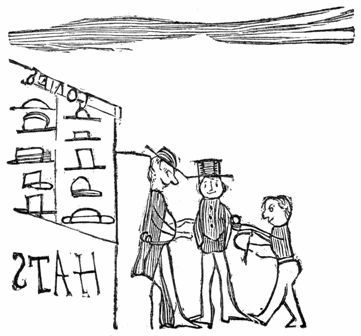
W. B.’s Composition.
HEADS.
Heads are of different shapes and different sizes. They are full of notions. Large heads do not always hold the most. Some persons can tell just what a man is by the shape of his head. High heads are the best kind. Very knowing people are called long-headed. A fellow that won’t stop for anything or anybody is called hot-headed. If he isn’t quite so bright, they call him soft-headed; if he won’t be coaxed nor turned, they call him pig-headed. Animals have very small heads. The heads of fools slant back. When your head is cut off you are beheaded. Our heads are all covered with hair, except baldheads. There are other kinds of heads besides our heads.
First, there are Barrel-heads. Second, there are Pin-heads. Third, Heads of sermons,—sometimes a minister used to have fifteen heads to one sermon. Fourth, Headwind. Fifth, Head of cattle,—when a farmer reckons up his cows and oxen he calls them so many head of cattle. Sixth, Drumheads,—drumheads are made of sheepskin. Seventh, Heads or tails,—when you toss up pennies. Eighth, Doubleheaders,—when you let off rockets. Ninth, Come to a head—like a boil or a rebellion. Tenth, Cabbageheads,—dunces are called cabbageheads, and good enough for them. Eleventh, At Loggerheads,—when you don’t agree. Twelfth, Heads of chapters. Thirteenth, Head him off,—when you want to stop a horse, or a boy. Fourteenth, Head of the family. Fifteenth, A Blunderhead. Sixteenth, The Masthead,—where they send sailors to punish them. Seventeenth, get up to the head,—when you spell the word right. Eighteenth, The Head of a stream,—where it begins. Nineteenth, Down by the head,—when a vessel is deep loaded at the bows. Twentieth, a Figurehead carved on a vessel. Twenty-first, The Cathead, and that’s the end of a stick of timber that a ship’s anchor hangs by. Twenty-second, A Headland, or cape. Twenty-third, A Head of tobacco. Twenty-fourth, A Bulkhead, which is a partition in a ship. Twenty-fifth, Go ahead,—but first be sure you are right.
Bubby Short’s Composition.
ON MORNING.
It is very pleasant to get up in the morning and walk in the green fields, and hear the birds sing. The morning is the earliest part of the day. The sun rises in the morning. It is very good for our health to get up early. It is very pleasant to see the sun rise in the morning. In the morning the flowers bloom out and smell very good. If it thunders in the morning, or there’s a rainbow, ’t will be rainy weather. Fish bite best in the morning, when you go a fishing. I like to sleep in the morning.
Here is a letter which, judging from the improvement shown in handwriting, and from its rather more dashing style, seems to have been written during William Henry’s second school year.
William Henry’s Letter about the “Charade.”
My Dear Grandmother,—
I never did in all my life have such a real tiptop time as we fellers had last night. We acted charades, and I never did any before, and the word was—no, I mustn’t tell you, because it has to be guessed by actions, and when you get the paper that I’m going to send you, soon as I buy a two-cent stamp, then you’ll see it all printed out in that paper. The teacher the fellers call Wedding Cake, because he’s such a good one, asked all the ones that board here to come to his house last night, and we acted charades, and his sister told us what to be, and what things to put on, and everything. You’ll see it printed there, but you must please to send it back, for I promised to return.
There weren’t females enough, and so Dorry he was the Fat Woman, and we all liked to ha’ died a laughing, getting ready, but when we were—there, I ’most told!
O if you could ha’ seen Bubby Short, a fiddling away, with old ragged clothes and old shoes and his cap turned wrong side out, then he passed round that cap—just as sober—much as we could do to keep in! I was a clerk and had a real handsome mustache done under my nose with a piece of burnt cork-stopple burned over the light. And she told me to act big, like a clerk, and I did.
Mr. Augustus was the dandy, and if he didn’t strut, but he struts other times too, but more then, and made all of us laugh.
Old Wonder Boy was the boy that sold candy, and he spoke up smart and quick, just as she told him to, and the teacher was the country feller and acted just as funny, and so did his sister; his sister was the shopping woman. Both of them like to play with boys, and they’re grown up, too. Should you think they would? And they like candy same as we do. And when it came to the end, just as the curtain was dropping down, we all took hold of the rounds of our chairs, and jerked ourselves all of a sudden up in a heap together, and groaned, and so forth.
I wish you all and Aunt Phebe’s folks had been there. We had a treat, and O, if ’t wasn’t a treat, why, I’ll agree to treat myself. Three kinds of ice-creams shaped up into pyramids and rabbits, and scalloped cakes and candy, and such a great floating island in a platter!—Dorry said ’t was a floating continent!—and had red jelly round the platter’s edge, and some of that red jelly was dipped out every dip. O, if he isn’t a tiptop teacher! Dorry says we ought to be ashamed of ourselves if we have missing lessons, or cut up any for much as a week, and more too, I say.
And so I can’t tell any more now, for I mean to study hard if I possibly can,
Your affectionate grandson, William Henry.
Please lend it to Aunt Phebe’s folks.
CHARADE. (Carpet.)
First Syllable.
Chairs placed in two rows, to represent seats of cars. Passengers enter and take their seats. Placard stuck up, “Beware of Pickpockets,” in capitals.
First. Enter two school-girls, M. and A., with books strapped about, lunch-box, &c. They are laughing and chatting. M. gives A. a letter to read. A. smiles while reading it, M. watching her face, then both look over it together. Afterwards, study their lessons. All this must be going on while the other passengers are entering.
Second. Business man and two clerks, one at a time. One takes out little account-book, another reads paper, another sits quietly, after putting ticket in his hat-band.
Third. Fat woman, with old-fashioned carpet-bag, umbrella, and bundles tied up in handkerchiefs; seats herself with difficulty.
Fourth. A clergyman, all in black, very solemn, with white neckcloth and spectacles.
Fifth. Yankee fellow from the country, staring at all new-comers.
Sixth. Dandy, with yellow gloves, slender cane, stunning necktie, watch-chain, and eyeglass comes in with a flourish, lolls back in his seat, using his eyeglass frequently.
Seventh. Lady with infant (very large rag-baby, in cloak and sunbonnet) and nurse girl. Baby, being fussy, has to be amused, trotted, changed from one to the other. Lady takes things from her pocket to please it, dancing them up and down before its face.
Eighth. Plainly dressed, industrious woman, who knits.
Ninth. Fashionable young lady, dressed in the extreme of fashion. She minces up the aisle, looks at the others, seats herself apart from them, first brushing the seat. Shakes the dust from her garments, fans herself, takes out smelling-bottle, &c. (Shout is heard.) “All aboard!”
Tenth. In a hurry, Lady that’s been a-shopping, leading or pulling along her little boy or girl. She carries a waterproof on her arm, and has a shopping-bag and all sorts of paper parcels, besides a portfolio, a roller cart, a wooden horse on wheels, a drum, a toy-whip (and various other things). Doll’s heads stick out of a paper. Lady drops a package. Dandy picks it up with polite bow. Drops another. Yankee picks it up, imitating Dandy’s polite bow. Gets seated at last, arranges her bonnet-strings, takes off the child’s hat, smooths its hair, &c.
Steam-whistle heard. Every passenger now begins the jerking, up-and-down motion peculiar to the cars. This motion must be kept up by all, whatever they are doing, and by every one who enters.
Enter Conductor with an immense badge on his hat, or coat. Calls out “Have your tickets ready!” Then passes along the aisle, and calls out again, “Tickets!” The tickets must be large and absurd. Passengers take them from pocket-books, gloves, &c. Fat old woman fumbles long for hers in different bundles, finds it at last in a huge leather pocket-book. Conductor, after nipping the tickets, passes out.
Enter boy with papers, “Mornin’ papers! Herald, Journal, Traveller!” (Business man buys one.) “Mornin’ papers! Herald, Journal, Traveller!” (Clerk buys one.) Paper boy passes out. Conductor appears, calls out, “Warburton! Warburton! Passengers for Bantam change cars!” (Noise heard of brakes, jerking motion ceases, school-girls leave, with those little hopping motions peculiar to school-girls. Yankee moves nearer fashionable miss. Two laborers enter. Steam-whistle heard, jerking motion resumed.) Candy boy enters. “Jessup’s candy! All flavors! Five cents a stick!” (Lady buys one for baby.) “Jessup’s candy! All flavors! Lemon, vanilla, pineapple, strorbry!” (Yankee buys one, offers half to fashionable miss. She declines. Crunches it himself.) Boy passes out.
Enter boy with picture-papers, which he distributes. Some examine them, others let them lie. (Dandy buys one.) Boy collects them and passes out. Enter a very little ragged boy, with fiddle, or accordion. After playing awhile, passes round his hat. Most of the passengers drop something in it. Exit boy.
Enter Conductor. “Tickets!” Collects tickets. (Steam-whistle heard.) Passengers pick up their things. Curtain drops just as the last one goes out. (This scene might be ended by the passengers, at a given signal, pulling their seats together, pitching over, and having the curtain fall on a smash-up.)
Second Syllable.
Lady in morning-dress and jaunty breakfast-cap, sadly leaning her head on her hand. On table near is toast, chocolate, &c. Enter Maggie with tray.
Maggie. Ate a bit, mum, ate a bit. ’T will cheer ye up like!
Lady (looking up). No, no, I cannot eat. O, the precious darling! It is now seventeen hours since I saw him last. Ah, he’s lost!
Maggie. And did ye slape at arl, mum?
Lady. Scarcely, Maggie. And in dreams I saw my darling, chased by rude boys, or at the bottom of deep waters, in filthy mud, eaten by fishes, or else mauled by dreadful cats. Take away the untasted meal. I cannot, cannot eat.
Exit Maggie with breakfast things. Enter Mike with newspapers.
Mike. Mornin’ paper, mum.
Lady (catching it, and looking eagerly up and down its columns). Let me see if he is found. O, here! “Found! A diamond pin on—” Pshaw, diamond pin! Here it is. “Dog found! Black and tan—” Faugh, black and tan! My beauty was pure white. But, Mike where’s the notice of our darling’s being lost?
Mike. Shure, an’ it’s to the side o’ the house I put it, mum, arl writ in illegant sizey litters, mum.
Lady (in alarm). And didn’t you go to the printers at all?
Mike. Shure an’ be n’t it better out in the brard daylight, mum, laning aginst th’ ’ouse convanient like, an’ aisy to see, mum?
Lady. O Mike, you’ve undone me! Quick! Pen, ink, and paper. Quick! I say.
Exit Mike.
Lady (solus). It was but yesterday I held him in these arms! He licked my face, and took from my hand the bits of chicken, and sipped of my chocolate. His little black eyes looked up, O so brightly! to mine. His little tail, it wagged so happy! O, dear, lovely one, where are you now?
Enter Mike, with placard on long stick, with these words in very large letters.
☞ Dog Lost! V Dollus! ReeWarD! InnQuire Withinn! Live oR DED!!!
Reads it aloud, very slowly, pointing with finger.
Mike. An’ it’s meeself larned the fine writin’, mum, in th’ ould counthry.
Lady (excited). Pray take that dreadful thing away, and bring me pen and paper!
Exit Mike, muttering. Knock heard at door.
Lady. Come!
Enter Market-Man, in blue frock.
Market-man. Good day, ma’am. Heard you’d lost a dog.
Lady (eagerly, with hand extended). Yes, yes! Where is he?
Market-man. Was he a curly, shaggy dog?
Lady. Yes! O yes! Where did you find him?
Market-man. Was your dog bright and playful?
Lady (in an excited manner). O, very! very!
Market-man. Answered to the name of Carlo?
Lady. Yes! He did! he did! O, if I had him in these arms!
Market-man (in surprise). Arms, ma’am? Arms? ’T is a Newfoundland dog! He could carry you in his arms!
Lady (dejected). O cruel, cruel disappointment!
Market-man. What kind of a dog was yours?
Lady. O, a dear little lapdog. His curls were white and soft as silk!
Market-man (going). Good day, ma’am. If I see him, I’ll fetch him.
Exit Market-Man. Mike enters with writing materials, and goes out again. Lady begins to write, repeating the words she writes aloud.
Lady. Lost, strayed, or stolen. A curly—(Tap at door.) Come!
Enter stupid-looking Boy, in scanty jacket and trousers, and too large hat.
Lady. Did you wish to see me?
Boy (drawling). Yes, ma’am.
Lady. About a dog?
Boy. Yes, ma’am.
Lady. Have you found one?
Boy. Yes, ma’am.
Lady. Is it a very small dog?
Boy. Yes, ma’am.
Lady. Sweet and playful?
Boy. Yes, ma’am?
Lady. Did you bring him with you?
Boy. Yes, ma’am (pointing). Out there.
Lady (excited). O, bring him to me. Quick! O, if it should be he! If it should! (Boy brings in small dog, yellow or black or spotted.)
Lady (in disgust). O, not that horrid creature! Take him away! Take him away!
Boy. Isn’t that your dog?
Lady. No! no! O, can’t you take the horrid animal away?
Boy (going). Yes, ma’am.
Exit Boy with dog. Lady prepares to write.
Lady. Stupid thing! Now I’ll write. (Repeats.) Lost, strayed, or stolen. A curly, white—(Tap at the door.) Come! (Lays down pen.)
Enter ragged Boy, with covered basket.
Lady. Have you found a dog?
Boy. No, I hain’t found no dog.
Lady. Then what do you want?
Boy. Father sells puppies. Father said if you’d lost your dog, you’d want to buy one of ’em. Said you could take your pick out o’ these ’ere five. (Opens basket for her to look in.)
Lady (shuddering). Little wretches! Away with them!
Boy. They’ll grow, father said, high’s the table.
Lady. Carry them off, can’t you?
Boy. Father wants to know what you’ll take for your dog, running. Father said he’d give a dollar, an’ risk the ketchin’ on him.
Lady. Dollar? No. Not if he were dead! Not if I knew he were drowned, and the fishes had eaten him, would I sell my darling pet for a paltry dollar!
Boy (going). Good mornin’. Guess I’ll be goin’. If I find your dog, I won’t (aside) let you know.
Exit Boy, with bow and scrape.
Lady (writes again, and repeats). Lost, strayed, or stolen. A cur—(Knock at the door.) Come! (Lays down pen.)
Enter Mrs. Mulligan.
Mrs. Mulligan. An’ is it yourself lost a dog, thin?
Lady (eagerly). Yes. A small, white, curly, silky dog. Have you seen him?
Mrs. Mulligan. Och, no. But’t was barkin’ all night he was, behint th’ ’ouse. An’ the b’ys,—that’s me Pat an’ Tim, they drooned him, mum, bad luck to ’em, in the mornin’ arly.
Lady. And did you see him?
Mrs. Mulligan. No, shure.
Lady. And where is he now?
Mrs. Mulligan. O, it’s safe he is, Pat tould me, to the bottom o’ No Bottom Pond, mum.
Lady. And how do you know ’t is my dog?
Mrs. Mulligan. Faith, an’ whose dog should it be, thin?
Lady. Send your boys, and I’ll speak with them.
Mrs. Mulligan (going). I’ll send them, mum. Mornin’ mum.
Exit Mrs. Mulligan. Another tap at the door.
Lady. O, this is not to be borne! Come!
Enter Countrywoman with bandbox,—not an old woman.
Lady (earnestly). If it’s about a dog, tell me all you know at once! Is he living?
Countrywoman. Yes’m, but he’s quite poorly. I think dogs shows their sickness, same as human creturs do. Course they have their feelin’s.
Lady. Do tell quick.
Countrywoman. Just what I want, for I’m in a hurry myself. So I’ll jump right inter the thick on ’t. You see last night when my old man was ridin’ out o’ town in his cart, with some o’ his cabbages left over, for garden sarse hadn’t been very brisk all day, and he was late a comin’ out on account o’ the off ox bein’ some lame, and my old man ain’t apt to hurry his critters, for a marciful man is marciful to his beasts, you—
Lady. But about the dog!
Countrywoman. Wal, the old man was a ridin’ along, slow, you know,—I alwers tell him he’ll never set the great pond afire,—and a countin’ over his cabbageheads and settlin’ the keg o’ molasses amongst ’em, and a little jug of—(nods and winks and smiles),—jest for a medicine, you know. For we never do,—I nor the old man,—never, ’xcept in case o’ sickness.
Lady (impatiently). But what about the dog?
Countrywoman. Wal, he was a ridin’ along, and jest got to the outskirts o’ the town, when he happened to see two boys a squabblin’ which should have a dog,—a little teenty white curly mite of a cretur—
Lady. Yes! Go on! Go on!
Countrywoman. And he asked ’em would they take fifty cents apiece and give it up. For he knew ’t would be rewarded in the newspapers. And they took the fifty.
Lady (eagerly). And what did he do with him? Where is he now?
Countrywoman. Why, I was goin’ to ride in with the old man this mornin’ to have my bunnet new done over, and I took the dog along. And we happened to see that ’ere notice, and he and I together, we spelt it out! (Opening bandbox.) Now look in here! Snug as a bug, right in the crown o’ my bunnet Seems poorly, but he’ll pick up. (Takes out a white lapdog.)[A]
Lady (snatches him, and hugs and kisses him). ’T is my Carlo. O my precious, precious pet! Ah, he is too weak to move. I must feed him and put him to sleep. (Rises to go out.)
Countrywoman. But the five dollars, marm!
Lady. O, you must call again. I can’t think of any paltry five dollars, now. (Exit.)
Countrywoman (calling out). I’ll wait, marm!
Enter Mike.
Mike. An’ what bisness are ye doin’ here?
Countrywoman. Waiting for my pay.
Mike. Pay, is it? Och, she’ll niver pay the day. She’s owin’ me wages, an’ owin’ the cook, and Mrs. Flarty that scoors, and the millinery lady, an’ ’t is “Carl agin,” she sez. “Carl agin. Can’t ye carl agin?”
Countrywoman. Then I’ll get mine now. (Takes off shawl, and sits down. Takes out long blue stocking, and goes to knitting, first pinning on her knitting-sheath.) I don’t budge, without the pay.
Mike looks on admiringly. Curtain drops.
Whole Word.
Clerk standing behind counter, with shawls and various dry goods to sell. Also rolls or pieces of carpet, oil and other kinds. Various placards on the walls,—“No credit.” “Goods marked down!” &c. Enter Old Woman.
Old Woman (speaking in rather high key). Do you keep stockings?
Clerk (handing box of stockings). O yes. Here are some, very good quality.
Old Woman (examining them). Mighty thin, them be.
Clerk. I assure you, they are warranted to wear.
Old Woman. To wear out, I guess.
Enter Young Married Couple.
Clerk. Good morning. Can we sell you anything to-day?
Wife (modestly). We wish to look at a few of your carpets.
Clerk. This way, ma’am.
Husband. Hem! (Clearing his throat.) We will look at something for parlors.
Clerk. Here is a style very much admired. (Unrolls carpet.) Elegant pattern. We import all our goods, ma’am. That’s a firm piece of goods. You couldn’t do better. We warrant it to wear. All fast colors.
Old Woman (coming near). A good rag carpet’ll wear out two o’ that.
Wife (to Husband). I think it is a lovely pattern. Don’t you like it, Charley?
Husband. Hem—well, I have seen prettier. But then, ’t is just as you say, dear.
Wife. O no, Charley. ’T is just as you say. I want to please you, dear.
Old Woman (to Clerk). Have you got any crash towelling?
Husband. What’s the price of this carpet?
Clerk. Three dollars a yard. Here’s another style (unrolls another) just brought in. (Attends to Old Woman.)
Husband (speaking to Wife). Perhaps we’d better look at the other articles you wanted. (They go to another part of the store, examining articles.)
Enter a spare, thin Woman, in plain dress and green veil.
Clerk. Can we sell you anything to-day?
Woman. I was thinking of buying a carpet.
Clerk. Step this way, ma’am. (Shows them.) We have all styles, ma’am.
Woman. I want one that will last. (Examining it.)
Clerk (taking hold of it). Firm as iron, ma’am. We’ve sold five hundred pieces of that goods. If it don’t wear, we’ll agree to pay back the money.
Woman. I want one that won’t show dirt.
Clerk. Warranted not to show dirt, ma’am. We warrant all our goods.
Woman. Can it be turned?
Clerk. Perfectly well, ma’am. ’Twill turn as long as there’s a bit of it left.
Woman. What do you ask?
Clerk. Well, we have been selling that piece of goods for three fifty, but you may have it for three dollars.
Woman. Couldn’t you take less?
Clerk. Couldn’t take a cent less. Cost more by wholesale.
Woman. I think I’ll look further. (Going.)
Clerk. Well, now seeing it’s the last piece, you may have it for two fifty.
Woman. I wasn’t expecting to give over two dollars a yard. (Going.)
Clerk. Now I’ll tell you what I’ll do. Say two and a quarter, and take it.
Woman. I have decided not to go over two dollars. (Going.)
Clerk (crossly). Well. You can have it for that. But we lose on it. In fact, we are selling now to keep the trade, nothing else. Twenty-five yards? I’ll measure it directly.
Old Woman. Have you got any cotton flannel?
Enter Fashionable Lady.
Clerk (all attention, bowing). Good morning, madam. Can we sell you anything to-day?
Fashionable Lady. I am looking at carpets this morning. Have you anything new?
Clerk. This way, madam. We have several new lots, just imported. (Shows one.)
Fashionable Lady. It must light up well, or it will never suit me.
Clerk. Lights up beautifully, madam.
Fashionable Lady. Is this real tapestry?
Clerk. O, certainly, madam. We shouldn’t think of showing you any other.
Fashionable Lady. What’s the price?
Clerk. Well, this is a Persian pattern, and we can’t offer it for less than six dollars. Mrs. Topothetree bought one off the same piece.
Fashionable Lady. ’T is a lovely thing, and when a carpet suits me, the price is no objection.
Old Woman (coming forward). Have you got any remnants? I wanted to get a strip to lay down afore the fire. (Speaking to Lady.) Goin’ to give six dollars a yard for that? Guess you better larn how to make a rag carpet. Fust, take your old coats and trousers, and strip ’em up inter narrer strips, and jine the strips together, and wind all that up in great balls. That’s your warp. Then take coarse yarn and color it all colors. That’s your fillin’. Then hire your carpet wove, and that carpet’ll last.
Enter Policeman and a Gentleman.
Gentleman (pointing to Fashionable Lady). That is the person.
Policeman (placing his hand on her shoulder). This gentleman, madam, thinks you have—borrowed a quantity of his lace goods.
Fashionable Lady (with air of astonishment). I? Impossible! Impossible, sir!
Gentleman. I am sure of it.
Policeman. Will you have the goodness, madam, to come with us?
Curtain drops, while all are gazing at each other in amazement.
I procured a copy of the above charade for little Silas. There was a sociable, one evening, at his school, got up for the purpose of raising money to buy a melodeon, or a seraphine, I don’t know which. I never do know which is a melodeon and which is a seraphine. I have an idea the first sounds more melodious.
They wanted a charade to act, and I sent them this of William Henry’s. Silas took the character of the fellow from the country. They liked the charade very much. The brake-man had the forward wheels of a baby carriage for his brakes. Of course only one of the wheels was seen, and he made a great ado turning it.
At the end the cars ran off the track, and the curtain fell upon a general smash-up.
William Henry to his Grandmother.
Dear Grandmother,—
The puddles bear in the morning and next thing the pond will, and I want to have my skates here all ready. ’Most all the boys have got all theirs already, waiting for it to freeze. They hang up on that beam in the sink-room chamber. Look under my trainer trousers that I had to play trainer in when I’s a little chap, on that great wooden peg, and you’ll find ’em hanging up under the trousers. And my sled too, for Dorry and I are going to have double-runner together soon as snow comes. It’s down cellar. We went to be weighed, and the man said I was built of solid timber. Dorry he hid some great iron dumb-bells in his pockets for fun, and the man first he looked at Dorry and then at the figures, and then at his weights; he didn’t know what to make of it. For I’ve grown so much faster that we’re almost of a size.
First of it Dorry kept a sober face, but pretty soon he began to laugh, and took the dumb-bells out, and then weighed over, and guess what we weighed?
The fellers call us “Dorry & Co.” because we keep together so much. When he goes anywhere he says “Come, Sweet William!” and when I go anywhere I say “Come, Old Dorrymas!” There’s a flower named Sweet William. There isn’t any fish named Dorrymas, but there’s one named Gurrymas. We keep our goodies in the same box, and so we do our pencils and the rest of our traps. His bed is ’most close to mine, and the one that wakes up first pulls the other one’s hair. One boy that comes here is a funny-looking chap, and wears cinnamon-colored clothes, all faded out. He isn’t a very big feller. He has his clothes given to him. He comes days and goes home nights, for he lives in this town. He’s got great eyes and a great mouth, and always looks as if he was just a-going to laugh. Sometimes when the boys go by him they make a noise, sniff, sniff, sniff, with their noses, making believe they smelt something spicy, like cinnamon. I hope you’ll find my skates, and send ’em right off, for fear the pond might freeze over. They hang on that great wooden peg in the sink-room chamber, that sticks in where two beams come together, under my trainer trousers; you’ll see the red stripes.
Some of us have paid a quarter apiece to get a football, and shouldn’t you think ’t was real mean for anybody to back out, and then come to kick? One feller did. And he was one of the first ones to get it up too. “Let’s get up a good one while we’re about it,” says he, “that won’t kick right out.” Dorry went to pick it out, and took his own money, and all the rest paid in their quarters, and what was over the price we took in peanuts. O, you ought to ’ve seen that bag of peanuts! Held about half a bushel. When he found the boys were talking about him he told somebody that when anybody said, “Let’s get up something,” it wasn’t just the same as to say he’d pay part. But we say ’t is. And we talked about it down to the Two Betseys’ shop, and Lame Betsey said ’t was mean doings enough, and The Other Betsey said, “Anybody that won’t pay their part, I don’t care who they be.” And I’ve seen him eating taffy three times and more, too, since then, and figs. And he comes and kicks sometimes, and when they offered some of the peanuts to him, to see if he’d take any, he took some.
Now Spicey won’t do that. We said he might kick, but he don’t want to, not till he gets his quarter. He’s going to earn it. If my skates don’t hang up on that wooden peg, like enough Aunt Phebe’s little Tommy’s been fooling with ’em. Once he did, and they fell through that hole where a piece of the floor is broke out. You’d better look down that hole. I’m going to send home my Report next time. I couldn’t get perfect every time. Dorry says if a feller did that, he’d know too much to come to school. But there’s some that do. Not very many. Spicey did four days running. I could ’a got more perfects, only one time I didn’t know how far to get, and another time I didn’t hear what the question was he put out to me, and another time I didn’t stop to think and answered wrong when I knew just as well as could be. And another time I missed in the rules. You better believe they are hard things to get. Bubby Short says he wishes they’d take out the rules and let us do our sums in peace, and so I say. And then one more time some people came to visit the school, and they looked right in my face, when the question came to me, and put me out. I shouldn’t think visitors would look a feller right in the face, when he’s trying to tell something. Dorry says that I blushed up as red as fire-coals. I guess a red-header blushes up redder than any other kind; don’t you? I had some taken off my Deportment, because I laughed out loud. I didn’t mean to, but I’m easy to laugh. But Dorry he can keep a sober face just when he wants to, and so can Bubby Short. I was laughing at Bubby Short. He was snapping apple-seeds at Old Wonder Boy’s cheeks, and he couldn’t tell who snapped ’em, for Bubby Short would be studying away, just as sober. At last one hit hard, and W. B. jumped and shook his fist at the wrong feller, and I felt a laugh coming, and puckered my mouth up, and twisted round, but first thing I knew, out it came, just as sudden, and that took off some.
I shall keep the Report till next time, because this time I’m going to send mine and Dorry’s photographs taken together. We both paid half. We got it taken in a saloon that travels about on wheels. ’T is stopping here now. Course we didn’t expect to look very handsome. But the man says ’t is wonderful what handsome pictures homely folks expect to make. Says he tells ’em he has to take what’s before him. Dorry says he’s sure we look very well for the first time taking. Says it needs practice to make a handsome picture. Please send it back soon because he wants to let his folks see it. Send it when you send the skates. Send the skates soon as you can, for fear the pond might freeze over. Aunt Phebe’s little Tommy can have my old sharp-shooter for his own, if he wants it. Remember me to my sister.
Your affectionate Grandson, William Henry.
As the photograph above mentioned had altogether too serious an expression, a younger one was used in drawing the picture for the frontispiece. Neither of the three do him justice, as neither of the three can give his merry laugh.
Grandmother to William Henry.
My dear Boy,—
Your father and all of us were very glad to see that photograph, for it seemed next thing to seeing you, you dear child. We couldn’t bear to send it away so soon. I kept it on the mantel-piece, with my spectacles close by, so that when I went past it I could take a look. We sent word in to your aunt Phebe and in a few minutes little Tommy came running across and said his “muzzer said he must bwing Billy’s Pokerdaff in, wight off.” But I told him to tell his muzzer that Billy’s Pokerdaff must be sent back very soon, and wasn’t going out of my sight a minute while it stayed, and they must come in. And they did. We all think ’t is a very natural picture, only too sober. You ought to try to look smiling at such times. I wish you’d had somebody to pull down your jacket, and see to your collar’s being even. But Aunt Phebe says ’t is a wonder you look as well as you do, with no woman to fix you. I should know Dorry’s picture anywhere. Uncle Jacob wants to know what you were both so cross about? Says you look as if you’d go to fighting the minute you got up.
Little Tommy is tickled enough with that sled, and keeps looking up in the sky to see when snow is coming down, and drags it about on the bare ground, if we don’t watch him.
I had almost a good mind to keep the skates at home. Boys are so venturesome. They always think there’s no danger. I said to your father, “Now if anything should happen to Billy I should wish we’d never sent them.” But he’s always afraid I shall make a Miss Nancy of you. Now I don’t want to do that. But there’s reason in all things. And a boy needn’t drown himself to keep from being a Miss Nancy. He thinks you’ve got sense enough not to skate on thin ice, and says the teachers won’t allow you to skate if the pond isn’t safe. But I don’t have faith in any pond being safe. My dear boy, there’s danger even if the thermometer is below zero. There may be spring-holes. Never was a boy got drowned yet skating, but what thought there was no danger. Do be careful. I know you would if you only knew how I keep awake nights worrying about you.
Anybody would think that your uncle Jacob had more money than he knew how to spend. He went to the city last week, and brought Georgiana home a pair of light blue French kid boots. He won’t tell the price. They are high-heeled, very narrow-soled, and come up high. He saw them in the window of one of the grand stores, and thought he’d just step in and buy them for Georgie. Never thought of their coming so high. I’m speaking of the price. Now Georgie doesn’t go to parties, and where the child can wear them, going through thick and thin, is a puzzler. She might to meeting, if she could be lifted out of the wagon and set down in the broad aisle, but Lucy Maria says that won’t do, because her meeting dress is cherry-color. Next summer I shall get her a light blue barege dress to match ’em, for the sake of pleasing her uncle Jacob. When he heard us talking about her not going anywhere to wear such fancy boots, he said then she should wear them over to his house. So twice he has sent a billet in the morning, inviting her to come and take tea, and at the bottom he writes, ☞“Company expected to appear in blue boots.” So I dress her up in her red dress, and the boots, and draw my plush moccasins over them, and pack her off. Uncle Jacob takes her things, and waits upon her to the table, and they have great fun out of it.
My dear Billy, I have been thinking about that boy that wears cinnamon-colored clothes. I do really hope you won’t be so cruel as to laugh at a boy on account of his clothes. What a boy is, don’t depend upon what he wears on his back, but upon what he has inside of his head and his heart. When I was a little girl and went to school in the old school-house, the Committee used to come, sometimes, to visit the school. One of the Committee was the minister. He was a very fine old gentleman, and a great deal thought of by the whole town. He used to wear a ruffled shirt, and a watch with a bunch of seals, and carry a gold-headed cane. He had white hair, and a mild blue eye, and a pleasant smile, that I haven’t forgotten yet, though ’t was a great many years ago. After we’d read and spelt, and the writing-books and ciphering-books had been passed round, the teacher always asked him to address the school. And there was one thing he used to say, almost every time. And he said it in such a smiling, pleasant way, that I’ve remembered it ever since. He used to begin in this way.
“I love little children. I love to come where they are. I love to hear them laugh, and shout. I love to watch them while they are at play. And because I love them so well, I don’t want there should be anything bad about them. Just as when I watch a rosebud blooming;—I should be very sorry not to have it bloom out into a beautiful, perfect rose. And now, children, there are three words I want you all to remember. Only three. You can remember three words, can’t you?”
“Yes, sir,” we would say.
“Well, now, how long can you remember them?” he would ask,—“a week?”
“Yes sir.”
“Two weeks?”
“Yes, sir.”
“A month?”
“Yes, sir.”
“A year?”
“Guess so.”
“All your lives?”
Then some would say, “Yes, sir,” and some would say they guessed not, and some didn’t believe they could, and some knew they couldn’t.
“Well, children,” he would say at last, “now I will tell you what the three words are: Treat—everybody—well. Now what I want you to be surest to remember is ‘everybody.’ Everybody is a word that takes in a great many people, and a great many kinds of people,—takes in the washer-women and the old man that saws wood, and the colored folks that come round selling baskets, and the people that wear second-hand clothes, and the help in the kitchen,—takes in those we don’t like and even the ones that have done us harm. ‘Treat—everybody—well.’ For you can afford to. A pleasant word don’t cost anything to give, and is a very pleasant thing to take.”
The old gentleman used to look so smiling while he talked. And he followed out his own rule. For he was just as polite to the poor woman that came to clean their paint as he was to any fine lady. He wanted to make us feel ashamed of being impolite to people who couldn’t wear good clothes. Children and grown people too, he said, were apt to treat the ones best that wore the best clothes. He’d seen children, and grown folks too, who would be all smiles and politeness to the company, and then be ugly and snappish to poor people they’d hired to work for them. A real lady or gentleman,—he used to end off with this,—“A real lady, and a real gentleman will—treat—everybody—well.” And I will end off with this too. And don’t you ever forget it. For that you may be, my dear boy, a true gentleman is the wish of
Your loving Grandmother.
P. S. Do be careful when you go a skating. If the ice is ever so thick, there may be spring-holes. Your father wants you to have a copy of that picture taken for us to keep, and sends this money to pay for it. I forgot to say that of course it is mean for a boy not to pay his part. And for a boy not to pay his debts is mean, and next kin to stealing. And the smaller the debts are the meaner it is. We are all waiting for your Report.
I did not think it at all strange that Uncle Jacob should buy the blue boots. It is just what I would like to do myself. I never go past one of those wonderful shoe-store windows, and look at the bright array of blue, yellow, and red, without wishing I had six little girls, with six little pairs of feet. For then I should have half a dozen excuses to go in and buy, and now I haven’t one.
Georgie’s boots looked pretty, with the nice white stockings her grandmother knit. And I couldn’t see any harm in her wearing a red dress with them. The red, white, and blue are the best colors in the world for me, and I’ll never turn against them!
“Three cheers for the Red, White, and Blue!”
William Henry to his Grandmother.
My Dear Grandmother,—
Excuse me for not writing before. Here is my Report. I haven’t sniffed my nose up any at Spicey. I’ll tell you why. Because I remember when I first came, and had a red head, and how bad ’t was to be plagued all the time. But I tell you if he isn’t a queer-looking chap! Don’t talk any, hardly, but he’s great for laughing. Bubby Short says his mouth laughs itself. But not out loud. Dorry says ’t is a very wide smile. It comes easy to him, any way. He comes in laughing and goes out laughing. When you meet him he laughs, and when you speak to him he laughs. When he don’t know the answer he laughs, and when he says right he laughs, and when you give him anything he laughs, and when he gives you anything he laughs. Though he don’t have very much to give. But he can’t say no. All the boys tried one day to see if they could make him say no. He had an apple, and they went up to him, one at once, and said, “Give me a taste.” “Give me a taste,” till ’t was every bit tasted away. Then they tried him on slate-pencils,—his had bully points to them,—and he gave every one away, all but one old stump. But afterwards Mr. Augustus said ’t was a shame, and the boys carried him back the pencils and said they’d done with ’em. Dorry says he’s going to ask him for his nose some day, and then see what he’ll do. I know. Laugh. You better believe he’s a clever chap. And he won’t kick. Dorry likes him for that. Not till he’s paid his quarter. Mr. Augustus offered him the quarter, but he said, No, I thank you. “Why not?” Mr. Augustus asked him. He said he guessed he’d rather earn it. We expect the teacher heard about it, and guess he heard about that feller that wouldn’t pay his part, and about his borrowing and not paying back, for one day he addressed the school about money, and he said no boy of spirit, or man either, would ever take money as a gift, long as he was able to earn. Course he didn’t mean what your fathers give you, and Happy New Year’s Day, and all that. And to borrow and not pay was mean as dirt, besides being wicked. He’d heard of people borrowing little at a time and making believe forget to pay, because they knew ’t wouldn’t be asked for. The feller I told you about—the one that kicks and don’t pay—he owes Gapper Sky Blue for four seed-cakes. Mr. Augustus says that what makes it mean is, that he knows Gapper won’t ask for two cents! Gapper let him have ’em for two cents, because he’d had ’em a good while and the edges of ’em were some crumbly. And he borrowed six cents from Dorry and knows Dorry won’t say anything ever, and so he’s trying to keep from paying. I guess his left ear burns sometimes!
Gapper can’t go round now, selling cakes, because he’s lame, and has to go with two canes. But he keeps a pig, and he and little Rosy make tiptop molasses candy to sell in sticks, one-centers and two-centers, and sell ’em to the boys when they go up there to coast. I tell you if ’t isn’t bully coasting on that hill back of his house! We begin way up to the tip-top and go way down and then across a pond that isn’t there only winters and then into a lane, a sort of downish lane, that goes ever so far. Bubby Short ’most got run over by a sleigh. He was going “knee-hacket” and didn’t see where he was going to, and went like lightning right between the horses’ legs, and didn’t hurt him a bit.
Last night when the moon shone the teachers let us go out, and they went too, and some of their wives and some girls. O, if we didn’t have the fun! We had a great horse-sled, and we’d drag it way up to the top, and then pile in. Teachers and boys and women and girls, all together, and away we’d go. Once it ’most tipped over. O, I never did see anything scream so loud as girls can when they’re scared? I wish ’t would be winter longer than it is. We have a Debating Society. And the question we had last was, “Which is the best, Summer or Winter?” And we got so fast for talking, and kept interrupting so, the teacher told the Summers to go on one side and the Winters on the other, and then take turns firing at each other, one shot at a time. And Dorry was chosen Reporter to take notes, but I don’t know as you can read them, he was in such a hurry.
“In summer you can fly kites.
“In winter you can skate.
“In summer you have longer time to play.
“In winter you have best fun coasting evenings.
“In summer you can drive hoop and sail boats.
“In winter you can snow-ball it and have darings.
“In summer you can go in swimming, and play ball.
“In winter you can coast and make snow-forts.
“In summer you can go a fishing.
“So you can in winter, with pickerel traps to catch pickerel and perch on the ponds, and on rivers. When the fish come up you can make a hole in the ice and set a light to draw ’em, and then take a jobber and job ’em as fast as you’re a mind to.
“In summer you can go take a sail.
“In winter you can go take a sleigh-ride.
“In summer you don’t freeze to death.
“In winter you don’t get sunstruck.
“In summer you see green trees and flowers and hear the birds sing.
“In winter the snow falling looks pretty as green leaves, and so do the icicles on the branches, when the sun shines, and we can hear the sleigh-bells jingle.
“In summer you have green peas and fruit, and huckleberries and other berries.
“In winter you have molasses candy and pop-corn and mince-pies and preserves and a good many more roast turkeys, (another boy interrupting) and all kinds of everything put up air-tight!”
(Teacher.) Order, order, gentlemen. One shot at a time.
“In summer you have Independent Day, and that’s the best day there is. For if it hadn’t been for that, we should have to mind Queen Victoria.
“In winter you have Thanksgiving Day and Forefather’s Day and Christmas and Happy New-Year Day and the Twenty-second of February, and that’s Washington’s Birthday. And if it hadn’t been for that we should have to mind Queen Victoria.”
When the time was up the teacher told all that had changed their minds to change their sides, and some of the Summers came over to ours, but the Winters all stayed. Then the teacher made some remarks, and said how glad we ought to be that there were different kinds of fun and beautiful things all the year round. Bubby Short says he’s sure he’s glad, for if a feller couldn’t have fun what would he do? After we got out doors the summer ones that didn’t go over hollered out to the other ones that did, “Ho! ho! Winter killed! Winter killed! ’Fore I’d be Winter killed! Frost bit! Frost bit! ’Fore I’d be Frost bit!”
I should like to see my sister’s blue boots. I am very careful when I go a skating. There isn’t any spring-hole in our pond. I don’t know where my handkerchiefs go to.
Your affectionate Grandson, William Henry.
P. S. Don’t keep awake. I’ll look out. Bubby Short’s folks write just so to him. And Dorry’s. I wonder what makes everybody think boys want to be drowned?
The boys must have been much interested in that “Debating Society.” When William Henry was at home he frequently started a question, and called upon all to take sides.
Georgiana to William Henry.
My dear Brother,—
Yesterday I went to Aunt Phebe’s to eat supper, and had on my light blue boots Uncle Jacob brought me when he went away. He dragged me over because ’t was snowing, for he said the party couldn’t be put off because they had got all ready. But the party wasn’t anybody but me, but he’s all the time funning. Aunt Phebe’s little Tommy he had some new rubber boots, but they didn’t get there till after supper, and then ’t was ’most his bedtime. But he got into the boots and walked all round with them after his nightgown was on, and the nightgown hung down all over the rubber boots. And when they wanted to put him in his crib he didn’t want to take them off, so Uncle Jacob said better let the boots stay on till he got asleep, and then pull ’em off softly as she could. Then they put him in the crib and let the boots stick out one side, without any bed-clothes being put over them. But we guessed he dreamed about his boots, because soon as they pulled ’em a little bit, he reached down to the boots and held on. But when he got sound asleep then she pulled ’em off softly and stood ’em up in the corner. I carried my work with me, and ’t was the handkerchief that is going to be put in this letter. Aunt Phebe thinks some of the stitches are quite nice. She says you must excuse that one in the corner, not where your name is, but next one to it. The snow-storm was so bad I stayed all night, and they made some corn-balls, and Uncle Jacob passed them round to me first, because I was the party, in the best waiter.
And we had a good time seeing some little pigs that the old pig stepped on,—six little pigs, about as big as puppies, that had little tails, and she wouldn’t take a mite of care of them. She won’t let them get close up to her to keep warm, and keeps a stepping on ’em all the time, and broke one’s leg. She’s a horrid old pig, and Uncle Jacob was afraid they might freeze to death in the night, and Aunt Phebe found a basket, a quite large basket, and put some cotton-wool in it. Then put in the pigs. When ’t was bedtime some bricks were put on the stove, and then he put the basket with the little pigs in it on top of the bricks, but put ashes on the fire first, so they could keep warm all night. And in the night they kept him awake, making little squealy noises, and he thought the fire would get hot and roast them, and once one climbed up over and tumbled down on to the floor and ’most killed himself so he died afterwards. And he says he feels very sleepy to-day, watching with the little pigs all night. For soon as ’t was daylight, and before too, Tommy jumped out and cried to have his rubber boots took into bed with him, and then the roosters crowed so loud in the hen-house close to his bedroom window that he couldn’t take a nap. He told me to send to you in my letter a question to talk about where you did about summer and winter. Why do roosters crow in the morning?
Two of the little pigs were dead in the morning, beside that one that killed itself dropping down, and now two more are dead. She is keeping this last one in a warm place, for they don’t dare to let it go into the pig-sty, for fear she would step on it or eat it up, for he says she’s worse than a cannibal. But I don’t know what that is. He says they kill men and eat them alive, but I guess he’s funning. She dips a sponge in milk and lets that last little pig suck that sponge.
Grandmother wants to know if little Rosy has got any good warm mittens. Wants to know if Mr. Sky Blue has. And you must count your handkerchiefs every week, she says. Little Tommy went out with his rubber boots, and waded way into such a deep snow-bank he couldn’t get himself out, and when they lifted him up they lifted him right out of his rubber boots. Then he cried. Tommy’s cut off a piece of his own hair.
Your affectionate sister, Georgiana.
William Henry to his Sister.
My dear Sister,—
You can tell Grandmother that Lame Betsey knit a pair for Gapper Sky Blue, blue ones with white spots, and little Rosy has got an old pair. You are a very good little girl to hem handkerchiefs. I think you hemmed that one very well. It came last night, and we looked for that long stitch to excuse it, and Dorry said it ought to be, for he guessed that was the stitch that saved nine. When the letter came, Dorry and Bubby Short and Old Wonder Boy and I were sitting together, studying. When I read about the pigs I tell you if they didn’t laugh! And when that little piggy dropped out of the basket Bubby Short dropped down on the floor and laughed so loud we had to stop him. Dorry said, “Let’s play have a Debating Society, and take Uncle Jacob’s question.” And we did. First Old Wonder Boy stood up. And he said they crowed in the morning to tell people ’t was time to get up and to let everybody know they themselves were up and stirring about. Said he’d lain awake mornings, down in Jersey, and listened and heard ’em say just as plain as day. “I’m up and you ought to, too! And you ought to, too!”
Then Bubby Short stood up and said he thought they were telling the other ones to keep in their own yards, and not be flying over where they didn’t belong. Said he’d lain awake in the morning and heard ’em say, just as plain as day, “If you do, I’ll give it to you! I’ll give it to you oo oo oo!”
But a little chap that had come to hear what was going on said ’t was more likely they were daring each other to come on and fight. For he’d lain awake in the morning and listened and heard ’em say, “Come on if you dare, for I can whip you oo oo!”
Then ’t was my turn, and I stood up and said I guessed the best crower kept a crowing school, and was showing all the young ones how to scale up and down, same as the singing-master did. For I’d lain awake in the morning and heard first the old one crow, and then the little ones try to. And heard the old one say, just as plain as day, “Open your mouth wide and do as I do! Do as I do!” and then the young ones say, “Can’t quite do so! Can’t quite do so!”
Dorry said he never was wide awake enough in the morning to hear what anybody said, but he’d always understood they were talking about the weather, and giving the hens their orders for the day, telling which to lay and which to set, and where the good places were to steal nests, and where there’d been anything planted they could scratch up again, and how to bring up their chickens, and to look out and not hatch ducks’ eggs.
The teacher opened the door then to see if we were all studying our lessons, so the Debating Society stopped.
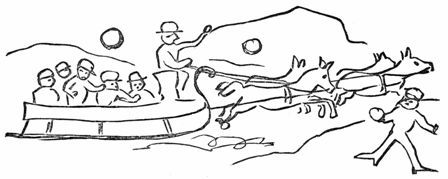
Should you like to hear about our going to take a great big sleigh-ride? The whole school went together in great big sleighs with four horses. We had flags flying, and I tell you if ’t wasn’t a bully go! We went ten miles. We went by a good many schoolhouses, where the boys were out, and they’d up and hurrah, and then we’d hurrah back again. And one lot of fellers, if they didn’t let the snowballs fly at us! And we wanted our driver to stop, and let us give it to ’em good. But he wouldn’t do it. One little chap hung his sled on behind and couldn’t get it unhitched again, for some of our fellers kept hold, and we carried him off more than a mile. Then he began to cry. Then the teacher heard him, and had the sleigh stopped, and took him in and he went all the way with us. He lost his mittens trying to unhitch it, and his hands ached, but he made believe laugh, and we put him down in the bottom to warm ’em in the hay. We ’most ran over an old beggar-woman, in one place between two drifts, where there wasn’t very much room to turn out. I guess she was deaf. We all stood up and shouted and bawled at her and the driver held ’em in tight. And just as their noses almost touched her she looked round, and then she was so scared she didn’t know what to do, but just stood still to let herself be run over. But the driver hollered and made signs for her to stand close up to the drift, and then there’d be room enough.
When I got home I found my bundle and the tin box rolled up in that new jacket, with all that good jelly in it. Old Wonder Boy peeped in and says he, “O, there’s quite some jelly in there, isn’t there?” He says down in Jersey they make nice quince-jelly out of apple-parings, and said ’t was true, for he’d eaten some. Dorry said he knew that was common in Ireland, but never knew ’t was done in this country. Dorry says you must keep us posted about the last of the piggies. Keep your pretty blue boots nice for Brother Billy to see, won’t you? Thank you for hemming that pretty handkerchief. I’ve counted my handkerchiefs a good many times, but counting ’em don’t make any difference.
From your affectionate Brother, William Henry.
The course of true love it seems did not always ran smooth with Dorry and William Henry.
William Henry to his Grandmother.
My dear Grandmother,—
This is only a short letter that I am going to write to you, because I don’t feel like writing any. But when I don’t write then you think I have the measles, else drowned in the pond, and I’ll write a little, but I feel so sober I don’t feel like writing very much. I suppose you will say,—what are you feeling so sober about? Well, seems if I didn’t have any fun now, for Dorry and I we’ve got mad at each other. And he don’t hardly speak to me, and I don’t to him either; and if he don’t want to be needn’t, for I don’t mean to be fooling round im, and trying to get him to, if he don’t want to.
Last night we all went out to coast, and the teachers and a good many ladies and girls, and we were going to see which was the champion sled. But something else happened first. The top of the hill was all bare, and before they all got there some of the fellers were scuffling together for fun, and Dorry and I we tried to take each other down. First of it ’t was all in fun, but then it got more in earnest, and he hit me in the face so hard it made me mad, and I hit him and he got mad too.
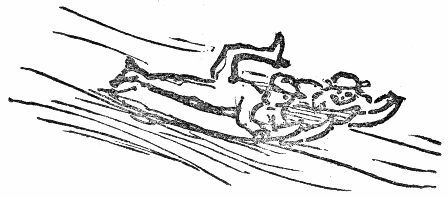
Then we began to coast, for the people had all got there. Dorry’s and mine were the two swiftest ones, and we kept near each other, but his slewed round some, and he said I hit it with my foot he guessed, and then we had some words, and I don’t know what we did both say; but now we keep away from each other, and it seems so funny I don’t know what to do. The teacher asked me to go over to the stable to-day, for he lost a bunch of compositions and thought they might have dropped out of his pocket, when we went to take that sleigh-ride. And I was just going to say, “Come on, Old Dorrymas!” before I thought.
But ’t is the funniest in the morning. This morning I waked up early, and he was fast asleep, and I thought, Now you’ll catch it, old fellow, and was just a going to pull his hair; but in a minute I remembered. Then I dressed myself and thought I would take a walk out. I went just as softly by his bed and stood still there a minute and set out to give a little pull, for I don’t feel half so mad as I did the first of it, but was afraid he did. So I went out-doors and looked round. Went as far as the Two Betseys’ Shop and was going by, but The Other Betsey stood at the door shaking a mat, and called to me, “Billy, where are you going to?”
“Only looking round,” I said. She told me to come in and warm me, and I thought I would go in just a minute or two. Lame Betsey was frying flapjacks in a spider, a little mite of a spider, for breakfast. She spread butter on one and made me take it to eat in a saucer, and I never tasted of a better flapjack. There was a cinnamon colored jacket hanging on the chair-back, and I said, “Why, that’s Spicey’s jacket!” “Who?” they cried out both together. Then I called him by his right name, Jim Mills. He’s some relation to them, and his mother isn’t well enough to mend all his clothes, so Lame Betsey does it for nothing. He earns money to pay for his schooling, and he wants to go to college, and they don’t doubt he will. They said he was the best boy that ever was. His mother doesn’t have anybody but him to do things for her, only his little sister about the size of my little sister. He makes the fires and cuts wood and splits kindling, and looks into the buttery to see when the things are empty, and never waits to be told. When they talked about him they both talked together, and Lame Betsey let one spiderful burn forgetting to turn ’em over time enough.
When I was coming away they said, “Where’s Dorry? I thought you two always kept together.” For we did always go to buy things together. Then I told her a little, but not all about it.
“O, make up! make up!” they said. “Make up and be friends again!” I’m willing to make up if he is. But I don’t mean to be the first one to make up.
From your affectionate Grandson, William Henry.
William Henry to his Grandmother.
My Dear Grandmother,—
I guess you’ll think ’t is funny, getting another letter again from me so soon, but I’m in a hurry to have my father send me some money to have my skates mended; ask him if he won’t please to send me thirty-three cents, and we two have made up again and I thought you would like to know. It had been ’most three days, and we hadn’t been anywhere together, or spoken hardly, and I hadn’t looked him in the eye, or he me. Old Wonder Boy he wanted to keep round me all the time, and have double-runner together. He knew we two hadn’t been such chums as we used to be, so he came up to me and said, “Billy, I think that Dorry’s a mean sort of a chap, don’t you?”
“No, I don’t,” I said. “He don’t know what ’t is to be mean!” For I wasn’t going to have him coming any Jersey over me!
“O, you needn’t be so spunky about it!” says he.
“I ain’t spunky!” says I.
Then I went into the schoolroom, to study over my Latin Grammar before school began, and sat down amongst the boys that were all crowding round the stove. And I was studying away, and didn’t mind ’em fooling round me, for I’d lost one mark day before, and didn’t mean to lose any more, for you know what my father promised me, if my next Report improved much. And while I was sitting there, studying away, and drying my feet, for we’d been having darings, and W. B. he stumped me to jump on a place where ’t was cracking, and I went in over tops of boots and wet my feet sopping wet. And I didn’t notice at first, for I wasn’t looking round much, but looking straight down on my Latin Grammar, and didn’t notice that ’most all the boys had gone out. Only about half a dozen left, and one of ’em was Dorry, and he sat to the right of me, about a yard off, studying his lesson. Then another boy went out, and then another, and by and by every one of them was gone, and left us two sitting there. O, we sat just as still! I kept my head down, and we made believe think of nothing but just the lesson. First thing I knew he moved, and I looked up, and there was Dorry looking me right in the eye! And held out his hand—“How are you, Sweet William?” says he, and laughed some. Then I clapped my hand on his shoulder, “Old Dorrymas, how are you?” says I. And so you see we got over it then, right away.
Dorry says he wasn’t asleep that morning, when I stood there, only making believe. Said he wished I’d pull, then he was going to pull too, and wouldn’t that been a funny way to make up, pulling hair? He’s had a letter from Tom Cush and he’s got home, but is going away again, for he means to be a regular sailor and get to be captain of a great ship. He’s coming here next week. I hope you won’t forget that thirty-three. I’d just as lives have fifty, and that would come better in the letter, don’t you believe it would? That photograph saloon has just gone by, and the boys are running down to the road to chase it. When Dorry and I sat there by the stove, it made me remember what Uncle Jacob said about our picture.
Your affectionate Grandson, William Henry.
William Henry to his Grandmother.
My dear Grandmother,—
The reason that I’ve kept so long without writing is because I’ve had to do so many things. We’ve been speaking dialogues and coasting and daring and snowballing, and then we’ve had to review and review and review, because ’t is the last of the term, and he says he believes in reviews more than the first time we get it. I tell you, the ones that didn’t get them the first time are bad off now. I wish now I’d begun at the first of it and got every one of mine perfect, then I should have easier times. The coast is wearing off some, and we carry water up and pour on it, and let it freeze, and throw snow on. Now ’t is moonshiny nights, the teacher lets all the “perfects” go out to coast an hour. Sometimes I get out. And guess where Bubby Short and Dorry and I are going to-night! Now you can’t guess, I know you can’t. To a party! Now where do you suppose the party is to be? You can’t guess that either. In this town. And not very far from this school-house. Somebody you’ve heard of. Two somebodies you’ve heard of. Now don’t you know? The Two Betseys! Suppose you’ll think ’t is funny for them to have a party. But they’re not a going to have it themselves. Now I’ll tell you, and not make you guess any more.
You know I told you Tom Cush was coming. He came to-day. He’s grown just as tall and as fat and as black and has some small whiskers. I didn’t know ’twas Tom Cush when I first looked at him. Bubby Short asked me what man that was talking with Dorry, and I said I didn’t know, but afterwards we found out. He didn’t know me either. Says I’m a staving great fellow. He gave Dorry a ruler made of twelve different kinds of wood, some light, some dark, brought from famous places. And gave Bubby Short and me a four-blader, white handled. He’s got a fur cap and fur gloves, and is ’most as tall as Uncle Jacob. He told Dorry that he thought if he didn’t come back here and see everybody, he should feel like a sneak all the rest of his life.