EDITOR’S INTRODUCTION. (continued 2)
Reading edition
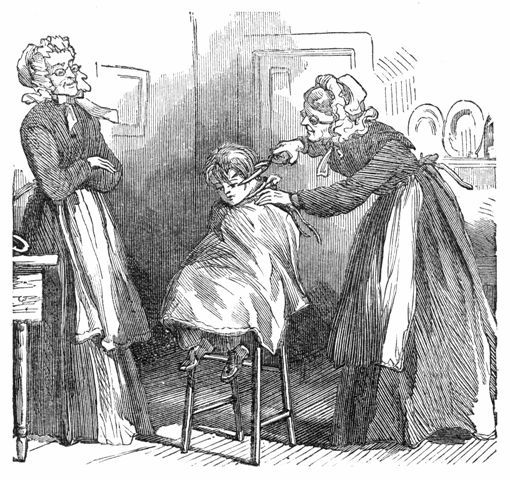
Lame Betsey tried very hard. First she stood off to look, and then she stood on again. She said her mother used to keep a quart-bowl on purpose to cut her boys’ hairs with; she clapped it over their heads, and then clipped all round by it even. The shears were jolly shears, only they couldn’t stop themselves easy, and the apron had been where snuff was, and made me sneeze in the wrong place. Says I, “If you’ll only take off this apron, I’ll jump up and shake myself out even.” I’m so glad I’m a boy. Aprons are horrid. So are apron-strings, Dorry says.
They gave me a few peppermints, and said to be sure not to run my head out and get it knocked off in the cars, and not to get out till we stopped going, and to beware of pickpockets.
O, we did have a jolly ride in the cars! Do you think my father would let me be the boy that sells papers in the cars? I wish he would. I didn’t see any pickpockets. We got out two miles before we got there. I mean to the right station. For Dorry wanted to make his sister Maggie think we hadn’t come.
We took a short cut through the fields. Not very short. And went through everything. My best clothes too. But I guess ’t will all rub off. There were some boggy places.
When we came out at Dorry’s house, it was in the back yard. I said to Dorry, “There’s your mother on the doorstep. She looks clever.”
Dorry said, “She? She’s the cook. I’ll tell mother of that. No, I won’t neither.”
I suppose he saw I’d rather he wouldn’t. The cook said everybody had gone out. Then Dorry took me into a jolly great room and left me. Three kinds of curtains to every window! What’s the use of that? Gilt spots on the paper, and gilt things hanging down from up above. A good many kinds of chairs. I was going to sit down, but they kept sinking in. Everything sinks in here. I tried three, and this made me laugh, for I seemed to myself like the little boy that went to the bears’ house and tried their chairs, and their beds, and their bowls of milk. Then I came to a looking-glass big enough for the very biggest bear. I thought I would make some bows before it, as you said. I was afraid I couldn’t make a bow and toe out at the same time. Because it is hard to think up and down both at once. While I was trying to, I heard a little noise, I looked round, and—what do you think? Bears? O no. Not bears. A queen and a princess, I thought. All over bright colors and feathers and shiny silks. The queen—that’s Dorry’s mother you know,—couldn’t think who I was, because they had been to the depot, and thought we hadn’t come. So she looked at me hard, and I suppose I was very muddy. And she said, “Were you sent of an errand here?” Before I could make up any answer, Dorry came in. He had some cake, and he passed it round with a very sober face. Then he introduced me, and I made quite a good bow, and said, “Very well, I thank you, ma’am.”
I tried to pull my feet behind me, and wished I was sitting down, for she kept looking towards them; and I wanted to sit down on the lounge, but I was afraid ’t wouldn’t bear. She was quite glad to see Dorry. But didn’t hug him very hard. I know why. Because she had those good things on. Dorry’s grandmother lives here. She can’t bear to hear a door slam. She wears her black silk dress every day. And her best cap too. ’T is a stunner of a cap. White as anything. And a good deal of white strings to it. Everything makes her head ache. I’d a good deal rather have you. When boys come nigh, she puts her hand out to keep them off. This is because she has nerves. Dorry says his mother has ’em sometimes. I like his father. Because he talks to me some. But he’s very tired. His office tires him. He isn’t a very big man. He doesn’t laugh any. If Maggie was a boy she’d be jolly. She’ll fly kites, or anything, if her mother isn’t looking. Her mother don’t seem a bit like Aunt Phebe. I don’t believe she could lift a teakettle. Not a real one. When she catches hold of her fork, she sticks her little finger right up in the air. She makes very pretty bows to the company. Sinks way down, almost out of sight. She gave us a dollar to spend; wasn’t she clever? Dorry says she likes him tip-top. If he’ll only keep out of the way.
I guess I’d rather live at our house. About every room in this house is too good for a boy. But I tell you they have tip-top things here. Great pictures and silver dishes! Now, I’ll tell you what I mean to do when I’m a man. I shall have a great nice house like this, and nice things in it. But the folks shall be like our folks. I shall have horses, and a good many silver dishes. And great pictures, and gilt books for children that come a-visiting. And you shall have a blue easy-chair, and sit down to rest.
Now, maybe you’ll say, “But, Billy, Billy, where are you going to get all these fine things?” O you silly grandmother! Don’t you remember your own saying that you wrote down?—“What a man wants he can get, if he tries hard enough.” Or a boy either, you said. I shall try hard enough. There’s more to write about. But I’m sleepy. I would tell you about Tom Cush’s father coming here, only my eyes can’t keep open. Isn’t it funny that when you are sleepy your eyes keep shutting up and your mouth keeps coming open? Please excuse the lines that go crooked. There’s another gape! I guess Aunt Phebe will be tired reading all this. I’m on her side. I mean about measles. I’d rather have ’em when I was a month old. I suppose I was a month old once. Don’t seem as if ’t was the same one I am now. But if I do have ’em,—there I go gaping again,—if I catch ’em, and all the doctors do come, I’ll—O dear! There I go again. I do believe I’m asleep—I’ll—I’ll get some natural-born old woman to drive ’em out, as you said, and good night.
William Henry.
My dear Grandmother,—
I am back again, and had a good time; but came back hungry. I’ll tell you why. The first time I sat down to table I felt bashful, and Dorry’s mother said a great deal about my having a small appetite, and afterwards I didn’t like to make her think it was a large one.
I guess I behaved quite well at the table. But I couldn’t look the way you said. It made me feel squint-eyed. Once I almost laughed at table. The day they had roast duck, it smelt nice. I thought it wouldn’t go round, for they had company besides me; and I said, “No, I thank you, ma’am.” Dorry whispered to me, “You must be a goose not to love duck”; and that was when I almost laughed at table. His grandmother shook her head at him.
Now I’ll tell about Tom Cush’s father. That Saturday, when we were eating dinner, somebody came to the front door, and inquired for us two,—Dorry and me. It was Tom Cush’s father. He wanted to ask us about Tom, and whether we knew anything about him. But we knew no more than he did. He talked some with us. The next evening,—Sunday evening,—Tom Cush’s mother sent for Dorry and me to come and see her. His father came after us. She said they wanted to know more about what I wrote to you in those letters.
O, I don’t want ever again to go where the folks are so sober. The room was just as still as anything, not much light burning, and great curtains hanging way down, and she looked like a sick woman. Just as pale! Only sometimes she stood up and walked, and then sat down again, and leaned way forward, and asked a question, and looked into our faces so. We didn’t know what to do. Dorry talked more than I could. Tom’s father kept just as sober! He said to Dorry: “It is true, then, that my boy wouldn’t own up to his own actions?” or something like that.
Dorry said, “Yes, sir.”
Tom’s father said, “And he was willing to sit still and see another boy whipped in his place?”
“Yes, sir,” Dorry said. But he didn’t say it very loud.
Then they stopped asking questions, and not one of us spoke for ever so long. O, ’t was so still! At last Dorry said, just as softly, “Can’t you find him anywhere?” And then I said that I didn’t believe he was lost.
Then Tom’s father got up from his chair and said, “Lost? That’s not it. That’s not it. ’T is his not being honorable! ’T is his not being true! Lost? Why, he was lost before he left the school.” Says he: “When he did a mean thing, then he lost himself. For he lost his truth. He lost his honor. There’s nothing left worth having when they are gone.”
O, I never saw Dorry so sober as he was that night going home. And when we went to bed, he hardly spoke a word, and didn’t throw pillows, or anything. I shut my eyes up tight and thought about you all at home, and Aunt Phebe, and Aunt Phebe’s little Tommy, and about school, and about Bubby Short, and all the time Tom’s mother’s eyes kept looking at me just as they did; and when I was asleep I seemed back again in that lonesome room, and they two sitting there.
From your affectionate grandchild, William Henry.
P. S. I want to tell that when I was at Dorry’s I let a little vase fall down and break. I didn’t think it was so rotten. I felt sorry; but didn’t say so; I didn’t know how to say it very well. I wish grown-up folks would know that boys feel sorry very often when they don’t say so, and sometimes they think about doing right, too. And mean to, but don’t tell of it. Next time I shall tell about Bubby Short and me going to ride in Gapper’s donkey-cart. He’s going to lend it to us. I should like to buy them a new vase.
W. H.
P. S. Benjie’s had a letter, and one twin fell down stairs.
There is one sentence in the first paragraph of the following letter which reminds me of a very windy day, when I was staying at Summer Sweeting place.
In returning from a walk, by a short cut across the field, I met a boy who was running just about as fast as he could.
Soon after I came to another and much smaller boy, who was not running at all, but was sitting flat upon the ground, under a tree, and crying with might and main. This smaller boy proved to be Tommy. On a branch of the tree, just out of his reach, hung a broom, towards which his weeping eyes were turned in despair. A paper of peanuts which I happened to have soon quieted him, because, in order to crack them, he had to shut his mouth. At the first of it, however, he went on with his crying while picking out the meats, which so amused me that I was obliged to turn aside and laugh.
It appeared that Tommy had been riding horseback on his mother’s broom “to see Billy,” and when he had made believe get there, he wanted to hitch his horse. A larger boy, out of mischief, or rather in mischief, bent down a branch of the tree, telling Tommy there was a tiptop thing to tie up to. He helped Tommy to tie the horse to the branch, and then ran off across the field. It is very plain what happened when the branch sprang back to its place.
I unhitched the animal, and then Tommy and I mounted it, he behind me, and away we cantered to the house, my amazing gallops causing the little chap to laugh as loudly as he had cried.
My dear Grandmother,—
Please to tell my sister I am much obliged to her for picking up that old iron for me. But that old rusty fire-shovel handle, I guess that will not do to put in again. For my father said, the last time, that he had bought that old fire-shovel handle half a dozen times. But Aunt Phebe’s Tommy, he pulls it out again to ride horseback on.
I know a little girl just about as big as my sister, named Rosy. Maybe that is not her name. Maybe it is, because her face is so rosy. She had a lamb. And she’s lost it. It ate out of her hand, and it followed her. It was a pet lamb. But it’s lost. Gapper came up to inquire about it. Mr. Augustus wrote a notice and nailed it on to the Liberty Pole, and then Dorry chalked out a white lamb on black pasteboard, and painted a blue ribbon around its neck, and hung that up there too.
Gapper let Bubby Short and me have his donkey-cart to go to ride in. He kicked up when we licked him, and broke something. But a man came by and mended it. So we didn’t get back till after dark. But the master didn’t say anything after we told the reason why. Did you ever see a ghost? Do you believe they can whistle? I’ll tell you what I ask such a question for.
There is an old house, and part of it is torn down, and nobody lives in it. It is built close to where the woods begin. The boys say there is a ghost in it. I’ll tell you why. They say that if anybody goes by there whistling, something inside of that house whistles the same tune. Dorry says it’s a jolly old ghost. Mr. Augustus thinks ’tis all very silly. Now I’ll tell you something.
The night Bubby Short and I were coming back from taking a ride in Gapper’s donkey-cart, we tried it. We didn’t dare to lick him again, for fear he would kick up, so we rode just as slow!—and it was a lonesome road, but the moon was shining bright.
Says Bubby Short, “Do you believe that’s the honeymoon?”
“No,” says I. “That’s what shines when a man is married to his wife.”
“Are you scared of ghosts?” said Bubby Short.
“Can’t tell till I see one,” says I.
“How far off do you suppose they can see a fellow?” says he.
Says I, “I don’t know. They can see best in the dark.”
“Do you think they’d hurt a fellow?” says he.
“Maybe,” says I. “There’s the old house.”
“I know it,” says he; “I’ve been looking at it.”
Says I, “Are you scared to whistle?”
“Scared! No,” says he. “Let’s whistle, I say.”
“Well,” says I, “you whistle first.”
“No,” says he, “you whistle first.”
“Let him whistle first,” says I.
“He won’t do it. Ghosts never whistle first,” says he.
I asked him who said that, and he said ’t was Dorry.
Then I said, “Let’s whistle together.”
So we waited till we almost got past, and then whistled “Yankee Doodle.” And, grandmother, it did,—it whistled it.
Bubby Short whispered, “Lick him a little.”
Then I whispered back, “’T won’t do to. If I do, he won’t go any.”
But in a minute he began to go faster of his own accord. He heard somebody ahead calling. It was Gapper, coming to see what the matter was that kept us so late. Now what do you think about it?
From your affectionate William Henry.
P. S. My boots leak. Shall I get them tapped, or get a new pair, or throw them away, or else keep the legs to make new boots of?
W. H.
Here we have William Henry trying his hand at story-telling.
My Dear Grandmother,—
Sometimes Dorry writes stories in his letters for his sister, just as he tells them to her, talking, at home. Now I’ll write one for my sister, and I’ll call it by a name. I’ll call it
THE STORY OF THE GREAT STORM.
Once there was a little boy named Billy, and Gapper lent him his donkey to go ride. That’s me, you know. Next day Gapper came and said, “You boys lost my whip.” Now I remembered having the whip when we crept in among the bushes,—for we got sight of a woodchuck, and came near finding his hole. So when school was done at noon, I asked leave to put some bread and meat in my pocket, instead of eating any dinner, and go to look for Gapper’s whip. And he said I might. ’T was two miles off. But I found it. And I dug for a good deal of saxifax-root. And picked lots of boxberry-plums.
And I never noticed how the sky looked, till I heard a noise something like thunder. It was very much like thunder. Almost just like it. I thought it was thunder. Only it sounded a great ways off. I was walking along slow, snapping my whip and eating my dinner, for I thought I wouldn’t hurry for thunder, when something hard dropped down close to me. Then another dropped,—and then another. And they kept dropping. I picked one up and found they were hailstones, and they were bigger than bullets.
It kept growing dark, and the hailstones came thicker, and hit me in the face. Then they began to pour right down, and I ran. They beat upon me just like a driving storm all of sharp stones. The horses and cows cut across the fields like mad. The horses flung up their heads. I was almost to that old house and ran for that, and kicked the door through to get in, for I thought I should be killed with the hail. The shingles off the roof were flying about; and when I got inside, ’t was awful. I thought to be sure the roof would be beat in. Such a noise! It sounded just exactly as if a hundred cartloads of stones were being tipped up on to the roof. And then the window-glass! It was worse than being out doors, for the window-glass was flying criss-cross about the room, like fury, all mixed up with the hail. I crouched down all in a bunch and put my arms over my head, and so tried to save myself. But then I spied a closet door a crack open, and I jumped in there. And there I sat all bent over with my hands up to my ears, and thought, O, what would become of me if the old house should go? And now the strangest part is coming. You see ’t was a pretty deep closet—School-bell! I didn’t think ’t was half time for that to ding. I’ll tell the rest next time. Should you care if I brought home Dorry to make a visit? He wants to bad. ’T would be jolly if Bubby Short went too.
From your affectionate grandchild, William Henry.
My Dear Grandmother,—
Everybody’s been setting glass. Counting the house and the school-house, and the panes set over the barn door, and four squares in the hen-house, we had to set four hundred and twenty-three squares. The express-man has brought loads and loads. All the great boys helped set. We slept one night with bedquilts and rugs hung up to the windows. The master tried to shut his blind in the storm, but the hail drove him in, and he couldn’t even shut down his window again. A rich man has given to the Two Betseys better windows than they had before. Now I will tell about my being in that closet.
When it began to grow stiller, I took my hands down from my ears, and one hand when it came down touched something soft. Quite soft and warm. I jumped off from it in a hurry. Then I heard a kind of bleating noise, and a little faint “ba’a ba’a.” But now comes the very strangest part. Farther back in the closet I heard somebody move, somebody step. I was scared, and gave the door a push, to let the light in. Now who do you think was there? Aunt Phebe must stop reading and let you guess. But maybe you’re reading yourself. Then stop and guess. ’T wasn’t a ghost. ’T wasn’t a man. ’T wasn’t a woman. ’T was Tom Cush! and Rosy’s lamb!
Says he, “William Henry!” Says I, “Tom!” Then we walked out into the room, and O, what a sight! Says I, “I thought ’t was going to be the end of the old house.”
Says Tom, “I thought ’t was going to be the end of the world.”
In the corners the hailstones were heaped up in great banks. You might have shovelled up barrels full. Most of them were the size of bird’s eggs. But some were bigger. Then we looked out doors. The ground was all white, and drifts in every cornering place, and the leaves stripped off the trees. Then we looked at one another, and he was just as pale as anything. He leaned against the wall, and I guessed he was crying. To see such a great boy crying seemed most as bad as the hailstorm. Maybe he didn’t cry. When he turned his head round again, says he: “Billy, I’m sick, and what shall I do?”
“Go home,” says I.
“No,” says he, “I won’t go home. And if you let ’em know, I’ll—” And then he picked up Gapper’s whip,—“I’ll flog you.”
“Flog away,” says I; “maybe I shall, and maybe I sha’ n’t.”
He dropped the whip down, and says he, “Billy, I sha’ n’t ever touch you. But they mustn’t know till I’m gone to sea.”
I asked him when he was going. And he told me all about it.
When he was sent away from school, he went into town and inquired about the wharves for a chance to go, and got one, and came back to get some things he left hid in the old house, and to wait till ’t was time to go. He sold his watch, and bought a great bag full of hard bread and cheese and cakes.
He was mad at Gapper for setting a man to watch, and so he took Rosy’s lamb. He was going to kill it. And then skin it. But he couldn’t do it. It licked his hand, and looked up so sorryful, he couldn’t do it. And when he cut his foot—he cut it chopping something. That’s why he stayed there so long. And he was the ghost that whistled. He knew the fellows wouldn’t go in to see what it was that whistled. And he ate up most all his things, and tied a string to the lamb, and let it out nights to eat grass, and then pulled it in again.
I wouldn’t have stayed there so for anything. He went into town three times, nights, to get victuals to eat. I don’t see what he wants to be such a kind of a boy for. He says he means to go to sea, and if ever he’s good he’s going home. I told him about his father and mother, and he walked while I was talking, and kept his back towards me. I asked him what ailed him, and he said ’t was partly cutting him, and partly sleeping cold nights, and partly the crackers and cheese. I gave him the rest of my meat, and he was glad enough.
He said he was ashamed to go home.
Now I have got to the end of another sheet of paper. I wish I hadn’t begun to tell my sister this story. It takes so long. And I want every minute of the time to play in. For ’t is getting a little cooler, and a fellow can stand it to run some. The master says it’s good weather for studying. Dorry says he never saw any weather yet good enough for studying. I shall write a very short letter next time, to tell the rest of it.
From your affectionate grandchild, William Henry.
P. S. I forgot to put this letter in the office. I guess I will not write any more letters till I go home. I was going to tell more, but I can do it better talking. I went to see Tom Cush the next day, and he had gone. Rosy’s got her lamb back again. But her flower-garden was killed by the hail. Not one leaf left. She found her lamb on the doorstep, waiting to get in.
We have next a letter from Aunt Phebe, a dear, good-hearted woman, who took almost a mother’s interest in William Henry. Indeed, I have heard her remark, that she hardly knew any difference between her feelings for him and for her own children.
Some of her letters will be found to contain good advice, given in a very amusing way.
Letter from Aunt Phebe.
Dear Billy,—
You rogue, you! I meant to have written before. You’ve frightened us all to pieces with your ghost that wasn’t a ghost, and your whipping that wasn’t a whipping, and your measles that you didn’t have. Grandmother may talk, but she’s losing her memory. You were red as a beet with ’em. As if I didn’t carry you about all night and go to sleep walking!
Grandmother says, “Yes, indeed! bring Dorry, and let him stay a week if he wants to.” Bless her soul! She’ll always keep her welcome warm, so never mind her memory. And Bubby Short, too. Pray bring Bubby Short. I want to see his black eyes shine. Don’t Benjie want to come? I’ve got beds enough, and girls enough to work, and a great batch of poor mince-pies that I want eaten up. Don’t see how I came to make such a miss in my pies this baking. Your uncle J. thinks I skinched on plums. There never was such a man for plums. I do believe if they were put into his biscuits he’d think he’d got no more than his rights.
Your uncle J. says: “Tell the boys to come on. I’ve got apples to gather, and husking to do.” They’d better bring some old clothes to wear. This is such a tearing place. I’ve put my Tommy into jacket and trousers. He used to hitch his clothes upon every rail. Such a climber! I don’t know what that boy’ll be when he grows up.
I send you a good warm comforter, knit in stripes; and all the family are knit into it, especially Tommy. The pink stripes are his good-boy days, and the black ones are his naughty actions. I showed him where I knit ’em in. That clouded gray and black stripe is for my two great girls quarrelling together about whose work ’t was to do some little trifle. I told ’em they should be knit in, big as they are, if they couldn’t behave and be accommodating. That bright red stripe is for Hannah Jane’s school report, all perfect. That blue stripe is for your sister Georgianna when she made a sheet. It matches her eyes as near as I could get the yarn. My blue dye is weak this fall. Indigo is high. Your uncle J. says it’s on account of the Rebs feeling so blue. That gray stripe, dotted with yellow, means a funny crying spell Tommy had at table. I came home, and there he sat in his high chair, with his two hands on the arms of it, his mouth wide open, eyes shut, and the tears streaming down, making the dolefullest noise,—“O-oh, a-ah; o-oh, a-ah.” Lucy Maria said he’d been going on in that strain almost half an hour, because we didn’t have mince-meat for supper. That green stripe is for the day we all took the hay-cart and went to ride in the woods. The orange-colored one is for the box of oranges your uncle J. fetched home. “A waste of money,” says I. “Please the children,” says he; “and the peel will save spice.” Makes me laugh when your uncle J. sets out to save. My girls and Tommy have got the very best of fathers, only they don’t realize it. But young folks can’t realize. The pale rose-colored stripe is for the travelling doctor’s curing your grandmother’s rheumatics, and promising she never should have another touch of ’em if she was careful. The dark red stripe is for the red cow’s getting choked to death with a turnip. She was a prime butter cow. Any man but your uncle J. would look sober for a month about it. But he says, “O, there’s butter enough in the world, Phebe. And the calf will soon be a cow on its own hook.” That’s your uncle J.
The plain dark purple stripe is for my Matilda’s speaking disrespectfully to grandmother. She was sorry enough afterwards, but I told her it should go in. That bright yellow stripe is for the day your father went to market and got such a great price for his colt. The bright fringe, mixed colors, is for us all in both houses, when we got news of your coming home, and felt so glad. There’s a stitch dropped in one place. That may go for a tear-drop,—a tear of mine, dear, if you please. Do you think we grown-up women, we jolly, busy women, never shed tears? O, but we do sometimes, in an out-of-the-way corner, or when the children are all gone to school, or everybody is in bed. Bitterer tears they are, Billy, than boys’ tears. One more stripe, that plain white one in the centre, is for the little Tommy that died. I couldn’t bear to leave him out, Billy. He had such little loving ways. You don’t remember him.
There’s your uncle J.’s whistle. He always whistles when he gets to the bars, to let me know it’s time to begin to take up dinner.
From your loving Aunt Phebe.
I will insert here two of Dorry Baker’s letters to his sister. When they were written Dorry and Bubby Short were making William Henry a visit.
Dorry to his Sister.
Dear Sis,—
Who’s been giving you an inch, that you take so many “l’s”? Or is father putting an “L” to his house, or some great “LL. D.” been dining there, or what is the matter, that about every “l” in your letter comes double? I wouldn’t spell “painful” with two “l’s” if the pain was ever so bad. But I know. You are thinking about Billy and the good times we are having. Aunt Phebe says you might have come too, just as well as not; for her family is so big, three or four more don’t make a mite of difference.
We got here last night. Billy’s grandmother’s a brick. She took Billy right in her arms, and I do believe she cried for being glad, behind her spectacles. His sister is full as pretty as you. Billy brought her a round comb. Aunt Phebe’s little Tommy’s as fat as butter. He sat and sucked his thumb and stared, till Billy held out a whistle to him, and then he walked up and took it, as sober as a judge.
“And I’ve brought you something, Grandmother,” says Billy.
He went out and brought in a bandbox tied up. I wondered, coming in the cars, what he had got tied up in that bandbox. He out with his jack-knife, and cut the strings, and took out—have you guessed yet? Of course you haven’t,—took out a new cap like grandma’s. He stuck his fist in it, and turned it round and round, to let her see it.
“Now sit down,” says he, “and we’ll try it on.”
She wouldn’t, but he made her.
“Come here, Dorry,” says he, “and see which is the front side of this.”
When her old cap was pulled off, there was her gray hair all soft and crinkly. He got the cap part way on.
“You tip it down too much,” says I.
“We’ll turn it round,” says he.
“’T is upside down,” said Billy’s father.
“Now ’t is one-sided,” says Uncle J., “like the colt’s blinders.”
“’T was never meant for my head,” says Grandmother.
“Send for Phebe,” says Uncle J.
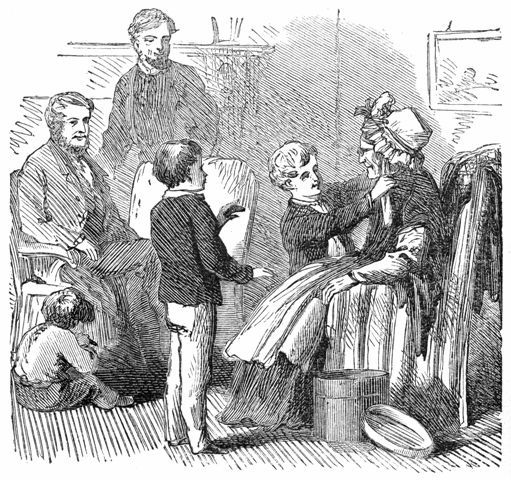
But “Phebe” was coming. There was a great chattering outside, and the door opened, and in came Aunt Phebe, laughing, and her three great girls laughing too, with their red cheeks, and their great braids of hair tied up in red bow-knots of ribbon. And they all went to kissing Billy.
And then says Aunt Phebe, “What in the world are you doing to your grandmother? A regular milliner’s cap, if I breathe! Well done, Grandmother! Here, let me give it a twist. It’s hind side before. What do boys know? or men either? What are all these kinds of strings for?”
“The great ones to hang down, and the little ones to tie up,” says Billy.
The girls stood by to pick the bows apart, and fuzz up the ruffles where they were smashed in; and Billy’s father and Uncle Jacob, they sat and laughed.
Grandmother couldn’t help herself, but she kept saying, “Now, Phebe! now, girls! now, Billy!”
“And now, grandmother!” says Aunt Phebe. “There! fold your hands together. Don’t lean back hard, ’t will jam easy. Now see, girls! Isn’t she a beauty?” And, Maggie, I do believe she’s the prettiest grandmother there is going. Her face is just as round and smiling!
“Now sit still, Grandmother,” said Aunt Phebe. And she winked to the girls, and they whisked two tables up together, spread on the cloth, set on the dishes; then out into the entry, and brought in great loaves of plum-cake, and pies and doughnuts, and set out the table,—all done while you’d be tying your shoe. Then they set a row of lights along the middle, and we all sat round,—Grandmother at the head, and Aunt Phebe’s little Tommy in his high chair; and I’ll tell you what, if these are poor mince-pies, I hope I shall never see any good ones.
“Why didn’t you have some fried eggs?” said Uncle Jacob.
“Now did anybody ever hear the like?” said Aunt Phebe. “Fried eggs! when they’re shedding their feathers, and it takes seventy-six fowls to lay a dozen, and every egg is worth its weight in currency! Better ask why we don’t have cranberry sauce!”
“There!” says Uncle J. “I declare, if I didn’t forget that errand, after all!”
“When I told you to keep saying over ‘Cranberries, cranberries,’ all the way going along!” says Aunt Phebe.
“They would ’a’ set my teeth on edge before I got to Ne’miah’s corner,” said Uncle J. “The very thoughts of ’em is enough. Lucy Maria, please to pass that frosted cake. I declare, I’m sorry I forgot that errand.”
For all we were so hungry, there was a great deal left, and I was glad to see it going into Billy’s buttery. Billy says it’s just like his aunt Phebe to come to supper, and make that an excuse to bring enough to last a week, to save Grandmother steps.
I do like to stay where folks are jolly. They keep me a-laughing; and as for Bubby Short, his little black eyes have settled themselves into a twinkle, and there they stay. I never had such a good time in my life.
From your same old brother, Dorry.
P. S. We have got good times enough planned out to last a month. Uncle J. says we may have his old horse, and Young Gray, and Dobbin, and the cow too, if we want, to ride horseback on, or tackle up into anything we can find, from a hay-cart to a wheelbarrow. I shall want to write, but sha’ n’t. There’ll be no time. When I get home, I’ll talk a week.
Love to all inquiring friends.
Maggie could have formed but little idea of the nature of the offer mentioned in Dorry’s postscript, because she had never, at that time, stood on the spot and seen with her own eyes all the “wheel-ed things” that were to be seen in Uncle Jacob’s back-yard.
How gladly would I, if space permitted, go into a minute description of that roomy enclosure, with its farming implements, garden tools, cattle, pump, fowls, watering-trough, grindstone, woodpile, haystack, etc., and carryalls, carts, wagons, wheelbarrows, roller-carts, and tip-carts, some in good repair, others very far out of it! “Entertainment for man and beast” might truly have been written over the entrance!
Mother Delight (an old nurse-woman) once remarked of Uncle Jacob, that he was a very buying man. This was a true remark, and yet he never bought without a reason. For instance, if Quorm (a Corry Pond Indian) brought bushel-baskets along to sell, Uncle Jacob took one, not because he had not bushel-baskets enough, but to encourage Quorm. And if Old Pete Brale wanted to let Uncle Jacob have an infirm, rickety wagon, and take his pay in potatoes, Uncle Jacob traded, that Pete Brale might be kept from starvation. And so of other things.
It may be imagined, therefore, that as time went on all manner of vehicles were there gathered together. Some of these were in good running order, while others had been bought partly with a view to their being repaired and sold at a profit. The expression on Aunt Phebe’s face when Uncle Jacob brought home an addition to his interesting collection was very striking. I remember particularly observing this at the coming into harbor of a rattling, shackly, green-bottomed carryall, which had a door at the back, and seats running lengthwise. It formerly belonged to some person who, having then a large family of small children to get to meeting, contrived a conveyance which would take in and discharge again the greatest number with the least trouble.
In this odd vehicle, which had been run under an overhanging apple-tree, I often sat through the summer afternoon, now reading my book, now watching the animal life about me, gaining useful knowledge from both. Sometimes, when feeling like a boy again,—as I often did and do feel,—I would amuse myself with playing go to ride in a comical old chaise. It was set high, and pitched forward, the lining was ragged, the back “light” gone, the stuffing running out of the cushions; yet there I liked to sit, and “ride,” and joggle up and down, as in the happy days of boyhood. But not, as in those happy days, “hard as I could,” for reasons easy to guess.
I trust no one will imagine that spacious yard to have been merely a sort of safe anchorage, where all manner of disabled craft might run in for shelter! Lest any words of mine should imply this, or seem to cast blame on Uncle Jacob, let me hasten to say that he really required a variety of “wheel-ed things” to carry on his business.
Neither of the Mr. Carvers got their living wholly, or even chiefly, by farming. They drew wood from lots owned by themselves, or by others, and used their teams in any way, according as employment was offered them. Thus heavy carts were wanted for heavy work, and light carts for light work, besides carryalls for dry and for rainy weather, and riding wagons, because they were handy.
For all the Summer Sweeting folks were hard workers, they knew how to get up a good time, and enjoyed it too, as we shall see by the account of one which Dorry gives in the following letter:—
Dorry to his Sister.
Dear Sis,—
O, we’ve hurrahed and hurrahed and hurrahed ourselves hoarse! Such a bully time! You’d better believe the old horses went some! And that hay-cart went rattle and bump, rattle and thump,—seemed as if we should jolt to pieces! But I’ve counted myself all over, and believe I’m all here! Bubby Short’s throat is so sore that all he can do is to lie flat on the floor and wink his eyes. You see we cheered at every house, and they came running to their windows, and some cheered back again, and some waved and some laughed, and all of them stared. But part of the way was through the woods.
This morning Billy and Bubby Short and I went over to Aunt Phebe’s of an errand, to borrow a cup of dough. I wish mother could see how her stove shines! And while we were sitting down there, having some fun with Aunt Phebe’s little Tommy, Uncle Jacob came in and said, “Mother, let’s go somewhere.”
She said, “Thank you! thank you! we shall be very happy to accept your invitation. Girls, your father has given us an invitation! Boys, he means you too!”
“But you can’t go,—can you?” Uncle Jacob cried out, and made believe he didn’t know what to make of it. O, he’s such a droll man! “I thought you couldn’t leave the ironing,” says he.
“O yes, we can!” Hannah Jane said; and “O yes, we can!” they all cried out.
Aunt Phebe said it would be entirely convenient, and told her girls to shake out the sprinkled clothes to dry.
“O, now,” said Uncle Jacob, “who’d have thought of your saying ‘yes.’ I expected you couldn’t leave.”
Then they kept on talking and laughing. O, they are all so funny here! Uncle Jacob tried to get off without going; but at last he said, “Well, boys, we must catch Old Major.”
That’s the old gray horse, you know. And we were long enough about it. For, just as we got him into a corner, he’d up heels, and away he’d go. And once he slapped his tail right in my face. But after a while we got him into the barn.
Then pretty soon Uncle Jacob put on a long face, and looked very sober, and put his head in at the back kitchen door, and said he guessed we should have to give up going, after all, for the mate to Old Major had got to be shod, and the blacksmith had gone away.
“Harness in the colt, then,” Aunt Phebe said. “No matter about their matching, if we only get there!”
That colt is about twenty years old. He’s black, and short, and takes little stubby steps; and he’s got a shaggy mane, that goes flop, flop, flop every step he takes. But Old Major is bony, and has a long neck, like the nose of a tunnel. Such a span as they made! What would my mother say to see that span!
They were harnessed in to the hay-cart. A hay-cart is a long cart that has stakes stuck in all round it. We put boards across for benches. Aunt Phebe brought out a whole armful of quite small flags, that they had Independent Day, and we tied one to the end of every stake.
Such a jolly time as we did have getting aboard! First all the baskets and pails full of cake and pies were stowed away under the benches, and jugs of water, and bottles of milk, and a hatchet, and some boiled eggs, and apples and pears. Then uncle called out, “Come! where is everybody? Tumble in! tumble in! Where’s little Tommy?”
Then we began to look about and to call “Tommy!” “Tommy!” “Tommy!” At last Bubby Short said, “There he is, up there!” We all looked up, and saw Tommy’s face part way through a broken square of glass—I mean where the glass was broken out. He said he couldn’t “tum down, betause the roosted was on his feets.” You see, he’d got his feet tangled up in Lucy Maria’s worsteds.
“O dear!” Lucy Maria said; “all that shaded pink!”
When they brought him down, Uncle Jacob looked very sober, and said, “Why, Tommy! Did you get into all that shaded pink?”
“Didn’t get in all of it,” said Tommy. Then he told us he was taking down the “gimmerlut to blower a hole with.” Next he began to cry for his new hat; and when he got his new hat, he began to cry for a posy to be stuck in it. That little fellow never will go anywhere without a flower stuck in his hat. Aunt Phebe says his grandmother began that notion when her damask rosebush was in bloom.
After we were all aboard, Uncle Jacob brought out the teakettle, and slung it on behind with a rope. He said maybe mother would want a cup of tea. Then they laughed at him, for he is the tea-drinker himself. Next he brought out a long pan.
“Now that’s my cookie-pan!” Aunt Phebe said. “You don’t cook clams in my cookie-pan!”
He made believe he was terribly afraid of Aunt Phebe, and trotted back with it just like a little boy, and then came bringing out an old sheet-iron fireboard.
“Is this anybody’s cookie-pan?” said he, then stowed it away in the bottom of the cart. Bubby Short wanted to know what that was for.
“That’s for the clams,” Uncle Jacob said.
But we couldn’t tell whether he meant so. We never can tell whether Uncle Jacob is funning or not. I haven’t told you yet where we were bound. We were bound to the shore. That’s about six miles off. The last thing that Uncle Jacob brought out was a stick that had strips of paper tied to the end of it.
“That’s my flyflapper!” Aunt Phebe said. “What are you going to do with my flyflapper?”
He said that was to brush the snarls off little Tommy’s face. Tommy is a tip-top little chap; but he’s apt to make a fuss. Sometimes he teased to drive, and then he teased for a drink, and then for a sugar-cracker, and then to sit with Matilda, and then with Hannah Jane. And, every time he fretted, Uncle Jacob would take out the flyflapper, and play brush the snarls off his face, and say, “There they go! Pick ’em up! pick ’em up!” And that would set Tommy a-laughing. Tommy tumbled out once, the back end of the cart. Billy was driving, and he whipped up quick, and they started ahead, and sent Tommy out the back end, all in a heap. But first he stood on his head, for ’t was quite a sandy place. I drove part of the way, and so did Bubby Short. We didn’t hurrah any going. Some men that we met would laugh and call out, “What’ll you take for your span?” And sometimes boys would turn round, and laugh, and holler out, “How are you, teakettle?” I think a hay-cart is the best thing to ride in that ever was. Just as we got through the woods, we looked round and saw Billy’s father coming, bringing Billy’s grandmother in a horse and chaise. Then we all clapped. For they said they guessed they couldn’t come.
When we got to the shore the horses had to be hitched to the cart, for there wasn’t a tree there, nor so much as a stump. Uncle Jacob called to us to come help him dig the clams. Billy carried the clam-digger, and I carried the bucket. Isn’t it funny that clams live in the mud? How do you suppose they move round? Do you suppose they know anything? Uncle Jacob struck his clam-digger in everywhere where he saw holes in the mud; and as fast as he uncovered the clams we picked them up, and soon got the bucket full.
Then he told us to run like lamplighters along the shore, and pick up sticks and bits of boards. “Bring them where you see a smoke rising,” says he.
O, such loads as we got, and split up the big pieces with the hatchet! Uncle Jacob had fixed some stones in a good way, and put his iron fireboard on top, and made a fire underneath. Then he spread his clams on the fireboard to roast. O, I tell you, sis, you never tasted of anything so good in your life as clams roasted on a fireboard!
And he put some stones together in another place, and set on the teakettle, and made a fire under it,—to make a cup of tea for mother, he said. Tommy kept helping making the fire, and once he joggled the teakettle over. Aunt Phebe and the girls sat on the rocks, the side where the wind wouldn’t blow the smoke in their eyes. But Billy’s grandmother had a soft seat made of sea-weed and the chaise cushions, and shawls all over her, and Billy’s father read things out of the newspaper to her. He said they two were the invited guests, and mustn’t work.
It took the girls ever so long to cut up the cakes and pies, and butter the biscuits. I know I never was so hungry before! The clams were passed round, piping hot, in box covers, and tin-pail covers, and some had to have shingles. You’d better believe those clams tasted good! Then all the other things were passed round. O, I don’t believe any other woman can make things as good as Aunt Phebe’s! Georgianna had a frosted plum-cake baked in a saucer; and, every time she moved her seat, Uncle Jacob would go too, and sit close up to her, and say how much he liked Georgie, she was the best little girl that ever was,—a great deal better than Aunt Phebe’s girls. Then Georgianna would say, “O, I know you! you want my frosted cake!” Then Uncle Jacob would pucker his lips together, and shut up his eyes, and shake his head so solemn! He keeps every body a-laughing, even Billy’s grandmother. He was just as clever to her! picked out the best mug there was to put her tea in,—Aunt Phebe don’t carry her good dishes, they get broken so,—and shocked out the clams for her in a saucer. When you get this letter, I guess you’ll get a good long one. After dinner we scattered about the shore. ’T was fun to see the crabs and frys and things the tide had left in the little pools of water. And I found lots of blanc-mange moss. We boys ran ever so far along shore, and went in swimming. The water wasn’t very cold.
When it was time to go home, Uncle Jacob drummed loud on the six-quart pail, and waved his handkerchief. And the wind took it out of his hand, and blew it off on the water. Billy said, “Now the fishes can have a pocket-handkerchief.” And that made little Tommy laugh. Tommy had been in wading without his trousers being rolled up, and got ’em sopping wet. Just as we were going to leave, a sail-boat went past, quite near the shore, with a party on board. We gave them three cheers, and they gave us three cheers and a tiger; then they waved, and then we waved. Uncle Jacob hadn’t any pocket-handkerchief, so he caught Georgianna up in his arms, with her white sunbonnet on, and waved her; then the people in the boat clapped.
O, we had a jolly time coming home! In the woods we all got out and rested the horses, and I came pretty near catching a little striped squirrel. I should give it to you if I had. Did you ever see any live fences? Fences that branch out, and have leaves grow on them? Now I suppose you don’t believe that! But it’s true, for I’ve seen them. In the woods, if they want to fence off a piece, they don’t go to work and build a fence, but they bend down young trees, or the branches of trees, and fasten them to the next, and so on as far as they want the fence to go. And these trees and branches keep growing, and look so funny, something like giants with their legs and arms all twisted about. And every spring they leaf out the same as other trees, and that makes a real live fence. My squirrel was on that kind of fence. I wish it was my squirrel. He had a striped back. I got close up to him that is, I got quite close up,—near enough to see his eyes. What things they are to run!
Coming home we sang songs, and laughed; and every time we came to a house we cheered all together, and waved our flags. Everybody came to their windows to look, for there isn’t much travelling on that road. O, I’m so out of breath, and so hoarse! But I’m sorry we’ve got home, I wish it had been ten miles. Now I hear them laughing and clapping over at Aunt Phebe’s. What can they be doing? Now Uncle Jacob is calling us to come over. Bubby Short’s jumped up. He says his throat feels better now. I wonder what Uncle Jacob wants of us. We must go and see. Good by, sis. This letter is from your
Brother Dorry.
I remember what they were clapping about. It happened that I came out from the city that day. The weather was so fine, I felt as if I must take one more look at the country, before winter came and spoiled every bright leaf and flower. I think the flowers and leaves seem very precious in the fall, when we know frost is waiting to kill them.
It was quite a disappointment to find the people all gone, and I was glad enough when at last the old hay-cart came rattling down the lane. Such a jolly set as they were! I jumped them out at the back of the cart.
That little Tommy was always such a funny chap. Just like his father for all the world. When the girls took their things off, he got himself into an old sack, and then tied on one of his mother’s checked aprons, and began to parade round. When Lucy Maria saw him she took him up stairs and put more things on him, and dressed him up for Mother Goose. I don’t know when I’ve seen anything so droll. They put skirts on him, till they made him look like a little fat old woman. He had a black silk handkerchief pinned over his shoulders, and a ruffle round his neck, and an old-fashioned, high-crowned nightcap on. Then spectacles. They put a peaked piece of dough on the end of his nose, to make it look like a hooked nose, and then set him down in the arm-chair. He kept sober as a judge. Bubby Short laughed till he tumbled down and rolled himself across the floor. Lucy Maria sent us out of the room to see something in the yard, and when we came back, there was a little old man with his hat on, and a cane, sitting opposite Mother Goose. He was made of a stuffed-out overcoat, trousers with sticks of wood in them, and boots. “That is Father Goose,” Lucy Maria said. Then Bubby Short had to tumble down again; and this time he rolled way through the entry, out on the doorstep!
Then came such a pleasant evening! Aunt Phebe said ’t was a pity for Grandmother to go to getting supper, they might as well all come over. Where anybody had to boil the teakettle and set the table, half a dozen more or less didn’t matter much.
So we all ate supper together, and it seemed to me I never did get into such a jolly set! Uncle Jacob and Aunt Phebe were so funny that we could hardly eat. And in the evening—But ’t is no use. If I begin to tell, and tell all I want to, there won’t be any room left for the letters.
Now comes quite a gap in the correspondence. There must have been many letters written about this time, which were, unfortunately not preserved. The next in order I find to be a short epistle from Bubby Short, written, it would seem, soon after the winter holidays.
A Letter from Bubby Short.
Dear Billy,—
My mother is all the one that I ever wrote a letter to before. So excuse poor writing, and this pen isn’t a very good pen to write with I bet. I am very sorry that you can’t come back quite yet. I hope that it won’t be a fever that you are going to have. Does your grandma think that ’t is going to be a fever? Do you take bitter medicine? I never had a fever. I take little pills every time I have anything. My mother likes little pills best now. But she used to make me take bitter stuff. Once she put it in my mouth and I wouldn’t swallow it down. Then she pinched my nose together and it made me swallow it down. Once I ate up all the little pills out of the bottle, and she was very scared about it. It wasn’t very full. But the doctor said that it wouldn’t hurt me any if I did eat them. How many presents did you have? I had five. Dorry he says he hopes that it won’t be a slow fever that you are going to have if you do have any fever, for he wants you to hurry and come back. Some new fellows have come. One is a tip-top one. And one good “pitcher.” I hope you will come back very soon, ’cause I like you very much.
Do you know who ’t is writing? I am that one all you fellers call
Bubby Short.
As may be gathered from the foregoing letter, William Henry did not go back to school with the rest. He was taken ill just at the close of vacation, and remained at home until spring. Grandmother said it was such a comfort that it didn’t happen away. And it seemed to me that this thought really made her enjoy his being sick at home.
Indeed, the people at Summer Sweeting place seemed ready to get enjoyment from everything, even from gruel, which is usually considered flat. I passed a day there at a time when William Henry was subsisting on this very simple but wholesome food. Aunt Phebe and Uncle Jacob came in to take tea at grandmother’s. The old lady was bringing out her nice things to set on the table, when Aunt Phebe said suddenly, I suppose seeing a hungry look in Billy’s eyes. She said,—
“Now, Grandmother, I wouldn’t bring those out. Let’s have a gruel supper, and all fare alike! We’ll make it in different ways,—milk porridge, oatmeal, corn-starch,—and I think ’t will be a pleasant change.”
“Gruel is very nourishing, well made,” said Grandmother; “but what will Mr. Fry say?”
“Mr. Fry will say,” I answered, “that milk porridge, with Boston crackers, is a dish fit for a king.”
“I’m afraid Jacob won’t think he’s been to supper,” said Grandmother.
“O yes,” said Uncle Jacob, “I’ll think I have at any rate. But I like mine the way the man in the moon did his, or part of the way.”
“Yes,” said Aunt Phebe, “I understand! The last part—the ‘plum’ part!”
“O, don’t all eat gruel for me,” said Billy. “Course I sha’ n’t be a baby, and cry for things!”
But Aunt Phebe seemed resolved to develop the gruel idea to its utmost. She made all kinds,—Indian meal, oatmeal, corn-starch, flour, mixed meals, wheat; made it sweetened, and spiced with plums, and plain. One kind, that she called “thickened milk,” was delicious. “Course” we had one cup of tea, and bread and butter, and I can truly say that I have eaten many a worse supper than a “gruel supper.”
Here is a letter from William Henry to Dorry, written when he began to get well:—
William Henry’s Letter to Dorry.
Dear Dorry,—
I’m just as hungry as anything, now, about all the time. My grandmother says she’s so glad to see me eat again; and so am I glad to eat myself. Things taste better than they did before. Maybe I shall come back to school again pretty soon, my father says; but my grandmother guesses not very, because she thinks I should have a relapse if I did. A relapse is to get sick when you’re getting well; and, if I should get sick again, O what should I do! for I want to go out-doors. If they’d only let me go out, I’d saw wood all day, or anything. There isn’t much fun in being sick, I tell you, Dorry; but getting well, O, that’s the thing! I tell you getting well’s jolly! I have very good things sent to me about every day, and when I want to make molasses candy my grandmother says yes every time, if she isn’t frying anything in the spider herself; and then I wait and whistle to my sister’s canary-bird, or else look out the window. But she tells me to stand a yard back, because she says cold comes in the window-cracks: and my uncle Jacob he took the yardstick one day, and measured a yard, and put a chalk mark there, where my toes must come to, he said. If I hold the yardstick a foot and a half up from the floor, my sister’s kitty can jump over it tip-top. My sister has made a Red-Riding-Hood cloak for her kitty, and a muff to put her fore paws in, and takes her out.
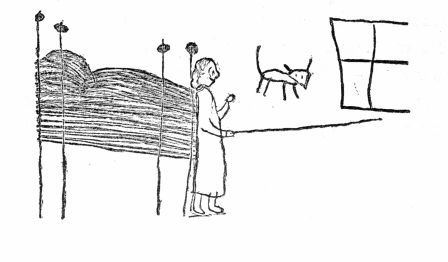
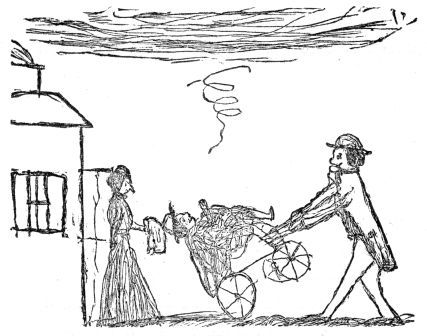
Yesterday Uncle Jacob came into the house and said he had brought a carriage to carry me over to Aunt Phebe’s; and when I looked out it wasn’t anything but a wheelbarrow. My grandmother said I must wrap up, for ’t was the first time; so she put two overcoats on me, and my father’s long stockings over my shoes and stockings, and a good many comforters, and then a great shawl over my head so I needn’t breathe the air; and ’t was about as bad as to stay in. Uncle Jacob asked her if there was a Billy in that bundle, when he saw it. “Hallo, in there!” says he. “Hallo, out there!” says I. Then he took me up in his arms, and carried me out, and doubled me up, and put me down in the wheelbarrow, and threw the buffalo over me; but one leg got undoubled, and fell out, so I had to drag my foot most all the way. Aunt Phebe undid me, and set me close to the fire; and Lucy Maria and the rest of them brought me story-books and picture-papers; and Tommy, he kept round me all the time, making me whittle him out little boats out of a shingle, and we had some fun sailing ’em in a milk-pan. Aunt Phebe had chicken broth for dinner, and I had a very good appetite. She let me look into all her closets and boxes, and let me open all her drawers. But I had to have a little white blanket pinned on when I went round, because she was afraid her room wasn’t kept so warm as my grandmother’s. Soon as Uncle Jacob came in and saw that little white blanket he began to laugh. “So Aunt Phebe has got out the signal of distress,” says he. He calls that blanket the “signal of distress,” because when any of them don’t feel well, or have the toothache or anything, she puts it on them. She says he shall have to wear it some time, and I guess he’ll look funny, he’s so tall, with it on. The fellers played base-ball close to Aunt Phebe’s garden. I tell you I shall be glad enough to get out-doors. I tell you it isn’t much fun to look out the window and see ’em play ball. But Uncle Jacob says if the ball hit me ’t would knock me over now. Aunt Phebe was just as clever, and let me whittle right on the floor, and didn’t care a mite. And we made corn-balls. But the best fun was finding things, when I was rummaging. I found some pictures in an old trunk that she said I might have, and I want you to give them to Bubby Short to put in the Panorama he said he was going to make. He said the price to see it would be two cents. They are true ones, for they are about Aunt Phebe’s little Tommy. One day, when he was a good deal smaller feller than he is now, he went out when it had done raining one day, and the wind blew hard, and he found an old umbrella, and did just what is in the pictures. The school-teacher that boarded there, O, she could draw cows and pigs and anything; and she drew these pictures, and wrote about them underneath.
I wish you would write me a letter, and tell Benjie to and Bubby Short.
From your affectionate friend, William Henry.
P. S. What are you fellers playing now?
Thinking the school-teacher’s pictures might please other little Tommys, I have taken some pains to procure them for insertion here. Little “fellers” usually are fond of carrying umbrellas,—large size preferred. Nothing suited Tommy better than marching off to school of a rainy day with one up full spread, provided he could hold it. His cousin Myra once took an old umbrella and cut it down into a small one, by chopping off the ends of the sticks, supposing he would be delighted with it. But no, he wanted a “man’s one.”
TOMMY ON HIS TRAVELS.
Tommy sets forth upon his travels around the house, taking with him his whip.
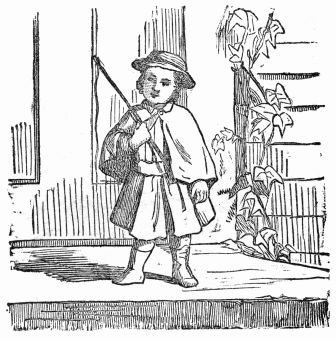
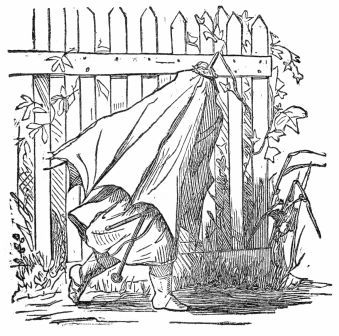
At the first corner he picks up an umbrella. A larger boy opens the umbrella, and shows him the way to hold it. Being an old umbrella, it shuts down again. But Tommy still keeps on in his way.
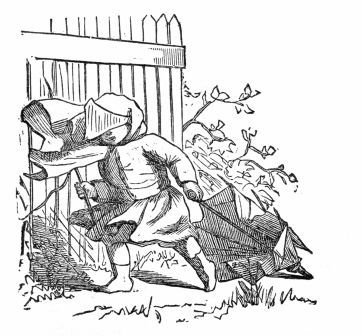
At the second corner a gust of wind takes down the umbrella, and blows his capes over his head. He pushes on, however, whip in hand, dragging the umbrella behind him.
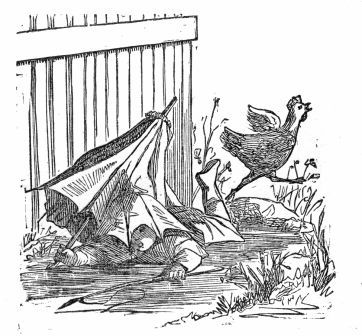
On turning the third corner a hen runs between his legs, and throws him down in the mud.
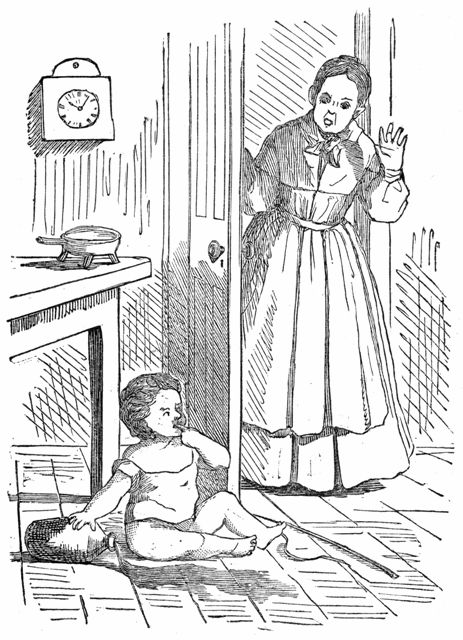
He is taken inside, stripped and washed, and left sitting upon the floor in his knit shirt, waiting for clean clothes. He can reach the handle of the molasses-jug. He does reach the handle, and tips over the jug. His mother finds him eating molasses off the floor with his forefinger. Tommy looks up with a sweet smile.
Here we have William Henry back at school again.
William Henry to his Grandmother.
My dear Grandmother,—
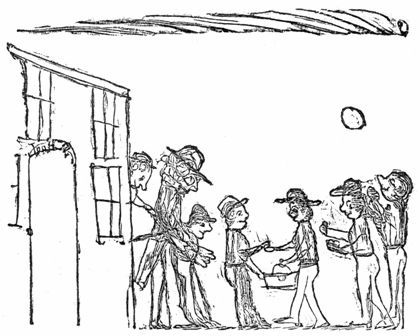
I’ve been here three days now. I came safe all the way, but that glass vial you put that medicine into, down in the corner of the trunk, broke, and some white stockings down there, they soaked it all up; but I sha’ n’t have to take it now, and no matter, I guess, for I feel well, all but my legs feeling weak so I can’t run hardly any. When I got here, the boys were playing ball; but they all ran to shake hands, and slapped my shoulders so they almost slapped me down, and hollered out, “How are you, Billy?” “How fares ye?” “Welcome back!” “Got well?” “Good for you, Billy!” Gus Beals—he’s the great tall one we call “Mr. Augustus”—he called out, “How are you, red-top?” And then Dorry called out to him, “How are you, hay-pole?” Dorry and Bubby Short want me to tell you to thank Aunt Phebe for their doughnuts, and you, too, for that molasses candy. The candy got soft, and the paper jammed itself all into the candy, but Bubby Short says he loves paper when it has molasses candy all over it. I gave some of the things to Benjie. Something hurt me all the way coming, in the toe of my boot; and when I got here I looked, and ’t was a five-cent piece right in the toe! I know who ’t was! ’T was Uncle Jacob when he made believe look to see if that boot-top wasn’t made of mighty poor leather. I went to spend it yesterday, down to the Two Betseys’ shop. Lame Betsey called me a poor little dear, and was just going to kiss me, but I twisted my face round. I’m too big for all that now, I guess. She looked for something to give me, and was just going to give me a stick of candy; but the other Betsey said ’t was no use to give little boys candy, for they’d only swallow it right down, so she gave me a row of pins, for she said pins were proper handy things when your buttons ripped off. Just when I was coming back from the Two Betseys’ shop I met Gapper Skyblue. He goes about selling cakes now. A good many boys were round him, in a hurry to buy first, and all you could hear was, “Here, Gapper!”
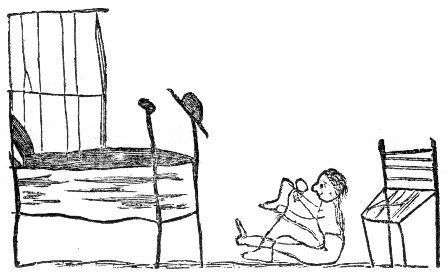
“This way, Gapper!” “You know me, Gapper!” “Me, me, me!” One boy—he’s a new boy—spoke up loud and said, “Mr. Skyblue, please attend to me, if you please, for I have five pennies to spend!” He came from Jersey. The fellers call him “Old Wonder Boy,” because he brags and tells such big stories. But now, just as soon as he begins to tell, Dorry begins too, and always tells the biggest,—makes them up, you know. O, I tell you, Dorry gives it to him good! You’d die a laughing to hear Dorry, and so do all the fellers. W. B.,—that’s what we call Old Wonder Boy sometimes,—W stands for Wonder, and B stands for Boy,—he says cents are not cents; says they are pennies, for the Jersey folks call them pennies, and he guesses they know. He says he gets his double handful of pennies to spend every day down in Jersey. But Bubby Short says he knows that’s a whopper, for he knows there wouldn’t anybody’s mother give them their double handful of pennies to spend every day, nor cents either, nor their father either. And then Dorry told Old Wonder Boy that he supposed it took his double handful of pennies to buy a roll of lozenges down in Jersey. Then W. B. said that our lozenges were all flour and water, but down in Jersey they were clear sugar, and just as plenty as huckleberries. Dorry said he didn’t believe any huckleberries grew out there, or if they did, they’d be nothing but red ones, for the ground was red out in Jersey. But W. B. said no matter if the ground was red, the huckleberries were just as black as Yankee huckleberries, and blacker too, and three times bigger, and ten times thicker. Said he picked twenty quarts one day.
Dorry said, “Poh, that wasn’t much of a pick!” Says he, “Now I’ll tell you a huckleberry story that’s worth something.” Then all the boys began to hit elbows, for they knew Dorry would make up some funny thing. Says he: “I went a huckleberrying once to Wakonok Swamp, and I carried a fourteen-quart tin pail, and a great covered basket, besides a good many quart and pint things. You’d better believe they hung thick in that swamp! I found a thick spot, and I slung my fourteen-quart tin pail round my waist, and picked with both hands, and ate off the bushes with my mouth all the while. I got all my things full without stirring two yards from the spot, and then I didn’t know what to do. But I’ll tell you what I did. I took off my jacket, and cut my fishing-line, and tied up the bottom ends of my jacket sleeves and picked them both full. And then I didn’t know what to do next. But I’ll tell you what I did. I took off my overalls, and tied up the bottoms of their legs, and picked them so full you wouldn’t know but there was a boy standing up in ’em!” Then the boys all clapped.
“Well,” Old Wonder Boy said, “how did you get them home?”
“O, got them home easy enough,” Dorry said. “First I put the overalls over my shoulders, like a boy going pussy-back. I slung all the quart and pint things round my waist, and hung the covered basket on one arm, and took the fourteen-quart tin pail in that same hand. Then I tied my jacket to the end of my fishing-pole, and held it up straight in my other hand like—like a flag in a dead calm!”
O, you ought to ’ve seen the boys,—how they winked at one another and puffed out their cheeks; and some of ’em rolled over and over down hill to keep from laughing! Bubby Short got behind the fence, and put his face between two bars, and called out, “S—e—double l!” But Dorry says they don’t know what a “s—e—double l” is down in Jersey. But I don’t believe that W. B. believes Dorry’s stories; for I looked him in the face, and he had a mighty sly look when he asked Dorry how it was he got his huckleberries home.
To-day they got a talking about potatoes. Old Wonder Boy said that down in Jersey they grow so big you have to pry ’em up out of the hill, and it don’t take much more than two to make a peck. Dorry told him that down in Maine you could stand on top the potato-hills and look all round the country, they were so high; and he asked W. B. how they planted ’em in Jersey, with their eyes up or down? He said he didn’t know which way they did turn their eyes. Then Dorry told him the Yankees always planted potatoes eyes up, so they could see which way to grow. Said he planted a hill of potatoes in his father’s garden, last summer, with their eyes all down, and waited and waited, but they didn’t come up. And when he had waited a spell longer, he raked off the top of that hill of potatoes, and all he saw was some roots sticking up. And he began to dig down. And he kept digging. Followed their stems. But he never got to the potato-tops; and says he, “I never did get to those potato-tops!” O, you ought to ’ve heard the boys!
Old Wonder Boy wanted to know where Dorry thought they’d gone to. Dorry thought to himself a minute, and looked just as sober, and then says he, just like a school-teacher, “The earth, in the middle, is afire. I think when they got deep enough to feel the warm, they guessed ’t was the sun, and so kept heading that way.”
Is the world afire in the middle? Dorry told me that part of his story was really true. How Uncle Jacob would laugh to sit down and hear Dorry and Old Wonder Boy tell about whales. W. B. calls ’em wales. His uncle is a ship-captain, he says, and once he saw a wale, and the wale was making for his ship, and it chased ’em. And, no matter how they steered, that wale would chase. And by and by, in a calm day, he got under the vessel and boosted her up out of water, when all the crew gave a yell,—such a horrid yell that the wale let ’em down so sudden that the waves splashed up to the tops of the masts, and they thought they were all drowned.
“O, poh!” Dorry cried out. “My uncle was a regular whaler, and went a whaling for his living. And once he was cruising about the whaling-grounds and ’t was in a place where the days were so short that the nights lasted almost all day. And they got chased by a whale. And he kept chasing them. Night and day. And there came up a gale of wind that lasted three days and nights; and the ship went like lightning, night and day, the whale after them. And, when the wind went down, the whale was so tuckered that he couldn’t swim a stroke. So he floated. Then the cap’n sang out to ’em to lower a boat. And they did. And the cap’n got in and took a couple of his men to row him. The whale was rather longer than a liberty-pole. About as long as a liberty-pole and a half. He was asleep, and they steered for the tail end. A whale’s head is about as big as the Two Betseys’ shop, and ’t is filled with clear oil, without any trying out. The cap’n landed on the whale’s tail, and went along up on tiptoe, and the men rowed the boat alongside, and kept even with him; and, when he got towards her ears, he took off his shoes, and threw ’em to the men to catch. After a while he got to the tip-top of her head. Now I’ll tell you what he had in his hand. He had a great junk of cable as big round as the trunk of a tree, and not quite a yard long. In one end of it there was a point of a harpoon stuck in, and the other end of it was lighted. He told the men to stand ready. Then he took hold of the cable with both hands, and with one mighty blow he stuck that pointed end deep in the whale’s head, and then gave one jump into the boat, and he cried out to the men, ‘Row! row for your lives! To the tail end! If you want to live, row!’ And before that whale could turn round they were safe aboard the ship! But now I’ll tell you the best part of the whole story. They didn’t have any more long dark nights after that. They kept throwing over bait to keep her chasing, and the great lamp blazed, and as fast as the oil got hot it tried out more blubber, and that whale burned as long as there was a bit of the inside of him left. Flared up, and lighted up the sea, and drew the fishes, and they drew more whales; and they got deep loaded, and might have loaded twenty more ships. And when they left they took a couple in tow,—of whales,—and knocked out their teeth for ivory, and then sold their carcasses to an empty whaler.”
Dorry says some parts of this story are true. But he didn’t say which parts. Said I must look in the whale-book and find out.
Your affectionate grandchild, William Henry.
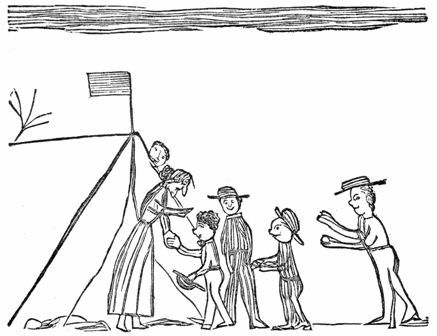
P. S. I wish you would please to send me a silver three-cent piece or five-cent. Two squaws have got a tent a little ways off, and the boys are going to have their fortunes taken. But you have to cross the squaws’ hands with silver.
W. H.
Georgianna’s Letter to William Henry.
My dear Brother Billy,—
O Billy, my pretty, darling little bird is dead! My kitty did it, and O, I don’t know what I shall do, for I love my kitty if she did kill my birdie; but I don’t forget about it, and I keep thinking of my birdie every time my kitty comes in the room. I was putting some seeds in the glass, and my birdie looked so cunning; and I held a lump of white sugar in my lips, and let him peck it. And while I was thinking what a dear little bird he was, I forgot he could fly out; but he could, for the door was open, and he flew to the window. I didn’t think anything about kitty. It flew up to that bracket you made, and then it went away up in the corner just as high as it could, on a wooden peg that was there. I didn’t know what made it flutter its wings and tremble so, but grandmother pointed her finger down to the corner, on the floor, and there was my kitty stretching out and looking up at my bird. And that was what made poor birdie tremble so. And it dropped right down. Before we could run across to catch kitty, he dropped right down into her mouth. I never thought she could get him. I didn’t know what made grandmother hurry. I didn’t know that kitties could charm birds, but they do. She didn’t have him a minute in her teeth, and I thought it couldn’t be dead. But, O Billy, my dear birdie never breathed again! I warmed him in my hands, and tried to make him stir his wings, but he never breathed again. Now the tears are coming again. I thought I wasn’t going to cry any more. But they come themselves; when I don’t know it, they come; and O, it was such a good birdie! When I came home from school I used to run to the cage, and he would sing to meet me. And I put chickweed over his cage.
Grandmother has put away that empty cage now. She’s sorry, too. Did you think a grandmother would be sorry about a little bird as that? But she’d rather give a good deal. When she put the plates on the table, and rattled spoons, he used to sing louder and louder. And in the morning he used to wake me up, singing away so loud! Now, when I first wake up, I listen. But O, it is so still now! Then in a minute I remember all about it. Sometimes kitty jumps up on the bed, and puts her nose close down, and purrs. But I say, “No, kitty. Get down. You killed little birdie. I don’t want to see you.” But she don’t know what I mean. She rubs her head on my face, and purrs loud, and wants me to stroke her back, and don’t seem as if she had been bad. She used to be such a dear little kitty. And so she is. She’s pretty as a pigeon. Aunt Phebe says she never saw such a pretty little gray and white kitty as she is. I was going to have her drowned. But then I should cry for kitty too. Then I should think how she looked all drowned, down at the bottom, just the same way I do now how my birdie looked when it couldn’t stir its little wings, and its eyes couldn’t move. My father says that kitty didn’t know any better. I hope so. I took off that pretty chain she had round her neck. But grandmother thinks I had better put it on again. Aunt Phebe’s little Tommy says, “Don’t kye, Dordie, I’ll bung dat tat. I’ll take a tick and bung dat tat!” He calls me Dordie, I guess I rather have kitty alive than let her be drowned, don’t you? Grandmother wants you not to catch cold and be sick.
From your affectionate sister, Georgianna.
P. S. Grandmother showed me how to write this letter.
A caged bird is never a very interesting object to me. But this little canary of Georgie’s was really a beautiful creature, and very intelligent. They used to think that he listened for her step at noon and night; for no sooner was it heard in the entry than he peeped out with his little bright eyes, and tuned up, and sang away, as if to say, “Glad! glad! glad you’ve come! glad you’ve come!”
Then she would go to the cage and talk to him, and let him take sugar from her mouth, and would hang fresh chickweed about its cage. Mornings she used to sing, from her bed, and the bird would answer. Indeed, he really seemed quite a companion for her.
At the time the accident happened I had been staying for a few weeks at the hotel, a mile or two off, and called at the farm that very day. Lucy Maria told me, as I stopped at their door, what the kitten had done, and how Georgianna had cried and mourned and could not be comforted.
I found her sitting on the doorstep. She had placed the bird in a small round basket, lined with cotton-wool, and was bending over, and stroking it. I had always noticed the bird a great deal, used to play with it, and whistle to make it sing louder and louder. The sight of me brought all this back to her mind, and she burst into tears again, sobbing out, “O, he never—will sing—any more! Dear little birdie! He had to fall down! He couldn’t—help it!”
I talked with her awhile, in a cheerful way, and when she had become quite calm I held out my hand and said, “Come, Georgie, don’t you want to go with me and find a pretty place where we can put birdie away, under the soft grass? And we will plant a flower there.”
The idea of the soft grass and the flower seemed to please her. She took my hand, and we went to look about.
We thought the garden not a very good place, because it was dug up every year, and the field would be mowed and trampled upon. But just over the fence, back of the garden, we came upon some uneven ground, where the old summer-sweeting trees grew. In one place there was a sudden pitch downwards, into a little hollow, which grass and plantain leaves made almost forever green. For here was what they called the Boiling Spring. The water bubbled out of the ground on the slope of the bank, and in former times, before the well was dug, had been used in the family. Several trees grew about there,—wild cherry, damson, and poplar,—and a profusion of yellow flowers, wild ones. Some of these grandmother called “Ladies’ Slipper”; the others, “Sullendine.” The spring had once been stoned up and boxed over. But the boards were now rotting away, the stones falling in, and our little hollow had quite a deserted look. The water trickled out and ran away around the curve of the bank.
Grandmother came with us, and Georgie’s teacher, and Matilda and Tommy. We hollowed out a little place under the wild-cherry tree, wrapped the birdie in cotton-wool, lay him in, and covered him over with the green sod. I then went down by the stone wall, where sweetbriers were growing, dug up a very pretty little one, and set it out close by, so that it might lean against the cherry-tree. Tommy kept very sober, and scarcely spoke a word, till it was all over. He then said to me, in a very earnest tone, “Mr. Fwy, now will another birdie grow up there?” I suppose he was thinking of his father’s planting corn and more corn growing.
William Henry to his Sister.
My dear Little Sister,—
I’m sorry your little birdie’s dead! He was a nice singing birdie! But I wouldn’t cry. Maybe you’ll have another one some time, if you’re a good little girl. Maybe father’ll go to Boston and buy you one, or maybe Cousin Joe will send one home to you, in a vessel, or maybe I’ll catch one, or maybe a man will come along with birds to sell, or maybe Aunt Phebe’s bird will lay an egg and hatch one out. I wouldn’t feel bad about it. It isn’t any use to feel bad about it. Maybe, if he hadn’t been killed, he’d ’a’ died. Dorry says, “Tell her, ‘Don’t you cry,’ and I’ll give her something, catch her a rabbit or a squirrel!” Says he’ll tease his sister for her white mice. Says he’ll tease her with the tears in his eyes,—or else her banties.
How do you like your teacher? Do you learn any lessons at school? You must try to get up above all the other ones. We’ve got two new teachers this year. One is clever, and we like that one, but the other one isn’t very. We call the good one Wedding Cake, and we call the other one Brown Bread. Did grandmother tell you about the Fortune Tellers? We went to-day and she told mine true. She said my father was a very kind man, and said I was quick to get mad, and said I had just got something I’d wanted a long time (watch, you know), and said I should have something else that I wanted, but didn’t say when. I wonder how she knew I wanted a gun. I thought perhaps somebody told her, and laid it to Old Wonder Boy, for we two had been talking about guns. But he flared up just like a flash of powder. “There. Now you needn’t blame that on to me!” says he. “You fellers always do blame everything on to me!” Sometimes when somebody touches him he hollers out, “Leave me loose! Leave me loose!” Dorry says that’s the way fellers talk down in Jersey. The Fortune Teller told W. B. that he came from a long way off, and that he wanted to be a soldier, but he’d better give up that, for he wouldn’t dare to go to war, without he went behind to sell pies. All of us laughed to hear that, for Old Wonder Boy is quick to get scared. But he is always straightening himself up, and looking big, and talking about his native land, and what he would do for his native land, and how he would fight for his native land, and how he would die for his native land. He says that why she told him that kind of a fortune was because he gave her pennies and not silver money. His uncle that goes cap’n of a vessel has sent him a letter, and in the letter it said that he had a sailor aboard his ship that used to come to this school.
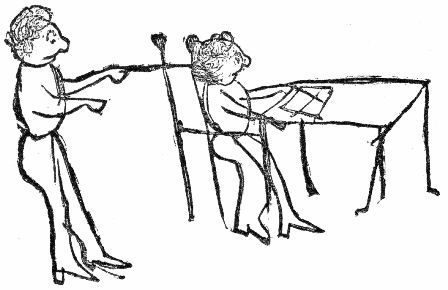
I was going to tell you a funny story about W. B.’s getting scared, but Dorry he keeps teasing me to go somewhere. I made these joggly letters when he tickled my ears with his paint-brush. Has your pullet begun to lay yet? I hope my rooster won’t be killed. Tell them not to. Benjie says he had a grand great rooster. It was white and had green and purple tail feathers, O, very long tail feathers, and stood ’most as high as a barrel of flour, with great yellow legs, and had a beautiful crow, and could drive away every other one that showed his head, and he set his eyes by that rooster, but when he got home they had killed him for broth, and when he asked ’em where his rooster was they brought out the wish-bone and two tail feathers, and that was all there was left of him. I wouldn’t have poor little kitty drowned way down in the deep water ’cause to drown a kitty couldn’t make a birdie alive again. Have your flowers bloomed out yet? You must be a good little girl, and try to please your grandmother all you can.
From your affectionate brother, William Henry.
P. S. Now Dorry’s run to head off a loose horse, and I’ll tell you about Old Wonder Boy’s getting scared. It was one night when—Now there comes Dorry back again! But next time I will.
W. H.
William Henry to his Sister, about Old Wonder Boy’s Fright.
My dear Sister,—
I will put that little story I am going to tell you right at the beginning, before Dorry and Bubby Short get back. I mean about W. B.’s getting scared. But don’t you be scared, for after all ’t was—no, I mean after all ’t wasn’t—but wait and you’ll know by and by, when I tell you. ’T was one night when Dorry and I and some more fellers were a sitting here together, and we all of us heard some thick boots coming-a hurrying up the stairs, and the door came a banging open, and W. B. pitched in, just as pale as a sheet, and couldn’t but just breathe. And he tried to speak, but couldn’t, only one word at once, and catching his breath between, just so,—“Shut—the—door!—Do!—Do!—shut—the door!” Then we shut up the door, and Bubby Short stood his back up against it because ’t wouldn’t quite latch, and now I will tell you what it was that scared him. Not at the first of it, but I shall tell it just the same way we found it out.
Says he, “I was making a box, and when I got it done ’t was dark, but I went to carry the carpenter’s tools back to him, because I promised to. And going along,” says he, “I thought I heard a funny noise behind me, but I didn’t think very much about it, but I heard it again, and I looked over my shoulder, and I saw something white behind me, a chasing me. I went faster, and then that went faster. Then I went slower, and then that went slower. And then I got scared and ran as fast as I could, and looked over my shoulder and ’t was keeping up. But it didn’t run with feet, nor with legs, for then I shouldn’t ’a’ been scared. But it came—O, I don’t know how it came, without anything to go on.”
Dorry asked him, “How did it look?”
“O,—white. All over white,” says W. B.
“How big was it?” Bubby Short asked him.
“O,—I don’t know,” says W. B. “First it looked about as big as a pigeon, but every time I looked round it seemed to grow bigger and bigger.”
“Maybe ’t was a pigeon,” says Dorry. “Did it have any wings?”
“Not a wing,” says W. B.
“Maybe ’t was a white cat,” says Mr. Augustus.
“O, poh, cat!” says W. B.
“Or a poodle dog,” says Benjie.
“Nonsense, poodle dog!” says W. B.
“Or a rabbit,” says Bubby Short.
“O, go ’way with your rabbit!” says W. B. “Didn’t I tell you it hadn’t any feet or legs to go with?”
“Then how could it go?” Mr. Augustus asked him.
“That’s the very thing,” said W. B.
“Snakes do,” says Bubby Short.
“But a snake wouldn’t look white,” says Benjie.
“Without ’t was scared,” says Dorry.