SHORT STORIES.
Reading edition
The second instalment of a budget of breezy little narratives—exciting, humorous, and curious—hailing from all parts of the world. This month we publish a humorous Canadian episode and a terrible affair which occurred on an American train.
A BLUFF THAT WORKED.
By J. K. Strachan, J.P., of British Columbia.
This amusing little story was told to me by Mr. John Wood, in the Tecumseh Hotel at Winnipeg. He happened to see there the character I have called “Slippery Dick,” whom he had known in 1881 or 1882 at a small village near London, Ontario, where he then lived, and the sight of the man recalled the facts to his mind. As most of the parties concerned are still living, I have thought it advisable to alter the names.
Dick Small was his name, but we called him “Small Dick,” or “Slippery Dick,” on account of his small and mean ways. Well, one night Sam Smart and I and several other boys were in Steve Brown’s bar, “talking horse,” when old Dick came meandering in, and, of course, chipped in with some of his usual boasting.
“I’ve got the best little mare in the settlement,” he told us, “and don’t you forget it. I’m game to back that little bit of horseflesh for fifty dollars for a mile, twice round the half-mile track, against anything you can produce in these parts. Who’s got anything to say? I’ll run her now, to-morrow, or any time.”
“You ain’t produced the collateral,” put in Sam, quietly.
With that old Dick thrust his hand into his back pocket and drew out quite a wad. Counting out five ten-dollar bills, he put them on the counter.
“Now, Steve, you’re stakeholder,” he said. “Who’s going to cover ’em? It’s put up or shut up.”
Sam got up, and, putting a fifty-dollar bill on top of Dick’s, replied, “I’ll jest take that bet. Hold the stakes, Steve.”
“All right,” said Steve, and pushed the money into his safe.
The boys all looked at Sam, puzzled like, and old Slippery was wondering what it all meant.
“Didn’t know you had a horse, Sam,” he remarked.
“You don’t know everything, Dick,” returned Sam, “but I ain’t surprised, for I only brought him home to-day. Well, let’s settle the time for the match. To-morrow morning at eight o’clock will suit me. I don’t want a crowd to know too much of my horse’s points, so we’ll do it on the quiet.”
The old man agreed to this, and Sam went on: “And now, as I’ve got to see some business, I’ll say good-bye, boys. Say, Steve, a word with you before I go.”
Steve and Sam went into the back room, and in about five minutes Sam came out and walked off.
The boys and Slippery hung around, and you could see the old miser was uneasy about his fifty dollars. So he began a-trying to pump Steve. “Say, Steve,” said he, “what kind of a horse has Sam got?”
“Don’t know; ain’t seen him,” replied Steve.
“You don’t know anything about him, I suppose?” inquired Dick.
“Only what Sam told me, and I don’t suppose he wanted me to repeat it. But as the bet’s made I don’t see that it matters. He told me that he covered fifteen miles with the horse yesterday in less than three-quarters of an hour, and he landed it fresh as paint; hadn’t turned a hair.”
“Gee whizz!” ejaculated Slippery, in dismay. “I’m a goner! I don’t know what I’d better do. I’ve a note to meet at the bank to-morrow, and if Sam wins my money I sha’n’t be able to come up to time on the note, and it’ll go to protest. Everybody’ll know it and my credit will be gone. What a fool I was!”
“Well, Dick,” said Steve, “I’m sorry for you, but it’s your own fault; nobody asked you to bet. Say, Sam’s not a bad sort when he’s treated right; couldn’t you tell him you forgot an important engagement for to-morrow, and ask him to agree to draw the bet? Maybe he would if you put it to him right.”
“Think he would, Steve?” asked Dick, doubtfully. “Wonder where I could find him?”
“I think I know where he could be located, and if you like I’ll send my boy Jim to bring him along.”
“Thanky, Steve. I wish you would,” said old Dick.
Soon after the boy returned, and close behind him came Sam. Looking round, and seeing old Slippery and nearly all the boys still there, he asked, “What’s up? Want to double the bet, Dick? If so, you can be accommodated.”
Steve, pretending to side with old Dick, explained that the old man had forgotten a particular engagement and had to go away for some days. As accidents might happen, he thought it would be better to cancel the bets and arrange a fresh match later on.
But Sam took it badly, angrily demanding what sort of idiot they took him for. “Draw bets? Not much!” he cried. “I’ll double it, if you like.”
Then he turned upon Dick Small, who was looking mighty miserable. “You old rascal,” he went on, “I know what it is—you’re afraid you’ll lose your money. Serve you right! You wanted to back your old mare, didn’t you? No one asked you to. Draw bets, you say? No, siree, not by a jugful!”
“Look here, Sam,” said Steve, “don’t be too hard. You think you’ve got a sure thing, but accidents might happen even on your side. Why don’t you two compromise? Supposing Dick allows you something for your trouble and sets up drinks for the crowd?”
“What do you mean by a compromise?” demanded Sam. “If Dick forfeits half his bet, that would be about fair, I should say.”
“Oh, I couldn’t do that, really,” cried old Slippery, in great distress.
“Very well,” said Sam, “then the bet stands. Good-bye; I’m busy.”
“Hold on a bit,” put in Steve, and, drawing the old man aside, he whispered to him for a minute or two. You should have seen the different emotions which chased over old Dick’s face! At last, however, he seemed to agree with Steve; and then Steve, addressing the crowd, told us that he quite understood the matter. The proposition he had to make was that Dick should pay Sam ten dollars and stand a double treat round for the crowd. If the boys now present considered that fair, he added, he thought Sam, as a sportsman, should accept.
“Do as you like,” said Sam. “I’m tired of the whole thing.”
So Steve took the votes of the company. A few thought the bet ought to stand; but the majority, being pretty thirsty, were in favour of the proposition, and it was finally carried, Sam getting back his fifty dollars and ten dollars of old Slippery’s. Steve charged three dollars for the two rounds, and gave the old man back the remaining thirty-seven dollars.
“Say, Sam,” said old Dick, just as he was going, “I should like to see your horse, if you have no objection.”
“Why, certainly,” replied Sam. “Any time you like; if I’m not at home, ask the missus.”
When Dick had gone the boys all started asking questions about Sam’s horse, but all he would say was, “You’ll know all about it by and by.”
Next day, as Sam expected, old Dick went up to Sam’s place. There was only the missus at home; Sam took care to be out of the way.
“Mornin’, Mrs. Smart,” said Slippery, politely.
“Good morning, Mr. Small,” answered Mrs. Smart. “What brings you round these parts?”
“Why, Sam said I might see the new horse if I came up.”
“I don’t see why you should be interested in such a thing,” said Mrs. Smart, looking puzzled, “but you can see it if you want to. It’s in the kitchen.”
Old Slippery was taken aback; he thought he must surely have misunderstood her.
“In the kitchen?” he echoed.
“Yes, in the kitchen, standing by the stove,” replied the woman. “You can go right in and look at it if you want to, but what there is to see in it I can’t make out.”
The old man, not comprehending things at all, went through into the kitchen and looked around. But the only horse he saw there, if he expected to see any other in such a place, was a new four-legged clothes-horse with a few articles hanging on it to dry!
In an instant he realized the trick that had been played upon him, and very nearly went crazy. He stamped and swore, while poor Mrs. Smart wondered what it all meant, or if the old man had suddenly gone mad. Presently, however, she commenced to smell a rat.
“What fool trick has that man of mine been up to now?” she asked.
“I don’t know about a fool trick,” screamed the old man, “but I do know that he has swindled me out of ten good dollars, besides making me pay three dollars for a double round of drinks for all the thirsty loafers down at Steve Brown’s saloon. But I’ll get even with him, the swindler, and with Steve Brown, too, and all his gang! It was a put-up job; I can see it all now. What a double-dyed fool I’ve been! But I’ll sue him—I’ll show him up!”
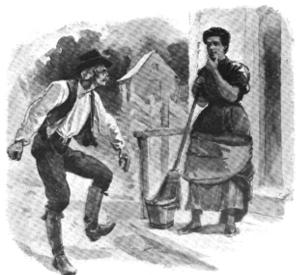
“I’LL SUE HIM—I’LL SHOW HIM UP!”
And away he went, leaving Mrs. Smart quite in the dark as to the cause of his wrath.
Still raving, the foolish old man came down town, where he saw Sam and Steve and some more of the boys. He promptly called them all a lot of thieves and crooks and swindlers, said it was all a put-up job, and that he would report Steve to the Licence Commissioners, get his licence cancelled, and make Sam return the ten dollars and Steve the three dollars he had for the drinks.
Steve heard him out quietly, and then told him to get out of his house. Dick would hear from him later, he said.
When Dick had gone, Sam and Steve went over to the town and told the whole story to Lawyer Harris. Sam said he had never thought of making any bet, but could not stand the old man’s everlasting boasting, so the idea struck him that he would work off a “bluff” on Small. He certainly had stated that he and his “horse” covered fifteen miles under forty-two minutes. It was quite correct, for he brought it in on the train. Moreover, he had stated that it landed “as fresh as paint”; that was true again—it had been freshly painted. He had said, further, that it didn’t turn a hair, and it didn’t—for the best of reasons.
The lawyer roared with laughter; it was the best joke he had heard for a long time, he said, and served the old skinflint right. “I’ll write and claim two hundred and fifty dollars each for Steve and Sam for malicious slander,” he added, “and threaten him with a writ if he doesn’t pay up.”
The lawyer sent his clerk over to deliver the letter to old Dick, who read it over two or three times before he understood it. Then he nearly had a fit, but the clerk advised him to keep quiet and come over and see Mr. Harris, and perhaps they could settle things.
When Small arrived the lawyer let him have it hot and strong. He told him he was always thrusting himself in where he wasn’t wanted, and now, because for once he had overreached himself, he couldn’t take his medicine quietly, but must go calling people thieves and swindlers, in spite of the fact that he would have been glad enough to pocket Sam’s fifty dollars. If he defended the suit, the lawyer said, he would certainly have to pay damages and costs, besides making himself the laughing-stock of the country for miles around.
Dick saw the point and began to climb down, and finally Mr. Harris let him off on paying ten dollars each to Sam and Steve, another ten dollars for lawyer’s fees, and signing a letter of apology. And that’s the whole story, but I don’t think old Dick has ever made a bet since.
THE YELLOW FIEND.
By Julian Johnson, of Los Angeles, California.
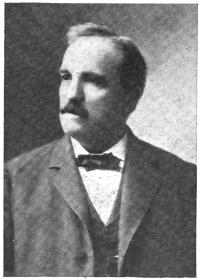
MR. CONLISK, WHO WAS THE CONDUCTOR OF THE TRAIN AT THE TIME THIS ADVENTURE HAPPENED.
From a Photograph.
Much of the history of railroading in Western America reads like a chapter from some “penny dreadful,” but none of the thrilling pioneer episodes surpasses in dramatic interest an incident which occurred a few years ago on one of the regular passenger trains of the Denver and Rio Grande.
The principal surviving actor in this singular tragedy is John Conlisk, who has now retired from active railroad service, and is at present living quietly at 2,717, Vermont Avenue, Los Angeles, California.
At the time of our story—March, 1892—Mr. Conlisk was a passenger conductor on the Denver and Rio Grande, running between Ogden, Utah, and Grand Junction, Colorado, making his home in the Utah city. This brief introduction is sufficient, however, and the rest may be narrated just as he told it to the writer recently.
The morning was crisp and clear and promised a bright March day. Shortly after two o’clock I was on the platform at Grand Junction waiting for No. 7, which I was to take back to Ogden. She came in on time, the few preliminaries attending the exchange of crews were finished as usual, and at three I was ready to go, when the conductor for the other division ran across the platform to me.
“Jack,” he said, “there’s a Chinaman in the ladies’ wash-room in the chair-car. He’s been in there two or three hours, and we can’t get him out. He’s in an ugly temper, and you may have trouble with him. If I were you I’d call the station officer.”
So I started on a hunt for that person, but he was not to be found anywhere, and after delaying the train two or three minutes I concluded to settle the matter with my own crew and passed the signal to the engineer. As we swung on board I spoke to my head brakeman, a young fellow named James Genong.
“There’s a Chinaman in the ladies’ wash-room in the chair-car,” I told him. “He’s locked himself in, for some heathen reason or other, and I wish you’d see if you can get him out without making any disturbance.”
I had a heavy load of passengers, probably two hundred in all, and after making my rounds, of course not disturbing the people in the sleepers, I went into the coach just ahead of the chair-car, and, with my train-box before me, sat down to count my tickets.
I had hardly finished my work when the door flew open, as though hurled by a violent gust of wind. Jim was behind it, with a pale, excited face. “Got a gun about you?” he asked, in a hoarse, frightened whisper.
“Why?” I asked, in astonishment.
“That Chinaman’s stabbed me!” he replied, looking furtively over his shoulder.
“Jim,” I said, getting up at once, “this thing may be serious, but it can’t be settled by indiscriminate shooting in a train-load of passengers. We’ve got to find another way.”
I must here interrupt my story for a moment to tell you what had actually happened. Jim, thinking the Celestial an easy conquest, started after him before the train was fairly under way. In those days chair-cars carried the time-honoured stove and wood-box, and the brakeman, putting one foot on the edge of the latter and the other on an opposite ledge, peered down over the transom and ordered the Chinaman to come out in language that admitted of no misinterpretation. And the Chinaman did come out, ducking fairly under Jim in his elevated position. As he ducked he slashed upward with a great curved hunting-knife. The slash caught the white man on the inside of the thigh, producing a wound that bled profusely and probably gave a deal of inconvenience, but which was not really dangerous.
Seeing Jim streaming with blood, and believing that the yellow man was actually running amok, I started for the door, first telling the passengers in that car to lie down on the floor if they heard any shooting going on beyond.
The train was making good speed, but as I stood on the platform I could hear the culprit jabbering about, “Fiftleen hundled dolla! Me got plenty monee!” He commanded his end of the car, from which practically all the passengers had retired panic-stricken. The only exceptions to the general decampment were a fine-looking young chap from Bunker Hill, Illinois, who sat in a forward chair reading a book, and an army officer’s wife with a little baby, bound for Salt Lake City—in the seat opposite. These were directly under the Chinaman’s eye, and whenever they attempted to move he waved them back with a ferocious gesture of his great glittering knife.
Going to the door, which was locked, I rapped sharply on it with my ticket-punch. I had no revolver with me, but I hoped to distract his attention. And I did! Turning, he saw me, and with his face distorted with an expression of the most hideous savagery he drew back his arm, and sent it and the knife through the glass, clear to the shoulder, the blade just missing me!
Without more ado I pulled the bell-cord and ran into the forward car, where I borrowed a big Colt’s revolver from a cowboy I knew. Then, returning to the platform, I waited until the train had almost stopped, and dropped to the ground, catching the rear platform of the chair-car as the wheels ground down to their final revolution.
The frightened people were packed so densely against the door that I had to fight my way in, and then through them. The Chinaman, with his two quiet prisoners, had the whole front end of the car to himself. I called to him, exhibiting the pistol.
At the sight of that gun the most awful frenzy blazed in his eyes. He was a big fellow, and now, with the greatest deliberation, he rolled up his wide sleeves, disclosing a tremendous pair of arms, covered with heavy black hair. He looked like a typical Boxer on the war-path.
Then he started in my direction, but in a moment changed his mind about leaving a foe in his rear, and with the most calculating, revolting cruelty that I have ever seen swirled his great blade down over the seated boy’s head, and plunged it to the hilt in his body. Women shrieked and fainted, and I felt myself all but falling.
Raising my revolver I fired, and the ball broke his legs under him. He fell, and the army officer’s wife, with a terrible shriek, raised her baby to her shoulder and started down the car.
But in an instant the Chinaman was on his feet, wounded as he was, and struck the woman an appalling blow over the shoulder. She dropped like a stone—apparently stabbed to the heart.
I waited no more on the possibility of a high bullet glancing into the car ahead, but fired straight at his heart. Even with the crash of my pistol another sounded just behind me, and the yellow fiend fell headlong between two chairs.
Someone went over and kicked him, but the body gave no sign of life, and we devoted our attention to the unfortunate young man, who now lay huddled in a pathetic and bloody heap in his seat.
Others crowded around us, and at length I saw my cowboy friend approaching. Just as he reached me I was stooping over the Celestial’s first victim, in an attempt to raise him, when I heard the puncher yell, in an agonized voice, “For Heaven’s sake, Jack, look out!”
I glanced backward, and there was that colourless, diabolical countenance again blazing into mine. He was standing erect, and the knife was poised for a blow which would have given me my quietus. As I looked, certain that death was coming, I felt a wrench at my hip-pocket. It was the cowboy tearing his revolver out of my clothes. Even as the knife descended, my saviour jammed his weapon squarely into the Chinaman’s ear—and fired.
The big bullet, at that distance, almost tore his head to pieces. Blood was spattered over all of us, in the most sickening way that could be imagined. Hating to touch the body, we pushed it under a seat and turned our whole attention to the wounded.
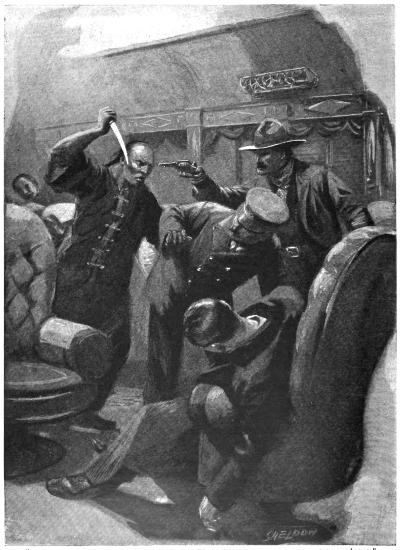
“EVEN AS THE KNIFE DESCENDED, MY SAVIOUR JAMMED HIS WEAPON SQUARELY INTO THE CHINAMAN’S EAR.”
The officer’s wife, strangely enough, had not a scratch on her. She was in a dead faint, but both she and the child were practically uninjured. The explanation of her escape seems to have been that the Chinaman’s wrist fell with full force on the baby, thus preventing the knife from doing any damage to either.
The poor boy, though conscious, was plainly mortally wounded. He made no complaint, and smiled faintly as we carried him back to a vacant berth in one of the Pullmans.
About daylight, at one of the longer stops, several of the passengers dragged the murderer’s horribly-battered body forward to the baggage-car. They did not carry him, but dragged him, and, as it was in the spring, the road-bed was very muddy. When the body reached the baggage-car the features were absolutely hidden in a combined coating of dried blood and slime.
Then, as we got under way again, a physician on the train, with myself and others, searched the remains. The dead man had on two pairs of trousers, and, sewn inside his shirt, fifteen hundred dollars in greenbacks. In his purse he had a first-class ticket from Pittsburg to San Francisco and, what was still more singular, a paid-up life insurance policy for five thousand dollars in favour of one Ah Say, of Evanston, Wyoming.
We rolled the body into a corner and looked over his few effects. Presently one of the men, who was sitting on a trunk facing us, gave a peculiar gasp and turned as white as blotting-paper. His eyes were fixed staringly on something behind our backs. We turned with one accord.
The supposedly dead Chinaman—a Chinaman with a body as full of holes as a sieve—was sitting up! I cannot convey in words the indescribably hideous effect of that face, caked as it was with gore and filth. Only a ghastly red crack of mouth was visible, grinning in demoniac vacancy, and two burning black slants which indicated his eyes.
The doctor was the only man who had his nerve in that excruciating moment.
“Well, John, how d’you feel now?” he said, speaking in a tone that was even jocular.
The Chinaman did not deign to answer, but first felt carefully all over himself. Then he put his hand to what should have been his trousers pocket, and at length ran his fingers violently around the place in his shirt from which we had taken his greenbacks. That frightful malevolence came back into his eyes, and, never taking those snaky optics from our faces, he began to hitch painfully across the floor towards a stand in which were kept guns for emergency use, in case of train robbery. To me, his actions seemed like those of some dreadful automaton. Every man of us watched him—held motionless, as a rattlesnake holds its victim, by the spell of terror.
Slowly, painfully, he progressed. He gained inch by inch, and at last was almost within reaching distance. He stretched out his arms to the guns, and partially rose; then he fell over stone-dead—dead this time for good and all.
The doctor examined him, and reported his survival to be due to opiates, which he had taken in enormous quantities.
At Salt Lake City I received an order from Mr. W. H. Bancroft, then receiver of the road, to stop there with the crew, which included James Donohue, engineer, and Charles Francis, fireman.
We arrived there about three o’clock, and the young man was still alive, though fast weakening. In an ordinary conversational manner he told us that his home was in Bunker Hill, Illinois, that his father was a banker, and that, after leaving school, he had been sent on a Western trip before assuming the business himself. Informed of his grave condition, he expressed his best wishes for all of us, and went under the anæsthetic with a happy smile. He died without ever returning to consciousness.
At the coroner’s inquest it was decided that the Chinaman had suddenly gone insane from an overdose of opium, for, as the evidence showed, he had been pleasant enough during the day, and had talked to several ladies in the car, telling them that he had been recently converted to Christianity and that he proposed to preach in San Francisco. After his burial expenses had been paid, the balance of his money was forwarded to the Chinese Consul in the city toward which he was bound.
There was an amusing sequel to the tragedy, though an exasperating one in some ways. Some months afterwards the keeper of one of the eating-stations, calling me to one side, inquired rather pointedly, “Have you noticed that the Chinese seem to be afraid of you?”
I replied that I hadn’t given the matter any thought, either way.
“Well,” he added, “Agent ——, of the U.P. (an opposition road), has told all the Chinks in the State that you killed their countryman for his money!”