Across America by Airship. THE STORY OF AN ILL-STARRED ENTERPRISE.
Reading edition
By Arthur Inkersley, of San Francisco.
Now that airships are so much to the fore, this account of the meteoric career of the largest “dirigible balloon” ever constructed—larger even than Count Zeppelin’s unfortunate monster—will be read with interest. The inventor had an ambitious scheme for running luxuriously-fitted aerial liners between New York and San Francisco, but his first ship got no farther than the ascension ground. The photographs accompanying the article are particularly striking.

Some time last year there came from the windy city of Chicago to the hardly less breezy San Francisco a man named John A. Morrell, who built a small airship with a balloon of insufficient size to lift the engines and netting. The craft got loose before the crew of twelve had taken their places and rose from a hundred to two hundred feet in the air, floating away in a southerly direction down the San Francisco peninsula and coming to rest at Burlingame, in San Mateo County, twenty miles from its starting-point.
Nothing daunted by this mishap, Morrell organized the “National Airship Company,” incorporated under the laws of South Dakota, established offices in a leading street of San Francisco, and put forth a glowing prospectus, in which people were invited to invest their money in a sure thing—to wit, an airship a quarter of a mile long, already under construction, and intended to make regular trips between San Francisco and New York City, carrying passengers as comfortably as a Pullman car. The chairs in this remarkable craft were to be made of hollow aluminium tubes and to weigh only seventeen ounces; the bedsteads, of the same material, weighing twenty-seven ounces. The mattresses were to be inflated with a very light gas of a secret nature. Extravagant and fantastic though all this sounds, Morrell possessed the enthusiasm and glibness of the genuine promoter, contriving to obtain many thousands of dollars from credulous people in support of his wild project.
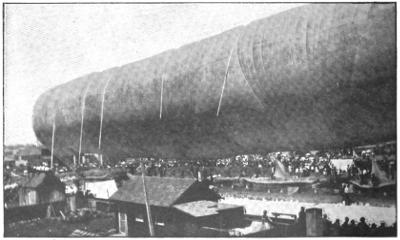
MORRELL’S MONSTER AIRSHIP BEING INFLATED, READY FOR ITS FIRST ASCENT, IN THE PRESENCE OF A VAST CROWD.
From a Photograph.
The National Airship Company established shops in San Francisco, and went to work upon the airship, which was named “Ariel.” The construction was under the direction of George H. Loose, who has had considerable experience in building aeroplanes and airships. It was intended that Loose should be first officer of the aerial liner, but, when the time for making the first ascent came, Loose wisely threw up his job, because Morrell had disregarded his advice in the construction.
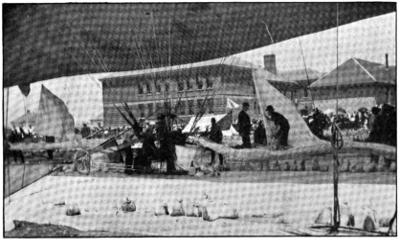
A NEAR VIEW OF PART OF THE AIRSHIP, SHOWING ONE OF THE ENGINES AND PROPELLERS—NOTICE THE FLIMSY NETTINGS AND THE MATTRESSES INTENDED TO SUPPORT THE CREW.
From a Photograph.
Nearly every well-known principle of airship construction was violated. The proportions were impracticable, the craft being four hundred and eighty-five feet long and having a diameter of only thirty-four feet. The gas-bag was like a huge snake, having no rigidity, either horizontally or vertically, and not being stiffened by trussing of any adequate sort. A gas-bag of such length and proportionately small diameter should have been strengthened by a vertical framework, or by trusswork of rope or wire, so as to impart rigidity; but nothing of this sort was done. The motive-power was supplied by six separate four-cylinder forty-horse-power automobile engines, hung below the balloon at intervals.
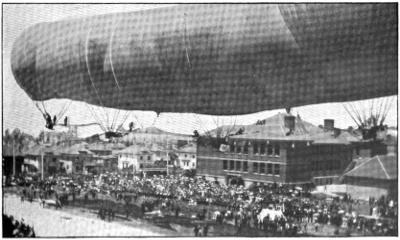
THE AIRSHIP LEAVING THE GROUND AMID THE CHEERS OF THE EXCITED ONLOOKERS.
From a Photograph.
These concentrated weights were carried on a platform, not of planks, but of mattresses, laid down on mere canvas, supported by the netting which covered the gas-bag. Ropes placed round the gas-bag at the points where the engines were situated cut deeply into it, and no arrangements whatever were made to meet the special stresses caused by the steering of so long-drawn-out an affair. Loose’s chief reasons for refusing to make the ascent were that if the envelope were filled with enough gas to render it rigid the emergency valves would open, and if these were tightened the envelope was liable to burst.
Serious as the various defects mentioned were, the most fatal one was the fact that nothing had been done to prevent collapse or deformation caused by sudden expansion or contraction of the gas from changes of temperature. The balloon was one great, undivided bag, containing from four hundred thousand to five hundred thousand cubic feet of gas, but having no compartments or internal air-bags. Its lifting capacity was from eight to ten tons, so that it was much the largest airship ever built in America, even exceeding in dimensions the great “dirigible” of Count von Zeppelin.
It might be supposed that it would be pretty hard to get together a score of persons who would be willing to risk their lives in such an unpractical affair as the Morrell airship; but, strangely enough, the greatest difficulty was experienced in keeping people off the craft. One man, a well-known aeronaut named Captain Penfold, repeatedly begged Morrell to let him make the ascent, but his request was flatly refused. Yet so eager was Penfold that at the last minute he smuggled himself on to the craft and went up with it and—a few moments later—came down with it.
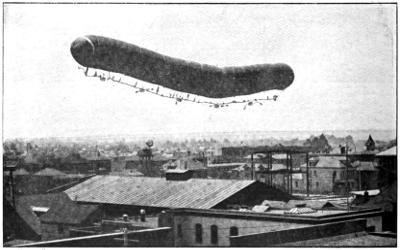
THE “ARIEL” IN MID-AIR. ITS NOSE HAD A DECIDED TILT DOWNWARDS, AND THIS INCREASED UNTIL ALL EQUILIBRIUM WAS LOST.
From a Photograph.
Some time before the attempted ascent was made the airship was conveyed from San Francisco across the Bay to Berkeley, in Alameda County, Cal. The trial trip was fixed for Saturday, May 23rd, and on that morning thousands of excited people were on hand to watch the ascent. The airship was released from its moorings and began to mount into the air, its nose having a decided tilt downwards. The machine had risen scarcely two or three hundred feet when the rear of the balloon had an upward inclination of as much as forty-five degrees.
Morrell shouted to his crew, consisting of engineers and valve-tenders, numbering fourteen or fifteen, to go aft, so as to depress the stern of the machine and cause it to resume its equilibrium. But the shouts and cheers of the people below drowned his voice so that he could not be heard. A moment later the gas rushed into the after-end of the bag with great force, bursting the oiled cloth of which the envelope was constructed, and the cheers had hardly died away before the horror-stricken crowd saw the great balloon collapse and come headlong to the ground, with its nineteen passengers, who included Morrell, eight engineers, five valve-tenders, two photographers with their assistants, and the aeronaut already mentioned.
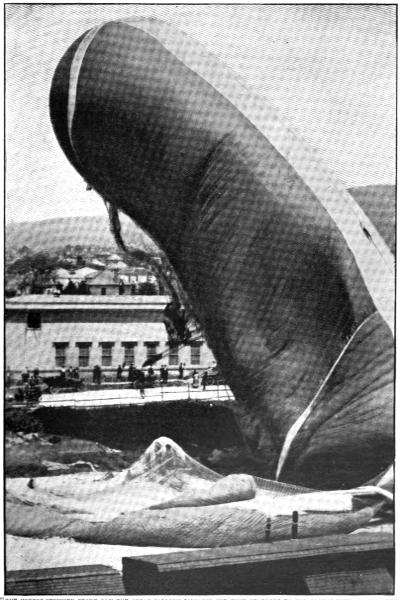
“THE HORROR-STRICKEN CROWD SAW THE GREAT BALLOON COLLAPSE AND COME HEADLONG TO THE GROUND WITH ITS NINETEEN PASSENGERS.” NOTICE THE VALVE-TENDER SCRAMBLING WILDLY ALONG THE NETTING ON TOP OF THE GAS-BAG; HIS AGILITY STOOD HIM IN GOOD STEAD, FOR HE ESCAPED ALMOST UNINJURED.
From a Photograph.
The unfortunate men were entangled in the wreckage of flapping cloth, network, and machinery, running the danger of being struck by the propellers of the engines or of being suffocated by the great volumes of escaping gas. One valve-tender, who was on the top of the great bag, can be seen in one of the photographs climbing along the netting. His agility stood him in good stead, for he escaped from the wreck almost uninjured.
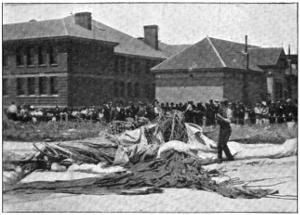
GATHERING UP THE WRECKAGE AFTER THE COLLAPSE OF THE AIRSHIP.
From a Photograph.
It might be supposed that nearly all the men on the ill-fated craft were killed; but, remarkable to relate, not one lost his life. Morrell himself sustained severe lacerations, and had both his legs broken by one of the propellers; Penfold, the persistent, had his right ankle and left instep broken; Rogers, an assistant engineer, suffered a broken right ankle; and another engineer met with broken ribs and ankles. Others were bruised or rendered unconscious by the gas.
Morrell ascribed the disaster to the fact that he was forced by impatient stockholders in the National Airship Company to make the attempted flight before he had worked out certain details of the vessel’s construction thoroughly. It is believed by those who saw the luckless craft that it was constructed flimsily of poor materials and not inflated sufficiently. The ill-starred aeronautic adventure not only cost many broken bones, but some forty thousand dollars (more than eight thousand pounds) in money.
It would naturally be supposed that so complete and disastrous a failure, after the expenditure of so large a sum of money, would have destroyed all confidence in Morrell as a designer of airships, and would have put him out of the business of aerial navigation for all time. But it was not so; the enthusiast still asserts that he has discovered the true principle of the navigation of the air, and that the National Airship Company is ready to proceed with the construction of another craft, much larger and costlier than the first one.
The new airship is to be seven hundred and fifty feet long and forty feet in diameter, equipped with eight gasolene engines, developing nearly three hundred and fifty horse-power and operating sixteen propellers. The inside bag will be of light silk and the outside bag of heavy silk interwoven with a material known as “flexible aluminium,” of which Morrell possesses the secret. The new balloon is to have more than a hundred compartments, many of which might be broken without disturbing the buoyancy or equilibrium of the vessel.
A rigid platform is to be substituted for the canvas and netting cage in which the unfortunate participants in the attempted ascent of the “Ariel” rode. The new vessel is to cost one hundred thousand dollars (more than twenty thousand pounds), and to be capable, if the inventor is to be believed, of a speed of a hundred miles an hour. The really marvellous things about the whole business are the unquenchable enthusiasm of the inventor and the unfailing credulity of those who believe in him.