Hunting the Hippopotamus.
Reading edition
By Lieutenant Paul Durand.
The hippopotamus—that enormous pachydermatous creature whose shape reminds us of the antediluvian monsters—was formerly met with over a large part of Africa, but it has been so pitilessly pursued by hunters that it is every day becoming scarcer and scarcer. Within a hundred years, perhaps, the hippopotamus will be numbered among the vanished curiosities of the animal world. In this article a French sportsman describes his exciting experiences while in quest of “river horses,” and furnishes a number of very impressive photographs.
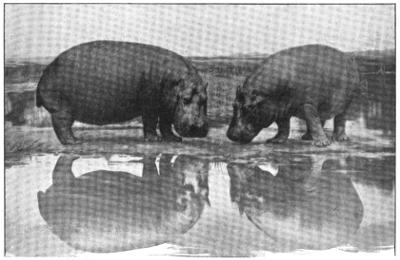
MALE AND FEMALE HIPPOPOTAMI ON THE BANKS OF AN AFRICAN RIVER.
From a Photograph.

Not many months ago the habitués of the Jardin des Plantes, the Paris “Zoo,” were much astonished to notice that one of their favourites—Jack, the hippopotamus—displayed signs of unwonted irritation. The change in the animal’s temper had been quite sudden. Hitherto Jack had been extraordinarily docile; now, whenever it became necessary to make him change his quarters, either for the purpose of cleaning the cage or to show him off to better advantage to visitors, he yielded with manifest surliness.
Then there came a day when the keeper in whose charge Jack had been for a great number of years found it quite impossible to induce the animal to leave his bath for the open enclosure, beyond the bars of which a score or two of nurses and children were eagerly waiting to feast their eyes upon him. The more insistent the keeper grew, the more did it become evident that the great, unwieldy beast was determined to try conclusions with its human tormentor. On his side the keeper was equally obstinate, but blandishment being clearly of no avail he resorted to more convincing measures.
Poor fellow, he little realized his danger! To the unutterable horror of those present the animal’s enormous jaws suddenly flew apart, disclosing a cavernous mouth and throat. By the time those jaws had closed again the unfortunate keeper had ceased to be numbered among the living!
Appeased, apparently, by this act of savage ferocity, Jack has since been as docile as he ever was. His diminutive, befogged brain had, no doubt, suddenly shown him, as in the mirage of fever, some dimly recognisable vision of the luxuriant African landscapes he was eternally severed from. He may—who knows?—have thought of other creatures like himself, lazily enjoying existence in sun-warmed, muddy streams, browsing at will on unspeakably luscious herbage. Then, perhaps, an illuminating flash of lightning rage showed him instantaneously the long tale of wrongs inflicted upon his dull-witted race by the white man. Because his ivory is finer-grained than that of the elephant and because it does not so easily become yellow, because his hide—cut into narrow strips—makes superexcellent sticks, not an instant’s respite from persecution is accorded to the poor “river horse.” Pitilessly is he harried and massacred, the hunter’s rifle vomiting forth a constant stream of bullets—“dum-dum,” explosive, or steel-pointed—to pierce the massive, narrow skull.
As a consequence of this ceaseless warfare the rivers are so rapidly becoming depopulated that the day cannot be far distant when, like the American buffalo, the African hippopotamus will be nothing but a memory. Possibly the domesticated “dark continent” of to-morrow will piously preserve in some park, national or international, a model herd of the only surviving representatives of this once prolific race. Learned men will then bring forward convincing arguments to prove the propriety of favouring the propagation of such useful animals; but the useful animals themselves, wearied out by the last years of their persecuted existence, will probably refuse to breed. Already the hippopotamus is scarce enough to make us realize some of the good that is in him. The knowledge has come too late; the “river horse,” it seems, is doomed to disappear. Under these circumstances, perhaps, the recital of my own recent experiences while hunting hippopotami may be found of interest.
To the African traveller the hippopotamus is a species of game particularly desirable, for its ivory and its hide are both valuable, while the not inconsiderable danger involved in its pursuit provides the delicious emotion without which every kind of hunting is tame and insipid. Moreover, the obligation under which the leader of the expedition lies to feed his servants and carriers adequately makes one of these enormous beasts, twelve feet long or so and disproportionately wide, a perfect godsend. Not only does the hippopotamus furnish a formidable amount of meat, but that meat has the inestimable merit of keeping fresh much longer than any other, principally owing to the fact that flies seem to have an insurmountable horror for it. I must admit that for a long time I thoroughly sympathized with the flies! Alive, the hippopotamus has a very peculiar odour, somewhat resembling musk, which discloses the presence of the animal from afar, when he happens to be to windward of one. In the flesh of the dead animal this odour—or the taste of it, rather—persists, and is much appreciated by the natives, though Europeans take a long time to get accustomed to it; some are never able to support it.
Once, when I was in the neighbourhood of the Chari River, my men informed me that a herd of hippopotami were in possession of a series of ponds not far from our camp. I immediately marched in their direction. As we approached the water we heard the trumpeting of the leader of the herd, and almost simultaneously caught sight of him. Erect on a small bank, his formidable mouth widely opened, he was uttering that characteristic neighing sound in which there are notes that remind one both of the lowing of a cow and the roar of a lion. On the surface of the ponds, moving quickly from place to place, were to be seen what appeared to be large balks of some kind of dark wood; these were the muzzles of the remaining members of the herd.
I succeeded in getting round the water unobserved to a spot where I was concealed from the animals by a small islet which occupied the middle of the pond. To this island I transported myself by means of a small and primitive canoe, which two of my men had brought on the chance of its being required.
By this time the old male had taken to the water again. The whole herd were now vaguely alarmed, for from my place of ambush I could obtain only fleeting glimpses every now and then of a muzzle momentarily showing itself on the surface of the water—just long enough for the animal to take breath—and then disappearing.
After waiting some time I grew impatient and began to salute each of these distant apparitions with a shot from my Express rifle. Nothing, however, is so deceptive as to shoot across water, especially when situated, as I then was, facing the sun; and I was not successful in lodging even one bullet in the targets I aimed at.
I then made up my mind to lie low for such time as might be necessary to reassure the animals. I had to wait some considerable time—certainly more than an hour; but finally my patience was rewarded. The old male, still swimming, was actually coming in my direction. His head, carried well clear of the water, presented a marvellous target at a distance of about twenty-five feet from me—a regular tyro’s shot. And yet something or other made my hand tremble, and as I pulled the trigger I realized that I had missed!
I also realized more than this. In order to make the effect of the ball the surer I had employed my largest gun, and I had given it a full elephant charge. The shock of the recoil was so tremendous that I was thrown on my back several paces away, with a feeling as if my shoulder had been put out of joint. When I got on my feet once more all the natives were shrieking with laughter, for this misadventure to their white master appeared to them highly diverting.
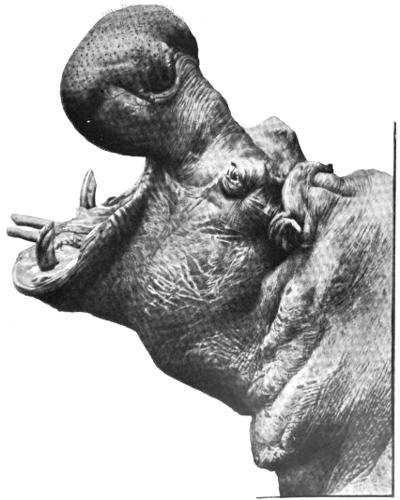
A GLANCE AT THIS TRULY FORMIDABLE PAIR OF JAWS WILL ENABLE THE READER TO REALIZE HOW IT IS THAT THESE GREAT BRUTES ARE ABLE TO DEMOLISH CANOES SO EASILY.
From a Photograph.
Meanwhile, in the pond a terrible scene was in progress. Maddened with rage and pain, the old hippopotamus was swimming furiously, first in one direction, then in another. Now he would mount on a sandbank, now plunge with a tremendous splash into the water, which was reddened with his blood. He was seeking an enemy on whom he might be avenged, and blindly pursued his fellows under the water. The ball had struck him in the chest, whereas the only immediately vital spot in the hippopotamus is situated just beneath the eye, the ball thence penetrating the brain. My bullet, though it had not killed him outright, must have caused terrible internal injuries, for very soon I saw him turn completely over several times, displaying successively above the surface of the water his head and his feet. Then, all at once, he sank and did not again reappear.
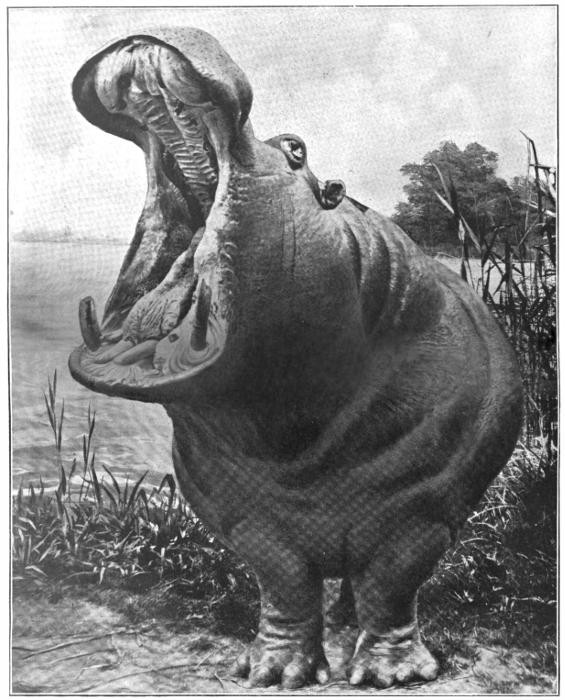
THE ALARM! A BOAT HAS APPEARED IN THE DISTANCE, AND THE GIGANTIC LEADER OF THE HERD ROARS OUT HIS WARNING.
From a Photograph.
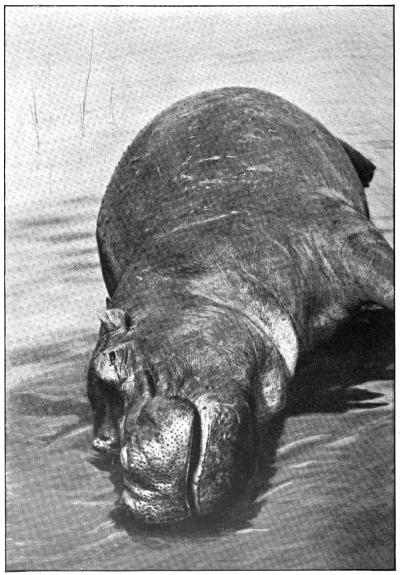
A DEAD HIPPOPOTAMUS WHICH HAS BEEN DRAGGED IN TO THE RIVER BANK.
From a Photograph.
A dead hippopotamus invariably sinks to the bottom, and it is only after an interval which varies between two and eight hours that the body rises and floats on the surface. For this reason, if you kill a hippopotamus in a river the current of which is at all rapid, you must, in nine cases out of ten, give up all hope of ever recovering your quarry. The carcass may be carried a great distance under the water, reappearing at the surface miles away, where it furnishes a providential feast to the native inhabitants on the banks, who call down ironical blessings upon the infallible rifle of the white man.
In the present instance there was no necessity for me to trouble about the carcass, which by the following morning, if not that very evening, I knew I should find floating placidly on the surface, waiting to be hauled ashore. In any case it would have been sheer madness to try to recover it at that moment, as the pond was infested with crocodiles.
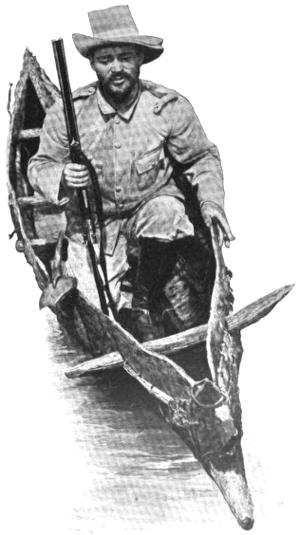
THE HUNTER DRIFTING DOWN STREAM IN A PRIMITIVE NATIVE CANOE.
From a Photograph.
That day every member of the unfortunate herd—there were six in all—fell a prey to my rifle; the massacre occupied about two hours in all. When I returned on the morrow half-a-dozen enormous carcasses lay stretched out among the aquatic herbs, some floating on the surface of the water, others stranded on the banks.
It was not without difficulty that I persuaded my men to carry out the ropes necessary for hauling in the carcasses that were out of reach, the pond, as I have said, being full of crocodiles. One of their number, however, at last volunteered to do the job. While he was engaged in his somewhat perilous undertaking the rest of the natives set up a chorus of the most atrocious howling it is possible to imagine, meanwhile thrashing the surface of the water, creating by one means and another so discordant a concert that the saurians, terrified no doubt out of their wits, must have sought refuge in the most hidden depths, for we saw nothing of them.
To cut up a hippopotamus is no easy task. In some places the hide is almost two and a half inches thick, and before you have got through a hand’s-breadth your knife has completely lost its edge, and requires to be resharpened. The head and the feet are put on one side to be preserved as trophies of the chase, while the remainder of the flesh is cut into long, thin strips which, after they have been dried by hanging them on the tree-branches, will keep good for a very long time. The ivory of the teeth and tusks, which is of very fine quality, used to be employed almost exclusively in the manufacture of false teeth; nowadays it is turned to all the purposes of ordinary ivory.
As for the hide, cut into strips it is made into sticks, which are as good defensive weapons as one could wish to possess. Treated with oil they become as transparent as tortoiseshell, and look quite pretty. Out of hippopotamus-hide bullock-drivers likewise make thongs for their whips which are positively everlasting, and fetch, relatively speaking, quite a good price.
In this particular expedition the only trouble I had was that involved in shooting the animals. Things do not always go off so smoothly, however, and hunting hippopotamus may turn out to be a more dangerous sport than almost any other.
On one occasion, when we were descending the course of the Chari in canoes, we perceived a number of the great beasts in the river, playing some clumsy sort of game among themselves and throwing up in the air jets of water, somewhat similar to those ejected by whales through their blow-holes. We could distinctly hear the animals’ powerful breathing.
Carried away by the nearness of the game, I forgot entirely how dangerous the pursuit of the hippopotamus may become when the hunter is in a boat.
Meanwhile we were advancing steadily, and every time a huge frontal bone or a giant muzzle appeared above the level of the water I pulled trigger. There were frequently quite long intervals, for the hippopotamus is able to remain over three minutes under water without coming up for breath.
Presently, out of the corner of my eye, I caught sight of a female and her little one on the river bank; then I saw her take to the water. My attention, however, was riveted on a spot in the river where I had seen an old male plunge. Every instant I expected him to reappear.
Suddenly, ere I fully realized what was occurring, I found myself projected upwards in the air with incredible violence. Before I descended I had time to see a gigantic jaw open wide, and then close with a snap on the unfortunate canoe which followed mine. An instant later I was in the water, striking out madly for the bank, almost persuaded that I felt the sharp teeth of a crocodile nipping off a thigh or an arm. I was fortunate enough to reach the shore, however, without mishap. Then we called over the roll. At first I supposed nobody was missing, but we soon perceived that our number was one short. We never saw the poor fellow again. Doubtless he had been injured when the jaws of the hippopotamus closed over his canoe, and was thus unable to reach the bank. At that moment, probably, a crocodile was devouring his body at the bottom of the river.
By dint of a few questions I was able to piece together what had happened. The female, thinking to defend her young, had thrown herself upon the canoe behind mine, and almost simultaneously the old male had emerged from the water with irresistible violence beneath my own craft, pitching me upwards. It was a very narrow escape, all things considered, and I can assure you that, for the rest of that day at least, we left the poor “river horses” in peace.