Volume 22 — The Promotion of Petroff.
Reading edition
By Maxime Schottland, Doctor Juris.
The amazing experience which befell a drunken old Russian bootmaker. "The events described occurred within my own cognizance while living in St. Petersburg," writes the author. "The episode could only have happened in Russia, unless there is any other country where the military caste is held in such veneration among civilians."

It was the birthday of Petroff, the bootmaker, and he had been celebrating it in the customary manner. That is to say, he had consumed so much of his favourite beverage, vodka, that he had now become hopelessly and helplessly intoxicated. In fact, so drunk was Petroff that the proprietor of the St. Petersburg inn where he had been soaking steadily all the afternoon had just turned him out into the street on the sufficient grounds that he could neither drink nor purchase any more liquor.
As poor Petroff staggered from the inhospitable doors of the inn, accompanied by the jeers of the remaining patrons, he fell into the arms of a couple of stalwart policemen.
"Lemme go," he protested, as the detaining hands tightened on his wrists. "I tell you I'm not—hic—drunk! I'm all ri'—shober as a judge, in fact. I want to go home."
The policemen laughed callously.
"You're going to the station with us," remarked the senior, with a grin at his comrade. "A night in the cells will cool your head, old man. Now, then, come along. Go quietly, or it will be the worse for you."
Petroff's legs swayed, and he would have fallen had not his escort, who were accustomed to dealing with such cases, held him tightly in their grasp.
The spectacle of the tipsy old man being led through the streets in custody promptly attracted a crowd, who followed the little procession at a respectful distance. Petroff turned his bleary eyes upon them, in the vain hope that they might light upon someone who would soften the hearts of his captors. Then another thought struck him with a chill feeling of dismay. If—as seemed certain to be his fate—he were locked up all night his wife would demand an explanation the next time he saw her. Mme. Petroff was a bit of a virago, and the drunken old reprobate had a wholesome terror of what might be in store for him if she got wind of his misbehaviour.
"Lemme go home," he whimpered. "I've a mosh important engagement—hic! My wife is waiting for me. It's all ri', I tell you."
The crowd laughed uproariously, as though they had just heard an excellent joke, while the policemen gave their prisoner a push forward.
Petroff wept bitterly. He was just going to burst into an angry denunciation upon their conduct, when his attention was attracted by a couple of officers in military uniform, who strode up to him with outstretched hands.
"My dear fellow," exclaimed the younger of the two, looking at him in a puzzled fashion, "what on earth is the meaning of all this? It won't do, you know. We must take care of you."
Petroff's eyes began to blink, and he pinched himself to make certain he was not dreaming. But no; everything was quite real. Here were two of the Czar's officers, whom he had no recollection of ever having seen before, actually claiming his acquaintance! Wonders would never cease! It was no time, however, for argument. Evidently the strangers meant him well, and if they were making a mistake he meant to profit by it. Shaking the speaker's hand, accordingly, he poured out his wrongs in an eager torrent.
The brilliant uniforms of the two new-comers had a magic effect upon Petroff's custodians.
"I beg your Excellency's pardon," said one of them, with a deferential salute, "but we found this—er—gentleman drunk in the streets, and we thought it best to take him to the station. May I inquire if you know him?"
The officer nodded.
"Certainly," he returned. "We know him very well indeed. In fact, he's a neighbour of ours. I'm afraid he's had too much to drink. We'll take charge of him, though, and see him safely home. Here's something for your trouble," he added, slipping a couple of roubles into the other's hand.
"Please call a cab, and we'll take the professor to his rooms," observed the second officer, who had not yet spoken.
Petroff smiled affably. It was much pleasanter to be called a professor than a drunken old man.
"It's all ri'," he exclaimed, delightedly. "These gentlemen are—hic—old friends of mine. We'll all go home together—see?"
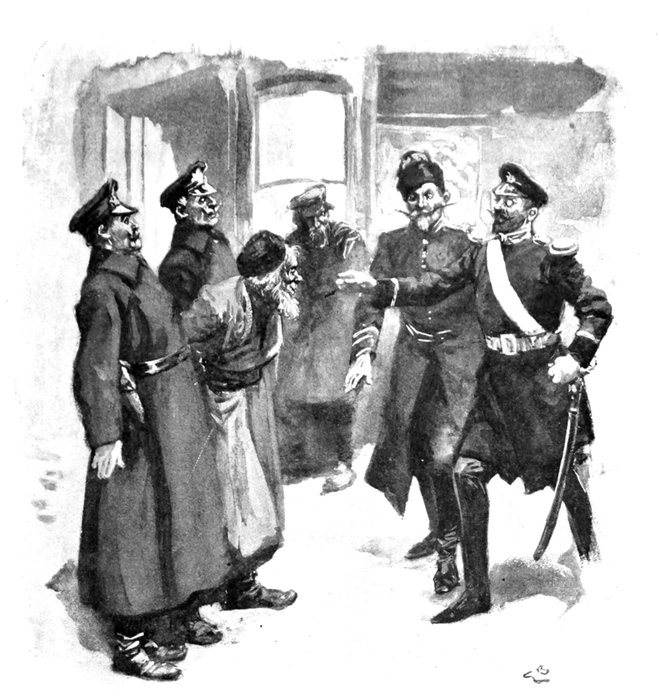
"'MY DEAR FELLOW', EXCLAIMED THE YOUNGER OF THE TWO, 'WHAT ON EARTH IS THE MEANING OF ALL THIS?'"
The two policemen, their last doubts dissipated by the promptitude with which the officers claimed their charge's acquaintance, acquiesced readily enough. A cab was procured and Petroff and his new-found friends installed therein, while the coachman was directed to drive to an address in a fashionable neighbourhood.
As the vehicle started off, Petroff looked at his deliverers with fresh wonder.
"Where have I met you before?" he murmured. "I don't seem to remember. Did you ever come to my boot-shop? If so, I mush have been drunk!"
The officer thus addressed shook his head gravely. "We had the honour of meeting your Excellency when you served in the army."
Petroff looked more puzzled than ever.
"The army?" he repeated. "What do you mean? I'm not a soldier. I'm a bootmaker."
The two officers exchanged glances.
"I beg your pardon for venturing to contradict you, sir, but the Czar has just been pleased to promote you to major-general in appreciation of your distinguished services."
Petroff smiled happily.
"It's the first I've heard of it," he murmured.
"I fancied, sir, that you might have been celebrating the appointment already," was the grave response. "We shall, however, be honoured if you will join us in a little refreshment. Our house is close at hand."
"Certainly, my friends. I was going to have a drink when those rude policemen interfered just now."
As the old man spoke the cab drew up at the door of a handsome building. The next moment Petroff found himself being ushered into a beautifully-furnished room. Here the first thing upon which his eyes fell was a sideboard covered with bottles and glasses.
"How perfectly lovely!" he exclaimed, clasping his hands in ecstasy. "You don't know how thirsty I am. But what house is this?"
"It is your house, general."
The bootmaker's eyes blinked.
"Who's a general?" he demanded, truculently. "I won't have you make fun of me."
The senior of the two officers bowed deferentially.
"Your Excellency is pleased to jest. Of course you are a general. As, however, it is only to-day that you were appointed one, it is quite possible that the fact has escaped your memory."
Petroff's momentary anger evaporated at the speaker's apologetic tone. After all, it was much better to be a major-general than a bootmaker, and he was not going to quarrel with his good fortune.
"I did forget it for the moment," he returned, "but I'll remember it now. If I'm a major-general, though, I must have something to drink, eh?"
"Certainly, your Excellency," replied the other, as he uncorked a bottle of vodka and poured out a brimming glass. Petroff sat sipping it happily, when the second officer came over to his chair and saluted.
"Will your Excellency be pleased to dress now?" he remarked. "It is time to get into uniform." Then, without waiting for the old man to recover from the surprise which this announcement created, he brought forward a richly ornamented tunic, together with the remaining items of a general's uniform. Petroff gazed at the clothes in awe; he had never seen so much magnificence in his life.
As his two companions proceeded to make his toilet for him he could do nothing but murmur, "I'm a general." At last he had repeated the statement so often that, in his befuddled condition, he almost came to believe in it.
"I suppose I am really a general?" he remarked, as his companions assisted him to buckle on his sword.
"There is no doubt of it, your Excellency," replied the senior. "Let me introduce myself as Major Romanoff, and my colleague here as Captain Marckovitch. We have been appointed to act as your adjutants, and shall be pleased to carry out any orders you may give us."
Petroff laughed delightedly. This was a thousand times better than being a bootmaker and getting locked up for taking too much vodka.
"Very well, then; if I'm a general I must have another drink," he declared, stretching out his hand towards the table.
The fiery spirit seemed to touch a chord of memory.
"But what about my wife?" he demanded, suddenly. "Does she know I'm a—hic—general?"
"Certainly, sir. In fact, she has been trying to find you all day."
Petroff's face paled.
"What does she want?" he gasped.
"Merely to offer your Excellency her congratulations."
Here was a new mystery.
"That's very strange. She never wanted to—hic—congratulate me before."
"But she has only just heard of your promotion, sir."
The look of dismay faded from the old man's countenance, and a placid smile took its place.
"I must buy her a present," he declared.
"Yes, sir. That is why we are going out. Your wife will have to be presented at His Majesty's next reception, and you must accordingly order her some suitable jewels. Captain Marckovitch and I will be very pleased to conduct you to a firm where you can obtain such diamonds and other articles as will be necessary."
Petroff gulped down another glass of vodka. Under its stimulus his mind was working rapidly.
"That's all very well, my friends, but how am I going to get the money to pay for them? I spent my last rouble in the inn where the policemen found me."
Major Romanoff nodded.
"We have not yet had time to draw any funds from the Treasury on your behalf. Everything will be all right by to-morrow, though. In the meantime my colleague and myself will see that you are supplied with whatever you may be pleased to order at any shop. As the afternoon is drawing in, I would propose that we set out for a drive at once in your carriage."
Petroff rubbed his eyes in amazement. It seemed that surprises would never cease.
"But I haven't got a carriage," he protested.
"Pardon me," said Captain Marckovitch, "but your Excellency's establishment includes a carriage and pair. It is already waiting at the door. Will it please you to make a start just now?"
"All right! I suppose I can't say anything better than that, can I?"
Captain Marckovitch bowed.
"Certainly, that will do admirably. In fact, sir, it's the only thing you need say while you are with us. Perhaps you will graciously pardon me if I take this opportunity of once more reminding you that, as your appointment is so—er—recent, it would perhaps be best if you permitted yourself to be guided by Major Romanoff and myself."
Petroff wagged his grey head with an air of profound wisdom. "Quite so. You tell me what to say, and I'll say it."
The senior adjutant bowed gravely.
"I was going to suggest that, sir. We are now all going out together to make some purchases for your Excellency's wife. While we are in the different shops it will not be necessary for you to say anything but 'All right' whenever your opinion is asked. You see, sir, your previous experience has almost entirely been gained on the field of battle. In fact, you have only just returned from a campaign."
"Have I?" interrupted the old man. "'Pon my word, I don't recollect it very clearly."
"Your Excellency was wounded in action," observed Captain Marckovitch, suavely. "Your memory may not return for a day or two. Still, you have only to say 'All right.'"
"Yes, I can remember that."
There was only time for a parting glass of vodka, and as Petroff drained the last drop in the bottle all his qualms disappeared. He felt determined to show the whole of St. Petersburg that he was as fine a major-general as any that the army of the Czar contained. The whole way down the stairs and out into the courtyard he kept repeating to himself, "I'm a general. All right."
A splendidly-appointed carriage was in waiting at the doorway. As the trio entered it, Major Romanoff gave the liveried coachman the address of a jewellery establishment in the Nevski Prospect. A few minutes' drive brought them to the door. The moment they alighted the manager and his assistants, dazzled by the magnificent equipage and uniforms of the party, came forward to receive their illustrious patrons with deferential bows.
Major Romanoff went up to Petroff, who had sunk heavily into a chair.
"Shall I explain your Excellency's wishes to Mr. Gorshine?" he inquired.
The manager rubbed his hands briskly. The unknown patron was an Excellency, then!
"All right," said Petroff.
"Perhaps I might be permitted to show his Excellency a selection from my stock," suggested Mr. Gorshine.
"Quite so," said Captain Marckovitch, hastily. "You must, however, please understand that his Excellency does not wish to spend more than two hundred thousand roubles this afternoon. The general," he added, sinking his voice a little, "is not feeling very well, so perhaps you had better make all the arrangements with Major Romanoff and myself."
Mr. Gorshine nodded comprehendingly.
"I understand perfectly, sir. His Excellency shall not be inconvenienced at all. Now, what can I have the pleasure of showing you?"
"His Excellency wishes to buy a diamond tiara and other jewellery for his wife. He would also like some rings and bracelets. Show us the best that your stock contains."
The manager beamed with delight, and, hastily unlocking a large safe, produced tray after tray covered with beautiful gems. The two adjutants inspected their contents hastily, and put aside the finest for a more detailed examination.
"How will this suit?" inquired Captain Marckovitch, picking up a magnificent tiara.
Petroff, who was feeling drowsy after his plentiful consumption of vodka, pushed it away with a lordly gesture.
"All right," he exclaimed.
"Then his Excellency approves of it?" inquired the delighted manager.
"Certainly, Mr. Gorshine; you have just heard him say so," declared Major Romanoff. "Pack it up."
"I'm feeling very thirsty," murmured Petroff. "Why doesn't somebody give me a drink?"
The obsequious jeweller rushed forward.
"Pray allow me to send for refreshments," he begged.
Captain Marckovitch nodded meaningly towards the chair where Petroff was sitting.
"Perhaps I ought to have told you that the general has a little weakness," he said. "His Excellency has only lately returned from a hot climate, and—well—you understand, no doubt."
The jeweller bowed.
"Entirely so, sir," he whispered. "In fact, a brother of mine, who is also in the army, cannot stand the slightest——"
"Besides," interrupted the adjutant, "we must make every allowance for so distinguished an officer. Apart from his bravery in action, it is well known that his kindness of heart, his thoughtfulness, and his generosity are proverbial. All the presents that he is buying now are intended for his wife."
"Yes, I'm going to give them to my wife," said Petroff, sharply. "She'll be so pleased that she'll forgive me. Now bring out some more. It's all right."
Mr. Gorshine wanted nothing better. Here was a customer who showed a lordly indifference to price, and who approved of everything set before him. Clearly a profitable afternoon was in store. Accordingly, he exerted himself to ransack the shelves and show-cases of their finest gems. These, after being critically inspected by the two adjutants, were passed over to their companion, who, for his part, contented himself with drowsily murmuring "All right."
At last, when goods to the estimated value of two hundred thousand roubles had been set aside, Major Romanoff declared that enough had been exhibited.
Mr. Gorshine bowed again. He had done a very fine day's work and nothing was to be gained by being too greedy.
"Might I venture to inquire his Excellency's name?" he hazarded.
Captain Marckovitch looked at him haughtily.
"I am surprised that you do not recognise the general," he remarked. "This is his Highness the Prince Savanoff, who has just returned from special service in the Caucasus. He is at present occupying an appointment at the Imperial Court."
"That's all right," murmured Petroff.
The jeweller was almost overcome with confusion at the slip he had made. Not to be familiar with the name of Prince Savanoff—the illustrious soldier whom all Russia was honouring just then on account of his distinguished services in the Caucasus—indicated a quite abysmal ignorance.
"Of course, I recognise his Excellency's name," he protested, humbly. "I had not, however, seen a photograph of the Prince."
Major Romanoff bent his brows.
"The Prince is as modest as he is brave. On this account he has never permitted his portrait to appear in the papers."
"Ten thousand apologies," exclaimed the contrite Mr. Gorshine. "And now, sir, is there anything else I can have the honour of showing you?"
"I will inquire," said the other, as he shook Petroff by the shoulder. "Is your Highness satisfied with what you have already chosen? If so, perhaps I had better take the jewels to the palace and let her Highness, your wife, decide which she will retain. Then, when I return, you can pay Mr. Gorshine for what she wishes to keep."
"All right," muttered Petroff.
The adjutant turned to the smiling jeweller.
"Very well, then. As time presses, I will start at once. His Excellency and Captain Marckovitch will remain here to await my return. The carriage is outside, and I can get to the palace and back in less than half an hour. Please pack everything up very carefully."
"Certainly, sir. If her Highness would like me to change any of these ornaments for others I shall be only too pleased to do so. Might I also beg, sir, that you will use your influence with the Prince to secure me an appointment as jeweller to the Court? Perhaps his Excellency would sign my application now?"
The major shrugged his shoulders and glanced at the somnolent Petroff.
"I'm really afraid," he answered, in a low tone, "that his Highness is scarcely in a condition to sign anything at this moment. Still, I will remember the matter. I should prefer, however, to speak to the Princess about it first. After all, these jewels are for her, you know."
"Quite so," was the prompt reply. "I will not detain you any longer."
As he spoke the manager picked up the velvet-lined cases and followed the adjutant to the carriage. When it disappeared from sight he went back into the shop, full of delight at the excellent stroke of business he had accomplished.
"A charming afternoon, your Excellency," he remarked.
Petroff gave vent to a long-drawn-out snore and dropped his head on the counter.
"The Prince is a little fatigued," observed Captain Marckovitch, apologetically. "He is not used to buying jewels. Perhaps you will be good enough to make out your bill, and it can be settled when my brother adjutant returns with her Excellency's decision."
"Certainly, sir. I will see about it at once."
Withdrawing to the counting-house, Mr. Gorshine spent a pleasant quarter of an hour totalling up the cost of the various articles which had been selected on approval. A smile of content spread over his features as he saw the substantial amount to which it came. Even if Major Romanoff brought back half the goods there would still be a handsome profit on the transaction. Certainly, Prince Savanoff was the sort of customer he would like to see in his shop every day in the week.
Presently he returned and handed the itemized account to the adjutant. Captain Marckovitch cast a cursory glance over it, and then put it down with a careless gesture.
"I expected it to be a good deal larger," he said, airily.
Mr. Gorshine began to reproach himself for not having added twenty-five per cent. to every item. The Prince would have paid it, he felt sure. However, it was no good wasting time on vain regrets. Accordingly, he began to speculate what would be the best position in his showroom for displaying the coveted certificate appointing him Court jeweller. A quarter of an hour passed in this fashion. Mr. Gorshine looked at the clock pointedly. The evening was coming on, and it would soon be time to close the premises for the night.
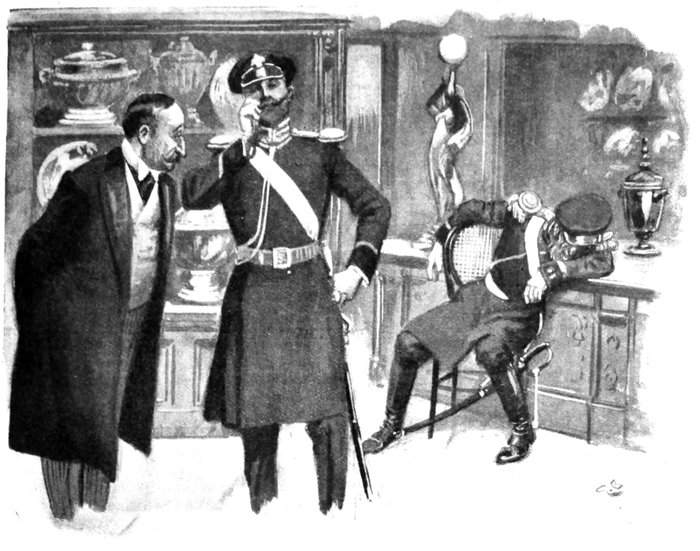
"'THE PRINCE IS A LITTLE FATIGUED,' OBSERVED CAPTAIN MARCKOVITCH."
"Major Romanoff is longer than I expected," observed Captain Marckovitch, taking out his watch.
"Perhaps he has not found her Excellency at home," suggested the other.
"I dare say you're right. It is quite possible, too, that her Excellency was out shopping when the major reached the palace. In this case he will naturally have decided to wait until she returns."
"Oh, naturally," agreed the jeweller.
Another twenty minutes went by. Despite all his efforts to appear at ease Mr. Gorshine began to feel a little disturbed. Several possible explanations of the delay occurred to him, the most likely one being that the Princess might have decided to see the general before making up her mind.
The adjutant interrupted his train of thought.
"I'm afraid it's not very far off your usual closing time," he remarked.
"We generally close at seven, sir."
The captain glanced at his watch again.
"It is now half-past six. If I start at once I can get to the palace and back by seven. Would you like me to drive there and explain that his Highness the Prince wishes her Excellency to make an immediate decision? Then, if by any chance I find she has not arrived, I will come back with Major Romanoff and the jewels."
Mr. Gorshine felt almost overwhelmed at such condescension.
"I could not think of troubling you, sir," he protested. "I will send one of my assistants."
"I'm afraid that won't do," returned the other, with a laugh. "You see, only an officer of the Guards would be admitted to the palace at this hour, and as I feel that I ought to relieve your very natural anxiety I will go myself. By the way, on no account disturb his Excellency during my absence. It would make him very angry, and he might cancel his order."
"Certainly not, sir."
"Very well, then, I'll start at once. Be good enough to call a cab with a fast horse."
Secretly overjoyed at having the matter thus settled, but volubly protesting his disinclination to trouble his illustrious patron, the jeweller escorted the captain to the door and saw him into a cab. Then he returned to the showroom, where a group of assistants, with smiling faces, were watching the still snoring Petroff. As the manager came up to his chair he opened his eyes sleepily.
"It's all right," he murmured.
Darkness began to fall. It was too late to expect any more customers. In fact, the usual closing hour had already gone by and the assistants were beginning to get restless. Mr. Gorshine went to the doorway a dozen times and peered out into the street. On each occasion, however, he returned to his desk in disappointment. There was no sign of either Major Romanoff or Captain Marckovitch.
"What can have happened to his Excellency's adjutants?" he said. "They ought to have been back here long ago."
The principal assistant blew his nose thoughtfully.
"It's a long way after closing time, sir. I really think we ought to awaken his Excellency."
Mr. Gorshine, mindful of Captain Marckovitch's injunction, would not hear of such a thing.
"On no account," he exclaimed. "If we did so, his Highness would be certain to cancel the order he has given us."
At the end of another half-hour, however, the jeweller decided that it would perhaps be better to take his assistant's advice after all. There was just a possibility, too, that the Prince might catch cold. Besides, he ought to be back in the palace by this time for dinner. Accordingly he went up to him deferentially and laid a respectful hand upon his epauletted shoulder.
"I beg your Excellency's pardon," he said, "but your adjutants have not yet returned, and we wish to close the establishment now. If you will graciously permit me, I will see you back to the palace."
"All right," muttered Petroff. "I'm a general."
"Certainly, your Highness; but this is closing time."
The vodka mounted to Petroff's brain, and he began to get angry.
"Go to the devil!" he shouted, rising unsteadily to his feet. "I'm a general, I tell you. I want a drink. If you don't let me have one I'll put you all in prison!"
"Oh, pray forgive me!" exclaimed the manager, regretting his boldness. "I did not mean to inconvenience your Excellency. I merely wished to point out that it is closing time, and that perhaps you would like to return home."
A gleam of intelligence crept into Petroff's eyes.
"Yes, I want to go home," he murmured. "I want to see my wife."
"Then pray permit me to escort you. I will send for a carriage at once."
"All right," was the sulky response.
Although the keen night air sweeping up the open street sobered him a little, Petroff was still somewhat unsteady on his feet. Mr. Gorshine and a couple of assistants, however, managed to get him into a cab.
"Will your Highness have the goodness to give me the address to which you wish to be driven?" inquired the manager, deferentially, as he took the opposite seat.
With some little difficulty Petroff remembered the obscure quarter of the city in which he lived, and repeated the name and number of the street. Mr. Gorshine heard the answer in amazement, convinced that there must be some mistake. His companion, however, showed such an inclination to become argumentative that he finally decided to humour him, and they set off for the address indicated.
At the end of half an hour's drive the cab stopped in front of a squalid-looking house in a mean little side-street, far removed from the fashionable quarter of the city.
"It's all right," declared Petroff, glancing out of the window. "Here we are. Don't let my wife get angry with me. Tell her it wasn't my fault."
The jeweller smiled reassuringly, as the other clung to his arm and led the way up a steep flight of stairs. At the top floor Petroff stopped and fumbled with his latch-key.
"Don't wake my wife," he whispered.
As he spoke, however, the door was flung suddenly open, and an elderly woman, brandishing a stick, rushed out into the passage.
"There you are, then, you wicked old drunkard!" she exclaimed, shrilly. "I'll give you something for stopping out all this time. See if I don't!"
"Please don't let her hit me," shrieked Petroff, trying to hide behind his companion.
"Pardon me, madam, but his Highness is unwell," protested the jeweller, quite at a loss to account for this extraordinary reception.
Mme. Petroff burst into a peal of derisive laughter.
"Unwell, is he?" she retorted. "He'll be worse presently, I can promise you!" Then her eyes fell on the magnificent uniform her husband was wearing.
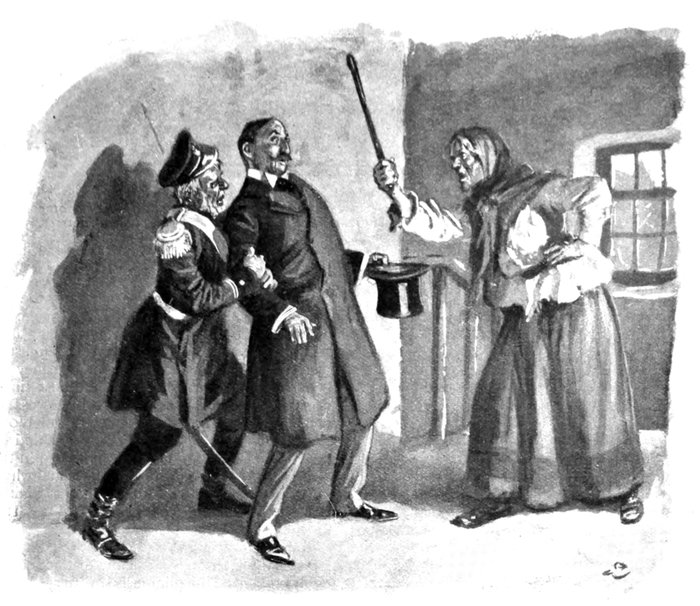
"'PLEASE DON'T LET HER HIT ME,' SHRIEKED PETROFF, TRYING TO HIDE BEHIND HIS COMPANION."
"What drunken freak is this?" she cried. "How dare you dress up as an officer, you silly old guy?"
Mr. Gorshine's face grew suddenly pale.
"I beg you not to be angry with his Highness," he exclaimed. "His adjutants, Major Romanoff and Captain Marckovitch, will probably be here directly."
Mme. Petroff snorted indignantly.
"I believe you're drunk, too. Since when, pray, has my husband been a Highness? He was Petroff, the bootmaker, this morning."
Mr. Gorshine sank into a chair, overwhelmed with horror.
"What?" he gasped, as soon as he found his breath. "Is not this his Highness Prince Savanoff, the famous general?"
"The famous fiddlestick," returned the other. "He's no more a Highness, and a Prince, and a general than you are yourself. He's a rascally, drunken old bootmaker, who disgraces the name of Petroff."
With the angry woman's shrill laughter ringing in his ears the unhappy jeweller staggered from the room and rushed down the stairs. He could think of nothing but the loss he had just sustained. By reporting the matter to the police at once there was a bare chance that some of the property might yet be recovered.
The superintendent of police, however, to whom he poured out his story, could not offer him much encouragement. It was clear that he had been made the victim of a singularly audacious robbery. The only thing that the authorities could do was to arrest Petroff as an accomplice. As, however, there was no evidence to connect him with the theft, he was, after a week's enforced sobriety, permitted to return to his wife.
This was comforting for Petroff, perhaps, but it was anything but pleasant for the hapless Mr. Gorshine, who never saw his jewels or the two "adjutants" again.