Volume 22 — The Humours of a Rectorial Election.
Reading edition
By "One of the Electors."
Some of the customs in vogue at American Universities are startling enough, but it comes as a surprise to learn that the authorities of an ancient Scottish foundation, aided and abetted by the police, countenance such extraordinary doings as are chronicled in this topical article. The writer describes the Glasgow University Rectorial Election of 1905, in which he took part as an official of one of the clubs concerned.

On October 24th of this year the students of Glasgow University will choose for themselves a new Lord Rector. Already announcements have appeared in the Press that the candidates are Lord Curzon (Conservative), Mr. Lloyd George (Liberal), and Mr. Keir Hardie (Socialist).
Triennially the public reads in some obscure corner in its newspapers that a Rectorial election is in progress in a Scotch University, that the fighting is fiercer than ever before, and that damage has been done amounting to hundreds of pounds. The reader, according to his viewpoint, either swiftly ejaculates a condemnation of such barbarous practices or grins as he detects what he takes to be newspaper exaggerations. The real facts behind all this the general public never learn; they never realize what a strange anachronism a Rectorial election is.
Fancy carefully-organized fighting, with a hundred or two hundred young men on either side, ending in the wrecking of the premises of the losers—to the breaking down the plaster of the walls and the tearing up of the floor—all countenanced by staid University authorities and countenanced, too, by the police department of a municipality that prides itself on being the most up-to-date in the country! Indeed, the police not only countenance the business but actually assist by sending forces of men to the scene of operations to ring round the arena, keep back the crowd, and often to hold up the electric cars and other street traffic while the rival parties push the claims of their respective candidates vi et armis! In the exigencies of the campaign, moreover, many deeds are done with perfect impunity by the students which would be seriously visited on less favoured mortals—for example, the cutting through of main water-pipes, carrying the supplies of whole blocks of buildings.
The good people of Glasgow are, for the most part, not at all inclined to withdraw this licence. They are, on the contrary, rather proud of the sacrifices they make in order that old customs may be kept up, and their complacency and good-humoured tolerance are almost inconceivable to people of non-University towns.
That the readers of The Wide World Magazine may realize what lies behind the fragmentary reports which they will find in their newspapers this month I shall relate what I know of Glasgow Rectorial elections, and particularly of the last election in November, 1905, in which I was specially concerned.
In most other Universities in these days the Rectorship is a purely academic distinction, probably conferred unanimously by the students. In Glasgow, however, it is still decided on political grounds.
In the University there exist two permanent clubs: the Glasgow University Conservative Club and the Glasgow University Liberal Club, the constitutional purpose of each of which is to effect the election of a Lord Rector of its own political colour.
For three years—since the last election—these clubs have been scraping money together. The election will cost each side from two to four hundred pounds, and the size of the fight they put up and their output of election literature will be on the scale of the funds in hand. Needless to say, most of the money comes from party sources and private subscriptions outside the University, but owing to the extraordinary nature of the campaign no accounts are ever made public. Like Tammany Hall and other efficient political "machines," a despotism is absolutely necessary. The entire control of the money is vested in four, or three, or even two students, and no questions are ever asked as to the uses to which they think best to put it.
At the beginning of the session preceding the election the presidents of the clubs, with great secrecy, approach various leading men of their parties, and finally fix on candidates. In the second half of the session, about February, the candidates are announced, and soon afterwards the Conservative and Liberal Rectorial Committees are formed. These committees are large, numbering, perhaps, fifty in each, though, as I have said, the actual executives are very small. Each committee is divided into three sections—the canvassing, the literature, and the physical force.
The conveners of these sub-committees are busy all through the summer vacation with preparations for the coming fray, forming their plans, inventing ruses, and intriguing for various advantages.
The campaign commences in earnest as soon as college reassembles in the third week of October, and continues in a wild whirl of excitement for a fortnight, until the day of election. Then all the leading men, haggard and nearly dead with fatigue and the incessant strain, go to bed and sleep for twenty-four hours. The day after the election the 'Varsity is as quiet and peaceful as the most select young ladies' seminary.
This is the invariable course of events. On the particular occasion I am about to describe—the election of 1905—the candidates announced in the spring were Lord Linlithgow (Conservative) and Mr. Asquith (Liberal). The Liberals had lost the last election badly, but the reaction against the Government gave them high hopes of pulling their man through on this occasion.
The summer, apart from the publishing of one magazine by the Liberals, was, as usual, a time of public inaction, but secret preparations. The clubs rented two large shops—almost next door to one another, by mutual arrangement—in a street near the University. These were the "committee rooms," and were practically the head-quarters from which the fighting was done. They were prepared for occupation by (1) removing all partitions and throwing the shop itself and the rooms behind into one large, bare apartment. (2) Taking out all fittings, even to the fire-grates. (3) Taking out the windows and filling their place with very massive, buttressed barricades, having loopholes high up. (4) Leading in special water supplies and fitting hydrants for hoses. In addition, the cellars are stocked with great cases of pease-meal, made up into paper packets of convenient size for throwing. A piano was also placed in each of the committee rooms.
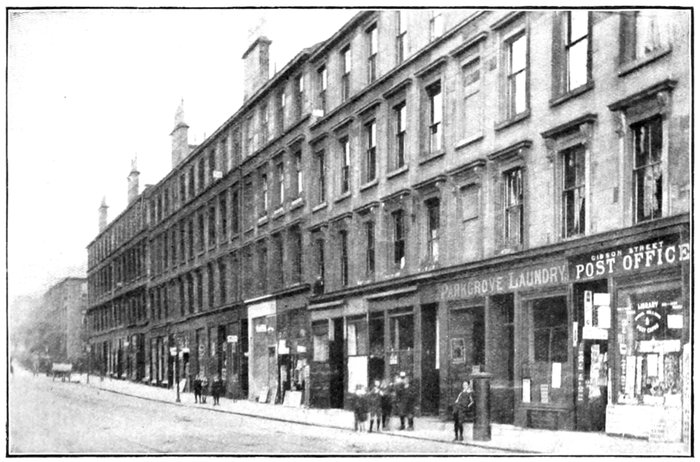
GIBSON STREET, GLASGOW, WHERE BOTH COMMITTEE-ROOMS ARE INVARIABLY SITUATED—IN THE LAST ELECTION THE CONSERVATIVES USED THE PREMISES OF THE LAUNDRY SHOWN AT THE RIGHT OF THE PHOTOGRAPH, WHILE THE INTERNAL ROOMS WERE TWO SHOPS HIGHER UP THE STREET.
From a Photograph.
About the 20th of October students rattled back to their Alma Mater from all parts of the country with an eager lust for the coming fray. For myself I can solemnly say that the ensuing fortnight was the happiest time I have ever had. The abandon, the madness of it; the fiercest possible fighting and raiding, with a minimum of serious injury; and behind it all, on both sides, the greatest good-humour—all these are impossible to describe. Only students, I imagine, could fight such wild, lunatic fights with never a lost temper.
The Glasgow University Conservative and Liberal Clubs hereby agree to the following arrangements for the conduct of the Rectorial Election.
1. The Rooms of the Clubs shall be used for Fighting on and after October 25th, with the exceptions hereafter mentioned.
2. Pianos shall be held inviolable.
3. There shall be no Battering Rams used or similar appliances whose use is dangerous.
4. Matriculation and Class Tickets shall not be taken.
5. Fighting shall be with "open doors," i.e., no insuperable obstacles shall be placed in the doorway.
6. Gas fittings shall be inviolable.
7. Canvassers and Canvass Sheets shall be inviolable.
8. The evenings on which Smokers are held by either Club shall be truces.
9. Truces shall exist till half-an-hour after all other meetings.
JOSEPH DAVIDSON, Hon. Secy., G.U. Conservative Club.
J. C. WATSON, Hon. Secy., G.U. Liberal Club.
THE "ARTICLES OF WAR," PUBLISHED BY BOTH CLUBS IN THESE MAGAZINES.
The atmosphere was something different from the rest of life; it was like a slice out of the Middle Ages. Up all night and sleeping during the day, life became for us a complicated mass of plottings and intrigues, ambushes, wild chases in cabs, men spying on other men and in turn being shadowed themselves. Last, but by no means least, there was the unholy but very real joy that comes of the unlicensed destruction of property. A Rectorial election is the shortest road to romance in this prosaic modern life that I know of.
The canvass, though very efficient, is comparatively routine work, and naturally neither particularly novel nor interesting. I shall pass it over and deal mainly with the fighting. There were four chief features in the fighting—"painting raids," "regular battles," "magazine captures," and "bus fights."
At this election some attempt was made for the first time to restrain and organize the fighting. It was thought that it would be better to have something in the way of fixed battles by mutual agreement rather than or in addition to the constant running fight. Consequently truces were frequently arranged, except at the times fixed on for battles. These truces, however, were technically held not to inhibit painting raids.
The front of each of the committee-rooms was, of course, loudly painted with the party colour—red for the Liberals, blue for the Conservatives. A painting raid meant stealing out at dead of night, with paint-buckets and brushes, and daubing the enemy's rooms your own colour.
Our opponents, however, sometimes received information beforehand in some mysterious way. The painters would be softly busy, with a whish-whish of brushes, chuckling to one another, when suddenly, without a whisper of warning, two deadly streams of water would pour an irresistible cross-fire from the loopholes and sweep painters, chairs, and ladders to the ground in a confused, dripping mass. Then there was much spluttering and vociferation, and, if possible, the contents of the paint-buckets were made to shoot through the loopholes. The barricades, however, were invulnerable, and the hoses could not be withstood. If the enemy are prepared for a painting raid there is little to do but retire.
In this sort of work it was pretty well give-and-take; both sides painted and were painted. The raids, however, ceased once the regular fighting commenced.
This happened a few days later, when the "articles of war," here reproduced, were published by both clubs in their magazines.
The "open doors" article was new. It came of past experience. If the massive doors of a committee-room were closed, obviously the only way of getting at those inside was with axes and heavy rams, with results and risks, in excited hands, rather more serious than the clubs were prepared to face. It turned out a wise step, for it had the effect of making the fights more physical and good-humoured, and in all probability prevented a great deal of serious injury and wounding.
The article about pianos was, strangely enough, strictly kept. It was a striking sight at the end of a "wrecking" to see the piano standing unhurt and immaculate amid a chaos of torn flooring and broken plaster.
The matriculation and class tickets of a student are what make him eligible to vote, and would cost at least four guineas to replace. To make war on these would be a shabby way of winning an election.
Though it was the "open season," so to speak, after October 25th very little fighting was done by the rank and file except at the battles. The clubs concentrated all their energies on these. The occasions were arranged beforehand, and there were four altogether.
On the evening of the first battle students arrived in the oldest rags they could lay hands on. A great crowd of spectators also turned up, the time of the engagement having leaked out. The crowd was kept back by a force of policemen. Inside the rooms busy preparations were going on. Boxes of pease-meal bags were hauled up from the cellar and served out to all hands—if you were clever you might manage to carry ten of these most effective missiles. The hoses were fixed up and tested, while men who were not willing to submit even the worst clothes they had to the combined effect of pease-meal and water stripped until they were clad only in the sparsest of underwear.
The Liberals—of whom I may as well confess at once I was one—divided their force. About two-thirds were detailed for attack, and the remainder had to stay by the rooms and defend them in case of need. This boldness was because we had been assured by our scouts that we were largely in the majority. The Conservatives, realizing their weakness, only threw perhaps a quarter of their number outside.
A few minutes before the hour the attacking forces lined up opposite their doors, facing one another. They looked a queer lot, in most grotesque attire—the first pease-meal bag ready in each man's right hand, their figures bulging with the remainder. In the rooms the defending forces were massed at the open doors, while at each loophole were two men controlling the nozzle of a hose. These waited anxiously, for the result of the collision of the outside forces determined whose rooms were to be attacked.
On this occasion, however, there was little doubt. The odds were so clearly against the Conservatives that, unless they had some stratagem up their sleeve (which was always very possible), it was decidedly to be the Liberals' night.
The good-natured and even sympathetic police-inspector in charge capped the official sanction by consenting to blow his whistle to start us. He stood, watch in hand, with the whistle between his lips and his eyes on the minute-hand. Dead silence prevailed all around.
Suddenly the whistle shrilled out, the crowd shouted, and the two forces rushed at one another, the narrowing space between them netted with the parabolas of pease-meal bags, which burst like shells where they struck. The concussion of the adversaries took place somewhere in the midst of a dense cloud of fine yellow dust. But out of that cloud, in the direction of the Blue rooms, there emerged a writhing bulk of men. It was body to body now; there was throwing only on the outskirts.
The Liberals were as three to one, and the Blues were crumpled up and driven before us. Our advance was irresistible; there was no stand or halt until they had retreated right into their rooms. In less than thirty seconds from the whistle we were in the Conservative doorway.
But there we stopped, for all their defence was opposed to us. In that doorway there was a tight, breathless jam—as severe an experience as I ever want to have. Our own men from the outside and the Tories from the back poured in a steady fusillade of pease-meal, of which the doorway was the focus. The pease-meal bag does not injure, but if it explodes in the face it fills mouth, nose, ears, and lungs with its nauseous, choking dust. Here there were hundreds bursting within a few square feet. The atmosphere was unimaginable.
With eyes tightly shut—one could not see an eighth of an inch if they were open—jammed off one's feet, and with a roaring in the ears, we remained there, unable even to think, but possessed with one insensate idea—to shove, shove, shove, whenever we could get the slightest purchase.
And presently the hoses were at it. The enemy had brought them away from the loopholes (where they were useless) and taken them back into the room. From there they played relentlessly on the jam in the door, the solid jets striking like rods of iron.
Behind us there were gusts of charging that shook our wedged mass. Parties of half-a-dozen would run back ten yards and then hurl themselves in a solid body at the pack. But still the Tories defended their citadel most pluckily, holding on to the doorway with desperate tenacity.
But steps were being taken to help us. In the Liberal rooms a small party of trusted men descended to the cellar. There, by crawling through holes and breaking down brick partitions, they arrived at length at the foundations of the block of buildings. Here they found a network of water-pipes, but to fix on the one which led to the Conservative rooms was a difficult job. While they were still hesitating, word came down to them that their men in the street above were having an awful time with the hoses. A big main pipe was obvious, and one of the band, equipped with an axe, speedily severed it.
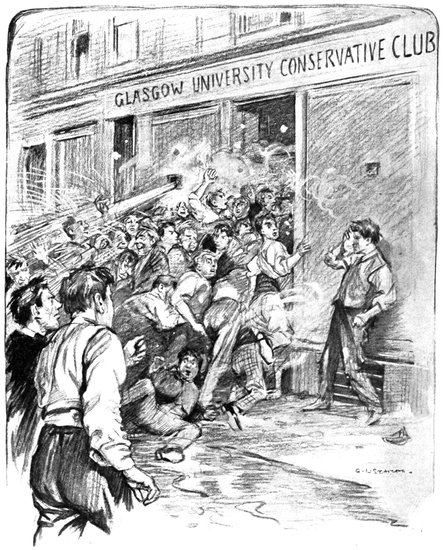
"IN THAT DOORWAY THERE WAS A TIGHT, BREATHLESS JAM."
Meanwhile, up above, the streams of water were playing splendidly. They could not break the jam, but they prevented and smashed up any attempt at organized effort on the outskirts of the attack. Suddenly, however, they stuttered, leapt out high, and then fell to the merest dribble. From our packed ranks there rose a muffled growl, which was meant for a cheer. With the chief obstacle removed—it is wonderful how a hose deters men—we began steadily to gain.
That terrible jam had lasted for nearly half an hour. The men in the forefront of the attack had long ago become exhausted, but unlimited energy came from behind. I felt myself scrape along the wall. Suddenly the resistance in front gave way and we staggered forward, our mass opening out like a fan. In another instant we were all inside.
Personally, I was content to lie on the floor in a corner; my eyes were bloodshot, and my nose bleeding from inhaled pease-meal. But fresher men set about the wrecking of the premises, and presently I, too, joined them with zest, while the defeated Conservatives looked on indifferently or jokingly proffered assistance.
The unsophisticated reader may think there is little to destroy in a room with bare walls and floor, but we found quite a lot. There was the woodwork to tear off, the plaster of walls and ceiling to be broken and poked down. The doors were detached and thrown in the Kelvin, a very convenient river, along with much other stuff. The gas-pipes for obvious reasons were inviolable, but much of the water-piping was destroyed, and in addition two hoses, a large supply of pease-meal, and a storming platform were captured and transferred to the Liberal rooms.
Thereafter a joint smoking-concert was held in the Liberal rooms, as being in their present state more comfortable, and both sides had a very jolly and friendly time, not at all disturbed by a party of policemen and plumbers, who came round with some strange story of a burst pipe they had to locate.
Two days later the second fight took place. The Reds were again in a large majority, and forced the Tory rooms in less than twenty minutes. Very little had been done in the way of repairing damages, and there was, consequently, not much scope for the wreckers. Nevertheless, there were some who were not discouraged, but did their best under the circumstances. If a barrel of dynamite had been exploded in the rooms they could not have looked more forlorn and dislocated than they did after this second visitation.
The third fight took place very late in the evening, because it followed a Liberal meeting in the St. Andrew's Hall, addressed by Mr. Lloyd George.
The Conservatives acted on the defensive all through this fight, and never left their rooms. For over an hour we tried to effect an entrance, but all in vain. We were baffled by a clever system of railing, rigged up to lead from each side of the door into the middle of the room. Almost across this passage was a platform. To enter the room one had to traverse this nine or ten feet of narrow gangway with the enemy massed behind the railing on each side, and dead in the face of a powerful hose which was stationed on the platform and had a clear sweep down the passage. Moreover, a special, inaccessible water-pipe, which our underground scouts were unable to discover, had been led into the building.
It was an impossible task. After many weary efforts we gave it up, and this fight was declared a draw.
The fourth was the last fight. We had so far had all the advantage. The enemy's rooms had been twice wrecked; ours were untouched. In this last fight the Tories made a big effort to equalize, while, for our part, we were rather slack.
The result was that for the first time they outnumbered us. At the very start we were swept off our feet and beaten back to our rooms. Our water supply was cut off, leaving only a feeble trickle, which was refreshing rather than otherwise. For an hour and a quarter we held them out; then we broke, and five minutes later the interiors of the two committee-rooms were as like each other as—well, as they were like anything.
In addition to these fixed battles there were constantly little skirmishes in which half-a-dozen or fewer might be engaged on each side. These mostly centred round attempts to capture the literature of one party or the other.
The literature was inviolable at the printers' and inviolable when it was up at college and being distributed, but it was liable to be seized at any point in transit. The respective printers are, of course, pledged to secrecy, and, to do them justice, for staid commercial men they enter into the spirit of the thing with uncommon zest. So much so, that on one occasion two genuine young Liberals, who had been sent for some printed matter with insufficient credentials, were suspected by our wily printers of being Tory spies, and were accordingly decoyed into a room, locked up for an hour or so, and finally unceremoniously bundled downstairs.
But, though the firm may be thus zealous, there are always employés in a large works who are approachable, and, having unstinted money for bribing, the enemy often get secret information as to when a magazine may be expected to come out.
During this campaign, however, though there were many exciting cab chases and encounters, the prize always escaped with its rightful owners. There was no single delivery of magazines or bills captured from either side. Once our magazine was only saved by a ruse. Just at the time of dispatch a party of Tories was observed in waiting. The convoy was not strong enough to run any risks, and had to use their wits to save the precious publications. A large number of cabs was promptly summoned by telephone from the nearest cab office. They all gathered round the printers' door. Into one of the cabs the magazine was carried and hidden. All the vehicles then drove off simultaneously in different directions. Of course, the right cab escaped.
The literature of the campaign, I may mention here, is delightful when one is "in the know." Unrestrained personalities are bandied backwards and forwards in elegant Billingsgate with quite remarkable freedom, but for the most part with perfect good-humour.
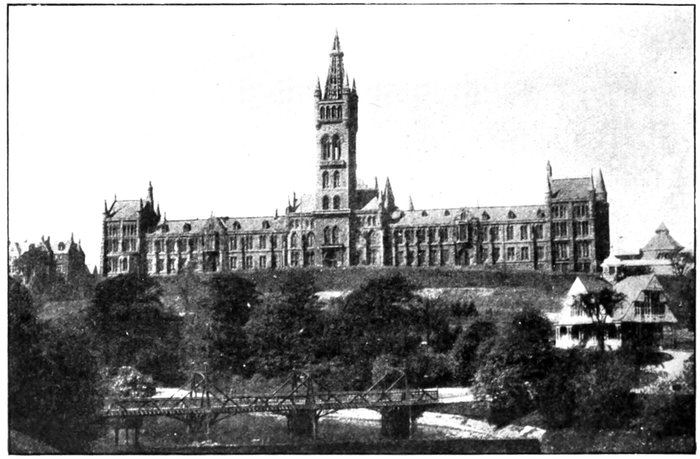
GLASGOW UNIVERSITY—IT IS ON THE TERRACE IN FRONT THAT THE FINAL BATTLE RAGES ON ELECTION DAY.
From a Photograph.
The Liberals, being in funds, published eight full magazines during the campaign, the Conservatives not so many. Only professional journalists will appreciate the strain on amateurs of putting forth a series of eight or twelve-paged magazines at intervals of a couple of days.
I have all the magazines before me now. They are full of cleverness both in writing and caricature, but they are so essentially topical and personal that it is difficult to make extracts that would be understood by the non-University reader.
At length the final day of the struggle came round. The election took place on the first Saturday in November. At an unearthly hour of the morning parties of Reds and Blues were out pasting their bills all over the town, on whatever flat surface they could find. These parties met sometimes, and bills were captured or lost and paste used as an offensive and defensive weapon.
An hour or two later began the last feature of the campaign—the bus fights.
Between seven and eight in the morning each club sends anything from a dozen to twenty buses to outlying parts of the city and to all the principal railway stations. Nominally, and probably originally, these buses were meant to collect voters. Now their chief mission is to hunt and destroy one another.
Each bus is manned by about a dozen men. It carries also a few boxes of pease-meal, but not many. There is a new weapon to-day, in abundant rows of cardboard boxes—rotten eggs. Up to the day of election it is considered bad form to throw anything but pease-meal. But on election day everything is permitted—soot, red and blue ochre, and, above all, rotten eggs.
When two hostile buses sight one another—and that is no very rare occurrence, since they are dispatched to the same districts—the crews descend and fight in the streets, unless the crew of one bus sees itself outmanned, when it may fly and be chased at breakneck speed, to the consternation and dislocation of the regular street traffic. Otherwise the crews fight in the street until one of the parties is beaten and forced back into its bus. They must defend this, whip up the horses, and try to escape. On the other hand, the assailants endeavour to cover the approach of one of their number who carries a long sharp knife. It is his business to cut the traces and prevent the enemy's escape.
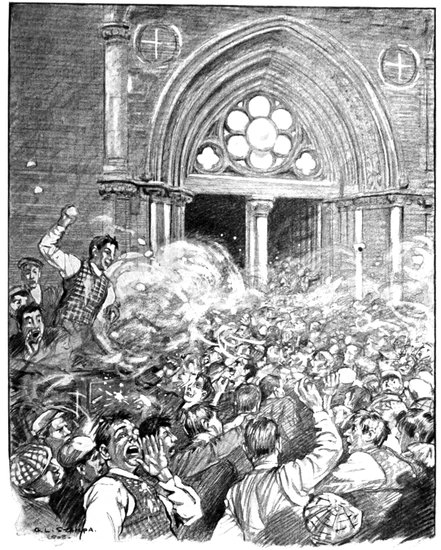
"WE SURGED ROUND THE 'FRONT' IN A PERPETUAL RUGBY 'SCRUM.'"
If they are successful in doing this they put the vanquished bus hors de combat altogether by cutting the harness to pieces and sending the grinning driver back to the stables with the horses. The bus on which I was had the good fortune to win its first fight. The combat was long and doubtful, and, incidentally, it took place in one of the busiest streets in Glasgow. All the time it lasted policemen held up the traffic on either side. When we had finished there were rows of electric cars packed behind one another, up the street and down; half Glasgow seemed to be waiting patiently while a score of young men exchanged hostilities.
When the battle was over we gave the policemen a hand to drag the dismantled bus of our enemy up a side-street. After that we were joined by a crew of Liberals who had been dispossessed in a similar manner. Thus brought to double strength, we soon scored another easy victory. Then we had a long stern chase after a fugitive bus. It ended fruitlessly, because we were overloaded.
Finally we made our way to the University, where polling was in progress all the forenoon.
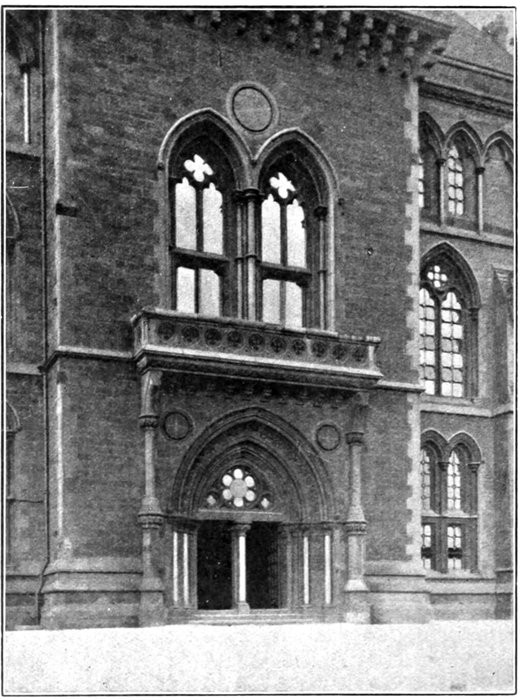
THE MAIN ENTRANCE TO GLASGOW UNIVERSITY—FROM THE BALCONY ABOVE THE RESULT OF THE POLL IS DECLARED.
From a photograph.
A pease-mealy, egg-plastered crowd we were, as we surged round the "Front" in a perpetual Rugby "scrum." The game here was to get possession of the doors and pass only your own men in. The Liberals succeeded in doing this for a time, but out came the Clerk of Senate and announced that unless the formation were broken the election would cease. As we had only sporting reasons for this policy—we knew we were going to win; the canvass had shown that—we dropped it, and, apart from a few local centres of disturbance, and the perpetual pease-meal, soot, and rotten eggs, we became quite pastorally happy and peaceful. The election goes by a majority of "nations." There are four of these nations—Glottiana, Rothesiana, Transforthiana, and Loudoniana. Every student belongs to and votes in one of these, according to his birthplace. Thus it is possible for a majority of votes to lose the election if they happened to be massed in one nation.
The result is announced about one o'clock from the balcony. The "Front" is packed with buses and carriages swarming with students. Long rows of hansoms contain the "Q.M.'s"—our girl students. They vote as well, but at their own college. I have not said anything about them during the campaign because all they do is to canvass and make rosettes.
Presently the white-bearded figure appeared on the balcony. For five minutes it was hopeless for him to attempt to speak. Then his lips moved and his beard wagged, and instantly there began a gradual, slow-swelling yell of terrific volume. Those near who had heard his words shouted them to those far off: "Asquith is in in four nations!"
Then the buses careered wildly round the town for an hour or two and the good folk of Glasgow grinned tolerantly, as is their way. Last of all we went home. It was finished, and we were dying for a long, long sleep.
In conclusion, for those who wish to follow the Rectorial campaign at present in progress in Glasgow, I would point out that by a rearrangement which has just come into force the session now begins on October 9th, and the election will take place on October 24th, instead of in November as heretofore.