Volume 22 — A White Woman in Cannibal-Land.
Reading edition
By Annie Ker.
Some incidents of a lady's life in the wilds of New Guinea. Miss Ker went out to Papua—as the country is now called—attached to a mission, and describes the many strange, amusing, and exciting experiences she encountered during her seven years' sojourn among the natives, who, not so very long ago, were always fighting and much addicted to cannibalism—a practice which still prevails among the wild tribes of the unexplored interior.
I.

When, nine years ago, I first set out from Melbourne bound for British New Guinea—or Papua, as it is now officially called—I had very vague ideas about how to reach it, or what it would be like when I got there. I knew that New Guinea was a large island lying off the extreme north of Australia, and that the part I was going to was a little south of the Equator, but that was about all. However, I was told that I should catch a boat at Sydney which was sailing for Samarai, the island port of Papua, and that there I should be met by the schooner of the Anglican Mission. I might have to finish the journey in a whaleboat, I was informed, so my belongings had better be packed in small boxes. Thereupon I set off, armed with a thousand tabloids of quinine, a defence against malarial fever, which everyone in Papua contracts more or less badly as a matter of course.
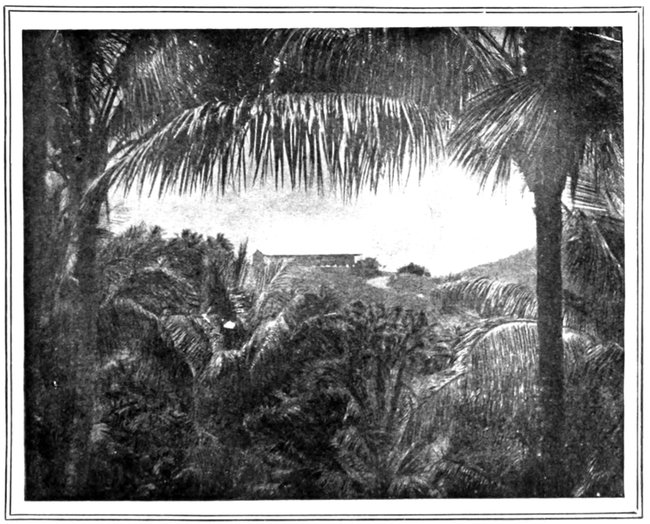
THE HOSPITAL AT SAMARAI, THE PICTURESQUE CAPITAL OF PAPUA.
From a Photograph.
Although the distance was not very great, the voyage took nearly three weeks, for we certainly did not hurry. The captain was a cautious old man, and every night, during one "reefy" part of the trip, our anchor went down at six o'clock, not to be hauled up till the same hour next morning.
Then, too, instead of making for Samarai, we rounded Cape York and visited Thursday Island, where we remained for some days. Moreover, after calling at Port Moresby, on the south coast of Papua, we deliberately went sixty miles out of our way to land some members of the Roman Catholic Mission at Yule Island, their head station.
But at last, one morning, we reached Samarai—and a very pretty little place I thought it, though it is now much altered by the addition of a number of stores and Government buildings. One of the latter, the hospital, is shown on the previous page. Four little hills rose in the centre of the tiny island, surrounded by a picturesque, though unhealthy, swamp. Gorgeous crotons blazed with crimson and gold in the tropical sunlight, and thick clusters of palms—coco, areca, and sago—swayed gently in the wind, while their stiff leaves rustled in a most misleading manner, imitating a heavy shower of rain. Papaw trees hung their graceful sprays of waxen blossom, or stood upright under their load of ripening yellow fruit.
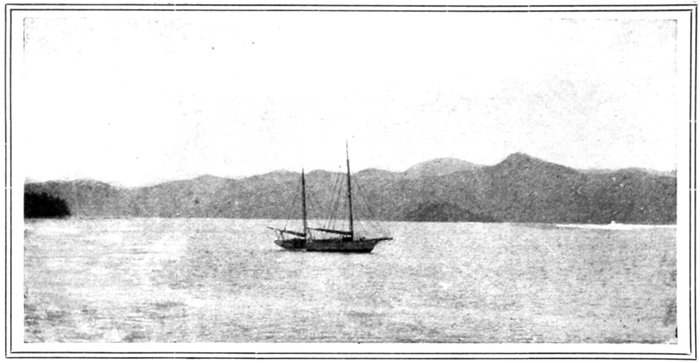
THE LITTLE VESSEL IN WHICH MISS KER COMPLETED HER LONG JOURNEY.
From a Photograph.
When the schooner eventually arrived, after some little delay, she began to load up with stores, comprising food (mostly tinned), trade goods, and medicines. After this was accomplished I went on board, and the last stage of my voyage began. I had not been on a sailing vessel before, and though I tried hard to believe we were actually moving, the breeze was so light that it required a great effort. On subsequent journeys I learned to be thankful if we did not actually retreat instead of advance, for one morning I woke and heard the captain say, "We're ten miles farther back than we were last night!"
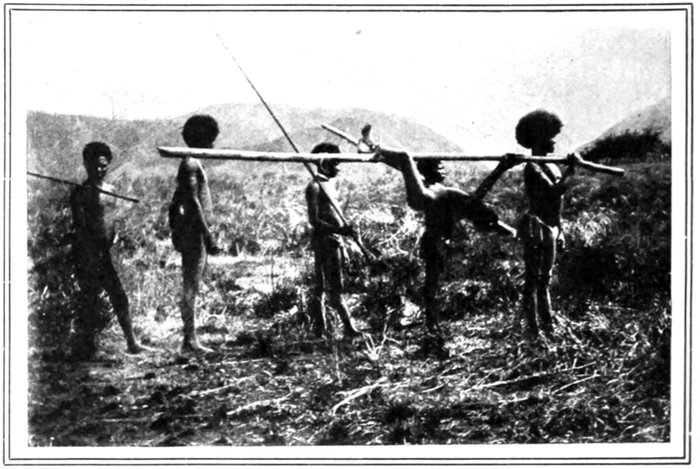
THIS PHOTOGRAPH SHOWS HOW PRISONERS WERE CARRIED OFF THE BATTLEFIELD IN THE "BAD OLD DAYS," TO BE AFTERWARDS COOKED AND EATEN.
However, we drifted peacefully along the coast, with an unvarying mountain range in the background, looking as though gigantic tiger-skin rugs had been thrown over it. The natives, I was informed, had produced this effect by burning the grass when hunting boars and wallabies. Occasionally we would pass groups of coco palms, which denoted the existence of a village beneath them. Then, one morning, quite suddenly we found ourselves at our destination, and I stepped ashore to be surrounded by crowds of excited natives, to whom the advent of a white woman had not lost the charm of novelty.
The village of Wedau, where I disembarked, had been, not many years before, the scene of frequent cannibal feasts. The Wedauans had lived in a state of continual feud with the hill-folk and other tribes at a distance, and had sallied forth on various occasions to fight with them on any convenient "merewa" or battlefield. The photograph here reproduced shows a group of natives on an old "merewa," and illustrates the method by which hapless captives were carried off the field in the bad old days, to be afterwards cooked and eaten.
The victim, sometimes only stunned or wounded, was lashed by the hands and feet to a stout pole, which was borne on men's shoulders through the village. Sometimes several of these unhappy wretches were captured at a time, and the treatment they received before being mercifully killed was cruel to a degree. Samuela Aigeri, a Wedauan Christian, once related to me incidents of great barbarity which had taken place in the village in connection with the slaughter of a man taken prisoner by the villagers. The poor wretch asked in vain for water to drink, and was stoned and otherwise tormented for a considerable time before being given the coup de grâce. This was customary.
I soon discovered that European housekeeping in Papua is charmingly simple. Everything arrived in a tin, for the most part ready for use. Meat, milk, butter, vegetables—all stood in tins in neat rows in the storeroom. A diet of tinned stuffs grew rather monotonous at times, but we were able occasionally to vary it. Sometimes a man would arrive with a live turtle, which he would sell for two sticks of tobacco, costing threepence. The wretched turtle would be killed and cut up, but would still insist on quivering in a most realistic manner even when placed on the fire to cook. Then, too, if the season was a good one, the kitchen would be found lined with joints of wallabies, and it would be hard to know what to do with so much fresh meat.
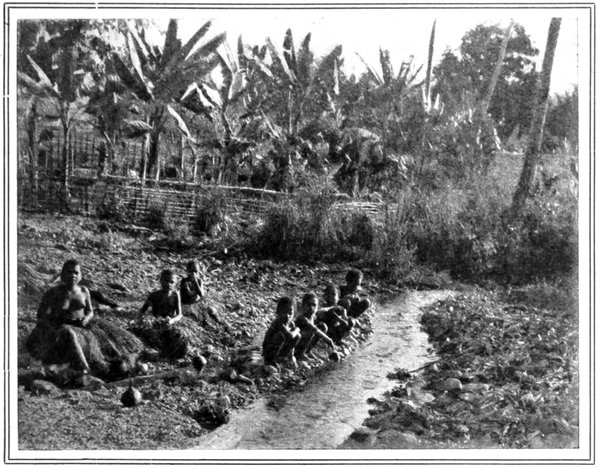
NATIVES FILLING WATER-BOTTLES AT A STREAM.
From a Photograph.
I remember once thinking that smoked wallaby would be a change, and I asked the little cook-boy if he could get some done for me. He assented willingly, and bore a leg off to where he said there was an "ovo" or platform for smoking meat. In a few days it was returned to me and looked most appetizing. We cut a dish full of delicate slices, and were just about to set it on the dining-table, when I thought of asking the cook-boy how it had been prepared. He told me quite cheerfully that he had given it to an old leper woman, who, being ill, could not leave the house, and so was sure to keep the fire alight. It was she we had to thank for so kindly smoking our meat. Needless to say, the dish did not appear on the table that night.
Girls as well as boys learned cooking when at the mission station. One girl was considered a very good cook, so much so that on one occasion she was trusted to prepare a meal by herself, as everyone had gone for a picnic. She was told to make rissoles of what she found in the safe. The pudding, a Christmas one, was to follow.
At evening the party returned and sat down, hungry and tired, to eat. Surely, they thought, the rissoles tasted rather peculiar. However, they were eaten, and demands made for the pudding.
"But you have had the pudding," was the model cook's answer; "it was in the rissoles!"
Laundry work was sometimes carried on under great difficulties. At one station the water supply was some distance away, and was brought weekly by bullocks which dragged a heavy "slide" on which our pails stood. The bullocks were occasionally obstreperous, on which occasions the supply of water was sadly diminished. Moreover, when it was safely placed in the laundry the ducks hastened thither and bathed luxuriously in each tub, leaving behind them cloudy water plentifully besprinkled with feathers. At night our girl boarders, feeling thirsty, would ask if they might drink from the tubs and would gratefully receive permission to do so, quite undeterred by the fact that many ducks had bathed in the water, which, I should have mentioned, was so "hard" that no soap ever formed a lather. It may be imagined, therefore, what the clothes looked like when returned from the wash.
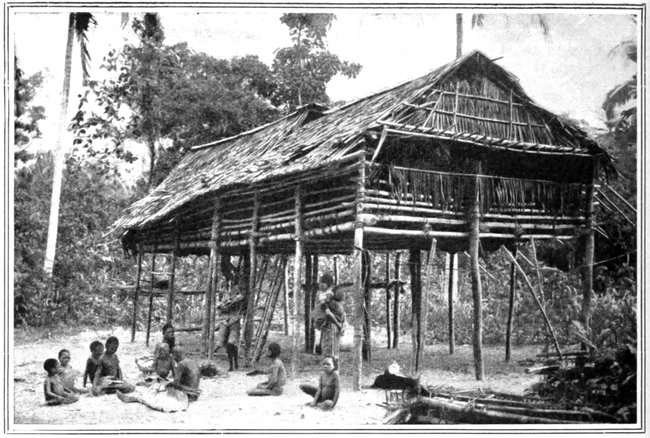
A TYPICAL NATIVE HOUSE.
From a Photograph.
Papuan marriage customs are interesting and rather intricate. In Collingwood Bay, for instance, the bride is mourned over for some days beforehand by her girl friends, who are losing their playmate. Then she is dressed in her best, presented with many gifts, and a procession is formed to take her to her new home.
The bridegroom is never to be found on his wedding-day. It is etiquette for him to go hunting or on some expedition which will take him from the village. His relatives, however, look after his interests and hasten the lagging footsteps of the wedding procession by lavish bribes. On arriving at the house the bride and her maids of honour enter and remain for the night, while the elders return home.
In the morning the poor little bride is deserted by her girl friends and betakes herself to sweeping her new domain with a handful of coco-nut bristles for a broom, thus officially acknowledging her marriage. After cooking a great pot of food she waits for the elusive bridegroom, who tarries only till the sun sets, when he joyfully returns after his voluntary exile and, alone with his wife at last, partakes of the marriage meal.
Medicine-men are regarded with great respect by the natives. Those I have met certainly seemed energetic and hard-working. They sit close to the patient, massaging the seat of pain with much vigour, and, while they are thus rubbing, make a noise with their lips rather like that which a groom makes when rubbing down a horse. The process is a tiring one, and the medicine-man stops at intervals to drink hot water in which taro has been boiled. His object is to extract some mysterious foreign substance from the sick man's body, and if he succeeds in this he receives a fee, otherwise he gets nothing. "No cure, no pay" is apparently the Papuan sufferer's motto.
On one occasion a medicine-man was attending to a patient outside a house in the village. The natives sitting round told me he had already extracted a pebble from one invalid and another cure was about to take place. I expressed a wish to see the next stone which should be removed, and waited patiently while the medicine-man rubbed on. At last he stopped and, with clenched fist, called upon me to watch. This I did, and he slowly opened his hand and, disclosing an empty palm, cried triumphantly, "It is gone!"
The natives were much impressed, but I must say I should have preferred one glimpse of the magic cause of disease before it vanished.
The weather in Papua is divided into two seasons only—wet and dry. The former is the summer, the latter the winter, but very little difference in temperature is noticeable. During the wet season thunderstorms may be expected, and some of these are truly terrible. I have seen even a white man look alarmed as great claps of thunder, following on vivid flashes of lightning, seemed to be cleaving asunder the roof over our heads. When to these are added strong wind and sheets of driving rain, the situation becomes distinctly unpleasant.
Like all savage races the Papuans have many superstitions, which appear to vary according to the tribe. The Wedauans, for example, had a belief that most of the unseen spirits around them were actively malignant.
There was a certain kind of eel which must not be eaten, or probably a disastrous flood would follow, while if a native wanted to cut down a tree he had to beware lest there was a kokome (dryad) living in it. If the kokome were annoyed it might cause the offender's face to swell and his skin to prick.
One of the worst possible offences against hidden powers was breaking a "tabu." "Tabu" was placed on all sorts of things—perhaps a certain coco-nut palm, or across a path. It was usually made of two upright sticks, with a crosspiece, on which were hung coco-nut leaf and husk. This was called an "iribubu," and was safeguarded by an incantation. It took a very reckless man or woman to disregard an "iribubu," for unless the enchanter was willing to accept a bribe he would not remove the charm, and the victim, so the natives thought, must die.
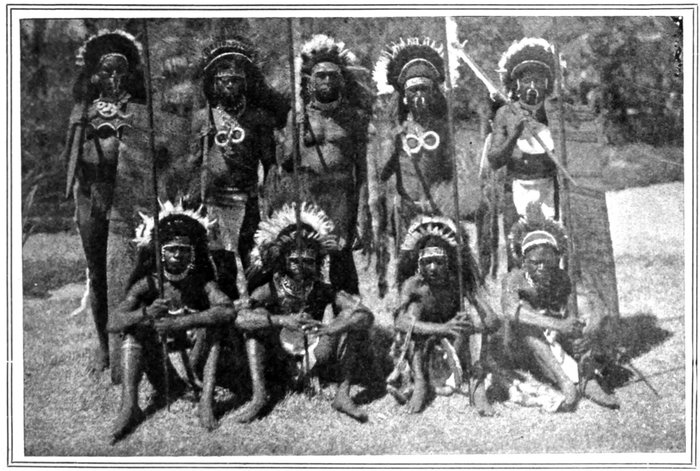
A PARTY OF COLLINGWOOD BAY NATIVES ON A HUNTING EXPEDITION.
From a Photograph.
A witch I knew lost her husband, and his death was put down to his wife's machinations. Nevertheless, the polite Papuan women came to blend their voices with the wailing of the newly-made widow. In a few years, spite of her uncanny reputation, the witch-widow became a wife once more. Her second husband must have been a brave man, or possibly he was a sorcerer, and intended to counteract his wife's powers with more potent charms than her own.
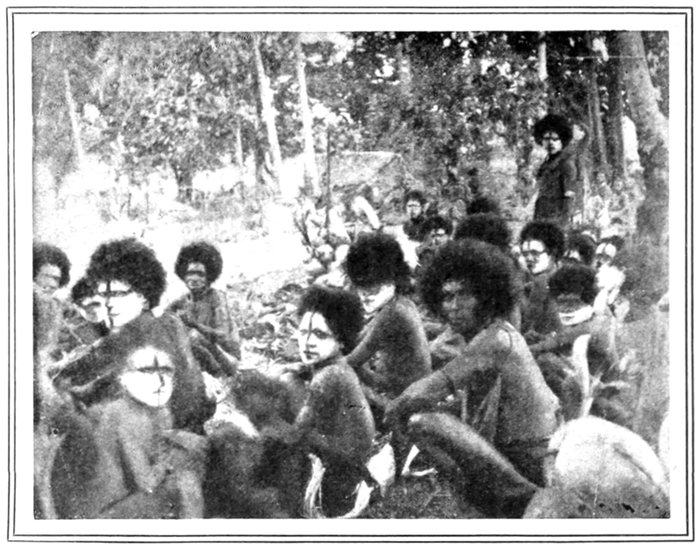
NATIVES ASSEMBLED FOR A PIG-FEAST—IT IS ETIQUETTE IN PAPUA TO EAT NOTHING BUT TO CARRY AWAY EVERYTHING.
From a Photograph.
In Wedau, directly anyone died, the house filled with wailing men and women, some of whom were paid mourners. Crying had to continue until after the funeral, and was extremely painful to listen to.
Marriage takes place early in Papua, so it was quite possible to have great-grandparents or children weeping at the grave. Imagine a whole family tree, with its collateral branches, all lifting their voices at once and with much energy, and you have a feeble idea of what a death in Wedau involved. The mourners usually called on the dead man by the relationship they bore to him, and seldom mentioned his name. After burial, in fact, the name was "popola," and must not be spoken. A small boy who was staying with me on a visit told me most emphatically that he must leave at once if I so much as mentioned the name of his dead grandfather.
At one of the villages up the coast a curious custom prevails. The mission girls and I went to witness the funeral of an old man. In the middle of the house, on the floor, the deceased lay in state. The poor old man's face was exposed to view, and was a ghastly sight, for the kinsfolk had rouged its cheeks, possibly to give it a semblance of life!
After some time spent in wailing, the procession proceeded to the grave. As the corpse was about to be placed in it the village policeman glanced at me, and requested to know whether I thought the grave was deep enough! It seems he had been required by the Government to superintend the digging of graves, and wished a foreigner's approval of the way he had fulfilled his task. What would have happened if I had suggested delaying the funeral to dig deeper, however, I shudder to think.
When I first went out to Papua there were only five other white women on the north-east coast, though there were a few at Samarai, the port. Naturally life under these conditions was very different from that in civilized countries. Roads there were none; but as we generally walked along the beach, or went by boat, this did not much matter, and there were a few tracks along which we walked in single file, with tall reeds or grass rising perhaps to six feet on either side of us. Gloves were unnecessary, and even veils were too hot to be worn. The best time of the day was the evening, though the early morning was deliciously cool. The Wedauans rose at an unearthly hour, and I have heard an astonished visitor at about 7 a.m. ask, "Is she ill?" on hearing that I was still in bed. But though we got up as a rule before seven we found a rest at midday almost imperative. My days went quietly and quickly enough. Sellers of edible ants, coco-nuts, and other foodstuffs came when it suited them or when they required tobacco, and patients who were receiving treatment usually arrived about 9 a.m. Then I could settle down to translation work, while the boy and girl boarders busied themselves in the garden or fished in the sea. In the afternoon we had school in the village for two hours, followed by classes or visiting the natives in their homes. They were most cordial, and would often make me a present of a sticky piece of taro or a fibrous sweet potato picked steaming out of the big earthenware pot. We all sat on the shingly floor, though perhaps I was given a mat to spread under me, and we would talk of pigs, crops, babies, and other matters till after service it was time for me to return to the house. It was not very exciting, but certainly a very happy life.
We tried the experiment of keeping sheep, but for various reasons, such as the presence of spear grass and attacks from village dogs or pigs, were compelled to give it up. Still, while we had them it was possible to taste fresh mutton occasionally, and I remember one of the lady missionaries coming in great glee to her fellow-workers. "Hurrah!" she cried. "A lamb has had sunstroke; we shall have fresh meat."
Fowls have always been difficult to rear, as there is little a village dog will not force his way through when he knows of their existence. On one occasion one of these daring animals killed a mission fowl in broad daylight, only to be immediately shot by a watchful missionary. We ate the fowl that night, while the villagers feasted royally on the dog. So, in spite of the double catastrophe, nothing was wasted.
Though cannibalism is still practised among the inland tribes, and even occasionally on the islands adjacent to the mainland, the coastal natives have to be content nowadays with pigs' flesh. They are very fond of giving feasts, and the last photograph shows a group of feast-givers decorated for the occasion, with gay feathers stuck in their fuzzy hair, which is teased out with a comb something like a many-pronged wooden toasting-fork. They hang egg cowrie shells on their arms, putting on all the finery they possess, and smearing their faces with lime.
All this preparation often took place days beforehand, for a feast in Papua is nothing if not movable. It used to be announced for a certain day, but at the appointed time all the necessary pigs might not have been brought in, or some expected visitors might not have arrived, or a pig already present might have struggled free from its bonds and have had to be hunted for a day or two. No one ever seemed to mind the delay, however. With well-bred calmness they waited until everything was quite ready, and then the feast began.
On one such occasion there were nearly a thousand people present, and fifty pigs, two thousand coco-nuts, and huge piles of taro were distributed. The feast-givers got nothing; that is a universal custom. The recipients likewise neither cooked nor ate a morsel until they got home, for it is considered good form in Papua to eat nothing but to carry away everything, thus practically reversing our notions of hospitality. There was a great heap of dismembered pigs lying on the ground, and the presiding genius of the feast, with his assistants, threw these violently towards the guests. Each important man had retainers who ran forward and bore the joint off, while the less fortunate ones kept up a running fire of comment—identifying a pig's head as having been the contribution of some particular man, or reproving the hill-folk for their awkward gait, telling them not to fear precipices on the coast, and so on.
At this particular feast one man, an ex-policeman, lost his temper completely. As his share of pork was thrown forward, the distributor took the opportunity of accusing him of certain misdemeanours. This so enraged the accused that he sprang to his feet brandishing a very unpleasant-looking knife about two feet long. His friends, not much impressed, stolidly brought him his pork and quite disregarded his angry commands to throw it away. Finally he subsided, muttering. In earlier days this would have been, no doubt, but the prelude to a very lively little battle, and spears would soon have been in action. The culprit, however, had served under Government, and knew what power it possessed to punish offenders.
(To be continued.)