THE WHITE PROPHET, VOLUME II (continued 4)
Reading edition
"There is something tragic in the idea that if I go to that dinner my father may find that there has been one gigantic error in his calculations, and I hate the thought of going, but if I go I go, and (D.V.) I shall not shrink.
"Good-night, dearest! 'Where is she now?' I ask myself for the nine-hundredth time, and for the nine-hundred and first time I answer, 'Wherever she is she is mine and nobody else's.' In-sha-allah!"
II
"Whew! It's comic, and if I were not such a ridiculously tragic person I should like to scream with laughter. The Ulema are at a loss to know what to do about the invitation to the King's Dinner, and have been putting their turbaned heads together like frightened chickens in a storm. Never having been invited to such functions before, they suspect treachery, think their conspiracy has got wind, and are for excusing themselves on the ground of a general epidemic among grandmothers, which will require them to be present at funerals in various parts of the country.
"On the other hand, Caiaphas, who is giving himself the airs of a hero—a hero, mind you—counsels courage, saying that if there is any suspicion of conspiracy the only way to put it out of countenance is to accept the Consul-General's invitation, which is of the nature of a command, and that this argument applies especially to me (that is to say, Ishmael), who might otherwise expose myself to the inference that I am not the wise and wealthy chief of the Ababdah, but another person who dare not permit himself to be seen. The fox! All the same I may find that it suits my book to go to the King's Dinner."
III
"The day of the festivities is approaching, and already the preparations have begun. Placards on the walls announcing a military tattoo, officials flying about the town, workmen hanging up lanterns for the illumination of the public gardens, and police bands in the squares playing 'God save' and 'The Girl I left,' and meantime Ishmael with his vast following coming up the Nile, full of the great Hope, the great Expectation!
"Talk about Nero fiddling while Rome burned! that was an act of no particular callousness compared to the infectious merriment of the European population, though many of them know nothing about the tidal wave that is sweeping down, the English press having been forbidden to mention it, and the one strong man in Egypt waiting calmly at the Agency until the moment comes to dam it.
"Of course the official classes are aware of what is happening, and their attitude towards the mighty flood that is coming on is a wonderful example of our British pluck and our crass stupidity. Not a man will budge, that much I can say for my countrymen who are ready to face death any day under a vertical sun, amid deadly swamps and human beings almost as dangerous. But they will not see that while the fanaticism of one hallucinated individual (Ishmael, for example) may be a little thing, the soul of a whole nation is a big thing, and God help the Government that attempts to crush it.
"In order to realise the situation here at this moment one has to make a daring, audacious, almost impious comparison—to think of the day when Christ entered Jerusalem through a dense, delirious crowd that shouted 'Hosanna to the Son of David!' and (forgetting that soon afterwards they deserted Him when His divinity appeared to fail) ask oneself what would have happened then if the Roman Consul, prompted by the Chief Priests, had met that frenzied multitude with a charge of Roman steel!
"God keep us from such consequences in Cairo; but meantime, though the Arabic newspapers are suppressed, the natives know that Ishmael's host is coming on, and the effect of the rumour that has gone through the air like a breath of wind seems to be frantically intoxicating. I confess that the sense of that mighty human wave, sweeping down the red waters of the high Nile, coming on and on, as they think to the millennium, but as I know to death, sits on me, too, like a nightmare. It has the effect of the supernatural, and I ask myself what in the name of God I can do to prevent the collision that will occur between two forces that seem bent on destroying each other.
"Something I must do, that is certain, and seeing that I am now the only one who knows what is being done on both sides, and that it is useless to appeal either to my father or to Ishmael, what I do must be done by me alone. Alone is a terrible word, Helena; but what I do I do, and the devil take the consequences.
"I expect to get further information from Hafiz to-morrow, so (D.V.) I'll write my last letter to Bedrasheen, where, as I hear, you are to encamp. Look out for it there—I see something I may want you to do for me with Ishmael. Meantime don't be afraid of him. Remember that you belong to me, to me only, and that I'm thinking of you every hour and minute, and then nothing can go seriously astray. Good-bye, my beloved, my dear, my darling! GORDON.
"P.S.—Is it not extraordinary, my dear Helena, that notwithstanding the torment I suffer at the thought of your position in Ishmael's camp I continue to ask you to remain in it? But wait—only wait! Something good is going to happen! In-sha-allah!"
CHAPTER XI
I
"THE NILE "(between Luxor and Bedrasheen).
"MY DEAR, DEAR GORDON—I saw your Hamid Ibrahim the moment I set foot in Luxor, and the way he passed your letter to me and I passed mine to him would have done credit to Charlie Bates and the Artful Dodger in the art of passing 'a wipe.'
"I really think we escaped the eyes of this odious Arab woman, but I am bound to add that almost as soon as I got back to the boat, and began to read your letter and to weep tears of joy over it, I was conscious of a shadow at the mouth of my cabin, and it was she, the daughter of a dog!
"No matter! Who the dickens cares! I shall be gone from here before the woman can do me any mischief, and if I am still in Ishmael's camp it is only because you said you were sending your last letter to Bedrasheen, so, you see, I had no choice but to come on.
"What you tell me of the course of affairs in Cairo only fills me with hatred of the Grand Cadi ('whom Allah damn'), and I find that I exhaust my Christianity in finding names that seem suitable to 'his Serenity'—beginning, of course, with the fourth letter of the English alphabet.
"I see already what you are going to do, and when I think of it I feel like a shocking coward. If you cannot work with the Consul-General I suppose you will work without him, perhaps against him, and a conflict between you and your father is the tragedy I always foresaw. It will be the end of one or both of you, and I am trembling at the bare thought.
"Oh, I know you are the bravest thing God ever made and at the same time the most unselfish, but I sometimes wish to heaven you were not—though I suppose in that event you would fall from your god-like pedestal, and I should not love you so much if I admired you less.
"We left Luxor immediately, for although there were still three days to spare before the day of the "festivities" and the river was racing down fast enough to carry a fleet of war, the people were in a fever to reach the end of their journey, so Ishmael consented to go on without a rest.
"I find the whole thing more frightening than ever now that we are so near to the end, for I suppose it is certain that whatever else happens, this vast horde of Ishmael's fanatical followers will never be allowed to enter Cairo, and it will be impossible to convince the Consul-General and the Government that they are not coming as an armed force. Then what will the people do? What will they say to Ishmael? And if Ishmael suspects treachery, what will he say? What will he say to me? But no matter—I shall be gone before that can occur.
"It is now eleven o'clock at night, yet I cannot sleep, so I shall sit up all night and see the rising of the Southern Cross. A silver slip of a moon has just appeared, and by its shimmering light our vast fleet seems to be floating down the rive like ships in a dream. Such calm, such silence! Phantoms of houses, of villages, of funereal palms gliding in ghostly muteness past us. Sometimes an obelisk goes like a dark skeleton down the bank—vestige of a vanished civilisation as full, perhaps, of delusive faith as ours. What is God doing with us all, I wonder? Why does He——
II
"Another thrilling moment! I must tell you—I cannot help myself.
"You may have gathered that since the scene in the tent on the desert Ishmael has left me alone, but last night he came again.
"That grim woman had gone to her crib somewhere outside, and I was writing to you as you see above, when suddenly in the silence, broken by nothing but the snores of the men in the hold, the lapping of the water against the side of the boat and the occasional voice of the Reis at the rudder, I heard a soft step which I have learned to know.
"'Rani!' said a voice without, and in a moment the canvas of my cabin was drawn, and Ishmael was sitting by my side.
"There was a look in his eyes that told of depths of tenderness, not to speak of consuming emotion, but at first he talked calmly. He began by speaking of you. It seems he had had news of you at Assouan, that you were staying at the Chancellor of El Azhar's house, and that the old Chancellor had no words warm enough for your wisdom and courage. Neither had Ishmael, who said the whole Mohammedan world was praising you.
I really believe he loves you, and I was beginning to melt towards him, thinking how much more he would worship you if he only knew what you had really done for him, when—heigho!—he began to speak of me and to return to his old subject. Love was a God-given passion, and he was looking forward to the end of his work when he might give himself up to it. His vow of chastity and consecration would then be annulled and he could live the life of a man!
Very tender, very delicate, but very warm and dreadfully Oriental! My nerves were tingling all over, and I was feeling shockingly weak and womanish while the great powerful man sat beside me, and when he talked about children, saying a woman without them was like a tree without fruit, I found myself for the first time in my life in actual physical terror.
"At last he rose to go, and before I knew what he was doing he had flung his arms around me and kissed me, and when I recovered myself he was gone.
"Then all the physical repulsion I spoke of before arose in me again, and at the same moment, as if by a whirlwind of emotion, I remembered you, and my strength came back.
"I have often wondered what sort of horror it must be to the woman who is married to an unfaithful husband or to a drunkard, to have him come in his uncleanness to claim her, and now (though Ishmael is neither of these, but merely a man who has 'rights' in me) I think I know.
"No matter! I am not afraid of Ishmael any longer, so you need not be afraid for me. It is not for nothing that I have Jewish blood in me, and if Ishmael attempts to force me, as surely as I am a daughter of Zion I will ... well, never mind! Dreadful? Perhaps so. Jezebel? I cannot help it. My husband? No, no, no; and if destiny has put me into the position of his wife, I despise and intend to defy it.
III
"Of course I did not sleep a wink last night, but I crept out of my hiding-place under the high prow of the boat when the dawn came up like a bride robed in pearly grey and blushing rosy red. By that time we were nearing Bedrasheen, and now we are moored alongside of it, and the people are beginning to land, for it seems they are to camp at Sakkara, in order to be in a position to see the light which is to shine from the minaret of Mohammed Ali.
"Such joy, such rapture! Men with the madra pole sounding the depths of the water, men with sculls pushing the boats ashore; all shouting in strident voices, or singing in guttural tones.
"Soon, very soon, their hopes will be blighted. Will they never know by whom? I wonder if anybody will tell them about that letter! Where is Mosie? I trust the Consul-General may keep him in Cairo. The boy is as true as steel, but with this woman to question him...! My God, make her meet a fate as black as her heart, the hussy!
"But why do I trouble about this? It matters nothing to me what becomes of the Arab woman, or of the Egyptians, or of the Soudanese, or even of Ishmael himself—the whole boiling of them, as you say. I know I'm heartless, but I can't help it. The only question of any consequence is what is happening to you. After all, it was I who put you where you are, and it is quite enough for me to reproach myself with that.
"What is the Government doing to you? What has your father done? What is going on among the descendants of the creeping things that came out of the Ark?
* * * * *
"I cannot see Hamid among the crowd on the land, but I hope to find him as soon as I go ashore. If I miss him in the fearful chaos, I suppose I shall have to go on to the camp, for, besides my anxiety to receive your letter, I am living under the strongest conviction that there is something for me to do for you, and that it has not been for nothing that I have gone through the bog and slush of this semi-barbaric life.
"There! You see what you've done for me! You've given me as strong a belief in the 'mystic sense' as you have yourself, and as firm a faith in fatality.
* * * * *
"No sign of Hamid yet! Never mind! Don't be afraid for me—I am all right.
"Gordon, my dear, my dear-dear, good-bye!
"HELENA."
CHAPTER XII
For more than three weeks the Consul-General had kept his own counsel, and not even to the Sirdar, whom he saw daily, did he reveal the whole meaning of his doings.
When the Sirdar had come to say that through the Soudan Intelligence Department in Cairo he had heard that Ishmael and his vast company had left Khartoum, and that the Inspector-General was of opinion that the pilgrimage must be stopped or it would cause trouble, the Consul-General had said—
"No! Let the man come on. We shall be ready to receive him."
Again, when the Governor at Assouan, hearing of the approach of the ever-increasing horde of Soudanese, had telegraphed for troops to keep them out of Egypt, the Consul-General had replied—
"Leave them alone, and mind your own business."
Finally when the Commandant of Police at Cairo had come with looks of alarm to say that a thousand open boats, all packed with people, were sailing down the river like an invading army, and that if the pilgrims attempted to enter the city the native police could not be relied upon to resist them, the Consul-General had said—
"Don't be afraid. I have made other arrangements."
Meantime the great man who seemed to be so calm on the outside was white hot within. Every day, while Ishmael was in the Soudan, and every hour after the Prophet had entered Egypt, he had received telegrams from his Inspectors saying where the pilgrimage was and what was happening to it. So great indeed had been the fever of his anxiety that he had caused a telegraphic tape to be fixed up in his bedroom that in the middle of the night, if need be, he might rise and read the long white slips.
A few days before the date fixed for the festivities one of the Inspectors of the Ministry of the Interior came to tell him that there were whispers of a conspiracy that had been blown upon, with hushed rumours of some bitter punishment which the Consul-General was preparing for those who had participated in it. As a consequence a number of the Notables and certain of the diplomats were rapidly leaving the country, nearly every train containing some of them. A sombre fire shone in the great man's eyes while he listened to this, but he only answered with a sinister smile—
"The air of Egypt doesn't agree with them perhaps. Let them go. They'll be lucky if they live to come back."
As soon as the Inspector was gone the Consul-General sent for his Secretary and asked what acceptances had been received of the invitations to the King's Dinner, whereupon the Secretary's face fell, and he replied that there had been many excuses.
Half the diplomats had pleaded calls from their own countries, and half the Pashas had protested with apologetic prayers that influenza or funerals in their families would compel them to decline. The Ministers had accepted as they needs must, but, with a few exceptions, the Ulema, after endless invocations to God and the Prophet, had, on various grounds, begged to be excused.
"And the exceptions, who are they?" asked the Consul-General.
"The Chancellor of El Azhar, his guest the Sheikh Omar Benani, the Grand Mufti, and——"
"Good! All goes well," said the Consul-General. "Make a list of the refusals and let me have it on the day of the dinner."
Before that day there was much to do, and on the day immediately preceding it the British Agency received a stream of visitors. The first to come by appointment was the English Adviser to the Ministry of Justice.
"I wish you," said the Consul-General, "to summon the new Special Tribunal to hold a court in Cairo at ten o'clock to-morrow night."
"Ten o'clock to-morrow night? Did your lordship say ten?" asked the Adviser.
"Don't I speak plainly?" replied the Consul-General, whereupon the look of bewilderment on the Adviser's face broke up into an expression of embarrassment, and his desire to ask further questions was crushed.
The next visitor to come by appointment was the British Adviser to the Minister of the Interior, the tall young Englishman on whose red hair the red fez sat so strangely.
"I wish you," said the Consul-General, "to arrange that the gallows be got out and set up after dark to-morrow night in the square in front of the Governorat."
"The square in front of the Governorat?" repeated the Adviser in tones of astonishment. "Does your lordship forget that public execution within the city is no longer legal?"
"Damn it, I'll make it legal," replied the Consul-General, whereupon the red head under the red fez bowed itself out of the library without waiting to ask who was to be hanged.
The next visitor to come to the Agency by appointment was the burly Commandant of Police.
"You still hold your warrant for the arrest of Ishmael Ameer?" asked the Consul-General.
"I do, my lord."
"Then come to Ghezirah to-morrow night, and be ready to receive my orders."
Then came the Colonel who, since the death of General Graves, had been placed in temporary command of the Army of Occupation.
"Is everything in order?"
"Everything, my lord."
"All your regiments now in the country can arrive at Calioub by the last train to-morrow night?"
"All of them."
"Then wait there yourself until you hear from me. I shall speak to you over the telephone from Ghezirah. On receiving my message you will cause fifty rounds of ammunition to be issued to your men, and then march them into the city and line them up in the principal thoroughfares. Let them stay there as long as they may be required to do so—all night if necessary; and if there is unrest or armed resistance on the part of the populace, of the native army, or of people coming into the town, you will promptly put it down. You understand?"
"I understand, my lord."
"But wait for my telephone call. Don't let one man stir out of barracks until you receive it. Mind that. Good-bye!"
The better part of the day was now gone, yet so great had been the Consul-General's impatience that he had not even yet broken his fast, although Fatimah, who alone was permitted to do so, had repeatedly entered his room to remind him that his meals were ready.
At sunset he went up to the roof of his house. Every day for nearly a week he had done this, taking a telescope in his hand that he might look down the river for the mighty octopus of demented people who were soon to come. Yesterday he had seen them for the first time—a vast flotilla of innumerable native boats with white, three-cornered sails, stretching far down the Nile, as a flight of birds of passage might stretch along the sky.
Now the people were encamped on the desert between Bedrasheen and Sakkara, a sinuous line of speckled white and black on the golden yellow of the sand, looking like a great serpent encircling the city on the south. As a serpent they fascinated the Consul-General when he looked at them, but not with fear, so sure was he that, by the machinery he had set to work, the vermin would soon be trampled into the earth.
There they were, he thought, an armed force, the scourings of the Soudan, under the hypnotic sway of a fanatic-hypocrite, waiting to fall on the city and to destroy its civilisation. In every saddle-bag a rifle; in every gebah a copy of the Koran; in every heart a spirit of hatred and revenge.
Since the Grand Cadi had told him of the conspiracy to establish an Arab Empire the Consul-General's mind had evolved developments of the devilish scheme. The practical heart of the matter was Pan-Islamism, a combination of all the Moslem peoples to resist the Christian nations. Therefore in the great historical drama which he was soon to play he would be seen to be the saviour not only of England and of Europe and of civilisation, but even of Christianity itself!
It would be a life and death struggle, in which cruel things could not fail to be done, but the issues were world-great, and therefore he would not shrink. He who wanted the end must not think too much about the means.
Ishmael? The gallows in the square of the Governorat? Why not? The man might have begun as a mere paid emissary of the Khedive, but having developed the Mahdist malady, a belief in his own divinity, he meant to throw off his allegiance to his master and proclaim himself Caliph. Therefore they must hang him—hang him before the eyes of his followers, and fling his "divine" body into the Nile!
As the Consul-General stepped down from the roof Ibrahim met him with a letter from the Grand Cadi saying he found himself suspected by his own people, and therefore begged to be excused from attendance at the King's Dinner, but sent this secret message to warn his Excellency that by the plotting of his enemies the Kasr-el-Nil bridge which connected Ghezirah with Cairo would be opened immediately after the beginning of the festival.
"The fox!" thought the Consul-General, but interpreting in his own way the dim purpose of the plot—that it was intended to imprison him on the island while Ishmael's followers entered the city—he merely added to his order for his carriage an order for his steam-launch as well.
Daylight had faded by this time, and as soon as darkness fell the Consul-General received a line of other visitors—strange visitors such as the British Agency had never seen before. They were women, Egyptian women, the harem, shrouded figures in black satin and the yashmak, the wives of the Ministers who had felt compelled to accept their invitations, but were in fear of the consequences of having done so.
Unexampled, unparalleled event, never before known in an Eastern country, the women, disregarding the seclusion of their sex, had come to plead for their husbands, to make tacit admission of a conspiracy, but to say, each trembling woman in her turn, "My husband is not in it," and to implicate other men who were.
The Consul-General listened with cold, old-fashioned courtesy to everything they had to say, and then bowed them out without many words. Instinctively Ibrahim had darkened the Agency as soon as they began to come, so that veiled they passed in, veiled they passed out, and they were gone before anybody else was aware.
The dinner-hour was now near, and leaving the library with the intention of going up to dress, the Consul-General came upon two men who were sitting in an alcove of the hall. They were Reuter's reporters, who for the past ten years had been accustomed to come for official information. Rising as the Consul-General approached, they asked him if he had anything to say.
"Be here at ten o'clock to-morrow night and I shall have something to give you," he said. "It will be something important, so keep the wires open to receive it."
"The wires to London, my lord?"
"To London, Paris, Berlin—everywhere! Good-night!"
Going upstairs with a flat and heavy step but a light and almost joyous heart, the Consul-General remembered his letter of resignation, and thought of the hubbub in Downing Street the day after to-morrow when news of the conspiracy, and of how he had scotched it, fell like a thunderbolt on the "fossils of Whitehall."
In the conflagration that would blaze heaven-high in England it would be seen at last how necessary a strong authority in Egypt was, and then—what then? He would be asked to use his own discretion, unlimited power be reposed in him; he would hoist the Union Jack over the Citadel, annex the country to the British Crown, cast off all futile obligations to the Sultan, and so end for ever the present ridiculous, paradoxical, suicidal situation.
While Ibrahim helped him to dress for dinner, he was partly conscious that the man was talking about Mosie and repeating some bewildering story which the black boy had been telling downstairs of Helena's "marriage to the new Mahdi."
This turned his thoughts in another direction, and for a few short moments the firm and stern, but not fundamentally hard and cruel man, became aware that all his fierce and savage and candid ferocity that day had been no more than the wild ejaculation of a heart that was broken and trembling because it was bereaved.
It was Gordon again—always Gordon! Where was "our boy" now? What was happening to him? Could it be possible that he was so far away that he would not hear of the weltering downfall, so soon to come, of the "charlatan mummer" whose evil influence had brought his bright young life to ruin?
CHAPTER XIII
That night the Sirdar dined with the Consul-General, and as soon as the servants had gone from the dining-room he said—
"Nuneham, I have something to tell you."
"What is it?" asked the Consul-General.
"Notwithstanding three weeks of the closest observation, I have found no trace of insubordination in the Egyptian army, but nevertheless, in obedience to your warning, I have taken one final precaution. I have given orders that the ammunition with which every soldier is entrusted shall be taken from him to-morrow evening, so that if Ishmael Ameer comes into Cairo at night with any hope of——"
"My dear Mannering," interrupted the Consul-General with his cold smile, "would it surprise you to be told that Ishmael Ameer is already in Cairo?"
"Already? Did you say——"
"That he has been here for three weeks, that he came by the same train as yourself, wearing the costume of a Bedouin Sheikh, and that——"
"But, my dear Nuneham, this is incredible," said the Sirdar, with his buoyant laugh. "It is certainly true that a Bedouin Sheikh travelled in the same train with me from the Soudan, but that he was Ishmael Ameer in disguise is of course utterly unbelievable."
"Why so?"
"Because a week after I left Khartoum I heard that Ishmael was still living there, and because every other day since then has brought us advices from our Governors saying the man was coming across the desert with his people."
"My dear friend," said the Consul-General, "in judging of the East one must use Eastern weights and measures. The race that could for fourteen centuries accept the preposterous tradition that it was not Jesus Christ who was crucified but some one else who took on His likeness and died instead of Him, is capable of accepting for itself and imposing upon others a substitute for this White Prophet."
"But you bewilder me," said the Sirdar. "Isn't the man Ishmael at this moment lying encamped, with fifty thousand of his demented people, on the desert outside Cairo?"
"No," said the Consul-General.
And then in his slow, deep, firm voice, grown old and husky, he unburdened himself for the first time—telling of Helena's departure for Khartoum on her errand of vengeance; of her letter from there announcing Ishmael's intention of coming into Cairo in advance of his people in order to draw off the allegiance of the Egyptian army; of Ishmael's arrival and his residence at the house of the Chancellor of El Azhar; of the visit of the Princess Nazimah and her report of the conspiracy of the diplomatic corps, and finally of the Grand Cadi's disclosure of the Khedive's plot for the establishment of an Arab Empire.
"So you see," said the Consul-General, with an indulgent smile, "that all the bad concomitants of an Oriental revolution are present, and that while you, my dear friend, have been holding your hand in the Soudan for fear of repeating the error of two thousand years ago—troubling yourself about Pontius Pilate and moral forces versus physical ones, and giving me the benefit of all the catchwords of your Christian socialism and Western democracy—a conspiracy of gigantic proportions has been gathering about us."
The Sirdar's usually ruddy face whitened, and he listened with a dumb, vague wonder while the Consul-General went on, with bursts of bitter humour, to describe one by one the means he had taken to defeat the enemies by whom they were surrounded.
"So you see, too," he said at last, lifting unconsciously his tired voice, "that by this time to-morrow we shall have defeated the worst conspiracy that has ever been made even in Egypt—meted out sternly retributive justice to the authors of it; put an end to all forms of resistance, whether passive or active, silenced all chatter about Nationalism and all prattle about representative institutions, destroyed the devilish machinery of this accursed Pan-Islamism, crushed the Khedive, and wiped out his fanatic-hypocrite and charlatan-mummer, Ishmael Ameer."
The Consul-General had spoken with such intensity, and the Sirdar had listened so eagerly, that down to that moment neither of them had been aware that another person was in the room. It was Fatimah, who was standing, with the death-like rigidity of a ghost, near to the door, in the half-light of the shaded electric lamps.
The Sirdar saw her first, and with a motion of his hand he indicated her presence to the Consul-General, who, with a face that was pale and stern, turned angrily round and asked the woman what she wanted, whereupon Fatimah, with trembling lips and a quivering voice, as if struggling with the spirit of falsehood, said she had only come to ask if the Sirdar intended to sleep there that night and whether she was to make up a bed for him.
"No, certainly not! Why should you think so? Go to bed yourself," said the Consul-General, and with obvious relief the woman turned to go.
"Wait!" he cried. "How long have you been in the room?"
"Only a little moment, oh my lord," replied Fatimah.
After that the two men went to the library, but some time passed before the conversation was resumed. The Sirdar lit a cigar and puffed in silence, while the Consul-General, who did not smoke, sat in an arm-chair with his wrinkled hands clasped before his breast. At length the Sirdar said—
"And all this came of Helena's letter from Khartoum?"
"Was suggested by it," said the Consul-General.
"You told me she was there, but I could not imagine what she was doing—what her errand was. Good heavens, what a revenge! It makes one shiver! Carries one back to another age!"
"A better age," said the Consul-General. "A more natural and less hypocritical age at all events."
"The age of an eye for an eye, a tooth for a tooth, perhaps—the age of a hot and consuming God."
"Yes, a God of wrath, a God of anger, a God who did something, not the pale, meek, forgiving, anæmic God of our day—a God who does nothing."
"The God of our day is at least a God of mercy, of pity, and of love," said the Sirdar.
"He is a lay figure, my friend, who permits wrong without avenging it—in short, no God at all, but an illogical, inconsequential, useless creature."
The Sirdar made no further resistance, and the Consul-General went on to defend Helena's impulse of vengeance by assailing the Christian spirit of forgiveness.
"There was at least something natural and logical as well as majestic and magnificent in the old ideal of Jehovah, but your new ideal of Jesus is contrary to nature and opposed to the laws of life. 'Love your enemies.' 'Do good to them that hate you.' 'If a man smite thee on the right cheek, turn to him the other also.' 'Resist not evil!' 'If any man take away thy coat, let him have thy cloak also!' Impossible! Fatal! If this is Christianity, I am no Christian. When I am hit, I hit back. When I am injured, I demand justice. The only way! Any other would lead to the triumph of the worst elements in humanity. And what I do everybody else does—everybody—though the hypocrisy of the modern world will not permit people to admit it."
The Consul-General had risen and was tramping heavily across the room.
"Is there one man alive who will dare to say that he actually orders his life according to the precepts of Christ? If so, he is either a liar or a fool. As for the nations, look at the facts. Christianity has been two thousand years in the world, yet here we are competing against each other in the building of warships, the imposition of tariffs, the union of trades. Why not? I say, why not?"
The Consul-General drew up and waited, but getting no answer he continued—
"Civilisation requires it—I say requires it. What holds the world together and preserves peace among the nations is not Christianity but cast-iron and gunpowder. Yet what vexes me and stirs my soul is to hear people praying in their churches for peace and concord, while all the time they know that 'peace and concord' is an impossible ideal, that Christianity in its first sense is dead, and that Jesus as a practical guide to life—as a practical guide to life, mind you—has failed."
Then the Sirdar lifted his eyes and said—
"Do you know, my dear Nuneham, I once heard somebody else talk like that, though from the opposite standpoint—of sympathy, not contempt."
"Who was it?"
"Your own son."
"Humph!"
The Consul-General frowned and there was silence again for some moments. When the conversation was resumed it concerned the dangers of the Arab Empire, which, according to the Grand Cadi, the Khedive (with the help of Ishmael) expected to found.
"What would it mean?" said the Consul-General. "The utter annihilation of the unbeliever. Does not the word 'Ghazi' signify a hero who slays the infidel? Does not every Mollah, when he recites the Khuttab in the mosque, invoke divine wrath on the non-Moslem? What then? The establishment of an Arab Empire would mean the revolt of the whole Eastern world against the Western world, and a return to all the brutality, all the intolerance of the farrago of moribund nonsense known as the Sacred Law."
The Sirdar made no reply, and after a moment the Consul-General said—
"Then think of the spectacle of a conquering Mohammedan army in Cairo! If the Citadel and the Arsenal of the capital could be occupied by that horde outside, it would not be merely England's power in Egypt that would be ended, or the English Empire as a world force that would be injured—it would be Western civilisation itself that would in the end be destroyed. The Mohammedans in India would think that what their brethren in Cairo had done they might do. The result would be incalculable chaos, unlimited anarchy, the turning back of the clock ten centuries."
The Consul-General returned to his seat, saying—
"No, no, my friend, a catastrophe so appalling as that cannot be left to chance, and if it is necessary to blow these fifty thousand fanatics out of the mouths of guns rather than lay the fate of the world open to irretrievable ruin, I ... I will do it."
"But all this depends on the truthfulness of the Grand Cadi's story—isn't it so?" asked the Sirdar.
The Consul-General bent his head.
"And the first test of its truthfulness is whether or not these thousands of Ishmael's followers are an armed force?"
Again the Consul-General bent his head.
"Well," said the Sirdar, rising and throwing away his cigar, "I am bound to tell you that I see no reason to think they are. More than that, I will not believe that when our boy took his serious step he would have sided with this White Prophet if he had suspected that the man's aims included an attack upon England's power in Egypt, and I cannot imagine for a moment that he could be fool enough not to know."
Again the Consul-General frowned, but the Sirdar went on firmly.
"I believe he thought and knew that Ishmael Ameer's propaganda was purely spiritual, the establishment of an era of universal peace and brotherhood, and that is a world-question having nothing to do with England or Egypt, or Arab Empires, except so far as——"
But the Consul-General, who was cut to the quick by the Sirdar's praise of Gordon, could bear no more.
"Only old women of both sexes look for an era of universal peace," he said testily.
"In that case," replied the Sirdar, "the old women are among the greatest of mankind—the Hebrew prophets, the prophets of Buddhism, of Islam, and of Christianity. And if that is going too far, then Abraham Lincoln and John Bright, and, to come closer home, your own son, as brave a man as ever drew a sword, a soldier too, the finest young soldier in the King's service, one who might have risen to any height if he had been properly handled, instead of being——"
But the old man, whose nostrils were swelling and dilating like the nostrils of a broken-winded horse, leapt to his feet and stopped him.
"Why will you continue to talk about my son?" he cried. "Do you wish to torture me? He allowed himself to become a tool in the hands of my enemies, yet you are accusing me of destroying his career and driving him away. You are—you know you are!"
"Ah, well! God grant everything may go right to-morrow," said the Sirdar after a while, and with that he rose to go.
It was now very late, and when Ibrahim, in the hall, with sleepy eyes, hardly able to keep himself from yawning, opened the outer door, the horses of the Sirdar's carriage, which had been waiting for nearly an hour, were heard stamping impatiently on the gravel of the drive.
At the last moment the old man relented.
"Reg," he said, and his voice trembled, "forgive me if I have been rude to you. I have been hard hit and I must make a fight. I need not explain. Good-night!" And he had gone back to the library before the Sirdar could reply.
But after a while the unconquerable spirit and force of the man enabled him to regain his composure, and before going to bed he went up on to the roof to take a last look at the enemy he was about to destroy. There it lay in the distance, more than ever like a great serpent encircling the city on the south, for there was no moon, the night was very dark, and the dying fires of the sinuous camp at Sakkara made patches of white and black like the markings of a mighty cobra.
Fatimah was at his bedroom door, waiting to bring his hot water and to ask if he wanted anything else.
"Yes, I want you to go to bed," he replied, but the Egyptian woman, still dallying about the room and speaking with difficulty, wished to know if it was true, as the black boy had said, that Miss Helena was in Khartoum and that she had betrothed herself to the White Prophet.
"I don't know and I don't care—go to bed," said the Consul-General.
"Poor Gordon! My poor boy! Wah! Wah! Everything goes wrong with him. Yet he hadn't an evil thought in his heart."
"Go to bed, I tell you!"
It was even longer than usual before the Consul-General slept.
He thought of Helena. Where was she now? He had been telling himself all along that to save appearances she might find it necessary to remain for a while in Ishmael's camp, but surely she might have escaped by this time. Could it be possible that she was kept as a prisoner? Was there anything he ought to do for her?
Then he thought of the speech he was to make in proposing the King's health the following day, and framed some of the stinging, ironical sentences with which he meant to lash his enemies to the bone.
Last of all he thought of Gordon, as he always did when he was dropping off to sleep, and the only regret that mingled with his tingling sense of imminent triumph was that his son could not be present at the King's Dinner to see—what he would see!
"Oh, if I could have him there to-morrow night—what I would give for it!" he thought.
At length the Consul-General slept and his big desolate house was silent. If any human eye could have looked upon him as he lay on his bed that night, the old man with his lips sternly set, breathing fitfully, only the tired body overcome, the troubled brain still working, it would have been a pitiful thing to think that he who was the virtual master of millions appeared to be himself the sport of those inscrutable demons of destiny which seem to toss us about like toys.
His power, his pride, his life-success—what had he gained by them? His wife dead; his son in revolt against him; alone, enfeebled, duped, and self-deluded.
God, what a little thing is man! He who for forty years had guided the ship of State, before whose word Ministers and even Khedives had trembled, could not see into the dark glass of the first few hours before him.
Peace to him—until to-morrow!
CHAPTER XIV
"SERAI FUM EL KHALIG,
"CAIRO.
"MY DEAREST HELENA,—I am going to that dinner! Yes, as Ishmael Ameer in the disguise of the Sheikh Omar Benani, chief of the Ababdah, I am to be one of my father's guests.
"This is the morning of the day of the festivities, and from Hafiz, by the instrumentality of one who would live or die or give her immortal soul for me, I have at length learned all the facts of my father's coup.
"Did you ever hear of the incident of the Opera House? Well, this incident is to be a replica of that, though the parts to be played in the drama are in danger of being differently cast.
"As this is the last letter I shall be able to send to you before an event which may decide one way or other the fate of England in Egypt, my father's fate, Ishmael's, and perhaps yours and mine, I must tell you as much as I dare commit to paper.
"The British army, as I foresaw from the first, is being brought back to Cairo. It is to come in to-night as quietly as possible by the last trains arriving at Calioub. The Consul-General is to go to Ghezirah as if nothing were about to happen, but at the last moment, when his enemies have been gathered under one roof—Ministers, Diplomats, Notables, Ulema—when the operation of their plot has begun, and the bridge is drawn and the island is isolated, and Ishmael and his vast following are making ready to enter the city, my father is to speak over the telephone to the officer commanding at Abbassiah, and then the soldiers, with fifty rounds of ammunition, are to march into Cairo and line up in the streets.
"Such is my father's coup, and to make sure of the complete success of it—that Ishmael's following is on the move, and that no conspirator (myself above all) escapes—he has given orders to the Colonel not to stir one man out of the barracks until he receives his signal. Well, my work to-night is to see that he never receives it.
"Already you will guess what I am going to do. I must go to the dinner in order to do it, for both the central office of the telephone and the office of the telegraph are now under the roofs of the Ghezirah Palace and Pavilion.
"I hate to do the damnable thing, but it must be done. It must, it must! There is no help for it.
"I cannot tell you how hard it is to me to be engaged in a secret means to frustrate my father's plans—it is like fighting one's own flesh and blood, and is not fair warfare. Neither can I say what a struggle it has been to me as an English soldier to make up my mind to intercept an order of the British army—it is like playing traitor, and I can scarcely bear to think of it.
"But all the same I know it is necessary. I also know God knows it is necessary, and when I think of that my heart beats wildly.
"It is necessary to prevent the massacre which I know (and my father does not) would inevitably ensue; necessary to save my father himself from the execration of the civilised world; necessary to save Ishmael from the tragic consequences of his determined fanaticism; necessary to save England from the possible loss of her Mohammedan dominions, from being faithless to her duty as a Christian nation, and from the divine judgment which will overtake her if she wantonly destroys her great fame as the one Western power that seems designed by Providence to rule and to guide the Eastern peoples; and necessary above all to save the white man and the black man from a legacy of hatred that would divide them for another hundred years and put back the union of races and faiths for countless centuries.
"If I am not a vain fool this is what I (D.V.) have got to do, so why in the name of God need I trouble myself about the means by which I do it? And if I am the only man who can, I must, or I shall be a coward skulking out of his plain responsibility, and a traitor not only to England but to humanity itself.
"God does not promise me success, but I believe I shall succeed. Indeed I am so sure of success that I feel as if all the recent events of my life have been leading up to this one. What I felt when I left Cairo for Khartoum, and again when I left Khartoum for Cairo—that everything had been governed by higher powers which could not err—I feel now more than ever.
"If I had delivered myself up to the authorities after your father's death my life would have been wasted and thrown away. Nay, if I had obeyed orders over the blunder of El Azhar I should not have been where I am now—between two high-spirited men who are blindly making for each other's ruin, and the destruction of all they stand for.
"This reconciles me to everything that has happened, and if I have to pay the penalty of playing buffer I am ready to do so. I have great trust that God will bring me out all right, but if that is not His plan, then so be it. I am willing to give my life for England, whatever name she may know me by when she comes to see what I have done, and I am willing to die for these poor Egyptians, because I was born and brought up among them, and I cannot help loving them.
"Death has no terrors for me anyway. I think the experiences of the past months have taught me all that death has to teach. In fact I feel at this moment exactly as I have felt at the last charge in battle, when, fighting against frightful odds, it has not been a case of every man for himself, but of God for us all.
"Besides I feel that on the day of your father's death I died to myself—to my selfish hopes of life, I mean—and if God intends to crush me in order that I may save my country and these people whom I love and who love me I really wish and long for Him to do so.
"But In-sha-allah! It will be as God pleases, and I believe from the bottom of my heart that He is working out His wonderful embroidery of events to a triumphant issue. So don't be afraid, my dear Helena, whatever occurs to-night. I may be taken, but (D.V.) I shall not be taken in disgrace. In any case I feel that my hour has come—the great hour that I have been waiting for so long.
"This may be the last letter I shall write to you, so I am sending it by Mosie, lest Hamid should find a difficulty in getting into your camp. I hope to God you may get it, for I want you to know that my last thoughts are about yourself.
"Upon my soul, dear, I believe the end will be all right, but if it is to be otherwise, and we are to be separated, and our lives in this world are to be wasted, remember that deep love bridges death.
"Remember, too, what you said to me at Khartoum. 'I am a soldier's daughter,' you said, 'and in my heart I am a soldier's wife as well, and I shouldn't be worthy to be either if I didn't tell you to do your duty, whatever the consequences to me.'
"Good-bye, my dear, my dear! If anything happens you will know what to do. I trust you without fear. I have always trusted you. I can say it now, at this last moment—never, dearest, never for one instant has the shadow of a doubt of you entered into my heart. My brave girl, my love, my life, my Helena!
"May the great God of Heaven bless and protect you!
"GORDON.
"P.S.—Oh, how the deuce did I forget? There is something for you to do—something important—and I had almost sent off my letter without saying anything about it.
"Do you remember that on the day I left Khartoum it was ordered by Ishmael that after the call of the muezzin to midnight prayers, a light was to be set up in the minaret of the mosque of Mohammed Ali as a sign that he might enter the city in peace?
"Well, if I fail and the British army comes into Cairo Ishmael must be kept out of it. He may be stubborn—a man who thinks God guides and protects him and makes a special dispensation for him is not easy to dissuade—but if the light does not appear he must be restrained.
"That is your work with Ishmael—why you are with him still. I knew it would be revealed to us some day. Once more, my dear, my dear, God bless and protect you!"
CHAPTER XV
"UNDER THE PYKAMIDS.
"MY DEAR GORDON,—Your letter has not yet reached me. What has happened? Has your messenger been caught? Who was it? Was it Hamid?
"Not having heard from you, I was of course compelled to come on with the camp and therefore I am with it still. We are under the shadow of the pyramids, with the mud-built village of Sakkara by our side and Cairo in front of us, beyond the ruins of old Memphis and across a stretch of golden sand.
"This is, it seems, the day of 'the King's Dinner,' and at sunset when the elephant-horn was blown for the last time we gathered for prayers under a sea-blue sky on the blood-red side of the Step Pyramid.
"It was a splendid, horrible, inspiring, depressing, devilish, divine spectacle. First, Ishmael recited from the Koran the chapter about the Prophet's great vision (the Surat er Russoul, I think), while the people on their knees in the shadow, with the sun slanting over their heads, shouted their responses. Then in rapturous tones he spoke, and though I was on the farthest verge of the vast crowd I heard nearly all he said.
"They had reached their journey's end, and had to thank God who had brought them so far without the loss of a single life. Soon they were to go into Cairo, the Mecca of the new world, but they were to enter it in the spirit of love, not hate, of peace, not war, doing violence to none and raising no rebellion. What said the Holy Koran? 'Whosoever among Moslems, Christians or Jews believe in God and in another life shall be rewarded.'
"Therefore let no man think they were come to turn the Christians out of Egypt. They were there on a far higher errand—to turn the devil out of the world! The intolerance and bitterness of past ages had been the product of hatred and darkness. The grinding poverty and misery of the present age was the result of a false faith and civilisation. But they were come to bring universal peace, universal brotherhood, and universal religion to all nations and races and creeds—one State, one Faith, one Law, one God!
"Cairo was the gate to the East. It was also the gate to the West. He who held the keys of that gate was master of the world. Who, then, should hold them but God's own, His Guided One, His Expected One, His Christ?
"More and yet more of this kind Ishmael said in his thrilling, throbbing voice, and of course the people greeted every sentence with shouts of joy. And then finally, pointing to the minarets of the mosque of Mohammed Ali, far off on the Mokattam hills, he told them that at midnight, after the call to prayers, a light was to shine there, and they were to take it for a sign that they might enter Cairo without injury to any and with goodwill towards all.
"'Watch for that light, O my brothers! It will come! As surely as the sun will rise on you to-morrow, that light will shine on you to-night!'
"It is now quite dark and the camp is in a delirious state of excitement. The scene about my tent is simply terrifying. At one side there is an immense Zikr, with fifty frantic creatures crying 'Allah!' to a leader who in wild guttural tones is reciting the ninety-nine attributes of God. At the other side there is a huge fire at which a group of men, having slaughtered a sheep, are boiling it in a cauldron, with many pungent herbs, that they may feast and rejoice together in honour of the coming day. People are sitting in circles and singing hymns of victory; tambourines, kettle-drums, and one-stringed lutes are being played everywhere, and strolling singers are going about from fire to fire making up songs that describe Ishmael's good looks, and good deeds, and his 'divinity'—the wildest ditty being the most applauded.
"Where Ishmael himself is I do not know, but he must indeed be carried away by religious ecstasy if he is not trembling at the mere thought of to-morrow morning. What is to happen if these 'Allah-intoxicated Arabs' have to meet five thousand British bayonets? Or, supposing you can obviate that, what is to occur when they are compelled to realise that all their high-built hopes are in the dust? O God! O God!
II
"El Hamdullillah! Your letter has come at last! Perhaps I wish it hadn't been Mosie who brought it, but the boy was clever in riding into the camp unobserved, and now I have sent him outside to hide in the darkness while I scribble a few lines in reply. He is to come back presently, and meantime, please God, he will keep out of the sight of that she-cat of an Arab woman.
"You are doing right, darling—I am sure you are! Naturally you must be troubled with thoughts about England and your father, but both will yet see what motives inspired you, and whatever they do now they will eventually make amends.
"Bravo, my boy, bravo! Perhaps we shall all become Quakers some day, but let the peace-people croak as they please, it is war that brings out the truly heroic virtues, and though you are trying to prevent bloodshed you are really going into battle. Go, then, and God bless you!
"What wretched ink this is—it must have got mixed with water.
"Oh yes, certainly! I will stay here to the end, and if occasion arises I will do what you desire, though I have not the faintest hope of succeeding. The fact is that even if I could persuade Ishmael not to enter Cairo the people would not under any circumstances be restrained.
"To tell you the truth, I cannot help feeling sorry for him. He really began with the highest aims and the strongest common sense, but he has become the victim of his people's idolatry, and, being made an idol, he may no longer be a man.
"I cannot help feeling sorry for the people also, for I suppose they have only tried in their blind way to realise the dream of humanity in all ages, the dream of all the holy books and all the great prophets—the dream of a millennium.
"It seems, too, as if God, who puts beautiful ideals in people's hearts, always calls for a scapegoat to pay the price of them. That is what you are to be, dear, and when I think of what you are going to do to save these poor people I begin to see for the first time what is meant by the sacrificial blood of Christ.
"I suppose this is shocking, but I don't care a pin about that. Every heroic man who risks his life for his fellow-man is doing what Christ did. You are doing it, and I don't believe the good God will ask any question about ways and means.
"There! That's something out of my eyes splash on to the very point of my pen. Don't take it as a mark of weakness, though, but as the sign-manual of Helena's heart telling you to go on without thinking about her.
"Forget what I said about my Jewish blood and Jezebel and all that nonsense. Ishmael's 'work' will not be 'finished' until he enters into Cairo, so I run no risk while I am here, you see.
"Of course I am in a fever of impatience to know what is happening on Ghezirah to-night, but you must not suppose that I am afraid. In any case, I shall stay here, having no longer the faintest thought of running away, and if there is anything to do I'll do it.
"This may be the last letter I am to write to you, so good-bye, my Gordon, and God bless you again! My dear, my dear, my dear! HELENA.
"P.S.—I suppose you are in the thick of it by this time, for I see that the illuminations on Ghezirah have already begun. My dear, my dear, my ... my——"
CHAPTER XVI
At eight o'clock that night the Pavilion of the Ghezirah Palace was brilliantly lit up for the "King's Dinner." A troop of British cavalry was mounted in front of it under the sparkling lights that swung from the tall palms of the garden, and a crowd of eager spectators were waiting to see the arrival of the guests.
The Consul-General came early, driving in his open carriage with two gorgeously clad saises running before him. When he stepped down at the door, in his cocked hat, laced coat, and gold-braided trousers, he was saluted like a sovereign. The band of a British regiment under the trees played some bars of the National Anthem, and the English onlookers cheered.
In the open court of the Pavilion, which was walled about by Oriental hangings, the Consul-General's own people were waiting to receive him. His old and weakened but still massive and even menacing personality showed out strongly against the shadowy forms of some of the Advisers and Under-Secretaries who stood behind him.
It was quickly seen that his manner was less brusque and masterful than usual, but that his tone was cynical and almost bitter. When his First Secretary stepped up to him and whispered that a Reuter's telegram, which had just come, announced that the Khedive had left Paris for Marseilles intending to take steamer for Egypt, he was heard to say—
"I don't care a —— what the Khedive does or what he intends to do. Let him wait until to-morrow."
The Sirdar was one of the first of the guests to arrive, and after saying in a low tone that he had just taken the necessary steps to withdraw the ammunition from the native troops, he whispered—
"The great thing is to keep calm—not to allow yourself to lose your temper."
"I am calm, perfectly calm," said the Consul-General.
Then the other guests came in quick succession, Envoys Extraordinary, Ministers-Plenipotentiary, Chancellors and Counsellors of Legation and Attachés, wearing all their orders; Barons, Counts, and Marquises—attired magnificently in a prodigious quantity of pad and tailor-work, silk stockings, white, blue, and red, coats with frogs and fur collars, stars, ribbons, silver shoe-buckles, tight breeches, and every conceivable kind of uniform and court-dress.
Among the diplomatic corps came Egyptian Ministers wearing the tarboosh and many decorations; the Turkish High Commissioner, a gorgeous and expansive person; a Prince of the Khedivial house, a long miscellaneous line of Pashas and Beys, and finally a few of the Ulema in their turbans and flowing Eastern robes.
The Consul-General received them all with smiles, and it was said afterwards that never before had he seemed to be so ceremoniously polite.
There was a delay in announcing dinner, and people were beginning to ask who else was expected, when the First Secretary was seen to approach the host and to say something which only he could hear. A moment later the venerable Chancellor of El Azhar entered the hall in his simple grey farageeyah, accompanied by a tall, strong, upright man in the ample folds of a Bedouin Sheikh, and almost immediately afterwards the guests went into the dining-hall.
Dinner was served by Arab waiters in white, and while the band in the gardens outside played selections from the latest French operas, some of the European guests consumed a prodigious deal of fermented liquor, and buzzed and twittered and fribbled in the manner of their kind. The Egyptian Ministers and Pashas were less at ease and the Ulema were obviously constrained, but the Consul-General himself, though he continued to smile and to bow, was the most preoccupied person in the room.
He passed dish after dish, eating little and drinking nothing, though his tongue wras dry and his throat was parched. From time to time he looked about him with keen eyes, as if counting up the number of those among his guests who had conspired against him. There they were, nearly all of them, his secret enemies, his unceasing revilers, his heartless and treacherous foes. But wait! Only wait! He would soon see their confusion!
The Sirdar, who sat on the left of the host, seemed to be conscious of the Consul-General's impatience, and he whispered again—
"The great thing is to be calm—perfectly calm."
"I am calm," said the Consul-General, but in a tone of anger which belied his words.
Towards the end of the dinner his Secretary stepped up to the back of his chair and whispered to him that the bridge had been opened, and after that his impatience increased visibly, until the last dish had been served, the waiters had left the room, the band outside had ceased playing, and the toast-master had called silence for the first toast. Then in an instant all impatience, all nervousness, all anxiety disappeared, and the Consul-General rose to propose "The King."
Never had any one heard such a bitter, ironical, biting speech. Every word stung, every sentence cut to the bone.
He began by telling his guests how happy he was to welcome them in that historic hall, "sacred to the memory of the glories of Ismail Pasha, whose princely prodigality brought Egypt to bankruptcy." Then he assured them that he took their presence there that night as a cordial recognition of what Great Britain had done through forty hard and sleepless years to rescue the Valley of the Nile from financial ruin and moral corruption. Next, he reminded them that England was now reaping the results of the education it had given the country, and among these results were certain immature efforts to found Western institutions on Eastern soil, not to speak of secret conspiracies to embarrass, disturb, and even destroy her rule in Egypt altogether.
"But I am glad to realise," he said in a withering tone, "that all such attempts to carry the country back from civilisation to barbarism have been repelled by the best elements in the community, European and Egyptian alike, and especially by the illustrious leaders by whom I am now surrounded."
Then his eyes flashed like the eyes of an old eagle, while, amid breathless silence, in the husky voice that came from his dry throat, turning from side to side, he thanked his guests, class by class, for the help they had given to the representative of the King in putting down political and religious fanaticism.
"Gentlemen of the diplomatic corps," he said, "you are satisfied with what England has done for Egypt, and you do not wish to see her rule disturbed. Between you and ourselves there are no animosities, no selfish interests to serve, no hostile groupings, no rival combinations. Knowing that we are the joint trustees of civilisation in a backward Eastern country, nothing could induce you so to act as if you wanted Egypt for yourselves. Gentlemen, in the name of the King, I thank you!"
Turning then to the Egyptian Ministers, he said in tones of blistering irony—
"Your Excellencies, it seems idle to thank you for your loyalty to the nation by whose power you live. You are far too intelligent not to see that a man cannot set fire to his house and yet hope to preserve it from being burnt to the ground, far too sensible of your own interests to listen to the extremists who would tear to pieces the country you govern and give it back to bankruptcy and ruin. Gentlemen, in the name of the King, I thank you."
Then facing the Notables he said, with a curl of his firm lip—
"It might perhaps be thought that you, of all others, had least reason to be grateful to the Power that took the courbash out of your hands, and deprived you of the advantages of forced labour; but you do not want to regain the powers you once held over the great unmoving masses of the people; you are willing to see all false ledgers showing unjust debts burnt in the public squares with your whips and instruments of the bastinado. Therefore, gentlemen, in the name of the King, I thank you."
Finally, looking down the middle table to where the Chancellor of El Azhar sat with his Bedouin friend beside him, he said—
"And your Eminences of the Ulema, I thank you also. Your enemies sometimes say that you continue to live in the Middle Ages, but you are much too keenly alive to your interests in the present hour not to realise how necessary it is to you to be assured for the future against the possible recurrence of Mahdist raids and revolutions. You know that the hydra-headed monster called fanaticism would destroy you and your class, and therefore you support with all the loyalty of your eager hearts the Power which in the interests of true religion would crush and quell it. Gentlemen, in the name of the King, I thank you."
The effect of the speech was paralysing. As, one by one, the Consul-General spoke to the classes represented by his guests, there was not a response, not a sound, nothing but silence in the room, with white faces and quivering lips on every side.
At length the Consul-General raised his glass and, in a last passage of withering sarcasm, called on the company to drink to the great sovereign of the great nation which, with the cordial sympathy and united help of the whole community, as represented by those who were there present, had done so much for civilisation and progress in the East—"The King!"
They could not help themselves—they rose, a lame, halting, half-terrified company, getting up irregularly, with trembling hands and pallid cheeks, and repeated after the toast-master in nervous, faltering, broken voices, "The King!"
After the speaker sat down there was a subdued murmur which rose by degrees to a sort of muffled growl. The Consul-General heard it, and his keen eyes flashed around the company. Down to this moment he had done no more than he intended to do, but now, carried away by the excitement created within himself by his own speech, he wished to throw off all disguise, and fling out at everybody.
"Better be calm, though," he thought, remembering the Sirdar's advice, and at the next moment the Sirdar himself, whom he had missed from his side, returned and said, in a whisper—
"Afraid I must go. Just heard that some of the Egyptian soldiers have been knocking down the officers who were sent to remove their ammunition."
At that news, which appeared to confirm predictions and to be the beginning of everything he had been led to expect, the Consul-General lost all control of himself.
"Wait! Wait a little and we'll go together," he whispered back, and then, calling for silence, he rose to his feet again and faced full upon his guests.
"Your Highness, your Eminences, your Excellencies, and Gentlemen," he said in a loud voice, "I have one more toast. I have given you the health of the King, and now I give you 'Confusion to his Enemies.'"
If a bomb had fallen in the dining-hall it could scarcely have made more commotion. The Consul-General saw this and smiled.
"Yes, gentlemen, I say his enemies, and when I speak of the King's enemies, I refer to his enemies in Egypt, his enemies in this room."
The sensation produced by these words was compounded of many emotions. To such of the guests as were entirely innocent of conspiracy it seemed plainly evident that a kind of mental vertigo had seized the Consul-General. One of them looked round for a doctor, another rose from his seat with the intention of stepping up to the speaker, while a third took out his gold pencil-case and began to scribble a note to the Sirdar, asking him, as the best friend of their host, to remove the Consul-General from the room.
On the other hand, the persons who were actually participating in conspiracy had, by operation of that inscrutable instinct which compels guilty men to expose themselves, risen to their feet, and were loudly shouting their protests.
"Untrue!" "Disgraceful!" "False!" "Utterly false!"
"False, is it?" said the Consul-General. "We shall see."
Then glancing over them one by one as they stood about him, his eye fixed itself first upon a foreign representative whose breast was covered with decorations, and he said—
"Baron, did you not say in the Salon of a certain Princess that out of your Secret Service money you were providing arms for the Egyptian populace?"
The Baron gave a start of surprise, made some movement of the lips as if trying to reply, and sank back to his seat. Then the Consul-General turned to one of two Egyptian Ministers who, with faces as red as their tarbooshes, were standing side by side, and said—
"Pasha, will you deny that as recently as yesterday you sent somebody to me in secret to say that while you were innocent of conspiracy against British rule, your colleague, who stands at your right, was deeply guilty?"
The Pasha stammered out some confused words and collapsed.
Then the Consul-General faced down to one of the Ulema, the Grand Mufti, who, in his white turban and graceful robes, was trying his best to smile, and said—
"Your Eminence, can it be possible that you were not present at the house of the Chancellor of El Azhar when a letter was sent to a certain visionary mummer then in the Soudan, asking him to return to Cairo in order to draw off the allegiance of the Egyptian army?"
The smile passed in a flash from the Grand Mufti's face, and he, too, dropped back to his seat. Then one by one the others who had been standing, slithered down to their places, as if each of them was in fear that some secret he had whispered in the salon, the harem or the mosque, would in like manner be blurted from the housetops.
The Consul-General swept the whole company with a look of triumph and said—
"You see, gentlemen, I know everything, and it is useless to deny. In order to overthrow the authority of England in Egypt you have condescended to the arts of anarchists—you have joined together to provoke rebellion against law and order."
All this time the Sirdar's face had been stamped with an expression of sadness, and now he was seen to be addressing the Consul-General in a few low-toned words, but his warning, if such it were, seemed to be quite unheeded. With increasing excitement and intense bitterness the Consul-General turned hotly upon the foreign representatives and said—
"Gentlemen of the diplomatic corps, joint trustees with me of peace and civilisation in a backward country, you thought you were using the unrest of the Egyptians to serve your own ends, but listen, and I will tell you what you were really doing."
Then, more fiercely than ever, his face aflame, his hoarse voice breaking into harsh cries, he disclosed his knowledge of the Egyptian plot as he understood it to be—how the final aim, the vast and luminous fact to which all Moslem energies were directed, was the establishment of an Arab Empire which should have for its first purpose to resist the Christian nations; how this Empire had originated in the mind of the Khedive, who wished to put himself at the head of it; and how, since it was necessary in an Eastern country to give a religious colour to political intriguing, Ishmael Ameer, the mock Mahdi, the fanatic-hypocrite, had been employed to intimidate the British authorities by bringing up the scourings of the Soudan to their very doors.
This fell on the whole company, innocent and guilty, like a thunderclap.
The great Proconsul, the strong and practical intellect which had governed the State so long, had been deceived on the main issue, had been fooled, and was fighting a gigantic phantom!
"Is this news to you, gentlemen of the diplomatic corps? Ask your friends, the Ulema! Is it news to you, too, gentlemen of El Azhar? Ask your Grand Cadi! But that is not all. You have had no scruples, no shame! In hitting at England you have not hesitated to hit at England's servant—myself. You have hit me where I could least bear the blow. By lies, by hypocrisies, by false pretences you have got hold of my son, my only son, my only relative, all that was left to me ... the one in whom my hopes in life were centred and——"
Here the old man's voice faltered, and it was afterwards remembered that at this moment the Bedouin Sheikh rose in obvious agitation, made some steps forward, and then stopped.
At the next instant the Consul-General had recovered himself, and, with increasing strength and still greater ferocity, was hurling his last reproaches upon his enemies.
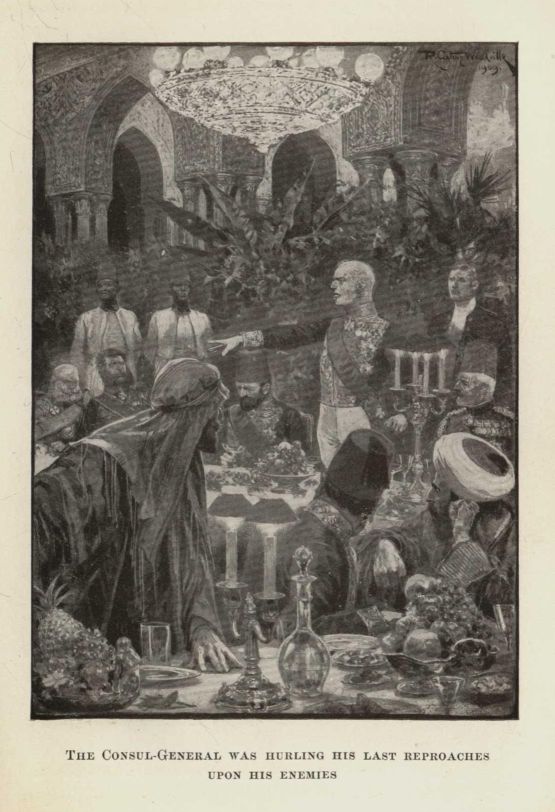
The Consul-General was hurling his last reproaches upon his enemies
"But you are mistaken, gentlemen. I may be old but I am not yet helpless. In the interests not only of England but of Europe I have made all necessary preparations to defeat your intrigues, and now—now I am about to put them into execution."
Saying this he left his seat and directed his steps towards the door. Nearly the whole of the company rose at the same moment, and all stood aside to let him pass. Nobody spoke, nobody made a gesture. In that room there were now no longer conspirators and non-conspirators. There were only silent spectators of a great tragedy. Everybody felt that an immense figure was passing from the world's stage, and none would have been more surprised if the Pyramid of Gizeh had crumbled before their eyes.
On reaching the door the Consul-General stopped and spoke again, but with something of his old courageous calm.
"I understand," he said, "that it was part of the plan that to-night at midnight, while the British army was expected to be on the Delta, and I and my colleagues were to be held prisoners on Ghezirah, the horde of armed fanatics now lying outside on the desert were to enter and occupy the city. That was a foolish scheme, gentlemen, such as could only have been conceived in the cobwebbed brains of El Azhar. But whatever it was I must ask you to abide by its consequences. In the interests of peace and of your own safety you will remain on this island until to-morrow, and in the morning you shall see ... what you shall see!"
Then saying something in a low voice to the Commandant of Police who was standing near, he passed out of the dining-hall and the door was closed behind him.
CHAPTER XVII
A few minutes afterwards the military band in the garden was playing again, red and white rockets were shooting into the dark sky from the grounds of the Khedivial Sports Club, and the Consul-General was entering the little insular telephone office of Ghezirah, which was under the same roof as the Pavilion.
"Call me up the Colonel commanding at Abbassiah and ask him to hold the line."
"Yes, my lord."
While the attendant put in the plug of his machine and waited for a reply, the Consul-General walked nervously to and fro between the counter and the door. He was expecting the Commandant of Police to come to him in a moment with news of the arrest of Ishmael Ameer. Without this certainty (though he had never had an instant's doubt of it) he could not allow himself to proceed to the last and most serious extremity.
"Not got him yet?"
"Not yet, my lord," said the attendant, and he plugged his machine afresh.
The Consul-General resumed his restless perambulation. He was by no means at ease about the unpremeditated developments of the scene in the dining-hall, but he had always intended to make sure that his enemies were safely housed on the island, and thereby cut off from the power of making further mischief, before he ordered the army into the city. The plugging of the machine was repeated.
"Not got him even yet, boy?"
"Cannot get an answer from the Central in Cairo, my lord."
"Try yet another line. Quick!"
The Consul-General thought the Commandant was long in coming, but no doubt the police staff had removed the supposed "Bedouin" to a private room, so that in making his arrest, and in stripping off his disguise to secure evidence of his identity, there might be no unnecessary commotion, no vulgar sensation. The plugging of the machine ceased.
"Got him at last?"
"No, my lord. Think there must be something wrong with the wires."
"The wires?"
"They seem to have been tampered with."
"You mean—cut?"
"Afraid they are, my lord."
"Then the island—so far as the telephone goes—the island is isolated?"
"Yes, my lord."
The old man's face, which had been flushed, became deadly pale, and his stubborn lower lip began to tremble.
"Who can have done this? Who? Who?"
The attendant, terrified by the fierce eye that looked into his face, was answering with a vacant stare and a shake of the head when the Sirdar entered the office, accompanied by the Commandant of Police, and both were as white as if they had seen a ghost.
"Well, what is it now?" demanded the Consul-General, whereupon the Sirdar answered—
"The Commandant's men have got him, but——"
"But—what?"
"It is not Ishmael Ameer."
"Not Ishma ... you say it is not Ish——"
The Consul-General stopped, and for a long moment he stared in silence into the blanched faces before him. Then he said sharply, "Who is it?"
The Commandant dropped his head and the Sirdar seemed unwilling to reply.
"Who is it, then?"
"It is ... it is a British officer."
"A British ... you say a British——"
"A Colonel."
The old man's lips moved as if he were repeating the word without uttering it.
"His tunic was torn where his decorations had been. He looked like ... like a man who might have been degraded."
The Consul-General's face twitched, but in a fierce, almost ferocious voice he said, "Speak! Who is it?"
There was another moment of silence, which seemed to be eternal, and then the Sirdar replied—
"Nuneham, it is your own son."
CHAPTER XVIII
"From the Slave of the Most High, Abdul Ali, Chancellor of El Azhar, to Ishmael Ameer, the Messenger of God—Praise be to Him, the Exalted One!
"A word in haste to say that he who came here as your missionary and representative has within the hour been arrested by the officials of the Government, having, so far as we can yet learn and surmise, been most treacherously and maliciously betrayed into their hands by means of a letter to the English lord from one who stands near to you in your camp.
"In sadness and tears, with faces bowed to the earth and ashes on our heads, we send our sympathy to you and to your stricken followers, entreating you on our knees, in the name of the Compassionate, not to attempt to carry out your design of coming into Cairo, lest further and more fearful calamities should occur.
"This by swift and trusty messenger to your hands at Sakkara.—The Slave of your Virtues,
"ABDUL ALI."
END OF FOURTH BOOK
FIFTH BOOK
THE DAWN
CHAPTER I
The day that Ishmael had looked for, longed for, prayed for—the day that was to see the fulfilment not only of his spiritual hopes but of his rapturous dream of bliss, the day of his return to Cairo—had come at last.
But the Ishmael Ameer who was returning to Cairo was by no means the same man as the Ishmael who had gone away. In a few short months he had become a totally different person. Two forces had changed him—two forces which in their effect were one.
By the operation of the first of these forces he had become more of a mystic; by the operation of the second he had become more of a man; by the operation of both together he had become a creature who was controlled by his emotions alone.
When he left Cairo he had been a man of elevated spirit but of commanding common sense. He had looked upon himself as one whose sole work was to call men back to God and to righteousness. But little by little the tyranny of outward events, the pressure of responsibility, and, above all, the heartfelt and prostrate but dim and perverted adulation of his followers, had led him to believe that he was a being apart, specially directed by the Almighty and even permitted to be His mouthpiece.
Insensibly Ishmael had come to look upon himself as a "Son of God." When he first saw that the crowds who came to him from east and west were beginning to believe that he was the Redeemer, the Deliverer, the Expected One whom he foretold, he was shocked, and he protested. But when he perceived that this belief helped him to comfort and console and direct them, he ceased to deny; and when he realised that it was necessary to his people's confidence that they should think that he who guided them was himself guided by God, he permitted himself, by his silence, to acquiesce.
From allowing others to believe in his divinity, he had come to believe in it himself. His burning, boundless influence over his people had seemed to his deep heart to be only intelligible as a thing given to him from Heaven, and then the "miracle" in the desert, the raising of the Sheikh's daughter from the dead, had swept down the last of his scruples. God had given him supernatural powers and made him the mouthpiece of His will.
And now, at the end of his pilgrimage, if he did not accept the idea that he was in very fact the Redeemer who was to bring in the golden age, the Kingdom of God, he succumbed to a delusion that was nearly akin to it—that just as the lord of the Christians, being condemned by the Roman Governor, had permitted another to take his form and face and bodily presence and to die on the cross instead of him, so the Messiah, the Mahdi, the Christ who was to come, was now using him as His substitute to lead and control His poor, oppressed, and helpless people until the time came for Him to appear in His own person.
Such was the operation of the force that had made Ishmael more of a mystic; and the force that had made him more of a man had been playing in the same way upon his heart.
It had played upon him through Helena.
When Helena entered into his life and he betrothed himself to her, he honestly believed that he was doing no more than protecting her good name. For some time afterwards he continued to deceive himself, but the constant presence of a beautiful woman by his side produced its effect, and little by little he came to know that his heart was touched.
As soon as he became conscious of this he remembered the vow he had made when his Coptic slave-wife died, that no other woman should take her place, and he also reminded himself of his mission, his consecration to the welfare of humanity. But the more he tried to crush his affection for Helena, the more it grew.
He was like a boy in the first beautiful morning light of love. The moment he was alone, after parting from Helena at the door of her sleeping-room, he would kiss the hand that had touched her hand, and find a tingling joy in stepping afresh over the places on which her feet had trod. A glance from her beaming eyes made his pulse beat rapidly, and when, one day, he saw her combing out her hair, with her round white arm bare to the elbow, his breathing came quick and loud.
His passion was like a flower which had sprung up in the parched place of the desert of his desolate soul, and everything that Helena did seemed to water it. Reading her conduct by the only light he had, he thought she loved him. Had she not followed him from India, breaking from her own people to live by his side? Had she not betrothed herself to him without a thought of any other than spiritual joys?
Her pride in him, too, was no less than her affection. Had she not proposed that he should go into Cairo in advance, because that being the place of the greatest danger was the place of highest honour also? In her womanly jealousy for her husband's rank, had she not resisted and resented the substitution of another when it was decided by the Sheikhs that "Omar" should go instead? And, notwithstanding her illness at Khartoum, had she not insisted on following him across the desert and, weak as she was, enduring the pains of his pilgrimage in order to continue by his side?
Allah bless and cherish her! Was there anything in the world so good as a sweet, unselfish, devoted woman?
During the journey Ishmael's love for Helena grew hour by hour until it filled his whole being, and made his wild heart a globe of infinite radiance and hope. Her beauty, her gifts of mind as well as of body, took complete possession of him. Whenever he saw her, everything brightened up. Whenever he turned on his camel, and caught sight of her dromedary at the tail of the caravan, he became excited. Whenever evil things befell, he had only to think of the Rani and his troubles died away. All that was good and beautiful in the world seemed to centre in the litter that held her by day and in the tent that covered her by night.
Then, in spite of his mission and the burden of his work, he began to remember that all this loveliness, all this sweetness, belonged to him. The Rani was his wife, and he could not help but think of the possibility of nearer relations between them.
When this thought first came to him he repelled it as a species of treachery. Had he not pledged himself to a spiritual union? Would it not be wrong to break that pledge—wrong to the Rani, wrong to his own higher nature, wrong to God?
But, nevertheless, the temptation to claim the rights of a husband became stronger day by day, and he struggled to reconcile his faith with his affection. He reminded himself that renunciation was no part of Islam, that it was a Christian error, that "monkery" had been condemned by the Prophet, that it was contrary to the clear law of nature, and that as soon as his task was finished it was his duty to live a human life, with woman and with children.
This seemed to solve the Sphinx-like problem of existence, but when he tried to talk of it to the Rani, in order to break the ground with her, his tongue would not utter the words that were in his heart, and something made him stop in confusion and hasten away.
Yet his self-denial only intensified his desire. Keeping away from Helena by day, he was with her in his dreams by night. One rapturous, incredible, almost impossible and even terrible dream of bliss was always stirring within him. A little longer, only a little longer. The hour in which he would lay down his task as leader, as prophet, would be the hour in which he would take up his new life as a man.
That hour was now near. He was outside the gates of Cairo. Nothing would, nothing could, intervene at this last stage to prevent him from entering the city, and once within, his work would be at an end. O God, how good it was to live!
All that day at Sakkara, Ishmael had been in the highest state of religious exaltation, and when night came he walked about the camp as if demented both in heart and brain.
The camp stretched from the hanks of the Nile at Bedrasheen over the black ruins of Memphis to the broad sands before the Step Pyramid, and everywhere the people sat in groups about their fires, eating, drinking, playing their pipes, tambourines and drums, and singing, to tunes that were like wild dance music, their songs of rejoicing.
They were singing about himself, his wise words, his miracles, his miraculous birth (born of a virgin), his good looks, which made all women love him, and his divinity, which would save him from death. Ishmael heard this, yet he had no misgivings, no fear of what the coming day would bring forth. A sort of spiritual lightning blinded him to possible danger, and his heart swelled with love for his people. God bless them! God bless everybody! Bless East and West, white man and black man, sons of one Father, soon to be united in one hope, one love, one faith!
Ishmael felt as if he wanted to take the whole world in his arms. Above all, he wanted to take the Rani in his arms. It was not that the lower man, the animal man, was conquering the higher man, the spiritual man, but that both body and soul were aflame, that a sense of fierce joy filled his whole being at the thought of entering into a new life, and that he wished to find physical expression for it.
Before he was aware of what he was doing, he was walking in the direction of Helena's tent. Striding along in the darkness, which was slashed here and there with shafts of light from the camp fires, he approached the tent from the back, the mouth being towards the city. Close behind it, he stumbled upon some one who was crouching there. It was a boy, and he rose hastily and hurried away without speaking, being followed immediately by a woman who seemed to have been watching him.