THE WHITE PROPHET, VOLUME II (continued 3)
Reading edition
This composed his irritated nerves, and presently he took up the other newspapers. Then came a shock. Without an exception the journals accepted the Minister's speech as a remonstrance addressed to him, and reading it so they sympathised with it.
One of them saw that Lord Nuneham, however pure and beneficent his intentions might be, had no right to force his ideals upon an alien race. Another hinted that he was destroying England's prestige in her Mohammedan dominions, and, if permitted to go on, he would not only endanger the peace of Egypt, but also the safety of our Indian Empire. And a third, advocating the establishment of representative institutions, said that the recent arbitrary action of the Consul-General showed in glaringly dangerous colours the faults of the One-Man Rule which we granted to the King's representative while we denied it to the King himself.
The great Proconsul was, for some moments, utterly shaken—the sheet-anchor of his public life was gone. But within half-an-hour he had called for his First Secretary and was dictating a letter to the Premier, who was also the Minister of Foreign Affairs.
"Having read the report of your lordship's speech at the Mansion House," he said, "I find myself compelled to tell you that so great a difference between your lordship's views and mine makes it difficult for me to remain in Egypt.
"I take the view that nine-tenths of these people are still in swaddling-clothes, and that any attempt to associate them with the work of government would do a grave injustice to the inarticulate masses for whom we rule the country.
"I also take the view that Egypt is honeycombed with agitators, who, masquerading as religious reformers, are sowing sedition against British rule, and that the only way to deal with such extremists is by stern repression.
"Taking these views and finding them at variance with those of your lordship, I respectfully beg to tender my resignation of the post of H.M.'s Agent, Consul-General and Minister Plenipotentiary, which I have held through so many long and laborious years, and at the same time to express the hope that my successor may be a man qualified by knowledge and experience of the East to deal with these millions of Orientals who, accustomed for seventy centuries to the dictation of imperial autocrats, are so easily inflamed by fanatics and yield so readily to the wily arts of spies and secret conspirators."
Having finished the dictating of his letter, the Consul-General asked when the next mail left for England, whereupon the Secretary, whose voice was now as tremulous as his hand had been, replied that there would be no direct post for nearly a week.
"That will do. Copy out the letter and let me have it to sign."
With a frightened look the Secretary turned to go.
"Wait! Of course you will observe absolute secrecy about the contents of it?"
With a tremulous promise to do so the Secretary left the room.
Then the Consul-General took up a calendar that had been standing on his desk and began to count the days.
"Five—ten—fifteen, and five days more before I can receive a reply—it's enough," he thought.
England's eyes would be opened by that time and the public would see how much the Government knew about Egypt. Accept his resignation? They dare not! It would do them good, though—serve as a rebuke, and strengthen his own hands for the work he had now to do.
What was that work? To destroy the man who had robbed him of his son.
CHAPTER II
Early the next morning the Consul-General received a letter from the Princess Nazimah, saying she had something to communicate, and proposed to come to tea with him. At five o'clock she came, attended by sais, footmen, and even eunuch, but wearing the latest of Paris hats and the lightest of chiffon veils.
Tea was laid on the shady verandah overlooking the fresh verdure of the garden, with its wall of purple bougainvillea, and thinking to set the lady at ease the Consul-General had told Fatimah, instead of Ibrahim, to serve it. But hardly had they sat down when the Princess said in French—
"Send that woman away. I don't trust women. I'm a woman myself, and I know too much of them."
A few minutes afterwards she said, "Now you can give me a cigarette. Light it. That will do. Thank you!" Then squaring her plump person in a large cane chair, she prepared to speak, while the Consul-General, who was in his most silent mood, composed himself to listen.
"I suppose you were surprised when this woman who blossomed out of a harem wrote to say that she was coming to take tea with you? Here she is, though, and now she has something to say to you."
Then puff, puff, puff from the scarlet lips, while the powdered face grew hard, and the eyes, heavily shaded with kohl, looked steadfastly forward.
"I have always suspected it, but I discovered it for certain only yesterday. And where did I discover it? In my own salon!"
"What did you discover in your own salon, Princess?" asked the Consul-General in his tired voice.
"Conspiracy!"
Trained as was the Consul-General's face to self-command it betrayed surprise and alarm.
"Yes, conspiracy against you and against England."
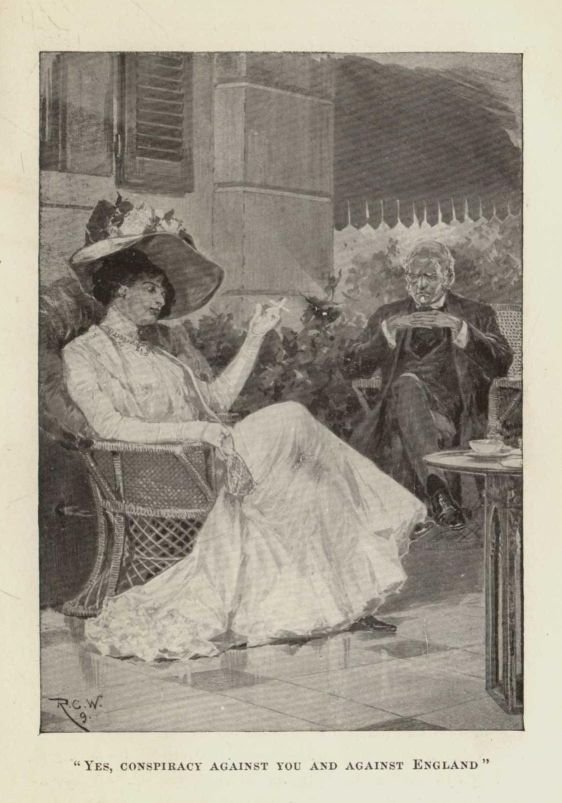
"Yes, conspiracy against you and against England"
"You mean, perhaps, that the man Ishmael Ameer——"
"Rubbish! Ishmael indeed! He is in it, certainly. In a country like Egypt the holy man always is. Religion and politics are twins here—Siamese twins, you may say, for you couldn't get a slip of paper between them.... What's that? The Mahdist movement political? Perhaps it was, but politics on the top of religion—the monkey on the donkey's back, you know. Always so in the East. The only way to move the masses is to make an appeal to their religious passions. They know that, and they've not scrupled to use their knowledge, the rascals! Rascals, that's what I call them. Excuse the word. I say what I think, Nuneham."
"They? Who are they, Princess?"
"The corps diplomatique."
Again the stern face expressed surprise.
"Yes, the corps dip-lo-ma-tique!" with a dig on every syllable. "Half-a-dozen of them were at my house yesterday and they were not ashamed to let me know what they are doing."
"And what are they doing, Princess?"
"Helping the people to rebel!"
Then throwing away her cigarette the Princess rose to her feet, and pacing to and fro on the verandah, with a firm tread that had little of the East and not much of the woman, she repeated the story she had heard in her salon—how Ishmael Ameer was to return to Cairo, with twenty, thirty, forty thousand of his followers, and some fantastic dream of establishing a human society that should be greater, nobler, wider, and more God-like than any that had yet dwelt on this planet; how the diplomats laughed at the ridiculous hallucination, but were nevertheless preparing to support it in order to harass the Government and dishonour England.
"But how?"
"By finding arms for the people to fight with if you attempt to keep their Prophet out! Ask your Inspectors! Ask your police! See if rifles bought with foreign money are not coming into Cairo every day."
By this time it was the Consul-General who was pacing up and down the verandah, while the Princess, who sat to smoke another cigarette, repeated the opinions of the foreign representatives one by one—Count This, who was old and should know better if white hairs brought wisdom; Baron That, who was as long as a palm tree but without a date; and the Marquis of So-and-So.
"They tell me because I'm a Turk; but a Turk need not be a traitor, so I'm telling you."
The iron face of the Consul-General grew white and rigid, but, saying nothing, he continued to pace to and fro.
"Why don't you turn them all out? They are making nothing but mischief. The head of the idle man is the house of the devil, and the best way is to pull it down. Why not? Capitulations! Pooh! While the meat hangs above, the dogs will quarrel below. Dogs, that's what I call them. Excuse the word. I speak what I think."
"And the Egyptians—what are they doing?"
"What are they always doing? Conspiring with your enemies to turn you out of the country on the ground that you are trampling on their religious liberty."
"Which of them?"
"All of them—pashas, people, effendis, officials, your own Ministers—everybody."
"Everybody?"
"Everybody! The stupids! They can't see farther than the ends of their noses, or realise that they would only be exchanging one master for fourteen. What would Egypt be then? A menagerie with all the gates of the cages open. Oh, I know! I say what I think! I'm their Princess, but they can take my rank to-morrow if they wish to."
The second cigarette was thrown away, and a powder-puff and small mirror were taken from a silver bag that hung from the lady's wrist.
"But serve you right, you English! You make the same mistake everywhere. Education! Civilisation! Judicial reform! Rubbish! The Koran tells the Moslem what to believe and what to do, so what does he want with your progress?"
The powder-puff made dabs at the white cheeks, but the lady continued to talk.
"Your Western institutions are thrown away on him. It's like a beautiful wife married to a blind husband—a waste!"
The sun began to set behind the wall of purple creeper and the lady rose to go.
"No news of your Gourdan yet? No? He was the best of the bunch, and I simply lost my heart to him. You should have kept him more in hand though.... You couldn't? You, the greatest man in.... Well, there's something to say for the Eastern way of bringing up boys, it seems."
Passing through the drawing-room the Princess came upon the portrait of Helena, which used to stand by Lady Nuneham's bed.
"Ah, the moon! The beauty! Bismillah! What did Allah give her such big black eyes for? Back in England, isn't she? My goodness, there was red blood in that girl's veins, Nuneham! God have mercy upon me, yes! You should have heard her talk of your Ishmael!"
The Princess put the portrait to her lips and kissed it, then closed her eyes and said with a voluptuous laugh—
"Ah, mon Dieu, if this had only been a Muslemah, you wouldn't have had much trouble with your Mahdi!"
Hardly had the Consul-General returned to his library after the departure of the Princess when his Secretary brought him a telegram from the Sirdar—the same that he had dictated at Khartoum, telling of the intended visit to Cairo, of the preparations for Ishmael's projected pilgrimage, and of the danger that was likely to arise from the growing belief in the Prophet's "divine" inspiration.
"So our friend is beginning to understand the man at last," he said, with an expression of bitter joy. "Meet him on his arrival. Tell him I have much to say."
That night when the Consul-General went up to his bedroom—the room in which alone the machine became the man—he was thinking, as usual, of Gordon.
"Such power, such fire, such insight, such resource! My own son too, and worth all the weaklings put together! Oh, that he could be here now—now, when every hand seems to be raised against his father! But where is he? What is he doing? Only God can say."
Then the Consul-General remembered what the Princess had said about Helena. Ah, if those two could have carried on his line—what a race! So pure, so clean, so strong! But that was past praying for now, and woe to the day when they had said to him, "A man child is born to you."
After that the Consul-General thought of Ishmael, and then the bitterness of his soul almost banished sleep. He had known from the first that the man could not be working alone; he had known, too, that some of England's "allies" were her secret enemies, but a combination of Eastern mummery with Western treachery was more than he had reckoned upon.
"No matter! I'll master both of them!" he thought.
A great historical tragedy should be played before the startled audience of disunited Europe, whose international jealousies were conspiring with religious quackeries to make the government of Egypt impossible, and when the curtain fell on that drama England would be triumphant, he would himself be vindicated, and the "fossils of Whitehall" would be ashamed.
Last of all he thought of the Egyptian Ministers. These were the ingrates he had made and worked with, but they were no fools, and it was difficult to understand why they were throwing in their lot with a visionary mummer who was looking for a millennium.
"I am at a loss to know what to think of a world in which such empty quackery can be supported by sane people," he thought.
There was one sweeter thought left, though, and as the Consul-General dropped off to sleep he told himself that, thanks to Helena, he would soon have Ishmael in his hands, and then he would kill him as he would kill a dangerous and demented dog.
CHAPTER III
During the next few days the Consul-General was closely occupied. The Law of Public Security being promulgated, he called upon the Minister of the Interior to call upon the Commandant of Police to issue a warrant for the arrest of Ishmael Ameer.
"But where is Ishmael Ameer?" asked the Minister.
When this was reported to the Consul-General his stern face smiled, and he said—
"Let him wait and see."
Early one morning his Secretary came to his room to say that the Sirdar had arrived from Khartoum, and had gone on to headquarters, but would give himself the pleasure of calling upon his lordship before long.
"Tell him it must be soon—there is much to do," said the Consul-General.
Later the same day the Commandant of Police came, with a knowing smile on his ruddy face, to say that the Bedouin had reached Cairo, and that he had been followed to the Serai Fum el Khalig, the palace of the Chancellor of El Azhar, where he had already been visited by the Grand Mufti, some of the Ministers, certain of the Diplomatic Corps and nearly the whole of the Ulema.
"Was he alone?" asked the Consul-General.
"Quite alone, your lordship, and now he is as safely in our hands as if he were already under lock and key."
"Good! What did you say his address was?"
"Serai Fum el Khalig."
"Palace Fum el Khalig," repeated the Consul-General, making a note on a marble tablet which stood on his desk.
Later still, very late, the Grand Cadi came with the same news. The suave old Moslem judge was visibly excited. His pale, lymphatic, pock-marked cheeks, his earth-coloured lips, his base eyes, and his nose as sharp as a beak, gave him more than ever the appearance of a fierce and sagacious bird of prey. After exaggerated bows, he began to speak in the oily, half-smothered voice of one who lives in constant fear of being overheard.
"Your Excellency will remember that when on former occasions I have had the inestimable privilege of approaching your honourable person in order to warn you that if you did not put down a certain Arab innovator the result would be death to the rule of England in Egypt, your Excellency has demanded proofs."
"Well?"
"I am now in a position to provide them."
"State the case precisely," said the Consul-General.
"Your Excellency will be interested to hear that a person of some consequence has arrived in Cairo."
Trained to self-control, the Consul-General conquered an impulse to say, "I know," and merely said, "Who is he?"
"He calls himself Sheikh Omar Benani, and is understood to be the wise and wealthy head of the great tribe of the Ababdah Bedouins who inhabit the country that lies east of Assouan to the Red Sea."
"Well?"
"The man who calls himself Omar Benani is—Ishmael Ameer."
At that the base eyes glanced up with a look of triumph, but the Consul-General's face remained immovable.
"Well?"
"No doubt your Excellency is asking yourself why he comes in this disguise, and if your Excellency will deign to give me your attention I will tell you."
"I am listening."
"Ishmael Ameer pretends to be a reformer intent upon the moral and intellectual regeneration of Islam, and he preaches the coming of a golden age in which unity, peace and brotherhood are to reign throughout the earth.
"Well?"
"With this ridiculous and impracticable propaganda he has appealed to many wild and ardent minds, so that a vast following of half-civilised people whom he has gathered up in the Soudan are to start soon—may have started already—for this city, which they believe to be the Mecca of the new world."
"Well?"
"Ishmael Ameer pretends to have come to Cairo in advance of his followers to prepare for that millennium."
"And what has he really come for?"
"To establish a political State."
Down to that moment the Consul-General had been leaning back in his chair in the attitude of one who was listening to something he already knew, but now he sat up sharply.
"Is this a fact?"
"It is a fact, your Excellency. And if your Excellency will once more deign to grant me your attention, I will put you in possession of a secret."
"Go on," said the Consul-General.
Instinctively the suave old judge drew his legs up on his chair and fingered his amber beads.
"Your Excellency will perhaps remember that owing to differences of opinion with the Khedive—may Allah bless him!—you were compelled to require that for a while he should leave the country."
"Well?"
"He went to Constantinople with the intention of laying his grievances against England before His Serenity the Sultan—may the Merciful give him long life!"
"Well?"
"The Sultan is a friend of England, your Excellency—the Khedive was turned away."
"And then?"
"Then he went to Paris, as your Excellency is probably aware."
"Well?"
"Perhaps your Excellency supposes that he occupied himself with the frivolities of the gay capital of France—dinners, theatres, dances, races? But no! He had two enemies now, England and Turkey, and he presumed to think he could punish both."
"How? In what way?"
"By founding a secret society for the conquest of Syria, Palestine and Arabia, and the establishment of a great Arab Empire with himself as its Caliph and Cairo as its capital."
"Well? What happened?"
"Need I say what happened, your Excellency? By means of his great wealth he was able to send out hundreds of paid emissaries to every part of the Arabic world, and Ishmael Ameer was the first of them."
The Consul-General was at length startled out of all his composure.
"Can you prove this?" he said.
"Your Excellency, if I say anything I can always prove it."
The Consul-General's brow grew more and more severe.
"And his name—his assumed name—what did you say it was?"
"Sheikh Omar Benani."
"Sheikh Omar Benani," repeated the Consul-General, making another note on his marble tablet.
"That is enough for the present," he said. "I have something to do to-night. I must ask your Eminence to excuse me."
After the Grand Cadi had gone, with many sweeping salaams, various oily compliments, and that cruel gleam in his base eyes which proceeds only from base souls, the Consul-General rang sharply for his Secretary.
"We have not yet made out our invitations for the King's dinner—let us do so now," he said.
He threw a sheet of paper across the table to his Secretary, who prepared to make notes.
"First, the Diplomatic Corps—every one of them."
"Yes, my lord."
"Next, our Egyptian Ministers and the leading members of the Legislative Council."
"Yes, my lord."
"Next, the more prominent Pashas and Notables."
"Yes!"
"Of course our own people as usual, and finally——"
"Yes?"
"Finally, the Ulema of El Azhar."
The Secretary looked up in astonishment.
"Oh, I know," said the Consul-General. "They have never been invited before, but this is a special occasion."
"Quite so, my lord."
The Consul-General fixed his eyeglass and took up his marble tablet.
"In writing to the Chancellor of El Azhar at the Palace Fum el Khalig," he said, "enclose a card for the Sheikh Omar Benani."
"Sheikh Omar Benani."
"Say that hearing that one so highly esteemed among his own people is at present on a visit to Cairo, I shall be honoured by his company."
"Yes, my lord."
"That will do. Good-night!"
"Good-night, my lord."
It was early morning before the Consul-General went to bed. The Grand Cadi's story, being so exactly what he wanted to believe, had thrown him entirely off his guard. It appeared to illuminate everything that had looked dark and mysterious—the sudden advent of Ishmael, the growth of his influence, the sending out of his emissaries, his projected pilgrimage, and the gathering up of camels and horses in such enormous quantities as even the Government could not have commanded in time of war.
It accounted for Ishmael's presence in Cairo, and his mission (as described by Helena) of drawing off the allegiance of the Egyptian army. It accounted, too, for the treachery of the Ministers, Pashas and Notables, who were too shrewd and too selfish (whatever the riff-raff of the Soudan might be) to risk their comfortable incomes for a religious chimera.
Yes, the Khedive's money and the substantial prospect of establishing a vast Arab Empire, not the vague hope of a spiritual millennium, had been the power that worked these wonders.
It vexed him to think that his old enemy whom he had banished had been more powerful in exile than at home, and it tortured him to reflect that Ishmael had developed, with the religious malady of the Mahdi, his political mania as well.
But no matter! He would be more than a match for all these forces, and when his great historical drama came to be played before the eyes of astonished humanity, it would be seen that he had saved, not England only but Europe, and perhaps civilisation itself.
Thus, for three triumphant hours, the Consul-General saw himself as a patriot trampling on the enemies of his country; but hardly had he left the library and begun to climb the stairs of his great, empty, echoing house, switching off the lights as he ascended, and leaving darkness behind him, than the statesman sank back on the man—the broken, bereaved human being—and he recognised his motives for what they were.
A few minutes after he had reached his bedroom Fatimah entered it with a jug of hot water, and found him sitting with his head in his hands, looking fixedly at the portrait in the black-and-gilt frame of the little lad in an Arab fez.
"Ah, everybody loved that boy," she said, whereupon the old man raised his head and dismissed her brusquely.
"You ought to be in bed by this time—go at once," he said.
"Dear heart, so ought your lordship," said the Egyptian woman.
The Consul-General could dismiss Fatimah, but there was some one he could not get rid of, the manly, magnificent, heart-breaking young figure that always lived in his mind's eye, with its deadly white face, its trembling lower lip, and its quivering voice, which said, "General, the time may come when it will be even more painful to you to remember all this than it has been to me to bear it."
Where was he now? What was he doing? His son, his only son, all that was left to him!
There was only one way to lay that ghost, and the Consul-General did so by telling himself with a sort of fierce joy that wherever Gordon might be he must soon hear that Ishmael, in a pitiful and tricky disguise, had been discovered in Cairo, and then he would see for himself what an arrant schemer and unscrupulous charlatan was the person for whom he had sacrificed his life.
With that bitter-sweet thought the lonely old man forced back the tears that had been gathering in his eyes and went to bed.
CHAPTER IV
I
"SERAI FUM EL KHALIG,
"CAIRO.
"MY DEAREST HELENA,—Here I am, you see, and I am not arrested, although I travelled in the same train with the Sirdar, met him face to face on the platform at Khartoum, again on the platform at Atbara, again on the landing place at Shelal, and finally in the station at Cairo, where he was received on his arrival by his officers of the Egyptian army, by my father's first Secretary, and by the Commandant of Police.
"I was asking myself what this could mean, whether your black boy had reached his destination, and if your letter had been delivered, when suddenly I became aware that I was being observed, watched and followed to this house, and by that I knew that in this land of mystery my liberty was to be allowed to me a little longer for reasons I have still to fathom.
"This is the home of the Chancellor of El Azhar, and I have delivered Ishmael's letter announcing the change of plan whereby I have come into Cairo instead of him, but I have pledged the good old man to secrecy on that subject, for the present at all events, giving him my confident assurance that in common with the best of the Ulema he is being wickedly deceived and made an innocent instrument for the destruction of his own cause.
"My dear Helena, I was right. My vague suspicions of that damnable intriguer the Grand Cadi were justified. Already I realise that after fruitless efforts to inveigle Ishmael into schemes of anarchical rebellion it was he who conceived the conspiracy, which has taken our friend by storm, in the form of a passive mutiny of the Egyptian army. The accursed scoundrel knows well it cannot be passive, that somewhere and somehow it will break into active resistance, but that is precisely what he desires. As I told you, it is the old trick of Caiaphas over again, and that is the lowest, meanest, dirtiest thing in history.
"Query, is he playing the same game with the Consul-General? I am sure he is, and when I think that England and my father may be in as much danger as Egypt and Ishmael from the man's devilish machinations, I am more than ever certain that Providence had a purpose in bringing me to Cairo, and I feel reconciled to the necessity of living here in this threefold disguise, being one thing to Ishmael, another to the Grand Cadi and Co., and a third to the Government and police. I feel reconciled too, or almost reconciled, to the necessity of leaving you where you are, for the present at all events, although it rips me like a sword-cut as often as I think of it.
"I have sent for Hafiz and expect to hear through him what is happening at the Agency, but I am hoping he will not come until morning, for to-night I can think of nothing but ourselves. When I left you at Khartoum I felt that higher powers were constraining and controlling me, and that I was only yielding at last to an overwhelming sense of fatality. I thought I had made every possible effort, had exhausted every means and had nothing to reproach myself with, but hardly had I got away into the desert when a hand seemed to grasp me at the back of my neck and to say, 'Why did you leave her behind?'
"In Ishmael's house and in that atmosphere of delirious ecstasy in the mosque it was easy to think it necessary for you to remain, otherwise my purpose in going away must from the first be frustrated, but awakening in the morning in my native compartment, with men and boys lying about on sacks, the sandy daylight filtering through the closed shutters of the carriage and the train full of the fetid atmosphere of exhausted sleep, I could not help but protest to myself that at any cost whatever I should have found a way to bring you with me.
"Thank God, if I have left you behind in that trying and false position it is with no Khalifa, no corrupt and concupiscent fanatic, but a man of the finest and purest instincts, who is too much occupied with his spiritual mission, praise the Lord, to think of the beautiful woman by his side, so I tell myself it was the will of Providence, and there is nothing to do now but to leave ourselves in the hands of fate.
"Good-night, dearest! D.V. I'll write again to-morrow."
II
"Have just seen Hafiz. The dear old fellow came racing up here at six o'clock this morning, with his big round face like the aurora borealis, shining in smiles and tears. Heavens, how he laughed and cried and swore and sweated!
"He thought his letter about my mother's death had brought me back, and when I gave him a hint of my real errand he nearly dropped with terror. It seems that among my old colleagues in Cairo my reputation is now of the lowest, being that of a person who was bribed—God knows by whom—to do what I did. As a consequence it will go ill with me, according to Hafiz, if I should be discovered, but as that is pretty certain to happen in any case I am not too much troubled, and find more interest in the fact that your boy Mosie is staying at the Agency and that consequently my father must have received your letter.
"My dear Helena, my 'mystic sense' has been right again. The Grand Cadi continues to pay secret visits to the Consul-General. That much Hafiz could say from his intercourse with his mother, and it is sufficient to tell me that, by keeping a running sore open with my father, the scoundrel counts on destroying not only Ishmael but England, by leading her to such resistance as will result in bloodshed, and thus dishonour her in the eyes of the civilised world and leave Egypt a cockpit in which half the foreign Powers will fight for themselves, no matter who may suffer.
"What should I do? God knows! I have an almost unconquerable impulse to go straight to my father and open his eyes to what is going on. He is enveloped by intrigues and surrounded by enemies in high places—his Egyptian Ministers, the creatures of his own creation; some of the foreign diplomats, the European leeches who suck his blood while they pretend to be his friends, and above all this rascally Cadi, with his sleek face and double-sword game.
"But what can I say? What positive fact can I yet point to? Will my father believe me if I tell him that Ishmael's following which is coming up to Cairo is not, as he thinks, an armed force? That the Grand Cadi & Co. are a pack of lying intriguers, each one playing for his own hand?
"My father is a great man who probably does not need and would certainly resent my compassion, but, Lord God, how I pity him! Alone, in his old age, after all he has done for Egypt! As for his Secretaries and Advisers, he has not brought them up to help him, and I would enlarge the Biblical warning about not putting one's trust in princes to include parvenus as well.
"My dear Helena, where are you now, I wonder? What is happening to you? What occurred after I left Khartoum? These are the questions which during half the day and nearly the whole of the night are hammering, hammering, hammering on my brain. Ishmael was to follow me in a few days, so I suppose you are on the desert by this time. The desert! In the midst of that vast horde! The scourings of a whole continent! Poor old Hafiz had something like a fit when I told him you were not in England but in the Soudan, yet as a fatalist he feels bound to believe that everything will work out for the best and he asks me to send his high regard to you.
"It gives one a strange sensation, and is almost like seeing things from another state of existence, to be here in Cairo walking about unrecognised amid the familiar sights, and hearing the gun fired from the Citadel every day; but the sharpest twinge comes of the hacking thought of where you are and what circumstances surround you. In fact, memory is always playing some devilish trick with me and raking up thoughts of the condition in which I found you in Khartoum.
"Helena, my dear Helena, I have an immense faith in your strength and your courage. You are mine, mine, mine—remember that! I do—I have to—all the time. That is what sets me at ease in my dark hours and gives sleep, as the Arabs say, to my eyelids. For the rest, we must resign ourselves and continue to wait for the direction of fate. The fact that I was not arrested in the character of Ishmael immediately on my arrival in Cairo makes me think Hafiz may be right—that, D.V. one way or another, God knows how, everything is working out for the best. It's damned easy to say that, I know, but, upon my soul, dearest, I believe it. So keep up heart, my poor old girl, and God bless you! GORDON.
"P.S.—I'll hold this letter back until I think you must be nearing Assouan, and then send it D.V. by safe hands to be delivered to you there.
"P.P.S.—I open my envelope to tell you of a new development! I am invited with the Chancellor of El Azhar to the Consul-General's dinner in honour of the King's Birthday. This, in the character of Sheikh Omar Benani, who is, it seems, the chief of the tribe of the Ababdah, inhabiting the wild country between Assouan and the Red Sea, a person with a great reputation for wealth and wisdom, and a man whose word is truth.
"What does it mean? One thing certainly—that acting on the information contained in your letter the authorities are mistaking me for Ishmael Ameer, and proposing some scheme to capture me. But why don't they take me without further ado? What unfathomable reason can there be for the delay in doing so? Intrigue on intrigue! I must wait and see.
"Meantime I am asking myself where the real Ishmael is and what he is doing now? Is the belief in his 'divine' guidance increasing? Is he acquiring the influence of a Mahdi? If so, God help him! God help his people! God help my father! God help everybody!
"But sit tight, my girl! Something good is going to happen to us! I feel it, I know it! All my love to you, Helena! Maa-es-salamah!"
CHAPTER V
I
"KHARTOUM.
"MY DEAR, DEAR GORDON,—Gone! You are actually gone! I can hardly believe it. It must be like this to awaken from chloroform after losing one's right hand, only it must be something out of my heart in this instance, for though I have not shed a tear since you went away and do not intend to shed one, I have a wild sense of weeping in the desolate chambers of my soul.
"Writing to you? Certainly I am. Gordon, do you know what you have done for me? You have given me faith in your 'mystic senses,' and by virtue of certain of my own I am now sure that you are not dead, and that you are not going to die, so I am writing to you out of the chaos that envelops me, having no one here to speak to, literally no one, and being at present indifferent to the mystery of what is to become of my letter.
"It seems I fainted in the mosque after that wild riot of barbaric sounds, and did not come back to full consciousness until next morning, and then I found the Arab woman and the child attending on me in my room. Naturally I thought I might have been delirious and I was in terror lest I had betrayed myself, so I asked what I had been saying in my sleep, whereupon Zenoba protested that I had said nothing at all, but Ayesha, the sweet little darling, said I had been calling upon the great White Pasha (meaning General Gordon) whose picture (his statue) was by the Palace gates. What an escape!
"Of course my first impulse was to run away, but at the next moment I saw that to do so would be to defeat your own scheme in going, and that as surely as it had been your duty to go into Cairo, it was mine to remain in Khartoum. But all the same I felt myself to be a captive—as surely a captive as any white woman who was ever held in the Mahdi's camp—and it did not sweeten my captivity to remember that I had first become a prisoner of my own free will.
"If I am a captive I am under no cruel tyrant, though, and Ishmael's kindness is killing me. I was certainly wrong about him in Cairo, and his character is precisely the reverse of what I expected. Little Ayesha tells me that during the night I lay unconscious her father did not sleep at all, but kept coming into the guest-room every hour to ask for news of me, and now he knocks at my door a dozen times a day, asking if I am better, and saying 'To morrow, please God, you will be well.' It makes me wretched, and brings me dreadfully near to the edge of tears, remembering what I have done to him and how certainty his hopes will be destroyed.
"Naturally his people have taken his cue, and last night Black Zogal gathered up a crowd of half-crazy creatures like himself to say a prayer for me at the Saint's house which is just outside my window.
"'Thou knowest our White Lady, O Father Gabreel, that she is betrothed to our Master, and that his heart is low and his bread is bitter because she is sick. Make her well if it please God, O Father Gabreel!' Thus the simple-hearted children of the desert called down God's spirit to their circle of fire for me, and after loud cries of 'Allah! Allah!' going on for nearly an hour, they seemed to be content, for Zogal said—
"'Abu Gabreel hears, O my brothers, and to-morrow, please God, our sister will be well.'
"I had been reaching up in bed to look and listen, and when all was over I wanted to lay down my head and howl.
"The time has come for the people to start on their pilgrimage, but Ishmael insists upon postponing the journey until I have quite recovered. Meantime Zenoba is trying to make mischief, and to-day when the door of my room was ajar, I heard her hinting to Ishmael that the White Lady was not really ill but only pretending to be—a bit of treachery for which she got no thanks, being as sharply reproved as she was on the morning of your mother's letter.
"That woman makes a wild cat of me. I can't help it—I hate her! Of course I see through her, too. She is in love with Ishmael, and though I ought to pity her pangs of jealousy there are moments when I want to curse her religion and the dawn of the day of her birth and her mother and her grandmother.
"There! You see I have caught the contagion of the country; but I am really a little weak and out of heart to-night, dear, so perhaps I had better say good-night! Good-night, my dearest!"
II
"Oh dear! Oh dear! I could not bear to play the hypocrite any longer, so I got up to-day and told Ishmael I was well, and therefore he must not keep back his pilgrimage any longer. Such joy! Such rejoicing! It would break my heart, if I had any here, but having sent all I possess to Cairo I could do nothing but sit in the guest-room and look on at the last of the people's preparations for the desert journey—tents and beds being packed, and camels and horses and donkeys brought in to a continuous din of braying and grunting and neighing.
"We are to start away to-morrow morning, and this afternoon when that fact was announced to me I was so terrified by the idea of being dragged over the desert like a slave that I asked Ishmael to leave me behind. His face fell, but—would you believe it?—he agreed, saying I was not strong enough to travel and Zenoba should stay to nurse me. At that I speedily repented of my request and asked him to allow me to go, whereupon his face lightened like a child's, and with joy he agreed again, saying the Arab woman should go to take care of me, for Ayesha was a big girl now and needed a nurse no longer. This was jumping out of the frying-pan into the fire, and I protested that I was quite able to look after myself; but, out of his anxiety for my health, Ishmael would not be gainsaid, and the Arab woman said, 'I'll watch over you like my eyes, my sister.' I am sure she will, the vixen!"
III
"We have left Khartoum and are now on the desert. The day had not yet dawned when we were awakened by a tattoo of pipes and native drums—surely the weirdest sound in the darkness that ever fell on mortal ear, creeping into the pores and getting under the very skin. Then came a din, a roar, a clamour—the grunting and gurgling and braying of five thousand animals and as much shouting and bellowing of human tongues as went to the building of the tower of Babel.
"The sun was rising, and there was a golden belt of cloud in the Eastern sky by the time we were ready to go. They had brought a litter on a dromedary for me, and I was almost the last to start. It was hard to part from the child, for though her sweet innocence had given me many a stab and I felt sometimes as if she had been created to torture me, I had grown to love her, and I think she loved me. She stood as we rode away, with a big tear ready to drop on to her golden cheek and looked after me with her gazelle-like eyes. Sweet little Ayesha, creature of the air and the desert, I shall see her no more!
"Crossing the Mahdi's open-air mosque at Omdurman, where we said morning prayers, we set our faces northward over the wild halfa grass and clumps of mimosa scrub, and as soon as we were out in the open desert with its vast sky I saw how gigantic was our caravan. The great mass of men and animals seemed to stretch for miles across the yellow sand, and looked like an enormous tortoise creeping slowly along.
"We camped at sunset in the Wadi Bishara, the signal for the bivouac being the blowing of a great elephant-horn which had a thrilling effect in that lonesome place. But more thrilling still was the effect of evening prayers, which began as soon as the camels and horses and donkeys had been unsaddled, and their gruntings and brayings and gurglings, as well as the various noises of humanity, had ceased.
"The afterglow was flaming along the flat sand, giving its yellow the look of bronze, when all knelt with their faces to the East—Ishmael in front with sixty or seventy rows of men behind him. It was really very moving and stately to see, and made me understand what was meant by somebody who said he could never look upon Mohammedans at prayers, and think of the millions of hearts which at the same hour were sending their great chorus of praise to God, without wishing to be a Moslem. I did not wish to be that, but with the odious Arab woman always watching me, I found myself fingering my rosary and pretending to be a good Muslemah, though in reality I was repeating the Lord's Prayer.
"It is dark night now, the fires at which the people baked their durah and cooked their asida are dying down, and half the camp is already asleep in this huge wild wilderness, under its big white stars.
"I must try to sleep too, so good-night, dearest, and God bless you! I don't know what is to be the end of all this, or where I am to dispatch my letter, or when you are to receive it, but I am sure you are alive and listening to me—and what should I do if I could not talk to you? HELENA."
CHAPTER VI
I
"SOUDAN DESERT (somewhere).
"It is ten days, my dear Gordon, since I wrote my last letter, and there has never been an hour between when I dared pretend to this abomination of Egypt (she is now snoring on the angerib by my side, sweetheart) that I must while away an hour by writing in my 'Journal.'
"Such a time! Boil and bubble, toil and trouble! Every morning before daybreak the wild peal of the elephant-horn, then the whole camp at prayers with the rising sun in our faces, then the striking of tents and the ruckling, roaring, gurgling and grunting of camels which resembles nothing so much as a styful of pigs in extremis; then twelve hours of trudging through a forlorn and lifeless solitude with only a rest for the midday meal; then the elephant-horn again and evening prayers, with the savage sun behind us, and then settling down to sleep in some blank and numb and soundless wilderness—such is our daily story.
"My goodness, Ishmael is a wonderful person! But all the same the 'divine' atmosphere that is gathering about him is positively frightening. I suspect Black Zogal of being the author and 'only begetter' of a good deal of this idolatry. He gallops on a horse in front of us, crying, 'There is no god but God,' and 'The Messenger of God is coming,' with the result that crowds of people are waiting for Ishmael at every village, with their houses swept, their straw mats laid down, and their carpets spread on the divans, all eager to entertain him, to open their secret granaries to feed his followers, or at least to kiss the hem of his caftan.
"Every day our numbers increase, and we go off from the greater towns to the beating of copper war-drums, the blowing of antelope horns, and sometimes to the cracking of rifles. It is all very crude in its half-savage magnificence, but it is almost terrifying, too, and the sight of this emotional creature, so liable to spasms of religious ecstasy, riding on his milk-white camel through these fiercely fanatical people like a god, makes one tremble to think of the time that will surely come when they find out, and he finds out, that after all he is nothing but a man.
"What sights, what scenes! The other day there was a fearful sand-storm, in which a fierce cloud came sweeping out of the horizon, big with flame and wrath, and fell on us like a mountain of hell. As long as it lasted the people lay flat on the sand or crouched under their kneeling camels, and when it was over they rose in the dead blankness with the red sand on their faces and sent up, as with one voice, a cry of lamentation and despair. But Ishmael only smiled and said, 'Let us thank God for this day, O my brothers,' and when the people asked him why, he answered, 'Because we can never know anything so bad again.'
"That simple word set every face shining, and as soon as we reached the next village—Black Zogal as usual having gone before us—lo, we heard a story of how Ishmael had commanded a sand-storm to pass over our heads without touching us—and it had!
"Another day we had stifling heat, in which the glare of the sand made our eyes to ache and the air to burn like the breath of a furnace. The water in the water-bottles became so hot that we dared not pour it on to the back of our hands, and even some of the camels dropped dead under the blazing eye of the sun.
"And when at length the sun sank beneath the horizon and left us in the cool dark night, the people could not sleep for want of water to bathe their swelling eyelids and to moisten their cracking throats, but Ishmael walked through their tents and comforted them, telling them it was never intended that man should always live well and comfortably, yet God, if He willed it, would bring them safely to their journey's end.
"After that the people lay down on the scorching sand as if their thirst had suddenly been quenched; and next day, on coming to the first village, we heard that in the middle of a valley of black and blistered hills, Ishmael smote with his staff a metallic rock that was twisted into the semblance of a knotted snake, and a well of ice-cold water sprung out of it, and everybody drank of it and then 'shook his fist at the sun.'
"Nearly all last week our people were in poor heart by reason of the mirages which mocked and misled them, showing an enchanted land on the margin of the sky, with beautiful blue lakes and rivers and green islands and shady groves of palm, and sweet long emerald grasses that quivered beneath a refreshing breeze; but when, from their monotonous track on the parched and naked desert, the poor souls would go in search of these phantoms, they would find nothing but a great lone land, in the fulness of a still deeper desolation.
"Then they would fling themselves down in despair and ask why they had been brought out into the wilderness to die, but Ishmael, with the same calm smile as before, would tell them that the life of this world was all a mirage, a troubled dream, a dream in a sleep, that the life to come was the awakening, and that he whose dream was most disturbed was nearest the gates of Paradise.
"Result—at the next town we came to, we were told that when we were in the middle of the wilderness Ishmael had made an oasis to spring up around us, with waving trees and rippling water and the air full of the songs of birds, the humming of bees, and the perfume of flowers, and we all fell asleep in it, and when we awoke in the morning we believed we had been in Heaven!
"Good-night, my dear—dear! Oh, to think that all this wilderness divides us! But ma'aleysh! In another hour I shall be asleep, and then—then I shall be in your arms."
II
"Oh my! Oh my! Two incidents have happened to-day, dearest, that can hardly fail of great results. Early in the morning we came upon the new convict settlement, a rough bastioned place built of sun-dried bricks in the middle of the Soudan desert. It contains the hundred and fifty Notables who were imprisoned by the Special Tribunal for assaults on the Army of Occupation when they were defending the house of your friend the Grand Cadi. How Ishmael discovered this I do not know, but what he did was like another manifestation of the 'mystic sense.'
"Stopping the caravan with an unexpected blast of the elephant-horn, he caused ten rows of men to be ranged around the prison, and after silence had been proclaimed, he called on them to say the first Surah: 'Praise be to God, the Lord of all creatures.'
"It had a weird effect in that lonesome place, as of a great monotonous wave breaking on a bar far out at sea, but what followed was still more eerie. After a breathless moment, in which everybody seemed to listen and hold his breath, there came the deadened and muffled sound of the same words repeated by the prisoners within the walls: 'Praise be to God, the Lord of all creatures.'
"When this was over Ishmael cried, 'Peace, brothers! Patience! The day of your deliverance is near! The Redeemer is coming! All your wrongs will be righted, all your bruises will be healed! Peace!'
"And then there came from within the prison walls the muffled answer, 'Peace!'
"The second of the incidents occurred about midday. When crossing a lifeless waste of gloomy volcanic sand, we came upon a desert graveyard, with those rounded hillocks of clay which make one think that the dead beneath must be struggling in their sleep.
"At a word from Ishmael all the men of our company who belong to that country stepped out from the caravan and riding round and round the cemetery, shouted the names of their kindred who were buried there: 'Ali!' 'Abdul!' 'Mohammed!' 'Mahmud!' 'Said!'
"After that Ishmael himself rode forward, and addressing the dead as if they could hear, he cried, 'Peace to you, O people of the graves! Wait! Lie still! The night is passing! The daylight dawns!'
"It was thrilling! Strange, simple, primitive, crude in its faith perhaps, but such love and reverence for the dead contrasted only too painfully with the vandalism of our 'Christian' vultures (yclept Egyptologists), who rifle the graves of the old Egyptians for their jewels and mummy beads, and then leave their bones in tons to bleach on the bare sand—a condition that is sufficient of itself to account for Jacob's prayer, 'Bury me not, I pray thee, in the land of Egypt.'
"And so say all of us! But seriously, my dear Gordon, I quite expect to hear at the next stopping-place a story of how Ishmael recited the Fatihah and the walls of a prison fell down before him, and how he spoke to the dead and they replied."
III
"It has happened! I knew it would! I have seen it coming, and it has come—without any help from Black Zogal's crazy imagination, either. There was only one thing wanted to complete the faith of these people in Ishmael's 'divinity'—a miracle, and it has been performed!
"I suppose it really belongs to the order of things that happen according to natural law—magnetism, suggestion, God knows what—but my pen positively jibs at recording it, so surely will it seem as if I had copied it out of a Book I need not name.
"This afternoon our vast human tortoise was trudging along, and a halt was being called to enable stragglers to come up, when a funeral procession crossed our track on its way to a graveyard on the stony hillside opposite.
"The Sheikh of a neighbouring village had lost his only child, a girl twelve years of age, and behind the blind men chanting the Koran, the hired mourners with their plaintive wail and the body on a bare board, the old father walked in his trouble, rending his garments and tearing off his turban.
"It was a pitiful sight; and when the mourners came up to Ishmael and told him the Sheikh was a God-fearing man who had not deserved this sorrow, I could see that he was deeply moved, for he called on the procession to stop, and making his camel kneel, he got down and tried to comfort the old man, saying, 'May the name of God be upon thee!'
"Then thinking, as it seemed to me, to show sympathy with the poor father, he stepped up to the bier and took the little brown hand which, with its silver ring and bracelet, hung over the board, and held it for a few moments while he asked when the child had died and what she had died of, and he was told she had died this morning, and the sun had killed her.
"All at once I saw Ishmael's hand tremble and a strange contraction pass over his face, and at the next moment, in a quivering voice, he called on the bearers to put down the bier. They did so, and at his bidding they uncovered the body, and I saw the face. It was the face of the dead! Yes, the dead, as lifeless and as beautiful as a face of bronze.
"At the next instant Ishmael was on his knees beside the body of the girl, and asking the father for her name. It was Helimah.
"'Helimah! Your father is waiting for you! Come,' said Ishmael, touching the child's eyes and smoothing her forehead, and speaking in a soft, caressing voice.
"Gordon, as I am a truthful woman, I saw it happen. A slight fluttering of the eyelids, a faint heaving of the bosom, and then the eyes were open, and at the next moment the girl was standing on her feet!
"God! what a scene it was that followed. The Sheikh on his knees kissing the hem of Ishmael's caftan, the men prostrating themselves before him, and the women tearing away the black veils that covered their faces, and crying, 'Blessed be the woman that bore thee!'
"It has been what the Arabs call a red day, and at that moment the setting sun catching the clouds of dust raised by the camels made the whole world one brilliant, fiery red. What wonder if these poor, benighted people thought the Lord of Heaven Himself had just come down!
"We left the village loaded with blessings (Black Zogal galloping frantically in front), and when we came to the next town—Berber, with its miles of roofless mud-huts, telling of Dervish destruction—crowds came out to salute Ishmael as the 'Guided One,' 'The true Mahdi,' and 'The Deliverer,' bringing their sick and lame and blind for him to heal them, and praying of him to remain.
"Oh, my dear Gordon, it is terrifying! Ishmael is no longer the messenger, the forerunner; he is now the Redeemer he foretold! I really believe he is beginning to believe it! This is the pillar of fire that is henceforth to guide us on our way. Already our numbers are three times what they were when we left Khartoum. What is to happen when thirty thousand persons, following a leader they believe to be divine, arrive in Cairo and are confronted by five thousand British soldiers?
"No! It is not bloodshed I am afraid of—I know you will prevent that. But what of the awful undeceiving, the utter degradation, the crushing collapse?
"And I? Don't think me a coward, Gordon—it isn't everybody who was born brave like you—but when I think of what I have done to this man, and how surely it will be found out that I have betrayed him, I tell myself that the moment I touch the skirts of civilisation I must run away.
"But meanwhile our pilgrimage is moving on—to its death, as it seems to me—and I am moving on with it as a slave—the slave of my own actions. If this is Destiny, it is wickedly cruel, I will say that for it; and if it is God, I think He might be a jealous God without making the blundering impulse of one poor girl the means of wrecking the hopes of a whole race of helpless people. Of course it acts as a sop to my conscience to remember what you said about God never making mistakes, but I cannot help wishing that in His inscrutable wisdom He could have left me out.
"Oh, my dear-dear! Where are you now, I wonder? What are you doing? What is being done to you? Have you seen your father, the Princess, and the Grand Cadi? I suppose I must not expect news until we reach Assouan. You promised to write to me, and you will—I know you will. Good-night, dearest! My love, my love, my only love! But I must stop. We are to make a night journey. The camp is in movement, and my camel is waiting. Adieu!
"HELENA."
CHAPTER VII
"SERAI FUM EL KHALIG,
"CAIRO.
"Salaam aleykoum! Ten days have passed, my dear Helena, since I wrote my last letter, and during that time I have learned all that is going on here, having in my assumed character of Ishmael in disguise interviewed nearly the whole of the Ulema, including that double-dyed dastard, the Grand Cadi.
"Under the wing—the rather fluttered one—of the good old Chancellor of El Azhar I saw the oily reprobate in his own house, and in his honeyed voice he made pretence of receiving me with boundless courtesy. I was his 'beloved friend in God,' 'the reformer of Islam,' called to the task of bringing men back to the Holy Koran, to the Prophet, and to eternal happiness. On the other hand, my father was 'the slave of power,' the 'evil-doer,' the 'adventurer,' and the 'great assassin,' who was led away by worldly things, and warring against God.
"More than once my hands itched to take the hypocrite from behind by the ample folds of his Turkish garments and fling him like vermin down the stairs, but I was there to hear what he was doing, so I smothered a few strong expressions which only the recording angel knows anything about, and was compelled to sit and listen.
"My dear Helena, it is even worse than I expected. Some of the double-dealing Egyptian Ministers, backed by certain of the diplomatic corps, but inspired by this Chief Judge in Islam, have armed a considerable part of the native populace, in the hope that the night when England, in the persons of her chief officials, is merry-making on the island of Ghezirah, and the greater part of the British force is away in the provinces quelling disturbances and keeping peace, the people may rise, the Egyptian army may mutiny, and Ishmael's followers may take possession of the city.
"All this and more, with many suave words about the 'enlightening help of God,' and the certainty of 'a bloodless victory,' in which the Almighty would make me glorious and the English would be driven out of Egypt, the crafty scoundrel did not hesitate to propound as a means whereby the 'true faith might be established all over Europe, Rome and London!'
"Since my interview with the Grand Cadi I have learned of a certainty, what I had already surmised, that the Consul-General has been made aware of the whole plot, and is taking his own measures to defeat it. Undoubtedly the first duty of a Government is to preserve order and to establish authority, and I know my father well enough to be sure that at any cost he will set himself to do both. But what will happen?
"Mark my word, the British army will be ordered back to the Capital—perhaps on the eve of the festival—and as surely as it enters the city on the night of the King's Birthday there will be massacre in the streets, for the Egyptian soldiers will rebel, and the people who have been provided with arms from the Secret Service money of England's enemies will rise, thinking the object of the Government is to prevent the entrance of Ishmael and his followers.
"Result—a holy war; and as that is the only kind of war that was ever yet worth waging, it will put Egypt in the right and England in the wrong.
"Does Ishmael expect this? No; he thinks he is to make a peaceful entry into Cairo when he comes to establish his World State, his millennium of universal faith and empire. Do the Ulema expect it? No; they think the Army of Occupation will be far away when their crazy scheme is carried into effect. Does my father expect it? Not for one moment, so sure is he—I know it perfectly, I have heard him say it a score of times—that the Egyptian soldier will not fight alone, and that Egyptian civilians can be scattered by a water-hose.
"Heaven help him! If ever a man was preparing to draw a sword from its scabbard it is my father at this moment, but it is only because he is played upon and deceived by this son and successor of Caiaphas the damned. I'll go and open his eyes to the Grand Cadi's duplicity. I'll say, 'Bring your oily scoundrel face to face with me, and see what I will say. If he denies it, you must choose for yourself which of us you will believe—your own son, who has nothing to gain by coming back to warn you, or this reptile who is fighting for the life of his rotten old class.'
"The thing is hateful to me, and if there were any other possible way of stopping the wretched slaughter I should not go, for I know it will end in the Consul-General handing me over to the military authorities to be court-martialled for my former offences, and, as you may say, it is horrible to put a father, with a high sense of duty, into the position of being compelled to cut off his own son.
"Meanwhile I am conscious that the police continue to watch me, and I am just as much a prisoner as if I were already within the walls of a jail. For their own purposes they are leaving me at liberty, and I believe they will go on doing so until after the night of the King's Birthday. After that, God knows what will happen.
"I am writing late, and I must turn in soon, so good-night, and God bless and preserve you, my own darling—mine, mine, mine, and nobody else's, remember that! Hafiz continues to protest that the Prophet has a love for you, and will bring out everything for the best. I think so too—I really do, so you must not be frightened about anything I have said in this letter.
"There is only one thing frightens me, and that is the damnable trick memory plays me when it rakes up all you told me of the terms of your betrothal to Ishmael. I can bear it pretty well during the day, but in that dead grey hour of the early morning, when the moonlight slinks into the dawn, before the sparrows begin to chop the air and the Arabs to rend it, I find myself thinking that though Ishmael, when he proposed marriage to you, may have been thinking of nothing but how to protect your good name, being a pure-minded man who had consecrated his life to a spiritual mission, yet the constant presence of a beautiful woman by his side must sooner or later sweep away his pledge.
"He wouldn't be a man if it didn't, and, the prophet notwithstanding, Ishmael is that to his finger-tips. But heaven help me! I daren't let my mind dwell on this subject, or I should have to fly back to you and leave my task here unfulfilled. So as often as I shut my eyes and see you trudging through the desert in Ishmael's caravan, I tell myself that Providence has something for you to do there—must have—though what the deuce it is, I don't yet see.
"No matter! D.V. I'll know some day, and meantime I'll nail my colours to the mast of your strength and courage, knowing that the bravest girl in the world belongs to me, and wherever she is, she is mine, and always will be. GORDON.
"P.S.—I am now dispatching my two letters to Assouan by Hamid Ibrahim—the second of the two Sheikhs who went with me to Alexandria—and if you find you can send me an answer, for God's sake, do! I am hungering and thirsting and starving and perishing for a letter from you—a line, a word, a syllable, the scratch of your pen on a piece of paper. Send it, for heaven's sake!
"I hear that hundreds of native boats are going up to Assouan to bring you down the Nile, so look out for my next letter when you get to Luxor—I may have something to tell you by that time."
CHAPTER VIII
I
"NUBIAN DESERT (anywhere).
"O MY GORDON,—Such startling developments! Ishmael's character has made a new manifestation. It concerns me, and I hardly know whether I ought to speak of it. Yet I must—I cannot help myself.
"I find there is something distinctly masculine in his interest in me! In Khartoum (in spite of certain evidences to the contrary) I was always fool enough to suppose that it was without sex—what milksops call Platonic—as if any such relation between a man and a woman ever was or ever will be!
"Oh, I know what you are saying! 'That foolish young woman thinks Ishmael is falling in love with her.' But wait, sir, only wait and listen.
"We left Berber at night, and rode for four hours in the moonlight. Goodness! What ghosts the desert is full of—ghosts of pyramids that loom large and then fade away. Such mysterious lights! Such spectral watch-towers standing on spectral heights! It was what the Arabs call 'a white night,' and besides the moon in its splendour there was a vast star-strewn sky. Sometimes we heard the hyena's cry, sometimes the jackal's ululation, and through the silver shimmering haze we could see the wild creatures scuttling away from us.
"Thus on and on went our weary caravan—the camels like great swans with their steady upturned heads, slithering as if in slippers along the noiseless sand, and many of the tired people asleep on them. But I could not sleep, and Ishmael, who was very much awake, rode by my side and talked to me.
"It was about love, and included one pretty story of a daughter of the Bedawee who married a Sultan—how she scorned the silken clothes he gave her and would not live in his palace—saying she was no fellaha to sleep in houses—and made him come out into the desert with her and dwell in a tent. I thought there was a certain self-reference in the story, but that was not all by any means.
"At midnight we halted by a group of wells, and while our vast army of animals was being watered my tent was set up outside the camp, so that I might rest without noise. I suppose I had been looking faint and pale, for just as I was listening to the monotonous voice of a boy who, at a fire not far away, was singing both himself and me to sleep, Ishmael came with a dish of medida, saying, 'Drink this, it will do you good.'
"Then he sat down, and, with that paralysing plainness of speech which the Easterns have, began to talk of love again, especially in relation to the duty of renunciation, quoting in that connection 'the lord of the Christians,' who had said, 'There be eunuchs which have made themselves eunuchs for the kingdom of heaven's sake.'
"It was more than embarrassing from the beginning, but it became startling and almost shocking when he went on to talk about Jesus in relation to Mary Magdalene (whom he supposed to be the sister of Martha), and of the home at Bethany as the only place in which He found the solace of female society, and how He had to turn His back on the love of woman for His work's sake.
"We are so accustomed to think of Jesus's inaccessibility to human affection as if it were a merit in Him to be superior to love, that it made my skin creep to hear this person of another faith talk like that. But I shivered a good deal more when he came to closer quarters, and said that renunciation was the duty of every one on whom God had laid a great mission until his task was finished, and then ... then it was just as much his duty to live as a man!
"He went away quite calmly, commending me to God, but he left me in a state of terror; and though I was nearly worn to death by the double journey, I did not sleep a wink that night for thinking of that accursed day of the betrothal, and what would happen if he ever broke his promise and came to me to claim the rights of a husband.
"The next day or two passed without any serious incident except that Ishmael, who had developed a pair of haunting, imploring eyes, was always riding his camel by its halter and nose-rein at the side of my litter, and talking constantly on the same subject. But then came an event of thrilling interest. Can I—shall I—must I tell you about it? Yes, I can, I shall, I must!
"Out here on the desert I always feel as if I were travelling in Bible lands, and if our caravan were to come upon 'Abram the Hebrew,' and Rachel and Rebecca flying away with some Bedouin Jacob, I should not be the least surprised, so it seemed natural enough that yesterday, in the country of the Bisharin Arabs, we lit upon Laban, living as a patriarch among his people.
"There were his sons and his sons' sons, big, brawny boys, strong and clean of limb, and with their loins well girt but hardly anything else covered, and there were 'the souls born of his house' in their felt skull-caps and blue galabeahs. But what most concerned me were his two splendid daughters. No corsetted women out of Bond Street, sir, but superbly fine and majestic young females, tall and straight, with big bosoms like pomegranates, ringletted black hair, clear oval faces, the olive skin of the purest Arab blood, and large black eyes that shone like gems.
"Such a woman, I thought, must Ruth have been when she lay at the feet of Boaz; but lo, it never occurred to me that the people's faith in Ishmael's 'divinity' did not forbid their ascribing to him the attributes of a man. Shall I go on? Yes, I will, for already you know that your Helena, your lady-love, is no mealy-mouthed miss—never was, and never can be.
"Well, last night, late, while I was looking at the shadowy forms of the camels coming and going in the light of the dying fires, I saw Laban, who had been pouring hospitalities upon us, leading one of his daughters, whose head was low, to Ishmael's tent. It was like something horrible out of the Old Testament, but I had to watch—I simply could not help it—and after a while I saw Laban and Rachel going away together, and then the old man's head as well as the girl's was down.
"Act One being finished last night, Act Two began to-day. We are in the middle of the Nubian desert now, and as the heat is great under the red wrath of the fiery mountains on either side, we have to rest for three hours in the middle of every day. Well, at noon to-day Ishmael came to my tent and talked of love again. It was a heavenly passion. Surely God had created it. Yet the Christians had made 'monkery,' and were thus rebuking the Almighty and claiming to be wiser than He. The union of man and woman without love was sin. That was what made so many Moslem marriages sinful. Marriage was not betrothal, not the joining of hands under a handkerchief, not the repeating of words after a Cadi; marriage was the sacrament of love, and love being present and nothing else intervening, renunciation was wrong, it was against the spirit of Islam, and no matter who he might be, a man should live as a man.
"I don't know what I said, or whether I said anything, but I do know that the blood left my heart and seemed long in making its way back again. My skin was creeping, and I had a feeling which I had never known before—a feeling of repulsion—the feeling of the white woman about the black man. Ishmael is not black by any means, but I felt exactly as if he were, for I could see quite well what was going on in his mind. He was thinking of his journey's end, of the day when his work would be finished, and he was promising himself the realisation of his love.
"That shall never, never be! No, not under any circumstances! My God, no, not for worlds of worlds! Good-night, Gordon! I may be betrothed to this man, but there is no law of nature that binds me to him. I belong to you, just as Rachel belonged to Jacob, and whatever I may be in my religion, I am no Trinitarian in my love at all events.
"Good-bye, dearest! Don't let what I have said alarm you. Oh, I know what you are now: 'That foolish young woman expects me to hear her when I am in Cairo and she is in the middle of the Nubian desert.' But you do, I am sure you do. And I hear you also. I hear your voice at this moment as clearly as I hear it when I awake in the middle of the night and it rings through my miserable tent and makes me wildly hysterical. So don't be alarmed; I can take care of myself, I tell you! My love, my love, my love!
II
"Mercy! I don't know who did it, or by whose orders it was done, but last night Ishmael's tent, which has hitherto been set up at a distance, was placed mouth to mouth with mine. More than that, the odious Arab woman, who has always afflicted me with her abominable presence, was nowhere to be seen. I was feeling by one of your 'mystic senses' that something was going to happen when late, very late, the last of the fires having died down and the camp being asleep, I heard Ishmael calling to me in a whisper—
"'Rani!'
"I did not answer—I could not have done so if I had tried, for my heart was thumping like an anvil.
"'Rani!' he whispered again, and again I did not reply. I knew he knew I was awake, and after a moment of silence that seemed eternal, he said—
"'By-and-by, then! When we come to Cairo and my mission is at an end.
"O God, what tears of anger and despair I shed when he was gone and all was quiet! And now I ask myself if I can bear this strain any longer. After all, Ishmael is only an Oriental, and perhaps in spite of himself and the pledge he gave to me, the natural man is coming to the top. Then I am his wife, and he has rights in me, according to his own view and the laws of his religion! I am in his camp too, and we are in the middle of the desert!
"How did it happen—that betrothal? Are these things ordained? Gordon, you talk about Destiny, but why don't you see that what took me to Khartoum was not really the desire to avenge my father (though I thought it was) but to avenge myself for the loss of you. So you—you—you were the real cause of my hideous error, and if you had loved me as I loved you I could never have been put to that compulsion.
"... Forgive me, dear! I am feeling wicked, but I shall soon get over it. I have not been sleeping well lately, and there are dark rims under my eyes and I am a fright in every way.... I feel calm already, so good-night, dearest! We cannot be far from civilisation now, therefore there can be no need to run away from here."
III
"Hurrah! Hurrah! Hurrah! We camped last night on the top of a stony granite hill, and this morning we can see the silver streak of the Nile with the sweet green verdure along its banks, and the great dam at Assouan with its cascades of falling water. Such joy! Such a frenzy of gladness! The people are capering about like demented children. Just so must the children of Israel have felt when God brought them out of the wilderness and they saw the promised land before them.
"Black Zogal galloped into the town at daybreak and has just galloped back, bringing a great company of Sheikhs and Notables—Egyptians, chiefly—who have come up the Nile to meet us, but many are Bedouins from the wild East country running to the Red Sea. Such fine faces and stately figures! Most of them living in tents, but all dressed like princes. They are saluting Ishmael as the 'Deliverer,' the 'Guided One,' the 'Redeemer,' and even the 'Lord Isa,' and he is not reproving them!
"But I cannot think of Ishmael now. I feel as if I were coming out of chaos and entering into the world. If anything has happened to you I shall know it soon. Shall I be able to control myself? I shall! I must!
"Oh, how my heart beats and swells! I can scarcely breathe. But you are alive, I am sure you are, and I shall hear from you presently. I shall also escape from this false position and sleep at last, as the Arabs say, with both eyes shut. I must stop. My tent has to be struck. The camp is already in movement.
* * * * *
"One word. We were plunging into Assouan, through the cool bazaars with their blazing patches of sunlight and sudden blots of shadow when I saw your Sheikh sidling up to me. He slipped your letter into my hand and is to come back in a moment for mine. I am staying at a khan. Oh, God bless and love you! El Hamdullillah! My dear, my dear, my dear!
"HELENA."
CHAPTER IX
I
"THE NILE
"(between Assouan and Luxor).
"OH, MY DEAR, DEAREST GORDON,—Mohammed's rapture when he received from the angel the 'holy Koran' was a mild emotion compared to mine when I read your letter. Perhaps I ought to be concerned about the contents of it, but I am not—not a bit of me! Having found out what the Grand Cadi is doing, you will confound his 'knavish tricks.'
"Never mind, my dear old boy, what the officials are saying. They'll soon see whether you have been a bad Englishman, and in any case you cannot compete with the descendants of all the creeping things that came out of the Ark.
"Don't worry about me either. Unparalleled as my position is, I am quite capable of taking care of myself, for I find that in the decalogue you delivered to your devoted slave on the day she saw you first, there was one firm and plain commandment, 'Thou shalt have no other love but me.' I dare say, being a woman, I am faithless to the first instinct of my sex in telling you this, but I have no time for 'female' fooleries, however delicious, and be bothered to them anyway!
"As you see, I did not run away from Ishmael's camp on reaching the railway terminus, and the reason was that you said you were writing to me again at Luxor. Hence, I was compelled to come on, for of course I would not have lost that letter, or let it go astray, for all the value of the British Empire.
"I was delighted with my day at Assouan though, with its glimpses of a green, riotous, prodigal, ungovernable Nature after the white nakedness of the wilderness: with its flashlight peep at civilised frivolities, its hotels for European visitors, its orchestras playing 'When we are mar-ried,' its Egyptian dragomans with companies of tourists tailing behind them, its dahabeahs and steam launches, and, above all, its groups of English girls, maddeningly pretty and full of the intoxication of life, yet pretending to be consumed by a fever of self-culture and devoured by curiosity about mummies and tombs.
"It's no use—these pink-white faces after the brown and black are a joy to behold, and when I came upon a bunch of them chattering and laughing like linnets ('Frocks up, children!' as they crossed a puddle made by the watermen) I could hardly help kissing them all round, they looked so sweet and so homelike.
"You were right about the boats. A whole fleet was waiting for us, which was a mercy, for the animals were utterly done up after the desert journey, and next morning we embarked under the strenuous supervision of a British Bimbashi who looked as large as if he had just won the battle of Waterloo.
"Of course the people were following Ishmael like a swarm of bees, and, much to my discomfiture, I came in for a share of reflected glory from a crowd of visitors who were evidently wondering whether I was a reincarnation of Lady Hester Stanhope or the last Circassian slave-wife of the Ameer of Afghanistan. One horrible young woman cocked her camera and snapped me—American, of course, a sort of half-countrywoman of yours, sir, shockingly stylish, good-looking and attractive, with frills and furbelows that gave a far view of Regent Street and the Rue de la Paix, and made me feel so dreadfully shabby in my Eastern dress and veil that I wanted to slap her.
"We are now two days down the river, five hundred to a thousand boat-loads of us, our peaked white sails looking like a vast flight of seagulls and our slanting bamboo masts like an immense field of ripe corn swaying in the wind. It is a wonderful sight, this flotilla of 'feluccas' going slowly down the immemorial stream, and when one thinks of it in relation to its object it is almost magnificent—a nation going up to its millennium!
"They have rigged up a sort of cabin for me in the bow of one of the high-prowed boats, with shelter and shade included, so that I still have some seclusion in which to write my 'Journal,' in spite of this pestilent Arab woman who is always watching me. In the hold outside there must be a hundred men at least, and at the stern there are a few women who bake durali cakes on a charcoal stove, making it a marvel to me that they do not set fire to the boat a dozen times a day.
"The wind being fair and the river in full flood—seven men's height above the usual level, and boiling and bubbling and tearing down like a torrent—we sail from daylight to dark, but at night we are hauled up and moored to the bank, so that the people may go ashore to sleep if they are so minded.
"Oh, these delicious mornings! Oh, these white, enchanting nights! The wide, smooth, flowing water, reflecting the tall palms, the banks, the boats themselves; in the morning a soft brown, at noon a cool green, at sunset a glowing rose, at night a pearly grey! Then the broad blue sky with its blaze of lemon and yellow and burnished gold as the sun goes down; the rolling back of the darkness as the dawn appears and the sweeping up of the crimson wings of day! If I dared only give myself up to the delight of it! But I daren't, I daren't, having something to do here, so my dear one says, though what the deuce and the dickens it is (except to stay until I receive that letter) I cannot conceive."
II
"The people are in great spirits now, all their moaning and murmuring being turned to gladness, and as we glide along they squat in the boats and sing. Strangely enough, in a country where religion counts for so much, there is hardly anything answering to sacred music, but there are war-songs in abundance, full of references to the 'filly foal' and of invocations to the God of Victory. These songs the men sing to something like three notes, accompanied by the beat of their tiny drums, and if the natives who stand on the banks to listen convey the warlike words to their Moudirs it cannot be a matter for much surprise that the Government thinks an army is coming down the Nile and that your father finds it necessary to prepare to 'establish authority.'
"As for Ishmael, he is in a state of ecstasy that is bordering on frenzy. He passes from boat to boat, teaching and preaching early and late. Of course it is always the same message—the great Hope, the Deliverer, the Redeemer, the Christ, the Kingdom or Empire that is to come, but just as he drew his lessons from the desert before so now he draws them from the Nile.
"The mighty river, mother of Egypt, numbered among the deities in olden days, born in the heights and flowing down to the ocean, rising and falling and bringing fertility, suckling the land, sustaining it, the great waterway from North to South, the highway for humanity—what is it but a symbol of the golden age so soon to begin, when all men will be gathered together as the children of one Mother, with one God one Law one Faith!
"It becomes more and more terrifying. I am sure the people are taking their teaching literally, for they are like children in their delirious joy; and when I think how surely their hopes are doomed to be crushed, I ask myself what is to happen to Ishmael when the day of their disappointment comes. They will kill him—I am sure they will!
"Gordon, I go through hell at certain moments. It was good of you to tell me I need not charge myself with everything that is happening, but I am hysterical when I think that although this hope may be only a dream, a vain dream, and I had nothing to do with creating it, it is through me that it is to be so ruthlessly destroyed.
"Then there is that masculine development in Ishmael's relation to me, and the promise he has made himself that as soon as his task is finished he will live the life of a man!
"Thank God, we are close to Luxor now, and when I get that letter I shall be free to escape. Have you seen your father, I wonder? If so, what has happened? Oh, my dear-dear! It is four years—days, I mean—since I heard from you—what an age in a time like this! My love—all, all my love! HELENA."
CHAPTER X
I
"CAIRO.
"MY DEAKEST HELENA,—El Hamdullillah! Hamid brought me the letter you gave him at Assouan and I nearly fell on his neck and kissed him. He also told me you were looking 'stout and well,' and added, with an expression of astonishment, that you were 'the sweetest and most beautiful woman in the world.' Of course you are—what the deuce did he expect you to be?
"I am not ashamed to say that while I read your letter I was either laughing like a boy or crying like a baby. What wonder? Helena was speaking to me! I could see her very eyes, hear her very voice, feel her very hand. No dream this time, no dear, sweet, murderous make-believe, but Helena herself, actually Helena!
"I am not surprised, dearest, at what you tell me of the development of the masculine side of Ishmael's interest in you. It was what I feared and foresaw, yet how I am to stay here, now that I know it has come to pass, heaven alone can say. I suppose I must, or else everything I have come for, lived for, hoped for, and fought for will be wasted and thrown away. Thank God, I have always hitherto been able, even in my blackest hours, to rely on your love and courage, and I shall continue to do so, and to tell myself that if you are in Ishmael's camp it must be for some good and useful purpose, although I know that in the dead waste of every blessed night I shall have some damnable pricks from the green-eyed monster, not to speak of downright fear and honest conscience.
"Neither am I at all surprised at what you say of the growth of the Mahdist element in and around Ishmael, though that is a pity in itself and a deadly misfortune in relation to the Government. Of course it is the old wretched story over again—the moment a man arises who has anything of the divine in him, an apostle of the soul of humanity, a flame-bearer in a realm of darkness, the world jumps on him, body and soul, and he finds he has brought not peace but a sword. The Governments of the world do not want the divine, for the simple reason that the divine begets divided authority, which begets divided allegiance, which begets riot and insurrection, so down with the divine!—hang it, quarter it, crucify it—which is precisely what they have been doing with it for two thousand years at all events.
"That, too, is a reason why I cannot carry out my first intention of going to my father, and another is that I see only too plainly now that he is playing for a coup. Not that I believe for a moment that like the authorities under arbitrary Governments (Russian, for example) my father would use provocation even if it were the only means by which peaceful work and life seemed possible, but I fear he is becoming a sort of conscientious collaborator with the accursed Grand Cadi, by acquiescing in conspiracy and permitting it to go on until it has reached a head in order to crush it with one blow.
"God forgive me if I am judging my own father, but I cannot help it. There is such a thing as being 'drunk with power,' as the Arabs say, and everything points to the fact that the Consul-General counts on making one surprising and overwhelming effort to suppress this unrest. That he did not take me (in my character of Ishmael) on my arrival in Cairo points to it, and that he has invited me to the dinner in honour of the King's Birthday puts it beyond the shadow of a doubt.
"How do I know that? I'll tell you how. Do you remember that when Ishmael's return was first proposed it was suggested that he should enter the city while the Consul-General and his officials were feasting on the Ghezirah, the bridge of their island being drawn and the key of the Pavilion being turned on them? Well, that was the scheme of the Cadi, and I have reason to believe that having obtained Ishmael's consent to it, he straightway revealed it to my father.
"What is the result? The Consul-General has invited the conspirators to join him at his festivities, so that while they think they are to hold him prisoner on Ghezirah until Ishmael's followers have entered Cairo, he will in fact be holding them, the whole boiling of them, including myself, especially myself, thus arresting his enemies in a bunch at the very moment when their rebellion is being put down on the other side of the Nile.