THE WHITE PROPHET, VOLUME II (continued 2)
Reading edition
"Am I dreaming?" he asked himself again and again, as one by one his thoughts rolled over him like tempestuous waves.
The first thing he saw clearly was that Ishmael was not now the same man that he had known at Alexandria; that the anxieties, responsibilities, and sufferings he had gone through as a religious leader had dissipated his strong common sense; and that as a consequence the caution whereby men guard their conduct had gone.
He also saw that Ishmael's spiritual ecstasy had reached a point not far removed from madness; that his faith in divine guidance, divine guardianship, divine intervention had become an absolute obsession.
Therefore it was hopeless to try to move him from his purpose by any appeals on the score of danger to himself or to his people.
"He is determined to go into Cairo," thought Gordon, "and into Cairo he will go."
The next thing Gordon saw, as he examined the situation before him, was that Helena was powerless to undo the work which by the cruel error of fate she had been led to do; that her act was irrevocable; that there was no calling it back, and that it would go from its consequences to the consequences of its consequences.
Helena's face appeared to him, and his heart bled for her as he thought of how she passed before him—she who had always been so bold and gay—with her once proud head bent low. He remembered her former strength and self-reliance; her natural force and grace; her fearless daring and that dash of devilry which had been for him one of her greatest charms; and then he thought of her false position in that house, brought there by her own will, held there by her own act—a tragic figure of a woman in the meshes of her own net.
"She cannot continue to live like this. It is impossible. Yet what can the end be?" he asked himself.
Hours passed like this. His head under his hot hands burned and his temples throbbed, yet no ray of light emerged from the darkness surrounding him.
But at length the man in him, the soldier and the lover, swept down every obstacle, and he told himself that he must save Helena from the consequences of her own conduct whatever the result might be.
"I must! I must!" he kept on repeating as Helena's face rose before him; and after a while this blind resolution brought him at one stride to a new idea.
Ishmael was determined to go into Cairo, but there was one way to prevent him doing so—that he, Gordon himself, should go instead!
When he first thought of that his temples beat so violently that it seemed as if they would burst, and he felt as if he had been brought to the very brink of despair. Seeing nothing before him but instant arrest the moment he entered the city, it seemed to be a pitiful end to his long journey across the desert, a poor sequel to his fierce struggle with himself, and to the mystic hopes with which he had buoyed up his heart, that immediately after he had reached Khartoum he should turn back to his death.
Work, mission, redemption—all that had so recently had a meaning for him had disappeared. But his heart rose when he remembered that if he did what he had determined to do he would break the cruel error of fate whereby Ishmael had been doomed to die for an offence he did not commit.
What was the first fact of this cruel situation? That Helena had believed Ishmael to be guilty of the death of her father. But Ishmael was innocent, whereas he, Gordon, was guilty! Could he allow an innocent man to die for his crime?
That brought him to the crisis of his conscience. It settled everything. Destiny, acting under the blind force of a poor girl's love for her father, was sending Ishmael to his death. But destiny should be defeated! He should pay his own penalty! Ishmael should be snatched from the doom that threatened him, and Helena should be saved from lifelong remorse.
"Yes, yes, I must go into Cairo instead," he told himself.
It had grown late by this time, and the bedroom had become dark when Abdullah knocked at the door and said that the Sheikhs were in the guest-room and Ishmael was asking for Omar.
Under its roof thatched with stalks of durah, lit by lamps suspended from its rafters, the Ulema and Notables of Khartoum—the same that visited the Sirdar—had gathered soon after sunset, and squatting on the divans covered by carpets and cushions, had drunk their coffee and talked in their winding, circuitous Eastern way of the business before them, and particularly of the White Lady's part in it, while they waited for Ishmael, who was still at the mosque.
"Yes," the vivacious old Pasha had said, "no matter how great a man may be, when he undertakes an enterprise like this he should always consult ten of his friends."
"But great ones are not great in friends," said a younger Sheikh. "What if he has not got ten?"
"Then let him consult one friend ten times over."
"Nay, but if he stands so high that he has not got even one friend?"
"Then," said the old man, with a sly look over his shoulder towards the women's side of the house, "let him consult his wife, and, whatever she advises, let him do the contrary."
When Gordon in his Bedouin dress entered the guest-room, Ishmael was sitting in the midst of his people, and he called to him to take the seat by his right side.
"But where is the Rani?" he asked, looking round, whereupon Abdullah answered that she was still in her room, and the old Pasha hinted that in the emancipation of the Eastern woman perhaps women themselves would be the chief impediment.
"I know! I know!" said Ishmael. "But all the same we must turn our backs on the madness of a bygone age that woman is inferior to man, and her counsel is not to be trusted. Bring her, Abdullah."
A few minutes afterwards Helena, wearing her Indian veil but with her face uncovered, entered the guest-room with downcast eyes, followed by the Arab woman and the child.
It cut Gordon to the heart to see her look of shame and of confusion, but Ishmael saw nothing in Helena's manner except maidenly modesty under the eyes of so many men, and making a place for her on his left, he began without further delay on the business that had brought them together.
They were about to win a dear victory for God, but it was to be a white war, a bloodless revolution. The heartless festivities that were to be held in honour of the birthday of the King who lived across the seas while people perished in Egypt, were to reach their climax something more than a month hence. Therefore the great caravan of God's children who were to cross the desert by camel and horse and ass, in order that they might meet the Expected One when he appeared in Cairo, should start within a week. But the messenger of God who had to prepare the path before them must go by train, and he ought to leave Khartoum in four days.
Other preliminaries of the pilgrimage there were to arrange, and after the manner of their kind the Sheikhs talked long and leisurely, agreeing finally that Ishmael should go first into Cairo in the disguise of a Bedouin Sheikh to make sure of the success of their mission, and that Omar (Gordon) should follow him in command of the body of the people.
At length there was silence for a moment, and then Ishmael said—
"Is there anything else, my brothers?"
And at that Gordon, who had not spoken before, turned to him and answered, in the style as well as the language of the Arabs—
"Listen, I beg of you, to my words, and forgive me if what I say is not pleasing to you or yours."
"Speak, Omar Benani, speak," said Ishmael, laying his right hand, with an affectionate gesture, on Gordon's left.
There was a moment of silence, in which Gordon could distinctly hear the sound of Helena's breathing. Then lie said—
"Reverse your order, O my brother, and let me go first into Cairo."
A tingling electrical current seemed to pass through the air of the room, and again Gordon heard the sound of Helena's laboured breathing, but no one spoke except Ishmael, who said in a soft voice—
"But why, Omar, why?"
Gordon braced himself up and answered—
"First, because it best becomes a messenger of God to enter Cairo in the company of his people, not alone and in disguise."
"And next?"
"Next, because I know Cairo better than Ishmael, and all that he can do I can do, and more."
There was another moment of tense silence, and then Ishmael said—
"I listen to your sincere proposal, O my brother, but before I answer it I ask for the counsel of my friends."
Then raising his voice he cried, "Companions, you have heard what Omar Benani has said—which of us is it to be?"
At that the tense atmosphere in the room broke into eager and impetuous speech. First came, as needs must in an Eastern conclave, some gusts of questions, then certain breezes of protest, but finally a strong and unbroken current of assent.
"Master," said one of the Sheikhs, "I have eaten bread and salt with you, therefore I will not deceive you. Let Omar go first. He can do all that Ishmael can do and run no risk."
"Messenger of the Merciful," said another, "neither will I deceive you. Omar knows Cairo best. Therefore let him go first."
After others had answered in the same way Ishmael turned to Mahmud, his uncle, whereupon the old man wiped his rheumy eyes and said—
"Your life is in God's hand, O son of my brother, and man cannot escape his destiny. If it is God's will that you should be the first to go into Cairo you will go, and God will protect you. But speaking for myself, I should think it a shame and a humiliation that the father of his people should not enter the city with his children. If Omar says he can do as much as you, believe him—the white man does not lie."
No sooner had the old man concluded than the whole company with one voice shouted that they were all of the same opinion, whereupon Ishmael cried—
"So be it, then! Omar it shall be! And do not think for one moment that I grudge your choice."
"El Hamdullillah!" shouted the company, as from a sense of otherwise inexpressible relief.
Meantime Gordon was conscious only of Helena's violent agitation. Though he dared not look at her, he seemed to see her feverish face and the expression of terror in her lustrous eyes. At length, when the shouts of the Sheikhs had subsided, he heard her tremulous voice saying hurriedly to Ishmael—
"Do not listen to them."
"But why, my Rani?" Ishmael asked in a whisper.
She tried to answer him and could not. "Because ... because——"
"Because—what?" asked Ishmael again.
"Oh, I don't know—I can't think—but I beg you, I entreat you not to let Omar go into Cairo."
Her agitated voice caused another moment of silence, and then Ishmael said in a soft, indulgent tone—
"I understand you, O my Rani. This may be the task of greatest danger, but it is the place of highest honour too, and you would fain see no man except your husband assigned to it. But Omar is of me and I am of him, and there can be no pride nor jealousy between us."
And then, taking Gordon by the right hand, while with his left he was holding Helena, he said—
"Omar, my friend, my brother!"
"El Hamdullillah!" cried the Sheikhs again, and then one by one they rose to go.
Helena rose too, and with her face aflame and her breath coming in gusts she hurried back to her room. The Arab woman followed her in a moment, and with a mocking smile in her glinting eyes, she said—
"How happy you must be, O lady, that some one else than your husband is to go into that place of danger!"
But Helena could bear no more.
"Go out of the room this moment! I cannot endure you! I hate you! Go, woman, go!" she cried.
Zenoba fled before the fury in her lady's face, but at the next moment Helena had dropped to the floor and burst into a flood of tears.
When she regained possession of herself, the child, Ayesha, was embracing her and, without knowing why, was weeping over her wet cheeks.
CHAPTER XXI
Now that Gordon was to take Ishmael's place, Helena found herself deeper than ever in the toils of her own plot. She could see nothing but death before him as the result of his return to Cairo. If his identity were discovered, he would die for his own offences as a soldier. If it were not discovered, he would be executed for Ishmael's conspiracies as she had made them known.
"Oh, it cannot be! It must not be! It shall not be!" she continued to say to herself, but without seeing a way to prevent it.
Never for a moment, in her anxiety to save Gordon from stepping into the pit she had dug for Ishmael, did she allow herself to think that, being the real cause of her father's death, he deserved the penalty she had prepared for the guilty man. Her mind had altered towards that event since the man concerned in it had changed. The more she thought of it the more sure she became that it was a totally different thing, and in the strict sense hardly a crime at all.
In the first place, she reminded herself that her father had suffered from an affection of the heart which must have contributed to his death, even if it had not been the principal cause of it. How could she have forgotten that fact until now?
Remembering her father's excitement and exhaustion when she saw him last, she could see for the first time, by the light of Gordon's story, what had afterwards occurred—the burst of ungovernable passion, the struggle, the fall, the death.
Then she told herself that Gordon had not intended to kill her father, and whatever he had done had been for love of her. "Helena was mine, and you have taken her from me, and broken her heart as well as my own." Yes, love for her and the torment of losing her had brought Gordon back to the Citadel after he had been ordered to return to his quarters. Love for her, and the delirium of a broken heart, had wrung out of him the insults which had led to the quarrel that resulted in her father's death.
In spite of her lingering tenderness for the memory of her father, she began to see how much he had been to blame for what had happened—to think of the gross indignity, the frightful shame, the unmerciful and even unlawful degradation to which in his towering rage he had subjected Gordon. The scene came back to her with horrible distinctness now—her father crying in a half-stifled voice, "You are a traitor! A traitor who has consorted with the enemies of his country!" and then tearing Gordon's sword from its scabbard and breaking it across his knee.
But seeing this, she also saw her own share in what had occurred. At the moment of Gordon's deepest humiliation she had driven him away from her. Her pride had conquered her love, and instead of flinging herself into his arms as she ought to have done, whether he was in the right or in the wrong, when everybody else was trampling upon him, she had insulted him with reproaches and turned her back upon him in his disgrace.
That scene came back to her, too—Gordon at the door of the General's house, with his deadly white face and trembling lips, stammering out, "I couldn't help it, Helena—it was impossible for me to act otherwise," and then, bareheaded as he was, and with every badge of rank and honour gone, staggering across the garden to the gate.
When she thought of all this now it seemed to her that, if anybody had been to blame for her father's death, it was not Gordon, but herself. His had been the hand, the blind hand only, but the heart that had wrought the evil had been hers.
"Oh, it cannot be! it shall not be!" she continued to say to herself, and just as she had tried to undo her work with Ishmael when he was bent on going into Cairo, so she determined to do the same with Gordon, now that he had stepped into Ishmael's place. Her opportunity came soon.
A little before mid-day of the day following the meeting of the Sheikhs, she was alone in the guest-room, sitting at the brass table that served her as a desk—Ishmael being in the camp, Zenoba and the child in the town, and old Mahmud still in bed—when Gordon came out of the men's quarter and walked towards the door as if intending to pass out of the house.
He had seen her as he came from his bedroom, with one of her hands pressed to her brow, and a feeling of inexpressible pity and unutterable longing had so taken possession of him, with the thought that he was soon to lose her—the most precious gift life had given him—that he had tried to steal away.
But instinctively she felt his approach, and with a trembling voice she called to him, so he returned and stood by her side.
"Why are you doing this?" she said. "You know what I mean. Why are you doing it?"
"You know quite well why I am doing it, Helena. Ishmael was determined to go to his death. There was only one way to prevent him. I had to take it."
"But you are going to death yourself—isn't that so?"
He did not answer. He was trying not to look at her.
"Or perhaps you see some way of escape—do you?"
Still he did not speak—he was even trying not to hear her.
"If not, why are you going into Cairo instead of Ishmael?"
"Don't ask me that, Helena. I would rather not answer you."
Suddenly the tears came into her eyes, and after a moment's silence she said—
"I know! I understand! But remember your father. He loves you. You may not think it, but he does—I am sure he does. Yet if you go into Cairo you know quite well what he will do."
"My father is a great man, Helena. He will do his duty whatever happens—what he believes to be his duty."
"Certainly he will, but all the same, do you think he will not suffer! And do you wish to put him into the position of being compelled to cut off his own son? Is that right? Can anything—anything in the world— make it necessary?"
Gordon did not answer her, but under the strain of his emotion he tightened his lips, and his pinched nostrils began to dilate like the nostrils of a horse.
"Then remember your mother, too," said Helena. "She is weak and ill. It breaks my heart to think of her as I saw her last. She believes that you have fled away to some foreign country, but she is living in the hope that time will justify you, and then you will be reconciled to your father, and come back to her again. Is this how you would come back? ... Oh, it will kill her! I'm sure it will!"
She saw that Gordon's strong and manly face was now utterly discomposed, and she could not help but follow up her advantage.
"Then think a little of me too, Gordon. This is all my fault, and if anything is done to you in Cairo it will be just the same to me as if I had done it. Do you wish me to die of remorse?"
She saw that he was struggling to restrain himself, and turning her beautiful wet eyes upon him and laying her hand on his arm, she said—
"Don't go back to Cairo, Gordon! For my sake, for your own sake, for our love's sake——"
But Gordon could bear no more, and he cried in a low, hoarse whisper—
"Helena, for heaven's sake, don't speak so. I knew it wouldn't be easy to do what I intended to do, and it isn't easy. But don't make it harder for me than it is, I beg, I pray."
She tried to speak again, but he would not listen.
"When you sent the message into Cairo which doomed Ishmael to death you thought he had killed your father. If he had really done so he would have deserved all you did to him. But he hadn't, whereas I had. Do you think I can let an innocent man die for my crime?"
"But, Gordon—" she began, and again he stopped her.
"Don't speak about it, Helena. For heaven's sake, don't! I've fought this battle with myself before, and I can't fight it over again—with your eyes upon me too, your voice in my ears, and your presence by my side."
He was trying to move away, and she was still clinging to his arm.
"Don't speak about our love, either. All that is over now. You must know it is. There is a barrier between us that can never——"
His voice was breaking and he was struggling to tear himself away from her, but she leapt to her feet and cried—
"Gordon, you shall hear me—you must!" and then he stopped short and looked at her.
"You think you were the cause of my father's death, but you were not," she said.
His mouth opened, his lips trembled, he grew deadly pale.
"You think, too, that there is a barrier of blood between us, but there is no such thing."
"Take care of what you are saying, Helena."
"What I am saying is the truth, Gordon—it is God's truth."
He looked blankly at her for a moment in silence, then laid hold of her violently by both arms, gazed closely into her face, and said in a low, trembling voice—
"Helena, if you knew what it is to live for months under the shadow of a sin—an awful sin—an unpardonable sin—surely you wouldn't ... But why don't you speak? Speak, girl, speak!"
Then Helena looked fearlessly back into his excited face and said—
"Gordon, do you remember that you came to my room in the Citadel before you went in to that ... that fatal interview?"
"Yes, yes! How can I forget it?"
"Do you also remember what I told you then, that whatever happened that day I could never leave my father?"
"Yes, certainly, yes."
"Do you remember that you asked me why, and I said I couldn't tell you because it was a secret—somebody else's secret?"
"Well?" His pulses were beating violently; she could feel them throbbing on her arms.
"Gordon," she said, "do you know what that secret was? I can tell you now. Do you know what it was?"
"What?"
"That my father was suffering from heart-disease, and had already received his death-warrant."
She waited for Gordon to speak, but he was almost afraid to breathe.
"He didn't know his condition until we arrived in Egypt, and then perhaps he ought to have resigned his commission, but he had been out of the service for two years, and the temptation to remain was too much for him, so he asked me to promise to say nothing about it."
Gordon released her arms and she sat down again. He stood over her, breathing fast and painfully.
"I thought you ought to have been told at the time when we became engaged, but my father said, 'No! Why put him in a false position, and burden him with responsibilities he ought not to bear?'"
Helena's own voice was breaking now, and as Gordon listened to it he was looking down at her flushed face, which was thinner than before but more beautiful than ever in his eyes, and a hundredfold more touching than when it first won his heart.
"I tried to tell you that day, too, before you went into the General's office, so that you might see for yourself, dear, that if you separated yourself from my father I ... I couldn't possibly follow you, but there was my promise, and then ... then my pride and ... and something you said that pained and wounded me——"
"I know, I know, I know," he said.
"But now," she continued, rising to her feet again, "now," she repeated, in the same trembling voice, but with a look of joy and triumph, "now that you have told me what happened after your return to the Citadel, I see quite clearly—I am sure—perfectly sure—that my dear father died not by your hand at all, but by the hand and the will of God."
"Helena! Helena!" cried Gordon, and in the tempest of his love and the overwhelming sense of boundless relief he flung his arms about her and covered her face with kisses.
One long moment of immeasurable joy they were permitted to know, and then the hand of fate snatched at them again.
From their intoxicating happiness they were awakened by a voice. It was only the voice of the muezzin calling to mid-day prayers, but it seemed to be reproaching them, separating them, tearing them asunder, reminding them of where they were now, and what they were, and that God was over them.
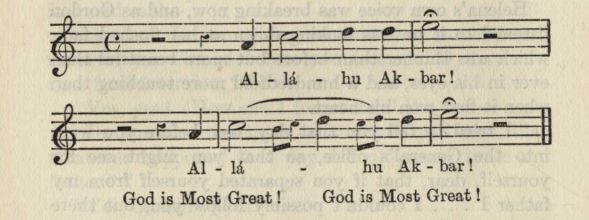
Music fragment
Their lips parted, their arms fell away from each other, and irresistibly, simultaneously, as if by an impulse of the same heart, they dropped to their knees to pray for pardon.
The voice of the muezzin ceased, and in the silence of the following moment they heard a soft footstep coming behind.
It was Ishmael. He did not speak to either of them, but seeing them on their knees, at the hour of mid-day prayers, he stepped up and knelt between.
CHAPTER XXII
When Gordon had time to examine the new situation in which he found himself he saw that he was now in a worse case than before.
It had been an inexpressible relief to realise that he was not the first cause of the General's death, and therefore that conscience did not require him to go into Cairo in order to protect Ishmael from the consequences of a crime he did not commit. But no sooner had he passed this great crisis than he was brought up against a great test. What was it to him that he could save his life if he had to lose Helena?
Helena was now Ishmael's wife—betrothed to him by the most sacred pledges of Mohammedan law. If the barrier of blood which had kept him from Helena had been removed, the barrier of marriage which kept Helena from him remained.
"What can we do?" he asked himself, and for a long time he saw no answer.
In the fierce struggle that followed, honour and duty seemed to say, that inasmuch as Helena had entered into this union of her own free will—however passively acquiescing in its strange conditions—she must abide by it, and he must leave her where she was and crush down his consuming passion, which was an unholy passion now. But honour and duty are halting and timorous guides in the presence of love, and when Gordon came to think of Helena as the actual wife of Ishmael he was conscious of nothing but the flame that was burning at his heart's core.
Remembering what Helena had told him, and what he had seen since he came to that house, he reminded himself that after all the marriage was only a marriage pro formâ, a promise made under the mysterious compulsion of fate, a contract of convenience and perhaps generosity on the one side, and on the other side of dark and calculating designs which would not bear to be thought of any longer, being a result of the blind leading of awful passions under circumstances of the most irresistible provocation.
When he came to think of love he was dead to everything else. Ishmael did not love Helena, whereas he, Gordon, loved her with all his heart and soul and strength. She was everything in life to him, and though he might have gone to his death without her, it was impossible to live and leave her behind him.
Thinking so, he began to conjure up the picture of a time when Ishmael, under the influence of Helena's beauty and charm, might perhaps forget the bargain between them, and claim his rights as a husband, and then the thought of her beautiful head with its dark curling locks as it lay in his arms that day lying in the arms of the Arab, with Ishmael's swarthy face above her, so tortured him that it swept away every other consideration.
"It must not, shall not, cannot be!" he told himself.
And that brought him to the final thought that since he loved Helena, and since Helena loved him and not her husband, their position in Ishmael's house was utterly false and wrong, and could not possibly continue.
"It is not fair even to Ishmael himself," he thought.
And when, struggling with his conscience, he asked himself how he was to put an end to the odious and miserable situation, he concluded at once that he would go boldly to Ishmael and tell him the whole story of Helena's error and temptation, thereby securing his sympathy and extricating all of them from the position in which they were placed.
"Anything will be better than the present state of things," he thought, as he reflected upon the difficult and delicate task he intended to undertake.
But after a moment he saw that while it would be hard to explain Helena's impulse of vengeance to the man who had been the object of it, to tell him of the message she had sent into Cairo would be utterly impossible.
"I cannot say anything to Ishmael about that," he thought, and the only logical sequence of ideas was that he could not say anything to Ishmael at all.
This left him with only one conclusion—that inasmuch as it was impossible that he and Helena could remain any longer in that house, and equally impossible that they could leave it with Ishmael's knowledge and consent, there was nothing for them to do but to fly away.
He found it hard to reconcile himself to the idea of a secret flight. The very thought of it seemed to put them into the position of adulterers, deceiving an unsuspecting husband. But when he remembered the scene in the guest-room that day, the moment of over-powering love, the irresistible kiss, and then the crushing sense of duplicity, as Ishmael entered and without a thought of treachery knelt between them, he told himself that at any cost whatsoever he must put an end to the false position in which they lived.
"We must do it soon—the sooner the better," he thought.
Though he had lived so long with the thought of losing Helena, that kiss had in a moment put his soul and body into a flame. He knew that his love was blinding him to certain serious considerations, and that some of these would rise up later and perhaps accuse him of selfishness or disloyalty or worse. But he could only think of Helena now, and his longing to possess her made him dead to everything else.
In a fever of excitement he began to think out plans for their escape, and reflecting that two days had still to pass before the train left Khartoum by which it had been intended that he should travel in his character as Ishmael's messenger, he decided that it was impossible for them to wait for that.
They must get away at once by camel if not by rail. And remembering Osman, his former guide and companion, he concluded to go over to the Gordon College and secure his aid.
Having reached this point, he asked himself if he ought not to obtain Helena's consent before going any further; but no, he would not wait even for that. And then, remembering how utterly crushed she was, a victim of storm and tempest, a bird with a broken wing, he assumed the attitude of strength towards her, telling himself she was a woman after all, and it was his duty as a man to think and to act for her.
So he set out in haste to see Osman, and when, on his way through the town, he passed (without being recognised) a former comrade in khaki, a Colonel of Lancers, whose life had been darkened by the loss of his wife through the treachery of a brother officer, he felt no qualms at all at the thought of taking Helena from Ishmael.
"Ours is a different case altogether," he said, and then he told himself that their life would be all the brighter in the future because it had had this terrible event in it.
It was late and dark when he returned from the Gordon College, and then old Mahmud's house was as busy as a fair, with people coming and going on errands relating to the impending pilgrimage, but he watched his opportunity to speak to Helena, and as soon as Ishmael, who was more than commonly animated and excited that night, had dismissed his followers and gone to the door to drive them home, he approached her and whispered in her ear—
"Helena!"
"Yes?"
"Can you be ready to leave Khartoum at four o'clock in the morning?"
For a moment she made no reply. It seemed to her an incredible happiness that they were really to go away together. But quickly collecting her wandering thoughts she answered—
"Yes, I can be ready."
"Then go down to the Post Landing. I shall be there with a launch."
"Yes, yes!" Her heart was beating furiously.
"Osman, the guide who brought me here, will be waiting with camels on the other side of the river."
"Yes, yes, yes!"
"We are to ride as far as Atbara, and take train from there to the Red Sea."
"And what then?"
"God knows what then. We must wait for the direction of fate. America, perhaps, as we always hoped and intended."
She looked quickly round, then took his face between her hands and kissed him.
"To-morrow morning at four o'clock," she whispered.
"At four," he repeated.
A thousand thoughts were flashing through her mind, but she asked no further questions, and at the next moment she went off to her own quarters.
The door of her room was ajar, and the face of the Arab woman, who was within, doing something with the clothes of the child, seemed to wear the same mocking smile as before; but Helena was neither angry nor alarmed. When she asked herself if the woman had seen or heard what had taken place between Gordon and herself, no dangers loomed before her in relation to their flight.
Her confidence in Gordon—his strength, his courage, his power to protect her—was absolute. If he intended to take her away he would do so, and not Ishmael nor all the Arabs on earth could stop him.
CHAPTER XXIII
Gordon could not allow himself to sleep that night, lest he should not be awake when the hour came to go. The room he shared with Ishmael was large, and it had one window looking to the river and another to Khartoum. Through these windows, which were open, he heard every noise of the desert town by night.
Sometimes there was the dead, measured thud of a camel's tread on the unpaved streets; sometimes the light beat of a donkey's hoofs; at intervals there were the faint and distant cries of the night watchmen from various parts of the town, intersecting the air like cross currents of wireless telegraphy, and once an hour there was the guttural voice of Black Zogal at the door of their own house, calling the confession of faith.
"There is no god but God—no god but God!"
It had been late when Ishmael came to bed, and even then, being excited and in high spirits, and finding Gordon still awake, he had talked for a long time in the darkness of his preparations for the forthcoming pilgrimage and his hopes of its progress across the desert—three and a half miles an hour, fourteen hours a day, making a month for the journey altogether. But finding that Gordon did not reply, and thinking he must be sleepy, he wished him a good night and a blessed morning, and then, with a few more words that were trustful, affectionate, warm-hearted and brotherly, he fell asleep.
It was after twelve by this time, and though Gordon intended to rise at three it seemed to him that the few hours between would never end. He listened to the measured breathing of the sleeping man and counted the cries outside, but the time passed as if with feet of lead.
It was never quite dark, and through the luminous dark blue of the southern night, fretted with stars, nearly everything outside could be dimly seen. Of all lights that is the one most conducive to thought, and in spite of himself Gordon could not help thinking. The obstinate questions which he had been able to crush down during the day were now rising to torment him.
"What will happen when this household which is now asleep awakes in the morning?" he asked himself.
He knew quite well what would happen. He would soon be missed. Helena would be missed too, and it would be concluded that they had gone together. But after he had banished the picture which rose to his mind's eye of the confusion that would ensue on the discovery of their flight, he set himself to defend it.
It was true that he was breaking the pledge he had made to the people when he undertook to go into Cairo, but he had made his promise under a mistake as to his own position, and therefore it was not incumbent upon him to keep it, now that he knew the truth.
It was true that Helena was breaking the betrothal which she had entered into with Ishmael, but she, too, had acted under an error, and therefore her marriage was not binding upon her conscience.
But do what he would to justify himself, he could not shake off a sense of deceit and even of treachery. He thought of Ishmael, and how he had heaped kindness and honour upon him since he came to Khartoum. He thought of Helena, and of the shame with which her flight would overwhelm the man who considered himself her husband.
"Go on!" something seemed to say in a taunting whisper. "Fly away! Seek your own happiness and think of nothing else! This is what you came to Khartoum for! This is what your great hopes and aims amount to! Leave this good man in the midst of the confusion you have brought upon him! Let him go into Cairo, innocent though he is, and die by the cruel error of fate! That's good! That's brave! That's worthy of a man and a soldier!"
Against thoughts like these he tried to set the memory of old Mahmud's words at the meeting of the Sheikhs: "Man cannot resist his destiny. If God wills that you should go into Cairo you will go, and God will protect you!"
But there was really only one way to reconcile himself to what he intended to do, and that was to think of Helena and to keep her beautiful face constantly before him. She was on the other side of the wall, and she would be awake now—the only other person in the house who was not asleep—thinking of him and waiting for the hour when they were to escape.
The luminous dark blue of the air died into the soft red of the early dawn, the "Wahhed!" of the night watchmen became less frequent, and the call of Black Zogal stopped altogether. It was now three o'clock, and Gordon, who had not undressed, rose to a sitting position on his bed.
This brought him face to face with Ishmael, whose angerib was on the opposite side of the room. The Arab was sleeping peacefully. He, too, had lain down in his clothes, having to rise early, but he had unrolled his turban, leaving nothing on his head but his Mecca skullcap, which made him look like the picture of a saintly Pope. The dim light that was filtering through the windows rested on him as he lay in his white garments under a white sheepskin. There was a look of serenity, of radiance, almost of divinity, in his tranquil face.
Gordon felt as if he were a thief and a murderer—stealing from and stabbing the man who loved and trusted him. He had an almost irresistible impulse to waken Ishmael there and then, and tell him plainly what he was about to do. But the thought of Helena came back again, and he remembered that that was quite impossible.
At length he rose to go. He was still wearing Hafiz's slippers, but he found himself stepping on his toes to deaden the sound of his tread. When he got to the door he opened it carefully so as to make no noise; but just at that moment the sleeping man stirred and began to speak.
In the toneless voice of sleep, but nevertheless with an accent of affection which Gordon had never heard from him before, Ishmael said—
"Rani! My Rani!"
Gordon stood and listened, not daring to move. After a moment all was quiet again. There was no sound in the room but Ishmael's measured breathing as before.
How Gordon got out at last he never quite knew. When he recovered his self-possession he was in the guest-room, drawing aside the curtain that covered the open doorway, and feeling the cool, fresh, odourless desert air on his hot face and in his nostrils.
He saw Black Zogal stretched out at the bottom of the wooden steps, fast asleep and with his staff beside him. The insurgent dawn was sweeping up, but all was silent both within and without. Save for the Nubian's heavy snoring there was not a sound about the house.
Feeling his throat to be parched, he turned back to the water-niche for a drink, and while he was lifting the can to his lips his eye fell on a letter which had been left for him there, having come by the train which arrived late the night before, and then been specially delivered after he had gone to bed.
The letter, which was in a black-bordered envelope, was addressed—
"SHEIKH OMAR BENANI, "In the care of ISHMAEL AMEER."
At first sight the handwriting struck him like a familiar face, but before he had time to recognise it he was conscious of a crushing sense of fatality, a vague but almost heart-breaking impression that while he had been spending the long, black hours of the night in building up hopes of flying away with Helena, this little packet of sealed paper had all the time been waiting outside his door to tell him they could not go.
He took it and opened it with trembling fingers, and read it at a glance as one reads a picture. It was from Hafiz, and it told him that his mother was dead.
Then all the pent-up pain and shame of the night rolled over him like a breaking wave, and he dropped down on the nearest seat and wept like a child.
CHAPTER XXIV
Contrary to Gordon's surmise, Helena had slept soundly, with the beautiful calm confidence of one who relied absolutely upon him and thought her troubles were over; but she awoke at half-past three as promptly as if an alarum-clock had wakened her.
The arms of Ayesha were then closely encircling her neck, and it was with difficulty that she liberated herself without awakening the child, but as soon as she had done so she could not resist an impulse to kiss the little one, so boundless was her happiness and so entirely at that moment had she conquered the sense that Ishmael's innocent daughter had been a constant torture to her.
Then dressing rapidly in her usual mixed Eastern and Western costume, and throwing a travelling cloak over her shoulders instead of her Indian veil, but giving no thought to the other belongings which she must leave behind, she stepped lightly out of the sleeping room.
The moment she entered the guest-room she heard a moan, and before realising where it came from, she said—
"Who's there?"
Then Gordon lifted his tear-stained face to her face, and, without speaking, held out the letter which hung from his helpless hand.
She took it and read it with a sense of overwhelming disaster, while Gordon, with that access of grief which, at the first moment of a great sorrow, the presence of a loved one brings, heaped reproaches upon himself, as if all that he had done at the hard bidding of his conscience had been a sin and a crime.
"Poor mother! My poor, dear mother! It was I who made her last days unhappy."
Half-an-hour went by in this way, and the time for going passed. Helena dared not tell him that their opportunity for flight was slipping away—it seemed like an outrage to think of that now—so she stood by his side, feeling powerless to comfort him, and dazed by the blow that had shattered their hopes.
Then Black Zogal, being awakened by the sound of Gordon's weeping, came in with his wild eyes, and after him came Abdullah, and then Zenoba, who, gathering an idea of trouble, went off to awaken Ishmael and old Mahmud, so that in a little while the whole of the Arab household were standing round Gordon as he sat doubled up on the edge of a divan.
When Ishmael heard what had happened he was deeply moved, and sitting down by Gordon's side he took one of his hands and smoothed it, while in that throbbing voice which went to the heart of everybody, and with a look of suffering in his swarthy face and luminous black eyes, he spoke some sympathetic words.
"All life ends in death, my brother. This world is a place of going, not of staying. The mystery of pain—who can fathom it? Life would be unbearable but for one thought—that God is over all. He rules everything for the best. Yes, believe me, everything. I have had my hours of sorrow too, but I have always found it so."
After a while Gordon was able to control his grief, and then Ishmael asked him if he would not read his letter aloud. With some reluctance Gordon did so, but it required all his self-control to repeat his mother's message.
Leaving out the usual Arabic salutations he began where Hafiz said—
"With a heavy heart I have to tell you, my most dear brother, that your sweet and saintly mother died this morning. She had been sinking ever since you went away, but the end came so quickly that it took us all by surprise."
Gordon's voice thickened, and Ishmael said—
"Take your time, brother."
"She had the consolations of her religion, and I think she passed in peace. There was only one thing clouded her closing hours. On her deathbed she was constantly expressing an earnest hope that you might all be re-united—you and she and your father and Helena, who are now so far apart."
"Take time, O my brother," said Ishmael, and seeing that Helena also was moved, he took her hand too, as if to strengthen her.
Thus he sat between them, comforting both, while Gordon in a husky voice struggled on—
"Not long before she died she wished to send you a message, but the power of life was low in her, and she could not write, except to sign her name (as you see below), and then she did not know where you were to be found. But my mother promised her that I should take care that whatever she said should come to your hands, and these were the words she sent: 'Tell my boy that my last thoughts were about him. Though I am sorry he took the side of the false ... the false prophet——'"
"Go on, brother, go on," said Ishmael in his soft voice.
"'Say I am certain he did what he thought was right. Be sure you tell him I died happy, because ... because I know I shall see him again. If I am never to see him in this world I shall do so in the world to come. Say ... say I shall be waiting for him there. And tell him it will not seem long.'"
It was with difficulty that Gordon came to the end, for his eyes were full of tears and his throat was parched and tight, and he would have broken down altogether but for the sense of Helena's presence by his side.
Ishmael was now more deeply moved than before.
"How she must have loved you!" he said, and then he began to speak of his own mother, and what she had done for him.
"She was only a poor, ignorant woman perhaps, but she died to save me, and I loved her with all my heart."
At that the two black servants, Abdullah and Zogal, who had been standing before Gordon in silence, tried to utter some homely words of comfort, and old Mahmud, wiping his wet eyes, said—
"May God be merciful to your mother, my son, and forgive her all her sins."
"She was a saint—she never had any," replied Gordon, whereupon the Arab nurse, who alone of all that household had looked on at this scene with dry and evil eyes, said bitterly—
"Nevertheless she died as a Christian and an unbeliever, therefore she cannot look for mercy."
Then Helena's eyes flashed like fire into the woman's face, and Gordon felt the blood rush to his head, but Ishmael was before them both.
"Zenoba, ask pardon of God," he said, and before the thunder of his voice and the majesty of his glance the Arab woman fell back.
"Heed her not, my brother," said Ishmael, turning back to Gordon; and then he added—
"We all serve under the same General, and though some of us wear uniform of red, and some of brown, and some of blue, he who serves best is the best soldier. In the day of victory will our General ask us the colour of our garments? No!"
At that generous word Gordon burst into tears once more, but Ishmael said—
"Don't weep for one who has entered into the joys of Paradise."
When Gordon had regained his composure Ishmael asked him if he would read part of the letter again, but knowing what part it would be—the part about the prophet—he tried to excuse himself, saying he was not fit to read any more.
"Then the Rani will read," said Ishmael, and far as Helena would have fled from the tragic ordeal she could not escape from it. So in her soft and mellow voice she read on without faltering until she came to her own name, and then she stopped and tears began to trickle down her cheeks.
"Go on," said Ishmael; "don't be afraid of what follows."
And when Helena came to "false prophet," he turned to Gordon and said—
"Your dear mother didn't know how much I love you. But she knows now," he added, "for the dead know all."
There was no further interruption until Helena had finished, and then Ishmael said—
"She didn't know, either, what work the Merciful had waiting for you in Khartoum. Perhaps you did not know yourself. Something called you to come here. Something drew you on. Which of us has not felt like that? But God guides our hearts—the Merciful makes no mistakes."
Nobody spoke, but Gordon's eyes began to shine with a light which Helena, who was looking at him, had never seen in them before.
"All the same," continued Ishmael, "you hear what your mother says, and it is not for me to keep you against your will. If you wish to go back now none shall reproach you. Speak, Omar; do you wish to leave me?"
There was a moment of tense silence, in which Gordon hesitated and Helena waited breathlessly for his reply. Then with a great effort Gordon answered—
"No."
"El Hamdullillah!" cried the two black servants; and then Ishmael sent Zogal into the town and the camp to say that the faithful would bid farewell to Omar in the mosque the following night.
That evening after sunset, instead of delivering his usual lecture to the people squatting on the sand in front of his house, Ishmael read the prayers for the dead, while Gordon and Helena and a number of the Sheikhs sat on the divans in the guest-room.
When the service was over, and the company was breaking up, the old men pressed Gordon's hand as they were passing out and said—
"May God give you compensation!"
As soon as they were gone Gordon approached Helena and whispered hurriedly—
"I must speak to you soon—where can it be?"
"I ought to go to the water-women's well by the Goods Landing to-morrow morning," said Helena.
"At what hour?"
"Ten."
"I shall be there," said Gordon.
His eyes were still full of the strange wild light.
CHAPTER XXV
At ten o'clock next morning Helena was at the well by the Goods Landing where the water-women draw water in their earthen jars to water the gardens and the streets, and while standing among the gross creatures who, with their half-naked bodies and stark-naked souls, were crowding about her for what they could get, she saw Gordon coming down in his Bedouin dress with a firm, strong step.
His flickering, steel-blue eyes were as full of light as when she saw them last, but that vague suggestion of his mother which she had hitherto seen in his face was gone, and there was a look of his father which she had never observed before.
"Let us walk this way," he said, indicating a road that went down to the empty and unfrequented tongue of land that leads to the point at which the Blue Nile and the White Nile meet.
"Helena," he said, stepping closely by her side, and speaking almost in her ear, "there is something I wish to say—to ask—and everything depends on your answer—what we are to do and what is to become of us."
"What is it?" said she, with trembling voice.
"When our escape from Khartoum was stopped by the letter telling me of my mother's death, I thought at first it was only an accident—a sad, strange accident—that it should arrive at that moment."
"And don't you think so now?" she asked.
"No; I think it was a divine intervention."
She glanced up at him. "He is going to talk about the betrothal," she thought.
But he did not do so. In his intense and poignant voice he continued—
"When I proposed that we should go away together I supposed your coming here had been due to a mistake—that my coming here had been due to a mistake—that your sending that letter into Cairo and my promising to take Ishmael's place had been due to a mistake—that it had all been a mistake—a long, miserable line of mistakes."
"And wasn't it?" she asked, walking on with her eyes to the sand.
"So far as we are concerned, yes, but with God ... with God Almighty mistakes do not happen."
They walked some paces in silence, and then in a still more poignant voice he said—
"Don't you believe that, Helena? Wasn't it true, what Ishmael said yesterday? Can you possibly believe that we have been allowed to go on as we have been going—both of us—without anything being meant by it?—all a cruel, stupid, merciless, Almighty blunder?"
"Well?"
"Well, think of what would have happened if we had been allowed to carry out our plan. Ishmael would have gone into Cairo as he originally intended, and he would have been seized and executed for conspiracy. What then? The whole country—yes, the whole country from end to end—would have risen in revolt. The sleeping terror of religious hatred would have been awakened. It would have been the affair of El Azhar over again—only worse, a thousand-fold worse."
Again a few steps in silence, and then—
"The insurrection would have been suppressed of course, but think of the bloodshed, the carnage! On the other hand——"
She saw what was coming, and with difficulty she walked steadily.
"On the other hand, if I go into Cairo, as I have promised to do—as I am expected to do—there can be no such result. The moment I arrive I shall be arrested, and the moment I am arrested I shall be identified and handed over to the military authorities to be tried for my offences as a soldier. There will be no religious significance in my punishment, therefore there will be no fanatical frenzy provoked by it, and consequently there can be no bloodshed. Don't you see that, Helena?"
She could not answer; she felt sick and faint. After a moment he went on in the same eager, enthusiastic voice—
"But that's not all. There is something better than that."
"Better—do you say better?"
"Something that comes closer to us at all events. Do you believe in omens, Helena? That some mystic sense tells us things of which we have no proof, no evidence?"
She bent her head without raising her eyes from the sand.
"Well, I have a sense of some treachery going on in Cairo that Ishmael knows nothing about, and I believe it was just this treachery which led to the idea of his going there at all."
She looked up into his face, and thinking he read her thought, he said quickly—
"Oh, I know—I've heard about the letters of the Ulema—that those suggestions of assassination and so forth were signed by the simple old Chancellor of El Azhar. But isn't it possible that a subtler spirit inspired them? ... Helena?"
"Yes," she faltered.
"Do you remember that one day in the Citadel I said it was not really Judas Iscariot who betrayed Jesus, and that there was somebody in Egypt now who was doing what the High Priest of the Jews did in Palestine two thousand years ago?"
"The Grand Cadi?"
"Yes! Something tells me that that subtle old scoundrel is playing a double sword game—with the Ulema and with the Government—and that his object is not only to destroy Ishmael, but, by awakening the ancient religious terror, to ruin England as well—tempt her to ruin her prestige, at all events."
They had reached the margin of the river, and he stopped.
"Well?" she faltered again.
"Well, I am a British soldier still, Helena, even though I am a disgraced one, and I want to ... I want to save the good name of my country."
She could not speak—she felt as if she would choke.
"I want to save the good name of the Consul-General also. He is my father, and though he no longer thinks of me as his son, I want to save him from ... from himself."
"I can do it too," he added eagerly. "At this moment I am perhaps the only man who can. I am nobody now—only a runaway and a deserter—but I can cross the line of fire and so give warning."
"But, Gordon, don't you see——"
"Oh, I know what you are going to say, Helena—I must die for it. Yes! Nobody wants to do that, if he can help it, but I can't! Listen!"
She raised her eyes to his—they seemed to be ablaze with a kind of frenzy.
"Death was the penalty of what I did in Cairo, and if I did not stay there to be court-martialled and condemned, was it because I wanted to save my life? No; I thought there was nothing left in my life that made it worth saving. It was because I wanted to give it in some better cause. Something told me I should, and when I came to Khartoum I didn't know what fate was before me, or what I had to do, but I know now. This is what I have to do, Helena—to go back to Cairo instead of Ishmael, and so save England and Egypt and my father and these poor Moslem people, and prevent a world of bloodshed."
Then Helena, who in her nervousness had been scraping her feet on the sand, said in a halting, trembling voice—
"Was this what you wanted to say to me, Gordon?"
"Yes, but now I want you to say something to me."
"What is that?" she asked, trembling.
"To tell me to go."
It was like a blow. She felt as if she would fall.
"I cannot go unless you send me, Helena—not as things stand now—leaving you here—under these conditions—in a place like this—alone. Therefore tell me to go, Helena."
Tears sprang to her eyes. She thought of all the hopes she had so lately cherished, all the dreams of the day before of love and a new life among quite different scenes—sweet scenes full of the smell of new-cut grass, the rustling of trees, the swish of the scythe, the songs of birds, and the ringing of church bells, instead of this empty and arid wilderness—and then of the ruin, the utter wreck and ruin, that everything was falling to.
"Tell me to go, Helena—tell me," he repeated.
It was crushing. She could not bear it.
"I cannot," she said. "Don't ask me to do such a thing. Just when we were going away, too ... expecting to escape from all this miserable tangle and to be happy at last——"
"But should we be happy, Helena? Say we escaped to Europe, America, Australia, anywhere far enough away, and what I speak of were to come to pass, should we be happy—should we?"
"We should be together at all events, and we should be able to love each other——"
"But could we love each other with the memory of all that misery—the misery we might have prevented—left here behind us?"
"At least we should be alive and safe and well."
"Should we be well if our whole life became abominable to us, Helena? ... On the other hand——"
"On the other hand, you want us to part—never to see each other again."
"It's hard—I know it's hard—but isn't that better than to become odious in each other's eyes?"
A cruel mixture of anger and sorrow and despair took possession of her, and, choking with emotion, she said—
"I have nobody but you now, yet you want me to tear my heart out—to sacrifice the love that is my only happiness, my only refuge.... Oh, I cannot do it! You are asking me to send you into the jaws of death itself—that's it—the very jaws of death itself—and I cannot do it. I tell you I cannot, I cannot! There is no woman in the world who could."
There was silence for a moment after this vehement cry; then in a low tone he said—
"Every soldier's wife does as much when she sends her husband into battle, Helena."
"Ah!"
She caught her breath as if a hand from heaven had smitten her.
"Am I not going into battle now? And aren't you a soldier's daughter?"
There was another moment of silence in which he looked out on the sparkling waters of the Blue Nile and she gazed through clouded eyes on the sluggish waves of the White.
Something had suddenly begun to rise in her throat. This was the real Gordon, the hero who had won battles, the soldier who had faced death before, and she had never known him until now!
A whirlwind of sensation and emotion seemed to race through her soul and body. She felt hot, she felt cold, she felt ashamed, and then all at once she felt as if she were being lifted out of herself by the spirit of the man beside her. At length she said, trying to speak calmly—
"You are right, quite right; you are always right, Gordon. If you feel like that about going into Cairo you must go. It is your duty. You have received your orders."
"Helena!" he cried, in a burst of joy.
"You mustn't think about me, though. I'm sorry for what I said a while ago, but I'm better now. I have always thought that if the time ever came to me to see my dearest go into battle, I should not allow myself to be afraid."
"I was sure of you, Helena, quite sure."
"This doesn't look like going into battle, perhaps, but it may be something still better—going to save life, to prevent bloodshed."
"Yes, yes!" he said; and struggling to control herself, Helena continued—
"You mustn't think about leaving me here, either. Whatever happens in this place, I shall always remember that you love me, so ... so nothing else will matter."
"Nothing—nothing!"
"And though it may be hard to think that you have gone to your death, and that I ... that in a sense I have been the cause of it——"
"But you haven't, Helena! Your hand may have penned that letter, but a higher Power directed it."
She looked at him with shining eyes, and answered in a firmer voice and with a proud lift of her beautiful head—
"I don't know about that, Gordon. I only know that you want to give your life in a great cause. And though they have degraded you and driven you out and hunted you down like a dog, you are going to die like a man and an Englishman."
"And you tell me to do it, Helena?"
"Yes, for I'm a soldier's daughter, and in my heart I'm a soldier's wife as well, and I shouldn't be worthy to be either if I didn't tell you to do your duty, whatever the consequences to me."
"My brave girl!" he cried, clutching at her hand.
Then they began to walk back.
As they walked they encouraged each other.
"We are on the right road now, Helena."
"Yes, we are on the right road now, Gordon."
"We are doing better than running away."
"Yes, we are doing better than running away."
"The train leaves Khartoum this evening, and I suppose they want to say farewell to me in the mosque at sunset.... You'll be strong to the last and not break down when the time comes for me to go?"
"No, I'll not break down ... when the time comes for you to go."
But for all her brave show of courage, her eyes were filling fast and the tears were threatening to fall.
"Better leave me now," she whispered. "Let me go back alone."
He was not sorry to let her go ahead, for at sight of her emotion his own was mastering him.
"Will she keep up to the end?" he asked himself.
CHAPTER XXVI
As the hours of the day passed on, Helena became painfully aware that her courage was ebbing away.
Unconsciously Ishmael was adding to her torture. Soon after the midday meal he called on her to write to his dictation a letter which Gordon was to take into Cairo...
"One more letter, O Rani, only one, before our friend and brother leaves us."
It was to the Ulema, telling them of the change in his plans and begging them to be good to Gordon.
"Trust him and love him. Receive him as you would receive me, and believe that all he does and says is according to my wish and word."
Helena had to write this letter. It was like writing Gordon's death-warrant.
Later in the day, seeing her idle, nibbling the top of the reed pen which she held in her trembling fingers, Ishmael called for the kufiah.
"Where is the kufiah, O Rani—the kufiah that was to disguise the messenger of God from his enemies?"
And when Helena, in an effort to escape from that further torture, protested that in Gordon's case a new kufiah was not essential, because he wore the costume of a Bedouin already, Ishmael replied—
"But the kufiah he wears now is white, and every official in Khartoum has seen it. Therefore another is necessary, and let it be of another colour."
At that, with fiendish alacrity, the Arab woman ran off for a strip of red silken wool, and Helena had to shape and stitch it.
It was like stitching Gordon's shroud.
The day seemed to fly on the wings of an eagle, the sun began to sink, the shadows to lengthen on the desert sand, and the time to approach for the great ceremony of the leave-taking in the mosque. Helena was for staying at home, but Ishmael would not hear of it.
"Nay, my Rani," he said. "In the courtyard after prayers we must say farewell to Omar, and you must clothe him in the new kufiah that is to hide him from his foes. Did you not promise to do as much for me? And shall it be said that you grudge the same honour to my friend and brother?"
Half-an-hour afterwards, Ishmael having gone off hand in hand with Gordon, and old Mahmud and Zenoba and Ayesha and the two black servants having followed him, Helena put on a veil for the first time since coming to Khartoum, and made her way to the mosque.
The streets of the town, as she passed through them, seemed to be charged with an atmosphere of excitement that was little short of frenzy; but the courtyard, when she had crossed the threshold, was like the scene of some wild phantasmagoria.
A crowd of men and women, squatting about the walls of the open space, were strumming on native drums, playing on native pipes, and uttering the weird, monotonous ululation that is the expression of the Soudanese soul in its hours of joy.
A moment later Helena was in the gallery, the people had made way for her, and she was sitting as before by the Arab woman and the child. Overhead was a brazen, blood-red Southern sky; below were a thousand men on crimson carpets, some in silks, some in rags, all moving and moaning like tumultuous waves in a cavern of the sea.
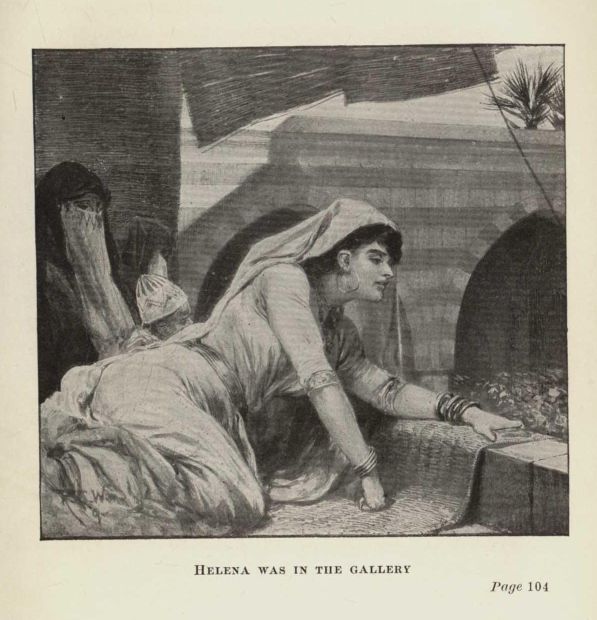
Helena was in the gallery
The Reader, in the middle of the mosque, was chanting the Koran, the muezzin in the minaret was calling to prayers, the men on the floor were uttering their many-throated responses, and the very walls of the mosque itself seemed to be vibrating with religious fervour.
A moment after Helena had taken her seat Ishmael entered, followed by Gordon, and the people gathered round them to kiss their hands and garments. Helena felt her head reel, she wanted to cry out, and it was with difficulty she controlled herself.
Then the Reader stood up in his desk and recited an invocation, and the people repeated it after him.
"God is Most Great!"
"God is Most Great!"
"There is no god but God! ...
"Mohammed is His Prophet! ...
"Listen to the preacher! ...
"Amen!"
"Amen!"
After that Ishmael rose from his knees before the Kibleh, took the wooden sword at the foot of the pulpit, ascended to the topmost step, and, after a preliminary prayer, began to preach.
Never had Helena seen him so eager and excited, and every passage of his sermon seemed to increase both his own ecstasy and the emotion of his hearers.
Helena hardly heard his words, so far away were her thoughts and so steadfastly were her eyes fixed on the other figure in front of the Kibleh, but a general sense of their import was beating on her brain as on a drum.
All religions began in poverty and ended in corruption.
It had been so with Islam, which began with the breaking of idols and went on to the worship of wealth, the quest of power, the lust of conquest—Caliphs seeking to establish their claim not by election and the choice of God but by theft and murder.
It had been so with Christianity, which began in meekness and humility and went on to pride and persecution—Holy Fathers exchanging their cells for palaces and their poverty for pomp, forgetting the principle of their great Master, whose only place in their midst was in pictured windows, on vaporous clouds, blessing with outstretched arms a Church which favoured everything he fought against and a world which practised everything he condemned.
"What is the result, O my brothers? War, wealth, luxury, sensuality, slavery, robbery, injustice, and oppression!
"Listen to the word of the Holy Koran: 'And Pharaoh made proclamation among his people, saying, Is not this Kingdom of Egypt mine and the rivers thereof?'
"But not in Egypt only, nor alone under the Government of the King who lives across the seas, but all the world over, wheresoever human empires are founded, wheresoever men claim the earth and the fruits of the earth and the treasures that lie in the bowels of the earth—impoverishing the children of men to obtain them, or destroying their souls that they may deck and delight their bodies—there the Pharaohs of this world are saying, 'Is not this Kingdom of Egypt mine and the rivers thereof?'
"But the earth and the fruits of the earth and the treasures of the earth are God's, my brothers, and He is coming to reclaim them, and to right the wrongs of the oppressed, to raise up the downtrodden, and to comfort the broken-hearted."
The mosque seemed to rock with the shouts which followed these words, and as soon as the cries of the people had subsided, the voice of Ishmael, now louder and more tremulous than before, rang through its vaults again.
"Deep in the heart of man, my brothers, is the expectation of a day when the Almighty will send His Messenger to purify and pacify the world and to banish intolerance and wrong. The Jews look for the Messiah, the Christians for the divine man of Judæa, and we that are Moslems for the Mahdi and the Christ.
"In all climes and ages, amid all sorrows and sufferings, sunk in the depths of ignorance, sold into slavery, the poorest of the poor, the most miserable among the most miserable of the world, humanity has yet cherished that great expectation. Real as life, real as death, real as wells of water in a desert land to man on his earthly pilgrimage is the hope of a Deliverer from oppression and injustice—and who shall say it is vain and false? It is true, my brothers, true as the sky rolling overhead. Our Deliverer is coming! He is coming soon! He is coming now!"
Ishmael's tremulous voice had by this time broken into hysterical sobs, and the responses of his hearers had risen to delirious cries.
More of the same kind followed which Helena did not hear, but suddenly she was awakened to full consciousness of what was going on about her by hearing Ishmael speak of Gordon and the people answering him with rapturous shouts.
"He is not of our race, yet no doubt enters into our hearts of his fidelity."
"El Hamdullillah!"
"He is not of our faith, yet he will be true to God and His people."
"Allah! Allah!"
"For us he has left his home, his country, and his kindred."
"Allah! Allah! Allah!"
"For us he is going into the place of danger."
"Allah! Allah! Allah!"
"What says the Lord in the Holy Koran?—'They therefore who had left their country and suffered for My sake I will surely bring them into gardens watered by rivers—a reward of God.'"
"Allah! Allah! Allah!"
"The Lord bless the white man to whom the black man is a brother! Bless him in the morning splendour! Bless him in the still of night! Bless him with children—the eye of the heart of man! Bless him with the love of woman—the joy and the crown of life!"
"Allah! Allah! Allah!"
"And may the Lord of majesty and might who has hitherto covered his head in battle protect and preserve him now!"
At this last word the whole company of men on the floor below—men in silks and men in rags—rose to their feet, as if they had been one being animated by one heart, and raising their arms to heaven, cried—
"Allah! Allah! Allah! Allah!"
Helena felt as if some one had taken her by the throat. To see these poor, emotional Eastern children, with their brown and black faces, streaming with tears and full of love for Gordon, shouting down God's blessing upon him, was stifling her.
It was like singing his dirge before he was dead.
During the next few minutes Helena was vaguely aware that Ishmael had come down from the pulpit; that the Reader was reciting prayers again; that the men on the crimson carpets were bowing, kneeling, prostrating themselves and putting their foreheads to the floor; and finally that the whole congregation was rising and surging out of the mosque.
When she came to herself once more, somebody by her side—it was Zenoba—was touching her shoulder and saying—
"The Master is in the Courtyard and he is calling for you—come!"
The scene outside was even more tumultuous. Instead of the steady solemnity of the service within the mosque there were the tum-tumming of the drums, the screeling of the pipes, and the lu-luing of the women.
The great enclosure was densely crowded, but a space had been cleared in the centre of the courtyard, where the Ulema of Khartoum, in their grey farageeyahs, were ranged in a wide half-circle. In the mouth of this half-circle Gordon was standing in his Bedouin dress with Ishmael by his side.
Silence was called, and then Ishmael gave Gordon his last instructions and spoke his last words of farewell.
"Tell our brothers, the Ulema of Cairo," he said, "that we are following close behind you, and when the time comes to enter the city we shall be lying somewhere outside their walls. Let them therefore put a light on their topmost height—on the minaret of the mosque of Mohammed Ali—after the call to prayers at midnight—and we shall take that as a sign that the Light of the World is with you, that the Expected One has appeared, and that we may enter in peace, injuring no man, being injured by none, without malice towards any, and with charity to all."
Then seeing Helena as she came out of the mosque, veiled and with her head down, he called on her to come forward.
"Now do as you have always designed and intended," he said. "Cover our friend and forerunner with the kufiah you have made for him, that until his work is done and the time has come to reveal himself, he may, like the angel of the Lord, be invisible to his foes."
What happened after that Helena never quite knew—only that a way had been made for her through the throng of wild-eyed people and that she was standing by Gordon's side.
Down to that instant she had intended to bear herself bravely for Gordon's sake if not for her own, but now a hundred cruel memories came in a flood to sap away her strength—memories of the beautiful moments of their love, of the little passages of their life together that had been so tender and so sweet. In vain she tried to recover the spirit with which he had inspired her in the morning, to think how much better it was that he should die gloriously than live in disgrace, to feel the justice, the necessity, the inevitableness of what he was going to do.
It was impossible. She could think of nothing but that she was seeing Gordon for the last time, that he was leaving her behind him, among these Allah-intoxicated Arabs, that he was going away, not into battle—with its chance of victory and its hope of life—but to death, certain death, perhaps shameful death, and that, say what he would about Fate and Destiny or the will of God, she herself was sending him to his doom.
She felt that the tears were running down her cheeks under her thin white veil, and that Gordon must see them, but she could not keep them back; and though she had promised not to break down, she knew that at that last moment, in the face of the death that was about to separate them, the dauntless heroine of the morning was nothing better than a poor, weak, heart-broken woman.
Meantime the drums and the pipes and the lu-luing had begun again, and she was conscious that under the semi-savage din Gordon was speaking to her and comforting her.
"Keep up! Be brave! Nobody knows what may happen. I'll write. You shall hear from me again."
He had taken off the white kufiah which he had hitherto worn, and she could see his face. It was calm—the calmest face in all that vast assembly.
The sight of his face strengthened her, and suddenly a new element entered into the half-barbaric scene—an element that was half human and half divine. These poor, half-civilised people thought Gordon was going to risk his life for them; but he was going to die—deliberately to die for them—to save them from themselves, from the consequences of their fanaticism, the panic of their rulers, and the fruits of the age-long hatred that had separated the black man from the white.
Helena felt her bosom heave, her nerves twitch, her fingers dig trenches in her palms, and her thoughts fly up to scenes of sacrifice which men talk of with bated breath.
"If he can do it, why can't I?" she asked herself, and taking the red kufiah, which the Arab woman was thrusting into her hands, with a great effort she put it on Gordon—over his head and under his chin and across his shoulders and about his waist.
It was like clothing him for the grave.
Every eye had been on her, and when her work was done, Ishmael, who was now weeping audibly, demanded silence and called on the Ulema to recite the first Surah—
"Praise be to God, the Lord of all creatures——"
When the weird chanting had come to an end the hoarse voices of the people broke afresh into loud shouts of "Allah! Allah! El Hamdullillah!"
In the midst of the wild maëlstrom of religious frenzy which followed—the tum-tumming of the drums, the screeling of the pipes, and the ululation of the women—Helena felt her hand grasped, and heard Gordon speaking to her again.
"Don't faint! Don't be afraid! Don't break down at the last moment."
"I'm not afraid," she answered, but whether with her voice or only with her lips she never knew.
Still the drums, the pipes, the zaghareet, and the delirious cries of "Allah!" And to show Gordon that she felt no fear, that she was not going to faint or to break down, Helena also, in the fierce tension of the moment, cried—
"Allah! El Hamdullillah!"
"That's right! That's brave! God bless you!" whispered the voice by her side. And again a moment later—
"God bless and protect you!"
After that she heard no more. She saw the broad gate of the Courtyard thrown open—she saw a long streak of blood-red sand outside—she saw Gordon turn away from her—she saw Ishmael embrace and kiss him—she saw the surging mass of hot and streaming black and brown faces close about him—and then a loud wind seemed to roar in her ears, the earth seemed to give way under her feet, the brazen sky seemed to reel about her head, and again she felt as if she were falling, falling, falling into a bottomless abyss.
When she recovered consciousness the half-barbaric scene was over, and she was being carried into the silence of her own room in the arms of Ishmael, who with many words of tender endearment was laying her gently on her bed.
CHAPTER XXVII
That day, under the two crackling flags, the Crescent and the Union Jack, Lady Mannering had given a party in the garden of the Palace of the Sirdar.
The physiognomy of the garden had changed since "the martyr of the Soudan" walked in it. Where scraggy mimosa bushes and long camel grasses had spurted up through patches of sand and blotches of baking earth there were the pleasant lawns, the sycamores, the date-trees, and the blue streams of running water. And where the solitary soldier, with his daily whitening head, had paced to and fro, his face to the ground, smoking innumerable cigarettes, there were a little group of officers of the military administration, with their charming wives and daughters, a Coptic priest, a Greek priest, a genial old Protestant clergyman, and a number of European visitors, chiefly English girls, wearing the lightest of white summer costumes, and laughing and chattering like birds.
In pith helmets and straw hats, Lady Mannering's guests strolled about in the sunshine or drank tea at tables that were set under the cool shadow of spreading trees, while, at a little distance, the band of a black regiment, the Tenth Soudanese (sons and grandsons of the very men who in the grey dawn of a memorable morning had rushed in a wild horde into those very grounds for their orgy of British blood), played selections from the latest comic operas of London and New York.
The talk was the same all over the gardens—of the new Mahdi and his doings.
"Married to an Indian Princess, you say!"
"Oh yes! Quite an emancipated person, too! A sort of thirty-second cousin of the Rani of Jhansi. It seems she was educated by an English governess, kicked over the traces, became a sort of semi-religious suffragette, and followed her holy man to Egypt and the Soudan."
"How very droll! It is too amusing!"
The Sirdar, who had gone indoors some time before, returned to the garden dressed for a journey.
"Going away, your Excellency?"
"Yes, for a few weeks—to the lower Nile."
His ruddy, good-natured face was less bright than usual, and his manner was noticeably less buoyant. A few of his principal officials gathered about him, and he questioned them one by one.
"Any fresh news, Colonel?" he said, addressing the Governor of the city.
"No, sir. A sort of sing-song to-day in honour of the Bedouin Sheikh—that's all I hear about."
But the Financial Secretary spoke of further difficulties in the gathering of taxes—the land tax, the animal tax, and the tax on the date-trees not having yet come in—and then the Inspector-General repeated an opinion he had previously expressed, that everything gave evidence of a projected pilgrimage, presumably in a northerly direction and almost certainly to Cairo.
The Governor of the city corroborated this, and added that his Zabit, his police officer, had said that Ishmael Ameer, on passing to the mosque that day, had been saluted in the streets by a screaming multitude as the "Messenger" and the "Anointed One."
"It's just as I say," said the Inspector-General. "These holy men develop by degrees. This one will hoist his flag as soon as he finds himself strong enough—unless we stop him before he goes further—and the Soudan is lost to civilisation."
"Well, we'll see what Nuneham says," said the Sirdar, and at that moment his Secretary came to say that the launch was ready at the boat-landing to take him across the river to the train.
The Sirdar said good-bye to his guests, to his officers, and to his wife, and as he left the garden of the palace the Soudanese band, sons of the Mahdi's men, played the number which goes to the words—
"They never proceed to follow that light,
But always follow me."
Half-an-hour afterwards, while the Sirdar's black body-guard were ranged up on the platform of the railway station, and his black servant was packing his luggage into his compartment, the Governor-General was standing by the door of the carriage, with his Aide-de-camp, giving his last instructions to his General Secretary.
"Telegraph to the Consul-General and say ... but please make a note of it."
"Yes, sir," said the Secretary, taking out his pocketbook and preparing to write.
"Think it best to go down myself to deal personally with matter of suspected mutiny in native army. Must admit increasing gravity of situation. Man here is undoubtedly acquiring name and influence of Mahdi, so time has come to consider carefully what we ought to do. Signs of intended pilgrimage, probably in northerly direction, enormous numbers of camels, horses, and donkeys having been gathered up from various parts of country and immense quantities of food-stuffs being bought for desert journey. Am leaving to-night, and hope to arrive in four days."
"Four days," repeated the Secretary, as he came to an end.
At that moment a tall man in the costume of a Bedouin walked slowly up the platform. His head and most of his face were closely covered by the loose woollen shawl which the sons of the desert wear, leaving only his eyes, his nose, and part of his mouth visible. As he passed the Sirdar, he looked sharply at him; then, pushing forward with long strides until he came to the third-class compartments, he stepped into the first of them, which was full of coloured people, strident with high-pitched voices and pungent with Eastern odours.
"Who was that?" asked the Sirdar.
"I don't know, sir," replied the Secretary. "I thought at first it was their Bedouin Sheikh, but I see I was mistaken."
Then came the whistle of the locomotive, and its slow, rhythmic, volcanic throb. The guard saluted, and the Sirdar got into his carriage.
"Well, good-bye, Graham! Don't forget the telegram."
"I'll send it at once.... In cypher, sir?"
"In cypher certainly."
At the next moment the Sirdar and Gordon Lord, travelling in the same train, were on their way to Cairo.
END OF THIRD BOOK
FOURTH BOOK
THE COMING DAY
CHAPTER I
The Consul-General had taken a firm grasp of affairs. Every morning his Advisers and Under-Secretaries visited him, and it seemed as if they could not come too often or say too much. He who rules the machine of State becomes himself a machine, and it looked as if Lord Nuneham were ceasing to be a man.
Within a week after the day on which he received Helena's letter, he was sitting in his bleak library walled with Blue-Books, with the Minister of the Interior and the Adviser to the same department. The Minister was the sallow-faced Egyptian Pasha whom he had made Regent on the departure of the Khedive; the Adviser was a tall, young Englishman with bright red hair on which the red tarboosh sat strangely. They were discussing the "special weapon" which had been designed to meet special needs. The Consul-General's part of the discussion was to expound, the Adviser's was to applaud, the Minister's was to acquiesce.
The special weapon was a decree. It was to be known as the Law of Public Security, and it was intended to empower the authorities to establish a Special Tribunal to deal with all crimes, offences, and conspiracies committed or conceived by natives against the State. The Tribunal was to be set up at any time and at any place on the request of the Agent and Consul-General of Great Britain; its sentences, which were to be pronounced forthwith, were not to be subject to appeal; and it was to inflict such penalties as it might consider necessary, including the death penalty, without being bound by the provisions of the penal code.
"Drastic!" said the Pasha, with a sinister smile.
"Necessary," said the Consul-General, with a frown.
The Pasha became silent again while the virtual ruler of Egypt went on to say that the state of the country demanded that the Government should be armed with special powers to meet widespread fanaticism and secret conspiracy.
"No one deplores more than I do," he said, "that the existing law of the land is not sufficient to deal with the new perils by which we are threatened, but it is not, and therefore we must make it stronger."
"Certainly, my lord," said the red-headed figure in the fez, and again the sinister face of the Pasha smiled.
"And now tell me, Pasha," said the Consul-General, "how long a time will it take to pass this law through the Legislative Council and the Council of Ministers?"
The Pasha looked up out of his small, shrewd eyes, and answered—
"Just as long or as short as your lordship desires."
And then the Consul-General, who was wiping his spectacles, put them deliberately on to his nose, looked deliberately into the Pasha's face, and deliberately replied—
"Then let it be done without a day's delay, your Excellency."
A few minutes afterwards, without too much ceremony, the Consul-General had dismissed his visitors and was tearing open a number of English newspapers which Ibrahim had brought into the room.
The first of them, The Times, contained a report of the Mansion House Dinner, headed "UNREST IN THE EAST. Important Speech by Foreign Minister."
The Consul-General found the beginning full of platitudes. Egypt had become the great gate between the Eastern and Western hemispheres. It was essential for the industry and enterprise of mankind that that gate should be kept open, and therefore it was necessary that Egypt should be under a peaceful, orderly, and legal Government.
Then, lowering the lights, the Minister had begun to speak to slow music. While it was the duty of Government to preserve order, it was also the duty of a Christian nation in occupation of a foreign country to govern it in the interests of the inhabitants, and, speaking for himself, he thought the executive authority would be strengthened, not weakened, by associating the people with the work of government. However this might be, the public could at least be sure that as long as the present Ministry remained in power it would countenance no policy on the part of its representatives that would outrage the moral, social, and, above all, religious sentiments of a Moslem people.
The Consul-General flung down the paper in disgust.
"Fossils of Whitehall! Dunces of Downing Street!"
For some minutes he tramped about the room, telling himself again that he didn't care a straw what any Government and any Foreign Minister might say because he had a power stronger than either at his back—the public.