Major General A.W. Drayson (continued 5)
Reading edition
I explained to Mr Rossmar that I had neither clothes nor money, and was scarcely in a condition to accept an invitation to a house. He said that all could be arranged very easily; that clothes for temporary purposes could be procured, ready made; and that he would see to everything in that way, I thanked Mr Rossmar for his kindness, and having bid good-bye to the captain and officers of the ship, I stepped into the boat and soon landed at Simon’s Town.
Having been provided with a stock of clothes at a warehouse, Mr Rossmar drove me in his carriage to the admiral’s, where I stopped for a short time, and then started for Wynberg.
There are few more beautiful places in the world than Wynberg. Situated in the lower slopes on the east of Table Mountain it is protected from the south-east and north-west gales. The vegetation is luxuriant, tropical trees and fruits growing in abundance, as also those common in England. The houses are excellent and roomy, and the gardens gay with flowers. The merchants at Cape Town, when well to do, usually have a house at or near Wynberg, and Mr Rossmar, as I afterwards learnt, was one of the richest men in this colony.
On arriving at Mr Rossmar’s house I saw several ladies at the window, and was introduced by Mr Rossmar to his wife and four daughters. Although I felt quite at my ease when talking to the admiral, yet I was awkward when the young ladies talked to me. Mr Rossmar told them that all which had been printed in the paper about the shipwreck and my adventures was true, and that I was quite a hero of adventure.
It was not long before I overcame my diffidence, and was soon talking to Mrs Rossmar and her daughters as if I had known them all my life. They were much interested in the account I gave them of my life among the Caffres, and when I told them the details of my fight with the Bushmen and Zulus, they became most excited. To me the change from the wild rough life I had led was like coming to fairyland. The house was beautifully furnished; there were several horses in the stable, and having learned to ride in India, I soon was able to manage the most spirited horse, and used to ride every evening with the ladies. They were all excellent musicians, and this to me was a new experience, for in India we had very little music in olden times, and as a boy I heard nothing of even that little.
The story of my escape from shipwreck and my life among the tribes up the country was known and talked about all over the Cape. Many people there, although long resident at the Cape, knew little or nothing of the Caffres, their habits, or their country. Cape Town and its neighbourhood was civilised, whilst where I had been was wild as the wildest country. I was asked out to many houses in the neighbourhood, and had over and over again to relate some of my adventures. As is usually the case with ignorant and jealous people, there were some who thought I was inventing stories to astonish them: they did not believe that I had gone through so many strange and exciting scenes, and did not understand how such a boy, as I comparatively was, could have been made a chief by these people.
I passed nearly four months at Mr Rossmar’s house, the happiest that I can remember in all my life. Although there was no pretence even of study or of learning anything, yet I gained knowledge from hearing the questions of the day discussed; and from the habits of observation I had acquired in consequence of my life in the bush, I found that I noticed and remembered things which had entirely escaped the observation of all the others. This habit of noticing once saved the life of one of the Miss Rossmars. I was walking in their garden one morning, near a small flower-bed, from which one of the ladies intended to pick some flowers. The path on which we were walking was close to this bed. On the path I noticed a broadish smooth mark leading into the flower-bed. Instantly I knew this to be the spoor of a snake. I stopped Miss Rossmar from picking the flower she was just stooping to gather, and made her stand back. I with my stick moved the flowers so as to examine what was underneath. Just under the flower that the young lady intended gathering, a large puff-adder was coiled, and the reptile was evidently on the watch, as it struck my stick the instant I moved the flower. Had this reptile bitten a human being, death would have been a certainty. I killed the adder, and it was afterwards stuffed by a naturalist at Cape Town, and a small wax-work flower-bed was made to represent the scene as it occurred. If Miss Rossmar had been bitten by the adder, it would have been considered an accident, and probably an unavoidable one; but this case was an instance of how observation may avoid an accident. A Caffre does not believe in what we call an accident: he says it is due to want of care, or to want of observation. In the majority of cases this is true. Men in London get knocked down by cabs and waggons because they do not look carefully to the right and left before they attempt crossing a street. Every year numbers of people are drowned in consequence of bathing in dangerous places, or entering the water alone when they do not know how to swim. When we read of the accidents that annually occur in England we can see that a very large number are due to want of caution or insufficient observation. Living as I had done in a country where one’s life may depend on the caution with which even your foot is placed on the ground (for a snake may be there, and treading on this would be death) makes one old in caution and thoughtfulness though young in years.
The four months that I lived with Mr Rossmar taught me much. I was quite at home in society, both with the ladies and gentlemen. I had learned to speak Dutch fairly—for nearly all the servants were Dutch—but was ignorant of accounts, and of Latin and Greek, and consequently would have been considered a dunce in most English schools. Yet I knew more than most youngsters in matters of practical utility.
Cape Town in those days was the high road to India. Nearly all the large East Indian merchant ships used to stop at Cape Town, and the English letters used to be brought by these. It was a few days beyond four months after my arrival at the Cape, that a ship arrived and brought letters from my uncle in England, both to me, and to Mr Rossmar. The letter to me was very kind. My uncle said that I had been given up for lost, as nothing had been heard of our ship for so many years; but that if I decided, and my father wished, that I should go to England to him, he would be very glad to see me, and he thought it would be the best thing I could do. He said I should be quite a hero in England, as the English papers had copied from the Cape papers the account of my escape from shipwreck, and life in the wilderness; but that he thought I should have to work hard for a year or two at various studies, in order to be equal with other young men in my position in life. I found that my uncle had written to Mr Rossmar, thanking him for his kindness to me, and sending bills for five hundred pounds, for my use in providing an outfit, paying for my passage home, and any other things that I might require. It was thought advisable that I should not leave the Cape until letters reached me from my father in India; and I must acknowledge that I did not like the idea of leaving my present comfortable quarters. I had become very fond of the Miss Rossmars, and felt just as if I were one of the family. I had everything I could require—a comfortable house, excellent companions, a horse to ride, and nothing to do except what I fancied. The novelty of the life charmed me, and this perhaps was one reason why I did not have any longing for the sports and excitement that had formerly fallen to my share.
A few weeks passed, and then a ship was signalled as entering Table Bay from the East. This ship was an Indiaman, so I expected a letter from my father. Scarcely, however, had the ship cast anchor than a boat left her, and pulled rapidly to the shore. In this boat was my father, who on hearing of my safety had obtained leave, and had at once started for the Cape.
Our meeting was a joyful one; my father was astonished to see the change that a few years had made in me. When I left India I was comparatively a child. The open-air life I had led, the continued exercise and the healthy food had caused me to grow rapidly, and also to be stout and strong. The various dangerous adventures through which I had passed had made me a man in manner, and I had gained that important quality self-dependence, without which a man is sure to be a failure. My father listened with the greatest interest to my accounts of the various dangers through which I had passed. When I explained to him the life led by some of these Caffre Chiefs, he agreed with me that, except for the uncertainty of being attacked by some other tribe, no life could be more pleasant than that of a chief in that country. To possess a large herd of cattle giving a plentiful supply of milk; several wives who cultivated the ground, and thus supplied corn, pumpkins and other vegetables required for food; game in abundance in the forests and on the plains, and no king or prince in Europe could lead a more happy life than did a Caffre Chief. When I compared the life of even a rich merchant in Cape Town with that of a Caffre Chief, I could not but come to the conclusion that the latter had the best of it. A merchant would go to his office by ten o’clock in the morning, would be shut up there going over accounts till about four o’clock; he had not time for any sport or pleasure during the day, and on his return home, often seemed pre-occupied with the business, to which he had devoted his time in the morning. Then, again, losses of money would sometimes occur, and the unhappiness caused by such a loss, seemed far greater than when a successful speculation, caused temporary happiness. A Caffre’s wants were few, but all these he could supply, and his only anxiety was that relative to wild beasts, poisonous snakes, and invasion by an enemy.
I went with my father to dine with the admiral at Simon’s Town, and also accompanied him to several other houses, to dinners, and entertainments of various kinds. Soon after his arrival he wrote to my uncle, saying that he still wished me to proceed to England to have my education attended to, that he could stay at Cape Town about a month, and would like me to remain with him during that period, after which I should embark for England.
The month passed very rapidly. My father was also a guest of Mr Rossmar’s, for Cape people were famous for their kindness and hospitality, and seemed as though we conferred a favour on them by staying at their house. At length the ship arrived in which my father was to return to India, and I bid him a long farewell, for it would be five years before he could retire and come to England, where he eventually intended to settle.
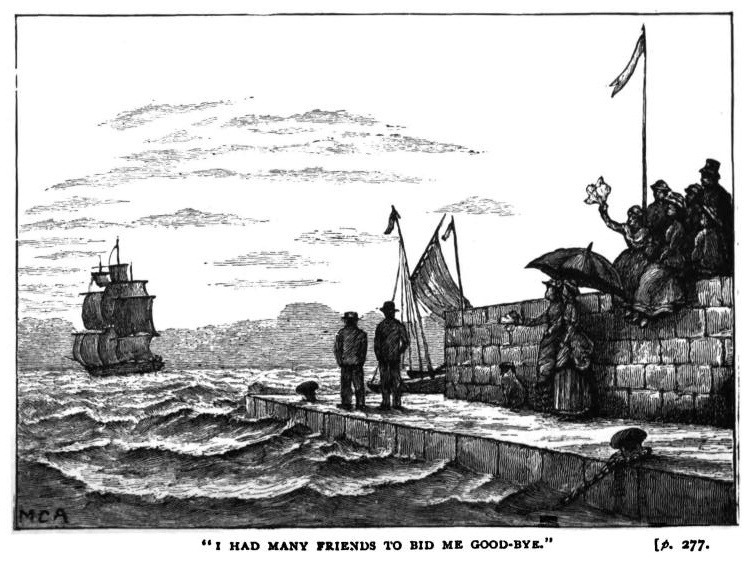
I now daily expected the arrival of the Indiaman in which passage had been taken for my voyage to England, and five days after my father had sailed, the ship was signalled, and a few hours afterwards anchored in Table Bay. I had many friends to bid good-bye besides those with whom I had been staying. The parting was very sad, but I promised that if possible I would come again to the Cape, and stay a long time with my various friends.
A voyage in the sailing-vessels of those days had much more romance and interest in it than is now possible in a modern steamer. Formerly a ship was dependent on the amount and direction of the wind; there was always the excitement of watching the barometer, the clouds, etc, to discover if possible any change of wind; a storm was a greater battle than it now is; and the uncertainty of the duration of the voyage had its charms. Some sailing ships were nearly eighty days in reaching England from the Cape, others accomplished the voyage in a little over fifty.
We had a fair wind on leaving Table Bay. I remained on deck watching the Table Mountain gradually sink, as it were, on the horizon, and when darkness came on I went to my cabin below, and felt dull and miserable. There were about fifty passengers on board, mostly old Indians. My story was known to them all, and several were acquainted with my father; so I soon made acquaintances with my fellow-voyagers, and found the time pass pleasantly enough. We cast anchor for a day at Saint Helena, and I had an opportunity of visiting the most beautiful parts of that island. Our voyage continued favourable until we were within a few degrees of the equator, when the favourable wind died away, and we were left becalmed. This was not an unusual condition. The captain informed us that he had remained on one occasion ten days in these latitudes without moving a mile. The heat was very great, but as most of us had been long in India we stood this better than did those passengers who had merely joined us at Cape Town. I soon took great interest in catching shark. These sea monsters seemed attracted to the ship, and there was usually a dorsal fin seen above the water within a hundred yards of our ship. I constructed an arrangement for shark-fishing which was very successful. At the end of a stout copper wire I lashed a strong hook, and then, with a long line fastened to the wire, I could play the shark just as salmon-fishers play a salmon. By this means I used to catch a shark nearly every day. One of these was a monster ten feet long. We used to haul these fish on deck by slipping a bowling-knot in a rope down our line and over the shark’s fins; and we had great excitement when the creatures were hauled on deck, as they were dangerous to approach until they were killed by blows on the head, and their tail partly amputated with a hatchet. There were on board three gentlemen, who were good chess-players. I used to watch these play their games, and soon learned the moves and the manner in which the game was played, and before the voyage was half over I could play chess very fairly. I also learned from one of the mates how to measure altitudes of the sun, and how to find the latitude each day. This gave me a taste for astronomy, and I learned also the names of the principal stars. The voyage was thus to me a period of interest, and did not hang heavily on my hands; whereas those people who took no interest in anything during the voyage, were always wearied and cross.
As we approached England we met or overtook several ships: our vessel was a very fast sailer, and never failed to overtake any ship that we saw ahead of us. It was on the fifty-fourth day from leaving the Cape that we saw some land, which the captain told us was Ushant. Two days afterwards we were off Plymouth, and in another week were beating up the Downs. There were few steamers in those days, and nearly all the ships sailed up the Thames. When we reached Gravesend a gentleman came on board, who told me he had been sent from London by my uncle, who wished me to land at Gravesend, and travel by coach to London. I was really sorry to leave the ship, where I had passed two months very pleasantly, and had been treated most kindly by the captain and officers, as also by my fellow-passengers.
However, I was delighted with what I saw from the outside of a four-horse coach, as we travelled up to London. But London bewildered me: the noise, the number of people and vehicles, made me quite giddy; and though I could find my way for miles in an African forest, yet I doubted whether I should ever be able to walk alone in London without losing myself. My uncle lived in an old-fashioned, but very comfortable house near Highgate, and we reached that locality about six o’clock in the evening. The time of year was autumn when I arrived, and it was a lovely evening, the sun about setting. My uncle’s house stood in a garden, with fine trees round it, and at that time Highgate was quite in the country. A very dignified oldish man met me at the door, who I was informed was the butler, and who, having taken charge of my luggage, said that Mr Peterson was in the drawing-room, and would be glad to see me there. I was preceded by the butler, who opened the door with great solemnity, and announced “Mr Peterson.” My uncle was standing with his back to the fire, and at the first glance I came to the conclusion that I had rarely seen a more striking-looking man. He was quite six feet high, neither thin nor stout; his hair was quite white, and worn rather long. He must have been nearly seventy years of age, but was as erect and straight as a life-guardsman. His eyes were deep-set, and partly concealed by heavy black eyebrows, which produced a curious contrast with his snow-white hair. His glance at me as I walked across the room seemed to read me at once, and I mentally exclaimed, “He is a chief.”
“Welcome to England, my boy,” said my uncle, as he shook me heartily by the hand. “You have had strange adventures since you left India; but, judging from your appearance, you do not seem to have suffered much. Why, you are quite a young man, and I expected to see a mere boy.”
At the age at which I had then arrived there are few things which are more flattering than that of being told you are no longer a boy. When with the Caffres I never thought of such things. The fact of having been made a chief had promoted me to the dignity of manhood, but when I came again among white people I was treated as a boy by some of these; my uncle, however, considered me a young man.
After a few remarks about my voyage, my uncle informed me that we should dine in an hour, and that probably it would take me some time to dress and refresh myself after my journey: he rang the bell, and told Edwards, the dignified butler, to show me to my room.
There was a solid well-to-do look in everything in my uncle’s house: the furniture consisted principally of carved black oak; curiosities of various kinds were hung up in the hall and on the walls of the staircase. My bedroom had several handsome pictures in it, the bed itself being a large four-poster.
Edwards helped me to unpack my portmanteaus, and hinted that the master always dressed for dinner. My outfit at Cape Town had been very complete, so I arrayed myself in a “claw-hammer” coat, as the sailors term it, and a white tie, and made my way to the drawing-room, where I found my uncle. In his evening dress he looked still more noticeable than when I first saw him, and I felt proud of being the nephew of so distinguished a looking man.
During dinner I was surprised at the knowledge my uncle possessed of the Caffres, and of South Africa. He had evidently studied that country, and was well acquainted with its geography, climate, and the character of the natives. The questions he put to me taxed all my local knowledge to answer, and I found it difficult to believe that he had not himself been in the country. He was much interested in my account of the language; he was himself a great linguist, and traced in the Caffre words I used a connection with the Arabic. After dinner we sat talking, mainly about my adventures at the Cape, my uncle’s questions leading me on to give him all the details of my life in that country. At ten o’clock he told me that he always breakfasted at eight; that at seven o’clock the gong sounded three times, at half past seven four times, and at eight five times. He added that one of the things about which he was particular was punctuality, as very much, especially in business, depended on attention to this.
When alone in my bedroom I began to speculate on what was to become of me. I had left India with the intention of being sent to a school in England, for the purpose of being educated for one of the colleges devoted to aspirants for India. After my long residence among the Caffres, where I had learned nothing of what in England is termed education, but had added years to my age, I knew how very awkward I should feel in going to a school where probably I might be the biggest boy in the school, but where the smallest boy would know considerably more than I knew. I, however, trusted my uncle would consider all these questions, and I had not long to wait before I found that my trust was justified.
On the third night after my arrival my uncle after dinner said:—
“I have been thinking, Julius, what is best to be done about your education. You are peculiarly situated: you are in age and appearance quite a young man, and I have discovered that you are very observant and have sound common sense; but you know nothing of those things which are esteemed in the world, such as mathematics, accounts, Latin, French, and other matters. I don’t think it would be pleasant for you to go to a school and mix with other boys, who would be so much younger than you are, but who know so much more. I have decided therefore to secure a private tutor, who will come to this house each morning and work with you till half-past-four. You will, if you are in earnest, progress much more rapidly by this means, and I wish to know when you would like to begin to work.”
“At once,” I replied. “I had thought exactly the same about going to school, and should certainly have been ashamed of myself for knowing so little.”
“It is no fault of yours,” replied my uncle. “You know more of some things than many men learn during the whole of their lives; for whilst others have been acquiring a knowledge of Greek, Latin, and mathematics, you have learned how to think for yourself and to reason on what you see. It is rare to find a youngster like you as much a philosopher as you are, and all your life you will derive a great advantage from knowing how to do things for yourself.”
My life now became one of routine; the tutor who came was a comparatively young man, but was a very able teacher. We were more like companions than master and pupil, and when in our leisure hours I had told him of my past life, he took great interest in me.
My uncle had a dinner-party about once a week, to which he invited men who were remarkable in some way—authors, artists, men of science, and travellers. I took great interest in such society, and my knowledge of South Africa and the private life of the Zulus caused me to be listened to with attention whenever I was asked questions.
Two years passed in this way, and I made such rapid progress that I had become a fair mathematician, understood book-keeping by double entry, had gone through the six books of Euclid, could read and write French, and might be said to be well educated. My tutor was surprised at the rapidity with which I acquired knowledge. I, however, attributed it to the cultivation of my powers of observation, which had been developed during the wild life I had led in Africa.
My uncle at this period informed me that my tutor had told him, that I had made such rapid progress, that there was no necessity for my continuing my studies, and that he now considered it desirable that I should decide what course I should adopt in life.
I knew my uncle must have already made up his mind, and so considered it desirable that I should tell him that I had not sufficient experience to make any selection, but would rather follow his advice.
“Then,” said my uncle, “what do you think of coming into my office, and learning the business which I have followed with tolerable success? The army is poor pay, and often great hardship. The Indian Civil Service is better, but I think you are too old for that, and I don’t know any other line that would suit you. You can live here with me as long as you find it comfortable, and perhaps in time you may take my place.”
During the whole of my residence with my uncle I had never been to his office, which I now learned was in Fenchurch Street; and in a few days I was taken by him and introduced to the head clerk, who, having received instructions from my uncle, took me into an outer office and made me acquainted with four young men who were clerks. These four young men were considerably older than I was, as far as years were concerned, but their manners and conversation soon caused me to look upon them as mere boys; they seemed to have but little powers of reflection, to avoid thinking deeply on any matter, and to endeavour to do as little work as was possible. They indulged greatly in chaff; but, I suppose, from the fact of my being the nephew of their chief, as they termed my uncle, they never chaffed me. I felt but slight inclination for their society, and before I had been a week in the office there was a sort of antagonism between these clerks and myself.
My uncle did not seem displeased that I had not become very intimate with these clerks. He asked me one day how I liked them. I replied that I found nothing really to dislike, but they seemed to me particularly foolish, and to be too fond of trifles.
My uncle smiled, and said, “The fact is, Julius, you are very old, though young in years. The scenes through which you have passed have aged you, and you look for realities in life. The clerks in my office are thoughtless and superficial.”
It would not interest the reader if I were to describe in detail the life I led during the next three years. It was passed without any important events. I learned the details of my father’s life in India from letters received nearly every month from him. I had become thoroughly acquainted with my uncle’s business, and obtained a knowledge of the largeness of his transactions. Considering what must have been his wealth, I should have been surprised at the quiet way in which he lived, had I not discovered that he had a great dislike to display. He had often expressed the opinion that a man should be more than he seemed, instead of seeming more than he was. This he carried out practically. He lived very comfortably, but even with me in the house could not have spent much more than a thousand pounds a year, whereas his annual income must have been seven or eight times that amount.
I had become acquainted with several people in London, all friends of my uncle. To the houses of these I was frequently asked, and great attention was shown me. It seemed to be understood that I should be my uncle’s heir; and I knew enough of the ways of the world, to be aware that this fact, had probably more to do with the attention paid me, than any special qualities in myself. I was not, therefore, carried away by such attentions, nor did I become vain in consequence, both dangers to which some young people are liable. I visited everything in London worth seeing, my uncle putting no restrictions on me. He was fond of the opera, and we often attended it together, as also some of the principal theatres. He allowed me an income for my work at the office, and told me that although he did not wish to restrict me as regards anything essential, yet he thought I ought to live within this income. After two years’ experience I found I could do so, and one day mentioned to my uncle that I had not only done so, but had saved fifty pounds.
But one event occurred during this period, which broke the monotony of civilised life.
It was on a Sunday afternoon, during the winter time, that my uncle accompanied me, to call on a family who lived on the borders of Hampstead Heath. Some of the members of this family were much interested in my adventures in Africa, and I had promised to bring over a knob-kerrie made of the horn of a rhinoceros, to show one of the daughters who was an invalid, and could not visit my uncle’s house to see the few African curiosities that I had there. We stayed at this house till it became dusk, and then set out on our walk home. At that date Hampstead Heath was a lonely place, and robberies were not unfrequent. It occurred to me, soon after we had commenced our walk, that if I were alone I might possibly have an adventure, which I believed would have been amusing. Armed as I was with this formidable knob-kerrie, I could have felled an ox; then I had not neglected my running, and I felt certain that not one Englishman in a thousand could catch me, in case I chose to run. I did not expect that two men walking across the Heath were likely to be stopped by highwaymen. As these ideas crossed my mind, my uncle said, “This heath is rather a dangerous locality to be in late at night: there have been several robberies here lately.”
“I was just thinking of that,” I replied, “but I suppose the robbers don’t use firearms.”
“Not if they can help it,” said my uncle, “as that would make too much noise.”
As we wended our way across the heath, I watched carefully the ground in advance. Although it was a darkish evening I could still see several yards in front of me. Everything was quiet, and we seemed the only people out at the hour. Suddenly, from some bushes near the path, three men jumped up, and were at once within a yard of us.
“Now then,” said one of these men, “just hand out what you’ve got, before we knock your brains out.”
He had scarcely spoken, before I had lunged at the lower part of his chest with my knob-kerrie, the point of which was sharp as a knife. Shifting my hand to the sharp end, I brought the heavy knob down on the head of the man next to me, who fell as though he had been shot. The third man had grappled with my uncle, and the two were struggling together; for my uncle, although old, was still powerful. Watching my chance, I dropped my knob-kerrie on the shoulder of the highwayman. His arm fell helplessly to his side; at the same time my uncle struck him with his fist and he fell to the ground.
We did not wait to see more, because these men were usually provided with pistols, and after the treatment they had received, we believed they would not be very particular about their use. We therefore moved off as rapidly as we could, and reached home in safety; my uncle little the worse for his struggle, except that his coat was torn. At that date the regular police did not exist, and our report of the affair produced no results. We, the next day, visited the scene of our encounter, and found unmistakable “spoor” of the highwaymen having suffered, as there was a great deal of blood on the ground where the man whom I had struck had fallen.
I was much complimented by all my friends, to whom my uncle related the adventure; but I explained to them that such scenes were not new to me, that the life I had formerly led had trained me specially so as not to be surprised or taken at an advantage, and it would be strange indeed if, now that I had come to civilisation, I should forget all my early education.
Whether it was this adventure, or merely the memory of the past that caused me to become unsettled, yet it was a fact that I had a growing desire to once more visit the country where I had passed such eventful years. In the solitude of my bedroom I used to carry on imaginary conversations in Caffre with my old companions, and retraced my career through the various adventures that had occurred. Weeks passed without my mentioning this feeling to my uncle; but one evening he was speaking about Mr Rossmar, when I said that I believed a very profitable trip might be made to Natal, where ivory, ostrich-feathers, and leopard-skins could be procured for a few beads or some cheap guns.
My uncle remarked that Mr Rossmar had, curiously enough, suggested the same thing, the difficulty being to find a trustworthy person who knew the country, and who would undertake the business.
I at once said, “I could do it myself. I know the country, can speak the language, and should be able to do away with ‘middle men,’” middle men being the intermediate traders who make their profit by buying cheap and selling dear.
“Would you like such a trip?” said my uncle.
“Most certainly I should,” I replied. “Lately I have thought how much I should like to visit the country again and see some of my old friends there. I am certain that there is a great quantity of ivory in many parts, and ostrich-feathers could be procured, as ostriches are plentiful.”
“We will think about it,” said my uncle, “and perhaps it may be managed.”
After this conversation I became unsettled. I was always thinking of the wild life I had led, of its freedom from all forms and conventionalities, and the beauty of the country.
My uncle said nothing more for some weeks, but again referred one morning to our previous conversation, and asked if I were still willing to pursue my adventures in South Africa. He said that I could sail to the Cape in one of the ordinary Indiamen, and charter at the Cape a small vessel which could cross the bar at Natal. When this ship was loaded I could return with her to Cape Town, transfer my goods to an Indiaman, and return home. The whole business, he thought, might occupy a year; and, if carefully carried out, ought to be profitable.
Chapter Eighteen.
It was a bright fresh morning in April, that—I embarked at Gravesend in the full-rigged ship Condor, bound to the Cape and Calcutta. The most unpleasant and dangerous portion of the voyage in those days was from Gravesend through the Downs, and along the Channel. Sailing ships only then made these long voyages, and they were sometimes detained during many weeks in the Downs waiting for a fair wind. Then, when sailing in the Channel, they often had to beat against a contrary wind the whole way. In my case we were fortunate in having a fair wind nearly the whole way from the Downs, until we had entered the Bay of Biscay. Fine weather continued until we were within a few degrees of the Equator, when the usual calms stopped us, and we lay broiling on the calm sea during ten days.
I caught two rather large sharks, and had a narrow escape from one as I was bathing from a boat near the ship. We reached Table Bay in sixty-two days after leaving Gravesend, which period was considered by no means bad time for a sailing vessel. Having cleared my baggage from the ship and Custom House, I put up at an hotel at the corner of the parade in Cape Town, and sent word to my friend, Mr Rossmar, to say I had arrived.
Early on the following morning. Mr Rossmar came to see me, and was at once full of complaints on account of my not having immediately gone to his house, and made it my home. The few years that I had been in England had taught me much as regards the rules of so-called society. In England there was formality and etiquette which did not exist in the Colonies, particularly at the Cape. Friendship in England and at the Cape conveyed entirely different meanings. At the latter, a friend’s house was almost like your own: you did not think it necessary to wait for a special invitation to go to dinner and take a bed, but if you rode over in the afternoon it was considered unfriendly if you did not stop till the next morning. I had forgotten these conditions, and so had first stopped at an hotel. By noon, however, I had reached Mr Rossmar’s house, and was received as though I had been a long-lost brother.
I was surprised, when I saw the Miss Rossmars, to find that they were more pretty than any girls I had seen in London. They had, too, the great charm of being natural and unaffected, and to be less occupied in seeking admiration than English young ladies. In spite of what I had gone through in the Zulu country, I was in reality merely a boy when I formerly stayed at Wynberg. Now I was a man; and the experience I had gained in society in London had made me capable of judging of the relative merits of that great paradox,—a young lady.
A certain portion of the day was occupied in making arrangements for my voyage to Natal. I found that a small vessel would sail from Table Bay in a month’s time, and I had made arrangements with the owners to use this vessel almost as if she were my own. I had brought from England quantities of beads of various colours, looking glasses, blankets, and some hundreds of assagy blades that I had caused to be made at Birmingham. All these things were, I knew, highly esteemed by the Caffres, and would purchase nearly everything they possessed. I was not so busy with my preparations but that I had plenty of time to pass with the Miss Rossmars. We rode nearly every day, had climbing expeditions up the Table Mountain, musical afternoons at home when the weather was not suitable for going out, and in fact enjoyed ourselves as people in the Colonies alone seem to do.
The natural results followed. I became much attached to Nina Rossmar, but as this is not a love story, but merely an account of my adventures in the wild country of south-eastern Africa, I will not weary my readers with the old, old tale, but will merely state that I wrote to my father and uncle, asking their consent to my marriage with Nina. These letters I wrote before I started for Natal, as I hoped the answers would be awaiting me on my return.
The month passed very rapidly, and I embarked at Table Bay in the little brigantine which was to convey me to Natal. I have sailed since that time on many seas, but the roughest I ever experienced is off the Cape. Well was this Cape termed the Cape of Storms, for there seemed a storm always on hand, and no sooner had the wind been blowing hard in one direction and then stopped, than a gale sprung up from the opposite point of the compass. Many times, as the huge waves came rolling towards us and seemed to be about to break over us, I thought nothing could save us from being sent to the bottom, or turned over; but the little vessel, which drew only eight feet of water, was like a duck on the ocean, and though she bounded like a thing of life as the monstrous waves approached and moved under her, she was very dry, scarcely any seas washing over her. We were, however, thirty days on our voyage from Table Bay to the Bluff at Natal, and we had to anchor on our first arrival, as the wind was off shore. I scanned the well-known coast as we lay at our anchorage, and recalled the strange scenes through which I had passed. There were the high-wooded bluff on the west entrance to the harbour, the low sandy hillocks to the east, where I had run the gauntlet of the Zulus, the dense wood of the Berea bush, and the islands in the bay where I had outwitted the Zulus, when I was in the boat. Now that I was again in the vicinity of these scenes of my early days, I felt in doubt as to whether I was not more a Caffre than an Englishman. I found myself actually thinking in Caffre, and speaking sentences in that language to myself.
I noted that there were several houses near the entrance of the harbour and up the bay which did not exist when I left Natal. These, I afterwards found, were the houses of some Dutchmen who had settled there.
The wind having changed the day after our arrival, we entered the bay, having crossed the bar in safety.
It seemed strange, after my experiences of civilised life, to come to a place where there was not an hotel, or any house where one could put up. I had, however, made my plans from my knowledge of the country, and had provided myself with waterproof sheeting that I could turn into a small tent, and so was independent of a house. The Dutch Boer, when he travels, makes his waggon his house, and is thus as independent as an English gipsy. I took the first opportunity of landing, and making the acquaintance of the few Dutchmen who resided at Natal. My knowledge of the Dutch language, which I had acquired at Cape Town, was now of great use. I thought it prudent not to let the Dutchmen know of my experiences in the country, but to be quite independent of them in my future proceedings. I made arrangements for the hire of a pony during my stay in the country, and also two oxen, which had been trained to carry packages and were termed pack-oxen by the Boers. I believed that I had so altered that none of my old Caffre comrades would recognise me, and I intended to travel among them—at least at first—without letting them know who I was.
One of the Boers asked me to stay at his house, but I preferred remaining on the ship until I made my start up the country.
The first visit I paid was to the kraal of Umnini, near the Umlass river. I took one of the Caffre servants of the Boer with me; this Caffre could speak Dutch, and I wanted to conceal my knowledge of Caffre for some time, so I spoke to him in Dutch, and asked him to speak in Caffre to the Caffres.
On arriving at the kraal of Umnini, I was interested as to whether I should be recognised by these men. During the interval that had elapsed since I was last at the kraal of Umnini, I had increased in height, and had developed whiskers; the change in my appearance, therefore, was considerable, and I considered it unlikely that I should be remembered. The Caffre with me told the people of the kraal that I was one of the Boers, he knowing no better, and that I had come to trade, and wished for leopards’ skins and elephants’ tusks.
Several of the men who were present I remembered: these men had been with me often, but although they looked at me very hard they none of them seemed to remember me. Having ascertained from my Caffre that I could not speak their language, they made their remarks on me very freely. These remarks were complimentary. They said I did not look like a Boer, but must be a young chief. “He has the head of a chief,” said one man, and the others agreed with him. They also decided that I must be strong and a good runner. These and other similar remarks I listened to with much amusement, but without giving the slightest sign that I understood what they were saying. After a time Umnini came to me, and, after looking at me for some time, said, “It is the young White Chief of the Umzimvubu.” The men who had been speaking about me smiled at this remark, and said to Umnini, “No, chief, it is not him, it is a young Boer.” Umnini looked at me very attentively, but I gave no sign either of recognising him, or understanding what he said.
Speaking in Dutch to my Caffre, I told him to ask the chief if he had any ostrich-feathers, or elephants’ tusks, as I wished to buy them.
He replied that he had a few tusks, and wanted to know what I would give for them.
Having brought with me some beads as specimens and a few blades of assagies, I showed him these, but he said that what he wanted was guns. The talking continued for some time, and I at length asked that I might see the tusks. Umnini said I could go with him into his kraal where the tusks were kept. We alone entered his hut, and he then pointed to six fine tusks, but believing that I could not understand what he said, he made signs that they belonged to three elephants.
Having carried my joke far enough, I looked at Umnini and said in Caffre:—
“Chief, you alone were correct and you alone knew me. I am the White Chief of the Umzimvubus, and I have come back to see you again, and to bring you some things you will like. I am going also to see my own tribe to the west.”
Umnini scarcely seemed surprised, as I told him who I was, but said he had been certain about it when he saw me.
Our conversation, which had not been heard outside of the hut, had been carried on in a low tone; so no one besides Umnini knew who I was. I told him I did not wish to be known at present, and asked him to keep my secret. He agreed to this, and when we crept out of the hut he did his acting splendidly, and spoke to my Caffre, asking him to enquire of me what I thought of the tusks.
I replied in Dutch, saying I would buy them. Then bidding good-bye to the people, I returned to the ship.
Two days afterwards I started with two Caffres and a Hottentot for my old residence near the Umzimvubu. The pony I rode was a good shooting pony, and on the first day I shot two coran and a red bush-buck, which supplied the party with plenty of food. On the second day I reached my old kraal, and was again anxious to see if I should be recognised. I was not long in doubt. Inyoni, my old boy-companion, had now grown into a fine young man, and was standing near the entrance to the kraal, watching me and my companions as we advanced. When close to him he looked at me for an instant, and then shouted, “Inkosi” (chief), and seized my hand. His shout had brought out all the people who were in the kraal, each of whom recognised me. Those whom I had left as boys, and little girls, were now young men and women, and all were delighted to see me. The Hottentot and Caffres, who had accompanied me from Natal, looked on with astonishment, and when they heard me speaking Caffre as well as they themselves spoke, they seemed to think it was witchcraft.
I had a busy time of it answering all the questions that were put to me by my old friends, who were anxious to know what I had been doing, where I had been, and whether I intended to again live with them. When I told them how I had passed day after day in a room, in the midst of a large city (London), and had rarely seen the sun, and had shot no buck, had not even seen a wild elephant, and had enjoyed no sport, they were astonished how it was I had gone through all this, when I could have come back at any time, and enjoyed the free, happy, exciting life of a chief with them.
The arguments used by my old friends have often been considered since that time by me, and the problem is a curious one, whether civilisation, with all its advantages, has not so many drawbacks as to render the wild, free, healthy life of so-called savages preferable.
At the date about which I write, there was no sport in the world finer than could be obtained in that part of Africa. Such sport as fox-hunting in England, deer-stalking in Scotland, pheasant, partridge, or grouse shooting, was as inferior to the sport in Africa as catching minnows is to salmon-fishing in a fine Canadian river. When a man has once followed the track of the giant elephant, through the mazes of an African bush, has come close to his formidable game, has fired at him, and heard the terrific sound of his angry trumpet, as he charges through the bush, he feels that he has enjoyed a class of sport superior to all other. Even stealthily approaching and slaying the formidable buffalo, in his forest stronghold, is a sport to be remembered all one’s life. To attempt to compare such sport as standing at the corner of a cover, and knocking over pheasants as they fly over you, with the sport formerly obtainable in the forests or on the plains of Africa is ridiculous.
“Why do you not come back to us, and enjoy life?” said Tembile;—“you, who could follow the tracks of a buck without a mistake, who could assagy a running buck, and hit with your knob-kerrie a bird on the wing. Here you could have plenty of cows, plenty of corn, several wives, and, as you are a chief, you could do all you wanted. What can there be in your country to compare with what we have here?”
As I listened to Tembile, and reflected on what he said, and then thought of the life I had led in my uncle’s office, I really began to think that civilisation was a mistake. What prince or duke in England could go out from his house, and within a few miles get a shot at a wild elephant or buffalo, or walk through as magnificent a forest as that near our kraal, and shoot antelope, or rare and beautiful birds? The freedom, too, of the life here was one of its greatest charms. Although the advantages of civilisation are great, yet the price we pay for these is enormous. Should I return to England and become a sort of slave to society, or should I remain in Africa? was really a question which I thought over frequently. The attraction at Wynberg, however, turned the scale.
Soon after my arrival at my old kraal, I had made inquiries about the white women who had been my fellow-passengers from India, but I found there was a disinclination on the part of the Caffres to give me any information about them. I afterwards spoke to Tembile about them, because I knew I could trust him to tell me the truth. He said that the Caffres were afraid, now that I had been so long among white men, that I might endeavour to take away the white women; so they had been concealed, and I was not to know where they lived.
I assured Tembile that I had no intentions of that sort, and I believed it would be better for the white women, to now remain with their husbands and children, than for them to return with me.
Having made various inquiries, I heard that there were more than a dozen elephants’ tusks in the kraal near, some of them very heavy, but the Caffres had no wish to dispose of their ostrich-feathers. These feathers they used as head-dresses when great dances took place, and were very proud of them. I told the Caffres that I wanted as many tusks as I could procure, and, as I had now some very strong guns, I should like to find elephants and shoot them.
I had been five days at the kraal of my old friends, when news was brought that the elephants, according to their annual custom were coming westward, and were only a day’s journey from our kraal.
I therefore assembled all the men whom I had formerly taught to use a gun, and told them that I wished their help in shooting some of the largest elephants. I explained to them that an elephant might be hit by many bullets and yet would not be killed, unless he were struck by the bullet behind the shoulder, or in the chest. I then said that I could give them powder and could make bullets for them, so that they need not expend the store of those which they had carefully preserved in case they were attacked again by the Zulus. The Caffres expressed their willingness to join me in my shooting expedition, but reminded me that there was as much danger in attacking elephants as there was in a fight with the Zulus. I admitted that there was danger, but that, if we were careful, we need none of us get hurt.
I had brought with me from England two large-bored double-barrelled guns, which I knew would be well-suited for shooting elephants or other large game, and I had practised with these guns at Cape Town, and could make nearly certain of hitting a mark the size of a man’s head at eighty yards nearly every time I fired. I felt, therefore, great confidence in my weapons, and I intended to take Tembile with me when I hunted, and to make him carry my second gun, by which means I could obtain four shots at any one elephant.
News was brought us two or three times a day by Caffres, as to where the elephants were feeding and what they were doing; so, all our plans being arranged, I started with Tembile and four other Caffres for that part of the bush where it was thought we should find the elephants.
The bush in this part of Africa consisted of large trees, about ten or twenty paces apart. Between these there was dense matted underwood, so thick and tangled that a man could not force his way through it. From the trees creepers of large size hung in festoons, like large ropes. Some of these had projecting from them thorns an inch or more in length, and sharp as a needle. The dense underwood rose to a height of three men, so that it was in many places impossible to see round you a greater distance than you could reach with an assagy. The only means of moving through the bush in these dense parts was by following the paths made by the elephants. When a herd of these animals had been for any length of time in the bush, they made so many paths that it was easy to move about in the bush; but the growth of the vegetation was so rapid, that a few weeks after the elephants had left the bush it had again overgrown the old paths, and was once more impenetrable.
Elephants usually left the thick bush during the night or very early in the morning; they would then roam about in the open country, and drink at some stream or pond. When possible, they would roll in the wet mud, like pigs; then, as day broke, they would re-enter the bush, seek the densest parts, and there remain quiet during the heat of the day.
I had decided that the best chance of success with the elephants would be to follow them into the bush, come upon them during the middle of the day, and get our shots at them as they stood half sleeping in the bush. The Caffres, I knew, could walk so quietly in the bush, that, if we were careful about the direction of the wind, we might approach the herd without their being aware that an enemy was near them.
A day’s journey brought our party to the country where the elephants had now taken up their residence. The Caffres near were most anxious about their crops, for they expected the elephants would come some night and eat up, or trample down their corn. We found that the elephants had not drank during the previous day; so we felt sure they would drink during the coming night. Some large ponds near the edge of the bush was the place where it was expected they would satisfy their thirst, so we sent some Caffre boys to keep watch near these ponds, and to let us know the news as soon as possible.
The sun had not risen on the following morning when our spies came into the kraal, and told us that the elephants were now drinking and rolling at these ponds; that there were nearly a hundred of them; and, among these, three enormous bull-elephants, with tusks nearly as long as an assagy.
This news was very gratifying. So, after we had eaten our breakfasts and taken some corn with us, we started for the bush. We examined the footprints and marks made by the animals, and could easily distinguish those made by the three large bulls. To follow these tracks into the forest was easy. The bush-path was clear and well trodden; so we moved on silently, but not too quickly.
When we were some distance in the bush, we heard the trumpet of an elephant; and I came to the conclusion that we were now within half a mile of our formidable game. Having sat down and talked in whispers for some time, we then slowly advanced, peeping through the bush whenever any opening gave us a chance of doing so.
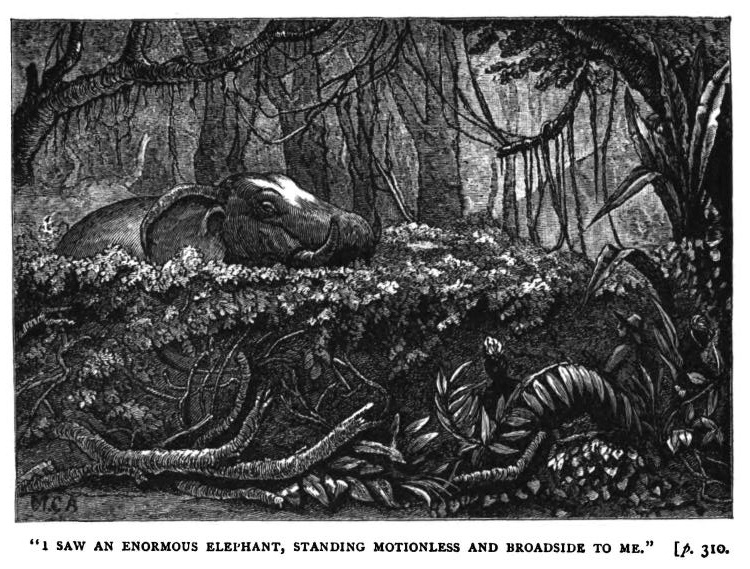
I was leading, and was followed by Tembile, who carried my second gun; then the other men came after, each stepping on the same spot, so that we incurred but slight risk of treading on any dried stick, for to crack a stick in the bush would have given the elephants warning of our approach. Suddenly Tembile touched my shoulder, and, on my looking round, he pointed to my right, and then stood motionless. On looking in the direction at which Tembile was pointing, I saw an enormous elephant standing motionless and broadside to me, and not ten paces distant. Signalling to two of the Caffres to approach, I pointed to the elephant’s shoulder, and, raising my gun, fired my two barrels in quick succession. Each of the Caffres fired a shot, then we turned and rushed down the path up which we had advanced. For an instant there was no sound except the echoes of our guns. Then the most tremendous screams and trumpetings were given by some fifty elephants, and we heard the branches of the trees snapping like a succession of rifle-shots.
We could not tell at first in which direction the elephants were moving, the noise of the broken branches coming from all around us. After a time, however, we learned from the sounds that the herd was moving away from us. Having reloaded my gun, we advanced with great caution to the spot from which we had fired. The elephant was not there, but his tracks were quite distinct. He had rushed forward through the bush, and had carried everything before him—trees being carried away as though they were mere sticks.
A few paces from where he had stood we found blood in abundance, and from the appearance of this blood the Caffres assured me the monster must soon die. It was dangerous work following this wounded elephant, because he would be more savage now than at any time; so we had to advance with great caution. We had not gone far, however, before we saw him leaning against a tree, swinging his trunk about, and swaying his huge body. The Caffres told me not to fire, as he must soon fall, and to fire would disturb the remainder of the herd. We waited only a short time, when the elephant slipped down and remained quiet. Tembile cautiously approached it and signalled to us that it was dead. We had no fear of the game being carried off, so we left it in the bush and again followed the remainder of the herd.
When elephants have been alarmed they rush away through the bush for about a mile, then stop and become very cautious; to approach them requires the greatest care, as they are then on the watch, and, their scent and hearing being both very acute, the approach of a man is soon discovered.
The traces of the elephants were easily followed, and we knew when we were close to them by the rumbling noise we heard. A large elephant was soon seen, standing flapping his large ears, and with his trunk raised so as to scent the air; but our approach had been so cautious that the animal had not discovered us, and he received eight bullets behind the shoulder before he had time to move. He did not charge as we expected, but ran only a few yards and then dropped. Two large-tusked elephants were thus killed, but we wanted two more; for we had seen by the footprints that there were two other large bulls in this herd.
During the whole of this and the following day we followed the herd, and killed five large elephants, all with magnificent tusks. Such sport I was aware I should never again enjoy, and so I made the most of it.
After four days the whole of this ivory was conveyed to Natal Bay, and I had bid my old friends good-bye. I hardly liked parting with them, and held out hopes that I would again return to their country; I feared, however, that I should not be able to do so, for when once settled in England it would be difficult for me to leave.
On my return to Natal, I found the Dutchman who was there had collected several large tusks, and also many hundred ostrich-feathers, so that I had a large stock to carry back to Cape Town. My voyage to Cape Town was rapid, a fair wind all the way; and in seven days after leaving Natal, I was once more at Wynberg, and at the house of my friends. I found letters there both from my father and uncle, in both of which consent was given to my marriage with Miss Rossmar.
After a month’s residence at Cape Town we were married, and started for England. Fair winds and fine weather favoured us, and in sixty days after leaving Cape Town we reached England.
My life now became one of comparative monotony. I worked with my uncle, and after a time succeeded him in his business. Money was plentiful: my wife possessed a good fortune, and my uncle at his death left me all his property, which was considerable.
I owned a house in London and also one in the country; in the vicinity of the latter there is what is called in England good sport—partridges, pheasants, hares, and rabbits being numerous. But such sport was to me dull and uninteresting; I was always remembering my sport in Africa, and had a longing for again roaming through an African forest in search of large game; but civilisation had advanced in South Africa, and I heard that where I had followed the tracks of elephants, sugar plantations and corn-fields now existed, and that even the Caffres had lost their simplicity, and were now in that disagreeable condition of being half-civilised.
My father had retired from the Indian service, and had taken a pretty house in the country near me, but was often complaining of the climate and habits of England. To him India was the most charming country in the world, and the servants in India were the very best. Still he managed to enjoy himself and passed much of his time with me, listening to my account of the incidents that had happened to me in Africa.
I had missed in my early youth the training usually given to gentlemen’s sons: I knew but little Greek or Latin; of history I was ignorant; of mathematics I had but a superficial knowledge. Yet my early training had been of a very practical kind, and was of benefit to me in after-life. I had learned to rough it in my youth, and to do everything for myself. Although I kept many servants, yet I was not dependent on these, as most people are in civilised countries. I could, if required, light my own fire and cook my own meals, and I should have felt it no hardship to do either.
Although I fully appreciated the advantage of a large and well-furnished house, yet I could have been quite happy in a hut no bigger than a Caffre kraal. And I had learned the great secret, that if we curtail our wants, we arrive at the same result, as though we increased our income. My wants were few, and these I had ample means of supplying. Instead of working on at my late uncle’s business till I became too old to enjoy freedom, I gave up the business whilst I was still comparatively young, and devoted my attention to various subjects in which I was interested; so that, although my early education had been very different from that of most boys, it had been of a thoroughly practical kind. I had learned self-dependence and could help myself, and envied no man. I watched with interest the changes that took place in South Africa, and my only regret was, in seeing how affairs were managed out there by those who seemed utterly ignorant of everything connected with the country and the people. I sometimes offered suggestions when it appealed that catastrophes must occur if matters went on as they were going. My opinions were ignored, and the disasters occurred, but such results are not unusual. My career as a White Chief of the Caffres was not without its charms to me, both during its existence and now as a reminiscence; and I trust it may have afforded amusement to my young readers.
| Chapter 1 | | Chapter 2 | | Chapter 3 | | Chapter 4 | | Chapter 5 | | Chapter 6 | | Chapter 7 | | Chapter 8 | | Chapter 9 | | Chapter 10 | | Chapter 11 | | Chapter 12 | | Chapter 13 | | Chapter 14 | | Chapter 15 | | Chapter 16 | | Chapter 17 | | Chapter 18 |