Major General A.W. Drayson (continued 2)
Reading edition
On leaving Inyati I took my assagies and walked out to the hill where my late companions Inyoni and Tembile were watching the cattle, and sat down with them, telling them of my having been made a counsellor and chief. These boys were quite excited at the news and very pleased, and we sat talking some time, till we noticed that the cattle were alarmed by something and seemed uneasy. We ran up to them, and then saw quite a small calf on the ground, and something shiny all round it. In an instant I saw it was an immense snake, as thick as my body. Seizing an assagy, I drove it into the snake’s head, and then, withdrawing it, stabbed it again in the body. The snake uncoiled itself, and came at me; but Inyoni, coming behind it, threw an assagy at it and pinned it to the ground, whilst Tembile drove another spear into it. Seeing my chance, I went close to the monster and stabbed it in the head two or three times, and thus killed it. As soon as we saw it was dead we cut some sticks, sharpened the ends of these, and pegged the snake straight on the ground. It was then longer than the three of us, and was a giant among snakes. The Caffre boys told me there were several such snakes about, and that they would kill and swallow a calf. They knew no other name for it than “Inyoka m’culu” (“the big snake.”) They said these snakes ate only about twice each moon, and after eating slept for many days, and were sometimes then killed by wild pigs and leopards. They said that, many months ago, a Caffre boy was sleeping near here, and whilst asleep one of these snakes came to him, coiled round him and killed him. Before the snake could swallow him, some men came to the place and killed the snake, but the boy had been dead some minutes before they arrived. They described how this snake attacked anything. It first crawled slowly along the ground till near its prey, or waited in long grass, or in bushes, till some animal or bird came near. When close to the animal it wished to capture, the snake lunged rapidly at it, seized it with its teeth and dragged it to the ground, at the same time coiling round the animal and compressing it in its folds. Even a riet-bok could be thus killed by the snake. The reptile then slowly gorges its prey, and remains torpid many days.
Although this large snake was a terrible creature to look at, it was not as dangerous as several other snakes that were common near our village. The most dangerous of these was the puff-adder, which the Caffres called “m’namba.” This snake I have seen about four feet long, and as thick as a stout arm. It is a sluggish, dull animal, very brilliantly coloured, its body being speckled yellow and black, which makes it look like dead leaves, so that you might tread on it without seeing it, unless you were always on the look-out. This snake has a practice of throwing itself backward and striking with its poisonous fangs anything that is following it. To be bitten by the m’namba is certain death, no case ever having occurred of a man or any cattle having been bitten and having lived after it. Our old rain-maker had some little bits of wood that he called mutt, some of which, he said, would prevent a man from dying when he had been bitten by a snake; but I never heard of a cure by this means. Some of his medicine was, however, wonderful in its effects, as I once experienced. I was very ill and had a bad fever; so old Amanzi came to me and gave me a small pill of wood, which I bit and ate. In a few minutes I broke out in a perspiration, and then went to sleep, and slept for nearly the whole of the sun’s course round the earth (a whole day), and when I woke I was quite well. Caffres are very seldom ill: they eat so little meat, are so much out of doors, and take so much exercise, that they rarely suffer from bad health. The climate also is very healthy, so that the people were strong and robust.
It was about two moons after our expedition against the Bushmen, that I was out one morning with Tembile and Inyoni, on some hills near, in search of riet-bok, when we saw two strange Caffres coming towards us. These Caffres, we knew by the “esikoko” (the ring on the top of their heads), came from the east, near the bay of Natal. Having given them the usual salutation, we said, “Chela pela s’indaba” (“tell us the news”), when they told us that a large herd of elephants was coming down the country, and had done much damage to the corn-gardens of the Caffres on the way, breaking down the fences, eating and treading down the corn. They said there were two bull-elephants, very savage, in the herd, who ran after any man they saw or scented; and that three Caffres, near the Umlass river, had been killed by these elephants.
A herd of elephants visiting a country where the inhabitants are as defenceless as were these Caffres, is a serious matter. Assagies were little or no use against elephants; and if a regular attack was organised against them, in the same manner as we had attacked the buffaloes, we should probably have ten or twenty men killed, and after all not kill the elephant. The corn-gardens, on which we depended for our store of food, might be destroyed; and then there might be, if not starvation, at least great scarcity of grain. So that to prevent the elephants from coming our way was considered most important. There was a great council held the evening after the news was brought; and it was decided that we should send some men towards the east, to find out when the elephants came near us; and on their approach we were to light fires in their track and make noises, so as to try and make them travel in another direction. To turn them back would not have been a proceeding pleasant to the Caffres east of us, but yet we should have liked it, as it would rid us of the animals.
There was nothing talked about during the next week besides the elephants, and I learned much about these animals and their habits from the Caffres. These elephants, I was told, came down the country each year: they did so when the umbrella acacia had its young branches and shoots; for on this tree and several others the elephants fed. In its wild state the elephant lives almost entirely on the branches of trees. These it breaks off with its trunk, eats the smaller branches, and grinds the larger to pieces so as to extract the juice from them. It is at night that the elephant usually travels and feeds: by day, especially if it be very hot, he remains quiet in the bush—so quiet, that you might be within fifty yards of a herd of elephants and not know they were there. If, however, a man disturbs the herd when they are thus at rest, the animals will very likely charge at him, and hunt him through the bush just as a pack of hounds will hunt a fox. At this time of year the elephant bulls, cows, and calves, all keep together; but later on the bulls separate and sometimes travel alone. When thus alone, the bulls are very savage; and if two bulls meet in the bush a terrible battle ensues. The Caffres consider that a bull-elephant is a match for 100 Caffres, and even then the animal may get the best of the fight.
I was much interested in these accounts of the elephants, and began to think how I could manage to kill an elephant; for it was my ambition to do so.
The Caffre name for an elephant is inglovu, and the words inglovu and ama inglovu were frequently heard during the next few days; for the expected arrival of the elephants was a most serious incident in the daily life of these people; and forty moons ago the elephants had suddenly travelled into this country and had destroyed all the crops of the Caffres near this village. It was all done in one night, and on the morning the people discovered that their yearly crop of corn had vanished. The season was too far advanced to sow again; consequently they were compelled to buy corn and to purchase it with cattle. So that their loss had been very severe.
Taking the first opportunity of speaking to Inyati, I inquired what he intended to do in order to protect his fields and gardens. He replied that the only thing to do was to light fires round the gardens, and to assemble and shout. I inquired why he did not dig a great ditch round his gardens; but he replied that it would take too long, and that the elephants could manage to cross almost any ditch that could be dug.
He also told me that sometimes pits had been dug for elephants; and some years ago an elephant fell into one of these pits, and had been helped out by other elephants; so that it was no use attempting anything against them, as they were as clever as men. That night I thought over every plan by which I could kill an elephant, and at length an idea occurred to me; but I kept my thoughts to myself, as I intended to try by myself if I could not kill one of these enormous animals. Great preparations were made by the Caffres for the arrival of the elephants, quantities of dead wood were gathered in heaps in readiness for large fires to be made when the animals approached our gardens. Several pits were also dug and covered with a hurdle, on the top of which earth was thrown and grass carefully laid. These pits were placed in the old paths of the elephants, because it was known that these animals always followed in their old tracks whenever they revisited a country, and though these tracks were overgrown, or obliterated, yet the instinct, or knowledge of locality of the elephants was so great, that they would travel miles through the bush, and then come out into the open at exactly the same place at which they had come out of the bush some thirty or forty moons previously.
The Caffres told me that the elephants did not understand any man getting up into a tree; that if they were chased by an elephant they climbed a tree, and, although this tree was not big enough to place them beyond reach of an elephant, yet the animal never seemed to think of pulling the man out of it, or of pulling down the tree. This information was of great value to me in carrying out a plan that I was forming in my head.
It was about half a moon’s time after we first heard that elephants were coming our way, that we discovered their traces within five miles of our village. There was a marsh about five miles from us, formed by the overflow of one of the rivers, and in this marsh the elephants had rolled in the mud, and had then returned to the bush. In this bush there were several large trees, hung over by creeping plants and very easily climbed. Having followed the track of the elephants into the bush for a short distance, I noticed a tree that was covered with mud about the stem, and as high as I could reach with my assagy. This was caused by the elephants rubbing themselves against the tree after they had rolled in the mud.
Although the elephant is a thick-skinned animal yet he is much worried in hot weather by flies and mosquitoes. So, to escape in some measure from these pests, he rolls in the mud, and this mud sticking to his hide, forms a coating over him, which defends him to some extent from the mosquitoes. When he passes a thick tree he leans against this and rubs himself, and thus rids himself of a portion of the mud, and spreads it more evenly over his body.
Having selected a tree, I thought at first that I would tell Inyati what I intended doing, and would ask him to accompany me when I carried out my plans. On second thoughts, however, it occurred to me that if I were successful and Inyati were with me, I should do everything, but he would get the honour, because he was a man, I only a boy. So I asked Inyoni and Tembile if they would accompany me in an attempt to kill an elephant.
They replied that to go near these elephants was very dangerous, and that perhaps I did not know how very likely I was to be killed, so that they hardly liked to go for fear I was trying to do too much. I said they might trust me, as I had thought a great deal about what was to be done, and that by my plan there would be very little danger.
From information I had gained from the Caffres, I learned that the elephants usually drank every other night, and that unless disturbed they would drink at the same pools of water. I hoped, therefore, that if I climbed the large tree that I before mentioned, I might during the night or early morning, find the elephants under this tree, when I should have a chance of trying my plan upon them.
My plan was as follows:—The Bushmen that I had shot were armed with a bow and two kinds of poisoned arrows. One kind were made of reeds with a bone end, and were used for shooting small game; the other arrows were stronger, and had a barbed iron end, covered with poison. The barbed end fitted into a stout reed out of which it could be easily pulled. The reason for this arrangement was, that if the arrow struck any large animal such as a lion or a buffalo, the lion would scratch at the arrow and pull it out, and the buffalo in rushing through the bush might do the same. If, however, the reed end of the arrow were pulled, or rubbed off from the animal, the barb containing the poison would remain in its body, and so enable this poison to enter the circulation of the animal, and eventually to cause its death.
If I climbed a tree, and the elephants came underneath it, I could fire an arrow into the back of any one I selected, and by this means I hoped to kill one, if not more elephants. I explained all this to Inyoni and Tembile, and they agreed with me that it was a very good plan and likely to succeed. So having obtained the arrows and a bow, we three started for the tree when the sun was two hands’-breadth above the horizon, and was going down. Before we entered the bush we walked in the wettest parts of the marsh, so that our feet and legs might be covered with mud, when we should not leave any scent from our tracks; for the elephant is very keen-scented, and would avoid any place where the scent of a man was strong. These elephants, however, were not much afraid of man, because in this part of the country guns were not used against them, and they were accustomed to see men run away from them. So that the elephants had it all their own way.
We climbed the tree without difficulty, and having broken off the branches that intercepted my view, I seated myself on a stout branch, high enough to be beyond the reach of an elephant’s trunk. Inyoni and Tembile were close beside me, and held the case containing the poisoned arrows. It was nearly full moon, but clouds occasionally made it rather dark in the bush, though not so dark as to prevent me from seeing anything beneath me.
The night came on, and the moon had gone over about half its course, when we heard a branch broken at some distance from us; and shortly after, the bushes made a rustling noise as though a gust of wind had shaken them; and then I saw something white and shining, and around this white object loomed a black mass. I almost immediately recognised the white object as the tusks of an enormous elephant, and the animal itself was the black mass. I took one of my arrows from Tembile, and fitted it to the bow, and waited for this elephant to come close to me. I was acquainted with the elephant in India, and was not surprised to find how quietly it walked in the bush: its steps made no noise, and the only sound audible was the slight rustling of the leaves as the animal moved along through the bush, and an occasional blow through its trunk as it sniffed the air around.
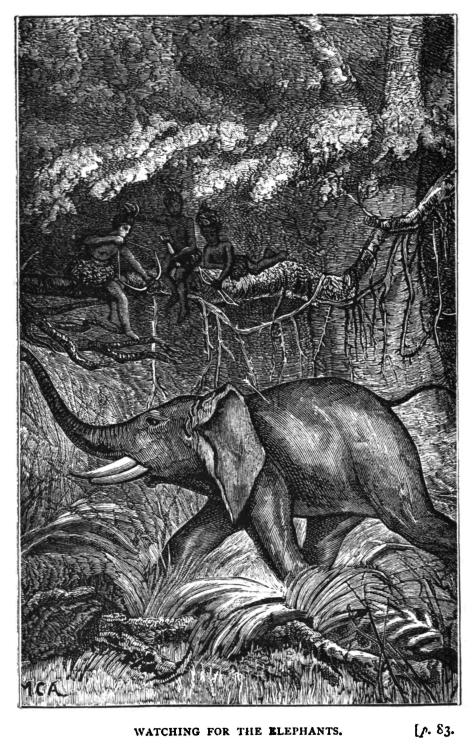
Careful as we had been to cover our feet with mud, still we must have left some scent; for the elephant came on very slowly, blowing through its trunk and shaking its great ears as it listened for some sound. At last it strode forward and came exactly beneath me, and, aiming at its back just clear of the backbone, I discharged one of my arrows with all my force. Immediately the elephant felt the prick of the arrow it gave a sharp cry and moved rapidly forward. It then stood still, listening, and apparently watching for some enemy, but it could not see us in the tree. After a short time it gave another and different cry, and immediately several other elephants, some large, some very small, shuffled along under the tree. One of these was a very large elephant with great tusks, and as it passed I sent an arrow into its back, which caused it to cry out just as the first had done. We counted about forty elephants in the herd, among which were three very large bull-elephants with large tusks. The herd went through the bush to the watering-place in the marsh, but did not return by the same path that they had followed on going to the marsh. So we did not see them as they came back.
As soon as it was light we descended from the tree, and found ourselves very stiff after sitting so long on the branches. After moving about a little we got all right, and then agreed that we should follow the trail of the two elephants that I had hit with my poisoned arrows.
The first thing to be done was to examine the feet-marks of these two elephants. Now the under part of the foot of an elephant is not smooth, but is marked by several small cracks; consequently when the elephant treads on soft ground, it leaves a kind of plan or map of its foot. The plans of no two elephants’ feet are exactly alike, so that when you have once studied the plan of a particular foot, you can recognise the footprint when you see it in another place. It is just the same with the inside of the thumb and top joint of each person’s finger. The grain of the skin makes a sort of pattern, and it rarely happens that this pattern of each finger is the same; and it still more rarely happens that the fingers of two people are alike. Having examined several good impressions of the two elephants’ feet, we went quickly out of the bush, walked along the edge of the marsh, and then entered the bush again at the place where the elephants had re-entered it. It was easy to follow the elephants along the path they had made as they first entered the bush, for along this they walked one after the other; but when we had gone some distance into the bush, we found that the elephants had separated, some going one way, some another. They had also stopped to feed, and had broken off some very large branches from their favourite trees. We now set to work to follow the footprints of the two elephants that I had struck with the arrows. It was very difficult at first, as the ground was very hard, and covered with dead leaves; so that we could not obtain a good impression of the feet for some time, and we were puzzled at first. At length we found an ant-bear’s hole in the ground, and near this the elephants had trodden on the loose earth, and we then recognised the footprints of the largest elephant that I had hit. We followed this elephant very cautiously, for he had separated himself from the others—a sign, as my companions said, that “Inglovu efar” (the elephant was ill), especially as it was evident he had not eaten, there being no branches broken along his track. After following the track during about a quarter of the day, we came so close to the elephant that we could hear him. Sometimes he would make a low rumbling sound, at others he would blow through his trunk, and then knock his tusks against the stem of a tree. All these acts were indications of his being very uneasy, and I hoped the poisoned arrow had begun to do its work. We sat down in the bush listening to the elephant, and ate some of our corn; for I had determined to follow this elephant for days, if possible, in order to find whether he died or lived. The elephant stood quiet in the bush about as long as it took the sun to move ten times its own diameter in the sky, and then it again moved slowly forward, selecting the densest parts of the bush to move through. About every hundred paces it stopped, and remained quiet for a little time, and then moved slowly on again. All these proceedings delighted my Caffre companions, who declared the elephant was very sick. During the whole of the day we followed this elephant, and when the night came we ascended a tree, and slept a little; but as we could hear a leopard calling in the bush, and several bush-pigs were under the tree, we were mostly on the watch. The night was fine, though there was a heavy dew; and though we felt it very cold we did not like to go down on the ground to light a fire for fear of the leopard. As soon as it was light enough to distinguish the tracks, we again followed our elephant. He had travelled during the night, but had gone very slowly; and we saw some marks on the stem of a large tree that showed the elephant had leaned against this, as though he could scarcely stand.
We had moved through the bush very quietly and slowly, stopping every now and then to listen, and also to look all round us; for if we had come on this elephant very suddenly he might have charged us, and, before we could have escaped, he might have caught us and probably killed one of us. Tembile told me that when an elephant caught a man, he pushed him to the ground with his trunk, and then either knelt on him or thrust his tusks into him, and also would push him down and get him between his front and hind feet, and kick him backwards and forwards till he killed him. So, with this description of the elephant’s proceedings, which I afterwards found was quite correct, we thought it best to be very cautious in our approach to the animal.
The sun had risen its highest in the sky, when we sat down to rest and to listen; for we knew that we were close to the elephant, as the footprints were quite fresh. We talked in whispers and avoided any noise, whilst we were on the alert for any sound that should indicate the whereabouts of the elephant. As we sat quietly thus waiting, Inyoni pointed upwards, and gave a grunt of delight: we looked up and saw a vulture slowly circling in the sky and nearly above us. “Elephant going to die,” said Inyoni; “vulture knows it.” We immediately followed on the elephant’s tracks, and, after advancing about two hundred paces, we heard a noise in front of us, and saw the elephant lying on its side, whilst every now and then it swung its trunk about and struck the bushes, thus making the noise we had heard. The elephant was dying, its vast frame overpowered by the subtle poison of the Bushman’s arrow. We kept at a short distance from the animal and watched it, as it gradually got weaker and weaker, and at length lay motionless. We then went close up to it, and found that it really was dead. It was a monster with great tusks as big round as my thigh, and as it lay on the ground it was far higher than I was as I stood up.
“The other elephant must be dead too,” I said, “for I hit that also with an arrow.”
“Yes,” replied my companions, “and we shall find that too: perhaps vultures will show us where it is, if we watch.”
We now agreed that Tembile should go as quickly as he could to our village, and call all the people to come and cut up the elephant, whilst Inyoni and I kept watch near it. So Tembile started off, whilst we who remained agreed to sleep turn and turn about, as we were both very tired.
I had a good sleep, and then Inyoni lay down whilst I kept watch. I could not keep my eyes from the dead elephant which lay a few paces from us. It looked such an enormous creature, that I could hardly believe its death had been caused by so trifling a wound as that given by the small arrow; but the poison used by the Bushmen is powerful beyond belief, and they kill all animals with their arrows.
As I sat listening for any sounds of the approaching Caffres, I heard a slight crack in the bush, then another and a louder crack; and I knew these noises must be caused by elephants, for the Caffres glide through the bush without making any noise. I awoke Inyoni, and we were soon convinced that the elephants were approaching us. My companion was alarmed, as he seemed to think the elephants were hunting us in order to revenge themselves on us. We crept through the bush to a large tree, and climbed this quickly, getting up so high that no elephant could reach us.
We had reached our place of safety, when we saw the first elephant approaching us: this was a cow, and it was following the track of the bull that was now dead. After this cow came about forty other elephants of various sizes. They came along with a sort of shuffling gait, stopping every now and then to listen and sniff the air, and then to move forward again. When they came to the spot where we had sat down, they smelt the ground, and then raising their trunks sniffed all round. Their attention, however, was soon attracted to the dead elephant, which they approached and touched with their trunks, several of them uttering sharp cries as though they wished to wake him. After a few minutes, however, they seemed to know that he was dead, as they moved away from him and stood looking at him, whilst they flapped their great ears and seemed very uneasy. Suddenly, as though suspicious of danger, the large cow-elephant uttered a shrill trumpet and dashed off through the bush, recklessly smashing the small trees and branches in her course. She was followed by the whole herd, and we could hear them as they forced their way through the underwood, the sounds becoming fainter and less audible until all was again quiet.
We remained in our tree, for we could not tell whether more elephants might not come, and on the ground we were in danger. All was quiet, however, for a long time, until we heard the slightest movement of some leaves; and then we saw Tembile, followed by Inyati and all the men and boys of our village. We whistled to them, and, descending the tree, told them what we had seen. We talked in whispers and then went up to the dead elephant and examined it. The reed portion of my arrow had been broken off, but the barb containing the poison was buried deep in the elephant’s flesh, and thus the poison had circulated rapidly and had caused the monster’s death.
Inyati with his assagy at once cut out this barb and a large portion of the flesh round it, and he then said we might safely eat the remainder of the animal, which would not be affected by the poison.
A scene was then commenced which I shall remember to my last day. About twenty Caffres set to work at the elephant, cutting the flesh off, and piling it in heaps near the animal, by the aid of hatchets; the tusks were cut out of the elephant’s jaws, and were so heavy that one man could only just lift one. It took a comparatively short time to cut the animal to pieces, and to take off all its flesh, which was then divided into portions, the boys being given small weights to carry, whilst the men took larger and heavier weights. We then commenced our march through the bush, and before sunset we reached our village, at which we were received with shouts of rejoicing by the old men and females. Notice had been sent to the next village that another elephant was supposed to be dead, and the men of that village had watched the vultures, and had succeeded in finding the second elephant lying dead in the bush, and had cut this one up in the same manner as we had done with the first elephant I had killed. Elephant’s flesh, although tough and unsavoury, is still eaten greedily by the Caffres. They are so fond of their cattle, and like to see a large herd near their kraals, that they will not kill an animal unless on some special occasion, such as a marriage, or a victory; so that a feast of flesh is a rare treat, and there is not usually any complaint about the toughness or want of flavour of the meat. As it was usual to have a great dance and general feast when any such event as slaying an elephant had occurred, invitations were sent to all the kraals near, to invite the neighbours to partake of the elephant’s flesh.
Before the evening on which the feast was to occur, there had assembled nearly all the Caffres from ten miles round. There were some fine fellows among them, several young men six feet high, and as active as leopards, who could run ten miles without stopping, and who could walk from sunrise till sunset without tiring. They all brought their assagies, and shields, as well as their knob-kerries, and were dressed in their dancing dresses.
News was also brought us about the elephants. There was now no fear of their destroying the gardens, as they had again taken up their residence in the forests about Natal. This was good news to all the Caffres about us, and was celebrated by one of the largest dances I had ever seen. There were more than a thousand men assembled, all in full war-costume, each with a shield, a knob-kerrie, and five assagies. They danced and ate, and danced again and ate again, during the whole night. To me was given the honour and glory of having killed the elephants, and I had to enter the centre of the ring of men, and describe and act the whole scene. I told how we climbed the tree; how I heard the elephants coming; how I sent my arrow first into one then into the other elephant; how these elephants paid no attention to so small a thing as an arrow, fired by me, a boy; but how this arrow was stronger than the elephant, and at last killed him. I went through all the movements of creeping through the bush on the track of the elephant, sitting down to listen, and at length seeing the elephant. I then lay on the ground just as did the elephant, and swung my arm about to imitate the movements of the animal’s trunk, and at length died just as did the elephant.
The shouts and dancing after this performance were of the most exciting description, and lasted for a long time. When, suddenly, a very old chief came into the centre of the circle, and raising his arm to command silence, spoke in a loud clear voice words of which the following is a translation:—
“My people, we have been delivered from the elephants; the elephants that have often destroyed our corn, and brought us to starvation. And how have we been delivered? Not by two hundred warriors armed with assagies, many of whom were killed by the elephants; not by digging holes, and the elephants tumbling into them; but there have been two large elephants killed by our white companion who came out of the sea. He alone thought out of his own head how to kill the elephants, and though very young, has the mind of an experienced chief and the courage of a warrior. We have held a council and have decided that he be from this time forth a chief, and that he be called ‘Umkunkinglovu.’ What say you, men?”
A tremendous shout was given by the assembled crowd at the termination of this speech; and then one of the oldest warriors came into the ring, and placed round my neck a necklace made out of leopards’ claws, whilst all the men called out “Inkosi!” The dancing and feasting were then continued till the first sign of daylight appeared, when we all retired to our kraals to rest.
On the following morning I met the old warrior who had put the necklace on me, and sat down talking to him. He was very anxious to hear where I had come from, and was much interested in the accounts I gave him of India. He was puzzled to know how it was possible that our ships found their way over the sea. There were no paths, he said, and the waves were always altering their shape, so that he could not tell how they got on. I told him that the men found their way by the sun and stars, but this he could not comprehend. After some time I asked him to tell me all he knew about his own people, and where they came from. He thought for some time, and then gave me the following account. Spreading his two hands on the ground he lifted the little finger of his left hand and said, “That me.” He then raised the next finger and said, “That my father.” He then raised the next and said, “That his father;” and so he went on, to the thumb of the left hand, giving father after father. “All these lived here,” he said. Then he raised the thumb of his right hand, and said, “That father lived in Zulu country, and quarrelled with great chief there, and came down here.”
“But how did those other fathers live?” I enquired.
He raised four more fingers, and pointing to the last said, “That father live other side of the sun.”
By this, I have since learned that he meant the other side of the equator, or up near Somali.
“That father and all his people have great fight; too many people there, so they come down slowly, and at last live in Zulu country. Those fathers had strange animals that they used to ride on, and which went as fast as an ostrich, but all these died as they came down country.”
I understood from this that he meant his people formerly owned horses.
“Then,” he continued, “we break up, some stop one place, some another—we come here.”
The old chief thus made out ten fathers, and, taking four generations for a hundred, it made out that, about 250 years previously, the Caffres must have resided not far from Nubia.
Two days after our feast all the Caffre visitors had gone home, and we had settled down again to our usual quiet life.
Chapter Seven.
I must now pass over three years of my residence amongst the Caffres; for although I had several adventures with wild animals, and my career was full of interest, yet the events that occurred were very similar to those which I have already related. The free, independent life I led, the perpetual outdoor exercise, and the fine climate, had so agreed with me that I had grown to be quite a young man. I was strong for my age, tall, and very active. There were only two Caffres in the country who could run faster than I could; and although I could not throw an assagy as far as some of the Caffres, yet my aim was good, and several times I had hit a running buck with one of my assagies, when the animal was forty yards from me.
It was at this date that news reached us which caused the greatest alarm. The Zulu country was about three days’ journey from us, that is, about 140 miles. The chief who ruled over the Zulus was named Chaka. He was a man never satisfied unless he was at war with some other tribe; and as he had trained a very large army to fight skilfully, he always gained a victory over those he attacked, and consequently was able to appropriate the cattle of the tribes he had conquered. Of all the chiefs in South Africa none were as powerful, and as much feared as Chaka. For he would not always wait for a cause before he attacked a tribe. It was provocation enough for him if another nation were rich in cattle. He considered that no one ought to be rich but he. So he would assemble his army, often without letting them know what he intended them to do. Then he would march off, and suddenly attack and destroy a tribe who had no suspicion that anything was intended against them.
The Caffres who lived near Natal Bay, and the Umlass river, were always on the alert. For they feared Chaka, and suspected that he would attack them some day.
Our tribe near the Umzimvubu were on very friendly terms with the Caffres near the Umlass, and it was agreed that if Chaka attacked them we should help them, and send as many fighting men as possible to aid them. We knew that if the Caffres near the Umlass were eaten up, it would only be a matter of time before our turn would come. If we allowed Chaka to attack each tribe separately his victory would be easy, but if we joined we should give him some trouble. The probability of Chaka coming down to attack us was a subject often discussed in our kraals, and also the best plan of defence. We knew that we should be outnumbered, and that therefore it would not do to meet his warriors in the open country. We must endeavour, by skill and stratagem, to make up what we wanted in numbers. With this end in view our men were always practising throwing the assagy, and the knob-kerrie, and also constantly running long distances, so as to be in good training. It was fortunate that these precautions had been taken, or our own tribe would have been destroyed.
One day the news was brought us that Chaka was assembling his army, and it was believed that he intended attacking the Caffres near Natal. The news was shouted from hill to hill, and spread rapidly over the country. A council was called, and on the same day that the news had arrived, about five thousand men had assembled near our kraal, each armed with assagies, knob-kerries and shield.
There was a great deal of talking amongst the chiefs, and the plan to be adopted for defence was long and eloquently discussed. It was decided that our little army was to travel at once to near the Umlass river, and join with the people there. The coast near the sea was densely wooded, and in many places was hilly, whilst several rivers twisted about amongst wide reedy banks; and amidst such country we should have a better chance with the Zulus, than we should have in the open country.
Before we started on our journey, I spoke to Inyati, and asked him to let me have twenty men whom I should select, and also that all the guns should be given over to me and my men. I had managed to get possession of a small barrel of gunpowder that had been saved from the wreck, and also some lead. This lead I melted and dropped into water, so as to form small pieces of lead like slugs. I made up nearly a hundred rounds of cartridges, with the aid of small skins cut from buck and other small animals; and with these precautions, I fancied I could do a great deal when it came to a fight. Among those I selected for my little company were Inyoni and Tembile, who I knew would follow me anywhere; in fact all the men I selected had full confidence in me, for never before had any boy (as I really was) done as much as I had.
Our march was commenced on the second day after our council, and we presented a formidable appearance. There were about five thousand men, all fine-looking, active fellows, full of confidence, and, in spite of the formidable reputation of Chaka’s warriors, ready to meet them in battle.
It occupied two days to reach the Umlass river, where we were met by some hundred chiefs, councillors, and head men from the villages near.
The plan that had been adopted for our march was to send on in advance a number of women and boys, each carrying a large basket full of mealies. These were deposited at the end of our first day’s march. The women and boys then collected as much corn as they could procure from the villages near them, and went on another day’s march, so we had plenty to eat on the journey.
The chiefs at the Umlass were very glad to see us, and were quite astonished when they beheld me. They asked all sorts of questions about me, and treated me with the greatest respect. I knew quite well how to behave with the dignity of a chief, and I soon impressed the visitors with my importance. They had heard of the power of my guns, and seemed terribly afraid of them, and looked at them with great awe. I told them that I could easily kill a man at the distance of three throws of an assagy, a statement that Inyati corroborated.
We heard from these chiefs that Chaka might come down upon us any day, and that he would try to surprise us; but that men were on the look-out beyond the Umganie, and runners were placed at various points to convey the news and signal when the enemy came in sight. The army of these Umlass Caffres was concealed in the bush along the coast, and amounted to nearly 8,000 men; whilst the cattle had been driven westward, and concealed in places from which it would be most difficult to drive them.
Our army was placed on a hill west of the Umlass river, which river opens into a wide bay near the mouth; and to attack us on this hill would entail great loss on the enemy.
We lay down to rest after our march, and slept; for it was a practice among these Caffres to sleep as much as possible before any great work, as they seemed to think that men could lay in a stock of sleep which would be of use to them two or three days afterwards. I am inclined to believe that this idea was correct, and that by sleeping a great deal during three or four days, we can go the next three or four days with scarcely any sleep.
The third day after our arrival at the Umlass, runners came from the east bringing the intelligence that the Zulu army, as numerous as a flight of locusts, had crossed the Tugela, and were spreading down the country. Quick as were the movements of this army, the Caffres in the country were equally rapid in their movements, and more than 3,000 men joined us, and several thousand cattle were driven across the Umlass river, and secreted in the bushy country to the west of it.
Umnini, a chief who lived near the head of Natal Bay, had the chief command of the whole army, whilst Inyati had command of the men who came from the Umzimvubu district. There had been several consultations between Umnini, Inyati, and other chiefs, as to the best method of defending the country, and a plan was arranged which was well thought out and carefully planned.
The course which it was thought the Zulus would follow, was on the open country about five miles from the coast; they must, however, pass through a portion of the bush near the Umbilo river at the head of Natal Bay, and it was here that our attack was to be made. Our plan was, to allow a certain portion of the army to pass through the bush; then to dash in, and separate this portion from the main body; keep the main body at bay whilst our men attacked those who had passed into the open beyond the bush.
During the various walks I had taken about the country, I had discovered a place that I at once selected as one suitable for my small party of twenty, in case we had to make a stand. It was a solid piece of ground like a rocky island in the middle of a large vlei or marsh. The marsh consisted of water and soft mud, so deep that a man would sink nearly to his shoulders in the mud. The island was surrounded by this mud for nearly 100 yards, and so was beyond the cast of an assagy. To secure a pathway to this island, I employed my men in cutting branches of trees and placing these in a line from the firm ground across the marsh to the island. It required a great many branches; but we worked hard, and at length made a foundation on which we could get to the island without sinking above our ankles. We had intelligence of the movements of the Zulu army, and knew just where they were each hour of the day; but our own army kept so carefully concealed, that not a man could be seen.
The Zulus evidently thought they were not likely to meet much opposition, and did not take the precaution of sending forward small parties to examine the ground in front, and feel for their enemies; so we hoped to surprise them.
All our arrangements were made to attack the Zulus when they had crossed the Umbilo river, which they did shortly after daybreak. They marched on, singing war-songs, and beating their shields, and entered the bush country; and when about 2,000 were out in the open beyond, about a thousand of our warriors rushed on the line, cut it in two; and half the party facing about, prevented those who had passed from retreating, whilst those who had been stopped found themselves unable to advance. With a shout that could be heard for miles, 5,000 of our warriors rushed out from their concealment and closed with the Zulus in the open. In spite of their discipline and training, the Zulus, thus overmatched, were soon broken and their slain covered the ground. The loss on our side in this encounter was small, though several men were wounded. In the meantime the fight in the bush-path was severe: not more than four or five men could stand abreast, so the numbers on the side of the Zulus were no great advantage. Our object was to prevent those behind from helping the party we had cut off in front. In a battle it is impossible for one person to describe what takes place in all parts of the field, so I will now confine my description to what occurred to my own party.
I believed that the Zulus were not acquainted with the fact that we had any firearms with us; and, consequently, that they would be much surprised when they heard the report of our guns, and saw the effect of our shot. I believed that, instead of beginning to fire at the early part of the battle, it would produce more effect if I waited until some critical period, and when, perhaps, our own side might require some special assistance. I had not very long to wait for such an event, as a large party of the Zulus had worked their way through the bush, and had formed up so as to attack our forces in rear, and at the time when they were broken and scattered after their victory over the two thousand Zulus. Seeing this party assembled, I called on my men to follow me, and ran down to within about two assagies’-cast from them. They awaited my coming, looking surprised to see so small a party attempt so daring a proceeding as to approach so close to them. Suddenly giving the word to my men, we turned and ran towards our island in the marsh, as though we were afraid. The result was just what I expected—the Zulus came full speed after us. All my men were splendid runners, so we reached our causeway and were on the island before a single Zulu had arrived at the edge of the marsh. The Zulus were not aware how soft and deep the mud was, nor did they know that the narrow causeway we had made was the only means of reaching the island; consequently several hundreds rushed into the vlei and were completely pounded, unable to advance or retreat. One of their leading chiefs, however, had seen where we had run across the vlei; so, assembling his men, he came over the causeway at a run, followed by some two hundred men. I allowed him to come almost within an assagy-throw’s distance, and then, aiming carefully with my gun, I shot him dead. Four or five other shots were fired by the men with me, and as many men fell dead. The result was that a panic seized these men, and they retreated; but our own people had now formed up, and were charging on the Zulus, and a terrible slaughter ensued. The men in the vlei were knocked on the head with stones or knob-kerries, and a second disaster befell the Zulu army. In the meantime, the Umlass Caffres, led by Umnini, had driven back a large force of Zulus, which had attempted to work round outside the bush and to outflank us. These men retreating, as also the few who had escaped from the first attack, led to a general rush among the Zulu army, who were not certain but what they might be attacked by a much larger force than their own. They knew they had been surprised, and they saw that our plans had been well arranged. This, together with the fact that our people possessed firearms, spread such alarm that they could not be made to attempt another attack. Our people followed up the retreat as far as the Umganie river, killing a large number more of the Zulus—and our victory was complete.
That night we had a great dance and a great feast, amidst which songs were sung descriptive of our various deeds during the day. We had placed our spies at different commanding positions, so as to give early intelligence in case the Zulu army recovered itself and again attacked us; but they did not attempt to do so, for they had captured several cattle up the country, which they drove into Zululand and claimed a victory over us. We heard that our tribe was the only one that had ever been able to stand against the Zulu army.
We had not gained our victory without loss, for the part of the Zulu army that we had cut off, although outnumbered, yet fought well, and killed more than two hundred of our men, whilst five or six hundred were wounded. The rapidity with which the wounded recovered was marvellous—a result due, I suppose, to their having lived almost entirely on vegetables and milk, and always being out in the open air.
Although there was much rejoicing on our return, there were also laments, because some of our bravest young men had been killed, and their relatives showed just as much regret at their loss as do the English when they lose a friend.
The scenes through which I had passed during my residence among these Caffres, had produced upon me the same effects as though I had lived three or four times as long. Although I was at an age when English boys are engrossed with tops, hoops, and marbles, and look upon a performance at football or cricket as something to make a boy famous, yet I had trapped a leopard, had killed an elephant and had now been engaged in a desperate fight and had aided to win the victory. These stern realities had aged me, and I felt confidence now both in myself and in the weapons I could use: I sat in the circle with the warriors, and had, after the battle, spoken before the assembled people. With the Intombis (young girls) I was a great favourite, and as some of these were very pretty, I liked to sit talking with them.
The life I now led was such as any boy might envy. I cannot imagine any of the pastimes, amusements, or excitements of civilisation that can compare with that which can be obtained in a life of nature. In the first place the climate was very good, never very cold and never very hot. Rains occurred in the autumn, but they were soon over and my kraal kept me dry. I had now several cows which supplied me with milk, ubisi, sweet fresh milk, and amasi, sour milk (like junket), which I preferred. What are now called mealies (Indian corn) were also plentiful, so that there was no want of food. These mealies we used to bury in large holes near our kraals. The holes were dug about ten feet deep, and about six feet in diameter. A fire was then lighted at the bottom, and from time to time we plastered the sides with mud, and then dried this with more fire, and so made a hard and dry hole; we buried the mealies in this and then arched the top of the hole by means of hurdles and turf, so that the water when it rained ran off the sort of roof: our mealies then kept dry and could be dug out when required. By means of various traps and snares that I set, I had caught several buck in the bush, and also some guinea-fowl. I clipped the wings of the guinea-fowl and kept them in an enclosure I had made of reeds, and now they had become quite tame, and I always had plenty of guinea-fowls’ eggs. Quail, too, used to come to this country in thousands during the autumn, and these we used to knock over with our knob-kerries. I had got quite accustomed to the absence of clothing; in fact, even now, I often feel uncomfortable and in a kind of prison when I have clothes on. I had killed several monkeys, out of the skins of which I had made myself tails to wear round my waist, and also round my neck. When the sun was very hot I carried some large banana leaves, which protected my head from the sun, and served as a parasol. Now, considering that I had no want of food, had nothing to do which I did not like, could go out hunting whenever I chose, was not bothered as boys are in civilised lands, I ought to have been very happy. I was happy; but I could not get over the feeling that I was away from my people, that my father must think I was dead, and my uncle, who intended being so kind to me, must also have given me up as lost. The ship in which I had embarked at Calcutta would be put down as one among the many “not since heard of.” I saw no chance, however, of ever again rejoining my relations; and, though I thought frequently of every possible chance of doing so, I could see no likely means of success. These Caffres had spared my life and taken me among them as one of themselves. They had behaved well and kindly to me, had rewarded me fairly for what I had done, and gave me the rank of a chief. If I eventually rose to be the paramount chief in this country I should be a king in a way: I should have the power of life and death over my subjects, and I thought I might be able to teach them many things which they now were ignorant of. When, however, I thought of their laws and customs I found it difficult to imagine what I should teach them to make them better than they were. I knew very little about religion, and did not feel equal to trying to teach it, because the chiefs were always reasoning about things that were told them, and did not understand believing things on faith.
There was one subject that I was anxious to speak to these chiefs about, but had always felt some hesitation. Now, however, I determined to inquire from them why they had killed all the sailors and men who had been shipwrecked. For, although these Caffres were warlike people, yet I knew they were just, according to their reasoning, and would not kill men in cold blood, unless with some end in view.
One evening I was sitting in my kraal, grinding down some nails to make points for some arrows, when an old chief named Inguana came to my hut and sat down beside me. After some conversation I asked him why his people killed the white men who were wrecked. He then told me that some years ago a ship came to nearly the same place, and about forty men landed and made friends with the Caffres, and stopped some days. At length they prevailed on several men and women to go on board the ship and kept them there; they then came again on shore and gave many men something to drink which made them insensible. These men they carried in boats to their ships: some men woke and resisted, and they were shot. Then the ship went away, and the Caffres never saw their friends again. So when they saw the men on shore from my ship, they feared them and thought similar acts would be committed; so, keeping a watch, they caught them asleep and assagied them. The proceedings of the former visitors showed they were slave-catchers, and thus their acts caused the death of the poor sailors who had escaped from shipwreck. Similar proceedings often happen in various parts of the world; some white men behave badly to the so-called savages, and then harmless visitors suffer for the acts of these rascals. From what I had seen of these Umzimvubu Caffres, I did not believe they would kill white men without a cause, so I was glad I had been able to hear why they had slaughtered the sailors. The Caffres themselves thought that the sailors were probably the same as those who had carried off their relatives, and so determined to surprise them before they had an opportunity of taking any more prisoners. When I told them that the men they had killed were harmless and in distress, they really seemed sorry for their acts.
Chapter Eight.
One of the Zulu chiefs who had been killed in our battle near Natal had a headdress of ostrich-feathers. This headdress was considered a great curiosity, and our principal chiefs divided these feathers amongst them, and on great occasions wore them in their head-rings. I heard that, on the plains under the Quathlamba Mountains, ostriches were to be found; so I was anxious to make an expedition there, in order to try and shoot or trap these birds, and so procure a large supply of feathers. On talking this matter over with the chiefs, they told me I must take a large party with me, as Bushmen were numerous there, and it would be dangerous to visit that country unless well-armed and in numbers. I, however, told the chiefs that three or four of us armed with guns were a match for any number of Bushmen. This statement the chiefs did not deny, but they said that if the Bushmen crept on us at night, they might hit us with their poisoned arrows, whilst we could not see them. I answered, however, that sport without some danger was only fitted for women, and that I had already proved that I could take care of myself.
After a very long talk it was agreed that I, with twenty men whom I should select, were to journey up country, and try our luck against the ostriches. I chose the best men with whom I was acquainted, and also my two young Caffre friends. We carried five guns with us and about twenty rounds of ammunition each. So that we were a formidable party as regards strength, though few in number. Our daily journeys must have been about thirty miles, as we walked from sunrise to sunset, and very quickly. We had no want of food, for there were plenty of antelope in this country, and we used to spoor these, to where they had lain down in the reeds or long grass; we then surrounded the spot where they were concealed, and closed in on them; when they jumped up to make off, we either assagied them, or knocked them over with our knob-kerries.
After eight days’ walking we came to the plains where we expected to find ostriches, and I now made use of my glasses to scan the country round. There was plenty of game in these plains, herds of the impovu (elands) and other animals, and water was also plentiful, as numbers of small streams flowed from the ravines of the Quathlamba into the plains, south and south-east of them. So that we considered this country very suitable for kraals, as there was plenty of grass for cattle and the soil was well-suited for growing corn.
We worked our way over these plains till we came to the rising ground at the foot of the mountains, which we ascended, and could then obtain a good view of the surrounding country.
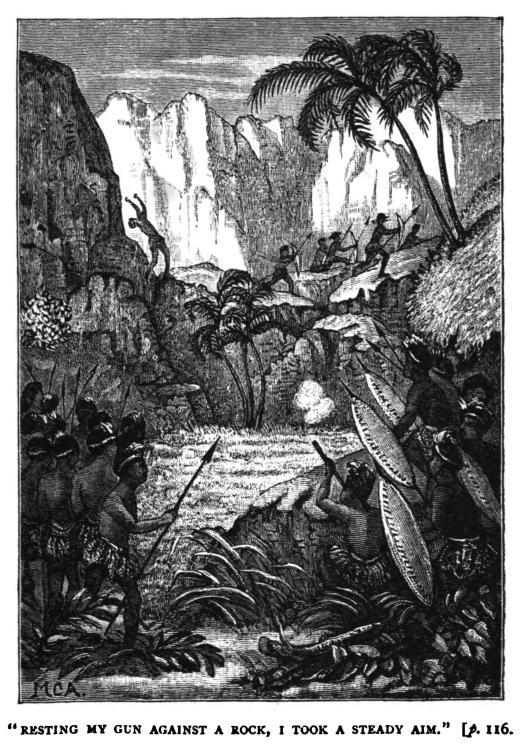
As we were sitting on the rocks looking in various directions, we heard a noise above us, and saw a large rock rolling and bounding down towards us. Instantly we jumped behind rocks and so protected ourselves, and the rolling rock bounded over our heads. On looking up we saw two Bushmen standing on some crags about 150 yards from us: it was these men who had loosened the rock, in order, if possible, to crush some of us. They shrieked at us, and shook their fists as if defying us; they thought themselves safe, as they were far more active on the rocks than Caffres, and could easily keep out of assagy-range; but they little knew how we were armed, for they had probably never heard the report even of a gun. Resting my gun against a rock, I took a steady aim at the Bushman and fired. The man instantly fell, rose again, and waved his arms, and then dropped dead. His companion instantly bounded off up the mountains as fast and as active as a klipspringer.
We ran up the rocks to where this Bushman lay, and the Caffres drove their assagies into him to make sure he was not shamming; he was, however, quite dead. On looking round we saw a well-worn path leading to what appeared a solid wall of rock. On approaching the rock we found a hollow which had been scooped out and formed into a cave, and this was evidently the Bushmen’s home. On entering this cave we were surprised at the multitude of things inside. There was a lion’s skin, and a necklace formed out of his teeth, two more formed out of his claws; three leopards’ skins; several skins of elands, which were arranged so as to form a bed. In one corner were about a hundred ostriche’s feathers, whilst nearly a dozen ostriche’s eggs filled with water were round the cave. There was also plenty of dried meat, evidently eland’s flesh, and a number of poisoned arrows. Here then we had come on a treasure, for the leopard-skins and the necklaces, were much valued among our tribes. All the animals whose skins had been found in this cave, must have been killed by the Bushmen with their poisoned arrows, showing how daring and skilful these men are with their tiny weapons, for to kill a lion they must have come to within at least forty paces of him. We secured all these articles, and then called a council of war to decide whether we should stop in this country in order to kill ostriches or return with what we had obtained. We at length decided to return; for we had seen no ostriches, and as they are the most keen-sighted and fastest of animals, we might wait many days before we even saw one. Eland, however, were plentiful, and we saw a large herd of them on the plains; so we divided our party into four divisions—three of these were to go round on the opposite side of the elands, whilst those of the fourth party, who had guns, were to lie concealed by some rocks, and the herd was to be driven up to us. Our plan succeeded well, and the herd came to within about an assagy’s-throw of us before they knew of our presence; so that we fired each two shots before they got out of range, killing three elands. This supplied us with plenty of meat; so we had a great feast, and dried enough flesh to last us on our journey back.
On our return to our kraals we were received like heroes who had won a great battle. Our feathers were the envy of the whole tribe, so I gave several to the various chiefs, and it was agreed that a chief might wear as many as he liked, the head man of a kraal might wear only one, and no lower man might wear any. We thus made a division in the rank of men, which is of great importance even with men as uncivilised as were these Caffres.
Among the men at our kraal there was one called Ebomvu, because his skin was redder than most Caffres. He was the Rain-maker of the tribe, and was much feared, because he was considered a wizard. Now the power which these wizards had was very great. They were believed by most of the men in the tribe to be able to foretell events, to produce rain in time of drought, to tell who had bewitched cattle, or men, and made them ill, and they used this power very often to get rid of any person who was not agreeable to them. The Rain-maker was a dangerous man, and I had soon learnt that, unless I was friendly with him, he might proclaim that I had bewitched somebody, and then probably all the power of my friends could not save me from being killed.
I saw one case where an old man who had made an enemy of the Rain-maker, was killed by the people, and as the proceedings then adopted were similar to those usually practised, I will give a description of what occurred.
A cow belonging to the head man of a neighbouring kraal died during the night. There was no doubt in my mind, on looking at the animal, that it had died from the bite of a snake, probably the m’namba umculu, or great puff-adder. Ebomvu, however, told the owner that the cow had been bewitched by some enemy who wanted to serve him an ill turn, and that this enemy he would smell out. In two days after the cow’s death Ebomvu commenced his proceedings. He assembled all the principal men of the kraal, and also those of the kraals near; and then, entering the cattle enclosure, went to the spot where the cow had died, and told the men to dig. Several men set to work digging up the ground, and discovered the end of a cow’s horn, on which was scratched a mark like a cow’s head. Ebomvu seized this and smelt it, shouting, “Nuka, Nuka” (“It stinks.”) He then moved slowly out of the kraal, holding the horn in front of him, and going first in one direction, then in another, until he reached the huts where the old man lived to whom he was an enemy. Here he went on the ground and crawled on like a dog, smelling the ground like a hound. He entered the hut of the old man, and pointing to a corner told the men to dig there. They turned up the ground, and found a horn just the same size and shape, as that which they had discovered in the cattle enclosure, and on this horn were the same marks as those on the horn first found. This was considered positive evidence that the cow had died from being bewitched. So a council of all the chiefs was called, and the case was tried. The evidence of the finding of the two pieces of horn was given, and on being examined the same marks were seen on each. So the old man was ordered to pay a fine of five cows to the man whose cow had died, and five cows to the chief himself. Had it been a man who had died instead of a cow, the old man himself would have been killed, and all his cattle taken by the chief.
I was much afraid lest the wizard should accuse me of “tagata,” as they called witchcraft, so I always made friends with him, and gave him presents, and used to sit and talk with him whenever I could. I gave him several fine ostrich-feathers, with which he was much pleased, and he told me I should some day be the great chief of this district.
Chapter Nine.
Shortly after my trip in search of the ostrich-feathers, an event occurred which obliged our people to call a meeting of the whole tribe. There came to our country some Caffres belonging to the tribes which lived west of us, and on the banks of the Kei river. These tribes were the Amakosa, the Amaponda, and others. Beyond them were the white men, consisting of the English, called the Umlungos, and the Amabores, as the Dutch farmers were called by the Caffres.
Between these white people and the Amakosa, there had been a sort of war going on for some months. The Caffres had been unable to resist the temptation of seeing fine fat cattle grazing near them, and but carelessly watched. The young Caffres especially were excited by such sights, because many of these wished to purchase a wife, and as the price demanded for a wife was ten cows, they were unable to buy the girl they were fond of. If, however, they could manage to drive off ten cows from the white men they might purchase a wife at once. Now in India, I remembered, it was just the reverse: there a father had to give a large sum of money to get his daughter married, so that a man who had several daughters was simply ruined in consequence of the money he had to give for his daughters to get husbands. Consequently, in India it became a general practice to kill female children as soon as they were born, as a matter of economy; whereas here, in South Africa, female children were a source of wealth to their fathers.
When the white men found their cattle had been stolen, they formed a party and started on the spoor, and if they caught the Caffres who had stolen them they shot them as if they were hyaenas. Fights consequently took place between the Amakosa and the white men, and several had been killed on both sides. These events led to war being declared against the Amakosa by the English, and this war had just commenced when the visitors came to our country.
All the principal men of our tribe having been assembled, we formed a large circle about four deep on some open ground near my hut. We sat down close together and remained silent whilst the two Amakosa stood in the middle of the ring to address us, which they did in the following manner:—
“Chiefs of the Umzimvubu!—We come as speakers from the Amakosa, to ask you to help us against the white man. We have lived for many generations on the banks of the Kei and in the Amatola Mountains. We once owned the land down to the Great Fish River; the Fingoes were our slaves, the Hottentots were afraid of us. The white man has now come, and on small pretences has taken our land, and made us give them hundreds of cattle. Our young men have been shot down like dogs; but at last we have quivered the assagy in our defence, and in our bush and in our mountains we are strong. We want your aid in two ways: first, to let your young men join us; and, secondly, that you will let us drive our cattle into your country, so that the white man cannot capture them. For this we will pay you cattle, giving you one in every ten. Your men are brave, and can fight as we heard they did against the Amazulu. If we are eaten up, the white man will soon come to your country; so we are a strong fence against them, and you should help to strengthen that fence. I have spoken as our chiefs have told me.”
The two Amakosa then moved from the centre of the circle and sat down among our chiefs. There was a silence of several minutes, during which each of the intending speakers was reflecting on what had been said. That we should receive one in ten of the cattle that we took care of was a tempting offer to many, whilst several of the young men were pleased at the idea of encountering the white man, and showing their bravery. I crept round the circle to where Ebomvu the Rain-maker was sitting, and whispered to him, “What do you think of this?” He replied, “I have not yet obtained the right thought!” I said, “The white men have all guns; they are in thousands; and if we join the Amakosa, they may come and attack us, and then, would the Amakosa help us?” Ebomvu nodded, and took a large pinch of snuff; and then, seeing that no chief came forward, he walked into the centre of the ring, and stretching out his arm addressed the chiefs.
Since that time I have heard among civilised nations many so-called orators, but I can fairly state that I never heard greater eloquence than I did from Ebomvu.
He said: “Men of the Umzimvubu!—Our visitors from the Amakosa have asked us to help them against the white man, who is encroaching on them. They also ask us to take care of their cattle, so that the white man, if he enters the Kloofs of the Amatola, may not carry off their cattle. They tell us that it is to our advantage to join them against the white man; for otherwise the white man will soon push against us. And if we take care of their cattle they will give us one out of ten. Now when anything is done between two tribes it is done because of friendship and brotherhood, or because of trading one with the other. Although we are friendly with the Amakosa, yet they have not treated us like brothers. They have been hard with us in trade: the knives, spearheads, and other things they obtained from the white man, they would not part with to us except for high prices. So we must look at this matter as trade, and I cannot see that we gain much advantage by sending our young men to be shot down by the whites. We should be fighting for the Amakosa; and we are asked to do this because, perhaps, by-and-by, the white man may want to fight with us. So we are asked to do now what would be very bad for us if we had to do it by-and-by. Then we are to protect the Amakosa cattle, and to receive as reward just one in ten. This is not enough: the Amakosa are hard at a bargain, and I think we are required to give much and receive but little.”
Ebomvu then sat down again among the principal men, a murmur of “Di’a vuma nawe” (“I agree with you”) being uttered by the older chiefs, whilst loud cries of “Hi, Hi, musa” were uttered by the younger men.
After a little delay a young chief, who had fought well against the Amazulu, stepped into the centre of the circle, and raising his shield and assagies, said, “Listen to me, men of the Umzimvubu. I am for war. I think we ought not to sit down like boys or women, and let our friends, the Amakosa, fight alone. We are strong and we know how to fight. If we join the Amakosa we shall share in the spoil; we must have our share of the cattle, of the guns captured, and we may also procure some of those animals on which men ride. Shall our tribe be termed a tribe of cowards? I say, let us join the Amakosa, and dip our assagies in the blood of the white man.”
A tremendous shout was given at the termination of this address; and it was evident that, as far as numbers went, there were more in favour of war than there were against it. This was an example of what took place among civilised nations. If the majority of an assembly are emotional rather than intellectual, a man who appeals to the emotions gains more adherents than the speaker who talks sound sense. Consequently, when another young chief spoke in favour of war, it was decided that we should join the Amakosa and fight the white man.
What I was to do I did not know. I felt that, although I had become a regular Caffre in habits and thoughts, yet I was an Englishman; and if I fired and killed a white man, I should be guilty of murder. I thought a great deal about this matter; for though I had nothing to complain of in my present life, yet I longed to see my father again, and to let him know I was not dead. I knew that, lost as was the ship in which I had left Calcutta, there would be no records of her ever found. I alone could tell the tale, for the ladies who had been saved had become the wives of Caffres, and they told me that now they must live and die as they were, and could never again return to civilisation.
I had great doubts whether the life I now led was not the one which most men in cities toiled for all their lives. Boy as I was, yet I had rank, I was a chief; I had cattle, the great wealth in this land; I had a gun and ammunition; I had always plenty to eat; I wanted no clothes, I could wrap myself in an ingubu (blanket or kaross) made of jackals’ skins, which kept me warm in the cold nights; I had no work to do that I didn’t like. There was plenty of game to shoot or trap; and, except during a short rainy season, the climate was as fine as any in the world. What more pleasant life than this could I lead anywhere? In England I should be at a school, having to learn a lot of things in which I took no interest; perhaps, if I did not work properly, I might be caned, I, who was now a chief, and if any man struck me should probably use my assagy against him. There were two sides to the question of returning to civilisation. I had read also that my uncle passed seven or eight hours a day in a dark office in London, in a place crowded round by other houses, so that you could scarcely see the sun, and where there were so many men that you scarcely ever breathed anything but second-hand air. Still, there was the longing always coming over me to see my father, and to tell him that I was happy, and if he did not mind I should prefer remaining where I was. But the war-spirit had broken out, and every one, even to the smallest intombi (girl) was dancing about, singing war-songs. As was the custom with these tribes, a great war-dance was arranged; all the fighting men, in full war-dress, assembled from miles round. We mustered more than five thousand fighting men, besides about three thousand boys able to throw an assagy, and assist at critical moments, when the enemy were broken or too powerful at any particular point.
I shall always remember the war-dance which now took place; it was a sight only to be seen in the wilderness, and where civilisation has made no progress. The men assembled formed a ring three and four deep, and sat quietly on the ground for more than an hour, each with his shield in front of him. At a given signal we all started to our feet, with a shout; then, imitating the movements of an old chief who entered the centre of the ring, we beat the ground, first with one foot, then with the other; then, jumping in the air, came to the ground with both feet at once, making the earth shake as we did so. After we had continued these proceedings for some time, a young bull was brought into the ring and turned loose, three young chiefs entering at the same time. They shouted and beat their shields, so as to alarm the bull, and then closed on him, hurling their assagies at him. The animal soon became savage and charged at the young chiefs, and a regular bullfight occurred; but so active were the Caffres, and so well did they back one another up, that in a few minutes the bull was so terribly wounded by assagies that it sank to the ground and died.
Four bulls were killed in the same manner and by different sets of young chiefs, the circle of warriors all the time singing their war-songs and dancing and beating their shields. During two days these festivities were kept up, and then the leading chiefs met in council to decide upon the plan of operations. I soon began to observe that several of the chiefs regarded me in a manner different from that in which they had formerly done. They were not unfriendly, but they were silent; and I feared that some enemy had been at work who was jealous of my rise and progress. I was rich for so young a chief, as I now possessed fourteen cows and several calves; but I did not think I was rich enough to be accused of witchcraft, and my cows taken from me. I had but to wait a few days before I learned why this change in manners had taken place. One evening an old chief sent for me to his kraal for a kaluma (talk), and on my entering his hut I found two other chiefs there. They offered me snuff, and Itchuala, and then the old chief said:—
“Umkunkinglovu! we know you are brave and can fight well, and we should have liked you to lead a division of our men; but we have thought that, as you, although a Caffre at heart, are still white, you might not like to fight against white men. We don’t know about white men; we don’t know who are friends, and who enemies. We, the Umzimvubu, fight against the Amazulu, though we are both black. Do you white men ever fight one against the other?”
“Yes,” I replied, “when nations like your great tribes disagree they fight.”
“Then are the people at war with the Amakosa of your tribe?”
“Yes, they are.”
“Then you would not like to fight against them?”
“No; I should be a rascal to do so.”
“We thought it might be so,” said the old chief, “so we are going to leave you in charge of the tribe, to take care of the cows and the young people, until we return.”
“I should like to speak about this war,” I said; “may I?”
A nod was the only answer.
“This war,” I said, “will probably bring great trouble to the tribe. You have been misled by the Amakosa; for the white men against whom you are fighting are powerful, and if they require them can bring ten men to your one. You with assagies only cannot defeat them, for they are all armed with guns, and are good shots. They can wear you out; for they can destroy your crops of corn, and capture your cattle, or worry them so that they cannot feed. You have little to gain, and all to lose. Why do you go on this expedition?”
The three chiefs sat silent for a few minutes, and then the elder said, “We believe the Amakosa. Their chiefs say the white men are not numerous, and are very slow—that in spite of their guns, which are not much use in the bush, the assagy has gained the victory; unless we fight the white man, he will march on and will soon want our country, and we shall be wiped out. We are now bound by promise to fight, so it is no use now thinking any more about it. Besides, the Amakosa tell us that the white men employed to fight are not allowed to fight as they like or could, but are bound up with straps and tight clothes, and are made to wear red blankets round their bodies, so as to be easily seen and therefore easily shot. They have to carry a number of things also, which prevent them from running fast, and tires them when they walk. So an Amakosa warrior feels he is better able to fight than a white soldier, who cannot move through the bush, as the thorns hold him by his clothes; so that he cannot shoot, and is easily assagied.”
I endeavoured to convince these chiefs that it was no use fighting against the English; but they listened patiently, and then said that, when I left my friends the whites, I was too young to be able to judge correctly of numbers and strength, and that I should see them return with many guns and plenty of cattle.
Chapter Ten.
Nearly all our fighting men had left our country, whilst I remained with the very old men, the young boys and the women. I did not like remaining inactive in this, way, yet I could not have fought against my own people. I felt very dull and lonely; so took my gun and wandered in the bush, following the old elephant-paths, and looking out for a buck or a leopard. Left to myself, I was accustomed to sit in the bush for hours, meditating on my past life, and on my probable future. Lately, a strange longing had come over me to return to civilisation. The novelty of my wild life had worn off, and the Caffres were not the companions to me that they had been when I was younger. Their aims and ambitions were limited. To eat abundance of meat, to possess abundance of cattle, to have four or five wives, was the looked-for happiness of the men. Anything that required mental exertion they seemed incapable of. They could with difficulty count beyond ten; they knew nothing about other countries, or the habits of other nations. They believed the Zulus the most powerful nation in the whole world, whilst the whites they regarded as foolish people with wrong ideas.
Reflecting on my condition, I began to consider how I could make my escape from the Caffres, and rejoin my own people. I knew that if I could reach England I could make myself known to my relatives, could communicate with my father, and should have fair prospects even if I returned to India. This was quite a change in my ideas, from what I fancied some months previously; but solitude seemed to have given me a clearer view of things as they really were, and I now thought over every plan by which it might be possible to reach some English settlement, make myself known, and thus be enabled to rejoin my relatives.
Several days passed, during which I scarcely spoke to any of the Caffres. I felt depressed and out of spirits—perhaps a presentiment of what was coming. I had received no news of the army that had gone to join with the Amakosa against the British soldiers, and so could not learn whether or not they had been victorious. Half a moon had passed since the army left, and the old men began to be anxious for news; still none came.
It was early morning, the sun not having appeared, that, as I lay rolled in my jackal-skin kaross in my hut, I heard the voices of men in my kraal. These voices were low, and subdued. Thinking it was our warriors who had returned, I jumped up and crawled out of my hut. It was not yet light enough to see clearly any objects except they were very near; but before I could rise on my feet, I received a blow on my head, which stunned me, and knew no more till I came to my senses, when the sun was nearly overhead. I then saw a sight which astonished me. Seated in our kraal were more than a hundred Zulu warriors, watching a fire at which one of our young bulls was being roasted. They were all in full war-costume, and I saw that many of their assagies were stained with blood. I tried to rise, but found that my hands and legs were tied, and that I could not move. The Zulus, seeing I was sensible again, called to a chief who was sitting at a distance, and pointed to me attentively, and then said—
“Who are you?”
“I am an Umlungo who has been kept among these people,” I replied, “and they have made me a chief.”
“Where do you come from?”
“I came in a ship which was wrecked on the coast; all the men were killed except me.”
“When do you expect your men to return?”
“I don’t know; they have gone to fight with the Amakosa against my people.”
“Why did they not take you?”
“I could not fight against my own tribe.” The chief waited for a short time, looking at me attentively, and then said, “You will return with us; attempt to escape, and twenty assagies will be in your body.” He then turned away, and walked to his seat outside the circle.
I was struck with the dignity and manner of this chief. He seemed one born to command, to be self-possessed, calm, and decided. He walked like a chief, and I could easily understand how it was that the Zulus were so powerful if they possessed many men like this one. I felt being tied, as it was very painful. So I spoke to one of the men near me, and said that, if the chief would unfasten my arms and legs, I would promise not to attempt to escape; but if I remained tied, I should not be able to move when they did unbind me. The Zulu carried my message to the chief, who nodded, and the young Zulu came and unbound me. I rose to my feet, but felt very sick and giddy from the blow I had received from the knob-kerrie on my head, and was obliged to sit down again. The chief then called me, and I went over to where he sat, and he asked me if I was hurt. I pointed to a lump on my head where I had been hit. He felt my head, and said, “That is nothing.” He then inquired how many guns had been taken by the warriors who had gone with the Amakosa.
I told him eight; and, thinking it better to deal fairly with him, I told him that in the thatch of my hut there was my gun.
He immediately sent a man into my hut to search, and shortly my gun was brought out. The chief examined this carefully—a gun was evidently new to him—and I explained how it was loaded and fired. He was much interested in all I said. So, being anxious to gain his favour, I told him there was something else more wonderful still that I could show him. He told me to bring whatever it was. So I brought him my field-glasses, and, adjusting them for a long sight, I placed them in his hands, and told him to look at some cows about half a mile off. He raised them to his eyes, and instantly started back with astonishment. He examined them carefully, and seemed more surprised as he looked again through them. I then made him look through the glasses the opposite way, viz., through the large glasses, and to look down at his feet. His legs then appeared about twenty feet long, and he was more astonished with this than even with the fact that distant objects were brought nearer by the aid of the glass. He called several of his men to look through the glass, and laughed at their surprise.