Major General A.W. Drayson (continued 4)
Reading edition
The attention of all the Zulus was taken up with the kraal from which I had escaped; for they expected me to rush out as soon as I found that the smoke and fire would destroy me. That I should escape from the back part of the hut had not been thought of.
The distance from the kraal to the Berea bush was about a mile, and this distance I passed over at a rapid walk, and succeeded in entering the bush without being recognised by any of the enemy. The Berea bush was at this time visited annually by one or two herds of elephants which came down from near the Zulu country. They stayed in the bush during several months, and made paths through the thick jungle, along which a man could walk easily. The bush was nearly impenetrable except along these elephant tracks; so I thought I might easily conceal myself in this bush for two or three days, unless my footprints were seen, when I should certainly be tracked and probably caught or assagied. Having entered the bush without having been recognised, I made my way along an elephant-path, where the tracks of the elephants were quite fresh. I knew that in this bush there must be a herd of these animals, and if they would only walk along the same path that I had travelled they would rub out the print of my footprints, and I should be safe. I walked on into the densest part of the bush; and then, finding a large tree, I climbed into it; so that, if the elephants scented me and became savage and hunted me, I should be safe in this tree.
I knew I might have to remain in the bush during two or three days, and that I might remain all that time without food; but I had been accustomed to this trial, and people who in civilised countries take their three meals a day are not aware how long a man in health can last without food, especially if he is in the open air and can obtain water.
From the tree into which I had climbed I could see the sea beyond the bay, so that if a ship came off the harbour I could see it, but how to reach it would be the difficulty.
I had been but a short time in the tree when I heard a noise as of branches being shaken. At first I imagined that the elephants were moving through the bush, and consequently shaking the trees; but I soon saw in the topmost branches a number of small grey monkeys, which were leaping from branch to branch, and peeping at me whenever they could obtain a glance. They seemed to consider me an invader of their property, and to be angry in consequence, as they came within a few yards of me and screamed loudly. Now I did not fear the monkeys, as they were small, and having an assagy, I could easily have defended myself; but I knew that if any Zulus were in the bush they would at once suspect that the monkeys were making this noise because some strange creature was in the bush, and they would come to see what it was; and so, though they might not be able to trace me by my footprints, yet they would be attracted to my concealment in consequence of the noise made by the monkeys. Breaking off some branches, I threw these at the creatures when they came near me; but they did not seem frightened, and screamed and jumped about more than before. Suddenly, however, their attention seemed to be attracted by something else, as they left the trees around me and became greatly excited as they watched something on the ground. I feared that perhaps the Zulus had followed my footprints, and had traced me to where I then was; but I soon heard a noise which I recognised as that made by an elephant, and it was this creature to which the monkeys were giving so much attention. The elephant I soon saw as he moved slowly through the bush; he was a large bull-elephant, and was alone, no others being near him. When this is the case an elephant becomes very savage, as he has usually been driven out of the herd by a combination of younger bull-elephants. He then wanders about in the bush, and is ready to attack anything that he comes across. I was rather pleased to know that such an elephant was in this bush; for I knew the Zulus had a great dread of a solitary bull-elephant even in the open country, whilst in the bush he was still more to be feared. It would therefore be probable that, if (as they soon would) they knew of the presence of the elephant, they would not like to traverse the bush in search of me. As long as I was up a tree as high and as strong as that in which I now was I was safe from an elephant.
During two days I remained in the bush, passing the night in a tree, and by day gathering fruit and drinking water. People in civilisation eat and drink either at stated hours or when hungry and thirsty. I had long been accustomed to do both when I could. If not thirsty, and I came on a stream of good water, I drank, because by so doing I prevented myself from becoming thirsty; so that probably I might have managed to pass a month in this bush, without suffering from want of food or water. I had, however, found a tall tree from which I could see a great part of the flat and marsh of Natal, as also the bay and sea beyond; and on the afternoon of the second day I saw two sights which rejoiced me. The first was a large party of Zulus moving from near the bay towards the Umganie river: these men were driving some cattle before them, and were apparently leaving the country. The other sight was a ship which was sailing up the coast, and was evidently making for the anchorage opposite the harbour. Having taken up a safe position in this tree, I passed the night quietly, and when the first light of day enabled me to see distant objects, I perceived that the ship which I had seen sailing was now at anchor, with no sails set. Immediately I saw this I descended from the tree, and worked my way out of the bush; and, exposing myself as little as possible in the open country, made my way across the marsh and through the bush to the beach. I there procured a large branch of a tree, and waved it so as to attract the attention of any one looking out from the ship.
I incurred some risk in doing this; for if any outlying party of the Zulus were near they would have seen me and I could not easily have escaped. But I was obliged to show myself on the beach, so as to attract attention, or I feared the ship might leave without sending a boat on shore. I watched with considerable anxiety for some sign of a boat from the ship, but it must have been several hours before I saw a sail set on the vessel, and she began to move. I now noticed that the tide was high, and that there was but little surf on the bar, so that it was possible the vessel, which was small, might intend coming into the bay. My doubts were soon set at rest, for she headed towards the bluff, and came slowly on, and after being washed by one or two breakers as she was on the bar, she came into smooth water, and glided into the harbour and cast anchor.
I did not wait for a boat, but jumped into the water and swam to the ship, from which a rope was thrown me and I climbed on board. The sailors and captain looked at me with much surprise, and I now found an unexpected difficulty, viz., to speak English readily. I, however managed to improve as I went on, and told the captain what had happened at Natal; and how the white men had been massacred by the Zulus, except those who had escaped in the ship. The captain had heard nothing of what had happened here, as he had come from the Mauritius, and the ship that had sailed out of the harbour had gone down the coast to Cape Town, and the communication then between various places was not as rapid as it is now. This ship required fresh meat, and the difficulty was how to procure it. All the cattle had been swept off by the Zulus, except that which had been concealed by my friends across the Umlass river; and there would be difficulty in communicating with these men, as it was not certain some strong force of the Zulus might not be in the bush concealed.
The captain of the ship was very kind to me, and fitted me with a suit of sailor’s clothes, and assured me he would take me down to Cape Town, from whence I could obtain a passage to England. He told me that nothing had ever been heard of the Madagascar, the ship in which I had sailed from India, and which had been wrecked; but it was supposed she must have gone down in the gale which had visited the Isle of France about that time. When I told him there were white women prisoners among the Caffres, or at least their wives, he said that he would go into the country with his men, and bring these women away. I told him that such an attempt would cost him his life and would be useless, because the white women were now contented with their lot, and probably would not leave; and the Caffres were not likely to allow their wives to be carried off by half a dozen men whom they could assagy without difficulty. The captain, however, like many ignorant Englishmen, underrated the power of the Caffres, and asserted that a dozen armed Englishmen, especially sailors, would be more than a match for a thousand niggers. I told him he did not know how skilful and cunning these natives were, and that if the country were bushy, an equal number of Caffres, though armed with assagies only, would be more than a match for him and his sailors. The captain merely laughed at me, and said he would like to try them.
Chapter Fifteen.
I remained on board ship this day, talking with the captain and sailors; the former was anxious to get his water casks filled, and also to procure some fresh meat and vegetables. I was able to tell him where to get fresh water: to get this it was necessary to pull up to the head of the bay to where the Umbilo river ran into the harbour. The water of this river was very good, and at low tide was not affected by the salt water that entered the bay. I told the captain he must be very cautious; because, as the boat would be seen as it proceeded to the river, an ambuscade could be arranged by an enemy without any difficulty. The captain said he would take his pistols, and the men would be armed with guns and handspikes; so he did not fear a few naked niggers. I suggested to him that we should row up the bay whilst it was dark, and get to the river before daylight, fill the casks and then return; by so doing, no spies could be aware of the boat having left the ship, and when it returned it would be too late to ambuscade us. The captain, however, said that this was making too much fuss about the matter; and, supposing after all no Zulus were near, we should have taken all this trouble for no reason.
“If,” I replied, “Zulus are here, and we don’t take this trouble, we shall all be assagied or made prisoners.”
It was no use, however, talking to the captain. He was one of those dull men who never can see a danger before it really occurs; and probably would have gone and sat down in a mealie garden to eat his lunch in an enemy’s country, and so have been surprised and assagied; whereas, had he selected a wide open space, he could have seen an enemy approach, and could either have retreated, or prepared for defence. Englishmen, however, are never fit for bush warfare with savages, until by long experience they have been taught what to do, by the savages themselves.
It was some time after sunrise when the captain and four men started in his largest boat with his barrels to procure fresh water. I went with him to show him where the Umbilo river was situated, and took with me a double-barrelled pistol and ten rounds of ammunition. I cautioned them all to converse in very low tones, because voices are heard from the water at very long distances, and it was not advisable to give an enemy’s ears the chance of discovering us in case he was so situated as not to be able to see us. I felt certain that if any Zulus were near the bay, they would keep watching the ship, and would have seen the boat leave, and would make their plans accordingly. It took us a long time pulling to the river, and I had scanned every part of the country to try and discover some sign of an enemy: not that I had much hope of seeing one, even if he was there. We reached the mouth of the river, and tasted the water, which was quite fresh. I suggested that we should examine the bush a little way, to see if there was any sign of the Zulus; for if they attacked us when we were busy with the casks, we should be taken at a disadvantage.
“There are none of your niggers here,” said the captain, “never fear; let’s get our water without more delay.” So the barrels were filled, and placed in the boat, and we were preparing to re-embark, when a rustling in the bush near us attracted my attention. On looking round I saw three or four Zulus crouching behind some bushes and watching us. Pointing my pistol at them, I said to the captain, “Zulus are here, get into the boat at once.” I would not fire for two reasons: first, if I discharged my pistol, I could not reload again before they could close with me; secondly, I knew that a Zulu would retreat to some cover when he saw a pistol pointed at him; and there would thus be time for us to get into the boat.
I hoped that when the captain knew that all my caution had not been without cause, he would get into the boat as rapidly as possible, and we might then easily have pulled beyond the range of an assagy, for no man can throw an assagy well when he is among the bushes. The captain, however, instead of following my advice, shouted “Hurrah, we’ll wallop ’em!” and before I could stop him, he had called to his men and had rushed into the bush where the Zulus had been watching us. It was useless to follow him. I called out to warn him that he was going to destruction, but he made no reply; and I at once ran to the boat and pushed off in it, so as to keep a short distance from the shore, and there waited to see what should occur. I soon heard the report of pistols and some loud shouting from the sailors, but not a sound came from the Zulus, who when in the bush like to keep their position secret. Soon, however, the shouts ceased, and I heard a groan, then another, and soon all was quiet. I knew too well what had occurred: the captain and his men might possibly have shot two or three Zulus; but then, when their pistols were unloaded, the Zulus had closed with them and had assagied them. I pushed the boat a little farther from the shore, and waited on the chance of some one of the party having escaped, and of this one reaching the shore; but in a very short time I saw four Zulus come to the mouth of the river and beckon to me. They made signs for me to come on shore, and pointed into the bush behind. I at once knew that, in my sailor clothes, they did not recognise me; so I called out in English, “What do you want?”
“He cannot speak Zulu,” said one of the men. “We must get the boat, and then we may get on board the ship in the night.”
I then heard them arrange a plan: which was that six of their men were to run down in the bush to where the channel was very narrow, through which channel I must pass. They could then, by swimming, get before the boat and hold on to it; and either get into it, or drag it on shore. A sailor, such as they supposed I was, they did not seem to think able to do them much damage. The Zulus sat down on the shore and took snuff from their small snuff-gourds, and no one unacquainted with the cool proceedings of these men, would have imagined that they had just been engaged in a deadly combat.
I spoke to them a few words in English; and then, taking out the oars, began pulling the boat down the bay. Luckily the tide had not yet turned, so the stream was with me. The boat was heavy, and I was not accustomed to using the oars. So I had great difficulty in moving the boat. I managed, however, to make it travel through the water. I could not help being amused at seeing how calmly the Zulus watched me. They made no attempts to stop me, because they knew that they could then do nothing effectually, and that if they did attempt to do anything it would merely excite my suspicions. I knew it would be of great advantage for me to conceal my identity; for, if they knew that they had to deal with one who had been trained in their own school of warfare, they would take extra precautions, to prevent being taken at a disadvantage. The narrow channel through which I had to make my way was about half a mile from the river, and as I approached this I kept a careful watch on the shore. In the boat were two pikes—very good weapons for close quarters, but no use against an assagy; for the latter can be thrown and will pass through a man at forty yards’ distance. As I approached the channel, I saw the bushes near the shore moving more than they would do if the wind alone had acted on them; so I knew where to expect the enemy. I then saw four Zulus slip quietly into the water; and, keeping all but their heads under water, make their way to the centre of the passage where the boat must pass. I went on with my rowing until I was within an assagy’s-throw of these men. I then pulled three or four strokes rapidly, so as to give the boat considerable speed; and, dropping the oars in the boat, crouched down and seized one of the pikes. All was quiet with the Zulus: not a ripple in the water showed their presence, whilst not a man was seen on the shore. Suddenly, standing up, I found two of the Zulus within a yard of the boat. With my pike I thrust at one of these, and drove the pike into his throat; the other had just placed a hand on the bows of the boat, and had partly raised himself out of the water. A second thrust, in this man’s chest, sent him back, and he sank—I fancy to rise no more, as the blood gushed out of his wound as I withdrew the pike.
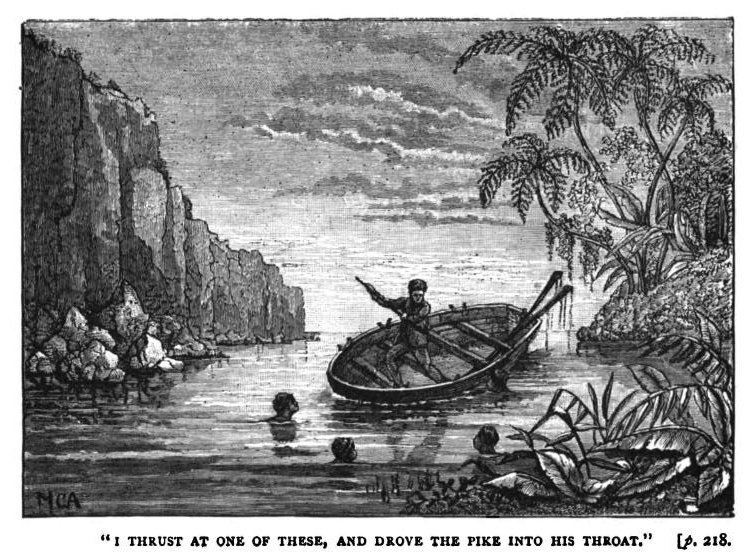
At the same instant two assagies flew close past my head, and I saw two Zulus up to their middle in the water and preparing to cast other assagies at me. Dropping into the bottom of the boat, so that only my eyes were above the bulwarks, I seized my pistol and aimed at the nearest Zulu. As I pulled the trigger he was about to cast his assagy; but it never left his hand, as I hit him in the chest and he sank in the water, rose again and floated down the stream. The other Zulus made for the bush and concealed themselves from view.
I again loaded my discharged barrel, and, taking the oars, pulled as fast as I could towards the vessel. The report of the pistols had been heard by the sailors on board, and they were on deck looking out. They hailed me as soon as I came near: and when I told them that I believed the captain and the other men had been killed, they were astonished, for they also seemed to think that the captain, with his pistols, was more than a match for any number of “niggers.”
I told them that the Zulus were not men to be despised, that they were brave in every sense of the word, and that they were clever in all the arts of bush warfare, and would most probably try to capture the ship; so that we must be prepared for them, and must keep a careful watch all night. Had the wind been suitable, the sailors would have left the harbour at once, but there was a heavy surf on the bar, and the wind was blowing in the harbour, so we could not get out.
After I had been some hours on board, I found the sailors talking together in low tones and looking at me very suspiciously. I had no idea what this meant, but after a time two of them came to me and told me they suspected me of being in agreement with the Zulus, and having led the captain into an ambush. I told them it was not my plan for the captain to go on shore for water; and if I had been friends with the Zulus, how was it I had shot them, and killed one of them with a pike? The sailors replied that they had no proof I had done so, and they would rather not have me on board. I told them that, if I had not come on board, they would have gone on shore fearlessly, and would all have been killed by the Caffres, and their ship taken. This argument produced no effect on the sailors; who, like all ignorant people, considered that no amount of reason or facts were as powerful as their own prejudices. They had somehow conceived the idea that I was in league with the Zulus, and could not perceive how differently I should have acted had I been so. They had, however, made up their minds to get rid of me, and to turn me out of the ship; and though I begged hard to be allowed to stay and go with the ship to Cape Town, they would not hear of it. They seemed to consider they were very generous not to string me up to the yard-arm, for having been concerned in what they called “the murder” of their captain and shipmates. They would not allow me to keep the pistol, but gave me a knife; and then, making me get into the boat, they pulled ashore, and there left me.
When I found myself once more on the land, alone and unarmed, I began to think that the Caffres were better than the white men. It was in consequence of the ignorant obstinacy of the white men that they had fallen into ambuscades and been slaughtered. This style of proceeding seems common among white men, as was shown during the Zulu war; where, in spite of all that has been written about the Zulus and Boers, the English commanders acted just as foolishly and recklessly as did the captain of the little ship, and the disasters which occurred might have been avoided by any one acquainted with the Zulu style of warfare. It was true that I was unarmed and without food, in a country where behind every bush there might be an enemy; but I did not feel as helpless as would a man who had lived all his life among towns and civilisation. I could construct traps for animals, I knew what roots and berries were good to eat, there was plenty of water to drink, and I might find some weapons. Besides, it was possible that another ship might come to the bay, the captain and sailors belonging to which would not be as self-sufficient as were those I had just left. I might still remain concealed in the bush for a long time, and probably might make my way down to the Umzimvubu tribe, and live the remainder of my life as a chief. The white men I had seen were not of a class to impress me much with the advantages of civilisation. The Caffres, it was true, were cruel in some ways, and had quite different ideas from the whites; but there was something very pleasant in their wild life, the simple requirements of existence, and their love of reasoning from facts. White men had their sciences, about which I knew little; but none of these could follow the spoor of a horse for miles over a hard-soiled country, nor could they distinguish the footprint of a hyaena from that of a leopard; and if any of them happened to be left alone in the bush as I was, surrounded by enemies, and without weapons or food, they would certainly starve or be captured.
The dress that had been given me by the captain was a blue flannel jersey, blue trousers, and a jacket. To be seen in this dress at any distance by a Zulu would have been fatal, for he would have recognised a white man’s attire. I therefore cut up the jacket to make “tails,” which I hung round my waist. I kept on the jersey because it made me look dark-coloured, but I dispensed with the trousers. People who have worn clothes all their lives do not know how imprisoned a man feels in clothing, when he has been accustomed to live without any. When I had on a jersey and a jacket I felt as though I could not cast an assagy; and as to running with trousers on, it was simply impossible. When I had divested myself of my unnecessary raiment, I felt much more as if I could take care of myself than I did when I was in sailor’s clothes. The weather was warm, but the nights were chilly. I had become so accustomed to be without clothes that I suppose I was like an Englishman’s face, which he never covers with clothes even in the coldest weather.
I did not long remain on the beach, but made my way into the bush to a thick part where there were some large trees; I then sat down to think what should be done. I knew there would be great danger in attempting to make my way down to the Umzimvubu; and, once there, I could not expect to get away in a ship, as no ships ever came near the coast at that part. I believed it possible that when the news reached Cape Town that white men had been murdered at Natal, some soldiers might be sent up in large ships, either to revenge the death of the murdered men, or to obtain particulars of the massacre, so if I remained near the bay I should stand the best chance of getting out of the country. I suppose it was on account of my white blood, if I may use the term, that made me wish to go again to civilisation, as also the desire to see my father. For there was much to attract me among my old companions. If I returned to my old residence, I should at once take my place again as a chief and have everything I wanted. My companions of years would be again with me; and I should rest, as it were, on the laurels I had won in my various adventures. I had already discovered that white men did not seem to value or even understand the qualities I possessed, whilst my being unable to read or write well was looked upon as indicating ignorance. When I lived among youths of my own age in England, I believed I should be laughed at because I did not know as much of book learning as they were acquainted with. My books had been the forests, the plains, the rivers and mountains, and the skies above us. To read from the signs on the ground what animals had travelled over it, and when they had travelled, was an interesting book to me, and quite intelligible. To know the time at night by the position of certain stars was also a page that was intelligible; but how should I feel when asked to read from a printed book, and found myself laughed at as a dunce? I had already seen that white men were suspicious of me, and acted on these suspicions alone. Considering all these points, I felt quite undecided whether to again join the Umzimvubu Caffres, and live all my life as a Caffre; or wait on the chance of some ship coming into the harbour, and of being able to get a passage to Cape Town or England.
Although much pre-occupied with these thoughts, I did not neglect the necessities of the present. I must make myself secure from the possible attacks of two forest enemies, viz., snakes and leopards. I must sleep, and when asleep I might be seized by a leopard, or be coiled round by a rock-snake; for there were, I knew, rock-snakes in this bush at least thirty feet long, and to be seized by one of these monsters would be certain death. There was no time before dark to build a kraal, so I cut down branches and brushwood, and arranged this in a circle round the spot on which I intended to pass the night. I cut also two sticks, one having a large knob at the end; the other, which was very hard wood, I sharpened so that it was like a spear. This was the best I could do in the short time before it came dark. I then lay down and listened to hear what might occur near me.
I soon heard some rustling in the bush, which sometimes came near and then went away to a distance. This might be caused by a buck, but it might be a leopard. It was so dark that I could see nothing. The nights in Africa are darker than they are in England; and when I held my hand up I could not see it, though it was not half a yard from my eyes. It is difficult to imagine anything more exciting and trying to the nerves than to be thus alone in the bush during a dark night; when you know that dangerous animals are near you, and when noises indicate that these animals are aware of your presence, and are examining you to see whether you can be safely attacked. To sleep was impossible; I did not like even to lie down in a position of rest, but crouched on the ground with my sharpened stick ready for use in case I was attacked. Towards daylight, however, I could resist the desire to sleep no longer; and, as all seemed quiet round me, I lay down and was soon in a sound sleep.
When I awoke, the sun was many times its own size above the horizon, and was shining on the trunks of the trees around me. I ascended one of the trees, from which I could see the masts of the ships in the bay. The wind was blowing from the south-east, and as long as this wind continued the vessel would not get over the bar. I knew as long as this ship remained in the harbour the Zulus would not leave this part of the country; they knew the stupid character of the English sailors, and they also must be aware that they could not leave until they had procured fresh water. Having descended the tree, I procured some fruit and berries; and, making my way to the edge of the bush, I procured some fresh water, of which I drank a large quantity, for I did not think it safe to move about in the bush, and did not wish to have to come again to the water during the day. On my return from the vlei, I heard a rustling in the bush near me; and, becoming instantly still, I heard some animal creeping away. Being desirous of knowing what the animal was, I moved cautiously to where I had heard the noise; and at only a few yards from me came on the carcase of a red bush-buck which had been only lately killed. There was a mark on the buck’s neck which I knew indicated that a leopard had been its destroyer; but little of the buck was eaten, so I knew I had disturbed the leopard at its feast. With my knife I cut several strips of meat from the back and hind quarters of the antelope; and, wrapping these in some large leaves, I fastened them round with strips of bark, and was then provided with food for at least three days.
On again ascending the tree to look out, I saw a boat leaving the vessel with some sailors, and I could see casks in the boat; so I knew they were going to the shore to procure water. These sailors, instead of going up the bay, had seen a small stream of water running down the side of the bluff, and had determined to get their barrels filled from this stream. It was certainly a safer place than the Umbilo river would have been, and I saw the men fill several casks and return in safety to their ship. Soon after a change of wind took place; and, the sea going rapidly down, the surf on the bar decreased, the sailors set sails on the vessel, and she glided out of the harbour, and, crossing the bar, was soon lost to view behind the high land of the bluff.
I was now once more alone as regards white men, but I might be surrounded by enemies; so after looking all round the country as far as I could obtain a view, I descended from the tree and sat down to consider what to do. Suddenly I heard a human voice—it came from the shore outside the bush. Listening attentively, I heard the Zulu language spoken; and as the men spoke loudly, their words were distinctly audible.
“The ship has left now,” said one of the men, “there is nothing for us to wait for.”
“He must have gone in the ship,” said another.
“Yes, his people must have taken him with them. He was very cunning: dressed like a white man, he deceived us at first, and he must have heard us speak of the plan for capturing the boat at the narrows. I knew him when he rose in the boat after shooting Copen.”
“He has escaped us,” said another Zulu, “but we have killed four white men, and have their small guns to take to our chief.” “Hambani si hambi” (“let us be going”), said a loud voice, and I could hear the tread of the men as they moved along the beach.
I remained motionless while the sun travelled about ten times its own breadth, for I knew enough of the Zulus’ cunning to be aware that this conversation might be carried on in various places, as a trap to throw me off my guard, in case I was concealed near enough to hear what was spoken. I then crept through the bush as stealthily as a snake, and examined the beach, and saw a long distance off a party of about forty Zulus moving along the shore towards the Umganie river, which was the direction of the Zulu country. I remained concealed until it became nearly dark, and then made my way down to the entrance of the bay, where the channel was very narrow. The tide was low, and no current was running in either direction; so I swam across the channel without difficulty, and made my way up the bluff to my old kraal, which I found had not been burnt or destroyed. There were several excavations made by the sea on the shore side of the bluff—sort of caves, in fact—and to one of these I made my way; and, having lighted a fire in this cave, cooked the whole of the antelope’s flesh and made a good meal, whilst I reserved a large quantity for future use. The light from my fire could only be seen from the sea, and there was no chance of any Zulu getting a glimpse either of the fire or its smoke. I found several small fish in the various pools which had been left by the high tide, and these I intended to cook and eat on the morrow, because fish will not last fresh as long as will flesh, especially when the weather is very hot. Having had a good meal I felt fit for anything.
There are probably some people who would feel unhappy if they were alone in a wild country, without clothes, weapons, or a stock of food; but I had been trained in a rough school, and having, at least, two days’ food with me, I was far from feeling in a bad way. There is always something pleasant in knowing that, on one’s own exertions only, one’s success or failure really depends. Half the pleasure in life is lost when we are helped to everything by the hands of another, our independence is gone, and we become too often dissatisfied and idle. Not only did my daily food depend on my exertions, but actually my life was in my own hands: any incautious act, such as showing myself on the beach or bluff, might lead to my being attacked by the Zulus. It was necessary to think before I did anything, and my daily habits were therefore the result of long consideration.
I had a wish to visit the Umbilo river, to see whether any of the weapons belonging to the captain remained on the spot where he had been killed. I knew this was a dangerous expedition to make; but everything I did was dangerous now, for I could not tell who was my enemy, or where I might meet one. I decided that any expedition I might make ought to be undertaken towards evening; because, if I should be seen by the enemy and pursued, the darkness of night would soon prevent them from following my spoor, and I should get a good start of them during darkness. If I could procure some weapon, even an assagy, I should feel more able to defend myself against some possible assailant. As soon as the sun approached the western horizon I moved along the beach towards the Umbilo river, which I reached just as there was light enough to see surrounding objects. I found the bodies of the captain and his men: these had been mutilated by the Zulus, and the clothes of all of them had been carried off. I looked carefully over the ground and among the long grass, for anything that might have been dropped, and was delighted to discover a double-barrelled pistol, which I knew belonged to the captain. It was unloaded, and had evidently been fired very recently. Near the pistol I found a small leather bag, in which were ten ball-cartridges, the bullets from which fitted the pistol. Before finding this I was only a match for one enemy, but when my pistol was loaded I knew I was equal to three at least.
I had no desire to pass the night near the dead bodies of the sailors, so I made my way through the bush towards the beach, where there were rocks and hollow places, amidst which I could find a secure resting-place for the night.
I had slept for some time when I was roused by a noise not far from me. It was a loud grunt or roar—I could not say which was the proper term. So I listened with the hope of gaining more information. My pistol in my hand, I crept to the opening of the cleft in the rock, in front of my sleeping-place. The breakers on the shore before me were sparkling with a thousand stars, for the sea-water here is very phosphorescent, and, consequently, made objects between me and these breakers quite distinct. I thus saw the form of an enormous animal standing near the shore, and recognised it as that of the imvubu, which is the Caffre name of the hippopotamus. If I had only possessed my bow and poisoned arrows, I might now have tried them on this monster, and probably might have been successful in driving an arrow through his thick hide; but to fire at him with my pistol would, I knew, merely be wasting a bullet and a charge of powder. Besides, I could eat but a small part of the imvubu; and as the vultures would be sure to circle in the air above where the carcase of the monster was to be found, any Caffres in the neighbourhood would notice these, and would come to see what was attracting them. At present I wanted to remain concealed, and to think what was to be done in the future. I lay on the ground watching the imvubu, which every now and then gave loud grunts, and opened his enormous mouth, as though gaping after a long sleep. The monster then moved along the beach; and, as I found on following his spoor in the morning, he had his home in the Umlass river, about two miles from where I had slept.
When the first signs of daylight appeared, I made a meal of oysters; and then ascended the high land to examine the surrounding country and see what was going on. I soon noticed vultures circling in the air, near the head of Natal Bay, and knew that these birds had been attracted by the bodies of the captain and sailors, whose bones they would pick, and leave but little for the hyaenas and jackals.
As soon as I saw no indications of men anywhere I walked on the high land near the sea, keeping a little on the side next the sea, so that I could not be seen from the land side. Every now and then I ascended to the ridge, just high enough to see over it, and then examined the country to discover anything going on near me. I should have found the opera-glasses very useful here; but my eyes had been well-trained, and I was not likely to fail in seeing anything unusual within one or two miles of me. People who have not been accustomed to use their eyes much, especially in a wild country, do not know how the sight can be cultivated. It is a case of eyes and no eyes. One man will see the spoor of animals and signs of different kinds, whilst another will not notice one of these things. A snake, for instance, I never missed seeing, and was as unlikely to put my foot on a snake without seeing it, as some men would be to put their foot in a pool of water.
I walked on towards the Umlass river, sometimes through thick bush, sometimes on the open ground, but saw no indications of men having lately passed over the ground. There were some old kraals here, but they had been long deserted; but some mealies were growing near the kraal, where the gardens had been, and some of these I gathered and ate: though they were rather tough, still they were good for food.
Not having slept much on the previous night, and the sun being now high in the heavens, and giving great heat, I decided to sleep for awhile. I therefore examined all the ground for about the distance of two assagy-throws from me, to see if there were any signs of snakes near; for I did not wish to sleep where it was likely a poisonous snake might crawl over me, or a large rock-snake become familiar. Seeing no signs of snakes, I lay down under the branches of a large euphorbia tree; and there, in the shade, I was soon fast asleep.
When I awoke, it was because of some noise which had disturbed me; and, upon glancing round, I saw some twenty or thirty men, armed with assagies, standing round me. At first I thought they were Zulus, but, on a second look, knew they were men of the Umzimvubu tribe; and I then, to my delight, recognised my old friend Inyati, and near him my companion Inyoni. At first they did not recognise me, but believed I was one of the sailors from the ship who had escaped the Zulus. When, however, I called Inyati by name, and he had looked at me close, he was astonished and delighted to find it was me. Inyoni shouted and danced as though he were mad. Having sent four men in different directions to keep watch and prevent a surprise, we sat down on the grass, and I related to the men all that had happened to me since I had last seen them. My journey from the Zulu country down to Natal, Inyati said, was wonderful; whilst he laughed at the ignorance of the captain and sailors, in allowing themselves to be caught in so simple a manner by the Zulus. I felt rather small in being caught asleep by Inyati and his men, so I asked him how he had discovered me.
He replied that he and his men had kept under the ridge of the hill, so as to examine the country, without themselves being seen; that with his glasses he could see everything a long way off, and he had seen me just before I lay down. He and his men then crept up to where I was sleeping, and had just surrounded me when I awoke. I informed Inyati that I believed no Zulus were now west of the Tugela; and that, unless a large army came to attack our tribe, none of the Zulus would come to Natal, as their object of driving away the white man had been accomplished.
Inyati then asked me what I was doing, or intended to do.
Thinking it unwise to tell him I wanted to get away in a ship, I replied that I was making my way to my own tribe when he and his men surprised me.
Being satisfied that no enemy was near us, it was agreed that we should hunt, and procure some flesh for a meal. The spoor of several buck had been seen, principally that of the impenzi, or duiker, as the small antelope is called by the English. This buck lives in the country where the bush is not thick, but is scattered, and where rocks and long grass afford plenty of cover. The manner by which we secured these antelope without firearms was simple and effective. The spoor of the animal was followed until it was certain that the buck was concealed in a small clump of bush. This bush was then surrounded, the Caffres being all at some distance from where the buck was crouching. The circle of Caffres then closed in rapidly and silently; and when only a few yards from each other, stones were thrown into the bush. The duiker then started out on the side opposite to that from which the stones had been thrown, and was met by a shower of assagies, one or two of which usually hit it. If it was missed, it would attempt to escape on the opposite side, when another shower of assagies assailed it. By this means three duiker were soon killed, and we then lighted a fire, and enjoyed a feast of venison.
There was much news which Inyoni told me that was interesting. One of the English ladies had died: I could not find out which, but Inyoni said she was not very young. He also told me that elephants had again come down near the kraal in which I had lived, and that there was a lion not far off. He was very anxious to kill this lion, not only on account of the honour that would attend the performance, but also to obtain a necklace of its teeth and claws. He suggested that when I came back to the kraal, he and I might make an expedition and shoot this lion.
After the escapes I had passed through among the Zulus, and the manner in which I had been treated by the English sailors, I felt quite at home among my old companions, and thought, as I have often done since, that the so-called savage is superior in many ways to the imperfectly educated Englishman. The Zulus and the Caffres on the south-east coast of Africa were what would be called gentlemanly men if they had resided among civilised beings. They were most considerate in all their proceedings one to another, and there was a ready acknowledgment of superiority when this had been demonstrated; whereas, amidst so-called civilisation, men too often attempt to claim merits which they never did and never will possess, and thus to claim to command when they are only fitted to obey. I soon discovered that my adventures and escapes had raised me in the opinions of my old companions. They addressed me now always as inkosi (“chief”), and listened with great attention to all I said.
After we had finished our meal, two Caffres were sent on to the hill-tops to keep a look-out, and the remainder of our party lay down in the shade and slept, till we felt ready to start on our journey down to the Umzimvubu country.
I felt quite safe now that I had so many armed and watchful men with me. We walked on over the hills and through the bush, occasionally stopping for an hour or two, to hunt duiker or red bush-buck, both of which were plentiful about this part of the country. We never neglected keeping watch whilst we were hunting; because, knowing how rapidly the Zulus move, and how fond they are of surprises, we never were certain that a party of these men might not be concealed somewhere and might suddenly attack us. Had the commanders on the English side, during the late Zulu war, been as well acquainted with the habits of these men as we were, such disasters as befell us would have been guarded against or avoided; but it seems as though men were selected for that war because they knew nothing either of the Zulus, their country, or language, but because they had crammed successfully at the Staff College.
When we arrived at the first kraal in our own country and among our own tribe, I was welcomed with shouts and congratulations by the men, and with pleasant smiles by the females; and certainly for a time I felt very glad that I had not sailed in the ship from Natal Bay, but was again among my friends who knew me, and where my past acts had caused me to be respected and admired. There are few things—as I have found in after-life—so painful as being among strangers, where the past of which we may be proud is unknown, and unthought of, and where we occupy the same position as though in our previous career we had acted like fools or rogues.
Chapter Sixteen.
Almost immediately after my return to my old kraal, I went to see the English ladies who had been on board the ship. I found that Mrs Apton was dead, but the others seemed to have become quite reconciled to their lot. They were now the mothers of several children, and they told me that they would not now leave the country if they could. What they most wished for were some clothes in which they might dress like Englishwomen. Their knowledge of dress, however, had enabled them to form, out of the skins of antelopes, very ornamental dresses; and although some people might have laughed at their attire, yet the Caffres thought their ornaments most becoming. It seemed singular how very quickly these females had become accustomed to the strange life they were compelled to lead. They did not work in the gardens as did the Caffre women, but were treated just the same as the wives of the greatest chiefs. The other Caffre women were not jealous of the English females, but treated them kindly, and seemed to regard them as strangers deserving of hospitality. What was most admired was the long hair of the English ladies, the Caffre women having only woolly locks.
There was no restriction now placed upon my movements. I had fought for my tribe, and had shown that I was true to the men who had saved my life; so I was trusted just the same as though I had been born a Caffre. Although I had been so well-treated by my present companions, and the life I now led was very pleasant, yet the fact of having seen and conversed with Englishmen had caused a feeling of restlessness to take possession of me; and I was always thinking of where I should be, and what I should be doing, if I had succeeded in getting away in the ship from Natal Bay. It was now a common thing for me to leave my hut and go down to the hills near the coast, and watch the sea, in order to find out if any ships were near. I knew enough of English habits to be certain that the slaughter of the captain of the vessel would be revenged, though I did not know by what means this would be accomplished.
It was about a moon and a half, or six weeks, after I had returned to the Umzimvubu district, that one morning I saw from my look-out station a large ship sailing, and not very far from the land. I remembered that the sailors had told me that when a vessel was going round the Cape to the east, she always kept about sixty or seventy miles from the land, to avoid the strong current that ran from east to west. When, however, a ship was travelling from east to west she kept nearer the coast, so as to get the benefit of the stream in her favour. The vessel I now saw was going eastwards, and yet was close inland; so I thought it very likely she was coming to Natal. She was of too large a size to come over the bar; and I believed she must be a vessel of war. As she came nearer the land I could see guns looking out, as it were, of her ports; and I then knew she was a man-of-war. Before the sun set this ship had anchored opposite the harbour of Natal, and had furled all her sails. I returned to my kraal and kept silence as to what I had seen. I wanted to think during the night what I should do as regards this ship. If I told the men of the kraal that a ship had come to Natal, they might object to my going there, for fear I should tell the tale about the slaughter of my shipmates. Silence therefore was the most prudent plan. Just before sunrise, I, with a large bag of boiled corn and armed with my pistols and an assagy, started for Natal Bay. The journey was a long one, but I was in such training that I could run and walk very fast, and I believe could manage fifty miles a day, without much fatigue. It was near sunset, however, before I reached the high land on the west of the bay: from this high land the ship was seen, and when first viewed I saw two boats rowing to the vessel. There was a great deal of surf on the bar, so I felt certain that no boat could have entered the harbour that day, and that probably the boats I had seen had been to look at the bar to see if it were practicable.
I found my old hut on the bluff just as I had left it; so, making a meal of my boiled corn, I lay down and slept well after my long journey.
I was awoke in the morning by the screams of a sea-eagle, and found, on looking out, that the sun had risen many times its own diameter in the sky. The wind had changed, and was now blowing from the north, and the surf on the bar was much less than it was on the previous day, and seemed to be decreasing. On looking towards the ship I saw two boats full of men pulling towards the harbour; and these, I saw, would, if properly managed, be able to cross the bar and enter the harbour. Descending the bluff, I went down to the shore, and, breaking off a large branch of a tree, waved it over my head, hoping that some one either on the ship or in the boats would see me. It was exciting work seeing these boats approach the bar and wait for some time as they saw the wives break and curl at this spot. After some time the oars flashed in the water. I saw the boats first on the crest of a wave, then lost sight of them, then saw them reappear and glide along in comparatively smooth water as they passed the dangerous breaking water on the bar. The boats were now so near that I could count the men in the boats, and could see they were all armed, and were dressed alike, which was not the case with the crew of the small vessel that had previously visited Natal. As the boats approached the shore several men stood up in the front part of the boat, and seemed to be on the look-out for an enemy, as they had guns, which they held ready for firing. I called out that there was no one on the shore but me, and saw that surprise was caused by my speaking English, because I was in dress like a Caffre, and my skin had become very brown.
On approaching the rocks on which I stood the boat stopped, and a young-looking man at the stern of the leading boat called out—
“Who are you?”
“I am an English boy who was shipwrecked here some years ago.”
“What is your name?”
I was about to answer “Umkinglovu,” but I remembered that I was called Julius by my father, so I replied, “My name is Julius.”
“Are there any Caffres about here?” inquired the officer, for such I found afterwards that he was.
“I do not think there are; but if there should be, I don’t think they would do you any harm.”
The officer smiled as he said, “Do me any harm! no, I don’t think they are likely to do that. Are there any white men here?”
“None,” I replied. “The few white men who were here have either been killed by a war-party of the Zulus, or have escaped in a vessel.”
“Then how is it you have escaped?”
“I was with a tribe down the coast, who fought with the Zulus and beat them off.”
“How did you come by those pistols?”
“They belonged to the captain of a small vessel here, who was killed by the Zulus as he was getting water up the bay.”
As I said this the officer spoke in a low tone to a companion who was sitting near him. He then said—
“Put those pistols on the ground, and come into the boat.”
I did as he told me, and stepped into the boat, the sailors eyeing me suspiciously.
“Pull off from the shore,” said the officer, and the boat was moved into the middle of the stream, so that it was safe from an attack by any one not armed with guns.
“Now sit down here,” said the officer, as he pointed to the stern of the boat, “and answer my questions.”
I complied with his request, and he then questioned me—as to where the nearest Caffres lived how numerous they were, how they were armed and whether they were friendly or otherwise to white men.
I gave him all the information I possessed on these points, but I found it difficult to make him understand how it was that the Zulus were enemies of the white man, but the Caffres about Natal were friendly. He seemed to look upon all Caffres as “niggers,” and not to distinguish the one tribe from the other.
He then asked me if I could show him where the captain of the merchantman had been killed, and upon my pointing to the place he ordered his men to pull up the bay, to the spot. Upon reaching this, I explained the whole affair to him, and pointed out where the Zulus had attempted to stop me. As I continued my account, I found by the looks of these sailors that I rose very much in their estimation.
“Why did you not come away in the ship?” inquired the officer.
I told him of the behaviour of the sailors, and their suspicions of me, and that they had put me on shore; that, if I had not been well acquainted with the habits of the Zulus, I should have been assagied or made prisoner by these people.
As we pulled down the bay towards the bar, the officer told me he intended taking me on board the ship to see the captain, and to tell him what I had seen and known about the slaughter at Natal.
Before we had gone halfway to the ship, I became very sick. There was a heavy sea on for a boat, and I was unaccustomed to the motion, so that I was soon suffering from the effects of the waves on the boat.
I, however, scrambled up on to the deck of the ship, and found myself in the presence of several officers, who looked at me with astonishment. The officer who had brought me in the boat told a tall officer, who, I afterwards learned, was the captain, what my previous history had been. The captain at once was deeply interested, and inquired all particulars about the shipwreck, and what had become of those who had escaped drowning. I told him that I was the only male survivor, that the others had by a mistake been assagied, as it was supposed they were slave-catchers. The females, I said, were the wives of Caffres, and would not wish to leave their adopted country. The captain having listened to all I had to tell him, asked me if I should like some clothes, for I was dressed like a Caffre. Upon my intimating that, if I remained in the country clothes would be useless, but if I were to be taken away I must have some raiment, the captain took me to his cabin, and having sent for some of the midshipmen, I was soon rigged out in a suit of clothes that fitted me tolerably well. From the captain I learned that he had come up to Natal to make inquiries relative to the murders that had been committed on the white people, and to punish the murderers. I explained to him that the Caffres who lived near the Umlass and in the neighbourhood, had nothing to do with the slaughter of these people; that it was a war-party of the Zulus which had come down the country for the purpose of killing all white men. He seemed, however, disinclined to believe that the people in the country were not a party to the massacre, till I told him of the fight we had with the Zulus, and our battle near the Umlass river.
On that night I slept on board ship, and by the following morning had quite recovered from my sea-sickness. The captain sent for me very early, and asked if I could guide a party to the nearest Caffre kraal, as he wanted to see the people in their natural state. I told him it might be dangerous, as the Caffres would suppose we had come to attack them or to make slaves of them. He laughed at the idea of being attacked; for, as he would take a large party with him, who would be armed, he considered he would be more than a match for all the Caffres in the country. I told him he did not know what these people were in war, and how by a surprise they would to a certain extent do away with the advantages which his firearms gave him. About fifty sailors were armed, and being led by the captain we landed at the upper part of the bay, and marched on towards the Umlass. The chief in that neighbourhood was named Umnini, and was a very fine fellow. I was anxious to let him know we were a friendly party come to see him, but I could not meet or see any Caffres by whom to send a message. I felt quite sure that we had been observed, for Caffres are very watchful. We had passed over some open ground just beyond the Umslatazane river, and had entered a bush-path beyond, when I heard a shrill whistle which I knew meant a signal for attack. I at once shouted in Caffre, “We are friends, come to see Umnini.” The captain looked at me in astonishment and said, “What are you shouting about?” I told him he must halt his men and keep them quiet, or we might have a thousand men on us in half a minute. As he could not see a Caffre, or even hear one, he said, “A thousand men! why there is not one to be seen.” I again called out in Caffre and said, “I have brought the chief of the big ship to talk to Umnini. He is friendly and wants to see him.” There was silence for a short time, and then a voice from the bush was heard, and inquiry was made as to why a messenger was not sent first to say we were friends.
I replied that the chief of the ship did not know what the law was in this country.
The captain, who was much surprised at hearing the voice come from the bush when he could see no one, asked me what they were saying. I told him that the Caffres suspected that he had come to attack them or to capture some slaves, and if I had not spoken he would have been attacked in this bush. I inquired of him if I should ask the Caffre chief to advance and to talk to us, for it would not be prudent for us to go on any farther unless the Caffres allowed us. The captain seemed rather suspicious of treachery, but having cautioned his men to keep together, said that I had better ask the chief to come to us. I called out again, asking the chief to come; when, from behind every tree and bush, and apparently out of the ground, a Caffre appeared, each armed with his six assagies and a knob-kerrie, and carrying his shield before him. Our party was completely surrounded, and had war been intended we should soon have been assagied. The chief who commanded this party was Umnini’s young brother, whom I knew well. As he quietly advanced to us, he showed no surprise or any sign of fear. His appearance, I saw, impressed the captain, who touched his cap as the chief advanced. This young chief was called Ingwe, and I told him who the captain was, and that he had come to pay a visit to Umnini. Ingwe shook hands with the captain, and then, speaking a few words to the Caffres informing them that we were friends, told them to go on to Umnini’s kraal and announce our arrival.
Ingwe led the way, and we walked through the bush-paths. The sailors seemed surprised at the order and discipline of these Caffres, and the dignified manner in which they behaved; but their surprise was greater when we approached the chiefs kraal, and found the men drawn up in two lines, between which we marched till we came near the huts, where Umnini met us. Umnini addressed all his conversation to me, and I translated it to the captain, and when the captain spoke I had to turn his words into Caffre.
Umnini said he was glad to see the chief of the large ship, and was sorry there had nearly been a mistake made, as the captain came armed and like a war-party; but he was welcome to the kraal, and a young bull would shortly be killed for a feast for the sailors.
The captain replied that he did not think his coming armed would have been mistaken for war, as he had no cause of complaint against Umnini, but wished to see the chief in his kraal; that he did not wish an ox killed, as his men would not be allowed to eat at that hour.
Umnini then asked the captain and me to come into his kraal, where we saw several of Umnini’s wives and children. The captain sat down in the hut, and we had a long conversation about the Zulus, and their attack on the white people at the bay; also about the life the Caffres lived, their habits, etc. The captain kept on making notes in a pocket-book as he received his answers, and seemed much interested in what he heard. He then asked about the white women who had been wrecked with me, and inquired whether it were possible to see them and persuade them to return to civilisation in his ship.
I told him I believed they would avoid being seen, and certainly would not leave the country, as they were the mothers of several children, and were regularly accustomed to the life they now led. We stopped about as long as it took the sun to go ten times its diameter; and then, bidding the chief good-bye, we returned to our boats and pulled off to the ship. Umnini had made a present of a gourd snuff-box to the captain, and had received in return a watch-chain, which Umnini hung round his neck.
Several of the officers of the ship were anxious to go on shore to have some shooting, and asked me where was the best place to go. I told them that in the bush there were elephants and antelope; that it was dangerous sport going after elephants, but if they were careful, they might kill one. Four officers arranged to go with me, in search of them, and to start at daybreak. On the open ground near the head of the bay, there were some pools of water just outside the bush, where the elephants were fond of drinking during the night. Upon landing from our boats, we walked to these ponds, and I told the officers that we must not speak above a whisper when we entered the bush, and must walk so quietly that no man could hear the footsteps of the man in front of him. The officers smiled at my cautious instructions, and seemed amused at the idea of being taught by a mere boy. The elephants had visited the pool early in the morning, and had then entered the bush by one of their well-worn paths. The traces of the animals were very plain, the print of their large feet being distinctly marked in many places. We had not entered the bush more than the distance of four or five throws of an assagy, when I heard the slight crack of a stick in front of us. I stopped, and stooping down, saw the outline of an elephant looming amidst some dense underwood. I pointed to this spot and whispered to the officers, “Elephant.”
They stooped and peeped, but could see nothing. I then signalled to them to go slowly forward, when they would, I hoped, obtain a view of the animal. The officers crept on, but not being accustomed to the bush, each man made more noise than would fifty Caffres. They had only gone on a few steps, when they turned to me and said, “That is not an elephant, it is only some old tree.” At the same instant, the elephant, hearing their voices, turned in the bush; and, crashing through the underwood, was soon far out of sight and beyond a shot. The astonishment of the officers was very great when they saw their “old tree” become a nearly full-grown elephant, and heard it crashing through the bush, the breaking branches which it carried away in its rush sounding like the report of musketry.
“The youngster was right after all,” they exclaimed. “Only fancy, an elephant standing as quietly as that.”
They wanted to follow the animal; but I explained to them that they might as well follow a bird on the wing, as the elephant would probably not stop until it had gone some four or five miles through the bush, and would then be on the alert and difficult to approach.
Finding there was no chance of again seeing the elephant, the officers decided to come out of the bush, and try to get a shot at some buck on the more open ground.
We had gone some distance from the bush, when, on looking towards the Umganie river, I saw in the distance a large party of Caffres. I instantly lay down, and called eagerly to the officers to do the same; for from the glance I had obtained I thought this must be a war-party of the Zulus, probably sent down to see what the ship was doing here. The officers laughed at my caution, but they concealed themselves, though not as quickly as they ought to have done. I wished now that I had my glasses with me, for the body of Caffres was a long way off. I soon saw, however, that the party were Zulus; and informed the officers of the fact, and that we must run for our lives.
Had I been alone I should not have feared for the result of a race, because we were some considerable distance in advance of the Zulus, and I could run as fast and as far as the best man amongst them; but I had already found that the officers were not fit to run far, the long time they had been on board ship having prevented them from getting into racing condition. Our boat was fully a mile and a half, as I should now term the distance, from where we were concealed, and I knew that a Zulu would run this distance about as fast again as the officers. I told them that their lives now depended on their doing exactly what I directed them to do; and I added that they ought now to know that I was better acquainted with things in this country than they were, as I could distinguish an elephant from a dead tree. They said—
“All right, give your orders.”
We crawled along the ground for some distance, till we were concealed by a portion of the bush; we then rose and ran along the edge of the bush, but we did not run very fast, for I was afraid that my companions would get out of breath before the real race began. When we had gone some distance near the bush, I found that, to go in the direction of our boats, we must now move in the open country. I told my companions of my plan, and said that we could move no faster than the slowest runner among them. I saw that one of the officers, who was rather stout, was already out of breath, and I feared that we should find it hard work reaching our boat before the Zulus were upon us. When we struck off into the open plain I looked round, and then knew that the Zulus must have seen us from the first, as they were coming on at a run, which, although not very fast, had yet enabled them to decrease the distance between them and us.
“Now do your best,” I said, and we commenced our run.
The Zulus uttered a shout, as they now saw us plainly, and several of their fastest runners advanced in front of the main body. I now carried two guns of the officers that they might get on the more easily, but found that our pursuers were gaining rapidly on us.
When we were within a short distance of the boat, about twenty Zulus were nearly within an assagy’s-throw of us. I said to the officers, “Run to the boat: I will stop the Zulus.” The officers ran on whilst I stopped, and, dropping one of the guns, aimed with the other at the leading Zulu. The man dodged about as I aimed, but my bullet struck him, and he fell to the ground; with the second barrel I hit another Zulu, and then the other men dropped on the ground to conceal themselves. Picking up the gun I had dropped, I darted off to the boat, into which the officers had embarked, and jumped into it, telling them to push off at once. The water for some distance was shallow, and before we could get into deep water, about a hundred Zulus dashed in, and were hurling their assagies at us. We fired at these men, whilst the four sailors in the boat rowed as fast as they could; and as the water became deeper, we could move faster than the Zulus, and so were soon beyond the range of their assagies.
The Zulus, on finding they could not reach us, instantly left the water and concealed themselves in the bush, in order to avoid our bullets.
“Smart work,” said one of the officers, who seemed rather to enjoy the excitement; “I don’t think I ever ran so far before.” Another officer said, “I tell you what it is, youngster, you are well up in this kind of work.”
As we rowed down the bay I heard a voice shouting from one of the islands in the bay, and asking what number of Zulus there were. I told the Caffre about five hundred.
I now asked the officers to stop the boat, because near the head of the bay I saw some dust rising, and I suspected that this was caused by some of Umnini’s warriors who had been assembled to resist any attack the Zulus might make. The rapidity with which these people could arm and assemble was very great. From a distant kraal men would arm and run towards the point of danger. As they passed the various kraals on the way they would be joined by the warriors from these kraals, and as every full-grown man was a warrior, the army soon swelled to a considerable size. I should have liked to join Umnini’s people in what I expected would be an attack on the Zulus, but I did not like to take the officers with me, and they said they would not allow me to leave them; so we kept the boat in deep water, and beyond where an assagy could be cast on to the boat. The Zulus, who had followed us down to the water, had concealed themselves in the bush as soon as we had secured our retreat; but they now evidently had some knowledge of the approach of Umnini’s men, as they were moving rapidly through the bush, and calling to one another. The distance from the head of the bay to where the Zulus had followed us was not very far, and I knew that the rapidity with which the Caffres moved would soon enable them to attack the Zulus. The latter, however, either thought the numbers of their enemies too great, or else they did not wish to fight, as there was nothing to fight for, no cattle being near enough for the Zulus to carry off, even if they gained the victory; so they retreated rapidly towards the Umganie river, followed by Umninis people.
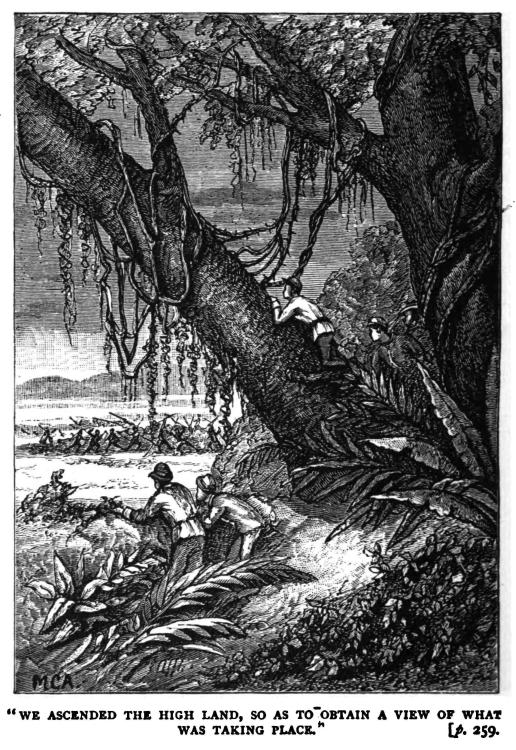
I knew that, from the summit of some tall trees on the shore of the bay near the bluff, a view could be obtained of the coast even beyond the Umganie; so I suggested to the officers that we pulled down the bay, and ascended the high land, so as to obtain a view of what was taking place. We soon reached the shore beneath the bluff, and ascending it found that we could see both the Zulus and Umnini’s Caffres. The Zulus, finding that they would be overtaken before they could cross the river, had faced about, and, standing shoulder to shoulder, were awaiting the attack of their pursuers. The battle soon commenced, by a shower of assagies being thrown by the Natal Caffres; then a charge was made, and for a time we could see nothing but a struggling mass of black warriors. Then the tide of battle evidently turned in favour of Umnini’s men; for the Zulus were flying in the direction of the river, followed by the Natal Caffres. In savage warfare, it is in the retreat that the greater number of men are killed: the pursuer has the advantage of casting his assagy at an enemy who can neither dodge nor protect himself by his shield. The number of Zulus who were slain during this retreat was very great—we could see man after man struck down and assagied; and the officers became quite excited, and exclaimed that these niggers fought like tigers. I told them of some of the battles I had been in, against the Zulus, and of some of the dodges we had practised. They said they wished they had some two hundred blue-jackets with them, and they would have given a good account of these Zulus. I told them that the cutlasses used by the sailors would be of no use against an assagy; that a Zulu would send his assagy through a man at twenty or thirty yards’ distance, and that a man armed with a sword would be unable to do anything with it at that distance. Then, again, when the Zulus rushed in on an enemy, it was possible to shoot down several of them, but those not shot would stab with their assagies, before the men armed with guns could reload.
Having seen the defeat and the slaughter of a large number of the Zulus, the officers decided to pull off to the ship, and report to the captain what had occurred. There was luckily very little surf on the bar, and we pulled over what there was without shipping much water in our boat. On reaching the ship, the officers gave an account to the captain of what had occurred, and were very full of praise for my skill and coolness in having saved them from the Zulus; for they agreed that, had they been left to themselves, they never could have reached the boats, as the Zulus would have surrounded them, and though they might have shot several, yet they could not have loaded quickly enough to prevent their enemy from closing in on them. The officers gave a very good account of the fight they had seen between Umnini’s Caffres and the Zulus; and if any doubt had remained in the mind of the captain about these two tribes being at enmity with each other, this fight would have placed the matter on the side of certainty.
On the morning following the day on which we had escaped from the Zulus, the captain sent for me to his cabin. On my entrance I found him sitting near a writing-table on which were various papers; he told me to sit down, as he wanted to ask me several questions. He then produced a map of the coast of South Africa, and pointed to Natal Bay, the Umlass river, and other places; and then asked if I could tell him exactly where the ship in which I had been wrecked had gone on shore. I estimated the distance from the Umzimvubu river, and with a pencil marked the spot.
I then described to him the country inland, as far as I had been, and pointed out that several small streams were not put down in the map.
After we had talked about these matters, the captain said, “Now tell me more about yourself, who you are, and all that.”
I gave the captain a history of my early days in India, and then explained to him that I was on my way home to England to be educated by my uncle, who was reported to be very rich, when our ship was wrecked. When I told him the name of my father, he looked in a large book, and then asked me my fathers Christian name. At first I could not recall it, but after a little thought I said it was William Mark.
“Your father is alive and is now a colonel,” said the captain, “but is no doubt under the impression that you were drowned, as nothing was heard of the ship you were in after she was seen at the Mauritius.”
I was delighted to hear this news, and a great longing now came over me to see my father and to again join civilisation. I told the captain what my wishes were, but that I had no money and did not know how I was to get to India, or to England; nor did I know whether my uncle was alive, and whether I ought now to go to England. I was quite able to take care of myself if alone in the African bush, or on the plains, though enemies of various kinds might be around me; but I felt I should be powerless among white men, whom, from my experience of the sailors in the former ship, I had found very stupid and suspicious.
The captain told me he would take me to Simon’s Town at the Cape, and see what could be done about communicating with my friends.
It took, in those days, upwards of four months for an answer to a Cape letter to England to be received, and about the same time for a letter sent to India to be answered and received at the Cape. I did not remember my uncle’s address in England, so that it would be impossible to communicate with him; nor did I know in what part of India my father was, but as he was well-known at Delhi, I believed that a letter sent there would be forwarded to him.
On the following day the captain decided to leave Natal and start for the Cape. The wind was in our favour, and we sailed westward, our course carrying us about twenty miles from the coast. I remained on deck watching the old familiar localities and pointing out to the captain the various rivers and headlands. Just before dark we were opposite the rocks where I was wrecked, and the captain took some observations and marked on his map the exact spot.
During the next two or three days I passed an hour or so each day, giving the captain an account of the wreck, and of what occurred afterwards; he wrote down what I told him, and, having made a sort of history of this, he then read it over to me, asking me if it were all correct.
He said, the loss of the ship had caused great excitement in England, he remembered, at the time; but when no news came, and a ship sent from the Cape to search could gain no intelligence, it was concluded that she had gone down in the storm, between the Mauritius and the Cape, and of course it was expected every one had been drowned.
We had a fair wind all the way down to Simon’s Bay, and accomplished the voyage in six days. As soon as we had anchored, the captain went on shore to visit the admiral, and I was left on the ship. In about an hour one of the officers came to me and said a signal had been sent from the admiral to say that I was to go on shore to the admiral’s house. A boat was provided, and I was soon pulled on shore.
Although I had led the life of a savage since my shipwreck, and had gained no experience of what is called polite society, yet the dangers through which I had passed had given me self-dependence; and the calm, dignified behaviour of the chiefs, both among the Zulus and the Umzimvubus, had given me an insight into the proper way of conducting myself. When, then, I was taken by the captain before the admiral I was not flurried as some youngsters might have been, but very cool and calm. The admiral examined me critically, and then said—
“You have had some strange adventures up the country.”
“Yes, sir,” I replied, “I have been some years living entirely among the Caffres.”
“Is the account you have given of the shipwreck quite correct?”
“Everything I told the captain is just as it occurred.”
“Don’t you think the English women who are up there would come away if they could?”
“No,” I replied, “they told me themselves they would not leave now: they have children, and have been well-treated; and they could not come again to civilisation after living during some years as the wives of Caffres.”
“Then,” said the admiral, “if I sent a ship up there to bring these women away, you don’t think they would come?”
“I am certain they would not; and you would not be able to find them. The Caffres would carry them up the country, and conceal them as soon as your ship was seen to be landing men; and if you attempted to use force, you might be opposed by several thousand warriors; who, though armed with assagies only, would yet, in the rough bushy country, slaughter two or three hundred men armed with muskets.”
After some further conversation the admiral asked me what I wished to do.
I replied that I had no money, no clothes, except what the captain had given me, and no friends at the Cape; that I should like my father, who was in India to know of my safety, and should like to receive his instructions as to what he wished me to do. I added that, if I stopped at the Cape, my father would pay any one for my keep as soon as he knew where I was.
The admiral shook hands with me, and said I had better return to the ship at present; but that he should be glad to see me at lunch in an hour’s time, and he would consider what should be done for me.
At the lunch I was fully occupied in answering questions about the details of the shipwreck, and my adventures in the wild country of the Umzimvubu. My description of the slaughter of the captain of the merchant vessel, and his obstinacy in not being cautious enough, seemed rather to amuse some of the officers who were present. Altogether, I was much pleased with my treatment by the admiral, and returned in the afternoon to the ship.
On the following morning I found that a Cape Town paper had a full account of the shipwreck, and of my adventures among the Caffres, giving my name, and stating who I was. I was amused at finding myself so famous all at once, but did not then anticipate what would be the speedy result of all this being known at the Cape. What was the result must be reserved for another chapter.
Chapter Seventeen.
It was about two hours past mid-day, that a boat came from the shore, and a gentleman in plain clothes stepped from the boat on to the ship, and inquired if Mr Peterson was on board. I was sitting in the cabin, reading, and the gentleman was shown down into the cabin, and I was told he came to visit me. The gentleman, who was old, but tall and erect, looked at me very critically, and then said, “Is your name Julius Peterson?”
“Yes,” I replied, “that is my proper name, but I have been renamed by the Caffres.”
“You of course remember your father,” said the gentleman; “can you describe him to me?”
I gave a very accurate description of my father, and then of our compound and bungalow at Delhi. In reply to the gentleman’s inquiry, I gave the details of our journey to Calcutta, and of our voyage, shipwreck, etc.
“You have no papers, or anything about you, which could prove you are the person you represent yourself to be?” said the gentleman.
I laughed as he made this remark, for I could not see how I could be any one else but myself; when, however, I saw how serious the gentleman was in making this inquiry, I began to reflect that there was really no one who could know me, and that my own statement was the only evidence of my identity. After several other questions the gentleman informed me that his name was Rossmar; that he lived at Wynberg, near Cape Town; that he was well acquainted with my uncle, who had written to him some time after I had left India, to meet me at the Cape if the ship touched there on her voyage home. He then told me of the anxiety my friends had suffered when nothing was heard of our ship, and at last they had concluded that we had all gone down with the ship. Mr Rossmar apologised for having asked me so many questions, but he said that cases had happened where a shipwrecked boy, or man, had after some years represented himself as some other person, who really had been drowned, so that he had merely used common caution. He then congratulated me on my escape, and said that he hoped I would come to his house and make it my home until I received instructions from my father or uncle, both of whom he said, by last accounts, were well.