Front matter (continued 4)
Reading edition
"It isn't you!" I declared. "It's another woman, quite. It's only you in the sense that it would be you if you were intoxicated, or if you were dreaming, or insane. You mustn't think of yourself as in any way responsible."
"Then of course she's not, either?"
"No more than a child, or an idiot. She uses your body and your mind, but she hasn't, so to speak, the use of your moral scruples. She's a disintegrated self, imperfectly functioned. All the same we have, of course, to treat her as quite another person. And the time is approaching, I think, when we'll have to act. I don't intend to spare her. We must use force if necessary."
"How does she know about me, after so long an ignorance?" Joy inquired.
I told her what I had heard at the telephone. She could scarcely credit my testimony.
"If the doctor is definitely leagued with Edna, what can we do? He has all his science and Edna's active help. I'm lost if he's really against me! I can't be sure that the doctor has deliberately played me false. There may be some mistake."
"I think I can prove that to you," I answered, "but I have a great deal to say to you first."
I think she knew, then; I think she hoped to hear what I was going to say, for she gave me her hand, and smiled up at me as she rose to go in to breakfast. We sat down with Leah at the table.
I had taken it for granted that Leah had told Joy everything that had happened the day before, and so, not wishing to grieve her further, I took care to say nothing about Nokomis. But the swelling on Leah's cheek could not be so easily ignored, and several times I saw the tears come into Joy's eyes at the sight of it.
While we were there the clock struck half-past eight. At the sound Joy's face changed—an expression of abstraction came into it. It was as if she were trying to recall something that eluded her memory. Then she half rose, like a somnambulist.
"I think I'll run up-stairs and telephone the doctor," she said, without looking at me.
"Why should you?" I asked, much surprised, after the way we had talked.
"I don't know," she said vaguely, looking about the room. "Oughtn't he to know how I treated Leah? Perhaps he can prevent that in some way."
"You'd better not, Joy," I said.
She stood for a moment irresolute, and then, as if urged by some extraneous impulse she moved a little nearer the door.
"I just want to find out if he's coming down to-day," she said automatically.
I jumped up and touched her shoulder.
"Please don't telephone to Doctor Copin—you mustn't!" I said with decision.
"Oh," she said, wide-eyed, coming to herself a little. "There's a reason?"
"There's a good reason!" I exclaimed fervently.
She moved back, as if still opposing some force that was drawing her out of the room, sat down limply, half rose again, reseated herself.
"Resist!" I said to her.
Leah looked on without a word, breathless, her lips open.
Joy looked madly at me. "What is it, Chester? Tell me!"
"It's only a post-hypnotic suggestion, that's all. You must defeat it."
Then she literally shook herself free from the obsession. "Oh, why am I tortured and racked so!" she exclaimed. "Can't I be permitted to be myself when I am myself? Isn't it bad enough to be robbed of myself half the time without his imposing his will on me now? Why is he doing this?"
"That's just what I want to find out," I said. "The important thing is not to give in to him. His experiments may possibly be justified, but I don't think so. We certainly have good ground to suspect him. Have you quite got over your desire to telephone?"
"Yes—but it's queer—I can still think of reasons why I might, though of course I agree with you that it's not best to. You see, I've only given up to you instead of to him. I'm quite in the dark, now; I seem to have no will of my own. I can't judge, I can't understand even my own impulses. Well, if I'm blind you and Leah will lead me, won't you?"
She reached over and took Leah's hand affectionately.
When we finished breakfast, Joy and I went into the library. There was an old, gilt-framed, concave mirror there, over the fireplace, that gathered in and focused on its disk the whole room in one condensed, shadowy scene. Joy went up to it.
"Aren't we queer and strange in there?" she said. "It's so dim and ghostly; when I look up and see any one in it, it always seems to me like some scene of Maeterlinck or Sudermann."
She walked over to another glass, more formal and more true, and looked at herself intently.
"Look at the lines about my eyes! They weren't there a year ago! My whole face has changed.... I have grown ten years older this last month.... My eyes themselves are different.... There's another wrinkle.... I wish my eyebrows were even.... I believe my nose is one-sided, too...."
Her voice died away. I looked up and saw her gazing into the mirror with a strange intentness. Her brow was puckered into a frown. Suddenly her hand went to her heart with a gesture of horror.
"Oh!" she cried, and hid her face in her hands.
"What is it?" I asked.
"The doctor!" she exclaimed, shuddering.
"Tell me!" I insisted.
Instead, she sprang up and began to walk up and down the room, wringing her hands. "It's awful; it's all confused in my mind, like a dream—but I seem to remember things that never happened at all. Oh, did they ever happen?" she turned to demand of me in despair.
"That's what I want you to tell me."
She dropped into her chair again and began to cry—"Oh, I can't tell you! I can't! It never happened, I'm sure! What does it mean, Chester?"
"It's probably what happened here yesterday—to Edna—that you remember, Joy."
"Oh, how dare he treat her so, then? It comes back to me in scraps and shreds of scenes. Oh, what a cad he must be! And what a woman she must be, to allow him—oh, I can't stand it! Why did you make me remember? How can I ever look any one in the face again?"
She threw herself into the cushions on the window-seat and burst into tears. There was but one way to restore her self-respect, and I went over to her and took her hand. At first she pulled it away, but I persisted.
"Dear Joy," I said, "don't grieve so, for it's all right. It was Edna, not you, you know, and Edna's not responsible for what she does, I'm sure. Don't cry, for I have something to say to you, now, that you must answer."
She looked at me through her tears, and waited.
"I want you to marry me, Joy."
"Oh, please don't!" she exclaimed. "Marry you? How can I listen to such a thing, after what has happened? Oh, no, no!"
"It's partly on account of that that I ask you now. I want to help you, and I can help you so much more if we are engaged. I want the right to help you."
"Oh, it's only pity that makes you ask me. It's only to protect me! Never, never!"
"It isn't that," I protested. "I love you, Joy—I have loved you for a long time, and loving you, I want to save you, not only for your sake, but for my own as well. I want you for my wife, Joy! Don't you love me?"
Her tears had ceased and now she looked at me with bright eyes that burned softly.
"My dear," she said, "of course I love you! I think I have loved you ever since that first day you came here. But for that very reason I must say no. How could I ever drag you into this wretched trouble?"
"Oh, I'm in it all over, whether or no," I said. "Do you think I could ever leave you now? Were I only your friend, even, I'd have to stay with you; but I'm your lover, Joy! I'm most desperately in love with you. And I intend to have you, too! No matter what you say, no matter what you do, you're mine, and you can't get away from me. So you'd better just say 'yes' this moment."
She sat up and looked at me tenderly. "Don't speak of it again—not till all this problem is settled, at least. It's impossible. Do you think I could think of it after what has happened, after I've found out what I really am? If I am ever released from this spell—if I can ever forget what I've just found out, it will be time enough to speak of love. But not now, I beg of you. I'm the White Cat!"
"I've already told the doctor that we're engaged," I said.
"You told the doctor!" she exclaimed. "How could you?"
I repeated our conversation in the lane. Her momentary resentment at me died away at hearing the doctor's own announcement.
"Then perhaps Edna is in love with him, after all! That would account for much, and excuse everything, perhaps." She drew a sigh of relief at the thought of this palliation.
"I don't think she is, but she might be willing to marry him to get her freedom," I offered.
"But then, if Edna is in love, I have still less right to let you propose to me. Why, just think of it—it's incredible! If they're engaged——"
"They're not engaged, I'm sure."
"It makes no difference—she may care for him more than you think. It's fearful! I can't talk about it!"
"But she can't marry him! We must prevent that! Think of the horror of that possibility!"
I had small need to appeal to her imagination. Her mind was already whirling with the possibilities of such a situation. She stared at me, dazed, speechless, her eyes filled with terror. Then she collapsed and fell into my arms.
"Oh, Chester, what shall I do? Take care of me! I'm so frightened!"
"You must listen to me, Joy," I said. "I love you so that my heart will break if you don't consent and let me help you. You must be my wife, and then we can defy them and fight it out together."
She started up with a new thought. "Oh, hasn't Edna a right to her love, too? Won't it be as bad for her, possibly, if I consent? How can I force her to suffer that! How can I bear to think of your being with her while I'm wandering, lost, eclipsed? Oh, don't you see how shockingly impossible the whole thing is? We can neither of us dare to love. We have no right even to think of it! How can you suggest it? It's unthinkable!"
"But you love me?" I asked.
She offered me her lips for the first time, and clung to me, trembling.
"Then nothing is impossible. We'll wait a while, and see. But at least, so far as the doctor is concerned, I can't afford to be stultified. You'll not repudiate my announcement? You'll admit it to him, if he asks? I must have that weapon against him."
She turned it over in her mind. "I'll not deny it," she said finally, "but you must not consider it a promise. It's simply too ghastly to think of!"
I had gained that much, at any rate, and though my heart sank at the thought of the possibilities our words had pictured, I still hoped to be inspired to some successful plan for attack and defense. I knew that Joy loved me—that was everything. It made me bolder and more confident. So I put the horrors from me and thought only of our love.
She turned suddenly toward me and said: "What would you do for me, Chester?"
"Anything, except give you up!"
"Remember the White Cat!" she said. "Would you do what she asked the Prince to do?"
"What do you mean?"
She spoke deliberately. "Conceive, if you can, our being beaten in the end. Conceive that Edna might marry the doctor—and then think of me!"
"I'll prevent that!" I said, through my teeth.
"You may not be able to prevent it, except in one way."
I understood. "If I ever believe that that is the only way to prevent it—I promise to help you."
"I may be able to do it alone; of course I shall try. But if I haven't the means, the opportunity, you must promise to help me find them."
"I promise!" I repeated.
She tossed her head back with her old gesture.
Then I said: "Joy, all this is unnecessary; though I've promised. If you'll only marry me now—if you'll even consent to an engagement, it will enable me to defy the doctor and prevent his coming here."
"Oh, I can not, I can not!" she cried. "You know why as well as I! It's too awful! I love you—that must be enough for the present."
She rose and added: "Let's go outdoors and take a walk. Perhaps the air and the sun will do me good, and afterward we can think it over and decide how to manage the doctor. I'll just run up-stairs and change my clothes and then we'll try the sun-cure."
As she went up to her room, I walked out into the kitchen to talk to King while I waited for her. He was busy at the stove, but welcomed me with his usual meaningless grin.
"Well, King," I said, "I guess your joss is pretty good, after all. Miss Fielding is better to-day."
"H'm!" He shook his head. "Debbil come plenty time more!"
"Perhaps we can pray him away," I suggested.
He dropped his spoon and came up and took my arm.
"You likee come lookee my joss?"
I assented, amused at his insistence, and he led me out into the yard where, beside the stable, he had a little shed. It was filled with the odor of burning sandalwood. In his room, by the upper end of his cot, was his porcelain joss, a horrible-faced deity. Long placards of red paper containing Chinese writing were hung about, and there were paper flowers, dusty and fly-specked, upon the stand. At the feet of the idol was a bowl full of ashes in which were many joss-sticks. Three were lighted, the others had burned out. There was also a small lamp, with a lighted wick floating on the nut-oil. I inspected it all very seriously.
King rummaged in his trunk, and soon, grinning, beckoned to me. I went over to him and saw, in the tray, a large, ferocious-looking mask such as are used in the Chinese theaters and at the Feasts of the Dead. Beside it was a pair of huge brass cymbals and a snake-skin tomtom. King held up the mask.
"Oh, you used to be an actor, eh!" I said.
He grinned and held the thing in front of his face. It certainly was horrible. He took up the cymbals and struck one clang. Then he put them away.
"Heap good for debbil. Dlive him away quick!" he said. "Maybe some time I tly him! You think so?"
I laughed, and went back to the library, where Joy was already waiting for me.
She was standing by the window-seat, looking out, putting in a hat-pin, lost in thought, when I entered. My footsteps made no noise on the heavy rug, and I thoughtlessly touched her on the shoulder before she was aware of my approach. Absorbed in her trouble, unstrung, the surprise startled her with a sudden irrational terror; she leaped away as if from the touch of a snake. Then, seeing me, she dropped upon the window-seat, her hand on her heart.
"Oh, you frightened me so! You see how nervous I am. I didn't hear you. I'm a goose!"
I took no step toward her, but stood there gazing at her. A sudden idea had come to me at sight of her fear, and immediately a plan was unrolled before me, a perfected thing, a solution of the problem, perhaps. At my fixed, stony attitude, however, she took a new alarm and cried out:
"What is it, Chester? What is it?"
"Wait a moment," I said quietly, "let me think it out." My tone reassured her, but she was still agitated as she watched me while I turned it over in my mind. Then I took a seat beside her.
"It's a desperate chance, but it may work."
"You have a plan?" she asked anxiously.
"Yes."
"What is it?"
"I can't tell you. It will be much better for you not to know."
"Oh, I'm afraid not to know! It's dreadful to be conspiring against that poor girl. It's like plotting a murder. I can't bear the thought of it. You must tell me."
"It will be hard enough for me—you could not stand it," I said. "You'll have to trust me, for I shall save you in spite of yourself. But I can't share this with you."
"You'll not injure her, Chester?"
"How can I, when it will be your own face that I shall confront? It will be your own voice that I shall hear. I wonder if I can do it!"
"Oh, I must know or I shan't consent," she declared. "What right have we to destroy her, after all? She has a right, perhaps, to her life!"
"Joy," I said, "you must think of it as a dream, as I said. In our dreams we suffer and enjoy, but so long as there is no bridge between that and our waking state, it need not matter to us. What must be done is no more than a surgical operation. It will restore you, I think, to health."
"But what of her?"
"She'll merely disappear. She'll take her place on the map again and join the rest of you."
"You won't tell me?"
"I can't!"
She rose proudly. "Then I do not consent," she declared. "I can suffer still. I'll summon new reserves of strength and I'll fight it out as it has begun. I'll forswear happiness, love, peace. I'll accept my fate—until I can stand it no longer. Then, I have my own remedy and I shall not be afraid to adopt it. There's always that way out! No, I'm stronger than you think, and it's quite settled. Now come outdoors and let's get some fresh air. It's like a haunted house in here."
I tried no longer to persuade her, but I had already decided that I would put my plan through without her consent, if necessary. It happened, however, that this course was not necessary.
We went out into the sunshine and the fresh air and the perfume of June roses. In front of the house she stopped and called the collies. They came trooping joyfully about her.
"Where's Nokomis?" she asked. "Hasn't Nokomis come back yet? That's queer!"
I saw, then, that she had not been told. It was shocking to have to inflict this new blow upon her, after all she had been through, but it could do no good to conceal the fact any longer. As she turned to go around to the stable, I took her hand.
"Send the dogs back," I said.
She did so, with a question in her eyes. I took her arm and led her down toward the turn of the lane.
"Nokomis will never come back, Joy," I said.
"Why?" she exclaimed. Then she saw the answer in my eyes, and she grasped my arm, as if she were about to fall.
"Oh, don't say—Nokomis isn't dead?" she whispered.
"It was my fault, Joy; I should have had her taken away out of danger. But I was too late."
I took her to the bed of ferns and pointed to the dead collie still lying there.
She ran to the spot and looked, aghast. Then, dropping to the ground, she took Nokomis' head tenderly and laid it in her lap.
"Oh, Nokomis, Nokomis!" she mourned, her little hand smoothing the ruffled neck affectionately.
I told her how it had happened, and she gazed at me, dry-eyed, till I had finished. Then she put the collie's beautiful head down, straightened out the body and finally broke into sobs that shook her whole body. I let her cry it out.
She looked up at me, her face drawn and tear-stained.
"Poor old Nokomis!" was all she could say.
I took her hand and helped her up, then led her gently away, as I had led Edna away only yesterday. It was the same hand I took, but it was so cold and weak! It was the same face I saw, but it was so shadowed with sadness! It was the same voice I heard, but then it had been proud and careless—now it was so tremulously stricken!
"To think that I should have killed Nokomis!" she said.
"It wasn't you, dear!"
"How do I know? If I could be sure!" was her doubting answer.
Then she wheeled about and faced me. She put both her hands on my shoulders and clung desperately to me.
"Chester," she cried, "take me, if you will—if you dare! I don't know any more what's right and what's wrong. The White Cat is blind! I must have you—I want you! I can't live without your help! I'll give it all up, now, and let you act; for I shall die anyway, if such a thing as this should happen again. Next time it may be Leah—it may be even you! If you can save me, I'll marry you. I consent to the engagement—I'll say 'yes' with all my heart, with all gratitude and all love. It's wrong and cowardly, I'm afraid, but you and Leah are all I have."
I kissed her on the lips, and put on her finger the little old seal ring I wore.
"Then we must be married," I said.
She freed herself and took a step back.
"Oh, no! Not yet!" she said sadly. "No, not even yet! When you have tried your plan—and I give you leave, now—when you have succeeded in freeing me—then we will be married. Oh, you must free me first—I can't share you with Edna—you must destroy her, before she destroys me!"
"Very well," I said. "I can't urge you further, though I am afraid there is a great risk in delay. I must go up to town first, and I shall have to leave you here, of course. I doubt if I could manage Edna, should she appear to-morrow while we're in town. But I shall return as soon as possible—to-morrow at the latest. Now I must get ready to take the one o'clock train up."
As we sat in the library waiting for Uncle Jerdon, Joy took up the crystal prism and watched abstractedly the rainbow spot upon the ceiling.
"You're leaving for the second time," she said. "It's the end of the second quest, isn't it? I'm afraid the White Cat has no piece of cloth fine enough to give her Prince, though."
I pointed up at the streak of prismatic color.
"There's a veil of beauty as wonderful as that the king's son brought home. Surely it's fine and subtle enough to pass through the eye of a cambric needle!"
She handed the crystal to me with a tender smile.
"Keep it, Son of a King! And, if you win me, I'll see you clad in those rainbow hues all my life long!"
At one o'clock I was in the train on the way to town, deliberating my plan and arranging for the preparations I must make.
PART THIRD
I
I started back for Midmeadows at ten o'clock the next day. It was a fine breezy morning and the country-side was full of odors. The sky was an intense blue, abounding in great rolling white clouds which spotted it like the continents and islands of a huge map upon which some titanic Napoleon was continually carving and remodeling new realms and empires of the firmament.
I paid less attention to them, however, than I did to the mental empire it was now my purpose to overthrow. If thunder and lightning could burst the cloud that kept the sunshine from my sweetheart's life, I was determined to conjure that storm.
I had, during my few hours in town, consulted a medical friend upon Joy's case, and while he gave no professional approval to my project, he had not denied the possibility of its being effective in producing a cure. Such conditions as Miss Fielding's were by no means rare, but they had been so little studied, except phenomenally, that there was no authorized course of treatment known. Each had to be dealt with according to its especial characteristics, and according to circumstances. He had talked to me a good deal concerning "subliminal selves," of the theory of "successive planes of consciousness" and of "isolated personalities," ending with the statement that, so far as any definite knowledge of the psychology of multiple or dissociated personality was concerned, even doctors were the merest laymen. Of its actual rationale they knew virtually nothing, though in some cases the disintegrated personalities had been synthesized into a normal self by means of hypnotic treatment.
I had left Joy herself, yesterday, and, in view of her accelerated alternations, due to the doctor's influence, I had every reason to expect to find Edna to-day in control. My chief hope was that she and Leah were still upon amicable terms, and that they would be alone in the house. But there had been time for many things to happen, and I awaited the news with considerable anxiety, though braced for any ordeal that might come—except, of course, what did come. I dismissed the carriage at the lane and walked the rest of the way.
There was no sign of life outside the house; I went up to the front door and knocked. It was some time before my summons was answered, and then, to my dismay, by Doctor Copin. This was worse than I had feared.
"Oh, how d'you do, Castle?" he said, making no move to let me in.
"I'm down again, you see. I believe Miss Fielding is expecting me," I said, as coolly as I could.
He stood with his hand on the door, defending the entrance. "I'm very sorry to say that Miss Fielding is not well to-day, and she can't see you."
"Can't see me! Why, that's impossible. She knows perfectly well that I was to return to-day!"
"She's said nothing about it to me, if she does. At any rate, she's in no condition to see anybody, and I must ask you to leave."
"Would you mind telling her that I'm here?" I said.
"I'll speak to her, if you like, though I don't particularly care to disturb her at present. Wait a moment, and I'll see how she is."
He shut the door and, I think, locked it. I waited on the step, hoping for a sight of Leah, and trying to make up my mind what to do if I were refused admittance. I might attempt to enter by force, but, with the doctor there, I could not possibly put my project into action. He finally reappeared with a long face.
"Miss Fielding begs to be excused," he announced.
"It's most extraordinary; I must insist on seeing her!" I cried.
"You certainly don't wish to force yourself in where you're not wanted?" he insinuated.
"If I were sure I wasn't wanted, no. But I don't believe you took my message in to her at all."
"I'll accept that insult, Mr. Castle, and we'll settle it at some other time. Just now, I must ask you to leave immediately. You may happen to recall what I told you the last time we met. As Miss Fielding's fiancé it is not only my right but my duty to see that you go."
"And do you recall my own words on that occasion! I have as good a right to insist upon entering!" I maintained.
"Well, well, this is no time to discuss that, for my presence is needed in the house," he replied. "As I am engaged to Miss Fielding, No. 2, if you please to accept that designation, and as it is No. 2 who is at present receiving me, you'll perhaps see the force of my claim."
It was infamous to have to stand bickering with him, and, as it could do no good to enact a scene, I turned away, lifted my hat and bade him "good morning!" He bowed, shut the green door, and this time I distinctly heard the key turn in the lock.
I was for a moment at a loss how to proceed, but walked slowly down the lane. At the bend I looked back and saw Leah at an upper window gesticulating to me. I stopped and watched her.
From her signs I gathered that she wished to meet me, and, being careful to make no signal in return, I passed out of sight and waited. It was fifteen minutes before she appeared, coming through the underbrush, having made a detour from the back of the house to escape observation.
"Oh, Mr. Castle," she said breathlessly, "it's dreadful! The doctor has been down here since early in the forenoon, and he has been with Edna all the time, shut up in the library."
"What are they doing? Could you see or hear?"
"Oh, what aren't they doing!" she exclaimed, turning away. "It's unbearable. I don't see how you can stand it!"
"I can't stand it! I won't stand it! I'll break down the door if they won't let me in!" I broke out. "I'll kill him!"
Leah caught my hand and stopped me. "It's no use," she said, "Edna herself won't let you in, I'm afraid. She's different this morning. I never saw her so much under his influence. Usually she jokes with him and teases him in all sorts of ways, but to-day she's more quiet and determined."
"Has she treated you badly?"
"No—if it were only that, I wouldn't care. It's something more dangerous. She's crafty and secret. It's sinister. It makes my flesh crawl!"
"Do you know how long the doctor will stay?"
"He's going back this afternoon, I think. That's why he's working so hard with her, I suppose. She's like a bird with a serpent—she's fascinated by him."
"What did he say to her—did you hear?"
"He has been hypnotizing her. I heard him say, 'You will be Edna, Edna, Edna!'—he repeated it over and over."
"You must go back to the house, then, immediately. You mustn't be missed on any account. Do your best to placate her and avoid trouble. I'll watch in the old cabin till he goes past. As soon as he's out of the way, I'll come."
She was off on the instant through the wood toward the back of the house. I walked down the lane and along the highroad a little way, to the deserted cabin. Here I took my post behind a window and waited patiently.
A couple of hours went by. It was an eternity to me. A hundred times I decided to go and break down the door of the house and have it out with the doctor. I had a couple of revolvers in my bag and the temptation to shoot him on sight was strong. When I thought of what was probably going on in the house—of Joy's body, perhaps, at his mercy—it was all I could do to remember that my intervention at this moment would ruin all hopes of her eventual release from his power. I bore it for her sake, with my teeth gritted, thinking mad thoughts.
At last I heard the rattle of wheels and saw the carriage approach. Uncle Jerdon was driving; the doctor, smoking a cigar, was laughing complacently. I shrank out of sight till they had passed. Then I left the cottage and ran up the lane.
Edna was sitting outside on the door-step as I approached, but, on seeing me, she rose and went quickly inside, shutting the door. She was indeed different, if she failed to welcome me. My heart fell, but I went up to the door and knocked. No answer. I knocked again, and, after a long wait, Leah appeared.
By her first glance at me, and an almost imperceptible nod of her head toward the library door, I knew that Edna was near by, watching and listening. I was not surprised, therefore, when, in answer to my greeting and question, Leah replied:
"Miss Fielding is sorry that she can't see you to-day. She's not well. She says that she sent you that word before."
"Mayn't I even speak to her for a moment?" I asked.
"She begs that you will excuse her, Mr. Castle." Leah's eyes gave me another sign.
"Very well, then; tell her I'm much disappointed, but I won't trouble her again." I added a gesture in the direction of the lane and walked away without looking back. I felt that Edna was watching from the library window. Leah closed the door.
I went a little way down the lane, searching my mind for some means of combating this unlooked-for contretemps. I had discovered a possible way out before Leah appeared, a half-hour later.
"Oh, I'm afraid she'll miss me this time!" she said, her eyes wide and frightened. "I took my chances, though, and you must be quick. What shall I do?"
"I am going over to the Harbor," I said. "I shall be back, probably in about an hour and a half, and I'll wait here for you. You must find some excuse for coming again. Then I'll give you your instructions. If anything happens that positively prevents your coming, hang a towel out of my window. That's all now; go back!"
She flew back to the house, and I started for the village, where I knew there was an apothecary's shop. In forty minutes I had, with some difficulty, procured what I wanted, a bottle of chloroform. But it was two hours before I got back to Midmeadows. Approaching the house, and keeping carefully hidden by the trees, I saw that there was no signal at the window, and knew that I could expect Leah. I retired a few yards beyond the curve and waited for her.
It was by this time about half-past six o'clock in the evening, and it was still light and warm, though the shadows were long about the old house. I had done a deal of waiting that day, and it had begun to tell on me. It was a great relief when Leah appeared, looking about anxiously. I came out from hiding.
"How goes it!" I asked.
"All right, but she's been restless and fretful. I shouldn't have been able to get off possibly, if she hadn't decided to take a walk before supper. She's gone up over the hill. What are you going to do, Mr. Castle?"
I handed her the bottle, and as she caught sight of the label her hand shook so that she nearly dropped it.
"What we'll have to do is to put her to sleep, so that Joy may return. I don't know, of course, whether it will work or not, but it's the only way I can think of. Have the bottle ready, hidden in the library, and wait till she sits down to supper. Then go in quickly, soak your handkerchief with the chloroform, come up behind her, and hold it to her face tightly—with all your strength, for she'll struggle—till her head drops. You must act quickly and firmly. If she has the slightest suspicion of anything, you'll fail, and we're lost. As soon as you've laid her on the floor, call me. I'll be right outside, ready to come in."
"But King?" she asked, trying hard to control her excitement.
"If King sees you, or attempts to interfere, tell him that I am trying to drive out Miss Fielding's devil. But he won't, I think. Is Uncle Jerdon there?"
"No, he's gone after the cow—he won't come into the kitchen till after seven o'clock, when he's through with his milking."
"Very well, then. Can you do it? Have you the nerve?"
"Yes. I'll do anything to bring back Miss Joy!"
She held herself erect, her lips compressed, looking at me bravely, though immensely agitated. I knew that whatever the struggle might cost her, I could rely upon her to rise to the situation. I sent her away with a final word of encouragement.
I waited some ten minutes more; then cautiously approached the house, went close to the library window, and looked in.
It was not long before I saw Miss Fielding enter from the hall door, take up a paper, look it over listlessly, and then, at the sound of King's gong, go into the dining-room and take her seat. This was just outside my range of vision, but occasionally, as she leaned back, I caught sight of her head. Leah passed and repassed several times, waiting upon her. I watched in an excited suspense.
I had begun to fear that the girl had lost her courage, when I saw her suddenly dart into the library, take the bottle from behind the books in one of the cases, and open it, drenching her handkerchief. At that very moment Edna must have called; for a moment I saw her head, as she turned round to look into the library. Then it disappeared again. Leah stole back into the dining-room, with the handkerchief held behind her.
She stopped back of Edna's chair. Then her right hand flew round with the handkerchief, and her left covered it. There was a short hard struggle, as Edna tried to free herself, but Leah held firm, crouching behind her mistress, tense and determined.
I waited for no more, but ran to the front door, through the library and into the dining-room.
Miss Fielding sat huddled into her chair, limp, inert, her arms hanging at her sides. Leah still stood behind her, staring, her eyes showing the whites above her pupils, her lips parted. She remained as if transfixed at the sight of what she had done.
I seized the unconscious form, and, taking it up in my arms, bore it into the library and laid it upon the couch in the window. Leah followed, without a word, still staring stupidly. I thrust her, then, into a chair, fearing that she might faint.
Then I stooped over Miss Fielding, calling, "Joy! Joy! Joy!"
II
I called her name involuntarily, I suppose, yet there was in my motive, too, a dim idea that the suggestion might in some way influence her to awaken as Joy, rather than as Edna. I did my best, meanwhile, to assist her to revive, fanning her with a newspaper and chafing her hands.
Long before she came to herself, however, there began a convulsive struggle that was one of the most terrible things I had to witness in all my experience with her. It was as if her two selves were fighting for supremacy, for the possession of her body, which was their battle-field. I could only wait helplessly for that fierce struggle gradually to expend itself in tremblings and in sighs, while I called her again and again, now with a definite idea of hypnotic suggestion. The conflict seemed to go on for a long, long time, though in point of fact it lasted, I think, only a few minutes. At the end, she drew a long, deep breath, relaxed, and opened her eyes. Almost immediately she was overcome by a violent nausea, and, attending to her and soothing her, it was some time before we knew with whom we had to deal. Her first words reassured me.
"Chester!" she exclaimed, "you've come back! I'm so glad, but I'm terrified—what has happened?"
I kissed her, kneeling on the floor beside her, stroking her hand. "Don't worry, dear," I said, "it's all right now."
She started up with a glad look on her face, misinterpreting my words.
"Oh, is it finished, then? Have we won? Is Edna driven away for ever?"
I had to tell her that it was not yet even begun, but that, God willing, I should soon be ready to put my plan to the test. She was disheartened and discouraged at that; it was as if she had gone through an unsuccessful operation, she was so exhausted and fearful, but in the end I succeeded in reassuring her somewhat, and she was restored to calmness and courage to bear the suspense. As soon as she felt better we went outdoors for a while, and the fresh, cool air brought back her spirits. There I told her just what had happened, and what we had to expect. Then, as I had eaten nothing since morning, I went back with her to the dining-room and we had supper with Leah.
"Chester," she said, "you've said enough to make me afraid of what you intend to do. I can't yet be sure that we have the right to destroy Edna. And I must be surer that Doctor Copin has betrayed me. I've known him too long to let him go without proving it. I must see him and have a talk with him first; then, if I am thoroughly convinced, you may go ahead. But I want to know just what it is you intend to do."
There, at least, I stood firm. "I hope you'll never find out," I said. "I intend to cut out the cancer—that's enough for you to know. But, as to the doctor, I'm positively afraid to trust you with him. And yet, it would be well to know just what he's up to. He may come to-morrow morning, too, which will prevent my doing anything, whether it's you or Edna who is here. And I can't risk the chance of being interrupted. He may not come, however, as he'll naturally expect you to be here to-morrow, unless Edna's making faster progress than she has heretofore. And even if I could put you to sleep now, Uncle Jerdon's being in the house will prevent my acting."
It was here that Leah put in the first suggestion that she had volunteered.
"Miss Joy," she said, "I have an idea how you might find out what you want to know, and perhaps the doctor's plans as well, if you'd consent to do it. I don't know whether you'll think it's right or not—I've been trying to decide for myself, but I can't."
"Let's have it, at any rate," I said. "We've left right and wrong so far behind, now, that they're quite out of sight."
"If Leah has even thought of it enough to propose it, I'll take my chances on its being justifiable," Joy added.
"Here it is, then," said Leah. "You want to know what the doctor is doing with Edna and to Edna, don't you?"
"That's it," said Joy.
"Then why not pretend to be Edna when he comes?"
"By Jove!" I cried. "There's an idea!"
"But I couldn't possibly do it!" Joy objected.
Leah explained further. "Mr. Castle and I will teach you. We have all night before us, and we'll have to stay up, anyway, to make sure that it is you who meets the doctor. During that time you can learn your part. It will be hard work, but I know you can do it."
"It will at least keep us awake," Joy smiled at last.
"And then, early in the morning, you, as Edna, can telephone to him and ask him to come down."
"He'll come," I said. "He'll be only too glad to find that Edna has had two days running."
Joy began to enter into the humor of the situation. "I'll not have to make up for the part, at least, shall I? And Edna's costumes will fit me. But do you think I can really do it?"
I was convinced that she could. "When you think that he will be predisposed to find you Edna, and how little cause he has to suspect such impersonation, and moreover how much more like you Edna is becoming, I think that there's very little risk," I said. "The best part of the plan is that after it's over the doctor is likely to go back and he'll be safely out of the way for my experiment."
"Oh, your experiment! How it terrifies me! What are we doing to that poor girl? What possible crime am I consenting to?" Joy broke down again.
Leah put her hand on Joy's arm and looked at her. "You'll do it for my sake, Miss Joy?" she pleaded. I knew well enough that she was not urging her own danger, despite her words. She was desirous only of Joy's peace—but her words had their effect.
"And for mine," I saw fit to add. The double appeal stilled Joy's protest.
We began, therefore, to instruct Joy in her part, and I think that she learned more of her secondary self that night than she had known in all the rest of her life put together. It was not easy for her, at first, to abandon herself to the character, and assume the gaucherie that was typical of Edna. It was hardest of all to do what, indeed, I was loath to teach her, the little coquetries and familiarities which I imagined Edna to be in the habit of lavishing upon the doctor. But there was a humor, as well as a pathos, in the play, and occasionally the fun of it overthrew our seriousness.
So we went over and over the plot that night. Edna's languishing glances, Edna's awkward poses and active gestures, Edna's quick speech and obvious sallies, her impatient, pettish whims, all were rehearsed. Joy, becoming gradually interested in doing her best, threw herself into the attempt. Her mimicry of Edna was a strangely confusing sight—it was like one mirror reflected in another. I took the doctor's part, going through the motions of hypnotizing her, teaching her how to resist while simulating sleep, how to reply, how to awaken from the trance. I prepared her for every complication that I could think of, not forgetting Edna's characteristic treatment of Leah—and I think that this part of her acting did more than anything else, through her indignation, to stimulate her to do her best on the morrow.
Besides all this, she was to do whatever occurred to her at the moment, taking her cue from the doctor. She had, I impressed upon her, always the resource at hand of a pretended fainting fit, after which she might plausibly awaken in her real character as Joy. In any case, I surmised that her failure to enact the part consistently would be attributed by him to her primary self's partial projection into consciousness. And, after all, there were, of course, many points of resemblance between the two women, and with moderate care, he would never suspect that she was feigning. It would scarcely have been possible for Edna to have taken the character of Joy.
It was nearly dawn before we felt that we had gone far enough to be willing to risk her facility; and then, to freshen ourselves up, we went outdoors. The air was cool and invigorating; it was a beautiful night of stars and cloud. About the house the trees waved and rustled. The mass of woods across the garden was black in shadow. I smelt mint mingled with violets.
I took her arm, but it was she who guided me through the obscurity, knowing every inch of the way through long acquaintance. The dogs awoke and growled as we passed the stable, but instantly relapsed into silence as if aware of the presence of friends. A horse whinnied in his stall. We climbed the hill, Joy feeling for the concavity of the path with sensitive feet and leading me on; and at the top we sat down, wrapped a shawl about our shoulders and waited for the day to break. We could hear the dogs barking far away. The second crowing of cocks sent challenges from one distant farm to another; infinitely remote a railway whistle sounded. After an hour the twittering of birds began, at first in occasional chirps, and finally in a chorus of matutinal gossip. The sky in the east grew pink, then, through red and orange and yellow, to a pale straw color. The limb of the sun pushed through the sea, freed itself from the horizon and floated up and up, flooding the country with light.
We walked back to the house, rejuvenated by the fresh air, and had our baths and hot coffee which Leah had ready for us. Joy was full of spirit and courage. The lines about her eyes were softened and her whole figure and bearing expressed determination. At eight o'clock she said:
"Well, let's ring up the curtain. I must begin the play. It's time to telephone. I'm going to tell the first lie I've told, I think, for months. You've no idea how unnecessary it has been down here. I'm afraid I've almost forgotten how to be a woman."
She got the doctor, and after a short conversation he promised to come down to Midmeadows on a train that would land him at the house at ten o'clock. We went over the day's campaign at the breakfast-table, and I gave her my last instructions. At nine o'clock Uncle Jerdon drove up, and I got into the carriage to go to the station, bidding her good-by, for his benefit.
The old man was loquacious as usual, but offered nothing in regard to affairs at Midmeadows. He commented upon the crops and the state of every farm we passed, without ever touching upon Miss Fielding's condition. If this were his custom with every one, no man could be safer to have about the premises, but I had an idea he was more communicative with the doctor. At any rate, it had seemed best to me to make him believe that I was going up to town.
I had already prepared the plan by which I was to outwit them both. The up-train came into the station first, while the down-train waited on a siding for it to pass. All I had to do was to bid Uncle Jerdon good-by, get into the smoking-car, and, as it pulled out, drop off the step and dodge quickly behind a woodpile beside the track. Here I waited, peeping over the top till the down-train had gone and I saw Doctor Copin get into the carriage to drive off with Uncle Jerdon. Then I walked leisurely back to Midmeadows, went into the cabin and waited with what patience I could.
I had to stay from ten till two o'clock, before I saw the carriage go back with its passenger. That wait had been long, but it was not so anxious a time as I had spent before, for I knew that Joy would be quite able to cope with the situation. But I was relieved to see the carriage go back, and left the cabin the moment the vehicle was out of sight.
I had gone only half-way up the lane when I saw Joy coming to meet me. She looked tired and pale. She ran to my arms and kissed me.
"Oh, he's infamous!" she cried. "I never would have believed it of him!"
"He didn't suspect you, then?" I asked anxiously.
"Suspect? No, he was too busy with his own machinations for that. Chester, if you had been there, I think you would have killed him! And I acted—how I acted! I got more and more in a rage, and I led him on with every bit of cunning I had till I had found out his worst. Oh, it was vile!"
I tried to hide my own rising fury. "What happened?" I demanded.
"Oh, I can't tell you! Let me try to forget it! He did everything that we have suspected, and more! I let him borrow money of me—I permitted his familiarities and his vulgarity as long as I could endure it—I listened to all his schemes. Why, Chester, d'you know, he is trying to destroy me, and make her take my place permanently? He hasn't a scruple! He's after my money, and, worst of all, after me! It's incredible. Oh, if you can't outwit him, I'm lost!"
"There's only one sure way, now, to foil him, Joy. You must marry me this afternoon!"
"I thought of that, too," she said, "and I think I'm ready. This forenoon has opened my eyes to the danger. If you say so, we'll go over to the Harbor. Oh, Chester, can you really marry such a mutilated, enslaved person as I am?"
"I am going to free you," I said, still holding her close.
"And Edna—" she broke away to look at me fearfully. "What will you do with Edna?"
"To-morrow there will, I hope, no longer be such a person."
"Then shan't we wait till to-morrow?"
"You forget," I said, "that, at his first opportunity, it is possible for him to marry her! The risk is too great!"
"That settles it—come to the house and we'll get Leah!"
My hopes reached to the skies, then, and I was sure that I could conquer anything and everything that stood between me and the fulfilment of her rescue. With the surrender, she, too, gave herself up completely to the occasion. We took hands and raced up the lane like two children. In that moment I got a fresh glimpse of what sort of person Joy really was, when she was free. Edna's galumphing was not more gay and abandoned, Edna's laugh never rang out more merrily. When we burst into the house I think that Leah, for a moment, thought we had both gone mad.
We did not even wait for Uncle Jerdon to return with the carriage. I went out to see that my motor-car was in order, while Joy, laughing with Leah so gaily that I could hear them even from the stable, prepared for the trip.
Joy threw up her window, to call out: "Chester, I want that little chain Edna gave you! I must have 'something old and something new, something borrowed, something blue'!" I knew, then, that the last trace of feeling at that incident had disappeared.
She came down all in white—hat, veil, gown, gloves, stockings, shoes, parasol. Leah, too, was dressed for the occasion, modestly, as usual; for, though she could well have carried off a modish toilet, she always shrank from being in the least conspicuous, as if fearing to compromise Joy by appearing to assume a social equality. She was in a frock of ecru linen, just severe enough in its trim design to keep her place with Joy's bewitching laces and flounces and chiffon. I myself made a sorry-looking bridegroom, I fear, for I had found something to do under the belly of my machine, and the employment did the only costume I had little good.
So, bidding King good-by, we were off with enthusiasm. Even Leah had caught the infection of our high spirits—for a moment the tension had been let down all along the line. Leah had, indeed, much reason to be happy. She had implicit confidence in my ability to frustrate the doctor's plans, she saw herself now safe with Joy, she anticipated for her mistress a new beatitude. Under the influence of this, I noticed that she lapsed, for the first time in my experience, partly into a negro dialect. It was the more remarkable and significant because I had seen her under the stress of fear and horror, and neither had affected her speech. It showed me how rare perfect happiness had been in her life, that this glint of joy should break the bonds of her speech and unloose the tongue of her girlhood. Both Joy and I laughed freely at her, and she herself laughed with us.
We raced madly for the Harbor, sought the Methodist minister there, went into his cool prim front parlor, were introduced to his wife—who had that day enough to gossip about, I'll warrant—and the thing was done in ten minutes. Then we piled happily into the car and pelted home.
Joy looked at me with new eyes. "You've done it, haven't you?"
"You bet I have!"
"How did you ever manage it! I thought I had refused you!"
"I don't understand it myself. It just happened. It had to be."
"You ought to be a highwayman!"
"It's partly your fault, you know!"
"And I've known you only a month! How reckless! It must have been that incorrigible, irresistible, unexpected, unkissed nick in your chin! I've gone from new moon to full, at a bound! Now I'm a bride-rampant: I could fight my way to you through eight miles of jungle! Was I pretty, Leah?" She turned and held out her hand.
"'Deed you were, Miss Joy, honey, I never see you' beat!"
How she laughed! "And you were the sweetest bridesmaid, too! See her eyes, Chester, please look round! Never mind if we do run into a tree, to-day. Did you ever see such hidden depths of gold as are beneath her eyes? Isn't that color and outline perfect? There's no wildfire or heroics about Leah, but she's got more brains than both of us put together! And she's got a southern accent now, that you couldn't dissipate with an electric battery. Leah, you're as beautiful as a jaguar! Can't you go faster, chauffeur, dear? I'd rather eat flypaper than ride in a slow automobile! Say, it's awfully stimulating to get married, isn't it? I'm going to do it all the time, after this."
I leaned over to kiss her, and we nearly ran into the depot-wagon on its way from the train. We were followed by two dozen eyes till we were hidden by a turn of the road.
So her brain coined as we sped along, shrieking with laughter. But Joy's frolic mood subsided as we approached Midmeadows. She looked at me plaintively and said:
"The idea of the White Cat's being married before she's had her head and tail cut off!"
"Oh, that'll be done before you know it!" I said. "What I'm thinking is that now Doctor Copin will never be allowed at Midmeadows again, if I have to keep him out by force. With him out of the way, we can manage the rest. But no more of that now. It's our wedding day! We ought to have told King to bake a cake!"
We had quieted down enough by supper-time to talk the matter over calmly and plan for to-morrow. The time had, queerly enough, more the effect of parting than the beginning of a new and happy life. Joy grew wistful and distraite as the evening wore on. I would not let her talk of "the murder," as she called it, and I tried to keep her mind from returning to the mystery of Edna's presence. Finally she said:
"Chester, I'd like to send her a message. Just think, I've never had any communication with her!"
"It will do no good," I replied.
"It will do no harm," she insisted. "I may never have another chance. I'm going to write a note for you to give her, if she comes to-morrow. Will you?"
I said that of course I would, and she sat down at her secretary and, after thinking a few minutes, biting her pen, she wrote this:
DEAR EDNA:—What has brought us together we can never know. But it is terrible to me to think that, being so closely and mysteriously related, we could not have been friends. For all you have done to me and mine, I forgive you, and somewhere and somehow I hope that you will forgive me for everything I have done to you.
JOY FIELDING.
It was the first specimen I had happened to see of Joy's handwriting, and was, as she had said, quite different from Edna's. It was bold and flowing, sharply slanted and graceful, the hand of a fast writer and a quick thinker. I put the note into my pocket to give to-morrow to Edna. I should but pass it back to the same hands that had written it, it would be read by the same eyes that saw it now—but I could guess with what scorn and anger it would be received.
Joy bade me good night with a tremor in her voice, gave me a long, clinging kiss, and looked up into my eyes.
"I'm not really your wife yet, you know, Chester," she said.
"'Come slowly, Eden,'" I quoted.
"And I may never be—" The tears filled her eyes.
"Do you think I shall fail, after to-day?" I said.
"I still have my revolver, if you do. Remember the White Cat, and your promise!"
"That's a sad thought for a wedding-night! I'm going to save you!"
"Poor Edna!" she said, releasing herself. Then, as if she thought it unwifely to leave me sorrowful, she flashed a smile at me, waved her hand, and ran up-stairs.
III
I have said so much of my "plan" that it is now quite time to explain it, for it was of the simplest. Many of the recorded cases of multiple personality, or rather, according to a more modern interpretation of the state, dissociated personality, had arisen, I found, from a shock, sometimes purely physical, sometimes mental. It was my idea that in Miss Fielding's case the process might be reversed—that I might inhibit her secondary self by some violent excitement. A long process of hypnotic treatment might, I knew, effect a cure more or less stable, but the doctor's superior knowledge and, heretofore, his superior advantages, had made me doubt of succeeding in that way. To take her to any competent specialist was inexpedient, for the reason that we should meet with a steady opposition from Edna, who could do much to make such a course impossible.
The means I intended to employ were, I must confess, brutal; I intended to frighten Edna to within an inch of her life—to frighten her, that is, so that she might be afraid to reappear. This explanation is superficial, but it conveys the idea; what really would happen, I thought, was that Joy would "wake up" and resume permanently her normal condition. I was not competent to explain the rationale of it; I trusted, in a way, to the mere reversion of the processes that had been described in similar cases of disintegrated personalities.
Exactly how to accomplish this end I was not yet decided, save that I had prepared myself with a pair of revolvers and blank cartridges; I left the actual operation to the inspiration of the moment, taking advantage of the circumstances. I knew that the mental shock must be severe, and that the tension should be prolonged almost to the breaking point. In some way or other it would come to threatening her life. In my mind it was like deliberately breaking a badly-set bone that it might heal again aright. So desperate a remedy I had not wanted to describe to Joy, nor did I ever expect to tell her, even should her cure be effected.
Of the cruelty to Edna, I had no thought. I knew no other way of accomplishing what I desired, and my sympathies, naturally, were entirely with Joy. She alone, surely, had a right to exist in that fair body. Seeing that I could not settle the ethical considerations involved, and that they only impaired my will, I cast them aside. I offer no other excuse for my conduct. It seemed expedient, in fact the only thing that would be effectual, in ridding my wife of her incubus. If it were wrong, well, I would take the blame. I have never been able to settle the question in my own mind, even yet.
She slept late the next morning. I was down-stairs when she rang for Leah, and so heard nothing, but it was no surprise to me when, a few minutes later, Leah came down and said:
"It's Edna."
The fight was on. I was now prepared to undertake (as it would certainly seem to a spectator) to torture my wife of a day half to death. I shall not attempt to describe my own feelings as I anticipated the prospect.
"Has she tried to telephone?" I asked. My voice, I imagine, was now like that of a surgeon at an operation asking his assistant for a knife.
"No," said Leah.
"Hurry up, then. You must manage to overhear what she says, if possible. I must know whether the doctor's coming or not. Have you sent Uncle Jerdon away?"
"He's harnessing up to go to the Harbor, and he'll be gone all the forenoon."
"Good."
She went into the kitchen and prepared Edna's breakfast, while I crept up-stairs and listened to hear in case she telephoned. As soon as Leah went up with the breakfast tray, I went down again and walked into the kitchen.
"King," I said, looking square at the Chinaman, "to-day I'm going to drive the devil out of Miss Fielding. You sabbee?"
He grinned very good-naturedly. "Yep, I sabbee," he answered, paring his potatoes calmly.
"Maybe I make heap noise. You sabbee?"
"Yep, I sabbee!" again.
"You no mind me, King? You not be frightened?"
He laughed and said: "Aw, no! I no care. Maybe I come help. I sabbee debbil all light!"
"No, I won't need your help, King. I can do it alone, I think. All I want, you stay here, and not be frightened."
"Aw, I no flighten'. What's a-matter? You no think so?"
"Well, you don't know anything about it. Sabbee? You must keep quiet, sure."
"Oh, I sabbee all light. Maybe somebody ask me, I say, 'I not know!' I sabbee. I say, 'You go-to-hell!' he-he!" He laughed to himself. "You heap good man, you all light, sure. Dlive away debbil, tha's all. Wha's a-matter? You no sabbee me? Aw?" He turned away in scorn at my distrust.
I was pretty sure that I could trust to his imperturbability, and returned to the library satisfied, leaving King still chuckling inanely to himself.
In a moment Leah came down again and said hurriedly to me:
"She's just telephoned. She said nothing about yesterday, or that you were here! He must have said he wasn't coming down to-day, or at least not this morning, for she tried to tease him to come. She's all dressed up—it's astonishing—I can't tell you!" She left me and immediately afterward I heard Edna's footsteps on the stairs.
For what reason she had dressed herself so extravagantly—whether from sheer wilful fancy, or a desire to tantalize me or to seduce me from my fondness of Joy—I have never decided. She wore an evening gown of gold tissue, sheer as gossamer, fold on fold, embroidered with gold threads all over the low-necked corsage. About her forehead was a garland of gold laurel leaves, beautifully modeled and tooled, interlaced with a slender string of coral beads. Her arms were bare. On her right breast was a red velvet rose, she had stockings of scarlet silk and golden slippers. It was a costume for a fancy-dress ball and had indeed been originally made for that purpose. To see her appear, now, and shine in the morning sunlight like a butterfly, was to see something as extraordinary as it was picturesque.
She came to me with all Joy's grace, and held out her hand, laughing.
"So you're here again after all, Chet," she said. "I thought I'd dress up for you. You've never seen me to advantage. How do you like it?" She turned slowly round for my benefit.
"You're an empress!" I exclaimed. "I don't deserve this honor!"
She began dancing a minuet all alone, speaking as she swirled.
"Indeed you don't! I didn't want you here yesterday, really. But now you've come down again, you'd better stay." She curtsied demurely. "But look out for the doc—tor!" She was off again in a circle. "I suppose it was Joy who invited you! I'll have to entertain Joy's guest, I suppose. There! Now sit down and talk to me."
What was behind her whimsical mood, and why she so willingly received me, I could not guess. When I had taken a seat she tapped me with her fan and said:
"You know I've always liked you, Chet, but you see the doctor thought it wasn't best for me to have you about. Really, I oughtn't to let you stay now. He'd be perfectly furious, you know. He thought you had gone up to town. You must hide, if he comes."
"Trust me for that," I said.
"So Joy wants you to come?" she continued. "I suppose you'd never come down just to see me! You must tell me about Joy. Is she nice?"
"She's lovely. Oh, you'd love her, Edna. It's a pity you can't know her. It would save so much trouble!"
"Oh, are you in love with her, then?"
"I'm very fond of her!"
She slapped her fan viciously and bit her lip. Then:
"I'm sure you like her much better than you do me, anyway—don't you?"
"I know her better than I do you, Edna, and she has always been nice to me."
"And haven't I? Didn't I dress up for you, sir?"
"I have a letter to you from her—would you like to read it?"
She held out her hand for it instantly, and I gave her the note. She glanced it over, then tore it up spitefully.
"Cat!" she exclaimed. "If I could only see her, if I could only talk to her once! I'd tell her what I thought of her! Oh, I'll give her something to forgive!" She looked about her, as if for something particularly Joy's upon which to vent her anger.
Just then, as luck would have it, Leah entered the room with a vase of flowers.
"Get out of here, you black hussy!" Edna cried. "Don't you see I'm busy? Your place is in the kitchen!"
Leah turned and left without a word.
"I've stood enough from that nigger," Edna said. "I'm going to get rid of her this very day."
"You said you'd keep her as long as I stayed," I interposed.
"Oh, Joy asked you to plead for her, I suppose! You're only here hoping to get a chance to see Joy, anyway! How did you get in yesterday, anyway? What happened? I'd forgotten all about that! What did I do in the evening? I can't remember. Were you here then, with Joy?"
"You fainted away at the dinner-table——"
"So you had your evening with Joy all right? Oh, what do you care for me? Nothing! You hate me, I believe!" The next moment she was crying, but, before I could assuage her, she had risen abruptly and run up-stairs.
I passed quickly into the kitchen and spoke to Leah.
"Has Uncle Jerdon gone?"
"Yes."
"Then keep out of the way as much as possible. I'm almost ready."
I went up to my own room and took the revolvers from my hand-bag and loaded them with the blank cartridges. Scarcely had I slipped the weapons into my pocket when Edna burst into the room with her arms full of dresses. She held out the pale green silk peignoir in which I had first seen Miss Fielding.
"Does Joy wear this?" she asked.
"Yes, sometimes," I answered.
"Well," she said, "she never will fascinate you in it again!" And with a single violent gesture, she ripped it from top to bottom. She took up another gown and tore that in two, also. She had begun on a third when I went up to her and stopped her hand.
"Edna, you mustn't!" I commanded.
She threw the whole heap upon the floor; and clasped her bare arms about my neck. "Oh, I hate her! I hate her!" she wept. "You are in love with her, Chet, you know you are! What have I done that you should hate me so? You know how I like you—why don't you love me a little?"
"Aren't you engaged to the doctor?" I asked, letting her stay with her face near mine. It did not seem wrong—it was Joy's own face.
"Oh, I suppose I am, but what does that matter? Mayn't I like you, too? He's the only friend I have. He's helping me! He's trying to free me! What are you doing? Are you helping me, Chet?"
It was hard enough to answer her question. What could I say? Somehow, even now, I could not lie to her outright—not while looking deep into Joy's own eyes.
"If you had shown any mercy to Joy, if you even desired to be friends with her, I might try to save you," I said. "But after this, how can I?"
"Oh, I'll be friends with her—I'll do anything if you'll only love me, Chet! Why can't we both love you? I'll promise not to be jealous; we'll share you. If you marry her, then you'll have me, too, and I'll have you!"
She looked up at me with wistful eyes—Joy's eyes—and Joy's arms were still about me. Never had Joy clung to me so closely and tenderly. It was all I could do to put her away and answer her preposterous suggestion.
"But you're engaged to the doctor—he told me so——"
"I'll break it off with him—I won't have anything more to do with him—I'll telephone to him now!" She even started to go to her room.
I was in a tumult of emotion. How could I begin my work when she acted in this way—as I had least expected? True, I knew that probably in a moment her fickle mood would change, but I could not begin yet. I held her back.
"You know," I said, "that the doctor is plotting to get rid of Joy for ever. You know, and I know, that that is the way he's been trying to help you. How can I care for you, when I know that is your purpose?" God knows I loathed myself for the hypocrisy, but I was at my wits' end.
She stopped and looked at me reproachfully. "Ah, you are in love with her, then! I thought so! She's everything, and I'm nothing to you!"
She flung away again in a new rage and walked proudly, scornfully down-stairs. I followed her. Just before I caught up with her, I heard her angry voice ring out.
"Oh, you sneak! Didn't I tell you to stay in the kitchen? Take that for your impertinence, you wench!"
There was the sound of a blow and a scream. I ran in and found Leah with her face bleeding. Edna, gorgeous in her silken gown, stood lowering like a furious queen, a heavy bronze paper-weight in her hand.
"You pack out of this house immediately!" she cried, her voice strident with passion. "I've had enough of your tricks! I want you to know I'm mistress here!"
Leah appealed to me with a glance. I nodded, pointing behind Edna's back, outdoors, to the old cabin. Leah disappeared, weeping. I went up to Edna.
"Do you expect me to love you when you act in this cruel way?" I asked in a quiet tone.
She stormed up and down, striding like a leopard in a cage, swishing this way and that, her fists firmly clenched.
"Oh, she's in league with you and Joy. I know all about it! She spies on me—hides things from me—tells on me! She and you are trying your best to get rid of me—the doctor said so! You are plotting to destroy me right now!" she flashed out, turning to me, her lips quivering with excitement. "I can tell! I know! You may go, too, Mr. Castle, I'm through with you, too! Leave this house, please!"
I tried to pacify her, thinking that, distraught with the violent moods she had shown to-day, a reaction would soon come. She was almost hysterical, and I waited for the revulsion of feeling, without heeding her words. In a moment it came. It was as if an angel and a devil were contending in her for the mastery, but the angel won again.
She sat down limply in a chair that was drawn up to the secretary, and the tears came to her eyes. I saw Leah go out the front door and hurry down the lane.
"Oh, I'm so wretched!" Edna complained bitterly. "I haven't a friend—not even Doctor Copin. All he wants is my money, and all you want is Joy. Oh, Chet, let me be your friend! Let me be your friend—you may stay—I'll be good, sure I will! I'll do anything if you'll only love me and be good to me! I'll take Leah back; I'll dismiss the doctor. Why was I sent here, anyway? Nobody wants me, nobody cares for me!"
She looked up at me and held out her hand. It was the stricken deer appealing for protection to the hunters. I had never seen her so gentle and tender. It was, for the moment, as if Joy herself were pleading for her life.
As I stood there, watching her, debating what to do, her head dropped to her left hand. With her right she had taken up a pencil which lay there, and was abstractedly making marks upon the blotter—circles and crosses and zigzag scrawls. But, even as she turned to me again, her eyes softened, I saw her right hand move more regularly over the paper blotter. She was writing, and writing automatically, without looking at what she was doing. A sudden idea came to me that the writing was inspired by some subconscious, subliminal self and I must let it have free play, that I must divert her thought from that hand.
So I walked up to her and touched her head, stroking her soft, brown hair. "Poor girl!" I said; "I wish I could answer your questions; I wish I might help you. Perhaps we can think out a way. We'll talk it over and see."
Her hand was still writing, as she looked up at me and listened.
"But you must tell me all about the doctor, and what he is doing. Is he coming own here to-day?"
She leaned affectionately against my side, her hand still working unconsciously. "I don't know," she said. "He may come on the eleven o'clock train, perhaps."
This was unexpected. I had little time, then, in which to act. But now her hand had stopped, and I bent over her shoulder to look at the blotter.
She turned her face to me again and said: "Won't you please kiss me, Chet? You've never kissed me! I'm sure you've kissed Joy!"
Then, following my glance, she saw the writing for the first time. "Oh, how funny!" she cried. "I've been writing! I didn't know it. What is it, anyway?" Then she read aloud:
"'Don't hesitate! Cut off my head and my tail! Hurry! White Cat.'
"How absurd!" she commented. "See, it isn't my handwriting at all! It isn't anything like it. But it's like—it's Joy's!" she burst out, and she jumped up, staring at me. "What does it mean?"
I had recognized the handwriting at the same instant, and was as surprised as she.
"It's Joy's!" she repeated, her voice now almost a scream. "Oh, but she is a cat! I believe she's trying to get rid of me. She wants you to kill me! Tell me, Chet, what does it mean?"
I didn't answer, for the shock of this communication bewildered me. It was like the voice of a ghost, urging me. It was Joy, calling up from Edna's subconsciousness. I was sure of it.
"It's Joy!" she cried a third time as she got the meaning, too. "She's trying to call you, through me! She loves you, and you love her. I knew it! You're trying to murder me! But I'll not let her have you! I'll kill you first!"
She stood with her little fists doubled, shaking with fury, her nostrils dilated, her cheeks gone white, her lips apart, showing the little uneven line of clenched teeth. The strap of her gown had fallen partly off, leaving one smooth, creamy shoulder bare, the golden wreath of laurel was tipped sidewise in her hair.
Then, in a quick whirlwind of passion, she snatched the silver-handled poker by the fireplace, raised it, and struck at me with all her strength. Slight as she was, and weak, ordinarily, her emotion gave her an unnatural power. The blow grazed my cheek, plowing a deep, ragged furrow through the skin. I grabbed the weapon from her, and she stood defiantly before me, blazing in all her finery.
The time had at last come to act.
IV
I may well say "act," for it was acting that was now necessary. I smarted from her blow, I saw in her a vicious, dangerous fury, with a devil snarling in her, but I had nothing but pity for her. How could I be angry? She was desperate, but it was the frenzy of an irresponsible spirit that urged her. And, moreover, she stood in my own bride's image, beautiful, splendid, virile. She was, in outward seeming, the woman I loved best in all the world. I had, I insist, nothing but the tenderest pity for her whom I must now, if I had the power, harry, harass, torment and destroy. But to accomplish this I had to play a part. I could show no trace of kindness or consideration. So I nerved myself and simulated rage when never was rage further from my heart.
"Oh, you would, would you!" I cried through my teeth, as villains do upon the stage. "Well, then, Miss Edna, it's time to talk honestly to you. I am in love with Joy, and I do hate you with all my heart! I would free Joy if I could, but you and the doctor are too much for us. I know what she's had to endure from him in your own person and her own, and rather than let her go through that outrage again, rather than let his lips touch hers, whether you consent or not, I'll kill you both. I can't touch her, for I love her, but I'm going to kill you, now!"
With that I drew a revolver from my pocket and took steady aim at her. Oh, I gave her time! The one thing I was afraid of, then, was that she would dare me to shoot. Luckily her nerve failed her.
She screamed and ran to the door like a deer. She screamed as she dashed up-stairs, tripping over her gown, calling wildly for Leah to come and save her. She screamed again and again as, giving her ample time to escape, I followed after her, shooting once, twice, thrice, stumbling up after her, muttering histrionic curses. There was no doubt that I had frightened her! But could I keep it up till she was literally beside herself with terror?
"Break the bone and let it heal right again!" I kept repeating to myself. But to break it—ugh! I shuddered and nerved myself again.
She had run into her room, slammed the door and locked it. I threw myself upon it and beat upon the panels with my hands. Again she screamed—the sound sickened me. I cried out that I would kill her, that there was no use in resisting, that I would break down the door. I shouted hoarsely enough, there was no need of pretending, now.
She came to the door and wailed.
"Spare me!" she cried. "Save me, Chet! You were wounded and fainting when I took you into my house. Didn't I do everything for you? How can you! How can you! What have I done?"
I fired again to stop her. I couldn't stand that reproach. Her screams broke out again. I could hear her overthrowing tables and piling them madly in front of the door.
Then her shrieks stopped suddenly, and I heard her running here and there as if searching for something. I heard drawers pulled open and emptied upon the floor, I heard chairs falling. Then there was an instant's lull.
Next, a muffled shot rang out. A bullet ripped through the panel of the door and buried itself in the mahogany wainscoting, missing my head by barely an inch. She had found her revolver—I had forgotten about that. The game was getting serious.
But now it was more necessary than ever to finish. I went down into the hall and shouted to King. He appeared at the dining-room door, his eyes as round as glass marbles, his mouth open.
"Get an ax, King, and bring it up here, quick!"
I went up again and, putting my pistol cautiously to the hole in the panel, fired another blank cartridge. My shot was immediately answered by her revolver, but the bullet went wild.
King came blundering up the stairs with the ax, showing a white mouthful of teeth. I had never thought it possible for him to show so much excitement, but he was quite wild. I took the ax and struck a heavy blow at the panel, splitting it open. Had I really wished to break down the door immediately, I would have aimed at the lock. But I wanted to draw her fire, and to torture her to the limit of suspense and fear.
She screamed again as the wood was ripped into splinters, and two more shots were fired in quick succession, only one of them going through the door. She had spent four cartridges now, and, as she held the last one, I had to act quickly so that she would have no chance to reload.
"You go down-stairs, King," I commanded. "Wait for her when she runs out. I'll chase her outdoors. She has only one shot left, so you needn't be afraid of her. I'll get that bullet, all right. Scream at her, scare her to death if you can, but don't touch her. If you do, by God, I'll kill you!"
He stole noiselessly down the stairs and disappeared. I tried another panel with the ax, but, as she was clever enough not to shoot, I reloaded my first pistol, and, taking what risk there was without thought, I seized the ax again and with one fierce blow smashed the lock to pieces. With the concussion the door fell partly in. I dropped the ax, put my shoulder to the door and swept the barricade inward, darting quickly through with my pistol raised.
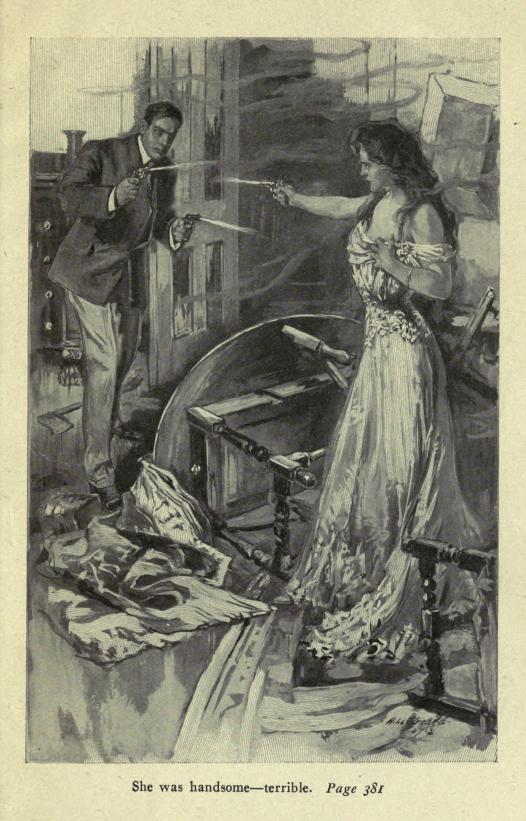
She was handsome—terrible.
She was handsome—terrible. Frightened as she was, she had control of herself yet, and was magnificently defiant, breathing in quick gasps with her mouth open, her bosom heaving, as if she were suffocating. Her embroidered waist was half torn off and hung away from her neck, revealing her brown-white breast, or perhaps she had torn the bodice open herself for air. Her golden wreath was gone. I saw it on the floor, trampled out of shape. Her hair had fallen over her shoulders, but its disarray was lovely. Her filmy, sparkling gown was rent and spotted from her falls.
She had taken refuge behind an overthrown table and stood with her revolver ready. Over her head was a drifting cloud of smoke, about her a wild confusion of disordered furniture. A shaft of sunlight played upon her disheveled costume. In the stable, I heard the dogs barking frantically.
So much I observed in one flash—the picture will always be with me as distinct as a photograph—but I had no time to speak, or even to think what I should do next, for, after that momentary pause, she bent forward deliberately and fired at me point-blank.
I felt a sting on my left arm where her bullet grazed, but, without stopping to find whether I was hurt or not, I fired with both pistols at once, and went forward at her. The sound of the double shot in the closed room was terrific. Her eyes, staring and fascinated, kept on me for an instant as if she were paralyzed, then she screamed again—her voice rivaled the pistol shots—and, suddenly pushing the table with all her might against me, she ran for the door. As she passed, I shot again. The din was maddening.
It was not my intention to finish with her there, though, and again I gave her a chance to escape, driving her before me. As she dashed out she brushed against a framed Madonna upon the wall and it came crashing down. She stumbled on the threshold—I thought she would never get away—and, moaning pitifully, she half ran, half fell down the stairway.
It was a dirty piece of business. I was sickened by it. But, having gone so far, I had no thought of stopping till I had accomplished my object. I gave her a moment's time, therefore, and then, leaving that horrid smoking chaos in her room, I followed her.
She had gone out the front door and turned the corner of the house, making, by some fatal impulse, for the stable. The barking of the collies had ceased, but as I got to the yard I heard it recommence in a higher and more violent key. It seemed incredible to me that she had sought refuge in the stable, but as I looked, I saw the great door rolled shut. When I came up to it, King came out of his cabin room.
King came out; but he was no longer the smiling, unctuous Celestial I had known. In that yelping, screaming clamor, I stopped to look at him in surprise.
He had fastened the mask upon his head and held the cymbals in one hand. With the other he dragged a package of fire-crackers six feet long, braided together in quadruple rows—there were as many there as in a hundred of the common Fourth-of-July packages. It was such an equipment as the Chinese use for their New Year's Day celebrations.
Before I could speak to him he had thrown the string into an empty barrel and had lighted the fuse. Immediately there was an uproar like a regiment of infantry firing at will. As soon as this was started, he took up his cymbals and began capering about, clanging them. The barking of the dogs rose frantically.
Surely, if anything could increase her excitement, this grotesque accession would, and I prepared for the last scene. The uproar inside now rivaled King's racket; Edna was screaming for help, and instantly it occurred to me that the dogs, who had always hated her, might be now upon her, and, if I did not act quickly, would tear her to pieces.
I tried the big door; it was held by something inside. Smashing in a window, sash, glass and all, with my naked fists, I climbed in and went through the harness-room to the carriage shed.
There she stood, now disarrayed to a shocking state, her shining golden skirt ripped half off, her bosom bare, her hair streaming. She was driven into a corner and was held there at bay by three snapping, yelping dogs. She had caught up a carriage whip and was slashing away so savagely that the collies dared not close with her, but I could see that it was only a question of a few minutes before she would collapse.
It was my Joy in face and form, remember! It was her face that was distorted with terror, her form that was draped in glittering rags, it was her voice that rose, shriek on shriek, above the din, till my blood ran cold. It was her voice that screamed to me for help before she was torn to pieces. Its terror will be with me always.
"Oh, help me! Help me!" she cried.
But I steeled myself for the coup de grâce. "Break the bone," I muttered, "and let it heal again!"
So I staggered to the great door, slipped the hasp and let in King, prancing, beating his cymbals, droning some savage chant. The sun shone full upon him, glinted on the brass cymbals and illuminated the red and white and black of his atrocious mask. He danced up to her, nearer and nearer. I watched her, spellbound.
Then, as I looked, I saw her face change. Her whip hand dropped, her staring eyes closed. She clutched at her naked breast, tottered and fell headlong, striking her forehead against a carriage wheel as she went down like a golden wave dashing on the shore. I sprang to catch her, just too late. But the next instant I was down on the floor beside her, beating the collies back, protecting her from their teeth by my own body. Even as I did so they drew off, stopped their fierce snarling and lay down, panting, to watch me quietly. How my hopes rose at this! How eagerly I waited for the prostrate form to revive. Outside, the last of the fire-crackers popped at intervals in the smoking barrel.
"Get some water!" I cried to King.
He threw off his mask, and dropped his cymbals with a clanging clash and was off through the big door.
The next moment I looked up from the pale scarred face on the floor, to see Doctor Copin standing at the entrance. Leah, wide-eyed, staring, was behind him.
"What in hell's the matter?" he demanded, and he looked in astonishment at the scene, at the flaccid body in its magnificent disarray, at me holding her passionately in my arms.
I watched her face for the first sign of life, and did not answer him. His presence mattered little, now, in my agonized suspense.
"For God's sake, Castle, what does this mean? Are you all mad? What has happened? What the devil are you doing here, anyway? Let me see to Miss Fielding, please."
I attempted to hold him off with one hand, but he seized me roughly before I was able to resist, and threw me to one side. He dropped to his knees, looked at the face and felt for the pulse. I took my revolver from my pocket and pointed it at him.
"You take your hand off her, or I'll make you!" I cried.
Quick as a flash he turned and looked at me bravely. "Shoot if you dare!" he said. "This is my day, and this is my Miss Fielding. I take no orders from you, sir. It's my duty as a physician to revive her. She'll send you packing herself, when she comes to."
I was, after all, so fearful of her condition by this time, that I was glad to take advantage of his skill. It would soon be settled one way or the other, at any rate. So I said: