Front matter (continued 2)
Reading edition
He monologued away thus as he helped me into my clothes, and, when I had finished, called to Leah.
She came in, and I took an arm of each, though I scarcely needed their help. We descended a narrow, paneled stairway slowly but safely, without causing me any pain, and turned into a door on the left-hand side of the lower hall. There I found a morris chair ready for me, drawn up before a wide brick fireplace where an oak log was burning. Uncle Jerdon left me with a wink at seeing Leah placing a foot-stool for me and drawing up a taboret on which were cigars and cigarettes. There ensconced, I looked about with interest.
It was a large room, finished all in paneled unvarnished redwood, most beautiful in color—a lighter red than mahogany, with more softness and bloom. Two sides were lined with book-cases, except for the chimney-breast; another was almost filled with a broad bow-window of leaded glass with a deep seat covered with corduroy cushions. There was a narrow shelf supported by carved brackets part way up, and a cornice above that. Between the adzed beams of the ceiling were panels of old Spanish leather, lacquered and stamped. The whole effect was a modified French Renaissance worked out with many charming originalities of detail. The pilasters, and the elaborate mantel with its ornamented moldings and graceful consoles, showed handicraft of an interesting sort. They seemed to have been carved by some artistic amateur, being boldly cut without the machine-like regularity of the professional. There was, besides the unusualness of the wood, much to interest me as an architect.
The library was well filled without appearing crowded, and everything, furniture and appointments, betokened, as had my chamber, not only taste, but luxury. It was evident that Miss Fielding was very well off, and knew how to use her money. It was as evident that she had a strong personality, for there were details that were unique. A large prism of rock-crystal, for instance, carelessly resting in the sunshine upon the dull brown cushions of the window-seat, threw a prismatic spot of splendor upon the ceiling. It was like a gorgeous butterfly pinned to the leather. There was a silver cage of waltzing Japanese mice upon the mantel, little grotesque, pied creatures that spun wheels, washed their necks with their paws and nibbled at rice. The books, too, were arranged upon the shelves apparently not as regards subjects, but rather on account of their bindings, giving masses of color, green and red and brown and black and white.
But it had all been indubitably so well lived in, its properties all ministered so to one's comfort, and the tones were all so restful and admirably composed, that I could imagine no more charming environment for a rainy day with Miss Fielding.
A great library table stood in the center of the apartment, one end of which was covered with magazines—everything from The Journal of Abnormal Psychology to the Pink 'Un. Upon the other end, resting on a hide of ooze leather, were scattered tools and materials, and the unfinished chest upon which Miss Fielding had been working. This was covered with young calfskin, the soft hair still on, a pretty brindled tan and white, and it was bound on the edges with brass strips. These were fastened in place by close rows of brass-headed nails, which accounted for the pounding I had heard. I was admiring the workmanlike way in which the chest was made, when Miss Fielding came in.
"What d'you think of my 'bossy coffret'?" she said. "Isn't it going to be a beauty? My own invention. Don't steal the scheme, and I'll show you how."
She stood up to the table, and, taking one of the brass strips, laid off the divisions and punched holes for the nails, and then hammered it on. She kept up, meanwhile, a running fire of persiflage. Occasionally she would stop to toss her hammer into the air and catch it nimbly by the handle as it fell.
"I thought you were going to call me Edna," she said after a while, pausing with some nails in her mouth to look over at me. "Don't you like the name?"
"I thought you didn't like it," I said, my eyes turning from her brisk, clever hands, to her absorbed face. A wave passed over it as I looked—that baffled expression I had noticed before.
"Did I say so!" Her hammer was poised in mid air.
"Why, didn't you?"
"Oh, yes, I suppose so. It doesn't matter. Nicknames seldom stick, anyway." She placed a nail in the hole.
"Oh, I don't object to 'Chet' at all."
"'Chet' goes, then." She drove in her nail with a frown.
Before I had thought of my promise, I said: "It's funny you don't remember it!"
Bang, bang-bang! Another nail went in, driven viciously.
I fully expected that she would speak of "the island" again, but she didn't. Instead, she dropped her tools, and said:
"I'm building a house, too!"
"Where?" I asked.
She laughed and galumphed across the room and back again without looking at me, before she answered. Then she stopped at the door and called up for Leah to bring down her bunch of keys. When these had come, she knelt in front of the window-seat and unlocked a cupboard below it. From this she brought out a little model house, built of pasteboard, perfect in all its details.
It had windows of mica, behind which were white sashes and lace-paper curtains. The house, an old-fashioned New England homestead, was placed in a little yard of green velvet divided by paths of sandpaper, and set out with toy trees. A child would have loved it. A fairy would have appropriated it at first sight. As an architect, the model made a great appeal to me. It had charm and atmosphere, good massing, good proportions, detail and color. I complimented her enthusiastically.
She was poking about the little front porch and the platform in the rear, where a miniature ash-barrel stood, adjusting the doors and blinds with her slender forefinger, when she frowned and said:
"Why, some one's broken that tree in front! Leah, have you been touching this house? There's a blind gone, too!"
"No, Miss Joy, I haven't touched it!" Leah protested.
Miss Fielding stamped her foot. "You must have! It was all right when I left it here last. Who could have done it, if you didn't?"
Leah grew more and more uneasy, but stood her ground. "Indeed, I didn't touch it, Miss Joy!" she repeated.
"You're all the time meddling with my things. I've caught you at it before. You know altogether too much. Well, go back to your work now!"
Leah left in silence, and Miss Fielding put back the house and locked it up. A hard look came into her face that I had not seen before.
Her temper passed off almost as soon as it had risen, and she was as gay as before. So until luncheon-time, she worked while I looked over the magazines and talked with her.
We sat, at luncheon, on opposite sides of the table in a long and rather narrow room without windows, lighted by a huge skylight. The walls of this strange place were covered with an old-fashioned imitation tapestry paper whose fanciful patterns consisted of consecutive scenes from The Lady of the Lake. Everything about the table was heavy, spotless, valuable and old, from the yellow linen to the hand-made forks and spoons. We were waited upon by King, a smiling, round-faced Chinaman with a cue coiled up on top of his head, and wearing a snowy white uniform. He moved like a ghost in and out. Leah and Uncle Jerdon I noticed, when the door was opened, eating at a table in the kitchen.
Miss Fielding and I spent the afternoon together in the library. She worked and talked alternately; it appeared that she could not do both at once, and always had to stop with her tool in hand when she spoke to me, like a child. Occasionally she would come over to my chair and seat herself familiarly upon the arm as she joked with me. Then she would spring up, to galumph up and down the room, sidewise, running her hand mischievously through my hair as she passed. I took no notice of the liberty, but I was a little surprised at it. It began to rain that afternoon and by five o'clock it was so dark that Leah came in to light the candles in the silver sconces on the walls. Miss Fielding's spirits were gradually tamed. I asked her to play the violin for me but she refused moodily without excuses.
Our talk fell to books, and I went back to Leah's surprising love for Browning.
"Oh, Leah knows more than is good for her," Miss Fielding said. She was on the window-seat, looking out at the steadily falling rain, her feet curled up under her. "Leah's so educated that she's unhappy; it's a great mistake, that. I can't seem to keep her in her place any more. But really, I don't see any poetry in Browning, do you?"
"Why!" I said, "I thought you were fond of Browning—that you 'felt' him, even if you didn't 'see' him. Didn't Leah do that for you?"
"Leah! Fancy! What d'you mean by 'seeing' and 'feeling' him, anyway?" She turned to me with her chin resting on the curled back of her hand.
"They're your own words," I answered, testily perhaps.
She opened her eyes wider. "Oh, I mean what do you mean?"
I didn't answer.
"If I said it," she continued slowly, as if searching for a plausible excuse, and then giving it up, "I suppose I was trying to impress you. You mustn't expect me to be consistent all the time."
"I'll never expect you to be again," I said, now irritated by her contrariness. I suppose I showed it in my tone.
She came right over to me, and took my hand, sitting on the arm of my chair. "Oh, Chet," she pleaded, "don't mind me. I'm a fool, and I know it. I know you don't approve of me any more, but I can't stand it to have you cross with me. I can't bluff you any longer, so I might as well tell you. The fact is, my memory is bad. It's really a disease. Amnesia is the name of it. Now do you see? It isn't my fault, is it? I can't depend upon myself for anything. Sometimes I absolutely forget all about a thing that happened only yesterday. I have great blank spaces in my life when I don't know what has happened. It's perfectly awful! Did you ever hear of any one like that?"
"Do you really mean to tell me that you forget what you said to me about Browning?" I asked her, taking her hand, for I was filled with a sudden pity.
"Yes, Chet, sure I do!" She rolled my seal ring between her fingers as she looked down.
"And about preferring 'Joy' to 'Edna', too?"
"Oh, did I say that, too? Yes, I forget."
"It doesn't seem possible!" I exclaimed. Then, tentatively, almost fearfully, for it seemed the crux: "And about 'the island'?" I held my breath.
"What 'island'?"
I dropped her hand. It was too much for me. "Oh, never mind." I sighed. "I'm very sorry. But I don't quite see, yet. Has this anything to do with your refusal to play for me?"
She rose, now, and tossed her head back, with that shake I had noticed before. The gesture seemed to be the only link between her two moods, and, for a moment, she seemed to be again the melancholy princess. But the phase passed instantly, and she grew petulant.
"I don't know how to play well enough. It bores me."
I refused to let her off, however. "Then how about playing chess?"
She shrugged her shoulders and said: "Oh, I haven't got the kind of brain for chess."
My mind leaped over the remark, obviously untrue, to get to the other side of the perversity, where I might see more clearly.
"But it's incredible!" I cried. "How do you get along? How do you account for things? Do you mean to tell me that you can't remember yesterday, for instance? Not even what you did?"
She was growing more and more impatient. "No—sometimes I don't know how much time I've lost at all. You see, it's like being asleep, that's all. That's what Doctor Copin comes down here for."
"Oh, I see!" I exclaimed.
"That, and other things—" she hinted coquettishly.
"Ah?" I raised my eyebrows. "Among the other things, I suppose, is the fact that you're perfectly charming."
"Oh, I don't think he quite ignores that," she laughed, and then, her mood changing, as if it had been pent up by such serious discussion and sought relief, she bounded away and galumphed madly up and down the room, waving her hands.
After dinner we spent the evening by the fire. She had put on an evening gown of black net over silver tissue, in which she looked more like a princess than ever. But it was only the costume now; her demeanor was far from royal. She snuggled herself into a bunch on the fur rug by the hearth, disclosing one slender ankle and a stocking of snaky silver silk. Had she not been so slender and petite, I might almost say she sprawled, though her hoidenish abandon was not quite immodest. She had her coffee and a cigarette or two, chattering a steady stream meanwhile. I could get no more about her malady out of her; the subject seemed to annoy her. But I could not get it out of my mind. I went back over what had passed, and found that her explanation accounted for much that had baffled me. Still, it did not account for everything. It did not account, for instance, for the way she now treated me.
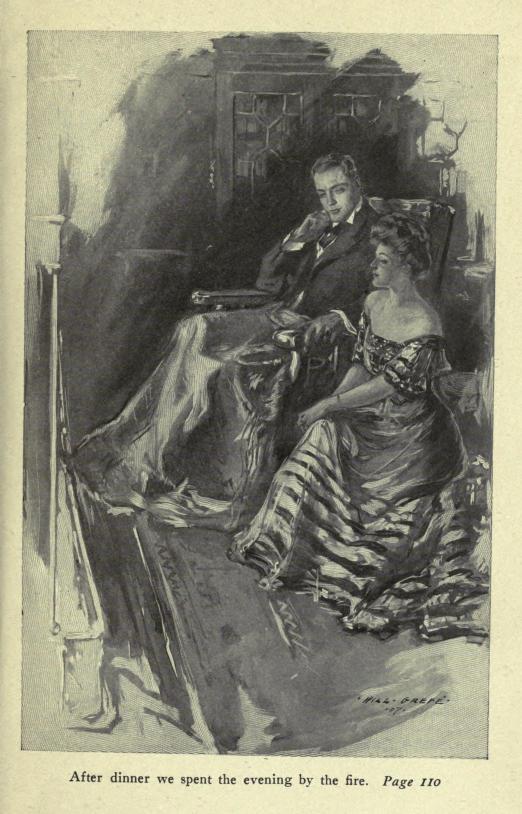
After dinner we spent the evening by the fire.
She got up, after a while, as if annoyed at my abstraction, and began to roam up and down the room.
"I guess coffee makes me a little drunk," she remarked. I did not quite get the point of this till she stopped behind my chair and ran her fingers through my hair carelessly.
"What a jolly wig you've got, Chet! Your hair is almost as fine as mine."
The familiarity made me, I confess, somewhat uncomfortable. I was neither a prig nor a prude, but her talk of the afternoon had wrought on me. I couldn't quite see my way. I didn't at all like, for instance, what she had said about Doctor Copin's coming down—for more than one reason. Perhaps it was this, more than any instinctive dislike of her unconventionality, that put me on my guard with her, and made me appear to ignore what I acknowledge, in other circumstances I might have been tempted to take advantage of. For she was distinctly making up to me. I could see that very plainly. She did like me. So I was unchivalrous enough, or chivalrous enough, if you like, to try to keep her at arm's length, though that is putting it rather too strongly.
It was not so easy, though, that night, with the seclusion, the comfortable open fire, the soft lights, and the rain outside. The situation was romantic; I was alone with a pretty girl, prettily gowned, and quite frankly desirous of a little more intimate companionship than I vouchsafed. Somehow I was rather proud of myself, having at that time, after all, such hazy reasons for forbearance. I scarcely need add to this that I was becoming fond of Miss Fielding, in spite of the puzzling mystery about her. She was alluring in any mood. My intuitions, however, were all for caution.
With such distractions the hours flew fast. The candles burned low and flickered till we talked only by the light of the fire. She told me a good deal of her life as a girl—there were no lapses of memory at that time—how she had been left an orphan and had always been more or less of a hermit thereafter. Part of the time she played with my hand, quite as a child might. Part of the time she sat, her chin at her knees, gazing into the dying flames in the fireplace. Then she would smile, look up suddenly, and quote some nonsense rhyme, or make fun of my discretion. Her body was never quite still; she was nervous and restless. If nothing else about her moved, her toe would be describing little circles on the rug.
She and Leah helped me up-stairs at ten o'clock. Miss Fielding flung me a cheery "Good night, Chet!" and went into her room alone.
A few minutes after, I heard a soft tapping at my door. Leah was there with a jug of milk and some biscuits.
"I thought you might like something to eat, perhaps, before you went to bed," she said. "Miss Joy forgot to speak of it."
"Thank you, Leah," I said, taking the little tray. I was about to close the door when she gave me a look that delayed me.
"Did you want anything else?" I asked.
"Do you mind if I speak to you for a minute?" she asked. She stopped and listened intently for a moment.
"Leah, where in the world are you?" Miss Fielding called impatiently.
Leah, spoke in an undertone to me. "Please wait. I'll be in as soon as I can." Then she went into Miss Fielding's room.
I left my door ajar and sat down by the window. The rain had ceased, and a full moon was breaking through masses of drifting cumulous clouds over the top of the hill behind the house. I could hear the dogs snapping and growling occasionally in their sleep, and below, in his little box of a room off the library, Uncle Jerdon's deep snoring. I must have been there for fifteen minutes before Leah reappeared with her candle. She shut the door noiselessly and came softly up to my side.
"Mr. Castle, how are you feeling, now?" she asked.
"Oh, I'm afraid I'm getting well," I said, smiling. "Why? Do you think I ought to be leaving?" I asked the question jocosely, but she took it up with seriousness.
"I'm really afraid you'd better, Mr. Castle." She looked me square in the eyes. Her own shone very wide and deep.
"I don't wish to hurry you," she went on, "but it will be much better for you to leave as soon as you can. You'll forgive me for mentioning it, won't you? I hope that you won't think that I don't realize my position; but—I can only say that I am doing what I think is best. If I weren't so sure that you are a gentleman, and a friend of Miss Joy's, I'd never dare mention it. But, oh, there'll be trouble if you stay, and Heaven knows we've had trouble enough." Her voice grew lower at the end of her sentence, and then she breathed poignantly, "Oh, please go!"
I felt a pang of self-reproach and a great pity for her. "Oh, I'll go!" I reassured her. "I understand. Or, at least, if I don't quite understand, I'm sure you're quite right. I think I can get away to-morrow morning, if you'll get the carriage for me."
"I'll attend to that. Uncle Jerdon can drive you to the station. And don't, please, mention it to Miss Joy that I spoke to you about it. She may ask you to stay—she likes you, really; but she doesn't know what I know, and I don't dare tell her." She clasped her hands and pressed them closely to her breast in the intensity of her feeling, as she added, "You must help me, Mr. Castle! I have nobody else to turn to."
"Are you sure that I can't help you by staying here?" I asked. "I'll do anything you suggest. Why can't you trust me? I dread to think of your having to fight it out alone, whatever it is."
"Oh, I don't dare to tell—I have no right to tell," she moaned, turning half away, looking down. "Indeed, I wish I might. It's breaking my heart." She turned to me again with a desperate glance. "We'll get on, somehow."
"The doctor will help you, won't he? Surely you can trust him?"
She gave me a frightened look, and her white teeth shone through her parted lips, gleaming in contrast to her fine dark face. Then her eyes strayed again, and she said, slowly, "Do you think he can be trusted?"
"Why not?" I replied, watching her sharply. "How, at any rate, can I tell, after having seen him only once?"
She gave a quick indrawn sigh. "Oh, once was enough for me!"
"You mean—that you don't trust him?" I exclaimed in surprise.
"I mean I'm not sure that I do." She was speaking slowly now, choosing her words with an effort. "That's quite as bad, isn't it? For I don't know what to do about him. I am afraid that I may make things worse, perhaps."
"You're sure that you can't tell me?"
"Oh, I daren't! If I were only sure, I might, but even then it would be hard." Her voice was plaintive, and yet her accent was decisive.
There was a pause in which I thought of many things. As I waited, uncertain, my eyes stayed on the fine, erect, colored girl before me, so passionately loyal to her mistress, so delicately sensitive to the anomalous part she was playing. Though her resolution had in no way broken down, I could see how she was wrought upon, how difficult a position was hers in that strange house.
"Well," I said finally, "there's of course nothing for me to do, then, but to leave. Miss Fielding has told me explicitly that your judgment can be depended upon. I have no right here, of course; I'm an interloper——"
She put a dark, well-shaped hand on my arm, in timid reproach.
"Yet, I hope you can trust me," I added, not hesitating to clasp that hand in friendship and confidence.
She took it away quickly, but looked at me with her soul in her dark eyes. "Oh, I'm sure of you!" she said simply.
"You make it very hard for me to go," I ventured.
"I shall think of you," she replied. "I shall long for your strength and judgment. I must think it over, more, and try to decide on a line of action. It may be—I won't promise—that I shall send for you to come down."
"I'll come at a moment's notice!" I exclaimed. "Oh, do let me help in some way!"
"Would you?" She clasped her hands to her breast again and sighed, as if I had really helped her by my promise. Then, "I'm glad to be able to know that. Miss Joy likes you. I think you have a rare sympathy for her condition. It's a relief. Then we'll leave it that way. So you'll go?"
"To-morrow morning," I answered.
VII
We met, next morning, in the library, for I could move alone, now, and had gone down early. My hostess, dressed in white duck, was in her most exquisitely graceful mood, quite the delicate, refined, intense woman I had first known.
"Do you really think that it's safe for you to leave to-day!" she asked, when I had announced my intention to her. "I am afraid we shall miss you very much, Mr. Castle. I feel quite as if I had made a friend."
"If you do, it more than repays me for my accident, Miss Fielding. It only remains for you to prove it by permitting me to do something for you."
She smiled quickly. "Stay here a while longer, then!"
"Ah, you know how glad I'd be to! But I really must get back. I've imposed on your hospitality unconscionably, already."
"Oh, well," she turned to the window, "if you're going to pay me the conventional compliments, we won't press it."
"If you knew what an immensely unwarranted interest I've begun to take in you, you'd spare me," I replied.
She held out her hand to me, her graceful fingers slightly divergent, exquisitely posed. "Thank you for your gallantry," she said. "You came out of the dark, were literally dumped here, you know, and it has been wonderful that we have understood each other as well as we have." She stayed my interruption, with a wave of her hand. "Oh, I understand you, I think, at least well enough to be sure of you. But, let's be frank—you don't quite understand me, yet. You don't quite approve of me. Nevertheless, you like me, and we can be friends. It may indeed be that I shall put you, sometime, to the test, and give you the chance of proving it. Until that time comes, you'll have to stay on the island, Mr. Castle, I'm afraid."
I saw by these words that she must have forgotten her revelations of the night before. It didn't seem quite fair not to let her know. So, risking her displeasure, I came out with it.
"May I venture to remind you of what you said last night?"
She looked hard at me. "What did I say? What do you mean? About what? We talked of so many things, you know." She was embarrassed, on the defense, watching eagerly my first word of enlightenment.
"About your memory," I prompted.
"My memory? I don't quite recall—" Her lips were parted and her fists closed a little as she waited.
"About your having amnesia, you know."
Her hand went to her heart.
"I only mention it," I said, "because I don't want to take advantage of any ignorance you may have concerning my position—and what I do know. If you have forgotten possibly, I think I ought to tell you, for I can't pretend to be on the island when I am not. It seems to me that quite in spite of myself I've got off it. What you said about Doctor Copin——"
She caught me up, now, a little wildly, discarding further attempt at evasion. Her face had suddenly grown white. "What did I say?" she asked.
"Oh, only that he was treating you for the amnesia," I replied. I couldn't possibly repeat the rest of it.
She put her hands to her face for a moment, hiding its expression. Then she withdrew them, compressed her lips, and, tipping her head back a little, shook it with the old gesture, as if to regain control of herself. Then she came up to me and put both her hands on my shoulders.
"It isn't your fault, I know, Mr. Castle. But you are off the island, and I'm afraid—that it's all over, now."
"Isn't it really all begun, rather?" I replied.
Her hands dropped to her sides, and she walked away to the window. "Oh, I don't know, I don't know!" she moaned. "You have made me think terrible things. But never mind. I didn't want you to know about me, I hoped we could be friends without. I couldn't risk it, I can't risk it now. You mustn't try to find out, you mustn't even wonder. Just be a little sorry for me—and wait."
She sat down in the broad window-seat, and laid her head back for a moment among the silk pillows, with a wearied settling of her body, closing her eyes. I didn't know what to say or do, so I did nothing, and was silent. She sat up again, took the crystal prism that still lay there, and gazed into it abstractedly, as if she were seeing visions. Then, still holding it, she looked up at me with a faraway smile. It was a new expression I saw on her face; it had the pathetic look of some elf, lost in a strange, terrible land. At last she said, "Come over here, and sit down beside me, please!"
I did so; and, still fondling the prism, which shot prismatic colors into the room, she said, as with great effort:
"Did you ever, in your childhood, read the story of the White Cat? It's a fairy tale, you know."
The name had struck me as familiar when she used it before, but I could not recall the story.
"It was one of those tales of the three quests, wasn't it?" I said.
"Yes; there are many variations of the same theme. It is the story of a king and his three sons. The father decided first to leave his throne to the one who would find the smallest dog in the world; then he gave them another quest, to find a piece of cloth that would go through the eye of a needle. Of course, the youngest son won each time, but the king wasn't contented, and for the final test commanded them to find the most beautiful lady in the world."
"And the youngest son won, of course. He always does, but he never plays fair. He's always helped by a fairy godmother or something."
"Of course. Such are the ethics of Fairyland. This prince was helped by a white cat. While he was on his travels he found her castle in a deep forest, and he was carried in by invisible hands."
"Just like me," I remarked.
She looked at me for a moment with an amusing expression of surprise, and a timid smile crept to her face. "That's so, isn't it? How queer! Why, I'll have to give you my little Hiawatha, to carry it out, won't I? Will you take him?"
"Oh, if you would!" I said. "I'd love to have him. It will be delightful to have something that has belonged to you."
"He's not the smallest dog in the world, but he's yours."
"And the third quest?" I reminded her.
"The third quest was the hardest of all. He came to White Cat's castle again, and he stayed a year. They had a most delightful time together."
"I can understand that. Just as we have had."
Her gaze went down to her feet. "Yes, just as we have had here at Midmeadows."
I reached over and took the prism from her hand. I couldn't help wanting to touch her, however casually.
"And of course—you don't need to tell me—he did find the fairest lady in the whole world."
She smiled dimly and clasped her hands. "Thank you," she said, not too absorbed to pay me most graciously for my compliment. Then, more seriously, she added, "Yes, I am the White Cat. That is the way you must think of me, when you have gone. The enchanted White Cat!"
I dared not answer. All the peculiar moods she had shown me came up for a new vision. So she knew that something was the matter, something of which her amnesia was only a symptom. She had never come so close to it before. I stooped down, took her hand and carried it to my lips.
"White Cat," I said, "I don't know whether you are enchanted or not, but I know you're enchanting!"
"Be careful I don't scratch you!" she said, a little bitterly.
"Ah, White Cat never did that, I'm sure."
"Yes, once, when she was invisible. The Prince doubted her. Do you know how it ended?" she asked.
"How?"
"White Cat told the Prince that, to destroy the fatal work of the fairies, it was necessary for him to cut off her head and her tail and fling them into the fire." She put her hand gently upon mine. "Would you do that for me, if I asked it?"
I puzzled with it. There was something tragic in her tone, but I was quite at a loss to interpret her symbolism.
"Would it ever come to that? Are you likely to call on me?" I asked her.
She tipped back her head again, shaking away some unpleasant idea.
"Ah, this is only the first quest, you know. You may never come again to my palace. But would you?"
A dreadful meaning came straight from her eyes to mine.
"No, I'm afraid I would not. It would be too terrible!"
She threw off a light laugh, and rose and walked to the book-case beside the chimney. Here she took down an old, tattered, red-covered volume and rapidly turned the pages till she found her place. Then she came back to her seat beside me, and, pointing to the lines, read aloud:
"'I!' exclaimed the Prince. 'Blanchette, my love! I be so barbarous as to kill you! Ah! you would doubtless try my heart; but rest assured it is incapable of forgetting the love and gratitude it owes to you.'
"'No, son of a king,' continued she, 'I do not suspect thee of ingratitude. I know thy worth. It is neither thou nor I who in this affair can control our destiny. Do as I bid thee. We shall both of us begin to be happy, and, on the faith of a cat of reputation and honor, thou wilt acknowledge that I am truly thy friend.'"
"But it ended happily, like all fairy tales. So will yours, I'm sure," I remarked.
She let the book drop wearily. "It must end some way—why not that?"
I clasped her hand. "You must not think of it, Miss Fielding! It appals me."
"Well, I won't speak of it again. But I should be glad to have a friend who would help me, if worst came to worst."
"You forget that, in spite of what I know, I am still on the island, after all; I can't yet judge of such a necessity."
"Well, Leah and I will fight it out."
"You said, once, that I could trust Leah in everything. Do you still mean that?"
"Absolutely. In fact, you can trust her when you're uncertain of me. Do you understand? I can't make it too emphatic."
"I understand," I said.
It was almost time to go now, and so, while I went up-stairs to see that my things were ready, Miss Fielding and Leah got Hiawatha, fixed a collar and chain on him, and put him into the carriage, highly excited at the prospect of traveling. Leah shook my hand and looked into my eyes with gratitude.
Uncle Jerdon drove up to the front door, and I got in beside him and captured the frisky puppy, who proceeded to bite my hand playfully. It had been arranged that I was to send some one down to repair the automobile, and I permitted myself to hope that I might find in that a sufficient excuse to come back myself. So it was not altogether with a feeling of permanent parting that I finally gave my hand to Miss Fielding.
"Well, good-by, White Cat," I said, as Uncle Jerdon took up the reins.
"Good-by, Prince!" she answered, smiling.
We drove off, and, as we turned into the long lane which led to the highroad, I saw the two women standing in the sunshine, at the front door, and waved a last farewell to them. With all the sinister suggestions that had been crowding upon me, I could not bear to leave them alone. "White Cat White Cat," was still echoing in my ears.
Uncle Jerdon winked at me.
"Lord, she's as crazy as a loon, ain't she?"
"Do you think so?" I asked coldly.
"Plum' crazy. She ought to be into an asylum, and would be, if she had any folks to send her there. But she's a dandy when she's all right, you can bet on that!"
I did not encourage him to go on, and for the rest of the way to the station we talked of his rheumatism and the extravagance of his nephew's second wife.
PART SECOND
I
My machine had been repaired for a week, but I had not had it brought up to town, when I received a note from Leah. It was dated "Tuesday."
"Come down immediately," she wrote, "if you can think of a plausible pretext, but don't say that I sent for you. Miss Fielding will not ask you, herself, but we need you very much. I trust to you."
I took an early afternoon train the next day, and, finding no one to meet me at the station, engaged a carriage to take me over to Miss Fielding's place. My driver would, I am sure, have been glad to gossip with me upon the lady's affairs, but I headed off all his hints, knowing pretty well from Uncle Jerdon's insinuations what the tenor of the neighborhood talk must be.
Midmeadows was about four miles from the station, and a half-mile back from the county road. The house was approached by two long lanes overgrown with shrubbery and hazels, one from the seaside on the east, and one from the main road on the north. We took the latter, a wild and tangled wagon-track, filled with stones and hummocks, and worn into deep holes. The boughs of trees constantly scraped across the top of the buggy and often hung low enough to threaten our eyes. Near the house, the lane took a turn round the corner of an extensive, old-fashioned garden of hollyhocks, rose-bushes, poppies and violets, then swung up to the green, eight-paneled front door, with its transom of old bull's-eye panes. The copse came in close to the garden, partly inclosing it on two sides. To the right of the house vegetables were planted, with meadows beyond, and behind, the hill rose almost from the stable. The whole place had a charming natural wildness, and seemed, as indeed it was, miles away from any other human habitation; but it was not uncared-for; its natural features had been amended and composed with the care of a true artist.
The house itself was long and low, covered with unstained shingles. A great square brick chimney rose from the middle of the gambrel-roof. The lower windows were leaded and built out into wide bays, but they showed above the little-paned sashes of the original building. The front was almost hidden by climbing Cecil Bruner roses, now odorously in bloom. The southern side was lined with a row of geraniums which rose in huge bushes. Here, in the second story, was another bay-window of curious construction, somewhat resembling the stern of an old galleon. It was Miss Fielding's sitting-room, which I had not yet visited.
The place seemed deserted, for not even the dogs were visible. I got out and knocked, while my driver waited curiously to catch what was, probably, a rare glimpse of the mistress of the house.
Joy herself, wearing a white duck sailor suit, with a red handkerchief knotted about her neck, answered my knock. She held her hand to her eyes to shade them from the rays of the afternoon sun, so that I could not, at first, quite make out her expression. The first thing she showed, after her surprise, was a most cordial satisfaction at seeing me. She did not, apparently, expect me, but my presence delighted her. I saw next that she was in trouble. The very intensity of her welcome alarmed me. The two vertical lines between her brows were deeply cut into her forehead, her lips were quivering, there were dark circles under her eyes.
She drew me quickly into the library, and I saw terror in her look. Her cheeks were pale and wan. Her hand trembled, as it lay on the back of a chair where she leaned.
"Oh, I am so glad you have come!" had been her first speech, murmured in the hall, and it was repeated now as I stood before her. "I am so glad you have come! I need you so!"
I had fancied before that her face was one capable of expressing tragedy—not every woman's is. Tragedy shadowed her face now, giving her a newer, more dramatic beauty so moving that, despite my alarm, I could not help wondering at it.
"You are not well," I exclaimed.
"Oh, well enough—" she replied.
"Something is the matter—what is it?"
"Sit down and I'll try to tell you." She dropped into a chair, with her elbow on the table, letting her cheek fall into the hollow of her palm. Her eyes closed for a moment; the soft, long lashes shading her pale cheek. Then she shook herself and sat erect. "I'm so sleepy!" she moaned. "I haven't slept since night before last."
I sprang up from the window-seat. "Won't you lie down here and rest? Do!" I pleaded.
"Oh, I don't dare! I don't dare!" she cried.
"Tell me what is troubling you, so that I may try to help you!"
She looked up and said, "Leah has gone!" and she put out a hand that trembled with a despairing gesture.
"Gone?" I repeated. "Where!"
"I don't know where. I don't know when she went. I don't know even why."
"Do you fear she has met with an accident, then?"
"Oh, no, not that. Worse than that!" She spoke helplessly.
"Worse?" I could not understand.
"I mean I think I must have driven her away."
I still could not guess. "Why, how could you have done that? You mean that she took offense at something, perhaps?"
"Oh, I must have made it impossible for her to stay."
"But what did you do? She was devoted to you."
She sprang up and wailed out with bitter vehemence, "Oh, I don't know! I don't know! If I only knew, I could do something. But what can I do, now? She's gone. She was my right hand, my eyes, my ears, my memory—but it's not that! It's that I could have been cruel enough to her to drive her away. Where is she? Where could she have gone, do you think? I've waited and waited to hear from her, or for her to come back—two whole days! I didn't go to bed at all last night. I didn't dare, lest she should come while I was asleep."
"You expect her to return, then?"
She was walking up and down the room, her hands clasped behind her back tightly. I could see that she was on the verge of hysteria. She turned to me again, and said:
"Oh, Leah would never abandon me, never! She's too true for that. But she's afraid to come back!"
I went up to her and led her gently to the seat.
"Now," I said, "tell me exactly what has happened."
She broke out again wildly, her face twitching with excitement. "I don't know! Don't you see I don't know? That's the horror of it! I may have killed her, for all I know!"
"Ah! Do you mean," I began, afraid to say it, "that you've forgotten?"
She stared at me. "Forgotten? Well, you may call it that. Yes, I've forgotten." She put her face into the pillow and began to sob convulsively. After this nervous crisis had spent itself she sat up, wiped her eyes and said with a faint, spectral smile:
"Oh, I'll have to tell you everything, now. I can't bear it any longer. It was bad enough while I had Leah to depend upon, but now I must have somebody to confide in, or I shall go mad—if I haven't already gone mad."
I looked over at the table where I noticed a coffee-pot and a cup on a salver. "How much coffee have you drunk?" I asked.
"Oh, I don't know. Cup after cup. I've been drinking it all day to keep me awake."
"That accounts for your nerves. You must rest. If you sleep a little, you'll get your strength back."
She sprang up suddenly, her gripped fists raised, her head thrown back in a sudden new access of alarm. "Oh, no, no, no! You don't understand! I daren't sleep! I'm afraid—afraid! How do I know what may happen, now when I'm so worn out!"
I had done considerable thinking while I was away, and I had done some reading as well. I was beginning now to make it out, piece by piece, and put it together in an astonishing whole. It was too late, in this crisis, for reserves, too late for me to keep to my promise of not trying to know. The girl was distraught and alone. And, indeed, the door to the cupboard where her skeleton had been hidden was now well ajar.
"You are afraid, you mean, of the other one?" I brought it out deliberately.
She stared at me, like a somnambulist.
"Yes," she whispered, "of the 'other one.'"
Then for the first time, and quite unconsciously, I think, she used my name. It seemed so natural to me that I was not surprised.
"Oh, I'm so glad you know, at last, Chester. I'm so glad that it will be easier to tell you." She put her hand on my arm and looked up at me in tenderest confidence. "Now you know why I called myself the 'White Cat.'"
"Yes, I see. Don't be alarmed. I'll help you. You must calm yourself and we'll find out a way. I know her, you know."
"Yes, I know you do. You must tell me all about her, sometime. How you must have hated me!"
"Perhaps I can manage her, but no matter about her, now. We must think it all out, and decide calmly what to do. I'm not afraid. Trust me, and I'll see you through. It will all come out right, I'm sure."
I went on so, purposely iterating such phrases to lull her, and key down the intense strain which wrought upon her. Her eyes kept on me, and I saw my influence work—my suggestion, I might say, since it was purposely hypnotic. Her hysteria made her abnormally sensitive to the treatment. She relaxed her attitude slightly, sighed, and dropped back among the silken pillows behind her.
"Oh, you're so good!" she breathed. "You will help me, I'm sure. You have helped me already! You're so strong—it's such a comfort to have you here!" She reached her hand out shyly and put it in mine, where it lay, small and cold. It was the first time she had done so, except under the direct stress of an earnestness strong enough to rob the act of any personal suggestion. It was a distinct caress, fearless and genuine.
"Now," I said, "begin at the beginning, and tell me all about what has happened."
She took it up again with a new courage. "As I've said, I don't know when Leah left. I only know that when I rang for her yesterday morning she didn't come. I went into her room and she wasn't there. She wasn't down-stairs. King didn't know anything about it."
"Nor Uncle Jerdon?"
"Uncle Jerdon has been away for three days, visiting his nephew, who's ill. You see, she—the other one—was here for two days running. It hasn't happened so for years. So whether it happened, whatever did happen, on Monday or Tuesday, I can't tell. Leah might have left either day."
"How do you know that 'the other one' was here for two days?"
"Only because Sunday is the last thing I remember before yesterday morning. The doctor was down then. You know that there's a hiatus when she's here—a perfect blank in my memory. I lose time, as she does, when I'm here."
Her mention of the doctor started a new train of thought, but I put that by for the present, to tell her of the letter I had received from Leah, which made it probable that she had left on Tuesday, the second day of "the other one." The situation was serious enough, I was sure, for me to disobey Leah's injunction to secrecy.
"Oh," said Joy, "that relieves my mind a little. It shows that Leah had a plan, and she must have stayed somewhere near here, expecting you, though how she happened to miss you, I don't see. It's quite right for you to have told me, for I had already telephoned to you—to-day, after you started. I was surprised to see you appear so soon, for that reason. I was at my wits' end yesterday, but I hated to drag you into this. But what could I do? Doctor Copin has gone out of town for a few days."
"I'm glad you sent for me," I said. "I shan't have to feel that I'm intruding. But now the question is, why doesn't Leah come back? Why didn't she wait for me at the station?"
"She must have been awfully frightened, to have gone away like this," Joy said.
"Perhaps she discharged her—I know she complained of Leah a good deal."
"Yes, I've thought of that. But I fear it's even worse."
"In any case, there's no reason why she shouldn't come back, now that 'the other one' has disappeared," I said.
"How can Leah tell?" Joy exclaimed. "How will she know whether it is I or 'the other one'? We're really the same person, outwardly. There's no difference that she could recognize unless she talked to me. That's what has terrified me."
Then, for the first time, I saw the dilemma. How, indeed, could Leah know? The same woman, the same clothes—but yet, how different! "Have you no sign?" I asked. "Haven't you ever arranged it with Leah so that she can tell?"
"Oh, not for a case like this. It has never been necessary. You see, the change always comes at night, at least always during sleep, so that when I wake up she can tell right off, by asking me what I'll have for breakfast. We've arranged it so that I shall always give a fanciful reply, and let her give an obvious commonplace one. But now, Leah daren't come in, for she knows that if I should happen to be 'the other one,' there'll be the same terrible something that happened before—a quarrel, or worse."
"Still, there are some apparent differences. You dress differently, it seems to me. You usually wear white. Won't Leah know by her experience of you both?"
"Oh, no; you can't tell. She's so whimsical—sometimes she'll do one thing, and sometimes another, like a child. You can't depend on her. She's tricky, too."
"I could tell, I'm sure—by your eyes. Hers are darker, and the pupils are dilated, aren't they, usually?"
"Yes—but Leah daren't come near enough for that, don't you see? Oh, she must be in agony, poor girl! But how do I know? She may be dead!"
"You forget that she has written to me since leaving."
"Oh, yes—that is a relief. But I may have hurt her."
"Oh, Joy! Don't say you could have—it was not you, it was Edna."
"Well, how can I tell whether or not I'm responsible?"
"I don't think she would have struck her," I said.
"No? She did once, though. She stabbed Leah with a carving-tool on the wrist. It always sickens me to see that scar. Oh, she has a temper! Poor Leah!"
She lay back on the cushions again and closed her eyes. Her hand had relaxed in mine.
I looked at her, so wearied and pale, and said softly:
"You just drop off to sleep for a little while, and I'll think it over—"
She nerved her body, and pulled herself up.
"Oh, no!" she exclaimed. "I'm dying for sleep, but don't you see I can't? If I should fall asleep who would it be that would awake? It might be she."
"By Jove!" I cried, "I hadn't thought of that!"
"I've thought of nothing else. That's why I've stayed up and kept awake while I am so exhausted. If Leah comes back, she must find me here, and not 'the other one.' I must see her and find out what has happened—we must arrange for everything and decide what plan to adopt to circumvent her. Oh, I must keep awake!" Even as she spoke her head dropped again heavily.
"You can't tell, then, when the change is likely to come?"
"Sometimes I have a feeling—a premonition—like that night, don't you remember, when I was so blue? I knew that I was going to change. But usually I can't tell. She has come lately, about two days in the seven, but irregularly. It's almost always after a deep, heavy sleep. You remember how late she used to lie abed? That's what worries me now. I'm absolutely exhausted, and if I do fall asleep, I'll go down deep. So deep, I'm afraid, that I'll change. Can you think what a horror that is to me? I must stay up till Leah comes. You must promise to keep me awake by every means in your power. But even then, what are we going to do? How can we arrange a way for Leah to get along with her?"
"That's where I come into the game," I said. "I think I can solve that problem."
"How did you get on with her?" Joy asked timidly. It was quite as if she were asking about another woman, and feared to commit an impertinence. "Do you like her?" she added.
"She's not to be compared to you, of course. But there's much that's likable about her, and at least, we get on beautifully. And so we shall this time, if she'll only let me stay. That's the difficulty."
"Oh, she'll let you stay, she'll be only too glad. She likes you, Leah says." Her brows drew together, and I wondered how much she knew.
"Well, then, I'll undertake to make her keep Leah."
"Oh, if you can do that—on any terms—we can stand it, both of us. Leah will suffer anything, I'm sure, rather than leave me."
"One thing more, then—since I must have all the information if I am to do anything—what does she know?"
"About me? Nothing, I think. At least she has never been told, I mean—we've always kept it from her. She thinks she's the only one."
"I don't see how that can be possible!"
"It does seem strange; but then, you know she's mentally undeveloped. In some ways she's a mere child. And then, too, she has never known it to be any different—why should she suspect that there is another personality—that she isn't the real Joy Fielding? She's conscious that she loses time, so to speak, and she thinks it is only the fault of her memory."
I thought it over a while. Then I said: "She wouldn't say much about it to me, and so I didn't quite get her point of view. It baffles me. She must know that she does things in the lapses, even if she doesn't recall them."
"I don't know that she's even aware of that. She may think that she's unconscious, during these lapses, but most likely it is just like dreams. Even if we vaguely remember them, for a moment, we forget them, and they don't seem to have been real—or, perhaps, they're like delirium, or insane intervals, of which she has no memory. Why, a man may even be simply drunk, and not recall what he has done, and that self is, really, a different personality."
"But," I pursued, "do you forget, too?"
"Yes. That is, almost always. At times I have had vague formless memories, as one has of dreams—that's about as much as this second life ever is associated with my normal one—if what I now have is the normal—how do I know even that? But I have known about the duality almost from the first, and of course Leah keeps me informed of everything that happens. You see, sometimes I'm not even aware that there has been a lapse—I don't realize that it isn't just the next day. Leah tells her as little as possible about me. She's easily managed and put off, usually, but somehow of late she seems to have grown stronger. She seems to be developing mentally. It frightens me a little."
"You don't think that anybody has told her, possibly?" I suggested.
"There's nobody to tell her. Of course Leah never would."
"Uncle Jerdon?"
"Oh, he thinks I'm crazy, and he never talks, anyway, I'm sure. He doesn't realize what's happening, for, after all, we're not obviously different; she might be taken for me in some queer mood, I mean," she added.
"King?"
"I believe he thinks that I'm possessed of a devil. Which I think I am!" She paused to smile faintly. "Anyway, he minds his own business. I have an idea that he has a reason for wanting to keep quiet."
"Or, lastly, then, the doctor?" I put it hesitatingly, yet I wanted to know what she would say. Her answer was prompt.
"He wouldn't tell, I'm sure. Why, he wants to cure me. It would spoil all chance of that, I think, if she knew."
I wasn't so sure of the doctor, after what Leah had said to me, but it would do no good, now, to mention that. She had trouble enough at present not to worry her with new doubts.
"Then, is it possible that she might have come across some evidence of you, in your writings, or something that would arouse her curiosity?"
"Oh, I think she hasn't the least suspicion. As I said, it must all seem natural enough for her to lose time—she has always done so. Everything is accounted for to her by the fact that she forgets. Of course, I am careful to hide everything that is strictly my own, anything, that is, that she would not understand. Leah keeps all my private letters under lock and key. I'm very careful, for I've been on my guard since it first began."
"How long?" I asked.
"Ever since I was thirteen. That's when she came first."
"It's incredible!" I exclaimed. "Of course, I've heard of such multiple personalities, of the celebrated ones, but they've seemed only like queer, improbable cases out of a book—monstrosities. Or I've regarded them as half-crazed or hysterical or somnambulistic. But you, Miss Fielding! You seem so beautifully sane, so poised, so complete—it's like a fairy tale. Oh, you are the 'White Cat'! You are under a spell!"
"It's only because I'm not a poor girl that I'm not a mere 'case,' I assure you. You don't know what a life I've led, how every physician I've had has wanted to study me, or put me in a sanatorium or a hospital or an asylum or worse. Yes, if I hadn't the money, I should probably be in a mad-house at this moment. Do you realize how easy it would be for a physician to put me there? From the ordinary point of view, I'm virtually insane part of the time. I have been in great danger, Chester. But, having some money, I have been able to get away from people and seclude myself and retain my freedom—if you call it freedom to be cheated out of part of your natural life! I have had Leah, and she was enough. She understands, she's loyal, and she is, above all, wise and good."
"But the doctor—what about him?"
"Of course I must have a physician at times, and Doctor Copin is a good one, and interested in my case. He has been most kind to me. Of course I am interesting, though, psychologically, and he's probably written a monograph about me for some medical society already. But I have him chiefly for medical troubles, and to keep general run of this thing, enough to advise me."
This was rather different from what Edna had led me to believe, so I said:
"He hasn't attempted to treat you for this psychological dissociation?"
"No. He has wanted to. In fact, he's always urging me to allow him to see what he can do, but I won't let him. He wants to hypnotize me—but I don't quite dare—would you?"
"No," I said. "I'd advise you not to. If that's to be done you ought to go to a great specialist."
I thought I had a clue now that would bear following up, but I decided to think it over a while before I spoke of it.
So intently had we talked, that we had scarcely noticed the darkness which had fallen until King's gong aroused us. Joy rose wearily.
"Would you mind lighting the candles?" she said.
She waited till all the sconces were burning and then, as I went to the window, she said:
"No, leave the shades up, please! I want the windows left so that Leah, if she comes, may look in. I feel somehow that she is near here, that she will come this evening, if she dares."
"Why haven't you been out where she could see you, then? Have you thought to call her?"
She looked at me blankly. "Why, I haven't thought of that, have I? But would she dare come?"
"Try it now!" I exclaimed.
"I will!" She went to the front door and threw it open and cried:
"Leah!—Leah!—Leah! Come here! It's all right. I want you, dear!"
There was enough in the scene—the stillness that ensued, the gathering mysterious twilight that shrouded the house, the tragic quaver in Joy's voice—to make me thrill to its dramatic power. She stood there for a few minutes, all in white, waiting, her hands clasped on her breast, vividly illuminated by the candles. But no sound came out of the shadows of the night.
Joy closed the door; then, with quick second thought, she returned to leave it ajar, and came back into the library.
We had moved almost to the dining-room, when, on a sudden whim, she paused, turned and looked toward the window. My own eyes followed hers. There was a dark face peering in—so dark that the whites of the eyes and the teeth were almost all that was visible, though enough to show who it was.
"Leah!" Joy cried, and ran again to the door, crying out hysterically. She called again, but no answer came.
It occurred to me that the excited accents of Joy's voice might well be misleading, and for the first time I thought to try myself. Joy had returned, to throw herself down, sobbing, full length upon the window-seat, her heart breaking with the suspense and disappointment. The strain was too much for her, after her hours of hope and fear. I did not stop to comfort her then, but ran to the doorway and stood in the lighted hall there in plain sight.
"Leah!" I called. "Come here, it's I—Mr. Castle. I want you!"
There was still no reply, but, feeling sure that Leah must be near at hand, I started off vaguely in the dark. I had gone but to the turn of the lane when I heard footsteps, running. Then in a rush Leah was upon me, and had seized my hand.
"Oh, Mr. Castle! I'm so glad you've come—but I was afraid to go in. I was afraid I might make it worse if she was there. Who is it? Tell me quick! Is it my own Miss Joy, or the other?"
"It's Joy," I assured her, "and she's waiting for you. You must come at once."
She paused a moment, evidently wondering if I knew the secret.
"You're sure?" she said. "You know that there are two?"
"Yes—I know everything, now, and this is Joy—your Joy!"
She bounded forward, and I with her, stumbling in the dark, into the doorway, to the library. There for a moment she stopped, trembling so violently that her teeth chattered audibly. Joy was still lying stretched out at full length upon the cushions of the window-seat. At the first glance Leah did not see her, but then she ran forward, knelt, and threw her arms about her mistress.
But the next instant, starting back as if she had embraced a corpse, she sprang up and faced me, her eyes opened wide in horror.
"Oh, Mr. Castle, she's asleep! Miss Joy's asleep!"
II
For a moment I was too surprised to realize the full significance of Leah's cry. Then Joy's own words came back—the wail of her harassed soul—"If I should fall asleep, who would it be that would awake?" There she lay, asleep at last. Her small head lay upon her arm, and her oval face was now flushed, her lips half parted, showing her little blue-white teeth. The crisp white duck blouse moved gently with her breathing—beneath her skirt two tiny red shoes lay one over the other.
As she herself had said, she was so utterly exhausted that she would "go down deep." Dared we awaken her? Certainly not Leah, who, of course, had seen the whole awful possibility on the instant.
I had to decide. What was to be done must be done quickly. If Joy were allowed to sleep long and deeply we might confidently expect "the other one" to awaken. The question was, could we, perhaps, rouse her before that incomprehensible change had taken place? It seemed to be the only thing to do. I determined, at all events, to take the risk.
Meanwhile, Leah had fallen into a chair, overcome with the disappointment of the situation. She was in a distressing state; her skirt was torn and soiled, her shoes dusty, her waist disheveled. Her black hair was awry; she was hatless. I thought at first that she, too, had fallen asleep from sheer fatigue.
I went to her and laid a hand on her shoulder to rouse her. She started with a frightened jump.
"Leah," I said, "I'm going to awaken Miss Fielding. It's the only thing to do, I think. We may be able to get her again, before she changes. But if not, we must be ready with some plan by which to manage Edna. We must hurry, though. First, tell me in the fewest possible words what has happened. Joy, of course, didn't know."
Leah had braced herself for the ordeal and was now quick, alert and concise. "She got angry on account of my 'trying to run her,' she said. You see 'the other one' was here for two days. I've always been able to manage her for one day, but the second day she seemed to be much stronger, and it was worse than it has ever been before. She found out that I had burned some of her old clothes—Miss Joy had told me to—and so she discharged me and told me to leave the place immediately. I wouldn't go, and she went into the barn and got a horsewhip and threatened me with it. I was afraid, Mr. Castle! She was in a fearful temper. I was afraid she'd kill me. Then I went. I stayed all night in the Harbor. I wrote to you as soon as I got there, for I couldn't get you on the telephone. Yesterday I hung about the place all day, but she didn't appear, and I was afraid to come in. I positively didn't dare, though I knew it probably was Miss Joy. To-day I stayed in that old cabin down by the road all day, for I was pretty sure it must be she who was here. I was so tired I fell asleep and that's how I missed you, I suppose. I've had hardly anything to eat since yesterday—only a few biscuits I brought with me."
I had been thinking out a plan as I listened, and as soon as she had finished I gave Leah her orders.
"Listen, now. If it is 'the other one' who awakens, I'll tell her that I happened to meet you in the Harbor, and induced you to come back, on my own responsibility. Do you see? I'll manage it; you needn't be afraid. I'll take care of you, and it will be all right. Of course if it is Joy who wakes up, that will be better. But we must act quickly. Can you tell immediately who it is that awakens, Joy or 'the other one'?"
"Oh, we can tell that easily enough, by the way she treats me!"
"Very well, then. You must awaken her now!"
I sat down where I could watch, and Leah went hesitatingly up to her mistress again, and shook her shoulder gently.
"Wake up, Miss Joy!" she said softly, but firmly. "Wake up, you're catching cold, honey."
Joy moaned, turned a little, then drew herself together again drowsily.
"Wake up, Miss Joy, you must have your dinner now!"
She moved again, and muttered, "Oh, I'm so sleepy! Let me go to sleep, Leah, please!"
Again Leah shook her. It seemed cruel to have to bring that exhausted body back to life. "Wake up, Miss Joy. Mr. Castle's here to see you! Wake up!"
She opened her eyes now, and stared vacantly at us. Then her face changed gloriously. She flung her arms round Leah's neck.
"Oh, Leah! Leah! You've come back to me!"
It was some moments before either of the women was able to speak. They clung to each other, sobbing.
After the first hurried words of explanation were over, Joy went up to her room to wash her face and freshen herself for what was yet to be done. Leah went with her, almost too happy to think of her own sorry appearance. Both came down, after a while, in a change of costume, and went with me into the dining-room where King was patiently waiting to serve the meal so long delayed. Joy showed plainly the ravages which two days of suspense and agony had accomplished, but she was braced mentally by my presence and Leah's return, and in a condition to discuss calmly what was to be done. Leah had also rallied from her collapse, and the dinner brought her strength and courage.
The meal was over before we had settled how Leah could be kept in favor with "the other one"—whom we agreed, hereafter, to call Edna—and we were still uncertain as to our actions in regard to many other complications which might arise. It depended principally upon the extent of my influence with Edna. To hear Joy discuss these phases of her condition in that other state—her fondness for me, her whims, her weaknesses—gave me a strange sensation. But what struck me as most remarkable in her talk was the sense of justice she always showed in regard to Edna. One might have expected Joy to resent the intrusion of this second personality, so inimical to her own interests, but she never failed to acknowledge Edna's rights. Indeed, her whole attitude was that Edna was strictly another person, rather than some part of herself broken off and endowed with an independent existence—which was my theory of the situation.
I quite lost myself in the subtleties of the case. To know that probably on the morrow I should be face to face with this same woman, in form and feature precisely the same, and yet as different from her, really, as the West is from the East, gave me, in spite of my effort to concentrate my mind upon the affair, a sort of mental instability which was disconcerting. I could not quite believe that she would or could change. She seemed too real, too normal, if I may qualify such adjectives. And besides all this, I had begun to think of her in another way, which made the prospect of any such change seem unbearable.
Meanwhile, Joy grew steadily sleepier. She roused herself occasionally, by an effort, but would droop the moment she had stopped speaking. Coffee no longer stimulated her. She began to walk up and down the room, leaning on Leah's arm, as if she were fighting off the effects of laudanum. Her suffering was cruel. We had, at last, to resort to strychnia.
So, for another hour we talked, while she became more haggard, more weak. Up and down, up and down the room they went. We talked of seeking the advice of some specialist, here or abroad, of the possibility of a direct appeal to Edna, in the chance of some compromise to be effected, of Leah's actions should she be peremptorily discharged again, of the prospect of her being able to stay in the vicinity, to return as soon as Joy's own personality had reasserted itself, of the proper method of safeguarding Joy's property, of the possibility of Edna's actually departing from Midmeadows—there were a hundred sides to the subject, and all baffling. There seemed to be nothing to do but to await further developments and see if I myself could not succeed in managing Edna. I rather wondered at the fact that Joy did not once mention the doctor as a possible coöperator with us. It seemed to me that she instinctively distrusted him, though she never permitted herself to say so. It was no doubt her fairness, rather than any conviction of his ability, that prevented.
Finally she stopped, scarcely able to hold herself up, as frail as a wilted flower, and said, with an effort at a smile:
"I'm afraid it's no use, Chester; I'm too far gone to think. I can't control my mind any longer. I must have sleep. You and Leah will have to settle it together—I'll leave it all to you—I'll agree to whatever you think best. I'm no more use than a baby to-night. Let me be your little sister and tell me what to do. I'm tired, tired—tired."
My heart ached for her. Her mouth was trembling like a child's just before crying, her eyelids hung heavy, all but closed. What she must suffer at the thought of sinking into temporary oblivion and resigning herself to the inevitable possession of "the other one," I could easily imagine. I implored her to go to bed.
When the two women had left, I pulled down the curtains, seated myself in the armchair, lighted my pipe and began to think it over.
I had seen Edna but twice, but, from what had happened, I was able to form a fair idea of her character. She was, in the first place, by no means the equal of Joy's true self. Mentally she was less developed; in some respects, as Joy had said, a mere child. She was inclined to be untidy, full of animal spirits, and constructive, in a mechanical way. She was not fond of animals; not, at least, of the dogs, and the same strain showed itself, I thought, in her prejudice against Leah, as a colored woman. There was something of that lack of charity, also, in the fun she had made of Uncle Jerdon, something of which Joy herself would be incapable. Edna was inclined to be bromic; Joy was indubitably a sulphite. Lastly, there was, I remembered, that hint of—what would I call it?—indiscretion? forwardness?—in the way she had "made up" to me that last evening I spent with her.
Here, perhaps, was a suggestion as to how I might manage her. It was not pleasant; the less so because I must necessarily keep it from both Joy and Leah. From Joy for obvious reasons—I could not think of permitting her to suspect that, even in this other phase, she was in the least lacking in delicacy—from Leah because she was, in her way, finer even than Joy. It would cause her, in fact, the keener suffering to know that any such thing was going on in the house. And yet I could not quite bear to act, even in these circumstances, secretly. The matter had been left to my judgment; but I could not yet make up my mind what was right. It was a choice of two evils, perhaps, but the thought of permitting even the lesser one to obtain troubled me. In a few words, Edna was apparently fond of me. I didn't care to put it any more strongly than that at present, nor to say that I would admit this basis of friendship as a condition in which I could manage her. But the thought was affording. While I was turning over in my mind this phase of the problem Leah came down.
"She fell asleep while I was undressing her," she said, taking a chair drearily. "I have never seen her so absolutely exhausted. She'll sleep late to-morrow; and," she added with a shudder, "she'll not wake up herself."
"Well, then, we'll have to be prepared for Edna," I replied.
"I'm so afraid of to-morrow!" said Leah. "Not for myself, you know, Mr. Castle. I'm willing to endure anything. But if she insists upon my leaving here again, what shall I do? I simply can't leave Miss Joy! What would she ever do without me?"
"I think I can manage it," I said, though, indeed, I was far from being confident. And then, to draw her out more, I added: "What I'm wondering is, if we hadn't better send for Doctor Copin."
"Oh, don't!" she pleaded. "You must take hold of this alone, Mr. Castle. He's been down here several times since you left, and I'm more afraid of him than ever. More, even, than I am of her."
"Why, what has happened?"
"Oh," she cried, "that's just what I don't know. She sent me away usually, and often they were alone together all day. Sometimes they went off on long walks, too."
"With her—with Edna, I mean, or with Joy?"
"Oh, with Edna, of course—never with Miss Joy herself."
This gave me more to think about. If she had acted with the doctor as she had with me, a good deal depended upon the kind of man Doctor Copin was.
"You saw nothing, then, to arouse your suspicions?" I asked.
I saw immediately, from her embarrassment, that she had; but she finally said:
"No, nothing to amount to anything, I think." It was easy to see her motive in this denial, I thought. She could not bring herself to say anything that might seem like an accusation of her mistress, even her mistress in this other person. She went on:
"There's another thing that worries me. She's been telephoning to the doctor almost every day. She never did that before, and I can't understand it. I don't think of any reason she can have, for physically she's quite well."
"You mean Edna has?"
"No! Miss Joy herself. Of course Edna does, all the time."
"How long since Joy has been doing so?"
"About two weeks—she began, I think, soon after you left."
"And the doctor has been coming oftener?"
"Yes."
"Does the doctor come usually when Joy is here, or when Edna is?"
"Almost always when it's Edna."
"How does Doctor Copin know when she is here?"
"That's a mystery. I've wondered myself about it, but I don't know."
"Leah," I said, after thinking a while, "do you think you can trust me, whatever you should happen to notice that seems, let us say, a bit too much like what the doctor might be imagined as doing?"
"You mean?" She drew a quick breath. "Oh, that? Why should you suggest it? Don't ask me to, please!"
"It would be better than permitting you to be driven away, wouldn't it?" I insisted.
She did not answer.
"I don't say that any such thing will be necessary," I added, "but I don't want you to be surprised at anything. I don't want, in any way, to be underhanded with you. It seems that you must, in any case, leave it wholly to me. That is, of course, provided there is no one else you can call on."
"Oh, there's nobody else! Miss Joy has no near relatives, and any one we might send for would perhaps be only too glad to have her shipped off to an asylum so that they could get hold of her property. That's what has always complicated it. That's why she lives here alone. It might be, too, why we should watch the doctor himself." She stretched out her hands appealingly to me. "Oh, Mr. Castle, you must have heard of such cases—I'm told they're common. Can't we drive her away for ever?"
"The doctor probably knows a good deal more about that than I," I replied. "I think that's probably why he's so much interested. But, if you don't trust him, the very fact that he does know so much about the subject makes him the more dangerous. I must have a talk with him. Do you know when he'll come again?"
"He may be here at any time. There's no telling. I don't think Miss Joy knows, but I have an idea that he may have arranged it with Edna. You can find that out for yourself to-morrow, can't you?"
"I think that I may be able to find out a good deal, if you'll only close your eyes."
Again that quick, indrawn breath, as if she were struck with a sudden pain, and she rose and stood before me.
"Oh, Mr. Castle, I can't help trusting you! I must trust you!"
"Will it help you," I said, looking her straight in the eyes, "if I tell you that I like Joy immensely—that, in fact, I'm very, very fond of her?"
She took both of my hands in hers, kneeling before me. "Oh, Mr. Castle!" she cried, "if you only do! If I could believe that, it would be such a comfort to me! I've wanted to believe it ever since you first came down. She's so alone—she has no one in the world but me! She needs you so much! Oh, you could do so much for her!"
"There's nothing, Leah, that I wouldn't do for her, believe me. Nothing! Do you know what that means? It means that I may have to do what she herself would never consent to have me do."
That was as far as I dared to go with the girl; indeed, it was almost as far as I had gone with myself. I could see hints of what it might possibly come to; but just how it would work out, I had no idea. It would be time enough for that, when it was time. But, on the whole, Leah was pacified and strengthened by my confession. As she was nearly in a state of collapse, by this time, I sent her to bed, and remained to smoke in the library.
The question was, now, whether Edna wouldn't wonder why I had come down. I had, of course, the excuse of my motor-car to account for that, but I thought it likely that she wouldn't be exigent in the matter of excuses, and would be quite ready, for her own reasons, to welcome me to Midmeadows. At any rate, I decided that I would stay, whether or no. Joy most certainly wanted me here, now that the White Cat was out of the bag, and I was quite prepared to strain a point, if necessary, to induce Edna to be hospitable.
It was now ten o'clock, and, excited as I was, I found myself in no mood for sleep. So, hearing King grinding coffee in the kitchen, I walked out there to make his acquaintance. As I came in, he looked up and grinned serenely.
"Hello! You come back?" he said affably.
"Yes, I'm back, King," I replied, and stood with my hands in my pockets, watching.
"I thought you come!" he said, nodding his head wisely.
"Oh, you did, did you?" I inquired. "Why?"
He went on automatically with his coffee-mill, still grinning inanely. "You likee Miss Fielding?" he asked audaciously.
"Heap much!" I said, laughing. He laughed with me.
"Aren't you lonesome here, King?" I asked next. "Not many Chinamen around here, are there?"
"Oh, Chinamen no good! All time make tlouble." He poured the ground coffee into a canister and took down a pot.
"There's a Chinese laundry over at the Harbor. Don't you go over there sometimes to smoke a pipe?"
"Aw! No good smoke pipe. More better stay here."
Now this was contrary to the habits of Chinamen as I had known them, and I scented something interesting.
"You no play fan-tan?" I asked.
"Aw! Fan-tan no good," King replied contemptuously. "All time lose heap money. No good!"
He shook his head again as he shook down his fire, poked it, and went to the sink to wash his hands and wipe them on the roller towel. I watched his deft, precise movements; he was like a machine in the accurate way in which he handled everything.
"What tong do you belong to, King?" I asked presently.
He gave me a cunning look.
"What-a-matter you?" he demanded. "What for you want to know?"
"Hip Sing?" I persisted. "See Yup? Sam Yup? What tong?"
"You sabbee China tong?" he asked.
"Oh, sure! You tell me, King. I keep him quiet. I no tell."
"Say!" he exclaimed, approaching me, grinning, "sometime you help me get away?"
"You in trouble, eh? What's the matter! Hatchet-men after you?"
He still grinned in the absurd way Celestials have, when the subject is most serious. "No catchee me!" he declared.
"Oh, I see. They're trying to find you, eh? What's the matter? You steal China girl? You take tong money? You kill Sam Yup man, maybe?"
He kept his grin and his secret. "Tha's all light, no catchee me!" was all I could get out of him. But I thought I had a suspicion as to why he was contented to stay alone, so far from any of his race, and never go to town or even smoke opium or play fan-tan at the Harbor.
III
By the next morning my mind had cleared somewhat, and I rose full of eagerness and interest for what was to come. I looked forward to it, now, as to a play where I myself was to go upon the stage and act a part. I got down-stairs early, to be ready upon the scene.
The day was fine, and I stepped outside, first, to pay a visit to the dogs, who scrambled over me in an ecstasy of delight, crouched, leaped, ran off and returned, exuberant with life and affection. King was outside, watering a patch of flowers, and grinned a welcome. I took a turn down the lane, reveling in the sweet-scented morning air laden with the perfume of the hundreds of rose-bushes in front of the house, and then back, quite tuned up for any emergency.
Leah had not yet appeared, so I went into the music-room which opened from the hall, opposite the library. Here further evidence of Miss Fielding's taste was evident, though, except perhaps for my own chamber, it was the most formal room in the house, with as fine a collection of Chippendale, Sheraton and Heppelwhite furniture as I have ever seen, and a ceiling plainly a replica of Adam's. The room, in fact, was almost like one of those chambers in show palaces whose entrances are roped off with crimson cords. I felt that I oughtn't to be surprised if, on approaching the harpsichord in the corner, I found upon it a printed card with the legend: "Défense de toucher."
While I was looking about, I heard Leah's footsteps hurrying down the stairs. I turned and waited for her, and my glance must have spoken as plainly as any words, for as soon as she saw me she said:
"It's 'the other one,' Mr. Castle. She's up, now. She's telephoning to the doctor."
"How is she?" I asked.
"She's fresh and well enough, but she's in a bad temper. I had an unpleasant scene with her. She wanted to know why I was here, and I told her what you said—that you had met me and asked me to come back with you. Then she quieted down a little, and asked me when you came and how long you were going to stay. She seemed to be glad that you were here, and it pacified her, but I'm awfully afraid that she'll send me away again!"
"Don't lose courage," I said. "If she's glad to see me, that's a good sign, and it will make it easier for me. But we mustn't seem to be plotting here together. It won't do to arouse her suspicions, whatever we do. You leave it to me, and cheer up!"
With that, I walked into the library and waited. It was not long before I heard Miss Fielding's door open and heard her whistling as she came rollicking down the stairs.
These noises, so thoroughly dissociated from my idea of Joy herself, created unconsciously a mental impression; an expectation that, without thinking of the absurdity of it, quite unprepared me for the sight of her when she appeared. I don't quite know what I did expect—something a bit unfamiliar, unnatural, I suppose—but what I saw was, of course, only the Miss Fielding I had always seen, pretty, slender, exquisite, the same brown-eyed, dark-haired creature as ever, at first glance the same woman whom I had left the night before, only now refreshed and full of life. It gave me a distinct shock. At second glance, it is true, there were almost undefinable, yet perfectly distinguishing marks of the new personality—of Edna; and as I noted them—the carelessness of her hair, her dilated pupils, the rolled-up sleeves of her shirt-waist, the odor of Santal, and above all a refreshing youthfulness—I adjusted myself quickly to the situation.
She came forward with a swinging stride and her hand held out in jovial welcome, smiling. Her grip was like a man's, as she said, "Isn't it dear of you to come down and see me, Chet! I was afraid that you'd got enough of me before and wouldn't ever want to come back again. I've missed you awfully. Sure, I have!"
She kept the hand I gave her, and swung it playfully. I said something about the automobile.
"I hope you can stay a while, now you've come," she went on. "There are all sorts of things we can do, now you're well, you know. Is your rib all right, now? Can I hug you, if I want to?" She laughed frankly at me.
"I want to talk to you about Leah," I said. "I hope you'll forgive my taking the liberty of bringing her back, but I knew that you would have changed your mind, and would miss her terribly. I thought that, if I brought her back and asked you to keep her, it would save you the embarrassment of sending for her, you know. Of course, you must have her here. You could never find any one who would fit in as well, who knows your ways; and, even if you could, Leah's too fine a girl to let go that way."
Her face clouded and she answered pettishly. "That girl's no good, Chet. She's regularly spying on me. She watches me all the time, and I won't have it. She interferes with my things, too, and she thinks she's too good to be a servant. If she'd only keep her place I wouldn't mind so much, but I won't have a nigger putting on airs with me. I've got to get rid of her!"
"But you can't get along without some one," I protested.
"Oh, yes, I can!"
"Why, even Uncle Jerdon's not here, now."
"Well, there's King."
"King isn't exactly what you'd call a chaperon, is he?"
She laughed and began to galumph up the room and back. "Oh, I don't need one, do I?"
"It seems to me you do if I'm to stay here!"
"'Fraid-cat, 'fraid-cat!" she taunted, starting off again, sidewise.
I had to laugh, and by a quick inversion she became serious, coming back to me, her chin up, her hands behind her, jiggling up and down on tip-toes.
"Do you really want me to keep Leah?" she asked.
"I really do," I answered gravely.
"Why?"
"Because I'm fond of you, and I think you ought to have her help."
"Oh!" she exclaimed. "Are you really fond of me, Chet?"
"Of course I am—when you behave."
"I might try her again," she said thoughtfully.
"She must stay here as long as I do, at least; or else I can't remain."
She inserted her little finger into a buttonhole of my coat and said, without looking up, "Will you stay as long as I keep her, then?" She looked up, now, to smile at her strategy.
"I won't promise that," I replied, "but I shall certainly go if you get rid of her."
"Then I'll keep her. But it will be for you to see that she behaves, Mr. Chet."
With that, she was away again, debonairly frolicsome.
I felt as if I had won the first battle, and could afford to hope that I might manage her. I was, however, skating on pretty thin ice, and it would take considerable skill to keep out of danger if I pursued these tactics much further. I had to encourage her enough to propitiate her and keep her friendly, without letting the affair get away from my control.
She danced into the library again to suggest that we go for a walk, and I followed her outdoors. As we passed the yard in the rear I saw the dogs lying in the sun. We had not got within twenty feet of them when they all rose, laid back their ears and began to growl. Old Nokomis, who had greeted me so affectionately, only a half-hour ago, stood with her brush down, grumbling, her head tilted, her eyes on Miss Fielding.
She turned to King, who was filling a pail at the pump.
"Say, King, you tie up the dogs in the stable, hear? I won't have them about, barking and growling at me." She made an impatient threatening gesture at Nokomis, who retreated, still watching sharply, till, with an angry yelp, she turned, and ran into the stable. The other collies followed her. It was uncanny.
"I'm going to sell those dogs pretty soon," she remarked carelessly, kicking at a thistle. "I don't see why in the world you wanted that puppy."
"Because you offered him to me," I answered, to see what she would say.
"Take them all, then, if you like," she said. "I confess I'm afraid of them sometimes."
We went along a lane behind the stable and beside a potato patch, and then, rising rapidly, through a gateway to a scrubby hillside, covered with huckleberry bushes and sweet fern. Miss Fielding, for so I must still call her, or you will perhaps forget that she was to all intents and purposes physically the same in this secondary personality, stuck her hands in the pockets of her red golf-jacket and swung up the path between the boulders, with a frank joyousness and comradeship that seemed as natural in its abandon as the windy air and the sunshine; and yet, mingled with it, was a sort of innocent trickery—the petty ruses of a primitive woman cropping out through a veneer of civilization.
I doubt if I can recall in precisely their order the little things which occurred after that to make me notice as evidences of her pursuit of me, but, as significant of her degree of craft, they amused me mightily. If I mention them, however, it is only fair to me to bear in mind that I regarded her quite as an abnormal phase of womanhood. She was not merely another person in Miss Fielding's guise, she was only the part of a person—a collection of functions sufficiently synthesized to have an independent consciousness and volition, but by no means a perfect whole. This is, I believe, the modern interpretation of multiple personality. Certain definite psychological tracts are split off and run themselves, so to speak. One might perhaps say that it is as if France, Germany, Austria and Italy should float off the map, and achieve a lesser Europe of their own. The line of cleavage in Miss Fielding's case was chiefly along intellectual and moral lines; Edna was a lesser and, mentally, a younger Joy—less cultured, less conscientious. It was quite in this way that I studied her.