Front matter (continued 3)
Reading edition
She stopped in the lane before we got to the gate, and, unfastening the little gold chain with a sapphire pendant which she had about her neck, held it out to me.
"Here, would you mind taking this, Chet? Keep it safe for me, please! I'm afraid I may lose it."
I reached for it, but before I could take it she had herself tucked it into my vest pocket and patted the place humorously.
She stopped again, afterward, to ask me to tie her shoe-lace. It was patently one of the many attempts she was always making to establish a closer physical contact, an effort to keep the relation personal. I remember, also, that not long afterward, having climbed up a sandy bank with my help, and with compliments upon my strength, she stopped at the top to take off that same shoe and empty it of sand, disclosing quite unaffectedly a delicate little foot in a grass-green silk stocking. I helped her also over several stone walls, as she appeared to expect it, smiling to think how often she must have scaled them unassisted. We passed cows of which she professed to be much afraid and clung tightly to me for protection. It all sounds crude enough, but it was prettily done, and I was more amused than critical.
We reached the top of the hill and threw ourselves down on the grass to rest. To the east, the land fell away, mottled with boulders and bushes, with a bunch of trees here and there, and away in the distance was the sea. On the other sides the middle distance was blocked with woods. It was warm and sweet with a fresh earthy smell, and still as a church.
She lay prone and, plucking a blade of grass, fell to playing with an ant-hill under her nose. I watched her, lazy and peaceful, basking in the June sunshine.
"Have you seen Doctor Copin lately?" I asked.
"No. He may come down to-day, though. I hope he will."
"Oh, you like him, then?" I said, giving my voice the inflections of mock jealousy.
"Not as well as I do you," she said, rolling a little nearer me to tickle my ear with her straw.
"What makes you think he'll come?"
"I telephoned to him this morning, and he said he might. He's just got back to town and wants to see me. He runs down when he likes."
"On business, I suppose?"
"Yes, about my memory. He makes diagram things and tries experiments on me."
I was interested. "Experiments? What kind?"
"Oh, he asks me if I remember things. You see, he tries to tell with his diagram things just when I shall forget and when I'll remember, and he comes down to fix them up. I don't understand it much, but he says that he's going to cure me."
"Oh, he's going to make you remember everything, I suppose."
"I hope so."
"Do you remember what happened yesterday?" I asked.
"Why, I sent Leah away, didn't I?"
"No, that was three days ago."
"Was it?" she returned, heading off an infuriated ant with her straw. She seemed to take little interest in the subject.
"What did you want me to take back Leah for, anyway?" she asked.
"I think she's honest and devoted. She's thoroughly fine. Do you realize what temptations a girl might have who knew that you forgot things?"
"I suppose she would. I never thought of that." As she spoke she crushed the ant with a twig.
"And Leah's mother was your nurse, too, wasn't she?"
"Yes, but Leah presumes on that and thinks that she can do anything she wants. Doctor Copin doesn't like her, either. He's got another girl he wants me to engage."
I couldn't help exclaiming, "Oh, I hope you won't!"
"Well, perhaps I won't, if you don't want me to, Chet. I was going to ask your advice about it. It'll make the doctor furious, but I don't mind. Poor Doctor Copin! I'm sorry for him, though. He's awfully hard up."
"Why! Is he so poor?" I smelled a mouse.
"He's all the time complaining to me, at any rate."
"I should think you'd be afraid to keep much money in the house. It's such a lonely place for burglars, you know."
"Oh, I don't keep much on hand. But I always have a little. I have a small income. It comes down every month. It's rents or stocks or something. It's safely invested and I don't bother about it."
It struck me that she took all this rather easily, but I soon found that it was the way she took everything. It had always been that way with her, and she saw nothing strange in it. Her amnesia accounted for everything. I saw how easily she might be led. Impressionable, and with a hasty, wilful temper, one who knew her temperament could soon learn to control her. I began to see how Leah's influence, which had heretofore been potent, might, perhaps, be undermined by the doctor. Here was the next thing to be investigated. But I would have to wait till I had had a talk with him.
She plucked a dandelion and put it into my buttonhole, looking up at me coquettishly as she did so.
"Chet, d'you know, I like you!" she remarked.
"Oh, I'm not a bit offended at that," said I.
"I wish I could make you like me a little."
"You are looking for a sinecure, aren't you!"
She returned to her ants and poked at them meditatively.
"I don't know why I tell you such things," she went on. "I've never done so before. But you understand—don't you!"
Oh, yes. I understood. I had heard that sort of thing often enough before.
"I like you because you treat me just as you'd treat a man. You're not always remembering that I'm a woman. The doctor—" She broke off. I understood this, too, but it amazed me to find that she, so far away from the world, could have so easily found the woman's way.
"You've got a perfectly stunning profile," was her next play.
I showed her how, by pressing in the tip of my nose, it could be made decidedly Hebraic in contour. She pulled my hand away with a pretty protest at the outrage to my looks.
Next, she complained that her hair was "horrid," and that after it was shampooed she could never do anything with it; she calmly took it down and combed it, a fine silken cascade of brown. It was quite beautiful enough to warrant the exhibition, which she ended by plaiting it into two magnificent braids falling below her waist. Finally, she got up and gave me her coat to hold for her while she put it on, a process which she delayed unnecessarily, snuggling slowly into the sleeves and looking coyly up at me over her shoulder. Then she seized my hand, and, before I knew it, had started to run me down the hill. She stumbled and fell—on purpose, I'm confident—and I picked her up. How such contacts and familiarities affected me, considering my growing fondness for Miss Fielding, I leave you to imagine.
We walked down the path as gleefully as children playing truant, and, arrived at the stable, she proposed that we go in to examine my machine, which she was anxious to try. The dogs had been shut up in the harness-room, and as soon as we approached, they set up a discordant barking. Edna scowled and went to the door to look in.
"Stop that noise!" she commanded irritably. A new chorus assailed her.
She had opened the door only a crack, but, as she spoke, Nokomis wriggled through, forcing it open, and, crouching in front of her, ears laid back, growled angrily. Quick as a flash Edna took up a short whip that stood in the corner and lashed at the bitch. Nokomis was upon her in an instant, and, before I could prevent, had seized her ankle and nipped it severely. Edna screamed and struck again, this time with the butt of the whip, hitting Nokomis squarely on the forehead.
Yelping, Nokomis released her hold and with her tail between her legs dashed out of the stable door and disappeared.
Meanwhile, I had closed the door of the harness-room and had run to Edna. Her face was white, with sudden rage rather than pain. Nokomis had given her only a nip—the skin was not cut.
"I'll have them all shot to-morrow, if I have to do it myself!" she cried.
I did my best to calm her, and in a few moments she had recovered her temper enough to laugh at the episode, though her spite against Nokomis remained. She forgot it in my explanation of the motor, which she examined with great intelligence.
Luncheon was ready when we reached the house and we went into the dining-room. Here it was dim and cool and we fell naturally into a more placid humor. Edna seemed less the impetuous, irresponsible child she had been that forenoon, and I got my first hint of what was characteristic of her in this condition—that, as the day wore on, she seemed to grow steadily older and more developed mentally.
Over her shoulder the tapestry paper showed a picture of the combat between James Fitz-James and Roderick Dhu; behind her the door opened and shut from time to time admitting King with his dainty dishes. He came and went like a ghost, all in white, while Leah, in a dark gown to-day, hovered like a shadow in the kitchen.
Edna had an amusing and not unpleasant sort of gaminerie at table. She was fond of selecting the daintiest, littlest piece of celery from the dish and tossing it over to my plate. She did not hesitate to use her fingers in cunning, unconventional ways, not as if she knew no better, but as if she knew herself to be pretty enough, and charming enough, to invest the solecism with a personal indulgent humor. So she dipped her bread in the gravy audaciously, so she crushed her strawberries with her fork to a red welter of pulp, and added cream with a flourish. She carried it off perfectly; it was quite a distracting sight.
At two o'clock we got out my machine and set out for the station to meet Doctor Copin, she guiding the car according to my instructions. She was an apt pupil, and though the first stretch of rough lane required considerable skill in handling the motor, we got out to the highroad without accident, and put on top speed. The excitement of it kindled her spirits and a dangerous light shone in her eyes. She was bareheaded and the wind brought a fine glow to her cheeks.
"Isn't it great!" she exclaimed. "I'm going to get a car the first thing I do."
Her touch was clever and firm on the wheel, and she passed from one speed to another and handled the spark like an expert, already. There was no time for much coquetry, now, but I got a glance now and then on the straight level runs. She swung up to the station with style, and my hand, though ready to help her, was not needed. I congratulated her upon her skill and she was pleased as a child.
"Oh, I'm going to show the doctor!" she cried. "You wait till he gets in and I'll give him a run for his money!"
The train appeared in a few minutes, and Doctor Copin, with his professional bag, got out from the parlor-car. He seemed to be much surprised at seeing me. I thought that I detected something like annoyance, too, in his expression. I wondered if she had not informed him of my being at Midmeadows when she had telephoned in the morning. He greeted me cordially enough, however, inquired as to my condition, made a dull joke about my ribs, and got into the back seat of the car. I kept my place in front beside Edna, coaching her as we went along.
I talked commonplaces to the doctor, who replied laconically, and Edna, being absorbed with her work, kept quiet, her lips closed tightly, her eyes on the road ahead, waiting for her chance to make speed. After we had got a little outside the village there was a sharp up-grade, and I saw her hand fly to the speed lever.
"Be careful how you throw in that clutch," I warned her. "Give it to her easy, now!"
Her thought was all for impressing the doctor with her ability as a chauffeuse, however, and she was too impatient. She released the clutch and threw her lever back to second speed. By the time she dropped her clutch back in again, however, the car had lost momentum, stopped and begun to roll down-hill, the engine still going furiously. The gears meshed, but something had to give under the strain, and with a snap the chain parted. The freed motor shook the car with its velocity. I grabbed the throttle from her, stopped the engine, set the brake, and the car came to a standstill.
"Oh!" she wailed, "I've broken something, haven't I?"
"I'm afraid you have," I answered, laughing. "But I'll see what can be done."
I crawled underneath the car, taking the attitude that has now become classic, and saw that it would be a case of fastening in a new link. I backed out, looked in my tool-box and found that there were no extra links there.
"I can't mend the thing here," I explained. "You and the doctor will have to get out and walk and leave me here. You'd better send some one back with a horse to tow me home."
She almost cried with shame and regret, but there was nothing for it but to do as I had suggested. I noticed a faint smile on the doctor's thin face. He was undoubtedly glad of the dilemma, as it would temporarily rid him of my company.
"It's too bad I can't sew it up for you," he said dryly. "I'm afraid it will require a capital operation, Castle. You'd better have a consultation with Uncle Jerdon. But if you need any anesthetic to keep it out of pain while you're waiting, I'll lend you my bag."
"Oh, my machine is used to it, you know," I replied. "If you'll only send back the coroner it'll be all right."
"Well, we'll hope for a change soon," he said. I verily believe the man meant it for a pun, for he closed one eye as he got it off. Edna giggled.
So they set out and left me. I took a seat, lighted a cigar, and waited as patiently as I could, not at all pleased at the thought of his having a free hour or two with her. At last Uncle Jerdon appeared on the scene, driving a span of horses.
"Hello," he greeted me. "The same old, sweet song, eh? Well, we all have to come to it, sooner or later. You ought to lead a hoss behind when you go. I'd as soon trust to an airship."
He harnessed his team to the car, and we proceeded slowly home. It was a humiliating experience, as it always is, but Uncle Jerdon was plainly hugely amused at my predicament.
"I guess the doctor wan't sorry ye had to stop here alone," he remarked. "He's a-makin' the most of his time, naow, I expect. Nothin' like a little friendly rivalry for a bashful man."
"How long have you been back?" I asked, not caring for his personalities.
"Oh, I jest happened to meet 'em in the north lane as I come. I guess they wan't expectin' to see nobody there, by the way it looked. Miss Fielding ain't so crazy but what she knows what she's abaout sometimes, I tell ye!" At which he went off into an ebullition of silent laughter. This was disquieting enough information, for I could guess what he had seen, though I couldn't afford to encourage him. So I changed the subject.
"How long have you been down here with Miss Fielding!"
"Goin' on two year," he answered.
"I suppose the neighbors talk about her a good deal?"
"I reckon they do! But they don't get nothin' outen me. I sit an' look wise an' chew a straw an' let 'em talk. Lord, how they do try to pump me!"
"Doesn't she ever see any of them?"
"Oh, yes, sometimes, when she's O.K., but she don't encourage 'em callin' much. They think she's so high and mighty, though, that they don't bother her to any great extent."
He proceeded now of his own accord.
"She's happy enough alone, I take it. Lord! I don't mind her at all. I attend to my business and she to hern. It ain't as if I was a woman an' curious, ye know. But when she abuses dumb critters, then I do get mad. I jes' see ol' Nokomis in the hazels, as I come past. She had her tail atween her laigs, an' I'm afraid that means trouble. I usually see to it that the dogs is got outen the way when she's looney, but I expect Leah must have forgot to attend to 'em. Funny King didn't, either. But it will happen on occasion. Some day they's goin' to be trouble. Ol' Nokomis knows more'n most folks herself. I believe King's crazy, too. He's got a heathen idol in his cabin he's all the time worshipin'. Burns punk-sticks an' a little peanut-oil lamp in front of it, night an' day. But I get my own quiet fun outen it all. I'm satisfied."
We got the car safely home, and I spent the rest of the afternoon, with Uncle Jerdon's assistance, in mending the chain and doing other necessary cleaning and repairs. Miss Fielding and Doctor Copin stayed shut in the library. When I had gone up to my room to clean myself, Leah, came in, bearing fresh towels.
"Oh, Mr. Castle, can't you go in and join them?" she said. "I hate to have them alone for so long—you don't know how I dread it!"
"What are you afraid of?" I asked.
"I don't know! I don't know! Only I don't trust him."
"Have you seen anything more?"
"Enough to make me worried." Then she brought out painfully, "Mr. Castle, do you think we would have any right to—to listen!"
"You mean really to eavesdrop?"
"Yes." There was a look of pain in her eyes. I saw by this confession how far she had gone with her fears.
"I hardly think so, yet," I answered. "It would be pretty hard for us to do, wouldn't it?"
"But you remember that Miss Joy said, last night, that she would leave it all to your judgment. Oughtn't we, to protect her, perhaps, find out just what it is he's doing?"
I thought it over at length. But it was a resource that I couldn't help wanting to leave till the last. After all, it wasn't as bad as that, yet. Except in Edna's familiarities with me, and Leah's vague fears, I had no reason for fearing anything wrong. All depended upon the doctor's motives in being alone with her. He might, indeed, be making love to her, but then, perhaps he was truly in love; he might even want to marry her. It was a maddening thought for me, but, after all, it was, strictly, none of my business. He had a right to try to woo her, and it couldn't, at any rate, go far without Joy herself becoming aware of it. She would be the first to acknowledge that Edna had a right to permit it. If, however, he were dishonest in his motive, if he were, for instance, after her money, that was quite another matter, and it was obviously my place to interfere. We should have, at least, to see that Edna could not get hold of any property.
Lastly, and this seemed, at that time, most probable, he might only be carrying on a series of experiments with an interesting patient for some technical end. True, Joy had herself refused to permit him to treat her, and this probably accounted for his devoting himself to Edna; but it was not, so far as I could see, dangerous. My position, therefore, was a delicate one, and I made up my mind to have another talk with Joy before showing my hand in interference.
I went over all this with Leah and she listened attentively. She iterated that she didn't trust Doctor Copin, and that she feared there was danger at hand. I could see that the hint that he might want to marry Edna frightened her most of all.
"How can I tell Miss Joy?" she said. "How can I hint that Edna is too free with him—and all the rest that I suspect? Why, Mr. Castle, if she knew that, it would kill her! But oughtn't I tell her? Is it fair for her not to know? It's the most awful situation! I can't bear to think of it! We must save her from herself, though, as well as from the knowledge of herself—do you see?"
She was sensitively alive to the intricate phases of honor that were entangled in the situation, and, showing such fineness and delicacy, I could quite ignore the fact that she was a negress. But that was merely the negative aspect of my admiration for her. From this time on, the more I was thrown with her in the intimate way required by our coöperation, the more I began actually to find in her a positive beauty, a beauty that was truly of her race and type—a beauty that foreshadowed what, were environment to permit its development, her race might in time attain, when, even though the skin were still dark, the features, insensibly modified by mental processes, would lose something of the extravagance of modeling now so repellent to whites.
Such vision came in moments like this, when her spirit was aroused and free. Usually, and always when suffering patiently the contempt or anger of Edna, I saw her only as the personification of loyalty, the loyalty of the hound who licks the hand that smites him. It was then as if her woman's soul were crushed back farther into the figure of the servant. But always those two qualities were finely blended in her—she was slave and friend, not alternately but at once. One dwelt with the other in perfect peace. No hunchback ever carried his deformity with a nobler grace than she the trial of her color.
Miss Fielding and the doctor remained closeted together till dinner-time, when we three met at table. She was slightly flushed and her eyes were keen and bright. It was as if she somehow saw more—as if she had passed from that curious, mentally apathetic state which I have called childlike, and were inspecting a new world. But this analysis, no doubt, comes from what I learned later rather than from my observation at that time. Perhaps all that impressed me then was that she had, in some way, changed. I could find no way in which to account for the precise degree of difference that I noticed. She was alternately gay and abstracted, at which latter times she fell unconsciously into poses so like those of her normal self—Joy's self—that it gave me, often, a start of surprise.
But, as if to cover all this, the doctor was more than usually jocose in a mechanical way so devoid of real humor that it irritated me. Try as I might, I could not get him to talk seriously. At every remark or question of mine, he threw me off with some nonsensical comment. It was the more maddening because of Edna's inevitable laughter, and it was evident that she thought him a most amusing companion, though to me he seemed wholly without atmosphere or radiation; everything appeared calculated, deliberate. I saw that there could be nothing between us, unless, indeed, it should come to open conflict. He was the sort of man who could, I was well aware, arouse all my antagonism. It was easy enough to see that I was already jealous.
We talked on thus through the meal and then adjourned to the library for our coffee. As we entered I cast a quick look about to see if I could catch any revealing sign. I saw nothing except that the morris chair was drawn up to another, so that the two faced each other, almost near enough to touch. There were a few sheets of ruled yellow paper on the table. These the doctor took up as he went in, and placed in his pocket.
The talk languishing after a while, we spent the evening at cards, and what with the doctor's sallies and Edna's obvious replies, I think I was never more bored in my life. The only amusing thing about it was the way she played us off, one against the other, twitting the doctor with his remissness when he was not so complimentary as I was to her, and accusing me of a lack of humor when I did not join in their badinage. She distributed her favors impartially, upon the whole, though I caught several indications of some secret understanding between them, which was not surprising, considering the length of their acquaintance. He seemed to enjoy the evening as little as I, and to be a trifle embarrassed, even somewhat anxious. This was evident in the way he watched her covertly, and in the way he headed off all my questions, as if always on the defense. From a look she gave him, once or twice, I got the idea, also, that his foot was busy, under the table, and that he was using that method of signaling when the conversation got dangerously near whatever it was that he wished to avoid. This interested me considerably for the reason that her other foot was touching mine in a way that assured me of her conscious intention. The situation was as unpleasant as it was extraordinary. I lost myself, at times, in the inconsistency of it—the strangeness of her actions so unattuned to the exquisite body which was wont to house such delicacies of soul. She had indubitably changed from those first whimsical madcap moods of the morning. Somehow her personality had deepened; it had grown in strength and color; it was more assertive. She was no longer carelessly, thoughtlessly frank and forward, she had some definite motive.
Her coquetry and raillery lasted, thus, till ten o'clock, when she excused herself and went up to her room. The doctor and I remained in the library. I determined to cross swords with him.
"I'd like to know what you make of Miss Fielding's case," I began. "Anything, that is, that you can tell me with propriety. I confess I'm much interested in it."
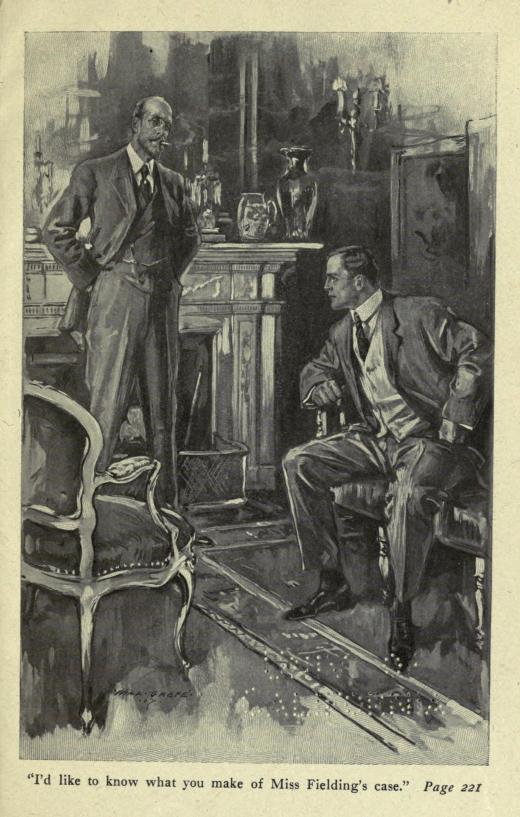
"I'd like to know what you make of Miss Fielding's case."
He got up, long and thin, put his hands behind him under his coat-tails, and stood backing the fireplace.
"Oh, I know what you're interested in!" he said with his grin.
"Do you think there's any chance of her recovering?" I said, ignoring his sarcasm.
"What's she lost?" he asked.
"Why, herself, hasn't she? To-day, at least."
"Oh, she'll find that to-morrow, I expect!" He balanced himself on his toes and smoked complacently.
I might as well stop there, I knew, but at the risk of being impertinent I was bound to see what I could get out of him.
"Have you found any law governing these alternations?"
"Why, yes; I have good reason to believe they come in turn—first one and then the other."
I got up. I fancy he came as near to receiving a blow on the point of the chin that moment, as he ever did in his life. But I held myself in check.
"Of course, if you think that it's none of my business, I'll ask you no more questions," I said angrily.
"Oh, no! Oh, no!" He shook his head with a deprecatory wave. "Only sometimes it's easier to ask questions than to answer them. This is a common enough case, as you know, if you know anything about psychology. A mild form of mania; that's all."
"Do you mean to say that you consider it merely insanity?" I demanded.
"Oh, we're all insane, more or less," he pursued in his maddening, non-committal way. "Insanity is a relative term, you know. 'All the world is queer but thee and me, and even thee's a little queer,' as the old Quaker said."
I did my best to keep my temper. "It's very unfortunate, at all events."
"Oh, I don't know. We can't have too many of such fine women as Miss Fielding, can we? I'm sure I'd like to know a half-dozen of them!"
"You must confess it's hard on her."
"Oh, it gives her something interesting to think about. All alone here, you know." He waved his long arm comprehensively over the scene.
"But aren't you trying to do anything for her? She surely wants to get over it." I was determined to push him into some definite statement. But it was no use.
"Oh, she'll come out all right," he replied, yawning behind his palm.
"She's too fine a woman, as you say; she has too fine a character, too fine a mind—" I began in protest.
"My dear Mr. Castle, women are always changing their minds." His shoulders shook as he laughed silently at his own joke.
"You'll change yours, before I've finished with you," I said to myself. But there was no use continuing the dialogue, and, bidding him good night, I went up to bed. Leah had given her own room up to him and she spent the night in Miss Fielding's study. I heard him come stumbling up at midnight.
IV
It was with a feeling of great relief that, next morning, I heard the dogs barking jubilantly in the yard, answering, each in turn, to their names. Nokomis, I knew by her heavy note, had returned to the house. Joy was, then, herself.
This was better than I had dared to hope. My suspicions in regard to the doctor were now strengthened and I felt intuitively that, in some way, his presence at Midmeadows accounted for the increasing frequency of Edna's visitations.
The last three days had shown regular alternations of personality, but I recalled the fact that on both Monday and Tuesday it had been Edna who had possessed Miss Fielding's body. With this thought came also the recollection of Joy's unusual actions in telephoning to the doctor.
The two facts seemed to indicate a significant relation—a relation, perhaps, of cause and effect. A third hint came—that such anomalous states of personality were sometimes developed during hypnosis—and the three separate thoughts snapped together, crystallizing into an idea. Had not Doctor Copin hypnotized Edna, and given her the post-hypnotic suggestion that she, in Joy's person, should telephone to him in the morning? It seemed probable, for I could not doubt, now, that it was to the doctor's interest to keep Miss Fielding as long and as often as possible in her secondary state, as Edna. As Edna she was impressible and easily managed to his ends. Edna invited him and welcomed him to Midmeadows, while Joy was cold and reserved. Everything that had happened dovetailed into my hypothesis—his annoyance at my presence, as the especial friend of Joy, and his own particular cultivation of Edna—the proof, in fact, seemed conclusive. What, then, was he trying to do?
I went down early and found him, lean and lank in his suit of muddy brown, wandering about outside, his long hands clasped behind his back. He greeted me civilly enough, but without warmth. I did not disturb him in his mood, and he meandered up and down, turning over a stone with his foot now and then, stooping to pluck a flower and sniff it thoughtfully, humming a tune to himself as he strolled.
Leah came to the doorway, gave me a happy look, nodded meaningly, and passed up stairs with Miss Fielding's tray. I went back to the stable to see the collies. Nokomis bounded up to me and nuzzled my hand. Her forehead showed a scar where the whip handle had struck her, and I talked to her about it condolently, in canine gutturals. We seemed to understand each other perfectly.
At half-past eight Leah called me in to breakfast. I found Doctor Copin already at table.
"Going up to town to-day, Castle?" he asked, tucking his serviette into his collar.
"No, I hadn't thought of it," I said, sitting down.
"H'm!" he ejaculated thoughtfully. "I didn't know but we might be taking the same train."
"Oh, I think I'll try my machine when I leave," I said.
He grinned. "Haven't you had enough ground-and-lofty tumbling yet?"
"Oh, I'm game. It's such fools as I that keep you fellows busy; you ought to encourage us."
He smiled dryly. "How long do you expect to be down here?"
The boot was on the other foot, now, and I was amused at his interrogation.
"I have some business to talk over with Miss Fielding," I said. "It depends largely upon her how long I remain."
"H'm!" He went on with his breakfast.
When Miss Fielding came into the room my first glance would have told me that it was Joy herself, even if I had not been given the hint already. As Edna, one would have called her pretty—as Joy she was beautiful. The lines of thought and care had returned to her face, but they did but emphasize the richness and meaning of her character, replacing abandon with subtlety. I watched the doctor's eyes leap at her, and then fall, disappointed. He, too, knew in a glance. He seemed to be surprised as well as disappointed. Leah had evidently not told him, and he had not dared ask. He shrugged his shoulders almost imperceptibly as we both rose to meet her.
"Good morning, doctor!" she said, giving him her hand, smiling. "I've just done a funny thing! Leah told me that you were here, of course, when I waked up, but I forgot it so completely that I've been trying to ring you up on the telephone."
I saw his pale blue eyes grow narrower as he laughed with her. He was pleased. "Well, did you get me?" he said.
"Are there two of you, too?" she returned, and the thing passed off in a general smile.
I took it that she had already heard from Leah of what had happened yesterday and I could not help admiring her calmness and self-restraint. The last thing, of course, that she could remember would be her anguish of two days when we were all so agitated over Leah's absence and dramatic return, and that weary vigil in the library trying to keep awake. Joy was used to these lapses; she had been so long schooled by her changes that she was usually poised outwardly and calm, ready for any emergency, on her guard against betraying surprise; but I could not help picturing to myself the nervous excitement of her awakening when her memory first rushed back and she had to learn hurriedly the history of the day before. How much, I wondered, had Leah told her?
Her attitude toward Doctor Copin, while quite that of an old friend, was so different from what it had been the night before that he must have felt somewhat uncomfortable at my seeing it. Of any such difference Joy was herself quite unconscious, but the interest she plainly showed in me served to heighten it. She was still full of gratitude toward me for what I had done in bringing Leah back—the doctor, on the other hand, was only making one of his periodical calls; she was anticipating, also, his urging again his request to give her a definite course of treatment, a thing she had steadily opposed. He came, as I understood it, only to keep track of her disorder in a general way, and to advise her with regard to it; and it was, so far, more because she had not enough confidence in his proficiency in this special subject, rather than any innate distrust of his character, that had impelled her to refuse a course of hypnotic treatment.
His elaborate wit failed to receive much encouragement from Joy. The conversation was, therefore, a little stiff for some time, and resulted finally in a dialogue between Joy and me, the doctor maintaining a silence almost surly.
After breakfast, however, she took him into the library for a short colloquy before it was time for him to leave. I waited outdoors. They came out in a few minutes, she, I saw, a little disturbed, a frown on her face. Uncle Jerdon drove up in the carriage and the doctor got in, bade us a conventional farewell, and was carried off.
We sat there for a while without talk, Joy gazing straight ahead of her, absorbed in her own thoughts. Then she turned to me and said:
"Edna is coming oftener than she used to. I don't like it!"
"Did you speak of it to the doctor?"
"Yes. He tried to reassure me. But I'm still uneasy. It was bad enough before, to lose two days a week, but if I'm to be robbed of half my time, it will be unbearable."
"Did you ask him if he thought he could prevent it, in any way?"
"Yes, and he asked me again to let him hypnotize me."
"Oh, I hope you refused!"
"Why?" she demanded, turning quickly to me. "I've refused only because I didn't consider him able enough—I was afraid to experiment, to put myself into his power, alone as I am here, and without friends. I wasn't quite sure enough of him. Have you any other reason why I shouldn't? He said that he could inhibit Edna's appearance, if I let him hypnotize me. He said she ought to be sent back to where she came from, and that he wanted to 'wake me up,' as he expressed it—make me normal again."
"Then he lied!" I remarked decidedly.
"Oh, Chester, you don't know how you frighten me! If I can't depend upon Doctor Copin, a physician, where can I look for help, and for protection against her? You have done much for me, but you're only a layman, after all; what I need is professional advice."
"Yes, of course," I said. "It is impertinent of me—it's positive audacity, to think I can help you, but, don't you see, the doctor, if he isn't to be trusted, is the more dangerous because of his knowledge? He can do you positive harm."
"Why do you distrust him?" she insisted. "I must have specific reason before I dare even to disregard his orders."
"Very well, then," I said. "But I may seem more than impertinent—even inquisitive."
She made a fine, impatient gesture. "Oh, we've got beyond such considerations—tell me!"
I turned to the door and called Leah, who came out immediately.
"Leah," I said, "do you know how much money Miss Fielding had in the house yesterday?"
"Forty dollars, exactly."
"Will you please find out how much of that is left, now?"
She ran up-stairs, while we waited. She returned in a few minutes with Joy's purse.
"There's only fifteen dollars here," she said, showing the money.
"And it wasn't spent for anything you know of?"
"There's no possible way of spending it," she answered.
"Then there's twenty-five dollars to account for. Doctor Copin undoubtedly has it. Are you in the habit of paying him cash, Joy?"
"Oh, no. Always by check, and, of course, I settle all his bills; that's understood between us. Edna can't draw any checks, anyway, for her handwriting is quite different from mine. What could she have given him the money for? Perhaps she didn't—how can we tell? Perhaps she hid it somewhere."
Leah interposed. "Oh, no, Miss Joy, the purse was in your room all the time, I'm sure."
"It may have been justified—it's barely possible," I said. "But yesterday Edna told me that the doctor was always complaining of being hard up. What else would he harp on that for, if not to borrow from her? Frankly, it's my opinion that he does. You know how impressionable and impulsive she is—any one with tact can easily manage her."
Joy stared at me. "Oh, that implies, too, considerable intimacy, doesn't it? Much more than I have with him, at least."
"It certainly does," I replied.
She caught the inflection I put into the remark. "Do you mean—?" She stopped suddenly.
"I mean that he is not above suspicion; that we should watch him."
"I'll never let him come down here again," she cried. "I'll dismiss him!"
"We must go slow," I said. "We must be surer, first; and, besides, you forget that Edna likes him."
A look of pain came to her face. "She likes him?" she repeated.
"He cajoles her. She flirts with him, perhaps. At any rate, I doubt if she'll refuse him admittance."
She rose and began to walk up and down the gravel walk. "What shall we do? What shall we do?" she exclaimed, extending her hands toward me. "Why, he is dangerous! Chester, I'm positively afraid, now. It's too horrible. It's getting worse every day!"
"Tell me," I said, "why have you been telephoning to him every day or so, Joy? You never used to, Leah says."
She looked blankly at me. "I don't know, I'm sure. It's funny, but I never thought much about any particular message. I suppose I was simply a little lonely and it occurred to me to ring him up, that's all."
That was enough for me, and I didn't explain the reason for my question. She had no time to worry about it, at any rate, for just then Leah, who had been listening silently, put in:
"Miss Joy, do you know what became of that little gold chain of yours with the sapphire pendant? Edna wore it yesterday, but I can't find it anywhere."
"Maybe it's up in my room somewhere," Joy answered, still walking up and down the path. Then suddenly stopping she faced me.
"Oh! Do you suppose she could have given that to the doctor, too?" she exclaimed.
I laughed. "No, she gave that to me to keep for her," I said, and I drew it forth from my vest pocket where it had remained since the little scene behind the stable.
Joy's eyes had followed my hand and fixed on the chain as I held it out. Her lips opened with a swift intake of air as she gazed. The two vertical lines appeared in her forehead. She put out a hand tentatively, but did not touch the ornament. It was as if she were in a trance. Then her lips moved automatically.
"Keep it—safe—for me, please!" she whispered. Suddenly her hand went to her forehead. "Oh, what was it?" she cried.
"Try to recall the rest!" I commanded, watching her sharply.
She thought a moment, then shook her head decidedly. "No, it's gone now," she said.
"You can get nothing more?" was my suggestion.
"Nothing. It was like a dream, like something I had done and said before. What does it mean—do you know?"
"It's precisely what you did say—what Edna said, that is—yesterday."
For some time she was too bewildered to speak, and stood staring at me—through me. "You mean that Edna said what I've just said!" she asked.
"Yes." I handed the chain to her.
She put it away with a sharp gesture. "Oh, no! If she gave it to you, keep it! I have no right—" She turned away.
"But it was only to keep till we got home," I explained.
She looked at me keenly and threw back her shoulders proudly. "No, it wasn't. She meant you to have it."
"You remember it, then?"
She smiled sadly, pityingly. "No. But I'm a woman, and I know."
Walking away to a rose-bush, she plucked a bud and returned slowly, as if to hide some emotion. It was quite time to comfort her.
"Joy," I said, taking her hand and bringing her to the steps again, "I have been doing a good deal of thinking, and I have a theory that I'd like to prove. I'd rather not say anything about it till I'm sure of it, but when I am, I'll tell you. Have I your permission to use my own judgment, even to the point, perhaps, of eavesdropping?"
"Oh, is that necessary, do you think?" She clasped her hands nervously at the thought. "I don't know. It's all so mixed up in my mind. Who can settle the ethics of a case like this?"
"It may come to a fight between you and Edna, I think."
"Oh, that's what it has come to!" she exclaimed. "That's what is killing me. Who is Edna? Where did she come from? Where does she belong? I must be fair—I want to be just to her, however she treats me. If I could only see her or hear her—if we could only communicate in some way, there might be an agreement. But she's like a ghost—a character in a book. Is she a different person, or only some phase of myself? Dare I come into open conflict with her? Why, I may be only destroying myself! I have to be she, don't I? Shan't I have to bear whatever I do to her? How do I know what danger may lie in any action I may take?"
"Yes," I replied, "I've thought of all that. I'm convinced that, as the doctor says, it's only a case of 'waking you up.' It's as if you were a somnambulist—walking in your sleep—dreaming half the time, irresponsibly. To wake you up may be uncomfortable for her. It may be like a surgical operation that she has to suffer, but when it's over you'll regain your health and reason, and, by the same token, so will she, and you'll forget all the pain. However, it hasn't come to that yet. What I want, now, is the right to explore, investigate, examine, experiment, perhaps, and then, when I have decided for myself, we can decide what course to adopt. If you're the White Cat, I'm going to be the Prince, and save you!"
She took my hand and pressed it affectionately.
"I trust you, Chester, and I'll agree to anything you think best. I feel as if I were being drawn into a maelstrom. Oh, what wouldn't I give to be just a normal, natural person, like every one else! Why am I tormented so? Yes, you must help me, Prince!"
"Well, then, now we'll talk no more of it for a while. Let's forget it, and go and see the collies."
Her face cleared and she sprang up, tossed back her head with her characteristic gesture and went with me to the stable. The dogs were all out in the sun, and as soon as we appeared they surrounded us joyfully. Nokomis walked up to Joy in her stately way and offered a paw.
"Why, Nokomis!" Joy exclaimed, "how did you get this awful cut on your head! We must attend to it immediately! Chester, won't you go in and get me some water and some salve? Leah will give them to you."
When I came back she was sitting on the ground with the dog's head on her lap. Nokomis' deep brown, soft eyes looked up gratefully while the wound was washed and dressed. The tears actually came to my eyes at the sight. The scene of yesterday, when these two were arrayed against each other, seemed impossible. It should go without saying that I made no mention of it to Joy, for it was evident that she had no idea of Edna's treatment of the collies.
"Now, Nokomis," Joy said, getting up and shaking the dust off her skirt, "listen! I want you to go in the house and get my golf-jacket, and bring it to me." She spoke very distinctly, accenting the important words. Nokomis trotted to the kitchen door, barked sharply, and was admitted.
"I'm educating her," Joy explained to me. "I want to see how far I can get her to understand what I say. This is rather a test, for there are at least three related ideas, the house, the jacket and bringing it back. But she's extraordinary at picking up words; she has really quite a vocabulary. Of course, you hear a good many stories of the intelligence of collies, but I've never heard of their being systematically trained except in a utilitarian way. I'm experimenting with more and more complex ideas. I hate the ordinary dog tricks; they're undignified and unworthy. I'm tremendously interested in animal psychology. Queer, isn't it, when I can't even handle my own!"
Nokomis appeared, in a distressed frame of mind, and whined.
"Well, Noko, what's the matter! Can't you find it?"
Nokomis barked, ran a few steps towards the house, and returned.
"All right, we'll go in and see what's the matter."
So we followed her into the house. The red golf-coat that Edna had worn yesterday was hanging upon a hat-stand in the hall. Nokomis went to it, shook it with her teeth, turned round and whined. It was as near talking as a dog could do.
"Oh, I see," said Joy. "You got the house and the coat all right, but you thought I meant just to come back, did you? No, bring, Nokomis, bring, bring, bring!" As she spoke, she placed the jacket in Nokomis' teeth and showed her what was meant. "Next time you'll know, won't you?" she said.
"Now we'll try your number lesson," Joy said as we went back to the stable. She and I sat down on a watering-trough, while Nokomis waited, her head tipped, her ears straight up, with the soft silky tips drooping like tassels. Her sloping eyes were quick and canny.
"One!" said Joy.
A single bark from Nokomis.
"Two!"
Correct, again.
"Three!"
Still correct.
"Four!"
Nokomis was perfect.
"Five!"
Four barks, then, after a pause, another.
"Six!"
This was too much for the collie. She barked, I think, eight times, having quite lost her head.
"Pretty good, isn't it?" said Joy, as I congratulated Nokomis—on the neck, at the spot dogs love. "This is straight culture, you know, no trick. I don't give her any sign, as they do stage dogs. I'm just trying to see how far she can go. I've begun, too, to teach her colors, but I haven't succeeded very well."
"It's immensely interesting," I said. "I wonder why collies are so much more intelligent than other dogs."
"They aren't. Caniches are fully as bright, but collies have been trained for generations with the sheep, and it has raised the level of perception. That's why I try to keep up their education, for of course they'll deteriorate if they're only bred for exhibition purposes. But the training of the shepherds isn't everything. My theory is that the reason why a collie is quicker is because his eyes are trained. Most dogs, you know, won't use their eyes if they can use their noses or their ears. Hunting dogs will run past quarry that's in plain sight, following a scent without looking. A collie has to watch his sheep sharply, and his eye is developed. Their ears have been trained, too, by the shepherds."
"How long would Nokomis keep this up, obeying your orders?"
Nokomis, who had been resting inattentively, looked up immediately.
"As long as I asked her to—wouldn't you, old girl?" Joy rubbed the dog's neck with her toe. "A dog's chief joy is to be in some way, in as many ways as possible, a part of his master. I never knew Nokomis to tire of doing anything that kept up and accented that relation. It is the mainspring of a good dog's life—it accounts for a dog's devotion. It's trite enough to say, but there is no love on earth so sure as a dog's love. It's unending! it's unchangeable!"
Did Nokomis know, as she watched her mistress there, of that strange soul that stole into the girl's form at night? Did she answer for herself instinctively, with an animal's secret prescience, the question that Joy had asked in anguish—"Who is Edna?" The thought came into my mind as I heard Joy's words, pathetic in their unconsciousness of how the love of Nokomis waxed and waned with her own obsession. Surely Nokomis was loyal and true. Surely she had never betrayed her mistress' confidence. Perhaps the collie alone knew the secret of the White Cat.
We took Nokomis with us, and walked over the hill as we had walked the day before. "We," I say, for, had any spectator been on the hillside to watch us pass on both days he could have seen no difference in the couple. With me was the same gracile creature abounding with life and beauty, the same small, brown-haired, brown-eyed woman with the flower-like hands.
But I need not say how different she was in talk, in gesture, in her mental attitude toward me. Yet, though I have shown Joy as intense, even as melancholy, this was not her natural quality. She could be as gay and debonair as Edna, but it was vivacity of a different key. Her laugh was as light and ringing, but it was provoked by other occasions. Her sallies were as joyous, but they sparkled with wit and comprehension. She was as frank, but she was keen as well. So it was not so much the sunny-dewy as against the quiet-shadowy, as it was April rivaled by June.
After luncheon with Leah, we went up to Joy's private sitting-room, or study, as she called it—and it was really that, as I saw by the books which lined its walls. She had indeed time enough to read them! It was a woman's room, but it was expressive of virility as well as taste. Like most of the other rooms, except the sleeping chambers and the dining-room, it was paneled to the ceiling—Joy confessed that she disliked plaster even when covered with paper. The wood here was a beautifully grained poplar and the general air of lightness and coolness was helped by the high, irregular, ceiled roof whose beams and ties stretched across from wall to wall. The ship-like bay-window which I had noticed from the outside was a nest of cushions of all colors of the rainbow—I speak literally—varying from violet, through blue, green, yellow and orange to red and purple again. There was a great table here where I saw a large microscope and case of slides. An upright piano stood in a corner. I noticed also a typewriter, and a camera on a tripod. The place had an air of work and study quite different from Edna's clutter and disorder. It showed me in a glance how it had been possible for her to live alone, so far away from civilization.
Here we spent the afternoon discussing her condition and prospects. She asked me much about Edna, for, though she had always been kept informed of Edna's actions by Leah, and had attained by this time a pretty good comprehension of her alternate's character, she was much interested in my opinions and conclusions, and I was able to cast new lights upon this second self of hers which gave her a new point of view. I could not yet bring myself to speak of Edna's coquetries, for of this she had no suspicion. There had been few visitors to Midmeadows since she had lived there, only the doctor and her lawyer, I believe; for she had, of late years, become more and more retiring as Edna's appearances had become more frequent.
Whatever indiscretions Edna had permitted herself with the doctor had been well concealed, as they were so much alone. I myself would never have suspected anything, had she not been free enough with me to set me on the watch. And all this sort of thing, too, had evidently been only of recent growth—it was coincident with Edna's increasing "strength." I don't think that either Leah or I had, for an instant, any compunction on Edna's account against informing Joy of what might be going on. We were loyal to Joy alone—it seemed unquestionable that she was the rightful sovereign self, and that the other was an interloper—our devotion did not hesitate at any violation of confidence incident to such a revelation. But we wanted to spare Joy's feelings as long as possible. For, under whatever spell, it was still Miss Fielding whose actions we must criticize. Irresponsible as she was, she could hardly bear to think of herself as appearing in such a light, knowing what the picture must be in our eyes, and her own. Indeed, it takes a more than ordinary amount of philosophy to know that one has shown a lack of taste or delicacy even under the effects of an anesthetic or an intoxicant, without suffering from mortification and shame. Her embarrassment would be quite as poignant as her sensibility was exquisite.
Joy had kept a diagram of her changes, and she got it out from her desk to show me. The first appearance of No. 2 had occurred when she was about fourteen years old; the second a month or so later, and there had been this usual interval until she was about twenty-one. From that time on, the appearance of No. 2 had increased in frequency, until for the last few years it had settled into a fairly regular average of two days in every week. There had been in her early childhood, beginning when she was seven years old, some curious abnormal tendencies that had not been recorded; it seemed, therefore, that her development was progressing, roughly, in seven-year cycles.
If that were so, the present daily alternation of personalities seemed to predict a gradual overthrow of her normal self, the original No. 1. The more I discussed it with her, however, the surer I was that this sudden access of strength on the part of Edna was chiefly attributable to the doctor's influence. I did not say so in so many words to Joy, for I wanted first to prepare my plan, but there was no doubt, in my mind, that whatever was his object in overthrowing Joy's control, and making Edna paramount, my coming had somewhat interfered with his experiments, and he had consequently increased his energy in a determination to succeed as soon as possible in his attempt at the replacement. How terrible this slow eclipse of her soul must be to Joy, I knew well enough.
It is hardly to be wondered at, therefore, that, thrown into intimate contact with so beautiful and so rare a character, I should bend all my will and powers toward helping her in her misfortune. I had decided already to make any sacrifice, and devote all my time to the task. Nor is it to be wondered at, I think, that, so devoting myself to her cause and being so privileged to study her closely, I should, by this time, have fallen deeply in love with her. Her very desperation, her hopeless, futile struggle against something outside any ordinary human experience drew me to her with an ever-increasing fondness. Her reliance on my aid strengthened the bond day by day, hour by hour. How much the doctor's interest in her had given me the additional fillip of jealousy, I would not care to say.
We came back to the incident of the gold chain more than once. What did that phenomenon mean? It was almost the first, and certainly the strongest and clearest symptom of a common share in Edna's life that Joy had ever had. Was it, then, Joy's dim vision of Edna's experience, or was it more sinister and significant, an evidence of Edna's ability to project herself into Joy's waking life? Did Edna, perhaps, have a coexistent, subconscious life? That it meant something, that it marked some new phase in this last cycle of development, we were both sure.
So we talked and talked that afternoon and through dinner. In the evening, exhausted with speculation, we gave it all up. Joy played her violin for me for an hour or so, and we lost all thought of the problem in our common enjoyment of her music. Then we started a game of chess, which, hard fought, lasted till bed-time.
Before we retired, Joy went out to see the dogs, and on returning she brought in Nokomis.
"I think I'll let her sleep in my room to-night, Leah, she's got such a poor, sore head," she remarked.
Leah looked at me as if to ask my help or advice.
"Aren't you afraid that—Edna may object in the morning, if she should be there?" I asked.
Instantly her suspicions were aroused. "Object to Nokomis! Dear old Nokomis, how could she!"
Nokomis whined anxiously, stretched her forelegs and waited.
I did not know what to say. Joy knew, of course, that Edna was not particularly fond of the collies, but she had no idea of the extent of her dislike. There was, I feared, some danger if, after what had happened yesterday, Edna and Nokomis found themselves together in the same room. Still, I wished to spare Joy, as long as possible, knowledge that would, I was sure, make her extremely sad. As Leah had tacitly left it for me to decide, I said:
"Leah, can't you call Nokomis out early in the morning, before Miss Fielding awakes—in case——"
"Yes, I think it will be all right," she replied.
If Joy suspected anything definite in this quick exchange of glances she did not inquire. She turned to bid me good night, and went up-stairs, Nokomis with her.
V
I was aroused in the night by a growling in Miss Fielding's room. Wide awake in an instant, I sat up in bed and listened intently, but I had not had time to get up before I heard a short, angry yelp, and then Nokomis' footsteps pattering out of the room and going down-stairs in hasty jumps. I struck a match and looked at my watch. It was a quarter past two o'clock. I knew well enough, then, that Edna would take Miss Fielding's place in the morning. It was much as if a ghost had entered the house and lurked in the darkness. For a long time I was too agitated to sleep.
The next day was cool and cloudy. I found a fire burning in the library when I went down-stairs and Leah was there, putting the room to rights. She looked up at me gratefully, as if it were a consolation to her to have some one to depend upon.
Leah had, by this time, begun to treat me quite as if I were her master. I had always tried to meet her upon terms which would prove that I had no prejudice on account of her color, but that very attitude of mine seemed to make her more willing to do me unlooked-for service. I am told that this is not, as a rule, true of negroes, and the Southerners, who by sentiment and tradition hold themselves as superior in virtue of their birth, keep the respect of colored folk and receive a willing acceptation of subservience that no Northerner, capable of no such race feeling, can achieve. That Leah's gratitude for my consideration did express itself in such devotion proves, perhaps, only that she was intrinsically finer—that she was, as I have already expressed it, ahead of her time. There was much pathos in it, nevertheless, for I was quite ready to regard her as a social, as she was, undoubtedly, a moral equal.
"Did you hear Nokomis?" she asked immediately.
"I should say! Didn't it awaken Miss Fielding?"
"Oh, no, she sleeps heavily at these times. But it awakened me—wasn't it horrible! It was Miss Edna coming in! Think of it!"
"How is she this morning?"
"Fretful and irritable—to me, at least. She asked for you, and she has been telephoning to the doctor again. Oh, I wish you might prevent that. What does she do it for, Mr. Castle?"
"He is probably making her do it," I replied. "You see, he has attained a sort of power over her, I suspect. Just how much, we must try to find out. Have you any idea what she said?"
"No; she sent me out of the room. But I think he'll probably be down to-day. How I dread it! Why does he come here so often?"
"He's coming down, Leah, because he realizes that we've begun to fight him. It will be open war, this time, I expect. We don't like each other, and I strongly suspect that by to-night the cards will be shown down."
"He's trying to get rid of me!" she said hopelessly, going on with her dusting.
"Well, he'll have to beat me there, first," I said. "So long as Edna doesn't have two days running I think I can keep you here safely. But we must be ready for the worst. Is there any place near here where you could stay, if necessary, for a day or so?"
She reminded me of the old cabin a little way down the road, and thought it might be fitted up well enough. She wouldn't be afraid to stay there alone, and could probably manage her meals somehow, through King, who was always ready to help her.
"Have you a revolver?" I asked.
"Miss Joy has one, and I can easily get it."
"It might be well to have it at hand," I suggested. "I'd advise you to ask Uncle Jerdon to clean up the cabin for you. And be sure that the collies are fastened up, too, won't you? Where's Nokomis now?"
"Nokomis came down-stairs and spent the rest of the night in the kitchen. When King opened the door, she went out. She'll not come back, I think, till Miss Joy's herself again."
"That will be to-morrow, I trust. But by that time we must have something definite to report to her. To-day, if possible, I am going to find out exactly what the doctor is up to. I shall hold back for no scruples; I'll listen, I'll lie and I'll cheat to find out his game and how to outwit him!"
"I'll do anything you say, too, Mr. Castle. I'm willing to take the same pledge." This was, for her, the consummate sacrifice. She would, I am sure, have given her honor, if necessary, to save her mistress.
We were interrupted then, by Miss Fielding's appearance—I dare not call her Edna, lest one forgets that in almost every outward aspect she was unchanged. Indeed, had her body, instead of her mind, been metamorphosed, I think it would have been easier to adjust one's self to the strangeness of it. But Edna's words and Edna's actions constantly gave the lie to Joy's voice and Joy's face. One could not even treat her as insane. It was definitely another person in masquerade. My soul went out to her at the sight, to return chilled at the revelation of that strangeness. I was constantly being tricked by my memory. When I had become so interested in the conversation as not to notice her appearance it was easy enough to feel that I was talking to quite another than Joy, but upon my first sight of her, or when, after having looked away for a while my eyes returned suddenly to her, the surprise of Edna's words coming from Joy's lips gave me a shock. But with all this I had begun to accept Edna as a perversion, a distortion of Joy's self, rather than as a separate individuality, and I was caring too much for Joy, now, not to witness the working of the spell without a constant, fiery protest in my heart.
After our first greetings Leah disappeared, and we went into the dining-room. Edna sat opposite me at the table as I breakfasted, her elbows on the cloth, her chin on the backs of her clasped hands, looking at me.
"Well," she began, "I've forgotten again, Chet."
I wondered what was coming. She seemed more absorbed, more introspective than usual, for what of this phase she had heretofore manifested had appeared usually later in the day. She watched me, too, with a curious intentness.
"But you're not so bad as you have been," I offered. "You know you only lost a day, this time."
"No, I'm getting hold of myself, I believe. The doctor is helping me, I'm sure. I used to lose four or five days every week."
"I congratulate you!" I said, falsely enough, I confess. But I must at any cost placate her.
"How was I yesterday, Chet?"
"What d'you mean?"
"How did I act? What did I do? Was I very different from what I am to-day, for instance? Tell me all about it!"
This staggered me. She had never betrayed so much curiosity before; she had always taken her lapses in her careless, thoughtless way, without much question. I saw Leah in the kitchen stop and listen, her lips parted, showing her white teeth.
"You were very lovely—as usual!" I said.
"I'm glad you found me so, Chet. You've never said that before, you know!"
"Well, I've thought so, often enough!"
"Did you like me any better than you usually do, then?" she insisted, keeping her eyes on mine.
"Oh, there are some times when I don't quite approve of you, I confess."
"When, Chet?"
"When you abuse the dogs—or Leah." Leah disappeared.
"But they abuse me, too, horrid things!" she complained peevishly. "And I can't for the life of me see why you're so fond of Leah. She's a great trial to me. I'm only keeping her on, now, on your account, and if you scold me, I'll be sorry I did."
"Oh, I'm not going to scold you. You're too charming."
"As charming as I was yesterday?"
"Almost." I hated myself for saying it.
"What did we do yesterday? You haven't told me yet."
"Why, we talked, mostly. We sat up in your study all the afternoon, and in the evening we played chess."
"Played chess? I must have played pretty badly!"
"Oh, no! In fact, you gave me a hard fight and beat me."
"Chess is stupid, though. I'd rather talk. What did we talk about?"
"Oh, about you, mostly."
"Did you make love to me?"
"No."
"Why not, if I was so very much nicer than usual?"
Her deliberate misquotation, a common enough feminine trait, was characteristic of Edna's newly acquired mental agility, but in addition I perceived that there was something behind even that. It was something new for her to proceed so categorically. It embarrassed me not a little, and yet I could not quite bring myself to lie to her outright, even to throw her off the track. It was almost impossible when I looked her straight in the face—Joy's face—nor, of course, could I reveal anything of what had really happened.
"Oh," I said, "you're very nice now, but I'm not making love to you, you see."
She further disconcerted me by saying, "Why not?"
There was nothing to do now but to carry the war into Africa.
"Because Doctor Copin seems to have that right—or privilege," I gave her boldly, making a good deal of it by my tone.
"Doctor Copin is very nice indeed to me; indeed, he's nicer than you are to me, Chet. He tells me things that you won't, and he's helping me to get my memory back. Why don't you help me?"
"How can I help?" I asked.
"Tell me how I was different yesterday, if I was different. Was I different toward him?"
"Of course, I don't know how you've been in the habit of treating him before I came."
"Well, how did he treat me, then?"
"Oh, you'd better ask him about that! But," I added, to try her, "I think he's undoubtedly in love with you."
"And you're not? For shame, Chet!" She looked demurely at me, as if merely to impugn my taste. "He's not nearly so nice as you, Chet," she continued, "but he does treat me better. He's done a great deal for me, and, if I ever do get well, it will be through his advice."
"What does he do? How does he treat you—can you tell me?"
"Why, he hypnotizes me, you know. I told you that before."
"And gives you suggestions, I suppose?"
"I don't know what you mean. I just go to sleep, and after a while I wake up again. He hasn't been able to do it till quite lately, and I don't understand it very well, anyway. I don't care, so long as I recover. He says I'm a remarkably interesting case."
"So you are, Edna, most assuredly," I replied. "You would be, even if you were all right."
"Thank you for that. I'll put down one good mark to your credit. But tell me—was I pretty yesterday, Chet?" She looked up at me earnestly under her brows.
"Very pretty—beautiful!"
"Was I clever, too?"
"Very!"
"More than usual? More pretty and more clever than I am to-day?"
Wishing to see what she was driving at, I risked a chance shot. "Yes," I said.
"Oh, I hate you!" she cried, and she got up in a pet and threw herself out of the room, scowling.
I hurried after to propitiate her, but she was already outdoors. I overtook her in the lane and tried to take her hand and get her back, but she flung away from me and walked on without answering me. Giving up the chase, I returned to the library, very sorry to have aroused her temper. I knew I should have lied to her for Joy's sake, for the sake of peace, for the sake of final victory.
I was pretty well convinced, by this time, that Edna's eyes were opened, and she knew what was going on. She must undoubtedly have been informed by the doctor the day before. That would account for her behavior at dinner and in the evening. For the first time in her life, she had become aware that, during those lapses when she lost days at a time, some one else lived for her, animating the same body. If, as I was not too modest to imagine, she cared for me, the reason for her anger was evident. Edna was now probably definitely pitted against Joy in the conflict that was doubtless already on. I was determined, therefore, to bring the thing to a crisis, that we might, at least, know where we stood.
I had not been alone fifteen minutes when I saw Leah approaching the house. She was sobbing, her head bent down, her handkerchief to her eyes. I ran out to meet her, my heart in my mouth.
She stopped and told me, trembling convulsively as she spoke, that while on the way with a broom to the cabin, intending to make it fit for temporary occupancy, Edna had met her and questioned her. At Leah's attempt to conceal the truth, Edna, who was already in an angry mood, burst into a fury and struck Leah across the face with such force that her cheek was badly cut, inside, by her teeth. The revolver had dropped from Leah's pocket; Edna had picked it up, accused Leah of stealing it, and had gone on down the lane.
"Oh!" Leah cried passionately, "I don't care how much she hurt me—she's not responsible, I'm sure—but I'm afraid that now she'll send me away again. Then what will become of Miss Joy? If she'll strike me, she'll do worse. If we don't do something pretty soon, it will be too late!"
"You must keep out of sight as much as possible for the rest of the day," I said, "especially as the doctor will probably come down. If we could only prevent that!" At the words, an idea occurred to me. "What train does he usually come down on?"
"The ten o'clock from the city. He usually takes luncheon here."
"Then there's just time, perhaps, to catch him. Come up-stairs. I'm going to try to see if we can't find out something. It's a desperate chance, but I'll take it. The thing can't be much worse, even if we're found out."
We went up into the study and I called up the doctor's number. While we were waiting for it I gave Leah her instructions.
"Don't speak loud, just barely loud enough so that he may hear with difficulty, and let him do most of the talking. Pitch your voice as high as you can. Ask him what train he's coming down on. I'll take the receiver and listen, and tell you what else to say."
In a few minutes the bell rang and we were connected with the doctor's office. I heard him say, "Hello! Is that you, Miss Fielding?"
"Say 'yes,'" I whispered. Leah did so.
"Anything the matter?" he asked. Leah said "No."
"What did you want, then?" was his next question.
Leah put the question about the train.
"I'm going to take the ten. I'm starting right off. What's the matter with your voice? It sounds different, and it's so weak anyway, I can hardly hear it!"
I told Leah to say, "What?"
"Oh, never mind," he exclaimed impatiently. "There must be some trouble over the line. I'd never recognize your voice at all. Can you hear me plainly?"
"Yes," said Leah.
"Well, look out for Castle," he went on, "Don't let him know that you suspect anything, will you?"
"No," from Leah, at my prompting.
"He's trying to make trouble for you; and he will, if we don't look out. He's in love with the other one, and you'd better try and see if you can't get rid of him! Now, Edna!"
"Yes!" Leah again repeated my whispered word.
"Are you listening?"
"Yes."
"Are you listening?" Why was he repeating the question?
"Yes!"
"Are you listening?"
At this, I suspected a formula he might be using for some hypnotic suggestion. I whispered to Leah to say "Yes, yes," faintly.
"Meet me at the station, sure. You will come alone. Good-by!"
I hung up the receiver, pretty sure that he had not suspected the deception. I went down-stairs again, and as, by eleven o'clock Edna had not returned to the house, I had no doubt that she had gone to the station of her own volition to meet the doctor. This was fortunate, as, seeing her evidently in obedience to his suggestion, he might be less likely to question her about telephoning and thereby discover our ruse. I was, however, nervous at the prospect of meeting them. Leah could scarcely be kept if the trick were discovered; I should have hard work brazening it out myself.
At about noon I started down the north lane to meet them, and discover the state of affairs in time to let Leah know. Half-way to the road, however, I happened to recall what Uncle Jerdon had told me about seeing the two, the day we had broken down in the automobile. I decided to hide and see what I could discover—in a word, to spy upon them. I was by this time in no mood to be nice about my choice of weapons, and I took the first one that came to hand.
I had not waited long before I heard voices approaching, and I concealed myself behind a clump of bushes to watch. I was too far away to hear distinctly, and, in fact, they did very little talking—an occasional exclamation from her, and the doctor's nasal replies. My eyes told me more than my ears—enough to prove that, however Edna regarded me, the doctor also came in for considerable more of affectionate demonstration than I had suspected, and either he was not so conscientious as I had been, or he was actually in love with her. Their actions were those of acknowledged lovers. Why, then, had she flirted with me? Was her behavior now, perhaps, mere pique caused by the jealousy I had aroused in the way I had spoken of Joy?
I went in as luncheon was served. Edna met me a little coolly, the doctor more so. I was decidedly uncomfortable at being now a guest in a house where I was, perhaps, not wanted, but I pretended not to notice anything amiss, and endured my position as well as I could. The doctor ignored my presence completely, addressing all his dull witticisms to Edna, who laughed at them as usual, doing her best, now and then, to drag me into the conversation. She could not keep any one mood for long, however, and before the end of the meal I flattered myself that she would, after all, prefer being with me alone; but the doctor's pop-eyes held her, and his interminable foolery kept her whole attention concentrated upon him, despite herself. Nothing at all was said about the telephoning.
Directly after luncheon was over the two went up-stairs into the study, without even the formality of an apology to me. As Leah was busy about her own work, I strolled out into the kitchen to see King. He was washing the dishes, and greeted me with his customary cryptic grin.
"Say, King," I said, "you got a joss in your room?"
His grin grew wider. "Yep!" he ejaculated, nodding.
"You no Christian, then? You not go to Sunday-school?"
"Aw, no good go to Sunday-school—I can talk Melican all light. Chlistian joss no good for Chinaman. You think so?"
"I guess you're right," I said. "But do you worship your joss? You burn punk-stick sometime? You trim him up with paper flowers, maybe?"
He laughed to himself as if it were a great joke, but kept on washing his dishes like a machine. "You likee see my joss?" he said, looking back over his shoulder. "Heap good joss—velly old. I bling him flom China."
"What d'you pray for, King?"
"Aw, sometime one thing, sometime other thing. I play for good luck, allee same Chlistian. You play, too?"
"Oh, sometimes," I said. "But go on, tell me, King. When do you pray? You pray to-day?"
He shook his head. "Aw, no; no play yet. Play all time at night."
"What did you ask for last night, then? Come on, tell me!"
"Aw, no, no!" He shook his head, still laughing sillily.
"Money, King? I'll bet you prayed for money!"
"Aw, no, no! I tell you. I play for Miss Fielding."
I had stumbled upon a live wire! Instantly I was aroused, and careful to say no tactless word. What I had already got from him was an extraordinary amount for a Chinese of his caste to discover to a white man. So I went witfully to lead him on to tell me more.
"That's good, King; I pray for Miss Fielding, too. I want her to get well. Don't you?"
"Yep. She good lady, you bet. Maybe she get well, I dunno."
"What you think the matter with her, King? I'm worried about her."
He emptied his dish-water out, and wiped his hands first. Then he stopped suddenly and said:
"Miss Fielding, she got one no-good debbil on inside. You know? Sometime he heap bad, sometime he keep still. Plenty people have debbil in China; all time go pliest, he dlive 'em away easy."
"The priest drives the devils away, King! How does he do it?"
"Oh, flighten debbil, tha's all. Stlike gong, burn fire-clackers, make all time heap loud noise and debbil go away flighten'."
"I wish Miss Fielding could be cured as easy as that, King!"
For the first time during the conversation his grin disappeared. He came up to me, gesticulating.
"You likee flighten away debbil? Maybe I help you sometime?"
"Could you do it?" I laughed.
"Sure! Aw! you no think so?" He returned to wipe his dishes philosophically. I smiled at his earnestness and walked away.
I sat down in the library to wait till the doctor came down. I found that he would have to walk to the station, as Uncle Jerdon was away, and I determined to have another talk with him, if I could manage to see him alone. I had decided on a coup d'état.
In a half-hour they reappeared, Edna showing traces of heaviness about her eyes, as if she had been asleep. The doctor looked at his watch, and found that he had just time to walk to the train. I offered to accompany him, and, though he appeared surprised, he assented with a good grace. Edna did not care to go with us. It seemed to me that she not only perceived the antagonism between the doctor and me, but fostered it for her own ends. It was as if we were fighting for her and she had decided to let the best man win. So we left her and started out.
I began as soon as we were round the turn of the lane.
"Doctor Copin," I said, "I wish you'd let me know exactly what Miss Fielding's condition is, and what hopes you have for her recovery."
"Did she ask you to interrogate me?" he asked blandly.
"In a way, she did. But I do so, nevertheless, quite on my own responsibility, as a friend who is very much interested in her case."
"Then I must decline to answer. You are aware, I suppose, that Miss Fielding has had her own reasons for not wishing the matter to be discussed?"
"I'm perfectly aware of that, but I think that, as I now know all the essential facts, it can't possibly matter to her. On the other hand, I can help, perhaps."
"I didn't know you were a specialist in nervous diseases—or even a psychologist," he answered in a sneering tone.
"I am neither, but I have common sense enough to perceive that her trouble is approaching a crisis. That, in fact, is my sole justification for staying on here."
"Oh, if that's all, you can go any time. I'm quite able to cope with the situation, I assure you."
"Doctor Copin, I insist upon having a statement of what you are doing in this matter. I speak as the representative of Miss Fielding—the real Miss Fielding."
He turned to me now with his thin lips drawn back, showing his even line of false teeth, in a cruel, selfish smile. "Insist?" he repeated. "You have hardly that right, whatever Miss Fielding has said."
"I certainly do have that right!" I maintained.
He stopped in his tracks and confronted me. "Why?" he demanded.
The time had come for me to play my bluff.
"Because I am engaged to Miss Fielding!" I announced curtly.
He scowled fiercely. "You are!" he retorted. "Very well, then, I have as good a right to refuse to answer you!"
It was my turn to say, "Why? What do you mean?"
"Because I am engaged to her myself. So there you are!" With that he walked off, leaving me standing, staring at him. I was literally bluffed to a standstill. I watched him striding down the lane in silence. I was in a labyrinth of thought. Then I turned slowly back toward the house and prepared for war. I should have to get it out of Edna, or give up and confess myself defeated.
As I walked up the lane I heard a rustling in the bushes, and peering through them, I saw Nokomis bounding along, her ears laid back, her brush trailing. She leaped down the bank a little way ahead of me and stood for a moment, pointing in the direction of the house. I called her, but she only turned her fine head for a moment, and then trotted on up the lane. I followed after her leisurely, preparing for my cross-examination of Edna.
Just before I came to the turn, I heard a quick, sharp yelp, and a woman's shrill cry. Then a shot rang out, echoing against the hillside. I ran round the bend at full speed.
There was Edna with a pistol smoking in her hand. In the path, in front of her, Nokomis lay dead. Leah, running up from the house, had stopped behind Edna, and stood horror-stricken, afraid to move. It was like the scene of a play.
I strode up. "What's happened?" I demanded.
Edna dropped the pistol to her side and looked down at the collie angrily.
"Nokomis tried to bite me," she said. "But she'll never try it again! I always thought she was dangerous."
"Give me that revolver!" I said sternly.
She met my look, shrinking a little, and handed over the weapon. I put it into my pocket. Leah retreated fearfully to the house.
First, I took Nokomis' body and carried it to a bed of ferns beside the path, patted her head and left her there till she could be buried. Then I took Edna's arm, gently, and led her away. She told me, a little frightened now at the impressiveness of my manner, that she had met Nokomis suddenly, and attempting to drive her away, the collie had snapped viciously at her. Edna had the revolver which she had taken from Leah earlier in the day, still in her jacket pocket, and, at the attack, had drawn it and fired immediately.
I had no reproaches for her—what was there to say? Even in speaking, she had recovered from her mood, and she became as blithe and inconsequent as if nothing had happened—the only effect apparent upon her was a whimsical pettishness at my implied rebuke. She began to attempt to cajole me childishly, patting my hand, looking saucily up into my face and pretending a sort of arch depreciation of her temper. It was evident that she was not at all sorry for what she had done; in fact, she seemed to be secretly altogether pleased at her prowess, though she covered it with considerable guile.
All the rest of the afternoon she was in an excited frame of mind. She treated me with all her former comradeship, but I could see that she was acting. It gave me a new insight into the rapidity of her development effected by the doctor's information. She was no longer a child; she was becoming complex, although still dominated by rapidly changing moods. A new phase had indubitably commenced; it was the sign, I feared, of a growing supremacy.
That evening she wheedled me with every art of the coquette. Her familiarity seemed to give the lie to the doctor's statement about their engagement, but it might well be true that she was playing him as audaciously as she was playing me. I did not, of course, ask her about it. It did not matter.
If I had needed to exercise my self-restraint on that other evening when she attempted to provoke me, it was much more necessary now, for she had become less differentiated, intellectually, from Joy; so much so, at least, as to permit me at times to give my imagination play, and fancy her, for the moment, the real Joy, my Joy in an alluring guise, tinctured with wild-fire. The line of cleavage now was more along moral lines. Edna's mind was evolving at the expense of her ethical nature. Her temptation was seductive and arrantly conceived to torment me; I was sure that it was intended to shake my allegiance to her rival self. It was like playing with edged tools to be alone with her. In her intervals of repose she fell so naturally into Joy's poses that it was disconcerting. It was like The Faerie Queene over again; like an errant knight, I was confronted by the image of my mistress so cunningly enchanted that I could not tell till she spoke that her body was obsessed by another spirit.
She asked me much about the day before, and about what she had done and said. As the evening wore on and she could not defeat my continual evasions, she began to grow sullen and reserved. Finally, she appeared to give it up, and went up-stairs with a sarcastic emphasis to her "Good night, Prig!"
VI
Next morning I lay in bed for some time after I awoke, planning my day. If it were Joy who appeared, there were several things to be decided upon and accomplished; if Edna, a conflict was imminent which caused me much anxiety. Queerly enough, the proposal I would have to make to Joy seemed almost as if it would be an ex post facto agreement. I had already announced my engagement to the doctor, but I had not made my bluff without holding a pretty good hand. I couldn't doubt, by this time, how Joy felt toward me.
At eight o'clock I heard the customary dialogue—Miss Fielding's door being still left ajar—but I noticed that her voice was quick and excited. Leah was called in immediately, and the two women seemed to have more than the usual amount of talk together.
Next, I heard the dogs barking in answer to their names; but there were only three replies to Joy's calls, to-day. Poor old Nokomis would never greet her mistress again. Then the door was closed. Joy evidently did not wait to have breakfast, as usual, in her room, for fifteen minutes later I heard her going down-stairs.
Fearing that something was wrong, though I was sure, now, that it was Joy herself whom I had heard, I rose and dressed as quickly as I could. I found her in the library waiting for me.
She held a folded paper in her hand, as she sat by the window, looking out listlessly. I bade her good morning; she looked up without a smile and silently handed me the paper. Unfolding it, I saw, written in a round, childish, vertical script, the words:
"I know you now—Cat!"
"I found this pinned to my pillow when I woke up," she said. "It's from Edna." Then a faint, dreamy smile softened her lips as she said, "You see, even to her, I am the White Cat!"
"How d'you know it's from Edna?"
"It's her handwriting. She writes very differently from me."
I looked at it, wondering. It was the first shot in the battle.
"You see, she has found out. Her eyes are opened," Joy said.
"Yes. I was going to tell you about it to-day. I suspected it yesterday, and it has proved true. It complicates things immensely."
"Leah has told me that I struck her, too. Think of it! It makes me positively faint. What horrible part of me has come to the surface in Edna? What undiscovered self is it that is torturing me so? It's a hideous revelation. It shows how depraved I must be, at heart."