Front matter (continued 7)
Reading edition
"Pray calm yourself, my dear. Our friend has not the slightest intention of insulting you. I know the expression well, it is perfectly 'en regle.'"
Madame tossed her head as much as to say "I don't believe you a bit." "Besides," she added, "it is not your place to instruct me in English, and I"—with rising voice—"I vill not sit here quietly vile those impudent Englishmen are insulting me and my daughter."
Beaupaire looked at Ridgeway, and gave a wink and a little chuckle half to himself.
"Don't mind her," he whispered to Ridgeway, as he offered him a cigarette, "the old lady is first rate when you get to know her, but she is a great stickler for etiquette—Spanish, you know—very proud—sixteen quarterings—father a Don—seventh cousin of the King of Spain—and all that sort of thing."
Ridgeway nodded.
"Ha! ha!" continued Beaupaire, laughing, "what you were just saying to madame reminds me of an anecdote of Philip the Second of Spain. It is said that when his first wife was coming to Madrid to be married to him she was met at the frontier by an escort of grandees, and was treated with all the stiff ceremonies of the Spanish Court. The lady had occasion to mention her legs during the conversation, and was at once rebuked by the Grand Chamberlain appointed to wait on her. 'Madame,' he said, 'the Queen of Spain is not permitted to have any legs.' On hearing this the good dame burst into tears, thinking it would be necessary to have them amputated. However, the Grand Chamberlain explained to her with profound genuflexions and much bowing, that it was highly impolite even to suggest that so exalted a personage as her prospective Majesty could possibly possess such parts of her anatomy. When this story was related to the King, it is said to have been the only occasion when that fanatical and gloomy monarch was ever seen to laugh."
Mr. Ridgeway was interrupted by the sudden noise of the brakes—z ... z ... z ... z ... z ... z ... Z ... Z ... Z ... sh ... sh ... sh ... sH ... sh ... SH ... H ... H ... H ... H.
The train pulled up in the station just two hours after leaving Paris.
"La Roche," shouted the guard. "Cinque minutes d'arrêt."
It was the first stop. Marcel was snoring vigorously notwithstanding the noise.
Riche woke up with the sudden cessation of movement and the noise of the brakes against the wheels. He sat up and rubbed his eyes with his knuckles.
The door opened, and a man with his buxom wife and two children began climbing into the compartment.
"Sh—h," said Riche stepping up to the door and putting his fingers to his lips. "You can't come in, my friend down here has just had a fit. He is subject to sudden outbursts of madness, and might kill you at any moment."
Marcel had just awoke and managed to catch the last sentence of his friend. A quiet smile flitted across his lips, and he closed his eyes again.
The parents exchanged glances as the guard was pushing them in.
"Be quick and get in," said the guard.
"Mais, monsieur, we dare not. This gentleman says his friend is lying down in a fit, and he is quite mad."
The guard hesitated for a moment, and was about to go and call the station master, when Dr. Riche handed him his card. It bore the inscription:—
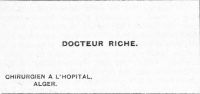
engraved in bold letters. The card decided matters at once, and the guard pushing the family away, closed the door and locked it at the doctor's request.
"Riche," said Marcel the moment the guard had left, "you are a brick. We can now sleep undisturbed until we get to Marseilles."
The next morning they arrived at Marseilles, and everybody got out to stretch their legs and enjoy a good cup of café au lait at the buffet.
The party had a refreshing wash and brush up to enable them to enjoy the delightful sea views of the Côte d'Azur.
It was the early part of the afternoon when the train pulled up at Beaulieu. They drove to the Hotel des Anglais, somewhat tired but in the best of spirits.
The feelings of Céleste and Renée on seeing the Côte d'Azur for the first time cannot be described. The balmy air was filled with the delicious perfumes of a million flowers and fields of new-mown hay. They saw the deep blue sky paling to a delicate turquoise where it touched the sea at the horizon. They saw the water scintillating with the sunlight, and its placid surface broken by the white crests of the countless waves. What delighted them most was the exquisite blending of colours, the variations of light and shade, and the luxuriance and wonderful variety of the foliage. Here they saw the loveliest forms of tropical foliage side by side with the more familiar but not less beautiful trees of central and northern Europe. The flowers of the whole world seemed to contribute to the enchanting loveliness of the scene. They saw dense forests of fragrant pine trees, woodland footpaths lined with the sweet alyssum, resembling drifts of scented snow, while the thyme and rosemary formed fragrant patches over the stony sides of the mountains. Higher up the slopes luxuriant groves of pistacia lentiscus or mastic trees could be seen, and bushes of the members of the quassia family, such as the cneorum tricoccum, with its curious triple clusters of berries. In the distance rose the beautiful Mount Boron crowned with the Fort of Montalban, and its slopes covered with tall cistus trees. Dotted here and there were charming villas with delightful gardens, intoxicating the senses with the perfume of lemon and orange. Occasionally the carouba tree could be seen with its wonderful locust-bean pods credited with being the staple food of John the Baptist.
Scattered up and down were olive trees, hoary with age, their trunks knotted and gnarled and twisted like the limbs of caliban. Quite close to Beaulieu they saw sheltered footpaths with hedges on either side lined with roses and geraniums. To the west was the Bay of Villefranche with small gunboats and yachts rocking placidly in the harbour.
"Surely," said the professor, "these must be the gardens of Alcinous with their perpetual summer hemmed in by the mighty salient battlements which form the vanguard of the Alpine chain."
As the members of the party were retiring for the night, Monsieur Beaupaire, who had caught a slight chill on the chest, in spite of what Charley had told him the day before, developed a fit of uncontrollable coughing accompanied with a feeling of oppression on the chest. Dr. Villebois immediately offered his services, which were accepted with gratitude. He prescribed a cough mixture, and ordered a mustard plaster to be applied for five minutes over the whole of the chest.
"Doctor," said Violette, putting her arms in a coaxing way on his shoulders, "may I prepare the plaster myself, as I have done it many times before, and I know so well how to do it."
"Certainly," said Villebois, "nobody could do it better, get it by all means, and put it on as soon as your father is comfortably settled in bed."
Violette, as soon as she had obtained the ingredients, set to work to prepare the plaster. It was quite late by this time, and the messenger had great difficulty in finding a chemist's shop open, to have the medicine made up.
Violette loved nursing and felt a keen pleasure in doctoring her father. She acted on the principle that if one dose will do a certain amount of good, two doses ought to do twice the benefit, and accordingly she spread a very liberal amount of mustard on the linen. When all was ready she went upstairs to his bedroom, but by this time all the lights were turned off, and she crept cautiously along the passage to his room. She opened the door, and a faint light just enabled her to see where her father was sleeping. He was snoring away apparently in a delightful dream, and Violette, unwilling to awake him, did not turn up the light. So in the semi-darkness she tenderly laid bare his chest, and carefully spread the plaster over the surface. The sufferer uttered a groan, but did not wake. Violette wrapped him up snugly and bent down and gave her father a kiss on his forehead, when the light becoming suddenly brighter, she perceived to her horror that it was not her father at all, but Marcel. Terrified at her mistake she gave a little scream, and ran out of the room, the perspiration streaming from her forehead.
"Oh! dear, oh! dear," she exclaimed, "whatever shall I do? Here I have gone into Marcel's room, and kissed him on the forehead and put a huge mustard plaster on his chest, and now I dare not take it off again for fear of waking him up. Oh! what will become of me?" Violette was in despair. Heartily wishing the ground would open and swallow her up, she walked up and down the passage wringing her hands in an agony of mind, and wondering what the end of it all would be. At length Violette went to her bedroom, and falling on her knees burst into a flood of tears. But her tears were soon over as the absurdity of the situation dawned on her. A few minutes later she undressed and was soon in the arms of Morpheus, quite oblivious of the mischief she was creating. Violette had not been in bed more than half an hour when she was awakened by hearing the most appalling noise. Somebody was shouting at the top of his voice, "Help! Help! Murder! Fire! Thieves!" Hastily putting on her slippers and dressing-gown, she ran into the passage. By this time the entire establishment was aroused, and men and women attired in all sorts of costumes came hurrying up the stairs to see what all the row was about. Mine host flew to the fire alarm and rang up the fire brigade without waiting to ascertain the real cause of the mischief. At the same time the portier telephoned to the police. The hubbub and confusion increased every moment. Waiters flew wildly up and down stairs, each one asking his neighbour what all the noise was about.
A few minutes later a fire engine came dashing up and half a dozen firemen with their hatchets and brass helmets ran up the stairs followed by three or four gendarmes in uniform. The proprietor ran towards them with his arms outstretched gesticulating wildly. Violette, who was standing in front of her door, looked up and saw the gentleman who was the author of all the scene rush past her clad in pajamas with an embroidered cap ornamented with a gold tassel, and almost flinging himself into the arms of the landlord. "Voilà!" he shouted, "see what some miscreant has done to me," and he laid bare his chest all blazing red and fearfully inflamed with the mustard, while he shook the offending plaster in monsieur's face. Violette caught sight of his face. Oh, horror, it was Marcel sure enough, his eyes gleaming, his face flushed, and shouting with a voice almost inarticulate with rage and pain.
"If I can only lay my hands on the scoundrel who has done it, I will flay him alive no matter who he may be."
Violette turned scarlet and looked away for fear he should see her. She hurried back to her bedroom and sank down on the sofa, asking herself how she ever dare face him again, and wondering whether he would ever forgive her if he found her out. What added to her misery was that she felt in her heart she really cared for him. At length a feeling of weariness overcame her, and crawling into bed she soon fell asleep.
CHAPTER XXIII
AT BEAULIEU
"The sun upon the calmest sea Appears not half so bright as thee."
The next morning Madame Villebois, whose slumbers had been disturbed by the excitement and noise during the night, and who loved ease, was having her chocolate in bed, and studying the menu which the maid had brought up for her special benefit.
"Marie," she said, as her maid propped her back up against the pillows, "you are to be sure to make friends with the chef and bring me a copy of the menus for lunch and dinner as soon as they are printed, and, Marie, fetch me my portemonnaie. See, give him this and tell him to allow you to see how the entrées are prepared, and don't forget the sauces—especially the sauces, do you understand? Oh, I forgot—yes—find out whether he wraps the red mullet in paper soaked in olive oil or butter, be sure and ask him this, as it is most important, and don't forget also to find out how he prepares his gigot à la Mailly, and his poulets à la Villeroy. Do you think, Marie, that he will tell you all this for a small pourboire?"
"Please, madame, I have seen him already and he is a most charming gentleman. He has such a sweet smile and such lovely whiskers. I think if you will leave him to me, madame, I will find out all you want. You know I have my little ways with gentlemen."
"Marie, what do you mean? How dare you take liberties with men? And with cooks of all people! You ought to be ashamed of yourself. I shall have to give you notice."
"Oh, but, madame, if you only saw him. He is such a nice gentleman, he patted me under the chin and gave me a kiss on my lips."
Madame gave a start that nearly threw her out of bed, and stared at her as if she were some new animal at the Zoo.
"Marie, Marie, leave the room this minute. I shall tell my husband the moment I get back to Paris, and he will dismiss you at once when he hears it. Oh, dear, what shall I do? To think you have disgraced the family in this way. I would dismiss you now, you vulgar thing, but—"
"Thank you, ma'am," Marie replied, curtseying with a pout.
"Thank you, indeed. Wait and see what Dr. Villebois will say to you. You dare to simper and smile after this?"
Marie readjusted her pillows, and her lips curled in a defiant smile, for she knew the doctor would take her part every time. Hadn't he on one occasion given her a brooch instead of dismissing her when madame drove her out of the room, and on another occasion a pair of turquoise ear-rings, when she handed her over to her spouse for reprimand and dismissal?
"Can I do anything more for madame?" she replied with her sweetest smile.
"Go away, you hussy. I shall send for the doctor immediately."
"Thank you, ma'am," said Marie again, as she bowed herself out of the room.
"Of all the impudent, brazen-faced minxes I have ever seen, Marie is the worst," said madame to herself, as she heard the door close behind her. "The idea of such a thing! I would have sent her about her business there and then, only I know I cannot do without her. The airs these hussies put on, I don't really know what the world is coming to with their scandalous behaviour. Had it been an officer who kissed her, it would not have mattered—but a cook, with a double chin and whiskers! Holy Mary!" and the good lady crossed herself and sank down among the pillows to dream of the wickedness of femmes de chambre in general, and her own amazing righteousness. It was half-past nine when the rest of the party sat down to breakfast in the salle à manger of the hotel. Marcel, flushed and tired, entered the room and looked round to see if he could detect the culprit among the numerous guests, and failing that, sat down next to Riche who did his best to soothe his ruffled feelings.
"I hope, my dear chap, that the pain has gone, and that you are none the worse for the practical joke which was played on you last night," said Villebois, standing up and bowing to him as he sat down.
Marcel returned the salutation. "Mon Dieu!" he exclaimed, wiping his brow with a gorgeous purple silk handkerchief, "no one can imagine what I have suffered. Even Dives could not have experienced worse sensations in his tongue in Hades than I did in my chest. I declare a flogging would not have hurt half as much. You should see my skin, it is all covered with blisters the size of a five-franc piece. If it had not been for my friend Riche who spread a handkerchief covered with Carron oil and dionine over it, I should not have been here this morning to breakfast, that's certain. Oh! if I could only meet the rascal who played me that trick, I would compel him to wear a plaster like mine for a week."
Just at the moment Monsieur Beaupaire was seized with a furious fit of coughing and wheezing. "I am afraid," said Villebois, "the medicine and plaster which I prescribed did not do its work as well as I expected."
"Medicine and plaster!" exclaimed Beaupaire with a look of astonishment. "I never saw either of them, although I remember you gave me the prescription with both remedies written down."
Marcel looked up in surprise and whispered something to Riche, while Violette blushed up to the roots of her hair, and bent down to pick up her napkin which she had purposely dropped. "Oh dear!" she whispered to Céleste who was sitting between her and Riche, "whatever will become of me?" and her face expressed unutterable things.
"Why! what have you done?"
Just then Céleste happened to lean back, and Violette turning half round, caught Riche's eye just as she was drinking her coffee, which caused her to swallow it in such a hurry that it nearly choked her. She set her cup down, and whispering into Céleste's ear, walked quickly out of the salle a manger followed by Céleste.
The two girls closed the door, ran quickly upstairs, and locked themselves in Violette's bedroom.
"Now tell me all about it," said Céleste, as they seated themselves on the ottoman.
"Oh! it's too dreadful for words," said Violette. "I asked Dr. Villebois to allow me to prepare the plaster for papa, and put it on him myself. I made a lovely one, and put three times as much mustard on it as I was ordered, as I wanted it to do him ever so much good. Well, I uncovered his chest and spread it carefully over and had just tucked him up and was about to leave when I discovered to my horror that I had entered the wrong room, and had put the plaster on a strange gentleman. I dared not take it off for fear of waking him, and so I crept out of the room on tip-toe. Later on when the people came rushing upstairs I ran to see what was the matter, and found out to my horror that the unfortunate man was—whom do you think?"
"Riche?"
"No, my dear—Marcel! Good Heavens! what shall I do? He will never forgive me."
Céleste gave a little cry of surprise.
"Good gracious!" she exclaimed, putting her arm round Violette's shoulder, "what a dreadful mistake to make, but I am sure, dear, with a little tact, you will be able to put matters right."
"Do you really think he will ever forgive me?" Violette asked, looking into her face for some gleam of hope.
"Oh yes, of course he will. I know Marcel far better than you do. He is really a very nice man, and has far too much sense of humour to be angry for long. Besides, you know the Italian proverb 'Ad ogni cosa e rimedio fuora ch'alla morte.'"
"Thank you ever so much, dear, for your sympathy and advice. I shall be much happier now," and so saying they left the room together.
Meanwhile, Riche had taken in the whole situation.
"I say, my boy," he said to Marcel, "I've found out the culprit at last."
"Who? Where?" cried Marcel in an excited voice.
"Why, that young lady who was sitting on the other side of Céleste."
Marcel turned round and looked at the position indicated.
"Why, you surely don't mean Mademoiselle Beaupaire?"
"Yes, of course I do. I saw her blushing furiously a few minutes ago, and I noticed her turn her face away the moment you happened to look in her direction. Oh, there can be no doubt about it."
"By Jove, I understand it all now, it's as clear as daylight," said Marcel, slapping Riche's thigh. "What a fool I was not to see it before. The explanation is quite simple; she mistook my bedroom for her father's, and as it was dark she put the plaster on the wrong man."
"Ha! ha! you've hit it, my boy, it's immensely funny. Ha! ha!" and Riche and Marcel both held their sides and shook with laughter.
"Oh! my chest, my chest," cried Marcel, "don't make me laugh so," and the tears streamed down his cheeks with the pain caused by his laughing.
"But I say, Riche," he said as he calmed down, "it's a terrible blow to me."
"Why?" asked Riche, looking at him with a curious smile.
"Well, you know I—ahem—have taken quite a fancy to her. She's a ripping girl, and as clever as they make them, and I am afraid this silly mistake has upset the whole apple-cart."
"Are you really so gone on her as all that?" enquired Riche with a wink of his eye.
"Well, I confess I am a bit in love with her. By Jove, Riche, she is the finest girl in all France."
"My word, you must be in love with her," Riche replied, "I had not the least idea that the little blind god had wounded you so deeply; ma foi! but it's becoming serious."
"Really, monsieur, you must not joke at me like this. If you only knew what a splendid girl she is, and how my future happiness depends on my getting her hand, you would not laugh at me."
Riche gave a low whistle. "By Jove," he said to himself, "he is madly in love with her and no mistake."
"Come! let's drop the subject," he said in a voice of despair, "all my hopes are shattered by that cursed plaster. It's finished now, and it is no good crying over spilt milk."
"What nonsense you are talking. My dear boy, it's the finest thing for you that could ever have happened."
"The finest thing that could have happened? What do you mean?"
"My dear fellow, you've got the game in your own hands now. By putting that beastly plaster, as you call it, on your chest, she handed you the trump card. You have only to appear angry to bring her to her knees, and you can name your own conditions of capitulation. Get a diamond ring, my boy, and the sooner the better."
"Do you really think she will let me put it on her finger?"
"If she likes you ever so little, and has no one else on her string she will, especially if you make your declaration of love at the psychological moment."
"And how am I to know when that is?" enquired Marcel in a tone of great anxiety.
"When she comes to beg your forgiveness. But," added Riche, "you must not forgive her right away, you must first play with your fish. Pay out the line until the fish is getting exhausted, and then you will be able to haul it in without any difficulty."
"Upon my soul, Riche, you are an artful card. Where did you manage to learn these things?"
"Ich habe gelebt and geliebt," replied Riche with a smile, humming Schubert's well known air.
Marcel wrung his hand. "Thanks awfully. I will follow your advice to the letter," and going into the hall he picked up his hat and stick and left the hotel arm in arm with his friend to see the beauties and sights of the place, but more especially with the object of purchasing the ring to adorn his divinity's hand, so as to be ready for the attack when they returned for lunch.
Meanwhile Delapine was walking arm in arm with Monsieur Payot and Renée up and down the broad terrace of the hotel.
"Where are we now?" said Payot to Delapine who was well acquainted with the Riviera.
"We are at present in the little seaside town of Beaulieu, which may be called a suburb of Villefranche, the town you see on the right snugly nestled in the little bay formed by the promontory over there," and he pointed with his stick.
"What is the town still further away on our right?" said Renée as she stood looking at a handsome steam yacht which was making its way towards the bay of Villefranche.
"That is Nice which we passed last night in the train, and further away you can just catch sight of Var and Antibes. That white streak there is the carriage road—the Corniche—one of the most celebrated roads in Europe which extends along the entire coast of the Riviera. Dante trod the road when an exile from Italy, and it suggested to him a road out of purgatory. In those days it was a terrible pass hewn out of the solid rock, now rising to giddy heights, and now dropping almost to the sea level. At times half hidden by great projecting rocks, and again splashed by mountain streams and disappearing into deep gorges covered with trees and ferns, it formed a majestic image to Dante of the ascent from the Purgatorial Sea."
"But, Henri, it does not seem dreadful at all to me."
"Not now; thanks to modern engineering, instead of being a rugged road on which a slip was frequently fatal, it is now a magnificent carriage road as smooth as this terrace and quite as safe. We shall walk along it this afternoon, when we will inspect the buildings and grounds of Monte Carlo, and I think you will say that you could never be tired of viewing such lovely scenery as we shall see, such wonderful variety does it offer.
"Look," he said, pointing with his stick to the verdure-clad mountains which formed the background to the picture, "how beautiful it is. See how the slopes are covered with olive, almond, carouba, and pine trees which grow here in such perfection as you will seek for elsewhere in vain. What could be finer? See far away in the distance the chain of the Alpes Maritimes with their summits decked with snow. Now come with me round the terrace. Do you see that great isolated rock towards Nice, standing out all by itself surmounted by a great ivy-coloured castle? That is the castle of Eza. See how brown with age it looks, clothed with pellitory and ivy."
"When was it built, Henri?"
"It dates from the time of the Saracens at the beginning of the ninth century, just after the death of Charlemagne during the golden age of the great Haroun al Raschid."
"Look, Henri, at that immense bank of rhododendrons forming a crimson carpet above the Corniche road. What a feast of colour for a painter."
"Yes," said the professor, "and look at that ruined temple with its Doric pillars entwined with African ivy. There, don't you see it—just above the quaint village of Turbia, or La Turbie as it is generally called, between those two limestone peaks, high above the rocky promontory of Monaco, and close to the fearful precipices of the Tête du chien. That is the triumphal tower, or Trophaea, built by Augustus to commemorate his victory over the Ligurians, and which marked the boundary between Gaul and Italy. In its perfect condition it formed a magnificent tower crowned as it was by a statue of the Emperor over twenty feet high. It must have presented an imposing appearance when surrounded by the camp of the Roman legions. What a contrast between the turmoil of war, the marching to and fro of the soldiers, the clashing of arms in those days, and the peaceful single white street bordered by houses and inns on either side, as it exists to-day. Now only a mighty ruin remains to recall its former greatness."
"Oh, yes," said Renée, "I remember I read about it in Tennyson's Daisy."
"Why, Renée, what a memory you have!"
"Not at all, Henri. You see I knew I was going to the Riviera, so I read up all I could about the place; and now the places seem like old friends."
"That is the way to travel, it is the only way to enjoy the scenery."
"Where are we going when the rest of the party returns?" asked Renée.
"Do you see that steep stony path near the funicular railway leading down the hill from La Turbie?"
"Yes, I do quite well."
"Well, do you notice where it leads to?"
"Oh yes, it leads down to the rock covered with houses which I see to the East."
"That is Monaco. Down below on the West—you cannot see it from here—is the bathing beach of Condamine, and the chapel of Saint Devote, the patron saint of Monaco, and there on the rocky slopes of the Spelugues hard by to the north of the bay are grouped the various buildings of the Casino, surrounded by villas, beautiful gardens and hotels which are largely patronised by the players. That finely decorated building standing on the edge of the cliff by the gardens of St. Martin is the Oceanographic museum which is filled by the wonderful collection of marine products collected by the Prince of Monaco. A most interesting exhibit, I assure you, and one which I am never tired of visiting. But that is not what I have come here to see this time.
"Look," said the professor, continuing the conversation as he pointed to the Casino, "that is the sole object of our expedition, and when I have done my business there, I intend to return to Paris."
"But surely, professor, you are not going to waste your time in playing at the Casino?" said Payot and Renée in the same breath. "We never knew you gambled."
"I never gamble—when I play, I play with knowledge, and I intend to teach the Casino Company and their dupes a lesson which they will never forget, and I trust we shall all profit by it."
"You speak in enigmas, professor," said Payot.
"All truth is an enigma, sir," replied Delapine with a quiet and somewhat cynical smile, and at the same time throwing at Payot one of those piercing glances with which he so frequently electrified his audiences.
Renée looked at Delapine with her brown eyes filled with an enquiring look of wonderment, and then turned to her father to see what reply he would make, but Payot said nothing, he merely evaded a reply by tracing figures with his cane on the sand.
The professor sat down on a chair and became absorbed in deep thought. Renée looked alarmed, as she fancied he was about to go off in another trance. Suddenly he sprang up. "Excuse me," he said, "I perceive that our two friends Riche and Marcel are in trouble. I must go and rescue them," and without another word he donned his slouch hat and went out of the hotel grounds with rapid strides.
"What on earth is he up to?" said Payot.
"I can't imagine, but if Riche and Marcel are in trouble Henri will get them out of their mess. Didn't you hear him tell us he would?"
"But how on earth is he able to know when he is not there to see?"
"You must ask Henri that question," said Renée. "He will tell you."
It was a lovely winter's morning. The blue sky covered the deep sapphire blue of the Gulf of Genoa like a great turquoise dome painted here and there with long fleecy clouds, while the restless sea broke into tiny ripples as it lapped against the rocky cliffs of the shore, forming feathery waves like the white wings of the seagulls.
Marcel and Riche walked along the broad white carriage road, looking at the motor-cars and carriages as they rolled along with gaily dressed ladies, shading themselves with parasols of every colour. Here and there they encountered women from the country with bronzed, withered faces like Normandy pippins, carrying huge baskets to market balanced on their heads filled with fruit or vegetables. Then a score of noisy children ran pell mell across the road from the national school, shouting to each other as they ran with satchels on their backs filled with lesson books. A little further on a herd of goats obstructed the way, butting each other with their horns, or lingering at the roadside to nibble the herbage, while an Italian boy with bare feet ran hither and thither urging them forward with a stick, and calling his dog to assist him.
The road crossed deep gorges bordered with locust trees, pines and castania trees, while here and there were aged olive trees with their shrunken, gnarled and twisted trunks filled with the dust of years between the crevices of the bark. Wonderful limestone rocks towered up the hill on the left like mediæval ruined castles varying from a creamy white to pale lilac or deep crimson. At one spot a stream of clear water trickled down, besprinkling with its spray soft cushions of velvety moss embroidered with lichens, maiden-hair ferns, aspleniums, and the beautiful white star-like leucorium nicæense. Here and there bunches of convolvuli and cistuses unfolded their crimson and purple trumpets.
Further on the village of Roccabrunna could be seen nestling among the brown rocks and huge boulders which had fallen ages before, and become partly cemented to the hillside with undergrowth and soil. Capping the summit half hidden among the houses, the ruins of the mediæval castle of the Lascaris arrested his eye, surrounded by lemon and orange trees.
Now the road turns aside through the village of Monaco, and on the right he saw in front of him the bold promontory of Monaco rising three hundred and fifty feet above the sea, which washed three of its sides where they dipped almost perpendicularly into the blue waters. All the way along on either side were lovely villas surrounded by well-kept gardens filled with flowers of every hue and kind. Cacti, palms, aloes, camphor trees, monkey trees, citron and orange trees abounded, the latter filling the air with their fragrant perfume. In the largest gardens they observed numerous specimens of the cedar of Lebanon, flat-topped pines, arancarius, Californian pines—the whole contributing to make this spot a veritable garden of Eden.
At length they passed a large jeweller's shop with a magnificent display of diamond and ruby rings in a case in the window.
"See here," cried Marcel, "the very thing." He went in and asked to be allowed to inspect a selection of engagement rings. Having made his choice he became so engrossed with admiring the various objects of art that Riche, getting tired, told his friend that he would stroll slowly on, and bid him follow on after he had finished.
It was fully half an hour before Marcel had completed his inventory of the shop, when looking at his watch was surprised to find how time had slipped by. Hurrying out Marcel walked rapidly in the direction where he knew he would find his friend. He had not gone more than a mile when he suddenly heard a babel of voices, and to his surprise saw a large crowd surrounding a Piedmontese beggar holding a brown bear by a chain. The man was violently gesticulating at a gentleman who was trying to defend himself against the menaces of the crowd, and was struggling with two gendarmes who appeared anxious to arrest him.
"Hullo, Riche!" cried Marcel, running breathlessly up and pushing his way to him through the crowd. "What's up? What are they pulling you about for?"
"I saw this brute of an Italian belabouring his bear over the head with a stick, and pulling the chain until his nose was covered with blood, and my blood was up, so I gave the fellow a taste of the beating that he had given the bear, and then the gendarmes, hearing the row, came up and arrested me."
Riche struggled with the gendarmes, tried to get free, and twisting his leg between those of one of the gendarmes Jiu-Jitsu fashion, threw him on the ground.
Marcel flung himself on the officer, and Riche would have got free, but the second slipped a noose of whip-cord over Riche's wrist, and drawing it tight, twisted it with a bit of stick so violently that he almost fainted with the pain.
Marcel was struggling on the ground with the officer, when a third policeman pushed his way through the crowd, and they were promptly marched away as prisoners towards the gendarmerie, followed by a crowd of idlers.
"What have those Allemands done?" cried a workman in a blouse, to his boon companion who was smoking the filthy stump of a cigarette.
"Ma foi, the rascals have been caught pocket-picking—serve them jolly well right too. I saw them do it. Come, comrade, we will give evidence and get them well lodged in the Violon. Ils sont des sacr—res Allemands."
At this moment a carriage and pair came dashing up, and a footman arrayed in gorgeous livery descended from his perch and opened the door. A general, magnificently attired in full dress uniform with a row of orders on his breast, stepped out, carrying his head proudly in the air, and looking for all the world like one of the old heroes of Gravelotte with his venerable-looking white locks and greyish white beard and moustache. The crowd made way for him and cheered as he marched with a firm military step towards the struggling prisoners.
"Halt!" he cried in a voice of thunder, as the gendarmes, petrified with astonishment, stood at attention immediately and saluted him.
"What are you doing with those two gentlemen?" he demanded in an imperious tone.
"We are taking them to the gendarmerie for assaulting this Piedmontese with his bear, and for violently resisting us while we were performing our duty in arresting him. One of them threw my comrade on to the ground and would have killed him had not a third member of the force arrived."
"I command you to release them immediately. Are you aware that they happen to be particular friends of mine, and belong to the Embassy? I shall hold you all three responsible for this. Give me your names at once. Do you hear me?" he said, as he stamped his foot on the ground with impatience as they hesitated to obey him.
Trembling with fear they wrote their names and numbers on a card, and handed it to him.
"Now go," he cried, "and take care not to touch my friends again, or beware——" and he shook a warning finger at them.
The three gendarmes stepped back a couple of paces, saluted, and then turning round speedily became lost in the crowd.
"Now step into my carriage," said the General as the footman opened the door for the two guests.
As soon as they were seated the General ordered the coachman to turn back and drive at full speed. Riche and Marcel stared at the General, and then looked at each other for an explanation.
"Whom have we the honour of addressing?" they both asked.
"General Alfieri, Commander of the Grand Cordon of the Order of Savoy, very much at your service, gentlemen."
"Accept our humble and most sincere thanks, General. We cannot thank you sufficiently both for your well-timed help, and for your extreme courtesy and attention."
"I accept your thanks, and request you to give me the pleasure of your company to lunch. Where may you be staying?"
"At the Hotel des Anglais, Beaulieu."
"Coachman, drive to the Hotel des Anglais, these gentlemen may desire to alight in order to arrange their toilette."
Riche and Marcel were more astonished than ever. "General Alfieri," they whispered to each other. "Who on earth could he be—some Italian General of high rank evidently. But what could he be doing in the territory of the Prince of Monte Carlo, which does not belong to Italy, and how could he possibly know us?"
In a few minutes they arrived at the hotel, and all three descended.
"Pray step in," said the General, "and I will follow directly."
As Riche and Marcel entered the hall the General stepped up to the coachman, and handing him a bank note dismissed him.
"Now, gentlemen, pray retire to your rooms, and when you are ready you will find me waiting for you in the hall."
As soon as Riche and Marcel had retired to their rooms, the General entered his, and after completing his ablutions and exchanging his military clothes for a civilian costume he returned to the hall. A few minutes later Riche and Marcel came down the stairs together.
"I say, professor, where have you sprung from?" said Marcel. "By the way, have you noticed a General in full uniform in the hotel?"
"No, I've seen no military man at all here, but I happened to notice a General in full uniform drive up to the front and enter the hotel. He was a fine, venerable looking man with white hair and a greyish white moustache and beard."
"That's the gentleman we want. You have described him exactly. But where has he gone to?" they enquired eagerly.
"I can't imagine. I only know that I heard him order the coachman to drive away, as he would not be wanted again."
"Surely, professor, you must be mistaken," replied
Marcel, "as the General not only got us out of a terrible scrape, but was kind enough to drive us here and actually invited us to lunch. In fact he bid us remove the traces of our scrimmage with those beastly gendarmes who tried to arrest us, and then meet him here in the hall."
"If he had not been so kind in the first instance," added Riche, "I should have imagined that he was playing us a joke."
"But why suggest such things?" said Delapine. "If he said he would wait for you here, he must be here."
"Please do not jest like this, professor, it is too serious a thing, we must go and look for him at once."
"Are you sure that it is necessary to do that?" said Delapine.
"What do you mean?" they both asked.
"I mean what I say. The General kept his word, and is waiting on you now."
"Where, where?" and Riche and Marcel looked up and down the passages in vain.
"Why, here, you silly chaps. Can't you recognise me?" and Delapine gave a merry twinkle with his eyes.
"What! You don't mean to say that you were the General?"
"Why not?" said the professor, turning his back to them and quickly donning his false beard and moustache and wig. "Now look at me," said he, turning round and saluting them.
"If this isn't just the top hole," said Marcel and Riche in a duet. "Whoever would have thought of it, but tell us, how did you manage to know where we were?"
"Oh! that was simplicity itself. I watched you both going out, and then I fell into one of those dreamy states in which my subliminal or other-self rises above the threshold—as Meyers used to say—and then this other-self, partly freed from my animal body, has greatly increased powers, which enables me to perceive things which are entirely invisible to the eye, since psychic sight is affected by altogether different laws from those which govern ordinary vision, and moreover it is quite independent of distance. The moment I fell into my hypnotic reverie, I saw Marcel sauntering along the Corniche in the direction of Monaco with my mind sight as clearly as I see you now, and I watched him half kill the Italian with his stick for maltreating a bear, and suspecting what would happen I hurriedly left the hotel, borrowed a General's uniform, pinned on all the second-hand orders I could lay my hands on, and telephoned immediately for the most expensive carriage and pair in the place. At the same time I telephoned to the Metropole at Monte Carlo for two footmen in livery. They climbed up on to the box-seat and I got into the carriage, and the one whom I selected as coachman drove as fast as possible to the spot where I knew I should meet you—and here we are," said the professor with a beaming smile. "Come, gentlemen, let me take you to lunch, as I promised you in the carriage. I think our good friends Beaupaire and Payot, as well as the ladies are expecting us."
"Great Scott!" whispered Marcel to Riche, "Mephistopheles is a fool beside our professor."
CHAPTER XXIV
THE PROFESSOR DISCOURSES ON GAMBLING
"Le hasard n'est rien. Il n'est point de hasard. Nous avons nominè l'effet que nous voyons d'une cause que nous ne voyons pas." Voltaire, Lettres de Memmius, III.
Chance is nothing. There is no such thing as chance. What we call by that name is the effect which we see of a cause which we do not see. "C'est le profonde ignorance qui inspire le ton dogmatique." La Bruyère, Characteres.
"Well, Monsieur Beaupaire, I hope that you are the better for Dr. Villebois's treatment," said Marcel as he shook hands with him in the salon while they were waiting for the dejeuner to be served.
"My dear sir, I confess I am better, but I cannot say I owe it to the doctor," and Beaupaire gave Marcel a comical look. "Perhaps in my turn I may be able to hope that you, my dear Marcel, are also better."
"Well, I am free from pain, but you must confess it was rather a mean trick to play on a man who had done your daughter no harm," said Marcel, looking at Violette and pretending to be very angry.
"Oh, Monsieur Marcel, please forgive me," said Violette, blushing furiously and looking very sheepish. "I really did not mean to do it."
"You didn't mean to do it, then why did you do so? I received a fearful shock, and suffered agonies for some hours afterwards."
Before Violette could reply, lunch was announced, and Marcel, following his friend Riche's advice, bowed stiffly to Violette and followed Beaupaire and Riche to the salle a manger.
Violette felt very uncomfortable and miserable as she puckered up her mouth and gave a little sigh. But it did not escape Riche who was watching the effect of Marcel's words with the eye of a connoisseur.
"It's all right, my boy," he whispered to Marcel as they sat down together, "your case argues well. I can see that you will win her."
"How do you know that?" Marcel enquired.
"Quite simply. Did you not see when she sat down that she gave a little sigh? That's one point. Then again I observed the comical look that her father gave you when he trusted that you were also better. Now, my boy, all you have to do is to keep your head and go steady, and she's yours as sure as my name's Riche."
After lunch Marcel arranged to meet Violette at a spot where he could talk to her unobserved. It required some manœuvring as there were very few places unoccupied. Riche very cunningly acted as a decoy by first luring Violette into an unoccupied room, and then by making way for Marcel, who entered the room apparently quite unconscious that anyone was there. On seeing Violette he uttered an apology, and bowing very politely turned round as if he intended to leave the room, when Violette stopped him.
"Pardon me, Monsieur Marcel, I cannot allow you to leave without obtaining your forgiveness for the injury I have done you. You will forgive me, won't you? I wanted to ask you before lunch but we were interrupted."
"Certainly I'll forgive you, and now let us shake hands to show that we have made it up."
Violette held out her right hand.
"No," said Marcel, "one hand won't do for me, I must have both."
Violette laughed and held out both.
"That is better," said Marcel, putting his hand in his pocket and pulling out a lovely diamond ring which he very adroitly slipped on the fourth finger of her left hand, taking care to slip it past the joint.
Violette drew back with a little scream. "How dare you take a mean advantage of me like that? You're a horrid man, I hate you," and suiting her action to her words she tried to pull it off. But the ring which Marcel had carefully selected to ensure its fitting tightly refused to budge, much to his delight.
"I believe you selected a tight fitting ring on purpose," she said in an angry tone of voice, looking very cross and almost in tears.
Marcel took his scolding with such a good-natured smile that Violette felt she would have to laugh if she stayed any longer, so rushing past him she ran to her father who was sitting down in an easy chair in the next room.
"Father, just look at what Monsieur Marcel has done to me," and she held out a very pretty finger for his inspection.
"That's a very charming ring he has given you," he replied with a knowing wink.
"But, father, only think of his impudence in slipping the ring on my finger by a horrid ruse, without even asking my permission. I think it was a very mean trick to take advantage of me like that. Don't you agree with me?"
"Well, to tell the truth I confess if I had been in his place I would have done exactly the same thing," and Beaupaire burst into a hearty laugh.
"Father, I don't like you a bit, I think you are horrid. I don't want his ring," and she tried to pull it off once more. "Oh, this wretched ring how am I to get it off?"
"Don't be a little goose, keep it on, my dear," and he took hold of her hand and patted it affectionately. "I admire Monsieur Marcel's taste. It is really a superb ring, and you ought to be very proud of it."
Violette stamped her pretty foot on the floor.
"Why do you always take Monsieur Marcel's part?" she asked with a little pout of vexation.
"My dear child, I consider him to be a very charming man, clever, highly polished and accomplished, very affectionate, and moreover the possessor of a most respectable private income. Why, what more do you want? He is a man who would make a most desirable husband. Besides, I have every reason to believe that he sincerely loves you."
"But, father, do you really mean it?"
At this moment Marcel, who had been listening with his ear against the door, came in.
Beaupaire came up and shook hands with him.
"My boy, I could not wish for a better man for a son-in-law."
"And I could not wish for a better lady for a wife than Violette," replied Marcel, his courage rising to undreamed-of heights.
"Take her, my boy, and if she loves you, as I have no doubt she does, you will be a very happy man."
Violette blushed up to the roots of her hair, and Marcel took her by the hand and asked her forgiveness.
"Well," she answered, laughing, "we are quits now."
"No, dear," replied Marcel, giving her a kiss on both cheeks, "not quits but one."
"Do you really love me, George?" she enquired, looking up into his face.
"I loved you all the time, Violette, from the moment I first saw you."
Violette flung her arms round him and embraced him passionately.
"So did I," she whispered.
"Now, you silly children," said Beaupaire with a smile of satisfaction, "you must make haste and get ready as the professor is on the point of taking us to Monte Carlo."
Three carriages had been ordered, and at length the party, personally conducted by the professor, entered the gardens of Monte Carlo.
"Here we are at last," said Delapine, "but before we enter the Casino let us take a short walk round the buildings."
"In my opinion," said the professor, "Monte Carlo is the gem of the Riviera. Here art and nature have contested for the palm of beauty. To complete this fairy scene it was necessary for man to contribute the magic of his art. Everything has been done by art to stimulate the imagination. Note how the wild rocks have been blasted and hewn out into broad and beautiful terraces, and how these are approached by graceful stone steps wrought into exquisite curves and supported on either side by numerous carved balustrades. Observe the smooth well-kept lawns and terraced gardens and verandahs—the rich colouring of the flowers, and the tropical plants and trees, while everything is kept in the most perfect order and neatness. But although art has contributed such pleasing effects, nature, not to be outdone, has laid bare the rugged rocks and stupendous precipices as if to mock the carefully thought out works of man. She has carved out the bay, and allowed this bold promontory to project into the sea as if to defy the elements. Just look at the exquisite fringe of the sea as the waves toss their spray against the iron-bound rocks. It is both grand and beautiful."
As the party walked round the Casino they heard a number of sharp reports as if from a number of men firing.
"Oh! dear," cried Madame Villebois, "to think of these poor fellows committing suicide in this dreadful way. I suppose they have all been ruined in the Casino, and are now putting an end to themselves."
Villebois and Riche burst out laughing.
"I am ashamed of both of you, and you, Adolphe, ought to know better than to laugh at such misery."
"Come this way, madame, and I will show you the suicides," said the professor, "and you can then judge for yourself."
He conducted Madame Villebois, with great reluctance on her part, to a spot where she could see the pigeon club. A number of members of the club attired in the very latest and most approved costumes were watching a couple of sportsmen alternately firing at some pigeons which were being liberated from a row of traps.
"These are your suicides, madame," said the professor, smiling.
An elegantly dressed young lady, obviously belonging to the demi-monde world, walked up to one of the sportsmen.
"Well, monsieur, it is a surprise to see you here. I suppose you have come here for the pigeon match?"
"That is so, I am here for the shooting. And what are you here for?"
"Me? Oh! I am here for the pigeons."
The young man looked amused, and offering her his arm they strolled together into the club.
Delapine and his party retraced their steps along the terrace to the Casino. As they approached they heard the strains of a fine band playing near at hand. "Come let us listen, there is nothing to pay, for everything is free at Monte Carlo."
"Look! Here are Charley and Ridgeway," said Beaupaire to Violette.
"How do you do," said Charley, taking off his hat to Violette and her father. "I suppose you are going into the Casino?"
"Yes, we are going there directly," said the professor, who overheard what had just been said.
"May we accompany you?" asked the two Englishmen.
"Certainly, by all means," replied Delapine, "but I would advise you not to play unless you can afford to lose."
"But we can afford to lose."
"Then you have no need to play," replied Delapine, smiling.
Charley and Ridgeway said nothing, but looked at each other and laughed.
Before them towered the Casino. They saw a large profusely decorated monstrosity, erected regardless of expense, which was surmounted at each end by a lofty tower. The building gave one the impression that it had been built under the direction of some millionaire pork-packer hailing from Chicago, rather than by the great architect of the famous Opera House in Paris.
The party ascended the steps, and Delapine procured the tickets of admission after a few formalities had been gone through.
"Now let us watch the fools lose their money," said Delapine as they entered the Salon du Jeu.
Renée and Céleste opened their eyes wide as they entered the huge gilded salon.
"If it were not for the double row of people standing round those seated at the tables, it might be an examination hall!" said Marcel.
A row of ladies and gentlemen occupied every side of the dozen or more green-covered tables, all intently gazing at a little ball as it hopped about the wheel which revolved at the bottom of a large metal basin.
The party looked from one table to another. They were all replicas of the first, although the phase of the game was different. Here the people gathered around were busy placing coins on one or other of the numerous squares marked out on the green cloth.
"Permit me to explain the game," said Delapine, pointing to the table in front of him. "Watch the little wheel which the croupier has just spun rapidly. You see it is divided into 37 equal compartments, each bearing a number from 1 to 36, eighteen are coloured red, and eighteen black, the remaining one being white, and is called Zero. The croupier has just dropped the ball in the centre wheel which he has caused to spin in the reverse direction. Now the wheel is slowing down, and the ball rushes hither and thither knocking against various obstructions until it drops into one of the 37 pockets. Contrary to the prevalent idea you will observe that the players have a large choice in the methods of staking their money. They may back red (rouge), or black (noir), odd (impair) or even numbers (pair) or they may put their money in the square representing any number below 19 (manque), or on the square representing any number exceeding 18 (passe). In all these cases if they win they receive the same amount as they have staked. Again the player may place the stake on any single number which may be chosen, including Zero, in which case as the chances are 36 to 1 against him, he receives 35 times the stake. If, however, the ball falls into Zero, the croupier gathers in every stake on the table, only paying those who have backed Zero. The stakes, if they have been made on even chances, are put, as they say, 'in prison' until the next throw, when they will be returned to the player if the throw is favourable to them, but if not, then they lose them. But a player can take such stakes out of prison by paying half their value. Moreover you will notice that the table is divided into three long columns, and sub-divided by two horizontal lines, so that there are nine large squares. The centre squares are sub-divided into three smaller ones each bearing one of the 36 numbers, while the outer large squares represent 'Passe,' 'Pair' and 'Noir' on the one side, and 'Manque,' 'Impair' and 'Rouge' on the other side, Zero being by itself at the top.
"This is the essence of the game, and the bank plays mechanically, but absolutely fairly. The whole secret of the success of the bank lies in the Zero. It is a wonderfully thought-out game," continued the professor. "Omit Zero and whether you back red or black, odd or even, or above or below 18, the chances are exactly even—it is the fatal Zero which turns the scale all the time in favour of the bank, and no matter what system is adopted the player is invariably beaten by the Zero, provided he only plays long enough.[19] It is like the old legend of the soul playing a game of chess with death. He may beat his adversary time after time—but the fleshless fingers of death always gain the victory in the end."
"Look at these fools," continued Delapine as he pointed at the silent players. "Watch them with their note books entering the numbers down. They all have their pet 'systems.' Some stake their money on their birthday number, or the number of black cats they have seen during the day, or a certain number they may happen to have dreamt of, or any other absurd superstition. The majority, however, cling to the Martingale fallacy."
"What is that?" asked Payot.
"A system based on faulty reasoning," said the professor. "It is common knowledge that the same number or colour may recur two, three, four, or half a dozen times running, and this will probably occur while we are looking on, but the players think that the chances become less and less for each additional recurrence, for the same colour has never been known to recur more than twenty-five times running ever since the Casino was started forty years ago, so the players, knowing this, watched until the same colour has turned up say six or seven times running, and then they back the opposite colour, doubling their stakes each time they lose, although each time they run the risk of Zero turning up and losing everything. The stupid players imagine that they have a much better chance if they start backing the opposite colour after a considerable sequence of one colour, under the mistaken impression that what has just happened will influence the next throw. They forget that they are playing against a soulless mechanical wheel, and not against an emotional human being, and that even after red has turned up twenty-five times, the probability that black will come up next throw is not a bit greater than for red; the chances always remain exactly the same.
"Gentlemen," added Delapine gravely, "all systems have invariably failed, and always will fail, although they may often succeed for a short time."
"I wonder whether Tennyson had this in his mind," said Marcel aside to Violette, "when he said:—
"'Our little systems have their day, They have their day and cease to be, They have no chance to cope with thee, And thou, O Blanc,[20] art more than they.'"
"O go on, Tennyson didn't really write that, did he?" enquired Violette, looking at him with a puzzled expression of mingled wonderment and doubt.
Marcel said nothing, but chuckled inwardly, and looked very knowingly.
"There is only one infallible way to get the better of the bank," continued Delapine.
"Oh! please, professor, do tell us what that is," they all exclaimed.
"Hush," said Delapine, "not so loud. Only wait until to-morrow and you shall all see it for yourselves."
"Just look at that horrid old woman," said Violette in a half whisper. "I saw her distinctly grab the winnings of another party who had placed her gold piece on the line between two squares (à cheval I think you call it.) Look, professor," and she pointed her out to him.
"I will soon stop her little game," said Delapine who had already detected her at it.
Taking half a dozen Napoleons from his pocket, he wrote the words 'Je suis voleur' (I am a thief) across the face of each in bold black letters, and stepping forwards he tossed them with the printed face downwards on the lines of several squares near her. The wheel spun round, and just before the croupier shouted the usual formula "No further play allowed," the woman in question gently pushed one of the coins with her sleeve over the border into the "manque" square. The ball dropped into number ten. "Dix, noir, pair, et manque," cried the croupier. Her piece was pushed towards her by the dealer as at the same time he tossed a Napoleon into the manque square. The old lady at once picked the two coins up, but Delapine was too quick for her. Seizing her closed hand he said very quietly, "Excuse me, these are my winnings."
The lady became highly indignant. "How dare you," she cried, "these are my coins. One of them I put down myself and the other was added by the croupier."
Delapine immediately called one of the officials.
"Open your hand, madame, and let the coin be your judge before this official."
The lady stared at Delapine and hesitated to do so, but the look the professor gave her caused her to obey him at once.
"Please turn the coins over," said Delapine to the attendant. He turned them over and the words "Je suis voleur" stared her in the face.
She dropped the coins and grew pale as death.
The lady was at once escorted to the door by two officials, and politely bowed out of the building, vehemently protesting her innocence. Four out of the six stakes were in Delapine's favour, and handing his winnings to the officials he quietly walked to another part of the room.
"Do tell us some more about the game," said Renée to her lover.
"Well, there is not much more to say."
"Are all the people playing, and do they all play the same way?"
"By no means, they are quite different. The players may be divided into three classes," said Delapine with a cynical smile. "First, those who play in order to retrieve their fortunes with an eye to the main chance—such people invariably lose their money. Secondly, those who play merely for the fun of the thing—these sometimes win, because they know when to leave off. And lastly there are those who look on. They enjoy the fun because it costs them nothing, and at the same time they flatter their vanity by giving advice—which by the way is always wrong, with a superb faith in their own infallibility."
"Where do the plungers come in, professor?" asked Riche.
"The plungers! Oh, they consist of men who have either everything or nothing to lose, and women who always play with other people's money. Look there," he added, pointing to a beautiful fair woman with a long graceful neck ornamented by a diamond necklace ending in a magnificent diamond and sapphire pendant. She was very elegantly dressed, and was sitting at the table with a sheaf of bank notes and several rolls of gold between her hands.
"Which class does she belong to?" asked Violette.
"She is a distinguished member of the first class," replied the professor.
"Do you notice that rather handsome young man with fair curly hair, and a pointed glossy beard just standing behind her?" said Marcel. "See he is whispering something in her ear."
"What a large sum she has put on to black," exclaimed Renée.
"Yes," said Delapine, "it is the maximum stake (6,000 frs.)."
"Look! Look!" said Renée, "she has won," as she saw 12,000 frs. worth of notes passed over to her by the croupier.
The curly headed gentleman squeezed her hand, "Didn't I tell you so," he said with a smile.
Delapine's party at once became intensely interested in her, wondering what would happen next.
"See she is listening to him again, and now she has put 6,000 frs. on 'red,' and 6,000 frs. on 'impasse,' and the same amount on 'even.'"
"Lord! what a pile of money," said Marcel, "Wouldn't I look a lovely bird if I were to be dressed up at that expense."
"You are quite good-looking enough without spending 18,000 francs on a new suit," replied Violette, laughing.
They all watched the little ball with intense eagerness as it jumped about as if it were alive, cannoning off one obstacle after another, until at length tired of its exertions it tumbled into number 11.
"Onze, noir, impair, et manque," shouted the croupier mechanically.
"Ciel! she has lost everything, what dreadful luck," said Violette, as the croupier raked in all her notes with a remorseless movement of his little rake.
The lady turned round with quivering lips and clenched hands.
"Beast," she hissed, "why didn't you hold your silly tongue? Look what has happened through my following your advice. You assured me that I was bound to win—and now see what you have done," and she scowled at him again.
At this moment her adviser happened to glance at Delapine and the rest of his party, but apparently he was satisfied that none of them recognised him, for after giving them another glance he walked rapidly to the door and disappeared.
"I seem to know his face," said Riche.
"I was just thinking the same thing," said Marcel. "Did you recognise him, professor?"
Delapine's face clouded, and he set his lips firmly together, but did not reply.
Renée was looking at her lover, and her hand trembled as she watched the change which came over his face. She caught hold of his hand.
"Don't worry your little head, Renée," said Delapine gently. "Riche," he continued, "I should be obliged if you and Marcel will do me the favour to follow that gentleman who has just left the salon, and let me know what he is doing and where he is living. Come and report to me at the hotel. I shall be leaving myself very soon. But be sure and don't let him see you, and don't tell a soul."
Riche nodded, and taking Marcel's arm the two hurriedly left the room.
"I think I will take a photo of the scene," said Delapine to the others, "if you will allow me." So saying he rapidly focussed his camera on the lady who had lost her money, and seizing a favourable opportunity when no one was looking at him, pressed the button and secured her photograph.
"Why did you take her photograph?" said Renée, looking very anxious.
"You can trust me, can't you?" said the professor.
"Why of course. You know I didn't mean that. It can't be—Monsieur—" She saw a quivering of her lover's lips, and never concluded the sentence. A deadly pallor swept over her face, and she would have fallen had not Delapine steadied her with his arm.
"Now I think we have seen enough for to-day," said the professor, as he folded up his camera and led the way out of the Casino.
FOOTNOTES:
CHAPTER XXV
DELAPINE TRIES HIS HAND AT THE TABLES
"The ball no question makes of Ayes and Noes, But here or there as strikes the Player goes, And he that tossed you down into the Field, He knows about it all—He knows, He knows." The Rubaiyat of Omar Khayyám, verse lxx.
"Where is the professor?" asked Villebois at the breakfast table next morning. "Has anyone seen him?"
As no one had apparently done so, a deputation was agreed upon to go in search of him and bring him down.
Villebois, Payot, Marcel and Riche were selected, and the quartette marched up to his bedroom and knocked.
They found him in his dressing-gown sitting at a table apparently deep in thought. All looked at him in amazement. He seemed transformed and unearthly. His face was ghastly pale with his brilliant eyes fixed and staring, while his fingers were twitching nervously.
"Professor," exclaimed Villebois, "we have come to tell you that breakfast is nearly over, and everyone is wondering what has become of you."
But Delapine made no movement. A roulette wheel stood before him similar to those used in the Casino. Several sheets of paper covered with algebraical equations lay on the table, while at his side was a well-thumbed copy of Vega's Logarithm Tables and Bertrand's and Poincaré's Calcul des Probabilités lay open near it.
"Professor, we are waiting for you," said Riche, giving him a gentle slap on the back, but suddenly started back declaring that he had received something like an electric shock.
They looked at one another in astonishment.
"What on earth is the matter with him?" they asked. "Is he ill, or in a trance, or what?"
Villebois drew Riche on one side, and they held a short consultation in hurried whispers.
"Don't be alarmed, Riche," said Villebois. "What would be very serious in the case of ordinary people is not so with Delapine. I know him well, and whenever he goes into this state he is sure to do something surprising and far beyond the powers of common mortals like ourselves. My advice is to slip away quietly and return to the ladies. Whatever you do, don't wake him, but let him come round by himself."
So saying he withdrew on tip-toe, the others following him silently out of the room.
They returned to the breakfast table, and Riche with great forethought saw that breakfast was kept hot for Delapine when he should come down.
"What an extraordinary man," said Violette to Marcel who was sitting next to her.
"Yes, you would have had reason to say so if you had been in his room just now when Riche touched him and actually received a shock. It reminded me of an electric eel."
"I was positively frightened when I saw him," said Payot. "He looked transfigured and his face was wax-like and quite motionless."
"You need not be frightened, papa," said Renée, looking up. "Henri told me last night that he intended to go to the Casino this morning, and he would give the directors something to think about for a long time to come, and you know by now that when Henri says anything will happen it always does happen."
"By Jove, there's nothing more certain," said Marcel. "It reminds me of Henry Smith's story of the difference between the judge and the bishop. It happened that the Master of Balliol was giving a dinner at which the careers of two of the men belonging to the College came up for discussion—one of whom had just been made a judge, and the other a bishop.
"Which of the two is the greater man?" asked the master.
"Oh," replied Smith, "the bishop of course. A judge after all can only say 'you be hanged,' whereas, the bishop can say 'you be damned.'"
"Yes," the master rejoined, "that's all very fine, but when the bishop says 'you be damned,' there's no certainty that you will be damned, whereas, if the judge says 'you be hanged'—well, you jolly well will be hanged."
"Marcel you are incorrigible," said Riche, shaking with laughter.
"But is Delapine really going to play at the Casino?" asked Villebois, as soon as they had ceased laughing.
"He told Renée and me so, didn't he, Renée?"
Renée nodded, and then added, "But I am certain of one thing, doctor, and that is he won't lose his money there. He has much too scientific a mind to take mere chances like the people we saw there yesterday. Besides, didn't he point out to us the fallacies of their systems?"
"That's true," said Villebois half to himself. "Well, well, we shall see."
At this moment the door opened, and one of the waiters came up with a note for Payot, and a message to say that the professor would be pleased to meet them in the garden in half an hour.
The note was dated the day before, and ran as follows:
Dear M. Payot,
Please hand over to Renée all the money you have brought with you to Beaulieu, and permit me to have the use of it unconditionally for one day. If you have complete confidence in my powers I shall have the pleasure of returning it to-morrow with interest.
Faithfully yours, Delapine.
Payot, after reading this note, went up to his room and returned in a few moments with a letter which he handed to his daughter with instructions to give it to Delapine at the very first opportunity. Shortly afterwards, according to the appointment made by Delapine, they all adjourned to the garden where they found him sitting in a little thatched summer-house, still wearing that strange weird look which they had noticed earlier in the morning.
Each in turn tried to draw him into conversation, but in vain. He remained in a dream-like attitude without speaking, while his face was as impassive and mysterious as the Sphinx. The only sign of life was in his eyes which occasionally lit up in an almost unnatural way, and then closed again.
At length he slowly rose from his seat, and with hands clasped behind his back, and with head bent as if in deep thought, walked towards the carriage drawn up in front of the hotel.
As soon as Delapine had taken his seat with the rest of the party, the coachman, who had already received his instructions, drove rapidly to Monte Carlo.
"Have you a letter for me?" asked Delapine, turning to Renée, who sat next to him.
"Oh, yes, Henri. Father gave me this for you, but I did not like to disturb your reverie, or I would have given it to you before."
Taking the letter from her hand, Delapine opened it, and found that it contained 4,000 francs in notes.
They arrived at the Casino in good time so as to enable Delapine to secure a seat close to the roulette wheel. He motioned to Renée and Payot to sit next to him, while the rest of the party stood round behind his chair.
All the people looked at him in wonder, as his vacant gaze and general mien were so unearthly, so entirely different from those of the other players, that a thrill of mingled awe and expectancy seemed to come over the whole assembly.
Delapine slowly turned his head round, fixing his intense gaze on each person in turn round the table.
"Look, look at Delapine," said Riche, as he nudged Marcel. "Doesn't he remind you of a Bengal tiger lying in ambush and turning his head slowly round to watch the movements of his prey? Parbleu, but it makes me feel quite creepy. I can imagine him lashing his tail just before making a spring."
"He is merely watching the other players, but he hasn't staked a sou himself up till now."
Meanwhile Delapine continued passively to watch the play for about twenty minutes. At the end of that time he quietly took out of the envelope three bank notes of 100 francs each, and placed one on each of the three consecutive numbers 7, 28 and 12, while putting a 1,000 franc note on each of the squares, red, impair, and manque, and then rapidly turning his head concentrated his gaze on the little ball which had just fallen on to the larger wheel. The ball bobbed frantically about, and at length fell into No. 7.
"Sept, rouge, impair et manque," shouted the croupier, as he raked in Delapine's pieces on 28 and 12, and tossed seven notes of 500 frs. each on to No. 7, and 1,000 fr. notes on to "rouge," "impair," and "manque." Delapine's stake of 3,300 frs. was now increased by 6,300 frs.[21] Whispering a few words to Renée, telling her what numbers to back, and without troubling himself in the least about his own gains, he once more turned his attention to the little ball.
Renée immediately did as he had told her and placed the maximum allowed—180 frs.—on number 7, leaving the money with the gains added on each of the single chances, rouge, pair and manque.
Round went the wheel again, and the little ball hopped about as before.
Delapine did not move his head but continued to gaze steadily on the ball.
Five times running Renée repeated the process, each time leaving the maximum—6,000 frs.—on each even chance, and the maximum on the single number. At last she ceased for a moment and counted the notes in hand. She had won 120,000 francs.
All this time Delapine had remained motionless with his eyes fixed like a carved Buddha. At length he leaned over and whispered to Renée, who immediately transferred the maximum stakes to three fresh numbers and different squares.
The whole thing was done so quietly and so unobtrusively that only an onlooker who had been specially regarding him could have noticed that Delapine had made the slightest movement.
Occasionally he would take half-a-dozen gold pieces and rapidly throw them on to as many squares or numbers, without troubling his head in the least as to whether they won or lost.
But Renée was winning so fast that she became the centre of attraction for the crowd which grew more and more dense at the table, little dreaming that it was the quiet professor at her side and not the player herself who was manipulating the stakes, and who was responsible for all her marvellous good fortune.
Strangely enough, Delapine lost his own little stakes more often than he won, as he allowed them to remain on any squares they chanced to fall on. Now and again a coin would drop on the line between two squares—à cheval—or covering four numbers—en carré. Sometimes the croupier would sweep them into the bank—sometimes Delapine would receive eleven or eight times his stake. When this happened he would quietly pick up his winnings so as to compensate for his other losses, but as often as not he did not trouble to collect his winnings, but allowed them to remain on the table until they were swept off by the remorseless rake.
"Look at that fool of a man," whispered one of the lady players, pointing to Delapine. "He sits there staring at the wheel like an idiot, and actually forgot to take up his money, and now it's all swept away. What a fool. Well, it serves him right."
"Yes," replied her companion, "he's evidently a bit soft in the head. What a pity he didn't ask me to play for him."
During the intervals when the wheel was at rest, or when it had just started revolving, Delapine would quietly look round the tables and make a mental note of the characters assembled.
Payot's eyes nearly started out of his head when he saw Renée's huge pile of notes creeping up minute by minute. He touched the professor and spoke to him. Delapine, however, did not for one moment appear to notice, and Renée, dreading lest her father should break the spell, touched him on the shoulder.
"Please, father, do keep quiet, or you'll spoil everything."
Payot had the good sense to take the hint and made no further attempt to interrupt.
It was not long before the news of Renée's amazing good fortune spread to the other tables, and soon she found herself surrounded by an eager crowd, pushing and jostling each other in their anxiety to see not only the numbers she was backing, but the lucky player herself. She had just placed the maximum on ten different chances, and several of the others, noticing how uniformly successful she was, put their money on the same numbers and squares.
Nine out of the ten stakes won, and as the croupiers were paying out the money they suddenly stopped. The bank was broken!
The news spread like wild fire all over the room, and a ringing cheer rose from the crowd.
Renée's pile had reached 700,000 francs.
A few minutes later two attendants came in carrying a large steel box containing a fresh supply of money.
Everyone now resolved to stake his or her cash on the same ventures as Renée.
Delapine who was quietly watching the greedy looks of the crowd round and in front of Renée, squeezed her hand unnoticed in a peculiar way which conveyed to her the hidden meaning. Scribbling a few words on a piece of paper which he folded up, Delapine whispered to Renée, and at the same time handed the folded paper to Payot.
The latter opened the note and read:—
"Do not be alarmed at what is going to happen. I know what I am doing, and I have good reason for doing it."
Ten different chances were selected by Renée and a small amount was placed on each.
"Zero," cried the croupier, and all the stakes were either raked in or placed 'in prison.'
Again Renée staked a couple of hundred francs on six different squares. The others followed. Zero came a second time, and all the previous stakes were swept into the bank, while a fresh lot went into 'prison.' Five times Zero turned up, and Renée lost 12,000 francs. Again and again she staked the same amount on different numbers and colours, and each time five out of the six stakes were swept into the bank. Most of those who had followed her cue dropped away from the table, and many left the room looking very downhearted, some indeed not attempting to hide their disgust.
At length her bad luck was so pronounced that they all ceased to follow her lead, and nearly all those standing round her had either left the room or had gone to watch the other tables.
Renée had lost 60,000 francs.
Delapine's eyes glistened and some of his natural colour came back, but it was only for a moment. The reaction proved too strong, and leaning back in his chair, he appeared to sink into a deep sleep. It was nearly half an hour before he woke up again. To his surprise he found himself almost alone with Renée. Only the members of his party remained, and they were for the most part scattered about the room. It was half-past twelve, and the crowd had evidently left for lunch.
"Let us go," said Delapine. "After lunch we will make some money."
"Haven't you made enough already?" they asked, laughing.
"No," he replied, "up till now I have only been skirmishing with the ball."
"Good Lord," said Marcel, "he has made nearly three-quarters of a million francs, and he calls that skirmishing. I wonder what his serious play will be like?"
"Have a little patience," said Delapine, "and you shall see."
While waiting for lunch Renée was privately instructed by Delapine as to the plan of campaign for the afternoon's play, and immediately after their meal the professor retired to his room to recover his energy. Shortly afterwards the carriages were ordered, and the party returned to the fray.
On entering the rooms Renée and Delapine resumed the seats which had been retained for them by means of a very liberal tip to the croupier and chef de partie of his table.
Owing to the heavy losses sustained by those who had followed Renée's lead during the later play in the fore-noon, very few people stood round the table, and those who were seated were too much afraid to be led again by her.
At first Delapine appeared quite normal as he sat watching the game, but gradually his manner changed, and he seemed to become oblivious to all around him. He stared fixedly at the ball, while Renée, acting under previous instructions, placed the maximum stake on every one of the eleven chances which the game offered. Sometimes she would place a maximum on Zero only, omitting all the other squares, and would leave it there four or five times running. At other times she would back two numbers of the same colour and put 2,000 francs on each of the even chances. In this way half an hour went by, and Renée's pile of notes steadily increased.
Twenty minutes later the Administration had to bring a third supply. The croupiers began to get anxious. Once more the crowd began to collect, and again Delapine started staking small sums at random. Whenever the other players showed a disposition to follow Renée's lead, her hand would feel a squeeze from Delapine, and she would place her stakes on the wrong numbers, or she would suddenly back the first four numbers, or put a maximum on Zero which was sure to turn up.
Charley and Ridgeway came in, and seeing Payot and Violette, went up to them. Payot whispered a warning to his two friends not to speak to or even to notice Delapine. They nodded in acquiescence.
At length the bank 'broke' for the third time, and play was suspended while the senior members of the Administration were called in. After an anxious consultation a new roulette wheel was brought, and half a dozen detectives were ordered to watch the professor and Renée, with the result that Delapine became quite reckless and lost several thousand francs, while Renée lost her stakes four times in succession. Unfortunately Charley and his friend were plunging heavily, and lost all they had on them.
"C'est rien," said the croupier to the director, "we shall get it all back in an hour—and more," they added significantly. The detectives shrugged their shoulders and left the table at the bidding of the director, but continued to keep their eyes on Renée and Delapine all the same.
Once more Delapine lapsed into his cataleptic condition, and once more Renée 'broke' the bank.
Five times the chef de partie had been obliged to send for fresh supplies of money, and thrice the roulette wheel was changed.
The chef tore his hair. "C'est terrible. The devil himself must be laying against us," and wringing his hands in helpless despair, he left the room, returning almost immediately with all the members of the Administration.
They all stood round Delapine.
All the players in the room had left their tables and collected in a huge crowd round the two tables, near the end of one of which the professor was sitting with Renée and Payot alongside of him. The crowd made way for the members of the Administration who stood in a half circle round Delapine and his two companions.
They watched Renée put a maximum on the eleven chances and one on No. 4, and saw with their own eyes the little ball tumble into one of the little compartments.
All of them craned their necks to see, and yes, sure enough, the croupier shouted out—"Quatre, noir, pair et manque."
The directors stared at one another, petrified with astonishment.
One of them slipped away hurriedly and returned with Monsieur Eperon the Chef de Police of Monaco and two of his satellites.
"Arrest them," cried the director in a loud voice, pointing to Renée and Delapine.
A moment afterwards the chief cashier of the bank came running into the room.
"Messieurs," he cried, "the bank is empty—not a sou remains in the coffers. Mon Dieu, what are we to do?"
The bank was really broken—for the first time in the history of the Casino.
The Administration formally declared the rooms closed, and Delapine and Renée were escorted to the police station, followed by the whole of their party together with Charley and Ridgeway who formed the rearguard. At length they entered one of the large rooms of the gendarmerie. Monsieur Eperon and two assistants sat down at a high table. Renée and Delapine stood in front of them while the directors stood around, and a whole crowd of witnesses filled the room behind.
The police took the names and addresses of the accused.
"Well, gentlemen, what is the crime you charge us with?" said the professor, drawing himself up to his full height, and looking at them with one of his commanding gestures.
"You are accused of cheating at the tables," said the Chef de Police.
"Cheating at the tables, what do you mean?"
"The Administration of the Bank accuse you of having bribed the croupiers and of tampering with the wheel," replied M. Eperon, twirling his moustache and looking very fierce.
"That is impossible," replied Delapine, "as the croupiers were changed each time they sent for more money."
The croupiers were brought in and cross-examined. They swore that they had never spoken a word to either the professor or the lady who was playing with him.
In the face of their denial it was seen to be useless to press the charge of bribery in connection with the croupiers, so after discharging them from further attendance, the Chef de Police decided that the solution of the mystery lay in the fact that Delapine and his accomplice must have tampered with the roulette wheel.
"But the wheel has been changed no less than three times," asserted Delapine, "and on the last occasion I heard it remarked that a new wheel was used."
Monsieur Eperon asked if it were true that a perfectly new wheel had been used, and on receiving a reply in the affirmative, shrugged his shoulders in a helpless manner.
A short consultation was then held, as a result of which a roulette wheel was sent for, and the Chef de Police himself spun it round.
"What number would you like the ball to fall into?" enquired Delapine quietly.
"No. 29," replied M. Eperon.
"29 be it," said Delapine, smiling, and as the wheel was spun round the little ball dropped into 29 as he had predicted.
One director after another repeated the experiment, but always with the result that the ball fell into whatever number they suggested. Cheer after cheer arose from the witnesses, and the police were either unwilling or powerless to suppress the applause.
"Une merveille," said M. Eperon, holding up his hands.
Everyone was absolutely dumbfounded.
As the directors were unable to maintain any of the charges against Delapine and Renée, they were requested to retire with the police to one of the anterooms, where a further conference was held.
At length they returned, and the Chef de Police asked Delapine how he invariably managed to put his stakes on the winning numbers.
"The law cannot compel me to explain my systems of play, gentlemen, and I refuse to answer. I have broken no law, I never saw either the croupiers or the roulette wheel before. I have not done anything against the regulations. I merely pitted my wits against yours, and I have won. Therein lies the whole of my offence."
At this all the visitors cheered, and were immediately silenced by the police.
M. Eperon was obliged to admit that they could not produce any evidence of guilt, and told the directors he was reluctantly compelled to dismiss the charge.
"What will you accept now to reveal your system to me?" said the head of the Administration in a whisper as he stepped up to the professor.
"If you will first hand over to me 500,000 francs as a reward for my disclosure as well as compensation to my fiancée and myself for our unjust arrest, I will disclose the secret," he replied, "but not otherwise."
At length after some discussion a cheque for the amount asked for by the professor was handed over to him.
"Excuse me," replied Delapine, "but I should much prefer to be paid in notes."
The head of the Administration gave a grim smile as he ordered the sum of half a million francs to be handed to him in crisp bank notes.