Front matter (continued 5)
Reading edition
It was not until François brought the café au lait to his bedside next morning that Riche awoke.
"By Jove!" he exclaimed, "it's ten o'clock."
"Oui, monsieur," said François, "I came to call you three times, but you were so fast asleep that I did not have the heart to wake you."
"And the others?" enquired Riche.
"They are all fast asleep too."
"I don't wonder after all we have gone through."
"Ah! monsieur, it is terrible," said François, and he shook his head solemnly. "I have been in Doctor Villebois' service seventeen years now, and never have I spent a night so horrible as this one."
"Yes, François. What Bossuet said in his great funeral oration will apply equally well here. 'O nuit désastreuse! O nuit effroyable! ou retentit tout-à-coup comme un éclat de tonnerre cette étonnante nouvelle. Monsieur est mort.'"
"Ah, mon Dieu! Monsieur le professor was indeed a good man. He will go straight to heaven without any purgatory."
"Are you sure that he will go to heaven?" asked Riche with a smile at the worthy man's earnestness.
"Oh! I think so, I think so. You will pardon me for speaking so plainly, mon docteur, but there is a difficulty, yes, just a little difficulty. You see he never went to Mass, or even to church, but then he was so noble and so good to the poor, that he would be certain to go to Paradise. Of course the good God would be obliged to give him a little purgatory as a mere matter of form just to keep up appearances, but He would be sure to let him out at the end of an hour or two. Don't you think so, mon docteur?"
"Let us hope so," said Riche fervently, but with a slight shrug of the shoulders, as François bowed and left the room.
In a little while the servant returned with a message. "My master requests you to be good enough to come and see him as soon as possible," said François, as Riche was putting the finishing touches to his toilette.
"Tell your master I will be with him in a few minutes."
"Ah, my dear Riche," said Villebois, as the doctor entered the parlour, "I want you to come to Renée's room and hold a consultation with me. I fear the poor child has taken Delapine's death too much to heart. She appears to be heart-broken, and is making herself ill with sobbing. Anyone could see that she was fond of him, but I had no idea that she loved him to this degree. It is really very touching, n'est-ce pas?"
They found poor Renée lying in bed, her face flushed with fever, and moaning as if in pain. Her maid had applied ice compresses to her head, and she barely noticed the doctors as they entered the room. At length Villebois persuaded her to sit up, and take a little nourishment.
"By the way, mademoiselle, did Delapine ever give you any packets or letters to take care of for him?" said Riche.
"Yes, doctor, two days ago he gave me a large envelope and told me to take care of it for him, and to be sure and open it the moment he was dead. I was very frightened at what he said, and asked him to explain what he meant, but he merely shook his head and assured me there was no need for alarm, and all he asked me to promise was to carry out his instructions."
"But you have not carried them out, my child," said Villebois, smiling.
"Oh, doctor, how could I? I have been so ill and worried I have been unable to think of anything at all."
"Well, never mind," said Riche consolingly, "fortunately no harm has been done. Do you remember what the envelope looked like?"
"It was sealed with large red seals."
"What," cried Riche, bounding up from his seat as if he had been shot, "did you say it was sealed?"
"Yes, doctor, it had five seals in wax."
"Diable!" cried Riche in such an excited tone of surprise that Villebois thought he must be out of his senses. "Tell me quick where it is."
"You will find it in my writing-desk, doctor," said Renée, alarmed at his excited manner. "What do you want it for?"
"I must have it—I mean, may I bring it to you?"
"Certainly, if you wish to, doctor."
Dr. Riche on hearing this hastily left the room in a great state of excitement.
"What is the matter with him?" asked Renée, "why is he so eager to get the packet? It is merely a trifle after all."
"I have no idea, but I will go and see for myself."
As Villebois was leaving the room, the servant met him, and whispered something in his ear as he handed him a card.
"Shut the door quickly," said Villebois in a low tone. "We must not on any account let mademoiselle hear about it."
He followed the servant into the library where a gentleman advanced to meet him.
"I am sent from the parquet with orders from the representative of the Procureur de la République to carry out an autopsy on the body of Monsieur le Professor Delapine."
"Good," replied Villebois, "pray step this way."
Doctor Roux, for that was his name, entered the séance room armed with a large black bag, from which he withdrew a white apron extending below his knees with long sleeves, and an array of instruments and dishes.
Placing the latter on a table near at hand, he removed his coat, and attired himself in his apron. He began operations by displaying an immense amount of zeal and activity in his preparations for the autopsy. He first ordered a large kitchen table to be brought into the middle of the room, and had Delapine's body placed on it. Doctor Villebois offered his assistance, which was somewhat reluctantly accepted.
Selecting a sharp scalpel Dr. Roux was about to make the first incision, when Riche rushed into the room in a state of tremendous excitement.
"Stop! For God's sake stop," he shouted, "before it is too late," and seizing Dr. Roux' arm he pulled it away so violently that the scalpel cut one of the worthy doctor's fingers.
"What is the matter with you, are you mad?" exclaimed Dr. Roux, as he tried to stop the blood which spurted from his finger.
"Stop, stop, you must not touch him, it's murder," cried Riche. "See here," and he showed Roux a letter which he had just taken out of the envelope.
Roux seized the letter and proceeded to read it, while the two other doctors read it from over his shoulder:—
"My beloved Renée," it ran—
"I have reason to suspect that someone is intending to poison me with a drug of such fearful power that I shall either be killed instantly or, what is more probable, I shall be rendered apparently dead, and show no signs of life. If therefore I am found apparently dead, I enjoin you for the love you bear me, not to permit my autopsy, or burial, until the signs of death are clear and unmistakable, otherwise I may be killed or buried alive."
"There, Dr. Roux, what do you make of that?" asked Riche.
"It is a hoax, sir," said Roux, "the man is dead right enough. I shall proceed to do my duty."
"You will not, sir," said Riche in a rage.
"Who are you, sir, that you speak to me in this way, and forbid me to obey my orders?"
"I am Dr. Riche, Ancien Interne at the Hotel Dieu, and surgeon to the Charité at Algiers," he said, handing over his card.
Dr. Roux looked him up and down from head to foot, and adjusting his pince-nez with deliberation took the card and read it carefully. Again he paused and looked at Riche, but observing the terrible earnestness of his expression, he restrained his feelings. "Dr. Riche," he exclaimed with mingled hesitation and astonishment, "forgive me, I apologise for my rudeness, I had no idea I was addressing a colleague so celebrated," and he offered his hand which Riche shook heartily.
"I also agree with my friend and colleague," said Villebois. "We must desist at once and arrange to await events."
Roux gave a slight grunt of disappointment, but yielding to the inevitable, packed up his instruments, and putting on his coat, bowed profoundly, and prepared to depart.
"No, Dr. Roux, we cannot allow you to go without partaking of our hospitality," said Villebois, bowing. "Let us go to the library, and break a bottle of wine between us."
The three doctors were soon chatting round the table in the library the very best of friends.
"See, doctor, what I have just found in another envelope," said Riche, handing Roux a little love-poem which Delapine had evidently written to Renée about the same time as the letter.
"Let me read it to you," said Riche, "it's a gentle rhyme of four verses such as a lover might write to his lady-love. It has, however, a disguised prophetic meaning which shows clearly that Delapine felt convinced that his 'death' would only be apparent, and that he would eventually return to life.
"Listen, this is what he says:
"Is it raining little sister? Be glad of rain. Yield not to the doubt sinister, Choose the pain. It will make your burden lighter, It will make your joy the brighter, Renée dear. "Does your heart ache, Renée dear? Be glad of pain. The harvest never will draw near, Without rain. Sorrow must prepare the way For the clouds to pass away, Renée dear. "Instead of weeping at your loss, Rejoice for him. You cannot see that he is sleeping, With eyes so dim. Death can never reach so far, Peering through the gates ajar, Renée dear. "Are you weary of the fight? Struggle on. When all is lost, and dark the night, The victory's won. Love will steer your bark aright, When there is no land in sight, Renée dear."
"It would be interesting to see if we could find any indications of life," said Roux, "and I propose that we adjourn to Delapine's bedside once more."
"That is quite a good idea," said Villebois and Riche together.
"If you will permit me, gentlemen," said Roux after applying the stethoscope over the heart to no purpose, "I will make a prick with a needle into the arm." He did so, but no blood flowed. "That is a certain proof that he is dead."
"Not so fast, not so fast, sir," said Riche. "Bring me a mirror. This is a much more delicate test which I have made with great success in Algiers, when all other methods have failed." The doctor held a small mirror close to Delapine's mouth, and the three doctors gazed at the highly polished surface intensely.
"Look, Villebois, look," said Riche excitedly. "I swear I saw a trace of vapour on the surface."
Villebois repeated the experiment without result.
"I think the mirror is too warm," said Villebois, "let us cool it." He placed the back of the mirror on a lump of ice for a minute, and wiping the surface with a handkerchief, tried again. "See, see, there is a trace of moisture—I swear it, look!"
All three doctors repeated the experiment several times. Sometimes they failed and sometimes they succeeded, or thought they succeeded, and Roux finally departed, unconvinced that he was alive, but at the same time unwilling to sign a certificate to the effect that he was dead. "We must wait for the post-mortem signs to appear over the abdomen," he said to himself. "Three days will settle it at any rate."
Riche and Villebois, however, were more sanguine, and they went back to Renée's room.
They found Payot sitting by her side, applying the iced bandages to her head, and ever and anon stroking her hair and kissing her forehead.
Renée recognised her father, and smiled with mingled surprise and pleasure at the great change which had come over his conduct towards her.
"Cheer up, Renée," Villebois cried aloud as they ran to her bedside, "cheer up, we have not abandoned all hope yet."
Renée was so petrified with astonishment that she was unable to speak for some moments.
"What did you say? Do you mean that Henri is alive?"
"Well, not exactly that," interposed Riche, "but I could almost swear he is not dead."
Renée sat bolt upright in bed, and rubbed her eyes to make sure she was not dreaming, and seizing Riche's hand made him repeat his statement.
"Oh, thank you, thank you, doctor, for this good news."
"Read this, Renée, and this as well," he said smiling, and he handed her Delapine's message and tender little verses.
"Are these what you found in the envelope?" she exclaimed, when she had read the contents. "Now I am certain that he will return to me."
"Oh, father," she cried, putting her arms round him and kissing him, "this is the best medicine in the world for me, it will soon make me well. See, I feel better already," and she clapped her hands for joy.
"Quick, doctor, run and fetch Céleste that I may be the first to give her the good news."
Presently Céleste came in, and Renée told her what she had just heard.
"Oh, Renée, this is almost too good to be true. Won't it be just delightful to have him back again. I don't think we half know the value of anything until we are deprived of it."
"You are perfectly correct," said Riche, "really I think the philosophic mantle of the professor must have descended on you."
"Now I begin to understand what Professor Delapine meant when he said the other day 'We shall be separated for a long time, but take courage, it will all come right.' It was a riddle to me at the time, but now it is quite clear what he meant. Don't you think, papa, that the professor must have some wonderful power of seeing into the future? How else could he possibly guess what was going to happen to him?"
"I can understand in a sort of vague way," said Payot, "that very clever people might be able to discover what had happened in the past, but how anyone can tell what is going to happen in the future is a mystery to me. Can you explain it to me, doctor?"
"I confess the whole thing is inconceivable to me," said Villebois, "and yet I know that it is not impossible, because on more than one occasion Delapine has predicted the most minute details of facts and events which have occurred since precisely as he said they would happen, and I have never once known him wrong."
"When Henri comes back to me I will ask him," said Renée as she looked up at Villebois with a slight nod, convinced in her own mind that Delapine was only taking a longer sleep than usual, and that he would be able to wake up of his own accord like Rip van Winkle. "I am sure he will be able to explain it, because he knows everything."
"That is rather a large order, mademoiselle," said Riche, laughing. "Even the immortal gods of Homer were not omniscient. If you had read your Faust you may recollect that when Mephistopheles is asked if he knows everything, replies 'Allwissend bin ich nicht; doch viel ist mir bewust.'"[13]
"But you must admit that the professor is frightfully clever," said Céleste, looking up at Renée for confirmation.
"There I am entirely with you," said Riche. "He is certainly the most gifted man I ever met. His marvellous discoveries are not all of a character that meet the public eye, as they are too mathematical and too far above the grasp of the general public to be appreciated; but you have only to ask any member of the Institute or of any of the royal societies of Europe what they think of him, and they will tell you he has a remarkable future before him. There is really nothing that seems impossible to him, if he only gives his mind to it. Isn't that your opinion, Mademoiselle Renée?"
But Renée never answered. The fresh excitement on hearing the good news had revived her for the moment, and then the reaction set in, and she fell back exhausted, and dropped asleep.
Villebois pointed to Renée, and held his fingers to his lips, then beckoning to the others to follow him, he slipped out of the room on tip-toe. Riche quickly pulled down the blinds, and made the room dark, while Renée was left alone to her slumbers.
FOOTNOTES:
CHAPTER XVI
THE SHADOW OF DEATH
Que l'oumbro, e toujour l'oumbro, es pire que la mort![14] Mistal (Mireille Chant xii.) 'Fleet footed is the approach of woe But with a lingering step and slow Its form departs.'—Longfellow, Coplas de Manrique.
Dr. Roux was a man who had risen to his present position by strict attention to his profession. He was an able man, and thoroughly versed in all the mysteries of his art. His reports to the Juge d'Instruction were always models of accuracy and precision, and were accepted without question by the Parquet. But now he confessed he was in a dilemma. "Here is a nice state of things," he soliloquised, "I come to Dr. Villebois' house for the purpose of making a post-mortem examination, and after getting everything ready to begin, two doctors whom I have never seen before persuade me to abandon my task. Now if I say he is dead I shall be blamed for not performing the autopsy; but if, on the other hand, I state that he is not dead, they will naturally ask me what proofs I have, and I must confess I have none. I had better talk it over with Paul Romaine. I fancy he will be at leisure during the afternoon."
"Well, it is too late now, he will have gone home."
The next day at four o'clock Roux knocked at the door of the Government laboratory.
At the moment of Roux's arrival, Paul was busily engaged in tidying up the laboratory previous to his going home.
"Well, what brings you here?" called out Paul as his visitor was ushered in. "I haven't seen you since we were students together at the Salpetrière under old Charcot. It is the unexpected that always happens."
"That is quite comprehensible," replied Roux, "the expected only comprises one event, whereas the unexpected may be any one of a million things. Hence the chances of the unexpected are a million to one compared with the expected."
"That is a queer kind of logic," replied Paul, laughing, "I wonder in what school of philosophy you were taught."
"The philosophy of the unknown—it is the best of all philosophies because no one can dispute it. But to be serious, my dear colleague, I want your advice as I am rather in a difficulty. Yesterday I received an order to conduct a post-mortem examination on the body of Professor Delapine who happened to have been the guest of Dr. Villebois in Passy."
"Whom did you say?" asked Paul becoming interested.
"Professor Delapine."
"What! Professor Delapine of the Sorbonne. I had no idea that he was dead. What did he die of?"
"I don't know that he is dead. That is just my difficulty."
"Do you mean to tell me that you were ordered by the Parquet to make a post-mortem examination, and you don't know whether he is dead or not? My dear fellow, if I did not know you for a serious man I would think that you were joking."
"I don't wonder at what you say, but pray listen to me patiently for a moment. It seems that the professor is a medium or spiritualist, or whatever you choose to call it, and the day before yesterday he was lying down in a sleep or trance in a sort of flimsy cabinet, when a cry of fire was raised, and the audience rushed out of the room upstairs to see where the fire had started. While they were gone a medical man—Dr. Riche, I think the name was—remembering that the professor was in a deep sleep or trance, ran down to look after him with a view of transferring him to a place of safety. As he was in the act of opening the door of the room where the professor was lying, it was shut with a bang by someone inside who immediately locked the door, and evidently got away, for when the door was forced, the intruder was nowhere to be seen. But the remarkable thing about it was that a medical hypodermic syringe was found lying on the floor half full of liquid, and on examining Delapine's body a puncture was discovered in his arm which was evidently made by the needle of the syringe. It appears that the head of the police was sent for, and he found Delapine lying on the couch apparently dead. Yesterday afternoon I arrived at the house in answer to a summons, and was about to conduct the autopsy—in fact I had the scalpel in my hand—when this Doctor Riche rushed into the room in a tremendous state of excitement, and tore the knife out of my hand so violently that it cut my fingers. 'Stop, in Heaven's name, stop,' he cried, 'do you want to commit murder?' I naturally became very indignant, and requested him to leave me to my work. Villebois backed up Dr. Riche, and suggested our talking things over in the smoking-room."
"That reminds me," said Paul, "won't you take something? I have some first-rate Beaune locked up in the cupboard which I only bring out to my special friends."
"Well, thanks, I don't mind. But let me offer you one of my cigarettes," said Roux. "Mine are a very special brand which I get from Prazmouski in Moscow. They send me about twelve boxes every month, and they are so delicious I always run short before the month is out."
"For my part," said Paul, "I am so accustomed to smoking Caporals that I have lost the taste for any other brand. Still, if I may—thanks. Yes, these certainly smell delicious," he added as he tapped the end of one on the table.
The two men sat quietly musing in their armchairs as they drank their wine and puffed away in silence.
Paul inhaled his smoke, ejecting it in two white whirls through his nostrils as he reflected on what his friend had been telling him.
"I wonder," he said, as a sudden thought occurred to him, "what made the two doctors stop you in such a hurry? Did they think he was not dead?"
"That is the extraordinary part of the tale. Riche happened to open a drawer at the request of one of the young ladies in the house, and found an envelope sealed up and addressed by Delapine to her. On opening it he found a curious message to the effect that if he were found dead, his body was not to be buried or opened by anyone as he was suspicious of foul play, and it was quite possible that he might not be really dead."
"When did he find this envelope?"
"While I was getting my instruments ready for examination."
Paul blew a cloud of smoke out of his nose and whistled. "'Pon my soul, this is a most mysterious affair. I have known many mysterious things in my life, but I have never come across anything so strange as this. And of course you felt it your duty to suspend operations?"
"Naturally I decided to await events."
"But tell me, doctor, what proofs have they that he is not dead?"
"Well, there have been no signs of post-mortem rigidity. If there had been any we must have noticed it, as one or the other of us has been at his side the whole time."
"How long has he been in that state?"
"Over forty-eight hours, and what is equally curious the body shows no signs of discoloration."
"Not even in the dependent parts?"
"Nowhere; not a sign. We have turned him over several times and his skin is quite white and clean."
Paul began to hum a tune. "Well, that is certainly most extraordinary. If he had been really dead both these signs must have appeared before now."
"That is true enough, but I confess I am rather in a difficulty what to do. The Parquet expects a detailed report of my medical investigation which must be handed in at once, as the law of France demands the burial of the deceased within three days."
"Certainement," said Paul. "But I should like to advise you that you and Monsieur le Commissaire Biron should deliver a verbal report ad interim to the Parquet in which you two describe the extraordinary state of affairs, and ask the Parquet the permission for Delapine's body to remain in its present position until his demise is ascertained without a shadow of doubt. Dr. Villebois, as owner of the house in which the strange occurrence happened, is bound to report it to the authorities on his behalf. If he will make an application to the Parquet in the same sense as I wish you and Monsieur Biron to do I am sure he will be allowed to keep Delapine's body in the house until all is settled."
"Vous avez raison," answered Roux, "I shall go and see Monsieur Biron to-morrow. There is something strange in Delapine's appearance which makes me believe that he is still alive, although there is absolutely no pulse, no heart sounds, and his temperature is very little, if any, above that of the room. In fact there are no signs of life whatever."
Roux looked anxiously at his friend Paul who had been listening intently to every word he said.
A sudden thought struck Paul. "Tell me," he said, "what was the fluid which the fellow injected into the professor's arm?"
"That I cannot tell you. I know it was a slightly yellowish-looking liquid, very brilliant, and possessing a pale bluish opalescense like quinine. Dr. Riche showed me what had been left in the syringe which he had poured into a small phial."
Paul played with his fingers nervously and poured out another glass of wine.
"Excuse me a moment," he said, "while I go into my laboratory."
"Mayn't I come with you?" asked Roux.
"Certainly, certainly, my dear colleague, by all means."
The two entered the laboratory, and Paul took up a well-worn handbook on Medical Jurisprudence, and with feverish haste turned up one reference after another.
"No," he said to himself, "there is nothing here which can afford a clue. I know of no poison which can produce the symptoms of death-trance. Stay, wait a minute," and he tapped his forehead. "Yes, how stupid of me," he said aloud, and crossing over to the side of the room he fetched a short ladder and ran rapidly up the steps. "Mon Dieu!" he cried, as he took down the bottle which had been sent him from Japan. "Look here, Roux, do you see this little bottle?"
"Yes, what of it?"
"Observe it is half empty, and I swear the other day it was quite full. Who could have taken it? I am always so particular to keep the room locked. Good God," he suddenly exclaimed, "can it be possible?"
"What is the matter?" asked Roux, as his companion suddenly stopped and put his hand to his head. "Are you ill?"
Taking the bottle in his hands he descended the ladder all of a tremble. In his excitement he lost his balance, and fell to the ground with the steps on top of him. The bottle flew out of his hand and was smashed to atoms.
"Oh dear, oh dear," he cried, "all the liquid has escaped. What shall I do?" and he wrung his hands in despair.
"What on earth is the matter?" said Roux, running up to the assistance of his friend. "Are you hurt?"
"No, no," said Paul testily, "don't mind me—it's the bottle," he cried. "It is a priceless treasure. It contained a poison from Japan, and some of the contents have been stolen."
"Well, surely that is not of much consequence," said Roux.
"Not of much consequence, you idiot? Don't you see that this contained the liquid which the fellow injected into Delapine's arm? I understand it all now," said Paul.
"Tell me quickly, have you found out who could have stolen the liquid? What was the rascal like, do you know his name?" asked Roux. "I am sorry I forgot to ask Dr. Riche about him."
"Still, if he knows he will tell us," answered Paul, anxious to conceal his thoughts, but with such a look of hesitancy and in such a strange voice that Roux felt certain that Paul knew a great deal more than he cared to admit.
"I believe you know who did it, but don't want to tell me. Confess now, Paul."
Paul's mind became a whirl of conflicting emotions. If he told Roux, the latter would have to put it in his report and communicate with the Parquet. And then there would be the greatest trouble. He stammered and hesitated while his face turned perfectly scarlet.
"Come now, out with it," said Roux impatiently.
"I cannot, I cannot," replied Paul, "please do not press me, but Dr. Villebois will tell you better than I can."
"Is Villebois on the telephone?"
"Yes, of course."
Roux ran over to the telephone and called up 26-230.
"Hullo, is that you, Dr. Villebois?"
"Yes, who are you?"
"Dr. Roux is speaking. I want to know if you have any clue as to the man who injected the fluid into Professor Delapine's arm?"
"No," came the reply, "we have no actual proof as to who did it, but we believe that the would-be assassin was the same individual who set fire to Riche's room."
"What makes you think that?"
"Because by setting fire to Riche's room it would draw the people in the house upstairs, so that the fellow could not be interrupted in his ghastly work."
"I think that is quite a reasonable explanation, but what a pity the scoundrel escaped," said Roux.
"Never mind, we shall find him yet," replied Villebois.
"May we come and see you at once?" asked Roux. "It is most important."
"Certainly, I will wait in for you; au revoir," and the telephone ceased.
Roux at once informed Paul what Dr. Villebois had told him.
"My God, what a scoundrel," said Paul. "But the motive—the motive?"
"I am quite in the dark as to his motive, anyhow there can be no doubt as to the course we have to pursue," said Roux. "Let us go together to Villebois's house, and we will examine the professor and draw up a report together."
"I have changed my mind, Dr. Roux, I shall tell you everything when we see Villebois. This last piece of villainy has decided me. The criminal must be brought to justice. But what a misfortune that I have lost all that precious fluid."
"Well, never mind, old chap, Dr. Riche has quite enough left for us to test."
"Do you really mean it? Thank God for that. Let us go at once, there is no time to lose ... as the proverb has it 'Il faut battre le fer quand il est chaud.'"[15]
A few minutes later the two doctors might have been seen walking rapidly in the direction of Villebois's house.
Half an hour later Roux and Paul were ushered into the library, where Villebois and Riche were awaiting their arrival.
Villebois looked at least ten years older than he did a week ago. He was no longer the faultlessly attired active physician of yore, his dress was untidy and his face bore traces of sleepless nights and constant mental strain.
"Ah, mon cher docteur," said Roux, "I am sorry to see you looking so depressed."
"Thank you, I confess I don't feel myself at all. I am so worried over this affair. The more I think of it, the more terrible it becomes, until it swells up into a Frankenstein. To have a fire in one's house is bad enough, but to have a murdered friend lying in one's drawing-room day after day is too awful to contemplate. The cook spends all her time gossiping with the butcher and the baker, and every person who comes to the back door. I found the butler lying dead drunk in the pantry for the first time since he has been in my service. Céleste and Renée are worn out with watching the professor, and now I am worried to death with official visits from the Maire and the police. My house is watched by detectives, and all the neighbours hang about outside the garden peering in at the windows, and pointing at me with their fingers, and whispering to each other. I shall go mad if this affair goes on much longer. We must find some way out of it."
"That's the very reason we have come, mon ami," said Roux; "but first let me ask you what the Commissaire de Police has done?"
"Nothing as far as I know. He has telephoned up three times to know the reason why you have not sent in your report, and has placed two detectives here to watch the grounds."
"Has he ordered any arrest to be made?"
"How could he, when we could not inform him who the culprit was? We could not charge Pierre with the crime."
"Why not?" asked Roux.
"Why not? My dear doctor, seeing that both he and his father have been guests at our house what could we do? We were unable to prove that Pierre was concerned in it, and supposing he turned out to be innocent? What would the Duvals think of us? The father would probably challenge me to fight him, and in any case we should have made them our enemies for life. Put yourself for a moment in Pierre's position. Suppose someone accused you of first setting fire to his house when you were his guest at the time, and then of poisoning a fellow guest who had never done you any harm, by means of some fearful drug, and it turned out afterwards that you were quite innocent, what would you think of him? That is absolutely the case with Pierre."
"Not so fast, doctor," said Paul, "I can prove that he is the person who did it. For God's sake do not pose as a miserable sentimentalist."
"What!" they all exclaimed with looks of horror on their faces, "do you really mean that Pierre did the dastardly act?"
"Certainly. Do you remember, Dr. Roux, when you called on me this afternoon and asked me to help you to draw up your report as you were uncertain whether Delapine was dead or not?"
"I do, perfectly."
"Well, you recollect that I searched in my text-books to find some drug which would cause a person to lapse into a state of apparent death for a long period, and failing to discover it, I suddenly thought of something, and climbed up a ladder and took a bottle from the top shelf, and to my horror and amazement discovered it to be half empty?"
"I do, and what's more you seemed to have lost your senses for a moment, you were so agitated," said Roux.
"Now, I suddenly remembered that two or three weeks ago, Pierre, whom I have not seen for two or more years, unexpectedly called and cross-questioned me as to the action of certain secret poisons which science has been unable to detect, and I showed him a Japanese poison which had recently arrived from Tokio. I took the bottle down and showed it to him, and I then replaced it on the shelf. The liquid was a thick, highly refractive dichromic liquid, which had a very unusual appearance something like quinine only much more highly refractive, besides being far heavier. When we left the room we waited in the passage of the house for a cab, when suddenly Pierre asked for the loan of the key of the room as he had forgotten his cigarette case. Not suspecting anything, I gave it to him, and waited there until he returned. To the best of my recollection, no one except my servant has ever had access to the room since, and when I discovered the bottle half empty to-day I knew it must have been Pierre who had opened it."
"Yes," said Riche, "and I remember at the séance last week I noticed Pierre quietly slip out of the room and disappear. Well, less than half an hour afterwards we all noticed the smoke of the fire."
"A strange coincidence that the two events should follow one another so soon," said Villebois, who had been listening intently. "Not only that, but your daughter called my attention to the fact that Pierre tampered with Delapine's coffee when we had the race on the lawn, and I think we all noticed how cleverly Delapine excused himself from drinking it, and killed a plant with a few drops of the liquid. You see how all these facts fit in together and render the evidence of his guilt convincing. Lastly, here is the liquid which I emptied out of the syringe I found on the floor of the séance-room after the person inside had escaped."
Paul took the bottle out of Riche's hand and examined it carefully.
"Yes," he replied, as he placed it on the table for the others to look at. "That is the Japanese liquid which was stolen from my laboratory."
"Are you quite sure?" asked Roux.
"Certainly, I can swear to it as it has a peculiar appearance which no other liquid possesses. Examine it for yourselves, gentlemen," and he handed the bottle to the others to inspect. The four doctors looked at one another for some time in silence. Villebois and Riche exchanged glances of surprise and horror.
"Mais, messieurs, this is terrible. What are we to do?" said Villebois, breaking the spell. Another silence followed, as if each one was afraid to say what he thought. At length Roux got up and said,
"I must do my duty, my dear colleague, and place this evidence in my report."
"For my part I should like to keep his name out of it," said Villebois.
"What! Would you screen an incarnate fiend from justice?" cried Paul and Roux together. "No, my dear Villebois," added Roux, leaning forward with both hands on the table, "there are crimes which we cannot allow our feelings to hide. We may be able to forgive injuries done to ourselves, but to protect a scoundrel who abuses your hospitality by murdering your friend and guest in cold blood, exceeds all the bounds of mercy."
"Well," said Villebois with a sigh, "I withhold my objection provided you will promise me the police will not be informed before twenty-four hours have elapsed. It is now six p.m. Promise me, Dr. Roux, that your report will not be handed in before the same time to-morrow."
"I suppose you wish to have time to warn Pierre?"
"Precisely," replied Villebois, "pray respect my feelings, gentlemen, I do it more to spare my friends Payot and General Duval."
Roux shook his head and frowned. "I cannot permit my feelings to interfere with my duty," he answered.
Paul nodded his head with approval.
"That is quite right," said Villebois, "but surely you will show me, your confrère, some mercy as well. If Pierre has time to escape no one will suffer, and we shall be effectually rid of him."
"Jamais de la vie," said Roux, his eyes flashing with indignation, and banging his fist on the table with such force that the contents of the inkpot were spilled. "I regret, my dear doctor," he added in a calmer voice, "I cannot oblige you, for I am determined that this unmitigated scoundrel shall be brought to justice, and I shall prepare my report at once and hand it without delay to the Commissaire de Police."
"And I mean to back you up, Roux," said Paul. "I swear I will not rest until this fiend is run to earth."
Paul shook hands with Villebois and Riche, and taking Roux by the arm, the two left the house without another word.
"Riche," said Villebois the moment they were alone, "this is a terrible business. I'm afraid it's all up with Pierre."
"Well, for my part, I hate the brute, and the sooner he gets his deserts the better. I should be only too happy to act the part of 'Monsieur de Paris' myself, and would not shed a tear when I saw his head fall into the basket."
Villebois heaved a sigh, and wiped his forehead with a silk handkerchief. "Perhaps they are right after all," he said to himself, "but then there is the old General to consider. It will kill him surely enough if his son is arrested on a charge of deliberate murder."
"Riche," he called out as a sudden idea struck him, "my nerves are so unstrung I feel I need a drop of cognac; will you share a liqueur with me?" and without waiting for a reply he rang the bell. "François," he said as the butler appeared, "bring a bottle of old liqueur brandy. No, you don't know where that special brand is, I will go." So saying, he followed François, closing the door behind him.
"François," he added in a hoarse whisper, "not a word, not a word of what I do, do you hear me?"
The butler nodded and touched his forehead.
"Now go and fetch the brandy. Stop, wait a minute."
Villebois took an old 'petit bleu' from his pocket, gummed it down and handed it to François.
"Hand me this when you bring the cognac, and tell me it has just arrived."
François saluted and vanished, while Villebois returned to the library.
Presently François arrived with a tray of glasses and the liqueur, and handed him the telegram.
"Why did you not bring me this before?" asked Villebois.
"It has only just arrived, sir," replied François, like a school-boy repeating a lesson.
Villebois hastily opened it, and glancing at the contents put it into his pocket.
"Excuse me, Riche," he said, swallowing a petit verre of the liqueur, "but I have an important appointment to keep. Pray amuse yourself until I return. You will find the last number of La Vie Parisienne on my table."
Villebois left the room and hurried to the telephone.
"Is Monsieur Pierre at home?"
"No, sir," came the reply, "he has gone to his club in the Avenue de l'Opera. He left half an hour ago."
"H'm," said Villebois, "this is very awkward."
"Oh, by the way, Marcel," he added as that little gentleman appeared in the passage, "just put on your hat and take a walk with me."
The two gentlemen hurried out of the house, and walked slowly arm in arm up and down the garden.
"Marcel, I want to take you into my confidence. Will you do me a special favour?" said Villebois, suddenly pausing in his walk and facing his companion.
"Certainly," replied Marcel, who loved nothing better than an adventure. "Command me and I will obey."
"Well then, I want you to go to the Circle des Italiens in the Avenue de l'Opera and ask to see Pierre. Tell him everything is discovered, and the game is up. He must leave Paris to-night, and disappear from France as quickly as possible. It is absolutely necessary for him to leave at once, as an order for his arrest may be issued at any moment. If his father learns of it, it will certainly kill him, and the disgrace and worry will probably finish me as well."
Villebois slowly walked back to his house, while Marcel ran out into the street and hailing a cab drove off towards the city.
FOOTNOTES:
CHAPTER XVII
EMILE VISITS HIS FRIEND PIERRE WITH MOST UNPLEASANT CONSEQUENCES
"Tout mal arrive avec des ailes." Voltaire. "Ben provide i'l cielo, Ch' uom per delitti mai lieto non sia."[16]
It was late at night when Pierre left the café and started out for his chambers in blissful ignorance that he was being closely followed by a man. The night was clear, and the innumerable shops and cafés lit up, gave the boulevard that bright and animated appearance which is one of the peculiar charms of the gay city.
He pulled out his cigarette case, a silver-gilt one with his monogram in blue enamel, a new-year's gift from Payot, and discovered it empty. Pierre got out of his fiacre, and dismissing the cocher turned into one of the numerous tobacco shops, where he speedily refilled it, and was in the act of lifting it up when the man, no other than Emile Levasseur, the waiter and lover of the girl whom he had insulted at Maxim's, dexterously extracted a pocket-book from Pierre's breast pocket. Long practice had made him an expert at this game, and watching his opportunity until Pierre had turned down one of the side streets, where he could be more easily followed, he opened it under one of the street lamps, and hastily looked through its contents. After abstracting a billet de banque for five hundred francs which he transferred to his own pocket to meet any emergencies that might arise, together with a few visiting cards which were evidently Pierre's—seeing that they all bore the same address—he left the rest of the notes in the pocket-book, and continued to follow Pierre. At length he observed Pierre take out his latch key, and running after him with the pocket-book in his hand took off his hat with a polite bow.
"A thousand pardons, but has not monsieur forgotten his pocket-book a few moments ago?"
Pierre felt in his coat pocket, and not finding it there, turned round to look at Emile once more.
"I had the honour to notice it lying on the counter of the tobacco shop after monsieur had just left it. But monsieur travelled so fast I had some difficulty in reaching him."
Pierre took the pocket-book, and after seeing that the contents had apparently not been tampered with, thanked him and offered him a five franc piece.
Emile refused the proffered tip with a superb smile, and a majestic wave of the hand.
"A thousand pardons, but really I cannot accept anything from monsieur, the fact that I have been the humble means of restoring monsieur's property is more than ample reward for me."
Pierre grunted with a smile of contemptuous unbelief, and returned the piece to his pocket, after scanning him closely from head to foot. His inspection was evidently satisfactory for he paused for a few minutes and asked him whether he would care to perform a small service for him, for which he would pay him handsomely.
"Ah, monsieur is too generous. To serve a patron like monsieur would be the supreme desire of my life, and payment would be quite a secondary consideration," he said with a greasy supercilious smile.
"What is your name and address?" asked Pierre.
Monsieur Emile opened a small card-case and handed him one of his cards which he always kept in readiness for emergencies like these. It bore the inscription:—
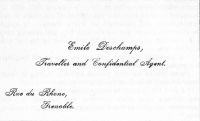
The inscription on the card had been devised by M. Emile after much meditation and reflection, and while drawn up to create confidence in the recipient, was really as misleading a document as one could find.
"You see," he would say to his 'copains,' "Grenoble is too far away for anyone in Paris to make awkward enquiries, the name of the street carries no number, and the fact that I am a traveller explains my presence in any city where I may be at the time, and does away with the necessity of having a fixed address. Moreover a confidential agent imparts a certain tone and air of respectability which cannot fail to give me the entire confidence of any patron who may be the favoured recipient of this small piece of pasteboard. Besides this, the fact that I have been a garçon for several years has enabled me to acquire that polished debonair appearance and deportment which can only be acquired from constant attendance on the high-born gentlemen and ladies whom I have had the honour to serve."
Glancing at the card, Pierre invited him to enter his rooms, and in a few moments the pair were settled in a well-furnished and comfortable library.
Emile was decidedly well dressed for a waiter, and beyond the fact that he wore mutton chop whiskers, a cleanly shaven face, a bald head, and had the habit of inadvertently placing his napkin under his arm and stepping across the room with his head in the air, no one would have suspected that he was in that line of business. He was a coward at heart, and was one of those sneaks who are always hanging about street corners—in fact he made street corners a speciality—and he was ever on the watch for something to turn up which might add to his income. These blackmailers—for that is what they really are—abound in all large cities, and seem without exception to attach themselves to one or more of the fair sex, whose inherited instincts of virtue have long since evaporated, and who night after night frequent one or other of the music halls or cafés, for the purpose of making fresh conquests. These pimps exert an evil influence over the minds of the girls, and by slow degrees insidiously drag them down to their own infamous level. Always keeping in the background, they are never seen by the gentleman who is drawn into the fair charmer's net, and only appear on the scenes when they perceive an opportunity of extracting money as the price of silence.
"Now, sir," said Pierre, as he poured out a small glass of absinthe which M. Emile tossed off at a gulp, "I want you to act as my private detective and watch a certain house for me, and to inform me of everything that goes on there. You are to call here at least once every day, and if I am out you are to leave a written message in a sealed envelope. I will pay you well, provided you allow no one to become acquainted with your movements, and you are not to tell a single soul as to where I am, or what I am doing. Is that well understood?"
"Oh, monsieur, if you only knew me better, you would be convinced that you have selected the best private detective in all Paris. I have frequently undertaken little commissions of this sort when travelling for my firm."
"Good! That will do. Now what do you consider a fair return for doing me this service?"
"Ah! I see monsieur is generous—I leave it to him."
"Well," said Pierre, lighting a fresh cigarette, and blowing a few whiffs in silence, "let me see. Supposing I pay you ten francs a day. What do you say to that?"
"Oh, mon cher monsieur!—"
"Don't address me as 'mon cher,'" Pierre interrupted. "Please remember you are my servant, and not my equal."
"Pardon, monsieur, a thousand apologies, it was my great appreciation of your nobility of character that warmed my heart towards you and impelled me to say this."
"Look here, Monsieur Emile, if you think you are going to get round me by that sort of blarney you're jolly mistaken. Tell me what you are prepared to accept, and don't try on any more of your monkey-brand soap on me, it won't wash. You'll provoke me to say something in a moment that you won't like. Now out with it. How much?"
"Ah! Monsieur is too cruel. The last time I undertook a commission like this I reluctantly accepted a hundred francs a day, but as I have taken a great fancy to you I will make an immense sacrifice and accept fifty francs."
"I suppose you think I'm a soft-headed idiot, and that I believe all your silly tales. Well, I may as well be frank and tell you that I don't believe a word you say. Look here, I'll offer you fifteen francs a day, and not a sou more. You may take it or leave it as you please."
Emile Levasseur cowed under the stern voice of Pierre, and seeing that the game was up, shrugged his shoulders, and spreading out the palms of his hands in a supplicatory fashion with a look of intense resignation and reluctance, accepted the offer.
Pierre gave a smile of satisfaction at the success of his counter-stroke, and after giving his now engaged detective a few more instructions, rang the bell, and ordered his valet to show him out. Emile was no match for a determined man, but having extremely plausible ways, he generally succeeded in gaining his ends with the lower class of women, and especially servant girls. Hence his first manœuvre to establish a footing in Villebois's house was by pandering to the vanity of the doctor's female servants. By means of a little subtle flattery, a kiss or two, and a few francs carefully invested in scents and cheap ribbons, he soon won the favour of the housemaid. From her he learnt all the goings-on in the house—the death-like trance of Delapine, the interrupted autopsy on the body, the discovery of the hypodermic syringe and the needle, and the visits of Messieurs Biron and Roux.
A couple of days later as Emile was loafing round the house during the evening, he noticed Villebois and Marcel engaged in earnest conversation in the garden. Thinking it might prove useful, he managed to climb over the wall and creep up to them in the dusk. He found an excellent hiding place quite close to them behind one of the laurel bushes. Emile could not catch all they said, but he distinctly heard Villebois say to Marcel, "Go to Pierre's club 'the circle des Italiens' in the Avenue de l'Opera, and inform him from me that he must quit France to-night, or he will be arrested to-morrow for the murder of Delapine. All is discovered and the game is up, and if his father hears of his arrest it will certainly kill him."
As they moved down the path Emile lost the rest of the conversation. He remained concealed until Villebois and Marcel had entered the house, and then creeping along the garden wall he succeeded in passing unobserved into the street.
Presently he saw Marcel come out of the house and hurry past. Emile watched him drive off in a fiacre, and hurried after him on foot, seeking all the time in vain for some means of overtaking him. Five minutes or more elapsed, but no vehicle could be seen. At length Emile threw up his hands in despair, and was on the point of abandoning the task as hopeless, when he saw a private motor-car coming along with two men inside. As he rushed into the middle of the road and waved his hands in front of the advancing car, the chauffeur brought the powerful Mercèdes to a stand, and demanded an explanation of the stoppage.
"A thousand pardons, gentlemen," said Emile, assuming a most bewitching smile of the very latest pattern, "but my car has broken down, and it is imperative that I should reach my club in the Avenue de l'Opera immediately. If I might trespass on your kindness, and ask you to drive me?"
The two men looked at each other and hesitated, but Emile handed them his visiting card with an elegant flourish, and a courtly bow. The card handed to the occupants of the Mercèdes bore a crown in the centre, and in ornamental copperplate letters appeared underneath:—
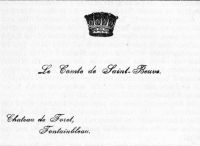
This at once decided the case, and delighted that they had a gentleman of such good rank and courtly bearing for a companion, they had no hesitation in granting his request, and cordially inviting him to be seated, they drove away to the club.
As the car pulled up at the entrance, one of the pages opened the door, and Emile, shaking hands with his two friends, majestically stepped out. Mounting the steps in a dignified manner, he passed by the portier as if the place belonged to him, without even deigning to look round.
Entering one of the writing rooms, he hastily scribbled a note, and descending at once he stood at the entrance of the club awaiting the arrival of Marcel.
A few minutes afterwards his quarry appeared, and Emile, walking up to him, hat in hand: "Excuse me sir, are you Monsieur Marcel?"
"Yes, that is my name. Why do you address me?"
"Because Monsieur Pierre Duval gave me this note for you."
Marcel looked very surprised at receiving a letter from Pierre as he could not imagine how Pierre could divine that he would call, but he at once took the proffered letter, and tearing open the envelope read as follows:—
"Dear Marcel,
I much regret to have missed you, but I have just received an urgent telegram calling me away to defend a case at Orleans which will probably detain me for a few days. A letter addressed to the Hotel de la Pucelle will find me. So sorry to have missed you.
A bientôt, Pierre."
While Marcel was reading the note Emile passed out of the club, and was speedily lost to sight.
"This is awkward," muttered Marcel, "still it will give him time to escape if Villebois writes him to-night. Well, it can't be helped, I must see Villebois, and he can write or send a wire to warn him. Anyhow, I can do no good by staying here." So saying he retraced his steps, and hailing a taxi soon found himself once more in Passy.
Entirely ignorant of what had just transpired, Pierre went home to dinner, followed at a little distance by Emile. Hardly was his meal finished when a ring was heard at the door.
"Ah," said Pierre, "I expect that rascal Emile has come to see me. I wonder what he has to say this time."
A moment later Emile was shown into the room.
"I have important news for monsieur," was his opening remark as he laid his hat and cane on a chair.
"Well, be quick and let me know what it is. I have not much time."
"But, before I begin, perhaps monsieur will settle my little account?" said Emile, reflecting that when Pierre heard the news, he would have more important matters to think about than the settlement of the little bill.
"Well, here are two napoleons, that is all I can spare at the moment, and if you don't bring me more news than you have done hitherto you may whistle for any more money from me."
"Oh," replied Emile as he pocketed the coins, "monsieur may be certain that I will give him plenty of news to-night, plenty of news, he may be quite sure."
"Now tell me what you have to say, and be quick about it," said Pierre, lighting a fresh cigarette.
"Monsieur will pardon me if I say that my news is not to be told too quickly, and perhaps monsieur himself will see when I have finished that the need for haste is not a matter for me."
While Emile was speaking Pierre nonchalantly turned his back on his visitor and was busying himself with the pages of a railway guide. At the totally unexpected words of Emile, uttered in a quiet and almost dignified manner, the young advocate turned sharply round, and was about to deliver a scathing rebuke to his impertinent employee, but the words died on his lips and a sickening feeling of dread crept over him when he saw Emile draw up a chair and calmly seat himself alongside the small table standing between them. Summoning as much indifference into his tone as he was able to under the circumstances, he said:
"Pray, do not consider me, make yourself quite at home. But I may remark, however, that up to this moment I was under the impression that I was the master here."
"It is my fond hope that monsieur may long remain free to be the master in his own house," replied Emile, looking straight into the eyes of Pierre. "But," he added slowly, "if monsieur will deign to accept the help of his humble ally——"
"Understand me once for all," interrupted Pierre haughtily, "I do not make allies of my servants; if you have any news to report, say briefly what it is. Have you carried out my instructions and obtained information from Dr. Villebois's servants?"
"Yes, monsieur, I have not only gained my news from the servants, but I have obtained most valuable information from the lips of the eminent Dr. Villebois himself."
"Ah, and what had he to say?" asked Pierre anxiously.
"That is the very matter which I desire to discuss with monsieur," replied Emile.
"How do you mean, discuss?" answered Pierre angrily. "You are not here to discuss; your place is to report, and that's what you are paid for. You seem to forget yourself when you talk to me about discussing my business with me."
Nettled at the tone of superiority adopted by Pierre, Emile put up a warning hand to interrupt, "I think monsieur will be very glad to pay me a very large sum of money to make me forget. Sit down, monsieur, sit down," he added, "and we will come to a little arrangement about what Dr. Villebois was good enough to inform your ally and friend."
Something in his visitor's manner and looks caused Pierre to see that the time for bravado and bluff was past, and with a contemptuous sneer at the figure opposite him, he sat down at the further side of the table.
"Monsieur would prefer to smoke perhaps," said Emile insinuatingly. "The cigarette has a wonderfully soothing effect on the nerves when they are shaken."
"Damn you, say what you have to say," snarled Pierre, "and get out of this."
"I would remind monsieur that politeness is not only a great virtue, but on occasions like this it is also the best policy."
"What do you mean by occasions like this? Explain yourself, I do not understand."
"Monsieur will do better not to adopt that tone with me. I am here as his friend if——"
"If what?"
"If it will please monsieur to pay me——"
"Pay you for what?"
"For my devotion to the interests of monsieur in coming to him first with my news instead of going to the prefecture and telling the police that monsieur has murdered Professor Delapine."
"What! Do you insinuate that I murdered the professor? How dare you, scoundrel!" he cried, jumping up from his chair white with passion and fear, while his face gradually became ashy pale, and a cold sweat broke over him. Reaching forward he poured out a full measure of brandy with a trembling hand, and swallowed it down at a gulp. "What are you staring at, you idiot?" he said, trembling all over. "Have you nothing else to tell me? Well then get out, I have no further use for you; and mind, if you breathe a word to a living soul about this, by God, I will kill you like a dog. What are you doing standing still like a born fool that you are? Get out, I say, do you hear me?" he cried as Emile hesitated to depart.
"I wish to assure monsieur," said Emile, who displayed great control over his voice, but an extraordinary want of tact, "that it was only my great devotion to him that prevented me from informing the police this evening, and monsieur would have been arrested immediately. Now, if monsieur will make me a little present, just enough to make it worth my while——"
"What! you infernal devil," interrupted Pierre, his voice becoming husky with passion as he rose from the table and looked at Emile with eyes blazing with fury. "Do you mean to tell me that you require me to muzzle your mouth with gold in order to secure your silence?"
"Ah! monsieur, we have all got to live, and for a thousand francs—a mere trifle to monsieur—I close my eyes, and for another couple of thousand more I close my lips, and I will never tell the police, or even your father."
"You limb of satan, you hellish fiend. By God, I swear I'll tear your lying tongue out of your mouth, and break every bone in your damned body," cried Pierre, and seizing a champagne bottle he hurled it with all his force at Emile's head as the imp tried to escape from the room. Emile ducked, and the bottle just caught the top of his head, causing a deep gash, and knocking him down as if he had been pole-axed. The blood trickled down his face, and Pierre was afraid for the moment that he had killed him. Hurrying out of the room he fetched a pail of water and some towels, and tying one of them tightly over the wound he soon stopped the bleeding. In a few minutes he had mopped up all the blood, and removed every trace of it from the floor, and seeing that Emile was not seriously hurt, propped him up in a chair and rang the bell.
"Joseph," he said to his servant, as the latter stared at Emile propped up like a Chinese idol with a towel twisted into a turban round his head. "Don't be alarmed, my friend has had the misfortune to cut his head with a champagne bottle as he was opening it, he will soon be all right again. Kindly go and fetch a fiacre as soon as possible, and see that he is driven to his diggings. By the way, Joseph," he added, "I shan't want you this evening, so you may go out and amuse yourself if you like, and remember," he continued, in as calm a voice as he could command, "not a word about this to anyone. This accident was purely his own fault, and as you see, he is not badly hurt."
"Thank you, sir," said Joseph, as he felt relieved at seeing Emile beginning to wake up. "Have you any further orders, sir?"
"No, Joseph, no, that will do, only be quick and get this fellow out of the way. His presence is getting on my nerves," added Pierre, becoming excited again.
A fiacre was soon brought, and Emile was bundled in.
"Where shall I drive to?" asked the cocher.
"Oh! anywhere you please," said Pierre, who had assisted Joseph in getting him in, "only don't bring him back here."
The cocher drove off, and Emile, recovering somewhat, shouted to the coachman to turn round and drive to the General's house.
As soon as Joseph had departed, Pierre set to work to pack up his possessions, and collect his papers and valuables together.
"Now," he said, consulting a railway time-table, "I shall be able to catch the midnight train for Bordeaux. That will suit me nicely, and I can alter my appearance so that my own mother would not recognise me."
FOOTNOTES:
CHAPTER XVIII
FACILIS DECENSUS AVERNI
Revenge at first though sweet, bitter ere long back on itself recoils. Paradise Lost.
Meanwhile Emile swore in a way that would have turned the English dragoons in Flanders green with envy. He was thirsting for vengeance and was busy turning over in his mind how he could best pay Pierre back in his own coin, when he found himself at the General's house. Thanks to Villebois and Riche's skill, Duval's bullet wound was so far healed that he was beginning to use his arm, and the movements and sensation of feeling showed that repair had set in vigorously. He was sitting in an easy chair when Emile was ushered into his presence.
"Well, and pray who are you, and what do you want to see me about at this time in the evening?" said Duval, frowning at him and looking very red in the face.
The General scrutinized the visiting card which Robert had just handed to him on a silver salver. Turning it over he examined it thoughtfully, and glanced up at him with a searching gaze.
"What have you been doing to your head?" he enquired.
Emile twisted his fingers, and played with his hat in a nervous fashion. "I met with an accident in the street, and a man ran out of a house and bound it up for me," he replied, cowed and trembling.
"I suppose you think that is the proper way to call on gentlemen of my rank in the evening, is it?"
Emile was beginning to feel faint, and sat down on a chair near the General.
"Get up, sir, this instant. How dare you sit down in the presence of a General of the French army, and without leave too? Parbleu, in my younger days you would have been arrested immediately, and severely punished. Ma foi, the service must be going to the devil. Get up this instant, do you hear me, sir?" he said, as the wretched man was too bewildered and confused to obey the General's orders.
"If you please, mon Général, I have the honour to inform you that—that your son has killed Professor Delapine, and that he will be arrested to-morrow morning for murder."
"What the devil do you mean, sir? Are you mad or what?"
"A thousand pardons, mon Général, I am telling you the naked truth. I have just come from Dr. Villebois's house, and I overheard him say that the moment Dr. Roux's report is presented to-morrow morning at the Parquet, your son, Monsieur Pierre Gaston Duval, will be arrested on the charges of arson and murder."
"What!" exclaimed the General, bounding out of his chair, and seizing the bully by his coat collar and shaking him violently. "Do you mean to tell me that—that——" he burst out in a voice that became incoherent with mingled rage and horror, "that—that—the police intend to—to arrest my son on a charge of murder?"
"It is true, mon Général, I heard Dr. Villebois and Dr. Roux both say so."
The General's eyes nearly started out of his head, and a profuse perspiration collected on his brow. An awful horror seized him, and his chest heaved with convulsive emotion. "My God! to think it has come to this! My only son, the pride of my heart, the heir to all my property, the sole survivor of my family, and to end in disgrace like this," and burying his face in his hands, he sobbed convulsively. Emile toyed with his hat more nervously than ever, and watched the General intently not to miss the effect which his speech had on him.
At length after a painful pause that seemed interminable, Duval stood up, and fastened his eyes with a searching gaze on Emile, while his face twitched convulsively, and assumed a look which terrified him almost out of his wits.
"What were you doing in Delapine's house to overhear this conversation? Were you invited there?"
"Oh! no, mon Général. I was paid by M. Pierre to watch the house and bring him all the news I could glean."
The General's feelings were working up to the boiling point, and his fury was passing beyond all his powers of control. Emile was on the point of making a bolt for it, but the furious gleam of Duval's eyes rooted him to the spot.
"You infernal sneak, you vile informer, you—you miserable reptile," said the General, with a look of withering contempt on his face, his voice rising in pitch until it almost ended in a shriek, "out with you before I shoot you dead," and suiting his actions to his words, he opened a drawer and pulled out a large army revolver.
But Emile did not wait for Duval to raise the weapon. Before the General had time to cock it, Emile had already bolted out of the room, and hurrying down the stairs, ran out of the front gate as fast as his legs could carry him.
Duval rushed after him and fired several shots, but his wounded arm prevented him from taking a steady aim, and Emile was speedily out of range.
The General returned to his room, and lay down on the sofa in a state of complete exhaustion. Nearly half an hour had elapsed before he was sufficiently recuperated to ring the bell and order the carriage to be got ready. He slowly went upstairs, and put on his uniform assisted by his valet.
"Buckle on my sword as well, Robert, I don't feel my real self without my trusty sword and revolver."
Robert appeared terribly scared at the appearance of his master, but knew him too well to venture on any remark, or to let him perceive that he saw it.
"You need not wait up for me, Robert," he said in a calm and measured voice which presented a marked contrast to his previous excited and furious tones, and now bore traces of strong determination mingled with unutterable sadness. "I don't like to say so, Robert, but I feel somehow that I may be addressing you for the last time. You will have no reason to forget me, Robert, you have been a faithful servant to me, and I have not forgotten you in my will."
"Oh! mon Général, do not talk like that," said Robert, weeping, "I cannot bear to think that misfortune could overtake you."
The General was deeply moved at the old servant's words, and pouring out a glass of brandy, handed it to him.
Robert for the moment was too astonished to drink it, and looked at his master for some explanation of his altogether unusual conduct.
"Drink it, drink it, my good fellow," said Duval, "I do not like leaving without some slight token of my regard for you," and so saying he filled another glass, and with a nod of approval clinked it against his valet's, and drank to his health.
"May le bon Dieu watch over you," said Robert in a solemn but respectful tone of voice.
"Merci, merci," replied the General nodding to him. "Now leave me, my good man, I am not well," and he shook his head and sighed painfully.
Robert's eyes were filled with tears as he left the room in silence.
It was after nine in the evening when the General arrived at Pierre's rooms. The latter looked out of his window to make sure that it was not a detective, or a member of the police force who stood at the door, and having assured himself on that score, he opened the door and admitted his father.
Duval quietly entered the room without saying a word. He sat down in an armchair and began by looking at Pierre, who was humming a tune, with a steady gaze.
Pierre felt very uncomfortable, and tried to avert his father's looks, but in vain. The silence was beginning to become unbearable, and picking up a newspaper he attempted to read, but the terrible look on his father's face rendered it impossible, and he flung the paper on one side.
"Now, sir, pray explain yourself," said his father very solemnly and slowly in an almost sepulchral voice. "I understand from a man who calls himself Emile Deschamps that you have not only attempted to burn Villebois's house down, but you have actually murdered his guest Professor Delapine, and that to-morrow morning you will be arrested in the name of the law."
"My dear father, what on earth are you talking about? I don't understand a word you're saying."
Pierre opened his cigarette-case, and having selected a cigarette to his satisfaction, proceeded to offer his father one.
"Don't trifle with me, sir. I have come here to demand an answer to my questions, and not to smoke cigarettes with you."
"You can ask me as many questions as you like, but I don't see that I am called upon to answer them," replied Pierre in a huff.
"By God, sir, you shall not leave the room until you have answered them," replied the General, becoming more and more angry.
"Look here, father, I won't have you talk to me as if I were a naughty child. You come here at this absurd hour of the night, and glare at me like a hyæna, and expect me to listen to some yarn about my burning down Villebois's house and murdering Delapine.
"Really, sir," he continued, "you are too funny for words, you ought to have been a comic actor. Ha! ha! ha!" and Pierre shook with laughter.
"How dare you trifle with me in this manner? Are you aware of the seriousness of this charge?" cried Duval in an awful voice.
"For goodness' sake stop, father, this conversation is becoming too tedious, I really can't stand it any longer," replied Pierre in a languid drawl. "By the way, won't you take a glass of port?"
"Hold your tongue, sir! Will you listen to me or not? You have been accused of having set fire to Villebois's house, and of murdering Professor Delapine. I wish to hear from your own lips; is it true or not?"
"Oh, do shut up, father, and don't play the fool with me any more," replied Pierre, his voice rising almost to a scream. "Is it likely that I, your own son, would dream of doing mad acts like that? The thing is too absurd even to argue about."
"Am I to understand then that you are innocent of both these deeds?"
"Most certainly I am. I swear the whole charge is a dastardly lie, and is without a shadow of foundation."
"Are you prepared to swear this to me on oath? Hold up your hand and swear then," said his father, as Pierre nodded assent.
"I swear before God that the whole story is nothing but a filthy lie," said Pierre, holding up his hand, "and I solemnly call God to witness what I say."
"You are lying, you are deceiving me—I can read it in your face."
"May God strike me dead on the spot if I am deceiving you," replied Pierre in a sudden outburst of passion, bringing his fist down on the table with a bang in order to carry conviction, although he was trembling from head to foot.
"Of course," he continued after a moment's reflection, "if you prefer to believe this damned cad whom you call Emile, rather than your own son, I have nothing more to say."
Duval remained silent for a few moments, fixing on him one of those terrible looks which would have cowed a Bengal tiger, and caused him to slink away.
"Come now, father, for goodness' sake change the subject, and don't waste my time with these absurd accusations," said Pierre, with well-feigned anger, although he was quaking with fear.
"Pierre, I ask you for the last time, do you still persist in your statement that it is all a lie?"
"Of course I do; what else could it be?"
"If it is a lie, then explain to me why you have employed a low sneak to watch the house and inform you from hour to hour what is going on there. Is that a lie also?"
Pierre grew very red in the face and tried to avert his father's gaze, but said nothing.
"Answer me, sir," said Duval with another of his searching looks.
"Oh, father, why do you ask me such ridiculous questions?"
"Ridiculous questions indeed. I suppose you will give that reply to the Juge d'Instruction when you are arraigned on the charge of wilful murder, and when the guillotine is staring you in the face? Hein!" and Duval looked at him once more with flashing eyes and tightly clenched teeth.
Pierre merely hung down his head.
"Hold up your head, sir," said Duval in a terrible voice, "and look me full in the face. I see your sense of guilt makes you ashamed to do it."
Pierre got up and made as if he would leave the room.
"Halt!" cried the General in a voice of thunder, and going quickly to the door he locked it and put the key in his pocket. "Now, sir, once for all, did you or did you not kill Delapine, and set fire to Villebois's house?"
Pierre could see from his father's face that prevarication was useless, and however much he denied the deed he would refuse to believe him.
"I see you refuse to believe me even when I do tell the truth. Well, as a matter of fact, I did try an experiment on Delapine when he was in a trance, with a little liquid which Paul Romaine gave me, and the fluid unfortunately proved too strong for him, and it ended fatally."
"Do you imagine for a moment that the jury will believe that story? Did you set fire to the house as an experiment to see whether it would cause the guests to quit the room and leave you free to murder an innocent man? Did you keep away from Villebois's house where you were a 'persona grata,' and a welcome guest, and employ a spy as an experiment to watch the house for you? Hein!"
"I see it is useless to argue with you, father, so I shall hold my tongue."
"You are not only an incendiary and a murderer," said Duval in a voice trembling with emotion, "but what, if possible, is worse, you are a liar! and a coward, sir! I disown you for ever as my son, but I cannot allow you to disgrace my name and that of our family by being put in prison, and handed over to the executioner as a felon," and so saying he quietly drew his loaded revolver and laid it on the table.
Deliberately rising up, he unlocked the door, saying as he did so, "I shall return in a quarter of an hour," and shutting it, locked it on the outside.
Duval went out of the house and paced up and down in front of the window of the room where his son was standing, and nervously looked at his watch from time to time.
Punctually, in a quarter of an hour he returned, and unlocking the door, looked at Pierre with a face of unutterable disgust. His eyelids were raised to their full extent showing the whites all round, while his pupils dilated and glistened with rage and emotion as he stood bolt upright with his head in the air like the brave old soldier that he was.
"Coward," he hissed, "so you have not even the courage to preserve your father's name. Well then, since you have not the courage, I must do it for you," and taking up the revolver he pointed it at Pierre's heart.
But Pierre loved life too well to be despatched without a struggle, and before Duval had time to pull the trigger, his son made a sudden dart at him and dashed the revolver aside, and at the same time closing with the General, threw him on to the ground. Under ordinary circumstances Duval's superior strength would have made it an easy task for him to render Pierre powerless, but the pain in his injured arm became so excruciating that it gave Pierre every advantage over him. Duval still held on to his revolver, and endeavoured to fire at his son's body, but as he was in the act of pulling the trigger during the heat of the struggle, Pierre unintentionally twisted his father's hand round at the moment when the revolver was going off. The trigger fell, and the bullet passed right through Duval's heart. Pierre instantly released him, and getting up observed his father give a few convulsive gasps and fall back dead.
He gazed on him with a wild look of terror, and falling on his neck, gave way to his feelings of grief. But his remorse soon changed to alarm for his own safety, and he fervently thanked his stars that he had sent his servant out for the evening.
His first task was to open the window wide, and then taking his father's money out of his pocket, he scattered a few coins on the floor, and upset some of the furniture. The rest of the money together with his father's gold watch, keys, and revolver, he transferred to his own pockets.
Pierre carefully locked the door on the inside, and climbing out of the window he re-entered the house by the front door, and picking up his valaise and portmanteau (which he had previously packed) straight-way left the house.
A couple of streets further on he hailed a cab and bid the cocher drive to his father's house. He kept the cab waiting while he let himself into the house with Duval's latchkey, and made his way to the library where his father kept the safe.
It was only the work of a few minutes to open the safe and tumble all the bank-notes, securities, and other valuables into a small portmanteau. Hurriedly grasping this, he ran downstairs and re-entered the fiacre.
"Drive to the Quai D'Orsay Station," he called to the cocher. As soon as the fiacre stopped, Pierre went quickly into the lavatory and washed off a few traces of blood which had splashed on his clothes.
"Thank God, no one can recognise me now," he muttered, as he proceeded to shave off his moustache, and adjust a set of false whiskers and a small beard which he had taken the precaution to pack away in his valaise. "Ha! Ha! Why, my own mother wouldn't know me," he added as he peered into the mirror with a look of satisfaction.
An hour later he bid good-bye to Paris, and found himself rapidly travelling in the direction of Bordeaux.
CHAPTER XIX
THE VIGIL
"Anche la Speme[17] Ultima Dea, fugge i sepolchri e involve Tutte cose l'Oblio nella sua notte." Foscolo.—Dei Sepolcri. 16.
"Nus rein avoir grant joie S'il n'en sueffre paine." (Pierre de Corbie.)
"The ghost in man, the ghost that once was man, But cannot wholly free itself from man, Are calling to each other thro' a dawn Stranger than earth has ever seen—the veil Is rending, and the voices of the day Are heard across the voices of the dark." Tennyson.
Delapine had been laid in the spare bedroom which had been partly altered into a sitting room and made as comfortable as possible. Madame Villebois had placed a small table just behind the head of the bed, and covered it with a white cloth. On it she devoutly placed a crucifix, together with a large wax candle on each side, which she gave directions should be kept burning all night. Two more candles were placed on small round tables at the foot of the bed.
"Now, my dear," said the good lady to her spouse, "I have turned the room into a little 'chapelle ardente.'"
Doctor Villebois nodded approval—but his mind turned to the practical rather than the spiritual needs of the professor.
"Let us put a stove in the room," he added, "so that it may be kept at a constant temperature of summer heat."
Renée insisted on sleeping in the room with a Sister of Mercy who had been called in to assist at the vigil during the night, while during the day Renée and Céleste agreed to take turns in watching.
"Is this the room where the tragedy took place?" asked Paul as the two doctors were shown into the room by Villebois.
"No, that was downstairs. This room has been specially prepared for the professor."
Paul went up to Delapine, who was lying white as marble and apparently lifeless.
"Yes, there is the syringe mark right enough."
Seizing the arm, he inserted a sterilised probe and then forcibly squeezed the skin. A few drops of yellowish fluid came out. He collected it on a watch glass and warmed it over a spirit flame. A tiny white deposit remained.
"Let me put this under your microscope," he said to Dr. Villebois. It was brought, and he carefully examined the crystals.
"I thought so. These are the crystals of the Japanese alkaloid right enough. There can be no doubt about what his condition is due to."
"What do you think about him?" asked Roux.
"He is either dead or will die very shortly."
Renée looked up with her heart thumping violently, apparently unable to grasp the full significance of the calamity.
"Oh! please, doctor," she said, rushing up to him and falling on her knees at his feet, "don't say that. Can't you give me any hope?"
Roux and Paul were visibly affected, and the latter patted her on the head to try and comfort her.
"I am afraid, mademoiselle, I cannot give you any hope," said Roux with a sorrowful look.
"But, Doctor, if he is not really dead, you won't surely allow him to be buried, will you?"
"No, no, you may be sure I won't allow that. I promise you that we will get an order from the Minister of the Interior to leave him here until there can be no question whatever as to his being dead or alive, and Roux and I have already sent our report to the Parquet with a request to that effect."
"I quite agree," said Paul, "to what you say, in fact, anything else would be criminal."
Two days later Dr. Roux received the following letter from Villebois:—
Mon cher Docteur,
The Parquet, after hearing the report which you and Monsieur Biron were good enough to give in this extraordinary case, has granted my petition that Delapine's body may remain unburied until it has been ascertained with absolute certainty that he is really dead, but I am sorry to tell you, mon ami, that you and Monsieur Biron are under the obligation to give the Parquet a detailed report every day concerning Delapine's condition, thus giving you both, I regret to say, a considerable amount of work.
Not only ourselves and the members of the Parquet, but all Paris—France—the whole world, are anxiously awaiting the solution of this wonderful riddle. The strain is telling on my nerves, and I really feel too ill to do any work. The whole house is becoming disorganized. Madame Villebois has been compelled to take to her bed, and my daughter Céleste and Mademoiselle Renée are taking turns to watch the professor in a room we have specially prepared for him. Reporters and other inquisitive people are calling all day long for news. A guard has been stationed at the front door by the kind permission of the Parquet to keep them away as much as possible, but it is needless to add that you, mon cher confrère, will always be welcome at any hour of the day.
Toujours à vous, Adolphe Villebois.
Dr. Villebois was compelled to abandon his practice for the time being, and devote himself to his mysterious patient. Dr. Riche offered to share all responsibility with him—an offer which needless to say was most cordially accepted.
Almost every hour of the day Riche would enter the bedroom and examine the thermometer to make sure that an even temperature was maintained. He had just entered the room and looked at Renée who was sitting down holding Céleste's hand, the picture of abject misery. Renée closed her eyes, her lips trembled while she emitted a half-suppressed sigh, feeling too sad to think or speak. From time to time she put her hand to her head as if she felt a pain there, and heaved a little sigh. All hope seemed extinguished, and left nothing but an empty longing in her heart. And now the sun was eclipsed. Her dream of love had become a ghastly nightmare. A fearful and unknown terror seemed to possess her. "Listen," her heart seemed to say, "listen to the rustling of the wings of the Death-Angel as he hovers over you. You have lost your protector. Pandora's box is empty. Hope, the sole remaining gift, has escaped and fled. There is nothing more to live for. All that remains is black, hopeless despair. Why hesitate any longer? Make away with yourself."
With such thoughts of undiluted misery, she lay down on the couch longing for comfort which never came, eager for someone to come and comfort her, and yet at the same time half hoping that she might be left alone.
"Oh! Henri, Henri, my beloved, come back, come back to me or I shall die."
She felt like a little wounded bird left alone in the nest to perish.
The next day Riche, who was somewhat of an electrician, brought in a couple of dry-cell batteries and fixed the wires so that the faintest movement of Delapine's head or limbs would complete the circuit in the wires and ring an alarm.
"There," he said to Renée when he had finished, "if the professor moves hand or foot as little as the twentieth part of an inch, the alarm will be heard ringing all over the house, and will continue until the circuit is broken again."
Suddenly the alarm bell, which was one of the largest size, rang with an indescribable din. Renée jumped up with a cry, while Céleste, Marcel and Payot came rushing into the room.
"What is it, what is it?" they all cried.
"Nothing," replied Riche, "I was merely testing the apparatus. See," he continued, "I will move the professor's hand the fraction of an inch." Immediately the gong sounded, and everyone started. Then he tested each limb in the same way, and always with the same result. Next he examined the thermometer which he had placed in Delapine's mouth the day before. It showed a temperature of 75° Fahrenheit. Then he looked at the thermometer on the wall. It showed 70° Fahrenheit. He smiled and gave utterance to an exclamation of pleasure and surprise.
"What's the matter, doctor?" asked Renée, sitting up as she watched Riche's face closely.
"I have good news—not very good, but still better than nothing. The body is five degrees warmer than the air of the room. If it were only the same temperature it would be a serious matter, but for it to be higher is a very good sign."
"Oh God, I thank Thee for this small mercy," said Renée, folding her hands and bowing her head devoutly. She hurriedly left the room, and a few minutes afterwards Riche heard the music of her violin.
He opened the door and listened. He heard the opening notes of Beethoven's "Kreutzer Sonata."
"My God," he said to himself, "what feeling, what execution! surely the professor's spirit must have entered the child." He listened enraptured. Stealing out of the room with Céleste and Marcel, he found Villebois and Madame Villebois standing at the half-opened door of the library not daring to enter lest they should break the spell.