Front matter (continued 6)
Reading edition
Then the air changed, and the "Ave Maria of Schubert" caught his enraptured ear.
After a pause she laid her violin down, and with closed eyes like a blind child she walked across to the organ. The fearful strain of the last few days on her nerves had exhausted her feeble frame, and she was evidently in a somnambulistic state.
Villebois with his medical training observed it immediately, and not daring to break the spell, worked the bellows for her.
She played a few chords, and then caught up that magnificent air of Handel's Messiah—"I know that my Redeemer liveth."
Riche had never felt so devout before. He had always regarded God merely as a convenient substantive when suitably qualified, to express his feelings with. Since he was a child he had never entered a church unless it were with an opera glass and a Baedecker in his hand, and now for the first time he felt a sort of consciousness of some unknown influence, some faint divine inspiration filling his soul. Accustomed as he had been in Morocco and Algiers to witness terrible scenes of cruelty and oppression unmoved, and to mingle in camp life with brutal soldiers, Turcos, and men who had been transferred to the frightful discipline of the Algerian foreign legion, the sweet almost angelic pathos of this girl in her exultation at the faint signs of life in her lover which Riche had revealed to her, exercised a subtle influence over his soul, which was something weird and strange to him. He felt his tears beginning to flow, and ashamed of his weakness he wiped them away and struggled to suppress them, but in spite of all his efforts they continued to dim his eyes. He looked up half ashamed of himself, but discovered the others completely overcome.
Even Marcel, the gay and frivolous cynic, usually all laughter and jokes, remained standing behind the others in a deep reverie, while Madame Villebois was sobbing convulsively.
At length Renée ceased playing, and the company dispersed, afraid lest their presence should break the spell. Silently she glided along, her eyes staring widely open, her hands outstretched before her, and her head turned upwards. She walked upstairs apparently fast asleep, and opening the door of the professor's chamber, proceeded straight to his bed. All the company followed breathlessly, and saw her bend over his form, and clasping him in her arms implanted a long and passionate kiss on his cold lips. Tears streamed down her cheeks and trickled down Delapine's face.
The death-like silence was terrible. Not a sound could be heard save the ticking of the clock. One could almost hear her breathing. Finally she left him, and still half unconscious lay down on her bed in a peaceful slumber.
No one dared to break the silence, and at length they all passed out of the room one by one to attend to their several occupations, or try and collect their thoughts.
A week passed away and then another week, and still Delapine lay unconscious in the same position.
Day by day Monsieur Biron called for news.
"Yes," said Villebois one morning in answer to his enquiries, "the professor lies there still unchanged in his death-like sleep."
"Do you mean to say he is not dead then?"
"I cannot tell you," replied Villebois, "but if he is not alive there are no signs of death."
"C'est une merveille, I cannot comprehend it," exclaimed Biron, holding up his hands and shrugging his shoulders.
"May I be permitted to look at him?" he asked.
"With pleasure, monsieur le commissaire."
Monsieur Biron entered the chamber of death with a slow and methodical step as became his dignity as an officer of the law, and proceeded to place his hat and stick on a chair. "Yes, who can tell?" he said, shrugging his shoulders, and looking up at the doctor for some reply. "Well, well, we shall see n'est-ce pas?" and he shrugged his shoulders, as if he felt somehow that the law wanted remodelling in order to be able to deal with such cases. After a short pause he rose and shook hands with Villebois in rather a patronising way, and bowing profoundly, left the house in an uncertain frame of mind, but fully convinced that he had performed a most meritorious duty.
Another day, a few weeks later, Dr. Roux came in, and taking a careful note of everything, examined the thermometer which perpetually remained in Delapine's mouth. He compared it with the thermometer on the wall, which remained at a constant temperature of about 68° F. He compared the figures with the chart on which the daily temperature was entered. "This is very strange!" he exclaimed, and hastening out of the room he ran downstairs to see Villebois.
"Dr. Villebois, are you there? Pray come here at once," he called out breathlessly.
"What's the matter?" cried Villebois, laying down his pen, and looking up at Roux who ran up to him and laid his hand on his shoulder in a state of great excitement.
"Come at once and look, Delapine's temperature has risen to 82° Fahrenheit."
Villebois jumped out of his chair with a bound. "C'est une merveille," he said as he flew upstairs after Roux who happened to have just called.
"Is it really true ... what can it mean?" cried Roux in a state of great excitement. He ran up to the professor and examined the thermometer with impatience. "You are right, doctor, quite right. It stands exactly as you said at 82° F. There can be no doubt about that. But what does it mean?"
"Who knows. But it looks favourable, doesn't it? His body is certainly not undergoing any decomposition, and therefore a rise of temperature must imply that the physiological functions of the body are beginning to assert themselves once more in some silent mysterious fashion."
The vigil continued day after day without a moment's interruption. Riche and Villebois took turns to relieve Céleste and Renée, but the latter insisted on always sleeping in the room. Often she would get up in the small hours of the morning, and with a night lamp in her hand would examine the thermometers, and bending over the professor would breathe a tender lover's kiss on his lips, and then creep back into bed.
Paul took an intense interest in the case, and insisted on Villebois telephoning him every detail often two or three times a day.
More than three months had passed away since Delapine first became unconscious, and still no signs of returning life appeared. One day about the middle of January of the following year, Paul happened to call, and going up to Delapine distinctly noticed a slight tremor of the facial muscles. He stood spellbound, and then happening to examine the thermometer found to his surprise that it indicated 90° F. He ran into the library where Villebois and Riche happened to be sitting, and at once communicated the discovery to them.
A veritable flutter in the dovecot followed. Telephonic messages were at once sent to Monsieur Biron, Roux, and to several of the most eminent professors and specialists at the various hospitals in Paris, for the mysterious case had become the daily topic of conversation among all the faculty. A great consultation was held in the library among all these learned doctors, and voluminous notes were taken. But although a vast amount of erudition was put forth, no one was able to offer any practical suggestions, and hence nothing came of it.
"Mais mon Dieu!" said one of the great men, "what can we do? We can only wait patiently until something happens."
A few days later Renée was lying in her bed about midnight in a semi-drowsy condition, when she suddenly saw a bright light floating like a nimbus over Delapine's head. She gave a little scream, and then becoming more and more awake gazed on it with intense fascination. At first it moved slightly, and then growing larger and larger began to condense into the form of a human face. Slowly the features developed, until at length it assumed the form of her mother. By degrees the entire body appeared clothed in white drapery, and slowly made its way towards Renée with a sweet smile on her face. As the light of the room increased Renée recognised her features, and springing out of bed she ran into her arms. "Oh, mother!" she cried, "Is that really you?"
"Yes, I am your mother, and am come to tell you that Henri will very soon wake up, and you will be able to see him as he was, and to hear him talk."
Renée seized her by both hands and squeezed them.
"Mother dear, that is too good to be true. Do you really mean it?"
"Of course I do. You know I never told you a lie, and why should I tell you one now?"
Renée's eyes fairly danced with delight as she heard the welcome news, and she clapped her hands for joy.
"But tell me, how are you, mother? Are you very happy?"
"I am very happy," her mother replied. "The life on the other side is merely a continuation of this, only without its limitations."
"Do you suffer pain like you used to so often, mother?"
"No, Renée, there is no pain beyond the grave. Here you are subjected to natural laws. You are tied down to the earth by the action of gravity. But we are free from all these restrictions. We can go where we please at will in an instant of time. Time and space have no limitation for us."
"Shall I join you soon, mother?"
"No, Renée, you have a mission to perform and a great deal of work to do yet, and I think you will have a long and happy life in company with your fiancé."
"But how did you possibly know of our engagement? Has anyone told you?"
"Have I not been by your side off and on ever since I left you, my child? Do you suppose a mother can ever forget her daughter?"
"Of course not," replied Renée, "but at the same time I never imagined that you would be able to see me."
"You could not see me now but for your lover's presence."
"What do you mean, mother?"
"I mean what I say, dear. Henri has come back to earth, and I have been using his body to form materialistic substance to clothe my spirit with, so that you are enabled to see me with your own eyes."
Renée jumped up at hearing this with an exclamation of joy as the thought of Henri's return began to dawn on her mind. "Do you really mean to say that Henri is back again, and that he will be the same old darling he was before?"
"Why of course I do. My presence is the proof positive that his spirit has returned. To-morrow he will wake up and in a very short time he will be quite well again."
Renée clapped her hands for sheer joy, and gave her mother a close embrace.
"Oh! mother, how very strange to think that I never knew you were so near. Why is it that you have never shown yourself to me before, except for a moment when Henri was in a trance?"
"I can only reveal myself to you in the presence of a medium who happens to be in a state of trance at the time, because I have to clothe myself with the earthly particles of his body which I subtract from it when he is in that condition, as I cannot do it when he is awake. If you were to weigh Henri now you would find half his weight gone."
Renée looked at Delapine's body, and to her horror she saw it had shrunk to two-thirds its former size, but her mother calmed her and reassured her at once.
"You need not be in the least alarmed, my darling, he will get all his substance restored to him the moment I am gone."
"Oh! mother, how you did frighten me," she said, "but do you manufacture the drapery you are wearing, as well as your body, out of the substance of his body as well?"
"Yes, everything, and in a few moments, without the least difficulty."
"Why do you surround yourself with such thick white stuff?"
"The drapery is thrown out to protect our psychic bodies from the light which acts injuriously on us when materialized," her mother replied.
"Now, Renée dear, I must leave you because I cannot hold my power any longer, and besides it will injure Delapine if I do, as although he has returned to his body, he is so very weak that a very little thing might really kill him now. I will come again and see you very soon."
Her mother kissed her affectionately on both cheeks, and then relaxing her hold, she slowly melted down into the ground and vanished.
Renée was too excited to sleep any more that night, so she got up and lit the lamp.
She held it close to Delapine, and to her surprise she saw that he had returned to his former size and weight.
As she continued to gaze on his features, she noticed that the muscles of his face twitched. Suddenly Delapine moved his fingers, which caused the bell to ring so loudly that it woke up all the household, and they all came running into the room attired in their dressing gowns, or the first garments that they could lay their hands on.
"What is the matter?" they all exclaimed. "Have any thieves got into the house?"
"Oh! no," said Renée, smiling, "it was Delapine who rang the bell. He moved his hands, I saw him do it, and immediately the bell sounded."
"Are you sure of this?" they all cried with one voice.
"As certain as that I am standing here," she replied.
They all looked at the professor, and distinctly observed the muscles of his face twitch.
"I think we will sit up to-night and watch him, what do you say to that, Riche?"
The doctor agreed, and accordingly they made themselves as comfortable as they could in a couple of armchairs.
The next morning they examined the thermometer. It had risen to 93° F. A faint flush suffused the professor's cheek, and a slight but distinct pulsation could be felt.
The event was telegraphed all over Europe, and crowds of savants and doctors came and left their cards, but no one was admitted by the doctor's orders. The ringing of the bell occurred so often that it became a nuisance, and Villebois had it removed.
The next day the temperature touched 98° Fahrenheit and Delapine opened and closed his eyes and looked around him. He moved his limbs slowly and even attempted to sit up, but the effort was too great, and he sank back again on his pillow.
A consultation was arranged forthwith, and half a dozen of the most celebrated physicians in Paris came to the house.
Renée was in the seventh heaven of delight as she heard her name whispered in her ear as she bent over him that evening. He made signs that he wanted food, and the doctors agreed to give him some beef-essence. A few days afterwards about three in the morning Renée's mother appeared again. "Renée," she said, "I am about to be called away, and must leave you for good."
"For good, mother? You don't mean to say that I shall not see you any more?" said Renée, looking very distressed.
"I must go, dear, but Henri will take my place. When you pass over to the other side you will see me as often as you please, but now I must leave you."
"Mother dear, won't you give me some keepsake?"
"Bring me a pair of scissors and I will cut off a lock of my hair." So saying her mother snipped off one of her light golden curls, and giving her a long tender embrace slowly vanished out of her sight. Renée looked around her. She was alone save for the form of her lover. It all seemed like a wonderful dream, and she rubbed her eyes to make sure she was awake. "I must have been dreaming," she said, but no, here was the lock of her mother's beautiful silky hair in her hand. That at any rate was no dream, and was proof positive that someone had brought it, and that her vision was not a dream but a stern reality. Renée kissed the lock of hair, and carefully put it away in one of her little treasure boxes.
"Ah! how many happy hours I have spent in playing with that beautiful hair, and now to think that I should actually handle it again. Who would ever have thought it possible? How sorry I feel for the poor poet Cowper when the only thing he had left of his beloved mother was her portrait, and which he immortalised in those beautiful lines which my governess taught me:—
"'Oh that those lips had language! Life has passed With me but roughly since I heard thee last. Those lips are thine—thine own sweet smile I see, The same that oft in childhood solaced me; Faithful remembrances of one so dear, O welcome guest, though unexpected here! My mother! When I learnt that thou wast dead, Say wast thou conscious of the tears I shed? Perhaps thou gav'st me, though unfelt, a kiss, Perhaps a tear, if souls can weep in bliss.'"
She showed the lock of hair to Riche and Marcel, but they only smiled and shook their heads when she told them that her mother had cut it off from her own head only the night before.
"No, no, mademoiselle, you can't make us believe that your mother really appeared to you in the flesh and cut off a lock of her hair with a pair of scissors, and handed it to you."
"But I assure you, doctor, it is perfectly true."
"The vigil has been too much for Renée, poor child," said Riche to Villebois as they were discussing the vision. "Her reason has broken down under the strain."
"Yes," said Villebois, "I agree that we must send her away for a change somewhere, or she will have brain fever, or lose her reason altogether."
"I am afraid that those visions of her mother show that she has lost her senses already," said Riche.
"But how do you account for the lock of hair?" said Villebois.
"Why it's Renée's own hair of course, or else that of her maid."
"Well it can't be that of her maid, because that is raven black."
"I don't believe the tale for a moment," said Riche with a smile of contempt for such an ignorant superstition.
"Well look at the two side by side as I have done, and you will change your opinion. They are as different as day from night. Renée's hair has a brownish colour, whereas her mother's is of a light golden colour." He showed them both side by side to Riche but he merely shrugged his shoulders. He had seen so many wonderful things lately that he had ceased to scoff, but felt it prudent to keep silent.
At the end of the week Delapine's temperature had risen to normal (98.4° F.) and he had so far recovered that he was able to walk downstairs and sit in the study.
Renée was in constant attendance. No hospital nurse could have looked after him better, and certainly no one in the world could have replaced her in Delapine's eyes.
"Oh! Villebois, mon ami," he would say as he lay on the sofa a few days later, "I have had a most marvellous sleep, and a wonderful recovery, but you cannot imagine in your wildest dreams what wonderful adventures and experiences I have had."
"Adventures!" they all exclaimed, "What adventures? Why, you have been lying down in your bed upstairs for months past watched by us in turn day and night without a moment's cessation, and now you talk of adventures. It's we who have had the adventures, not you. Strange things have happened since that memorable evening when you went off in the trance-sleep. Are you aware, professor, that Pierre attempted to murder you by injecting a subtle poison into your arm?"
"Enough of that," said Delapine, "I know it all. Didn't you get my letter, Renée, in which I pointed it all out to you, and entreated you not to allow me to be touched or buried?"
"Rather! Why, Henri, Dr. Riche brought it to me, and it was that letter which saved your life by convincing Riche and Villebois that you were not dead, and so preventing the autopsy. Oh! how thankful I was when I read it. It gave me new life—in fact I am sure if I had not received some such encouragement I should have died of grief."
"Thank God that you saw the letter in time," replied Delapine, "I had a strange premonition that all this was going to happen, and so I prepared for it by giving you the sealed envelope."
"Let us not talk about it now, Henri, you are under my orders and I cannot allow my patient to get excited."
"Well, wait a few days until I get stronger, and then I will dictate to you my experiences, and you shall write them down, and we will publish a book about them. I think they will make good reading. You must know, Renée, that the moment I went into the deep sleep or trance, my soul (or Ego) left the body and went far away, and only returned to it about the 19th January."
"Why that was when dear mother came to see me."
"Precisely," Delapine nodded. "She was watching over you all the time, but she was unable to reveal herself in a visible tangible form, unless there was a suitable medium who was en rapport with her. Fortunately I was such a medium, and the moment I returned to my body she seized the opportunity which she had been long waiting for to reveal herself to you in bodily form by building herself out of the particles of my body."
"How strange!" they all exclaimed.
"Yes," said the professor, "I have studied these things deeply. I have discovered that all spiritualistic phenomena are governed by laws which are just as fixed and unalterable as are the laws which govern all the phenomena of this visible world. We have only to learn and understand how spiritual phenomena are produced and controlled by these laws, to extend our conquest over the invisible world of science in the same way that we have extended our knowledge over the visible world of science during the last three hundred years. Spiritual science is only in the same stage of knowledge and advancement in which electricity was at the time of Volta, or steam at the time of Watt."
"Oh, do tell us about it," they all said.
But no answer came. The professor's excitement had proved too much for him in his weak state, and when they looked at him he was sleeping peacefully as a little child with a happy smile on his face.
"Hush," said Renée, and she put her fingers to her lips.
All the guests crept out of the room in silence, leaving Renée alone to nurse her lover.
Day by day Delapine grew stronger, thanks to the careful nursing of Renée and to the medical skill of Riche and Villebois.
A week later the professor walked out into the garden, for the first time, with a stick, and sat down in the summer-house.
"Ah, yes, this is where I had my last cup of coffee, if I remember rightly."
"Yes," replied Riche and Céleste together, "and if you had drunk it you would not be here to tell the tale."
"But the insectivorous plant would, eh! Renée?" said Delapine with a comical smile. "Well I have got to thank Pierre after all. For if he had not injected that wonderful liquid into my arm I should never have made those wonderful discoveries, and had those extraordinary adventures which I have experienced all these months. Yes, I promise you I shall have them all in writing before long, and I trust I shall be spared to see you all enjoy reading them."
"But before you dictate them, professor, it is imperative that you have a change and re-establish your health, and we shall want you to take a trip somewhere."
"Yes, yes, I have provided for all that. I intend going to Monte Carlo."
"What!" they all exclaimed, "to Monte Carlo?"
"Why not?" he replied.
"Oh, but you surely do not mean to go there to play at the tables?"
"Why not?" he repeated.
"But, professor, we never knew you were a gambler."
"Well, well, it is part of my programme, and you will see how necessary it will be. It is true I am not a gambler, but I have resolved to play at the tables. Now, no more questions, or Renée will turn you all out of the garden," and Delapine laughed in his own hearty way.
"What a marvellous man," said Riche to Villebois.
"Oh, you don't know him yet, just wait a bit and see."
FOOTNOTES:
CHAPTER XX
THE NEW JERUSALEM GOLD MINE
En vieillissant on devient plus fou et plus sage La Rochefoucauld. Maximes, 210.
Quien Mucho abarca poco a prieta. (Spanish Proverb.)
Payot's financial schemes had not been flourishing of late. The Morocco concessions for very obvious reasons had unavoidably fallen through, and the financier's credit was none of the best.
It is a well-known fact that many men finding their business affairs going from bad to worse, revert to speculation with a view of retrieving their fallen fortunes. The general result of this policy is that instead of quietly setting about putting their house in order so as to stop the debacle, they get dragged deeper and deeper into the mire of financial ruin. Unfortunately for Payot, who was naturally rather a weak and credulous character, matters had almost reached that acute and alarming stage with him, and he proved no exception to the rule.
One day after the termination of his visit to Dr. Villebois's house, while sitting comfortably in his armchair after dinner, a portly looking gentleman with a clean-shaven, very red and puffy face, was announced.
"Monsieur le Baron D'Ormontagne," said the butler, handing M. Payot the visitor's card.
The baron appeared to be about forty-five years of age, with a digestive apparatus of vast dimensions, which was screened off by a white waistcoat carrying a gold chain with links like a cable. His nose was very large and decidedly curved, and this, together with his fleshy under-lip and double chin, betrayed both his affluence and his Hebrew origin. The baron was known among his former associates as Moses Goldberg, but fortune having favoured him of late, he felt that his position warranted his assuming the more ambitious title of Baron D'Ormontagne, which of course meant the same thing, only it sounded very differently.
"Pray sit down, baron," said Payot, handing him a chair, and looking him up and down as if he were about to measure him for a suit of clothes. "What service may I have the pleasure to render you?"
The baron who was very wheezy, commenced operations by drawing a large red bandana handkerchief from the recesses of his capacious coat pocket, and after a few flourishes, began coughing violently and clearing his throat.
"I presume I have the distinguished honour and good fortune to address M. Felix Payot, am I correct?"
"Yes, that is my name," said Payot.
"I have here a letter of introduction from M. Armand who has known me for years, and he has unbounded faith in my admirable judgment and great business capacity," and so saying he handed the letter to the financier.
Payot scanned the letter, and carefully folding it, placed it on the table.
"You know him well, do you not?"
"Oh, yes," said Payot, "I have known him for many years."
"Ah then, I see we are friends at once," said the baron, rubbing his hands in his eagerness to commence his acts of friendship. "To count upon a financier like you, my dear monsieur, as one's friend is an unexpected pleasure."
At this moment a butler entered and handed him a liqueur on a salver.
"No, thank you," said the baron, throwing forward the palms of his hands as if he were pushing a boat from the landing stage, "I have just had dinner—well, as you press me—I really cannot refuse. What was I saying? Oh, yes, I remember—I have just returned from Mexico where I discovered a very valuable gold mine of outstanding richness. You will be astonished when I show you the prospectus—and the samples—ah, such samples. Voila," and spreading the crimson handkerchief on the table, he emptied into it a small heap of quartz rock studded with gold nuggets as large as peas. "What do you think of that, mon cher, for a gold mine? Is it not superb?" and the baron rubbed his hands together as if he were lathering them with air. "Fifty-six, or is it a hundred and fifty-six ounces to the ton," he continued, "I really forget which. But no matter, you will see it in the prospectus. And there are thousands and thousands of tons—in fact a small mountain of it, and the reef crops up like currants in a cake. Examine the reef where you will, you always find the same thing—quartz studded with gold, or gold studded with quartz. It is positively like prospecting the vaults of the Bank of France. The mine positively reeks with gold. I discovered it purely by accident. I was travelling over the Sierras and lost my way. Feeling tired I sat down on an outcrop of rock, and casually picked up a loose chunk to throw at a rabbit near me. The piece of stone felt so heavy that I examined it, and to my delight and surprise I found it simply scintillating with bits of gold. Ma foi, you may be sure I marked the place well, and returning with a couple of friends I pegged it out and registered my claim in the city of Mexico. Now, here is the prospectus I have drawn out. Read it carefully and to-morrow, my dear friend, I shall come again, if you will be good enough to fix a time?"
"Say the same time to-morrow," said Payot.
"Excellent, excellent, nothing like doing business at once. That is my plan, and I owe all my success in business to it. And now, mon ami, I will leave you to think over it. I see you are unable to digest any more. It is a dream—a dream, n'est-ce pas? Such a mine has never yet been seen in the world. But so true—so true. Ah, you will never again in your lifetime have such a chance as this. Ah," he said as he rose to leave, "you are admiring my watch-chain? Everyone does, it is such a marvel. Each link, sir, was forged from gold taken from this very mine. Feel its weight, sir, eh?" and he gave a greasy smile of plutocratic opulence and contentment. Carefully dusting his white cotton spats with the red handkerchief, he took hold of Payot's hands and shook them effusively. "My dear monsieur," he continued, "this has been the greatest evening of my life. The thought of sharing this find with you—so rich that I have christened it the New Jerusalem Mine—just causes my happiness to bubble over."
"But why did you call it the New Jerusalem?" asked Payot.
"What name could be more appropriate? New Jerusalem—descending from Heaven—gates of pearls—streets of shining gold—my mine to a T. What could be finer as an illustration? To-morrow then at eight p.m. Au revoir, au revoir, mon brave," he said, as the butler in answer to the bell appeared at the door and opened it to its full extent, while the wheezy gentleman with his vast display of waistcoat toddled out of the room, bowing profusely.
"A queer sort of card that," thought Payot to himself as he opened the prospectus and proceeded to examine it.
If Payot thought that the baron was piling on the abnormal richness of the mine too thickly, he found to his surprise that the report of Monsieur Alexandre Norcier, the mining engineer, went considerably further. It was certainly an able report, but the fabulous richness of the reef absolutely staggered him. His eyes glistened with excitement and greed.
"Ah," he said to himself, "if this mine is only a quarter as rich as the old baron makes out, I shall be one of the richest men in all Paris. Just think what power it will give me. What would old Duval have given to have a third share in it? I believe he would have sold his immortal soul to the Devil—aye a hundred times over. Well, there's no knowing, it may be true after all. Anyhow, I'll call on Norcier and Armand to-morrow and see what they have to say."
When Payot fell asleep that night with his imagination already heated by the story told by the baron, he dreamt that he was filling trucks with nuggets of gold, and that they were being carted to the Mint every day of the year. When his fabulous wealth became known he was invited as the piece de resistance to the receptions at every Court in Europe. Daughters of royal blood strove in bevies to compete for his hand, and the President of the Republic decorated him with the Grand Cordon of the Legion d'Honneur, and the King of England with the Order of the Garter. Mighty schemes of reform filtered through his brain. He would rebuild Paris at his own expense on a scale that would dazzle humanity. He would fill the parks with statues rivalling those of Greece. He would erect palaces, museums, places of amusement far surpassing the Golden House of Nero. He would line the banks of the Seine with the choicest trees and flowers that the whole world could offer. He would deepen the Seine so as to form a ship-canal with a depth sufficient to admit the Oceanics, Imperators, and other sea monsters right up to the very quays of Paris.
Next morning he woke with a violent headache, and it required several cups of café au rhum, combined with repeated doses of phenacetin to get him out of bed.
The fresh air outside revived him, and thinking a walk would do him good, he proceeded on foot to Norcier's business offices.
"Pardon me, M. Norcier," he remarked as he sat down, "but I had an interview with our friend the Baron D'Ormontagne yesterday, and he gave me an account of his new gold mine in Mexico. So I thought you would not mind if I asked you for a few details concerning it."
"With pleasure, M. Payot, as a matter of fact I have greatly undervalued its richness; to be candid, in my report I have cut down everything to half so as to be well on the safe side. Do you not approve?"
"Most certainly, Monsieur Norcier, most certainly I do. Do you consider it a really safe speculation?"
"My dear sir, I would not recommend it to you at all but for three reasons. Firstly, your name is one to play with, it represents such honour and integrity that it will give our syndicate great weight, and for that reason we intend, should you care to have a stake in it, to give you the most favourable terms possible. Secondly, I myself am putting in every available penny, and lastly M. Armand and the Baron D'Ormontagne, two of the most honourable men in all Paris, take each an equal share. By the way, have you met M. Armand?"
"No, I confess I have not seen him for a long time."
"Oh, then you will find him a most charming man, and one who combines great business talent with extreme caution." In fact the testimonials of these two gentlemen were so high that Payot felt it would be almost an insult to call on Armand at all.
Precisely at eight o'clock in the evening the baron, true to his word, and looking even more florid than usual, called again.
"Voila, mon ami, we can now arrange everything. We have taken such a fancy to you, mon brave, that we feel our consciences will not be satisfied until we offer you two hundred shares in our syndicate at the absurdly low figure of 1,000 francs each."
"Two hundred thousand francs (£8,000)," said Payot meditatively, "that is a great deal of money in these days—a great deal of money."
"But consider, mon ami, what you are going to get for it—a large share in the richest mine in the world. Why, in three months when the first dividend is declared, each of your two hundred shares will be worth 50,000 francs, and the first dividend alone will repay you for all you have spent, five times over. Such a chance as this only happens once in a lifetime."
"But if they are so enormously valuable, why do you sell them at all?"
"For a very simple reason, my dear Payot, we are not selling them to you for your money, but for your name. You must remember your name is a thing to conjure with. You are held in such esteem that when the public sees the prospectus with your name on the list of subscribers, there will be an active market at once, and the shares will go to ten or twenty times the present price."
Payot felt extremely flattered and firmly persuaded himself that it was really the case, and that his name could command capital anywhere. After some hesitation he consented to take the shares, and prepared to arrange with his bankers to pay D'Ormontagne the purchase money.
He was delighted with his bargain, especially as every few days he received a copy of a cable message showing the increasing returns they were getting.
A meeting of directors was held at which Payot attended. It was passed unanimously that the Company should be floated with a capital of 10,000,000 francs, and the public was invited to take up shares.
"My dear Payot," said the baron, "now is a chance to underwrite. Each of our directors is going to underwrite a million francs, and of course we look to you to do the same. You will receive 250,000 shares as a bonus, and you will never have to pay for a single share. Why, the public will subscribe ten times over. The demand is already so great that the secretary has applied for ten extra clerks."
Payot hesitated and said he would think it over.
The next day the baron brought Armand with him, and the latter simply boiled over with enthusiasm.
"My dear Payot," he exclaimed, shaking his hand vigorously and patting him in a patronising way on the back. "My congratulations, you are a multi-millionaire already. Now you see the wisdom of following the advice of my esteemed friend the baron. Ah, D'Ormontagne is a great financier. Rothschild will have to look to his laurels now, but I am afraid he will have to give up the race. You mark my words, Payot, we shall all be in the Ministry at the next elections. France simply can't get on without us."
Payot sighed and merely shook his head. "I perceive you are an optimist, monsieur, and to be candid with you I confess I dread optimists. They are only a shade better than the pessimists. The latter look only on the dark side of everything, and are so cautious that they are afraid to embark on any enterprise at all, the result being that they never attempt anything unless it is absolutely devoid of any risk whatsoever. But the optimists—believe me, I have had enough of them, goodness only knows—the optimist, I repeat, always counts his chickens before they are hatched. He sees everything through rose-coloured spectacles. He counts on everything going right, and makes no provision for anything going wrong. This fanatic has also a curious way of calculating the number of tons of ore extracted every month which he multiplies by the number of ounces assayed per ton, and sets the total down as the amount which will be distributed in dividends. The silly fellow overlooks the immense amount of money which has to be sunk in working capital on the mine—in transport, food, tools, machinery, water, motive power and fuel. The condition of the roads, the proximity to a railway, the amount of available horse-power, fuel and water, the absence of any one of which is enough to ruin the prospects of the best mine—are details which never trouble him in the least. Nothing is set aside for reserve, nothing for emergencies, and so his estimate of the profits instead of being, let us say for the sake of argument, £10,000 a month, really works out at £1,000—or a tenth of his estimate when it comes to be divided among the shareholders. In a word, he becomes saturated with megalomania like a general paralytic."
"My dear Payot, you have almost taken the words out of my mouth, so thoroughly do I agree with all that you have just said," replied Armand, "but you are entirely mistaken, if you imagine that I am an optimist. On the contrary, I am so cautious that my friends nickname me the pessimist, a quite inappropriate term, I assure you, since I have the reputation of having the dash and boldness of the great Napoleon. Is that not so, baron?"
The baron had been nodding approval so violently at every word that his friend Armand had been saying, that he had to express his assent by patting him on the back instead.
"My dear Payot," said the baron, "excuse me always addressing you in this way—but your charm of manner has so won my heart that I feel it quite impossible to address you by any other term. If you will be good enough to read the prospectus carefully you will see that everyone of these items is munificently provided for. No detail has been omitted. The sum which our engineer considers ample to meet every possible contingency only amounts to £10,000 a month."
"What!" cried Payot, horrified beyond measure as he jumped up with a bound. "Do you really mean to say that this blessed mine is going to cost us £120,000 a year to keep going? Why, we shall have to close down before we can distribute a sou in dividends. Ma foi, we shall all be ruined in no time."
"Not so fast, my dear sir," they both shouted together, "not so fast. It is quite clear that the magnitude of the undertaking has been too vast to enter your brain. You must digest it gradually, and take in bits at a time, just as a boa constrictor swallows an antelope. Now just follow me very carefully," said the baron, standing up from his chair and waving his hands about like a musical conductor, in order to give greater emphasis to his remarks. "Let me repeat. The expenses all told amount to £10,000 a month. Let us multiply that sum by two to be on the safe side, and we arrive at £20,000 a month."
"Stop, my good fellow, you must be mad," cried Payot excitedly.
"Please reserve your remarks, mon ami, until I have done. When our stamp battery is in full work, the engineer says we shall crush 20,000 tons a month, and taking the lowest estimate of the richness of the ore at 28 ounces per ton—which is far below our average, as you must admit—we shall recover 560,000 ounces of gold a month. Reckon the market price of gold at £4 per ounce, the output of the mine amounts to £2,240,000 a month! Now, to satisfy the doubts of our mutual friend let us suppose the monthly working expenses to come to four times what our engineer considers ample, or £40,000, and still we have two million two hundred thousand golden sovereigns to distribute among the shareholders every month—a fortune amounting to six hundred and sixty million francs a year. I can prove that is absolutely correct," added Armand, bringing his fist down on the table with a thud, "and you, mon cher Payot, with your underwriting shares added to those you already possess will enjoy a perpetual income of eighty-eight million francs a year. Only think of it, my dear friend, and ask yourself what will all this wealth have cost you? A paltry £8,000. Why, in a year's time you will be spending more than that in fancy waistcoats and cigars, or tips to your servants."
A few days later the Petit Journal appeared with a whole page devoted to the Prospectus of the Company.
The Journal des Mines in a scathing article pointed out that the whole thing was a fraud from beginning to end, and warned the public not to touch a share. It even cast doubts on the very existence of the mine, and called attention to the fact that no railway existed within a hundred miles of it. But the Mining Journal is not printed for the general public, who, after all, comprise the vast majority of the subscribers.
Le Soir, Le Petit Journal, Le Temps, La Patrie and all the other dailies contained leading articles on the wonderful richness of the baron's discovery. But although these newspapers made use of it as excellent copy, they one and all ridiculed it as a 'mare's nest,' and pointed out that no such mines ever had been, or ever would be found. Payot had not only taken up the 100 founders' shares of 1,000 francs each in cash which he borrowed on the securities at his bank, and which principally found its way into the pockets of the baron and Norcier, but he had further committed himself by underwriting 40,000 shares at 25 francs each.
As he walked along the boulevard his ears were delighted by the hoarse cries of the newsvendors—"Discovery of a wonderful mine in Mexico," "The New Jerusalem Mine," "Meeting of the Directors," "Complete copy of the Prospectus."
For a few days it was a seven days' wonder.
Payot spent most of the day fingering the paper tape as it poured out of the slit of the machine like a serpent's tongue, and formed endless coils in a large wicker basket beneath it.
At first the shares began to boom.
He fingered the tape with nervous fingers. 25 francs came out in deep blue figures on the tape. Payot watched the tape roll out—French Rentes—Suez Canal shares—Messagerie Maritimes—Consols 79.
Then the machine stopped suddenly of its own accord, and as suddenly started again only to stop once more.
The financier at length saw the welcome news—New Jerusalem 25.50—26 francs—27.50—28—30 francs.
"Hurrah! well done, Jerusalem the Golden"—35 francs—40 francs.
"Ah, that's all right," he said, and the machine stopped again.
He waited a long time, but a fresh quotation failed to appear.
"Never mind, I will go to a first-class restaurant and enjoy a good dinner. 40 francs," he said to himself. "Well, I have nearly doubled my money already. That's good enough business for one day," and so saying he took a taxi and drove off to fetch the baron to dine with him and drink the health of the New Jerusalem Mine, in a bottle of Perrier Jouet.
Early the following morning he took up the tape again. His heart thumped with excitement so much that he could hardly hold the tape steadily enough to read it.
34 francs, it began—35 francs, ah, that's better—40 francs—45 francs—50 francs. Payot actually clapped his hands with excitement, and caused several Agents de Bourse to turn round and look at what had excited him.
"What is amusing you?" he enquired, looking round at a broker who was examining the tape over Payot's shoulder.
"Only your excitement over those stupid Jerusalems."
"What!" enquired Payot, "have you not bought any? I should advise you to do so immediately. They are climbing up fast, and if you wait you will have to pay through the nose for them, I can tell you."
The gentleman to whom Payot spoke so confidently was a delightful man, passionately fond of children, somewhat abrupt to strangers, but very warm-hearted and sympathetic with those he knew. He bore a very remarkable resemblance to Dr. Villebois, with his bald head, clean-shaven face and bushy side-whiskers. He had a bourgeois mien, very talkative and gay, and usually spoke in a loud voice, which is considered so objectionable by the English.
"Bah!" he exclaimed, "I would not touch them with a ten-foot pole. That mine is a fraud. I know it."
"And how does monsieur know it?" enquired Payot, his heart thumping for a very different reason from that which excited it a few moments ago.
"Wait a bit, and monsieur will see. I notice they stand at 50 frs. now, but to-morrow monsieur will find them drop. Oh yes," he added, as Payot looked flushed and angry at the man's cynical smile, "you will see. Mark my words and you will see them drop to 30 frs. and then to 20 frs.—10 frs.—5 frs.—and then to this," and he made a circle with his forefinger and thumb, and winked his eye with a chuckle.
Payot got very red in the face, and cast a defiant glance at the Agent de Bourse.
"Has monsieur got many?" the broker enquired.
"Yes, I am the proud possessor of a million francs worth."
"Holy Virgin," cried the agent in a mocking tone, "what a fool!"
"Does monsieur wish to insult me then?" cried Payot. "I think I know what I am doing better than he does. I know the mine and I know the promoters."
"I beg monsieur's pardon a thousand times," replied the agent, feeling a little ashamed of himself and assuming a kinder tone, "but I also know the promoters, and if monsieur will take my poor advice, which I give without the least prejudice or self interest, monsieur will sell his shares as quickly as he can. See," he added, as he took up the tape once more, "regardez-la," and the letters spelt out, 'Jerusalems 45 frs.—35 frs.—20 frs.—17 frs. 50—15 frs.—10 frs.' Payot gazed at them in terror. He shut his eyes and would have fallen but for his friend, the agent, who caught hold of him and steadied him.
"Come with me," he said in a kindly voice, and taking him to the nearest café gave him a glass of brandy.
The brandy revived him and he thanked his friend.
"Now, my dear sir," he replied, "permit me to sell your shares for you."
Payot squeezed his hand. "Merci, monsieur," he replied, "I would gladly do so, but my shares are all underwritten, and I have not received them yet."
The broker whistled. "Diable, what a misfortune!" he exclaimed. "Anyhow, here is my card. Call on me to-morrow at my office, and if I can be of any assistance, you may rely on me."
He looked at the card which bore the name:—
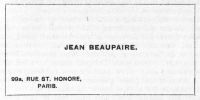
The next day the shares dropped—to nine—and finally to eight francs.
Payot felt so ill he sent for Villebois. The worthy doctor did what he could, but although an admirable physician for bodily ailments, he was almost helpless to cure the mind.
The day after, the shares made a slight recovery. They went to 12 frs. 50, and finished for the day at 15 frs., but the next day they dropped again to 6 frs.—no buyers.
Payot called on M. Beaupaire and implored him to help him.
"Certainly, my dear sir, rely on me. I may save some of the wreckage yet. Anyhow, I will do my best."
The financier squeezed his hand and went back to his house.
A few days later he received a very polite note from the baron in which he called on him to pay for his underwritten shares, and enclosed a polite account.
Payot's eyes swam when he saw the amount, £40,000, which had to be met on the making-up day at the end of the month.
He went to his banker's with a sad heart, and was closeted with him for a couple of hours, ascertaining the market value of his securities. They added up to £36,000 in all. There was nothing left but his house and furniture, and he owed £40,000.
"Sell everything I have at once," he replied, "I am ruined," and he shook hands with the banker and left the bank with a heavy heart.
He walked, for he was afraid to spend the money on a cab, and arrived at Monsieur Beaupaire's house.
How terribly dark the future loomed up before him, what visions floated through his fevered brain. He pondered over the dark days of poverty which faced him in lurid colours. Where was the dot he promised his daughter for her marriage portion? What would she think of him now? How could Delapine marry her when she was without a sou? How could she earn her living except as a despised and pitied governess? He thought of his old comrade Duval—the brave old man in spite of his vanity and eccentricities—now lying cold in the grave. He thought of his son Pierre, a parricide and an outcast like Ishmael of old, a wild man, whose hand was against every man and every man's hand against him, and he trembled at the awful vista it awoke in his mind. He looked out of the windows and saw the carriages pass with the footmen on the box and handsome women inside beautifully dressed, and watched them going to the opera with their lovers or husbands, and he shuddered as he felt that his poverty would cause all men to forsake him, and he would have to face the world alone, uncared-for and despised by all, even his nearest friends. How could he face poverty with its lean fleshless hands and sunken eyes, the single, cold, comfortless room, and the pangs of hunger? He thought of all his friends, wealthy, influential, talented, and how they would turn their heads on one side when he passed by. Oh, how bitter was the world! He thought of the saying he had so often repeated at the festive board—'Laugh and the world laughs with you, cry and the world will laugh at you,' and he felt the fearful truth and reality of it at last. "When a man is down, kick him. Yes, that is the way of the world," he said to himself, "ah, yes, it is a cruel, cruel world when the gilding is all brushed off. Alas, the world has no sympathy for the gambler who loses."
He was brooding over his terrible blow when M. Beaupaire entered the room.
"Bon jour, mon ami, I am delighted to see you."
Payot reached out his hand and turned his face aside.
"Console me, my good friend," he said, "I am a ruined man."
"My dear fellow, don't look so glum as that, things are never so bad that they can't be worse. Come along, cheer up, I have promised to stick to you and help you, and I mean to do it. Here, have a glass of wine with me, and we will see what is the best thing to do now."
"It's all up with me, my friend, you can't help me, I am done for."
"Pray don't say that. Everything is for the best."
"Because everything is for the best, it does not follow that everything is for my best," said Payot gloomily.
"My dear sir, don't be down in the dumps. You remember the adage,
'For every evil under the sun There's a remedy or there's none. If there is one try and find it, If there isn't——never mind it.'
"Cheer up, old man. Don't you remember the saying of Jean Paul Richter 'Sorrow is often sent for our benefit, just as we darken the cages of the birds in order to teach them to sing.'"
Payot heaved a sigh and said nothing.
"First of all let us sell your shares, mon ami. They have still some sort of a value, and we must begin to glean the field. I will be back in an hour."
M. Beaupaire went into the Bourse and tried to sell the shares. He managed to sell 1,000 at 5 francs, and another 4,000 at 2 frs. 50, but after that there were no offers.
He found Payot looking the image of despair.
"Never mind, I have sold 5,000 shares for 19,000 frs. That is better than nothing anyhow," cried Beaupaire cheerily. "By the way, have you no friends at all who can help you, mon ami?"
"You know what friends are when you have no money."
"Well, well, surely there are some decent ones left?"
"I know the Villebois family, but I don't like to ask assistance of him."
"Don't you know anyone else—come now think?"
"No, I know no one. Stop, there is Professor Delapine. Perhaps he would not refuse to listen to me because he is engaged to my daughter."
"What? Do you mean Professor Henri Delapine of the Sorbonne?"
"Yes, why do you ask?"
"My dear fellow, don't lose a minute. He is the very man for you. I know him intimately—an awfully good sort, and clever! Why he is the smartest man in Paris. I'll lay you a wager of any amount you like, that Delapine will pull you through. Shake," he said proffering his hand to Payot who grasped it warmly.
"Thank you with all my heart," said Payot; "we will see him immediately," and M. Beaupaire hailed a taxi, and they drove to the Villebois's.
M. Beaupaire and Payot were soon engaged in earnest conversation with Delapine, who was propped up in an easy-chair with Renée who sat on a footstool beside him.
"You need not leave me, Renée," said the professor, as she was about to retire. "I am sure these gentlemen will not mind, and I know she wants to know the worst, don't you, Renée?"
Delapine listened quietly to the history of the New Jerusalem bubble, and leaning back with his eyes half closed, and with the tips of his fingers pressed together after the manner of divines, but said nothing. When Payot and Beaupaire had quite finished, Delapine looked up with a smile.
"Well," he answered, "I like you to put your confidence in me. You are a man after my own heart, and I promise you I will put you straight again, in fact all my arrangements for doing it have been completed for several days past."
"What do you mean, professor?" the two men called out together.
"Have I not put it clearly then?"
"Yes, but we don't understand you."
"Ah, that is another affair. As a matter of fact I did not intend that you should understand me. But I know everything that has happened since you first met with that arch-rogue, Baron D'Ormontagne, who by the way was a bookmaker's clerk who got dismissed for swindling, and is no more a baron than you are."
"My God," said Payot, "how did you learn all these things?"
"A little bird told me," said Delapine, smiling. "Now, my dear Payot, all you have to do is to sell everything you have got, and pay off your debts like a man of honour as I know you are. I give you fourteen days to do it in."
"Good," replied Payot, "and then?"
"Then come and see me again."
Renée nodded significantly to Delapine.
"My lady doctor is in command of the ship, and her orders have to be obeyed, and they are that both of you must leave the room at once. Pray do not think that I want to get rid of you, gentlemen, but I have no option in the matter," said Delapine, smiling.
CHAPTER XXI
MARCEL MAKES AN UNEXPECTED ACQUAINTANCE
Beaupaire and Payot had no sooner left the house than they encountered Marcel walking up and down the garden footpath. He was so absorbed in composing aloud a new poem on Christopher Columbus that he was quite unconscious that he was being overheard.
"Dis donc, mon cher Marcel, what is that you are saying about a flock of parrots?"
"It was a remarkable incident in the great navigator's voyage which profoundly affected mankind—but I had no idea that I was declaiming aloud."
"Indeed you were, and we were both remarking what charming verses they were. But tell us what the parrots had to do in the matter?"
"The parrots had everything to do with it. Although it was apparently a mere accident, it changed the history of the world and sealed the fate of nations. The story runs as follows:—Columbus, who had been tossing about for weeks and weeks in the Atlantic searching for the unknown Continent which he believed existed somewhere to the west, at length knew from various indications that he was nearing land, and while he was debating in his mind what would be the best course to pursue, Captain Pinzon, who was in command of the Pinta, happened to observe a flock of parrots flying in a south-west direction. Accordingly Columbus altered the course of his vessels, and steered in the direction of the Brazils instead of heading for North America. The result was that the southern continent became Spanish and Catholic, while the northern one afterwards became Anglo-Saxon and Protestant."
"A most remarkable and momentous incident," replied Payot, "and one which teaches us what astonishing results may follow from the most trifling causes. By the way, M. Beaupaire, allow me to introduce my esteemed and highly gifted friend Monsieur George Marcel, of whom we have all heard so much lately."
Marcel took off his hat and bowed gracefully.
Monsieur Beaupaire returned the salutation and expressed his unqualified delight in meeting such a distinguished man. He was particularly struck with Marcel's unique appearance and charming manners, and felt that it would be a great opportunity to invite him and Payot to dinner.
"I shall be delighted to accept your kind invitation," said Payot, "and I am sure my distinguished friend will be equally honoured by partaking of your hospitality with me, eh, Marcel?"
The latter shook hands with Monsieur Beaupaire, and said that it would give him immense pleasure.
Payot became so engrossed in listening to his friend Marcel's lively and amusing conversation, that he soon recovered his gaiety, and actually indulged in a joke.
"Ah! M. Payot," said Marcel, who had been listening to the account of Payot's misfortunes, "it does one good to meet a man who can be cheerful after having lost everything. There is nothing like a little sympathy for cheering a man up. Sympathy is the sum of all the virtues."
"You are a man after my own heart, sir," said Beaupaire, patting Marcel on the back, "you have made our friend Payot's face look quite cheerful."
"That's right," said Marcel to Payot, "God loveth the cheerful loser. Yes," he added, putting his hand on Payot's shoulder and looking up into his face,
"Smile Awhile, And while you smile Others smile, And soon there's miles and miles Of smiles, And life's worth while Because you smile."
Payot's face lit up and he actually beamed with inward hope, as the world suddenly seemed to him to grow brighter and more beautiful. "Where did you get that from, Marcel?" said Payot, smiling.
"You don't suppose I am going to give away the source of all my jokes to you?"
Beaupaire looked at Payot and they both laughed.
As they entered Beaupaire's drawing-room he introduced his guests to Madame Beaupaire, who rose at once and welcomed them effusively, with both hands outstretched.
"Allow me, gentlemen, to introduce you to my daughter Violette."
Marcel and Payot bowed and shook hands. Marcel, who was of a very impressionable nature, became visibly affected by her beauty and striking personality.
Violette was an uncommon specimen of her race. Born of a French father and Spanish mother, she was at the same time an enigma to her acquaintances and a revelation to strangers. Her hair was long and black with that peculiar bluish lustre of a raven's wing. Her face was of ivory whiteness, regular in outline, with a finely chiselled nose, which grew out of her face like that of a Greek goddess, and just tipped in a most provoking manner to render the nostrils visible, while her lips were firm and rosy and delicately curved like cupid's bow. Moreover, her brilliant eyes which, like her features, were constantly on the move, gave her that charm of expression which is at once so fascinating and dangerous to the other sex. At one moment she was sweetness itself and polite to a degree, and then suddenly, without warning, her mischievous smile would change into a look of scorn or disapproval, which would completely upset all the calculations of her companions as to her real feelings. Highly gifted herself, she delighted in nothing better than a passage-of-arms with a man whom she felt to be her superior, but was herself loth to admit it.
"Have you lived a long time in Paris, mademoiselle?" enquired Marcel, when they had sat down to dinner.
"Oh, yes, we have been here for some years now, but Paris is not my birth-place you know," she answered with a smile.
"And what town, may I ask, has been so fortunate as to claim mademoiselle as a citizen?"
"Buenos Aires, monsieur," she replied in a soft, musical voice, and darting a quick glance at Marcel, and then lowering her eyelashes in a way that sent a thrill of emotion down to his very boots.
"Ah! a most delightful place. I was there some years ago," said Marcel. "Yes, I can still picture it in my mind, I remember it so well. I shall never forget the charming Avenida Alvear, and the Plaza 25 de Mayo overlooking the classical portico of the cathedral. What a lovely cathedral it is to be sure. It always reminds me of "La Madeleine," with its twelve stately Corinthian columns and its exquisitely carved pediment."
"How delightful to meet a gentleman who is so familiar with my dear old birth-place," said Violette. "I feel we are quite old friends already."
Marcel chuckled inwardly with satisfaction. "That chess opening of the pawn to King's four followed by the Knight to Bishop three has begun the game well," he thought to himself. "I could not very well appear ignorant of a town which gave birth to so charming a creature."
"What were you doing there, if it is not a rude question?" Violette enquired, warming up with her subject.
"H'm, you see my father had the good fortune to be a man of means, and although I was educated at the university, I employed my time in cultivating the arts of poetry and music."
"Oh! how delightful, we must invite you to play for us. We have an amateur concert here every Sunday evening. I will ask mama to invite you. What instrument do you play?"
"Pardon me, mademoiselle, but I am—ahem—afraid you misunderstood me," he answered, feeling that he was treading on dangerous ground already. "I am not a musician, I am—ahem—I sing."
"Oh! that's still better. There are so many good musicians now-a-days, but so few really good singers. I feel certain you have a good voice. You will promise me to come and sing, won't you?"
"Ah, mademoiselle, you flatter me. Unfortunately I am under the doctor's orders just now for a slight inflammation of the throat, and I am strictly forbidden to sing. It is a terrible trial for one who has such a passion for harmony."
"A terrible trial I am sure," replied Violette, watching his face closely. "Has monsieur endured this calamity for long?"
"Yes, ahem—for some considerable time now. But to return to Buenos Aires."
"Haven't you finished with that place yet? Gracious, I thought you had left some time ago."
Marcel looked at her to try and fathom her meaning.
"By the way, monsieur, where did you live in Buenos Aires?" she said a little suspiciously.
"Oh, I used to spend most of my time riding up and down the Parque 3 de Febrero in Palermo."
"Oh, yes, how well I remember it. I have often driven through that beautiful park. I think Palermo the most beautiful spot in the world."
"Ah, there I am with you, mademoiselle—especially if I knew that you were living there."
Violette laughed, and her eyes twinkled with roguish fun as she tapped him on the knuckles with her fan. "Oh, you men, what flatterers you all are."
"And where did you live, mademoiselle, if I may be so bold as to ask?"
"I? Oh, I lived in the Calle Florida, next to a magnificent building," and her eyes twinkled with mischief.
"What a strange coincidence. Why, I lived just on the other side of it."
Monsieur Beaupaire who happened to be listening burst out into a loud laugh.
"Sapristi! but that's too funny for words," he exclaimed.
Marcel looked round and saw Violette in fits of laughter as well.
"Checkmated, by Jove," thought Marcel. "I wonder how I put my foot in it," he muttered unconsciously half aloud. But the quick hearing of Violette caught the muttered exclamation.
"Why, that building is the town jaol," she said laughing.
"Good Lord, deliver us," exclaimed Marcel, trying to conceal his vexation.
"Monsieur, I don't believe you have ever been to Buenos Aires. Now confess."
"If Mademoiselle will forgive me, I own up to it."
"We will forgive you this time," she said, tapping him once more with her fan.
"A penny for your thoughts?" he next enquired.
"To speak plainly, I think you are just a pure romancer," she answered, looking very cross and frowning. "I gave you credit for more ability than you seem to possess," and she turned her head away from him. Marcel felt very angry and nettled at her outspoken criticism, and felt inclined to show her his annoyance, but he allowed his discretion to overcome his feelings.
"Ah, mademoiselle, you forget—
"The naked truth and the naked lie Are banned in good society.
"What do you like best among the arts?" added Marcel, anxious to change the conversation.
"Oh, I adore music," she replied, turning towards him and becoming more amiable, "and I love painting, but I think I enjoy reading best."
"What? Novels?"
"Oh, dear no, poetry and the literature of the great writers. By the way, I think you said you had taken to writing poetry?" she said sarcastically.
"That is true, mademoiselle."
Violette looked at him incredulously, and bit her lip with a frown.
"I can vouch for the truth of that, mademoiselle," said Payot who had been talking to her father and was now listening to Violette. "I assure you I know nothing superior to our friend's poetry. It combines the sparkle and wit of Alfred de Musset with the intense pathos of Victor Hugo, and is not inferior to either."
"What!" cried Violette, "you don't mean to say that I am actually talking to George Marcel who wrote the book on epigrams, 'Les poemes de ma Jeunesse,' and 'Le dernier combat dans le Colisée'?"
"That is the same gentleman, mademoiselle. There is only one George Marcel in the world as far as I know."
The change which took place in Violette's features was almost ludicrous. She had been under the impression that he was merely an ignorant and very conceited fop, who was only pretending that he had travelled, and was posing as a poet and author of merit, when she suddenly discovered that she had been snubbing one of the most promising poets and writers in France.
Marcel watched the struggle going on in her mind, and noted her confusion and blushes with an amused expression.
"Since I am unable to play and sing to Mademoiselle, may I perhaps have the great pleasure of hearing her play and sing to me?"
Violette blushed again and looked up at her mother who fortunately took up the cue.
"Certainly, monsieur," said Madame Beaupaire, "we shall expect you on Sunday evening next, if you will take pot-luck with us, and we shall then be better prepared for the concert afterwards."
"Queen protects the Knight," said Marcel still with the game of chess in his mind, "but renders herself open to attack," thought Marcel to himself. "By Jove, I may win the game yet. She plays well and hits hard, but I like Violette all the more for that."
"You will be sure and come, won't you?" the young lady asked in a half whisper as she lit a cigarette when the coffee had been served, and looked up in his face with a roguish smile.
Marcel felt he could have worshipped her. He so far lost himself as to squeeze her hand, thinking that he had made sufficient progress to warrant it, but Violette gently removed her hand with a look of displeasure. He felt he had made a false move, but resolved to turn it to his advantage by saying in a low voice which he knew would only reach her:—
"Cinco sentidos tenemos Y los cinco necesitamos Y los cinco nos perdemos Quando nos enamoramos."[18]
To his unbounded delight she replied:—
Love is strong, but love is blind, No faults can we discover; It is the heart and not the mind, We look for in a lover.
He stayed just long enough for the host and hostess to rise, and then with immense self-content and tact nudged Payot to accompany him, and bidding them all good-night departed for the Villebois's house dreaming of the delight at crossing swords with her at the forthcoming Sunday's dinner, and feeling that he was already hopelessly in love with her.
Punctually fourteen days later, Payot and Beaupaire were ushered into the library where Delapine was sitting in an easy-chair revising an essay which he was preparing for the Academie des Sciences.
On the entrance of his visitors the professor rose to welcome them.
"Delighted to meet you, gentlemen," he said, extending his hand with a frank smile. "I suppose you have come in obedience to my request?"
Payot nodded.
"I hope," continued Delapine, "you have sold your property and shares to the best advantage, and realized enough money to pay off your liabilities?"
"Every one of them," said Payot.
"I can vouch for that," said Beaupaire, "as my friend Payot gave me a power of attorney to act for him, since he was too unnerved to rely on his own judgment."
"Excellent," said Delapine, stroking his chin and glancing from one to the other with his piercing eyes. "Have you anything left?"
"Alas! monsieur, only forty thousand francs."
"Well, that is better than nothing anyhow. You must be thankful for small mercies. I suppose you have still kept the house?"
"Well, not exactly. I was obliged to mortgage it, and managed with the money I raised to sell everything, and have a few thousand francs over."
"Never mind, however great a misfortune may be, you may always be sure it might have been much worse. Forty thousand francs is at least something to fall back upon."
"That is true, but I shall not be able to afford any dot for Renée."
"I will see to that."
"What! You, professor? How can you provide a dot out of your slender income?"
"I never said I was going to find my fiancée's dowry out of my income, nor do I intend to borrow it."
"Then how will you find the money?"
"You need not have any anxiety on that score, the moment the money is wanted the money will be here."
"So you have the money ready?"
"Not a sou."
"And you intend to get it almost immediately?"
"Yes, within a week."
"But how? Do tell us," they both exclaimed.
"I make it a rule of my life never to discuss anything I intend to do until it is accomplished."
"But, my dear professor, you might at least give us some outline of the method you intend to employ, especially as we are such good friends, and besides we might be able to help you."
"Can you keep a secret?" he asked them.
"Of course we can," they replied, eager to get the news.
"So can I," he replied with a merry chuckle, and one of his beaming smiles.
"What an extraordinary man," said Beaupaire.
"Now, listen," said the professor. "I have already had a talk with Dr. and Madame Villebois and with our friends Marcel and Riche, and they have all agreed to my plan to take the train on Monday night to Beaulieu, which is the next station to Monaco, and I trust that both of you gentlemen will be able to accompany us."
Payot rubbed his hands with excitement and they both eagerly assented.
"Why is he going to Beaulieu of all places in the world?" Payot asked himself, "I wonder whether it has anything to do with his promise to restore my fortune? He can't surely be insane enough to imagine that he can recover the money by gambling at Monte Carlo. The professor is certainly eccentric, but I credit him with more common-sense than to do that. However, we shall see."
"You must both of you pack up and get ready," said Delapine. "I shall be away seven days from this evening, and we shall start for Beaulieu the day after to-morrow by the nine o'clock Rapide de Nuit from the Gare de Lyon. We shall meet at the ticket office at a quarter-past eight. C'est entendue?"
"Bien—but is that all you intend to tell us?" said Payot, somewhat surprised at his imperious tone.
"Have I not said enough?"
"Yes—but—"
"But you must excuse me, gentlemen, as I have still a great deal of work to do before I can leave. I shall expect you the day after to-morrow, good-bye till then," and he waved them off with one of his choicest smiles.
Wednesday night saw the whole of the party assembled soon after eight o'clock near the ticket office of the Gare de Lyon. Delapine had reserved a coupé for each of the Villebois and Beaupaire families together with Monsieur Payot, so that Marcel and Riche had to shift for themselves.
"I say, Marcel," said Riche, "who is that charming young lady I saw you chatting with just now?"
"Whom do you refer to?"
"Why that girl over there between Madame Villebois and the professor."
"Oh! don't you know her? Mademoiselle Violette Beaupaire," he replied in a half whisper lest the party referred to should overhear him, "she is the daughter of M. Beaupaire the stock broker, who is running about after the luggage, she's a ripping girl, I assure you, and no mistake."
"Violette Beaupaire," said Riche half aloud to himself, "I know that name somehow. Where was it I heard it?" and he tapped his forehead in thought. "Oh! yes, I remember now, she was the girl with the wonderful ring I met that day at the café near the Ecolle de Medicine. How small the world is to be sure."
"Why! You don't mean to say that you know her?" said Marcel, who had caught the drift of what he had been saying half aloud to himself. "Where did you meet her?" he added with a tinge of jealousy in his voice.
The doctor related the curious adventure he had had at the café, and the marvellous predictions of Violette which she had made while gazing at the ring.
"Have you never seen her since?" enquired Marcel with a tone of anxiety in his voice.
"Never my boy, until this very day, I give you my word; but," he added, "I have been hunting all over Paris to try and find her ever since that afternoon. I would have given a good deal to have had her address."
"Why! are you in love with her then?" asked Marcel as he scrutinized his friend's face while waiting for the reply, but could detect nothing in his face, not even a muscle moved.
"Lord bless you, no," replied the doctor, "but she is the most interesting girl I have ever met in all my life, and I have been simply dying to test her extraordinary powers again with her ring."
"Thank God for small mercies," thought Marcel to himself, as he assured himself that he was no rival of his, "However it is just as well that he and I will be travelling in another part of the train out of the reach of temptation."
The departure of the Rapide de Nuit from the Gare de Lyon is one of the greatest events of the day. The great glass-roofed station is filled with fog, and vibrates with the shrill whistles of innumerable engines which perpetually come and go apparently without rhyme or reason. At all times the din is ear-splitting, but from half past eight p.m. onwards, the noise increases tenfold. The station gets more and more packed with people. Here one may notice a company of tired and sunburnt soldiers marching up the platform in their blue coats and red baggy trousers covered with black leather below the knee, each carrying a painfully heavy knapsack and rifle; while hurrying along may be seen gay-coloured Turcos, Arabs with their red fezzes, or crowds of peasants patiently waiting for the omnibus train, which leaves an hour later than the express. The waiting rooms are crowded with tourists, English, French, Germans, and Americans.
What a babel! But see, there are more outside hurrying about hither and thither in wild confusion, demanding of every official they meet what time the train leaves and where they can find it, notwithstanding the fact that they have been told a score of times already. Interpreters, Cook's men, Gaze's men, and couriers are bustling about collecting their flocks together. Porters with trolleys and hand-barrows piled up with luggage are to be seen hauling and shoving and struggling to push their way through the impenetrable forest of human beings. To the casual observer calmly surveying the scene, the entire place seems to be a hopeless muddle in which reigns a veritable pandemonium. More and more people enter the train, until it seems incapable of being moved at all, while the huge filthy-looking black engine, so different from the brilliantly painted and exquisitely kept British ones, is belching forth a torrent of black smoke, and blowing off steam with such violence and din as to render all conversation impossible. Here one may see a regular procession of boxes, rugs, and bags all waiting to be weighed, while a file of fifty people or more are standing at the guichet awaiting the delivery of their luggage checks.
The train was crowded to suffocation, and but for Delapine's foresight our friends could not have obtained seats. As it was, Marcel and Riche were pushed into a compartment already nearly full, much to the disgust and annoyance of the passengers who were arranging their rugs for a comfortable sleep during the night.
"That is not good enough for me," said Riche, "I'll bet you a five-franc piece we will get a compartment all to ourselves."
"Done," said Marcel, "but you are bound to lose it, my boy."
"Not a bit of it, you watch me."
"Guard," Riche shouted as the bell rang and the doors were being shut, "this is a smoking compartment and we greatly object to smoking."
Marcel looked at Riche and gave a low whistle.
"Can't be helped," said the guard, "we're just off."
"Excuse me," said Riche in a commanding voice, "I am Monsieur Faure of the Engineering Department, and I must call your attention to Section XIII. Paragraph 79 of the byelaws of the Administration."
"I don't know your name, sir."
"Silence, sir, when I speak. I have only recently been appointed assistant to M. Demange, the chief engineer."
The guard looked him up and down, and scanned his face critically to see if he were joking, but Riche never moved a muscle.
"But, monsieur," said the guard, apologizing profusely, "it is impossible, the train is due to start," and he shrugged his shoulders and spread out his hands in despair.
"Remember that you are speaking to a high official on the Railway," replied Riche, looking severely at him. "Now you know who I am, look sharp, or I shall be obliged to report you."
The guard grumbled, and discussed the matter with several officials. Almost immediately afterwards Riche and Marcel saw him walk rapidly away. Slowly the huge train steamed out of the station, and various shunting movements took place until at length, after ten minutes delay, a brand-new first-class carriage was attached to the rear of the train.
"Now get in, gentlemen, quickly," said the guard somewhat testily as he blew the whistle.
The moment they were seated, Riche pulled out of his pocket a silver-mounted cigar case and handed Marcel a fine Hanava cigar, at the same time selecting one for himself. As the train rolled out of the station the guard saw to his horror two blue clouds of smoke rolling out of the window of the compartment.
"Sacr—r—re bleu?" hissed the guard as he held up his hands and shook his fists at the sham officials as they disappeared in the distance, while Riche and Marcel waved their handkerchiefs at the frantic guard as a parting shot.
"By Jove, you know how to travel," said Marcel as he handed Riche a five franc-piece.
"Now for a cosy nap," said Riche, and making a comfortable bed by a skilful arrangement of the seats, he wrapped himself in his rug, put his ticket in the flap of his cap, and was soon fast asleep.
FOOTNOTES:
CHAPTER XXII
VIOLETTE NURSES HER FATHER WITH ALARMING RESULTS
The comfort of a long railway journey is largely dependent on the number of people travelling in the compartment. Two is the ideal number, as one person can lie outstretched on each side. Two is company but three is none, and is nearly as bad as four, in fact it verges on misery for two out of the three, but five makes comfort impossible.
Such was the state of things in Monsieur Beaupaire's coupé. Monsieur, Madame, and Mademoiselle Beaupaire were congratulating themselves on travelling undisturbed, when a couple of English tourists clambered in—or rather were pushed in just as the train was moving, in spite of the protests and remonstrances of the Beaupaires.
The compartment became unbearably stuffy, all the windows being, as is usual on the Continent, hermetically sealed.
It is the wonder of all Englishmen that 'Foreigners' insist on travelling with all openings for ventilation persistently closed, and equally incomprehensible to the foreigner how Englishmen can travel with the windows open, and not catch their death of cold.
"Phew! this is awfully stuffy," exclaimed the elder of the two Englishmen who answered to the name of Ridgeway, "I can't imagine why these foreigners always insist on having the windows closed. There's not a breath of air in the place, Charley," he said to the younger of the two, "do open the windows, there's a good chap." The young man got up and tugged at the strap at the window—it gave way and he fell backwards on to the feet of the passengers.
"Sorry," he said as he picked himself up, and he proceeded to open the opposite window.
Madame Beaupaire looked daggers at him, and she rubbed the foot on which he had fallen.
Charley suddenly uttered a cry of pain. In attempting to open the second window, the frame had slipped and jammed his finger.
"Confound these carriages," said Charley, "why can't someone invent a fool-proof window which will be provided with a strap that will not come off, and that can be opened without reducing one's fingers to pulp?"
Violette laughed at the wry face he made.
Charley turned round, and seeing her good-looking face lit up with merriment, laughed in concert.
"Well, that's a funny way to introduce yourself," said Violette in good English, but with rather a pretty foreign accent.
Violette evidently had the gift of humour, and Charley fell in with it at once.
"I hope Mademoiselle does not mind the window being open," he said.
"Not in the least as far as I am concerned," she replied. "I only hope papa and mamma will not catch cold."
"Oh, there's no fear of that. May I ask if you are going to Monte Carlo to play?"
"We are going there, certainly, but I don't think we are going to play at the Casino, if that's what you mean."
"Well, we are going there, and you bet we are going to have a shy at the tables."
Violette wondered what the expression could mean.
"How do you shy at the tables?" she asked.
"Surely you know what 'shy' means?" he said.
"Of course I do," she replied, nettled to think he imagined she didn't know English. "I know," she continued, "a girl is shy when she hangs down her head and blushes and simpers when a gentleman speaks to her, but I cannot see how one can shy at the tables at Monte Carlo—unless the crowd is so great that it makes one nervous," she added reflectively.
"Oh," said Charley, who was warming up and becoming very communicative, "shy is one of our wonderful English words, like 'box,' and 'shot' and 'go' and 'make.' They may mean anything and everything."
"But, monsieur, how is one to know what a word means if it may imply anything and everything?"
"That's the beauty of our language. It's a perfect joy. It's so tremendously expressive. If you can't get at the meaning by the context you have to guess it by the tone of the voice, as one does when speaking Chinese. Thus, if you were to say to me 'You're a nice young man,' it would mean that I was not a nice young man. Whereas if you were to say 'you are a nice young man' you imply the exact opposite, namely that I am nice."
"Are you fishing for compliments?" asked Violette, laughing.
"Not exactly, but I feel sure you will say that my last illustration was correct in every respect."
"Oh, you men, you are as vain as peacocks, you think that every girl you meet must at once fall over head and ears in love with you."
"And is not that a very delightful frame of mind to be in?" asked Charley, wondering what she would say next.
Violette laughed heartily at the Englishman's egotism.
"But I assure you, mademoiselle, these little Anglo-Saxon words would fill a dictionary with their shades of meaning. To take an example: the word 'go' has at least a hundred different meanings. Thus we say, 'the clock is going,' whereas it is standing still all the time. 'Go' may mean 'to die,' as in the phrase (he is going)—to succeed (the scheme did not go)—to fare (how goes it?)—to release (let go my hand)—it may mean a misfortune (here's a pretty go)—or an attempt (let's have a go at it)—or——"
"Please, that's enough," cried Violette, "my poor head is in a whirl already. Let us conclude the whole matter by saying that with a dozen of these elastic Anglo-Saxon words of yours one may write a book and express every sentence in Macaulay, Milton and Shakespeare."
"What a pretty wit," said Ridgeway, laughing. "The remarkable thing about the English language," he added, "is that all the words which we use most are not to be found in any dictionary."
Violette opened her eyes in amazement.
"It's a fact, I assure you, mademoiselle."
"What a dreadful language," she replied, "I had no idea English was so difficult. How on earth is the ordinary person to learn it?"
"One does not learn it," said Charley, "it just grows on one. If you try to learn English you never will. The professors of English who are paid to teach you don't know the words themselves, that is, the really useful ones, such as, 'awful,' 'jolly,' 'ripping,' 'rot,' 'blooming,' and thousands of others, and even in the very best French dictionaries you will find the English equivalent which is given, as something which has not the remotest connection with the word you have looked up."
"Surely you are joking, monsieur," she replied.
"Not in the least I assure you," he answered. "I see you have a Gasc's pocket dictionary, mademoiselle, which is one of the very best. Do me the favour to turn up the word 'cad.'"
Violette did so and read out, "cad—conducteur d' omnibus."
"There you are," he replied, "what did I tell you? Suppose an unfortunate and harmless Frenchman arriving for the first time in London, were to rely on the dictionary and address the conductor of the first 'bus he entered as a cad, by George, he would probably find himself the next moment rolling in the gutter with the conductor on the top of him, and his only excuse would be that he trusted to the dictionary."
Violette looked at him with a mingled expression of amazement and doubt as to whether he was serious or not, and then glanced at her father who was snoring in the corner of the carriage, with a night-cap tied over his ears, while Madame Beaupaire was taking stock of Charley by the aid of a gold-mounted pair of lorgnettes attached to a long tortoise-shell handle.
"Evidently you zink ze English language ees vastly superior to ours, monsieur," said madame, who had spent a summer in England, and picked up enough English to understand the drift of what he had been saying.
"Well, to be candid I do. Just think of its range. Our new dictionary contains a million and a half of words, whereas your language has only——"
"Oh, come on, Charley, don't pull her leg," said Ridgeway.
"Sir!" said madame, sitting bolt upright, and surveying him through her hand magnifiers, "you insult me."
"A thousand pardons, madame. What I said was only a colloquial expression for pulling the long bow."
"Pulling ze vot?" she enquired somewhat suspiciously.
"Pulling the long bow—another colloquial expression much employed by Englishmen. It merely implied a caution to my young friend not to exaggerate so much. I assure you, my dear madame, the remark I uttered had no reference whatever to your legs."
"My vot, sir? I think you are egstremely rude."
"Pray forgive me, madame, I crave your indulgence. May I substitute for the word 'legs,' 'inferior extremities,' or lower limbs?"
Madame got very wrath and turned herself half round, and looked out of the opposite window. Beaupaire had just woken up, and catching the last sentence burst out into a hearty laugh, which had the effect of making his better half still more angry.
"How can you be so cruel as to laugh at me, Jean," she said to her husband, "when you see me insulted like this? Have you no feelings left?"