THE WHITE MAN'S BRIDE.
Reading edition
The Blood Indian camp was pitched on one of the bottoms of the Kootenay River, and with its two hundred or more lodges formed a picturesque group, the painted buffalo-skins of the lodges and the gay attire of the numerous Indians who rode in and out among them and on the surrounding prairie, making a brilliant and attractive scene.
There was unusual excitement in the camp on the evening on which our story opens. This excitement was most noticeable among the female portion of it, and was caused by the arrival of Major Brown, an Englishman, and a fine specimen of that educated class of his countrymen who, being possessed of private means, are able to indulge their desire of change and adventure. White men had visited the camp before; some had even made their homes for a few months among the tribe, but never at any time had so much interest and curiosity been excited, or so many questioning glances been exchanged between the women as on the arrival of this particular Englishman.
Major Brown's personal appearance was doubtless a sufficient reason for the unwonted stir among the women, especially in the lodges where the younger ones dwelt. He certainly was a handsome man, and, in conscious indifference to its effect, bore himself in a dignified manner among the people. Belonging to an old family of noble lineage, his youth had been spent in one of the best public schools; two years of hard work at Oxford had followed, and the foundation of a good education laid. Unable, owing to a lack of fortune, to maintain the position his birth and education had entitled him to in the Old World, he determined at the close of the two years' residence in the University to seek a home where he might in a short time earn sufficient to enable him to start a good business in England, and eventually become one of her merchant princes. His friends tried to dissuade him from carrying out this plan, but without success. He had heard of the Indians, had read much of the sport to be had, of the freedom of the life in the north-western part of Canada, and the conditions of existence appeared so fascinating to him, so attractive in comparison with the formality and conventionality of social life at home, that he could not be induced to give up a prospect of pleasant adventure for the present and possible prosperity for the future to live a narrow life hampered by want of means at home. Therefore bidding his friends farewell, he set out for the New World, resolved to make a stay of some years in the far West. He arrived in the country at the time when a great gathering of the tribes—Crees, Stoneys, Blackfeet, Piegans, Bloods and Sarcees—was assembled at the Blackfoot Crossing.
The tribes had been invited to meet the representatives of the Government at Blackfoot Crossing. Having implicit confidence in the Great Mother, the Queen, they made their way to the place of meeting. There were assembled nearly three thousand belonging to the different tribes when Major Brown arrived. He was much impressed with the people, and listened in amazement to the oratory of Crowfoot, Red Crow and Bear's-paw, notable chiefs of the Blackfoot, Blood and Cree tribes. The Government Commissioners addressed the people in the name of the Queen, urging them to make a treaty surrendering their lands to her for the benefit of her subjects, and assuring them that she would compensate them amply for their loyalty.
It seemed a difficult matter for the Indians to give up the lands whereon they had dwelt so long, and to allow the white man to come in and take possession, but they knew that every promise which had hitherto been made to them in the Queen's name had been faithfully fulfilled, and that the advice given them was for their good.
The great chief of the Blackfeet, Crowfoot, arose, and addressing the Commissioners in the presence of the large assemblage, said, in the impressive manner of which he was a master:
"While I speak, be kind and patient. I have to speak to my people, who are numerous, and who rely upon me to follow that course which in the future will tend to their good. The plains are large and wide. We are the children of the plains. It is our home, and the buffalo has always been our food. I hope you look upon the Bloods, Blackfeet and Sarcees as your children now, and that you will be indulgent and charitable to them. They all expect me to speak now for them, and I trust that the Great Spirit will put it into their breasts—into the minds of the men, women and children and their future generations—to be a good people.
"The advice given me and my people has proved to be very good. If the police had not come to this country, where would we all be now? Bad men and whiskey men were killing us so fast that very few, indeed, of us would have been left to-day. The police have protected us as the feathers of the bird protect it from the frosts of winter. I wish them good, and trust that all our hearts will increase in goodness from this time forward. I am satisfied; I will sign the treaty."
Several others spoke, but they for the most part repeated what Crowfoot had said. At last the terms of the treaty being fully explained and understood, the names of the chiefs were written in the native language, and the men signed it with their marks or totems.
Food was given the people, and the chiefs accepted the officers' uniforms and medals which were given in commemoration of the event. After being informed that they would receive their money payments regularly every year, the vast assembly dispersed.
Major Brown was busy among the people, and through the aid of one of the interpreters he made many friends among the red men.
A large detachment of Mounted Police travelled southward until they came to the prairie village on the banks of the Old Man's River, where they had erected their barracks of logs and mud. The Major accompanied them, and was not long in getting a position as clerk in one of the trading establishments in the primitive-looking town, where by his manly bearing and genial disposition he very soon made friends among the white people and the red men.
After breaking up their camp the Indians started southward on a buffalo hunt, and few of them were again seen until about the time when they returned for the annual treaty payment. They met on the banks of the Kootenay River, pitched their camp and then rode into the prairie village to receive their annuities.
Several thousands of dollars were paid, for each received five dollars per annum—men, women and children—the chiefs receiving ten dollars and the head chief twenty-five dollars.
As soon as the payments were over Major Brown set out with three men and a large supply of goods for the Indian camp, and it was upon his arrival that the women were struck with the handsome appearance of the tall Englishman.
A large tent was pitched, and the people gathered in large numbers to feast their eyes, like little children, upon the great display. Blankets, beads, tea, tobacco, fancy pipes, shirts, belts, guns and various kinds of cloth in fancy colors attracted young and old.
The presence of the Mounted Police in the country had made it possible for this handful of men to expose their goods in this loose fashion among the people. In the days previous to the advent of this force of red-coats the trading was done in a very different fashion. Formerly the traders built a log fort, which they fortified with a high stockade. A few Indians were allowed to enter for the purpose of trading, and while they stood at the counter they were guarded by men who had rifles, ready to shoot them down if they showed any intention of stealing, or acted in a spirit of enmity. Brawls were frequent under such conditions, as some of the traders were unscrupulous, and when under the influence of liquor took advantage of the natives.
The Major had picked up some of the common words among the people, and was able to make himself understood. A brisk trade was done in the camp for several days. The Indians were paid in one-dollar bills, as they did not understand bills of a larger denomination.
Five women were seated in a lodge conversing while the men were visiting their friends or buying goods at the trading tent.
One of them spoke up saying, "Have you seen the tall man?" and another said, "Yes; have you seen the white chief?" "He is a handsome man!" "He has a good temper!" "He does not get angry!" "He is always smiling!"
With expressions such as these, mingled with a gentle titter, the women talked about the man who was in charge of the tent.
"Has he a wife?"
"No! he has not any," replied one of the women. "I was at his lodge and I did not see any woman there, and he has not another tent in the camp."
"He is like all other white men; he does not care for an Indian woman," ejaculated another.
"No! he is not like others; he is a far better looking man, and he would not treat an Indian woman like them. He has too good a heart."
"I would not trust him. He is like all the others. They are all alike. My chief says they are all the same. They look very pleasant, but they have the heart of a snake."
In the lodge sat a young woman who took no part in the conversation, and yet listened intently to the words of the others. She was an interested listener, but with the quiet demeanor of an Indian her countenance was unmoved while they were speaking. She was a comely maiden of about fifteen or sixteen years, whom her father loved so much that he would not give her to any of the men in the camp; thus she had remained unmarried longer than was generally the case. She was modest and beautiful, dressed neatly and worked hard. She, too, had seen the white chief, as they called Major Brown, for she had accompanied her father several times to trade. He had even spoken to her, and she had replied in her own quiet way to his questions when her father signified his desire for her to speak. It was not, therefore, an uninteresting conversation to her, although she refrained from discussing his personal appearance or character.
"Come, Napiake, what do you think of the white chief?" asked one of the women.
"I don't think anything about him," she replied, in her modest way.
"Oh, yes, you do," replied one of the group. "You do not go to the trading tent with your father every day for nothing."
She was silent, however, upon this subject, and although the women tried to draw her out by their questions they failed. It could not be doubted, however, from the expression of her eye, that she had experienced some emotion when the subject was touched upon, but from her manner she seemed to care little about the matter. This may have arisen from her womanly nature. At any rate she remained quiet while the women talked on upon a topic so pleasing to them.
After the busy time was over, the white men determined to remain two or three days longer, and during this period Major Brown was a frequent visitor at the old man's lodge. He seldom came without bringing some tobacco or other present to the chief, and although he did not understand much of the native language, he listened respectfully while the chief would relate in his own animated style the thrilling tales of his early days.
The Major was able to follow him to some extent in his stories, and at any rate he seemed delighted with what the old man said, which pleased his host very much. Napiake sat in the lodge an interested listener.
The tent at last was cleared of all the goods and placed on the large wagon, and in a few hours they would take their departure for town. Major Brown bought a fine horse and made a present of it to the chief, with a gun and some provisions. He then turned to the young woman and simply said, "Napiake." The father nodded his head, spoke a few words to her in the Blackfoot tongue, and the girl arose, dressed herself and followed Major Brown.
The women peered from the doors of their lodges, but Napiake cared not, for well she knew that some of them would be jealous and others delighted that she was the wife of the white chief. Unceremonious it might seem to the civilized, but Napiake had long expected that some day she would have to go forth at the bidding of her father to be the wife of some Indian who would take her father's fancy, or reward him well, so that his love would be outweighed. The time had come, and she had got better than an Indian chief for her husband, and the maiden was delighted beyond measure. She had heard that the white men had only one wife each, and that they were kind to them, so felt that she was elevated above the Indian maidens in thus becoming the sole wife of one man. Unregretfully she left her father's lodge, for she was going not more than a day's journey distant, so that she could see her kin often; besides she had remained at home full two years longer than the maidens of her camp, and she felt grateful to her father for his love.
Major Brown was a happy man as this beautiful Indian woman of tender years followed him at a close distance. He was following the custom of the white men in the country in taking an Indian woman for his wife. He placed her upon the wagon and along with the men she went to town. She found a home for two weeks with the Indian wife of one of the white men in town, and during this time the Major built a small log-house, neat and comfortable, and furnished it well. Napiake was pleased to have a house of her own, and she set to work to make it as attractive as she could for her husband. As husband and wife they were happy and contented. He had a good situation, was steady and industrious, and she was tidy, hard working, and faithful.
A babe was born to them and their cup of happiness seemed full. He was the welcome heir of the log mansion, the father's pride and the mother's joy. At night when the heavy day's work was done, the Major would dandle the child on his knee, and sing and coo to him. He was happy, and nothing could induce him to leave his home in the evenings. The babe resembled his father, a fact of which both parents were proud.
The child was only a few months old when Major Brown received instructions to proceed to Pincher Creek, nearly forty miles distant, with a supply of goods to trade with a camp of Indians located there. The Major and Napiake went along with the other members of the party who were to accompany them.
A few days were spent with the Indians near the mountains, and upon their return home, the mail having arrived, the Major found some important letters awaiting him from the home land. The business of the camp for a time kept him later than usual at his office, but after the busy season was over, he informed Napiake that he was going to give her a visit of a few days in the camp with her friends, and during her absence he would start off to the mountains on a hunting expedition.
Napiake was delighted with the idea, as she had seen the Major's face for the past few days was paler than usual, and felt sure that a hunting expedition to the mountains would restore the color to his cheeks. She began at once to make clothes for her babe, that she might show him off to advantage in the lodges of her people.
The day came for her departure, and the Major took her and the child to the lodges of her people. Napiake and her babe were received with great joy, and her husband welcomed, for the Major had not been in the camp more than twice since the day that he took Napiake from her home. Nearly three years had passed since she departed with the Major, but it had been such a happy period that it seemed but as yesterday since she turned her back upon her father's home.
Major Brown returned to the camp at the time promised for Napiake and his child, and the aged chief was delighted to see him. The Major took his wife and child to their home, and was as happy as ever in their company. Napiake said nothing to him about what she had heard in the camp, for she had trusted him, and he seemed to be worthy of all her confidence.
A few months passed by and another babe was born. The Indians came to see the fair skinned babe, whom they named Morning Star. She shed her light for a while in the home, and then it was suddenly extinguished. The child sickened and died, and great was the sorrow of the household at her loss. But there is always a blessing in affliction, uniting the hearts of the sorrowing ones more firmly together and increasing their love for each other. And it was so in this instance. The Major could not do enough for his wife to soothe her heart for the loss of the babe. Little Morning Star was placed in a beautiful coffin, and laid away to rest in the ground beside the graves of the white men in the settlement.
Napiake often wandered with her little boy to the grave of her darling, and sitting beside it she would pour out her grief. So intense was it that she oftentimes forgot to go home, and the Major would find her weeping by the spot. The father was sad, but he restrained his grief and endeavored to comfort his wife.
One evening after the mail had come in, Major Brown came home with a serious countenance. His wife and child met him at the door. At once his serious mood disappeared and he was himself again. He dandled his boy upon his knee and talked cheerfully to Napiake. Supper over, he drew a large envelope from his pocket, and opening the letter it contained, read it inaudibly, but with an earnest, serious expression on his face. His wife busied herself about her household duties, glancing occasionally at the Major as he sat poring over his letter.
"Napiake," he said sadly, "I am going on a long journey across the sea. I have some important business to attend to at my old home, and I must go there to look after it."
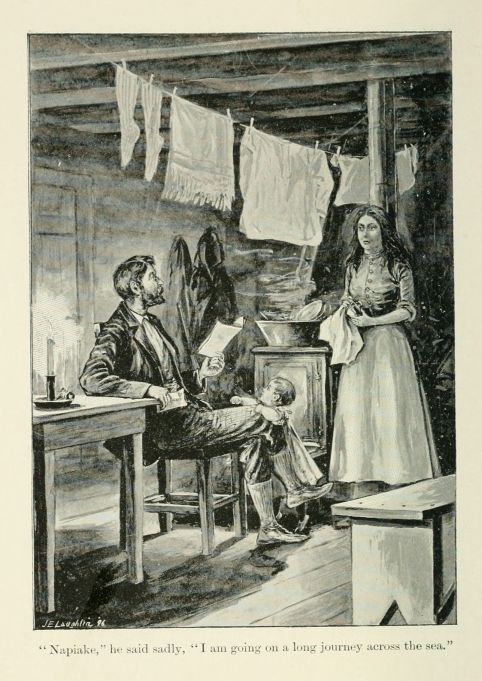
"Napiake," he said sadly, "I am going on a long journey across the sea."
The woman stopped her work as the Major uttered these words, a great fear coming into her heart.
"May I not go with you and make you happy among your people? I am willing to go anywhere with you," she said, as she looked steadfastly in his face.
"That would never do, Napiake, to take you away from your own people."
The tears started to her eyes. Was her devoted husband going to leave her, and would he never return? Perhaps he might follow the example of others, and leave her. No, that was impossible. He was too good. She never had cause to doubt his faithfulness, and she knew that he would either take her or return to dwell in the country.
"When are you coming back?" she asked timorously.
"I shall be absent about a year, and then I will return, and we shall never again be parted."
Napiake gazed earnestly at him through her falling tears, but his glance was so honest and true that she said, "Well!" Not a word more escaped her lips, but the tears ran freely down her cheeks.
In a few weeks the Major had all his matters arranged and was ready to leave. A few minor matters had to be attended to, so he took his wife and child to camp. The aged chief received him with marks of esteem. He loved his son-in-law, and thought there was no one in all the country equal to him for ability, and he never tired telling his friends that the Major was a handsome man.
The Major related his plans to his father-in-law, who listened attentively, and when he had finished he placed a sum of money in the hands of the old man.
Early next morning as he bade them farewell, a large party stood around the lodge to see him depart. He stooped and kissed Napiake and his son, and with a wave of his hand, drove away.
A grand banquet was given the Major in town by his friends, many of whom came miles to attend this farewell supper, for he was a great favorite with all. A large crowd gathered about the stage-coach to shake hands with him as he said good-bye to one and all.
That same evening there were a number of his friends in the neighboring town of Leighton to see him off at the little railroad station. The night was dark, and as he stood in the circle of friends, he excused himself for a moment and stepped aside. There in the gloom stood an Indian woman with her boy, looking on and weeping. It was Napiake and her child who had come a distance of thirty miles to get a last glimpse of him. Faithful to the last, there she stood, weeping disconsolately.
The Major was touched by this evidence of her devotion to him, but as he strove to comfort her the conductor shouted, "All aboard!" the engine whistled, and the Major, placing a sum of money in the hands of each, kissed them both, sprang upon the train, and was gone. Napiake and the boy watched the retreating train until it disappeared in the darkness, and then sadly retraced their way to the camp.
"I'll give you two horses for her," said Pinakwaiem.
"Two horses are not enough. She is a good worker, and she is young, and you know she can talk English, and is a good housekeeper, for she was the wife of the white chief."
"The wife of the white chief! And that's the reason she is not worth so much. I'll give you the two horses."
"All right, you can have her."
Napiake, after waiting patiently for two years for the return of her white chief, had become the wife of an old Indian, sold for two horses and destined to slavery. Pinakwaiem led Napiake and her son to his lodge. Not a word escaped from the patient woman. As a sheep led to the slaughter she was dumb, submissively following the man who had bought her, for she was now his wife according to the Indian custom. There were three women already in the lodge to which she was going who were recognized as wives, and Napiake as the latest addition held a good position for a while amongst them. The old man then treated them well, and she seemed to have a hold upon his affections. She did her work faithfully, uttering no word of complaint. But in a few months the novelty of the new life wore off, and Pinakwaiem began to treat her harshly. It was not hard for him to see that her heart was not with him. Napiake never smiled, and seldom spoke. Her life was sad and hard. She carried the wood from the bush on her back, the burden bending her almost in two, and bore large pails full of water a long distance from the stream. Her little boy seemed to be always in the way; he was scolded, but never struck, for the customs of the natives frown upon the harsh treatment of children.
The old life and the new were in strange contrast. She had become the drudge of the lodge and the most despised of the wives of the old man. Doomed as she now was to a life of sadness, toil and oppression, all hope died out of her heart and she had no delight in any of the amusements of the camp.
Sometimes the name of the white chief was mentioned in her presence as a taunt, and stung with the remembrance of her former treatment, Napiake sought peace in the solitude of the bush or by the river, where she sat for hours with her little boy by her side. She gave not railing for railing. The sweet and beautiful countenance of the former days had fled, and given place to a haggard expression which made her appear to be an old woman, as she dragged her wearied limbs through the camp. Some of the Indians jeered at her, but others pitied her in her loneliness and grief. The thought of her boy alone sustained her, and by a great effort she determined to live for him.
She could not flee to another camp, there was no place for her among the white people, divorce there was none, and she hoped that some day her Indian husband might sell her to another Indian who might treat her more humanely. But the seeds of disease were sown in her system, and she was already doomed to fall a victim to the curse of the Indians, that fell destroyer, consumption.
The medicine drum was beaten night after night, and the song and prayers of the medicine-man sounded through the camp. But all was of no avail; Napiake's life was slowly ebbing away.
Late one night there entered the lodge a white man, dignified and grave. The Indians gave him the seat of honor in the lodge. He knelt beside the sick woman, beautiful now as ever in the days of health. The haggard looks had disappeared, and a peaceful contentment rested upon her face. The visitor spoke in a low tone, and Napiake listened, attentively answering his questions. Her father and friends leaned forward to catch her faintly expressed words. After some quiet conversation, raising herself in a state of excitement and looking the missionary in the face, Napiake inquired:
"Shall we see each other there?"
"Yes, in the land of God, we shall see each other."
"Shall we know each other?" eagerly asked the woman upon whose countenance the shadow of the death-angel had fallen.
"Yes," was the simple answer of the man.
"I shall see him! I shall see him! Shall we live there always?"
"Yes, we shall, never to be parted again!"
Napiake fell back upon her couch, saying, "I'm satisfied, I'm satisfied! God is just."
A few heavings of the breast and the hands fell by her side. Napiake, the beautiful Blackfoot woman, was at rest.
In a large and busy manufacturing town in the west of England, a merchant sat in his office reading his letters. At the door stood a coach with a pair of handsome horses; seated in it a lady with a babe upon her knee.
"Tell your master that I am waiting," said she to the footman, who promptly obeyed the command.
"I will be there in a few minutes," was the reply. The merchant seldom went for a drive, his extensive business usually requiring his whole attention; but he had made up his mind to spend this afternoon with his wife and child. The letter-carrier had just delivered his mail, and he was hastening to give directions to the letter clerks to answer them before leaving.
Among the others was a paper from the Canadian North-West, in which a marked paragraph caught his eye:
"There died last Friday, on the Blood Reserve, Napiake, an Indian squaw. Some of the pioneers of the district may remember her as a beautiful woman when she was young, who lived for a time in the village in the early days."
Turning suddenly pale, he laid the paper aside and left the office. As he sat in the coach his wife pointed to several objects of interest which they passed, chatting freely about them, but he paid little attention. It was as though he heard her not. All her efforts to drive away his morose silence were in vain. Far away at the foot of the Rocky Mountains the husband saw a woman dying in an Indian lodge, a woman who loved him to the last, but whom he had deserted and forgotten. Forgotten? No! He could never forget her.
But in that busy English town he is a merchant prince, holding an honored position in society. He is a member of several societies, and is often speaking on behalf of the enfranchisement of women and popular education.
Sometimes an old man leading a boy by the hand may be seen standing beside a mound on the wide prairie of the West, but there is no other that ever visits that lonely grave.
Little Charlie Brown finds a home among the Indians, depending on them for food and clothing, and sometimes an old-timer takes compassion upon the boy and gives him a morsel of food or some clothing. He endures the poverty of an Indian lodge, while over the sea his father enjoys the comforts of an English mansion.