THE SPIRIT GUIDE.
Reading edition
There was a gay company assembled in the lodge of Eagle Rib, engaged in the pleasant pastime of tea-drinking and story-telling. The old chief had been successful in his late hunting expeditions, and from his sale of robes to the Indian traders a good supply of provisions had been brought to his lodge. A special invitation had been given to the leading members of the camp to attend the feast, and a large number had assembled to partake of the bounty in store. Every available pot and pan had been brought into requisition, and around the blazing lodge fire there stood vessels filled with buffalo meat, berries cooked in fat, and tea. The invited guests did full justice to the delicacies, both eating and drinking heartily. The pipe of peace was then passed around, and comments were freely made upon the conduct of those present who had been unfortunate in their hunting adventures. The stolid countenances of the Indians relaxed, and seriousness at times gave place to laughter loud and prolonged, as one after another related some story of hunting, love or war. The old men fought anew their battles of former years, and as the feast proceeded, a spirit of enthusiasm was begotten which infused itself into the heart of every individual present.
An interested listener half reclined with his head and shoulders on a native reed pillow; but his face bore a stern expression, showing no sign of participation in the others' merriment, as if the perils and victories of his fellows were nothing to him. Although apparently heedless of his surroundings, yet he was none the less a partaker of their pleasure. This taciturn individual was Medicine Runner, a famous chief of the Blackfoot Indians. Tall, stern and dignified, he commanded the respect of all, and was honored with the position of war chief of the tribe. Though his hair was turning grey, there were no signs of mental or physical decay. When he addressed his people on any subject every tongue was silent, all ears were opened to catch the words of the illustrious chief. He was a true orator, sparing in words, but every sentence was full of meaning; and though his language was couched in nature's garb, not even the Indian trader could mistake its full import. Many times he had led his warriors to victory when contending with Cree, Crow or Sioux Indians. They loved and honored him, while his enemies hated the name he bore. He lay for some time thus, a silent spectator of the joys of his companions. Then his eyes brightened, and he raised himself from his reclining position as if about to speak. The host and his guests knew at once the meaning of the change, and waited in respectful silence, anxious to hear what the chief had to say.
"Twenty-five winters have passed away," said he, "since a party of Sioux warriors entered our camp and stole a large number of horses. I was young and active then, and without any loss of time I called my warriors together that we might consult as to what was best to be done. After much deliberation at last I told them that I had prayed about the matter and felt it to be my duty to follow our enemies, taking another chief with me, while the warriors who remained in the camp were to be prepared for any sudden attack from the tribes who might be in our vicinity. I chose Three Bulls, who was at that time called Medicine Runner, to go with me on the expedition. We went out to the rock on the hill and made sacrifices and prayers. I prayed to my god for guidance, protection, and victory, and as I lay in my lodge at night, the god came to me in a vision, and told me to go, assuring me of an answer to my prayers. We had a war dance and feast, painted our bodies and our horses with war paint, and then set out on our journey south. We had gone but a little way when I got off my horse and prayed again. I vowed that if successful and I was permitted to return I should sacrifice myself at the next sun dance.
"Four days we rode and saw not any signs of our foes, but as evening drew near on the fifth day we were pacing slowly on the plains when we came to the brow of a hill, and there right at our feet was a camp of Sioux Indians, numbering three hundred lodges. Our hearts beat fast when we saw so many lodges congregated together, and my companion expressed his determination to return that night, as it was impossible to do anything against such a strong foe. I remembered my prayers and my vow, and resolved to remain, though at the same time urging my companion to go home and to take my horse with him. He begged me not to throw away my life, but to accompany him and to bring back with us a large number of our warriors to help in slaying all the Sioux Indians. I told him I dare not consent, as my guardian spirit was driving me onward and I felt sure of victory, though alone.
"Three Bulls bade me a sad farewell, and taking my horse with him he rode away quickly in the direction of our camp.
"Again I prayed and resolved upon action. It was a dark night, and thus highly favored I waited until the middle of the night, that all the people might be asleep, watching meanwhile as closely as I could and studying the lodges in the camp. The time had come. I descended and entered the camp stealthily and unseen. Outside of a chief's lodge there was fastened a fine horse, a good buffalo runner, and this lodge I resolved to enter, examining my gun and knife to see that they were all right. I then peered into the lodge and saw the chief and his family quietly sleeping. Drawing the door gently back I went inside. A few dying embers lay upon the fire, and beside it stood a pot of meat. Feeling hungry I soon disposed of some of the food. I then took off one of my moccasins and left it that they might know an enemy had been there. Leaving the lodge as quietly as I entered, it was only the work of a minute to cut the horse loose, jump on his back and depart. Conscious of having gained the victory, and feeling safe on the back of such a fine animal, I could not refrain from uttering the war-whoop as I was leaving the camp. The greatest excitement prevailed when they heard it, and I knew that I would soon be pursued. They had heard the sound of the horse's hoofs, for presently several Sioux were on my track, yelling and beating their horses to increase their speed. I had nothing to fear, for a good horse and a good start were in my favor. Most of my pursuers gave up the chase, and finally I could hear distinctly the sounds of the hoofs of but two horses following. Right ahead in the darkness I could hear the sound of rushing waters. I hastened on. Plunging into the foaming waters I crossed the stream safely and turned suddenly around as I reached the bank. Springing from my horse I waited for my pursuers, and as they approached levelled my gun and shot the leader. Before the other could escape by advance or retreat I brought him to the ground with another bullet. Victory was assuredly mine, for now two scalps were fastened to my belt, and I rejoiced that full compensation had been made for the depredations of our enemies."
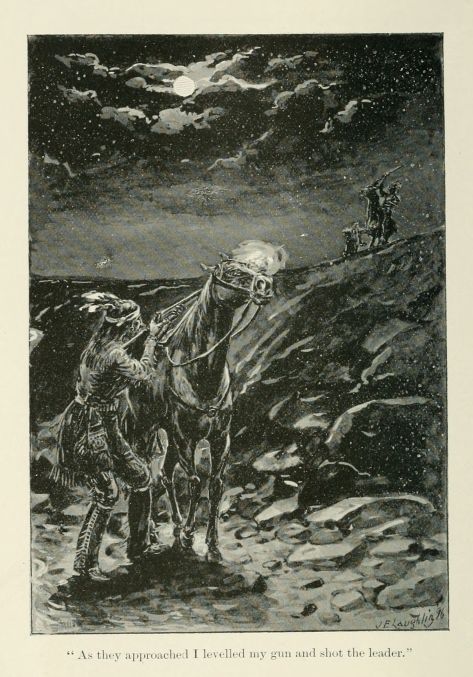
"As they approached I levelled my gun and shot the leader."
"Homeward I sped, resting occasionally to give my horse time to recover his breath and refresh himself a little. When I reached our camp I heard the women wailing for me as one dead, for they had given up all hopes of my safety, but when the people saw my approach and the scalps by my side their sorrow was changed to songs of rejoicing. A great feast and scalp dance were held. Three Bulls made a long speech exalting my heroism, and ended by giving me his name of Medicine Runner, which he then bore, and which I have since borne until this day."
The chief had scarcely finished his story when a young man entered named Running Wolf. He was tall, slim, and of noble aspect, showing his relationship to the bravest of the tribe. He had a careworn appearance and was evidently suffering keenly from physical exhaustion; still a faint smile played upon his features and his eyes glistened with unusual brightness. Five days previous, this young man had gone from his lodge on an errand of some importance, as was evident by the determination which was expressed in the firmly compressed lips and the look of daring in his eye. For some time he had been very serious, and it had been remarked by some of the aged people that he seemed to be holding communion with the spirits. He withdrew within himself, saying little but thinking much, and the young man who formerly had been so full of merriment and delighted in all the amusements of the camp, had become suddenly transformed into a sedate man, almost prophetic in his looks. Without informing anyone of his intentions he had departed from his lodge, going rapidly toward the hills, apparently hoping to meet someone or determined to do some work. He walked quickly, shunning the presence of his companions, heeding not the riders who were driving herds of horses, and caring not for the scenes which always delighted him.
Old and young who saw him travelling at such a rapid pace across the prairie kept out of his way, for it was evident to their eyes that a supernatural power was guiding him. For many hours he travelled without halting, his eyes fastened on the ground, but with a holy purpose in his heart. Into one of the deep ravines he entered, and far into its recesses he travelled, where seldom penetrated the eyes of man, haunted as the Indians believed it to be by spirits of the dead, who possessed the power of inflicting injury upon the living.
It was in this community of spirits that Running Wolf found the resort which his soul longed for, its gloomy shades, rugged, tall rocks and scanty vegetation agreeing with the state of his soul. It was the home of the buzzard, coyote and eagle. Loveliness there was none, and as a resting place for man, no spot on earth could have been found more uninviting. This was the place, however, which seemed pleasing to the spirit of the young man, and for a few moments, although exhausted and sad, a gleam of satisfaction shone from his countenance. He fell upon his face kissing the ground, and in accents of tenderness cried, "My mother!" He lay upon the sod for a long time, fatigued with his journey and the physical exhaustion arising from nervous excitement, but at length arose, gathered his blanket upon his left arm, and began pacing to and fro, praying earnestly to the Great Sun for the revelation of himself.
Alone upon the hills and in the deep recesses of the ravines he wandered, praying and fasting, allowing nothing to pass his lips but a little water. Earnest, solemn and prolonged was his communion with the Great Power which overshadowed him, and the more keenly he felt this invisible presence the more fervently he prayed and longed for the fulfilment of his vows. Bright were his hopes, for he had implicit faith in the spiritual influences with which he was surrounded.
For days and nights the young man wandered alone, his voice heard by none save the spirits, the birds and the animals. At last he fell to the ground worn out with his devotions, and as he lay in a half-conscious state pleasant dreams flitted through his brain. The air was filled with happy voices. Angel attendants came to minister to him. Earth was no longer a weary place to live in, but the songs of joyous hearts came to him in all their sweetness, more pleasing than he had ever heard, and as he sang in unison with them, his heart was filled with joy. How long this continued he never knew, but in the midst of it all there came a voice assuring him of peace, the acceptance of his vows and prayers, and the gift of a Guide and spiritual Friend. The blessed vision rested on his soul as a rich benediction; and in this pleasant frame of mind he awoke. As he raised himself there came running toward him a small ground squirrel. This he seized instantly, and as he held the timid animal in his hand he remembered that this was the visitor named in his vision which would come to him, and within whose body would dwell the Spirit which was given him as a guide through life. As he held it, gently he drew it toward his bosom, and there nestling with fear it suddenly ceased breathing. His visitor was dead!
His heart was moved with sorrow; but he learned by the keen spiritual perception which had been given him that the Spirit Guide needed not a living agent wherein to dwell, for He could give animation if that were required.
Quietly and with reverence he laid the little thing upon the ground; tears filled his eyes. He prayed anew for guidance and strength, and as he prayed he took his knife and removed the skin of his little visitor and reverently preserved it.
A gentle voice whispered to him that the vision was ended. So casting a few quick glances around, he turned homeward, tired and footsore, but very happy.
A long journey lay before him, and in his fainting condition he could walk but feebly, yet so strong was his spirit that it overcame his physical weakness and enabled him to speed across the plains. New life had been granted him, and a companion of the spirits was now beside him wherever he went. As he drew near to the camp the dwellers fled at his approach. They beheld something supernatural in his manner which made them afraid. He entered the lodge of Eagle Rib as Medicine Runner finished his story, and without speaking a word sought his accustomed couch.
One by one the visitors left, impressed with the fact that some prophetic power had fallen upon the young man, and they dreaded contact with spiritual visitants.
These people are often called savages by members of the white race, yet they have been taught the greatest respect for all forms of religion, recognizing these forms as methods by which men approach the Supreme Power, hence their reverential attitude when the young man came into the lodge. In a few moments all the visitors had gone, and there remained only Eagle Rib and his family alone with Running Wolf.
He slept many hours, and then awaking fully refreshed, he partook of food, but said little to anyone. Becoming much reserved, not because of his superior position or knowledge, but rather because of the consciousness of this invisible companion, Running Wolf increased in favor with all the people. Gentle, sober and true, he won the hearts of the young men and maidens, who of all the natives of the lodges were most exacting.
A few uneventful years passed by, and the young man stood at the head of the young warriors of the camp, a recognized leader, well qualified to direct and destined to become victorious over every foe. His words were few, but when he spoke his judgment seldom erred, and his decision always carried away all opposition. Clothed with power and wisdom he had nothing to fear from any antagonist, and still he seemed unhappy. A restlessness of spirit appeared suddenly to take possession of him, compelling him to depart from the peace and happiness of the camp.
One evening, while sitting in the lodge, surrounded by his friends, without any word of warning or expression of any kind, he arose and departed, no one daring to follow, and no one asking the cause of his action.
The sun sank behind the Rocky Mountains, and the prairie was soon enveloped in darkness, but the young man heeded not the deepening shadow; he was not afraid. He wandered far from the camp and entered the forest unnoticed and unpursued. Straight as an arrow he went onward until he came to the foot of a giant tree, and kneeling upon his knees, he breathed out a prayer, simple, majestic and brief.
Drawing his knife from its sheath, he began to dig vigorously under the sod, never resting in his eager search for some hidden prize. Presently from the depths of the soil he brought forth a tender rootlet, upon which he gazed with admiration, hugging it closely to his bosom as a treasure of rare value.
Then, quietly retracing his steps, he soon found rest in the lodge. No questions were asked, and few indeed were the words spoken, his reticent manner preventing any undue familiarity.
A few nights passed by and a messenger came to the lodge in deep sorrow, to inform Running Wolf that the daughter of Mastwena was very sick. Without manifesting any surprise, Running Wolf arose, went direct to the lodge of his friend where the sick child lay, and bending gently over her, he looked into the face of the little one. A gleam of satisfaction passed over his countenance. She was very sick, but not beyond hope of recovery.
The medicine drums were brought down and beaten to call to his aid the spirits which flitted from tree to tree and from stone to stone outside the lodge. The medicine song was chanted by all the members of the family, and Running Wolf sang vigorously as he swayed his body to and fro in an excited manner.
As he sang and prayed he drew from his medicine bag a piece of root, which he broke, and placing it in a vessel with a small quantity of oil, stirred it well. As he muttered words of import which acted as a charm to aid the medicine in performing its desired end, he gave it to the feverish child with the gentleness of a woman.
As the little one drank the medicine, he again repeated the strange words which had fallen from his lips, and although misunderstood by the members of the family, a shudder ran through the company, for they felt the sacred power which accompanied the casting out of the evil spirit which had taken possession of the child.
The child lay motionless for a few moments as Running Wolf prayed over her, and then a sudden change took place, the whole physical frame being strangely contorted through pain, the agony being almost unbearable. Heavy drops of sweat stood upon the child's forehead and rolled off her body, until as the agony increased and the culminating point seemed to be reached, she uttered a piercing cry, and then fell back motionless upon her earthen couch.
Deep slumber fell upon her, and she lay asleep for hours as if under the influence of a gentle opiate, no one daring to arouse her, or caring to intrude upon the territory of the home of the spirits.
As the sun arose in his splendor behind the hills which lay across the prairie, the Indian maiden opened her eyes, refreshed with her slumbers, free from pain and the disease overcome. In a few days she was running with her companions as strong and merry as she had ever been.
The fame of Running Wolf was spreading fast and was not confined to his own tribe, and had he been a man of ordinary ability he would no doubt have become elated over his success. Keeping his own counsel he still felt humble, for he depended solely for his success on the ministrations of the Spirit Guide and the wondrous revelations which were frequently made to him.
Many uneventful days were passed in the camp, the severe illness of a friend or a skirmish with some neighboring tribe alone breaking the monotony.
No counsel was more eagerly sought in the gatherings of the chiefs, and there was no chief in greater demand as arbitrator in difficulties than Running Wolf.
He was loved for his wisdom, kindness and unassuming manner. The children listened to his stories as he sat in his lodge surrounded by the youth of the camp, who became so docile under his influence that with a single wave of his hand they quietly departed. Frequently they gathered around his lodge fire, and when the shadows of evening fell, they ran homeward to repeat the wonderful stories he had told them. Many a needless war was averted by his cool judgment and courage.
Late in the fall of the year this wise counsellor stood at his lodge door, and called aloud for his friends to attend a feast which he had made. A large company assembled to do honor to their friend. As they sat around in his spacious lodge, entertained by the conversation of the most notable men of the tribe, the evening passed away pleasantly. Running Wolf led off in the conversation late in the evening, and as he spoke in a tone of gravity, yet with a spirit of deep feeling, every ear listened and every heart beat in sympathy with the sentiments expressed. The orator proceeded to relate the history of the tribe, the story of its conquests, the records of the noble deeds of its great men, the advent of the white race and the present condition of the Indians. He depicted the future in dark colors, the gradual decay of the red men, the diseases and debauchery of the people, the corruption of the Indian politicians and the utter overthrow of the native religion. He counselled them to accept of the glory of the coming day when the red men would mingle with the white race, accepting their teachings and civilizations and finding therein peace, plenty and contentment. His voice faltered, and their hearts grew sad as he told them he would always remain with them to cheer them with his presence and encourage them by putting wise thoughts into their hearts; and he would touch the hearts of the white men, so that more tenderly than ever would they treat their brothers in red.
With downcast countenances they left his lodge and sought repose, although few of them slept because of the strange visions of the future his words had awakened in their minds.
Upon the following day a strange rumor spread rapidly over the camp that Running Wolf had not been seen after his great feast with the chiefs. Forebodings of dark destiny filled the minds of the people, and sorrow was depicted on every countenance. Women and children wept, and the men groaned in spirit, heavy with foreboding fears.
Running Wolf's favorite horse stood at the lodge door, his gun and military habiliments lay in their accustomed place, but the wise man was gone. A few footprints were seen leading out towards the prairie in the direction of the mountains, but after following them a short distance all traces of them were lost. Far and near they sought him but found him not.
Then the chiefs recalled the sadness of their hearts when he assured them he would always abide with them, encouraging their hearts and subduing their enemies. They now believe that he is true to his predictions, and that he still presides over them in a higher degree as chief among the spirits. Yet they cannot help going out every day to look across the prairie for the return of Running Wolf.
Some day he may return, but not as we look for him. As the guardian spirit of the tribe he still maintains his ascendancy over the people, and with greater power than ever he waits upon them in their counsels and religious feasts, no longer guided by the spirits, but himself a seer among the gods.