THE SKY PILOT.
Reading edition
Broadcloth and pemmican seldom met together in the far West during the old buffalo days. Occasionally, though, a "sky pilot" dressed in prairie garb found his way to the trading posts or the mining camps of the old-timers, where he was hospitably entertained and sometimes handsomely remunerated. There were few attractions for men of culture and refinement in such a life; only that to be found in a free and easy life on the western plains, strengthened by the desire to do good and the assurance of success which always accompanies every earnest toiler who obeys the behests of his Master.
Parson Morris was a Methodist preacher of the old school, with few tastes, yet withal a man of culture and sterling worth. He had not only seen the inside of a college, but he was a good classical scholar. Few could handle the Greek Testament better than he, or were better versed in the standards of Methodist theology. When a lad he had found peace at the ancient "penitent bench," and the first prayer that fell from his lips was the simple but very expressive sentence, "Lord, make me a missionary!" This missionary zeal had been fed by reading the life of John Hunt of Fiji and current missionary literature.
During his college course the keen eye of one of the church leaders recognized the fitness of the young man for the mission field, and a messenger was sent to request his consent to go into the work of bringing the heathen to Christ. His heart had been set upon going to Japan, but the voice of destiny sent him to the western plains of Canada, where under the shadow of the majestic mountains he unfurled the banner of the Prince of Peace.
Parson Morris must, like all wise men, take a partner with him to his western home, one with whom to share his toil and his joy; for, although there were many who sought to deter him from engaging in such a fruitless task as striving to lead Indians or frontiersmen to the feet of Christ, he anticipated success, and his heart was therefore full of joy. It would have been needless for him to have gone forth upon his mission if he had not been buoyant in spirit and deeply impressed with the great work he had undertaken.
The friends of the young missionary and his wife felt their departure keenly, and some kind-hearted souls deeply sympathized with them, and spoke to them as if they had been banished by some edict of the Almighty to dwell in lone banishment in some desert wilderness. The young parson received a handsome gift from his ministerial friends, and Nancy, the parson's bride, was made the recipient of several valuable presents from her college friends.
While attending the session of Conference the Rev. John Boswell offered his congratulations to the missionary, adding: "It does seem a pity that a man possessed of such good talents as you should become a missionary to the Indians. You would do well on the best fields of the East."
The simple answer was, "I feel that I ought to go!"
Two days before starting upon the missionary journey an interesting though scarcely encouraging missive was received offering good-will, and containing a newspaper clipping detailing the hanging of a Cree Indian for the inhuman act of murdering, cooking and eating his own family!
Some of these kind friends who sent this letter were numbered amongst the most generous contributors to the missionary cause, and prayed most earnestly for its success.
The solemn moment of parting came, and many tears were shed, many words of regret spoken. The parson felt depressed when thus surrounded by so many gloomy countenances, but he naturally turned aside in search of one or two kindred spirits, and as he stood upon the railroad station platform there came a vision before his eyes, one which filled them with tears. It was that of the heathen waiting in thousands with outstretched arms calling for help, while not a soul appeared to hear the cry which ascended to heaven and arrested the angels in their mission of mercy and love. The great responsibility of helping men toward a nobler life rested heavily upon the heart of Parson Morris, and as he talked to his friends, hearing and answering their questions, his heart was far away on those distant plains.
Their journey lay through the pleasant farms and shady woodlands in northern Ontario, then up the lakes of the north, across stormy Lake Superior, over the prairies of Minnesota and Dakota, until the Missouri was reached, when a halt was made to await the steamer. One week was spent in the city of Bismarck, at that time a small village characterized by all the roughness of western civilization.
There were large ox-trains composed of three and four heavily laden wagons, drawn by eighteen or twenty head of oxen, on their way to the Black Hills, the land of mineral wealth and lawlessness.
On Sunday the cowboys ran their horses wildly up and down the principal streets, firing their revolvers into the air. A theatre was in full progress, and all the stores were doing a thriving business.
Parson Morris and his friends held a service in a public hall, and while the heads of the worshippers were bowed in devotion their souls were called to earth again by the sudden entrance of a man who shouted, "Is this a fire meeting?"
Perceiving his mistake he retreated.
Up the muddy Missouri the pilgrims continued their journey, past the extensive Cactus plains, winding in and out of the sand-bars and snags which filled the river, crawling slowly through the rapids, passing vast herds of buffalo and bands of Indians, until after ten days' sailing in the famous river steamer, the Key West, they landed at Benton, the head of navigation. Dirt, drink and depravity were the chief features of the village in the buffalo days. Money was abundant, and so were gamblers. The main street was lined with taverns and gambling-hells, and every morning the street was almost paved with playing cards. Here were men of quality and culture mingling with the scum of society around the tables. Brawls were common occurrences, and not infrequently were attended with the death of one or more of the participants.
At Benton an outfit was purchased, and Parson Morris with his wife Nancy embarked in a "prairie schooner" for their home across the plains. Bidding farewell to the last evidences of civilization, they began their march. Alkali lands were abundant and water was scarce; indeed, water fit to drink was seldom found, and frequently the travellers had to seek a stagnant pool, containing not more than a pailful of slimy liquid. By filtering it through a handkerchief the water was strained and freed from most of its obnoxious ingredients. At times a tiny rain pool served to yield a small supply of water. Strong coffee was made with it in order to destroy the discoloration of the water and its nauseous properties. Mosquitoes and swollen rivers served not too pleasantly to relieve the monotony of the trip. There was excitement, too, as for instance when the wagon-box was lashed with a hide and made to serve as a boat, the occupants trembling for their safety as the rudely made craft was borne wildly down the turbulent stream.
Arrived at their destination a very primitive log structure was sufficient to afford the parson and Nancy a place of rest and shelter from the inquisitiveness of the too neighborly Indians. It was a rude building, but there was joy in it arising from the consciousness of duty done for God and man.
The field of operation, embracing an extent of territory larger than the whole of England, was extensive enough to engage all the young man's powers.
The suit of broadcloth was discarded for one of buckskin, long top boots and a sombrero (a hat with a brim of very wide dimensions). Nancy was compelled sometimes to remain at home while her husband visited the lone and distant settlements. These visits often involved an absence of some weeks from his home, and brought trying times for Nancy; many an anxious hour was passed as she lay at night thinking of the parson asleep upon the prairie at a long distance from any habitation and having no companion save his faithful horse, while the savage dogs howled around her home and the Indians sang and shouted at their heathen feasts. When Parson Morris started out on a journey, his thoughtful wife made extra hard buns, put some tea in one small sack, a supply of sugar in another, a little butter in a can, the whole neatly arranged so that it could be equally divided and fastened on the back of the saddle.
A small axe and an old kettle, a few books, a picket-pin and a rope completed the outfit. Dressed in his buckskin suit, the parson gave Nancy a kiss, breathed a prayer for their mutual protection, sprang into the saddle, dashed through the river and sped across the prairie at a rapid pace, for he must travel forty miles before night overtakes him. Half of his day's journey completed, he unsaddled his faithful animal, picketed her in a good spot where there was some choice buffalo grass, built a fire of such material as he could gather, and then hastily cooked his meal.
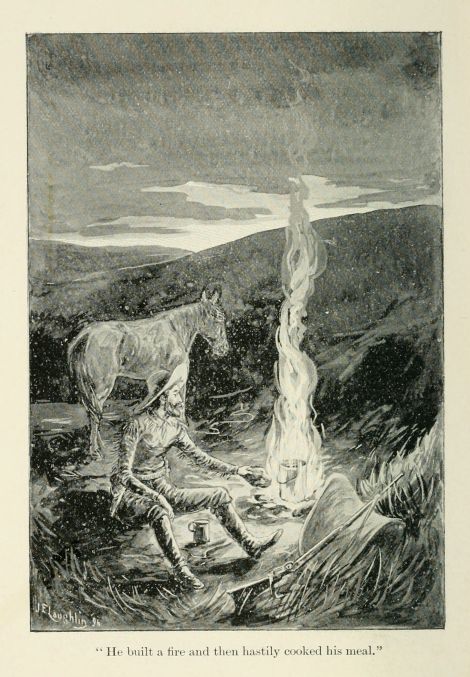
"He built a fire and then hastily cooked his meal."
A rest of two hours was taken before his journey was continued. When night approached he sought some low lying spot where water might be obtained, and there, encouraged by a few shrubs or good feed for his mare, he encamped for the night. He picketed the mare at a short distance, so that if she became restless he could hear her, for she was apt to become fractious through the presence of Indians or wolves. His saddle was his pillow, the saddle-blanket a covering, and before lying down for the night he surveyed the prairie on every side, took care the fire he had kindled to cook his supper did not spread, and then breathing out a prayer for Nancy, he rolled himself in his saddle-blanket, laid his gun and revolver by his side, and was soon in a sound sleep.
The parson was a brave man and always found ready access to the homes of the old-timers, sharing their beds and meals. He sympathized with them in their trials, and strove to present to them the noblest type of a masculine Christianity. He was to these men a "sky pilot" and a "gospel grinder," a man whom they loved because he could ride well, swim the rivers, endure the cold, sleep on the prairie or in a miner's shack, preach an honest sermon, was not afraid to tell them of their vices, and showed himself a faithful dispenser of "soul-grub." He could preach in a tent or Indian lodge, a wagon or an old shack. He was not averse to sitting down to listen to the tales of prairie life told by the rough settlers, and at such times their conversations were bereft of any vulgarisms—not an oath ever falling from their lips or an immoral allusion, although these might have originally formed part of the tale. Willingly did he write their letters home, and carry them a hundred miles or more as he journeyed eastward, that they might be sent safely on their way. The tears sometimes came to the eyes of the gamblers as they talked together of their childhood's early years and of the old folks at home.
Two or three years of western life had passed when the parson, one Sunday evening, announced from his primitive-looking pulpit in the little log building which served as a school-house and church, that on the following Sunday he would preach a temperance sermon. A buzzing noise arose in the congregation, indicative of the tone of feeling on the question of whiskey and liberty.
There was abundance of liquor among the white men, although the Indians were not allowed to receive any, an exception rigidly enforced by the vigilant efforts of the Mounted Police.
Sunday evening came, and the little church was filled to overflowing. Indians and half-breeds stood around the door and looked in at the windows, their forms darkening the place. Within the building were Mounted Police officers and constables, whiskey traders, cowboys, gamblers, half-breeds and Indians, men from different countries, educated and ignorant, some who were graduates in arts from Oxford and Cambridge, and others who were trained at the horse ranches of Montana, Idaho and Mexico. There were two white ladies present, the only females in the congregation. Assembled together with bowed heads were men of various creeds and no creed, Protestants and Roman Catholics, Anglicans and Dissenters, Unitarians, Baptists, Presbyterians, Methodists, atheists, representatives of almost every known sect.
The parson gave out the hymn and led the singing, every member of this strange congregation joining in the service by singing or assuming a reverent attitude, and then silently every head was bowed while prayer ascended to the throne of heaven. An able temperance sermon was preached, and was listened to with deep attention and gravity. When it was finished, and as the parson took up his hymn-book to announce the closing hymn, an aged Indian chief named Manistokos arose and addressed the congregation. As he stood up to speak, a half-breed who was employed as Government interpreter, drew near to interpret the speech of the Indian chief.
With head erect and in a clear, distinct tone of voice, Manistokos spoke and the interpreter translated: "I am glad to hear the words of the praying man. Many years ago we had fine clothes, good buffalo-skin lodges, lots of food, and we were contented and happy. The white men came and brought whiskey with them, and then our people began to die. The buffalo went away. We had no food, our lodges became old and unfit for use, our clothes dropped off our bodies, and there was nothing left us but to go to our graves. We are now poor, depending upon the Government for food, having poor clothing and sad hearts. We are now so poor that we have no whiskey, for since the Mounted Police came they have drank all the whiskey and there is none left for us."
The eyes of the Mounted Police flashed fire as the old chief sat down amid the laughter and applause of the audience.
Parson Morris arose and said in dignified tones: "My friends, we are always glad to hear what anyone has to say, but when any white men have not the courage of their convictions, but must employ an Indian for their mouthpiece, we will not listen to what they may wish to say. If there are any here who think that upon choosing the side of intemperance they have truth and justice on their side, I will give them an opportunity to air their opinions. They can have the use of this church every alternate night this week, and I will kindle the fire and light the lamps myself, as I have to be sexton and preacher; but I reserve for myself the right of replying upon the alternate evenings of this week."
There was no reply and the service closed.
Upon investigation by the Mounted Police it was found that the interpreter had been employed by some of the members of the whiskey fraternity to interpret falsely, and the aged chief had been induced to be present to give his views on the temperance question, which were all in favor of the total suppression of the traffic.
The Government authorities dismissed the interpreter, and the cause of temperance was strengthened by the brave words and manly attitude of the parson and the Indian chief.
The little village of Mackleton, in which Parson Morris and Nancy took up their residence, consisted of a few log buildings with mud floor and mud roof, and with one street of various widths and very circuitous. Sunday was the most important day of all the week. It was then that the Mounted Police started on their long journeys, no doubt being better able to reckon from that day than any other.
Sunday morning came, and the parson and Nancy paid their usual visits to the Indian lodges and homes of the half-breeds. As they went from house to house, they found it well-nigh impossible to cross the street, an ox-train having come to the village on Saturday and encamped in the middle of the thoroughfare. There stood the long trains of wagons, the yokes of oxen, and the camping outfit of the teamsters, who were at this time squatted on the ground eating their breakfast, which they had cooked by means of a fire made in the street. The men had slept in their wagons where they stood, and the oxen were grazing on the prairie, herded by one of the men belonging to the train.
As soon as the meal was over, the train-boss proceeded to unload his goods, and the men entered heartily into the work, which kept them busily engaged for two days. The work of visitation was kept up all forenoon, save an hour for school, when there assembled the half-breed and Indian children belonging to the Sarcee, Blood, Piegan, and Blackfoot tribes.
Amongst the number was an obstreperous boy of six years, whom the parson had to seize and carry on his back to school, and when once he had him there, was compelled to lock the door to keep him from retreating.
During the afternoon the bowling-alley and billiard tables were well patronized, the stores were well filled with buyers of all kinds, the blacksmith busily plied his trade, and a more lively day was not to be found during the week. The day wore on, bereft of its sacredness and peace, no songs of Zion stealing upon the ears, and no worshippers in their best attire wending their way to the house of God.
Four weeks had passed away and there had been no signs of the mail. Many wistful eyes scanned the prairie to catch, if they might, a glimpse of the long-expected wagon with its precious contents of joy and sorrow from friends in the far distant cities of the East. The old-timers became excited and climbed on the roofs of the houses with glasses in their hands to scan the horizon, hoping they might see the rig coming.
"The mail! The mail!" shouted Kanrin and his friends as they stood upon the mud roof of the solitary hotel, and the shout was echoed from one end of the village to the other, each man as he heard the cry joining in the announcement till it had passed from mouth to mouth. The gamblers left their cards and the billiard tables were vacated as from every house and store the people rushed to gaze upon the wagon which held the mail. Every heart was agitated, and it was impossible to eat, drink, work, play or rest at such an important time.
It was the hour of holding service and Parson Morris and Nancy repaired to the little church, but not a soul was there. They waited patiently until a single straggler entered to join in the worship of God. The preacher gave his best sermon to Nancy and her companion, who pronounced it very good and appropriate to the occasion. The congregation had deserted the church, the most frequent worshippers being found upon their knees at the principal store, where, the mail having been emptied on the floor, they were aiding in the assortment of the letters, papers and books. It was a feast day to many in the village as they read again and again the news from home; but there were some sad hearts among them—those who came expecting a letter and whose expectations were not fulfilled.
Here stood a rough gambler with tears in his eyes as he held in his hand a sheet of paper written in a very trembling hand, and there upon a bale of buffalo robes sat young Hanna, deep in thought, as Indians chattered in their native tongue beside him. The letter he was reading, one from his aged mother in the old English rectory in his native Yorkshire, was evidently touching his heart, for the gay young man, cultured, kind and courtly, was nevertheless the most inveterate gambler in the town. His father was a clergyman of means who had allowed his son to emigrate with the hope of becoming wealthy and gaining a position there, which he could not hope for in England; and the young man, with the spirit of adventure, had eagerly grasped at the proposal and sought a home in the far West.
Money was abundant, and as it was much easier to gamble than to farm or raise stock, he drifted with the tide and became an expert, winning thousands of dollars in a few days and as quickly losing all he had. He was a fair sample of many young men who in the early days sought wealth upon the plains of the West.
Parson Morris became more intrepid in his work the longer he dwelt among the rough settlers. These men had warm, generous hearts, despite the usual roughness of their garb, manners and speech, and no one knew this better than the parson. He had proved it oftentimes when their comrades were sick, and had ever found them generous and kind. Seldom, therefore, did he call upon them for help, not being desirous of riding a willing horse to death, seeing that they gave so liberally to all his schemes and it seemed to be a pleasure to them to assist him. There were times, however, when in religious matters he felt it necessary to resort to the method which they called "raising the wind." Sometimes Nancy would visit the billiard rooms and settlers' shacks to ask their aid. At such times she always met with politeness and generous responses.
One Sunday morning the parson went to the little log church to find his congregation again absent as before; the mail had arrived and every worshipper had gone to find news from home. Nothing daunted, he resolved in his mind that he was not going to be defeated. While thinking seriously what had best be done, he suddenly recollected the startling fact that there was a church account of fifty dollars which must be paid. What better service could he render to those men, than to entertain them by allowing them to preach a sermon on giving. No sooner thought of than the parson started for the billiard-hall and hotel of Kamusi.
A veteran of the prairie whose civilized appellation was shrouded by his western cognomen, Kamusi was one of the parson's right-hand men. He would get drunk and swear, and he lived with an Indian woman, but nothing was thought of these things in those early days, when parsons were few and life was held to be of little value. Brave and kind, no hungry man was ever turned from his table because he had not the wherewithal to pay for his meal, and many times there could be found in one of his back rooms a sick stranger cared for and fed at the old veteran's expense.
"I'm dead broke! I'll have to shut up shop. I've been losing money every day. The people are robbing me!" he grumbled repeatedly as he hobbled along about his work, coughing severely from an old asthmatic trouble, while sitting by his doorstep were two cripples who were being supplied with food and medicine by him, and for three months they had lived there.
When the parson's small larder was nearly empty, which happened occasionally, if Kamusi had the least suspicion that such a thing existed, or if he had a rare dish or a choice dainty, part of it would find its way to the parson's table. Kamusi was the "Sky Pilot's" friend.
Quietly the parson entered Kamusi's billiard-hall, where dazzling lights were burning in profusion. Men stood at the bar smoking and talking, and the billiard-tables were surrounded by a gay company of young and middle-aged men. As the parson stepped to the head of one of the tables every eye was turned upon him, the hum of conversation ceased, the cues dropped to the ground and every hat was removed.
"Friends," said the parson, "I have not come here to preach a sermon, but I am on business, and, as you all know, I am not given to beating about the bush. I am come here to get some money. There is no man here can say that at any time I have ever asked him what denomination he belonged to, but have always treated you as men and brothers, and tried to help you in whatever way I could and whenever you needed it."
"That's so, parson," said Paul Vrooman, a noted gambler, who stood with his cue in his hand.
"When your comrades have been sick I have gone long distances to visit them, at any time of the day or night, and at any season of the year."
"That's so," said another.
"I have stood beside you in sickness and trouble. I have buried your comrades on the prairie and have tried to help you to lead better lives. Now, I have a church account to pay, and I am here to ask you to assist in paying it. You have never refused to help, and I know that you will help me now."
"We will, parson," said Vrooman again.
"There is Paul Vrooman, he will take the hat and go around, and receive what you are willing to give."
Paul took his hat, and passing around the tables received a contribution from each which he handed to the parson, who thanked the men and departed.
As the parson was closing the door they shouted after him, "Come again!" The words cheered his heart and made him long for the time when they would follow his teachings more closely, and forsake the haunts of sin.
The good man spent the Sunday evening in going among the billiard saloons, and the next morning he went to the Mounted Police barracks, where he found the men sitting down to breakfast. He addressed a few words to the men, who heartily responded to the appeal, then returning home, and counting over the gains, he found that he had enough to settle his account. This he did with a very light heart. Such was one of the parson's methods of "raising the wind." He never failed in gaining the hearts of the men, as he spoke to them in a manly way, without any signs of effeminacy or peculiar sanctity unsuited to western life.
Our "Sky Pilot" still retains his buckskin suit, and when he wears it again he feels the scent of the prairie air, and longs like the war-horse for another engagement on the plains of the West, where, unhampered by the petty forms of civilized life, he can talk to men who rejoice in and illustrate in their lives a noble type of Christianity.