THE VEGETABLE GARDEN
Reading edition
Perhaps the most characteristic feature of Northern and Eastern farms is the home vegetable garden. Even where no orchard has been planted, and where the ornamental surroundings of the home have been neglected, a fairly well-kept garden in which are grown a number of the staple kinds of vegetables is generally to be found. In many cases the principal interest in the garden is manifested by the women of the household and much of the necessary care is given by them. A small portion of the garden inclosure is generally devoted to the cultivation of flowers, and a number of medicinal plants is invariably present. Throughout the newer parts of the country it is seen that the conditions governing the maintenance and use of the vegetable garden are somewhat different, and, while a number of vegetable crops may be grown somewhere on the farm, there is wanting that distinction so characteristic of the typical New England kitchen garden.
It would be impossible to make an accurate estimate of the value of crops grown in the kitchen gardens of the United States, but from careful observation the statement can safely be made that a well-kept garden will yield a return ten to fifteen times greater than would the same area and location if devoted to general farm crops. A half acre devoted to the various kinds of garden crops will easily supply a family with $100 worth of vegetables during the year, while the average return for farm crops is considerably less than one-tenth of this amount. A bountiful supply of vegetables close at hand where they may be secured at a few moments' notice is of even more importance than the mere money value.
Fresh vegetables from the home garden are not subjected to exposure on the markets or in transportation and are not liable to become infected in any way. Many of the products of the garden lose their characteristic flavor when not used within a few hours after gathering. By means of the home garden the production of the vegetable supply for the family is directly under control, and in many cases is the only way whereby clean, fresh produce may be secured. The home vegetable garden is worthy of increased attention, and a greater number and variety of crops should be included in the garden.—(F. B. 255.)
The development and extension of truck farming in the Atlantic coast States have been coincident with the development of transportation facilities throughout that section. In the beginning the points affording water connection with the great consuming centers of the North were those at which truck farming first became established. The phenomenal growth of the great consuming centers of the country has stimulated a corresponding growth and extension of the food-producing territory, especially that capable of producing perishable truck crops. The demands for vegetables out of season, followed later by the continuous demand for fresh vegetables throughout the year by the great cities, led first to the market gardeners located near the cities supplementing their field operations by extensive forcing-house enterprises. Naturally, the products from the greenhouses were expensive and available only to the few who were able to pay fancy prices for green products out of season. The improvement and extension of the transportation facilities which came with the great railway-building era of the United States made it possible to take advantage of the wide diversity of climate offered along the Atlantic coast of the United States to furnish these perishable products to the great cities of the North and East.
Transportation facilities, together with cheap labor and cheap lands at the South, have made it possible to produce in extreme southern locations products out of season at the North in competition with greenhouse products. The greater land area and the smaller amount of capital involved in the production of crops at the South, even though transportation charges were high, have enabled southern growers to produce much larger quantities of the desired crops than could be grown profitably under glass. It was therefore not many years before lettuce, celery, tomatoes, radishes, beets, and bunch beans came to be regular winter and early spring products of gardens located at great distances from the centers of consumption.—(Y. B. 1907.)
It is only necessary to look around the village and town gardens in the South to become convinced of the great need that exists for information in regard to the proper care of the garden, and particularly that part which is intended to give supplies to the table. There town gardeners are very active in the early spring, and their enthusiasm often leads them to go ahead and plant a great many things at a season too early for their safety, so that a return of cold often compels the almost entire replanting of the garden. But with the production of the early crops in the garden, the enthusiasm of the gardeners oozes out under the influence of the summer's heat, and the garden that at first looked so neat in its spring dress becomes merely a weed patch. Few people realize the advantage that long summers and sunny autumns give for the production of a constant succession of crops in the garden, and still fewer realize that in this climate the garden need at no season of the year be abandoned to the weeds. One of the greatest troubles that results from the common practice of allowing the garden to grow up in weeds after the first peas, corn, cabbage, and tomatoes are secured, is that these weeds are the places where the larvæ of the cut-worm hide, and are ready to begin their destructive work as soon as the garden plants are set in the spring. If the garden is kept clean and cropped continuously all the year round, as it may and should be here, there will be no cut-worms to bother the early plants. From January to January there is no need in the South for any space in the garden unoccupied by crops. From the time the earliest peas go into the ground in January up to the time it is necessary to prepare for them the following year there can be a constant succession of fresh vegetables from the garden, by the exercise of a little forethought. And this succession can be made still more perfect if there be added a frame with some hotbed sashes for the production of lettuce, cauliflower, radishes, carrots, etc., during the colder months; while all through the winter there can be celery, kale, spinach and turnips.—(N. C. Bul. 132.)
LOCATION.
The question of the proximity to the house or other buildings is of great importance when locating the garden. Caring for a garden is usually done at spare times, and for this reason alone the location should be near the dwelling. In case the site chosen for the garden should become unsuitable for any cause, it is not a difficult matter to change the location. Many persons prefer to plant the garden in a different location every five or six years. The lay of the land has considerable influence upon the time that the soil can be worked, and a gentle slope toward the south or southeast is most desirable for the production of early crops. It is an advantage to have protection on the north and northwest, by either a hill, a group of trees, evergreens, a hedge, buildings, a tight board fence, or a stone wall to break the force of the wind.
Good natural drainage of the garden area is of prime importance. The land should have sufficient fall to drain off surplus water during heavy rains, but the fall should not be so great that the soil will be washed. The surface of the garden should not contain depressions in which water will accumulate or stand. Waste water from surrounding land should not flow toward the garden, and the fall below should be such that there will be no danger of flood water backing up. The garden should not be located along the banks of a creek or stream that will be liable to overflow during the growing season.
A good fence around the garden plot is almost indispensable, and it should be a safeguard against all farm animals, including poultry, and should be close enough to keep out rabbits. A tight board fence will accomplish, this result and also serve as a wind-break.—(F. B. 255.)
PLAN AND ARRANGEMENT.
The garden should be planned with a view to furnishing a large assortment and continuous supply of vegetables through the entire season. Its size will depend primarily upon the amount of land available. On the farm, where any amount of land the owner desires can be reserved, for a garden, vegetables to be stored for winter as well as the summer supply, should be grown. On the village lot, space may be insufficient to grow more than the summer's supply, and it may also be necessary to leave out certain vegetables that require a large amount of space. On a city lot, the space available for growing vegetables is necessarily small, and plantings must usually be confined to those vegetables which produce a large amount of edible product for the space occupied.
Whether the garden is on the farm, in the village, or on the city lot, the principles governing its planting and care are the same although the distances of planting, methods of tillage, and intensity of cropping may differ widely. On the farm, the saving of labor is more important than the saving of space; even the small vegetables are planted in long rows rather than in beds; and horse power is substituted for hand power wherever possible. In the village and the city, the vegetables must usually be planted as closely as the nature of their growth will permit, and hand tillage employed almost exclusively.
Much loss of time in planting a garden can be avoided by making a definite plan of the garden several weeks or even months before the planting is to begin. After measuring the area to be used for the garden, the next step is to decide what vegetables are to be grown. If space is ample, this will be determined primarily by the personal tastes of the gardener and his family. However, if only a limited amount of time and attention can be given the garden, it may be wise not to undertake the growing of some of the more exacting crops. Whatever the space to be devoted to gardening, the crops to be grown should be decided upon long before the time of planting.
In planning the garden, it is well to arrange the vegetables in the order in which they are to be planted. This facilitates the preparation of the land for planting, and makes it possible to maintain the unplanted portion in a good friable condition with the least expenditure of labor. In order that the vegetables may be so arranged, it is necessary to know the proper time for planting each crop. This depends primarily upon the temperature and moisture requirements of the particular crop in question.
If any of the small fruits, such as raspberries, currants, and gooseberries, are to be planted within the garden enclosure, they should be included with the permanent crops. The area devoted to the hotbed, cold frame, and seed bed should be decided upon, but these may be shifted more or less from year to year or located in some convenient place outside of the garden. Where there is any great variation in the composition of the soil in different parts of the garden it will be advisable to take this into consideration when arranging for the location of the various crops. If a part of the land is low and moist, such crops as celery, onions, and late cucumbers should be placed there. If part of the soil is high, warm, and dry, that is the proper location for early crops and those that need quick, warm soil.
In planning the location of the various crops in the garden, due consideration should be given to the matter of succession in order that the land may be occupied at all times. As a rule it would not be best to have a second planting of the same crop follow the first, but some such arrangement as early peas followed by celery, or early cabbage or potatoes followed by late beans or corn, and similar combinations, are more satisfactory. In the South as many as three crops may be grown one after the other on the same land, but at the extreme north, where the season is short, but one crop can be grown, or possibly two by some such combination as early peas followed by turnips.—(F. B. 255.)
FERTILIZERS.
The kind of fertilizer employed has a marked influence upon the character and quality of the vegetables produced. For the garden only those fertilizers that have been carefully prepared should be used. Fertilizers of organic composition, such as barnyard manure, should have passed through the fermenting stage before being used. The use of night soil generally is not to be recommended, as its application, unless properly treated for the destruction of disease germs, may prove dangerous to health.
BARNYARD MANURE.
For garden crops there is no fertilizer that will compare with good, well-rotted barnyard manure. In localities where a supply of such manure can not be secured it will be necessary to depend upon commercial fertilizers, but the results are rarely so satisfactory. In selecting manure for the garden, care should be taken that it does not contain any element that will be injurious to the soil. An excess of sawdust or shavings used as bedding will have a tendency to produce sourness in the soil. Chicken, pigeon, and sheep manures rank high as fertilizers, their value being somewhat greater than ordinary barnyard manures, and almost as great as some of the lower grades of commercial fertilizers. The manure from fowls is especially adapted for dropping in the hills or rows of plants.
COMMERCIAL FERTILIZERS.
Commercial fertilizers are sold under a guaranteed analysis, and generally at a price consistent with their fertilizing value. No definite rule can be given for the kind or quantity of fertilizer to be applied, as this varies with the crop and the land. At first the only safe procedure is to use a good high-grade fertilizer at the rate of from 1,000 to 2,000 pounds to the acre and note the results. Market gardeners frequently apply as much as 2,500 pounds of high-grade fertilizer per acre each year. Farmers who do not have sufficient barnyard manure for their crops should begin gradually to use the commercial fertilizers.—(F. B. 255.)
PROFITS FROM THE USE OF FERTILIZERS.
The aim usually in the use of artificial fertilizers is to so supplement soil supplies of plant-food as to obtain a profit, and, as already intimated, the profits for the different crops will be in proportion to their economical use of the desired constituent. Still, one should not be deterred from the use of fertilizing materials, even if the conditions should render the application apparently wasteful—that is, the farmer should estimate the increase that it is necessary for him to obtain, in order to be regarded as profitable, and if only this is obtained, he should not be discouraged. Many persons seem to have gotten the impression that the use of fertilizers is a gamble at best, and are not satisfied unless the returns from the investment in fertilizers are disproportionately large. We very often hear the statement that by the use of certain fertilizers the crop is doubled or tripled, as if this were a remarkable occurrence, and partook of the nature of a mystery. Such results are not mysterious; they can be readily explained. In an experiment on celery it is shown that the weight of celery from an application of 400 pounds per acre of nitrate of soda is two and one-half times greater than on the land upon which no nitrate was used, and that very great profit followed its use. This result is not mysterious—the nitrogen applied, if all had been used by the crop, would have given a still greater increase; it simply shows that where no extra nitrogen had been applied the plant was not able to obtain enough to make the crop what the conditions of the season and soil, in other respects, permitted. These favorable conditions, however, are not uniform, and variations in return from definite application must be expected.
It is quite possible to have a return of $50 per acre from the use of $5 worth of nitrate of soda on crops of high value, as, for example, early tomatoes, beets, cabbage, etc. This is an extraordinary return for the money invested and labor involved; still, if the value of the increased crop from its use was but $10, it should be regarded as a profitable investment, since no more land is required, and but little more capital with this return. The waste of nitrogen does not result in loss.
DANGER OF LOSS OF NITRATES BY LEACHING.
The chief difficulties in the use of nitrate of soda are due to promptness in its solubility and availability. The fact that it is so soluble carries with it the very grave danger that losses by leaching may occur if the conditions of soil and crop at the time of its application are not favorable for a rapid absorption of the nitrate by the plant. This danger is greater if it is applied to the soil before rapid growth, when there is a limited number of plants that have not made much growth, or whose roots have not taken possession of the soil, as in the case of the vegetable crops. In meadows, on the other hand, or in grain crops, where there are a large number of plants per unit of area, and in orchards or berry patches, where there are fewer plants, but a wider distribution of the feeding roots, losses are not so liable to occur. There may be, therefore, great disappointment in the returns from the use of nitrate of soda, if opinions as to its usefulness are based entirely upon its availability. Nevertheless, because no unknown conditions enter in, in reference to its availability, it is possible to avoid, in a great degree, the losses liable to occur, and thus to secure a maximum return from the application of this form of nitrogen.
THE INFLUENCE OF QUANTITY APPLIED AND METHOD OF APPLICATION.
If the quantity applied is too small to meet the demands of the crop, unless all seasonal conditions are favorable, the chances are that the results will not be completely satisfactory, as weather conditions are not likely to be perfect; it may be too wet or too dry, too cold or too hot, and hence, during certain periods, the plants would not be able to obtain their food—that is, it would be impossible for the plant to absorb always its food uniformly, or in such amounts and at such times as would result in the best development of the plant. In all cases an amount should be applied that would exceed the needed requirement under perfect conditions.
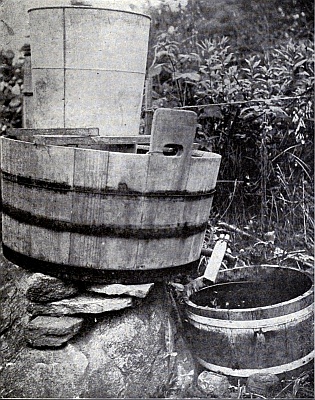
LIQUID MANURE IS ONE OF THE BEST ACTING FERTILISERS
In the second place, if the quantity found to be necessary for a definite increase of crop, under average conditions, were all applied at once, say in the early spring, a greater opportunity would be offered for losses from leaching than would be the case if the material were given in successive dressings, so that the losses due to the escape of the nitrogen would be minimized; on the other hand, if no losses occurred, the plant might take up more than could be utilized in a normal development, thus defeating the purpose, because resulting in a product of less commercial value. This would apply, of course, only in the case of those crops that are injured by abnormal development in certain directions, as, for example, too large a proportion of straw in cereal grains, too large a root in sugar beets, etc. All these difficulties may be obviated by a fractional application, or, in other words, by supplying the nitrogen at the time and in the quantity best adapted for the plant and for the purpose in view in its growth. The results from the use of nitrogen may be also unsatisfactory if nitrogen only of the elements essential is used. The best results from the use of nitrate can come only when there exist in the soil, or are applied with it, sufficient amounts of the mineral elements to enable the plant to obtain a food suited to its needs—nitrogen is but one element of plant food.—(N. J. A. E. Sta., 157.)
PREPARATION OF THE SOIL.
Where there is considerable choice in the location of the garden plot, it is often possible to select land that will require very little special preparation. On the other hand, it may be necessary to take an undesirable soil and bring it into suitable condition, and it is generally surprising to note the change that can be wrought in a single season.
Plowing.—Autumn is the time for plowing hard or stiff clay soils, especially if in a part of the country where freezing takes place, as the action of the frost during the winter will break the soil into fine particles and render it suitable for planting. Sandy loams and soils that contain a large amount of humus may be plowed in the spring, but the work should be done early in order that the soil may settle before planting. In the Southern States, where there is not sufficient frost to mellow the soil, this process must be accomplished by means of frequent cultivations, in order that the air may act upon the soil particles. It is desirable to plow the garden early, at least a few days sooner than for general field crops.
Sandy soils will bear plowing much earlier than heavy clay soils. The usual test is to squeeze together a handful, and if the soil adheres in a ball it is too wet for working. In the garden greater depth of plowing should be practiced than for ordinary farm crops, as the roots of many of the vegetables go deeply into the soil. Subsoiling will be found advantageous in most cases, as the drainage and general movement of the soil moisture will be improved thereby.
Hand spading should be resorted to only in very small gardens or where it is desirable to prepare a small area very thoroughly.
Smoothing and Pulverizing the Soil.—After plowing, the next important step is to smooth and pulverize the soil. If the soil be well prepared before planting, the work of caring for the crops will be very materially lessened. It is not sufficient that the land be smooth and fine on top, but the pulverizing process should extend as deep as the plowing. Some gardeners prefer to thoroughly cut the land with a disk harrow before plowing, so that when it is turned by the plow the bottom soil will be fine and mellow. After the plow the disk or cutting harrow is again brought into play and the pulverizing process completed. If the soil is a trifle too dry and contains lumps, it may be necessary to use some form of roller or clod crusher to bring it down. For smoothing the surface and filling up depressions a float or drag made from planks or scantlings will be found serviceable.
TIME OF PLANTING.
No definite rule can be given regarding the time for planting seeds and plants in the garden, for the date varies with the locality and the time that it is desired to have the crop mature. A little practice will soon determine when and how often sowings should be made in order to escape frost and mature the crop at a time when it will be most useful. Certain crops will not thrive during the heated part of the summer, and their time of planting must be planned accordingly.
THE SELECTION AND PURCHASE OF GARDEN SEEDS.
In order to have a good garden it is necessary to plant good seeds. It is not alone essential that the seeds be capable of growing; they must be capable of producing a crop of the desired quality, under the conditions existing where the gardening is to be done. Some varieties of vegetables are restricted in their adaptations, while others thrive over a wide range of territory and under widely different conditions of soil and climate. If the behavior of different varieties in a given locality is not known, the safe plan to follow in selecting varieties for planting is to choose mainly those that have proved themselves adapted to a wide range of conditions and have thereby become recognized as standard sorts. The newer varieties may be tested in small quantities until their suitableness for a given place and purpose has been determined. Particular care should be taken to select varieties that are capable of yielding a product of high quality. Such varieties are numerous, and some are better for one region than another.
It is always a safe plan to have a little more seed on hand than is actually needed to plant the area desired. Sometimes the first planting of a given crop is destroyed by frost or insects, making replanting necessary. In such a case, delay in replanting could be avoided by having the seeds on hand. The additional expense is slight compared with the value of the crop. In the case of many seeds, an ounce costs but little more than a packet; and in such cases, it is the part of wisdom to purchase an ounce, even though a packet might contain sufficient seed to barely plant the desired area. The more expensive seeds may be purchased in smaller quantities, with less margin between the actual amount required and the quantity purchased.—(U. Ill. B. 154.)
SEED SOWING.
Garden seeds should always be sown in straight rows regardless of where the planting is made. If a window box is employed for starting early plants in a dwelling, the soil should be well firmed and then laid off in straight rows about 2 inches apart. The same method holds good for planting seeds in a hotbed, cold frame, or bed in the garden, except that the rows should be farther apart than in the window box. By planting in straight rows the seedlings will be more uniform in size and shape, and thinning and cultivating will be more easily accomplished. In all cases where the soil of the seed bed is not too wet it should be well firmed or pressed down before laying off and marking for sowing the seeds. After the seeds are sown and covered, the surface should again be firmed by means of a smooth board.
No definite rule can be given for the depth to which seeds should be planted, for the depth should vary with the kind of seed and with the character and condition of the soil. In heavy clay and moist soils the covering should be lighter than in sandy or dry soils. In all cases the depth should be uniform, and when planting seeds in boxes or a bed the grooves in which the seeds are planted should be made with the edge of a thin lath.—(F. B. 255.)
Planting.—The most distinctive feature of the garden on the farm should be the reduction of hand labor to a minimum. In planting the garden, therefore, it should be laid out in long rows, sufficiently far apart to permit the use of a horse and cultivator in tending the crops. Time and confusion will also be saved if the vegetables are grouped according to their cultural requirements, and the number of plantings made as small as is consistent with the demands of the various crops. Each group of crops may then be planted and tended as one crop, and the garden operations thus greatly simplified. When more than one planting of a given crop is desired for the sake of securing a succession, the second planting may be put in at the same time that other crops are being planted, so that even in this case, the number of plantings need not be multiplied. The use of two or more varieties of the same vegetable, differing in their time of maturity, will also aid in keeping down the number of different plantings.
The arrangement of the garden as to length of rows and time of planting, is not the only labor saving feature that should characterize the typical farmer's garden. Field methods should be practiced in preparing the land for planting, and as much preliminary work done in the fall as is possible, for the sake of both securing an early garden and reducing the amount of labor in spring. After the land is cleared of refuse from preceding crops, it should be heavily manured, and plowed in the fall. The amount of manure to be applied will depend somewhat upon the fertility of the land, but more largely upon the trueness of the farmer's conception of the plant food requirements of garden crops. The best gardens are possible only where plant is supplied much more liberally than is considered ample for field crops. Forty tons of manure per acre is a very moderate application for garden crops, and this amount should be applied annually, even on soils already rich, if maximum crops of vegetables are to be grown.
The plowing under of manure in the fall hastens the drying out of the soil in the spring, so that planting may begin earlier than if the manuring and plowing were deferred until spring. This is both because the soil actually dries out earlier, and also because no time is lost in manuring or plowing after the soil has reached workable condition. It often happens that early in the spring when the cool season crops should be planted, the soil remains in ideal condition for working only a brief period, and then becomes so thoroughly wet by copious rains that further garden work is precluded for two or three weeks. If the manuring and plowing have been done in the fall, it is often possible to plant the early vegetables in the brief period during which the soil is fit to work, while otherwise this entire period might be expended in making preparations, and the actual planting necessarily deferred until the next time the soil was dry. Since the success of many of the early crops depends upon early planting, the wisdom of fall preparation is apparent.
If the land has been manured and plowed in the fall, and is worked at the proper time in spring, very little labor is necessary in the preparation of a seed-bed for the early planting. Soil containing sufficient humus to grow vegetable crops advantageously, can be fitted for planting without the use of hand tools, if the precaution is taken to work it at the exact time it reaches the right degree of dryness. It will then crumble readily, and a seed-bed can be prepared by the use of a disk, harrow, and planker. The use of these tools saves an enormous amount of labor, and is a vast improvement over the old method of using a hoe and rake.
The actual planting of the garden is a simple matter, provided a definite plan has previously been made, so that no time is lost in deciding which vegetable to plant first, where to plant it, or how much to plant. In the home garden, only a small amount of seed of each kind is planted, so that a seed drill cannot be used to advantage, and the planting is therefore almost invariably done by hand. For the small vegetables, sown in drills, the planting involves four distinct operations: (1) making the drills, (2) dropping the seed, (3) covering, and (4) firming. The most rapid way of making the drills in a garden to be planted in long rows is to use a marker that makes three or four drills each time it is drawn across the area to be planted. With a medium weight marker, and the soil in proper condition for planting, the marks will be of the proper depth for planting seeds of any of the smaller vegetables usually sown in drills. For peas or beans a deeper drill may be made with the plow attachment of a wheel hoe. After the seed is dropped, it is covered with a rake, or in the case of deep planting, with a hoe, or a wheel hoe. The soil is firmed over the seed by the use of the feet, the back of a hoe, or a garden roller. Whatever the means employed, the firming must be thorough, especially in light soil or dry weather; for unless the soil is brought in close contact with the seeds, they will not germinate.—(U. Ill. B. 154.)
Cultivation.—By the proper cultivation of the garden there is accomplished three things: (1) The weeds are kept out so that they do not shade or take away valuable plant food and moisture from the plants which one desires to perfect. (2) The surface soil is brought into the best condition to resist drouth; that is, into the best condition for availing itself to the utmost of the stores of water in the subsoil and to prevent the evaporation of this water from the surface soil. (3) The stores of insoluble plant food are made soluble by the chemical action and fermentation, which are increased by loosening the soil, thereby letting in the air.
Keeping Out the Weeds.—The methods best adapted for keeping the weeds out of the garden are many and varied, and depend much upon the condition and kind of soil in which the weeds grow; upon the kind of crop and upon the habits of the weeds themselves. The most important step in making easy the prevention of weeds in the garden is the harrowing or other thorough cultivation of the land just before the planting of the seed, to kill the young weeds. If this is done thoroughly, the weeds do not have a better chance than the crop. If this is not done, the weeds will be ahead of the crop in growth, and if started even ever so little when the crop is planted, the result generally is that the crop is seriously overgrown by them before it is large enough to be cultivated. This is a common mistake, and is, perhaps, responsible for more failures in the garden than any other factor which enters into the consideration of this subject; and it is a very simple matter to prevent any trouble from this source if a little foresight is exercised.
Early Cultivation to Kill Weeds.—The next most important factor in the prevention of weeds in the garden is early cultivation. In the case of seeds that require a long time to germinate, it is an excellent plan to lightly rake over the land with an ordinary fine-toothed rake, even before the crop appears above the ground, providing the work is so carefully done as not to disturb the seeds. When the seed is sown with a drill, the line of the row may be plainly seen even before the plants come up, thus making it easy to commence cultivating it in advance of the weeds. In case of such crops as carrots, onions, parsnips and beets, which are quite delicate when young, cultivation should begin with some hand garden cultivator, even if it is intended later on to cultivate with a horse, and the crop is planted with this purpose in view. Such close and careful work cannot be done with any horse implement now in use as with the best hand implements. With proper tools, the work may be done nearly as quickly by hand as by horse power, and far more perfectly when the plants are small. Careful early cultivation is of the utmost importance, since, if the weeds are removed when they are young, the work of weeding is very small. If allowed to remain until well rooted, their removal is often a very serious matter, and frequently, if neglected at this early stage, the weeds become so firmly established as to make it a question whether to remove them or plow under the whole crop; and often it is the part of wisdom to adopt the latter alternative. Aside from its effect in the prevention of weeds, early cultivation is of great value in breaking up the crust that packs firmly around the tender growing stems of plants, and that seriously interferes with their growth. It is also, like all surface cultivation, of aid in the conservation of moisture in the soil.
Importance of Not Allowing Weeds to Go to Seed.—A common source of weed infection is often found in the few weeds that are allowed to go to seed toward the end of the growing season in the maturing crop or after the crop has been gathered. To some farmers it often seems a small matter to allow a few plants of pig-weed, purslane, tumble weed and weeds of other kinds to go to seed in the garden, but absolute cleanliness should be the only rule in this particular, and it is by far the most economical in practice in the long run. It requires but little labor and saves much useless expense to destroy weeds that are going to seed. If the preventives for weeds suggested are closely followed hand weeding will be reduced to a minimum and will often be unnecessary with any crop.
Weed Seeds in Manure for the Garden.—The manure applied to the garden is often coarse and contains many weed seeds, and is a fruitful source of weed infection. The manure intended for the garden that contains the seeds of weeds should be piled up and allowed to ferment until the whole mass is thoroughly rotted. By this means the seeds in it will be killed. But in order to rot manure to best advantage, it should be forked over occasionally when well warmed up by fermentation, and the whole turned over, with the outside of the pile thrown into the center. If dry, it should be watered enough to enable fermentation to continue, and to prevent "fire-fanging." It is seldom advisable to use fresh manure in the garden, and manure should only be applied in this condition when free from weeds, and then only for some late-maturing crops, in which case there will be time for it to rot before the crops need it. All early crops need well rotted manure, and require it in much larger quantities than do the late-maturing crops.—(U. Minn. A. E. S. 38.)
General Cultivation.—The methods to be pursued in the general cultivation of garden crops will vary somewhat, according to the soil, season and crop. However, it is very important to remember that the destruction of weeds is but a small part of the work of cultivation. The most important part is to so fit the soil that it may best withstand drouth. This is accomplished by frequent shallow cultivation during the period of growth. The first implements to use in the care of such crops as are generally cultivated by hand are those that work the soil to only a very slight depth, close to the plants. Such implements may be used just as the seedlings are breaking ground. As soon as the plants have gained some little strength, implements should be used that will go deeper, until a depth of two or three inches can be easily worked without endangering the safety of the crop by covering the plants with dirt. It is doubtful if any of our garden crops should ever be cultivated more than three inches deep, and it is very certain that many crops are injured by cultivating deeply very close to the plants, in which case the roots are cut off near their upper ends and thus wholly destroyed. Cultivation in a period of drouth results in forming a mulch or blanket of dry earth on the surface of the land, which prevents the moisture from passing into the atmosphere, and a rather shallow blanket, say two inches deep, accomplishes this purpose. A compact subsoil readily transmits the water upwards to the surface soil, in the same manner that a lamp wick carries the oil to the flame. At the surface the soil water is prevented from evaporating by a blanket of loose earth, and is thus saved in the upper subsoil and lower and middle parts of the furrow slice for the roots of the crop; loose surface soil is a good non-conductor of water. During the growth of a crop, the surface of the ground should never be left long with a crust on it, but should be stirred after each rain or after artificially watering.
TOOLS.
There are a number of one-horse cultivators that are especially adapted for work in the garden. These may be provided with several sizes of teeth and shovels, and are easily transformed for various kinds of work. In working the crops while they are small the harrow or smaller teeth may be used, and later when the plants become larger the size of the shovels may be increased. Many gardeners, however, prefer to use the harrow teeth at all times. When it is desirable to ridge up the soil around a crop, the wings, or hillers, may be put on either side of the cultivator. A one-horse turning plow is useful for running off rows or throwing up ridges. Aside from the horse tools in general use on the farm, there are only one or two cultivators that will be required for the garden, and these are not expensive.
The outfit of hand tools for the garden should include a spade, a spading fork, a cut-steel rake, a 10-foot measuring pole, a line for laying off rows, a standard hoe, a narrow hoe, dibbles, a trowel, an assortment of hand weeders, a watering can, a wheelbarrow, and if the work is to be done largely by hand the outfit should also include some form of wheel hoe, of which there are a number on the market.
MULCHING.
The term mulch as generally used means a layer of litter applied to the surface of the ground primarily for the purpose of retarding evaporation from the soil. Mulches are thus used as a substitute for cultivation to conserve the moisture in the soil in summer and to keep down weeds. They are also used as winter and spring coverings for low-growing small fruits to retard flowering and fruiting and thus to protect them from injury by late frosts. What is termed a "soil mulch" or "dust mulch" is maintained by frequent cultivation of the surface soil, and, like the ordinary mulch, is an effective means of retarding evaporation. Among the common materials used for mulching crops are straw, marsh hay, and leaves. These materials are usually applied to the whole surface of the soil in layers 4 to 6 inches deep. Mulching crops with straw or other litter is not very common. On a large scale it is too expensive. It frequently happens on a farm, however, that spring finds an old straw stack in the barnyard that will be practically valueless for feed the following winter. Can it be used profitably as a mulch?
This question was investigated quite thoroughly by the Nebraska Station. Experiments were made to determine how mulching vegetables compares with the most thorough cultivation as a general farm practice. Old straw was the material used. After settling, the layer applied was about 4 inches deep. A large number of different vegetables were grown. In general it was found that mulching in Nebraska gave much better results in normal or dry seasons than in wet seasons.
The value of the mulch in conserving the soil moisture was found to be quite marked. Soil samples taken one season in July and August showed the moisture content to a depth of 6 inches to be 18.2 per cent, as compared with 17.1 per cent in cultivated soil. When the mulch was applied early in the season before the ground became thoroughly wet, it often had a retarding effect on the growth of the vegetables. With early spring vegetables, like lettuce, which require only a few cultivations, it was found cheaper and better to cultivate than to mulch; but with longer-growing crops that require frequent cultivation throughout the season, such as cabbage, tomatoes, etc., mulching usually proved more effective and cheaper than cultivation.
The fact that most vegetables, especially the more tender kinds, can not be mulched, until they have become well established and the weather has become warm, thus requiring some preliminary cultivation, certainly increases the labor required in growing mulched vegetables over what would be necessary if the mulch could be applied earlier. But, if the impracticability of early mulching is a serious drawback to the use of mulches, so is the impracticability of midsummer cultivation under farm conditions a serious objection to dependence upon cultivation alone. For most vegetables mulching should be used to supplement cultivation rather than to displace it. Such cultivation as is commonly given farm gardens is better for most vegetables in early spring than mulching; but mulching is just as surely better in midsummer than the neglect which is the common thing in farm gardens at that time of year. The experiment station tests have indeed shown mulching to be better in many cases than the most thorough cultivation throughout the summer.
The station tests indicate that it is unwise to mulch drilled onions, lettuce, or sweet corn. The stand of the onions and lettuce is injured by mulching, while so few cultivations are required for sweet corn that mulching is hardly profitable, and in wet seasons the yield was decidedly decreased by mulching. With transplanted onions, beets, salsify, parsley, peas, and melons the labor required and yield obtained were found to be about the same by either method of culture. With cabbage, tomatoes, beans, cucumbers, potatoes, and sweet potatoes, very favorable results were secured by mulching. The yields of each of these crops were considerably increased by mulching and the labor required was considerably less than in case of cultivation alone. Mulched cabbage produced larger heads than cultivated cabbage, and there was less injury from rot. The vigor of tomato plants was decreased by mulching, but the yield of fruit increased. The fruit was also cleaner and less subject to rot. Mulched cucumbers produced perfect fruits during dry periods when the fruit from the cultivated plants was small and imperfect. The quality of potatoes was not hurt by mulching except in wet places.
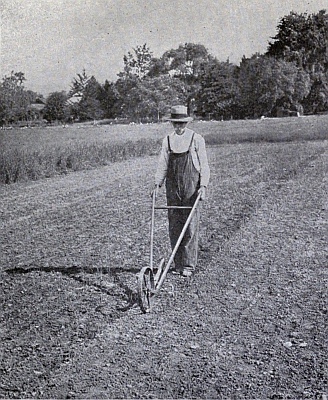
THE WHEEL HOE IS THE HANDIEST GARDEN TOOL
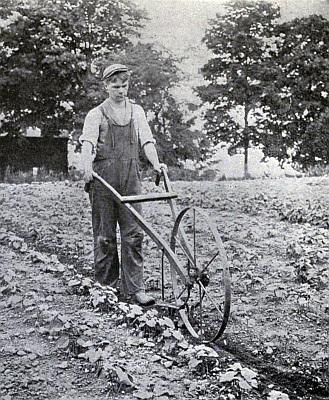
THE EASIEST RUNNING WHEEL HOE VALUABLE FOR MAINTAINING A DUST MULCH
In a special test of a 4-inch and 8-inch straw mulch and early and late mulching for potatoes a 4-inch mulch applied late in summer after several cultivations gave the best results. In the case of sweet potatoes the vines did not take root through the straw mulch as they do on cultivated ground, which was considered a decided advantage for mulching.
On the whole this work seems to indicate that on the farm where cultivation of the garden is likely to be neglected in midsummer, a mulch of straw can be used profitably as a substitute. For the best results the mulch should not be applied until the ground has become thoroughly warmed up and after two or three cultivations have been given. The mulch may then be safely applied to such vegetables as cabbage, tomatoes, potatoes, and beans, and the garden left to take care of itself the rest of the season.
The same plans were worked at the New Jersey stations. One season it was found that mulching increased the yield of sound fruits of eggplants 66.5 per cent and of tomatoes and peppers about 13 per cent each. The keeping quality of cucumbers also appeared to be slightly benefited by the use of a mulch. The season following, which was considerably more rainy, no advantage resulted from mulching. In this experiment there was no noticeable difference in the effectiveness of new salt hay, old hay, or excelsior as a mulch.
Several of the experiment stations have carried out experiments in mulching potatoes. The favorable results obtained in such experiments in dry seasons at the Nebraska Station have already been referred to. At the Michigan Station the following yields were obtained: Mulched, 167 bushels of potatoes per acre; cultivated, 199 bushels per acre. With another variety the yield of mulched potatoes was 252 bushels, and of cultivated, 385 bushels. The cost of cultivation was less than the cost of mulching, and the profit in both instances was in favor of cultivation. It should be stated, however, that there was a large amount of rain during this season, and that the straw used as a mulch contained a considerable amount of grain, which came up on the mulched plats, both of which conditions were unfavorable to mulching.
At the Oklahoma Station the total potato crop was increased about 50 per cent by mulching, the marketable crop nearly 100 per cent, and the size of the tubers about 70 per cent. Mulching potatoes with old shavings at the New Jersey stations increased the total number of tubers on a small plat about 16 per cent and the weight of the crop about 35 per cent. At the Georgia Station mulching potatoes with pine straw was not found to be of sufficient value to recommend the practice. These conflicting results secured with potatoes would seem to confirm the conclusion reached at the Nebraska Station that mulching is of greatest value in a dry season.
There is, however, a drawback to mulching that may not at first occur to the reader, viz., the danger it involves from fire. In dry weather a lighted match or cigar dropped upon the mulch may easily start a conflagration that it may be impossible to stop until the orchard is destroyed. It gives disaffected trespassers in the orchard an excellent opportunity to take vengeance upon the owner.
The cost of the mulch will of course depend much upon the price at which the material may be obtained. Clean wheat, rye, or oats straw would answer the purpose well, and in many localities would be cheaper than marsh hay. In some seasons oats sown as a second crop would grow fast enough to make mulching material by the time of frost. In the vicinity of marshes the coarser marsh grasses that have no value as hay may be cut after the ground freezes in autumn and would make excellent material for mulching. Cornstalks have been suggested, but they are probably too coarse to keep down weeds.
It has been suggested that by sowing rye in September, and harvesting the crop the following June, and then sowing the same ground to millet, the rye straw with the millet would mulch an area of plums equal to that on which the two crops were grown, and would leave the thrashed rye to compensate for the labor. This is certainly worth trying by those who have no better source from which to obtain mulching.—(Nebr. Sta. Bul., 79, 80.)
IRRIGATION.
Throughout the portions of the country where rains occur during the growing season it should not be necessary to irrigate except occasionally in order to produce the ordinary garden crops. In arid regions, where irrigation must be depended upon for the production of crops, the system best adapted for use in that particular locality should be employed in the garden. Wherever irrigation is practiced the water should not be applied until needed, and then the soil should be thoroughly soaked. After irrigation, the land should be cultivated as soon as the surface becomes sufficiently dry, and no more water should be applied until the plants begin to show the need of additional moisture. Constant or excessive watering is very detrimental in every case. Apply the water at any time of the day that is most convenient and when the plants require it.
By the subirrigation method of watering, lines of farm drain tiles or perforated pipes are laid on a level a few inches below the surface of the soil. This system is especially adapted for use in backyard gardens where city water is available and where the area under cultivation is small. Subirrigation is expensive to install, as the lines of tiles should be about 3 feet apart, or one line for each standard row. By connecting the tiles at one end by means of a tile across the rows the water may be discharged into the tiles at one point from a hose, and will find its way to all parts of the system, entering the soil through the openings.
THINNING.
Where plants are not to be transplanted twice, but remain in the plant bed until required for setting in the garden, it may be necessary to thin them somewhat. This part of the work should be done as soon as the plants are large enough to pull, and before they begin to "draw" or become spindling from crowding.
When thinning plants in the plant bed it should be the aim to remove the centers of the thick bunches, leaving the spaces as uniform as possible. When thinning the rows of seedlings in the garden the best plants should be allowed to remain, but due consideration should be given to the matter of proper spacing. Failure to thin plants properly will invariably result in the production of an inferior crop.
There is a tendency for some gardeners to leave the plants of carrots, onions, and similar vegetables too thick, or to defer the thinning too long, with the intention of making use of the thinnings. Usually this is a serious error, except in the case of beets, which can be used quite young for greens. The crowded seedlings do not reach edible size as soon as they would if not crowded; and the removal of part of the crowded plants when they are wanted for the table is likely to seriously disturb and impair the growth of those which remain. A better plan is to make at least a preliminary thinning as early as possible, leaving the plants perhaps twice as thick as they are eventually to stand; and then to pull out every other plant after they reach edible size. This method of thinning is especially adapted to beets, carrots, lettuce and onions. The other root crops, like parsnips and salsify, should be thinned to the full distance at the first thinning.—(U. Wis. Cir. 16; F. B. 255.)
TRANSPLANTING.
At the North, where the growing season is short, it is necessary to transplant several of the garden crops in order to secure strong plants that will mature within the limits of the growing season. In the Southern States the season is longer, and transplanting, while desirable, may not be necessary, as many crops that must be started indoors at the North can be planted in the garden where they are to remain. Transplanting should be done as soon as the seedlings are large enough to handle, and again when the plants begin to crowd one another. Aside from producing more uniform and hardy plants, the transplanting process has several other very marked influences. Certain crops which are grown for their straight roots are often injured by having their roots bent or broken in transplanting. On the other hand, such plants as celery, which at first have a straight root and are grown for their tops, are greatly benefited by transplanting. In all cases transplanting has a tendency to increase the number of small roots, and these are the main dependence of the plant at the time it is set in the open ground.
A large number of garden crops, including melons, cucumbers, and beans, do not transplant readily from the seed bed to the open ground, and some special means for handling the plants must be employed where extra early planting is desired. A common practice among gardeners is to fill pint or quart berry boxes with good soil and plant a single hill in each box.
Another method is to cut sods into pieces about 2 inches thick and 6 inches square and place them, root side upward, on the greenhouse bench or in the hotbed, the hills being planted in the loamy soil held in place by the roots of the grass. When the weather becomes sufficiently warm, and it is desired to set the plants in the garden, the berry boxes or pieces of sod are placed on a flat tray and carried to the place where the planting is to be done. Holes of sufficient size and depth are dug and the boxes or sods are simply buried at the points where it is desired to have the hills of plants. The boxes should be placed a little below the surface and fine earth worked in around the plants. If it is thought desirable, the bottoms of the boxes may be cut away when set in the garden.
SETTING IN THE OPEN GROUND.
A few hours before removing plants from the seed bed or plant bed they should be well watered and the water allowed to soak into the soil. This will insure a portion of the soil adhering to the roots and prevent the plants from wilting. If the plants have been properly thinned or transplanted it is often possible to run a knife or trowel between them, thus cutting the soil into cubes that are transferred with them to the garden. Where the soil does not adhere to the roots of the plants it is well to puddle them. In the process of puddling, a hole is dug in the earth near the plant bed, or a large pail may be used for the purpose, and a thin slime, consisting of clay, cow manure, and water, is prepared. The plants are taken in small bunches and their roots thoroughly coated with this mixture by dipping them up and down in the puddle a few times. Puddling insures a coating of moist earth over the entire root system of the plant, prevents the air from reaching the rootlets while on the way to the garden, and aids in securing direct contact between the roots and the soil.
Previous to setting out plants, the land should be worked over and put in good condition, and everything should be ready for quick operations when a suitable time arrives. The rows should be measured off, but it is well to defer making the furrows or digging the holes until ready to plant, in order to have the soil fresh. The time best suited for transferring plants from the plant bed to the open ground is when there is considerable moisture in the air and clouds obscure the sun, and if the plants can be set before a shower there will be no difficulty in getting them to grow. During seasons when there is very little rain at planting time, or in irrigated regions, evening is the best time to set the plants. It is possible to set plants in quite dry soil, provided the roots are puddled and the earth well packed about them. When water is used in setting plants it should be applied after the hole has been partially filled, and the moist earth should then be covered with dry soil to prevent baking. Where water is available for irrigation it will be sufficient to puddle the roots and then irrigate after the plants are all in place. Plants should be set a trifle deeper in the garden than they were in the plant bed. The majority of plants require to be set upright, and where the dibble is used for planting care should be taken that the soil is well pressed around the roots and no air spaces left.
PRECAUTIONS TO AVOID ATTACKS OF INSECTS AND DISEASES.
In the control of insects and diseases that infest garden crops it is often possible to accomplish a great amount of good by careful sanitary management. In the autumn, after the crops have been harvested, or as fast as any crop is disposed of, any refuse that remains should be gathered and placed in the compost heap, or burned if diseased or infested with insects. Several of the garden insects find protection during the winter under boards and any loose material that may remain in the garden. Dead vines or leaves of plants are frequently covered with spores of diseases that affect those crops during the growing season, and these should be burned, as they possess very little fertilizing value.
PROTECTION OF PLANTS.
Some plants require protection from the direct rays of the sun in summer or from cold in winter, and there are many that need special protection while they are quite small. Seedlings of many of the garden crops are unable to force their way through the crust formed on the soil after heavy rains, and it is necessary either to break the crust with a steel rake or soften it by watering.
In parts of the country where the sunshine is extremely hot during a part of the summer, some plants, especially those that are grown for salad purposes, are benefited by shading. Shading is often used in the care of small plants when they are first transplanted.
Where boards are available they can be used for protecting plants that have been set in rows in the garden by placing them on the south side of the row at an angle that will cast a shadow over the plants, and holding them in place by short stakes driven in the ground. Laths, wooden slats, cotton cloth, or shaded sash are frequently used to protect plant beds from the heat of summer.
For protecting plants from cold in winter several kinds of materials are used, such as boards, cloth, pine boughs, straw, manure, or leaves. There are a number of crops of a tropical nature that may be grown far north, provided they are properly protected during the winter.
Several of the annual crops can be matured much earlier in the spring if they are planted in the autumn and protected during the winter. Plants of this kind can often be protected by means of boards set at an angle on the north side of the row instead of on the south. A mulch of manure, straw, or leaves forms a good protection, but care should be taken that the mulch does not contain seeds of any kind or serious trouble will attend the further cultivation of the crop. Plants are like animals in that they require air, and care should be exercised in putting on the winter covering not to smother them. Coarse, loose materials are better for a winter covering than fine, easily compacted substances.—(F. B. 255.)
HARVESTING, PACKING AND SHIPPING.
As a rule the crop should be harvested just before it reaches maturity. The time for this depends somewhat upon the distance from the market and the method of shipment. Remember that it costs just as much freight for a package of poor goods as for the best, and while there is a market for good produce, poor stuff not only does not bring good prices, but reacts upon the superior article, reducing its price. It is, therefore, poor policy to ship inferior goods. Inspect and assort rigorously, retaining all doubtful product for canning, or to be otherwise disposed of. Better lose it entirely than send it to market to undermine the good. Learn what kind of package the market you are selling in prefers. Provide that package, and pack the goods securely and honestly. Be sure the package is full. Not only is this more honest, but your produce will arrive upon the market in better condition if this is done. Have the goods in each package as near the same size as possible, and as near the same degree of ripeness. Do not make the error of placing the best on top. Remember that every package is examined by the buyer until he learns whether you are honest or not, and this practice fools no one, and only serves to make the buyer wary of your goods. Pack neatly in a neat clean package. Nail it up securely, stencil your name and post office, and the name of the consignee upon it, and ship as promptly, and by the most direct route possible. Notify the consignee promptly of the shipment in order that he may know it is on the way, and have a chance to provide for its reception and disposal. The shipment of perishable goods by freight in refrigerator cars is preferable. Very early in the season ventilated cars may give satisfaction. Except with a few packages of very early vegetables or fruits, express shipments will not, as a rule, be found profitable. Not only will the charges be four or five fold, but the packages are handled so often, and so roughly, that they invariably reach their destination in poor condition. Besides this, there is no assurance as to the temperature being kept low, and a low temperature, while in transit, is essential to the arrival of your produce upon the market in good condition.
Careful selection, packing and shipping cannot be too strongly urged. Upon the intelligence and care with which this is done, depends, largely, the success of the shipper. Remember that after leaving your hands, and before reaching the consumer, these perishable goods are subjected to their greatest ordeal, and too much care cannot be given to make this test as light as possible. A proper understanding of this by the shipper would save many a disappointment, and many a hard word for the consignee. Of course, all else being equal, it is much safer and more satisfactory to sell on the track. However, this is not always possible, nor is it always advisable when possible. It would be unjust to demand or to expect the buyer to pay you the net price of the big city market for your goods at your home town.
In buying from you there, he takes the risk of transportation, of the fluctuations of the market, and pays all selling charges, and it is but just and right that he should be allowed a fair margin for these risks. On the other hand, human nature is the same the world over, and unless you watch Mr. Buyer closely, you will find he shows a decided tendency to make this margin unnecessarily large. To sell on track, intelligently and advantageously, therefore, you must make a close study of the market conditions. It is not enough to know what stuff sold for last week. You should know what it sold for the day before, and what the conditions of supply and demand are. Is the crop a large one? Is the movement to your market large or light? Is the demand brisk or dull? Is your railroad service efficient? All these questions should be considered, and unless the farmer recognizes that the disposal of his crop is a business, and adopts business methods, he is sure to come to grief. In order to do this, it is necessary to have some reliable source of information. For this purpose, select some reliable commission house, and if necessary, pay them to furnish you daily market reports by wire during the shipping season. Do not begrudge the little money these telegrams will cost, for they will frequently save you many a dollar, even on one carload.—(La. St. U. & A. & M. Col. 81.)
CANNING VEGETABLES IN THE HOME.
One of the many problems that confront the American housewife is the supply of vegetables for her table during the winter months. "What can I have for dinner today?" is a question often heard. Since the advent of the modern greenhouse and the forcing of vegetables under glass, fresh vegetables can usually be found at any time in the markets of the large cities. But the cost of forcing vegetables or growing them out of season is and will continue to be very great. This makes the price so high as almost to prohibit their use by people of moderate means, except as a luxury. A healthful diet, however, must include vegetables, and therefore the housewife turns to canned goods as the only alternative. These are sometimes poor substitutes for the fresh article, especially the cheaper commercial grades, which necessarily lack the delicate flavor of the fresh vegetable. There is practically no danger, however, from contamination with tin or other metals providing the containers are made of proper materials and handled carefully. In some cases the proper care is not taken in packing vegetables for market. The decayed and refuse portions are not so carefully removed as they should be and the requisite degree of cleanliness is not observed in their packing. Happily, however, such carelessness is not general.
Every housewife may run a miniature canning factory in her own kitchen, and on the farm this is especially economical and desirable, the economy being less pronounced in the case of city dwellers, who must buy their fruits and vegetables. Enough vegetables annually go to waste from the average farm garden to supply the table during the entire winter. But usually the farmer's wife cans her tomatoes, preserves her fruits, and leaves her most wholesome and nutritious vegetables to decay in the field, under the impression that it is impossible to keep them. This is a great mistake. It is just as easy to keep corn or string beans as it is to keep tomatoes, if you know how.
Sterilization.—The great secret of canning or preserving lies in complete sterilization. The air we breathe, the water we drink, all fruits and vegetables, are teeming with minute forms of life which we call bacteria, or molds, or germs. These germs are practically the sole cause of decomposition or rotting. The exclusion of air from canned articles, which was formerly supposed to be so important, is unnecessary provided the air is sterile or free from germs. The exclusion of air is necessary only because in excluding it we exclude the germ. In other words, air which has been sterilized or freed from germs by heat or mechanical means can be passed continuously over canned articles without affecting them in the least. If a glass bottle is filled with some vegetable which ordinarily spoils very rapidly—for instance, string beans—and, instead of a cork, it is stoppered with a thick plug of raw cotton and heated until all germ life is destroyed, the beans will keep indefinitely. The air can readily pass in and out of the bottle through the plug of cotton, while the germs from the outside air cannot pass through, but are caught and held in its meshes. This shows that the germs and their spores or seeds are the only causes of spoilage that we have to deal with in canning.
Germs which cause decay may be divided into three classes—yeasts, molds and bacteria. All three of these are themselves plants of a very low order, and all attack other plants of a higher order in somewhat the same way. Every housewife is familiar with the yeast plant and its habits. It thrives in substances containing sugar, which it decomposes or breaks up into carbonic acid and alcohol. This fact is made use of in bread making, as well as in the manufacture of distilled spirits. Yeasts are easily killed, so they can be left out of consideration in canning vegetables. Molds, like yeasts, thrive in mixtures containing sugar, as well as in acid vegetables, such as the tomato, where neither yeasts nor bacteria readily grow. Although more resistant to heat than yeasts, they are usually killed at the temperature of boiling water. As a general rule, molds are likely to attack jellies and preserves and are not concerned with the spoiling of canned vegetables. The spoiling of vegetables is due primarily to bacteria.
The reproduction of bacteria is brought about by one of two processes. The germ either divides itself into two parts, making two bacteria where one existed before, or else reproduces itself by means of spores. These spores may be compared with seeds of an ordinary plant, and they present the chief difficulty in canning vegetables. While the parent bacteria may be readily killed at the temperature of boiling water, the seeds retain their vitality for a long time even at that temperature, and upon cooling will germinate, and the newly formed bacteria will begin their destructive work. Therefore it is necessary, in order to completely sterilize a vegetable, to heat it to the boiling point of water and keep it at that temperature for about one hour, upon two or three successive days, or else keep it at the temperature of boiling water for a long period of time—about five hours. The process of boiling upon successive days is the one that is always employed in scientific work and is much to be preferred. The boiling on the first day kills all the molds and practically all of the bacteria, but does not kill the spores or seeds.
As soon as the jar cools these seeds germinate and a fresh crop of bacteria begin work upon the vegetables. The boiling upon the second day kills this crop of bacteria before they have had time to develop spores. The boiling upon the third day is not always necessary, but is advisable in order to be sure that the sterilization is complete. Among scientists this is called fractional sterilization, and this principle constitutes the whole secret of canning. If the housewife will only bear this in mind she will be able with a little ingenuity to can any meat, fruit, or vegetable.
Exclusion of the Air.—Even after sterilization is complete the work is not yet done. The spores of bacteria are so light that they float about in the air and settle upon almost everything. The air is alive with them. A bubble of air no larger than a pea may contain hundreds of them. Therefore it is necessary after sterilizing a jar of vegetables to exclude carefully all outside air. If one bacterium or one of its spores should get in and find a resting place, in the course of a few days the contents of the jar would spoil. This is why the exclusion of air is an important factor, not because the air itself does any damage but because of the ever-present bacteria.
All of this may seem new fashioned and unnecessary to some housekeepers. Persons have quite often heard it said: "My grandmother never did this, and she was the most successful woman at canning that I ever knew." Possibly so, but it must be remembered that grandmother made her preserves—delicious they were, too—and canned her tomatoes, but did not attempt to keep the most nutritious and most delicately flavored vegetables, such as lima beans, string beans, okra, asparagus, or even corn.
So-Called "Preserving Powders."—There are a great many brands of so-called "preserving powders" on the market. These are sold not only under advertised trade names but by druggists and peddlers everywhere. In the directions for use the housewife is told to fill the jar with the fruit or vegetable to be canned, to cover with water, and to add a teaspoonful of the powder. It is true that these powders may prevent the decay of the fruit or vegetable, but they also encourage uncleanly, careless work, and in the hands of inexperienced persons may be dangerous. While with small doses the influence may not be apparent in an adult in normal health, with a child or an invalid the effect may be of a serious nature. The proper way to sterilize is by means of heat, and as this can be done very easily and cheaply the use of chemical preservatives in canning is not to be recommended.
Kinds of Jars.—The first requisite for successful canning is a good jar. Glass is the most satisfactory. Tin is more or less soluble in the juices of fruits and vegetables. Even the most improved styles of tin cans which are lacquered on the inside to prevent the juice from coming in contact with the tin are open to this objection. While the amount of tin dissolved under these conditions is very small, enough does come through the lacquer and into the contents of the can to be detected in an ordinary analysis. While the small amount of tin may not be injurious, it gives an undesirable color to many canned articles. Tin cans can not readily be used a second time, while glass with proper care will last indefinitely.
There are a great many kinds of glass jars on the market, many of them possessing certain distinct points of advantage. The ordinary screw-top jar is the one in most common use. Although cheap in price, these jars are the most expensive in the long run. The tops last only a few years and, being cheaply made, the breakage is usually greater than that of a better grade of jar. The tops also furnish an excellent hiding place for germs, which makes sterilization very difficult.
The most satisfactory jar is the one which has a rubber ring and glass top, held in place by a simple wire spring. There are several brands of these jars on the market, so no difficulty should be experienced in obtaining them. Vegetables often spoil after being sterilized because of defective rubbers. It is poor economy to buy cheap rubbers or to use them a second time. As a general rule black rubbers are more durable than white ones.
Buy a good grade of jar. The best quality usually retails at from a dollar to a dollar and twenty-five cents a dozen. The initial expense may be, therefore, somewhat high, but with proper care they should last many years. The annual breakage should be less than 3 per cent on the average. In selecting a jar always give preference to those having wide mouths. In canning whole fruit or vegetables and in cleaning the jars the wide mouth will be found to be decidedly preferable.
Containers for Sterilizing.—A tin clothes boiler with a false bottom made of wire netting cut to fit may be used as a container for sterilizing. The netting is made of medium-sized galvanized wire (No. 16) with one-half inch mesh. A false bottom is absolutely necessary, as the jars will break if set flat upon the bottom of the boiler. Narrow strips of wood, straw, or almost anything of this nature may be used for the purpose, but the wire gauze is clean and convenient.
There are several varieties of patent steamers or steam cookers in common use. These have either one or two doors and hold a dozen or more quart jars. They are ideal for canning, but they are somewhat expensive and can be easily dispensed with. A common ham boiler or clothes boiler with a tight-fitting cover will answer every purpose.—(F. B. 359.)
Selection and Preparation of Vegetables.—The first step in successful canning is the selection and preparation of the vegetables. Never attempt to can any vegetable that has matured and commenced to harden or one that has begun to decay. As a general rule, young vegetables are superior in flavor and texture to the more mature ones. This is especially true of string beans, okra, and asparagus. Vegetables are better if gathered in the early morning while the dew is still on them. If it is impossible to can them immediately, do not allow them to wither, but put them in cold water, or in a cold, damp place and keep them crisp until you are ready for them. Do your canning in a well-swept and well-dusted room. This will tend to reduce the number of spores floating about and lessen the chances of inoculation.
STORING.
The assortment of vegetables which can be made available for winter use is much larger than is ordinarily supposed. No less than thirty distinct kinds of vegetables can be preserved for winter use by proper methods of storing, canning, and pickling. Of these, at least twenty may be kept in the fresh state, without canning or pickling. Besides the staple crop, potatoes, the list includes the root crops (beets, carrots, horse-radish, parsnips, winter radish, ruta-baga, salsify, turnips), kohl-rabi, cabbage, celery, leeks, chicory, parsley, onions, dry beans, pumpkins, squashes and sweet potatoes. The vegetables most commonly canned are rhubarb, tomatoes, corn, peas and string beans; those commonly preserved by pickling are cauliflower, cucumbers (both green and ripe), citron, green peppers and green tomatoes.
When vegetables are to be canned or pickled, it is not usually necessary to grow them especially for that purpose, except to make sure that a suitable variety is planted in sufficient quantity. When the vegetables have reached the right stage of maturity and the supply is abundant, part of the crop is simply canned or pickled without special regard to the particular time in the season it may be done. However, with vegetables to be preserved in the fresh state for winter use it is essential that they be planted at such a time that they will reach the right stage of development at the proper season for storing. This means that in the case of some of the crops they will be planted considerably later than if designed for summer use, since the product is of better quality if not allowed to continue growth after reaching the desired stage of development, and this stage should not be reached before the arrival of the storage season. Since most vegetables usually keep best if put into storage comparatively late, it should be the aim of the gardener to mature the vegetables for winter use as late in the season as he can, and yet have them harvested before they are injured by cold.
Of the vegetables stored for winter, some require entirely different conditions in storage than do others, so that attempts to store all vegetables under the same conditions would result only in failure. In order that the root crops may be stored without wilting, rotting or starting into growth, they must be kept cool, fairly moist, and away from contact with circulating air. Cabbage may be successfully stored under the same conditions. Onions must be kept at a low temperature, but differ from the root crops in that they must be in a dry atmosphere and have free circulation of air. In a moist atmosphere, under high temperature, they would either rot or sprout. Vegetables that are expected to continue growth while in storage, such as celery, leeks, Brussels sprouts, chicory and parsley, must be planted in dirt and the roots kept moist. Air should circulate freely about the tops, and the temperature must be low. On the other hand, sweet potatoes, pumpkins and squashes demand a high temperature and dry atmosphere, with free circulation of air.
The conditions of storage favorable to the different crops are secured in various ways. Market gardeners use outdoor pits or specially constructed cellars for their root crops, cabbage and celery. Onions are commercially stored in slatted crates piled in tiers in frost-proof houses provided with means for ventilation so that the temperature can be maintained at slightly above freezing. Sweet potatoes and squashes are also stored in specially constructed houses, in which the temperature can be controlled; but since a high temperature is demanded for these crops, artificial heat is usually employed. Circulation of air about these products in storage is facilitated by the use of slatted bins, and allowing ample space between the bins and the side walls of the building.
For home use the root crops and cabbage can best be stored in outdoor pits for late winter use, and in the cellar for use early in the season. The chief objection usually urged against storing root crops in the cellar is that they are likely to wilt. This difficulty can be obviated by packing the roots in boxes with alternate layers of earth or sand, and placing the boxes in the coolest part of the cellar. The earth will absorb any odors in case the vegetables should start to decay, and thus avoid endangering the health of the family. Cabbage can be stored in the same way if the roots and outer leaves are removed and merely the heads are packed in boxes or barrels of earth.
Cabbage intended for late winter use, however, will keep better in an outdoor pit than in a cellar. The same is true of parsnips, salsify, horse-radish and some of the other root crops. Except where the ground is especially well drained, the pits are usually made entirely above ground. For storing cabbage in this manner, the plants are pulled with the roots and leaves on, and placed upside-down in regular order on a level piece of ground. Usually three plants are placed side by side, with two above, and this arrangement repeated so that the final result is a long, low pile of cabbage showing five plants in a cross section. Earth is piled against and over this array of cabbage until the plants, including the roots, are entirely covered. In a severe climate, a layer of manure may be added when cold weather arrives.
For storing parsnips, salsify and horse-radish, which are uninjured by freezing, the roots may be placed in a pile on the ground and covered with about six inches of earth. The advantage of storing in this manner, instead of allowing the roots to remain where they grew, is the saving in time of digging, when a few roots are wanted during the winter. It is much easier to open the pit when the ground is frozen than to dig roots from the garden with a pick. In fact, the difficulty of digging almost precludes the use of these crops in midwinter unless they are more accessible than in the place where they grew.
Beets, carrots, turnips, ruta-bagas, kohl-rabi and Irish potatoes can also be stored in outdoor pits, but they must be covered sufficiently to prevent freezing. One of the best ways of handling these crops is to place them in a conical pile and cover first with six or eight inches of hay or straw, then with earth to a similar depth. If extremely cold weather is expected, a layer of manure should be placed outside of the earth. In getting vegetables from pits of this kind in midwinter, the manure is removed slightly from one side of the pit near the bottom and a hole about a foot square chopped through the frozen earth with an old ax. Sufficient hay is then pulled out by means of an iron hook, to enable a person to thrust his arm into the opening and reach the vegetables.—(U. Ill. 154.)
EARLY PLANTS IN HOTBEDS.
The most common method of starting early plants in the North is by means of a hotbed. The hotbed consists of an inclosure covered with sash and supplied with some form of heat, usually fermenting stable manure, to keep the plants warm and in a growing condition. As a rule, the hotbed should not be placed within the garden inclosure, but near some frequently used path or building where it can receive attention without interfering with other work. The hotbed should always face to the south, and the south side of either a dwelling, barn, tight board fence, hedge, or anything affording a similar protection, will furnish a good location. The hotbed should be started in February or early in March, in order that such plants as the tomato and early cabbage may be well grown in time to plant in the open ground. There are two or three forms of hotbeds that are worthy of use.
A temporary hotbed, such as would ordinarily be employed on the farm, is easily constructed by the use of manure from the horse stable as a means of furnishing the heat. Select a well-drained location, where the bed will be sheltered, shake out the manure into a broad, flat heap, and thoroughly compact it by tramping. The manure heap should be 8 or 9 feet wide, 18 to 24 inches deep when compacted, and of any desired length, according to the number of sash to be employed. The manure for hotbed purposes should contain sufficient litter, such as leaves or straw, to prevent its packing soggy, and should spring slightly when trodden upon. After the manure has been properly tramped and leveled, the frames to support the sash are placed in position facing toward the south. These frames are generally made to carry 4 standard hotbed sash, and the front board should be 4 to 6 inches lower than the back, in order that water will drain from the glass. Three to five inches of good garden loam or specially prepared soil is spread evenly over the area inclosed by the frame, the sash put on, and the bed allowed to heat. At first the temperature of the bed will run quite high, but no seeds should be planted until the soil temperature falls to 80° F., which will be in about three days. In most farmhouses enough heat is wasted throughout the winter to sustain a small hothouse to say nothing of a hotbed.
Hotbeds having more or less permanence may be so constructed as to be heated either with fermenting manure, a stove, a brick flue, or by means of radiating pipes supplied with steam or hot water from a dwelling or other heating plant. For a permanent bed in which fermenting manure is to supply the heat, a pit 24 to 30 inches in depth should be provided. The sides and ends of the pit may be supported by brick walls or by a lining of 2-inch plank held in place by stakes.
Standard hotbed sash are 3 by 6 feet in size, and are usually constructed of white pine or cypress. As a rule, hotbed sash can be purchased cheaper than they can be made locally, and are on sale by seedsmen and dealers in garden supplies. In the colder parts of the country, in addition to glazed sash either board shutters, straw mats, burlap, or old carpet will be required as a covering during cold nights. It is also desirable to have a supply of straw or loose manure on hand to throw over the bed in case of extremely cold weather.
During bright days the hotbed will heat very quickly from the sunshine on the glass and it will be necessary to ventilate during the early morning by slightly raising the sash on the opposite side from the wind. Care should be taken in ventilating to protect the plants from a draft of cold air. Toward evening the sash should be closed in order that the bed may become sufficiently warm before nightfall. Hotbeds should be watered on bright days and in the morning only. Watering in the evening or on cloudy days will have a tendency to chill the bed and increase the danger from freezing. After watering, the bed should be well ventilated to dry the foliage of the plants and the surface of the soil and prevent the plants being lost by damping-off fungus or mildew.
HANDLING OF PLANTS.
Successful transplanting of indoor-grown plants to the garden or field depends largely upon their proper treatment during the two weeks preceding the time of their removal. Spindling and tender plants will not withstand the exposure of the open ground so well as sturdy, well-grown plants, such as may be secured by proper handling.
Plants grown in a house, hotbed, or cold frame will require to be hardened off before planting in the garden. By the process of hardening off, the plants are gradually acclimated to the effects of the sun and wind so that they will stand transplanting to the open ground. Hardening off is usually accomplished by ventilating freely and by reducing the amount of water applied to the plant bed. The plant bed should not become so dry that the plants will wilt or be seriously checked in their growth. After a few days it will be possible to leave the plants uncovered during the entire day and on mild nights. By the time the plants are required for setting in the garden they should be thoroughly acclimated to outdoor conditions and can be transplanted with but few losses.—(F. B. 255; U. Mo. Col. Ag. & Mech. Arts 33; N. La. 81; Kan. St. Ag. Col. 70; S. Dak. 47; U. Idaho 17.)
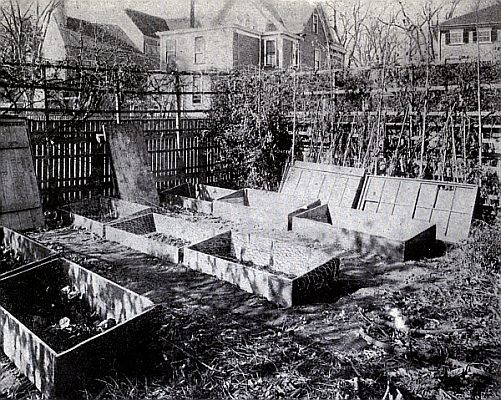
TEMPORARY HOTBEDS IN A CITY BACK YARD
FRAMES USED IN TRUCK GROWING.
Intensive gardening under sash or cloth covers has become one of the most popular and, in certain localities where the conditions are suitable, one of the most profitable lines of outdoor work. The trucker and the market gardener of the present day have been compelled by keen competition and a constantly increasing demand for high-grade products out of season to provide special facilities for increasing and improving the product, as well as to take advantage of every favorable natural condition. Many localities are especially favored with an abundance of sunshine at all seasons of the year, and at the same time their climate, due to the influence of large streams or near-by bodies of water, is mild and free from extremes of temperature. In such localities it would be possible to grow lettuce, radishes, and similar crops during the entire winter without protection were it not for a few cold days and nights. A very slight covering or the application of a small amount of heat will, as a rule, carry the plants through in good condition. This industry may readily be combined with regular truck farming, as it furnishes remunerative employment during the winter months. A comparatively small area is necessary for the frames, but several times that acreage of land should be available, so that the site of the frames may be changed every few years to safeguard against diseases and insect injuries.
Cloth-Covered Frames.—The type of frame or bed varies with the different localities and is ordinarily no more elaborate or expensive than is necessary to protect the crops. In North Carolina and South Carolina the type of frame generally used is that having for the sides two lines of 12-inch boards set on edge and held in place by means of stakes driven into the ground. The covering of cheap unbleached muslin is supported on strips of wood 1 inch thick and 2½ or 3 inches wide, which are raised in the center by being carried over the top of a stake; the ends are held down by nailing to the sides of the bed. Most of these frames are temporary and are taken apart and stored during the summer months. Before placing the frames in position in the autumn the soil is plowed, thoroughly fitted, and given a liberal dressing of well-rotted stable manure and commercial fertilizers. The placing of the boards will cause some trampling of the bed, and before putting in the ends and nailing on the rafters or strips to support the cloth it is desirable to loosen the soil again by means of a harrow or cultivator. The stakes for supporting the cross strips or rafters are then driven through the center and the strips nailed in place at intervals of 4 feet. The ends are inclosed by means of 12-inch boards, and the bed is then ready for the cloth cover. The cloth is first stitched, with the strips running lengthwise of the bed, into one great sheet large enough to cover the entire bed. This sheet is fastened on the north side of the frame by nailing over it plastering laths or similar strips of wood. The cloth should not be fastened to the top edge of the board but on the side, 1 or 2 inches below the top. For fastening the sheet on the south side of the frame short loops of string or cloth are attached to its edge and these are looped over nails driven into the side of the bed.