THE VEGETABLE GARDEN (continued 3)
Reading edition
Mulching.—In muck soils it will not be found necessary to mulch the ground around the plants after setting, but some kind of a covering is desirable on sandy and clay soils. As soon as the plants are in position and before any water is applied, cover the ground for a distance of 8 or 10 inches on either side with any finely divided material that will shade the top of the soil and prevent a crust being formed after watering; half-rotted manure is preferable for this, as it aids the growth by its fertilizing qualities. Good celery can be grown on clay upland with but one watering—at the time of planting—provided that plenty of mulch is applied as soon as the plants are set. The roots of celery, after it is once transplanted, run close to the surface, and the mulch will protect them from the heat of the sun. Among materials that may be used for a mulch may be mentioned pine needles, leaves of any kind, straw, cornstalks run through the cutter, clippings from the lawn, etc., none of which, however, are as good as barnyard manure. Have the material to be used as a mulch near at hand, and as the plants are set cover the soil around them to a depth of 2 inches, bringing the mulching material up close to the plant, but being careful to allow none to get into the heart. Apply the mulch before watering, if possible.
Where celery is planted in single rows and mulched it will only be necessary to maintain shallow cultivation between the rows, not allowing the cultivator teeth to come nearer the plants than the edge of the mulch. Where no mulch is used the cultivation may be carried a little closer to the plants, but should be very shallow, and at no time should deep cultivation be practiced, as the roots are to be found very near the surface of the soil. If a mulch is used no hand cultivation will be required, either along the side or between the plants in the row, except to pull any weeds that may spring up. Where no mulch is used it will be necessary lightly to stir the surface with a wheel hoe or iron rake, to prevent a crust being formed after each rain or watering. Keep the surface of the soil smooth and in no case allow lumps of earth to remain near the plants.
Blanching.—In its original wild state the stems of celery are tough, full of woody strands, of a rank flavor, and green in color, being similar to the outside stems or trimmings of our present varieties. The object of blanching is to secure leafstalks free from woody strands, crisp and tender, and without the rank flavor found in those that are green. Of the cultivated plant there are two classes of varieties, the large-growing, or giant, and the dwarf sorts. These are again divided into those which must be blanched by excluding all the light and those which are in a measure self-blanching. Of the former the Giant Pascal variety is a type, and of the latter the Golden Self-Blanching variety is a good illustration.
Blanching is accomplished by the same general method that is employed for destroying the coloring matter in any plant tissue, that is, by excluding the light and allowing the growth to proceed in the dark. The particular method to be adopted must be determined largely by the time when the crop is to be used. If for early use or marketing, the blanching must be completed where the plants are grown; but if the celery be for winter use the blanching may take place after the crop has been removed from the field and placed in storage. In fact, it is best to blanch as little as possible before storing when the product is to be kept until late, as the keeping qualities are better while it is unblanched. When planting for early use it is necessary to choose one of the self-blanching varieties, such as may be conveniently blanched by the use of boards or other similar means.
For early blanching on a small scale, such as would be employed on the farm or in the garden of the amateur horticulturist, there are several methods. One of the most common is by means of boards placed on edge along each side of the row.
After the boards are in position it is a good plan to run a celery hiller between the rows and to throw a little soil against the lower edges of the boards to close any openings that may result from the uneven surface of the soil.
Two or three weeks' time will be required to complete the blanching of the early varieties, and the boards must be kept in position until the crop is removed from the ground, after which they may be used again two or three times during the season. If the celery is allowed to remain in the boards too long after it has reached a marketable stage, it loses in weight and flavor and is liable to be injured or even destroyed by the attacks of blight. This is especially true during the earlier part of the season, when the weather is warm. At the end of the season the boards should be piled flat, with strips inserted at every fourth or fifth course, and the whole pile roofed over to shed off rain; treated in this manner they will last from ten to twelve years.
Perhaps the most satisfactory way of blanching early celery on a small scale is by means of ordinary farm drain tiles of about 4 inches inside diameter, placed over the plants after they have become almost fully grown. To facilitate the work of placing the tiles over the plants, some of the outside leaves should be pulled away and the main part of the plant loosely tied together by means of a soft string, or, better, with what is known as paper twine, being a string made by twisting a strip of soft paper. This string will lose its strength as soon as it becomes wet, and will offer no resistance to the further growth of the plant. If the common, unglazed tiles are used the evaporation from their surface has a tendency to keep the plant cool during the heat of the day, and a very crisp and tender product is the result. This method of blanching is desirable also on account of its cleanliness, as celery treated in this way will need very little washing before marketing.
The most common method for blanching celery on a small scale is that of banking with soil, and it is by this means that the finest flavor can be obtained. Where the plants are set in single rows the soil can often be partially thrown up by means of a plow, or, better, by a celery hiller. Before the plow or banking machine is used a small quantity of dirt must be placed around the plants by hand to hold them in position while the earth is being thrown around them. This may also be accomplished by tying up the plants with paper twine, as previously recommended for use in connection with tiles.
Storing.—The plan usually adopted where but a small quantity of celery is to be stored for winter use is to bank up with earth and cover the plants where grown. Place enough earth around the base of the plants to hold them in good form, and then allow them to remain without any further banking as long as there is not danger of a hard frost. Celery may be safely stored in cellars provided the temperature is kept low and plenty of ventilation maintained. The warmth and dampness of the ordinary cellar have a tendency to cause the celery to decay, but these conditions can frequently be overcome. Celery will readily absorb any odor that may be present in the atmosphere of the storage place, and care should be taken to provide sanitary conditions. When storing in a cellar, the plants should have most of their roots attached, and a bed of moist sand in which to set them should be provided.
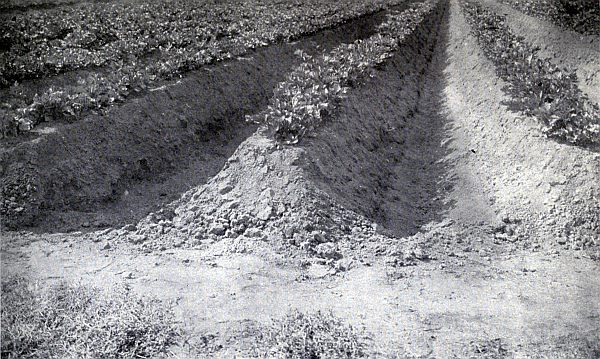
CELERY BANKED WITH EARTH TO BLANCH IT
Preparing Celery for Market.—In preparing it from the rows where grown, it is not necessary to remove the entire root from the earth, but it may be cut off just below the surface of the soil by means of a stiff knife. Remove the outside leaves and trim the root evenly, pack in boxes, and load on the wagon for removal to the washing house. The blanching boards should not be removed till necessary, and the trimmed celery must not be allowed to lie exposed to the sun or wind for any length of time. It is well also to have a piece of canvas to protect the celery while it is on the wagon on the way to the washing house. In marketing from the trenches the process is practically the same as from the rows, except that the celery is already loosened from the soil and the roots can be removed more easily. Upon reaching the washing room the celery is placed upon a rack consisting of wooden slats over a large trough and subjected to a spray of cold water to cool it and to remove the adhering soil. After washing, it is allowed to drain; then it is tied in bunches of 12 or more plants each, according to the size. The bunches are packed 6 in a box for first-grade celery and 8 or 9 for second or third grades. These boxes should be practically air-tight, and a lining of paper should be placed in them before packing the celery, or each bunch should be wrapped separately. The celery should be nearly dry before it is placed in the boxes, and throughout the entire handling must be kept as cool as possible.
Sanitary Conditions.—It is essential that the celery should be washed in pure water to prevent the transmission of disease germs. Any germ, such as that producing typhoid fever, which is found in contaminated water, is readily carried to the digestive system of the consumer, and may or may not produce an attack of the disease, according to the strength of the person to resist it. The washhouse and its surroundings should be kept clean and free from any decomposing materials. Shippers and dealers alike lose sight of the fact that the edible portion of celery is constantly being exposed to the contaminating effects of dirty wagons, unclean cars, and dusty markets. Many persons have discontinued the use of celery on account of the unclean condition in which it is served. This statement holds good for all vegetables that are served in the raw state, but it is especially applicable to celery.
Estimates of Returns.—Anyone contemplating making a start in celery growing will do well to first investigate the market prospects, and unless satisfactory shipping arrangements can be made beforehand the crop should be planted only on a small scale for one or two years, until a local trade can be established. It is fair to estimate a return of 1,500 dozen from 1 acre; and this should bring 25 cents per dozen, at the lowest average estimate; this will yield a gross income of $375 to the acre, leaving a net balance of $125 to cover the interest on the investment and the profit. As a matter of fact, the growers who are making a success of celery raising—and many are doing so—receive a net profit of $100 an acre over and above the interest on the investment. On the other hand, hundreds of acres are grown annually which do not much more than pay expenses, but this is due to the fact that the soil has become exhausted and the product is consequently undersized and inferior.—(F. B. 255, 282; Cornell E. S. 132; Colo. E. S. 144.)
CETEWAYO, OR ZULU, POTATOES.
The Cetewayo, or Zulu, potato, a wild variety of Solanum tuberosum found in Africa, is sometimes grown as a garden vegetable for its flavor and novelty. It has practically the same percentage composition as the ordinary potato. When cooked, the flesh is purple in color, but when brought in contact with vinegar, as in salads, it turns red.—(F. B. 295.)
THE CHAYOTE.
The chayote suggests the cucumber rather than any other of the cultivated plants of the same family, but is a larger and more vigorous plant, climbing widely by means of numerous branched tendrils. When grown under ordinary garden conditions the cultural requirements of the chayote may be said to be two in number: (1) A somewhat sheltered situation and (2) something to climb upon. While the vine will not refuse to grow without these advantages, the results will not be satisfactory. Like many climbing plants, the chayote is very susceptible to injury from the wind, while, unlike many Cucurbitaceae, it does not seem to take kindly to creeping upon the ground, at least in the Tropics. In the different parts of the world the chayote has been found to grow upon a great variety of soils, though it is generally considered to thrive best in a loose sandy or loamy substratum, providing sufficient humus or other fertilizing material be at hand. Although it has been found possible to secure plants from the seed when planted alone, or even from the embryo when carefully extracted from its seed coats, it is the universal practice to plant the entire fruit. The fruit should be gathered before fully matured, because of the tendency to germinate. It is like the cucumber, edible at any stage of growth, and may be picked when large enough. The chayote is a good shipper and may be shipped in bulk in vegetable crates, wrapped and well packed; cold storage will not be necessary.—(Dept. Ag., Div. of Botany 28; P. Rico A. E. S. 7).
CHERVIL.
Under the name of chervil two distinct plants, known as salad chervil and the turnip-rooted chervil, are cultivated. The seeds of the salad chervil are sown in spring and the crop will thrive on any good garden soil. The seeds of the turnip-rooted chervil should be sown in the early autumn, but they will not germinate until the following spring. The edible part of this plant is the root, which somewhat resembles the carrot and is used in the same manner. The leaves are used the same as parsley for garnishing and in flavoring soups.—(F. B. 255.)
CHICORY.
Chicory is grown for two or three purposes. The root of this plant is the common adulterant of coffee, and large quantities are used for this purpose. The commercial growing of chicory is confined to a few sections, as the crop will not thrive on every kind of soil. A deep, rich loam, without excessive amounts of clay or sand, is desirable, and soil that is not too rich in nitrogenous matter is best suited to the production of roots. The roots are frequently placed in soil under a greenhouse bench or in a warm cellar and covered with a foot or more of straw, or with a light covering of straw and then several inches of warm manure. Under this covering the leaves will be formed in a solid head, which is known on the market as witloof. Chicory has run wild in some parts of the country and is considered a bad weed. The handsome blue flowers, which are borne the second season, are very attractive. As a pot herb chicory is used like spinach, but the leaves should be boiled in two waters to remove the bitter taste. As a salad the roots are dug in the autumn and planted in cellars or under a greenhouse bench, where they produce an abundance of blanched leaves, which are eaten raw. The blanched leaves are also boiled and used as greens.—(F.B. 255; U. Idaho E. S. 10.)
CHILE.
The chile is used in many different ways and it is quite an important article of food among the Spanish speaking population in the Southwest and in Mexico. It is eaten both in the green and ripe state. It may be grown on ridges or in level plats. The former method is the more common in New Mexico. In the spring after the ground has been plowed and leveled (the plowing of the land can be done in the fall or winter) and just a little before planting the ridges are made. These ridges may vary in height from 8 to 12 inches. It is better to irrigate the ridges before planting, though this is not always done. The object of irrigating before planting is to get the water mark on the side of the ridges and to settle the newly plowed soil somewhat. As soon as the soil is dry enough so it can be worked, which is generally from four to seven days, the seed is planted usually on one side of the ridge and just above the water mark. The seed is planted by hand in hills about every two feet in the row. The chile does not stand freezing weather, though it will stand a little more cold than tomatoes. For the convenience of intending chile growers the following table which gives the number of hills per acre at different distances has been prepared:
Number of
Distance. Hills per Acre.
3½ feet between rows × 2 feet in the row 6222
3½ feet between rows × 2½ feet in the row 4978
4 feet between rows × 2 feet in the row 5445
4 feet between rows × 2½ feet in the row 4356
Planting.—The seed is planted on the side of the ridge, when the ridge method is practiced. The southern exposure of the ridge is always preferable since this is usually warmer and the germination, other factors being uniform, is quicker. If level culture is practiced there is no choice of exposure. Whatever method of planting is followed care should be taken not to bury the seed too deeply. As a general thing the seed should not be deeper than three-fourths of an inch to an inch and a half. Shallower planting, if the moisture is kept normal, will give quicker and better germination. More seed is required per acre when the planting is done by hand on the ridges than when it is drilled with a garden drill in plats.
Thinning.—Chile started from seed planted in the field must be thinned to one or three plants to the hill. When the chile has been thinned out properly the plant or plants in the hill branch out considerably and produce a heavier and better crop. If too many plants are left to the hill there is a marked tendency for the plants to grow too tall and more or less top heavy. The chile is thinned out when about 3 to 5 inches high. If a good germination takes place it is more difficult to thin the chile, because there are more small plants to the hill to be pulled out. Care should be had in selecting the strongest plants in the hill and in injuring as little as possible the roots of those which remain. While the common way of growing chile is to plant the seed out in the field in the spring, it can also be grown by starting the plants in cold frames early in the season and transplanting to the field as soon as danger of frost is over.
Irrigation.—After the irrigations to get the crop started have been given, the frequency of the subsequent irrigations depends upon the weather and soil conditions, and for that reason no specific statement can be made just when and how often the chile should be irrigated. One thing, however, is important to keep in mind, and that is that the chile plant keeps bearing as long as it is growing. If the growth should be checked by the lack of irrigation the plant stops bearing and the blossoms and the very small pods are likely to drop off. The grower himself should study his local conditions and decide for himself when and how much to irrigate. While the chile plant resists considerable drought, at the same time, it should not be allowed to suffer from the lack of irrigation. When the chile is grown on ridges the space between the ridges should be allowed to fill with water almost up to the plant. If the water is simply turned in and allowed to rush down the furrow to the other end the ridges will remain practically dry, necessitating frequent irrigations to keep the plants from suffering. In irrigating the chile on ridges always aim to hold the water long enough in the furrow for the ridges to get fairly well soaked through. In the level plat the irrigation is more simple and the soil around each hill gets wet sufficiently while the water is running down to the end of the plat. When the plats are quite long and are made up of a series of squares as soon as each square is filled with water the border, dividing that square from the next one, is cut and the water rushes into the next square which is treated the same as the one before.—(N. Mex. Col. Ag. and Mech. Arts 67.)
CHIVE.
This is a small onion-like plant having flat, hollow leaves which are used for flavoring soups. The chive rarely forms seeds, and it is propagated by the bulbs, which grow in clusters. The leaves may be cut freely and are soon replaced by others.—(F. B. 255; S. Dak. E. S. 68.)
CITRON.
The citron is a type of watermelon with solid flesh which is used for preserves and sweet pickles. The rind of the watermelon is frequently substituted for citron. The cultivation of the citron is the same as for the watermelon.—(F. B. 255; U. Idaho E. S. 10.)
COLLARDS.
The culture and uses of collards are the same as for cabbage and kale. Collards withstand the heat better than either cabbage or kale, and a type known as Georgia collards is highly esteemed in the Southern States. Collards do not form a true head, but instead a loose rosette of leaves, which, when blanched, are very tender and of delicate flavor.—(F. B. 255; U. Idaho E. S. 10; P. Rico A. E. S. 7.)
CORN SALAD.
Corn salad is also known as lamb's-lettuce and fetticus. Sow the seed during the early spring in drills 14 to 18 inches apart and cultivate the same as for lettuce or mustard. For an extra early crop the seed may be planted during the autumn and the plants covered lightly during the winter. In the Southern States the covering will not be necessary and the plants will be ready for use during February and March. The leaves are frequently used in their natural green state, but they may be blanched by covering the rows with anything that will exclude the light. Corn salad is used as a salad in place of lettuce, or mixed with lettuce or water cress. The flavor of corn salad is very mild, and it is improved by mixing with some other salad plant for use. It is also boiled with mustard for greens.—(F. B. 255.)
CRESS.
Under the name of cress there are two forms, the water cress and the upland cress. The upland cress, sometimes called peppergrass, is easily grown from seed sown in drills a foot apart. As the plants last but a short time, it will be necessary to make a sowing every few days if a continuous supply is desired.
Water cress can be grown all the year in small open ditches containing running spring water. It is best and most easily produced in water from rather warm springs in limestone regions. A sufficient supply for family use can be grown in a small spring-fed brook, and the plants may be started either from small pieces of plants or from seed. Cress is used in salads, to which it imparts a pleasant pungency.—(F. B. 255; U. Idaho E. S. 10; P. Rico A. E. S. 7.)
CUCUMBERS.
Soil.—The soil best adapted to the cultivation of cucumbers in the open is a light sandy loam, one which responds quickly to temperature and fertilizer. Such soils are prepared early in the season and thrown into gentle undulations, so as to produce slight ridges upon which to plant the seed to insure good surface drainage.
Fertilizers.—The soil for cucumbers should be made very rich by the annual application of heavy dressings of stable manure to be incorporated with the soil. During the time it is not occupied by cucumbers or lettuce, cowpeas are frequently grown upon the area and turned under prior to planting a fall crop of lettuce. In addition to this, liberal applications of a fertilizer carrying a considerable percentage of nitrogen are employed.
Planting.—There are almost as many methods of planting cucumbers as there are growers. Some plant in hills the standard distance of 6 feet apart each way; others plant in hills 6 feet apart in one direction and 2 or 3 feet apart in the row, while others plant in drills or broad belts 6 feet apart and chop out the plants to stand about a foot apart in the row after all danger from insect depredation has ceased. The methods which seem most economical under the conditions at hand will of course be adopted by the grower. In outdoor culture the cucumber is frequently used as a companion crop to other crops, like beans. Beans being of rapid growth come on quickly and form a partial protection or wind-break for the young cucumber plants. When arranged in this way, cucumbers are planted in drills or in hills 6 feet apart and a row of beans is placed between two rows of cucumbers, a method which insures a very complete and satisfactory use of the ground. The quick maturity of the beans allows them to be harvested and entirely removed from the area before it is required for the cucumbers.
Harvesting.—Cucumbers intended for pickling purposes are harvested when they have attained a length of from 2½ to 5 inches. Because such cucumbers are bought by weight it will readily be seen that the small-sized pickles are less profitable to the grower than the larger ones, and in order to secure them before they have attained an unsalable size it is necessary that the picking be repeated at frequent intervals, as cucumbers grow rapidly and a delay of twenty-four to forty-eight hours in harvesting would render many of them unsalable. It is therefore necessary to have regular intervals to harvest certain areas of the patch and to continue this routine throughout the bearing season. Another point which is of prime importance in the management of the cucumber patch is that none of the fruits be allowed to come to maturity. The ripening process, which means the development and maturing of the seeds, produces a heavy strain upon the growing plant, the life and yield of the plant being in proportion to the number of fruits which are allowed to ripen. If no fruits are allowed to come to maturity the plants will remain green and in an active vegetative condition longer and will produce a much larger aggregate number of fruits.
Dill Pickles.—Dill pickles, which are much prized and command the highest price among pickles, can be made from fresh cucumbers as they come from the vines, or from vat stock which has been carried for some time at the salting station.
Cucumbers Grown in Cold Frames for Market.—Soil for use in cold frames should be a well-enriched sandy loam of the type of the usual sandy loam. If it can be dark in color, this is an advantage. If normally light, the color can be changed by the addition of muck or by incorporating well-decomposed stable manure with the surface soil. A dark color is of some advantage in helping to raise the temperature in the frames under the glass.
Watering.—Since the glazed sash prevent the soil beneath them being moistened by natural means—that is, by rain or dew—it is necessary that means be provided for watering or irrigating the plants. This can be done by arranging pipes upon the surface of the ground or at a convenient height overhead, so as not to interfere with cultivation, from which water can be drawn to sprinkle the surface of the beds at desired intervals and as the plants may require. The work of watering should, however, be very carefully done. The same general precautions necessary for the care of plants in cold frames should be observed—that is, to do the watering in the morning on bright days only, when air can be admitted and when the sun will soon dry the moisture from the leaves of the plants. In this way much can be done to protect the plants from injury from such diseases as the damping-off fungus and mildew.
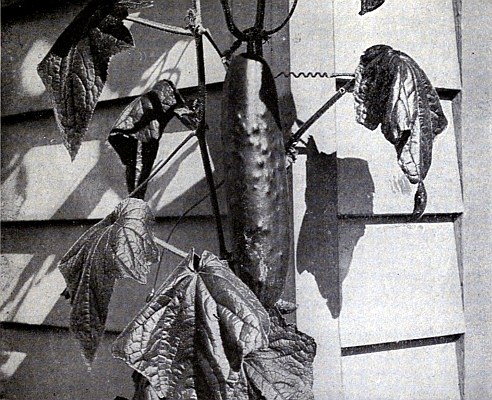
JAPANESE CLIMBING CUCUMBER NEARLY SIX FEET FROM THE GROUND
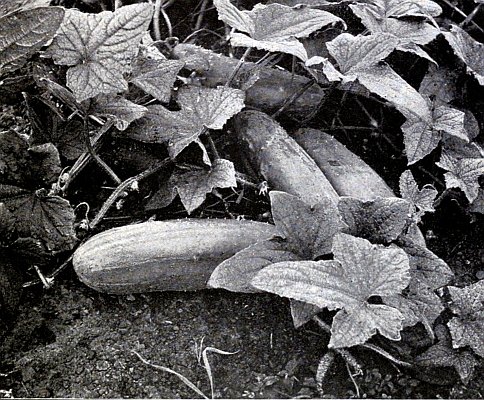
WELL-GROWN CUCUMBERS
Ventilation.—Besides the precautions to be observed in watering plants in cold frames, extreme care is necessary to give the plants sufficient air to keep them in a healthy condition. If the atmosphere is allowed to become close and very hot, the plants will be weakened and thus rendered more susceptible to the attacks of plant diseases.
Forcing Cucumbers Under Glass.—Forcing is a technical term used by gardeners to designate the growing of plants out of their normal season under an artificial environment. The cucumber is one of the few garden plants which lend themselves to this manner of cultivation in addition to their more extensive cultivation in the open ground. Under the stimulus of forcing work, two distinct types of cucumbers have been developed. These are recognized in the trade as the English type and the American type. The English type is purely a product of forcing-house conditions, as the climate of England is not congenial to the growth and development of the cucumber in the open. The American type of cucumber is primarily a product of field conditions, and the few varieties which have been developed to meet the requirements of the forcing house are simply modifications of the existing field or outdoor forms. The English type of cucumber is a long, cylindrical, uniformly green fruit, with few seeds and a very fleshy seed cavity; in fact, the normal seed cavity of the forced cucumber is almost entirely wanting. The triangular shape characteristic of the normal outdoor cucumber has been lost, and the cylindrical outline almost perfected. There is considerable difference in the size and length of the various English varieties of cucumbers. The American type of cucumber is primarily grown in the field, the product to be used either for pickling or for slicing. Forcing cucumbers in America is confined to those varieties which produce large fruits suitable for slicing. Only three or four of the better and larger field varieties are adapted to this purpose. Notable among these is the White Spine, the Arlington White Spine being the variety which has been especially developed for forcing. The Long Green, or a modification of it, is also sometimes used, but aside from these two varieties there are few that ever find their way into the forcing house. Such varieties as the Boston Pickling, Chicago Pickling, and the cluster varieties in general are not adapted to forcing purposes. The forcing of cucumbers presupposes that an adequate forcing house or greenhouse is at hand for such work. The chief desideratum in a forcing house for cucumbers is a maximum amount of light, sufficient headroom, and adequate radiation to maintain a temperature varying from 65° to 85° F. The amount of radiation will, of course, depend upon the style of heating employed, whether steam or hot water, and upon the location of the greenhouse, whether at the north or the south; the outside temperature determining to a considerable extent the amount of radiation required in the house to maintain a given degree of heat.
Propagation.—There are a number of methods of propagation followed by successful cucumber growers, all of which have some advantages. Three of the more common practices are as follows: (1) To plant the seeds of cucumbers in the soil of the bench where the plants are to grow and mature; (2) to plant the seeds of the cucumbers in 3-inch or 4-inch pots filled about half full of soil and after the seeds have germinated and the hypocotyl or stem of the seedling has elongated to fill the pots well up to the seed leaves with soil; and (3) to plant the seeds in cups similar to those used for harvesting strawberries, except that the cups for this purpose are usually made of Georgia pine. In the first case, where the seeds are planted directly in the soil on the benches, cucumbers are usually employed as a crop to follow lettuce, seeds being planted in the lettuce benches before the crop is entirely removed, heads of lettuce being taken out at proper distances to allow for the correct spacing of the cucumber plants, and the seeds of cucumbers planted in the areas so left. In the other two cases the rearing of the plants for forcing purposes can be carried on in a small house especially designed for this purpose or in a general propagating house, thus obviating the necessity of heating and maintaining normal conditions in the growing house during the period previous to which the plants begin to run.
Planting on the Benches.—As soon as the plants show well-developed runners and are 10 to 12 inches long they should be placed in their permanent position upon the greenhouse benches. Plants grown in pots must be carefully removed from these receptacles to the bench, but those grown in the wooden cups above referred to can be planted, cup and all, in the soil of the bench. The utmost care should be exercised to keep the plants of the cucumber growing rapidly at all times. If cucumbers receive a severe check or are placed under conditions which are not entirely congenial to them, they are liable to become dwarfed and stunted, and as soon as vigorous growth ceases they become the prey of the melon aphis, mildew, and other pests and diseases which are so annoying to growers of cucumbers under artificial conditions.
Distance to Plant.—After the plants have attained a height of 10 or 12 inches and are in a vigorous growing condition they should be placed about 15 or 18 inches apart in single rows upon the side benches of the greenhouse, which are normally 3½ feet wide, or if planted on 8-foot benches they should be planted about 10 or 12 inches from the edge of the bench and 15 to 18 inches apart and parallel with the edge of the bench. In the broad benches, where more than a double row can be carried, plants can be set about 18 inches apart and in rows about 2 feet apart. A satisfactory plan for an 8-foot bench will be a row parallel with and 10 inches from each edge of the bench and a double row 18 inches apart through the middle of the bench. It is well, however, to allow as much space as possible. The cucumber is a rank-growing plant and many side branches will develop if sufficient space is allowed.
Training the Plants.—As soon as the plants show a tendency to run they should be trained so as to keep them from becoming unduly tangled and in order to fill all the space upon the trellis. Galvanized wires No. 16 can be run lengthwise of the house and stapled to the supports, which should be placed about 6 feet apart. Upon side benches which are elevated it will be necessary to train the cucumbers to the framework of the greenhouse. For this purpose screw eyes about 8 inches in length can be placed in the sash bars at intervals of 4 or 5 feet and the parallel wires to which the vines are to be tied stretched 12 inches apart lengthwise of the house through these screw eyes and firmly fastened at the ends. The vines should then be loosely tied to the supporting wires with raffia or soft cotton yarn. When the fruits become heavy, as in the case of the English varieties, it will become necessary to truss them to prevent their weight breaking the vines. Heavy fruits will cause the supporting wires or bands of raffia to break or girdle the vines unless they are supported independently. The American varieties seldom attain sufficient size to require this precaution. Fruits of these varieties as soon as they are 8 to 10 inches in length and 2 inches in diameter are harvested for market. The vines are usually sufficiently strong to withstand the weight of fruit of this size.
Pollination.—The cucumber, like the other members of the gourd family to which it belongs, bears two kinds of blossoms on widely separated parts of the plant. The staminate or nonfruit-bearing flower is the first to appear and is in general borne near the base of the plant. The pistillate blossom with the embryo cucumbers at its base appears later and is borne near the extremity of the newly forming and rapidly growing shoots. Since these flowers are normally produced in this way, it is necessary that a transfer of pollen be made from the staminate to the pistillate flowers throughout the agency of insects or by other artificial means. Under greenhouse conditions and at the time of year that the cucumber is forced it is necessary to provide for pollination. In small establishments this work can be done by hand. The staminate blossoms are removed, the petals turned back so as to allow the anthers to project, and the pencil thus produced is then thrust into the cup of the pistillate flower in such a way as to distribute pollen upon the stigma of the pistillate flower. In large establishments where hand pollination is out of the question a colony of honey bees is placed in each house to accomplish the work.—(F. B. 254, 255; Mass. Ag. Col. E. S. 87; Iowa Ag. Col. E. S. 47.)
DANDELION.
Sow the seed of dandelion in spring in drills 18 inches apart, covering it one-half inch deep. Thin the plants to about 12 inches apart and give good clean cultivation throughout the summer. In the colder parts of the country it may be desirable to mulch slightly during the winter to prevent the plants heaving out of the soil. Early the following spring the plants will be ready for use as greens, but they are greatly improved if blanched by setting two boards in the forms of an inverted letter V over the row. The blanching not only makes the leaves more tender but destroys a part of the bitter taste. Dandelion greens should be boiled in two waters to remove the bitterness.—(F. B. 255-68; S. Dak. 68; U. Id. E. S. 10.)
DILL.
Grown as fennel which it greatly resembles, both being well known herbs used for flavoring pickles, and both being of unsurpassed hardiness.—(Mich. E. S. 20.)
EGG PLANT.
This delicious vegetable is not so much cultivated in our gardens as it should be. This has arisen largely from the difficulty of getting the plants from seed in the open ground. If you have no greenhouse, hotbed, nor frame, it will be best to buy the plants at setting-time from some one who grows them early in pots. Plants pulled from a bed are seldom worth planting, as the egg plant is slow to recover from a serious check.
Kind of Soil.—A sandy loam will be found excellent soil; this should be well drained and have a moist subsoil. Land that has been drained, if all other conditions are proper, will make an excellent field. This plant is a deep feeder, so that the land should be plowed as deeply as possible. A new field should not be taken, while one might succeed, the chances are not so good as on an old and well-tried piece of land. Be sure that all rubbish and matter that could interfere with cultivation has been removed. Fertilize the field broadcast; there is little or no danger of the plants failing to get the food if it is in the soil. The best way is to apply the fertilizer just before plowing the field, and then apply a smaller amount where the plants are to stand; work the fertilizer in well a week or two before setting out. Lay the land off into rows four feet apart, and set the plants three or four feet apart in the row. At convenient distances a row may be skipped to make a road to gather the crop. After the crop has been planted there is little or no use for a hoe; the plow can and ought to do the work. No weeds should be allowed to show more than the seed leaves, and the ground should be kept mellow enough to let a person sink nearly to the ankles in dry times. When the fertilizer has been applied properly the roots will seek the deeper soil, and the ordinary horse cultivator will not reach them at all. Eggplant raising pays best under high cultivation. By replenishing the fertilizer, plants may be kept in bearing until frost kills them in the fall, but it will be found more profitable to renew the field, if a summer or fall crop is desired.—(U. Id. E. S. 10; N. C. E. S. 132; Fla. E. S. 31; F. B. 255; Iowa E. S. 47.)
ENDIVE.
The endive is a form of chicory. Sow the seeds thinly in drills, and when the plants are well established thin to 8 inches. Water and cultivate thoroughly in order that a good growth of leaves may be made. When the leaves are 6 to 8 inches in length draw them together and tie them so the heart will blanch. The leaves should not be tied up while wet or decay will follow. The heads should be used as soon as blanched. For winter use sow the seeds rather late and remove the plants, with a ball of earth adhering to the roots, to a cellar or cold frame, and blanch during the winter as required for use. Endive is used as a salad at times of the year when lettuce and similar crops are out of season.—(F. B. 255; U. Id. E. S. 10; S. Dak. E. S. 68.)
FENNEL.
Cultivated for the sweet aromatic foliage and fruit is an herb used for flavoring pickles.—(Mich. E. S. 20.)
GARLIC.
Garlic is closely allied to the onion, but will remain in the ground from one year to another if undisturbed. Garlic is planted by setting the small bulbs, or cloves, either in the autumn or early spring. The culture is practically the same as for the onion. The bulbs are used for flavoring purposes.—(F. B. 255.)
GINGER.
Ginger, the underground root stock of Zingiber officinale, is perhaps most commonly used dry as a spice, though the fresh root or green ginger is common in autumn, being used in pickle making, preserving, and in other ways. The young and tender ends of the branching root or rhizome, called ginger buds, are the most delicate portion as regards both texture and flavor. Large quantities of ginger root are preserved in rich sugar syrup, the round stone jars of "Canton ginger" being an old-fashioned confection which is still much prized. The crystallized or candied ginger is even more common and is frequently served as a sweetmeat, and is also used in making deserts of various sorts.—(F. B. 295.)
HERBS.
To this group belong a number of plants hardly recognized as vegetables in the common use of the term, yet of sufficient importance to entitle them to a corner in the family garden. The herb garden or "patch" is too often considered a worthless gift or fashion handed down from grandmother's day. In every well ordered garden there should be a few of the common herbs. The same conditions concerning care, cultivation, etc., will answer for all. The site selected should be out of the way so that it may not be disturbed. As the bed is to be permanent it should be made fertile and cultivated deeply. In sowing classify according to whether they are annuals or perennials. The plants may be grown from seed but whenever possible, propagation by root division is much more easy and certain. In autumn before frost the leaves and stems of those desired for winter use should be gathered, tied in small bunches and hung up to dry in an airy room. Where the seed is desired, it should be allowed to ripen and harvested.—(U. Id. E. S. 10; S. Dak. E. S. 68; N. C. E. S. 132.)
ICE PLANT.
This plant (Mesembryanthemum cristallinum) gets its name from the crystalline ice-like covering of the leaves. In hot countries the leaves are used as a salad or boiled the same as spinach.—(S. Dak. E. S. 68.)
HORSE-RADISH.
This plant will thrive best in a deep, rich soil, where there is plenty of moisture. The rows should be 3 feet apart and the plants 12 to 18 inches apart in the row. Tops cut from large roots or pieces of small roots are used for planting. A comparatively few hills of horse-radish will be sufficient for family use, and the roots required for starting can be secured of seedsmen for 25 or 30 cents a dozen. This crop will require no particular cultivation except to keep down the weeds, and is inclined to become a weed itself if not controlled. The large fleshy roots are prepared for use by peeling and grating. The grated root is treated with a little salt and vinegar and served as a relish with meats, oysters, etc. The roots should be dug during the winter or early spring before the leaves start. After being treated with salt and vinegar the grated root may be bottled for summer use. As this has always been considered strictly a cold-weather plant, is would seem useless to try to grow it in Porto Rico, but, as it gave very favorable results at this station, it can no doubt be produced for local consumption. It is practically unknown in Porto Rico, but most people acquire a taste for it, and foreigners, who are used to it in their native country, will find it very gratifying that they can grow it here. In the North it thrives in any soil from a light sand to a heavy clay, but prefers a medium heavy loam. Here it grows luxuriantly in heavy clay but may not do so well in sand. It is planted from cuttings of the lateral roots, which should be from 4 to 6 inches long and planted at a distance of 12 to 15 inches in rows 24 to 30 inches apart. Root cuttings can be obtained either in spring or fall from any seed firm, and these should be planted when received. The roots can be dug when large enough for use or can be left in the ground until wanted.—(F. B. 255: U. Id. E. S. 10; P. Rico E. S. 7.)
KALE, OR BORECOLE.
There are a large number of forms of kale, and these are thought by some to be the original type of the cabbage. Kale does not form a head and has convoluted leaves and thick leaf stems. It is cultivated the same as cabbage, but may be set somewhat closer. This crop is very hardy and will live through the winter in the open ground in localities where freezing it not too severe. The flavor of kale is improved by frost. Kale is used for greens during the winter, and as a substitute for cabbage.—(F. B. 255; N. Car. E. S. 132; U. Id. E. S. 10.)
KOHL-RABI.
Kohl-rabi belongs to the same class as cabbage and cauliflower, but presents a marked variation from either. It is, perhaps, half-way between the cabbage and turnip, in that its edible part consists of the swollen stem of the plant. For an early crop, plant and cultivate the same as for early cabbage. For a late crop or for all seasons in the South the seed may be sown in drills where the crop is to be grown and thinned to about 8 inches apart in the row. The rows should be from 18 to 36 inches apart, according to the kind of cultivation employed. The fleshy stems should be used while they are young and quite tender. Prepare kohl-rabi for the table in the same manner as turnips, which it very much resembles when cooked.—(F. B. 255; U. Id. E. S. 10; Mich. E. S. 20; N. C. E. S. 132; La. E. S. 90.)
LEEK.
This plant belongs to the same class as does the onion, but requires somewhat different treatment. Leeks can be grown on any good garden soil and are usually sown in a shallow trench. The plants should be thinned to stand about 4 inches apart in the row and the cultivation should be similar to that for onions. After the plants have attained almost full size the earth is drawn around them to the height of 6 or 8 inches to blanch the fleshy stem. The leek does not form a true bulb like the onion, but the stem is uniformly thick throughout. Leeks are marketed in bunches like young onions, and they may be stored the same as celery for winter. Leeks are used for flavoring purposes and are boiled and served with a cream dressing the same as young onions.—(N. Car. E. S. 132; La. E. S. 90; F. B. 255.)
LETTUCE.
This crop attains its best development in a rich sandy loam in which there is plenty of organic matter. Lettuce thrives best during the early spring or late autumn and will not withstand the heat of summer. In order that the leaves may be crisp and tender, it is necessary to force the growth. The usual method of growing lettuce for home use is to sow the seeds broadcast in a bed and remove the leaves from the plants as rapidly as they become large enough for use. A much better method is either to thin or transplant the seedlings and allow the plants to form rather compact heads and then cut the entire plant for use. In the Southern States the seeds may be sown during the autumn and the plants allowed to remain in the ground over winter. At the North the seeds may be sown in a hotbed or cold frame and the seedlings transplanted to the open ground, or the seeding may be in rows in the garden and the plants thinned to 5 or 6 inches in the row. Lettuce may be grown in rows about 12 inches apart. In order to produce crisp and tender lettuce during the summer months, it may be necessary to provide some form of partial shading.—(F. B. 255; N. Y. E. S. 208; N. Car. E. S. 147; Tenn. E. S. 2; Purdue Ind. E. S. 66 and 84; Kas. E. S. 70.)
LLEREN (Calathea allouya).
This vegetable, although cultivated in Porto Rico for a long time, is not extensively known. The plant at a cursory glance resembles a canna. The edible tubers, which are formed in great profusion, can be eaten boiled like potatoes; but, unlike potatoes, they do not become soft, but appear hard and crisp after prolonged boiling. Lleren somewhat resembles boiled sweet corn in taste, and most people pronounce it delicious without needing to acquire a taste for it. The best soil for lleren is a rich, moist, well-drained loam, which is usually benefited by an application of wood ashes or sulphate of potash; an excess of nitrogen causes the production of large tops and few tubers. The stools or roots immediately adhering to stalks are the parts used for propagating; the tubers will not germinate. Lleren should be planted at intervals of 2 feet in rows 4 feet apart, and cultivated like any other vegetable. It requires ten to fifteen months to mature tubers, which are ¾ to 1 inch in diameter, and may be harvested at any time when large enough, but can be left in the ground for a long time without spoiling. It is a good shipper and if introduced into the northern market it would soon create a demand.—(P. Rico E. S. 7.)
MARTYNIA (Unicorn Plant).
The curious, long beaked fruit is used for pickles. The plants are quite hardy and ornamental, the fruit being no less conspicuous for its odd shape than the large wax-like flowers of whitish color with purple and yellow spots.—(Mich. E. S. 20.)
MELON—MUSK.
Soil and Location.—The soil for muskmelons must be well drained and contain an abundance of humus and readily available plant food. If these conditions are met, it matters little what the particular type of soil may be. A knoll or ridge sloping gently to the south and protected by timber on the north and west furnishes an ideal site for melons. Such a location will usually produce earlier melons than a north or west slope and is better than a level area because the soil dries out more quickly after a rain, thus permitting more timely tillage in a wet season, and resulting in the production of melons of better flavor. It is only in dry seasons that low, flat land, unless thoroughly tile-drained, produces good melons. The condition of the soil in reference to its supply of humus has a marked influence upon the welfare of the melon crop. Because of its abundance of humus, newly cleared timber land is well adapted to melon culture, but is difficult to work on account of the stumps and roots. Land slightly deficient in humus can be put in condition for growing melons by plowing under a clover sod, or a crop of cowpeas or rye, or a coat of manure applied broadcast. If melons are to be grown as one of the crops in a regular rotation, they should constitute the crop immediately following the leguminous crop designed to add humus and nitrogen to the soil. In regions where winter wheat and clover are grown, a rotation of wheat, clover and melons is highly satisfactory. Another good rotation would be: oats, clover, melons, corn. In regions where clover does not thrive and wheat and oats are not grown, a rotation of corn, cowpeas, and melons may be employed, or the rotation extended by seeding to grass after the melons are harvested. Even with careful attention to rotation and the incorporation of humus by plowing under catch crops or manure, ordinary farm land—including good corn land—is not sufficiently rich to produce a satisfactory crop of melons without the use of fertilizing material in the hills. It is only on garden soil that has been made exceedingly rich by repeated applications of manure, that it is wise to attempt to grow melons without special treatment of the hills.
Manure for the Hills.—The manure for use in the melon hills is ricked up in the fall in long low piles, about eight feet wide and two or three feet deep. The sides of the pile are made as nearly perpendicular as possible and the top is flattened so that rains will soak in instead of running off. Sometimes a layer of dirt about three inches deep is placed on top of the manure to help retain the moisture. Early in the spring, work is commenced on the manure to put it in condition for use. The pile must be cut down and the manure turned and mixed until it is thoroughly decomposed and of fine texture. Formerly this work was done by hand with a fork, and entailed a large amount of labor. Now some of the large growers do all this turning of the manure with a disk and plow. The pile is worked three or four times at intervals of one or two weeks.
Time of Planting.—The melon is a warm season crop, and unless the soil is warm and the weather favorable the seeds will not germinate nor the plants grow. It is therefore usually unwise to plant in advance of the normal season in the hope of securing an early crop. Occasionally, such plantings do well, but usually the stand is poor, necessitating much replanting, and the early plants which do survive are likely to be so badly stunted by reason of the cool weather that they do not mature their crop much in advance of the later plantings which have had the benefit of warm weather from the start.
Preparations for Planting.—Melon ground should be plowed early in the spring, or replowed if it was broken in the fall. After plowing, it should be thoroughly pulverized by the use of a disk or harrow, or both, and then kept in good, friable condition by occasional working until planting time arrives. Shortly before planting is to begin, the field should be furrowed out both ways with a single-shovel plow or a one-horse turning plow. The furrows should be about six inches deep, and as far apart as the hills are to be placed. On some soils melon vines make only a moderate growth and the hills may be planted as close as four feet apart each way; but on rich soil, where they make a stronger growth, they should be at least five by five, and in some cases six by six. After the land is furrowed out the rotted manure is applied at the intersections of the furrows. From a quart to a half-peck of manure is used for each hill, depending upon the quality of the manure and also the quantity available. The manure is dropped into the bottom of the furrow, and either mixed thoroughly with the soil there, and covered with a layer of pure soil in which to plant the seed, or is merely covered with the soil without any mixing. The latter method seems to give fully as good results as the former, especially when a small quantity of manure is used, and is a great saving of labor. In either case, especial care should be taken to compact the soil over the manure so that when the seed is planted it will not suffer from lack of moisture by reason of any vacant air space in or about the mass of manure. Sometimes the manure is covered with soil by merely plowing a furrow on each side of the furrow containing the manure, but unless the soil is in exceedingly fine condition, this method is not as satisfactory as using a hoe and giving each hill individual attention. In making the hill, some planters compact the soil with the hoe, while others use the feet. When ready for planting, the hill should be practically level with the general surface of the field. If too low, the hill will become water-soaked in case of rain and the seeds or plants injured; if too high, there is likely to be insufficient moisture to insure proper germination and growth.
Planting the Seed.—If the hills have been made more than a few minutes before the seed is dropped, the top layer of dry soil should be scraped aside with a hoe so that the seed may be placed in immediate contact with moist soil. The area thus prepared for planting the seed should be at least six inches across, and should be smooth and level. From ten to fifteen seeds should be scattered uniformly over this area, and covered with about half an inch of fine, moist soil. This should be firmed with the back of the hoe and then covered with a sprinkle of loose dirt to serve as a mulch. If a heavy rain packs the top of soil and a crust is formed before the plant appears, it is wise to go over the field and carefully break the crust over each hill by means of a garden rake. The method of preparing the hills and planting the seed described above applies to field rather than garden conditions and to soils of medium rather than excessive fertility. In a market garden where the soil is exceedingly rich as a result of repeated manuring for onions or cabbage, and is in fine tilth, it is a common practice to sow the melon seed in drills six to eight feet apart, by means of a garden seed drill. This is done without any special preparation of the soil where the plants are to stand, or application of fertilizing material other than manure applied broadcast before plowing.
Thinning.—While ten to fifteen seeds are planted per hill for the sake of insuring a full stand, only two, or at most three, plants are left to make the crop. Thinning is usually deferred until the plants have become fully established, and the struggle against the striped beetle is nearly over. However, the plants must be thinned before they begin to crowd badly, or those which are to remain will be stunted in growth. Usually the thinning is completed by the time the plants have four rough leaves. If the seed has been well scattered in planting, so that each plant stands apart by itself, the superfluous plants may be pulled with the fingers, but extreme care must be taken to avoid disturbing the roots of the remaining plants. Sometimes the plants are cut off with a knife or shears, instead of being pulled, and thus all danger of disturbing the roots is avoided. If the seeds have been sown with a drill as in market gardening practice, the plants are usually thinned to one in a place at distances of two to two and one-half feet in the row.
Transplanting.—Since it is impossible to increase the earliness of the crop to any great extent by early planting in the field, growers have adopted the transplanting method. This makes it possible to plant the seed three or four weeks earlier than would otherwise be feasible, and to grow the plants under controlled conditions of temperature and moisture during their most critical period. It also simplifies the matter of protection from striped beetles. The main objections to this method are the expense for sash, and the difficulties attending the transplanting. A melon plant will not survive transplanting if the root system is disturbed. For this reason the seed is sown on inverted sod, in pots or in dirt bands. The dirt bands are used almost exclusively by commercial growers. These are thin strips of wood veneer, three inches wide and eighteen inches long, scored at intervals of four inches so that they can be bent without breaking. When folded ready for use, each band resembles a small strawberry box without the bottom. These bands are placed close together in a hotbed and filled level full with fine, rich soil. With a block of wood shaped for the purpose, the soil within the bands is pressed until it is ½ to ¾ inch below the top of the band. If only part of the dirt is put in at first, and is pressed down firmly, then the rest of the dirt put on and pressed, the soil in the band will be more compact throughout and will hold together better in the transplanting than if the dirt were pressed only once. Unless the soil used was very moist, the bed is then thoroughly watered. Next, three seeds are placed in each band. These are covered with fine, loose soil deep enough to fill the band. This soil is not firmed. The hotbed for melon plants should have full exposure to light and be maintained at a high temperature—about 85 degrees F. during the day and 65 to 70 degrees at night. As much ventilation should be given as the weather will permit, and care exercised to avoid overwatering. As soon as the plants are well started, they are thinned to two in a band by cutting off the extra plant with a sharp knife. When the plants are about four weeks old from the planting of seed they will be in the right condition for transplanting to the field. They are then compact, stocky plants with about four rough leaves. If allowed to remain longer in the bed they begin to stretch for light and are of little value for planting, for the long naked stems, unable to support themselves and unaccustomed to direct sunlight, would easily be sun-burned, and the plants seriously checked if not killed outright.
Cultivation.—Whether the melons are transplanted from a hotbed or grown from seed planted in the field, the tillage of the crop should begin as soon as the plants can be seen. In the case of transplanted plants, this will be the same day that they are set in the field. The early tillage should be deep, and as close to the plant as it is feasible to run the cultivator. The object of this deep tillage is to establish a deep root system so that the plants will not suffer so severely from dry weather later in the season. In the case of a field planted crop it is not feasible to cultivate so close to the plants early in the season because of the danger of tearing out the little plants. For this deep tillage a one-horse five-shovel cultivator, often weighted with a rock, is the tool most commonly used. It is customary to follow this with a "boat" or a 14-tooth cultivator to more fully pulverize the soil. Tillage is usually given after each rain or at least once each week so that the soil is maintained in a loose friable condition. In addition to the cultivation with a horse, much hand hoeing is required close about the plants. Any crust forming after a rain, is broken, and fresh, moist soil drawn up about the plant. Crab grass and weeds appearing in the hill are removed by hand. Most growers cease tillage and lay-by the crop as soon as the vines have run enough to interfere with the cultivator. The experience of a few growers who have turned the vines and kept them in windows so that tillage could be continued until the picking season opened, indicates that a departure from the old method is likely to insure better development of the melons and a longer picking season, though the first fruits may not ripen so early. There is another distinct advantage in this turning of the vines, in that the gathering of the crop is greatly facilitated and there is no injury to the vines from tramping.
Seed.—No matter what variety of melon is grown, it is extremely important that pure seed be planted if good melons are to be produced. The melon deteriorates very rapidly under careless methods of seed selection. None but the very choicest specimens of the desired type, from productive vines, should be selected for seed. It is unsafe to cut seed from a field in which more than one variety of melon is grown; for seed from such a field would likely be very badly mixed, and the product undesirable for market. If a grower has sale for all his good melons, it may be cheaper for him to purchase his seed than to save it. But here again there is danger of procuring inferior seed, for much of the melon seed on the market is cut without careful selection, in order to meet the demand for cheap seed. Even cull melons are used to supply this demand. Such seed is expensive at any price. The difference in the cost of good seed and poor seed is insignificant when compared with the advantages to be derived from the use of seed which can be depended upon to produce melons of a given type.
Picking.—There is considerable difference of opinion as to the exact stage of maturity at which melons should be picked for shipment. If allowed to become too ripe before picking, they become soft by the time they reach the market, and often must be sacrificed in order to effect an immediate sale. If picked too green, the melons reach market in firm condition, but are lacking in flavor, and are not desired by the best trade. It is a nice point to pick melons at such a degree of ripeness that they will reach the market in firm condition, and yet possess the requisite flavor. The farther from market the melons are produced, the less mature they must be when picked. Furthermore, the rapidity of softening after picking varies with the temperature to which the melons are subjected. The cooler they can be kept after picking, the longer they can be allowed to remain on the vines and the better flavor they will have. It is, therefore, essential that the melons be placed in the shade as soon as possible after picking, and be kept shaded until they are loaded into the car. For the same reason, riper melons can be shipped under the refrigeration than in ventilated cars. It is also true that melons shipped during excessively hot weather, unless under refrigeration, will soften more rapidly than those shipped during cooler weather. The condition of the vines and the rapidity of ripening of the melons in the field will also have a bearing upon the stage of maturity at which they should be picked. Early in the shipping season, when the vines are in full vigor and the melons ripening slowly, the fruits may safely be left upon the vines until more mature than would be safe later in the season when the plants have become somewhat weakened, or, by reason of excessive heat, the melons are ripening very rapidly. Melons should not be picked at the same degree of maturity under different conditions of ripening, methods of transportation, and distances from market.
While it is true that no rule can be given for picking melons that will apply under all conditions, and that the grower must exercise judgment in reference to each day's picking, the ideal will be attained when the conditions are such that the melons will reach the market in the best condition if picked as soon as the fruit will part readily from the stem when the latter is pressed with the thumb or finger. There is a tendency among some growers to pick considerably before this point has been reached, in order to run no risk of the melons becoming soft in transit. In fact, some growers make a practice of picking the melons before a crack appears about the stem or any change of color takes place, even on the under side of the fruit.
Market Demands.—While various types of muskmelon may be disposed of upon a local market, there are certain types which are recognized as standards in the large city markets; and it is seldom wise to attempt to force upon a general market a variety not recognized as a standard in that particular market. In the Chicago market the sorts most in demand are the Netted Gem, or Rocky Ford type, and the Osage.—(Ill. E. S. 124, 139; F. B. 255; S. Dak. E. S. 67; N. Hamp. E. S. 70, 96; N. Y. E. S. 200; N. Mex. E. S. 63.)
MELON—WATERMELON.
The cultivation of the watermelon is practically the same as for the muskmelon, except that the plants grow larger and require more room for development than those of the muskmelon. Watermelons require that the soil should contain a larger percentage of sand than muskmelons, and that the land should be quite rich. Watermelons should be planted 10 feet each way between the hills, or in drills 10 feet apart and thinned to 3 feet apart in the drills. The watermelon seedlings must be protected from the cucumber beetle until the foliage becomes toughened. Watermelons readily group themselves into six classes based upon the color or characteristics of the skin or external appearance. It does not necessarily follow that in the proposed classification the fruit of each variety will all be of the same form to which it is referred; for, as every melon grower knows, the fruits in each hill vary more or less; but if everything is normal and favorable for their development the characteristic form or that typifying the variety will predominate. The larger the experience of the grower, the easier it is for him to understand these various types. In order to get the true type of each variety, it is important that the seeds be secured directly from the seedsman who first introduced them thus avoiding complications or errors.—(F. B. 255; N. H. E. S. 86; Ind. E. S. 123; N. Mex. E. S. 63; S. Dak. E. S. 67.)
{
Sweet Heart Type
(oval shape)
I. Light Green —— ——
Class (medium shape)
Monarch Type,
(Long shape)
{
Icing Type,
(oval shape)
II. Medium Green —— ——
Class (medium shape)
Jackson Type,
(long shape)
{
Black Spanish Type
(oval shape)
III. Dark Green —— ——
Class (medium shape)
Boss Type,
(long shape)
{
Kolb's Gem Type,
(oval shape)
IV. Light Striped Cuban Queen Type,
Class (medium shape)
Rattlesnake Type,
(long shape)
{
Pride of Georgia Type,
(oval shape)
V. Dull Striped Christmas Type,
Class (medium shape)
Favorite Type,
(long shape)
{
Nabob Type,
VI. Mottled Green (oval shape)
Class Phinney Type,
(medium long shape)
MUSTARD.
Almost any good soil will produce a crop of mustard. The basal leaves of mustard are used for greens, and as the plants require but a short time to reach the proper stage for use frequent sowings should be made. Sow the seeds thickly in drills as early as possible in the spring, or for late use sow the seeds in September or October. The forms of white mustard, of which the leaves are often curled and frilled, are generally used. Mustard greens are cooked like spinach.—(F. B. 255; Mich. E. S. 20; La. E. S. 90.)
NASTURTIUM.
The hardiness and unsurpassed beauty of this plant should make it a favorite near every home. The seed pods just before beginning to ripen make a delicious flavoring for pickles.—(Mich. E. S. 20; S. Dak. E. S. 68.)
NEW ZEALAND SPINACH.
The plant known as New Zealand spinach is not a true spinach, but grows much larger and should be planted in rows 3 feet apart, with the plants 12 to 18 inches apart in the row. Some difficulty may be experienced in getting the seeds to germinate, and they should be soaked one or two hours in hot water before planting. New Zealand spinach is satisfactory for growing in warm climates, as it withstands heat better than the ordinary spinach. The fleshy leaves and tender stems are cooked the same as spinach.
OKRA (Gumbo).
This plant may be grown throughout the greater portion of the United States, but only one crop can be produced during a season in the northern part of the country. In the region around New Orleans successive plantings are made and a constant supply is maintained. The plant is of a tropical nature and will not endure frost, but the pods begin to be produced very soon after the plants start into rapid growth and continue to form for several weeks, especially if all pods are removed while young and no seeds allowed to ripen upon the plants.
Soil and Its Preparation.—The soil upon which okra can be most successfully grown is a rich mellow loam, plowed rather deeply and well worked over with pulverizing tools. After the seedlings become established and the roots get a firm hold of the soil, the growth is very rapid and a large amount of available plant food, especially of a nitrogenous nature, is required. Quick-acting commercial fertilizers may be applied in moderate quantities, but these should be well mixed with the soil. The same conditions that will produce good cotton or corn will be found suitable for the production of okra.
Planting the Seed.—Throughout the Northern States planting should be done as early as possible in spring, or as soon as the soil is warm enough for the planting of general garden seeds. In the Southern States, where a continuous supply is desired, successive seedings of four or five weeks apart should be made. Plant in rows 3½ feet apart for the dwarf types, and 4½ feet for the larger-growing varieties. Scatter the seeds in drills, or plant loosely in hills, as with corn, and cover to a depth of 1 or 2 inches, according to the compactness and moisture content of the soil. The seeds may be planted with any good seed drill, but when placed in hills they should be separated 3 or 4 inches to allow space for the development of the stems. If the soil is reasonably warm, germination will take place within a few days, but should there be a heavy rainfall in the mean time the soil should be lightly cultivated between the rows and the crust broken over the seed by means of an iron rake.
Cultivation.—As soon as the plants are well established they may be thinned to three or four in a hill, or, if grown in drills, to 12 or 14 inches for the dwarf and 18 to 24 inches for the larger growing varieties. Where vacant places occur from failure in germination they may be filled in by transplanting. Cultivate as in the case of corn or cotton, keeping the ground well stirred and the surface soil loose, especially while the plants are small. After the leaves begin to shade the ground, very little cultivation is necessary except to keep the land free from weeds. A poor soil and insufficient moisture will yield pods of inferior size and quality, and irrigation may often be desirable in order to produce a marketable crop. Okra is sometimes grown as a mixed crop with cotton, the okra being removed before the cotton begins to mature; but this practice is not to be recommended, as both crops draw heavily upon the nitrogenous matter of the soil. The okra plants will usually continue to grow until late in the season, but after a time the pods are not so large or tender as those produced earlier in the season. As the pod is the only part of the plant ordinarily used for food, it is desirable to secure a rapid and continuous growth in order to produce the greatest quantity of marketable pods.
Gathering and Marketing.—As soon as the plants begin to set fruit the pods should be gathered each day, preferably in the evening. The flower opens during the night or early morning and fades after a few hours. The pollen must be transferred during the early morning, and the pod thus formed will usually be ready for gathering during the latter part of the following day, although the time required to produce a marketable pod varies according to the age of the plant and the conditions under which it is grown. The pods should always be gathered, irrespective of size, while they are still soft and before the seeds are half grown.—(F. B. 232.)
Cultivation for Seed.—If okra is to be grown for seed alone, only one variety should be planted, or if more than one variety is grown each should be separated from the other by at least one-fourth mile to prevent mixing. When several varieties of okra are grown near each other no seed should be saved except that produced by the method of bagging and hand pollination. To secure seed in this way is a rather simple matter when only a small quantity is required, as the pods formed on a single day when the plants are at their best will produce enough seed. The bags should be tied over the flower buds in the evening and the pollen transferred early the following day. Replace the bags immediately, as an insect or the wind may at any moment bring to the flower the pollen of another variety. After going over all the flowers of a variety it is well to return to the first three or four and repollinate them in order that they may receive pollen from different individual flowers of the same variety and to insure perfect fertilization. Before beginning upon another variety the brush used for transferring the pollen should be thoroughly cleaned. If a brush is not available, use a portion of a young leaf, folded together between the thumb and finger, to convey the pollen. This improvised brush should be discarded and a new one adopted for each variety. The bags need remain only during the day on which the pollen is transferred and may be replaced by a tag to mark the pod. The seed should remain on the plant until fully ripe.
The common bumblebee is a frequent visitor to the flowers of the okra, and a single bee was on one morning observed to pollinate over 500 flowers, comprising more than 50 separate samples. In this instance practically every flower in the field was visited and pollinated, although no pollen had previously been transferred. This observation demonstrated the necessity of great care to prevent cross-pollination. Our variety tests with okra have shown that seed growers have not always succeeded in keeping the varieties separate, and as a result there has been a gradual blending together of all the sorts. In many of the samples all the sorts usually grown are represented.
Uses.—The principal use of okra is in soups and various culinary preparations in which meats form an important factor, as in the so-called gumbo soups, to which the young pods impart an excellent flavor, besides giving a pleasant mucilaginous consistency. The young seeds are occasionally cooked in the same way as green peas, and the very young and tender pods are boiled and served as a salad with French dressing. Both the stem and the mature pod contain a fibre which is employed in the manufacture of paper. No copper, brass, or iron cooking vessels should be employed in preparing okra, as the metal will be absorbed and the pods discolored or even rendered poisonous. The cooking should be done in agate, porcelain, or earthen ware.—(F. B. 232.)
Varieties.—There are three general types of okra, viz., tall green, dwarf green, and lady finger. Each of these is again divided according to the length and color of the pods, making in all six classes or varieties, namely, tall green, long pod; tall green, short pod; dwarf green, long pod; dwarf green, short pod; lady finger, white pod; and lady finger, green pod. All variations from these are merely the results of mixtures, no true crosses or hybrids being formed. These mixtures are easily separated and referred to the parent type, and a little attention to roguing and selection is necessary in order to keep the varieties pure. It is essential that the parietal strain should be pure in order that a uniform and marketable lot of pods may be produced.—(F. B. 232, 255; U. Id. E. S. 10.)
ONIONS.
The onion is exceptional in that it will thrive under a very wide range of climatic and soil conditions. There is perhaps no extended area in the United States, except the mountainous regions, where the onion can not be successfully grown. For best results a temperate climate without great extremes of heat and cold should be selected. Onion culture is rarely profitable in regions where the climate does not change or has no definite seasons of heat and cold or wet and dry. Naturally the onion does best under rather cool conditions, with plenty of moisture during its early stages, but requires a reasonable degree of heat, together with dryness of both soil and atmosphere, for its proper ripening.
Soils.—The essential requirements of a soil upon which to grow onions profitably are a high state of fertility, good mechanical condition in order that the crop may be easily worked, sufficient drainage, and freedom from weeds. If a soil has the proper mechanical properties—that is, if it contains sufficient sand and humus to be easily worked, is retentive of moisture and fertilizers, and is capable of drainage—all other requirements can be met. As a general rule new land is not adapted to onion growing until it has been worked one or two years with other crops. Onions should follow some crop that has been kept under the hoe and free from weeds the previous season. Corn, beans, and potatoes are suitable crops with which to precede onions. Muck and sandy soils may in some cases be brought to a suitable condition for onions the first season, but the fitting will have to be very thoroughly performed. The land should be plowed in the autumn, then replowed in the spring, after which numerous harrowings and doubtless some hand work will be required to get the soil in suitable shape. If necessary to manure the land heavily before planting to onions, it will be desirable to plant to some farm crop one season, then apply the manure during the autumn in order to give it time to become incorporated with the soil. Owing to the value of good onion land it would not be advisable to devote it to general farm crops for any extended period, although corn is frequently planted and oats or rye are sometimes used in the North. Cowpeas may be of great service in bringing new land into shape for planting to onions.
Preparation of the Soil.—Assuming that the land intended for planting to onions is capable of being brought to a good mechanical condition, fertile, well drained, and reasonably free from weed seeds, the first step in the production of the crop will be to plow moderately deep, then harrow, disk, roll, and drag until the soil is smooth and mellow to a depth of 4 or 5 inches. On soils that are naturally well drained and where surface water can not accumulate, the plowing may be done in large blocks, but where the opposite conditions are found or irrigation is practiced it may be necessary to plow the land in narrow beds. In the case of insufficient drainage it will be desirable to throw the soil together into beds, leaving a double furrow between each bed to carry off surplus water. Where the flooding system of irrigation is practiced the beds must be leveled and a system of ditches and ridges provided for distributing and controlling the water.
Crop Rotation.—Onions should not be planted on the same piece of land year after year, and some system of crop rotation should be maintained. Care should be taken, however, to use crops in the rotation that will not be exhaustive of the high fertility necessary in the onion land. During the years when the land is not devoted to onions it can be planted to some truck crop that will give a return that will justify the application of large quantities of fertilizers, or, better to a leguminous crop to be turned under as green manure. Continuous cropping with onions will cause the land to become infested with both disease and insect enemies that will sooner or later injure the crop to such an extent as to render it unprofitable.
Fertilizers.—As the onion is an intensive crop and yields great quantities of marketable bulbs for the area planted, the grower is justified in manuring heavily. It would be difficult indeed to make the soil too rich for onions, provided the manures are thoroughly incorporated with the soil. A heavy application of fresh raw manure just before planting would have an injurious effect, but where the manure is well rotted and uniformly applied there is nothing to be feared.
Animal Manures.—There is perhaps no fertilizer so well adapted to the production of onions as plenty of clean, well-composted stable manure, and the quantity and frequency of application will depend upon the nature of the land under cultivation. All stable manure used on onion land should be well composted before use and then spread upon the land several months before planting to onions. In the Northern States the manure may be applied during the autumn and well disked into the soil. The land can then be allowed to lie in the rough state and exposed to the action of frost during the winter, or it can be smoothed and seeded to rye, in which case it will be necessary to replow during the early springtime. Large quantities of fresh manure applied to onion land just before planting will have a tendency to produce an overgrowth of tops at the expense of the bulbs. This is especially true on irrigated lands and soils that are naturally moist.
Commercial Fertilizers.—Where there is an abundance of humus matter in the soil the onion crop will be greatly benefited by moderate applications of high-grade commercial fertilizers. Many growers follow the practice of applying only a part of the fertilizer at planting time, reserving the balance to be put on as a top-dressing at some time during the period of cultivation. This plan is especially desirable where onions are grown during the winter, as the application of highly nitrogenous fertilizers in the autumn is liable to promote a soft growth that will be injured by cold. If the fertilizer is not put on until cold weather is over, the crop may be forced without danger of injury. For this purpose only those fertilizers of a very available form will answer.
Planting and Thinning.—Experienced growers are frequently able by using extreme care in regulating the drills to distribute onion seed in rows where the crop is to mature so that little thinning will be necessary. Thinning is generally left until the time of the first hand weeding, when all thick bunches along the rows are thinned to a uniform stand of eight or ten plants to the foot. It is always well, however, to allow for considerable loss of plants, and unless the plants are so thick as to actually crowd, thinning will not be necessary.
Transplanting.—The transplanting process, often spoken of as the "new onion culture," is merely a modification of the regular seeding method. The objects gained by transplanting are an earlier crop, a uniform stand, and bulbs of more regular size. Where a small area is to be grown, the transplanting process is the ideal method, but for large acreages and where labor is difficult to obtain, this would not be practical. After transplanting, the seedlings will require rain or watering in order that they may start, and for this reason the transplanting process is practically limited to areas where some form of irrigation is available. In growing onions by the transplanting method the seed is sown in greenhouses, hotbeds, cold frames, or specially prepared beds at the rate of 3½ or 4 pounds for each acre to be planted. When the seedlings are grown under cover, they are given the necessary attention regarding watering and ventilation and kept growing quite rapidly until near the time for setting them in the open ground. As planting time approaches, the seedlings are "hardened" or prepared for transplanting by increased ventilation and exposure and by withholding water. When ready to transplant, the seedlings should be somewhat smaller than a lead pencil and rather stocky. The plants are lifted from the seed bed and the roots and tops both trimmed somewhat.
Methods of Tillage.—The cultural requirements of the onion are frequent shallow stirring of the soil and freedom from weeds. The feeding roots of the onion run close to the surface of the soil and should not be disturbed by deep cultivation. Sometimes a heavy rain immediately after seeding will so pack the surface that the seedlings can not break through. Under such circumstances it will be necessary to slightly break the surface by means of a steel rake or a rake-like attachment on a cultivator. As soon as the plants are up and the rows can be followed the cultivator should be started to loosen the soil, which is always more or less compacted during seeding. It is well-nigh impossible to produce a crop of onions without some hand weeding. During favorable seasons the strictly hand work may be reduced to but one or two weedings, but a greater number will be necessary during rainy seasons. The work of hand weeding may be facilitated by the use of some of the small hand tools designed for the purpose. Among these tools might be mentioned the onion hoe, the hand weeder, and the thinning or weeding hook.
Irrigation.—Outside of the areas where irrigation methods are depended upon for the production of general crops it is not customary to use artificial watering in the growing of onions.
Harvesting.—In the North the bulbs are allowed to become as ripe as possible before removing them from the soil. Growers prefer that the tops ripen down and shrivel and that the outer skin of the bulbs be dry before they are pulled. To the southward, where the onions are not cured so thoroughly, they are often pulled about the time that the tops begin to break and fall. The ripening process may often be hastened by rolling a very light roller or a barrel over the tops to break them down. This process is frequently spoken of as "barreling." Where the bulbs are practically upon the surface they may be pulled by hand and thrown in windrows consisting of eight or ten onion rows. If the onion bulbs are considerably covered with soil it will be necessary to employ a one-horse plow or a cultivator with a sweep attached for lifting them. In any case it will be necessary to gather them from the soil by hand. After lying in the windrows for several days and being stirred occasionally with wooden rakes they are gone over and the tops removed either by twisting or cutting with ordinary sheep shears. In cases where very bright color is important as with fancy White Globe onions, and this would be injured by exposure to the sun and rain, the bulbs are cured in long, narrow, low ricks formed by two rows of onions laid with the bulbs regularly to the center, tops to the outside, the rows a few inches apart at the bottom of the rick but coming together at the top, and the top of the rick covered by straw or boards to shed the rain. As the tops are removed the bulbs are generally placed in crates for drying. In some sections onion-topping machines are employed, the bulbs being hauled from the field to a central location and run through the topper. These machines remove the tops, grade the bulbs, and deliver them into the crates or bags. If crates are not employed for curing, the bulbs are allowed to lie in the windrows for some time, and are then either put into sacks or hauled to slat cribs, where they complete the curing process. Too long exposure to hot sunshine will injure the bulbs. Where the bulbs are extremely dry at the time of their removal from the soil, they may be allowed to lie in the windrows for a few days only, and then sorted and cleaned in the field ready for packing and marketing.