THE VEGETABLE GARDEN (continued 4)
Reading edition
Storage.—In order that onions should keep well when stored they must be well ripened and thoroughly cured. Those that are immature, soft, or "thick necks" should never be placed in storage but sold as soon as gathered for whatever price they will bring. Good storage onions will rattle almost like blocks of wood when poured from one crate to another. In order that the bulbs may remain bright and of attractive appearance they should not be allowed to lie exposed to the weather, but should be hauled and stored in open sheds just as soon as they may safely be placed in one-bushel crates. After the bulbs have remained in drying sheds or cribs for several weeks they will be ready for screening and removal to the storehouse. In handling onions it is the rule to pass them over a screen each time they are moved, as in this way the loose skins are removed and any soft or decaying bulbs may be sorted out. The essentials for the successful storage of onions are plenty of ventilation, storing in small quantities, a comparatively low temperature, dryness, and safety from actual freezing. Any building wherein the above conditions may be secured will answer.
Marketing.—Large quantities of onions are sold and shipped direct from the fields where they are grown. A part of the crop is held in temporary storage until late autumn or early winter. During recent years the winter storage of onions has become of great importance and the finest stock is held for late winter deliveries. The Bermuda crop from the southwestern part of the country comes upon the market during April and May, so that most of the storage onions are disposed of before that time. In marketing onions the first essential is to properly grade and clean the bulbs, in order that they may present an attractive appearance when offered for sale. Ordinarily the bulbs are separated into three grades—primes, seconds, and picklers. The primes include all those of 1¼ inches, in diameter and larger, and the seconds consist of those from ¾ inch to 1¼ inches in diameter, while all those that will pass through a ¾-inch screen are sold for pickling purposes. The grading is generally done in the field during the cleaning process, but as onions shrink considerably while in storage it is necessary to regrade before placing upon the market.
Weight of Onions.—The legal weight of onions per bushel varies somewhat in different States, but 56 pounds of dry onions are generally considered a standard bushel.
Important Commercial Varieties.—The varieties of onions that have distinctively yellow, white, and red skins and are of the globular type are of greatest commercial importance. Among the varieties that belong to the yellow globe class are the Prizetaker, Yellow Danvers, Yellow Globe, Danvers, Southport Yellow Globe, and Ohio Yellow Globe. The principal white varieties are Southport White Globe, New Queen, Italian Tripoli, Silver Skin, and White Silver King. Among the more important red sorts are Red Globe, Red Wethersfield, and Australian Brown. The principal Bermuda varieties are Red Bermuda, White Bermuda and Crystal Wax. The Bermuda onions are all of the more or less flat type. The red coloration of the Bermuda onion is not distinctive like that of the Red Wethersfield or Red Globe varieties, but is lighter in color. The famous Denia onion is somewhat of the Prizetaker type, is light yellow in color, grows to a large size, and is mild in flavor. In the selection of varieties for any particular locality the soil conditions and market requirements should both be considered. Those adapted to the muck soils are the yellow and red sorts. For alluvial and prairie soils the red and brown varieties are to be preferred, while all kinds do well on the sandy loams and light soils. A cleaner, better grade of white onions can generally be produced on light or sandy soils than on muck or clay loams. Those of the Bermuda, Spanish, and Egyptian types flourish on the deep, rich alluvial soils of the river bottoms and delta regions. Certain of our markets show a decided preference for onions belonging to a particular type. The red and brown varieties find ready sale on the markets of the Middle West, while onions of the yellow and white varieties are preferred in the eastern cities. Onions will withstand long-distance shipment, those of the Red Globe type being generally more subject to injury than the yellow and brown sorts. Some of the white varieties also have a thin skin and are easily injured. It should be the aim of every grower to employ varieties that will withstand handling and at the same time find ready sale on the market. Other types of onions are top onions, multipliers, garlic, and leeks, which are planted to some extent for marketing purposes.
Bermuda Onions.—The production of Bermuda onions in the United States is a comparatively new industry and has thus far been undertaken mainly in Texas and California. Soils of a silty or alluvial nature are suited to the production of Bermuda onions, and those containing considerable sand are most desirable. The Bermuda requires a very rich soil for the best results, and this can only be obtained by first selecting a good soil and then manuring heavily. The Bermuda onion as grown in this country is a winter crop; therefore, mild climatic conditions are required. While the plants would withstand considerable freezing, their growth is seriously checked by cold weather, and the crop will not mature in time for the early market if grown to the northward. The cultural methods employed in the growing of Bermuda onions are essentially the same as those for ordinary onions. As the greater portion of the crop is grown in a region which has no regular rainfall, irrigation methods are employed almost universally. The greater part of the crop is grown by the transplanting process and a great amount of hand labor is required. Bermuda onions are harvested as early as possible, generally before the tops have become fully ripened. Phenomenal yields of 34,000 and 35,000 pounds of Bermuda onions are frequently made on an acre of land, but this is far above the general average, which is in the neighborhood of 10,000 or 12,000 pounds to the acre. Many fields, especially when planted for the first time, do not yield as much as 10,000 pounds to the acre. On land that has been heavily manured and planted to onions for several years the yield averages about 16,000 pounds. The best Bermuda-onion farms are valued at $300 to $500 an acre. In order to prove profitable, the growing of Bermuda onions should be conducted on a comparatively large scale. The necessary land and irrigation facilities will require the initial outlay of from $10,000 to $30,000, and the running expenses are quite heavy. Labor can be secured at a low price, but is correspondingly inefficient and often not to be had in sufficient quantities. Furthermore, the markets are now pretty well supplied with Bermuda onions, and persons who desire to engage in their production are advised to investigate every phase of the industry before embarking too heavily in it. The expansion of the Bermuda-onion industry is limited by the facts that a large supply of bulbs can be grown on a comparatively small area, that the distance to market is great, that the product is perishable, and that the markets will consume only a limited quantity at the prices at which the crop can be sold with profit.
Green Onions for Bunching.—Another phase of onion culture that is of considerable importance in certain localities is the production of young bunching onions for the early spring trade. In several sections along the South Atlantic coast the growing of this class of onions is quite an enterprise. Many persons who are engaged in other lines of work follow the practice of growing a small area of bunching onions as a side issue. The varieties known as multipliers and top onions are generally employed for this purpose; however, bunching onions are sometimes grown from ordinary sets, from inferior and damaged large onions, and from seed. The multipliers and top onions are the only kinds adapted for this work on a large scale. For growing bunching onions the bulbs or sets are planted during the autumn either in beds or in rows 12 or 14 inches apart with the bulbs quite close in the rows. The bulbs will start growing within a short time and make more or less growth during the winter. As soon as the weather becomes warm during the first months of spring the onions make a rapid growth and are ready for marketing about the time peach trees begin to bloom. In marketing this class of onions the young shoots are pulled, the roots trimmed, and the outside peeled off, leaving the stem white and clean. The onions are then tied in small bunches by means of a soft white string, the tops trimmed slightly, and the bunches packed in crates or baskets for shipment or sale on the local market. This phase of the onion industry is limited to small plantings and is well suited to the needs of the general market garden. During the springtime and early summer large quantities of ordinary young onions are pulled when the bulb is about the size of a fifty-cent piece, the roots and tops are trimmed, and they are then bunched and sold for stewing purposes. So far as known, this class of onions is not shipped to any great extent, but is sold mainly on local markets.
Home Production of Onion Seed.—The bulbs, or "mother bulbs," as they are commonly called, for the production of onion seed should be grown in the same manner as those intended for marketing, except that more care should be taken throughout. Some seed growers prefer to use 6 pounds of seed to an acre for the production of seed bulbs instead of 4 pounds, as ordinarily used in growing for market, in order that the bulbs may crowd and not become too large. The planting, culture, and harvesting of the bulbs are practically the same as for first-class marketable stock. Onion-seed growing is a two-year process and two crops are constantly to be cared for. After growing the bulbs the first summer they must be stored over winter and replanted the following spring for the production of seed. Meantime the crop for the next year's planting must be coming on in order to have a crop of seed every year. The first requisite for the growing of the best seed is a clear-cut ideal of the exact shape, form, color, and general characteristics sought in the variety being grown. The second requisite is the growing of seed from bulbs of that exact type for the greatest possible number of generations. Two selections should be made, the first to include but a small number of the very finest and most ideal bulbs from which to produce the stock seed to be used the following year for the growing of the seed bulbs, and the second to include the bulbs from which to grow the supply of seed for the market. By keeping the very best stock separate and using the product for propagation the entire strain will be gradually improved. Bulbs a trifle below the ideal market size, or about 1½ to 2 inches in diameter, are the most profitable for seed production.
Bulbs that are to be used for seed productions should be allowed to become thoroughly ripe in the field. After pulling they should be stored in crates under a roof where they will have plenty of ventilation and be protected from sun and rain. Before freezing weather begins the onions should be graded and removed to a house where both ventilation and temperature can be controlled. The temperature of the storage house should at no time be so low as to cause the bulbs to become frosted. A temperature of 32° F. for a short period will do no harm, but should not be allowed to continue. If the bulbs become frosted, heated, or sweated in storage they will sprout before planting time and be greatly injured for seed purposes. In general, the storage conditions should be the same as for marketable onions.
The proper time to gather the seed is when the inside of the grain has reached the dough stage. Onion seed assumes its black color very early; in fact, before it has passed the watery stage and formed milk in the grain. This change of color is no indication of ripeness and very often deceives the inexperienced grower. The heads should be harvested just before the first-formed seed begins to shatter in handling.
Curing the Seed Heads.—Any building having a tight floor and in which a free circulation of air can be maintained will serve as a curing place for onion seed. In localities where rains do not occur during the curing period the seed heads are frequently dried on sheets of canvas stretched over frames or spread upon the ground. For curing the seed in houses, wire-bottomed racks or trays placed one above the other are generally employed. As the seed is stirred from time to time during the curing process considerable of it will be shattered and fall upon the tray below or finally upon the floor. The main essentials in the curing of onion seed are to spread the heads very thinly, not over two heads in depth, and to give free ventilation. Even at a depth of 3 inches in the trays it will be necessary to stir them very often, especially during damp weather.
Thrashing and Cleaning the Seed.—The date for gathering the seed depends upon the locality and climate, but as a rule this will be about midsummer. The thrashing and cleaning of the seed are often deferred until quite late in the autumn, except where the curing is done in the open air. Where large quantities of seed are produced the thrashing is done with machines similar to regular grain thrashers, but when grown on a small scale the seed is removed by beating with a flail.
After the seed has been thrashed, there is still considerable danger of its heating or molding if left in too great bulk. The usual practice is to run it through a fanning mill to remove the dust and small particles of the heads or chaff that are broken up in thrashing. In former years the method of cleaning was to place the seed in a tank of water the heavy seed settling to the bottom of the tank while the chaff and lighter portions could be floated off. This process is no longer used to any great extent, owing to the improvement in cleaning machinery, and the danger of injuring the seed by the water. After the seed is fanned and most of the foreign matter removed, it should be spread thinly on the floor or canvas and stirred from time to time. About the only test that can be applied in order to detect moisture in the seed is that of feeling it with the hand, and anyone experienced in the handling of seed will soon become expert at determining when it is safe to bag it ready for storage or shipment.
Production of Seed for Onion-Set Growing.—Frequently the seed for onion-set growing is produced from bulbs selected from the sets themselves; in other words, the bulbs or mother bulbs are the overgrown sets. Owing to the great quantity of seed employed in set growing it is desirable to secure it cheaply, and the bulbs selected from the sets, being small, will produce a larger quantity of seed per bushel from mother bulbs than when grown in the usual manner. The stock seed bulbs should, however, be well matured, small necked, uniform in size, and selected according to an ideal shape. Onion seed from undersized bulbs is not so desirable, even for set growing, as that from standard bulbs. The length of time that onion seed will retain its vitality depends largely upon maturity and climatic conditions. Well-matured seed will always keep better than poorly ripened and inferior seed. Under ordinary conditions onion seed loses its vitality very rapidly after the second year, especially if stored in a damp climate. It will often pay to ship the seed to a dry climate for storage.
Production of Onion Sets.—The term "set," as applied to the onion, indicates a small, undersized bulb which, when replanted in the ground, will produce a large onion. This method of producing onions is perhaps the oldest and now the most universally employed for the growing of small areas of onions in the garden where an early crop is desired. The common method of producing sets is to plant a large quantity of seed on a small area of rather rich land and thus procure a great number of bulbs that are undersized, owing to crowding and lack of plant food. The greater number of these bulbs do not attain sufficient size or maturity to produce seed the following season and are really plants in which the process of growth has been arrested. The climatic conditions governing the production of onion sets are practically the same as those for standard onions, although it is not necessary to plant quite so early in the spring. As the essential feature of growing onion sets is the crowding together of the plants in the rows, a large quantity of seed is required to plant an acre. The quantity of seed required varies with the different localities. The ideal onion set is almost globular in shape and a trifle less than half an inch in diameter. The color should be bright and the surface free from smut or spots. The term "pickler" is applied to the onion just above sets in size, or, in other words, one-half to three-fourths of an inch in diameter. The term "boiler," or "stewer," is applied to the size next larger than picklers, which are too small for sale as standard onions, or from three-fourths of an inch to 1¼ inches in diameter.
Varieties Used for Sets.—Seed of almost any variety of onion may be used for the production of sets, but a greater demand exists for the distinctly yellow, white, and red colors. In the trade the sets are recognized by their color rather than by actual varietal names. The demand for the yellow and the white sets is greater than for the red, and those of the globular type are generally preferred.
Onion sets are sometimes grown from left-over seed, in which case a large number of varieties may be included. In the principal set-growing districts, where the seed has been locally grown for many years, the varieties are more or less distinct from those of seedsmen's catalogues.—(F. B. 255, 354, 434; Ariz. E. S. Cir. 75; Colo. E. S. 81, Cir. 5; N. Mex. E. S. 52, 74; Oreg. E. S. 74; N. Y. E. S. 206; U. Id. E. S. 22; N. Dak. E. S. 12; S. Dak. 47; Mich. E. S. 6; Kans. E. S. 70.)
PARSLEY.
After soaking the seeds of parsley for a few hours in warm water, they may be sown in the same manner as celery seed and the plants transplanted to the open ground. At the North, parsley will live over winter in a cold frame or pit, and in the South it will thrive in the open ground during the winter, but it can not withstand the heat of summer. The plants should be set in rows 12 inches apart and every 4 inches in the row. The leaves of parsley are used for garnishings around meats and for flavoring soups.—(F. B. 255, 295; N. Car. E. S. 132; U. Id. E. S. 10.)
PARSNIP.
Sow the seeds of parsnip as early as convenient in the spring in drills 18 inches to 3 feet apart. Thin the plants to stand 3 inches apart in the rows. The parsnip requires a rich soil and frequent cultivation. The roots can be dug late in the fall and stored in cellars or pits, or allowed to remain where grown and dug as required for use. It is considered best to allow the roots to become frozen in the ground, as the freezing improves their flavor. As soon as the roots begin to grow the following spring they will no longer be fit for use. All roots not used during the winter should be dug and removed from the garden, as they will produce seed the second season and become of a weedy nature. When the parsnip has been allowed to run wild the root is considered to be poisonous.—(F. B. 255, 295; Mich. E. S. 20; U. Id. E. S. 10; N. Car. E. S. 132.)
PEAS.
Garden peas require a rather rich and friable soil with good drainage in order that the first plantings may be made early in the spring. Fertilizers that are high in nitrogenous matter should not be applied to the land immediately before planting, as they will have a tendency to produce too great growth of vines at the expense of pods. Land that has been well manured the previous year will be found satisfactory without additional fertilizer. A sandy loam is to be preferred for growing peas, but a good crop may be produced on clay soils; however, the pods will be a few days later in forming. Peas are easily grown and form one of the most palatable of garden products. For the best results peas should be planted in the bottom of a furrow 6 inches in depth and the seeds covered with not more than 2 or 3 inches of soil. If the soil is heavy the covering should be less than 2 inches. After the plants attain a height of 4 or 5 inches the soil should be worked in around them until the trench is filled. The rows for peas should be 3 feet apart for the dwarf sorts and 4 feet apart for the tall kinds. A pint of seed will plant about 100 feet of single row. Many growers follow the practice of planting in a double row with a 6-inch space between. The double-row method is especially adapted for the varieties that require some form of support, as a trellis can be placed between the two rows. Brush stuck in the ground will answer for a support for the peas to climb upon. Three-foot poultry netting makes a desirable trellis. If peas are planted for autumn use, the earliest varieties should be employed. The first plantings should be of such varieties as Alaska or Gradus, which make a small but quick growth, and may or may not be provided with supports. The dwarf sorts like American Wonder come on later, require very little care, and produce peas of fine quality. The tall-growing sorts of the Telephone type are desirable for still later use on account of their large production and excellent quality. Sugar peas have tender pods and if gathered very young the pods may be eaten in the same manner as snap beans. In order to maintain a continuous supply of fresh peas, plantings should be made every ten days or two weeks during the spring months, beginning as soon as the ground can be worked. In the extreme South peas may be grown during the entire winter.—(F. B. 255; N. C. E. S. 132; Mich. E. S. 20, 190; S. Dak. E. S. 85, 91; Del. E. S. 41; Colo. E. S. 172.)
PEPPERS.
Plant the seed of peppers in a hotbed, and transplant to the open ground as soon as it is warm, or sow the seeds in the garden after all danger of frost is past. When grown in the garden the plants should be in rows 3 feet apart and 15 to 18 inches apart in the row. The plants require about the same treatment as the tomato. Peppers are divided into two classes—the sweet varieties, which are eaten as vegetables, and the pickling varieties, which are used for pickles or dried and powdered, in which form they are much used in Mexico. Of the sweet peppers the varieties Sweet Mountain, Ruby King, and Large Bell are good standard varieties; and of the pickling peppers, the Cayennes and Chilies are largely used. The pickling varieties are all more or less pungent and should never be prepared with bare hands, because the burning sensation is very difficult to eliminate.—(F. B. 255; B. P. I. 6; P. Rico 7; Iowa, E. S. 47; N. C. E. S. 132.)
PHYSALIS.
The physalis is also known as the ground-cherry or husk-tomato. Sow the seed in a hotbed or cold frame and transplant to the garden after danger of frost is past, or the seeds may be sown in the row where the plants are to remain and thinned to 12 or 18 inches. No particular care is required except to keep them free from weeds. There are a large number of varieties of the physalis, and the fruits vary in size and color. The variety commonly used in gardens produces a bright-yellow fruit, which is about the size of an ordinary cherry. Toward fall the fruits will drop to the ground and will be protected for some time by their husks. If gathered and placed in a cool place the fruits will keep for a long time. The physalis will self-sow and may become a weed, but it is easily controlled. A few of the volunteer plants may be lifted in the spring and placed in rows instead of making a special sowing of seed. Ten plants will produce all the husk-tomatoes desired by the average family. The fruits are excellent for making preserves and marmalade.—(F. B. 255; S. Dak. E. S. 68.)
POTATO.
The term "potato," when not modified by an adjective, suggests to the mind of an American the so-called potato (Solanum tuberosum). When the name is modified by the word "sweet," reference is made to a different plant, belonging to the morning-glory family and known botanically as Ipomoea batatas. Attention is here directed entirely to the Irish potato.
Soil and Rotation.—The potato is grown in every State and Territory, and naturally on a great variety of soils. Indeed, it has been grown on nearly every class of soils, but this fact does not minimize the importance of selecting for the potato the kind of soil best adapted to it. The ideal soil for this crop should be one so light as to offer no great resistance to the enlargement of the tubers, so supplied with organic matter as to be rather moist without being wet, and so rich as to furnish an unfailing supply of fertilizing ingredients. A rich, sandy loam abundantly supplied with organic matter and naturally well drained is preferable. Stiffer soils may be rendered suitable for the potato by drainage and by the incorporation of farm manures; or better, by plowing under green crops. Very heavy clay should be avoided if the farm contains any lighter soil. Recently cleared ground suits the potato. Sandy soils, if not too subject to drought, may be fitted for this plant by the addition of organic matter. It is claimed that potatoes grown on sandy land are of better quality than those grown on stiffer soil.
The potato requires a rich soil, but even more important than natural fertility is a proper mechanical condition of the soil. Artificial fertilizers may be substituted in part for natural fertility, but they are effective only when the soil is in such a condition as to furnish a constant supply of water. The potato should have the best soil on the farm, since it is more exacting in this respect than the other staple crops and since the product of an acre is generally of greater value. The success of the potato is largely dependent on the crops preceding it in the rotation. If clover, cowpeas, or other leguminous plant is grown just preceding potatoes, its stubble furnishes organic matter and adds to the store of available nitrogen in the soil. Corn after sod frequently precedes potatoes, and this is generally regarded as the best rotation.
Rye is sometimes sown in late summer or fall and plowed under so as to lighten a heavy soil. Buckwheat and other plants have also been used for the same purpose. On light soils and in rather mild climates, crimson clover for green manuring may advantageously take the place of rye where early planting of potatoes is not specially desirable. One year, or at most two years, is as long as a field should be devoted to continuous potato culture, although this crop is sometimes grown for more than two years in succession on the same land. This latter course taxes heavily the fertility of the soil and necessitates liberal manuring; moreover it involves considerable risk of injury from fungous diseases, especially from potato scab. A clean crop of potatoes can not, as a rule, be grown on land which in the preceding year produced scabby tubers. The germs of the disease once in the soil must be starved out by growing on the infected field other crops, such as grass or grain, for several years. In certain localities in the central part of the United States and elsewhere the following three years' rotation has given highly satisfactory results on farms where potatoes are extensively grown; Fall wheat, in which clover is seeded in the spring; second year, clover, plowed under in fall or winter; and third year, potatoes. In some localities the uncertainty in obtaining a catch of clover renders this rotation inexpedient.
Detailed directions for the preparation of one class of soils would not apply to others, hence it can only be said that preparation should be deep and thorough, and that unnecessary compacting of the soil should be avoided. Plowing can scarcely be too deep, provided that much of the subsoil is not brought to the surface; when practicable, the depth should be gradually increased from year to year. Though the tubers are usually formed within 6 inches of the surface of the ground, the roots feed deeper. Practical experience, as well as the extent of the distribution of potato roots in the soil, emphasize the importance of deep and thorough preparation of the soil for this crop. Whether fall plowing is advisable depends on a variety of local considerations. In general in a mild climate fall plowing of light land exposes it to leaching; on the other hand, fall plowing is sometimes necessary, as, for example, when a field is badly infested with injurious insects.
Fertilizing.—The potato requires liberal manuring. Barnyard manure usually affords a large increase in the crop, for not only does it supply nitrogen, phosphoric acid, and potash, but it improves the mechanical conditions of the soil. However, its direct application to the potato affords conditions favorable to potato diseases, and thus injures the quality of the crop. For this reason the best practice is to apply barnyard manure to corn or grass the year before the potatoes are grown. If it is considered necessary to apply it directly to the potato crop it should first be well rotted.
If for several years before potatoes are planted the land has been properly manured with farm manures, or with green crops plowed under, commercial fertilizers can be advantageously used on most soils. Generally, a complete fertilizer should be used—i. e., one which contains nitrogen, phosphoric acid, and potash. The farmer is justified in supplying all three of these fertilizing ingredients, unless by previous tests he has learned that on his soil a certain one of them can be safely omitted. Of nitrogenous fertilizers, one of the best for potatoes is the quick-acting nitrate of soda. Of phosphatic fertilizers, superphosphate is preferred. Among potash fertilizers the sulphate of potash has been found to afford a better quality of potato than kainit and muriate of potash. Ashes, are extensively and effectively used to supply potash to potatoes.
As little farmyard manure is available in the Southern States where the early crop of potatoes is chiefly produced, this seldom enters as a factor in the production of the crop. Commercial fertilizers of a nature especially adapted to the potato crop form the chief reliance of the growers. A fertilizer carrying 3 to 4 per cent of nitrogen, 6 to 8 per cent of phosphoric acid, and 8 to 10 per cent of potash is used at the rate of 500 to 1,500 pounds to the acre, depending upon the crop which is to follow the potato crop and the liberality of the grower. The fertilizer may be applied broadcast if put on at the rate of 1,000 pounds or more to the acre. When less than 1,000 pounds to the acre are used it is almost universally applied along the line of the row, a furrow being opened for the reception of the fertilizer; which is scattered by hand or by a distributor which can be used to fertilize several rows at a time. After the fertilizer has been distributed, a cultivator is run along the line of the rows to incorporate the fertilizer with the soil in order to prevent its coming in contact with the seed when planted. Sometimes the furrow is refilled and reopened prior to the planting of the seed, so as to incorporate the fertilizer more completely with the soil. Still another plan is to open the furrow, distribute about one-half the quantity of fertilizer to be used in the bottom, incorporate it with the soil, plant the potatoes, partially cover them, and scatter the remainder of the application on the seed bed above the seed.
Planting.—The rows should be laid off as close together as practicable without interfering with horse cultivation. Generally the seed pieces should be dropped in furrows made in the level field and not on ridges. However, low ridges are advantageous for an early crop and on poorly drained land. In covering the seed pieces, whether they are planted flat or on ridges, it is well to leave a small, sharp ridge marking the line of the row. In some localities, however, where excessive moisture is not feared, the opening furrows are only partially filled after planting, leaving a depression along the row to be filled by the use of the smoothing harrow or other implement. In planting late in the season this course is sometimes advisable. The pieces may be dropped by hand in the open furrow, or a potato planter may be used, dropping and covering the seed pieces at one operation. There are several potato planters that do very satisfactory work, but their cost restricts their use to those who plant a large acreage in potatoes or to cases where several farmers can use one together. Their more extended use is perhaps desirable, since they save a considerable amount of labor and enable the potato grower to take full advantage of even a brief period of favorable weather at planting time regardless of scarcity of labor. In the preparation of the ground and in planting, the earth along the line of the row should be compacted as little as possible consistent with thorough work, and hence the team should be made to walk between the rows whenever possible instead of along the drill. There is a simple potato coverer constructed somewhat like a triangular snowplow, with the wide end forward and a portion of the point or apex cut away so as to leave a narrow opening at the rear. No special implement, however, is required for this purpose.
Planting Machines.—Planting potatoes by hand on any large scale is out of the question on account of the expense. The large potato grower can of course afford the most modern machinery. In a community of small potato growers it is possible for them to own machinery jointly, and thus avoid any large expense to the individual farmer. The two most expensive machines connected with potato growing are the planter and the digger. A word of caution about the type of planter is perhaps desirable. There are some planters which pick up the seed potatoes by means of a prong or fork which breaks the skin of the tuber. This exposes the potato to any germs of potato diseases which may be present in the soil. Furthermore, it carries any germ disease that may be on some of the seed potatoes to others. There are planters which pick up the potatoes in such a way as not to break the skin. This point is especially important in planting whole seed. In planting cut seed there is still the danger of transferring the disease from one piece of potato to another. Whatever planter may be used, some one should ride on the machine in order to see that it works regularly, so as to give as nearly a perfect stand as possible. The improved planters of today open the furrow, drop the seed, cover it, firm the dirt over the seed, and mark the next furrow. Such a planter is drawn by two horses. Experiments with potatoes planted in rows all the way from 36 to 42 inches apart indicate that the best distance depends upon the seasonal conditions and type of soil; it is a problem for each grower to solve for himself. The distance apart the potatoes should be planted in the row also depends so much upon the variety, the fertility of the soil, the availability of water, etc., that each farmer must determine this from his own experience.
Time of Planting.—Each community is the best judge of the proper date for planting. Where potatoes are grown for the early market the aim is to plant as early as possible, without subjecting the young plants to severe cold. The crop should be planted at such a date as to bring the stage of growth during which the tubers are rapidly developing at a time when there is ordinarily an adequate supply of moisture. The month when dry weather is most certain varies with the locality, and each potato grower should so time his planting as to be least affected by drought. Where the growing season is long the crop that is to be stored over winter should be planted very late, so that it may remain in the ground until cool weather. On the other hand, where the season is short, late varieties should be planted in time to ripen before frost.
Depth of Planting.—The Toots of a young potato plant grow, not directly from the seed piece, but from the underground joints or nodes of the stem. From these underground nodes also grow the short stems which bear the tubers at their extremities. Hence the seed pieces should be placed deep enough in the soil to permit several of these joints to form below the surface, so as to afford room for an ample supply of roots and tuber-bearing stems to grow. Many experiments have been made to ascertain the best depth for planting. The results, with some exceptions, favor planting not less than 4 inches deep. The favorable effects of deep planting were especially marked on well-prepared, friable soil and in dry seasons. Very deep planting is open to objection because of the increased labor of harvesting and the danger of a deficient stand when weather conditions are unfavorable. Very shallow planting reduces the yield and injures the quality of the crop.
Growing Seed Potatoes Under Mulch.—The Nebraska Experiment Station reported an interesting comparison of the value for seed purposes of potatoes grown under mulch with those grown with ordinary cultivation under like conditions, which indicates that the mulch method offers a convenient and practical means of producing good home-grown seeds under Nebraska conditions. The theory of the method and the results obtained in the comparative tests are thus stated: Potatoes are a cool-weather crop. It is because of this that they succeed so well in the far north. Moreover, potatoes require for their best development fairly uniform conditions, especially as regards soil moisture and soil temperature. This being the case, why should not potatoes grown under a litter mulch be especially well developed and therefore make strong seed? The soil beneath a mulch not only has a moderately low temperature during summer, but its temperature is also exceptionally uniform, varying not more than a degree or two between day and night and only a few degrees from day to day. The soil moisture beneath a good mulch is also more abundant and much more nearly uniform in amount than in case of bare ground, even though the latter is given good tillage.
The value for seed purposes of tubers grown under a litter mulch has been tested during two seasons at the experiment station. In 1904 a plat of potatoes was mulched with straw and an adjoining plat was given careful cultivation. The soil of the two plats was practically uniform and the seed planted on the two plats was taken from the same lot of tubers. Seed was saved from the mulched and cultivated plats separately, kept under the same conditions during winter, planted on adjoining plats in the spring of 1905, and given identical cultivation during the summer. In 1906 the experiment was repeated with seed grown in mulched and in cultivated ground the year before. The same precautions were observed as in the first test. Uniform seed was used to start with in 1905. The seed saved from the mulched and from the cultivated plats was taken as it came, without selection, and was kept over winter under the same conditions. Both kinds of seed were cut in the same way, planted in the same way, on adjoining plats, and treated alike as regards tillage, spraying, etc. Under these conditions any constant differences in yield between the two plats must be ascribed to the effect of the methods of culture employed the previous season. The yields obtained from the mulched and from the cultivated seed were as follows: Cultivated seed, 384 pounds in 1905; mulched seed, 563 pounds in 1905; cultivated seed, 123 pounds in 1906; mulched seed, 174 pounds in 1906.
The use of seed that had been grown under a mulch the preceding year increased the yield of potatoes 47 per cent in 1905 and 41 per cent in 1906. If further tests confirm the results reported here, it would seem that mulching might be used for the production of high-grade seed potatoes at home. Moreover, mulching usually results in increased yields if properly handled. Mulching potatoes on a large scale is of course impracticable, but most farmers could easily mulch enough of their potato field to produce the seed that they would require the following year, and in doing so they would not necessarily increase the cost of production per bushel.
Time to Cut Seed Potatoes.—At least three American experiment stations have conducted tests to learn the effect of cutting seed potatoes several days or weeks in advance of planting. The results varied somewhat according to the length of time that the cut sets remained unplanted, but on the whole indicated no marked difference in productiveness between planting freshly cut pieces and those that had been cut for a week or less. The investigations of Kraus and of Wollny in Germany led to the conclusion that a slight wilting of the seed pieces increased the yield on moist soils and in wet seasons, but reduced it on soils not retentive of water and in dry seasons. On the whole it appears that the storing of cut pieces for several days, which sometimes becomes necessary, is attended with no great disadvantages. Of course due care should be taken in such instances to prevent heating, and it may be well to dust the cuttings with gypsum (land plaster) to prevent excessive wilting.
Seed End v. Stem End.—When potatoes are cut in half through their smaller diameter there is a seed or bud end more or less crowded with eyes and a stem or butt end on which there are few eyes. Experiments to determine the relative values of cuttings from the stem end and from the seed end of the tuber have been numerous. The majority of these showed that the yield was greater when the seed end was used. The superior productiveness of the seed end as compared with the stem end was maintained, whether the halves of the potatoes, the thirds, or smaller cuttings were employed.
Effect of sprouting.—The growth of sprouts before planting is made at the expense of the tubers from which they draw their support. Hence if these shoots are rubbed off before planting there is a total loss of the nutriment contained in them. Moreover, numerous weak shoots grow from the injured eye. To prevent these evil consequences of premature sprouting, seed potatoes are stored in a dark, dry, cool place. In spite of all precautions the tubers sometimes sprout; but when practicable only potatoes that have not sprouted should be selected for planting. If the eyes appear dormant in spring, seed potatoes may be exposed to the light and warmth for a few days before planting so as to promote germination and prompt growth. If long exposed, sprouts will form and careful cutting and planting by hand become necessary, so as to avoid breaking of these sprouts.
Quantity of Seed Potatoes per Acre.—A bushel of potatoes (60 pounds) may contain 240 quarter-pound tubers. When the seed pieces are planted a foot apart in 3-foot rows an acre requires 14,520 sets. When tubers averaging 4 ounces are employed an acre requires at these distances 60 bushels for planting whole potatoes, 30 bushels when halves are used, and 15 bushels when quarters are planted. In a number of tests the amount of seed cut to 2 eyes, spaced 1 by 3 feet, averaged 13 bushels per acre, the usual range being from 10 to 14 bushels. In 18 experiments with many varieties the average amount of seed cut to single eyes was at these distances 6.3 bushels per acre, the usual range being from 5 to 7 bushels, though the varieties with large tubers bearing few eyes required considerably more seed.
Size of Seed Pieces.—In the size of the seed piece planted the practice of different farmers varies widely, some advocating a liberal use of seed and others claiming equally good results from small cuttings. To aid in settling this question the State agricultural experiment stations have made numerous tests of seed pieces of different sizes. Taken separately these experiments show certain amount of divergence in results, as might naturally be expected of tests conducted under widely different conditions. However, the majority of these tests, and especially the figures expressing the average results of all available American experiments, may be safely taken as indications of what the farmer, under ordinary conditions, will generally, but not always obtain. The effect of size of seed pieces on yield of crop will be treated here under three distinct heads: (1) On the total yield; (2) on the gross yield of salable potatoes, and (3) on the net yield of salable potatoes, i. e., after deducting the amount of seed planted.
Effect on Total Yield.—In making up the averages below it was found practicable to use the results of 19 tests of single eyes v. 2-eye pieces, 4 tests of 2-eye cuttings v. quarters, 17 comparisons of quarters and halves, and 44 tests of halves v. whole potatoes. The results of other experiments less completely reported were used for the purpose of corroboration. The following table shows the average results of these tests, including potatoes of all sizes:
Bushels. Per cent.
Excess from use of—
2-eye pieces over 1-eye pieces 26 21
Quarters over 2-eye pieces 15 16
Halves over quarters 24 18
Whole tubers over halves 31 18
If there are compared all the total yields with the total yield produced by single eyes there appears an increase of 21 per cent for 2-eye pieces, 41 per cent for quarters, 67 per cent for halves, and 96 per cent for entire tubers. The total yield resulting from planting whole potatoes is practically double that obtained by planting single eyes. Thus far there is considered only the total yield, i. e., large and small potatoes, and it is found that the total yield increases somewhat uniformly as the size of the seed piece is increased. The farmer and gardener, however, have to consider other factors than the total yield, for a heavy crop may consist very largely of tubers too small for the market, or the great expenditures for seed when large pieces are planted may more than counterbalance the increased yield. Before noting the gross and net yields of large or salable tubers, resulting from seed pieces of different sizes, it is well to consider the causes inducing a somewhat regular increase in total yield accompanying the use of larger seed pieces.
Several causes operate to increase the yield when large seed pieces are planted. The larger the cutting the greater generally the number of eyes and the number of stalks. The young shoot, before it develops a strong system of feeding roots, is dependent for nutriment on the material stored up in the seed piece; hence the more abundant this supply the more vigorous the growth of the plant and this increased luxuriance is not confined to the early stages of growth, but is marked throughout the growing season. Investigation has shown that severing the connection between the seed piece and the growing vine, even after the latter is thoroughly rooted, reduces the yield of potatoes. The danger of partial or entire failure resulting from an imperfect stand is much greater with small cuttings than with large seed pieces. The small pieces with extensive cut surfaces are liable to perish should the season be unfavorable, either through excessive moisture or drought. The sprouts from small cuttings being weaker reach the surface with difficulty, or fail entirely on soil not properly prepared.
Effect on Gross Salable Yield.—By averaging the results of the experiments referred to above, it is found that the actual increase in the potatoes of salable size due to using larger seed pieces was as follows, every increase in the size of the seed pieces being followed by an increased gross salable yield:
Bushels. Per cent.
Excess from use of—
2-eye pieces over 1-eye pieces 23 21
Quarters over 2-eye pieces 10 15
Halves over quarters 15 15
Whole tubers over halves 14 10
Effect on Net Salable Crop.—Before concluding that the largest seed pieces are the most profitable it becomes necessary to deduct from the crop the amount of seed planted. It is plain that the increased amount of seed potatoes required when larger pieces are used may more than counterbalance the increase in yield obtained. The true test of profit is the market value of the crop produced, less the cost of seed planted. Should the quantity of seed potatoes used be subtracted from the total yield of large and small potatoes or from the salable crop? If small or unsalable seed potatoes are planted, then the former course is the proper one, but since large or medium tubers (either entire or cut) are generally selected for seed purposes, it seems best to subtract the seed from the salable crop, thus ascertaining the net salable yield. The following table shows the actual average results for the net salable yield; that is, the crop after deducting the small potatoes and the seed used:
Bushels. Per cent.
Excess from use of—
2-eye pieces over 1-eye pieces 15.0 14
Quarters over 2-eye pieces 7.0 15
Halves over quarters 5.0 6
Halves over whole tubers 8.5 8
The amount of the net salable crop rose with the increase in the size of the cutting employed, but when the whole potato was planted the figures declined on account of the large amount of seed potatoes which had to be deducted. The above figures indicate a very slight advantage in planting halves rather than quarters when the price of seed and crop produced are the same. As a matter of fact, spring prices are usually somewhat higher than fall prices. A high price for seed potatoes may make it profitable to plant smaller pieces (as, for example, quarters) than would be economical where seed and crop command the same price per bushel.
Amount of Seed Potatoes.—In the following diagram 100 represents the total yield from planting single eyes. The figures may be read as bushels per acre, if it is constantly borne in mind that there are being considered soils of such character as to average 100 bushels of large and small potatoes per acre when planted with 1-eye pieces. The first group answers the question, "What size of seed piece generally affords the largest yield of large and small potatoes?" The second group answers the query: "What size of seed piece generally gives the greatest yield exclusive of small potatoes?" The third group offers an answer to a still more important question: "What size of seed piece generally produces the largest yield after deducting both the small potatoes and the amount of seed planted?"
Yield from planting different seed pieces, assuming 100 as the total yield from single eyes.
RELATIVE TOTAL YIELD.
1 eye........... 100 ———————————
2 eyes.......... 121 —————————————
Quarters........ 141 ———————————————
Halves.......... 167 ——————————————————
Wholes.......... 196 ————————————————————
RELATIVE GROSS SALABLE YIELD.
1 eye........... 87 —————————
2 eyes.......... 105 ————————————
Quarters........ 123 —————————————
Halves.......... 142 ———————————————
Wholes.......... 157 ——————————————————
RELATIVE NET SALABLE YIELD.
1 eye........... 83 —————————
2 eyes.......... 95 ——————————
Quarters........ 109 ————————————
Halves.......... 115 —————————————
Wholes.......... 107 ————————————
Taking as the correct measure of profit the yield of salable potatoes less the amount of seed used, there is seen by the third section of the diagram that with seed and crop at the same price per bushel it was more profitable in these tests to plant halves than smaller cuttings and whole potatoes. If there be taken account of the yield of small potatoes the advantage of large seed pieces is even greater than the figures in the last section of the diagram would indicate, for the yield of small potatoes is greater with large than with small seed pieces. Where large quantities of small potatoes can be profitably utilized, as, for example, as seed for the second crop, the potato planter may therefore use quite large seed pieces with advantage. On the other hand, the higher price of potatoes in spring rather than in fall is an argument in favor of planting quarters rather than halves or whole tubers. A number of investigators have noted that large seed pieces (either large cuttings or entire potatoes) afford an earlier crop than very small cuttings, a matter of much interest to growers of early potatoes. However, some growers have reported that uncut potatoes germinate more slowly than large cuttings. Most of those who raise potatoes for the early market use large cuttings rather than whole potatoes.
In this connection it may he said that the seed-end half gives an earlier crop than the other half. This suggests the expediency of cutting a potato lengthwise when halves or quarters are to be planted, thus securing on each piece one or more of the eyes which germinate first. Another advantage of cutting lengthwise is that it insures a more even distribution of the eyes on the several pieces. Of course this system is not practicable when very small cuttings are to be made from long, slender potatoes, since the large amount of exposed surface would render the long pieces susceptible to injury both from moisture and dryness.
If it is desired to cut the potato into small pieces the operator should begin at the stem end, and the pieces should be cut in a compact shape, and of as nearly equal size as is practicable without leaving any piece entirely devoid of eyes. There are special implements for cutting potatoes, and their use is reported as enabling a man to cut four or five times as many bushels of seed per day as by hand. The character of the work is said to be satisfactory. No definite rule can be given as to the best size of seed piece, for this depends somewhat on the distance between the hills and on the character of the soil and season. Another important factor in determining the proper amount of seed is variety. Some varieties are able to produce a crop almost as large from small cuttings as from large pieces.
Size of Seed Tubers.—A study of more than a hundred experiments testing the relative values of large, medium, and small uncut tubers confirms the general law that an increase in the weight of seed planted affords an increase in the total crop. The yield of salable potatoes increases less rapidly than the total yield. With whole potatoes as seed the salable yield reached its extreme upward limit in one test when tubers weighing about half a pound were planted; in another when those weighing 4½ ounces were employed. The limit of profitable increase was reached with tubers weighing 4½ and 3 ounces respectively. The size of seed tubers selected becomes a matter of importance when they are to be cut, for we have seen that the heavier the cutting the larger the total yield, and seed tubers for cutting should be of such size that their halves, quarters, or other divisions shall not be extremely small.
Small Potatoes for Planting.—Whether or not to use uncut small potatoes for seed is an important question on which farmers are divided. Some present the plausible argument that the use of undersized potatoes results in degeneration. If this claim is based on the results of experience it should determine practice, but if the conclusion is simply a generalization based on the fact that large seed usually give best results the reasoning is defective, and the question remains open. The potato tuber is not a seed, but an underground stem, and the relations existing between seeds and their progeny do not necessarily exist between a tuber and its descendants. Others hold that potatoes just below marketable size, if shapely and sufficiently mature, may be used without serious deterioration, and that for economic reasons their use is especially desirable, because if not planted or used at home they must be lost or fed to stock, for which purpose their value is usually smaller than the market price.
The result of tests at a number of experiment stations have uniformly indicated that small tubers uncut can be used for seed purposes without detriment to the succeeding crop. It may still be urged, however, that the choice of small seed year after year will result in degeneration. On this question the information is meager, but two experiments, extending over four and eight years, respectively, have been reported in which no degeneration resulting from the continued use of small potatoes from the preceding crop was apparent. Although the evidence seems fairly conclusive that small uncut seed potatoes may sometimes be used with profit, it cannot be advised that small seed tubers be selected year after year from a crop which has been grown from small potatoes. Potatoes of irregular shape and injured tubers should be rejected as unfit for planting.
Number of Eyes and Weight per Set.—Many potato growers cut tubers into pieces containing one, two, or more eyes, laying greater stress on the number of eyes than on the size of the cutting. Extensive experiments at the Indiana station and elsewhere prove that of the two factors, number of eyes and weight of piece, the latter is the more important. Of course it is desirable that each piece, whether large or small, should contain at least one eye, and it has been generally profitable for it to be of such size as to contain at least several eyes; but whether it has one or many eyes it is important that the seed piece be heavy enough to furnish abundant nutriment to the shoots which spring from it. A single eye may give rise to several stalks, for each eye is a compound bud or cluster of buds. An eye can be bisected, and each half may then grow successfully if it is not a victim to dryness or decay, to which its exposed condition subjects it.
In one series of experiments it was found that the number of stalks growing in a hill was less dependent on the number of eyes than on the size of the seed piece, whether cut or entire. In general, as the number of eyes per piece increased each eye became less prolific in sending up stalks, so that there was less crowding of stalks where large seed pieces with many eyes were used than would be expected from the large number of eyes planted. After numerous experiments touching on almost every aspect of this subject the investigator advised that tubers be cut so as to make each piece of a constant size or weight, whatever the number of eyes that might fall to its share.
Cuttings per Hill.—A custom not uncommon among those who plant small cuttings is to drop two pieces in each hill. They usually get a larger yield by so doing than by planting single pieces, the increase generally, though not always, being sufficient to pay for the excess of seed. This does not prove the practice profitable, for better results may be secured by planting a single piece weighing as much as the combined weight of the two pieces which would have been dropped in one hill. Thus the labor of cutting is considerably reduced and, what is more important, larger pieces improve the chances of getting a good stand in an unfavorable season, because they have less exposed surface than two small pieces of equivalent weight, hence are less liable to dry out excessively when drought follows planting. They are also better able to resist rotting if wet weather prevails.
Stalks per Hill.—The most common objection urged against planting large seed pieces is, next to the expense, the danger of having the hills so crowded with stalks, and consequently with tubers, that a large proportion of the potatoes never develop to marketable size. This objection is probably valid for entire tubers, and also for halves planted very close in the row. The evidence available does not permit us to conclude that in the case of quarters used as seed there results any injurious crowding, and it may be questioned whether halves give rise to this trouble when planted under favorable conditions and at considerable distance apart. The number of stalks that can be advantageously grown in each hill varies greatly with variety, season, soil, and distance apart.
Distance Between Plants.—In deciding on the proper distance at which to plant potatoes it is necessary to take into consideration the size of the seed piece that is to be employed. In general, small seed pieces should be planted close and the distance allotted to each hill should be greater as the weight of the piece is increased. Close planting for small cuttings is best attained, not by narrowing the row to less than about 2½ or 3 feet (for if the distance is much less horse cultivation becomes difficult), but by planting the seed pieces close together in the row. To frame a general rule giving best distances for seed pieces of different sizes is plainly impossible, for the distance at which the largest yields is obtained depends also on the variety, the season, the soil, and the fertilizers. However, the results of some of the investigations covering this matter afford help in deciding on the proper distance under varying conditions. It has been shown that if very small cuttings are used, and if the soil is fertile, the distance can be reduced to 6 or 9 inches without sacrificing the yield, provided the season happens to be favorable, but this is not generally advisable.
On rich soil cuttings of considerable size can be advantageously planted as close as 12 inches. Checking effects a saving of labor in cultivation, and also in planting and harvesting, when these latter operations are performed by hand; hence expensive labor and the absence of machines for planting and harvesting the crop are conditions in favor of checking. For planting in checks a variety can be chosen which makes a large growth of vines and which forms many tubers in each hill, thus more completely utilizing the space at its disposal than could a variety with small vines and few tubers. In checking there is danger on rich soil that some of the tubers may grow to an objectionable size. Potato growers in attempting to obtain a phenomenal yield, as in contests for prizes, almost universally plant in drills rather than in hills, and place the seed pieces from 8 to 15 inches apart. The advocates of planting in drills claim that by this method a larger yield can be obtained, and experience seems to confirm the correctness of this view. The few experiments that have been made on this question are not entirely conclusive, though the majority of them favor drills. Although no fixed rule regarding distance of planting can be given, the following general considerations are widely applicable:
(1) For maximum yield of salable potatoes plant in rows as narrow as can be conveniently cultivated.
(2) Crowd small seed pieces close together in the row, increasing the distance with every increase in the size of the seed piece; avoid on the one hand such close planting as to greatly reduce the average weight of the tubers, and on the other such wide spacing as to leave any considerable portion of the soil unshaded by the full-grown vines.
(3) As a rule, the richer the land the less the required distance between sets.
(4) Varieties with strong growth of vines or which set many tubers in a hill should have greater distance between plants than is necessary with less vigorous varieties.
Cultivation.—Soon after planting, and again just as the young plants are beginning to appear above ground, the field should be harrowed, inclining the teeth of the harrow backward. This is a cheap method of cultivation, since a wide space is covered. It is also effective in destroying small weeds, in leveling the ridges left in planting, in preventing the formation of a surface crust, and in keeping the land covered with a mulch of dry earth, thus conserving moisture within the soil below. Subsequent cultivation should be frequent so as to accomplish these same ends. Almost any pattern of cultivator may be used, provided it is made to do shallow work. However, if the ground has become packed the first cultivation may be deeper. Experience and exact experiments generally favor flat or nearly flat cultivation. Excessive hilling during cultivation intensifies the injurious effects of dry weather. It also results in breaking many of the feeding roots between the rows. The frequent use of the cultivator should be substituted as far as possible for hoeing. If a severe frost is apprehended soon after the plants come up, the tops should be covered by throwing a furrow to each row.
Mulching.—While mulching with hay, straw, leaves, or other litter frequently increases the yield and is specially valuable in tiding over a season of drought, it is not generally practicable on farms where potatoes are grown on a large scale. Its place is in the garden rather than in the field. It is a substitute for cultivation, and it is generally cheaper to maintain a soil mulch by frequent cultivation than to apply litter. If a mulch is employed, it can be applied over the entire surface or in the furrow above the seed pieces, or between the rows. Mulching in the furrow is not commended by the results of tests in Colorado, Louisiana, and Michigan. In striving for a large yield, with little regard to cost, or to insure against drought, mulching is useful.
Material intended to serve as a mulch should first be exposed to the weather, so as to cause the sprouting of any seed it may contain. It is better to apply a mulch after potato plants have made some growth, as an earlier application may result in smothering some plants and in injury from late frosts.
Harvesting and Storing.—The death of the vines is the signal for digging the main crop. For the early market potato growers do not wait for this, but are governed by the size of the tubers. As long as any portion of the vine is green the tubers can continue to grow. In gardens very early potatoes are sometimes obtained by carefully removing a few of the larger tubers from the growing plant, replacing the soil and allowing the smaller potatoes to continue growing ("grabbing"). The large amount of labor required prohibits "grabbing" except when early potatoes are selling at a price very much higher than can be expected from the later crop.
In harvesting a large area a high-priced potato digger is frequently used; hand digging with a four-tined fork is probably the best method on small areas, though many make use of a potato hoe or of a plow. Careful handling always pays, and extreme carefulness is necessary, especially with the early crop, to prevent injury to the tender skin of the immature potatoes. In harvesting, as well as in storage, potatoes should be exposed to light as little as possible. In storing potatoes a low temperature is required. The potato tuber is uninjured by a temperature of 33° F., and one authority gives the freezing temperature of potatoes 30.2° F. Warmth favors sprouting, which injures potatoes both for planting and eating.
Most of the farmers have potato houses or cellars constructed for storing their stock and holding the unsold portion of the crop through even the coldest weather until they can market it. Some growers, especially those near town, depend on the warehouses of the dealers alongside the railroad tracks. The common type of storehouse on the farm is a cellar walled up with concrete or stonework, about 8 or 9 feet deep, with a low wooden roof above it, giving a considerable space for the storage of tools, barrels, etc., on the floor above the cellar portion. These cellars are usually built on the side of a hill, so that the potatoes are unloaded down through the floor in the fall and taken out at a lower doorway during the winter.
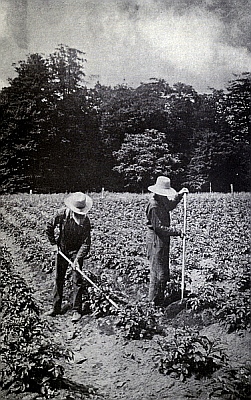
Photo by Verne Morton, Groton, N. Y. THOROUGH CULTIVATION OF THE GROWING CROP IS AN ESSENTIAL OF SUCCESSFUL POTATO RAISING
Grading.—The grading of early potatoes is quite as important as the grading of fruits. Large and small tubers should not be mixed in the same barrel. The pickers should be taught to gather the large and merchantable tubers in one basket and the small or seed potatoes in another, and these if placed upon the market should go in separate receptacles and be clearly marked so as to represent the grade. If a mechanical sorter is used this work will be more effectively accomplished than if left to the pickers. The type of grader usually used is similar to that employed in some sections for grading apples and peaches, although the common type of potato grader is a rotary screen which separates the earth from the tubers and allows the small tubers to fall through the large meshes of the screen before reaching the general outlet which carries away those of merchantable size. The objection to a mechanical grader of this type is that it bruises the immature tubers and renders them somewhat less attractive than when not so handled and probably also shortens the length of time they can be safely held on the market.
Marketing.—The perishable nature of the immature potato renders it necessary to place it upon the market in such quantities only as will admit of immediate consumption. Producers in regions where the growing of early potatoes has been extensively developed appreciate this and have provided for this condition by organizing shippers' associations through which the crop is graded, often trade-marked, and distributed chiefly in carload lots. The officers of the association being in constant telegraphic communication with the various markets are thus informed regarding the most satisfactory destination for every consignment which may be necessary. It is the purpose of these associations, however, to conduct their business in such a way that the product can be sold f. o. b. shipping point instead of by consignment, and the best organized associations are usually able to do this.
The great advantage of such a system of selling is that it enables the brokers in a small city or town to buy direct from the producer instead of through another city broker. It enables the consumer to obtain fresh products, as they are shipped direct from the point of production to the place of consumption. The plan carries other benefits which are of great moment to the producer. He is enabled to sell in carload lots at shipping point, thus saving to himself the cost of transportation, which ranges from 7 to 15 per cent of the gross selling price. The exchange secures a much wider distribution of the crop, with the result that overstocked markets are much less likely than under the consignment system. Transportation companies provide better service, and claims are more promptly settled through the exchange than in the case of individuals. This plan enables the producer to be his own salesman. It transfers the distributing point from the city to the field, where it should be. It brings the market to the fields instead of the product to the market. The exchange becomes the farmer's commission house, and it is much easier to keep informed regarding the transactions of a home association than of a foreign concern.
Varieties.—The following are among the most widely known varieties: Early, Early Ohio, Early Rose, Beauty of Hebron, and Triumph. Medium and late, Burbank, Rural New Yorker No. 2, Empire State, Mammoth Pearl, White Star, and Dakota Red. These are standard varieties, and though not necessarily the best, they seem to have given general satisfaction.
Second-Crop Potatoes for Seed at the South.—Within recent years there has been a marked increase in the use of second crop potatoes for seed throughout the southern potato-growing sections. This crop is frequently grown on the same land from which the first crop of potatoes was harvested. In most instances, however, it follows beans or cucumbers, as the seed for this second potato crop is not usually planted until July or August. The seed for this crop is, as a rule, saved from the early crop, the small tubers being stored in a well-ventilated shed, where they are protected from the direct action of the sun and from storms until about ten days or two weeks before the time of planting, when they are spread thinly upon the ground and lightly covered with straw or litter to partially protect them from the sun. Under these conditions the tubers quickly "green" and all those suitable for seed will develop sprouts. As soon as the sprouts are visible, and before they are large enough to be rubbed off in handling, the potatoes are ready to plant. The product of this planting gives a crop of partially matured tubers which are held over winter for spring planting. This practice gives excellent results in many localities and is found to be more economical than the purchase of northern-grown seed. To what extent it is safe to follow this practice without renewing the seed from the North by the use of fully matured tubers has not been determined. Those following the method should carefully observe the quality and yield of the crop for the purpose of determining whether or not it is deteriorating under this treatment. In general, it is believed that it will be within the limits of good practice to secure every second or third year enough northern-grown seed to supply seed for the second crop; in fact, some of the most successful growers of potatoes who use second-crop seed get enough northern-grown seed each year to supply planting material for the second crop. In this practice it will be economy to err on the side of safety and obtain fresh seed frequently from reliable northern sources. In a majority of instances it is found that second-crop home-grown seed is slower to germinate and later in maturity than northern-grown seed, and as quick development is an important element in the crop at the South, growers are urged to consider this point carefully.
Held-over Seed.—The consensus of opinion is that in southern localities it is impracticable to keep early potatoes from harvest time to the next season's planting period. The conclusions of those who have given this problem careful study are that the exposure of the tubers to the sun at harvest time is the chief factor in determining their keeping qualities. In other words, it is possible to keep potatoes in the extreme South from season to season provided the tubers are not exposed to the sun after being dug. They should be immediately carried to a protected place where there is ample ventilation and where they will receive only diffused light, such as a cyclone or other cellar, or the basement of a house, or even where brush protection will prevent the sun shining directly upon them. It is, of course, necessary that the tubers be well matured before being dug and that they be the product of disease-free plants. Plants killed by blight yield tubers which seldom keep well even under the most favorable conditions.
Methods of Securing Extra-Early Potatoes.—One of the most important factors having an influence on the profitableness of market garden crops is that of earliness. A difference of two or three days or a week in placing a crop on the market often makes the difference between profit and loss, and the prices obtained for extra-early crops have stimulated cultural experiments with every kind of fruit and vegetables. Some interesting results along this line with potatoes have recently been reported by the Kansas and Rhode Island stations. At the Kansas Station seed tubers of four different varieties of medium-sized potatoes were placed in shallow boxes with the seed ends up in February. They were packed in sand, leaving the upper fourth of the tubers exposed, and the boxes were placed in a room with rather subdued light, having a temperature of 50° to 60° F. Vigorous sprouts soon pushed from the exposed eyes. The whole potatoes were planted in furrows in March in the same position they occupied in the boxes. The same varieties of potatoes taken from a storage cellar were planted in parallel rows. The sand-sprouted potatoes took the lead from the start in vigor and strength of top and produced potatoes the first of June, a week earlier than the storage-cellar potatoes. At the final digging they showed better potatoes and gave a 10 per cent larger total yield. In other experiments part of the potatoes was treated the same as in the first test, except that the sand was kept moistened, and the other part was placed in open boxes and kept in a light room having a temperature of 50° F. The tubers placed in sand developed strong sprouts and nearly all rooted. When planted in the field they outstripped both the tubers sprouted in open boxes and the storage-cellar tubers in vigor of growth. The tubers started in the open boxes gave earlier yields than were obtained from the storage-cellar tubers, but not as early as the tubers sprouted in moist sand. The tubers sprouted in moist sand produced table potatoes from 7 to 10 days earlier than the storage-cellar seed.
At the Rhode Island Station medium-sized whole potatoes sprouted on racks, in a fairly warm and light room, gave a 27 per cent better yield at the first digging than potatoes kept in a cold cellar until planting time; and this was increased to 40 per cent at the final digging. The percentage of large tubers was also greater at each digging with the sprouted tubers. The results of these experiments are suggestive. The handling of seed potatoes in such manner as to secure strong, stocky sprouts before the tubers are planted out is shown to be an important factor in increasing both the earliness and the total yield of the crop. By planting only well-sprouted seed, a full stand is assured.
One of the objections to this method of growing potatoes is the large amount of space required for exposing the tubers to the light for sprouting. This objection has been overcome in part by the use of trays and racks. At the Rhode Island Station the rack used held 9 trays. Each tray was 3¾ feet long and 1½ feet wide, and would hold about 1 bushel of potatoes when spread out in a single layer for sprouting. The bottoms of the trays were made of pieces of lath placed about 1 inch apart. Nine trays were placed in a rack over each other, leaving about 9 inches of space between each tray. This method of arrangement has the advantage of securing a very uniform distribution of light, heat, and air for all the trays. It greatly facilitates the handling of the potatoes and lessens the danger of breaking off the sprouts and transferring to the field for planting.
Another method of securing early potatoes in Rhode Island on a commercial scale is that of sprouting tubers in a cold frame and planting out as soon as danger of frost is past. The tubers are cut into pieces, not smaller than an English walnut, after rejecting the two or three eyes nearest the stem end, which have been found to start late. The pieces are placed side by side in the bed, skin side upward, and covered about 4 inches deep with fine, rich earth. Their growth can be controlled by proper regulation of the cold-frame sash. At planting time the tubers, the sprouts of which should be just breaking the surface of the soil, are carefully lifted with manure forks, separated by hand, and placed in well-fertilized rows, and entirely covered with soil; or, if danger of frost is past, they are placed with the apex of the sprout just at the surface of the soil. About 216 square feet of cold frame is required to sprout sufficient potatoes to plant an acre in 30 to 32 inch rows, 12 inches apart. Eight men can transplant an acre in a day.
On the Island of Jersey, where early potatoes are raised in large quantities for the London market, the potatoes destined for seed are placed side by side in shallow boxes and stored, as soon as cold weather sets in, in a light and well-sheltered loft or shed, out of danger of frost. The position of the boxes is changed from time to time so that the sprouts will be of equal length and strength at the planting season. Medium-sized tubers selected from the best of the crop and allowed to lie in the field in the fall until they become greenish are used.
Potatoes on Western Irrigated Farms.—With thorough cultivation, for potatoes planted the first of May, irrigation is seldom necessary until July. Generally speaking irrigation water is cold and it is highly important not to irrigate too frequently, since the water not only causes the soil to run together but lowers the temperature to a point that is not favorable to the growth of potatoes. Irrigation water is applied only when the condition of the plants indicates that they are in need of water, as by darkening of the foliage. Or one may dig down in the hill and press a handful of soil in the hand; if it fails to retain its form, irrigation is needed. Care should be taken not to wait until the ground is too dry, because one can not cover the whole field of potatoes in one day's irrigation, and some are likely to suffer for water before being reached. Experience shows that if potatoes are grown as rapidly as possible, so as to become strong and well established early in the season, they withstand the maximum of unfavorable weather conditions later on, when the hot dry winds becomes a menace to the crop.
When the time for irrigation arrives, a V-shaped trench half-way between the rows should be opened in alternate middles with an 8 or 10 inch lister plow; that is, a narrow plow with a double mold-board which throws the dirt each way. In these furrows the irrigation water is run so that the soil will not become solidified by flooding, and the necessary amount of water may be properly distributed. For the second irrigation furrows are opened in the middles that were not opened at the first irrigation, and this alternation is continued for succeeding irrigations. At the head of each field is a feeder ditch from which the water is admitted to these irrigation furrows between the rows. It is essential that the right quantity of water be used, and that it be uniformly distributed. Cultivation should commence as soon after irrigation as the soil will permit so as to insure rapid and uniform growth without check. This will not only result in the production of smooth, uniform tubers of attractive appearance, which are always in demand at high prices, but will also result in large, profitable yields and at the same time keep the soil in good mechanical condition for future crops. Do not irrigate after August 10, so as to give fifty or sixty days for ripening in dry earth.
There is no line of farming in the irrigated districts that gives such marvelous profits as that of scientific potato production. With scientific knowledge which can certainly be acquired by experiments in supplying perfectly balanced plant food and maintaining soil fertility, the scientific principles of which are similar to those used by every successful breeder in feeding and fitting prize-winning stock; and with the proper proportions of plant foods—phosphates, nitrogen, and potash—in the soil as found in many parts of the West; and by the use of clover and alfalfa, there is no reason for those who contemplate engaging in the potato industry to fear the outcome. Too much stress can not be put upon the value and importance of livestock in keeping up favorable soil conditions, as no country now known has been continuously successful in crop production without the use of manures from the feeding of forage and grain crops.
Varieties.—Years of experience have demonstrated that comparatively few varieties of potatoes are really adapted to western or mountain conditions. Among the early varieties none has been so universally successful as the Early Ohio. This potato is of fine quality and uniform in size and shape, though not a heavy yielder. Another good potato, though not so early, is the Rose Seedling. For a medium to late variety, the Dalmeny Challenge, a Scotch variety, is being used quite extensively on the western slope of Colorado. For later varieties, the White Pearl and Rural New York No. 2 are more extensively used at Greeley, in the San Luis Valley, and in the Uncompahgre Valley; and the Perfect Peachblow is the favorite in the upper Grand Valley.
PUMPKIN.
The true pumpkin is hardly to be considered as a garden crop, and, as a rule, should be planted among the field corn. Plant where the hills of corn are missing and cultivate with the corn. However, some of the better sorts of pie pumpkins should be grown in the garden for cooking purposes, because they are productive and much superior in quality to the common field pumpkins.—(F. B. 255; Mich E. S. 20, 190.)
RADISH.
The radish is quite hardy and may be grown throughout the winter in hotbeds at the North, in cold frames in the latitudes of Washington, and in the open ground in the South. For the home garden the seed should be sown in the open ground as soon as the soil is moderately warm. Plant in drills 12 to 18 inches apart, and as soon as the plants are up thin them slightly to prevent crowding. Radishes require to be grown on a quick, rich soil, and some of the earlier sorts can be matured in two to three weeks after planting. If the radishes grow slowly they will have a pungent flavor and will not be fit for table use. For a constant supply successive plantings should be made every two weeks, as the roots lose their crispness and delicate flavor if allowed to remain long in the open ground. As a rule a large percentage of radish seed will grow, and it is often possible by careful sowing to avoid the necessity of thinning, the first radishes being pulled as soon as they are of sufficient size for table use, thus making room for those that are a little later. Radishes will not endure hot weather and are suited to early spring and late autumn planting. There are a number of varieties of winter radishes, the seed of which may be planted the latter part of summer and the roots pulled and stored for winter use. These roots should remain in the ground as long as possible without frosting and should then be dug and stored the same as turnips. This type of radish will not compare with the earlier summer varieties, which may be easily grown in a hotbed or cold frame during the winter. One ounce of radish seed is sufficient to plant 100 feet of row, and when grown on a large scale 10 to 12 pounds of seed will be required to the acre.—(F. B. 255, 295; U. Id. E. S. 10; Mich. E. S. 20; N. Car. E. S. 132.)
RHUBARB (PIE PLANT).
The soil for rhubarb should be deep, and there is little danger of having it too rich. Like asparagus the seedling plants of rhubarb can be grown and transplanted. Ten to twelve good hills are sufficient to produce all the rhubarb required by the average family, and these are most easily established by planting pieces of roots taken from another bed. Good roots may be secured from dealers and seedsmen at about $1.50 a dozen. The old hills may be divided in the early spring or late fall by digging away the earth on one side and cutting the hill in two with a sharp spade, the part removed being used to establish a new hill. The usual method of planting rhubarb is to set the plants in a single row along the garden fence, and the hills should be about 4 feet apart. If more than one row is planted the hills should be 3½ or 4 feet each way. The thick leaf stems are the part used, and none should be pulled from the plants the first year after setting. Rhubarb should receive the same treatment during winter as asparagus, and the plants should never be allowed to ripen seed. The roots may be brought into the greenhouse, pit, cold frame, or cellar during the winter and forced. Rhubarb does not thrive in warm climates. The use of rhubarb is principally during the early spring for making pies and sauces, and the stems may be canned for winter use.—(F. B. 255; N. Car. E. S. 132; U. Id. E. S. 10.)
RUTA-BAGA (SWEDES).
The culture of the ruta-baga is the same as for the turnip, except that the former requires more room and a longer period for its growth. The roots are quite hardy and will withstand considerable frost. The ruta-baga is used like the turnip, and also for stock feed. Two pounds of seed are required for one acre.—(F. B. 255; Mich. E. S. 6.)
SALSIFY (VEGETABLE OYSTER).
Sow seeds of salsify during the spring in the same manner as for parsnips or carrots. At the South, a sowing may be made in summer to produce roots for winter use. One ounce of seed is required to plant 100 feet of row, and on a large scale 10 pounds to the acre. After the plants are well established they should be thinned sufficiently to prevent their crowding. The cultivation should be the same as for parsnips or carrots, and frequent use of a wheel hoe will avoid the necessity for hand weeding. Salsify may be dug in the autumn and stored or allowed to remain in the ground during the winter, as its treatment is the same as for parsnips. Salsify is a biennial, and if the roots are not dug before the second season they will throw up stems and produce seed. It is of a weedy nature and care should be taken that it does not run wild by seeding freely. Salsify is deserving of more general cultivation, as it is one of the more desirable of the root crops for the garden. The uses of salsify are similar to those of the parsnip, and when boiled and afterwards coated with rolled crackers and fried in butter it has a decided oyster flavor, from which the name vegetable oyster is derived.—(F. B. 255, 295; N. Car. E. S. 132; Idaho E. S. 10.)
SCOLYMUS.
Scolymus is a vegetable with spiny, thistle-like leaves, from Spain, with roots much like a small parsnip and keeping equally well in winter.—(S. Dak. E. S. 68.)
SKIRRET.
This is called "Zuckerwurzel" (Sugar root) in Germany. The plump, fleshy roots are sweet and used boiled during winter, the same as Salsify.—(S. Dak. E. S. 68.)
SORREL.
This plant resembles the weed "sour dock" of the fields. The leaves are large, tender and juicy, very broad and often 10 inches long, retaining the pleasant acid flavor of the original weed. Much prized in France where it is cultivated as a spring vegetable and used singly or mixed with spinach.—(Mich. E. S. 20; U. Idaho E. S. 10.)
SPINACH.
Spinach thrives in a rather cool climate and attains its best development in the Middle South, where it can be grown in the open ground during the winter. Large areas are grown near Norfolk, Va., cuttings being made at anytime during the winter when the fields are not frozen or covered with snow. When the weather moderates in the early spring the plants make a new growth, and a large crop of early greens is available. North of the latitude of Norfolk, spinach can be planted in the autumn and carried over winter by mulching with straw or leaves. Sow the seeds in drills 1 foot apart at the rate of 1 ounce to 100 feet of row or 10 to 12 pounds to the acre. To produce good spinach, a rich loam which will give the plants a quick growth is required. As ordinarily grown, it occupies the land during the autumn and winter only and does not interfere with summer cultivation. It is an easily grown garden crop, and there is, perhaps, no other of its kind that will give as good satisfaction. Three or four ounces of seed, planted in the autumn after a summer crop has been harvested from the land, will produce an abundance of greens for the average family during the late autumn and early spring. In gathering spinach the entire plant is removed rather than merely cutting off the leaves. The larger plants are selected first, and the smaller or later ones are thus given room to develop. No thinning is required if this plan of harvesting is practiced.—(F. B. 255; Mich. E. S. 20; U. Id. E. S. 10; N. C. E. S. 132.)