BOOK II (continued 4)
Reading edition
Kate could hardly speak, so great was her fear and joy. "Morton Serviss, what do you think now? Ask him—"
The voice from the trumpet interposed. "Don't ask me a word about conditions over here—it's no use. I can't tell you a thing."
"Why not?" asked Morton.
"Well, how would you describe a Connecticut winter to a Hottentot? Not that you're a Hottentot"—the voice broke into an oily chuckle—"or that I'm in a cold climate." The chuckle was renewed. "I'm very comfortable, thank you." Here the invisible one grew tender. "My boy, your mother is here and wants to speak to you but can't do so. She asked me to manifest for her. She says to trust this girl and to carry a message of love to Henry. I brought one of her colonial wineglasses with me—as a sign of her presence and as a test of the power we have of passing through matter."
For nearly an hour this voice kept up a perfectly normal conversation with a running fire of quips and cranks—recalling incidents in the lives of both Kate and Morton, arguing basic principles with Weissmann yet never quite replying to the most searching questions, and finally ended by saying: "Your conception of matter is childish. There is no such thing as you understand it, and yet the universe is not as Kant conceived it. As liberated spirits we move in an essence subtler than any matter known to you—ether is a gross thing compared to spirit. Your knowledge is merely rudimentary—but keep on. Take up this work and my band will meet you half-way. My boy, the question of the persistence of the individual after death is the most vital of all questions. Apply your keen mind to it and depend on old 'Loggy.' Good-by!"
Kate was quivering with excitement. "Morton, that settles it for me. That certainly was 'Loggy.' Oh, I wish mother could have spoken."
Morton's voice was eager and penetrating as he said: "Mrs. Lambert, I would like to place my hand on your daughter's arm again, I must be permitted to demonstrate conclusively that she has had nothing to do with the handling of the horn."
"I will ask the 'guides.' Father, can Professor Serviss—"
Three feeble raps anticipated her question.
"They say 'yes'—but they are very doubtful—so please be very gentle."
Serviss rose, his blood astir. At last he was about to remove his doubt—or prove Viola's guilt. "Doctor," he said, and his voice was incisive, "take the other side and place a hand on her wrist. That will be permitted?" he asked.
Three raps, very slow and soft, assented.
Clarke interposed. "I am impressed, gentlemen, to say: Let each of you put one hand on the psychic's head, the other on her arm."
"We will do so," replied Weissmann, cheerfully.
With a full realization of the value of this supreme test of Viola's honor, Morton laid his right hand lightly on her wrist. At the first contact she started as though his fingers had been hot iron, and he was unpleasantly aware that her flesh had grown cold and inert. He spoke of this to Weissmann, who replied: "Is that so! The hand which I clasp is hot and dry, which is a singular symptom." Then to the others: "I am now holding both her hands. One is very hot, the other cold and damp and I feel no pulse."
"She is always so," Mrs. Lambert explained. "She seems to die for the time being."
"That is very strange," muttered Weissmann. "May I listen for her heart-beat?" Three raps assented, and a moment later he said, with increased excitement: "I cannot detect her heart-beat."
Clarke reassured him. "Do not be alarmed. She is not dead. Proceed with your experiment." There was a distinct note of contempt in his voice.
As Morton laid his hand upon the soft coils of her hair Viola again moved slightly, as a sleeper stirs beneath a caress, disturbed yet not distressed—to settle instantly into deeper dream.
"We are ready," called Weissmann. "Whatever happens now Miss Lambert is not the cause. Take Mr. Clarke's hands in yours—"
"Mrs. Lambert's also," added Morton.
"Our hands are all touching," answered Kate.
"Now, let us see!" cried Weissmann, and his voice rang triumphantly. "Now, spirits, to your work!"
Clarke laughed contemptuously. "You scientists are very amusing. Your unbelief is heroic."
As they stood thus a powerful revulsion took place in Morton's mind, and with a painful constriction in his throat he bowed to the silent girl, and with an inconsistency which he would not have published to the world, he prayed that something might happen—not to demonstrate the return of the dead but to prove her innocence.
As he waited the pencil began to tap on the table, and with its stir his nerves took fire. A leaf of paper flew by, brushing his face like the wing of a bird. A hand clutched his shoulder; then, as if to make every explanation of no avail, the room filled with fairy unseen folk. Books began to hurtle through the air and to fall upon the table. A banjo on the wall was strummed. The entire library seemed crowded with tricksy pucks, a bustling, irresponsible, elfish crew, each on some inconsequential action bent; until, as if at a signal, the megaphone tumbled to the floor with a clang, and all was still—a silence deathly deep, as if a bevy of sprites, frightened from their play, had whirled upward and away, leaving the scene of their revels empty, desolate, and forlorn.
"That is all," said Clarke.
"How can you tell?" asked Kate, her voice faint and shrill with awe.
"The fall of the horn to the floor is a sure sign of the end. You may turn up the gas, but very slowly."
Stunned by the significance, the far-reaching implications of his experiment, Morton remained standing while Weissmann turned on the light.
Pale, in deep, placid sleep, Viola sat precisely as they had left her, bound, helpless, and exonerated. She recalled to Morton's mind a picture (in his school-books) of a martyr-maiden, who was depicted chained to the altar of some hideous, heathen deity, a monster who devoured the flesh of virgins and demanded with pitiless lust the fairest of the race.
Of her innocence he was at that moment profoundly convinced.
XIVToC
PUZZLED PHILOSOPHERS
While he still stood looking down upon her Viola began to moan and toss her head from side to side.
"She is waking," cried Mrs. Lambert. "Let me go to her."
"No!" commanded Weissmann, "disturb nothing till we have examined all things."
"Make your studies quickly," said Morton, his heart tender to the girl's sufferings. "We must release her as soon as possible."
Weissmann was not to be hastened. "If we do not now go slowly we lose much of what we are trying to attain. We must take her pulse and temperature, and observe the position of every object."
"Quite right," agreed Clarke, "Do not be troubled—the psychic is being cared for."
Thus reassured the two investigators scrutinized, measured, made notes, while Kate and Mrs. Lambert stood waiting, watching with anxious eyes the changes which came to Viola's face. Weissmann talked on in a disjointed mutter. "You see? She has no pulse. The threads are unbroken. The table is thirty inches from her finger-tips. Observe this pad, forty-eight inches from her hand—and which contains a message."
"Read it!" demanded Kate.
He complied. "'You ask for a particle of matter to be moved from A to B without the use of any force known to science. Here in this wineglass is the test. Oh, men of science, how long will you close your eyes to the grander truths.'"
"That is from father," remarked Mrs. Lambert.
"It is signed 'McLeod,' and under it are two words, 'Loggy' and 'Mother,' each in different handwriting."
"Give it to me!" cried Kate, deeply moved.
"And here is the wineglass," replied Weissmann, extracting from among the books a beautiful piece of antique crystal.
Kate took it reverentially, as if receiving it from the hand of her dead mother. "How came that here?"
"You recognize it? It was not left here by mistake?"
"Oh no. There are only four of them left and I keep them locked away. I have not had them out in months."
Clarke smiled in benign triumph. "That is why they brought it—to show you that matter is an illusion and to prove that dematerialization and transubstantiation are facts. That was the bell we heard."
"Morton, what do you think? How could—"
But Morton was bending above Viola and did not heed his sister. The girl's eyes were opening as from natural slumber, and he said, gently: "I hope you are not in pain? We will release you in a moment."
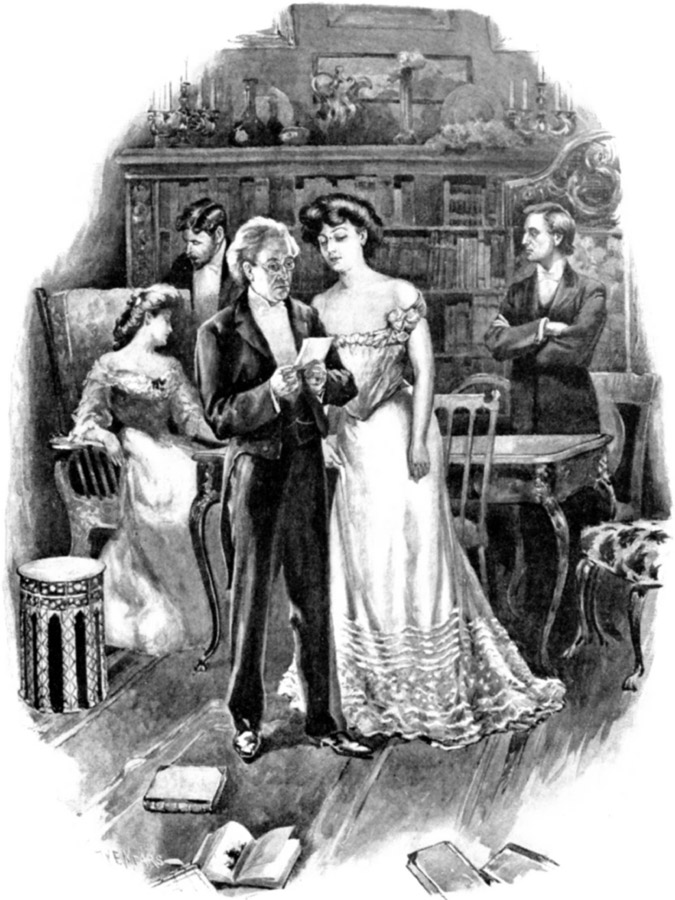
"THE GIRL'S EYES WERE OPENING AS FROM NATURAL SLUMBER"ToList
She smiled faintly as she recognized him. "My arms are numb, and my feet feel as if strips of wood were nailed to my soles," she answered, wearily, "and my head is aching dreadfully; but that will soon pass."
"She always complains of her feet," the mother explained. "She can't walk for quite a little while afterwards."
"You poor thing!" exclaimed Kate. "You are a martyr—that's what you are."
Viola looked up with sweet and anxious glance. "Did anything happen? Did your friends come to you, Mrs. Rice?"
"No, but several voices spoke to Morton."
"I'm sorry no one came to you. I've been a long way off this time," she continued, with dreamy, inward glance, "into a beautiful country from which I hated to return. I wouldn't have come back to you at all only a thread of light tied my soul to my body and drew me down to earth in spite of myself."
"What was it like—that far country?" asked Morton.
She pondered sleepily. "I can't tell you—only it was very beautiful and I was happy. Every one lived in the light with nothing to fear. I had no memory of the earth—only of my body which I was sorry for. There was no death, no cold, no darkness up there. I was very happy and free."
"You should be free and happy here," answered Morton, gravely. "Come, doctor, can't we free her now?"
"Yes, you may do so," he replied, still busy with his note-book.
The young host, with a feeling of having been unnecessarily brutal, ripped the tape loose from the floor, and Kate slipped the loops from Viola's ankles. Then, leaning on her hostess's arm, she rose slowly, smiling brightly, her weakness most appealing. "I hope a great deal happened—it means so much to me. I want to talk, but I can't now, my head is too thick. You must tell me all about it pretty soon."
"A great deal happened—you are quite clear of any connection with it."
Her face lit with placid joy. "Oh, I'm so glad! It must be very late," she added, turning to her mother.
"Yes, and we must be going," responded Mrs. Lambert, nervously. "Mr. Pratt will be impatient."
"I wish you'd stay with me to-night," pleaded Kate. "It was all so wonderful. I can't let you go. Please stay! Both of you. You're too tired to go out into the raw air."
"Oh no, we can't do that—not to-night," Viola answered, decisively.
Morton threw back the doors. "Kate, take Miss Lambert into the dining-room and give her something to drink. She is quite exhausted. Let me steady you," he said, tenderly, touching her arm. "You fairly reel with weakness."
"I will be as well as ever as soon as my blood begins to circulate," she bravely answered, and his touch quickened her pulse miraculously.
As soon as Weissmann had finished taking his notes and measurements, he locked the door of the library and joined them all in the dining-room, where they were sipping coffee and nibbling cake. Morton was sitting beside Viola (who had entirely regained her girlish lightness of mood), and was chafing her cold hand in the effort to restore the circulation as well as to remove the deep mark the silken thread had made about her wrist.
"We shall be obliged to shut out all young men from our committee," the old scientist jocularly remarked, as he stood looking down at them. "Lovely psychics like you would put the whole American Academy of Science in disorder."
Clarke, raging with jealous fire, turned to Weissmann in truculent mood. "Well, Dr. Weissmann, how do you account for these phenomena? To whose agency do you ascribe these marvels?"
"Spooks!" answered the old man, with cheerful promptness.
Clarke reeled before this laconic admission. "What! You agree? You admit the agency of spirits?"
"Certainly—unless I say Miss Lambert wriggled herself out of her skin, which would not be nice of me, or that you are the greatest ventriloquist in the world. No, I prefer to compliment the spirits."
Clarke's face darkened. The old man's face and voice were too jocose. "I see you do not value our wonderful experiences to-night."
Viola, pinching her sleeve about her wrist, looked up roguishly. "I couldn't possibly wriggle out of my gown, could I, Dr. Weissmann? And if I did, how could I get the tacks back without a hammer?"
"Precisely. You would be more burglarious than the ghosts which walk through the key-holes," he answered.
"And the little girl who spoke German—who was she?" asked Kate.
The hour that followed was a delicious one for the young people, for they had come at last to some sweet and subtle understanding. As she recovered the use of her limbs Viola glowed with joy of Morton's change of attitude towards her. He, on his part, was puzzled by this mood. It was as if she had been vindicated to herself—liberated from some dead body of doubt.
Clarke glowered in silence; disapproving, with manifest disdain, the levity of the scientists, and resenting bitterly Viola's growing trust and confidence in Serviss. Each moment his anger took on heat, and he found it hard to reply even to his hostess, who tried to interest him in a deeper discussion of the evening's marvels. He seemed to have but one desire—to get away and to take Viola with him.
"Tell me," said Viola to Morton, "did papa speak to you?"
"A voice purporting to be your father spoke a few words."
"He is very nice. Didn't you think so?"
"The voice was very gentle and refined, and expressed a very tender regard for you."
She sighed. "I have never heard my father's voice, for he always comes when I am in my deepest trances. They say that I will be permitted some day to hear all the voices through the cone—I only hear them now in an interior way."
"Do you really suffer as you seem to do?" he asked, the echo of his pity still in his tone.
"Not after I am really gone. Did I groan?"
"Horribly! My heart was filled with remorse—"
"I'm sorry. It doesn't really hurt me—physically. You see I am perfectly well again. And yet I hate more and more to give myself up. I can't explain it, but I seem to be losing more and more of myself—that is the thought that scares me. I hate to think of being so helpless. It seems to me as if I were becoming like—like a hotel piano—for any one to strum on—I mean that any one in the other world—It is so crowded over there, you know!" Her brows drew together in momentary disgust.
"I don't know, but it must be so if all the myriads of past humanity are living there. If I had my way you would never sit again," he declared, most fervently.
"I wouldn't mind so much," she went on, "if I were not marked out for suspicion—if people would only talk to me of nice earthly things part of the time as they would to any other girl—but they never do. Everybody wants to talk to me about death and spirits—"
"That's what gives edge to my remorse," he interrupted. "Here am I doing the very things you abhor. To think that we who have made such a protest against your slavery could not allow you one free evening! I will not say another word on these uncanny subjects."
"But I want to talk of them to you! I wanted to tell you all about myself that day we rode up to the mine—but I could not."
"I wish you had. It might have made a great deal of difference in your life—and mine. I have been thinking of that ride to-night, as we sat in the darkness. If I could, I would keep you as girlish, as gay, as you were that day. This business is all a desecration to me. I love to think of you as you were then—when you laughed back at me in the rain. I wish we were both there this minute."
She smiled. "You forget the time of night!" Her face grew wistful. "I've been getting homesick for the mountains lately—and yet I like it here. I love this beautiful room. I adore your sister. I know I could have a delightful time if only my guides weren't so anxious to have me convert the world."
"I grow more and more conscience-smitten!" he exclaimed. "To think we should be the ones to tie and torture you, and at our first dinner-party!"
"Please don't blame yourself. It was not your fault; grandfather insisted on talking with you, and I—I wished it very much." Her face grew radiant with pleasure. "Oh, I'm so glad you made it a test-sitting!—I want you to believe in me. I mean that I don't deceive—"
"I am sure of that."
"There are so many things I want to talk with you about—but not now—it is late."
Clarke, who had grown too restless to remain seated, interrupted a story which Kate was relating, and rose, saying, harshly: "It is time for us to be going. Pratt will lock us out if we don't."
The cloud again fell on Viola's face—her little hour of freedom from her keeper was over. Morton felt the change in her, and so did Kate, who fairly pleaded with the mother to remain. "It is late and you are tired, and after this wonderful evening you ought not to go back to that gloomy place."
Mrs. Lambert looked at Clarke, whose reply was stern. "No, we must return."
Something very sweet and intimate was in Morton's voice as he found opportunity to say to Viola: "I don't like to think of you returning to that gilded mausoleum. It is a most unwholesome place for you. You are too closely surrounded with morbid influences."
"I know it. I dread to go back—I admit that. I suppose Mr. Pratt is a good man, I know he does a great deal for the faith, and he is very generous to us, but oh, he is so vulgar, so impertinent! He bores me nearly frantic by being always at my elbow. I shudder when he touches me as if he were some sort of evil animal. Mother can't realize how he annoys and depresses me, and Anthony insists that we must endure it."
"I wish you'd stay here!" he exclaimed, impulsively. "Accept my sister's invitation—it would give us such an opportunity to talk of this sitting. Come, let me send for your trunks."
She shrank a little from his eager eyes, and Mrs. Lambert again interposed. "It is quite impossible, professor; perhaps some other time."
Viola yielded to her mother and went away to get her cloak, and Morton turned to Clarke. "One of the conditions of my promise to organize a committee is this: you and Pratt must be excluded from the circle."
Weissmann echoed this. "Quite right! That we demand."
The clergyman's face hardened. "You ask the impossible. It is necessary for me to be present at each sitting. I have the right to be there as the historian of the case. Furthermore, I add to the strength of the manifestations—that I have fully demonstrated."
"I appreciate your position, but in order to avoid criticism, to make the tests perfect, it will be necessary to hold the sittings either here or at Weissmann's, and to exclude every one connected with Miss Lambert. In no other way can we convince ourselves or the public."
Clarke's face was darkly stubborn. "Then you will have no sittings. My challenge will go forth next Sunday afternoon, and one of the unchangeable clauses of that challenge will be this: the sittings must take place in Pratt's library and I must be present."
"I hope you will not insist on that," Morton further urged; "for Miss Lambert's sake you must not. To incorporate such terms in your challenge will brand her as an impostor and you and Pratt as her confederates. In this statement I think you will find her 'controls' agreeing. They were undecided to-night, but when they consider carefully they will see that my advice is sound."
Clarke's eyes were aflame. "You have my terms. Accept them or refuse them, as you please."
Viola, returning, extended her hand to Morton with a trustful smile. "I've had a beautiful evening."
"To say that after we have tied you hand and foot till you were numb, and kept you in the dark all the evening, is very gracious of you. I feel very much the brutal host. But you must come again. I swear Kate shall not pester you next time."
Kate was indignant. "Well, I like that! when you were the one crazy to experiment. Of course they're coming, coming to stay to-morrow night, and any one who dares to talk ghosts to her will be sent to bed."
And so in a hearty, cordial clangor of farewells they got out into the hall, and Morton, seeing Viola in her handsome cloak, her eyes shining, her face once more gay and smiling, was again filled with wonder at her astounding resiliency of mood. It was as if two sharply differentiated souls alternated in the possession of her body.
Clarke, wearing a cape overcoat and a soft hat, was far less admirable in appearance than when, with head uncovered, he sat within. He resembled a comic picture of an old-fashioned tragedian—a man glad to feel the finger of remark directed towards him, but his face was bitter, his eyes burning with anger, his lips white with pain.
Serviss relented as he studied him. "You'd better take Britt's trail and return to the mountains," he said, kindly. "This is a bad climate for you."
"My work is here," he replied, curtly. "I have no fear," and so they parted.
Weissmann was sitting in silent meditation in one corner of the dining-room when Serviss returned. "Well, master, what do you think of to-night's performance?"
Weissmann replied, in ironical phrase: "Hearing in civilized man is vague and indefinite. Spooks do well to limit their manifestations to a sense which most powerfully appeals to the imagination."
Morton spoke with great earnestness. "Weissmann, that girl could not move a limb. She positively remained where we put her. So far as I am concerned, to-night's test eliminated her from the slightest complicity, and I confess it rejoices me greatly; but who was responsible for the prestidigitation?"
Weissmann replied, slowly: "It is very puzzling," and fell into a muse which lasted for several minutes. At last he roused to say: "Well, we will see. Next time Clarke and the mother must be eliminated."
"You don't think evil of her?" exclaimed Morton.
"She is very anxious, you know—"
Kate put in her word. "It's all very simple," she said; "the spirits did it. You needn't tell me that Clarke or Mrs. Lambert got up and skittered around the room doing those things. I held their hands—and know they didn't get away. Besides, how did that glass come there? and how could they make those voices sound so natural? What is the use of being stupidly stubborn? If you treat Viola fairly she will confound your science."
"You base all this on one imperfect test?"
"I don't know what you'd call a perfect one. Anyhow, that child is absolutely honest."
"I hope you are right, Kate; but there are some serious discrepancies—even in to-night's performances. Nothing took place which I could not do sitting in her chair with my hands free."
"But her hands weren't free! If there is any virtue in cotton fibre or steel she remained precisely where we set her at the beginning."
"But to admit that one book was moved from its place is to admit that a force exists unknown to science."
"But what are you going to do? Did you do it? Or did I? Did Clarke reach from where he sat and manipulate the horn? Who brought the old wine-glass from the china-closet? No one entered from the outside—that is certain. And then the things 'Loggy' said?"
"What do you think, Dr. Weissmann?"
Weissmann looked up abstractedly. "If Clarke performed these feats to-night he is wasting his time in any profession but jugglery. You said the cone touched you?" he asked of Morton.
"Several times."
"To do that he must have left his seat."
"I am perfectly sure he did not," replied Kate, firmly.
Morton insisted. "He must have done so, Kate—there is no other explanation of what took place. It was very dark and the rug soft. There is another important point—all of the books came from within a radius of a few feet of the psychic, so that if she were able to rise and free her hands—"
"Which she did not do," answered Weissmann. "She remained precisely where we put her; but we should have nailed Clarke to the floor also."
"How about the child who spoke German?" asked Kate. "Was she—"
Weissmann replied slowly, with a little effort, "I had a little girl of the name Mina who died at eight years of age."
Kate's voice expressed sympathy. "I didn't know that. She must have been a dear. The voice was very sweet. I could almost touch the little thing."
"I do not see how Clarke or any one here knew of my daughter or her name. Clarke may be a mind-reader. The voice did not prove itself."
"Neither was 'Loggy' quite convincing," said Morton. "And yet I cannot understand how those voices were produced. Our imaginations must have been made enormously active by the dark. As scientists we cannot admit the slightest of those movements without the fall of some of our most deeply grounded dogmas. What becomes of Haeckel's dictum—that matter and spirit are inseparable?"
"There is matter and matter," replied Weissmann. "To say that spirit and flesh is inseparable is to claim too much. We can say that we have no proof of such separation, but Crookes and others claim the contrary. It is curious to observe that we to-night have trenched on the very ground Crookes trod. I am very eager now to sit with this girl—the mother and Clarke being excluded."
"Of one thing I am more than half persuaded, and that is that Clarke is a mind-reader; for how else could he know the things which the supposed ghost of my uncle recounted?"
"It is very puzzling," repeated Weissmann, deep-sunk in speculation; and in this abstraction he took himself silently away.
Kate, with an air of saying, "Now that we are alone, let's know your real mind," faced her brother with eyes of wonder. "Morton, what do you honestly think of it? Viola had nothing to do with it, did she?"
"No; but are you absolutely sure Clarke did not get loose and do things?"
"Mort, I was never more alert in my life, and I know he didn't move out of his chair."
"But think what it involves!"
"I don't care what it involves. So far as the senses of touch and hearing go, Clarke remained seated every minute of the time, and I certainly held both his and Mrs. Lambert's hands the whole time while the books were being thrown."
"Well, there you are. Somebody did it." He shrugged his shoulders in an unwonted irritation.
"Why not say the spirits did it all?"
"Because that is unthinkable."
"Sir William Crookes and Dr. Zöllner, you say, believed in these disembodied intelligences—"
"Yes, but they belong to what Haeckel calls the imaginative scientists."
"You needn't quote Haeckel to me, Morton. If I believed what he preaches I would take myself and my children out of the world. I don't see how a man can look a child in the face and say such things. I can't read any of your scientific friends straight along. Their jargon is worse than anything, but I pick out enough to know that they don't believe in anything they can't see, and they won't go out of their way to see things. Do you suppose I'm going to believe that Robbie is nothing but a little animal, and that if he should die his soul would disappear like a vapor?"
"I can only repeat that the converse is unthinkable. There is no room in my philosophy for the re-entrance of the dead."
"Why not? It's all very simple. We're creatures of our surroundings, aren't we? Now, sitting there in the dark to-night, it seemed to me that the people we think of as dead were all about me. It scared me at first; but, really, isn't it the most comforting faith in the world? I've always liked the idea of the Indian's happy 'hunting-grounds'—and this is something like it."
He smiled shrewdly. "That performance to-night and this conversation would make a pretty story to lay before the president of Corlear—now wouldn't it?"
"How do you suppose he will take your going into this investigation?"
"I don't know, but I think he'll 'fire' me instanter."
"Well, let him try it! He wouldn't dare—"
"Oh yes, he would, if he thought I was hurting the institution. See what they did to poor little Combes, who mildly claimed to be able to hypnotize people."
"Yes, but he made himself ridiculous in the papers."
"You mean the papers made him ridiculous. Couldn't they do the same with Weissmann and me? Think of a big, sprawling, sketchy drawing in the Blast, with Weissmann glaring at a strangely beautiful young lady in scanty gown—his hands spread like claws upon the table, while another younger man (myself) catches at a horn floating overhead. Oh yes, there are great possibilities in to-night's entertainment. May I ask you, Mrs. Rice, to be more than usually circumspect?"
"You may, Dr. Serviss."
He rose gravely. "Very good. Now I think you would better go to bed."
"I wish your Mr. Lambert would come."
"So do I. I'm afraid he is going to ignore my summons. Unless I hear from him to-morrow I shall consider him craven or indifferent."
"What will you do then?"
His brows contracted into a frown. "I don't know. She should be freed from Clarke's immediate influence, but I don't see how I can interfere."
"I can't believe that she really cares for him; in fact, from things she said to-night, I think she fears him. He was furiously jealous of you, I could see that. And I must say you gave him cause."
He turned and looked at her in affected amazement. "Where are you heading now?"
She laughed. "Where are you drifting, my boy? I never saw any one more absorbed, and I can't say I blame you; she was lovely. Good-night." And so she left him.
Sitting thus alone in the deep of the night, the flush of his joy at the proof of Viola's innocence grew gray and cold in a profound disbelief in the reality of his experiences. "Did anything really happen?" he asked himself. Returning to the library with intent to study the situation he mused long upon the tumbled books, the horn, the tables, and the chairs. He put himself in Viola's seat in the attempt to conceive of some method whereby even the most skilful magician would be able to pull out tacks, rip stitches, and break tape—and then—more difficult than all, after manipulating the horn, reseat himself and restore his bonds, every tack, to its precise place. And his conversation with "Loggy," most amazing of all, came back to plague him. What could explain that marvellous simulation of his uncle's chuckling laugh?
Yes, Viola was clearly innocent. It was impossible for her to have lifted a hand; that he decided upon finally—and yet it was almost as difficult for Clarke or Mrs. Lambert to have performed all the tricks, "Unless Kate"—he brought himself up short—"in the end, my own sister, is involved in the imposture," he exclaimed, with a sense of bewilderment.
When he dwelt on Viola's delight in her own vindication, and remembered her serene, sweet, trustful glance, a shiver of awe went over him, and the work of saving her, of healing her, seemed greater than the discovery of any new principle; but whenever his keen, definite, analytic mind took up the hit-or-miss absurd caperings of "the spirits" he paced the floor in revolt of their childish chicanery. That the soul survived death he could not for an instant entertain. Every principle of biology, every fibre woven into his system of philosophy repelled the thought. To grant one single claim of the spiritists was disaster. "No, the mother and Clarke are in league, and when the bonds are on one the other acts. I see no other explanation. I distrust Clarke utterly—but the mother is apparently very gentle and candid, and yet—Weissmann may be right. Maternal love is a very powerful emotion. That second voice was like hers. And yet, and yet, to suspect that gentle soul of deliberate deception is a terrible thing. What a world of vulgarity and disease and suspicion it all is! An accursed world, and the history of every medium is filled with these same insane, foolish, absurd doings."
And so he trod in weary circles, returning always to the same point, with an almost audible groan. "Why, why was that charming girl involved in all this uncanny, hellish, destructive business? Clarke claims her. On him her fate depends. Perhaps at this moment her name and hideous reproductions of her face are being printed in all the sensational papers of the city. Oh, that crazy preacher! It may be that he has already made her rescue impossible." And always the dark, disturbing thought came at the end to trouble him. "Can she ever regain a normal relation with the world—even if I should interfere? She should have been freed from this traffic long ago. Can the science of suggestion reach her? Am I already too late?"
The conception that sank deepest and remained most abhorrent in his musings was that conveyed in her own tragic words: "It seems to me I am becoming more and more like a public piano, an instrument on which any one can strum—and the other world is so crowded, you know!"
"If there is any manhood left in Lambert he must assert it or I will throttle Clarke myself," he muttered through clinched teeth. "I ran away two years ago—I evaded my duty yesterday, but I do not intend to do so now. I will not sit by and see that sweet girl's will, her very reason, overthrown by a fanatic preacher eager for notoriety. I will see her again and demand to know from her own lips whether she is in consent to be his wife. I cannot believe it till she tells me so, and then I can decide as to future action."
And at the moment he was comforted by the recollection of something timidly confiding in her parting smile.
XVToC
VIOLA REVOLTS FROM CLARKE
No sooner were they seated in their carriage than Clarke broke forth in harsh protest. "You must not think of leaving Pratt's house at this time."
"Why not?" asked Viola, roused by the tone of his voice, which was even less considerate than his words.
"Because it will displease him—may possibly alienate him just at a moment when we need him most. He will not consent to be shut out from these test-sittings; on the contrary, he is likely to insist on their taking place in his own library. Furthermore, I don't see why you are in haste to leave so sumptuous an abode."
"Because I hate him, and all connected with him." Her voice was colored with a fierce disgust. "That is the reason, and reason enough."
"You must not let him know that."
"I don't care if he knows it or not. We are not dependent on him or his house."
"Yes, we are! He is most important to all of us until our tests are over and my book in type. I need his indorsement besides. He is very bitter and vindictive with those whom he thinks should be very grateful, and we must not anger him; we can't afford it."
Mrs. Lambert mildly protested. "I'm sure Mr. Pratt will not think of detaining us if father thinks it best for us to go, and I confess I am anxious to get away myself, Tony. He has been very disagreeable lately."
Clarke went on: "We must continue to let him think his advice and aid invaluable till our book is out, then we can cut loose from him. Our policy—"
Rebellion was in Viola's heart as she cuttingly interrupted: "You speak as if we were in league to cheat him of something. You have always told me that my powers were 'dedicated to the good of the world,' but lately you talk as if they were dedicated to your personal advancement in some way. Now which do you really mean?"
He saw his mistake. Once or twice before he had met her complete opposition, and he feared it. His voice suppled, became persuasive. "I mean, Viola, that in entering upon a great contest—one whose issue is to electrify the civilized world—"
"I don't believe it. What does the world care about a little speck of humanity like me? Professor Serviss is nearer right when he says that converting people to any creed is a thankless task. Ask grandfather to let me live my own life. He listens to you. Tell him I'm tired and—"
"He has promised to be easier on you after we have won our battle."
"But I dread the battle—oh, how I dread it! Professor Serviss says we will lose."
Clarke broke in, sharply: "Please don't quote what Serviss says. His view is that of the worldly wise materialist. You should listen to my advice—not his."
"You said you were anxious to have him on the committee."
"Yes, because I thought his name would count, and that he could bring Weissmann—but now I distrust him. He is too bigoted."
As he continued in this strain he stood in dark contrast to Morton, and the girl could not but wince under the revelation he was unconsciously making. "Anthony, you have talked in that strain ever since we came East. Nothing but using people, using people, all the time. You've been constantly running after those who could 'be of use to us!' and I don't like it. Every word you're saying now makes me doubt your sincerity. I was ashamed of you to-night—I am ashamed of you now. How can I respect you when you say things like that?"
He again tacked. "I do it all for the furtherance of our faith. To do our work we must have authority. It is always necessary to make a big stir in the world in order to do good—think of Christ defying the money-changers and making a scene in the temple!"
She pursued her way. "It's the tone of your voice that scares me. You're a different person since we came here—you've been harsh and cruel to me." Her voice choked, and yielding to a flood of doubt she cried out: "I've lost faith in you. This ends it all, I will never marry you! I don't care what my 'guides' say. I daren't trust myself to you—now that's the truth."
The mother was aghast. "Why, Viola Lambert! What a terrible thing to say!"
"I can't help it, mother—that is my decision."
Clarke blundered a third time. "I won't release you! This mood is all the influence of those accursed pagans we have just left. That man Serviss has been an evil influence upon you from the very first. He has no God in his heart. You must keep away from that home—it is destructive."
"It is not!" she retorted, fiercely. "It is beautiful and honest and—sane, and I'm going there as often as they will let me—and I'm going to leave the Pratt house to-morrow! I will not stay there another day."
"There are others to be consulted about this," he grimly answered. "You have tried playing truant before."
She was now in full tide of revolt. "I am going to leave that house if I fall dead in the streets. I am going if 'they' choke me black in the face."
He sneered. "I know where you are going!"
At this moment she hated him and everything he stood for, and her voice was hoarse with her passion. "I don't care what you say or what you do, I will not be hounded and driven around like a slave by you or Simeon Pratt any longer. I'm going to have a little life of my own if 'they' tear me in pieces for it."
This outburst, so much more intense than any which had preceded it, alarmed Clarke and appalled Mrs. Lambert, who took her daughter in her arm with soothing words and caresses. "There, there, dearie! Don't worry—don't excite yourself. Father will not insist on your doing anything that will be harmful. He will protect you."
The girl, sobbing in reaction, bowed to the maternal bosom, feeling once more her own helplessness, receiving no help from her mother's sympathy, which was merely superficial. Her only hope of release lay in the strong, bright, self-reliant, humorous people she had just left, those to whom her grandfather and his "band" were less than shadows. They alone could save her from the despairing madness which she felt creeping upon her like a beast in the night. Her nerves, strung to dangerous tension, gave away utterly, and Clarke, realizing this, ceased to chide, and the ride ended without another word.
Pratt, who had been waiting for hours with the angry impatience of senility, met them at the door, truculent as a terrier. "What time o' night do you call this?" he asked, with insulting inflection.
Mrs. Lambert answered: "I'm very sorry, but we had a sitting, and it took longer—"
"A sitting!" He faced Viola. "What did you do that for? I told you I didn't want any sittings given unless I was present, and you promised not to give any."
"I did not!" she replied, lifting a tear-stained but imperious face to him.
"Well, Clarke did."
Clarke hastily interposed: "The 'chief control' asked for it—said he wanted to talk to some of those present."
"I don't care what the 'chief control' said—"
Viola, thoroughly roused, now faced him, pale and scornful. "What right have you to ask where I've been or what I've done? I am not your servant—nor one of your poor relatives. You seem to forget that. I will not be your guest another day! I'd leave this house this instant if I could. I came here against my wish, and I will not be insulted by you any longer. I wish I had never seen you." And with haughty step she started to pass him.
He put out a hand to stay her. "Hold on, now!"
With flashing eyes and a voice that smote him like a whip, she cried out, "Leave me alone, please!" He fell back against the wall, and she passed on and up the stairway, leaving him leaning there in dismay, his jaw lax.
The mother hastily followed, and as the door closed behind them Viola turned with blazing eyes. "This is horrible—disgraceful! I hope you enjoy being treated like that! How can you endure it? How can you ask me to endure it? If Anthony Clarke possessed one shred of real manhood—But he hasn't. He's so selfishly bent on his own plans he's willing to let me suffer anything. I'm done with him, mother. You needn't try to find excuse for him. I don't see how I endured him so long. He must never touch me again."
"Don't do anything rash, child."
"Will you submit to more insult? You can stay on till you are ordered out of the house if you like, but I will not!"
"But you know they advise it."
The girl turned, a new tone in her voice. "There, now, mother, we come back to that again! I'm tired of hearing that. If they insist on our staying here I will be sure they are the voices of devils and not those they claim to be. I don't believe my father would ask me to stay in a house where the very servants sniff at us. I don't believe he would let Anthony make use of me in this way. Professor Serviss calls our faith a delusion, and to-night I almost hope he's right. I have lost the spirit of the martyr, and everything seems foolish to me."
Mrs. Lambert regarded her daughter with horror. "Child, some earth-bound spirit has surely taken possession of you."
"I hope it will stay till to-morrow—till I get out of this house," she replied, and went to her own room without a good-night kiss, leaving her mother hurt and dismayed.
A few moments later Clarke knocked at the sitting-room door. "Julia, here is a message I want you to give to Viola."
As she opened to him he faced her, pale and tremulous, all his anger, all his resolution gone. "She was unjust to me," he said, humbly; "take her this." He extended a folded leaf of paper in a hand that partook of the pallor of his face.
"You poor boy," she exclaimed, her heart wrung by his suffering, "you mustn't mind what she said—it was only a girlish pet."
"Mother," he cried, passionately, "to lose her now would kill me. She is my hope, my stay, my God! She has stabbed me to the heart to-night. Did she mean it? She can't mean it!"
She patted him on the shoulder. "Go to bed, laddie, it's only a mood. She will be all sunshine to-morrow. It's only a reaction from a wearisome day—be patient and don't worry."
"She tortured me deliberately," he went on, wildly. "She let that man take her hand. She smiled at him in a way that set my brain on fire. I tried to be calm. I didn't intend to speak harshly, but I wanted to kill him when he said good-night to her. May God eternally damn his soul if he tries to steal her from me!"
She recoiled from his fury. "Tony! What are you saying?"
"I mean it! Do you think I will submit to his treachery? I told him she was mine, and yet he took her hand—he leaned to her—he looked into her face." His eyes blazed with such wild light that the gentle woman shrank and shivered.
"Tony, you are letting your imagination run away with you. Go to bed this instant," she commanded, in a voice that trembled.
He went away at last, weeping, miserably maudlin, almost incoherent, and when she closed and locked the door upon him she dropped into a chair, and for the first time since her husband's death gave way to tears of bewilderment and despair.
XVIToC
THE HOUSE OF DISCORD
Surely Simeon's house that night was a place of tormenting and tumult—the meeting-place of spirits whose dispositions were to evil fully inclined, and of mortals whose natures were upon the edge of combat. Viola, in full revolt, would not even permit her mother to come to her. Clarke, in an agony of love and hate, paced his room or sat in dejected heap before his grate. Mrs. Lambert, realizing that something sorrowful was advancing upon her, lay awake a long time hoping her daughter would relent and steal in to kiss her good-night, but she did not, and at last the waters of sleep rolled in to submerge and carry away her cares.
Viola, made restless by her disgust of Pratt as well as by her loss of respect and confidence in Clarke, did not lose herself till nearly dawn. Her mind was at first busy with the past, filled with a procession of the many things he had done to enrich her life. She was troubled by the remembrance of the grave, sad courtesy of his intercourse in the days just following his wife's death. At that time his kindly supervision of her music and his suggestions for her reading had given him dignity and romantic charm. "He was nice then," she said to herself. "If only he had stopped there." When he fell at her feet in the attempt to rouse her pity he had been degraded in her eyes. His whole manner towards her became that of suppliant—beseeching the "guides" to sanction their ultimate union. She burned with shame as she thought of her tacit acquiescence in this arrangement. "You have no right to interfere with my—with such things," she now said to the invisible ones. "I do not love Anthony Clarke. I don't even respect him any longer."
He had, indeed, become almost as offensive to her as Pratt, and the picturesque, soulful presence which he affected was at the moment repugnant. In contrast to the young scientist he was mentally and morally sick, and the world which he inhabited (and which she shared with him) hopelessly askew. Of this she had a clear perception as her mind recalled and dwelt upon the taste, the comfort, the orderly cheer of the Serviss home.
"We never made the spirit-world so awful. Mamma did not take such an excited view of it all. What has produced this change in us? Tony has. He has carried us out into a nasty world and he has set us among frauds and fanatics, and I will not suffer it any longer."
She did him an injustice, but she was at the same time right. Mrs. Lambert, left to herself, would have kept a serene mind no matter what the manifestations might be. With her the world of spirit interpenetrated the world of every-day life, and the one was quite as natural as the other and of helpful, cheering effect. She had remained quite as normal in her ways of thought as when in Colorow, and aside from her dependence upon the spirit-world for guidance would not have seemed at any point to be akin to either fraud or fanatic.
At last the girl's restless mind, cleared of its anger, its doubts and its doles, came back to rest upon the handsome, humorous, refined face of young Dr. Serviss. She felt again the touch of his deft, strong hands, and heard again the tender cadence of his voice as he said: "I hope you are not in pain? We will release you very soon." She dwelt long upon the final scene at the table, when, with a jesting word on his lips, but with love in his eyes, he took her hand to remove the marks of her bonds; and the flush that came to her was not one of anger—it rose from the return of her joy of those few moments of sweet companionship.
How sane and strong and safe he was. "He does not believe in our faith, but he does not hate me. How Dr. Weissmann loves him! They are like father and son."
Thinking upon these people and their home, with their griefs, their easy, off-hand, penetrating comments, their laughter filling her ears, the girl grew drowsy with some foreknowledge of happier days to come, and fell asleep with a faint smile upon her lips.
She woke late to find her mother bending over her, and lifting her arms she drew the gray head down to her soft, young bosom and penitently said: "Mamma, forgive me. I am sorry I spoke as I did. I am not angry this morning, but I am determined. We must go away from here this very day."
The mother did not at once reply, but when she spoke her voice trembled a little. "I guess you're right, dearie. This house seems like a prison to me this morning. But what troubles me most is this: Why do Maynard and father permit us to stay here? I am afraid of Mr. Pratt—everybody says he will make us trouble, and yet our dear ones urge us to remain."
"Mamma," gravely replied Viola, "I want to tell you something that came to me this morning. I wonder if what grandfather says is not made up of what Pratt and Anthony want?"
"What do you mean, child?" asked the mother, sitting back into a chair and staring at her daughter with vague alarm.
"I mean that—that—grandfather, strong as he seems to be, is influenced in some way by Tony. He goes against my wishes and against your wishes, but he never goes against Tony's."
The mother pondered. "But that is because Tony is content to follow his will."
The girl lost her firm tone. "I know that interpretation can be given to it, but to-day I feel that it is the other way, and, besides, it may be that grandfather doesn't realize all our troubles."
The mother rose. "It's all very worrisome, and I wish some change would come. I dread to meet Mr. Pratt, but I suppose I must."
"Don't go down. I don't intend to see him again if I can avoid it. Ring for your coffee and take your breakfast here with me this morning."
"No. That would only make him angry. I'll go down."
"I don't care what he says, mamma, I shall do as I like hereafter."
With this defiant reply ringing in her ears, Mrs. Lambert went slowly down the stairs to find the master of the house, sullen, sour, and vindictive, breakfasting alone in his great dining-room. As she timidly entered he looked up from his toast with a grunt of greeting, and Mrs. Lambert, seeing that his resentment still smouldered, stopped on the threshold pale with premonition of assault. She would have fled had she dared to do so, but the maid drew a chair for her, and so she seated herself opposite him in silence.
"Where's that girl?" he asked, harshly.
"She's not feeling very well this morning, so I told her she needn't come down to breakfast."
He grunted in scorn. "What happened over there last night? Everybody seems upset by it. I want to know all about it. You had a sitting, did you?"
"Yes."
"Whose idea was that—Clarke's?"
"No, father wanted to speak with Dr. Serviss and Dr. Weissmann."
"Weissmann was there, was he? What did he say?"
"He seemed impressed."
"What happened?"
"Father came, as usual—"
"I mean what happened outside the séance? Something set that girl against me and upset Clarke. I want to know what it was."
"I don't think anything was said of you at all."
"Yes, there was. You can't fool me. Somebody warned that girl against me. The whole thing seems funny to me." (By funny he meant strange.) "You go away from my house for a dinner against my will—leave me in the lurch—and come home at one o'clock in the morning with faces that would sour milk, and now here you are all avoiding me this morning. It just convinces me that if we're going to carry on this work together we've got to have a definite understanding. You've got to stop going to such houses and giving séances without my permission. I won't have that under any conditions."
Clarke, who had appeared at the doorway, a worn, and troubled spectre of dismay, now put in a confirmatory word. "You are quite right, Simeon. That house reeks with the talk of wine-bibbers and those who make life a witticism. Such an atmosphere profoundly affects Viola."
Pratt glowered at him with keen, contemptuous glance. "You look as if you'd been drawn through a knot-hole. What happened to you?" As Clarke did not reply to this he took another line of inquiry. "About this sitting, what was the upshot?"
"It was a very remarkable test-sitting, and seemed to make a profound impression. The conditions were severe—"
"Why was I left out? That's what I want to know."
"That's what puzzles me. McLeod, who promised us never to have a circle without you, insisted on the sitting there—"
"How do you know he did? Did he write or speak to you?"
"No—he impressed the psychic."
"I don't trust that girl in such a house. Did you talk with Weissmann about heading the committee?"
"Yes, but"—he hesitated—"they both insisted that if they took the matter up both of us must be excluded."
Pratt bristled. "And you consented to that?"
"I did not. I insisted that the sittings take place here and that we be present. They would not listen to that, so I think I'll go ahead on my programme and decide upon the personnel of the committee afterwards."
Pratt regarded him fixedly. "I'm not sure I like your programme, my friend. I've been thinking it over lately, and I've just about come to the conclusion that you'd better not issue that challenge."
"Why not?"
Pratt snapped like a peevish bull-dog. "Because I don't want it done—that's all the reason you need. I've never made any concessions to reach these damn scientists, and I don't intend to begin now. You are planning to involve us in a whole lot of noise and sensation, and I don't like it. Furthermore, I don't intend to submit to it."
Clarke was too irritable to take this quietly, and his eyes blazed. "You're very sensitive all at once. When did you reach this new point of view?"
"Never you mind about that; I've reached it, and I intend to maintain it. Why, you simple-minded jackass, these scientists will eat you up. They'll make a monkey of me and disgrace the girl. They'll pretend to expose her—the press will be on their side—and I will be made the butt of all their slurring gibes. I won't have it!"
"You're too nervous about the press," replied Clarke, loftily. "You're all wrong about the papers. They'll take a malicious joy in girding at the scientists as 'the men who know it all.' They'll have their fling at us, of course, but it won't hurt."
"Oh, it won't! Well, it may not hurt you—it's a fine stroke of advertising for you—but I don't need that kind of publicity. That's settled! Now, about this man Serviss"—he turned to Mrs. Lambert—"is he married?"
"No."
"I thought not. How long has he known Viola?"
"It's nearly two years since he came to Colorow; but he has only seen her a few times—"
Pratt cut her short. "I begin to understand. You'd better not let him mix in here—he's too young and too good-looking to conduct experiments of this kind with your girl. If you had any sense, Clarke, you'd see that for yourself."
Clarke's expression changed. His cheeks grew livid with his passion, and his eyes burned with the same wild light that had filled them as he looked across the room at Morton bending over Viola's hand. Pratt's brutal frankness had cleared his own thought and re-aroused his sense of proprietorship in the girl. Until that dinner came with its revelation, he had thought of Serviss merely as the scientist to be used to further his own plans. Now he knew him for what he was—a young and dangerous rival. With a sinking of the heart he suspected him to be a successful rival.
He rose from the table and left the room, and Mrs. Lambert followed him fearful of what he might do in his rage.
"Tony, Tony!" she called.
He turned and faced her, his face set in horrible lines, his fists clinched. "I've been a fool, a fool!" he declared, through set teeth. "Why didn't you warn me? I should have made her safely my own before I came East. She loves him, but he shall not have her—by God he shall not! Where is she? Tell her I must see her!"
She pleaded for delay, and at last calmed him so that he left her and went to his room. She then hastened to Viola and locked the door behind her.
"Viola, dear, get ready! We must leave this house at once," she said, breathlessly.
"What has happened?" asked Viola.
Mrs. Lambert took time to think. "It was very disagreeable. They are wrangling again about that challenge and about you."
"About me! Yes, that's what wears on me—they wrangle about me as if I had no right to say what part I am to take. But it's all over, mother; unless grandfather holds me by the throat every mortal minute to-day I'm going into the street—"
A knock at the door startled them both, but it proved to be the maid, who said, "Here is a note from Mr. Clarke, miss; he said, 'be sure and bring an answer,' miss."
The note was a passionate appeal for a meeting, but Viola wrote across it in firm letters, "No. It is useless," and returned it to the girl. "Take that to him," she said, careless of the fact that her refusal was open to the eyes of the messenger.
When they were again in private she said: "We'll go if we have to telephone the police to help us. And I'm going to wire Papa-Joe to come and take us home."
"You are cruel to Tony, child."
"No, I'm not! He must understand, once for all, that I belong to myself. I never really cared for him. Deep in my heart I was afraid of him, and now he has grown so egotistical that he is willing to sacrifice me to his own aims, and I hate him. I will not see him again if I can avoid it."
The mother protested less and less strongly, for she was forced to admit that something fine and true had gone out of her idol, and that he now stood in a new and harsh light. All the hard lines of his face appeared to her, and his pallor, his deep-set eyes were those of a sick and restless soul. She no longer rejoiced at the thought of giving her daughter into his hands.
Clarke was truly in a pitiable state of incertitude and despair. His oration, his interdicted challenge, his book, his religion were all swallowed in by the one great passion which now flooded and filled his brain—his love for Viola. "She belongs to me," he repeated, as he walked his room with shaking limbs, a dry, hard knot in his throat, his eyes hot with tears that would not fall. "She must surrender herself to me—finally and now—to-day, I will wait no longer. She must leave this house at once—but she must go as my wife! She is right. Pratt is a beast—a savage. He will rage—he will vilify us both, but we will defy him. Our 'guides' will confound him. We are, after all, not dependent upon him. We can go on—" The maid, returning, handed him Viola's answer and went hastily out. He read it and reread it till its finality burned into his brain, then dropped into a deep chair and there lay for a long time in despairing stupor.
Was it all over, then? Was her final decision in that curt scrawl? She had returned his own note as if with intent to emphasize her refusal to see him, and yet only a few days ago she had assented to all his plans, leaning upon his advice. What had produced this antagonism? What evil influence was at work?
He rose on a sudden, fierce return of self-mastery, and went to Mrs. Lambert's door and knocked, and when she opened to him demanded of her a full explanation. "What is the matter? Is she sick or is she hatefully avoiding me?"
"She's all upset, Anthony. Don't worry, she will see you by-and-by."
"She must see me! After what she said last night I can't think—I am in agony. What is the matter with us all? Yesterday we were triumphant; to-day I feel as if everything were sinking under my feet. She shall not leave me! I will not have it so! Tell her I insist on seeing her! I beg her to speak to me if only for a moment."
"I will tell her you are here." She left him at the threshold, a haggard and humble suitor, while she knocked at her daughter's door. "Viola, child, Anthony is here. Let me in just a moment."
As he waited the half-frenzied man noted the absence of certain family portraits and cried aloud, poignantly: "She is packing! She is going away!" And when Mrs. Lambert returned he seized her by the arm, his eyes wild and menacing. "Tell me the truth! She is preparing to leave."
Mrs. Lambert looked away. "I tried to reason with her, Anthony. I wanted her to 'sit for council,' but she's so crazy to get away she will not do it. She will hardly speak to me."
"She must not go—she shall not leave me! I will not permit her to go to him!" His voice rose and his lifted hand shook.
"Hush, Tony! She will hear you. Please go away and let me deal with her."
He lifted his face and spoke with closed eyes. "Donald McLeod, if you are present, intercede for me. Bring her to me. Command her to remain. You gave her to me. You led us here. Will you permit her to ruin all our plans? Stretch out your hand in power. Do you hear me?" There was no answer to his appeal, neither tap nor rustle of reply. In the silence his heart contracted with fear. "Have you deserted me, too?" Then his brain waxed hot with mad hate. His hand clinched in a savage vow. "I swear I will kill her before I will let her go to that man! Together we will enter the spirit-world."
He sprang towards the door, but Mrs. Lambert, with eyes expanded in horror, caught him by the arm. "Tony, Tony! What are you doing? Are you crazy?"
Her hand upon his arm, her face drawn and white with fear, recalled him to himself. He laughed harshly. "No—oh no; I'm not mad, but it's enough to make me so. I didn't mean it—of course I didn't mean it."
"You are dreadfully wrought up, Tony. Go out and walk and clear your brain, and by-and-by we'll sit for council."
In the end she again persuaded him to return to his chamber, but he did not leave the house—neither could he rest. Every word the girl had said of his selfishness, his egotism, burned like poison in his brain. Had his hold on her been so slight, after all? "She despises me. She hates me!" And in his heart he despised and hated himself. He cursed his poverty, his lack of resource. "Why am I, the evangel of this faith, dependent on others for revelation. Why must I beg and cringe for money, for power?" He was in the full surge of this flood of indignant query when Pratt shuffled into his room.
"Some reporters below want to see you. I guess you better—"
Clarke turned, the glare of madness in his eyes. "Curse you and your reporters! Go away from me! I don't want to be bothered by you nor by them."
Pratt stared in dull surprise, which turned slowly to anger. "What's the matter with you now?" he roared. "Damn you, anyway. You've upset my whole house with your crazy notions. Everything was moving along nicely till you got this bug of a big speech into your head, and then everything in my life turns topsy-turvy. To hell with you and your book! You can't use me to advertise yourself. I want you to understand that right now. I see your scheme, and it don't work with me."
He was urging himself into a frenzy—his jaws working, his eyes glittering, like those of a boar about to charge, all his concealed dislike, his jealousy of the preacher's growing fame and of his control of Viola turning rapidly into hate. "I don't know why you're eating my bread," he shouted, hoarsely. "I've put up with you as long as I am going to. You're nothing but a renegade preacher, a dead-beat, and a hypocrite. Get out before I kick you out!"
This brought the miserable evangel to a stand. "I'll go," he said, defiantly, "but I'll take your psychic with me—we'll go together."
"Go and be damned to the whole tribe of ye!" retorted Pratt, purple with fury. "Go, and I'll publish you for a set o' leeches—that's what I'll do," and with this threat he turned on his heel and went out, leaving Clarke stupefied, blinded by the force of his imprecations.
The situation had taken another turn for the worse. To leave the house of his own will was bad enough; to be kicked out by his host, and to be followed by his curse was desolating. "And yet this I could endure if only she would speak to me—would go with me."
He fell at last into a deep gulf of self-pity. Yesterday, now so far away, so irrevocable, was full of faith, of promise, of happiness, of grand purpose; now every path was hid by sliding sand. The world was a chaos. His book, his splendid mission, his communion with Adele, his very life, depended upon this wondrous psychic. Without her the world was a chaos, life a failure, and his faith a bitter, mocking lie. With a sobbing groan he covered his face, his heart utterly gone, his brain benumbed, his future black as night.
And yet outside the window, in reach of his hand, the spring sunlight vividly fell. The waves of the river glittered like glass and ships moved to and fro like butterflies. The sky was full of snowy clouds—harbingers of the warm winds of spring. Sparrows twittered along the eaves, and the mighty city, with joy in its prosaic heart, was pacing majestically into the new and pleasant month.
XVIIToC
WHEN DOCTORS DISAGREE
At breakfast next morning Morton took up the paper with apprehension, and though he found Clarke's name spread widely on the page, he was relieved to find only one allusion to the unknown psychic on whose mystic power the orator was depending.
"She has another day of grace," he said to himself, thinking of Lambert.
All the way down to his laboratory he pretended to read the news, but could not succeed in interesting himself in the wars and famines of the world, so much more vital and absorbing were his own passions and retreats, so filmy was the abstract, so concrete and vital the particular. A million children might be starving in India, a thousand virgins about to be sold to slavery in Turkestan; but such intelligence counted little to a man struggling with doubt of the woman he loves, and questioning further the right of any philosopher to marry and bring children into a life of bafflement and pain and ultimate annihilation.
This must ever be so. The particular must outweigh the general, and philosophers, even the monists, must continue to be inconsistent. The individual must of necessity consider himself first and humanity afterwards; for if all men considered the welfare of the race to the neglect of self, the race would die at the root and the individual perish of his too-widely diffused pity. To be the altruist, one must first be the egoist (say the philosophers), to give, one must first have.
The questions which filled this implacable young investigator's mind were these: Is my love worthy? And again: Dare I, insisting on man's unity with all other organisms and subject to the same laws of extinction, entertain the idea of marriage? If the theories I hold are true—if the soul of a child is no more than the animating principle of the ant or the ape (and this I cannot deny)—then of what avail is human life? By what right do men bring other organisms into being knowing that they will only flutter a little while in the sun like butterflies and die as unavailingly as moths?
Up to this time he had accepted with a certain calm pitilessness the most inexorable tenets of the evolutionists, and had defended them with remorseless zeal; but on this fair spring morning, with love for Viola stirring in his heart, he found himself far less disposed to crush and confound. He acknowledged a growing sympathy with those who mourn the tragic fact of death.
All that he had read concerning clairvoyance, telepathy, hypnotism, and their allied subjects began to assume new significance and a weightier importance. He was annoyed to find himself profoundly concerned as to whether the power of "suggestion" was anything like as coercive as many eminent men believed it to be, and in this awakened interest he 'phoned Tolman (upon reaching his desk), asking him to lunch with him at the club. "If there is anything in his philosophy I want to know it," he said, as he turned to his desk.
He found no word from Lambert, and this troubled him. "If he does not come to-day I must act alone," he concluded, and attempted to take up his work, but found his brain preoccupied, his hand heavy.
Weissmann came in late, looking old and worn. He, too, had passed a restless night. He nodded curtly to his assistant and set to work without reference to the sitting or the psychic; and yet Morton was very sure his chief's mind was as profoundly engaged as his own, and a little later in the forenoon he stopped at his desk and said: "Lunch, with me, doctor; I have asked Tolman, and I want to talk things over with you both."
Weissmann consented in blunt abstraction, and the work proceeded quite in the regular routine so far as he was concerned.
Tolman was the farthest remove from the traditional mesmerist in appearance, being a brisk, blond man of exceeding neatness and taste in dress. He wore the most fashionable clothing, his hair and beard were in perfect order, and his hands were very beautiful. He was, indeed, vain of his slender fingers and gesticulated overmuch. His voice also was a little over-assertive, but his eyes were clear, steady, and strong.
As they took seats in the cheerful sunlit dining-room of the Mid-day Club, the three theorists formed a notable group and one that attracted general comment, but their conversation would have astonished the easygoing publishers and professional men who were chatting at neighboring tables, so full of interrogation and assertion was each specialist.
As Tolman rose to speak to a friend at a table across the room, Weissmann confidentially remarked: "I did not sleep last night, not a wink. I could not satisfy myself about those performances. Therefore I smoked and studied. Last night's test proved nothing to me except that the girl had nothing to do with the phenomena."
The young man's heart glowed at these words and he feelingly replied. "To prove that would mean a great deal to me, doctor."
Weissmann's tired face lighted up. "So! Then you are interested in her? You love her? I was right, eh?" he asked, with true German directness.
Serviss protested. "Oh no! I haven't said that; but it troubled me to think of her as a possible trickster. Please don't hint such a thing in Tolman's hearing."
As the hypnotist returned to his seat, Serviss opened up the special discussion by asking him his opinion of the claims of spiritualists.
This question threw Tolman into a roar. "That from you, and in the presence of Weissmann, is a 'facer'! What has come over Morton Serviss that he should invite me to a lunch to talk over a case of hysterico-epilepsy, and start in by asking my opinion of spiritualism? Come, now, out with the real question."
Serviss perceived the folly of any subterfuge, and briefly presented Viola's history, without naming her, of course, and ended by describing in detail the sitting of the night before, while Tolman ate imperturbably at his chop and toast with only now and then a word or a keen glance.
When the story was finished, he looked up, like a lawyer assuming charge of a witness. "Now there's a whole volume to say upon what you've told me, and our time is limited to a chapter. Make your questions specific. What point do you particularly want my opinion on?"
"First of all, has the preacher in this case been controlling the girl?"
"Undoubtedly, but not to the extent you imagine."
"Has the mother?"
"Yes. She has been a great and constant source of suggestion."
"You would advise taking the patient out of her present surroundings, would you not?"
"Yes, that would be helpful, but is not absolutely necessary. The essential step is to fill her mind with counter-suggestions." Here he launched into an exposition of the principles and potentialities of hypnotism, and was in full tide of it when Weissmann interrupted to ask:
"But suppose these phenomena actually and independently exist? Suppose that they are not illusions but objective realities, how then will your suggestion help?"
This put Tolman on his mettle. He entered into a discourse filled with phrases like "secondary consciousness," "collective hallucinations," "nerve-force," wherein, while admitting that great and good men believed in the phenomena of "spiritism," he concluded that they were overhasty in assigning causes. For his part, the realm of hallucination was boundless. "The mind has the power to create a world of its own—it often does so, and—"
Here Weissmann again broke in. "You will enroll yourself with Aksakof and Von Hartmann and Lombroso?"
"Not precisely. They admit the reality of the appearances. I do not believe that the mind has power to dematerialize objects, as in the case of your wine-glass last night, which was a trick."
"But the mind can produce a blister without external cause," said Serviss. "You hypnotic sharps have proved that it can also deaden nerves and heal skin diseases, if not bone fractures."
"Yes, we produce marvellous cures within the organism, but we draw the line at the periphery of the body. Telekinesis is to me the word of a lively fictionist."
"One is as easy to believe as the other, and Crookes, Lodge, Lombroso, Tamburini, Aksakof, Von Hartmann, all believe in the reality of these happenings," retorted Serviss. "They differ only in their explanations. One party believes them due to disembodied spirits, the other relates them to the inexplicable action of a certain psychic force generated within the sitters and acting on objects at a distance. I am not yet persuaded of the phenomena, but I am progressing. I am willing to admit that these gentlemen are entitled to a respectful hearing."
Tolman resumed his own explanation, and after several premises and general statements put a case. "For example, take automatic writing. You begin by placing a pad and pencil before the mind. That suggests writing—sets up a certain train of associated ideas. These ideas have the innate tendency to realize themselves, the will of the subject being weakened. This is why the left hand is often used. These ideas disassociate themselves from the rest of the mental organism and may, in highly developed cases, become what is called a 'secondary personality.' They may give a weak imitation of discourse. They may assume a vague resemblance to some other individual, but they can never give a full statement or a new statement. This is why all the so-called spirit communications are so fragmentary and so futile. The cure of any such state is to set up a strong current of counter-suggestion."
Weissmann asked: "Is it not extravagant to say that there can exist in the unconscious mind of a young girl, a skill so great as will enable her to draw intricate patterns, manipulate objects at a distance, and impersonate dead persons unknown to her?"
"But there you have passed into the region of hallucination or deceit."
"I'm not so sure of that. I do not see how fraud or hallucination can come into the most of what we saw last night. I will admit that coming alone by itself the test would have little weight; but it does not come alone. The literature of the subject is great and growing."
Tolman smiled. "Yes, the newspapers are filled with accounts of mediums exposed."
They entered then upon a discussion of the trance, and passed to a consideration of multiple personality, which brought out many singular facts. "We learned also," Tolman said in discussion of a certain case which he had studied, "that certain drugs have the power of arousing specific nerve-centres, and that in cases of alternating personality by flooding the brain with blood we were able to bring back the normal self."
"Doesn't that weaken your argument of the power of mind over matter?" asked Serviss, profoundly interested in this assertion.
"Not at all. It is my belief in the drug that influences the patient."
Serviss laughed and Weissmann's mouth twitched. "You cannot head them off—these modern mind-specialists! They plunge into the subconscious like prairie-dogs into the sod, only to come up at a new point."
Tolman's interest in the unknown psychic was now keen, and he asked for a chance to try his powers.
To this Serviss was strongly averse. "I have never had a chance at a case of this kind and I would very much like to experiment. Perhaps I may need you; but if suggestion is what you claim it to be, if the power is really in the mind of the subject, I can arouse it as well as any one. But as a believer in matter I would like to ally myself with the drug you mention."
"Very well, here is the prescription." He jotted down on a card a few hieroglyphic phrases. "And now I must hurry away. I'm sorry, but I have an engagement."
Serviss took his hand cordially. "I'm glad to have had this talk with you. It has suggested a new train of thought to me."
"If you need me on the case you mention, be sure to let me know. It sounds mighty interesting, and I'd like a hand in it."
After Tolman left, Weissmann remarked: "There is a school of thinkers which believes that exceptional individuals may have the power to effect molecular changes in matter at a distance."
"Yes, I know that. I spent most of the night reading the Proceedings of the Society for Psychical Research, in which that theory has a large place."
"Well, may it not be that Miss Lambert has this power? May it not be that she is able in some such way as that suggested by Lombroso, to impart cerebral movements to the ether and so modify matter as to produce movement of objects, telekinetic writing, and all the rest of it?"
"That is too violent an assumption. We might as well surrender to the spiritists at once. What evidence have we that Clarke did not rise and tiptoe about the room manipulating the horn himself?"
"We have our own observation, joined to the report of Crookes and Richet."
"But Crookes is discredited on this score. He belongs to what Haeckel calls 'the imaginative scientists.' So do Von Hartmann, Lombroso, Wallace, and Lodge."
"Why should that be? Why should we accept their testimony on gases and the spectrum, and exclude it when it comes to a question of phenomena new to us? 'This man is a great chemist and physicist,' you say,'but a crazy ass when he sets to work to examine the claims of spiritism,' which is absurd and unjust. So far as I can see, he examined the phenomena of spiritism quite as a scientist should."
Morton believed that his chief was taking the opposing side out of perversity and replied: "I admit that as you read, they seem reasonable, and I also admit that the experiments with Eusapia, especially the recent ones, ought to be conclusive to my mind, but they are not. That is the singular thing—they do not convince."
"That is because we do not clear our minds of prejudice. These men are far-sighted and profound in their own lines. They have exposed themselves to sneers by going into these new fields. They are to be honored as pioneers. Why not believe the phenomena they discuss are at least worth our attention?"
"That is Clarke's plea."
"Precisely! And he is right. I am less critical of him to-day than I was last night. He gave his psychic over into our hands. What more could we ask?"
"He might have absented himself."
"He may do that next time."
"No; he was furious when I suggested the idea."
"My interest is awakened. It may be, as Clarke says, that this young lady is about to give the world of science a new outlook. It may be that she is to out-do Home and Eusapia."
Morton's face was cold and his voice firm as he said: "Not if I can prevent it. My zeal as an investigator does not go so far as that. I intend to free her from all connection with this uneasy world, and to that end I have wired her step-father to come on, and with his assistance I hope to end Clarke's control of her and set to work upon the cure she expects of me."
Weissmann smiled indulgently. "The scientist is defeated by the lover. I see; you would exclude all others from the sitting. Very well! that shall be as you wish; but it seems a shame now when we have such a wonderful chance to duplicate the Crookes' experiments. But, as you say, it would be too much to ask of a young and lovely girl. We will sacrifice only men and the ugly crones, eh?" Morton smiled faintly and his chief went on: "Well, now, in case you find yourself sitting—" he held up a warning hand—"I say if you find yourself unable to stop these trances—"
"I have no doubt of that—provided I can take her out of her present associations."
"Very good! I was about to say that all, or nearly all, of the phenomena of last night took place within a limited radius of the psychic. The books all came from behind her. The horn hovered near her—all of which would support the arguments of the 'psychic force' advocates. Lombroso and Tamburini both suggest that it is not absurd to say that possibly the subconscious mind may be able not merely to transmit energy, but to produce phantasmal forms, and I wondered last night whether there might not be some supernormal elongation of the psychic's arms which might enable her to seize and manipulate the horn at a distance beyond her normal reach."
"It is easier for me to believe that Mrs. Lambert did it. I am convinced that Clarke in some way played us false."
"I'm not sure of that. I am willing to grant that it is possible for the mind to alter the circulation of the blood, even to accelerate or decrease the up-building processes among the cells. If the mind can produce a pathologic process like a blister, it can also remove warts or cancer, as the hypnotists of the Charcot school claim. If the mind can move a book or a pencil without the intervention of any known form of matter, then Clarke (as well as his psychic) may be innocent, and all that happened last night be due to thought-transference and telekinesis."
The young man shrugged his shoulders. "To admit a single one of your premises would turn all our science upside down."
Weissmann smiled musingly. "So said the Ptolmaic philosophers when Copernicus came. Yet nothing was destroyed but error—they established the truth."
"I didn't mean what I said, exactly. I meant that the whole theory is opposed to every known law of physics."
"I'm not so certain of that, I can imagine a subtler form of force than magnetism. I can imagine the mind reacting upon matter, creating in its own right by the displacement and rearrangement of the molecules of a substance—say of wood. What is a wine-glass but an appearance? No, no! It will not do to be dogmatic. We must not assume too much. We must keep open minds. Are we not advancing? Is any one nearing the farther wall? No, my boy, each year should make us less arrogant. Ten thousand years from now men will still be discovering new laws of nature just as they were ten thousand years ago. It is childish to suppose that we or any other generation will know all that is to be known. Infinite research is before us just as infinite painful groping is behind us. I do not assume to say what the future will bring to mankind. Perhaps soon—very soon, science will shift its entire battle-line from matter to mind. To say the mind is conditioned in a certain way to-day does not mean that these conditions may not utterly change to-morrow. Great discoveries wait in the future."
"But you would not say that a new way of squaring the circle would appear—or that perpetual motion—"
"Oh no, no! Error is not a product of enlightenment. I only say that the problem which is insoluble to you and to me may be quite simple to the biologist of the twenty-second century. Once I thought I might come to know much of the universe, now I am quite certain I shall never know but a few processes—never the mystery itself."
As the old man talked with the light of prophecy in his gaunt face, the young man's imagination took wing into the future, that mighty and alluring void, black as night, yet teeming with transcendent, potential unborn men and women, and his brain grew numb with the effort and his heart humble with the moments' prophetic glance. Ay, it was true! He in his turn would seem a child of the foolish past—a fond old man to the wise future. His complacence was lost. His faith in his authorities violently shaken. He recalled a line from Whitman: "Beyond every victory there are other battles to be fought, other victories to be won." And his eyes grew dim and his thought filled with reverence for those seers of the future, and with awe of the inscrutable and ever-beckoning and ever-retiring mystery of life.
His chief resumed: "No, we pretend to larger knowledge of living organisms; but how will our text-books be regarded by the teachers of the future? Will they not read us and smile over us as curious mixtures of truth and error—valuable as showing the state of science in our day? Do you dream of solving the mystery of life? Of bridging the chasm between the crystal and the non-nucleated cell? I do not. As I sat alone last night unable to sleep, my eyes ran over the backs of the books on my shelves—they were all there, all the great ones, Laplace, Spinoza, Descartes, Goethe, Spencer, Hegel, Kant, Darwin, all the wonder-workers. How masterful each had been in his time. How complacent of praise; how critical of the past! But here now they all stood gathering dust, and I thought: so will the unborn philosophers of the next century fold me up and put me away beside the other mouldy ones—curious but no longer useful. My book will be but an empty shell on the reef of human history. Of such cruelty are the makers of scientific advance."
Morton was profoundly moved by the note of pathos, of disillusionment in the old man's voice. "Would you have me believe that these men we doubt to-day are forerunners of the future?"
"I feel so. The materialists have had their day. Some subtler expression of matter is about to be given to the world, not as Kant gave it, but through experiment, and to men like Myers and Sir William Crookes may come great honor some day."
"You would not have us weaken in our method?"
Weissmann's manner changed. He resumed his most peremptory tone. "By no means. We must not relax our vigilant scrutiny of fact one atom's weight, but we must keep our minds open to new messages—no matter how repulsive the source."
Morton sat for a moment in deep study, then said: "If I fail to stop the public announcement of Miss Lambert's powers, if Clarke's challenge is issued in spite of my protest, I shall ask the privilege of heading the committee in order to be present and shield her. If it comes to this, will you join me and support me?"
"With pleasure."
"But suppose the president and our board object?"
"What right have they to object? So long as I do not neglect my duties they will not dare to object."
"They will be scandalized. Two of us going into an investigation of this sort will seem to involve the whole school, and they may insist on our keeping out of it, so long as we are connected with the institution. If they ask for our resignation, the public will side with us, but all other institutions, and probably the bulk of our colleagues, will go against us. I hesitate, therefore, to ask you to take up this work. It is not a matter of bread and butter to me. I can resign, and I am thinking this is my best plan. At the same time I hope, for Miss Lambert's sake, that the public test will not be made."
Weissmann's shaggy old head lifted like that of a musing lion. "What is this opposition to me? I too can resign. What my colleagues say will not matter if I feel that I am advancing the cause of science. Their flames will scorch, but I have a thick skin. Besides, I am old, with only a few more years to work, and if I felt I could better serve the world by going into this investigation than by remaining in the one in which I now am, I would gladly do it. I will not utterly starve."
"Not while I am able to share a crust," quickly exclaimed Serviss. "If they ask for your resignation, give it and come with me. Together we will found an institute for the study of the supra-normal. What do you say?"
Weissmann's eyes glowed with the quenchless zeal of the experimentalist. "My dear boy, I would resign now for that purpose; but I hope it will not be necessary, for your sake."
They shook hands like two adventurers setting out on their joint exploration of a distant and difficult country; but this moment of exaltation was followed in Serviss's mind by a sense of having in some way dedicated Viola to the advancement of science rather than to the security of the fireside and to the joys of wife and mother.