BOOK II (continued 2)
Reading edition
"There are but two keys in existence," explained Simeon, with shining face. "The one I now hold and the one in my safety vaults. No one is permitted in this room without my secretary or myself." He moved down the room between the cabinet and the big table. "Here is a message from Columbus." He unlocked and drew out one of the drawers and laid it upon the table. It was exquisitely made, and contained two ordinary hinged school-slates, with the inner sides visible, but protected by a heavy plate of glass. "This message came to me through Angelica Cox—under test conditions," Pratt further explained, as Kate bent above it.
"What do you mean by test conditions?" asked Britt.
"I mean, sir, that I bought and took these slates to the medium, and held them in my hands while that message was written." There was irritation in his voice. He replaced the drawer. "But here is a painting from Murillo, the great artist. He painted the face of one of the ancients." He laid before his silent auditors another drawer which contained a sheet of card-board on which was a fairly good pastel of an Arab in a burnouse. It had the weak and false drawing which would result in the attempt of an amateur to copy an engraving in color. "This came in broad daylight while I held the clean card-board on my head," explained Simeon.
Britt looked at Kate. "The painter might have stood on his head," he blasphemously whispered.
And so down through that splendid room the host moved, exhibiting letters from Napoleon, flowers from Marie Antoinette, verses from Mary Queen of Scots, together with paternal advice from many others equally eminent in history.
"You keep good company," ventured Kate. "Have you anything from Shakespeare?"
"Certainly; and from Edwin Forrest and Lincoln and Grant."
"Anything from Admiral Kidd?" asked Britt.
"Or from Mary Jane Holmes?" added Kate.
Simeon looked at the jokers in silence, not quite sure whether they intended to trap him or not. "No, I save only the words of the most eminent persons in history, outside my own family—I have wonderful testimony from them."
"Ah, show us those, please," cried Kate.
He hesitated, pondering Britt's face, and at last said, "I will show you some materializations," and led the way to some cases filled with pressed flowers. "These are from India and Tibet," he explained.
Kate was getting bored, but Britt seemed fascinated by both Pratt and the exhibit. "To think of one human being possessing a collection like that—painfully amassing it. It's too beautiful!"
"But the girl—ask him to let us see the girl," she urged.
"Don't hurry; he can't be turned aside from his groove."
The treasures of the drawers hinted at, Simeon proceeded to exhibit other wonders. He possessed a coin brought from the sacred city of Lhasa and dropped through the ceiling into a closed and sealed box. "There is no other known to the Western Hemisphere," he said. "The British Museum offered me a thousand pounds for it."
To his mind all these slates, pictures, and flowers were evidences of the interest the great shades had taken in the work of converting Simeon Pratt to the faith, and the messages were intended to steady him in his convictions and to furnish him material with which to bring the world to his view. The man's faith was like to madness—without one ray of humor.
At any other time this astounding museum would have been a most absorbing study to Kate, but she was tingling with desire to get at the young seeress and her mother. "What must they be," she asked herself, "to mix with this kind of idiocy?"
At last, when the favoring pause came, Britt explained to Pratt that Mrs. Rice was the sister of one who had known Viola in the West, and that she very much wished to see the psychic for a moment.
"I think Miss Lambert is engaged," replied Simeon, sulkily; "but I'll see," and he led the way to a small sitting-room on the same floor. "Stay here and I'll send your card up."
"Tell her a sister of Professor Serviss."
Simeon turned quickly. "Serviss—ain't he one of the men that Clarke talks of having on the committee? Are you his sister?"
Kate bowed. "Yes; my brother met Miss Lambert in the West."
Pratt's face cleared. "Well, well! I will send her right down. Your brother is the kind of man we want to reach," he added, as he went out.
"Now, Dr. Britt," began Kate, firmly, "I want you to keep that boresome old man occupied while I talk with these women. I don't want him putting in his oar."
"I'll do my best," he answered, manfully, "up to the measure of gagging him. I can't agree to order him out of the house."
Kate was on her chair's edge with interest as she heard the rustle of skirts and the murmur of a pleasant voice, and when Viola, flushed, smiling, beautifully gowned, entered the room with outstretched hand, she rose with a spring, carried out of her well-planned reserve by the warmth and charm of the girl's greeting. She closed her gloved palm cordially on the fine hand so confidingly given. "I am glad to know you. My brother has spoken so enthusiastically of you."
Viola's flush deepened. "Has he? I assure you we speak often of him. I suppose he is too busy with his wonderful microbes to come and see poor, commonplace creatures like us."
"He is busy, but he only learned of your presence a few days ago."
Viola turned. "Mother, this is Mrs. Rice, Professor Serviss's sister."
Kate liked Mrs. Lambert also, for she was looking remarkably handsome in a black gown of simple pattern. "If these are adventuresses they are very clever in dress," was her inward comment. "I don't wonder Morton was captivated." And she presently said: "Can't you take me to your own room? I want to talk secrets with you."
"Yes, let us do that." Viola turned to her mother. "Let's take Mrs. Rice to our sitting-room."
Mrs. Lambert assented timidly, with a quick glance towards Simeon, who was garrulously declaiming to Britt concerning the wonders of another painting by the Swedish cook.
Pratt, seeing the women rise, approached. "Where are you going?" he asked, with a note of impatience in his voice.
"To my room," answered Viola, firmly, and led the way up-stairs in silence; but when they were beyond earshot in the hall above she bitterly exclaimed: "He spies on everything I do. He will hardly let me out of his sight. I am beginning to hate him, he has so little sense of decency."
"Viola!" warned the mother.
"I don't care," retorted the girl, defiantly. "Why do we endure him—we are not dependent on him. He treats us precisely as if he owned us, and I'm tired of it. I wish papa would come on and take us home."
"He may be a bore, but he houses you like royalty," Kate remarked, as she glanced about the suite which Viola and her mother occupied. It formed the entire eastern end of the third floor of the house, and the decorations were Empire throughout, with stately canopied beds and a most luxurious bath-room.
"Oh yes, it's beautiful; but I would rather be this minute in our little log-cabin in the West," answered the girl, with wistful sadness. "Oh, these warm days make me homesick. When I was there I hated it, now I long to get back. I seem five years older—this winter has been terribly long to me."
"Well, now, lock the door," exclaimed Kate, excitedly, "and tell me all about yourself. Start at the very beginning. Dr. Britt has told me something, but I want to know everything. When did you first know you had this power? That's the first question."
Mrs. Lambert began in the tone of one retelling an old story. "Up till the day my little son Walter died, Viola was just like any other girl of her age—healthy and pretty—a very pretty child."
"I can believe it." Kate's eyes dwelt admiringly on the girl.
"My husband and I were good Presbyterians, and I had never given much thought to spirits or spiritualism, but after our little boy died Robert began to study up, and every time we went to the city he'd go to see a psychic, and that troubled me. As a good church-member I thought he ought not to do it, and so one day I said, 'Robert, I think you ought to tell Mr. McLane'—that was our minister—'what you are doing. It isn't right to visit mediums and go to church, too—one or the other ought to be given up.' He said—I remember his exact words: 'I can't live without these messages of comfort from my boy. They say he is going to manifest himself soon—here in our own home.' I remember that was his exact expression, for I wondered what it was to manifest. That very night things began."
Kate's eyes snapped. "What things?"
"Well, Waltie had a little chair that he liked—a little reed rocking-chair—and my husband always kept this chair close by where he sat reading. That night I saw the chair begin to rock all by itself—and yet, some way, it didn't scare me. 'Robert, did you move Waltie's chair?' I asked. 'No,' he said. 'Why?' 'Because it rocked.' Robert threw down his book and looked at the chair. 'Viola must have moved it,' he said. 'Viola was in her own little chair on the other side of the table,' I said. 'It must have been the cat, then.'
"And then, just while we both looked at it, it began to move again exactly as if Waltie were in it. It creaked, too, as it used to when he rocked."
"I should have been frightened stiff," exclaimed Kate, whose eyes were beginning to widen.
"Nothing that has happened since has given me such a turn. Robert jumped up and felt all about the chair, sure that Viola had tied a string to it—and still she was no child for tricks. Then Robert bent right down over the chair, and it stopped for a moment, and then slid backward under the table, just as our own boy used to do. He loved to play tent. Robert looked up at me as white as the dead. 'It is Waltie, mother; he has come back to us,' he said, and I believed it, too."
In spite of herself, Kate shivered with a keen, complete comprehension of the thrilling joy and terror of that moment, but Viola sat listlessly waiting the end of her mother's explanation. Plainly, it was all a wearisome story to her.
Mrs. Lambert went on: "After that he came every night, and soon the tappings began, and finally we got into communication with my father, who told us to be patient and wait and Waltie would speak to us. Then the power took hold of Viola and frightened her almost into fits."
The girl visibly shuddered and her eyes fell.
"How did it begin?" asked Kate, breathless with interest.
"The first we noticed was that her left arm began to twitch so that she couldn't control it. Then she took to writing with her left hand, exactly like my father's hand-writing. She could write twenty different kinds of writing before she was twelve. These messages were all signed, and all said that she was to be a great medium. Then began the strangest doings. My thimbles would be stolen and hidden, vases would tumble off the mantels, chairs would rock. It was just pandemonium there some nights. They used to break things and pound on the doors; then all of a sudden these doings stopped and Viola went into deathly trances. I shall never forget that first night. We thought she was dead. We couldn't see her breathe, and her hands and feet were like ice."
The girl rose, her face gray and rigid. "Don't mother, don't!" she whispered. "They are here!" She shook her head and cried out as if to the air: "No, no, not now! No, no!"
The mother spoke. "She is being entranced. Some one has a message for you, Mrs. Rice?"
For the first time, Kate had a suspicion of both mother and daughter. This action of the girl seemed a thought too opportune and much too theatric. Now that her splendid eyes were clouded she lost confidence in her, and as she waited she grew cold with a kind of disgust and fear of what was to follow.
The mother gently sided with her daughter against the control, and, taking both her hands, said, quietly: "Not now, father, not now." But in vain. The girl sank back into her chair rigid. "They have something they insist on saying, Mrs. Rice," said Mrs. Lambert, after a silence. "Is it some one for Mrs. Rice?" Three loud snapping sounds came from the carpet under Viola's feet.
"Good gracious! What is that?" exclaimed Kate, a cold tremor passing up her spine.
"It is my father," answered Mrs. Lambert, quite placidly. "Can't you write, father? Be easy on Viola to-day.—He is very anxious to converse with you for some reason, Mrs. Rice."
Again a creeping thrill made Kate's hair rise, and she bit her finger-tip. "Am I dreaming?" she asked herself, as she listened to the mother talking to the air, only to be answered by rappings from the table and thumpings from the chairs. "How absurd, how childish it all is!" she thought.
Even as this thought passed through her mind, the room seemed to darken, the air to thicken. The girl's proud young body sank, doubled till she seemed a crone, old and withered and jocose; a sneering laugh came from her drawn lips; her hands, trembling together, hookedly reached towards Kate; the eyes were sunk lidless and gleaming with malice; a voice that was like the croak of a raven sounded forth: "You got my money, Kit—but you didn't get it all." And from the young, distorted lips a disgusting laugh issued, a laugh that froze Kate's blood and stiffened her tongue so that she could not cry out. She gasped and sank back into her chair, while the voice went on: "You know me. I always hated you—you wasted my money—you poisoned my pets—I hated your husband—he cheated me once—you'll get no joy of my money till you pay that debt."
Kate, inert, aghast, sat blindly staring while this vindictive, remorseless voice went on; only when it stopped was she aware of the mother's serene attitude of waiting, of polite regret at being present at a disagreeable scene; then the girl's lips resumed their sweetness, the beautiful hands fell slack upon her knees, the head lifted and, turning, rested peacefully against the cushion of her chair. The table was violently shaken. A small ornament upon it leaped into the air and fell in Kate's lap. She sprang to her feet with a cry of alarm, shaking the thing away as if it were a toad, and was about to flee when Mrs. Lambert's voice struck her into immobility, so unconcerned was it, so utterly matter of fact.
"Did you know the spirit visitor?" she asked.
With the question Kate's panic ceased. Her awe, her fright, passed into wonder and amazement.
"It was exactly like my great-aunt," she gaspingly admitted. "But, oh, it was terrible! Why do you let her go into such states?"
"We cannot control these manifestations. Hush! They are not yet finished. They are about to write for you."
Still lying in languid ease, the girl lifted one hand to the table—to Kate it seemed that the hand was raised by some outside invisible power—and there it rested, as though weary and meditating. As it paused thus the girl's eyes opened, and she sat regarding it as though it belonged to some other intruding self. Mrs. Lambert brought a pencil and a pad of paper, and laid them upon the stand.
Suddenly the hand woke to vigorous action. Seizing the pencil as a dog might lay hold upon a bone, it began to write slowly, firmly, while Viola watched it, quietly, detachedly, as if it were something entirely separate from her brain. At the end it tore the leaf from the pad and flung it to the floor.
Mrs. Lambert picked it up. "It is from father," she said; "but it is for you."
Kate took the leaf, on which was written, in a firm, round, old-fashioned hand, these words: "Your aunt is here, and asks that you and your brother pay her debt. She is angry because it has not been done."
"I have no knowledge of any such debt," said Kate. "I don't understand this."
The hand was writing again, busily, imperturbably, and the color was coming back into Viola's face. As Kate waited, her awe began to pass, and doubts came thronging back upon her. There was something farcical in all this.
Again the hand flung its message, and again the mother picked it from the floor.
"This also is from father," she announced, with more of excitement than she had hitherto betrayed.
The message began abruptly: "The doubter may be convinced if he will but put himself in the way of it. The life of my granddaughter is more valuable to-day than that of any king or queen. Her mission is to open the door between the two worlds. She is here ready for the test. Let the men of science come to her and be convinced of the life beyond the grave." It was signed with an elaborate rubric "McLeod."
"Who is this message for, father?" asked Mrs. Lambert. "Mrs. Rice?"
A violent thump answered "No."
"Maybe it's for my brother," suggested Kate.
Three tremendous thumps upon the underside of the table gave affirmative answer.
Kate was quite restored to her ruddy self. "Very well, I will see that he gets it."
Viola now spoke wearily, but quite in her natural voice again. "There is no test in that kind of a message. I didn't write it—I had nothing to do with it; but you or Professor Serviss would be justified in thinking I did. Grandpa wanted me to go into a trance. This kind of writing is a compromise."
"But what of my aunt who spoke through you?" asked Kate.
Viola stared at her blankly, and her mother laid a warning hand on Kate's arm. "She knows nothing of these impersonations," she said.
"What did I do?" asked Viola. "I hope nothing ridiculous."
"Mrs. Rice's aunt spoke through you, that's all," answered Mrs. Lambert, reassuringly.
"Tell me more," said Kate, eagerly. "It is all so unreal to me—I want to see more. Dr. Britt has told us wonderful things of you. Do you really believe the dead speak to you?"
"They are with us all the time," placidly, yet decisively, answered Mrs. Lambert. "We are never alone. I can feel them always near."
Kate shrank. "I don't believe I like that—altogether. Don't you feel oppressed by the thought?"
"Yes, I do," answered Viola; "they take all the joy out of my life."
"Dearest!" warned the mother.
"It is true, and I want Mrs. Rice to know it. Since I was ten years old I have not been free of the thing for a day—only in the high mountains. There I could always draw a long breath. I am glad you've come, Mrs. Rice. I want you to ask Professor Serviss to come and investigate me. My only hope is in the men of science. Tell him I want him to help me understand myself." She was speaking now with force and heat. "I want him to padlock me and nail me down. I want to know whether I am in the hands of friends or enemies. Sometimes I think devils are playing with me. All my life I've been tortured by these powers; even at school they came banging about my bed, scaring my room-mates. They disgraced me before my teacher, the one I loved best. They interfered with my music, they cut me off from my friends, and now they've landed me here in this strange house with this dreadful old man, and I want some one, some good man who knows, some one who is not afraid, to come and test me. Mamma never doubts, Mr. Clarke is entirely satisfied, and this Mr. Pratt is worse than all. I don't believe in his pictures, I don't believe in what I do—I don't know what I believe," she ended, despairingly; then added, fiercely: "This I do know, I want to be free from it—free, free—absolutely free. I pray to God to release me, but He does not, and my slavery grows worse every day."
The girl's intensity of utterance thrilled Kate to the heart. Here was the cry of a tortured soul, the appeal of one in bondage. Dr. Britt was right, she was a victim.
"You poor thing. I begin to understand. I will help you, and so will my brother. He is already interested in you. He is just the one to advise with you. If any one can help you he can. He is so keen-eyed, so strong."
"I know he is. Have him come soon, won't you?"
The mother interposed. "But, dearie, you know Mr. Clarke says—"
"I know what he says," the girl answered, her face sullen and weary again. "He and all of you have no regard for me. You pretend to have, but you are all willing to sacrifice me to prove a theory. I don't care whether spiritualism is true or not, I want to have one single day when I can be sure of being myself, free to come and go like other girls. I feel as if I had a band of iron around my neck. I shall go mad with it some day."
Kate, usually ready, blunt, and fearless, sat in silence, perfectly convinced by the fury of the girl's protest, stunned by a belief in the complete truth of her indignant accusations. These devotees, these fanatics, were immolating a beautiful young life on the altar of their own selfish faith. The virgin was already bound to the rock, and the priest, torch in hand, was about to apply the flame.
"What can I do? I want to help you—"
An imperious knock at the door interrupted her, and for an instant Kate thought this another spirit message, but Mrs. Lambert called out, "Is that you, Anthony?"
A deep voice answered, "Yes, it is I. I have something to tell you." Clarke opened the door and stepped within, a handsome, dark, theatrical figure.
Mrs. Lambert rose to meet him. "What is it, Anthony?"
"We've decided on the date. I am to speak on the second," he answered exultantly.
Viola started up. "You shall not use my name. I forbid it!" Her hands were clinched, her eyes blazed with the fury of her determination, and she struck her heel upon the floor. "I tell you I forbid it!"
Clarke pushed Mrs. Lambert aside and strode to the centre of the room; his face was hard, his tone contemptuous. "You forbid it! What is your puny will against the invisible ones? You forbid it?" His voice changed as he asked, "Who has influenced you to this childish revolt?" He turned to Kate. "Have you, madam?"
Kate Rice was not one to be outfaced. "If I have, I shall be most happy," she answered. "Who are you that demand so much of this poor girl?"
"I am the one chosen by her 'control' to convey their message to the world."
Kate recoiled a little. "Oh, you are? Well, I don't care if you are. You have no right to use her name in this way without her consent."
"Her consent! What she desires or what I desire is of small account. We are both in the grasp of the invisible forces, making for the happiness of the race. She can't refuse to go on. It is her duty. There are millions of other women to sing, to dance, to amuse men—there is only one Viola Lambert in the world. Nothing in the annals of the occult exceeds her wonderful mediumship. She must give herself to the world of science. She must help us to prevail over the terrors of the grave. Her mission is magnificent. Her fame will fill the earth."
Kate stoutly confronted him. "Perhaps the fame you give her will destroy her. It sounds to me like notoriety rather than fame. This poor child has a right to herself, and I will help her assert it."
Clarke's eloquent hand fell to his side. Something in Kate's calm, matter-of-fact speech reached his shrewder self. He perceived here no mean antagonist. "You need not take the trouble, madam. I am guarding her. They are guarding her."
It was plain that both Mrs. Lambert and her daughter were profoundly in obedience if not in terror of this wild young evangel, and Kate, to test her divination, said, "Suppose she refuses?"
"She dare not refuse. Her 'control' would cut her down where she stands. She has no choice where they are concerned. The hands are upon her this moment," he ended, triumphantly.
A shudder of despair went over the girl. "It's true; I feel them here." She touched her throat. "They are all against me—the living and the dead," and she fell into her chair with a moan of despair, her beauty, her shining garments adding to the pity of her fate. Kate's heart went out to her without reservation as she knelt beside her.
"I am for you, my dear, and so is my brother; we will help you, I give you my word. Be brave. You must see Morton and Dr. Weissmann. They will know what to do."
Viola turned upon her mother with a wail of supplication. "Take me home, mother, take me home!"
Mrs. Lambert herself was weeping now. "I dare not, dearie, not till they consent. Be patient—they have promised to release you after this test."
Over the girl's face a stony rigidity spread, her eyelids drooped, her head rolled from side to side, a pitiful, moaning cry came from her pinched lips, and then, at last, drawing a long, peaceful sigh, she slept.
Kate, in terror, stood watching, waiting till the lines of struggle, of pain, smoothed out, and the girl, doubly beautiful in her resignation, lay like one adorned for the angel of death. Then Clarke said, solemnly: "She has ceased to struggle. She is in good hands, in the care of those who love her and understand her; when she wakes she will be newly consecrated to her great work. Come."
Kate, awed and helpless, permitted him to lead her from the room, but when fairly outside she turned upon him fiercely: "Don't touch me. I despise you. You are all crazy, a set of fanatics, and you'd sacrifice that poor girl without a pang. But you sha'n't do it, I tell you—you sha'n't do it!"
And with that defiant phrase she swept past him down to the street, forgetting Dr. Britt in her frenzy of indignation and defeat.
VIToC
SERVISS LISTENS SHREWDLY
Meanwhile Morton, with an armful of the publications of "The Society for Psychical Research" before him, was busied with the arguments of the spiritists and their bearings on Viola Lambert's case.
The thing claimed—that the dead spoke through her—he could not for a moment entertain. Such a claim was opposed to all sound thinking, to every law known to science—was, in short, preposterous.
He had acquired all the prejudices against such a faith from Emerson's famous phrase, "rat-hole philosophy," down to the latest sneer in the editorial columns of The Pillar, to the latest "exposé" in The Blast. Upon the most charitable construction, those who believed in rappings, planchettes, materialized forms, ghosts, messages on slates, and all the rest of the amazing catalogue, were either half-baked thinkers, intellectual perverts, or soft-pated sentimentalists, whose judgment was momentarily clouded by the passing of a grief.
"And yet," said one author, "go a little deeper and you will find in the very absurdities of these phenomena a possible argument for their truth. A manufactured system would be careful to avoid putting forward as evidence a thing so childish and so ludicrous as a spirit tipping a table, writing in a bottle, or speaking through a tin horn. Who but a childlike and trusting soul would expect to convince a man of science of the immortality of the soul by causing a message from his grandfather to appear in red letters on his arm? The hit-or-miss character of all these phenomena, the very silliness and stupidity which you find in the appeal, may be taken as evidence of the sincerity of the psychic."
To this Morton took exception. "I don't see that. There has never been a religion too gross, too fallacious, to fail of followers. Remember the sacred bull of Egypt and the snake-dance of the Hopi. The whole theory, as Spencer says, is a survival of a more primitive life and religion."
Finding himself alone with Weissmann during the afternoon, he said, carelessly:
"If you were called upon to prove the falsity or demonstrate the truth of the spiritualistic faith—how would you set to work?"
Weissmann was a delicious picture as he stood facing his young colleague. He was dressed to go home, and was topped by a low-crowned, broad-brimmed, black hat, set rather far back on his head, and floating like a shallop on the curling wave of his grizzled hair. His eyebrows, gray, with two black tufts near the nose, resembled the antennæ of a moth. His loose coat, his baggy trousers, and a huge umbrella finished the picture. He was a veritable German professor—a figure worthy of Die Fliegende Blätter.
"I can't say exactly," he replied, thoughtfully. "In general I would bring to bear as many senses as possible. I would see, I would hear, I would touch. I would make electricity my watch-dog. I would make matter my trap."
"But how?"
"That, circumstances would determine. My plan would develop to fit the cases. I would begin with the simplest of the phenomena."
"Do you know Meyers's book?"
"Bah! No."
"And yet they say it is a careful and scientific study."
"They say! Who say?"
Serviss smiled. "The spiritualists." Then lightly added: "What would you and the rest of the scientific world do to me if I should go into this investigation and come out converted?"
The old man's eyes twinkled and his mustache writhed in silent enjoyment. "Burn you alive, as we did Bent and Zöllner."
"Of course you would. What you really want me to do is to go in and smash the whole thing, eh?"
"That's about it."
"Clarke, that crazy preacher, said we men of science were just as dogmatic in our way as the bishops, and I begin to think he's right. We condemn without investigation—we play the heretic, just as they did. Could you—could any man—go into this thing and not lose standing among his fellows?"
"No." The old figure straightened, and his mustache bristled sternly. "No; he who goes into this arena invites a kind of martyrdom—that is also why I say you, a young man—you might live to see your vindication, but I would die in my disgrace as Zöllner did."
So they parted, Serviss admiring his chief's blunt honesty and vast learning, Weissmann busy with the thought that his eyes were failing, and his work nearly done, "and so little accomplished," he sadly added.
Kate met her brother at the door in a kind of fury. "Something must be done for that girl. I have had a perfectly nerve-racking time. We must get her out of that house before they drive her crazy."
The sincerity of her rage froze the smile on his face. "Is it as bad as that?"
"It is as bad as you can imagine. That man Clarke has some kind of baneful influence over her. He seems able to control her by just waving his hand at her. And the mother is such a dear old silly—she trusts to him completely. But go and dress and we will talk it all over. I'm all of a-tremble yet with what I've seen. I feel as if I had been to an insane asylum and witnessed a strangling."
He went away to his room, deeply perturbed, resentful of all this ill-regulated human nature which could so upset his sane sister and come between his own mind and his work. He believed in orderly and humorous human life. Why should this teasing, tormenting girl from the mountains come with her trances and tricks to make life furious and antic where it had been amusing and accountable? To what would a closer acquaintance lead? What would become of his studies if he gave himself to her case? "To disillusionment, I sincerely hope," he said.
As he joined his sister at dinner, he began, "Well, now, sis, I'll listen."
Kate had lost a little of her excitement under the influence of her toilet-table, but she was still tense and flushed, as she hesitated, her heart overflowing with sisterly admiration, so handsome, so strong, and so very established did Morton appear at the moment. His tone still further calmed and reassured her, and she began:
"In the first place, I like the girl very much; she is very pretty and much more au fait than you had led me to suppose. Her manner is extremely good. The mother is dear and sweet, but deluded. Clarke and that old man Pratt ought to be in an asylum—or the calaboose."
Morton laughed harshly. "Your succinct statement puts me in complete possession of the case. They're all fakirs together."
"No, I didn't mean that. They're all fanatics. You should see the spirit-paintings and the slate-writings in that house! It was like a journey to a far country. Really, Morton, it staggers belief to think that within twenty blocks of where we sit such a man and such a home can exist. They do exist, and it only makes me realize how small a part of the city we know, after all. And some things I heard there to-day make me wonder if science isn't shutting its eyes—as these people say—to a world right under its nose. Morton, those people believe what they talk. That girl is honest; she may be self-deceived, but her sufferings are real. I can't believe that she is wicked."
"Weissmann practically advised me to go into a study of these morbid conditions."
"He did? Well, that from Rudolph Weissmann, after what I've seen to-day, unsettles my reason. Maybe those people really have a message. But, Morton, you really must do something for that girl. Her condition is pitiful. One of the plans of that lunatic Clarke is to issue a challenge to the world of science and to throw that girl into the arena for you scientists to tear."
Morton started—stared. "No! Not a public challenge."
"Isn't it pitiful? Yes, he's going to speak on the second of next month at the Spirit Temple, and he's going to publicly describe Viola's powers, and, as her manager, challenge the world to prove her false."
As Morton's mind flashed over the consequences of this challenge, his face paled. "Good God, what an ordeal! But the girl, does she consent?"
"She does and she doesn't. As a sweet, nice child she shrinks from it; but as a 'psychic,' as they call her, she has no choice. These inner forces seem able to take her by the throat any minute. They seized her while I was there. Morton, she impersonated Aunt Dosia, and delivered the most vindictive message—she scared me blue. You never saw anything more dramatic—more awful."
"What was the message?"
"Something about a debt she wanted us to pay. She was furious about it. I don't know of any debt; do you?"
"No. How did the message come?"
As Kate described it, the impersonation grew grotesque, lost much of its power to horrify, and Morton, though he writhed at thought of the girl's depravity, blamed the mother and Clarke for it. Kate made end by saying: "It was horrible to see, and it startled me. Then the other messages, those written ones, came through her hand—"
"Automatic writing, they call it. That has no value—none whatever. The whole programme was arranged for your benefit."
"No, it wasn't. The girl was carried out of herself. She is somehow enslaved by Clarke, and she wants help. She wants to be investigated; but she wants it done privately. She wants you to do it. She begs you to do it."
"Begs me?" His eyebrows lifted.
"Yes, she passionately desires your advice. The poor thing made an appeal that would have touched your heart. She wants to be cured of this horrid thing—whatever it is. She wants to escape from Pratt and Clarke and all the rest of those queer people. You must take it up, Morton. You must make up a committee and take charge of her."
"Clarke is mad. No reputable man of science will go on such a committee. The girl will fall into the hands of notoriety-seekers—men of position do not meddle with such questions."
Kate flared forth. "Why don't they? It is their duty just as much as it is Viola's duty to offer herself. That is where I lose patience with you men of science. Why don't you meet these people half-way? Women wouldn't be such bigots—such cowards. If you don't help this poor girl I'll consider you a bigot and coward with the rest."
"Your whole position is most feminine," said Morton, arguing as much against himself as against Kate. "You've only seen this girl once—you have witnessed only one of her performances, and yet you are ready to champion her before the world. I wish you'd tell me how you arrived at a conviction of her honesty. Think of it! She assumes to be the mouth-piece of the dead. The very assumption is a discredit."
"I don't care; she has good, honest, sweet eyes."
"I bow to the force of the eyes, but over against her claim I put the denials of science. The phenomena these fanatics base their hopes upon science has already proven to be tricks, illusions, deceits."
"I don't care, her story, her own attitude towards the thing, convinced me that she is honest."
"It's the rogue who looks like a gentleman who runs the longest race."
"Well," ended Kate, rather helplessly, "see her—see her before you condemn her."
"But I have seen her—I've spent more days in her company than you have hours."
Kate looked at him with new interest. "You didn't tell me that before. You said you'd met her casually."
"She is enormously interesting, but"—his voice changed to earnest protest—"but, Kate, the thing the girl claims to be is out of key with all organized human knowledge. It is a survival of the past. It belongs to a world of dreams and portents. It is of a piece with the old crone's tales, fortune-telling, palmistry, and all the rest of the hodge-podge or hocus-pocus which makes up the world of the unlearned. I've given a great deal of thought to her fate. My heart bleeds for her, but what can I do? She really needs the care of a great physician, like Tolman. She should be snatched from her unwholesome surroundings and sent away to Europe or back to her hills. When I saw her last she was as sweet and blithe as a bobolink—we were on the trail together, so far above the miasma of humankind that her girlhood seemed uncontaminated by any death-affrighted soul. Why don't she go back? She is vigorous and experienced in travel. Her step-father is not poor; he is rich. Why don't she pull away and go back to her valley?"
"Do you know what a 'control' is?"
"I believe that is the name they give the particular spirits which assume to advise and guide a medium. Why?"
"Well, that poor thing is in mortal terror of her 'control,' who is her grandfather. She was quite defiant till Clarke reminded her that her guide would cut her down in her tracks if she refused. Then she wilted—went right off into death-like sleep. It was pitiful to see her. Clarke was terrible when he said it—he is a regular Svengali, I believe, and the mother is completely dominated by him. One of the spooks is her own father, the other her first husband. It seems that they are willing to sacrifice the girl to their science, for it seems they are leagued to dig a hole through to us from their side, and Viola is their avenue of communication. Then, too, the girl believes in it all. She rebels at times, but she has been having these trances ever since she was ten years old." As the memory of the mother's tale freshened, Kate changed her tone. "You needn't tell me, Morton Serviss, that these people are frauds. They may be mistaken, but they're horribly in earnest. They believe in those spirits as you do in germs, and Viola is absolutely helpless in their hands, if you can say they have hands. They can throw her into a trance at any moment. They've made her life a misery. She is absolutely enslaved to them."
"That, too, could be a delusion—medical science is full of cases of auto-hypnotism."
"Viola Lambert is not a medical case. It's astonishing what a blooming beauty she is in the midst of it all. In fact, her health gives Clarke and the mother an argument—they say 'it hasn't hurt her, you see.' But what future has the poor girl? Think of going through life in that way!"
Morton's eyes were sad as he said: "Her future is a dark one, from our point of view, but she may be earning a crown to be given in the land of shadows. She is beautiful, but it is the beauty of a blighted flower."
Kate regarded him with affectionate eyes. "I don't wonder that she has bewitched you, Morton. She can never be anything to you, of course. But we must help her, just the same, and I confess I am crazy to see one of her 'performances,' as you call them." Her face lightened. "How would it do to invite them to dinner and have a séance afterwards? You could judge then of her truth."
"Sacrifice her to make our holiday, eh? Kate, I thought better of you than that. Isn't that precisely the poor girl's complaint that everybody wants to use her as a sort of telephone connection with the other world? No. If you invite her here, receive her as a lady, not as a pervert. But, now, let us see. You say Clarke is going to issue his challenge soon?"
"On the second."
"And that she has consented?"
"Consented? Poor thing, she has no choice."
"If he issues that challenge, she is lost." His brows knitted. "To defy the world of science in that way will make her fair game for every charlatan in the city. The press will unite to destroy her. I will see Clarke and Pratt myself. For the sake of their own cause they must not enter on such a foolish plan. Unless this life has already eaten deep into the essential purity of the girl's nature, she will be corrupted. This public-test business will drive her into all kinds of artifices and shifts. Her exposure will be swift and sure. Yes, I will see Clarke. If necessary I will undertake to secure a purely private investigation of her claims—"
Kate rose and came round to his chair. "Will you? Oh, that will be good of you, Mort. I can't begin to tell you how that girl's face has worked on me to-day. I feel that it would be criminal in you not to do something when she expects it of you. She looks to us to save her. She passionately desires your help. Go over there to-morrow. Don't delay; they may issue that challenge any minute. Clarke was angry and alarmed at my attitude, and may send out the notice to-night. Do go, Morton. You can't afford to stand on ceremony when a soul is in danger."
He rose. "Very well, I will go; but I never embarked on an enterprise that seemed more dangerous, more futile. My heart says go, but my reason is against it."
"Follow your heart in this instance."
"If I did that wholly, I would go straight to this dragon's den and snatch the fair maiden home to my castle."
"That would be romantic, but a little too daring, even for my enthusiasm."
"You may be reassured. No one really follows the heart in these days—at least, those who do land in jail Of the almshouse."
As he lit his cigar he observed that his hand trembled. For the first time in his life his nerves were over-charged and leaping with excitement just above control.
VIIToC
THE SLEEPING SIBYL
The following evening, after much debate with himself, Serviss, armored in scientific reflection, set forth towards the unknown country wherefrom his sister had brought report of a maiden dwelling in the power of giants, pitiably ensnared by evil-minded enchanters. The errand, in Kate's mind, was as chivalric as any of the olden time, but the knight's progress was lit by the green and red lamps of trade, and threaded only the brazen jungles of traffic. For dragons he had but the overhead monsters of iron and brass—monsters too intent on their own mad game to take account of such small deer as this footman picking his road beneath. It was half-past eight of the night-watch.
Serviss began to realize that his reawakened interest in this girl was not purely impersonal and scientific. It had become, indeed, a most disquieting, intimate concern, and every step towards the West sharpened the sense of his folly. Had it not been for the memory of that ride up the mountains—his keen remembrance of that day of joyous youth—he could have easily dismissed Viola's case from his mind; but as he permitted himself to dwell upon her rosy, rain-wet face, her bird-like ecstasy of voice, her splendid defiance of the sun and wind, a desire that was as fierce as anger actuated him, making his proffer of aid not a gallantry but a duty. "I will defend her from herself. Though a liar, she is still worth redemption. In a certain sense the despicable rôle she is playing has been forced upon her."
As he mounted Simeon's steps he observed that awnings covered the adjacent carriage-block, and that some young people, all in party dress, were entering—a merry, chattering group—whereas the Pratt mansion towered gloomily, unlighted, unalluring as a prison.
He was about to touch the bell when the door opened and a porter softly greeted him. "The meeting has begun, sir. Step right in, sir. This way, sir. Softly, please."
Before he was fairly aware of his attendant's meaning Serviss found himself thrust through a heavily curtained archway into a large room dimly lighted by a single lamp at the farther end. It contained about twenty people, and he hesitated in embarrassment and some amazement at the threshold.
Beneath the light, on a reclining-chair, lay a woman with closed eyes and folded hands. Beside this figure stood Clarke in the midst of an address, every word of which was made dramatically effective by a forced calmness, an elocutionary trick.
"Some of you, my friends, may never have seen any of these mysterious things. So many people say to me, 'Nothing supernatural ever happens where I am.' To you I repeat my answer to them. Have you ever tried to enter the right conditions? Here is a caravan of Arabs on the desert. The road, hard-beaten, is wide and dusty, the necks of the camels sway, the drivers shout, there is the smell of sweat, of leather, of oil. The alkaline dust blinds and blisters. Physical weariness and suffering shut out all else. This is no place to look for heavenly visitors. You would be a fool to expect a demonstration there. But at night when the beasts are at rest, when the cool, starry sky bends close, when the tent-flaps are closed, then the old men sit about and commune with their dead—as all primitive, natural peoples do.
"So with you. You say to me, 'I have no heavenly visions in my life.' I answer: Do you expect them on Broadway or in your business office? You are on the dusty, weedy, noisy high-road, my friends, and you will never hear a spirit voice or catch the flutter of a hand till you retire to the dusk and the quiet. Enter the land of meditation. Manifest a willingness to meet the angel visitors half-way, and then the wings of the unseen will rustle about you, the cool and scented winds of the invisible universe will kiss your cheeks. Shadowy voices will be wafted from the dark. Song will break from the silences to comfort and heal you.
"We see only what we will to see—that is a known law of psychology. Electricity was a force in the world six thousand years before man really saw it. Now we hear it crackle in our hair and stir in our garments. By studying the conditions of its manifestation we are able to call it forth in giant power. So of these invisible ones—they are all about us, eager to bless, to prove their presence. They are here now. Around each one of you there are throngs hovering to manifest their love; they will do so, by the aid of this wonderful psychic who has consented to sit for us to-night. Let me repeat that she does this because the dead demand and the living beseech her to act as their intermediary." With abrupt, almost ludicrous change to a matter-of-fact tone, he added, "Henry, turn the light a little lower."
As the attendant glided to his task, Serviss was mightily moved to rise in his seat and cry out against the foolish, profaning business. They were putting the girl into the exact attitude of the paid trickster. At college he had attended a few of these séances, where vulgar and immoral women had furthered their trade; and to see Viola, whom he still believed to be essentially sweet, or at least reclaimable, thrown into this most dubious posture, disgusted and angered him. "But I am an uninvited guest. My rising would precipitate a scene, involving Viola," he reasoned, and so kept his seat, though his hands clinched and his teeth set with the effort at control.
Some one commenced to play softly upon a harp, and a little sigh like a breeze passed over the group. The women had begun to respond to the manager's emotional appeal. "I can feel them gathering," he called, softly, from his seat beside the motionless girl. "The spirit host are about us. I can almost hear the rustle of their wings."
The harpist stopped abruptly, and an echoing strain of faint music continued to sound, seemingly from the ceiling—a fairy harp exquisitely clear. "That is my Adele," announced Clarke, in a voice so convincing in its tone of satisfied longing that the women of his audience again rustled with ecstasy.
"I think he is beautiful!" exclaimed one.
"A voice is whispering to me," Clarke continued. "It is asking for some one—I cannot quite make out. Who is it? Again, please. Morton Serviss?" His voice rose in surprise. "He is not here. You are surely mistaken. Certainly, I will ask. Is Professor Serviss here?"
Serviss replied, with a slight note of annoyance in his voice, "Yes, I am here."
Again the little group shivered with excitement—not because they were acquainted with the name and fame of the scientist, but because they anticipated some especially wonderful manifestation of the psychic's power. Serviss, irritated and puzzled, waited in silence.
Clarke's voice trembled with his effort to appear calm as he said: "Professor Serviss, I am glad to welcome you. Won't you please come forward? The 'control' desires it."
For a full minute, in dead silence, Serviss debated the matter, then rose to comply. Mrs. Lambert met him with cordial hand, saying, in a whisper: "We did not know you were coming; but they knew. They want you closer to the manifestation."
He, sick at heart at her connivance in the trick, made no reply, but silently took the seat which Clarke indicated.
Viola lay as silent as a statue, her face faintly showing, a diamond in her corsage emitting a momentary gleam as she breathed tranquilly at long intervals. There was nothing of the professional sibyl in her dress, and her tall figure was very beautiful in this attitude of deep sleep.
Clarke, mindful of effect, made explanation: "Professor Serviss, as many of you know, is renowned in science, and the 'controls' are especially anxious that he shall have the best possible opportunity to hear and see. Will you play again, Mrs. Robinson?"
As the harp resumed its sadly sweet pulsations, the dead matter in the room seemed to awake. Cracklings, snappings, as of a fire-log, arose from the carpet. Rappings resounded from the walls. The piano began to thrill as if a roguish child were thumping it.
"That's my little boy," whispered Mrs. Lambert.
Clarke shut off the light above his head till it was but a faint point of yellow light, and then a hand, firm and broad, was laid for an instant on Serviss's shoulder. Stars of phosphorescent fire floated about. A small hand fluttered in a caress about the face of the sleeping girl.
"That is her father's hand," again murmured Mrs. Lambert.
Serviss was willing to believe the girl's trance real, and that she had no part in the hocus-pocus up to this point; but even as he leaned forward to peer into the faintly visible face of the sleeper a voice, breathy yet metallic, as though coming through the horn of a phonograph, sounded in his ear. "Be not so doubting, my boy. I, too, doubted."
"Who are you?" he asked.
"Loggy," answered the voice, with a chuckle.
This answer, so unexpected, this chuckle, so familiar, startled him, for it was his pet name for an uncle, a professor of mathematics who used to call himself "Old Logarithms" when in play with his nephews; but, before Serviss had time to put out his hand, the horn came down softly on his head, then withdrew, and a boyish voice laughed in his ear, "You're a dunce!"
Mrs. Lambert bent towards him. "Did some dear one speak to you? I hope so. We are so anxious to have you one of us."
He did not reply, for a third voice, seemingly that of an old man, was issuing from the horn in pompous, stolid, old-fashioned utterance. "The reality of all you see, young man, can be proven. Set yourself to the grand task of destroying all fear of the change men call death. Science is hopeless. We alone can save the world from despair."
"That is my father," explained Mrs. Lambert, "he is my daughter's chief 'control,' He cares for her—teaches her."
Again the floating horn passed Morton's face, and a boyish voice called, "Mamma, are you happy?"
"Yes, dear, when you are with me."
"We're always with you. We're glad P'ofessor Serviss came."
"So are we, Waltie."
"Papa says, 'Tell him to watch—tell him—to be patient—'" The voice hesitated, murmured, and was silent, then added, plaintively: "Oh, dear, there are so many who want to talk—they take my strength away. Good-bye."
The horn dropped with a clang, but was at once caught up and floated away over the circle. Dear names were whispered, secrets recalled. Loved voices, long stilled by the grave, were heard again. Hands that the earth had covered touched tear-wet cheeks, and with these caresses sobbing outcries burst from the women.
"I believe. Yes, yes! I know you, darling," called a man's voice, and his accent was more moving than the cries of the women.
Pratt, in wistful accents, asked, "Is there no one for me to-night?"
"Yes, father," answered a girl's voice from the megaphone, now hanging almost directly in front of Serviss, "we are all here. I'm going to sing for you—the song you liked the best."
This she did in a far-away voice, sweetly and with excellent vocalization, but the first notes startled Serviss. They were from "The Banks of Loch Lomond," the very song Clarke sang to Viola's accompaniment that night in the little cabin in Colorow. "And yet she told me she had no voice!" he said to himself, and a bitter heat overcame the chill of his disgust, "What unconscionable trickery!" This last piece of deception seemed to involve the girl more directly than any other of the evening's accursed jugglery.
Pratt was pleading, brokenly: "My old paw is open, Jennie; put your hand in it—just for a moment—as you used to. I'm so lonely without you. Girls, can't you touch your old father? Give me a kiss—and mother, is she with you to-night?"
"Yes, we're all here. I can't kiss you to-night, father; sometime I will," the gentle voice replied. "I'm not strong enough to-night." There was infinite regret in the tone, which conveyed to Serviss, with singular vividness, a virginal charm, united to something very sweet, almost saintly. Every sentiment had been beautifully voiced—no actress could have done it better.
Clarke spoke gently, solemnly: "Professor Serviss, will you now take a seat beside the psychic. Her 'controls' wish to make some special demonstration for you."
With reluctance and loathing, the young scientist moved forward, guided by the mother, and placed his seat at the right side of Viola, whose daintily robed, graceful figure he could still detect. Her wrists appeared to be lying on the broad arms of her reclining-chair and her head was turned away from him. She seemed very feminine, very lovely, and very helpless, and he had a definite and powerful desire to take her in his arms, to wake her, to snatch her from this most revolting drama of the dark.
He was now seated directly between the sibyl and Clarke, her manager, and every sense was keenly awake. A tapping, metallic sound at once arose either upon his chair or Viola's, and the horn, or whatever it was, floated dimly into view, then vanished, and a moment later the voice of the chief "control" entered his right ear: "Man of science, do not shirk your duty. Here now we offer you a chance to solve the great mystery. Will you accept?"
To this he made no answer, for his widely opened eyes were strained in the effort to locate Viola's hands, eager to determine her part in the phenomena, and as the moving megaphone again touched his right temple he laid a quick hand lightly on her white wrist.
She leaped convulsively with a gasping cry, the horn tumbled to the floor with prodigious clatter, and the women all shrieked and rose to their feet.
"Fool! What have you done?" cried Clarke, in a terrible voice.
Serviss's tone expressed only contempt as he answered, "No great harm, I think."
The clergyman pushed him aside rudely, and knelt beside the girl, who was writhing and moaning in her chair, as though contorted with pain.
Words of indignation arose from the circle, and one or two shouted, "Run him out! He has no business here." But Clarke cried out, in a commanding voice: "Remain where you are, friends! Be quiet for a few minutes." They obeyed, and Serviss was about to withdraw when Pratt confronted him. "What do you mean? Do you want to kill the psychic?"
The mother was bending above her daughter with soothing words. "There, there, dearie! It will soon pass. You may turn on the light, Anthony."
Clarke turned the cock of the burner till a faint glow revealed the girl, white, suffering, her left side convulsed. "You can't do things like that," he went on, addressing himself to Serviss. "In these trances the nervous system is in a state of enormous tension. The psychic must not be mishandled."
"I merely touched her arm," answered Serviss, quietly.
The mother answered: "The lightest touch is sufficient to convulse her, professor. You should have asked permission of the 'control,' then it would not have shocked her."
"I hope it has done no lasting harm." His voice, in spite of himself, took on sympathy, though he believed the girl's shock to have been grossly exaggerated for some reason of her own. "I thought I was invited to make the test."
The mother's calm voice was thrilling as she said: "She's better now. You may turn the light on full."
Viola was a most appealing figure as she bloomed from the dark, pure and pale as a lily. She was dressed exquisitely in white, and seemed older, more worldly wise, and more bewitching than when he had last seen her; but with a feeling of profound contempt and bitterness Serviss shrank from meeting her gaze. He slipped away into the hall and out of the house—back into the cool, crisp air of the night, ashamed of himself for having yielded again to the girl's disturbing lure, burning with disappointment, and sad and grieving over the loss of his last shred of respect for her.
"Britt was right," he exclaimed, drawing a deep breath as if to free his lungs of the foul air of deceit. "They are all frauds together," and with this decision came a sense of relief as well as of loss.
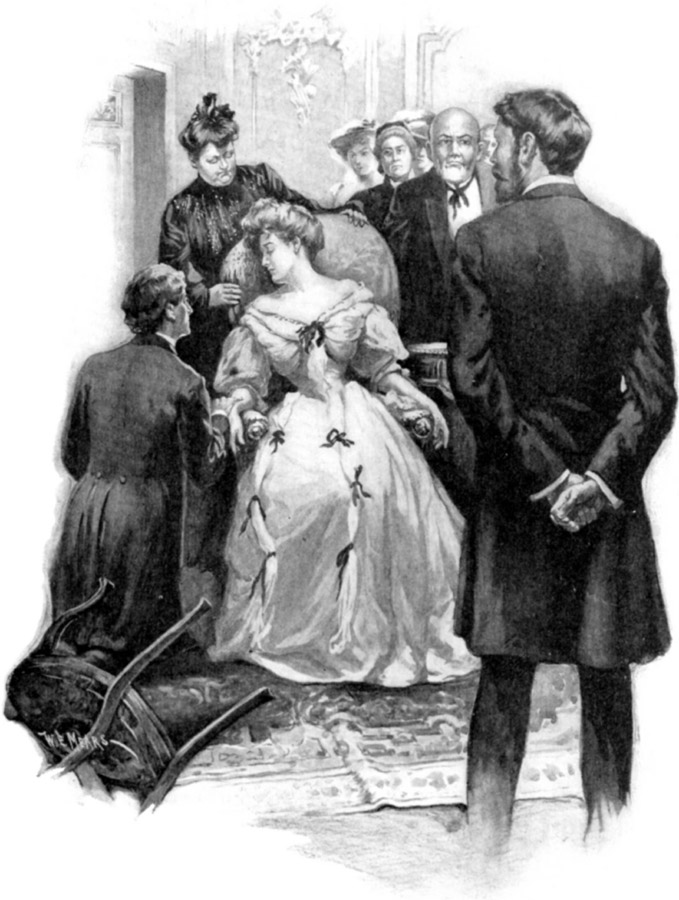
"'WHAT DO YOU MEAN? DO YOU WANT TO KILL THE PSYCHIC?'"ToList
VIIIToC
KATE'S INTERROGATION
Kate, waiting impatiently in her turn, met him at the door. "Well, did you see her? What did she say?" Her voice rose in excitement, for she perceived unusual gravity in the lines of his face.
"Your 'far country' lies on the borders of hell," he replied, with disconcerting succinctness. "Yes, I saw her—or, rather, the ruin of her."
She recoiled before this tone. "What do you mean?"
He shook himself free of his coat. "She has descended swiftly. She now lends herself to the shallowest, basest trickery."
"I don't believe it. What has happened to make you so bitter?"
"I will tell you presently," he replied, hanging up his hat with aggravating deliberation. "But not here. Come to the library." He led the way and she followed quite meekly, for she perceived in him something new and harsh. She sat quite still while he filled his pipe and lit it, waited until the soothing flow of smoke through its stem had softened his face. He began, sadly: "The girl has gone beyond our interference, Kate; and if she weren't so pretty, if I hadn't seen her when she was wholesome and altogether charming, I would not have wasted this evening on her. To-night's doings were unforgivable."
"Did she give you a sitting?"
"No, but they were in the midst of a séance"—he spoke this word with infinite disgust—"and the usher, mistaking me for an invited guest, thrust me into the very centre of the circle."
"How lucky! I wish I had been there."
"Well, that's as you look at it. When I realized what was going on I wanted to leave, and, I repeat, had the chief actress been an old hag or the usual sloven who plays this game, I would have fled; but she was as beautiful as a statue as she lay there, professedly in deep trance."
"You're sure it was Viola?"
"I wish there were a doubt! Yes, she was there, surrounded by a group of Pratt's friends, giving a performance." This word, too, expressed his contempt, his pain. "She went the whole length—lent herself to the cheapest kind of jugglery, playing with horrible adroitness upon the emotions of a lot of bereaved men and women. It was revolting, Kate. It shakes one's faith in humanity to see such a girl in such a position—and that nice-appearing old mother sat there serene as a tabby-cat while her daughter bamboozled a dozen open-faced ninnies."
"Tell me exactly what happened; I can't share your horror till I know what the girl actually did."
He approached the details with a grimace.
"First of all, imagine a little half-circle of well-dressed men and women, in a big drawing-room, enclosing a girl lying on a low chair under a single gas-jet, and a man standing beside her speechifying."
"That was Clarke, of course."
"Of course. Then imagine the light turned down, and the usual floating guitar—in the dark, of course—and rappings and whispers and the touch of hands—all in the dark. Then imagine—this will make you laugh—some kind of horn or megaphone of tin, that rambled around invisibly, distributing voices of loved ones here and there like sweetmeats out of a cornucopia—"
"You mean the spirits spoke through that thing?"
"That's what they all believed."
"But you don't think the girl—"
"Who else? Some of the voices were women's and one or two were children's. Clarke couldn't do the children's voices."
"I can't believe it of her! Clarke must have done them. He's capable of anything, but I don't, I won't believe such baseness of that girl."
"It hurts me to admit it, Kate, but I am forced to believe that she not only sang through that horn to-night, but that she lied to me. She told me once that she had no voice, and yet 'by request' she sang into that horn, and very sweetly, too, the very song to which she played an accompaniment when Clarke and I met for the first time. The effrontery of it was confounding."
"Maybe there was a confederate."
"That doesn't sweeten the mess very much."
"No, and yet it wouldn't be quite so bad. But go on—what else?"
"Then I was invited by the 'controls'—so Clarke said—to come up and sit beside the medium, which I did, very loathly. It gave me a keen pang to look down on that lovely creature pretending to sleep, knowing perfectly well that she was planning some deep deception."
"You are bitter. What next?"
"I took a seat beside her, determined to see if she really had a hand in the deception. I thought I could prevent anything happening."
"Did you?"
"No. Everything went on quite as briskly as before, and all the while I thought I could see her arms lying limp along her chair—lovely arms they were, too. She isn't poor, you must understand that, Kate; and that really makes the crime worse, for she has not the usual excuse—she is not doing it for her daily bread."
Kate sat like a judge, "Go on. You seized her, of course?"
"Yes; just when the cone was emitting an old man's pompous harangue I laid my hand on her arm. The horn dropped, the circle rose in confusion, and I came away."
"I expected you'd do that. All sceptics do, I believe. But I want to know all that took place. You're so concise. You say the cone emitted a man's voice. Now, how could—"
"It produced the impression of a man's voice. It is easy to deceive under such conditions. The cone was passed from her hand to Clarke's at the proper moments, and, as you say, there might have been a child—"
"You must not infer, Mort—my faith in that girl is at stake. Was there nothing in her favor? Nothing that justified her claim?"
He hesitated and Kate leaned forward in excess of interest. "Go on, Morton, be honest."
"Well, now, as I think of it there was one little thing which was rather curious. I don't know how she or Clarke or any one there should know what we used to call Uncle Ben."
"What? Did you get a message from him?"
"A voice from the megaphone asked for me, and when I requested the name of 'the party speaking,' as Clarke says, it replied with an oily chuckle, exactly like the old duffer, 'It's old Loggy.'"
"It did?" Her voice was sharp with surprise. "Well, now, that is as wonderful as my experience. How do you account for that? How do you account for such things?" she repeated, insistently.
"Clarke must have known—"
"Nonsense. No one outside our immediate family knows of that nickname. Besides, how would he know the way 'Loggy' laughed? I'd forgotten it myself."
"So had I. But what would you say? Would you jump to the conclusion—"
"You are jumping at the conclusion, Mort. If there is one single thing that you can't understand, you must give that girl the benefit of the doubt. What did 'Loggy' say?"
"There you go! You're ready to swallow the whole lump of humbuggery, just because there is one little puzzling plum in it."
Kate was not to be put down. "What did uncle say?"
He submitted. "Nothing else. Like most of those dead folk, he was there just to manifest, not to impart wisdom."
Kate leaned back in her chair and grew thoughtful. "Morton, that was wonderful. No one knew you were coming, no one knew you except those people, and they're from, the other end of the earth—and yet somebody speaks, using a pet name we've both forgotten. Now, I call that a most important thing to dwell upon. How can you, a scientist, overlook it?"
"But you must remember all this happened in the house of jugglery. There is no value in a performance of that kind. There was no test applied. Confederates had full opportunity to come and go. To have weight with me these wonders must take place under conditions of my making, not theirs."
"That's what she wants."
"I don't believe it. Pardon me, Kate, but you've been taken in. Whatever this girl was two years ago, she is now a part of Clarke's scheme, which is to secure a tremendous lot of advertising and then—emit a book."
Kate transfixed him with a finger. "Morton Serviss, there is nothing so convincing as a tone. I know that girl is honest—she may be deceived, she may be made a tool of, unconsciously, by Clarke, but she does not wilfully deceive. I will not let you off with this experience; you must see her in private—talk with her as I did."
"I will have nothing further to do with her or hers," he replied, with determined quiet, knocking the ashes from his pipe. "I have other and better business in the world."
"I don't believe it is better business. Now, wait a moment, I have something to tell of my own evening. While you were gone I 'phoned Uncle Harrison and Aunt Nancy about that debt of my great-aunt—who came to me through Viola to-day; they knew nothing about it, but they set to work looking over her old papers, and found that there was a sealed letter addressed to a doctor in Michigan, and in the letter was a check made out to him and which she intended to send him. Now, what do you think of that?"
"I don't see that that has any necessary connection with your experience this afternoon."
"But it does. I'm sure of it. Auntie felt grateful to this young doctor and wanted to reward him. Morton, it was a big check!" She uttered this impressively.
"Was it? How much?"
"Five thousand dollars."
He faced her with a whistle of surprise. "Well, well! that isn't so amusing. Are we to pay it? Is that the idea?"
"If I am sure—if the letter is what they 'phoned it to be, we've got to pay it, I'm her sole legatee, and she was very angry because it hadn't been paid; but that's not the really important part. How did Viola Lambert know of that letter—and that check?"
He was deeply impressed, and did not try to conceal it. "That is very puzzling; but it may be a case of mind-reading, which, I believe, the modern psychologists admit has been proved." He began to muse. "It may be, as Weissmann says, that there is always some basis for a claim such as Clarke makes for this girl. It may be that she has a faculty for reading what lies in the brain of another—"
"Morton Serviss, you shall not condemn that girl unheard. You have taken Britt's word about her, and you've listened to my story, but you must see her yourself and talk with her alone, so that she will be free to tell you just how she feels."
"No. I am going to bed and try to forget the whole disconcerting group."
"That's the way with you scientists. You'll pursue the tail of a comet—or a germ—till you're black in the face, but when something really important to the human race comes under your nose you can't see it."
"You're forceful but not elegant, sis."
"I'm out of all patience with you."
He laughed. "Good-night."
"I hope that girl's face will haunt you," she replied.
It did. From the moment he turned off his light his mind leaped into the most restless activity. Taking up the scroll of the night's events, he read and reread it with minutest care. A voice seemed to present the girl's case, arguing that she had no conscious part in the manifestations. "It is possible for one in deep trance to rise and manipulate horns, bells, and guitars at the suggestion of another precisely as a somnambulist walks without intention of wrong-doing, without conscious knowledge of what is being done. She might have had a veritable hand in to-night's drama and still be innocent. Hypnotism is now pretty thoroughly proven—and to Clarke you must look for the real offender.
"The human brain, which is marvellous enough when in health and singing merrily forward like a cunningly constructed and jewelled time-piece, becomes, in disease, as baffling, as hopeless of solution as the laws of the unfathomable sky. Beyond the utmost sweep of the imagined lies the marvel of fact. The beliefs, the vagaries, the hallucinations of the insane have never been co-ordinated, perhaps they never will be. It is possible that this girl, so normal in appearance, has a rotten strand in her—some weakness inherited from her father. This is the only way in which to account for her glowing physical health and her manifest mental disorder. She has her father's mind in a body drawn from her mother. One-half of her is pure and sweet and girlish, the other is old, decayed, lying, and irresponsible. Can she be reclaimed?
"It is now known that the conscious mind is but a pin's-point of the mind's activity, the conscious state being but one of an infinite number of possible states—that the submerged, unconscious self is a million times more complex than the chain of those conscious states which makes up the normal or orderly life of an individual. May it not be that this girl, by reason of her long practice of submission—induced by others—has dethroned her conscious, higher self, making of her subliminal self a tyrant? This submerged self, holding, as it does, all the experiences of the dark past, all the lusts, deceits, and subterfuges, all the cruelties and shameless potentialities of her animal and semicivilized forebears, and being but a mass of discordant impulses—states almost entirely disassociated from her conscious life—has all but taken possession of her higher self. The restraint of the later-developed, governing, moral self being weakened, the witches and wolves are leaping forth to vex and destroy. Over this fortuitous subversion of her soul's kingdom Clarke now rules like a demon councillor.
"Considered in the light of a study in morbid psychology, her case is enthralling. From the standpoint of human pity this use of her is a diabolical outrage. Suppose Kate to be right—suppose the girl has awakened to a full realization of her danger? Suppose that her cry for succor is real, can I, can any man who hears it, refuse to heed? Would I ever sleep in peace again?"
He went further, he admitted that her beauty was the deciding element. "She is too lovely to be left to a fanatic's designs. She has matured in body, grown more womanly, since we rode the trail together; may it not be that her mind, maturing even more rapidly, has come to perceive the crumbling edge of the abyss before it stands and turns to science as the only rescuer? No matter what her past deceptions have been, is it not my duty to help her?"
His anger and contempt dissolved into compassion. He recalled her youth, her inexperience. "I will at least see her again," he decided, deep in the night. "I will talk with her. I will draw her out. I will study her. All will depend upon her attitude towards me and towards her own soul." And in that softened mood sleep came to him.
IXToC
VIOLA'S PLEA FOR HELP
Morton went to his work next morning quite unfitted for an especially delicate piece of dissection which he had in hand. He bungled it, and Weissmann transfixed him with a glare of disapproval. "My boy, these social gayeties do not consort well with science."
The young man smiled to think how wide of the mark his chief was. He held up both hands. "I swear, it shall not happen again." Then, moved by a desire to secure a comment on the curious phenomena of the séance, he related the story of his brief interview with his uncle Ben's ghost. "Now, do you suppose that Clarke, or the 'medium,' could dig around among the dusty, forgotten lumber of my mind and get hold of a queer fact like that nickname?"
"Why go so far round?" inquired Weissmann. "Why not say it was your uncle Ben who spoke?"
"You are joking."
"I am not joking. If the facts are as you say, then one explanation is as reasonable as the other."
Serviss was amazed. "You don't really mean it!"
"If you say it was an illusion of the sense of hearing, I agree; but do we not stagger among illusions? Who so well as we know the illusory nature of every fact? Nothing is stable under our hands. Of what avail to reduce the universe to one substance, as the monists do? We pry, we peer into that substance—it fades like smoke. Forty years I have probed among the cells of the body—the final mystery remains insoluble. Why? Because the atom, the thing once demonstrated 'the final division of matter,' is itself an illusion, made up of the intangible and the imponderable. This I have given my whole life to discover. Life is an illusion—why not death? Shall we dogmatize, especially on the one thing of which we know nothing? The spirit world is unthinkable, but so, at the last analysis, is the world of matter."
The young man, believing this to be only the mocking mood of one who knew the argument of the dualists better than they knew it themselves, remained silent, and Weissmann composedly resumed: "The dogmatism of Haeckel is as vain as the assumption of Metchnikoff. We shall forever discover and forever despair. Such is the life of man."
When he went home Morton found a note from his sister saying that she had received a message from Viola and that she would be at home at five. "Now don't fail to go. I have to pour tea for Sally, or I would go with you. I'm crazy to see the girl again. I spent the morning talking the whole thing over with Doctor Safford. She thinks as I do, that the girl is exactly what she claims to be, a medium, and that while it is her duty to go on, she ought to be protected from the vulgar public. We both want you to take her in hand. Certainly there ought to be no disgrace in standing as interpreter between the living and the dead. Isn't it just our foolish prejudice? If the girl can bring messages from the other world, she ought to be honored above all other women. Seriously, Morton, her plea the other day wrung my heart. I don't want you to get too interested in her, of course, but what we call a disease may be a God-given power. Think of the way we run after a foolish, vulgar woman who has married into millions, and then think of the way we sniff at this girl because she has some gift which science doesn't understand. If one teenty, tiny bit of what they claim about her is true, science ought to cherish her. As Marion said, if she had discovered a star so far off and so faint it wouldn't matter in the least to any one but a few cranks whether it existed or not, she would be honored all over the world; but as she claims to have discovered something vital to every human soul, she is despised. It is your duty to help her. I had her over the 'phone just now, and her voice was trembling with eagerness as she said, 'Do tell him to please come and see me.'"
This note, so like his sister, so full of her audacities, touched Morton on the quick. It was plain that she was more than half-seas over towards faith in the girl, and quite ready to take her up and exhibit her among her friends. Her use of the word "disease" was intended as a mockery of his theories. He knew that she was quite capable of talking over the 'phone precisely as she had written (reserve was not her strong point), and that she had undoubtedly given Viola reason to expect him. However, having concluded on his own account to see her once more, Kate's exhortation merely confirmed him in a good intention, "I will confront Clarke, and try to pluck the heart out of this mystery, but I will keep clear of any personal relation with the girl and her mother," he said, as if in answer to his sister's admonition.
It was about five o'clock of the afternoon as he again mounted to Pratt's portico, recalling, as he did so, the dramatic contrasting scenes of the evening before—on this side of the brick wall a communion with the dead, on that the throbbing, gay life of a ballroom. Truly a city street was a microcosm.
A solemn-visaged colored man—not the officious usher of the night before—took his card and led him into a gorgeous, glacial reception-room on the left. The house was very still and cold and gloomy, for the day was darkening and the lights were not yet on. It impressed him as a vast and splendid tomb, and with a revived knowledge of Simeon Pratt's tragic history he chilled with a premonition of some approaching shadow. "What a contrast to the sunlit cabin of the Colorow!" he inwardly exclaimed, and the thought of the mountain girl housed in this grim and sepulchral mansion deepened his wonder.
A gruff voice above inquired: "Who is it? Let me see the card. Serviss, eh? Tell him—No, wait, I'll go down and see him myself."
Morton smiled grimly, realizing perfectly the manner in which Pratt had intercepted his card. "The old watch-dog," he exclaimed.
A heavy tread descending the stairs announced the approach of his host, whose sullen face was by no means engaging as he entered. "Are you Professor Serviss?"
"I am."
The flabby lips curled in scorn. "You are one of those scientific gentlemen who know it all, aren't you?"
"I sent my card to Miss Lambert," replied Serviss, with cutting formality.
Pratt's face darkened. "I am the master of this house."
"But not of your guests, I hope."
"I have a right to know who calls, and I intend to protect Miss Lambert from such as you. You were not invited here last night."
"Not by you, I admit. I owe you an explanation for that. I came to call on Miss Lambert. Your man shouldered me into the room before I knew what was going on. I didn't intend to 'butt in,' as they say. I was afterwards invited forward by Mr. Clarke, as you will remember, and later by the 'control.'"
"Clarke is not running things here."
"Ah, but the spirits? Would you question their judgment? They insisted on making me the guest of honor, you will remember. They played to me, you may say."
Pratt was daunted by his visitor's mocking tone. "You should have had more sense of honor than to grab the medium the way you did."
"Being invited to sit near, I took it as an invitation to make a test. I wanted to know who held that horn. How can you hope to convince a sane mind of the truth of such an exhibition as that last night unless you permit tests?"
The colored man had returned. "Miss Lambert will see you, sir. This way, please."
For a moment Pratt meditated interference, but something in the movement and face of the visitor deterred him. As Serviss followed his guide up the great stairway, he asked himself: "What will she be like? She must be changed—deeply changed. How will she meet me?" He acknowledged a growing excitement.
She met him so simply, so cordially, with such frank pleasure, that his own restraint gave way at first glance. In her glowing color, in the tones of her voice, lay a charm which carried him back to Colorow, linking the mature and splendid woman with the unformed girl of the mountain-cabin. He took her hand with a keen thrill of admiration—whatever had come to her she had gained in grace without apparent loss of sincerity.
His eyes disturbed her, and she stammered some commonplace expression of pleasure, and he replied almost as lamely, then turned to the mother. "I hope you have forgiven me for my action of last night?" Then again to Viola. "I only intended to touch your arm. I trust you suffered no lasting ill effects."
Again something that was at once attraction and repulsion passed between them. She perceived in his tone a note of mockery, involuntary in its expression, but all the more significant on that account.
"I am sorry you were there," she quickly replied. "I don't blame you. No, it did not hurt me—I mean, it was all over in half an hour. The contraction is very painful while it lasts. It's just like a cramp. I didn't intend to give the sitting, but Mr. Pratt requested it for a few of his friends and I couldn't well refuse. I didn't know you were there till mamma told me afterwards. There is no value in such a sitting to you."
With a dim suspicion of her wish to cover some deception, he answered: "My entrance was quite as unpremeditated, I assure you." He spoke with returning humor. "I really came to call upon you, to welcome you to the city and to talk of the West. The usher mistook me for one of the seekers and thrust me bodily into the circle. Please believe that I acted upon sudden impulse in seizing your wrist. I am heartily ashamed of myself. I was an intruder, and had no right, no excuse—although your 'guides,' as you call them, seemed eager to have me sit beside you."
"I do not blame you," she repeated, and fell strangely silent.
He studied her with mounting pleasure. The flower-like line of her lips, her glorious bosom, the poise of her head, all the lines that had meant so much to him at their first meeting, were there, more womanly, more dangerous in their witchery than ever. For two years their thoughts had subtly crossed and intertwined, and she now felt his doubt, his question, almost as keenly as if he had uttered them.
He broke the momentary silence by saying, with a distinctly tender tone, "Are you thinking of Colorow? I am."
She flushed and started a little. "Yes."
"I was recalling my first view of you—a fragment of sunset cloud caught on a mountain-crag."
Her face grew wistful. "That seems a long time ago to me."
"It doesn't to me. It seems but yesterday. My trip that year was a symphonic poem with a most moving final movement. I have thought of it a thousand times." He paused a moment, then added: "Well, now, here you are in New York, and here I am, and what of your music? I was to advise you, you remember."
Her head lifted in defiance, an adorable gesture. "You know my secret now." It was as if she said, "Come, let us have it over."
He replied, very gently; "I knew something of it then. Dr. Britt told me something of it at the time."
Her eyes bravely searched his. "Was that why you did not come to say good-bye to us?" His glance fell in a wish that she had been less cruelly direct. She went on: "You needn't answer. I'm used to being treated that way. I knew somebody had told you I was a medium. You despised me when you found out about me—everybody does, except those who want to use me. All the people I really want to know go by on the other side as if I were a leper. It was so in Boston; it is going to be the same here."
Mrs. Lambert interposed. "That is not true, Dr. Serviss. We met many nice people in Boston."
"Yes, mamma—nice people who wanted me to tell their fortunes."
Her tone went to Serviss's heart. She was so young to be so bitter; but he could think of nothing at the moment which would not add to her chagrin, for was not his own interpretation of her quite as hard to bear?
She went on: "No, I don't blame you or any one for avoiding me. But I wish they would let me have one or two friends. But they won't. Lots of people like me at first, but they surely find out after a while, and then they change towards me. Sometimes I think I might as well publish my name as a medium and let everybody know it at once."
"You must not permit that, Miss Lambert," he earnestly said. "That is what I came to say. Don't allow them to use you so."
"How can I help it?" she passionately exclaimed, "when they all demand it—mother, Mr. Clarke. Mr. Pratt, grandfather—everybody. They think I owe it to the world."
"I don't. I think it is your right to say—"
"I have no rights. Listen." She leaned towards him, her face paling, her eyes big and soft and terrified. "I want you to understand me, Dr. Serviss. You must know all about me." Her voice fell to a husky murmur. "You must know that I can't direct my own life. My 'guides' can do what they please with me. Can you understand that?"
"I confess I cannot."
"It is true. My grandfather insists on these public tests. He is determined to 'convict the men of science,' and Mr. Clarke is only too glad to agree with him. Mother is controlled entirely by what grandfather says. My wishes don't count with anybody. But I think I've done my share in this work." She faced her mother in challenge and appeal. "Ever since I was ten years old I've given myself up to it; but now I'm afraid to go on. I don't want to be a medium all my life. They all say it is hard to change after one is grown up, and I'm afraid," she repeated, with a perceptible shudder.
The mother, undisturbed by this plea, turned to Serviss with an exultant smile. "Does she look like one breaking down?"
The girl rose from her chair like a tragedienne. "It isn't my body, it's my mind!" she cried, with poignant inflection, clasping her head with both her hands; and her look transformed her in the eyes of the young scientist. It was the tragic gaze of one who confronts insanity and death at a time when life should be at its sweetest. For an instant she stood there absorbed in her terror, then dropped her hands, and in a voice of entreaty, which melted all his distrust, hurried on. "I want to know what is going on in my brain. I am losing control of my self! I want some man of science like you to study me. Your sister said you would help me, and you must! You think I deceive—you thought so last night—but I don't. I knew nothing of what went on. I didn't know that you were there. I don't know what I do nor what I am. I want you men of science to investigate me. I will submit to any test you like. You may fasten me in a cage, or padlock me down—anything!—but I will not be advertised to the world as a medium, and I must have rest from this strain. Don't you understand? Can't you see how it will be?"
"I do," he answered, quickly. "I understand perfectly, and I will go at once to see Mr. Clarke and intercede—"
"That is not enough. You must intercede with my grandfather and his band, they are the ones who control me. Ask him to release me."
This request staggered the scientist. "My dear Miss Lambert, you will pardon me, but I can't do that—I do not even believe in the existence of your grandfather."
She stood in silence for a moment and then answered; "You would if his hands were at your throat as they are at mine. He is just as real to me as you are. He is listening this minute."
"That is a delusion."
"I wish it were," she bitterly and tragically answered. "The hands are so real they choke me—that I know. I am helpless when he demands things of me. He can lead me anywhere he wants me to go. He can use my arms, my voice, as he wills. You must believe in him to help me. He will listen to you, I feel that." She grew appealing again. "Your sister believes in me—I am sure of that—and my heart went out to her. Sometimes it seems as if all the world, even my own mother, were willing to sacrifice me."
"Viola!" cried Mrs. Lambert, sharply. "You shall not say things like that."
"They're true. You know they're true!" the girl passionately retorted. "You all treat me as if I had no more soul than a telephone."
"That is very unjust," declared Mrs. Lambert. "This is only one of her dark moods, doctor. You must not think she really means this."
The girl's brows were now set in sullen lines which seemed a profanation of her fair young face. "But I do mean it, and I want Dr. Serviss to know just what is in my heart." Her voice choked with a kind of helpless, rebellious anger as she went on: "I'm tired of my life. I am sick of all these moaning people that crowd round me. It's all unnatural to me. I want to touch young people, and have a share in their life before I grow old. I want to know healthy people who don't care anything about death or spirits. It's all a craze with people anyway—something that comes after they lose a wife or child. They are very nice to me then, but after a few weeks they despise me as the dust under their feet—or else they make love to me and want to marry me."