BOOK II (continued 3)
Reading edition
Mrs. Lambert rose. "I will not allow you to go on like this, Viola. I don't understand you to-day. You'll give Dr. Serviss a dreadful opinion of us all."
"I don't care," the girl recklessly replied, "I am going to be honest with Dr. Serviss. I don't like what I do, and I don't intend to trust my whole life to the spirits any longer. They may all be devils and lying to us. I don't believe my own grandfather would be so cruel as to push me into this public work."
Mrs. Lambert again warned Serviss from taking this outburst too seriously. "She is possessed, doctor. Some bad spirit is influencing her to say these things to you. She's not herself."
Viola seized on this admission. "That's just it. They've destroyed my own mind so that I don't know my own thoughts. If there are good spirits, there must be bad spirits—don't you think so, Dr. Serviss?"
His eyes did not waver now. His voice was very quiet, but very decisive, as he replied: "My training, my habit of thinking, excludes all belief in the return of the dead either as good spirits or bad, but if there are spirits I should certainly think evil of them if they were to force you into a service you abhor. I do not pretend to pass judgment on your case—I know so little about it—but I do sympathize with you. I deeply feel the injustice of these public tests, and I will do all I can to prevent them."
Mrs. Lambert interrupted: "But, Dr. Serviss, my father's advice has always been good; to question it now would be to question my faith. His wish is my law."
Serviss shrugged his shoulders a little impatiently. "My dear lady, we have no common ground there. The wishes of the dead have no weight with me when set against the welfare of the living. The question which I beg you to consider is whether you wish your daughter to continue in this mental torture? Do you want her name blazoned to the world as a public medium? You cannot afford to add disgrace to her private torment."
The mother held her ground. "Her 'guides' say she will be taken care of, and as for the disgrace, that is all imaginary. It is an honor—"
Viola again burst forth: "They are always talking to me about the honor of being a medium, about the distinction of it, and when I ask what distinction the world gave to the Fox sisters or Home or Madame Cerillio, they answer that the world has changed since then. But it has not changed enough to make my work respected. Mr. Clarke says it ought to be; but saying so does not make it so. Every time I read of a medium exposed I turn cold and hot, for I know people consider all mediums alike. I don't want to go about all my life like an outcast. I don't want to be happy after I'm dead; I want to be happy now. I don't want to be different from other girls; I want to be like them. If they publish me, I will be a medium forever. I will be in constant terror of attack, and that will drive me insane—they must set me free! Dr. Serviss," she pleaded, as if she were the victim of some murderous design, "you are wise and strong. There must be some way for you to help me."
All of Serviss's well-ordered sympathetic phrases failed him as he listened to the storm of her plea and felt the flame of her passionate protest. All doubt of her sincerity, her own honesty, vanished, being utterly burned away by the light in her lovely eyes. Her mental bondage was real, her desire to escape contamination indubitable. He met her gaze with tender gravity. "I believe in you," he said, as if committing himself to a most momentous enterprise, "and I will help you."
His voice, so manly, so strong, so tender, robbed her of the power to speak. She seized his extended hand in both of hers and pressed it hard, the tears in her eyes veiling her soul from the passion that filled his glance.
As she faced him thus, leaning to him trustfully, so vivid, so magnetic, so much the woman, so little the sibyl, that he forgot all his hesitations and doubts, filled for an instant with an irrational impulse to seize her, claiming her as his own, in defiance of the mandates of her world and the conventions of his own. But she dropped his hand and turned away, and he went out in a maze of conflicting desires, his judgment sadly clouded by the youthful riot in his blood.
At the moment he was in love with her and single-minded in his desire to aid her, to defend her, but the door had hardly closed behind him when his questionings, his suspicions began to file back, stealthily, silently, along the underways of his brain. Her distress began to seem a little too theatric, her troubles self-induced—all but one—madness did in very truth seem to hover over her, a baleful, imminent shadow.
Clarke, looming darkly, confronted him in the lower hall. "Well met, Dr. Serviss. I'd like a word with you."
"I have a request to make of you," responded Serviss. "Miss Lambert has expressed to me her great distress of mind as concerns the public tests you are planning and has asked me to intercede for her. She profoundly objects to the use of her name, and I ask—"
Clarke's voice was harsh and sullen as he interrupted: "I have considered her objections and find them insufficient."
Serviss's voice rose slightly. "Her lightest objection should be insuperable. I don't understand your point of view. I can't see by what right you ignore the wish of the human soul most vitally concerned in your crusade. You treat her as if she were a rabbit dedicated to the use of a biologic laboratory. I am better informed now than when we met in your church-study, Mr. Clarke. I know, not merely Miss Lambert's secret, but your own. It may be that you honestly think this challenge will confer great distinction upon her, but, let me assure you, it will put an ineffaceable stain upon her. Furthermore, your tests will end in disaster to yourself and to your cause."
"What do you mean by that?" interposed Pratt, who had come up and stood listening. "Do you doubt her powers?"
"I do. She will fail, and the failure will be crushing. The thing you claim is preposterous. Every time science has taken one of your mediums in hand he or she has suffered extinguishment. It is the grossest outrage to ask this girl to face certain exposure. A challenge of this blatant kind will rouse the most violent antagonism among scientists, and if you succeed in getting any really good man to take it up—which I doubt—he will be merciless."
"We want him to be," declared Clarke. "We glory in your defiance. Let your scientific men come with their bands of steel, their bolts and bars, their telephones, and their electric traps. We defy every material test."
"You are fools—madmen," hotly answered Serviss. "You would sacrifice this girl to a brazen scheme of self-advertising?"
Clarke was contemptuous. "That is your point of view. From our side there is no greater glory than to be an Evangel of the New Faith. What matters the comment of the gross and self-satisfied to us who work for the happiness of those who mourn? The world in which we live despises the materialism of yours."
At this moment a new conception of Clarke's plan crossed Serviss's mind. "He is deeper than I thought. He would discredit the girl in the eyes of normal suitors, thereby assuring her to himself." Aloud he said: "Miss Lambert's right to herself should be your first consideration. She is something more than a trumpet for sounding your fame."
Clarke's resounding voice had drawn Mrs. Lambert from her room, and she now hurried down the stairway with intent to calm him.
Serviss turned to her. "Again I beg of you, Mrs. Lambert, to consider well before you consent to this plan. Your daughter's name will be a jest from one end of the country to the other. It doesn't matter how sincere and earnest you are, the public will regard this challenge as a seeking for notoriety. Your daughter is about to be flung to the beasts." Seeing something unyielding in her eyes, he added, with such intensity his own heart responded: "Will you stake your daughter's reputation, her health, her reason, upon the issue of a voice in the dark?"
"Yes, when the voice is that of her own father. He knows the future. He will protect her. I have no fear."
There was such conviction, such immutable faith in her gentle voice, that Serviss was confounded. When he spoke, in answer, his voice was lower in key, with a cadence of hopeless appeal.
"How do you know these advisers are your husband and your father? You must be very certain of them."
"I am certain. I believe in them as I believe in my own existence." The line of her mouth lost something of its sweetness, and Serviss, seeing this, took another tack.
"Granted these voices are genuine, they may be mistaken—rash with zeal. You wouldn't say that they have gained infallibility—a knowledge of both past and future—merely by passing to the shadow world?"
To this Clarke made answer: "That is precisely what we do believe. They have predicted our future, they have laid out all our plans. Their advice has brought us to our present high place, and we shall continue in our course, despite you or any other doubter."
"They have brought you to a very dubious sort of success," Serviss cuttingly replied, "But what about your victim? I know this city and its ways. I realize, as none of you seem to do, the wasting injustice you are about to inflict. Let me intercede—let me arrange some other plan—"
On Clarke's face a sneering, one-sided smile crept as he answered: "You are too late. Our plans are made, our programme published."
"What do you mean?"
"The reporters have just been here. The notice of my speech and a broad hint of the nature of my challenge will appear in four of the leading papers to-morrow morning—"
"But Viola's—Miss Lambert's name! You surely haven't used that?"
"Oh no. That is to follow. The challenge, with her name and defiance, form the climax to my oration." He swelled with pride as he spoke, as if visualizing himself on the platform, the centre of thousands of eyes, the champion of reviving faith.
"Thank God for your vanity! There is still time for some one to intervene," responded Serviss, minded to thrust him through.
Pratt shouldered in again. "What have you got to do with it, anyway? Who asked you to interfere?"
"The chief person concerned—Miss Lambert herself."
Pratt was about to utter some further insult when Clarke diplomatically interposed. "We want you to have a part in the work, Dr. Serviss. We will welcome you to a committee of investigation, but we cannot permit you to interfere with our plan. The 'Forces' are bent on the work, and they are inexorable."
"It is you who are inexorable," replied the young scientist—"you and this deluded mother."
This rapid dialogue had taken place in the wide hall just beneath the huge chandelier whose light fell on Serviss's white forehead and square, determined face. Pratt was confronting him with lowering brow, a bear-like stoop in his shoulders, and the muttering growl of his voice was again filling the room as Viola appeared upon the great stairway. She came slowly, with one slim hand on the railing, as though feeling her way, and at every step mysterious, jarring sounds came from beneath her feet and from the walls; her eyes were shut, her chin lifted, and on her face, white and tense, lay the expression of a sorrowful dreamer. Her mouth, drooping at the corners, was pitiful to see. All her vivid youth, her flaming rebellion, had been frozen into soulless calm by the implacable powers which reigned above and beneath her in the dark.
In horror and fierce, impotent rage, Serviss watched her descend. It was plain that she was again in the grasp of some soul stronger than herself; and he believed this obsession, close akin to madness, to be due to a living, overmastering magician—to Clarke, whose voice broke the silence. "There is your answer!" he called, and his voice rang out, with triumphant glee. "Her 'guides' have brought her to show you the folly of human interference. She is only an instrument like myself—clay to the hands of the invisible potters."
Once again a flaming desire to seize the girl with protecting hands filled Serviss's young and chivalric heart; but a sense of his essential helplessness, a knowledge of his utter lack of authority, stayed his arm, while his blaze of resolution went out like a flame in the wind. Sick with horror, he stood till Mrs. Lambert took Viola in her arms, then, in a voice that shook with passion, he said: "Madam, your faith in your spirits passes my understanding. Only devils from hell would demand such torture from a blithe young girl."
And so saying, with shame of his impotence, and with a full realization of Viola's mental bondage to Anthony Clarke, he turned away. "I now understand Britt's words—only the authority of the husband can save her from her all-surrounding foes," and at the moment his fist doubled with desire to claim and exercise that power.
XToC
MORTON SENDS A TELEGRAM
The harsh reality of the outside world was like the hard-driven, acrid spray of the ocean in a wintry storm, it stung yet calmed with its grateful, stern menace. A thin drizzle of rain was beginning to fall, and the avenues were filled with the furious clamor of belated traffic. The clangor of the overhead trains—almost incessant at this hour—benumbed the ear, and every side-street rang with the hideous clatter of drays and express-carts, each driver, each motor-man, laboring in a kind of sullen frenzy to reach his barn before six o'clock, while truculent pedestrians, tired, eager, and exacting, trod upon one another's heels in their homeward haste.
This tumult of turbulent, coarse, unthinking life seemed at the moment not merely normal but wholesome and admirable by force of contrast with the morbid, unnatural, and useless scenes through which he had just passed. Better to be a burly, unreflecting truckman than a troubled, unresting soul like Anthony Clarke, "Yes, and better for Viola Lambert to be the wife of one of these rude animal types, suffering a life of physical hardship, than to continue the sport of a man who, having lost the true values out of his own life, is remorselessly distorting those of the woman he professes to love."
His mind then went back, by the same law of contrast, to his momentous ride across the Sulphur Spring trail. "To think on how small a chance my share in this girl's singular history hangs! Had I taken 'the cut-off,' as my guide suggested, had I camped in the log-cabin at the head of the cañon, or had I saddled up the next morning and ridden over to Silver City, as I had planned, we would never have met; and I would not now be involved in her hysterical career."
But he had done neither of these things. He had camped in the town, he had sought her, and in this seeking lay something more than chance. His second meeting was an acknowledgment of his youth and her beauty. She had held him in the village day by day, because she was lithe of body and fair of face and because her eyes were unaccountably wistful. Yes, he had sought her that night when the river sang with joyous, immemorial clamor, and the lamp beckoned like a hand. He had gone to her for diversion—that he now acknowledged—and he had grown each day more deeply concerned with her life and its burdens.
And now here she was at his door, more dangerously enthralling than ever, involved in a snare of most intricate pattern, calling upon him through some hidden affinity of their natures as no woman had ever called him before—calling so powerfully, so insistently, that to save her from her peril, as pressing as it was intangible, seemed the one and only task at his hand.
In this mood, sustained by the memory of her anguished face, he sent a telegram to Lambert, urging him to come at once to the relief of his wife and daughter.
He did not appreciate the full force of this act until he left the office and resumed his walk homeward. Then, like a shock from a battery, came the realisation. "I have now definitely intervened; but how weakly, how ingloriously!"
This thought grew less agreeable and more humiliating as he dwelt upon the possible consequences. "Will Lambert remember me? Will he take my warning to heart?"
In imagination he followed the small envelope as it passed to the hand of a messenger and started up that fearsome, splendid trail towards the mill. The world was stern and cold and white and still up there in the Basin—winter yet reigned in majesty and the pathways were deep sunk in heaped and sculptured snows.
Up to the half-buried office the courier would ride, and with a cheery halloo call Lambert to the door. What would he think upon receiving such an imperative summons from a stranger? "Did I make the situation clear? He may imagine that some dire physical disaster has overtaken his women. But that would be true. Their peril is none the less real because intangible, and yet my part in it may not seem either wise or manly."
In truth every step towards his own door removed him an emotional league from the scene in the hall, and as the throb of Viola's agonized voice died out of his ears the crisis in her life grew hysteric, unsubstantial, and at last unreal. Her gestures, her plea for help, her descent of the stairway, came to seem like the climaxes in a singular drama powerfully acted. "God! what an actress—if she is an actress!" he exclaimed, as the tragic intensity of her face returned upon him.
He passed from this to the next phase of his development. In a certain good-humored way he had accepted his friend Tolman's theories of hypnotic control, but had never taken them into serious account till this moment. He was forced now to admit the entire truth of "suggestion" or to charge this girl, whose character so bewitched him, with being an impostor. She was either a marvellous artist in deception or Clarke controlled her through some sinister and little-understood law of the mind. What else could have brought her creeping like a somnambulist down the stairway to demonstrate her tormentor's demoniacal sovereignty? And if he could call her to him in such wise, then all the weird tales of the romancers, all the half-mythical doings of Mesmer and Charcot, were true, and the feet of Bulwer Lytton's remorseless lover solidly set upon the rock of fact.
"My school of thought is very exact and very dogmatic. It prides itself on not looking beyond its nose. There is no room in our text-books for this girl and her claims. But—" He stood on the corner and surveyed the familiar scene, the rushing, commonplace men, the commonplace horses, the commonplace, ugly walls and signs, and for an instant they lost substance, became as shadowy as drifting mist, the men were of no more bulk than phantoms, the walls and pavements but the effluvia of the commonplace perceiving mind. All were as transitory as smoke, as illusionary as the opium-eater's mid-day dream. What did it signify—this mad rush to get round a corner to creep into a hole? Why should he trouble himself about one of the millions of women, evanescent as butterflies, with which the earth continually replenished its swarms of men?
He walked on, eager to return to his own little nest, to his books, his easy-chair, his glowing fire. What folly to go out of his own life, to profess accountability for the welfare of a girl whom he had seen but a few hours in all his life. Why trouble to explain her case? Was it worth while to dethrone Spencer in order to defend the action of a child's disordered mind.
This mood gave way to one far less philosophical—he permitted himself a moment of exultation over his youth. Science had not yet taken out of him the nerves that leap to the touch of a woman's palm—the right woman. Ten years' deep, patient, absorbing dissection of pathologic tissue had not rendered the gloss and glow of a girl's cheek less velvet-soft. On the contrary, the healthy, wholesome flesh, the matured beauty of this mountain maid seemed of more worth than any fame to be wrung from the niggard hands of the Royal Academy. The absorption of the true scientist was completely broken up. "Love is worth while," he said, in answer to himself, "and to serve others the only solace in the end."
XIToC
DR. BRITT PAYS HIS DINNER-CALL
Kate had not returned, and he was glad of this, for it gave him time in which to recover his normal serenity of mind. He met her at dinner with an attempt at humor, but she was not to be deceived nor put off from the main subject. He was forced to make instant report, which he did, leaving out, however, all the deeply emotional passages. He fell silent in the midst of this story—profoundly stirred by the memory of Viola's confiding gesture as she leaned to him, awed by the essential purity of the soul he perceived lying deep in her eyes. How blue, how profound they seemed at the moment!
Kate, if she perceived his abstraction, ignored it. "Well, I hope you agree with me now. Clarke is her control, her black beast."
"Yes; that is the only explanation at this moment, the only solution which leaves her innocent."
"But to admit that is to admit a good deal, Mr. Scientist."
"I know that, Mrs. Precipitancy; but what would you have me do? I don't want to believe the girl a trickster." After a pause he said: "Kate, I never felt less of a man than I acknowledged myself to be as I turned away, leaving her in the clutches of those accursed fanatics."
"Why did you do it?"
"What else could I do? She was entranced—I had no authority. My attempt at a rescue would have created a disgusting scene and put Clarke on his guard. My native caution and my conventional training combined to paralyze me."
Kate, fired with reckless ardor, said, "Let's go and snatch her away—now!"
"No, my second thought is best. Think of what Clarke's arrest would mean to the girl and to us? No, we must wait for Lambert. Clarke at present has all the authority. It won't do to push him. He would instantly trumpet her name to the four winds of heaven if he thought we were about to interfere. If Lambert heeds my warning, he will arrive on Friday, and that will prevent the challenge."
"What sort of person is this Mr. Lambert?"
Serviss pondered, "He's a small, mild-mannered man—not unlike a nice, thoughtful country doctor in appearance."
"I wish he were six feet high, and fierce as his inches," said Kate.
"If he had been that, this preacher fellow would never have been able to run away with his family." He sighed. "Well, he's all we have to conjure with. If he fails us we must resort to craft."
"I wish we could get Viola and her mother here. Would they come to dinner if I should ask them? If we could get them here once we might be able to persuade them to stay."
"That would not save her from the pillory in which Pratt and Clarke design to set her. We must be careful not to anger them. The girl hates and fears Pratt."
"I know she does."
"His air of proprietorship is fairly indecent. We must be especially careful not to rouse him. He has millions to use in asserting his claims, and is as vindictive as a wolf."
Kate sat in silence for a few moments—a very unusual state with her—and at last announced her purpose. "Leave the whole thing to me. We will have Dr. Weissmann, and I will ask Clarke to come to meet you in order to talk over his plans for a committee. I'll just ignore Pratt. He's nothing but an old kill-joy, anyway."
"He's worse than that. Don't brush him the wrong way. We're going to have trouble with him before we are out of this."
"I don't care. I will not have him in my house," responded Kate.
"Very well. He's eliminated. I hope Clarke will permit them to come."
"Oh, they'll come unless Pratt absolutely locks them in their rooms. Shall I ask Marion and Paul?"
"No. I want a chance to talk to our 'psychic' alone."
"Very well. The table just balances, anyway. Now, about your telegram, are you going to speak to Mrs. Lambert about that?"
"No. It is all up to Lambert. He can act or not, as he sees fit. He will probably wire them that he is coming, and as there can be no explanations till he arrives you will please say nothing of my share in the warning."
They had just risen from the table when Britt sent in his card.
"Excuse my calling so early," he began, with tranquil drawl, "but I'm going back to the West to-night. I've got to get out of this climate or join the spooks. I'm thinking of doing that, anyway, just to see what it's like 'round the corner in the 'fourth dimension,' and also because I'd like a change of climate."
"You look well—exceedingly well," Kate cheerily replied.
"You're very good; but I don't feel as well as I look. My poor one lung is working overtime, and a collapse is imminent. I don't see how my beloved brother Clarke bears up. He must get help from the 'other side.' You see, he spent the winter in Boston—think o' that! But it's telling on him. If I wished him well—which I don't—I'd advise him to return to Colorado and to his Presbyterianism by the limited mail."
"Could he do that—I mean go back to his church?"
"I don't suppose he could. You see, he went out under a cloud—took the whole window-sash with him, you might say—and I don't think the elders would welcome his relapse. Furthermore, he has embraced 'spiritism,' as he calls it, with both arms. By-the-way, professor, I've been talking about these psychic matters with Weissmann and others, and I agree with him that you're the very man to go into an investigation of these occult forces."
"And be called insane, as Zöllner was?"
"Oh, well, times have softened since then. Now, really, what do you think of Zöllner's experiments?"
"I wish he hadn't been so eager to demonstrate the fourth dimension—that vitiated everything he did."
"Oh, I don't know. I've been rereading Lodge and Wallace and Meyer. We studied them when I was at college, mainly to click our tongues—'poor old chaps!'" He smiled. "You understand? Of course, I can't go the whole length, but I must say I don't know what you're going to do with the evidence Crookes collected."
"But Slade and Home and the Fox sisters, from whom he drew his 'facts,' were exposed again and again, and one of the Fox sisters confessed to fraud, didn't she?"
"M—yes. But afterwards recanted and re-recanted. They were all a dubious lot, I'll admit. That is why I hate to see a girl like Viola Lambert put in their class by a self-seeking fakir like Clarke."
"Is he self-seeking—or is he only a fanatic?" asked Kate. "I believe him to be quite sincere—that's why he's so dangerous. He is willing to walk hot plough-shares to advance his faith. What are his relations to Viola? Do you suppose she has actually promised to marry him?"
Serviss waited for his reply in such suspense that his hands clutched his chair. Britt's face lost its gleam. "I'm afraid she has—or at least she feels herself 'sealed to him' by her 'controls.'" Serviss rose and took a turn about the room as Britt went on. "You see, this sweet-tempered old ghost McLeod is anxious to have his granddaughter unite her powers with Clarke's in order to 'advance the Grand Cause.' McLeod, it seems, was a Presbyterian clergyman himself here 'on the earth plane,' and has carried his granitic formation right along with him. I've argued with the old man by the hour, but his egotism is invincible."
Serviss faced him abruptly. "Now, see here, Britt. You've seen a good deal of Miss Lambert's performances—what's your honest opinion of them?"
"Frankly, I don't know," he answered, with a smile. "Since rereading Zöllner and Crookes and going over my notes and those of Dr. Randall, I'm a little shaken, I confess. So far as human evidence goes these men prove that there is a world of phenomena ignored by science. I don't go so far as to say that these doings were the work of disembodied spirits, but I do admit that I am puzzled by things which I have witnessed with one sense or another. The things seem to tally in a most convincing way. This girl is repeating, substantially, the same phenomena witnessed by Crookes twenty-five years ago. The singular thing about the whole subject is that one man can't convince another by any amount of evidence. A personal revelation is necessary for each individual."
"Isn't that true of other faiths?" asked Kate.
"No, there's a difference. For example, I would take your brother's evidence as to a new germ; but as to a spirit—no. And yet one is quite as incredible as another. Crookes applied the same methods to the study of these manifestations that he used in his other researches, and piled up a mass of evidence, yet his fellows of the Royal Academy sneered or haw-hawed—and do yet. Do you know, doctor," he continued, "I have moments when I dimly suspicion that we scientists are a thought too arrogant. We lose the expectant mind. We assume that we've corralled and branded all facts, when, as a matter of history, there are scattered bunches of cattle all through the hills. Take Haeckel, for instance. He talks very like the head of a church laying down the law to you and to me as well as to the ignorant outsider. Spencer was a good deal less sure of himself. It takes a physical specialist to be cock-sure. Darwin never professed to solve the final mystery of life or death, but Haeckel and Metchnikoff do. They are so militant against religion that they become intolerant of their colleagues who presume to differ with them on matters that are purely speculative. Any one attempting to discuss new phases of human thought is a fakir. I am not willing to say that all the notions of the 'dualists' are survivals of the age of superstition, as Haeckel does. It may be that in the midst of all their fancies which are survivals there are some subtle perceptions of the future."
Serviss lifted his eyebrows in surprise. "That's a whole lot for you to concede. Weissmann must have been corrupting you."
Britt went on: "We must always remember that every age is an age of transition. We are losing faith in the revelations of the past, but we should not presume to define the faith of the future. Men will not live in the hopelessness which the monists would thrust upon them, they will not patiently wait while Pasteur and Koch and the other germ theorists labor to prolong the life of some other generation. They will always insist on having something to live for and to die for. I don't pretend to say what this faith will be, but it will be sufficing."
Kate exclaimed with glowing eyes: "And all this change in you two men has come about through the influence of a pretty girl!"
The two inexorables looked at each other with a certain air of timidity, and Britt's face expanded in a slow, sly smile. "You've discovered us. We are human, like the rest of our sex, if you catch us out of our laboratories. Theoretically we hold life of no account actually we're all lovers or husbands." A mockery more moving than tears came into his voice. "My hopeless philosophy, dear lady, arises from weak nerves and a poor digestion. I would give all I know of science, all I expect to be in my profession, and all I hope to be after I am dead, for just five years of health, such as Lambert's miners squander in carousals every Saturday night in the saloons of Colorow. I hold with Haeckel in one thing—I believe in a man's right to suicide, and when I find myself of no further use to the sick I shall slip quietly out. I hope I won't have to poison Clarke before I go. I'd do it cheerfully if I thought it the only way to rid that girl of him." Seeing that his hostess was really shocked by these words, he lightly ended: "However, I think such extreme measures unnecessary. I'm going to send Lambert on to kill him for me."
Kate looked at Morton with inquiring eye—he shook his head.
Britt resumed: "I am trusting in you, Serviss. If I could be sure of living two weeks longer I would stay and help, but money and breath are now vital to me, and I must go. However, I'm perfectly willing to put Clarke out of the way if you advise it. He really ought to die, Mrs. Rice," he gravely explained as he rose to go. "He is a male vampire. To think of him despoiling that glorious young soul maddens me. I am the son of a coarse, powerful, sensual, drunken father; but he neglected to endow me with his brutal health. My mother was an invalid; therefore, here am I, old and worn out at forty—that's why I worship youth and beauty. Health is the only heaven I know, and that is denied me." Here his smile died, his eyes softened, and his face set in impenetrable gravity. "Had I the power I would keep Viola Lambert forever young and forever virgin." Then, with a quick return to his familiar drawl: "But I am going away without even killing Clarke, to plod my little round in Colorow and wait news from you. If I do not see you again, Mrs. Rice, keep me in mind. I make the same promise your husband made—I will 'manifest' to you if I can."
"I would rather you came in the flesh," she replied.
He bowed deeply. "I thank you both for a very satisfying glimpse of a civilised home."
"Sometimes I think we're over-civilized," she replied, quickly. "But come and see us again."
"I fear it will be as a spook—they laugh at microbes as well as locks. However, I promise to rap when I call."
"Thank you, that will make you a most considerate ghost."
When they were alone together Kate said, with a sigh: "What an amount of sin and sickness and trouble and death there is in the world!"
"That's a sign we're getting on," he replied. "When we're young we laugh at the falling leaves—they are only a sign of some new sport. When I'm as old as you are I suppose I'll begin to observe all the bald-heads at the theatre."
"Well, now, for our dinner-party. I must write to Mrs. Lambert to-night."
"You'd better take second thought about this matter—'Reckless Kate.'"
"I have."
"Take a third. Consider this—the girl may go into a trance at the table."
"Oh, if she only would! My fear is she'll be like other amateur performers—'subject to a cold' or something. These gifted people are so often disappointing."
"Now, see here, Kit, seriously, if you invite Miss Lambert to our house it must be as any other charming guest—"
"You didn't suppose I was really going to ask her to spookle?" she indignantly answered; then added, with a smile: "Of course, if she insists on reading my palm—or—any little thing like that, it wouldn't be nice to refuse, would it?"
"I knew it! You have designs upon her. Don't do it. It would be too gross after your protest against others for using her. She herself complained bitterly of just this treatment. You must not even speak of her powers."
She lifted her hand solemnly. "I swear!"
"I mistrust you even when you swear," he ended, doubtfully. "There's a tell-tale gleam in your eyes."
And at this moment of banter they both lost their sense of the girl's imminent peril and thought of her only as a most entertaining possibility as a guest.
XIIToC
VIOLA IN DINNER-DRESS
Viola glowed with joy over Kate's invitation to dinner, and, flying to the telephone (as she was requested to do), accepted without consulting either her mother or Clarke, and fell immediately into wonder whether she possessed a gown becoming enough to fit the golden opportunity.
Mrs. Lambert was also pleased, but at once said, "I hope Tony will feel like going."
Viola resented the implied doubt of their own acceptance. "I am going, anyhow. I will not be shut up here any longer like a convict. I like Mrs. Rice very much, and I want to see her house. I know it will be just as nice as she is."
"But we can't go without Anthony, my dear."
Clarke came to the door a little later to say that he had received Mrs. Rice's invitation, but that he did not care to feed the curiosity of such people. "You would better plead a previous engagement," he added to Viola.
"I'll do nothing of the sort," she indignantly answered. "Indeed, I've already accepted. You needn't look black—I'm going," she added, in pouting defiance.
Something in her look as well as in her tone convinced him that wisdom lay in not attempting to restrain her, therefore he gave assent, gloomily and with a sense of loss. "I don't know how Pratt will feel about it. He don't like those people, and, besides, he has invited some friends in to see you this evening."
"He said nothing to me about it," Viola responded, curtly, "and, besides, how can he expect me to be always at his command? He is not my jailer. I'm tired of his demands, they are so unreasonable."
Mrs. Lambert, as usual, entered to soothe and heal. "Viola's been very good about meeting Mr. Pratt's friends, Tony. We've hardly been out to dinner since we came here, and it really seems to me as if we had the right to go out to-night."
"We ought to have Thursdays, anyway," the girl scornfully added. "We have less liberty than our maids. The whole situation is becoming intolerable."
Clarke acknowledged that Pratt demanded a good deal, and was gracious enough to say: "It won't be necessary much longer. I'll go down and try to arrange the matter, and report what he says."
"I don't care what he says, I'm going," Viola repeated. "I'm going if he locks us out. I wish he would."
Pratt was resentful at once. "I don't want her to go to-night. I have some people coming in to see her. I don't want them disappointed; she must remain."
"She feels aggrieved because she has been kept so close here, and I must say—"
"I don't see why she feels that way, she has every luxury. She goes for a drive every afternoon, and there is hardly a night that I don't bring home somebody to dinner. It seems to me she's seeing all the people she ought to see. I don't believe in having her mix with those sceptics too freely."
He went up-stairs sulkily, quite in the mood to bully, but Mrs. Lambert turned away his wrath with a smile and several soft words, and Viola did not see him till she was on her way to the carriage. He was lurking in the hall below, waiting for her surly and sour and insulting.
Viola, perceiving his humor, said to herself: "I will not let you spoil my evening by making me angry. I will not listen to you," and she didn't, though she could not help hearing his warning growl.
"I'll expect you home early."
Once safely out of the house she said to Clarke: "This really is too much, Anthony. He is insufferable. If you don't tell him so, and teach him better manners, I will leave the house. But there! I said I wouldn't let him spoil our evening, and I won't—I won't even think of him again."
Serviss expected her to show some signs of the deep emotional stress of his former interview, but in this he was most pleasurably surprised. He marvelled at the height of her rebound from the wan helplessness of her mood upon the stairs. She was, indeed, a totally different being—a radiant, blooming creature belonging wholly to the world of youth—and he was scarcely able to relate the two scenes to the same girl, and again he exclaimed, "What an actress—if she is an actress!" She was very simply attired in pale blue with but few ornaments, but she bore herself like a queen demanding homage—and he gave it. He was all the lover and nothing of the scientist as he stood to greet her.
She, on her part, behind her proud mask, was breathing quick with pleasure. To meet Professor Serviss in dinner-dress, in his own home, exalted her above the pupil and transformed him into something more intimate than the master—something more dangerously compelling than friend.
Kate, quite carried away by her enthusiasm, caught the girl again in her arms. "You dear, sweet thing! I wish I had made a big party for you; you're too fine to be wasted on three cranky old scientists."
Serviss met Clarke with less of repulsion than he had anticipated, for, notwithstanding the preacher's haggard cheeks and a certain set glare which came into his eyes occasionally, he was a handsome figure. He was plainly on guard, however, and extremely ill at ease, and his eyes kept furtive watch on Viola's every movement.
Kate at once engaged him in conversation in order that he and Morton might not fall into argument, and with the further purpose of permitting her young people a little time for mutual explanation. She was glad when Weissmann came in, brisk as a boy, his keen eyes peering alertly through his horn-bowed glasses; he not merely proved a diversion, he completed her party. The great man was as animated as a cricket (this was his society manner), and upon being presented to Viola began paying her the most marked and absorbed attention, hopping briskly from one heavy German compliment to another, quite unaware, apparently, that she was anything more than a very pretty girl.
He took her out to dinner, with elaborate courtesy, and divided his attentions between his partner and his hostess with mathematical precision, beaming now upon Viola, now upon Kate, with such well-calculated intervals that Serviss broke into a broad smile.
"You find yourself well placed, Dr. Weissmann?"
"Well placed and well pleased," he responded, quickly, "with no thanks to you, I suspect."
Kate was much relieved by Weissmann's liking for Viola—it made her party a little less difficult; but she was anxious to have Morton free to talk with Viola, and to that end drew the good doctor into conversation with Clarke, who was not at all pleased with his seat, which was by design at the farthest remove from his psychic. He saw no reason why they might not have been seated side by side.
As Kate remarked to Marion afterwards, it was a hard team to drive, for the table was too small to permit anything like private conversation at either end, and to enter upon general topics was to start Clarke and Weissmann into dialectic clamor. "I trusted in the food," she answered to Marion's query. "It was a good dinner and kept even the preacher silent—part of the time."
Clarke's face was flushed with wine, and his glance, which rested often on Viola, was not pleasant. He was afraid of her when she shone thus brightly among careless, worldly, sceptical people. She seemed to forget her work, her endowments, and to think only of flattering speeches and caresses. It was all so childish, so foolish in her, so undignified in one who meant so much to the sin-darkened world.
Mrs. Lambert, on the contrary, was humanly glad (for the moment, at least) of her daughter's respite from her grave duties, and sat blandly smiling while the young people talked animatedly on a wide list of subjects.
Morton was delighted to find that Viola had read a good many books, not always the best books, but of such variety that her mind was by no means that of the school-girl. Her experience in life was very slight, but her hunger to know was keen. He was eager to draw her out on her morbid side, but, as he had said to Kate, "We must not permit anything to rob her of one evening of unbroken normal intercourse. If you can manage Clarke, I will do the rest."
Kate tried hard to "manage Clarke," and was succeeding rather adroitly. Whenever he seemed about to enter upon a discourse she interrupted him, met his ponderous phrases with flippancies, plied him with food (for which he had a singular weakness), and in many other womanly ways discouraged and, in the end, intimidated him. He was at a distinct disadvantage and knew it, and the knowledge irritated him. However, with all his eccentricities he was a man of considerable social experience, and, while he was not at any time joyous of countenance, he did not in open guise offend, though he sank at last into a glowering silence, leaving the talk to Weissmann.
Morton gave much attention to Mrs. Lambert, securing from her, almost before she realized it, a promise to join a theatre-party, and thereupon turned to Viola to say, "I hope you will consent."
"Consent?" she cried, with shining eyes. "I should like it above everything. You see I've never really lived in a big city, and it's all so new and splendid to me."
Morton responded lightly. "I wish I could see it with your eyes. I suppose New York is a wonderful city, and I'm sure all this chaos is making towards something unparalleled in beauty, but just now I take the point of view of a native who has been driven out of the good old down-town streets by vulgar trade. The Servisses lived for forty years at the corner of Corlear Square, but four years ago a big apartment hotel rose next door, shutting off our light, and we had to move. Hence our acrimony. The city grows more and more a show-place, wherein the prodigal American may buy the pleasure he thinks commensurate. Most of us who were born here have quite lost our hold on the earth; for instance, here we are, Kate and I, treed in a ten-story hotel on ground from which we used to gather huckleberries, and therein lies the history of many another New York family."
Viola looked round the spacious and handsome dining-room. "I think this way of living is beautiful. I want mamma to take an apartment over here on the Park. I love the Park, although it makes me homesick for the West sometimes."
"If you do decide to take an apartment, consult Kate. What she doesn't know of New York isn't lady-like for any one to know. Frankly, Mrs. Lambert, I should be very glad to see you get away from Pratt's house. He is, I fear, a selfish, brutal business-man—an egotist who would sacrifice you both instantly if it would add to his comfort of mind or body. But wait. I am forgetting my duties as host—we are to avoid all unpleasant topics," and thereupon he led the conversation back to impersonal discussions of books and music.
All through this exquisite little dinner Viola sat with a strengthening determination to assert her right to leave her gloomy prison-house on the Drive, a house in which there was neither wholesome conversation nor privacy nor order. An ambition to live humanly and harmoniously in an apartment like this grew each moment in definiteness. She appreciated the delicacy of the centre-piece of maidenhair-fern, veiling with its cloud of green a few flame-like jonquils. She took a woman's joy in the immaculate napery and in the charm and variety of the china. Such housekeeping was an art, and quite impossible without the personal touch of the mistress, and, as she looked across towards Kate's homely, pleasant face, her heart went out to her in gratitude and love. She could be trusted, this frank, laughing, graceful woman. She represented a most modern union of housewife and intellectual companion. No wonder Dr. Serviss remained unmarried.
Clarke's forbidding, unrelenting face, looming darkly at Kate's side, was revealed to her in a new and most unpleasant light. She resented his scowling glances, and pitied his failure to glow in such genial company. She saw him for the first time the prosing bigot, narrow and repulsive. She resented his failure to subordinate his theories. Up to this moment she had supposed herself respecting him; now she began to realize that she had lost even that, and the thought made her shiver with foreboding. How different were the men of science, with their jocular, irrelevant, but always illuminating comment on whatever subject they handled! It was all touch and go with them, and yet they were quite as serious as he.
As the coffee came in Kate rose with a word of caution: "Morton, we'll expect you to join us soon—"
"You may depend upon us," replied Weissmann.
"And you mustn't talk out all the interesting subjects—save some of them for us to hear."
"We shall not be able to talk on any other subject than yourselves," retorted Weissmann, gallantly, "and that would not be good for you to hear."
Kate laughed. "I know what that means. These Western girls are compelling creatures. Well, I will not complain if she only shakes you out of your scientific complacency."
They were hardly out of the room before Weissmann asked, "Is Miss Lambert from the West?"
"From the Rocky Mountains."
"So? I find her quite charming."
Morton dryly answered: "I noticed that. Yes, she's Western born, but of Eastern stock. Mr. Clarke is a New-Yorker, I believe."
"I was born in Maryland, sir, but all my early life was spent in Brooklyn."
Weissmann turned his telescopic eyes upon Clarke and studied him in silence somewhat as a pop-eyed crab might regard a clam. "So, so," he said, softly. "You are the one who is preparing to assault the scientific world—the Clarke mentioned in the papers to-day?"
Clarke folded his arms in defiant mood. "I am."
"And this charming girl is your victim—the one for whom you make such claims, eh?"
Clarke regarded the old man with imperious lift of the head. "She is, without question, the most marvellous psychic in the world."
"'Psychic!'" Weissmann barked this word at him like an angry mastiff. "'Psychic!' What business has she to be a 'psychic'? She is too lovely to be anything but a wife and mother—a happy hausfrau. And you would make her infamous? My friend, I do not understand you."
Clarke's eyes blazed. "If I had the power I would lay her message before every living soul on the globe. Infamy? Sir, I know no higher honor than that of being cup-bearer to despairing souls thirsting for the water of life." Then a direct answer to the old man's prolonged stare: "You need have no fear. I will not go one jot beyond the advice of her 'guides.'"
"Her 'guides'? Who are they?"
"I mean her invisible ministers, compared with whose wisdom our learning is child's prattle for they are one with the sages of history. Their minds drink of the limitless ocean of all past knowledge and catch the gleam of discovery to come. Furthermore"—here his voice grew hard and his glance shifted to Serviss—"no one living has a more vital interest in her welfare than I. Surely I may be trusted to guard and cherish one who is soon to be my wife."
This blow, delivered with the orator's telling arrangement of phrase, fell with tremendous force upon Serviss, towards whom it was vengefully directed. With a heart filled with anger and disgust and pain the young host responded: "I am glad to have this assurance from you, for your action has seemed to me calculated to do Miss Lambert irreparable injury. Of course, I do not doubt your good intentions as regards her—I cannot do that after your final statement—but I think you underestimate your opposing force."
"We expect battle, but nothing can really harm us. What do we care for the puerile dispraise of the press? We are doing God's work in the world, and as for the scientists, they are as moles in the dark."
Weissmann's voice became reflective. "Do the parents of the girl not object?"
"Quite the contrary. Her mother trained her for this great work."
"That is very strange—this mother seems nice and sensible."
Clarke sneered. "You physicists think nothing is natural or sensible but your own grubbing. You nose in the mire studying parasites of decaying flesh, while we are lifting wing into the world of spirit where neither pain nor death is known. You are blinded by your bigotry, or you would see the leading of every new discovery in the modes of motion. Heat, light, the X-ray, the emanation of radium—do they not all point to new subtleties of the physical universe? The power which the spirits use to communicate with us, the world which they inhabit, is only a higher evolution, a more potent condition—"
Weissmann arrested him in full flight and began to question him about Viola's powers, drawing from him rapidly, and with the precision of a great lawyer, all that he would say of her case, while Serviss, smoking quietly, listened in deep amazement, so candid, so sincere did Clarke seem to be in his answers. He was more—he became eloquent, almost convincing; and the young scientist was forced to acknowledge once more that appearances were deceitful. "Can this man be the fakir I have thought him? He is a bigot, a crazy fool, but he does not fit the rôle of villain; and yet—"
He could not put the alternative into words, so deeply did it involve Viola herself.
The preacher was in full flow—turgid, studiedly ornate, egotistical, and bombastic, but the final effect, even upon Weissmann, was that of one deluded, rather than of one carrying on a deep and far-reaching system of deception. He bodied forth the emotional moralist seeking escape from the ferocity of the creed in which his youth had been nurtured, rather than the self-seeking, coldly calculating fortune-hunter. With lofty courage he concluded:
"Now to you, gentlemen of science, we say: We respect your methods, but not your subjects of study. Nothing gives me greater pleasure than a perusal of your books. The patient way in which you pursue some clew in the labyrinth of biology is admirable. I met a man last week—a man I knew in college—and upon my asking what he was doing he replied, gravely, 'For the last six months I've been making a study of the parasites in the abdomen of the flea!'" Here Clarke's sneering laugh broke out. "Yet that man despised me—called me a fool—because I, forsooth, was intent on the laws which govern the return of the dead." His laugh died, he became very earnest and very sincere. "Now, men of science, all we ask of you is to apply your precision of handling to subjects a little more worth while than the putrid body of an insect."
Serviss laughed, but Weissmann, with true German contrariety, returned the compliment gravely. Being confronted with a true believer, he automatically assumed the opposite position, and with searching scorn assailed the whole spiritist camp with merciless knowledge of every defenceless portal.
For a time Morton enjoyed Clarke's discomfiture, but at last his sense of duty as host awoke and he was about to come to the preacher's relief when Kate appeared in the doorway, and the old warrior lowered his lance and rose politely.
Kate gave him a reproving glance. "You've been arguing—I can tell by your guilty looks."
"Oh no, not at all; a mere statement of opinion—of no interest, I assure you."
Kate's voice was eager. "Mr. Clarke, Viola wants to sit for us—have you any objections?"
"Kate!" called Serviss. "I am ashamed of you—"
"I assure you I didn't ask it—I didn't even hint towards it. 'Cross my heart—hope to die.'"
Morton was at the moment displeased, for he had been looking forward to a long and intimate conversation with Viola in the drawing-room, and would have been glad if Clarke had opposed it firmly—which he did not. Perhaps he saw a chance to turn the tables on his critics; at any rate, he rose, saying, "I will talk with her and decide the matter," and followed Kate out of the room.
"What is it? What did she say?" queried Weissmann, bewilderedly.
Morton explained that Miss Lambert had particularly requested him to sit with her and talk to her "guides," and that she had expressed a particular desire for an immediate test.
Weissmann's eyes glittered with new interest. "Very good. Why not? It is a fine opportunity. Do you not feel so?"
In truth he did not. The intrusion of the abnormal side of Viola's life seemed at the moment not merely inopportune but repulsive. As he entered the drawing-room he found her sitting in a low chair beside a small table on which stood a shaded lamp. Clarke was talking with her, and Serviss could detect even at a distance the depressing change which had come to her. Her girlish ecstasy was quite gone and in its place lay pallid languor and a look of appeal.
Clarke moved away as his host approached, and Viola, glancing up wanly and wistfully, said: "Isn't it stupid? Just when I was so happy. I wanted this evening free, but they would not have it so. No sooner was I seated here than they began to work on me. They say they want to talk with you—my grandfather especially—and I, too, want you to do so—only I didn't intend to ask it to-night. Please be patient with me, won't you?"
"Do not distress yourself about that. I shall be very glad to sit. I was afraid Kate might be requesting it. I particularly warned her against mentioning the subject, but if your 'guides' wish it, and you are willing, be sure Dr. Weissmann and I will be most pleased. But, tell me, how did the change come? What began to happen?"
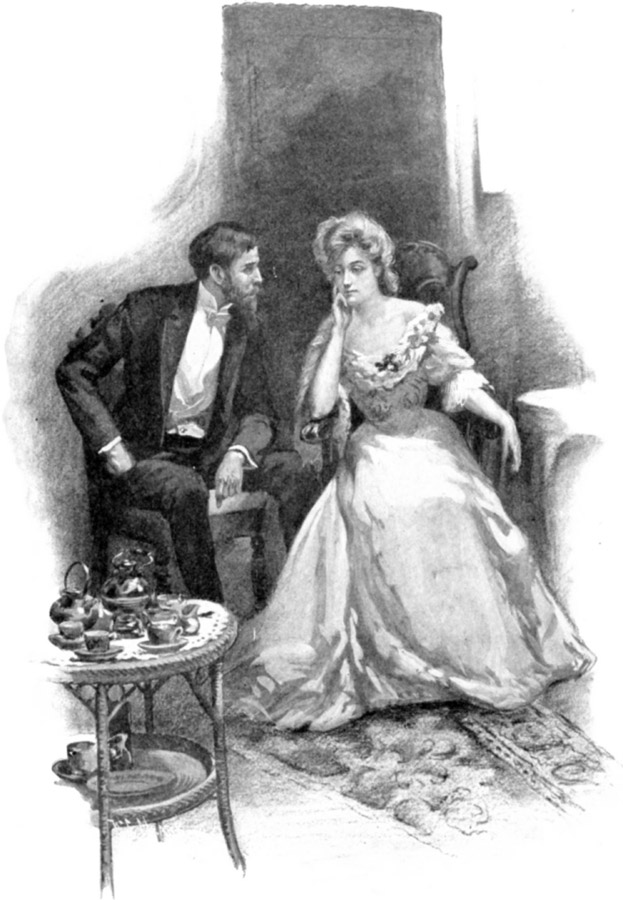
"'BUT, TELL ME, HOW DID THE CHANGE COME? WHAT BEGAN TO HAPPEN?'"ToList
"The usual tapping—here on the table—then my hand wanted to write. I ignored it—I fought it. I didn't intend to yield, but they set to work undermining my will, and then I knew that I must consent or be strangled. As soon as I gave up they took their fingers from my throat, but they are here—my grandfather is just back of me—I can feel his heavy hand on my head. I'm sorry, Professor Serviss. I was having such a good time. I hope you won't despise me."
"You are entirely too modest," he answered, cheerily. "We are highly favored. It's like having Paderewski volunteer to play for his dinner."
His lightness of tone hurt her a little. "You don't believe in me in the least, do you? You think I am an impostor?"
"Oh no. I believe in you."
"But you've got to believe in these manifestations if you believe in me."
"No, no, that does not follow," he replied, quickly; then, perceiving that this involved him, "All you do may possibly be explained without resort to the spiritualistic hypothesis—" He was embarrassed by her gaze.
"Why are you so contemptuous of spiritualists? It is very hard to bear."
He felt the rebuke. "I am not contemptuous—"
"Yes, you are. Scientific people never speak of us without a laugh or a sneer, and it hurts. It confuses me, too. If good people like you care nothing about death—if you only laugh—"
"I beg your pardon, Miss Lambert, I never intended to be either harsh or contemptuous. I do not accept—I mean to say I am unable to accept—your faith. I confess that my mind refuses to entertain the postulates of what Clarke considers a religion. I must be honest. I am a 'sceptic,' so far as your faith goes, but that does not mean that I do not believe in the sincerity of your mother; and as to your own powers—I do not wish to dogmatize, for the physical universe is a very large and complicate thing, and, young as I am"—here he smiled—"I don't pretend to a knowledge of all it contains."
She accepted his explanation, and, with musing candor, replied: "I don't really blame you. I suppose if these things had happened to some one else I would not have believed in them. I have thought a great deal of what you said to me. I want to get away from that house; I am hating Mr. Pratt more and more, and I will leave to-morrow if grandfather will only consent. If he comes to you to-night, tell him so—maybe my father will come, too. I want you to know my father. I'm sure you will like him. Isn't it strange that I have never been able to hear his voice?"
He ignored her question. "I do not understand the motives of your 'guides'—I cannot conceive of myself sacrificing you to any cause whatsoever."
"Don't awaken my doubts," she cried, despairingly. "I don't know why it is, but you always rouse in me something that makes war."
"I'm sorry if I seem to corrupt you."
"I don't mean that," she hastened to say. "The life which you and your sister represent is the life I love. I was almost resigned to my fate when your sister called upon me. Now I'm all rebellion again. Being here to-night makes me hate all that I am. I hate my very name. I hate Pratt and his horrible house—I almost hate my mother. Sometimes she is so cruel to me. She don't mean to be, but she is."
His face grew reflective, almost stern. "I wish there were some way of taking you out of the world in which you now suffer. I wish—" He paused, checked by the thought of Clarke's claims upon her.
"There is only one way—my grandfather must consent to my release; he rules us all."
This delusion rose like a stone wall at the end of every avenue, and Morton turned to a personal explanation. "I cannot associate what you seem to me now with what you were when I last saw you. What would you have said had I seized you the other day—snatched you from the stairs and ran—"
Her eyes opened wide. "The stairs?"
"Had you no knowledge of following your mother down the stairway after our interview?"
"I knew I was entranced, but I didn't know—What did I do?" She asked this anxiously.
"Nothing." He hastened again to change the current. "We were in hot argument. You came down as peace-maker. I went away cravenly, most impotently, leaving you there like a captive."
"I don't remember a word of it. I came to myself in my own room, and only mother was with me." Her rebellious fire blazed up again. "Oh, Dr. Serviss, I was resigned yesterday, but to-night I am in terror again, and they know it. They are eager to show their power, to confound you and convert Dr. Weissmann. I'm sure they will do some wonderful thing for you to-night if you will let them."
"The best thing 'they' could do for me would be to let you sit and talk to me," he replied in the voice of a lover.
She seemed to listen to some interior voice. "They are insisting. They are here—listen!"
As he listened a series of throbbing raps seemed to come from the chair beneath her hand.
"Very well, we will sit." As he said this three heavy, rending, low thuds sounded on the under side of the table.
"That is grandfather," she said. "He wants you to be very rigid, and so do I," she said. "Sometimes it seems as if I did these things myself—I mean certain physical things—and I get all mixed in my mind. I want you to study me." She passed her hand wearily over her face, and Morton looked at her in sorrow, meditating a firm, decisive assault on her hallucination, but checked himself. "If I am to help you, I must know all about you," he said at last, "and a sitting may help."
"You wonder at my fear of my grandfather, but that's because you don't realize his power. Let me tell you what happened to me once, when I tried to run away from him. I became desperate one summer vacation and determined to get away from it all. Without telling mother, I took the train one morning—" She paused abruptly and pressed both hands to her burning cheeks. "Oh, it was horrible! My grandfather threw me into a trance on the train, and the conductor thought I was drunk—" She shuddered with the memory of it, and could not finish. "Since then I have never dared to really oppose him."
He pondered her blush, the quiver of her lips, and the timid look of her eyes, and gravely answered: "I share your horror of an experience like that. But it does not endear your malevolent grandfather to me. He must be a kind of male witch—"
"You mustn't feel that way towards him," she cried out in some alarm. "He is firm because he feels that I should be doing my work—"
"I'd like to talk this matter over with him, but I don't like to have you entranced. Is that necessary?"
"Yes, to get the voices. The writing we can have any time."
"What do you do to induce this coma—this sleep?"
"Just fold my hands and give myself up."
"It seems a desecration of you; but if there is no other way we will grant 'the powers' audience."
At his word her face cleared, her fingers relaxed, and she smiled. "Thank you. He has taken away his hand."
As she rose and stood before him she seemed again the buoyant, care-free girl, and he could only weakly say, "It seems so ungracious, so inhospitable in us," as they walked side by side across the room to Kate.
Clarke was sitting in silence, without pretence of listening to his hostess, watching Serviss with gloomy, uneasy eyes—a fierce flame of jealousy burning in his brain. He recalled the change in Viola which had followed this man's visit to Colorow, and associated her first persistent revolt with him; and now, seeing her beside him, in his own house, looking up into his face, absorbed, fascinated, utterly forgetful of her duty, oblivious to every one else, was maddening. Her gown angered him. "Why did she wear that dress?" he fiercely asked himself. "She does not do that for me. She is in love with him—that is why. She shall not come here again. These people are destructive to her higher aims."
In this mood he changed his mind, opposed the sitting; but Viola convinced him that it was the will of her 'guides' and that it was a splendid opportunity to interest two renowned sceptics, and in that spirit he again reluctantly consented.
XIIIToC
THE TEST SÉANCE
Morton's study was decided upon as the most suitable place in which to experiment, for the reason that it had but one exit, a sliding double door, which led to the library, and its windows all opened upon the street, six stories below. A burglar could not have entered with full license to do so.
Viola assisted Morton and Kate in clearing the big mahogany table, while Weissmann conferred with Clarke. To judge from the girl's gayety and eager interest the preparations were for a game of cards rather than for a test séance in which her love and honor were at stake. Mrs. Lambert was quite serene; Clarke alone seemed anxious and ill at ease.
Weissmann, at Morton's request, assumed general direction, and betrayed an astonishing familiarity with the requirements. Under his direction they grouped themselves about the table as for whist, Viola at the north end, with Clarke directly opposite, and Kate and Mrs. Lambert on either side and quite near him. The two inquisitors then took seats—Morton at the psychic's right, Weissmann at her left.
When the positions were all decided upon, Viola, with a note of disappointment in her voice, asked, "Aren't you going to tie me?"
"Oh no," replied Morton, "the conditions are yours to-night. You are our guest. Our tests will be made at some other time."
"Please make them to-night," she pleaded. "Please make them as hard as you can."
Weissmann's glasses glistened upon her with joyful acclaim. "Very good, your wishes shall be met. Let us see—we shall tie you. Have you something suitable?" he asked of his assistant.
Morton took from his desk a roll of white tape. "How will this do?"
"Just the thing," Weissmann replied; "but we must have no knots, no tying. Kate, get your needle, we must fasten Miss Lambert in such wise that no one can say, 'Oh, she untied the knots!'"
Under his supervision Kate looped the tape about Viola's wrists and sewed it fast to her close-fitting satin cuffs. She then encircled her ankles with the tape, and Morton drew the long ends under and far back of the chair and nailed them to the floor. Thereupon Weissmann said, "I wish to nail these wristbands to the chair-arm.—Do we sacrifice the cuffs?" he asked of Viola.
"Yes, yes—anything. Nail as hard as you please."
"And the chair?" pursued the old man, glancing at Morton.
"Oh, certainly," replied he. "Science goes before furniture in this house," and a couple of long brass tacks were driven firmly down through both tape and sleeve.
"You poor child!" exclaimed Kate. "If they hurt you, cry out, and I will free you."
Weissmann then fastened a silk thread to her wrist and gave one end to Morton. "We will keep this taut," he said; "every motion will be felt."
As they worked the enthusiasm of investigation filled their eyes. They lost sight of the fact that all this precaution implied a doubt of the girl, and Viola on her part remained as blithe as if it were all a game of hide-and-seek.
Clarke, too, became exultant. "McLeod, now is your opportunity," he called to the invisible guide. "Bring your band and put the monist bigots to rout."
Morton moved about the girl with growing excitement, a subtle fire mounting to his brain each time his fingers touched her smooth, round wrists. Once she said, "I have never had a real test like this—this is what I wanted you to do. If anything happens now it will be outside of me, won't it?"
"We must be cruel in order to be kind," he answered, enigmatically.
At last Weissmann stood clear of her. "Now we are ready," he said, beaming with satisfaction. "You see I lock this door and here is the key." He held it up in confirmation. "I pocket the key. Now what?"
"Turn down the gas," replied Clarke. "Do not use electricity—the room must be perfectly dark."
"Why perfectly dark? I don't like that." Weissmann spoke with manifest irritation. "We should be able to see something."
Clarke shrugged his shoulders. "You can do as you wish. The guides say their manifestations are antagonized by light—and that darkness is necessary for these special phenomena of the cone."
"Oh, we have no cone!" exclaimed Mrs. Lambert.
"Cone? What cone?" asked Weissmann.
"We need some sort of megaphone to enlarge the spirit-voices."
"Make one of card-board," suggested Viola. "Any sort of horn will do."
Morton rose and took down a horn from the top of a bookcase. "Here is the megaphone of my phonograph; will it do?"
Clarke examined it. "It's rather heavy, but I think they will use it. Place it on the table. Put a pad and pencil there also," he added. "We may get some writing."
"Anything else?"
"No—now we are quite ready," replied Clarke, in his exhibition voice. "It is well to touch hands for a time—until the psychic sinks into her trance."
"With your permission," said Morton to Viola.
A faint flush came into her face. "Certainly, professor," and a touch of emphasis on his title had the effect of a slight, a very slight rebuff.
Clarke turned the light down to a mere point of yellow fire, and in the sudden gloom all were plunged into silence. "Now, whatever you do, gentlemen, don't startle the psychic after she goes into sleep."
Morton, with his fingers resting lightly on Viola's soft hand, experienced a keen, pang of sympathetic pain. "She is so charming! What profanation to develop the seamy side of her nature! What pitiful tomfoolery! She is in the lion's mouth now—and yet how eagerly she seemed to desire it. Weissmann has made anything but the simplest ventriloquistic performance impossible—she cannot lift a hand. To save her from herself, as well as from Clarke, it is necessary to expose her weakness as well as his trickery."
She was saying, in answer to a question: "No, Dr. Weissmann, I have no control over the manifestations; in fact, the more anxious I am, the longer we have to wait. I cannot promise anything to-night—"
Morton, hearing this, inwardly commented; "These obscure forms of hysteria often possess the cunning, the dissimulation of madness. Poor girl! She is beginning to realize her predicament, and is preparing us for disappointment," and a return of his doubt kept him silent.
Weissmann spoke. "Shall we not sing something—'We Shall Meet Beyond the River,' or some ditty like that?"
Thereat Kate said: "Doctor, you betray astonishing familiarity with the ways of 'spooks.'"
"Oh, I know everything."
"I begin to believe it," she retorted. "I begin to suspect that you are a secret adherent. Morton, you would better tie Dr. Weissmann, otherwise he may speak from the cone himself."
As if to counteract this banter Clarke began a discourse on the leadings of the most recent discoveries:
"The X-ray is a mode of motion, as light is a mode of motion, but the waves of light move in such a way as to clash with and weaken those of the X-ray; so we argue that the mode of motion, through which disembodied souls manifest themselves, being far subtler than the X-ray, is neutralized—though by no means destroyed—by the motion called light. Furthermore, there seems to be a reluctance on the part of the invisible ones to have the actual processes scrutinized. I once laid a pencil on the table and asked for a visible action of writing, vainly, so long as it was completely exposed, but upon being covered with a silk handkerchief it plainly rose and wrote. It could be distinctly seen moving beneath the cloth. Sir William Crookes had a similar experience, except in his case he saw the pencil move, prop itself against a ruler, and try three times to write—all in the light. I have seen letters form on an exposed surface of a slate, I have had hands appear through a curtain and write in the light, but the power must always be generated in shadow."
Kate shuddered. "Woo! It gives me the shivers to think of such things. Will anything as wonderful happen to-night?"
"I cannot tell—the conditions are severe, but I think we will have something. Viola?" he called, softly.
"Yes," she answered, faintly.
"Would you like us to sing?"
"No—I'd rather you'd all talk. Perhaps they will let me take part in the demonstration to-night. They promised to do so, you remember."
Weissman recounted some of the experiences Zöllner had enjoyed in Germany shortly after the Fox sisters became so celebrated in America. "Crookes and Wallace and several others went into the whole question at that time—the world rang with the controversy. But the clamor passed, the phenomena passed. It is like an epidemic, it comes and it goes, and in the end is humanity the wiser? No."
"Yes, it is," broke in Clarke. "We are just that much more certain of the indestructible life of the soul—every wave of this spirit-sea leaves a deposit of fact on the beach of time, makes death that much less dreadful. We make gains each decade. Sir William Crookes, Sir Oliver Lodge, Alfred Russel Wallace, Lombroso have all been convinced of the reality of these phenomena. Surely such men must influence the thought of their time. Experimental psychology is on the right road—"
Morton was suffering with the girl, whose hand was beginning to tremble beneath his palm. She no longer replied to his questions, but that she was still awake he knew, for he could hear her sighing deeply, so deeply that the sound troubled him almost as if she were weeping. His impulse was to rise and turn on the light and give over this trial, which could only end in humiliating her. "Her temerity is a part of her malady," he argued. "It has arisen through years of misconceived petting and nursing on the part of her mother. Up to this moment her performances have always been in the presence of friends and relatives, or for the consolation of those eager to believe, and therefore easily deluded. Every sitter has conspired to practically force her into an elaborate series of deceptions, each deceit being built upon and made necessary by the other. It is pitiful, but she now believes in herself—that is pathetically certain. Otherwise she would not have yielded herself so completely into the hands of an inexorable investigator like Weissmann. She must take the consequences," he ended, with grim closing of the lips. "We must be cruel in order to be kind. This night may be her salvation."
Weissmann was replying to Mrs. Lambert. "I do not care for a return of my dead, madam; what I wish your daughter to do is quite simple. I would like her to move a particle of matter from A to B, without a known push or a pull—that is to say, by a power not known to science—as Zöllner claimed Slade was able to do for him."
"She can do it," cried Clarke. "She can move a chair from A to B without bringing to bear any of the known forces. She can suspend the law of gravity. She can make a closed piano play, and she can read sealed letters in an ebony box tightly closed and locked."
"You claim too much, my friend," replied Weissmann, ironically. "We shall be satisfied with much less. If she will change one one-hundredth part of a grain from one scale to another, under my conditions, I will be satisfied. The most wonderful phenomena taking place in the dark have no value to me."
Mrs. Lambert interposed. "Please don't argue—it prevents the coming of the spirits."
Both men felt rebuked and the group again settled into silence. Suddenly, Kate began to laugh, "Isn't it childish? Really, Morton, if our friends could see us sitting around here in the dark, as we are now, they would roar. Why should it all be so silly, Mr. Clarke?"
"It is not silly if we take the right view. We must sit together in order to get into harmony. We further these conditions by sitting in subdued light with fingers touching. Song adds still more to this concert of thought. Nothing is really silly or prosaic—all depends upon the minds of those—"
He was in the midst of an elaborate defence of spirit methods when Viola's hand began to leap as if struggling to be free. She moaned and sighed and writhed so powerfully that her chair creaked. "Oh, dear! Oh, dear!" she cried, gaspingly.
"Is she trying to free her hands?" Morton asked himself, with roused suspicion. "Is this a ruse to cover some trick?"
Mrs. Lambert spoke quietly. "She is going! Sing something, Anthony."
Clarke began to hum a monotonous tune, while Morton, bending towards the girl, listened to her gurgling moans with growing heartache. "She seems in great pain, Mrs. Lambert. Don't you think we'd better release her? I do not care to purchase sensation so clearly at her expense."
"Don't be alarmed, she always seems to suffer that way when some great manifestation is about to take place."
The poor girl's outcries so nearly resembled those of a death struggle that Kate at last rose. "Turn up that light! She is being strangled!"
"Please be silent!" said Clarke, almost angrily. "Take your hands from her, gentlemen! You are too 'strong'—and do not startle her! Be quiet everybody!"
Morton took his hand away in anger and disgust. "All this is a ruse to weaken our grasp upon her," he thought. "Even the mother, so serene, so candid, is aiding the deception."
"Things will happen now," remarked Mrs. Lambert, confidently; "she is giving herself up at last."
The girl drew a long, deep, peaceful sigh, and became silent, so silent that Morton, leaning far over, with suspended breath, his ear almost to her lips, could detect no sound, no slightest movement, and listening thus he had for an instant a singular vision of her. He seemed to see her laughing silently at him from a distant upper corner of the room, and for the moment secured a glimpse into a new and amazing world—the world of darkness and silence wherein matter was fluid, imponderable, an insubstantial world peopled, nevertheless, with rustling, busy souls.
A sharp rapping began on the cone, a measured beat, which ended in a clang, which startled Kate into a shriek. "Who is doing that?" she asked, nervously.
"They are here," Clarke solemnly announced.
"Is that you, Waltie?" asked Mrs. Lambert, sweetly.
Three raps, loud and clear, answered "yes." A drumming on the cone followed, and Mrs. Lambert, her voice full of maternal pride, remarked: "Waltie is the life of our sittings—he's such a rogue! You must be a nice boy to-night—on account of these very distinguished men."
"Rap, rap!" went the cone.
"Does that mean 'all right'?"
"Rap, rap, rap!" Yes.
"Is grandfather there?"
"Yes."
"Does he wish to speak to the gentlemen?"
"Yes."
"Are we sitting right?"
A decided thump—"No."
Guided by the rapping Mrs. Lambert and Kate moved down to the foot of the table, sitting close beside Clarke, thus leaving Morton and Weissmann alone with the sleeping girl. No sooner were they rearranged than the table began to move, precisely as though pushed by the girl's feet. Still guided by the rapping, Weissmann and Morton moved with the table, but retained their threads of silk. Morton's pity had given place to a feeling of resentment at this device to get them farther away, and he drew his tell-tale thread tight across his finger. "If she moves she is betrayed," he thought with hardening heart.
No sooner were they settled than a fumbling sound began in the middle of the table, and the pencil was twice lifted and dropped. Following this the leaves of the writing-pad rustled as though being thumbed by boyish hands.
Kate shivered and cried out: "This is uncanny! Morton, are you doing this?"
"Certainly not," he replied, curtly.
"Do you feel any motion in your thread?" asked Weissmann, in a quiet voice.
"None whatever," Morton replied.
"Then the psychic is not moving."
Again they sat in silence, and after some minutes the fumbling began again and the horn was heard scraping slowly about, as if being lifted with effort only to fall back with a clang.
"Is it too heavy?" asked Clarke.
Three sharp raps replied—an angry "yes"—and then, with a petulant swing, the instrument apparently left the table and floated upon the air. In deep amazement Morton listened for some movement, some sound from Viola, but there was none, not a breath, not a rustle of motion where she sat, and the silk thread was tight and calm. "She has nothing to do with that," he said, beneath his breath.
Kate called excitedly, "Oh! It touched me."
"What touched you?" asked Weissmann.
"The horn."
"Did it bump you?"
"No, it seemed to float against me."
Morton spoke out sharply: "Where is Mr. Clarke?"
"Right here on my right," replied Kate.
"What idiotic business!" he exclaimed, mystified, nevertheless.
The horn dropped to the middle of the table, but was immediately swept into the air again as if by a new and more vigorous hand, and a voice heavily mixed with air, but a man's voice unmistakably, spoke directly to Morton, sternly, contemptuously.
"We meet you on your own level. You asked for material tests, and now conditions being as you have made them—proceed. What would you have us do?"
"Who are you?"
"I am Donald McLeod—grandfather to the psychic."
At this moment Morton became seized of the most vivid realization of the physical characteristics of the man back of the voice. In some mysterious way, through some hitherto unknown sense, he was aware of a long, rugged face, with bleak and knobby brow. The lips were thin, the mouth wide, the dark-gray eyes contemptuous. "It is all an inner delusion caused by some resemblance of this voice to that of some one I have known," he said to himself; but a shiver ran over him as he questioned the old man. "If you are the grandfather of the psychic," he said, "I would like to ask you if you think it fair to a young girl to use her against her will for such foolery as this?"
"The purposes are grand, the work she is doing important—therefore I answer yes. She is yet but a child, and the things she does of her own motion trivial and vain. We make of her an instrument that will enable man to triumph over the grave. You will observe that we do not harm her, we take but little of her time, after all. You are unnecessarily alarmed. Our regard for her welfare far exceeds yours. Her troubles arise from her resistance. If she would yield herself entirely, she would be happy."
As the voice paused, Morton asked, "Weissmann, can you hear what is being said to me?"
"Very indistinctly," answered Weissmann.
"What does it say?" asked Kate. "I can only hear a kind of jumble."
Weissmann interjected; "I must ask you, Mrs. Rice, have you tight hold of Mr. Clarke's hand?"
"Yes," answered Kate.
Morton's brain whirled in confusion and conjecture. He believed the whole thing to be a piece of juggling, and yet he could not connect Viola in any way with it, and it seemed impossible, also, for Mrs. Lambert to sit where she was and handle the cone, to say nothing of the ventriloquistic skill necessary to carry on this conversation. He again addressed the voice: "You consider your control of the psychic to be justified?"
"We do."
"Do you know, also, what perilous notoriety, what positive disgrace—from every human point of view—you are about to bring upon her?"
The hidden old man pondered a moment, as if to master a profound contempt, then answered: "We have taken all things into account. When she has grown to years of sobriety she will thank us that we turned her aside from dancing and from light conversation, and from all loose-minded companions. All the sane pleasures are now hers. She is soon to be idolized by thousands. Her playing on the piano, her singing are as the rustle of leaves in the forest compared to her mediumship, which is as a trumpet-blast opening the gates of the city of refuge to let the weary traveller in." The voice weakened a little. "The earth-life is but a school—the real life is here. Besides, when she has completely subordinated her will to ours, when she has given our message—" The spirit grand-sire seemed to falter and diminish. "My power is waning, but I will again manifest. We will try—" The voice stopped as though a door had been shut upon the speaker, and the megaphone dropped upon the table.
"All that is very interesting," commented Weissmann, "but inconclusive. Is it all over?"
"Oh no," answered Mrs. Lambert. "They are uniting upon something wonderful—I feel it."
As they listened the horn moved feebly, uneasily rising a few inches, only to fall as though some weak hand were struggling with it; but at last it turned towards Weissmann, and from it issued the voice of a little girl, thrillingly sweet and so clear that Serviss could hear every word. She addressed Weissmann in German, calling him father, asking him to tell mother not to grieve, that they would soon all be together in a bright land.
To this Weissmann replied in harsh accent: "You assert you are my daughter?"
The voice sweetly answered: "Yes, I am Mina—"
"But Mina could not understand a word of English—how is that?"
The little voice hesitated. "It is hard to explain," she replied, still in German. "I can understand you in any language—but I can only speak as you taught me."
Thereupon he addressed her in French, to which she replied easily, but in her native tongue.
As this curious dialogue went on Serviss was searching vainly for an explanation. "Mr. Clarke, will you kindly speak at the same time that this voice appears?"
Clarke began a discourse, and the two voices went on at the same time. The young scientist then said: "Mrs. Lambert, will you permit Kate to lay her hand over your lips? You understand, it is for the sake of science—"
"Certainly," said Mrs. Lambert.
Here the test failed of completeness, it was so difficult to get the three voices precisely together; but at last it seemed that the child's voice was produced at the same time that Clarke spoke and while Kate's hand covered the mother's mouth.
Thereupon the little voice said farewell, and all was silent for a few moments. The cone rose again into the air and a soft, sibilant voice addressed Mrs. Lambert.
"Oh!" she cried, joyfully. "It is Robert!—Yes, dear, I'm listening. I'm so glad you've come. Can't you talk with Professor Serviss?—He says he will try," she said to the company.
As Morton waited the cone gently touched him on the shoulder, and a moment later a man's voice, utterly different from the first one and of most refined accent, half spoke, half whispered: "We are glad to meet you, professor. I am deeply gratified by your interest in our dear girl."
"Who are you?" he asked, moved, in spite of himself, by a liking for this new personality, so distinct from the others.
"I am R.M. Waldron—Viola's father."
He seemed to wait for questions, and Serviss asked: "How do you feel about your daughter's mediumship? Are you not uneasy when you think of what you are demanding of her?"
The invisible one sighed, hesitated, and replied with evident sadness: "It troubles me to find her reluctant. I wish she were happier in the work. It seems so important to us." Then the voice brightened. "But perhaps it is only for a little while. After the public test—after the truth of her mediumship is made manifest—I think, I hope, we will ask less of her. Perhaps it will be possible to release her altogether for a time; but for the present she is too valuable—" The sentence was lost in a buzz of inarticulate whispering, as if two or three friends were consulting. The opening and closing of lips could be heard, and a stir within the horn was curiously trivial in effect, as if a mouse were at play with a dry leaf.
"If I were to organize a committee of men like Weissmann and Tolman, and other men of international fame, willing to test your daughter's powers, will you give over this public demonstration—this publishing of a challenge?"
Clarke interrupted almost angrily. "Not unless you promise to—"
"Be silent!" commanded Weissmann.
From the horn came a faint murmur, so dim, so far, Serviss could, with difficulty, distinguish the words. "We will consider that. I am going. Guard my girl. Good-bye."
The horn, again seemed to rest, and for a long time no sound or stir broke the silence, till at last Viola began to writhe in her chair in greater agony than before.
"I think she is waking," said Morton.
Mrs. Lambert answered, quickly: "No. Some great event is preparing—when this paroxysm passes some very beautiful test will come."
While Morton and Weissmann were considering this the girl again became silent as a stone, and a moment later a clear, sweet sound pulsed through the air as if an exquisite crystal bell had been struck. Then, while still this signal trembled in his ear, a whispering noise developed just before the young man's face, as if tremulous lips were closing and unclosing in anxious effort to communicate a message without the use of the trumpet.
"Is some one trying to speak to me?" he asked, gently.
Three measured strokes upon, the tiny bell replied, and with their pulsations the room seemed to stir with a new and different throng of winged memories. The very air took on mystery and beauty and a sweet gravity. Matter was for the moment as subtle, as imponderable as soul.
"Who is it?" he asked, and into his voice, in spite of himself, crept a note of awe.
The answer came instantly, faint as the fall of an autumn leaf on the grass.
"Mother."
Kate bent eagerly forward, "Who was it, Morton?"
Ignoring her question Morton addressed the invisible one. "Can't you speak again?"
There was no reply and the whispering ceased. Almost instantly the horn seemed grasped by a firm and masterful hand, and the rollicking voice of a man broke startlingly from the darkness in words so clear, so resonant, that all could hear them.
"Hello, folks. Is this a Quaker meeting?"
"Who are you?" asked Morton.
"Can't you guess?"
Kate gasped. "Why, it's Uncle Ben Roberts!"
The voice chuckled. "Right the first time. It's old 'Loggy'—true bill. How are you all?"