THE CONQUEST OF MONTEZUMA'S EMPIRE (continued 3)
Reading edition
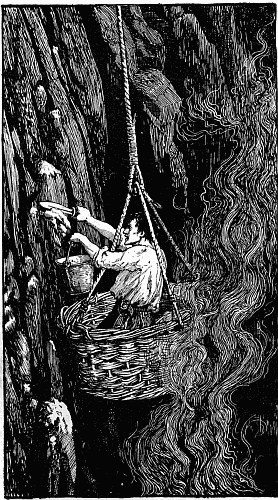
Cortés reached Tlascala in safety, and at once began to prepare his revenge on the Mexicans, aided by reinforcements of a few Spaniards from Vera Cruz. Gunpowder had also to be manufactured, and a cavalier named Francio Montaño undertook the perilous task of obtaining sulphur for the purpose from the terrible volcano of Popocatepetl. He set out with four comrades, and after some days journeying, they reached the dense forest which covered the base of the mountain, and forcing their way upward, came by degrees to a more open region. As they neared the top the track ended, and they had to climb as best they could over the black glazed surface of the lava, which, having issued from the crater in a boiling flood, had risen into a thousand odd forms wherever it met with any obstacle, and continually impeded their progress. After this they arrived at the region of perpetual snow, which increased their difficulties, the treacherous ice giving way at every step, so that many times they narrowly escaped falling into the frozen chasms that yawned all round them. At last, however, they reached the mouth of the crater, and, crawling cautiously to the very edge, peered down into its gloomy depths. At the bottom of the abyss, which seemed to them to go down into the very heart of the earth, a lurid flame burned sullenly, sending up a sulphureous steam, which cooling as it rose, fell again in showers upon the sides of the cavity. Into this one of the brave explorers had to descend, and when they had cast lots the choice fell upon Montaño himself. His preparations were soon made, and his companions lowered him in a basket into the horrible chasm to a depth of four hundred feet, and there as he hung, he scraped the sulphur from the sides of the crater, descending again and again until he had procured enough for the wants of the army, with which they returned triumphantly to Tlascala. Meanwhile the construction of the ships went forward prosperously, and by Christmas, in the year 1520, there was no longer any reason to delay the march to Mexico.
While all these preparations were being made, some changes had taken place among the Aztecs. Cuitlahua had suddenly died after reigning four months, and Guatemozin his nephew had been chosen in his stead. This young prince had married one of Montezuma's daughters. He was handsome and valiant, and so terrible that his followers trembled in his presence. He had a sort of religious hatred of the Spaniards, and prepared manfully to meet the perils which he saw threatening his country, for by means of spies he had kept a watch upon the movements of the Spaniards, and had discovered their intention of besieging the capital. Cortés, upon reviewing his army, found that his whole force fell little short of six hundred men, of whom forty were cavalry, and eighty arquebusiers and cross-bowmen. The rest were armed with sword, target, and the long copper-headed pikes, which had been made specially by the general's directions. There were also nine cannons of moderate size, but the supply of powder was but indifferent. Cortés published a code of strict regulations for the guidance of his men before they set out, and addressed them as usual with stirring words, touching all the springs of devotion, honour, and ambition in their hearts, and rousing their enthusiasm as only he could have done. His plan of action was to establish his headquarters at some place upon the Tezcucan lake, whence he could cut off the supplies from the surrounding country, and place Mexico in a state of blockade until the completion of his ships should enable him to begin a direct assault. The most difficult of the three ways into the valley was the one Cortés chose; it led right across the mountain chain, and he judged wisely that he would be less likely to be annoyed by the enemy in that direction. Before long the army halted within three leagues of Tezcuco, which you will remember was upon the opposite shore of the lake to Mexico, and somewhat further north. Up to this time they only had had a few slight skirmishes with the Aztecs, though beacon fires had blazed upon every hill-top, showing that the country was roused. Cortés thought it very unlikely that he would be allowed to enter Tezcuco, which was now reigned over by Coanaco, the friend and ally of Guatemozin. But the next morning, before the troops were well under arms, came an embassy bearing a golden flag, and a gift for Cortés, and imploring him to spare Coanaco's territories, and to take up his quarters in his capital. Cortés first sternly demanded an account of the Spaniards who, while convoying treasure to the coast, had been slain by Coanaco just when Cortés himself was retreating to Tlascala. The envoys declared at once that the Mexican emperor alone was to blame; he had ordered it to be done, and had received the gold and the prisoners. They then urged that to give them time to prepare suitable accommodation for him, Cortés should not enter Tezcuco until the next day; but disregarding this he marched in at once, only to find the place deserted, and Coanaco well on his way across the lake to Mexico. The general, however, turned this to his own advantage by assembling the few persons left in the city, and then and there electing a brother of the late sovereign to be ruler in his place, and when a few months later he died, he was succeeded by Ixtlilxochitl, son of Negahualpilli, who, always a friend of the Spaniards, now became their most valuable ally, and by the support of his personal authority and all his military resources, did more than any other Aztec chieftain to rivet the chains of the strangers round the necks of his own countrymen.
The Siege and Surrender of Mexico.
The city of Tezcuco, which lay about half a league from the shore of the lake, was probably the best position Cortés could have chosen for the headquarters of the army. His first care was to strengthen the defences of the palace in which they were lodged, and next to employ eight thousand Indian labourers in widening a stream, which ran towards the lake, so that when the ships arrived they might be put together in Tezcuco, and floated safely down to be launched upon it. Meanwhile many of the places in the neighbourhood sent in their submission to Cortés, and several noble Aztecs fell into his hands. These men he employed to bear a message to Guatemozin, in which he deprecated the necessity of the present hostilities, and declared himself willing to forget the past, inviting the Mexicans by a timely submission to save their capital from the horrors of a siege. But every man in Mexico was determined to defend it to the uttermost, and this appeal produced no effect. The general now turned his attention to securing all the strong places upon the lake. Iztapalapan was the first; the attacking party, after a sharp struggle, succeeded in entering the town; many of the inhabitants fled in their canoes, but those who remained were massacred by the Tlascalans in spite of all Cortés could do to restrain them. Darkness set in while the soldiers were eagerly loading themselves with plunder; some of the houses had been set on fire, and the flames lighted up the scene of ruin and desolation. Suddenly a sound was heard as of the rush of the incoming tide—and Cortés with great alarm realised that the Indians had broken down the dykes, and that before long the low-lying ground upon which the town stood would be under water. He hastily called off his men and retreated, the soldiers, heavily laden, wading with difficulty through the flood which gained fast upon them. As they left the burning city behind them they could no longer find their way, and sometimes plunged into deep water where many of the allies, unable to swim, were carried away and drowned. When morning dawned they were harassed by the enemy, who hovered round and discharged volleys of arrows and stones, so that it was with no small satisfaction that they presently found themselves once more within the walls of Tezcuco. Cortés was greatly disappointed at this disastrous end of an expedition which had begun so well, but after all the fate of Iztapalapan produced a good effect, and many more towns sent to tender their allegiance, amongst others Otumba and Chalco, which was a place of great importance. Cortés also managed to induce the tribes, who though friendly to him were hostile to one another, to forget their feuds and combine against Mexico, and to this wise policy he owed much of his future success.
News now came from Tlascala that the ships were ready, and Sandoval was despatched with a considerable guard to bring them to Tezcuco. On his way he was to stop at Zoltepec, where the massacre of the Spaniards had taken place, to find out and punish all who had had a hand in the matter; but when they got there the inhabitants had fled. In the deserted temples they had the horror of finding many traces of the fate of their comrades; for beside their arms and clothing, and the hides of their horses, the heads of several soldiers were found suspended as trophies of victory; while traced in charcoal upon the wall in one building were the words, in the Spanish language, 'In this place the unfortunate Juan Juste, with many others of his company, was imprisoned.' It was fortunate that the inhabitants had fled, for they would have met with but scant mercy from the Spaniards, who were full of indignation at the thought of the horrible doom which had overtaken their companions. Sandoval now resumed his march to Tlascala, but before he could reach it, the convoy appeared transporting the ships through the mountain passes. Retaining twenty thousand of the warriors as a guard, the Spanish captain dismissed the rest, and after four laborious days Cortés and his garrison had the joy of welcoming them safe within the walls of Tezcuco. It was not long before the general once more sallied forth to reconnoitre the capital, and by the way to chastise certain places which had sent him hostile messages. After an exciting struggle Xaltocan and three other towns were taken, and a considerable quantity of gold and food fell into the hands of the victors. Marching on, the general found himself before Tlacopan, through whose streets he had hurried in consternation at the end of the night of horror. It was his intention to occupy the town, which he did after a sharp fight, just before nightfall, and the next morning, seeing the enemy in battle array on the open ground before the city, he marched out against them and routed them utterly. The Aztecs fled into the town, but were driven through its streets at the point of the lance, and compelled once more to abandon it, after which the Tlascalans pillaged and set fire to the houses, much against the will of Cortés, but they were a fierce race, and sometimes dangerous to friends as well as foes. After six days the general went back to Tezcuco, and for some time things went on as before, with many skirmishes and expeditions against the towns garrisoned by the Mexicans. Sandoval took several strongholds which threatened the security of Chalco, and all the while the work upon the canal was going rapidly forward, and the ships were nearing completion in spite of three attempts made by the enemy to burn them. Just at this time came the welcome news that three vessels had arrived at Villa Rica, with two hundred men on board well provided with arms and ammunition, and with seventy or eighty horses, and the new comers soon made their way to Tezcuco, for the roads to the port were now safe and open.
In April 1521, Cortés started once more to scour the country with a large force, passing quite round the great lakes, and exploring the mountain regions to the south of them. Here he came upon Aztec forces intrenched in strong towns, often built like eagles' nests upon some rocky height, so that to take them was a work of great difficulty and danger. Once he found himself before a city which it was absolutely necessary to subdue, but he was separated from it by a cleft in the solid rock of no great width, but going sheer down thousands of feet. The bridges which generally crossed it had been broken down at the approach of the Spaniards, and as they stood there, unable to advance, the enemy's archers as usual kept up a steady fire, to which they were unavoidably exposed. The general sent a party to seek a passage lower down, but they met with no success until they came to a spot where two large trees, growing one on either side of the ravine, interlaced their branches overhead, and by this unsteady and perilous bridge one of the Tlascalans ventured to cross. His example was soon followed, and one by one about thirty Spaniards and some more of the natives crawled across, swinging dizzily above the abyss. Three lost their hold and fell, but the rest alighted in safety on the other side and attacked the Aztecs, who were as much amazed at their sudden appearance as if they had dropped from the clouds. Presently a temporary bridge was contrived by which the remainder of the force managed to cross also, and before long the town was taken, and the trembling caciques appeared before Cortés, throwing the blame of their resistance upon the Mexicans, and promising submission for the future.
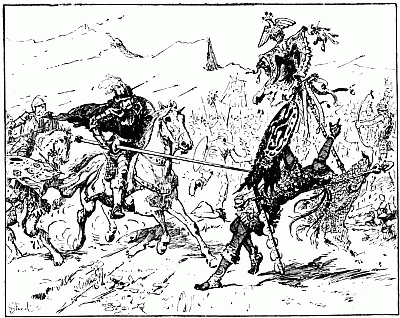
The general then continued his march across the eastern shoulder of the mountain, descending finally upon Xochimilco, which was built partly upon the lake like Mexico itself, and was approached by causeways, which, however, were of no great length. It was in the first attack upon this town that Cortés was as nearly as possible taken prisoner by the Aztecs. He had thrown himself into the thick of the fight with his usual bravery, and was trying to resist an unexpected rush of the enemy, when his horse stumbled and fell, he himself received a severe blow upon the head before he could rise, and was seized and dragged off in triumph by several Indians. At this moment a Tlascalan saw his danger and sprang furiously upon his captors, trying to tear him from their grasp. Two Spaniards also rushed to the rescue, and between them the Aztecs were forced to quit their hold of the general, who lost no time in regaining his saddle, and laying about him with his good sword as vigorously as before. After a terrible struggle the enemy was driven out, and Cortés took possession of the city. As it was not yet dusk he ascended the principal teocalli to reconnoitre the surrounding country, and there beheld a sight which could but cause him grave anxiety. The lake was covered with rapidly approaching canoes full of warriors, while inland Indian squadrons were marching up in dense columns. Xochimilco was but four leagues from the capital, and at the first tidings of the arrival of the Spaniards, Guatemozin had mustered a strong force and marched to its relief. Cortés made all possible preparations for the defence of his quarters, but not until the next day did the Mexicans attack him, and then the battle raged long and with varying success; but in the end Spanish discipline prevailed, and the natives were routed with such dreadful slaughter that they made no further attempt to renew the conflict. The city yielded a rich hoard of plunder, being well stored with gold and feather-work, and many other articles of use or luxury, so that when the general mustered his men upon the neighbouring plain before resuming his march, many of them came staggering under the weight of their spoil. This caused him much uneasiness, since their way would be through a hostile country; but seeing that the soldiers were determined to keep what they had so hardly won, he contented himself with ordering the baggage to be placed in the centre guarded by part of the cavalry, and having disposed the rest to the best advantage, they once more set forth, at the last moment setting fire to the wooden buildings of Xochimilco, which blazed furiously, the glare upon the water telling far and wide the fate that had befallen it. Resting here and there, and engaging in many skirmishes with the Aztecs who followed them up, furious at the sight of the plunder which was being carried away by the invaders, the army presently completed the circuit of the lakes, and reached Tezcuco, to be greeted with the news that the ships were fully rigged and the canal completed, so that there was no longer any reason to delay their operations against Mexico.
It was a triumphant moment when the vessels were launched, and reached the lake in good order. Cortés saw to their being properly armed and manned, and then reviewed the rest of his forces, and summoned his native allies to furnish their promised levies at once.
The general's plan of action against Mexico was to send Sandoval with one division to take possession of Iztapalapan at the southern end of the lake, while Alvarado and Olid were to secure Tlacopan and Chapoltepec upon its western shore, and at the latter place destroy the aqueduct, and so cut off the supply of fresh water from Mexico. This they did successfully, and in several days of fierce fighting breach after breach was carried, and the Spaniards penetrated the city as far as the great teocalli, driving the natives before them, while the Tlascalans in the rear filled up the gaps in the dyke as well as they could, and brought up the heavy guns. Cortés and his men now pushed their way into the inclosure of the temple, and some of them rushed to the top, so lately the scene of their terrible battle, and there found a fresh image of the war-god. Tearing away the gold and jewels with which it was bedecked, they hurled it and its attendant priests over the side of the pyramid, and hastened down to the assistance of their comrades, who were by this time in a most perilous position, the Aztecs having rallied and attacked them furiously. Indeed it seemed likely to go hard with them, for they were driven helplessly back down the great street in utter confusion and panic; but the timely arrival of a small body of cavalry created a diversion in their favour, and Cortés managed to turn them once more and drive the enemy back into the enclosure with much loss. As it was by this time evening, he retreated in good order to Xoloc. Though this affair caused some consternation among the Mexicans, they speedily opened the canals and built up the ramparts again, so that when Cortés renewed the attack the whole scene had to be gone through as before. When they had once gained the street, however, they found it much easier to advance, the Tlascalans having on the last occasion pulled down many of the houses on either side. This time Cortés had determined to destroy some of the cherished buildings of the Mexicans, and began by setting fire to his old quarters, the palace of Axayacatl, and then the palace of Montezuma on the other side of the great square. The sight so maddened the natives that the Spaniards had some ado to make good their retreat, and few reached their camp that night unwounded. The Aztec emperor for his part made frequent sallies against the Spaniards both by land and upon the lake, sometimes with considerable success. At first he managed to obtain supplies of food in canoes, under cover of the darkness, but by degrees the large towns on the mainland, seeing the Mexicans unable to defend themselves, gave in their allegiance to the Spaniards, and then starvation began to be felt in the unhappy city. In spite of everything, however, all offers of terms from Cortés were steadily refused.
At this juncture, the general was persuaded by some of his officers that it would be well for two of the divisions to unite, and occupy the great market-place in the heart of the town, and so at a given time they marched along their respective causeways and entered the city. Strict orders were given by Cortés that as they advanced every opening in the causeways should be filled up and made secure. The attack began, and the enemy, taken apparently by surprise, gave way and fell back; on rushed the Spaniards by every street, eager to reach the appointed meeting place. Only the general suspected that the enemy might be purposely luring them on to turn upon them when they were hopelessly involved. Taking a few men with him, he hastily proceeded to see for himself if the way was clear should a retreat become necessary, and found, as he had feared, that all had been too eager to be in the front to attend to this most important duty. In the first street he traversed was a huge gap, twelve feet wide, and at least as many deep, full of water, for it connected two canals. A feeble attempt had been made to fill this up with beams and rubbish, but it had been left before any good had been done. Worse than all Cortés saw that this breach was freshly made, and that his officers had probably rushed headlong into a snare laid by the enemy. Before his men could do anything towards filling up the trench, the distant sounds of the battle changed into an ever-increasing tumult, the mingled yells and war cries, and the trampling of many feet grew nearer, and at last, to his horror, Cortés beheld his men driven to the edge of the fatal gulf, confused, helpless, surrounded by their foes. The foremost files were soon hurried over the edge, some trying to swim across, some beaten down by the struggles of their comrades, or pierced by the darts of the Indians. In vain with outstretched hands did Cortés try to rescue his soldiers from death, or worse still from capture; he was soon recognised, and six of the enemy tried to seize and drag him into a canoe. It was only after a severe struggle, in which he was wounded in the leg, that he was rescued by his brave followers. Two were killed in the attempt, while another was taken alive as he held the general's horse for him to mount. In all, sixty Spaniards were captured on this fatal day, and it was only when the rest reached their guns in the open space before the causeway that they were able to rally and beat back the Aztecs. The other division had fared equally ill, and were moreover in great anxiety as to the fate of Cortés, who was reported to have been killed. When they once more reached their quarters, Sandoval, though badly wounded, rode into the camp of Cortés to learn the truth, and had a long and earnest consultation with him over the disaster, and what was next to be done. As he returned to his camp he was startled by the sound of the great drum on the temple of the war-god, heard only once before during the night of horror, and looking up he saw a long file of priests and warriors, winding round the terraces of the teocalli. As they came out upon the platform at the top he perceived, with rage and despair, that his own countrymen were about to be sacrificed with the usual ghastly ceremonies. The camp was near enough to the city for the white skins of the victims and their unavailing struggles to be distinctly seen by their comrades, who were nevertheless powerless to help them, and their distress and fury may be imagined.
For five days the horrible scenes went on, the Mexicans feasting, singing, and dancing, while their priests predicted that in eight days the war-god, appeased by these sacrifices, would overwhelm their enemies and deliver them into their hands. These prophecies had a great effect upon the native allies of Cortés, who withdrew from him in immense numbers. But the general treated their superstition with cheerful contempt, and only bargained with the deserters to remain close by and see what would happen. When the ninth day came, and the city was still seen to be beset on every side, they ceased to believe in the oracle, and returned, with their anger against the Mexicans rekindled, and their confidence in the Spaniards greatly strengthened. At this time another vessel loaded with stores and ammunition touched at Vera Cruz, and her cargo was seized and sent on to Cortés by the governor. With his strength thus renewed the Spanish general resumed active operations. This time not a step was taken in advance without securing the entire safety of the army, once and for all, by solidly building up the dykes, filling every canal, and pulling down every house, so that slowly and by degrees a bare open space was made, which took in more and more of the town, till at last the unhappy Aztecs, after many desperate sallies, were shut into the portion of the city which lay between the northern and western causeways. Here famine and pestilence did their awful work unchecked. The ordinary articles of food were long exhausted, and the wretched people ate moss, insects, grass, weeds, or the bark of trees. They had no fresh water. The dead were unburied, the wounded lay in misery, yet all the endeavours of Cortés to induce Guatemozin and his chiefs to submit were useless. Though the two divisions of the army had proceeded with their work of destruction until they could join their forces, and seven-eighths of the city lay in ruins, though the banner of Castile floated undisturbed from the smouldering remains of the sanctuary on the teocalli of the war-god, still the Aztecs defied the conquerors, and fiercely rejected their overtures of peace.
Hundreds of famishing wretches died every day, and lay where they fell, for there was no one to bury them. Familiarity with the spectacle made men indifferent to it. They looked on in dumb despair waiting for their own turn to come. There was no complaint or lamentation, but deep, unutterable woe. In the midst of this appalling misery Guatemozin remained calm and courageous, and as firmly resolved not to capitulate as at the beginning of the siege. It is even said that when Cortés persuaded a noble Aztec prisoner to bear his proposals for a treaty to the emperor, Guatemozin instantly ordered him to be sacrificed. The general, who had suspended hostilities for several days hoping for a favourable answer to his message, now resolved to drive him to submission by a general assault, and for that purpose led his men across the dreary waste of ruins to the narrow quarter of the city into which the wretched Mexicans had retreated. But he was met by several chiefs, who, holding out their emaciated arms, exclaimed, 'Why do you delay so long to put an end to our miseries? Rather kill us at once that we may go to our god Huitzilopochtli, who waits to give us rest from our sufferings!'
Cortés, moved by the piteous sight, replied that he desired not their death but their submission. 'Why does your master refuse to treat with me,' he said, 'when in a single hour I can crush him and all his people?' Then once more he sent to demand an interview with Guatemozin. This time the emperor hesitated, and agreed that next day he would meet the Spanish general. Cortés, well satisfied, withdrew his force, and next morning presented himself at the appointed place in the great square, where a stone platform had been spread with mats and carpets and a banquet made ready. But after all Guatemozin, instead of coming himself, sent his nobles. Cortés, though greatly disappointed, received them courteously, persuading them to partake of the feast he had prepared, and dismissing them with a supply of provisions for their master and a renewed entreaty that he would next day come in person. But though he waited for three hours beyond the time appointed, neither the emperor nor his chiefs appeared, and the general heard that the Mexicans were preparing to resist an assault. He delayed no longer, but ordering Sandoval to support him by bringing up the ships and directing his big guns against the houses near the water, he marched at once into the enemy's quarters. The Mexicans set up a fierce war-cry, and with their usual spirit sent off clouds of arrows and darts; but the struggle soon became a hand-to-hand one; and weakened by starvation and hemmed in as they were the unhappy Aztecs had no chance against their foes. After a scene of indescribable horror, which appalled even the soldiers of Cortés, used as they were to war and violence, the Spanish commander sounded a retreat and withdrew to his quarters, leaving behind him forty thousand corpses and a smouldering ruin. Through the long night that followed all was silent in the Mexican quarter. There was neither light nor movement. This last blow seemed to have utterly stunned them. They had nothing left to hope for. In the Spanish camp, however, all was rejoicing at the prospect of a speedy termination to the wearisome campaign. The great object of Cortés was now to secure the person of Guatemozin, and the next day, which was August 18, 1521, he led his forces for the last time across the black and blasted ruin which was all that remained of the once beautiful city. In order to give the distressed garrison one more chance, he obtained an interview with the principal chiefs and reasoned with them about the conduct of their emperor.
'Surely,' he said, 'Guatemozin will not see you all perish when he can so easily save you.' But when he had with difficulty prevailed upon them to urge the king to confer with him, the only answer they could bring was that Guatemozin was ready to die where he was, but would hold no communication with the Spanish commander. 'Go then,' replied the stern conqueror, 'and prepare your countrymen for death. Their last moment is come.' Still, however, he postponed the attack for several hours; but the troops were impatient at the delay, and a rumour spread that Guatemozin was preparing to escape by the lake. It was useless to hesitate: the word was given, and the terrible scene that ensued repeated the horrors of the day before. While this was going forward on shore numbers of canoes pushed off across the lake, most of them only to be intercepted and sunk by the Spanish ships, which beat down upon them, firing to right and left. Some few, however, under cover of the smoke, succeeded in getting into open water. Sandoval had given particular orders that his captains should watch any boat that might contain Guatemozin, and now two or three large canoes together attracted the attention of one named Garci Holguin, who instantly gave chase, and with a favourable wind soon overtook the fugitives, though they rowed with the energy of despair. As his men levelled their guns at the occupants of the boat one rose saying, 'I am Guatemozin; lead me to Malinche; I am his prisoner. But let no harm come to my wife and followers.'
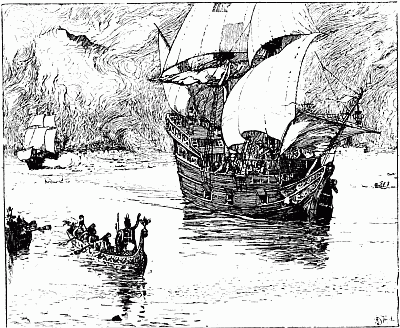
Holguin took them on board, and then requested that the emperor would order the people in the other canoes to surrender. 'There is no need,' he answered sadly, 'they will fight no longer when they see their prince is taken.' And so it was, for when the news of his capture reached the shore the Mexicans at once ceased to defend themselves. It seemed as if they had only gone on so long to give their sovereign a better chance of escape. Cortés, who had taken up his station on the flat roof of one of the houses, now sent to command that Guatemozin should be brought before him, and he came, escorted by Sandoval and Holguin, who each claimed the honour of having captured him. The conqueror, who was, as usual, accompanied by the Lady Marina, came forward with dignified courtesy to receive his noble prisoner. The Aztec monarch broke the silence saying, 'I have done all I could to defend myself and my people. I am now reduced to this state. Deal with me, Malinche, as you will.' Then laying his hand on a dagger which hung from the belt of Cortés, he added, 'Better despatch me at once with this and rid me of life.'
'Fear not,' answered the conqueror. 'You shall be treated with honour. You have defended your capital like a brave warrior, and a Spaniard knows how to respect valour even in an enemy.' He then sent for the queen, who had remained on board the Spanish ship, and after ordering that the royal captives should be well cared for and supplied with all they needed, he proceeded to dispose of his troops. Olid and Alvarado drew off their divisions to their quarters, leaving only a small guard in the wasted suburbs of the pestilence stricken city, whilst the general himself, with Sandoval and the prisoners, retired to a town at the end of the southern causeway. That night a tremendous tempest arose, such as the Spaniards had never before witnessed, shaking to its foundations all that remained of the city of Mexico. The next day, at the request of Guatemozin, the Mexicans were allowed to leave the capital, and for three days a mournful train of men, women, and children straggled feebly across the causeways, sick and wounded, wasted with famine and misery, turning often to take one more look at the spot which was once their pleasant home. When they were gone the conquerors took possession of the place and purified it as speedily as possible, burying the dead and lighting huge bonfires in the deserted streets. The treasure of gold and jewels found in it fell far short of the expectation of the Spaniards, the Aztecs having probably buried their hoards or sunk them in the lake on purpose to disappoint the avarice of their enemies. Cortés, therefore, to his eternal disgrace, caused Guatemozin to be tortured; but fire and cord could not wring the secret of the treasure from this illustrious prince. In later days Cortés hanged Guatemozin, on pretence of a conspiracy. Cortés, having no further need for his native allies, now dismissed them with presents and flattering speeches, and they departed well pleased, loaded with the plunder of the Mexican houses, which was despised by the Spanish soldiers. Great was the satisfaction of the conquerors at having thus brought the long campaign successfully to an end. Cortés celebrated the event by a banquet as sumptuous as circumstances would permit, and the next day, at the request of Father Olmedo, the whole army took part in a solemn service and procession in token of their thankfulness for victory.
Thus, after a siege of nearly three months, in which the beleaguered Mexicans showed a constancy and courage under their sufferings which is unmatched in history, fell the renowned capital of the Aztecs, and with its fall the story of the nation comes to an end.
The Aztec empire fell by its own sin. The constant capture of men from neighbouring states as victims for sacrifice had caused the Aztecs to be hated; thus Cortés obtained the aid of the Tlascalans, but for which even his courage and energy would have been of no avail. He deserted Marina when she ceased to be useful, and gave her as a wife to one of his followers.