Chapter IV
Reading edition
ON THE MAINLAND
To understand the Prince's proceedings for the next few weeks it is necessary to have a clear idea of the country which was the scene of his wanderings. From Loch Hourn (which opens opposite Sleat in Skye) on the north down to Loch Shiel on the south a little group of wild and rugged peninsulas run out into the Atlantic, called respectively Knoydart, Morar, Arisaig, and Moidart. Between these deep narrow lochs run far inland. Loch Nevis lies between Knoydart and Morar; Loch Morar, a freshwater loch, cuts off the peninsula of the same name from Arisaig, and this again is separated from Moidart by Lochs Nanuagh and Aylort, and Loch Shiel separates the whole group from Ardnamurchan in the south. The wild, inaccessible nature of the country, the deep valleys and many rocky hollows in the hills offered many hiding-places; but a glance at the map will show that a vigilant enemy by stationing men-of-war in all the lochs and drawing a cordon of soldiers from the head of Loch Hourn to the head of Loch Shiel, could draw the net so tightly that escape would be nearly impossible.
In these first days of July, however, the search was still chiefly confined to the Long Island and Skye, and Charles got a clear start of his enemies. On July 5, in the early morning, he and his faithful Mackinnons landed at a place named Mallach on Loch Nevis, and spent the next three days in the open. They were in a good deal of perplexity as to their next movements, and when Charles learned that old Clanranald was staying in the neighbourhood, at the home of his kinsman Scothouse, he sent to ask his advice and help, expecting confidently to find the old faithful kindness that had helped him in Uist. But the old gentleman had had enough of danger and suffering in the Prince's cause; his son was a fugitive, his brother a prisoner, he himself was in hiding. The sudden appearance of Mackinnon startled him into a state of nervous terror, and he declared querulously that he could do no more nor knew anyone else who could give any help. Mackinnon returned indignant and mortified, but the Prince received the news philosophically, 'Well, Mr. Mackinnon, we must do the best we can for ourselves.'
It was the first rebuff he had met with; but a day or two later he found the same lukewarm spirit in Mr. Macdonald of Morar, a former friend. The poor man had had his house burnt over his head and was living with his family in a wretched hut, and probably thought that he had suffered enough for the cause. This desertion cut the Prince to the quick. 'I hope, Mackinnon,' he cried, addressing John, 'that you will not desert me too.' The old chief thought that the words were addressed to him. 'I will never leave your Royal Highness in the hour of danger,' he declared, with tears, and John's reply was no less fervent.
There was one house in the neighbourhood where the Prince could always count on a welcome whether he came at midnight, at cockcrow, or at noon, whether as a Prince on his way to win a crown or as a beggar with neither home nor hope. The hospitable house of Borodale was a mass of blackened ruins, but the laird—'my kind old landlord,' as the Prince fondly called him—and his two sons had still strong hands, shrewd heads, and warm hearts ready for the Prince's service.
From Morar the Prince and the two Mackinnons walked through the summer night over the wildest mountain track and arrived at Borodale in the early morning. Old Angus was still in bed when they knocked at the door of the bothy where the family was living. He came to the door, wrapt in his blanket. When Mackinnon explained who it was that desired his hospitality, the old man's welcome came prompt and unhesitating. 'I have brought him here,' said Mackinnon, 'and will commit him to your charge. I have done my duty, do you do yours.'
'I am glad of it,' said Angus, 'and shall not fail to take care of him. I shall lodge him so securely that all the forces in Great Britain shall not find him.'
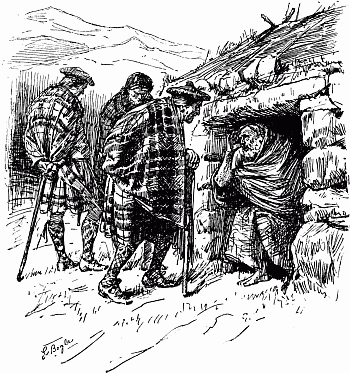
So John Mackinnon, having done all he could, parted from the Prince with the same affectionate sorrow that had marked the farewells of all his faithful Highlanders. He was caught on his return to Skye, by the cruel Captain Scott, and five days later was brought back to Lochnanuagh, a prisoner on board an English man-of-war. Opposite the place where the ship cast anchor was a fissure in the rock, and halfway up was what looked like a mere grassy bank. In reality it was a small hut roofed with sods, so contrived that no one unless he were in the secret would have suspected it of being anything but a grassy slope. Here the Prince had spent the preceding night, but as soon as the ship entered the loch he betook himself to the hills. He was accompanied by old Borodale and his son John—the young man who had been supposed to have died at Culloden. A cousin of Borodale's, Macdonald of Glenaladale, had always been a special friend of the Prince's. He joined him now in the wilds, resolved to share all his worst dangers, though he had to leave his wife and 'five weak pretty children' unprotected and living in a bothy, the only home the English soldiers had left them. The first plan these brave men concerted together was to carry the Prince into Lochiel's country, where young Clanranald had promised to provide him a hiding-place. On their way, however, they heard that a body of soldiers were approaching from Loch Arkaig, which completely blocked their way on that side. That same night old Borodale learnt that General Campbell with several ships was in Loch Nevis, Captain Scott was still in Lochnanuagh, and parties from these ships were searching every foot of ground in their neighbourhoods. At the same time troops had been landed at the head of Loch Hourn, and others simultaneously at the head of Loch Shiel. Between these two points the distance as the crow flies must be some twenty or five-and-twenty miles, but the wild mountainous nature of the country makes the actual distance far greater. In spite of all difficulties the Government troops in a few days had drawn a complete cordon from one point to the other. This cordon consisted of single sentinels planted within sight of each other who permitted no one to pass unchallenged. At night large fires were lighted, and every quarter of an hour patrolling parties passed from one to the other to see that all the sentinels were on the alert.
Charles's case was almost desperate. For several days he and his companions lived like hunted animals on the mountain-tops. They were frequently within sight of some camp of the enemy; more than once they had to go precipitately down one side of a hill because the soldiers were coming up the other. They changed their quarters at night, sometimes marching long miles merely to reach some mountain which having been searched the day before was less likely to be visited again. In the daytime the Prince could snatch a few hours of troubled sleep in some rocky hollow while the rest of the party kept guard. News of the enemy's movements was brought them occasionally by secret friends under cover of darkness, but even their approach was full of terror for the fugitives. Worst of all was their suffering from hunger. The soldiers devoured and destroyed what meagre stores the country could boast, and in spite of the generosity of the poorer clansmen no food could be had. For four days the whole party lived on a few handfuls of dry meal and some butter. On one occasion soldiers passed below their lair driving cattle. The Prince, who was starving, proposed to follow them, and 'lift' some of the cattle in the night. His companions remonstrated, but he led the party himself, and secured the beef.[8] The guide, and indeed the leader of the little band, was a farmer, Donald Cameron of Glenpean. But for this man's daring courage and his intimate knowledge of the country the Prince must sooner or later have fallen into the hands of his enemies.
The circle was daily being drawn more closely round the prey, and daily the fear of starvation stared them in the face. Should they wait to die like driven deer or make one desperate effort to break through the toils that surrounded them, and either escape or die like men? For brave men there could only be one answer to such a question. On the night of July 25 they determined to force their way through the cordon.
All that day the Prince had lain in closest hiding on a hill on the confines of Knoydart, not a mile from the chain of sentinels. He had slept some hours while two of the party had kept watch and the other two had gone and foraged for food, bringing back two dry cheeses as the result. (Old Borodale had gone back at this time; the party consisted of his son John, Glenaladale and his brother, and Cameron of Glenpean.) All day parties of soldiers had been searching the neighbourhood, and now the sentinel fires were alight all along the line of defence. At nightfall the little band started, walking silently and rapidly up a mountain called Drumnachosi. The way was very steep, and the night very dark. Once crossing a little stream the Prince's foot slipped, he stumbled, and would have fallen down over a cliff had not Cameron caught one arm and Glenaladale the other and pulled him up. From the top of the hill they could see the sentinel fires close in front of them, and were near enough to hear the voices of the soldiers quite distinctly. Under cover of the friendly darkness they crept up another hill and came out opposite another fire. At a point midway between these two posts a mountain torrent had made a deep fissure on the side of a hill on the further side. Could they break through the line and reach this river-bed the overhanging banks, aided by the darkness of night, would conceal their figures, and following the stream they could cross over into wild broken country, where they could hide themselves. Donald Cameron, with a fine Highland gallantry, undertook to make trial of the way first. If he could reach the spot and return again to report 'all safe,' the rest of the party might make the attempt. It had all to be done in a quarter of an hour, for that was the interval at which the patrolling parties succeeded each other.
In dead silence they waited till the sentinels had past; then as stealthily and rapidly as a cat Cameron slipped down the hillside and disappeared into the darkness. The rest stood breathless, straining every nerve for the faintest sound; no footfall or falling pebble broke the stillness, and in a few long, heavily-weighted minutes Cameron returned and whispered that all was well. It was two o'clock now and the darkness was growing thinner. They waited till the sentries had crossed again and had now their backs to the passage, then they all moved forward in perfect silence. Reaching the torrent, they sank on all fours and one after the other crept up the rocky bed without a sound. The dreaded cordon was passed, and in a short time they reached a place where they were completely hidden and could take a little much-needed rest.
Once clear of this chain of their enemies they turned northward to the Glenelg country. Their plan was to go through the Mackenzie's country to Poole Ewe, where they hoped to find a French vessel. But the next day they learned from a wayfaring man that the only French ship which had been there had left the coast. Seeing that that plan was fruitless, their next idea was to move eastward into the wilds of Inverness and wait there till the way should be clear for the Prince's joining Lochiel in Badenoch.
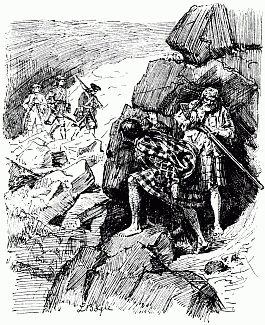
In Glen Sheil they parted with Cameron of Glenpean, and here too they had a curious adventure which might have proved seriously inconvenient to them. They had spent a whole hot August day hiding behind some rocks on a bare hillside, the midges had tormented them, and they were oppressed with thirst, but had not ventured from their hiding-place even to look for water. At sunset a boy appeared bringing quarts of goat's milk; he was the son of a certain Macraw, a staunch though secret friend in the neighbourhood. Glenaladale at this time carried the fortune of the little party—some forty gold louis and a few shillings—in his sporran. He paid the lad for the milk, and in his hurry did not notice that he had dropped his purse. They had hardly gone an English mile before the loss was discovered, and Glenaladale insisted at all risks on going back to look for the purse. He and his cousin did indeed find it lying at the expected place, but though some shillings remained the louis were gone. It was midnight before the indignant pair reached Macraw's house, and the family were all asleep. They roused the master, however, and fairly told him what had happened. No shadow of doubt seems to have crossed the father's mind, no word of expostulation rose to his lips. 'Without a moment's delay he returned to the house, got hold of a rope hanging there, and gripped his son by the arm in great passion, saying, "You damned scoundrel, this instant get these poor gentlemen's money, or by the heavens I'll hang you to that very tree you see there." The boy, shivering with fear, went instantly for the money, which he had buried underground thirty yards from his father's house.' This accident turned out most luckily for the Prince. He and Glenaladale's brother while awaiting the other two had hidden behind some rocks; shortly after they were hidden they saw an officer and two soldiers coming along the very path they had intended to take. But for the delay caused by their companions going back they must have fallen into the hands of their enemies.
They now turned eastward, and after a long night's march found themselves in the wild tract of country called the Braes of Glenmoriston.
Here Charles was to find a new set of friends, different indeed from the chivalrous Kingsburgh and the high-bred Lady Margaret, but men who were as staunch and incorruptible as any of his former friends. These were the famous 'Seven Men of Glenmoriston,' men who had served in the Prince's army, and who now lived a wild, lawless life among the mountains, at feud with everything that represented the existing law and order. They have been described as a robber band, but that title is misleading. They were rather a small remnant of irreconcilable rebels who had vowed undying enmity and revenge against Cumberland and his soldiers. And indeed there was ample excuse for their hatred and violence in the cruelties they saw practised all round them. Sixty of their clansmen after surrendering themselves had been shipped off to the colonies, all their own possessions and those of their neighbours had been seized, and friends and kinsfolk had been brutally put to death.
Swooping down like mountain eagles on detached bands of soldiers, these seven men wreaked instant vengeance on oppressors and informers, and carried off arms and baggage in the face of larger bodies of the enemy. To these men, ignorant, reckless, and lawless, Charles unhesitatingly confided his person, a person on whose head a sum of thirty thousand pounds was set.
Four of these men were in a cave, Coraghoth, in the Braes of Glenmoriston, when Glenaladale brought Charles to see them. They had expected to see young Clanranald, and as soon as they saw the Prince one of their number recognised him, but had the presence of mind to address him as an old acquaintance by the name of 'MacCullony.' When the four knew who their guest really was, they bound themselves to be faithful to him by the dreadful Highland oath, praying 'that their backs might be to God, and their faces to the devil, and that all the curses the Scriptures do pronounce might come upon them and their posterity if they did not stand firm to the Prince in the greatest danger.'
For about three weeks Charles shared the life of these outlaws, sleeping in caves and holes of the earth, living on the wild deer of their shooting and the secret gifts of the peasantry. They did not understand his English, but the Prince was beginning to pick up a little Gaelic. He was able at least to improve their cooking and reprove their swearing, two services they liked afterwards to recall. Here too, as elsewhere on his wanderings, the Prince gained the hearts of all his followers by his gracious gaiety and plucky endurance of hardships. In the beginning of August his hopes had again turned to Poole Ewe, but learning for a second time that no French ship could land on the closely guarded coast, he and his friends determined to remain in the northern straths of Inverness-shire till the Government troops should withdraw from the Great Glen—the chain of lakes which now forms the Caledonian Canal—and thus leave the way clear into Badenoch, where Lochiel and Macpherson of Cluny were hiding.
A curious incident is supposed to have helped the Prince at this time. There had been among his Life Guards a handsome youth named Roderick Mackenzie, son of a jeweller in Edinburgh, who in face and figure was startlingly like the Prince. This lad was actually 'skulking' among the Braes of Glenmoriston at the time when the Prince was surrounded in Knoydart. A party of soldiers tracked him to a hut, which they surrounded. Flight was impossible, and the poor boy stood at bay. As he fell beneath their sword-thrusts he cried out, 'Villains, ye have slain your King.' Whether these words were a curious last flash of vanity, or whether he intended to serve the Prince by a generous act of imposture, can never be known. The soldiers at any rate believed that they had secured the prize. They carried off Mackenzie's head with them to Fort Augustus, and the authorities seem for some time to have been under the impression that it was indeed that of the Prince. Possibly it was owing to this that in the middle of August the Government rather relaxed their vigilance along the Great Glen. Charles was eager to press at once into Badenoch, but the wary outlaws would only consent to taking him to the Lochiel country, between Loch Arkaig, Loch Lochy, and Loch Garry. They travelled chiefly by night; the season was very wet, and the rivers were in flood, and they had to cross the River Garry Highland fashion in a line, with each man's arm on his neighbour's shoulder, for the water was running breast-high.
At this time the Prince's condition was as bad as at any period of his wanderings. His clothes were of the coarsest, and they were in rags. Lady Clanranald's six good shirts had long since disappeared; it was as much as he could do to have a clean shirt once a fortnight. The provisions they carried were reduced to one peck of meal. In this state did the Prince arrive in the familiar country round Loch Arkaig. It was a year almost to the day since he had passed through that very country elate and hopeful at the head of his brave Macdonalds and Camerons. He was now a fugitive, ill-fed, ill-clad, with a price on his head; the only thing that was unchanged was the faithful devotion of his Highlanders.
Cameron of Clunes and Macdonald of Lochgarry, or Lochgarie, though they were themselves 'skulking,' received the Prince with the utmost kindness and found a hiding-place for him in a hut in a wood at the south side of Loch Arkaig. Here the outlaws left him; only one of their number, Patrick Grant, remained till the Prince should be supplied with money to reward their faithful service. From this place, also, John Macdonald and Glenaladale's brother returned to the coast, where they were to keep a careful look-out and to send the Prince news of any French ship which might appear.
Glenaladale still remained, but the Prince's thoughts were turning more and more towards Badenoch, where his friend Lochiel was in comparatively secure hiding.
Among all the gallant gentlemen who risked life and estate in this rising there is no figure more attractive than that of the 'Gentle Lochiel.' He had for years before the rebellion been the mainstay of the Jacobite party. No man in the Highlands carried so much weight as he, partly from his position, but more from his talents and the charm of his character. 'Wise' and 'gentle' are the words that were applied to him, and with all the qualities of a high-bred gentleman he combined the simpler virtues of the Highland clansman—faithfulness, courage, and a jealous sense of personal honour. From the very beginning he had seen the folly of the rising. But when he had failed to convince Charles of its hopelessness, he had thrown himself into the movement as if it had been of his own devising. Never did he afterwards reproach Charles by word or look for the ill-fated result.
He and his cousin, Macpherson of Cluny, were at this time hiding among the recesses of Benalder. The road to Inverness ran by within a few miles, and at a little distance lay Lord Loudoun's camp, but so great was the devotion of the clansmen, so admirable their caution and secrecy, that the English commander had not the slightest suspicion that the two most important Jacobite fugitives had for three months been in hiding so near to him. Lochiel had been wounded in the feet at Culloden, and his lameness as well as his dangerous position prevented his going to look for the Prince. He had two brothers, one a doctor and the other a clergyman, both accomplished and bold men, who had also been involved in the Jacobite rebellion. Towards the end of August, news having come to Benalder that the Prince was living near Auchnacarry under the protection of Cameron of Clunes, the two Cameron brothers set off secretly for that country. The Prince with a son of Clunes and the faithful outlaw Patrick Grant were at this time living in a hut in a wood close to Loch Arkaig. It was early on the morning of August 25, the Prince and young Clunes were asleep in the hut, while Patrick Grant kept watch. He must have got drowsy, for waking with a start he saw a party of men approaching. He rushed into the hut and roused the Prince and his companion. Charles had long lived in expectation of such moments. He kept his presence of mind completely, decided that it was too late to fly, and prepared to defend himself. The fowling-pieces were loaded and got into position, and they very nearly received their friends with a volley. Dr. Cameron in his narrative describes the Prince's appearance thus: 'He was barefoot; had an old black kilt coat on and philibeg and waistcoat, a dirty shirt and a long red beard, a gun in his hand and a pistol and dirk at his side; still he was very cheerful and in good health.'
Another week they all waited in the neighbourhood of Auchnacarry (the ruined home of the Lochiels). At last a message reached them from Benalder that the passes were free and that they might safely try to join Lochiel. Having parted with his devoted friend Glenaladale, who returned to the coast, the Prince, with Dr. Cameron and Lochgarry, arrived on August 30 at Mellaneuir, at the foot of Benalder. People in hiding have no means of discriminating their friends from their enemies at a little distance. Lochiel seeing a considerable party approaching believed that he was discovered and determined to make a good fight for it. He as narrowly missed shooting Charles as Charles had missed shooting Dr. Cameron the week before. When, however, he recognised the figure in the coarse brown coat, the shabby kilt, and the rough red beard, he hobbled to the door and wanted to receive the Prince on his knees. 'My dear Lochiel,' remonstrated Charles as he embraced him, 'you don't know who may be looking down from these hills.'
In the hut there was a sufficiency of mutton, beef sausages, bacon, butter, cheese, &c., and an anker of whisky, and the Prince was almost overwhelmed by such an excess of luxury. 'Now, gentlemen,' he said with a cheerful air, 'now I live like a Prince.' Charles's wardrobe was as usual most dilapidated, and Cluny's three sisters set at once to work to make him a set of six shirts with their own fair hands, doubtless sewing the most passionate loyalty and infinite regret into their 'seams.'
The hiding-place where the Prince was now concealed was a very curious hut contrived by Cluny in one of the inmost recesses of the hills. It was called 'The Cage,' and was placed in a little thicket on the rocky slope of a hill. The walls were formed by actual growing trees with stakes planted between them, the whole woven together by ropes of heather and birch. Till you were close to the hut it looked merely like a thick clump of trees and bushes. The smoke escaped along the rocks, and the stone being of a bluish colour it could easily pass unnoticed. This hut could only hold six persons at a time, so the party generally divided in this way: one man cooked the food, four played cards, and the last man looked on at the others and possibly smoked!
Probably they played cards and talked and jested over the daily needs and hardships, and spoke little of the disastrous times that lay behind them, or the doubtful hopes that lay before them. Fearing lest the Prince might have to remain in hiding all winter the ingenious Cluny began to fit up a subterranean dwelling, thickly boarded up, where the party would have been in safety and shelter. But in the meantime no efforts were lacking to find a means of escape. Lochiel's brother, the clergyman, a man of great prudence, went secretly to Edinburgh, and there procured a ship and sent it round to a port on the East coast to await the Prince. Succour, however, had come from another quarter; it was known to the Prince and his followers that a certain Colonel Warren was fitting out a couple of ships in France for the purpose of bringing off the Prince, and daily they expected news of their arrival. On September 6 two ships, L'Heureux and La Princesse, appeared at Lochnanuagh. Old Borodale and his two sons immediately fled to the hills, leaving a faithful servant to find out and report to them who the strangers might be. After nightfall, twelve French officers came to the hut where they were hiding and told their errand. Information was at once sent to Glenaladale, who undertook to go to Auchnacarry and send on the news through Cameron of Clunes, he himself not knowing where the Prince was hiding. Any delay, even of a few hours, might be fatal, as the presence of the French ships must sooner or later become known to the authorities at Fort Augustus. To his dismay Glenaladale failed to find Clunes, and only by an accident met with an old woman, who directed him to the place where the latter was hiding. A messenger was at once despatched, and he, happening by a curious chance to meet with Cluny and Dr. Cameron on a dark night in Badenoch, gave them his message, and an express was at once sent to the Cage. On September 13, at one in the morning, the party—which now included Cluny, Lochiel, Macpherson of Breakachie, and some others of the Prince's more important followers—set off for the coast. They travelled by night, remaining in concealment by day, but so lonely was the country, so recklessly high were the Prince's spirits, that one whole day he amused himself by flinging up caps into the air and shooting at them.
Again he passed through the well-known country round Loch Arkaig, past Auchnacarry, the home of the Lochiels, which was lying in ruins, over the rugged hills where he had been hunted like a wild creature a few weeks before, down to the familiar waters of Lochnanuagh, back to the warm-hearted household of Borodale.
A considerable number of Jacobite gentlemen who had lain for months in hiding had been drawn to Lochnanuagh by the report of the landing of the French ships; amongst these were young Clanranald, Glenaladale, and Macdonald of Daleby. On the Prince's ship there sailed with him Lochgarry, John Roy Stuart, Dr. Cameron, and Lochiel. 'The gentlemen as well as commons were seen to weep, though they boasted of being soon back with an irresistible force,' says the newspaper of the day. For the greater part they never came back, never saw again the homes they loved so well. Most were to spend a life of hope deferred and of desperate longings for home, as dependents on a foreign Court. Dr. Cameron was ten years later taken prisoner in London and executed, the last man who suffered as a rebel; Lochiel died two years after he left Scotland, a heart-broken exile. 'Weep ye not for the dead, neither bemoan him; but weep sore for him that goeth away, for he shall return no more nor see his native country.'[9]