E. L. TROUVELOT,
Reading edition
FORMERLY CONNECTED WITH THE OBSERVATORY OF HARVARD COLLEGE; FELLOW OF THE AMERICAN ACADEMY OF ARTS AND SCIENCES, AND MEMBER OF THE SELENO-GRAPHICAL SOCIETY OF GREAT BRITAIN; IN CHARGE OF A GOVERNMENT EXPEDITION TO OBSERVE THE TOTAL SOLAR ECLIPSE OF 1878.
NEW YORK
CHARLES SCRIBNER'S SONS
1882
INTRODUCTION
During a study of the heavens, which has now been continued for more than fifteen years, I have made a large number of observations pertaining to physical astronomy, together with many original drawings representing the most interesting celestial objects and phenomena.
With a view to making these observations more generally useful, I was led, some years ago, to prepare, from this collection of drawings, a series of astronomical pictures, which were intended to represent the celestial phenomena as they appear to a trained eye and to an experienced draughtsman through the great modern telescopes, provided with the most delicate instrumental appliances. Over two years were spent in the preparation of this series, which consisted of a number of large drawings executed in pastel. In 1876, these drawings were displayed at the United States Centennial Exhibition at Philadelphia, forming a part of the Massachusetts exhibit, in the Department of Education and Science.
The drawings forming the present series comprise only a part of those exhibited at Philadelphia; but, although fewer in number, they are quite sufficient to illustrate the principal classes of celestial objects and phenomena.
While my aim in this work has been to combine scrupulous fidelity and accuracy in the details, I have also endeavored to preserve the natural elegance and the delicate outlines peculiar to the objects depicted; but in this, only a little more than a suggestion is possible, since no human skill can reproduce upon paper the majestic beauty and radiance of the celestial objects.
The plates were prepared under my supervision, from the original pastel drawings, and great care has been taken to make the reproduction exact.
The instruments employed in the observations, and in the delineation of the heavenly bodies represented in the series, have varied in aperture from 6 to 26 inches, according to circumstances, and to the nature of the object to be studied. The great Washington refractor, kindly placed at my disposal by the late Admiral C. H. Davis, has contributed to this work, as has also the 26 inch telescope of the University of Virginia, while in the hands of its celebrated constructors, Alvan Clark & Sons. The spectroscope used was made by Alvan Clark & Sons. Attached to it is an excellent diffraction grating, by Mr. L. M. Rutherfurd, to whose kindness I am indebted for it.
Those unacquainted with the use of optical instruments generally suppose that all astronomical drawings are obtained by the photographic process, and are, therefore, comparatively easy to procure; but this is not true. Although photography renders valuable assistance to the astronomer in the case of the Sun and Moon, as proved by the fine photographs of these objects taken by M. Janssen and Mr. Rutherfurd; yet, for other subjects, its products are in general so blurred and indistinct that no details of any great value can be secured. A well-trained eye alone is capable of seizing the delicate details of structure and of configuration of the heavenly bodies, which are liable to be affected, and even rendered invisible, by the slightest changes in our atmosphere.
The method employed to secure correctness in the proportions of the original drawings is simple, but well adapted to the purpose in view. It consists in placing a fine reticule, cut on glass, at the common focus of the objective and the eye-piece, so that in viewing an object, its telescopic image, appearing projected on the reticule, can be drawn very accurately on a sheet of paper ruled with corresponding squares. For a series of such reticules I am indebted to the kindness of Professor William A. Rogers, of the Harvard College Observatory.
The drawings representing telescopic views are inverted, as they appear in a refracting telescope—the South being upward, the North downward, the East on the right, and the West on the left. The Comet, the Milky-Way, the Eclipse of the Moon, the Aurora Borealis, the Zodiacal Light and the Meteors are represented as seen directly in the sky with the naked eye. The Comet was, however, drawn with the aid of the telescope, without which the delicate structure shown in the drawing would not have been visible.
The plate representing the November Meteors, or so-called "Leonids," may be called an ideal view, since the shooting stars delineated, were not observed at the same moment of time, but during the same night. Over three thousand Meteors were observed between midnight and five o'clock in the morning of the day on which this shower occurred; a dozen being sometimes in sight at the same instant. The paths of the Meteors, whether curved, wavy, or crooked, and also their delicate colors, are in all cases depicted as they were actually observed.
In the Manual, I have endeavored to present a general outline of what is known, or supposed, on the different subjects and phenomena illustrated in the series. The statements made are derived either from the best authorities on physical astronomy, or from my original observations, which are, for the most part, yet unpublished.
The figures in the Manual relating to distance, size, volume, mass, etc., are not intended to be strictly exact, being only round numbers, which can, therefore, be more easily remembered.
It gives me pleasure to acknowledge that the experience acquired in making the astronomical drawings published in Volume VIII. of the Annals of the Harvard College Observatory, while I was connected with that institution, has been of considerable assistance to me in preparing this work; although no drawings made while I was so connected have been used for this series.
E. L. TROUVELOT.
Cambridge, March, 1882.
CONTENTS
INTRODUCTION LIST OF PLATES
THE SUN
GENERAL REMARKS ON THE SUN SUN-SPOTS AND VEILED SPOTS SOLAR PROTUBERANCES TOTAL ECLIPSE OF THE SUN
THE AURORAL AND ZODIACAL LIGHTS
THE AURORA BOREALIS THE ZODIACAL LIGHT
THE MOON
THE MOON ECLIPSES OF THE MOON
THE PLANETS
THE PLANET MARS THE PLANET JUPITER THE PLANET SATURN
COMETS AND METEORS
COMETS SHOOTING-STARS AND METEORS
THE STELLAR SYSTEMS
THE MILKY-WAY OR GALAXY THE STAR-CLUSTERS THE NEBULÆ APPENDIX
LIST OF PLATES[1]
PLATE
I. GROUP OF SUN-SPOTS AND VEILED SPOTS. Observed June 17, 1875, at 7 h. 30m. A. M. II. SOLAR PROTUBERANCES. Observed May 5, 1873, at 9h. 40m. A. M. III. TOTAL ECLIPSE OF THE SUN. Observed July 29, 1878, at Creston, Wyoming Territory. IV. AURORA BOREALIS. As observed March 1, 1872, at 9h. 25m. P. M. V. THE ZODIACAL LIGHT. Observed February 20, 1876. VI. MARE HUMORUM. From a study made in 1875. VII. PARTIAL ECLIPSE OF THE MOON. Observed October 24, 1874. VIII. THE PLANET MARS. Observed September 3, 1877, at 11h. 55m. P. M. IX. THE PLANET JUPITER. Observed November 1, 1880, at 9h. 30m. P. M. X. THE PLANET SATURN. Observed November 30, 1874, at 5th. 50m. P. M. XI. THE GREAT COMET OF 1881. Observed on the night of June 25-26, at 1h. 30m. A. M. XII. THE NOVEMBER METEORS. As observed between midnight and 3 o'clock A. M., on the night of November 13-14, 1868. XIII. PART OF THE MILKY-WAY. From a study made during the years 1874, 1875 and 1876. XIV. STAR-CLUSTER IN HERCULES. From a study made in June, 1877. XV. THE GREAT NEBULA IN ORION. From a study made in the years 1873-76.
Reproduced from the Original Drawings, by Armstrong & Company, Riverside Press, Cambridge, Mass.
GENERAL REMARKS ON THE SUN
The Sun, the centre of the system which bears its name, is a self-luminous sphere, constantly radiating heat and light.
Its apparent diameter, as seen at its mean from the Earth, subtends an angle of 32', or a little over half a degree. A dime, placed about six feet from the eye, would appear of the same proportions, and cover the Sun's disk, if projected upon it.
That the diameter of the Sun does not appear larger, is due to the great distance which separates us from that body. Its distance from the Earth is no less than 92,000,000 miles. To bridge this immense gap, would require 11,623 globes like the Earth, placed side by side, like beads on a string.
The Sun is an enormous sphere whose diameter is over 108 times the diameter of our globe, or very nearly 860,000 miles. Its radius is nearly double the distance from the Earth to the Moon. If we suppose, for a moment, the Sun to be hollow, and our globe to be placed at the centre of this immense spherical shell, not only could our satellite revolve around us at its mean distance of 238,800 miles, as now, but another satellite, placed 190,000 miles farther than the Moon, could freely revolve likewise, without ever coming in contact with the solar envelope.
The circumference of this immense sphere measures 2,800,000 miles. While a steamer, going at the rate of 300 miles a day, would circumnavigate the Earth in 83 days, it would take, at the same rate, nearly 25 years to travel around the Sun.
The surface of the Sun is nearly 12,000 times the surface of the Earth, and its volume is equal to 1,300,000 globes like our own. If all the known planets and satellites were united in a single mass, 600 such compound masses would be needed to equal the volume of our luminary.
Although the density of the Sun is only one-quarter that of the Earth, yet the bulk of this body is so enormous that, to counterpoise it, no less than 314,760 globes like our Earth would be required.
The Sun uniformly revolves around its axis in about 25½ days. Its equator is inclined 7° 15' to the plane of the ecliptic, the axis of rotation forming, therefore, an angle of 82° 45' with the same plane. As the Earth revolves about the Sun in the same direction as that of the Sun's rotation, the apparent time of this rotation, as seen by a terrestrial spectator, is prolonged from 25½ days to about 27 days and 7 hours.
The rotation of the Sun on its axis, like that of the Earth and the other planets, is direct, or accomplished from West to East. To an observer on the Earth, looking directly at the Sun, the rotation of this body is from left to right, or from East to West.
The general appearance of the Sun is that of an intensely luminous disk, whose limb, or border, is sharply defined on the heavens. When its telescopic image is projected on a screen, or fixed on paper by photography, it is noticed that its disk is not uniformly bright throughout, but is notably more luminous in its central parts. This phenomenon is not accidental, but permanent, and is due in reality to a very rare but extensive atmosphere which surrounds the Sun, and absorbs the light which that body radiates, proportionally to its thickness, which, of course, increases towards the limb, to an observer on the Earth.
THE ENVELOPING LAYERS OF THE SUN
The luminous surface of the Sun, or that part visible at all times, and which forms its disk, is called the Photosphere, from the property it is supposed to possess of generating light. The photosphere does not extend to a great depth below the luminous surface, but forms a comparatively thin shell, 3,000 or 4,000 miles thick, which is distinct from the interior parts, above which it seems to be kept in suspense by internal forces. From the observations of some astronomers it would appear that the diameter of the photosphere is subject to slight variations, and, therefore, that the solar diameter is not a constant quantity. From the nature of this envelope, such a result does not seem at all impossible, but rather probable.
Immediately above the photosphere lies a comparatively thin stratum, less than a thousand miles in thickness, called the Reversing Layer. This stratum is composed of metallic vapors, which, by absorbing the light of particular refrangibilities emanating from the photosphere below, produces the dark Fraunhofer lines of the solar spectrum.
Above the reversing layer, and resting immediately upon it, is a shallow, semi-transparent gaseous layer, which has been called the Chromosphere, from the fine tints which it exhibits during total eclipses of the Sun, in contrast with the colorless white light radiated by the photosphere below. Although visible to a certain extent on the disk, the chromosphere is totally invisible on the limb, except with the spectroscope, and during eclipses, on account of the nature of its light, which is mainly monochromatic, and too feeble, compared with that emitted by the photosphere, to be seen.
The chromospheric layer, which has a thickness of from 3,000 to 4,000 miles, is uneven, and is usually upheaved in certain regions, its matter being transported to considerable elevations above its general surface, apparently by some internal forces. The portions of the chromosphere thus lifted up, form curious and complicated figures, which are known under the names of Solar Protuberances, or Solar Flames.
Above the chromosphere, and rising to an immense but unknown height, is the solar atmosphere proper, which is only visible during total eclipses of the Sun, and which then surrounds the dark body of the Moon with the beautiful rays and glorious nimbus, called the Corona.
These four envelopes: the photosphere, the reversing layer, the chromosphere, and the corona, constitute the outer portions of our luminary.
Below the photosphere little can be seen, although it is known, as will appear below, that at certain depths cloud-like forms exist, and freely float in an interior atmosphere of invisible gases. Beyond this all is mystery, and belongs to the domain of hypothesis.
STRUCTURE OF THE PHOTOSPHERE AND CHROMOSPHERE
The apparent uniformity of the solar surface disappears when it is examined with a telescope of sufficient aperture and magnifying powers. Seen under good atmospheric conditions, the greater part of the solar surface appears mottled with an infinite number of small, bright granules, irregularly distributed, and separated from each other by a gray-tinted background.
These objects are known under different names. The terms granules and granulations answer very well for the purpose, as they do not imply anything positive as to their form and true nature. They have also been called Luculœ, Rice Grains, Willow Leaves, etc., by different observers.
Although having different shapes, the granulations partake more or less of the circular or slightly elongated form. Their diameter, which varies considerably, has been estimated at from 0".5 to 3", or from 224 to 1,344 miles. The granulations which attain the largest size appear, under good atmospheric conditions, to be composed of several granules, closely united and forming an irregular mass, from which short appendages protrude in various directions.
The number of granulations on the surface of the Sun varies considerably under the action of unknown causes. Sometimes they are small and very numerous, while at other times they are larger, less numerous, and more widely separated. Other things being equal, the granulations are better seen in the central regions of the Sun than they are near the limb.
Usually the granulations are very unstable; their relative position, form, and size undergoing continual changes. Sometimes they are seen to congregate or to disperse in an instant, as if acting under the influence of attractive and repulsive forces; assembling in groups or files, and oftentimes forming capricious figures which are very remarkable, but usually of short duration. In an area of great solar disturbances, the granulations are often stretched to great distances, and form into parallel lines, either straight, wavy, or curved, and they have then some resemblance to the flowing of viscous liquids.
The granulations are usually terminated either by rounded or sharply pointed summits, but they do not all rise to the same height, as can be ascertained with the spectroscope when they are seen sidewise on the limb. In the regions where they are most abundant, they usually attain greater elevations, and when observed on the limb with the spectroscope, they appear as slender acute flames.
The granulations terminated by sharply-pointed crests, although observed in all latitudes, seem to be characteristic of certain regions. A daily study of the chromosphere, extending over a period of ten years, has shown me that the polar regions are rarely ever free from these objects, which are less frequent in other parts of the Sun. In the polar regions they are sometimes so abundant that they completely form the solar limb. These forms of granulation are comparatively rare in the equatorial zones, and when seen there, they never have the permanency which they exhibit in the polar regions. When observed in the equatorial regions, they usually appear in small groups, in the vicinity of sun spots, or they are at least enclosed in areas of disturbances where such spots are in process of formation. In these regions they often attain greater elevations than those seen in high latitudes.
As we are certain that in the equatorial zones these slender flames (i. e., granulations) are a sure sign of local disturbance, it may be reasonably supposed that the same kind of energy producing them nearly always prevails in the polar regions, although it is there much weaker, and never reaches beyond certain narrow limits.
Studied with the spectroscope, the granulations are found to be composed in the main of incandescent hydrogen gas, and of an unknown substance provisionally called "helium." Among the most brilliant of them are found traces of incandescent metallic vapors, belonging to various substances found on our globe.
The chromosphere is not fixed, but varies considerably in thickness in its different parts, from day to day. Its thickness is usually greater in the polar regions, where it sometimes exceeds 6,700 miles. In the equatorial regions the chromosphere very rarely attains this height, and when it does, the rising is local and occupies only a small area. In these regions it is sometimes so shallow that its depth is only a few seconds, and is then quite difficult to measure. These numbers give, of course, the extreme limits of the variations of the chromosphere; but, nearly always, it is more shallow in the equatorial regions; and, as far as my observations go, the difference in thickness between the polar and equatorial zones is greater in years of calm than it is in years of great solar activity. But ten years of observation are not sufficient to warrant any definite conclusions on this subject.
There is undoubtedly some relation between the greater thickness of the chromosphere in the polar regions, and the abundance and permanence of the sharply-pointed granulations observed in the same regions. This becomes more evident when we know that the appearance of similarly-pointed flames in the equatorial zones is always accompanied with a local thickening of the chromosphere. The thickening in the polar regions may be only apparent, and not due to a greater accumulation of chromospheric gases there; but may be caused by some kind of repulsive action or polarity, which lifts up and extends the summit of the granulations in a manner similar to the well-known mode of electric repulsion and polarity.
As it seems very probable that the heat and light emanating from the Sun are mainly generated at the base of the granulations, in the filamentary elements composing the chromosphere and photosphere, it would follow that, as the size and number of these objects constantly vary, the amount of heat and light emitted by the Sun should also vary in the same proportion.
The granulations of the solar surface are represented on Plate I., and form the general background to the group of Sun-spots forming the picture.
THE FACULÆ
Although the solar surface is mainly covered with the luminous granulations and the grayish background above described, it is very rare that its appearance is so simple and uniform as already represented. For the most part, on the contrary, it is diversified by larger, brighter, and more complicated forms, which are especially visible towards the border of the Sun. Owing to their extraordinary brilliancy, these objects have been called Faculœ (torches).
Although the faculæ are very seldom seen well beyond 50 heliocentric degrees from the limb, yet they exist, and are as numerous in the central parts of the disk as they are towards the border; since they form a part of the solar surface, and participate in its movement of rotation. Their appearance near the limb has been attributed to the effect of absorption produced by the solar atmosphere on the light from the photosphere; but this explanation seems inadequate, and does not solve the problem. The well-known fact that the solar protuberances—which are in a great measure identical with the faculæ—are much brighter at the base than they are at the summit, perhaps gives a clue to the explanation of the phenomenon; especially since we know that, in general, the summit of the protuberances is considerably broader than their base. When these objects are observed in the vicinity of the limb, they present their brightest parts to the observer, since, in this position, they are seen more or less sidewise; and, therefore, they appear bright and distinct. But as the faculæ recede from the limb, their sides, being seen under a constantly decreasing angle, appear more and more foreshortened; and, therefore, these objects grow less bright and less distinct, until they finally become invisible, when their bases are covered over by the broad, dusky summit generally terminating the protuberances.
The faculæ appear as bright and luminous masses or streaks on the granular surface of the Sun, but they differ considerably in form and size. Two types at least are distinguishable. In their simplest form they appear either as isolated white spots, or as groups of such spots covering large surfaces, and somewhat resembling large flakes of snow. In their most characteristic types they appear as intensely luminous, heavy masses, from which, in most cases, issue intricate ramifications, sometimes extending to great distances. Generally, the ramifications issuing from the masses of faculæ have their largest branches directed in the main towards the eastern limb of the Sun. Some of these branches have gigantic proportions. Occasionally they extend over 60° and even 80° of the solar surface, and, therefore, attain a length of from 450,000 to 600,000 miles.
Although the faculæ may be said to be seen everywhere on the surface of the Sun, there is a vast difference in different regions, with regard to their size, number, and brilliancy. They are largest, most abundant, and brightest on two intermediate zones parallel to the solar equator, and extending 35° or 40° to the north and to the south of this line. The breadth of these zones varies considerably with the activity of the solar forces. When they are most active, the faculæ spread on either side, but especially towards the equator, where they sometimes nearly meet those of the other zone. In years of little solar activity the belts formed by the faculæ are very narrow—the elements composing them being very few and small, although they never entirely disappear.
The faculæ are very unstable, and are constantly changing: those of the small types sometimes form and vanish in a few minutes. When an area of disturbance of the solar surface is observed for some time, all seems in confusion; the movements of the granulations become unusually violent; they congregate in all sorts of ways, and thus frequently form temporary faculæ. Action of this kind is, for the most part, peculiar to the polar regions of the Sun.
The larger faculæ have undoubtedly another origin, as they seem to be mainly formed by the ejection of incandescent gases and metallic vapors from the interior of the photosphere. In their process of development some of the heavy masses of faculæ are swollen up to great heights, being torn in all sorts of ways, showing large rents and fissures through which the sight can penetrate.
Very few faculæ are represented in Plate I.; several streaks are shown at the upper left-hand corner, some appearing as whitish ramifications among the granulations representing the general solar surface.
SUN-SPOTS AND VEILED SPOTS PLATE I
Besides the brilliant faculæ already described, much more conspicuous markings, though of a totally different character, are very frequently observed on the Sun. On account of their darkish appearance, which is in strong contrast with the white envelope of our luminary, these markings were called Maculæ, or Sun-spots, by their earlier observers.
The Sun-spots are not equally distributed on the solar surface; but like the faculæ, to which they are closely related, they occupy two zones—one on each side of the equator. These zones are comprised between 10° and 35° of north latitude, and 10° and 35° of south latitude. Between these two zones is a belt 20° in width, where the Sun-spots are rarely seen.
Above the latitudes 35° north and south, the Sun-spots are rare, and it is only occasionally, and during years of great solar activity, that they appear in these regions; in only a few cases have spots of considerable size been seen there. A few observers, however, have seen spots as far as 40° and 50 from the equator; and La Hire even observed one in 70° of north latitude; but these cases are exceedingly rare. It is not uncommon, however, to see very small spots, or groups of such spots, within 8° or 10° from the poles.
The activity of the Sun is subject to considerable fluctuation, and accordingly the Sun-spots vary in size and number in different years. During some years they are large, complicated, and very numerous; while in others they are small and scarce, and are sometimes totally absent for weeks and months together. The fluctuations in the frequency of Sun-spots are supposed to be periodical in their character, although their periods do not always appear to recur at exactly regular intervals. Sometimes the period is found to be only nine years, while at other times it extends to twelve years. The period generally adopted now is 11⅒ years, nearly; but further investigations are needed to understand the true nature of the phenomenon.
The number of Sun-spots does not symmetrically augment and diminish, but the increase is more rapid than the diminution.
The period of increase is only about four years, while that of decrease is over seven years; each period of Sun-spot maximum being nearer the preceding period of Sun-spot minimum than it is to that next following.
The cause of these fluctuations in the solar energy is at present wholly unknown. Some astronomers, however, have attributed it to the influence of the planets Venus and Jupiter, the period of revolution of the latter planet being not much longer than the Sun-spot period; but this supposition lacks confirmation from direct observations, which, so far, do not seem to be in favor of the hypothesis. At the present time the solar activity is on the increase, and the Sun-spots will probably reach their maximum in 1883. The last minimum occurred in 1879, when only sixteen small groups of spots were observed during the whole year.
Sun-spots vary in size and appearance; but, unless they are very small, in which case they appear as simple black dots, they generally consist of two distinct and well-characterized parts, nearly always present. There is first, a central part, much darker than the other, and sharply divided from it, called the "Umbra;" second, a broad, irregular radiated fringe of lighter shade, completely surrounding the first, and called the "Penumbra."
Reduced to its simplest expression, a Sun-spot is a funnel-shaped opening through the chromosphere and the photosphere. The inner end of the funnel, or opening, gives the form to the umbra, while its sloping sides form the penumbra.
The umbra of Sun-spots, whose outlines approximately follow the irregularities of the penumbral fringe, has a diameter which generally exceeds the width of the penumbral ring. Sometimes it appears uniformly black throughout; but it is only so by contrast, as is proved when either Mercury or Venus passes near a spot during a transit over the Sun's disk. The umbra then appears grayish, when compared with the jet-black disk of the planet.
The umbra of spots is rarely so simple as just described; but it is frequently occupied, either partly or wholly, by grayish and rosy forms, somewhat resembling loosely-entangled muscular fibres. These forms have been called the Gray and Rosy Veils. Frequently these veils appear as if perforated by roundish black holes, improperly called Nuclei, which permit the sight to penetrate deeper into the interior. To all appearance the gray and rosy veils are of the same nature as the chromosphere and the faculæ, and are therefore mainly composed of hydrogen gas.
Whatever can be known about the interior of the Sun, must be learned from the observations of these openings, which are comparatively small. But whatever this interior may be, we certainly know that it is not homogeneous. Apparently, the Sun is a gigantic bubble, limited by a very thin shell. Below this shell exists a large open space filled with invisible gases, in which, through the openings constituting the Sun-spots, the gray and rosy veils described above are occasionally seen floating.
The fringe forming the penumbra of spots is much more complicated than the umbra. In its simpler form, it is composed of a multitude of bright, independent filaments of different forms and sizes, partly projecting one above the other, on the sloping wall of the penumbra, from which they seem to proceed. Seen from the Earth, these filaments have somewhat the appearance of thatched straw, converging towards the centre of the umbra. It is very rare, however, that the convergence of the penumbral filaments is regular, and great confusion sometimes arises from the entanglement of these filaments. Some of these elements appear straight, others are curved or loop-shaped; while still others, much larger and brighter than the rest, give a final touch to this chaos of filaments, from which results the general thatched and radiating appearance of the penumbra.
The extremities of the penumbral filaments, especially of those forming the border of the umbra, are usually club-shaped and appear very brilliant, as if these elements had been superheated by some forces escaping through the opening of the spots.
Besides these characteristics, the Sun-spots have others, which, although not always present, properly belong to them. Comparatively few spots are so simple as the form just described. Very frequently a spot is accompanied by brilliant faculæ, covering part of its umbra and penumbra, and appearing to form a part of the spot itself.
When seen projected over Sun-spots, the faculæ appear intensely bright, and from these peculiarities they have been called Luminous Bridges. They are, in fact, bridges, but in most cases they are at considerable heights above the spots, kept there by invisible forces. When such spots with luminous bridges approach the Sun's limb, it is easy to see, by the rapid apparent displacement which they undergo, that they are above the general level.
When the spots are closing up, the inverse effect is sometimes observed. On several occasions, I have seen huge masses of faculæ advance slowly over the penumbra of a spot and fall into the depths of the umbra, resembling gigantic cataracts. I have seen narrow branches of faculæ, which, after having fallen to great depths in the umbra, floated across it and disappeared under the photosphere on the opposite side. I have also seen luminous bridges, resembling cables, tightly stretched across the spots, slackening slowly, as if loosened at one end, and gently curving into the umbra, where they formed immense loops, large enough to receive our globe.
It is to be remarked that, in descending under the photospheric shell, the bright faculæ and the luminous bridges gradually lose their brilliancy. At first they appear grayish, but in descending farther they assume more and more the pink color peculiar to the rosy veils. The pinkish color acquired by the faculæ when they reach a certain depth under the photosphere, is precisely the color of the chromosphere and of the solar protuberances, as seen during total eclipses of the Sun—a fact which furnishes another proof that the faculæ are of the same nature as the protuberances.
I record here an observation which, at first sight, may appear paradoxical; but which seems, however, to be of considerable importance, as it shows unmistakably that the solar light is mainly, if not entirely, generated on its surface, or at least very near to it. On May 26, 1878, I observed a large group of Sun-spots at a little distance from the east limb of the Sun. The spot nearest to the limb was partly covered over on its eastern and western sides by bright and massive faculæ which concealed about two-thirds of the whole spot, only a narrow opening, running from north to south, being left across the middle of the spot. Owing to the rotundity of the Sun, the penumbra of this spot, although partly covered by the faculæ, could, however, be seen on its eastern side, since the sight of the observer could there penetrate sidewise under the faculæ. Upon that part of the penumbra appeared a strong shadow, representing perfectly the outline of the facular mass situated above it. The phenomenon was so apparent that no error of observation was possible, and a good drawing of it was secured. If this faculæ had been as bright beneath as it was above, it is evident that no shadow could have been produced; hence the light of these faculæ must have been mainly generated on or very near their exterior surfaces. This, with the well-proved fact that the bright faculæ lose their light in falling into the interior of the Sun, seems to suggest the idea that the bright light emitted by the faculæ, and very probably all the solar light, can be generated only on its surface; the presence of the coronal atmosphere being perhaps necessary to produce it. Several times before this observation, I had suspected that some faculæ were casting a shadow, but as this seemed so improbable, my attention was not awakened until the phenomenon became so prominent that it could not escape notice.
With due attention, some glimpses of the phenomenon can frequently be observed through the openings of some of the faculæ projecting over the penumbra of Sun-spots. It is very seldom that the structure of the penumbra is seen through such openings, which usually appear as dark as the umbra of the large spots, although they do not penetrate through the photosphere like the latter. It is only when the rents in the faculæ are numerous and quite large, that the penumbral structure is recognized through them. Since these superficial rents in the faculæ do not extend through the photosphere, and appear black, it seems evident that the penumbra seen through them cannot be as bright as it is when no faculæ are projected upon it, and therefore that the faculæ intercept light from the exterior surface, which would otherwise reach the penumbra.
While the matter forming the faculæ sometimes falls into the interior of the Sun, the same kind of matter is frequently ejected in enormous quantities, and with great force, from the interior, through the visible and invisible openings of the photosphere, and form the protuberances described in the following section of this manual (Solar protuberances) It is not only the incandescent hydrogen gas or the metallic vapors which are thus ejected, but also cooler hydrogen gas, which sometimes appears as dark clouds on the solar surface. On December 12, 1875, I observed such a cloud of hydrogen issuing from the corner of a small Sun-spot. It traveled several thousand miles on the solar surface, in a north-easterly direction, before it became invisible.
Solar spots are formed in various ways; but, for the most part, the apparition of a spot is announced beforehand, by a great commotion of the solar surface at the place of its appearance, and by the formation of large and bright masses of faculæ, which are usually swollen into enormous bubbles by the pressure of the internal gases. These bubbles become visible in the spectroscope while they are traversing the solar limb, as they are then presented to us sidewise. Under the action of the increasing pressure, the base of the faculæ is considerably stretched, and, its weakest side finally giving way, the facular mass is torn in many places from the solar surface, and is perforated by holes of different sizes and forms. The holes thus made along the border of the faculæ appear as small black spots, separated more or less by the remaining portion of the lacerated faculæ, and they enlarge more and more at the expense of the intervening portions, which thus become very narrow. This perforated side of the faculæ, offering less resistance, is gradually lifted up, as would be the cover of a box, for example, while its opposite side remains attached to the surface. The facular matter separating the small black holes is greatly stretched during this action, and forms long columns and filaments. These appear as luminous bridges upon the large and perfectly-formed spot, which is then seen under the lifted facular masses. The spots thus made visible are soon freed from the facular masses, which are gradually shifted towards the opposite side.
In such cases the spots are undoubtedly formed under the faculæ before they can be seen. This becomes evident when such spots, not yet cleared from the faculæ covering them, are observed near the east limb; since in this position the observer can see through the side-openings of the faculæ, and sometimes recognize the spots under their cover.
It frequently occurs that the spots thus formed under the faculæ continue to be partly covered by the facular clouds, the forces at work in them being apparently too feeble to shift them aside. In such cases these spots are visible when they are in the vicinity of the limb, where they are seen sidewise; but when observed in the east, in being carried forward by the solar rotation towards the centre of the disk, they gradually diminish in size, and finally become invisible. The disappearance of these spots, however, is only apparent, being due to the fact that, as they advance towards the centre of the disk, our lateral view of them is gradually lost, and they are finally hidden from sight by the overhanging faculæ which then serve as a screen between the observer and the spot. This class of spots may be called Lateral Spots, from the fact that they can only be seen laterally, and near the Sun's limb.
Solar spots are also formed in various other ways. Some, like those represented in Plate I., appearing without being announced by any apparent disturbance of the surface, or by the formation of any faculæ, form and develop in a very short time. Others, appearing at first as very small spots having an umbra and a penumbra, slowly and gradually develop into very large spots. This mode of formation, which would seem to be the most natural, is, however, quite rare. Spots of this class have a duration and permanence not observed in those of any other type. These spots of slow and regular development are never accompanied by faculæ or luminous bridges, nor have they any gray or rosy veils in their interior; a fact which may, perhaps, account for their permanent character.
Another class of spots, which is also rare, appear as long and narrow crevasses showing the penumbral structure of the ordinary spots; but these rarely have any umbra. These long, and sometimes exceedingly narrow fissures of the solar envelopes, with their radiated penumbral structure, strongly suggest the idea that the photosphere is composed of a multitude of filamentary elements having the granulations for summits. Such a crevasse is represented on Plate I., and unites the two spots which form the group.
The duration of Sun-spots varies greatly. Some last only for a few hours; while others continue for weeks and even months at a time, but not without undergoing changes.
The modes of disappearance of Sun-spots are as various as those of their apparition. The spots rarely close up by a gradual diminution or contraction of their umbra and penumbra. This mode of disappearance belongs exclusively to the spots deprived of faculæ and veils. One of the most common modes of the disappearance of a spot is its invasion by large facular masses, which slowly advance upon its penumbra and umbra and finally cover it entirely. It is a process precisely the reverse of that in which spots are formed by the shifting aside of the faculæ, as above described. In other types, the spots close up by the gradual enlargement of the luminous bridges traversing them, which are slowly transformed into branches of the photosphere, all of the characteristics of which they have acquired. In many cases, the spots covered over by the faculæ continue to exist for some time, hidden under these masses, as is often proved, either by the appearance of small spots on the facular mass left at the place they occupied, or even by the reappearance of the same spot.
Apart from the general movement of rotation of the solar surface, some of the spots seem to be endowed with a proper motion of their own, which becomes greater the nearer the spots are to the solar equator. According to the observations of Mr. Carrington, the period of rotation of the Sun, as deduced from the observations of the solar spots during a period of seven years, is 25 days at the equator; while at 50° of heliocentric latitude it is 27 days. But the period of rotation, as derived from the observations of spots occupying the same latitude, is far from being constant, as it varies at different times, with the frequency of the spots and with the solar activity, so that at present the law of these variations is not well known. From the character of the solar envelope, it seems very natural that the rotation should differ in the different zones and at different times, since this envelope is not rigid, but very movable, and governed by forces which are themselves very variable.
Although it is a general law that the spots near the equator have a more rapid motion than those situated in higher latitudes, yet, in many cases, the proper motion of the spots is more apparent than real. For the most part, the changes of form and the rapid displacements observed in some spots are only apparent, and due to the fact that the large masses of faculæ which are kept in suspense above them are very unstable, and change position with the slightest change in the forces holding them in suspension. Since in these cases we view the spots through the openings of the faculæ situated above them, the slightest motion of these objects produces an apparent motion in the spots, although they have remained motionless. Accordingly, it has been remarked that of all the spots, those which have the greater proper motion are precisely those which have the most faculæ and luminous bridges; while the other spots in the same regions, but not attended by similar phenomena, are comparatively steady in their movement. These last spots are undoubtedly better adapted than any others to exhibit the rotation of the Sun; but it is probable that this period of rotation will never be known with accuracy, simply because the solar surface is unstable, and does not rotate uniformly.
The Sun-spots have a remarkable tendency to form into groups of various sizes, but whatever may be the number of spots thus assembled, the group is nearly always composed of two principal spots, to which the others are only accessories. The tendency of the Sun-spots to assemble in pairs is general, and is observed in all latitudes, even among the minute temporary groups formed in the polar regions. Whenever several are situated quite close together, those belonging to the same group can be easily recognized by this character. Whatever may be the position of the axis of the two principal spots of a group when it is first formed, this axis has a decided tendency to place itself parallel to the solar equator, no matter to what latitude the group belongs; and if it is disturbed from this position, it soon returns to it when the disturbance has ceased.
It is also remarkable that the spots observed at the same time remain in nearly the same parallel of latitude for a greater or less period of time; but they keep changing their position from year to year, their latitude decreasing with the activity of the solar forces.
Among the Sun-spots, those associated with faculæ form the groups which attain the largest proportions. When such groups acquire an apparent diameter of 1' or more, they are plainly visible to the naked eye, since for a spot to be visible to the naked eye on the Sun, it need only subtend an angle of 50". I have sometimes seen such groups through a smoky atmosphere, when the solar light was so much reduced that the disk could be observed directly and without injury to the sight.
The largest spot which ever came under my observation was seen during the period from the 13th to the 19th of November, 1870. This spot, which was on the northern hemisphere of the Sun, was conspicuous among the smaller spots constituting the group to which it belonged, and followed them on the east. On November 16th, when it attained its largest size, the diameter of its penumbra occupied fully one-fifth of the diameter of the Sun; its real diameter being, therefore, not less than 172,000 miles, or nearly 22 times the diameter of the Earth. As the umbra of this spot occupied a little more than one-third of its whole diameter, seven globes like our own, placed side by side on a straight line, could easily have passed through this immense gap. To fill the area of this opening, about 45 such globes would have been needed. This spot was, of course, very easily seen with the naked eye, its diameter being almost eight times that required for a spot to be visible without a telescope.
Ancient historians often speak of obscurations of the Sun, and it has been supposed by some astronomers that this phenomenon might have been due in some cases to the apparition of large spots. A few spots on the surface of the Sun, like that just described, would sensibly reduce its light.
Besides the ordinary Sun-spots already described, others are at times observed on the surface of the Sun, which show some of the same characteristics, but never attain so large proportions. They always appear as if seen through a fog, or veil, between the granulations of the solar surface. On account of their vagueness and ill-defined contours, I have proposed for these objects the term, "Veiled Spots." Veiled spots have a shorter duration than the ordinary spots, the smaller types sometimes forming and vanishing in a few minutes. Some of the larger veiled spots, however, remain visible for several days in succession, and show the characteristics of other spots in regard to the arrangement of their parts.
The veiled spots have no umbra or penumbra, although they are usually accompanied by faculæ resembling those seen near the ordinary spots. They are frequently seen in the polar regions, but are there always of small size and of short duration. The veiled spots are larger, and more apt to arrange themselves into groups, in the regions occupied by the ordinary spots, and it is not rare to observe such spots transform themselves into ordinary spots, and vice versa. The veiled spots, therefore, seem to be ordinary spots filled up, or covered over by the granulations and semi-transparent gases composing the chromospheric layer. That it is so, becomes more evident, from the fact that large Sun-spots in process of diminution are sometimes gradually covered with faint and scattered granules which descend in long, narrow filaments, and become less and less distinguishable as they attain greater depth. This phenomenon, associated with the fact that the luminous bridges seen over the Sun-spots which are closing up are sometimes transformed into branches which show the characteristic structure of the photosphere, goes far to prove that the solar envelopes are mainly composed of an innumerable quantity of radial filaments of varying height.
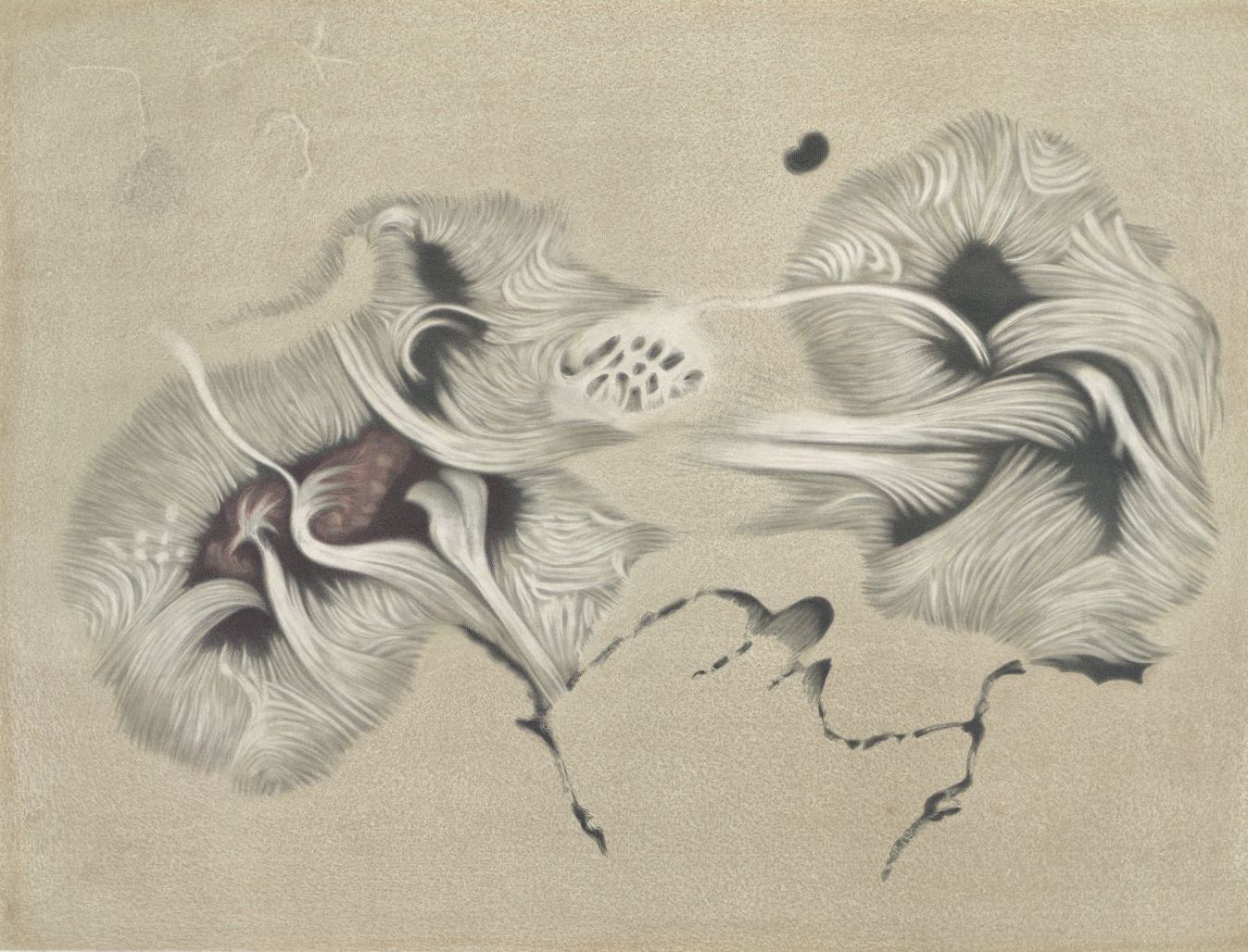
PLATE I.—GROUP OF SUN-SPOTS AND VEILED SPOTS.
Observed on June 17th 1875 at 7 h. 30 m. A.M.
The group of Sun-spots represented in Plate I., was observed and drawn on June 17th, 1875, at 7h. 30m. A. M. The first traces of this group were seen on June 15th, at noon, and consisted of three small black dots disseminated among the granulations. At that time, no disturbance of the surface was noticeable, and no faculæ were seen in the vicinity of these spots. On June 16th, at 8 o'clock A. M., the three small spots had become considerably enlarged, and, as usual, the group consisted of two principal spots. Between these two spots all was in motion: the granulations, stretched into long, wavy, parallel lines, had somewhat the appearance of a liquid in rapid motion. At 1 o'clock, P. M., on the same day, the group had considerably enlarged; the faculæ, the granulations, and the penumbral filaments being interwoven in an indescribable manner. On the morning of the 17th, these spots had assumed the complicated form and development represented in the drawing; while at the same time two conspicuous veiled spots were seen on the left hand, at some distance above the group.
Some luminous bridges are visible upon the left hand spot, traversing the penumbra and umbra of this spot in various directions. The umbra of one of the spots is occupied, and partly filled with gray and rosy veils, similar to those above described, and the granulations of the solar surface form a background to the group of spots.
This group of spots was not so remarkable for its size as for its complicated structure. The diameter of the group from east to west was only 2½ minutes of arc, or about 67,000 miles. The upper part of the umbra of the spot situated on the right hand side of the group was nearly 7,000 miles in diameter, or less by 1,000 miles than the diameter of the Earth. Some of the long filaments composing that part of the penumbra, situated on the left hand side of the same spot, were 17,000 miles in length. One of these fiery elements would be sufficient to encircle two-thirds of the circumference of the Earth.
SOLAR PROTUBERANCES PLATE II
The chromosphere forming the outlying envelope of the Sun, is subject, as has been shown above, to great disturbances in certain regions, causing considerable upheavals of its surface and violent outbursts of its gases. From these upheavals and outbursts of the chromosphere result certain curious and very interesting forms, which are known under the name of "Solar Protuberances," "Prominences," or "Flames."
These singular forms, which could, until recently, be observed only during the short duration of the total eclipses of the Sun, can now be seen on every clear day with the spectroscope, thanks to Messrs. Janssen and Lockyer, to whose researches solar physics is so much indebted.
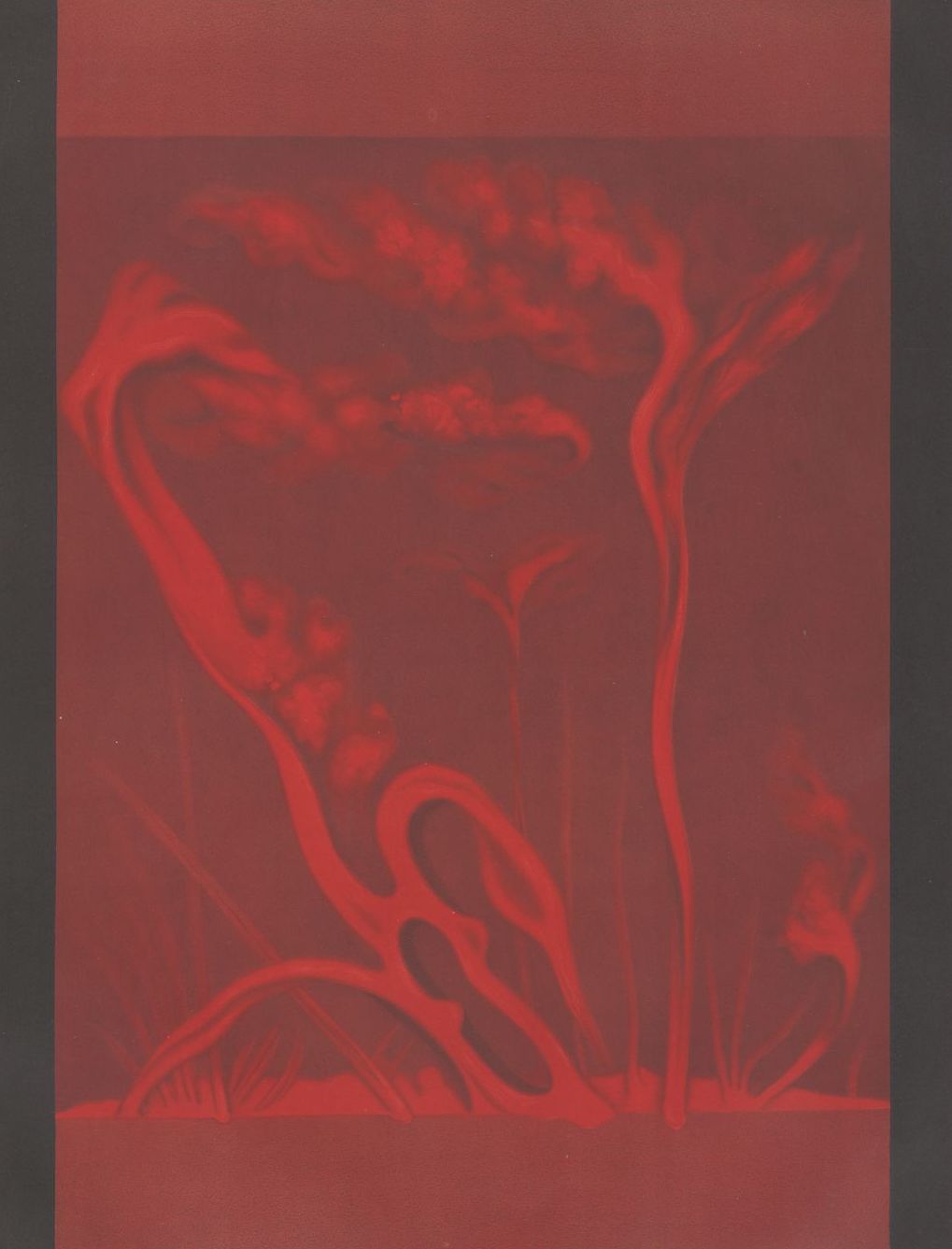
PLATE II.—SOLAR PROTUBERANCES.
Observed on May 5, 1873 at 9h, 40m. A.M.
The solar protuberances, the Sun-spots, and the faculæ to which they are closely related, are confined within the same general regions of the Sun, although the protuberances attain higher heliocentric latitudes.
There is certainly a very close relation between the faculæ and the solar protuberances, since when a group of the faculæ traverses the Sun's limb, protuberances are always seen at the same place. It seems very probable that the faculæ and the protuberances are in the main identical. The faculæ may be the brighter portion of the protuberances, consisting of gases which are still undergoing a high temperature and pressure; while the gases which have been relieved from this pressure and have lost a considerable amount of their heat, may form that part of the protuberances which is only visible on the Sun's limb.
A daily study of the solar protuberances, continued for ten years, has shown me that these objects are distributed on two zones which are equidistant from the solar equator, and parallel with it. The zone arrangement of the protuberances is more easily recognized during the years of minimum solar activity, as in these years the zones are very narrow and widely separated. During these years the belt of protuberances is situated between 40° and 45° of latitude, north and south. In years of great solar activity the zones spread considerably on either side of these limits, especially towards the equator, which they nearly reach, only a narrow belt, usually free from protuberances, remaining between them. Towards the poles the zones do not spread so much, and there the space free from protuberances is considerably greater than it is at the equator.
During years of maximum solar activity, the protuberances, like the Sun-spots and the faculæ, are very numerous, very large, and very complicated—sometimes occupying a great part of the whole solar limb. As many as twenty distinct flames are sometimes observed at one time. In years of minimum solar activity, on the contrary, the prominences are very few in number, and they are of small size; but, as far as my observations go, they are never totally absent.
In general, the solar flames undergo rapid changes, especially those which are situated in the vicinity of Sun-spots, although they occasionally remain unchanged in appearance and form for several hours at a time. The protuberances situated in higher latitudes are less liable to great and sudden changes, often retaining the same form for several days. The changes observed in the protuberances of the equatorial regions are due in part to the comparatively great changes in their position with respect to the spectator, which are occasioned by the rotation of the Sun. This rotation, of course, has a greater angular velocity on the equator than in higher latitudes. In most cases, however, the changes of the equatorial protuberances are too great and too sudden to be thus explained. They are, in fact, due to the greater solar activity developed in the equatorial zones, and wherever spots are most numerous.
The solar protuberances appear under various shapes, and are often so complicated in appearance that they defy description. Some resemble huge clumsy masses having a few perforations on their sides; while others form a succession of arches supported by pillars of different styles. Others form vertical or inclined columns, often surmounted by cloud-like masses, or by various appendages, which sometimes droop gracefully, resembling gigantic palm leaves. Some resemble flames driven by the wind; others, which are composed of a multitude of long and narrow filaments, appear as immense fiery bundles, from which sometimes issue long and delicate columns surmounted by torch-like objects of the most fantastic pattern. Some others resemble trees, or animal forms, in a very striking manner; while still others, apparently detached from the solar limb, float above it, forming graceful streamers or clouds of various shapes. Some of the protuberances are very massive, while others are so thin and transparent as to form a mere veil, through which more distant flames can easily be seen.
Notwithstanding this variety of form, two principal classes of solar protuberances may be recognized: the cloud-like or quiescent, and the eruptive or metallic protuberances.
The first class, which is the most common, comprises all the cloud-like protuberances resting upon the chromosphere or floating about it. The protuberances of this type often obtain enormous horizontal proportions, and it is not rare to see some among them occupying 20° and 30° of the solar limb. The height attained by protuberances of this class does not correspond in general to their longitudinal extent; although some of their branches attain considerable elevations. These prominences very seldom have the brilliancy displayed by the other type, and are sometimes so faint as to be seen with difficulty. Although it is generally stated by observers that some of the protuberances belonging to this class are detached from the solar surface, and kept in suspension above the surface, like the clouds in our atmosphere, yet it seems to me very doubtful whether protuberances are ever disconnected from the chromosphere, since, in an experience of ten years, I have never been able to satisfy myself that such a thing has occurred. Many of them have appeared to me at first sight to be detached from the surface, but with a little patience and attention I was always able to detect faint traces of filamentary elements connecting them with the chromosphere. Quite often I have seen bright protuberances gradually lose their light and become invisible, while soon after they had regained it, and were as clearly visible as before. Observations of this kind seem to show that while the prominences are for the most part luminous, there are also a few which are non-luminous and invisible to the eye. These dark and invisible forms are most generally found in the vicinity of Sun-spots in great activity. When observing such regions with the spectroscope, it is not rare to encounter them in the form of large dark spots projecting on the solar spectrum near the hydrogen lines. On July 28th, 1872, I observed with the spectroscope a dark spot of this kind issuing from the vicinity of a large Sun-spot, and extending over one-fifth of the diameter of the Sun. This object had been independently observed in France a little earlier by M. Chacornac with the telescope, in which it appeared as a bluish streak.
The second class of solar protuberances, comprising the eruptive type, is the most interesting, inasmuch as it conveys to us a conception of the magnitude and violence of the solar forces. The protuberances of this class, which are always intensely bright, appear for the most part in the immediate vicinity of Sun-spots or faculæ. These protuberances, which seem to be due to the outburst of the chromosphere, and to the violent ejection of incandescent gases and metallic vapors from the interior of the Sun, sometimes attain gigantic proportions and enormous heights.
While the spectrum of the protuberances of the cloudy type is simple, and usually composed of four hydrogen lines and the yellow line D3, that of the eruptive class is very complicated, and, besides the hydrogen lines and D3, it often exhibits the bright lines of sodium, magnesium, barium, titanium, and iron, and occasionally, also, a number of other bright lines.
The phenomena of a solar outburst are grand and imposing. Suddenly immense and acute tongues and jets of flames of a dazzling brilliancy rise up from the solar limb and extend in various directions. Some of these fiery jets appear perfectly rigid, and remain apparently motionless in the midst of the greatest disorder. Immense straps and columns form and rise in an instant, bending and waving in all sorts of ways and assuming innumerable shapes. Sometimes powerful jets resembling molten metal spring up from the Sun, describing graceful parabolas, while in their descent they form numerous fiery drops which acquire a dazzling brilliancy when they approach the surface.
The upward motion of the protuberances in process of formation is sometimes very rapid. Some protuberances have been observed to ascend in the solar atmosphere at the rate of from 120 to 497 miles a second. Great as this velocity may appear, it is nevertheless insignificant when compared with that sometimes attained by protuberances moving in the line of sight instead of directly upwards. Movements of this kind are indicated by the displacement of the bright or dark lines in the spectrum. A remarkable instance of this kind occurred on the 26th of June, 1874. On that day I observed a displacement of the hydrogen C line corresponding to a velocity of motion of 1,600 miles per second. The mass of hydrogen gas in motion producing such a displacement was, according to theory, moving towards the Earth at this incredible rate, when it instantly vanished from sight as if it had been annihilated, and was seen no more.
Until recently the protuberances had not been observed to rise more than 200,000 miles above the solar surface; but, on October 7th, 1880, a flame, which had an elevation of 80,000 miles when I observed it at 8h. 55m. A. M., had attained the enormous altitude of 350,000 miles when it was observed at noon by Professor C. A. Young. If we had such a protuberance on the Earth, its summit would be at a height sufficient not merely to reach, but to extend 100,000 miles beyond the Moon.
Although the solar protuberances represented in Plate II. have not the enormous proportions attained by some of these objects, yet they are as characteristic as any of the largest ones, and afford a good illustration of the purely eruptive type of protuberances. The height of the largest column in the group equals 4' 43", or a little over 126,000 miles. A large group of Sun-spots was in the vicinity of these protuberances when they were observed and delineated.
TOTAL ECLIPSE OF THE SUN PLATE III
A solar eclipse is due to the passage of the Moon directly between the observer and the Sun. Such an eclipse can only occur at New Moon, since it is only at that time that our satellite passes between us and the Sun. The Moon's orbit does not lie precisely in the same plane as the orbit of the Earth, but is inclined about five degrees to it, otherwise an eclipse of the Sun would occur at every New Moon, and an eclipse of the Moon at every Full Moon.
Since the Moon's orbit is inclined to that of the Earth, it must necessarily intersect this orbit at two opposite points. These points are called the nodes of the Moon's orbit. When our satellite passes through either of the nodes when the Moon is new, it appears interposed to some extent between the Sun and the Earth, and so produces a solar eclipse; while if it passes a node when the Moon is full, it is more or less obscured by the Earth's shadow, which then produces an eclipse of the Moon. But, on the other hand, when the New Moon and the Full Moon do not coincide with the passage of our satellite through the nodes of its orbit, no eclipse can occur, since the Moon is not then on a line with the Sun and the Earth, but above or below that line.
Owing to the ellipticity of the Moon's orbit, the distance of our satellite from the Earth varies considerably during each of its revolutions around us, and its apparent diameter is necessarily subject to corresponding changes. Sometimes it is greater, sometimes it is less, than the apparent diameter of the Sun. If it is greater at the time of a solar eclipse, the eclipse will be total to a terrestrial observer stationed nearly on the line of the centres of the Sun and Moon, while it will be only partial to another observer stationed further from this line. But the Moon's distance from the Earth may be so great and its apparent diameter consequently so small that even those observers nearest the central line of the eclipse see the border of the Sun all round the black disk of the Moon; the eclipse is then annular. Even during the progress of one and the same eclipse the distance of the Moon from the parts of the Earth towards which its shadow is directed may vary so much that, while the eclipse is total to some observers, others equally near the central line, but stationed at a different place, will see it as annular.
The shadow cast by the Moon on the Earth during total eclipses, travels along upon the surface of the Earth, in consequence of the daily movement of rotation of our globe combined with the movements of the Earth and Moon in their orbits. The track of the Moon's shadow over the Earth's surface has a general eastward course, so that the more westerly observers see it earlier than those east of them. An eclipse may continue total at one place for nearly eight minutes, but in ordinary cases the total phase is much shorter.
The nodes of the Moon's orbit do not invariably occupy the same position, but move nearly uniformly, their position with regard to the Sun, Earth, and Moon being at any time approximately what it formerly was at a series of times separated by equal intervals from each other. Each interval comprises 223 lunations, or 18 years, 11 days, and 7 or 8 hours. The eclipses which occur within this interval are almost exactly repeated during the next similar interval. This period, called the "Saros," was well known to the ancients, who were enabled by its means to predict eclipses with some certainty.
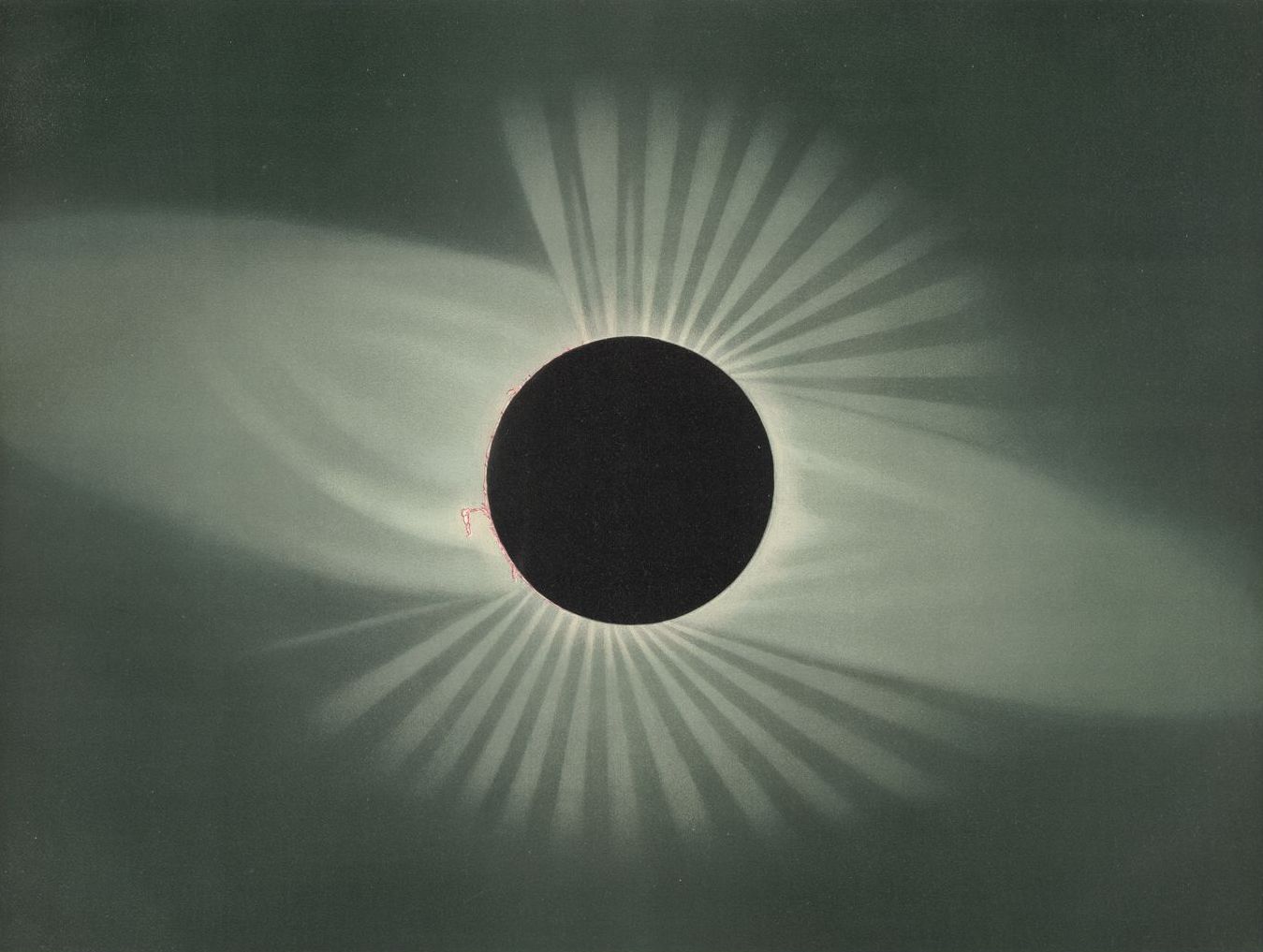
PLATE III.—TOTAL ECLIPSE OF THE SUN.
Observed July 29, 1878, at Creston, Wyoming Territory
A total eclipse of the Sun is a most beautiful and imposing phenomenon. At the predicted time the perfectly round disk of the Sun becomes slightly indented at its western limb by the yet invisible Moon. This phenomenon is known as the "first contact."
The slight indentation observed gradually increases with the advance of the Moon from west to east, the irregularities of the surface of our satellite being plainly visible on the border of the dark segment advancing on the Sun's disk. With the advance of the Moon on the Sun, the light gradually diminishes on the Earth. Every object puts on a dull and gloomy appearance, as when night is approaching; while the bright sky, losing its light, changes its pure azure for a livid grayish color.
Two or three minutes before totality begins, the solar crescent, reduced to minute proportions, gives comparatively so little light that faint traces of the Sun's atmosphere appear on the western side behind the dark body of the Moon, whose limb then becomes visible outside of the Sun. I observed this phenomenon at Creston during the eclipse of 1878. From 15 to 20 seconds before totality, the narrow arc of the Sun's disk not yet obscured by the Moon seems to break and separate towards the extremities of its cusps, which, thus divided, form independent points of light, which are called "Baily's beads." A moment after, the whole solar crescent breaks into numerous beads of light, separated by dark intervals, and, suddenly, they all vanish with the last ray of Sunlight, and totality has begun with the "second contact." This phenomenon of Baily's beads is undoubtedly caused by the irregularities of the Moon's border, which, on reaching the solar limb, divide the thin solar crescent into as many beads of light and dark intervals as there are peaks and ravines seen sidewise on that part of the Moon's limb.
With the disappearance of the last ray of light, the planets and the stars of the first and second magnitude seem to light up and become visible in the sky. The darkness, which had been gradually creeping in with the progress of the eclipse, is then at its maximum. Although subject to great variations in different eclipses, the darkness is never so great as might be expected from the complete obscuration of our luminary, as the part of our atmosphere which is still exposed to the direct rays of the Sun, reflects to us some of that light, which thus diminishes the darkness resulting from the disappearance of the Sun. Usually the darkness is sufficient to prevent the reading of common print, and to deceive animals, causing them to act as if night was really approaching. During totality the temperature decreases, while the humidity of the atmosphere augments.
Simultaneously with the disappearance of Baily's beads, a pale, soft, silvery light bursts forth from behind the Moon, as if the Sun, in disappearing, had been vaporized and expanded in all directions into soft phosphorescent rays and streamers. This pale light is emitted by gases constituting the solar atmosphere surrounding the bright nucleus now obscured by the dark body of our satellite. This solar atmosphere is called Corona, from its distant resemblance to the aureola, or glory, represented by ancient painters around the heads of saints.
With the bursting forth of the corona, a very thin arc of bright white light is seen along the Moon's limb, where the solar crescent has just disappeared. This thin arc of light is the reversing layer, which, when observed with the spectroscope at that moment, exhibits bright lines answering to the dark lines of the ordinary solar spectrum. Immediately above this reversing layer, and concentric with it, appears the pink-colored chromospheric layer, with its curiously shaped flames and protuberances. During totality, the chromosphere and protuberances are seen without the aid of the spectroscope, and appear of their natural color, which, although somewhat varying in their different parts, is, on the whole, pinkish, and similar to that of peach-blossoms; yet it is mixed here and there with delicate prismatic hues, among which the pink and straw colors predominate.
The color of the corona seems to vary in every eclipse, but as its tints are very delicate, it may depend, in a great measure, upon the vision of the observer; although there seems to be no doubt that there are real variations. At Creston, in 1878, it appeared to both Professor W. Harkness and myself of a decided pale greenish hue.
The corona appears under different forms, and has never been observed twice alike. Its dimensions are also subject to considerable variations. Sometimes it appears regular and very little extended, its distribution around the Sun being almost uniform; although in general it spreads a little more in the direction of the ecliptic, or of the solar equator. At other times it appears much larger and more complicated, and forms various wings and appendages, which in some cases, as in 1878, extend to immense distances; while delicate rays radiate in straight or curved lines from the spaces left in the polar regions between the wings. The corona has sometimes appeared as if divided by immense dark gaps, apparently free from luminous matter, and strongly resembling the dark rifts seen in the tails of comets. This was observed in Spain and Sicily during the total eclipse of the Sun in 1870. Different structures, forming wisps and streamers of great length, and interlaced in various ways, are sometimes present in the corona, while faint but more complicated forms, distantly resembling enormous solar protuberances with bright nuclei, have also been observed.
As the Moon continues its eastward progress, it gradually covers the chromosphere and the solar protuberances on the eastern side of the Sun; while, at the same time, the protuberances and the chromosphere on the opposite limb gradually appear from under the retreating Moon. Then, the thin arc of the reversing layer is visible for an instant, and is instantly followed by the appearance of a point of dazzling white light, succeeded immediately by the apparition of Daily's beads on each side, and totality is over, with this third contact. The corona continues to be visible on the eastern side of the Sun for several minutes longer, and then rapidly vanishes.
The thin solar crescent increases in breadth as the Moon advances; while, at the same time, the darkness and gloom spread over nature gradually disappear, and terrestrial objects begin to resume their natural appearance. Finally the limb of the Moon separates from that of the Sun at the instant of "fourth contact," and the eclipse is over.
The phenomena exhibited by the corona in different eclipses are very complex, and, so far, they have not been sufficiently studied to enable us to understand the true nature of the solar atmosphere. From the spectral analysis of the corona, and the phenomena of polarization, it has been learned, at least, that while the matter composing the upper part of the solar atmosphere is chiefly composed of an unknown substance, producing the green line 1474, its lower part is mainly composed of hydrogen gas at different temperatures, a part of which is self-luminous, while the other part only reflects the solar light. But the proportion of the gaseous particles emitting light, to those simply reflecting it, is subject to considerable variations in different eclipses. At present it would seem that in years of great solar disturbances, the particles emitting light are found in greater quantity in the corona than those reflecting it; but further observations will be required to confirm these views.
It is very difficult to understand how the corona, which in certain eclipses extends only one diameter of the Sun, should, in other cases, as in 1878, extend to the enormous distance of twelve times the same diameter. Changes of such magnitude in the solar atmosphere, if due to the operation of forces with which we are acquainted, cannot yet be accounted for by what is known of such forces. Their causes are still as mysterious as those concerned in the production of the monstrous tails displayed by some comets on their approach to the Sun.
Plate 3, representing the total eclipse of the Sun of July 29th, 1878, was drawn from my observations made at Creston, Wyoming Territory, for the Naval Observatory. The eclipse is represented as seen in a refracting telescope, having an aperture of 6⅓ inches, and as it appeared a few seconds before totality was over, and when the chromosphere was visible on the western limb of the Sun. The two long wings seen on the east and west side of the Sun, appeared considerably larger in the sky than they are represented in the picture.
THE AURORA BOREALIS PLATE IV
The name of Polar Auroras is given to certain very remarkable luminous meteoric phenomena which appear at intervals above the northern or the southern horizons of both hemispheres of the Earth. When the phenomenon is produced in our northern sky, it is called "Aurora Borealis," or "Northern Lights;" and when it appears in the southern sky, it is called "Aurora Australis," or southern aurora.
Marked differences appear in the various auroras observed from our northern latitudes. While some simply consist in a pale, faint luminosity, hardly distinguishable from twilight, others present the most gorgeous and remarkable effects of brightness and colors.
A great aurora is usually indicated in the evening soon after twilight, by a peculiar grayish appearance of the northern sky just above the horizon. The grayish vapors giving that appearance, continuing to form there, soon assume a dark and gloomy aspect, while they gradually take the form of a segment of a circle resting on the horizon. At the same time that this dark segment is forming, a soft pearly light, which seems to issue from its border, spreads up in the sky, where it gradually vanishes, being the brightest at its base. This arc of light, gradually increasing in extent as well as in brightness, reaches sometimes as far as the polar star. On some rare occasions, one or two, and even three, concentric arches of bright light form one above the other over the dark segment, where they appear as brilliant concentric rainbows. While the aurora continues to develop and spread out its immense arc, the border of the dark segment loses its regularity and appears indented at several places by patches of light, which soon develop into long, narrow, diverging rays and streamers of great beauty. For the most part the auroral light is either whitish or of a pale, greenish tint; but in some cases it exhibits the most beautiful colors, among which the red and green predominate. In these cases the rays and streamers, which are usually of different colors, produce the most magnificent effects by their continual changes and transformations.
The brightness and extent of the auroral rays are likewise subject to continual changes. An instant suffices for their development and disappearance, which may be succeeded by the sudden appearance of others elsewhere, as though the original streamers had been swiftly transported to a new place while invisible. It frequently happens that all the streamers seem to move sidewise, from west to east, along the arch, continuing meanwhile to exhibit their various changes of form and color. For a time, these appearances of motion continue to increase, a succession of streamers alternately shooting forth and again fading, when a sudden lull occurs, during which all motion seems to have ceased. The stillness then prevailing is soon succeeded by slight pulsations of light, which seem to originate on the border-of the dark segment, and are propagated upwards along the streamers, which have now become more numerous and active. Slow at first, these pulsations quicken by degrees, and after a few minutes the whole northern sky seems to be in rapid vibration. The lively upward and downward movement of these streamers entitles them to the name of "merry dancers" given them in northern countries where they are frequent.
Long waves of light, quickly succeeded by others, are propagated in an instant from the horizon to the zenith; these, in their rapid passage, cause bends and curves in the streamers, which then, losing their original straightness, wave and undulate in graceful folds, resembling those of a pennant in a gentle breeze. Although the coruscations add to the grandeur of the spectacle, they tend to destroy the diverging streamers, which, being disconnected from the dark segment, or torn in various ways, are, as it were, bodily carried up towards the zenith.
In this new phase the aurora is transformed into a glorious crown of light, called the "Corona." From this corona diverge in all directions long streamers of different colors and forms, gracefully undulating in numerous folds, like so many banners of light. Some of the largest of these streamers appear like fringes composed of short transverse rays of different intensity and colors, producing the most fantastic effects, when traversed by the pulsations and coruscations which generally run across these rays during the great auroral displays.
The aurora has now attained its full development and beauty. It may continue in this form for half an hour, but usually the celestial fires begin to fade at the end of fifteen or twenty minutes, reviving from time to time, but gradually dying out. The northern sky usually appears covered by gray and luminous streaks and patches after a great aurora, these being occasionally rekindled, but more often they gradually disappear, and the sky resumes its usual appearance.
The number of auroras which develop a corona near the zenith is comparatively small in our latitudes; but many of them, although not exhibited on so grand a scale, are nevertheless very interesting. On some very rare occasions the auroral display has been confined almost exclusively to the dark segment, which appeared then as if pierced along its border by many square openings, like windows, through which appeared the bright auroral light.
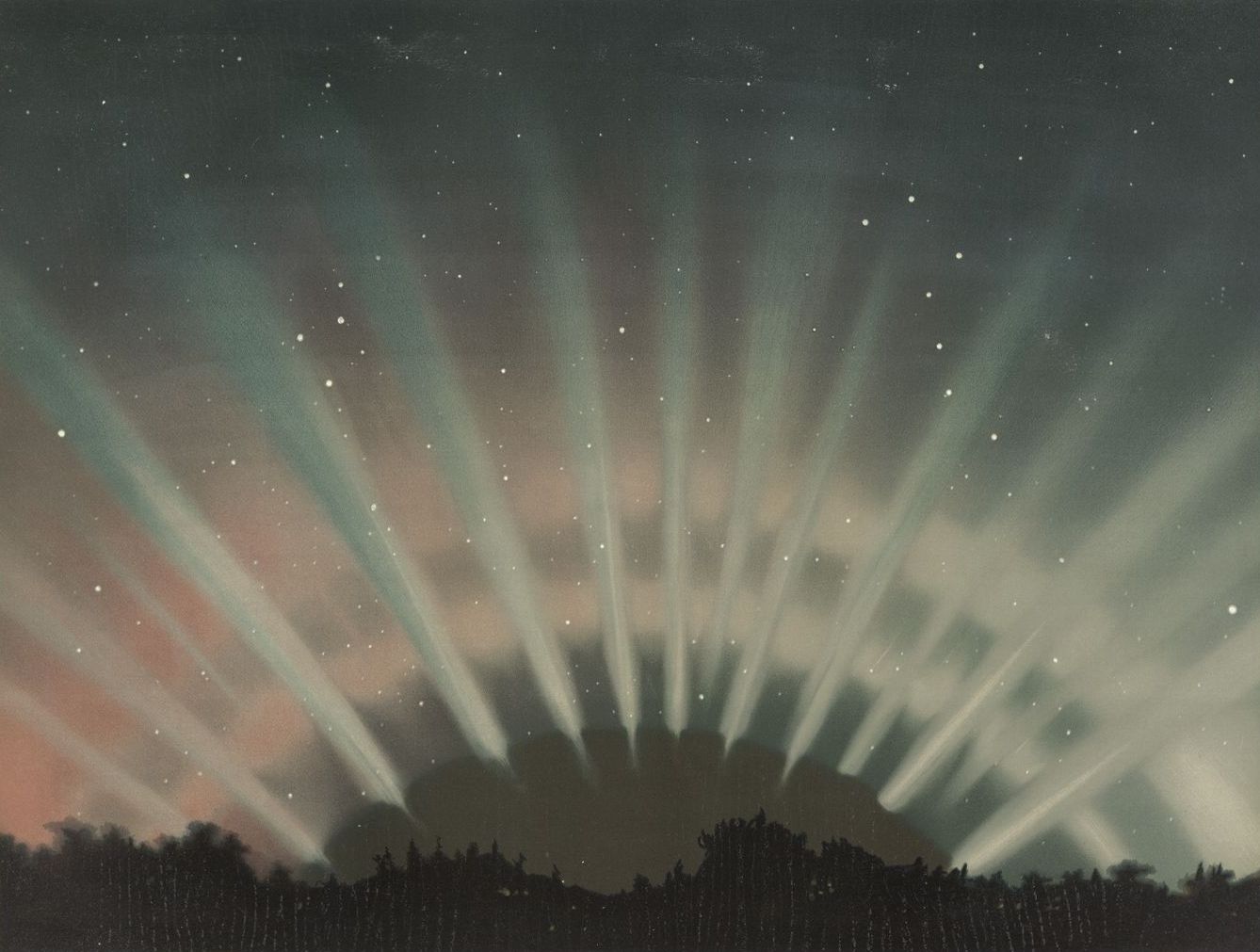
PLATE IV.—AURORA BOREALIS.
As observed March 1, 1872, at 9h. 25m. P.M.
Among the many auroras which I have had occasion to observe, none are more interesting, excepting the type first described, than those which form an immense arch of light spanning the heavens from East to West. This form of aurora, which is quite rare, I last observed on September 12th, 1881. All the northern sky was covered with light vapors, when a small auroral patch appeared in the East at about 20° above the horizon. This patch of light, gradually increasing westward, soon reached the zenith, and continued its onward progress until it arrived at about 20° above the western horizon, where it stopped. The aurora then appeared as a narrow, wavy band of light, crossed by numerous parallel rays of different intensity and color. These rays seemed to have a rapid motion from West to East along the delicately-fringed streamer, which, on the whole, moved southward, while its extremities remained undisturbed. Aside from the apparent displacement of the fringes, a singular vibrating motion was observed in the auroral band, which was traversed by pulsations and long waves of light. The phenomena lasted for about twenty minutes, after which the arch was broken in many places, and it slowly vanished.
The aurora usually appears in the early part of the evening, and attains its full development between ten and eleven o'clock. Although the auroral light may have apparently ceased, yet the phenomenon is not at an end, as very often a solitary ray is visible from time to time; and even towards morning these rays sometimes become quite numerous. On some occasions the phenomenon even continues through the following day, and is manifested by the radial direction of the cirrus-clouds in the heights of our atmosphere. In 1872 I, myself, observed an aurora which apparently continued for two or three consecutive days and nights. In August, 1859, the northern lights remained visible in the United States for a whole week.
The height attained by these meteors is considerable, and it is now admitted that they are produced in the rarefied air of the upper regions of our atmosphere. From the researches of Professor Elias Loomis on the great auroras observed in August and September, 1859, it was ascertained that the inferior part of the auroral rays had an altitude of 46 miles, while that of their summits was 428 miles. These rays had, therefore, a length of 382 miles. From the observation of thirty auroral displays, it has been found that the mean height attained by the summit of these streamers above the Earth's surface was 450 miles.
But if the auroral streamers are generally manifested at great heights in our atmosphere, it would appear from the observations of persons living in the regions where the auroras are most frequent, as also from those who have been stationed in high northern and southern latitudes, that the phenomenon sometimes descends very low. Both Sabine and Parry saw the auroral rays projected on a distant mountain; Ross saw them almost at sea-level projected on the polar ice; while Wrangel, Franklin, and others observed similar phenomena. Dr. Hjaltalin, who has lived in latitude 64° 46' north, and has made a particular study of the aurora, on one occasion saw the aurora much below the summit of a hill 1,600 feet high, which was not very far off.
The same aurora is sometimes observed on the same night at places very far distant from one another. The great aurora borealis of August 28th, 1859, for instance, was seen over a space occupying 150° in longitude—from California to the Ural Mountains in Russia. It even appears now very probable that the phenomenon is universal on our globe, and that the northern lights observed in our hemisphere are simultaneous with the aurora australis of the southern hemisphere. The aurora of September 2d, 1859, was observed all through North and South America, the Sandwich Islands, Australia, and Africa; the streamers and pulsations of light of the north pole responding to the rays and coruscations of the south pole. Of thirty-four auroras observed at Hobart Town, in Tasmania, twenty-nine corresponded with aurora borealis observed in our hemisphere.
The auroral phenomena, although sometimes visible within the tropics, are, however, quite rare in these regions. For the most part they are confined within certain zones situated in high latitudes north and south. The zone where they are most frequent in our hemisphere forms an ellipse, which has the north pole at one of its foci; while the other is situated somewhere in North America, in the vicinity of the magnetic pole. The central line of the zone upon which the auroras seem to be most frequent passes from the northern coast of Alaska through Hudson's Bay and Labrador to Iceland, and then follows the northern coast of Europe and Asia. The number of auroras diminishes as the observer recedes from this zone, and it is only in exceptional cases that they are seen near the equator. Near the pole the phenomenon is less frequent than it is in the region described. In North America we occupy a favorable position for the observation of auroras, as we are nearer the magnetic poles than are the Europeans and Asiatics, and we consequently have a greater number of auroras in corresponding latitudes.
The position of the dark auroral segment varies with the place occupied by the observer, and its centre always corresponds with the magnetic meridian. In our Eastern States the auroral segment appears a little to the west of the north point; but as the observer proceeds westward it gradually approaches this point, and is due north when seen from the vicinity of Lake Winnipeg. At Point Barrow, in the extreme north-west of the United States, the aurora is observed in the east. In Melville Islands, Parry saw it in the south; while in Greenland it is directly in the west.
It is stated that auroras are more numerous about the equinoxes than they are at any other seasons; and also, when the earth is in perigee, than when it is in apogee. An examination which I have made of a catalogue by Professor Loomis, comprising 4,137 auroras observed in the temperate zone of our hemisphere from 1776 to 1873, sustains this statement. During this period, one hundred more auroras were recorded during each of the months comprising the equinoxes, than during any other months of the year; while eighty more auroras were observed when the earth was in perigee, than when it was in apogee. But to establish the truth of this assertion on a solid basis, more observations in both hemispheres will be required.
The aurora is not simply a terrestrial phenomenon, but is associated in some mysterious way with the conditions of the Sun's surface. It is a well-known fact that terrestrial magnetism is influenced directly by the Sun, which creates the diurnal oscillations of the magnetic needle. Between sunrise and two o'clock, the north pole of the needle moves towards the west in our northern hemisphere, and in the afternoon and evening it moves the other way. These daily oscillations of the needle are not uniform in extent; they have a period of regular increase and decrease. At a given place the daily oscillations of the magnetic needle increase and decrease with regularity during a period which is equal to 10⅓ years. As this period closely coincides with the Sun-spot period, the connection between the variation of the needle and these solar disturbances has been recognized.
Auroral phenomena generally accompany the extraordinary perturbations in the oscillations of the magnetic needle, which are commonly called "magnetic storms," and the greater the auroral displays, the greater are the magnetic perturbations. Not only is the needle subject to unusual displacements during an aurora, but its movements seem to be simultaneous with the pulsations and waving motions of the delicate auroral streamers in the sky. When the aurora sends forth a coruscation, or a streamer in the sky, the magnetic needle responds to it by a vibration. The inference that the auroral phenomena are connected with terrestrial magnetism is further supported by the fact that the centre of the corona is always situated exactly in the direction of that point in the heavens to which the dipping needle is directed.
It has been found that the aurora is a periodical phenomenon, and that its period corresponds very closely with those of the magnetic needle and Sun-spots. The years which have the most Sun-spots and magnetic disturbances have also the most auroras. There is an almost perfect similarity between the courses of the three sets of phenomena, from which it is concluded that the aurora is connected in some mysterious way with the action of the Sun, as well as with the magnetic condition of the earth.
A very curious observation, which has been supposed to have some connection with this subject, was made on Sept. 1st, 1859, by Mr. Carrington and Mr. Hodgson, in England. While these observers, who were situated many miles from one another, were both engaged at the same time in observing the same Sun-spot, they suddenly saw two luminous spots of dazzling brilliancy bursting into sight from the edge of the Sun-spot. These objects moved eastward for about five minutes, after which they disappeared, having then traveled nearly 34,000 miles. Simultaneously with these appearances, a magnetic disturbance was registered at Kew by the self-registering magnetic instruments. The very night that followed these observations, great magnetic perturbations, accompanied by brilliant auroral displays, were observed in Europe. A connection between the terrestrial magnetism and the auroral phenomena is further proved by the fact that, before the appearance of an aurora, the magnetic intensity of our globe considerably increases, but diminishes as soon as the first flashes show themselves.
The auroral phenomena are also connected in some way with electricity, and generate serious disturbances in the electric currents traversing our telegraphic lines, which are thus often rendered useless for the transmission of messages during great auroral displays. It sometimes happens, however, during such displays, that the telegraphic lines can be operated for a long distance, without the assistance of a battery; the aurora, or at least its cause, furnishing the necessary electric current for the working of the line. During auroras, the telephonic lines are also greatly affected, and all kinds of noises and crepitations are heard in the instruments.
Two observations of mine, which may have a bearing on the subject, present some interest, as they seem to indicate the action of the aurora on some of the clouds of our atmosphere. On January 6th, 1872, after I had been observing a brilliant aurora for over one hour, an isolated black cumulus cloud appeared at a little distance from the western extremity of the dark auroral segment. This cloud, probably driven by the wind, rapidly advanced eastward, and was soon followed by a succession of similar clouds, all starting from the same point. All these black clouds apparently followed the same path, which was not a straight line, but parallel to and concentric with the border of the dark auroral segment. When the first cloud arrived in the vicinity of the magnetic meridian passing through the middle of the auroral arc, it very rapidly dissolved, and on reaching this meridian became invisible. The same phenomenon was observed with the succession of black clouds following, each rapidly dissolving as it approached the magnetic meridian. This phenomenon of black clouds vanishing like phantoms in crossing the magnetic meridian, was observed for nearly an hour. On June 17th, 1879, I observed a similar phenomenon during a fine auroral display. About midway between the horizon and the polar star, but a little to the west of the magnetic meridian, there was a large black cumulo-stratus cloud which very slowly advanced eastward. As it progressed in that direction, its eastern extremity was dissolved in traversing the magnetic meridian; while, at the same time, several short and quite bright auroral rays issued from its western extremity, which in its turn dissolved rapidly, as if burned or melted away in the production of the auroral flame.
It seems to be a well observed fact, that during auroras, a strong sulphurous odor prevails in high northern latitudes. According to Dr. Hjaltalin, during these phenomena, "the ozone of the atmosphere increases considerably, and men and animals exposed out of doors emit a sulphurous odor when entering a heated room." The Esquimaux and other inhabitants of the northern regions assert that great auroras are sometimes accompanied by crepitations and crackling noises of various sorts. Although these assertions have been denied by several travelers who have visited the regions of these phenomena, they are confirmed by many competent observers. Dr. Hjaltalin, who has heard these noises about six times in a hundred observations, says that they are especially audible when the weather is clear and calm; but that when the atmosphere is agitated they are not heard. He compares them to the peculiar sound produced by a silk cloth when torn asunder, or to the crepitations of the electric machine when its motion is accelerated. "When the auroral light is much agitated and the streamers show great movements, it is then that these noises are heard at different places in the atmosphere."
The spectrum of the auroral light, although it varies with almost every aurora, always shows a bright green line on a faint continuous spectrum. In addition to this green line I have frequently observed four broad diffused bands of greater refrangibility in the spectra of some auroras. In two cases, when the auroras appeared red towards the west, the spectrum showed a bright red line, in addition to the green line and the broad bands described. These facts evidently show that the light of the aurora is due to the presence of luminous vapors in our atmosphere; and it may reasonably be supposed that these vapors are rendered luminous by the passage of electric discharges through them.
THE ZODIACAL LIGHT PLATE V
In our northern latitudes may be seen, on every clear winter and spring evening, a column of faint, whitish, nebulous light, rising obliquely above the western horizon. A similar phenomenon may also be observed in the east, before day-break, on any clear summer or autumn night. To this pale, glimmering luminosity the name of "Zodiacal Light" has been given, from the fact that it lies in the zodiac along the ecliptic.
In common with all the celestial bodies, the zodiacal light participates in the diurnal motion of the sky, and rises and sets with the constellations in which it appears. Aside from this apparent motion, it is endowed with a motion of its own, accomplished from west to east, in a period of a year. In its motion among the stars, the zodiacal light always keeps pace with the Sun, and appears as if forming two faint luminous wings, resting on opposite sides of this body. In reality it extends on each side of the Sun, its axis lying very nearly in the plane of the ecliptic.
In our latitudes the phenomena can be observed most advantageously towards the equinoxes, in March and September, when twilight is of short duration. As we proceed southward it becomes more prominent, and gradually increases in size and brightness. It is within the tropical regions that the zodiacal light acquires all its splendor: there it is visible all the year round, and always appears very nearly perpendicular to the horizon, while at the same time its proportions and brilliancy are greatly increased.
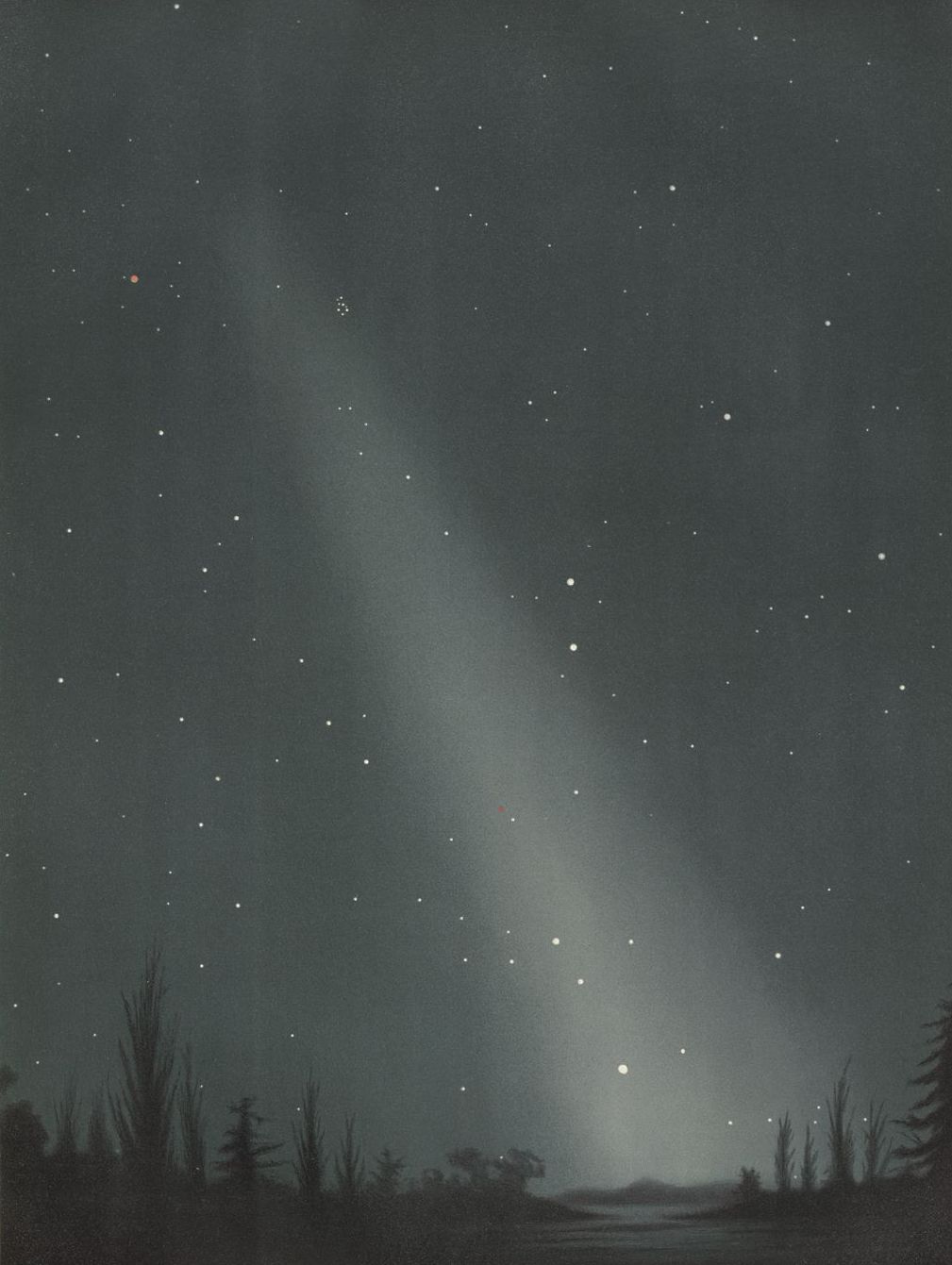
PLATE V.—THE ZODIACAL LIGHT.
Observed February 20, 1876
The zodiacal light appears under the form of a spear-head, or of a narrow cone of light whose base apparently rests on the horizon, while its summit rises among the zodiacal constellations. In general appearance it somewhat resembles the tail of a large comet whose head is below the horizon. The most favorable time to observe this phenomenon in the evening, is immediately after the last trace of twilight has disappeared; and in the morning, one or two hours before twilight appears. When observed with attention, it is seen that the light of the zodiacal cone is not uniform, but gradually increases in brightness inwardly, especially towards its base, where it sometimes surpasses in brilliancy the brightest parts of the Milky-Way. In general, its outlines are vague and very difficult to make out, so gradually do they blend with the sky. On some favorable occasions, the luminous cone appears to be composed of several distinct concentric conical layers, having different degrees of brightness, the inner cone being the most brilliant of all. There is a remarkable distinction between the evening and morning zodiacal light. In our climate, the morning light is pale, and never so bright nor so extended as the evening light.