E. L. TROUVELOT, (continued 2)
Reading edition
In general, the zodiacal light is whitish and colorless, but in some cases it acquires a warm yellowish or reddish tint. These changes of color may be accidental and due to atmospheric conditions, and not to actual change in the color of the object. Although the zodiacal light is quite bright, and produces the impression of having considerable depth, yet its transparency is great, since all the stars, except the faint ones, can be seen through its substance.
The zodiacal light is subject to considerable variations in brightness, and also varies in extent, the apex of its cone varying in distance from the Sun's place, from 40 to 90 degrees. These variations cannot be attributed to atmospheric causes alone, some of them being due to real changes in the zodiacal light itself, whose light and dimensions increase or decrease under the action of causes at present unknown. From the discussion of a series of observations on the zodiacal light made at Paris and Geneva, it appears certain that its light varies from year to year, and sometimes even from day to day, independently of atmospheric causes. Some of my own observations agree with these results, and one of them, at least, seems to indicate changes even more rapid. On December 18th, 1875, I observed the zodiacal light in a clear sky free from any vapors, at six o'clock in the evening. At that time, the point of its cone was a little to the north of the ecliptic, at a distance of about 90 degrees from the Sun's place. Ten minutes later, its summit had sunk down 35 degrees, the cone then being reduced to nearly one-half of its original dimensions. Ten minutes later, it had risen 25 degrees, and was then 80 degrees from the Sun's place, where it remained all the evening. On March 22d, 1878, the sky was very clear and the zodiacal light was bright when I observed it, at eight o'clock. At that moment the apex of the cone of light was a little to the south of the Pleiades, but this cone presented an unusual appearance never noticed by me before, its northern border appearing much brighter and sharper than usual, while at the same time its axis of greatest brightness appeared to be much nearer to this northern border than it was to the southern. After a few minutes of observation it became evident that the northern border was extending itself, as stars which were at some distance from it became gradually involved in its light. At the same time that this border spread northward, it seemed to diffuse itself, and after a time the cone presented its usual appearance, having its southern border brighter and better defined than the other. It would have been impossible to attribute this sudden change to an atmospheric cause, since only one of the borders of the cone participated in it, and since some very faint stars near this northern border were not affected in the least while the phenomenon occurred. Besides these observations, Cassini, Mairan, Humboldt, and many other competent observers have seen pulsations, coruscations and bickerings in the light of the cone, which they thought could not be attributed to atmospheric causes. It has also been observed that at certain periods the zodiacal light has shone with unusual intensity for months together.
When this phenomenon is observed from the tropical regions, it is found that its axis of symmetry always corresponds with its axis of greatest brightness, and that both lie in the plane of the ecliptic, which divides its cone into two equal parts. But when the zodiacal light is observed in our latitude, the axis of symmetry does not correspond with the axis of greatest brightness, and both axes are a little to the north of this plane, the axis of symmetry being the farther removed. Furthermore, as already stated, the southern border of the cone always appears better defined and brighter than the corresponding northern margin. It is very probable, if not absolutely certain, that these phenomena are exactly reversed when the zodiacal light is observed from corresponding latitudes in the southern hemisphere, and that there, its axes, both of symmetry and of greatest brightness, appear south of the ecliptic, while the northern margin is the brightest. This seems to be established by the valuable observations of Rev. George Jones, made on board the U. S. steam frigate Mississippi, in California, Japan, and the Southern Ocean. "When I was north of the ecliptic," says this observer, "the greatest part of the light of the cone appeared to the north of this line; when I was to the south of the ecliptic, it appeared to be south of it; while when my position was on the ecliptic, or in its vicinity, the zodiacal cone was equally divided by this line."
Besides the zodiacal light observed in the East and West, some observers have recognized an exceedingly faint, luminous, gauzy band, about 10 or 12 degrees wide, stretching along the ecliptic from the summit of the western to that of the eastern zodiacal cone. This faint narrow belt has been called the Zodiacal Band. It has been recognized by Mr. H. C. Lewis, who has made a study of this phenomenon, that the zodiacal band has its southern margin a little brighter and a little sharper than the northern border. This observation is in accordance with similar phenomena observed in the zodiacal light, and may have considerable importance.
In 1854, Brorsen recognized a faint, roundish, luminous spot in a point of the heavens exactly opposite to the place occupied by the Sun, which he has called "Gegenschein," or counter-glow. This luminous spot has sometimes a small nucleus, which is a little brighter than the rest. Night after night this very faint object shifts its position among the constellations, keeping always at 180 degrees from the Sun. The position of the counter-glow, like that of the zodiacal light and zodiacal band, is not precisely on the plane of the ecliptic, but a little to the north of this line. It is very probable that near the equator the phenomenon would appear different and there would correspond with this plane.
There seems to be some confusion among observers in regard to the spectrum of the zodiacal light. Some have seen a bright green line in its spectrum, corresponding to that of the aurora borealis; while others could only see a faint grayish continuous spectrum, which differs, however, from that of a faint solar light, by the fact that it presents a well-defined bright zone, gradually blending on each side with the fainter light of the continuous spectrum. I have, myself, frequently observed the faint continuous spectrum of the zodiacal light, and on one occasion recognized the green line of the aurora; but it might have been produced by the aurora itself, as yet invisible to the eye, and not by the zodiacal light, since, later in the same evening, there was a brilliant auroral display. If it were demonstrated that this green line exists in the spectrum of the zodiacal light, the fact would have importance, as tending to show that the aurora and the zodiacal light have a common origin.
Rev. Geo. Jones describes a very curious phenomenon which he observed several times a little before the moon rose above the horizon. The phenomenon consisted in a short, oblique, luminous cone rising from the Moon's place in the direction of the ecliptic. This phenomenon he has called the Moon Zodiacal Light. In 1874, I had an opportunity to observe a similar phenomenon when the Moon was quite high in the sky. By taking the precaution to screen the Moon's disk by the interposition of some buildings between it and my eye, I saw two long and narrow cones of light parallel to the ecliptic issuing from opposite sides of our satellite. The phenomenon could not possibly be attributed to vapors in our atmosphere, since the sky was very clear at the moment of the observation. Later on, these appendages disappeared with the formation of vapors near the Moon, but they reappeared an hour later, when the sky had cleared off, and continued visible for twenty minutes longer, and then disappeared in a clear sky.
Although the zodiacal light has been studied for over two centuries, no wholly satisfactory explanation of the phenomenon has yet been given. Now, as in Cassini's time, it is generally considered by astronomers to be due to a kind of lens-shaped ring surrounding the Sun, and extending a little beyond the Earth's orbit. This ring is supposed to lie in the plane of the ecliptic, and to be composed of a multitude of independent meteoric particles circulating in closed parallel orbits around the Sun. But many difficulties lie in the way of this theory. It seems as incompetent to explain the slow and rapid changes in the light of this object as it is to explain the contractions and extensions of its cone. It fails, moreover, to explain the flickering motions, the coruscations observed in its light, or the displacement of its cone and of its axes of brightness and symmetry by a mere change in the position of the observer. Rev. Geo. Jones, unable to explain by this theory the phenomena which came under his observation, has proposed another, which supposes the zodiacal light to be produced by a luminous ring surrounding the Earth, this ring not extending as far as the orbit of the Moon. But this theory also fails in many important points, so that at present no satisfactory explanation of the phenomenon can be given.
As the phenomenon is connected in some way with the Sun, and as we have many reasons to believe this body to be always more or less electrified, it might be supposed that the Sun, acting by induction on our globe, develops feeble electric currents in the rarefied gases of the superior regions of our atmosphere, and there forms a kind of luminous ridge moving with the Sun in a direction contrary to the diurnal motion, and so producing the zodiacal light. On this hypothesis, the counter-glow would be the result of a smaller cone of light generated by the solar induction on the opposite point of the Earth.
Plate 5, which sufficiently explains itself, represents the zodiacal light as it appeared in the West on the evening of February 20th, 1876. All the stars are placed in their proper position, and their relative brightness is approximately shown by corresponding variations in size—the usual and almost the only available means of representation. Of course, it must be remembered that a star does not, in fact, show any disk even in the largest telescopes, where it appears as a mere point of light, having more or less brilliancy. The cone of light rises obliquely along the ecliptic, and the point forming its summit is found in the vicinity of the well-known group of stars, called the Pleiades, in the constellation of Taurus, or the Bull.
THE MOON PLATE VI
In its endless journey through space, our globe is not solitary, like some of the planets, but is attended by the Moon, our nearest celestial neighbor. Although the Moon does not attain to the dignity of a planet, and remains a secondary body in the solar system, yet, owing to its proximity to our globe, and to the great influence it exerts upon it by its powerful attraction, it is to us one of the most important celestial bodies.
While the Moon accompanies the Earth around the Sun, it also revolves around the Earth at a mean distance of 238,800 miles. For a celestial distance this is only a trifling one; the Earth in advancing on its orbit travels over such a distance in less than four hours. A cannon ball would reach our satellite in nine days; and a telegraphic dispatch would be transmitted there in 1½ seconds of time, if a wire could be stretched between us and the Moon.
Owing to the ellipticity of the Moon's orbit, its distance from the Earth varies considerably, our satellite being sometimes 38,000 miles nearer to us than it is at other times. These changes in the distance of the Moon occasion corresponding changes from 29' to 33' in its apparent diameter. The real diameter of the Moon is 2,160 miles, or a little over one-quarter the diameter of our globe; our satellite being 49 times smaller than the Earth.
The mean density of the materials composing the Moon is only ⁶⁄₁₀ that of the materials composing the Earth, and the force of gravitation at the surface of our satellite is six times less than it is at the surface of our globe. If a person weighing 150 lbs. on our Earth could be transported to the Moon, his weight there would be only 25 lbs.
The Moon revolves around the Earth in about 27⅓ days, with a mean velocity of one mile per second, the revolution constituting its sidereal period. If the Earth were motionless, the lunar month would be equal to the sidereal period; but owing to its motion in space, the Sun appears to move with the Moon, though more slowly, so that after having accomplished one complete revolution, our satellite has yet to advance 2¼ days before reaching the same apparent position in regard to the Earth and the Sun that it had at first. The interval of time comprised between two successive New Moons, which is a little over 29½ days, constitutes the synodical period of the Moon, or the lunar month.
The Moon is not a self-luminous body, but, like the Earth and the planets, it reflects the light which it receives from the Sun, and so appears luminous. That such is the case is sufficiently demonstrated by the phases exhibited by our satellite in the course of the lunar month. Every one is familiar with these phases, which are a consequence of the motion of the Moon around the Earth. When our satellite is situated between us and the Sun, it is New Moon; since we cannot see its illuminated side, which is then turned away from us towards the Sun. When, on the contrary, it reaches that point of its orbit which, in regard to us, is opposite to the Sun's place, it is Full Moon; since from the Earth we can only see the fully illuminated side of our satellite. Again, when the Moon arrives at either of the two opposite points of its orbit, the direction of which from the Earth is at right angles with that of the Sun, it is either the First or the Last Quarter; since in these positions we can only see one-half of its illuminated disk.
The curve described by the Moon around the Earth lies approximately in a plane, this plane being inclined about 5° to the ecliptic. Since our satellite, in its motion around us and the Sun, closely follows the ecliptic, which is inclined 23½° to the equator, it results that when this plane is respectively high or low in the sky, the moon is also high or low when crossing the meridian of the observer. In winter that part of the ecliptic occupied by the Sun is below the equator, and, consequently, the New Moons occurring in that season are low in the sky, since at New Moon our satellite must be on the same side of the ecliptic with the Sun. But the Full Moons in the same season are necessarily high in the sky, since a Full Moon can only occur when our satellite is on the opposite side of the ecliptic from the Sun, in which position it is, of course, as many degrees above the equator as the Sun is below. The Full Moon which happens nearest to the autumnal equinox is commonly called the Harvest Moon, from the fact that, after full, its delays in rising on successive evenings are very brief and therefore favorable for the harvest work in the evening. The same phenomenon occurs in every other lunar month, but not sufficiently near the time of Full Moon to be noticeable. When, in spring, a day or two after New Moon, our satellite begins to show its thin crescent, its position on the ecliptic is north as well as east of that occupied by the Sun; hence, its horns are nearly upright in direction, and give it a crude resemblance to a tipping bowl, from which many people who are unaware of its cause, and that this happens every year, draw conclusions as to the amount of rain to be expected.
One of the most remarkable features of the Moon's motions is that our satellite rotates on its axis in exactly the same period of time occupied by its revolution around the Earth, from which it results that the Moon always presents to us the same face. To explain this peculiarity, astronomers have supposed that the figure of our satellite is not perfectly spherical, but elongated, so that the attraction of the Earth, acting more powerfully upon its nearest portions, always keeps them turned toward us, as if the Moon were united to our globe by a string. It is not exactly true, however, that the Moon always presents its same side to us, although its period of rotation exactly equals that of its revolution; since in consequence of the inclination of its axis of rotation to its orbit, combined with the irregularities of its orbital motion about us, apparent oscillations in latitude and in longitude, called librations, are created, from which it results that nearly ⁶⁄₁₀ of the Moon's surface is visible from the Earth at one time or another.
The Moon is a familiar object, and every one is aware that our satellite, especially when it is fully illuminated, presents a variety of bright and dark markings, which, from their distant resemblance to a human face, are popularly known as "the man in the moon." A day or two after New Moon, when the thin crescent of our satellite is visible above the western horizon after sunset, the dark portion of its disk is plainly visible, and appears of a pale, ashy gray color, although not directly illuminated by the Sun. This phenomenon is due to the Earth-shine, or to that portion of solar light which the illuminated surface of our globe reflects to the dark side of the Moon, exactly in the same manner that the Moon-shine, on our Earth, is due to the solar light reflected to our globe by the illuminated Moon.
Seen with a telescope of moderate power, or even with a good opera-glass, the Moon presents a peculiar mottled appearance, and has a strong resemblance to a globe made of plaster of Paris, on the surface of which numerous roundish, saucer-shaped cavities of various sizes are scattered at random. This mottled structure is better seen along the boundary line called the terminator, which divides the illuminated from the dark side of the Moon. The line of the terminator always appears jagged, and it is very easy to recognize that this irregularity is due to the uneven and rugged structure of the surface of our satellite.
A glance at the Moon through a larger telescope shows that the bright spots recognized with the naked eye belong to very uneven and mountainous regions of our satellite, while the dark ones belong to comparatively smooth, low surfaces, comparable to those forming the great steppes and plains of the Earth. When examined with sufficient magnifying power, the white, rugged districts of the Moon appear covered over by numerous elevated craggy plateaus, mountain-chains, and deep ravines; by steep cliffs and ridges; by peaks of great height and cavities of great depth. This rugged formation, which is undoubtedly of volcanic origin, gives our satellite a desolate and barren appearance. The rugged tract occupies more than one-half of the visible surface of the Moon, forming several distinct masses, the principal of which occupy the south and south-western part of the disk. That this formation is elevated above the general level is proved by the fact that the mountains, peaks, and other objects which compose it, all cast a shadow opposite to the Sun; and further, that the length of these shadows diminishes with the elevation of the Sun above the lunar horizon.
Since Galileo's time the surface of the Moon has been studied by a host of astronomers, and accurate maps of its topographical configuration have been made, and names given to all features of any prominence. It may even be said that in its general features, the visible surface of our satellite is now better known to us than is the surface of our own Earth.
One of the most striking and common features of the mountainous districts of the Moon, is the circular, ring-like disposition of their elevated parts, which form numerous crater-like objects of different sizes and depths. Many thousands of crater-like objects are visible on the Moon through a good telescope, and, considering how numerous the small ones are, there is, perhaps, no great exaggeration in fixing their number at 50,000, as has been done by some astronomers. These volcanic regions of the Moon cannot be compared to anything we know, and far surpass in extent those of our globe. The number and size of the craters of our most important volcanic regions in Europe, in Asia, in North and South America, in Java, in Sumatra, and Borneo, are insignificant when compared with those of the Moon. The largest known craters on the Earth give only a faint idea of the magnitude of some of the lunar craters. The great crater Haleakala, in the Sandwich Islands, probably the largest of the terrestrial volcanoes, has a circumference of thirty miles, or a diameter of a little less than ten miles. Some of the great lunar craters, called walled plains, such as Hipparchus, Ptolemæus, etc., have a diameter more than ten times larger than that of Haleakala, that of the first being 115 miles and that of the last 100 miles. These are, of course, among the largest of the craters of the Moon, although there are on our satellite a great number of craters above ten miles in diameter.
The crater-forms of the Moon have evidently appeared at different periods of time, since small craters are frequently found on the walls of larger ones; and, indeed, still smaller craters are not rarely seen on the walls of these last. The walls of the lunar craters are usually quite elevated above the surrounding surface, some of them attaining considerable elevations, especially at some points, which form peaks of great height. Newton, the loftiest of all, rises at one point to the height of 23,000 feet, while many others range from ten to twenty thousand feet in height. Several craters have their floor above the general surface—Plato, for instance. Wargentin has its floor nearly on a level with the summit of its walls, showing that at some period of its history liquid lavas, ejected from within, have filled it to the brim and then solidified. The floors of some of the craters are smooth and flat, but in general they are occupied by peaks and abrupt mountainous masses, which usually form the centre. Many of their outside walls are partly or wholly covered by numerous ravines and gullies, winding down their steep declivities, branching out and sometimes extending to great distances from their base. It would seem that these great volcanic mouths have at some time poured out torrents of lavas, which, in their descent, carved their passage by the deep gullies now visible. Sometimes, also, the crater slopes are strewn with debris, giving them a peculiar volcanic appearance.
Notwithstanding their many points of similarity with the volcanoes of the Earth, the lunar craters differ from them in many particulars, showing that volcanic forces acting on different globes may produce widely different results. For example, the floors of terrestrial craters are usually situated at considerable elevations above the general surface, while those of the lunar craters are generally much depressed, the height of their walls being only about one-half the depth of their cavities. Again, while on the Earth the mass of the volcanic cones far exceeds the capacity of their openings, on the Moon it is not rare to see the capacity of the crater cavities exceeding the mass of the surrounding walls. On the Earth, the volcanic cones and mouths are comparatively regular and smooth, and are generally due to the accumulation of the ashes and the debris of all kinds which are ejected from the volcanic mouths. On the Moon, very few craters show this character, and for the most part their walls have a very different structure, being irregular, very rugged, and composed of a succession of concentric ridges, rising at many points to great elevations, and forming peaks of stupendous height. Again, many of the larger terrestrial craters have their interior occupied by a central cone, or several such cones, having a volcanic mouth on their summits; on the Moon such central cones are very rare. Although many of the large lunar craters have their interior occupied by central masses which have been often compared to the central cones of our great volcanoes, yet these objects have a very different character and origin. For the most part, they are mountainous masses of different forms—having very rarely any craters on them—and seem to have resulted from the crowding and lifting up of the crater floor by the phenomena of subsidence, of which these craters show abundant signs. Besides, the terrestrial craters are characterized by large and important lava streams, while on the Moon the traces of such phenomena are quite rare, and when they are shown, they generally differ from those of the Earth by their numerous and complicated ramifications, and also by the fact that many of these lava streamlets take their origin at a considerable distance from the crater slopes, and are grooved and depressed as if the burning liquids which are supposed to have produced them had subsequently disappeared, by evaporation or otherwise, leaving the furrow empty.
The dark spots of the Moon, when viewed through a telescope, exhibit a totally different character, and show that they belong to a different formation from that of the brighter portions. These darker tracts do not seem to have had a direct volcanic origin like the latter, but rather appear to have resulted from the solidification of semi-fluid materials, which have overflowed vast areas at different times. The surface of this system is comparatively smooth and uniform, only some small craters and low ridges being seen upon it. The level and dark appearance of these areas led the ancient astronomers to the belief that they were produced by a liquid strongly absorbing the rays of light, and were seas like our seas. Accordingly, these dark surfaces were called Maria, or Seas, a name which it is convenient to retain, although it is well known to have originated in an error. The so-called seas of the Moon are evidently large flat surfaces similar to the deserts, steppes, pampas, and prairies of the Earth in general appearance. The great plains of the Moon are at a lower level than that of the other formation, and that which first attracts the observer's attention is the fact that they are surrounded almost on all sides by an irregular line of abrupt cliffs and mountain chains, showing phenomena of dislocation. This character of dislocation, which is general, and is visible everywhere upon the contours of the plains, seems to indicate that phenomena of subsidence, either slow or rapid, have occurred on the Moon; while, at the same time, the sunken surfaces were overflowed by a semi-fluid liquid, which solidified afterwards. The evidences of subsidence and overflowing become unmistakable when we observe that, along the borders of the gray plains, numerous craters are more or less embedded in the gray formation, only parts of the summit of their walls remaining visible, to attest that once large craters existed there. The farther from the border of the plain the vestiges of these craters are observed, the deeper they are embedded in the gray formation. That phenomena of subsidence have occurred on a grand scale on the Moon, is further indicated by the fact that the singular systems of fractures called clefts and rifts generally follow closely the outside border of the gray plains, often forming parallel lines of dislocation and fractures. In the interior regions of the gray formation, these fractures are comparatively rare.
The gray, lava-like formation is obviously of later origin than the mountainous system to which belong the embedded craters above described. Its comparatively recent origin might also be inferred from the smallness of its craters and its low ridges. The few large craters observed on this formation evidently belong to the earlier system.
The color of this system of gray plains is far from being uniform. In general appearance it is of a bluish gray, but when observed attentively, large areas appear tinted with a dusky olive-green, while others are slightly tinged with yellow. Some patches appear brownish, and even purplish. A remarkable example of the first case is seen on the surface, which encloses within a large parallelogram the two conspicuous craters, Aristarchus and Herodotus. This surface evidently belongs to a different system from that of the Oceanus Procellarum surrounding it, as, besides its color, which totally differs from that of the gray formation, its surface shows the rugged structure of the volcanic formation.
When the Moon is full, some very curious white, luminous streaks are seen radiating from different centres, which, for the most part, are important craters, occupied by interior mountains. The great crater Tycho is the centre of the most imposing of the systems of white streaks. Some of the diverging rays of this great centre extend to a distance equal to one-quarter of the Moon's circumference, or about 1,700 miles. The true nature of these luminous streaks is unknown, but it seems certain that they have their origin in the crater from which they diverge. They do not form any relief on the surface, and are seen going up over the mountains and steep walls of the crater, as well as down the ravines and on the floors of craters.
The Moon seems to be deprived of an atmosphere; or, if it has any, it must be so excessively rare that its density is less than of the density of the Earth's atmosphere, since delicate tests afforded by the occultation of stars have failed to reveal its presence. Although no atmosphere of any consequence exists on the Moon, yet phenomena which I have observed seem to indicate the occasional presence there of vapors of some sort. On several occasions, I have seen a purplish light over some parts of the Moon, which prevented well-known objects being as distinctly seen as they were at other times, causing them to appear as if seen through a fog. One of the most striking of these observations was made on January 4th, 1873, on the crater Kant and its vicinity, which then appeared as if seen through luminous purplish vapors. On one occasion, the great crater Godin, which was entirely involved in the shadow of its western wall, appeared illuminated in its interior by a faint purplish light, which enabled me to recognize the structure of this interior. The phenomenon could not be attributed in this case to reflection, since the Sun, then just rising on the western wall of the crater, had not yet grazed the eastern wall, which was invisible. It is not impossible that a very rare atmosphere composed of such vapors exists in the lower parts of the Moon.
If the Moon has no air, and no liquids of any sort, it seems impossible that its surface can maintain any form of life, either vegetable or animal, analogous to those on the Earth. In fact, nothing indicating life has been detected on the Moon—our satellite looking like a barren, lifeless desert. If life is to be found there at all, it must be of a very elementary nature. Aside from the want of air and water to sustain it, the climatic conditions of our satellite are very unfavorable for the development of life. The nights and days of the Moon are each equal to nearly fifteen of our days and nights. For fifteen consecutive terrestrial days the Sun's light is absent from one hemisphere of the Moon; while for the same number of days the Sun pours down on the other hemisphere its light and heat, the effects of which are not in any way mitigated by an atmosphere. During the long lunar nights the temperature must at least fall to that of our polar regions, while during its long days it must be far above that of our tropical zone. It has been calculated that during the lunar nights the temperature descends to 23° below zero, while during the days it rises to 468°, or 256° above the boiling point.
It has been a question among astronomers whether changes are still taking place at the surface of the Moon. Aside from the fact that change, not constancy, is the law of nature, it does not seem doubtful that changes occur on the Moon, especially in view of the powerful influences of contraction and dilatation to which its materials are submitted by its severe alternations of temperature. From the distance at which we view our satellite, we cannot expect, of course, to be able to see changes, unless they are produced on a large scale. Theoretically speaking, the largest telescopes ever constructed ought to show us the Moon as it would appear to the naked eye from a distance of 40 miles; but in practice it is very different. The difficulty is in the fact that, while we magnify the surface of a telescopic image, we are unable to increase its light; so that, practically, in magnifying an object, we weaken its light proportionally to the magnifying power employed. The light of the Moon, especially near the terminator, where we almost always make our observations, is not sufficiently bright to bear a very high magnifying power, and only moderate ones can be applied to its study. What we gain by enlarging an object, we more than lose by the weakening of its light. Besides, a high magnifying power, by increasing the disturbances generally present in our atmosphere, renders the telescopic image unsteady and very indistinct. On the whole, the largest telescopes now in existence do not show us our satellite better than if we could see it with the naked eye from a distance of 300 miles or more. At such a distance only considerable changes would be visible.
Notwithstanding these difficulties, it is believed that changes have been detected in Linné, Marius, Messier, and several other craters. An observation of mine seems to indicate that changes have recently taken place in the great crater Eudoxus. On February 20th, 1877, between 9h. 30m. and 10h. 30m., I observed a straight, narrow wall crossing this crater from east to west, a little to the south of its centre. This wall had a considerable elevation, as was proved by the shadow it cast on its northern side. Towards its western end this wall appeared as a brilliant thread of light on the black shadow cast by the western wall of the crater. The first time I had occasion to observe this crater again, after this observation, was a year later, on February 17th, 1878; no traces of the wall were then detected. Many times since I have tried to find this narrow wall again, when the Moon presented the same phase and the same illumination, but always with negative results. It seems probable that this structure has crumbled down, yet it is very singular that so prominent a feature should not have been noticed before.
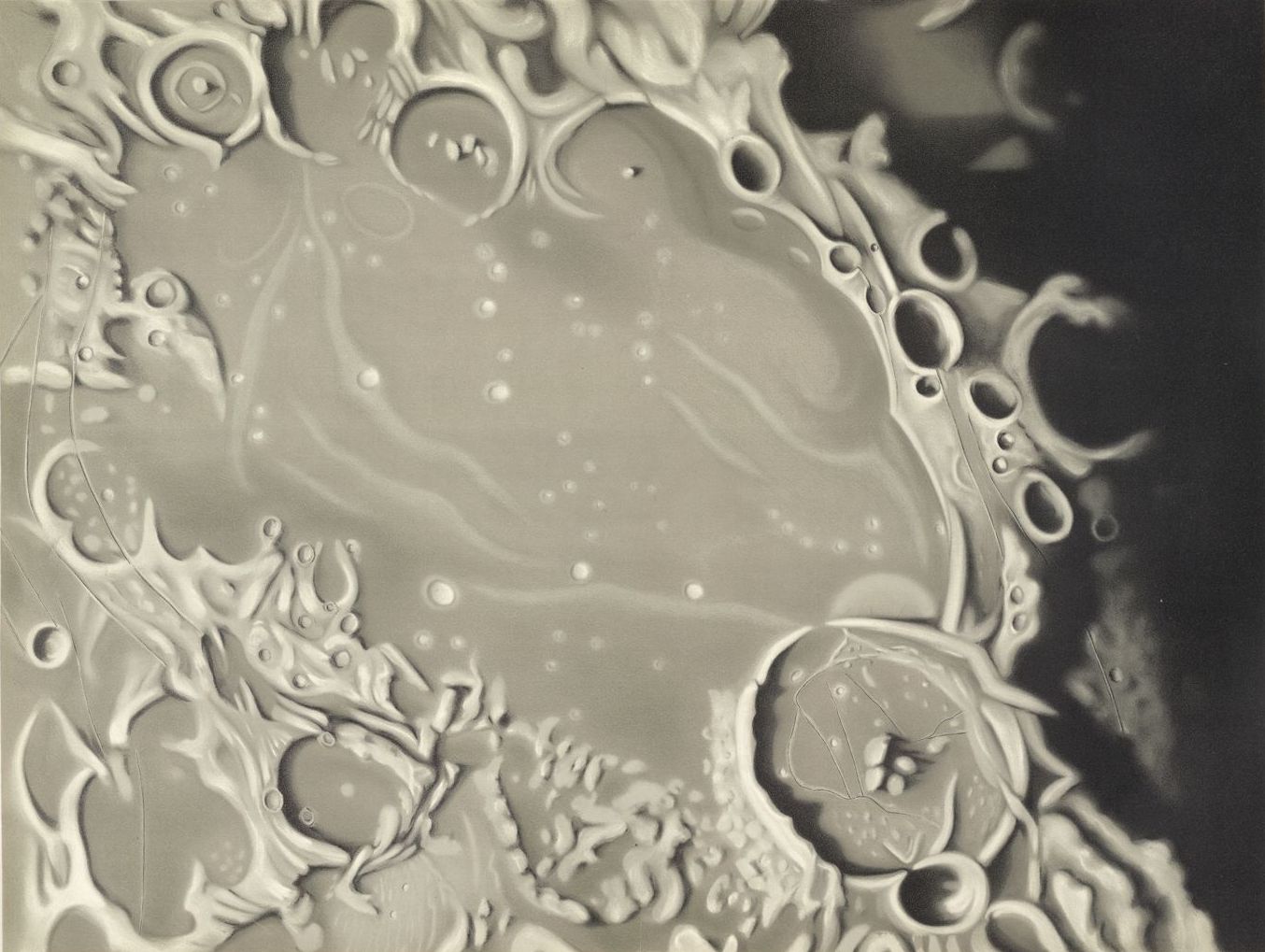
PLATE VI.—MARE HUMORUM.
From a study made in 1875
The "Mare Humorum," or sea of moisture, as it is called, which is represented on Plate VI., is one of the smaller gray lunar plains. Its diameter, which is very nearly the same in all directions, is about 270 miles, the total area of this plain being about 50,000 square miles. It is one of the most distinct plains of the Moon, and is easily seen with the naked eye on the left-hand side of the disk. The floor of the plain is, like that of the other gray plains, traversed by several systems of very extended but low hills and ridges, while small craters are disseminated upon its surface. The color of this formation is of a dusky greenish gray along the border, while in the interior it is of a lighter shade, and is of brownish olivaceous tint. This plain, which is surrounded by high clefts and rifts, well illustrates the phenomena of dislocation and subsidence. The double-ringed crater Vitello, whose walls rise from 4,000 to 5,000 feet in height, is seen in the upper left-hand corner of the gray plain. Close to Vitello, at the east, is the large broken ring-plain Lee, and farther east, and a little below, is a similarly broken crater called Doppelmayer. Both of these open craters have mountainous masses and peaks on their floor, which is on a level with that of the Mare Humorum. A little below, and to the left of these objects, is seen a deeply embedded oval crater, whose walls barely rise above the level of the plain. On the right-hand side of the great plain, is a long fault, with a system of fracture running along its border. On this right-hand side, may be seen a part of the line of the terminator, which separates the light from the darkness. Towards the lower right-hand corner, is the great ring-plain Gassendi, 55 miles in diameter, with its system of fractures and its central mountains, which rise from 3,000 to 4,000 feet above its floor. This crater slopes southward towards the plain, showing the subsidence to which it has been submitted. While the northern portion of the wall of this crater rises to 10,000 feet, that on the plain is only 500 feet high, and is even wholly demolished at one place where the floor of the crater is in direct communication with the plain. In the lower part of the mare, and a little to the west of the middle line, is found the crater Agatharchides, which shows below its north wall the marks of rills impressed by a flood of lava, which once issued from the side of the crater. On the left-hand side of the plain, is seen the half-demolished crater Hippalus, resembling a large bay, which has its interior strewn with peaks and mountains. On this same side can be seen one of the most important systems of clefts and fractures visible on the Moon, these clefts varying in length from 150 to 200 miles.
ECLIPSES OF THE MOON PLATE VII
Since the Moon is not a self-luminous body, but shines by the light which it borrows from the Sun, it follows that when the Sun's light is prevented from reaching its surface, our satellite becomes obscured. The Earth, like all opaque bodies exposed to sunlight, casts a shadow in space, the direction of which is always opposite to the Sun's place. The form of the Earth's shadow is that of a long, sharply-pointed cone, which has our globe for its base. Its length, varying with the distance of the Earth from the Sun, is, on an average, 855,000 miles, or 108 times the terrestrial diameter. This conical shadow of the Earth, divided longitudinally by the plane of the ecliptic, lies half above and half below that plane, on which the summit of the shadow describes a whole circumference in the course of a year. If the Moon's orbit were not inclined to the ecliptic, our satellite would pass at every Full Moon directly through the Earth's shadow; but, owing to that inclination, it usually passes above or below the shadow. Twice, however, during each of its revolutions, it must cross the plane of the ecliptic, the points of its orbit where this happens being called nodes. Accordingly, if it is near a node at the time of Full Moon, it will enter the shadow of the Earth, and become either partly or wholly obscured, according to the distance of its centre from the plane of the ecliptic. The partial or total obscuration of the Moon's disk thus produced constitutes a partial or total eclipse of the Moon. The essential conditions for an eclipse of the Moon are, therefore, that our satellite must not only be full, but must also be at or very near one of its nodes.
Although inferior in importance to the eclipses of the Sun, the eclipses of the Moon are, nevertheless, very interesting and remarkable phenomena, which never fail to produce a deep impression on the mind of the observer, inasmuch as they give him a clear insight into the silent motions of the planetary bodies.
At the mean distance of the Moon from the Earth, the diameter of the conical shadow cast in space by our globe is more than twice as large as that of our satellite. But, besides this pure dark shadow of the Earth, its cone is enveloped by a partial shadow called "Penumbra," which is produced by the Sun's light being partially, but not wholly, cut off by our globe.
While the Moon is passing into the penumbra, a slight reduction of the light of that part of the disk which has entered it, is noticeable. As the progress of the Moon continues, the reduction becomes more remarkable, giving the impression that rare and invisible vapors are passing over our satellite. Some time after, a small dark-indentation, marking the instant of first contact, appears on the eastern or left-hand border of the Moon, which is always the first to encounter the Earth's shadow, since our satellite is moving from west to east. The dark indentation slowly and gradually enlarges with the onward progress of the Moon into the Earth's shadow, while the luminous surface of its disk diminishes in the same proportion. The form of the Earth's shadow on the Moon's disk clearly indicates the rotundity of our globe by its circular outline. Little by little the dark segment covers the Moon's disk, and its crescent, at last reduced to a mere thread of light, disappears at the moment of the second contact. With this the phase of totality begins, our satellite being then completely involved in the Earth's shadow.
The Moon remains so eclipsed for a period of time which varies with its distance from the Earth, and with the point of its orbit where it crosses the conical shadow. When it passes through the middle of this shadow, while its distance from our globe is the least, the total phase of an eclipse of the Moon may last nearly two hours. The left-hand border of our satellite having gone first into the Earth's shadow, is also the first to emerge, and, at the moment of doing so, it receives the Sun's light, and totality ends with the third contact. The lunar crescent gradually increases in breadth after its exit from the shadow, and finally the Moon recovers its fully illuminated disk as before, at the moment its western border leaves the Earth's shadow. Soon after, it passes out of the penumbra, and the eclipse is over. In total eclipses, the interval of time from the first to last contact may last 5h. 30m, but it is usually shorter.
Soon after the beginning of an eclipse, the dark segment produced by the Earth's shadow on the Moon's disk generally appears of a dark grayish opaque color, but with the progress of the phenomenon, this dark tint is changed into a dull reddish color, which, gradually increasing, attains its greatest intensity when the eclipse is total. At that moment the color of the Moon is of a dusky, reddish, coppery hue, and the general features of the Moon's surface are visible as darker and lighter tints of the same color. It sometimes happens, however, that our satellite does not exhibit this peculiar coppery tint, but appears either blackish or bluish, in which case it is hardly distinguishable from the sky.
It is very rare for the Moon to disappear completely during totality, and even when involved in the deepest part of the Earth's shadow, our satellite usually remains visible to the naked eye, or, at least, to the telescope. This phenomenon is to be attributed to the fact that the portion of the solar rays which traverse the lower strata of our atmosphere are strongly refracted, and bend inward in such a manner that they fall on the Moon, and sufficiently illuminate its surface to make it visible. The reddish color observed is caused by the absorption of the blue rays of light by the vapors which ordinarily-saturate the lower regions of our atmosphere, leaving only red rays to reach the Moon's surface. Of course, these phenomena are liable to vary with every eclipse, and depend almost exclusively on the meteorological conditions of our atmosphere.
In some cases the phase of totality lasts longer than it should, according to calculation. This can be attributed to the fact that the Earth is enveloped in a dense atmosphere, in which opaque clouds of considerable extent are often forming at great elevations. Such strata of clouds, in intercepting the Sun's light, would have, of course, the effect of increasing the diameter of the Earth's shadow, in a direction corresponding to the place they occupy, and, if the Moon were moving in this direction, would increase the phase of total obscuration.
The eclipses of the Moon, like those of the Sun, as shown above, have a cycle of 18 years, 11 days and 7 hours, and recur after this period of time in nearly the same order. They can, therefore, be approximately predicted by adding 18y. 11d. 7h. to the date of the eclipses which have occurred during the preceding period. During this cycle 70 eclipses will occur—41 being eclipses of the Sun and 29 eclipses of the Moon. At no time can there ever be more than seven eclipses in a year, and there are never less than two. When there are only two eclipses in a year, they are both eclipses of the Sun.
Although the number of solar eclipses occurring at some point or other of the Earth's surface is greater than that of the eclipses of the Moon, yet at any single terrestrial station the eclipses of the Moon are the more frequent. While an eclipse of the Sun is only visible on a narrow belt, which is but a very small fraction of the hemisphere then illuminated by the Sun, an eclipse of the Moon is visible from all the points of the Earth which have the Moon above their horizon at the time. Furthermore, an eclipse of the Sun is not visible at one time over the whole length of its narrow tract, but moves gradually from one end of it to the other; while, on the contrary, an eclipse of the Moon begins and ends at the very same instant for all places from which it can be seen, but, of course, not at the same local time, which varies with the longitude of the place.
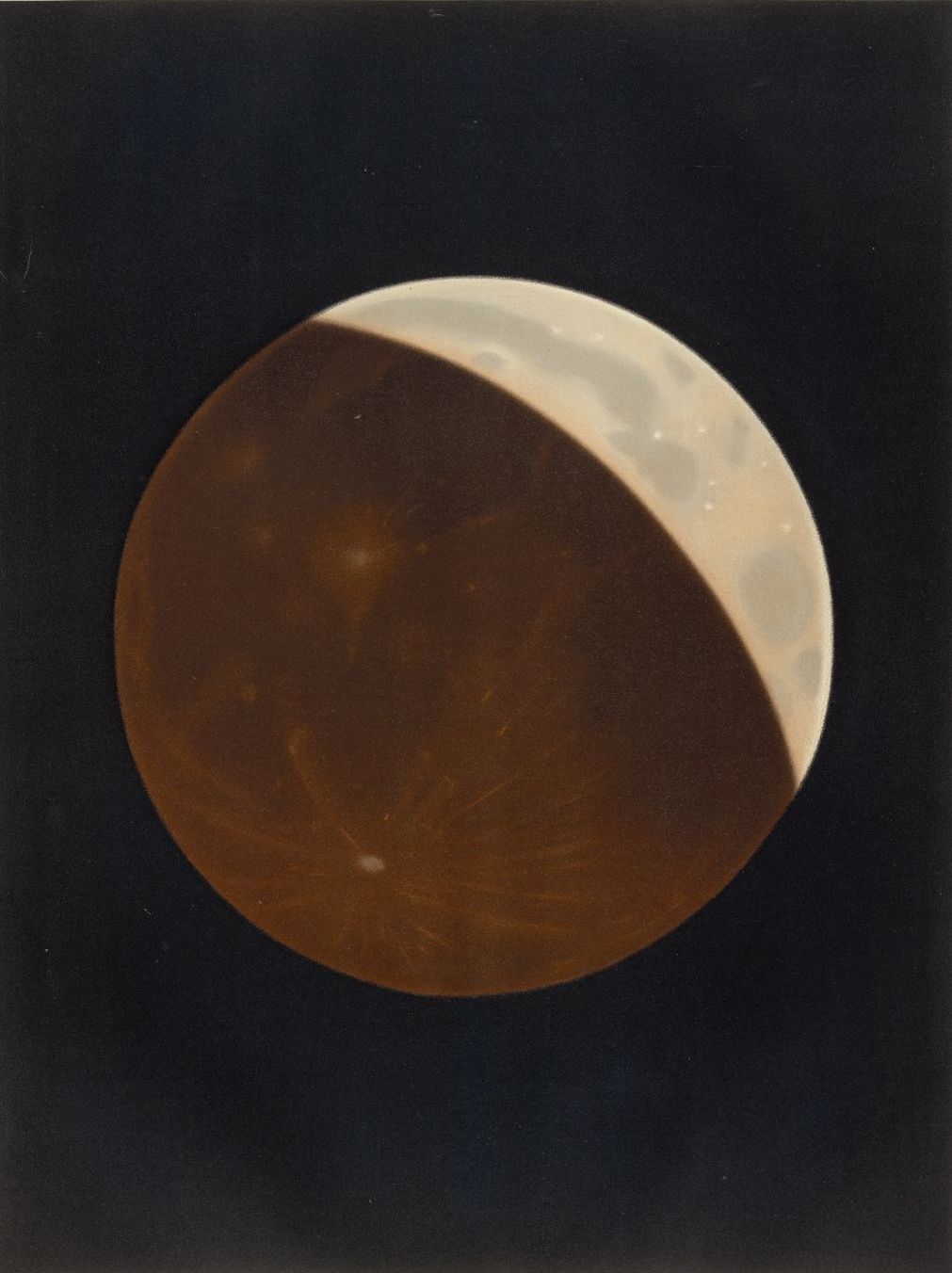
PLATE VII.—PARTIAL ECLIPSE OF THE MOON.
Observed October 24, 1874
The partial eclipse of the Moon, represented on Plate VII., shows quite plainly the configuration of our satellite as seen with the naked eye during the eclipse, with its bright and dark spots, and its radiating streaks. This eclipse was observed on October 24th, 1874.
THE PLANETS
Around the Sun circulate a number of celestial bodies, which are called "Planets." The planets are opaque bodies, and appear luminous because their surfaces reflect the light they receive from the Sun.
The planets are situated at various distances from the Sun, and revolve around this body in widely different periods of time, which are, however, constant for each planet, so far as ascertained, and doubtless are so in the other cases.
The ideal line traced in space by a planet in going around the Sun, is called the orbit of the planet; while the period of time employed by a planet to travel over its entire orbit and return to its starting point, is called the sidereal revolution, or year of the planet. The dimensions of the orbits of the different planets necessarily vary with the distance of these bodies from the Sun, as does also the length of their sidereal revolution.
The distance of a planet from the Sun does not remain constant, but is subject to variations, which in certain cases are quite large. These variations result from the fact that the planetary orbits are not perfect circles having the Sun for centre, but curves called "Ellipses," which have two centres, or foci, one of which is always occupied by the Sun. This is in accordance with Kepler's first law.
The ideal point situated midway between the two foci is called the centre of the ellipse, or orbit; while the imaginary straight line which passes through both foci and the centre, with its ends at opposite points of the ellipse, is called "the major axis" of the orbit. It is also known as "the line of the apsides." The ideal straight line which, in passing through the centre of the orbit, cuts the major axis at right angles, and is prolonged on either side to opposite points on the ellipse, is called "the minor axis" of the orbit.
When a planet reaches that extremity of the major axis of its orbit which is the nearest to the Sun, it is said to be in its "perihelion;" while, when it arrives at the other extremity, which is farthest from this body, it is said to be in its "aphelion." When a planet reaches either of the two opposite points of its orbit situated at the extremities of its minor axis, it is said to be at its mean distance from the Sun.
The rapidity with which the planets move on their orbits varies with their distance from the Sun; the farther they are from this body, the more slowly they move. The rapidity of their motion is greatest when they are in perihelion, and least when they are in aphelion, having its mean rate when these bodies are crossing either of the extremities of the minor axes of their orbits.
The imaginary line which joins the Sun to a planet at any point of its orbit, and moves with this planet around the Sun, is called "the radius vector." According to Kepler's second law, whatever may be the distance of a planet from the Sun, the radius vector sweeps over equal areas of the plane of the planet's orbit in equal times.
There is a remarkable relation between the distance of the planets from the Sun and their period of revolution, in consequence of which the squares of their periodic times are respectively equal to the cubes of their mean distances from the Sun. From this third law of Kepler, it results that the mere knowledge of the mean distance of a planet from the Sun enables one to know its period of revolution, and vice versa.
The orbit described by the Earth around the Sun in a year, or the apparent path of the Sun in the sky, is called "the ecliptic." Like that of all the planetary orbits, the plane of the ecliptic passes through the Sun's centre. The ecliptic has a great importance in astronomy, inasmuch as it is the fundamental plane to which the orbits and motions of all planets are referred.
The orbits of the larger planets are not quite parallel to the ecliptic, but more or less inclined to this plane; although the inclination is small, and does not exceed eight degrees. On account of this inclination of the orbits, the planets, in accomplishing their revolutions around the Sun, are sometimes above and sometimes below the plane of the ecliptic. A belt extending 8° on each side of the ecliptic, and, therefore, 16° in width, comprises within its limits the orbits of all the principal planets. This belt is called "the Zodiac."
Since all the planets have the Sun for a common centre, and have their orbits inclined to the ecliptic, it follows that each of these orbits must necessarily intersect the plane of the ecliptic at two opposite points situated at the extremities of a straight line passing through the Sun's centre. The two opposite points on a planetary orbit where its intersections with the ecliptic occur, are called "the Nodes," and the imaginary line joining them, which passes through the Sun's centre, is called "the line of the nodes." The node situated at the point where a planet crosses the ecliptic from the south to the north, is called "the ascending node" while that situated where the planet crosses from north to south, is called "the descending node."
The planets circulating around the Sun are eight in number, but, beside these, there is a multitude of very small planets, commonly called "asteroids," which also revolve around our luminary. The number of asteroids at present known surpasses two hundred, and constantly increases by new discoveries. In their order of distance from the Sun the principal planets are: Mercury, Venus, Earth, Mars, Jupiter, Saturn, Uranus and Neptune. The orbits of the asteroids are comprised between the orbits of Mars and Jupiter.
When the principal planets are considered in regard to their differences in size, they are separated into two distinct groups of four planets each, viz.: the small planets and the large planets. The orbits of the small planets are wholly within the region occupied by the orbits of the asteroids, while those of the large planets are wholly without this region.
When the planets are considered in regard to their position with reference to the Earth, they are called "inferior planets" and "superior planets." The inferior planets comprise those whose orbits are within the orbit of our globe; while the superior planets are those whose orbits lie beyond the orbit of the Earth.
Since the orbits of the inferior planets lie within the orbit of the Earth, the angular distances of these bodies from the Sun, as seen from the Earth, must always be included within fixed limits; and these planets must seem to oscillate from the east to the west, and from the west to the east of the Sun during their sidereal revolution. In this process of oscillation these planets sometimes pass between the Earth and the Sun, and sometimes behind the Sun. When they pass between us and the Sun they are said to be in "inferior conjunction," while, when they pass behind the Sun, they are said to be in "superior conjunction." When such a planet reaches its greatest distance, either east or west, it is said to be at its greatest elongation east or west, as the case may be, or in quadrature.
The superior planets, whose orbits lie beyond that of the Earth and enclose it, present a different appearance. A superior planet never passes between the Earth and the Sun, since its orbit lies beyond that of our globe, and, therefore, no inferior conjunction of such a planet can ever occur. When one of these planets passes beyond the Sun, just opposite to the place occupied by the Earth, the planet is said to be in "conjunction;" while, when it is on the same side of the Sun with our globe, it is said to be in "opposition." While occupying this last position, the planet is most advantageously situated for observation, since it is then nearer to the Earth. The period comprised between two successive conjunctions, or two successive oppositions of a planet, is called its "synodical period." This period differs for every planet.
It is supposed that all the planets rotate from west to east, like our globe; although no direct evidence of the rotation of Mercury Uranus, and Neptune has yet been obtained, it is probable that these planets rotate like the others. It results from the rotation of the planets that they have their days and nights, like our Earth, but differing in duration for every planet.
The axes of rotation of the planets are more or less inclined to their respective orbits, and this inclination varies but little in the course of time. From the inclination of the axes of rotation of the planets to their orbits, it results that these bodies have seasons like those of the Earth; but, of course, they differ from our seasons in duration and intensity, according to the period of revolution and the inclination of the axis of each separate planet.
THE PLANET MARS PLATE VIII
Mars is the fourth of the planets in order of distance from the sun; Mercury, Venus and the Earth being respectively the first, second and third.
Owing to the great eccentricity of its orbit, the distance of Mars from the Sun is subject to considerable variations. When this planet is in its aphelion, its distance from the Sun is 152,000,000 miles, but at perihelion it is only 126,000,000 miles distant, the planet being therefore 26,000,000 miles nearer the Sun at perihelion than at aphelion. The mean distance of Mars from the Sun is 139,000,000 miles. Light, which travels at the rate of 185,000 miles a second, occupies 12½ minutes in passing from the Sun to this planet.
While the distance of Mars from the Sun varies considerably, its distance from the Earth varies still more. When Mars comes into opposition, its distance from our globe is comparatively small, especially if the opposition occurs in August, as the two planets are then as near together as it is possible for them to be, their distance apart being only 33,000,000 miles. But if the opposition occurs in February, the distance may be nearly twice as great, or 62,000,000 miles. On the other hand, when Mars is in conjunction in August, the distance between the two planets is the greatest possible, or no less than 245,000,000 miles; while, when the conjunction occurs in February, it is only 216,000,000 miles. Hence the distance between Mars and the Earth varies from .33 to 245 millions of miles; that is, this planet may be 212 million miles nearer to us at its nearest oppositions than at its most distant conjunctions.
From these varying distances of Mars from the Earth, necessarily result great variations in the brightness and apparent size of the planet, as seen from our globe. When nearest to us it is a very conspicuous object, appearing as a star of the first magnitude, and approaching Jupiter in brightness; but when it is farthest it is much reduced, and is hardly distinguishable from the stars of the second and even third magnitude. In the first position, the apparent diameter of Mars is 26", in the last it is reduced to 3" only.
The orbit of Mars has the very small inclination of 1° 51' to the plane of the ecliptic. The planet revolves around the Sun in a period of 687 days, which constitutes its sidereal year, the year of Mars being only 43 days less than two of our years.
Mars travels along its orbit with a mean velocity of 15 miles per second, being about ⁸⁄₁₀ of the velocity of our globe in its orbit. The synodical period of Mars is 2 years and 48 days, during which the planet passes through all its degrees of brightness.
Mars is a smaller planet than the Earth, its diameter being only 4,200 miles, and its circumference 13,200 miles. It seems well established that it is a little flattened at its poles, but the actual amount of this flattening is difficult to obtain. According to Prof. Young, the polar compression is ¹⁄₂₁₉.
The surface of this planet is a little over ²⁸⁄₁₀₀ of the surface of our globe, and its volume is 6½ times less than that of the Earth. Its mass is only about ⅒ while its density is about ¾ that of the Earth. The force of gravitation at its surface is nearly ¾ of what it is at the surface of our globe.
The planet Mars rotates on an axis inclined 61° 18' to the plane of its orbit, so that its equator makes an angle of 28° 42' with the same plane. The period of rotation of this planet, which constitutes its sidereal day, is 24 h. 37 m. 23 s.
The year of Mars, which is composed of 669⅔ of these Martial days, equals 687 of our days, this planet rotating 669⅔ times upon its axis during this period. But owing to the movement of Mars around the Sun, the number of solar days in the Martial year is only 668⅔, while, owing to the same cause, the solar day of Mars is a little longer than its sidereal day, and equals 24 h. 39 m. 35 s.
The days and nights on Mars are accordingly nearly of the same length as our days and nights, the difference being a little less than three-quarters of an hour. But while the days and nights of Mars are essentially the same as ours, its seasons are almost twice as long as those of the Earth. Their duration for the northern hemisphere, expressed in Martial days, is as follows: Spring, 191; Summer, 181; Autumn, 149; Winter, 147. While the Spring and Summer of the northern hemisphere together last 372 days, the Autumn and Winter of the same hemisphere last only 296 days, or 76 days less. Since the summer seasons of the northern hemisphere correspond to the winter seasons of the southern hemisphere, and vice versa, the northern hemisphere, owing to its longer summer, must accumulate a larger quantity of heat than the last. But on Mars, as on the Earth, there is a certain law of compensation resulting from the eccentricity of the planet's orbit, and from the fact that the middle of the summer of the southern hemisphere of this planet, coincides with its perihelion. From the greater proximity of Mars to the Sun at that time, the southern hemisphere then receives more heat in a given time than does the northern hemisphere in its summer season. When everything is taken into account, however, it is found that the southern hemisphere must have warmer summers and colder winters than the northern hemisphere.
Seen with the naked eye, Mars appears as a fiery red star, whose intensity of color is surpassed by no other star in the heavens. Seen through the telescope, it retains the same red tint, which, however, appears less intense, and gradually fades away toward the limb, where it is replaced by a white luminous ring.
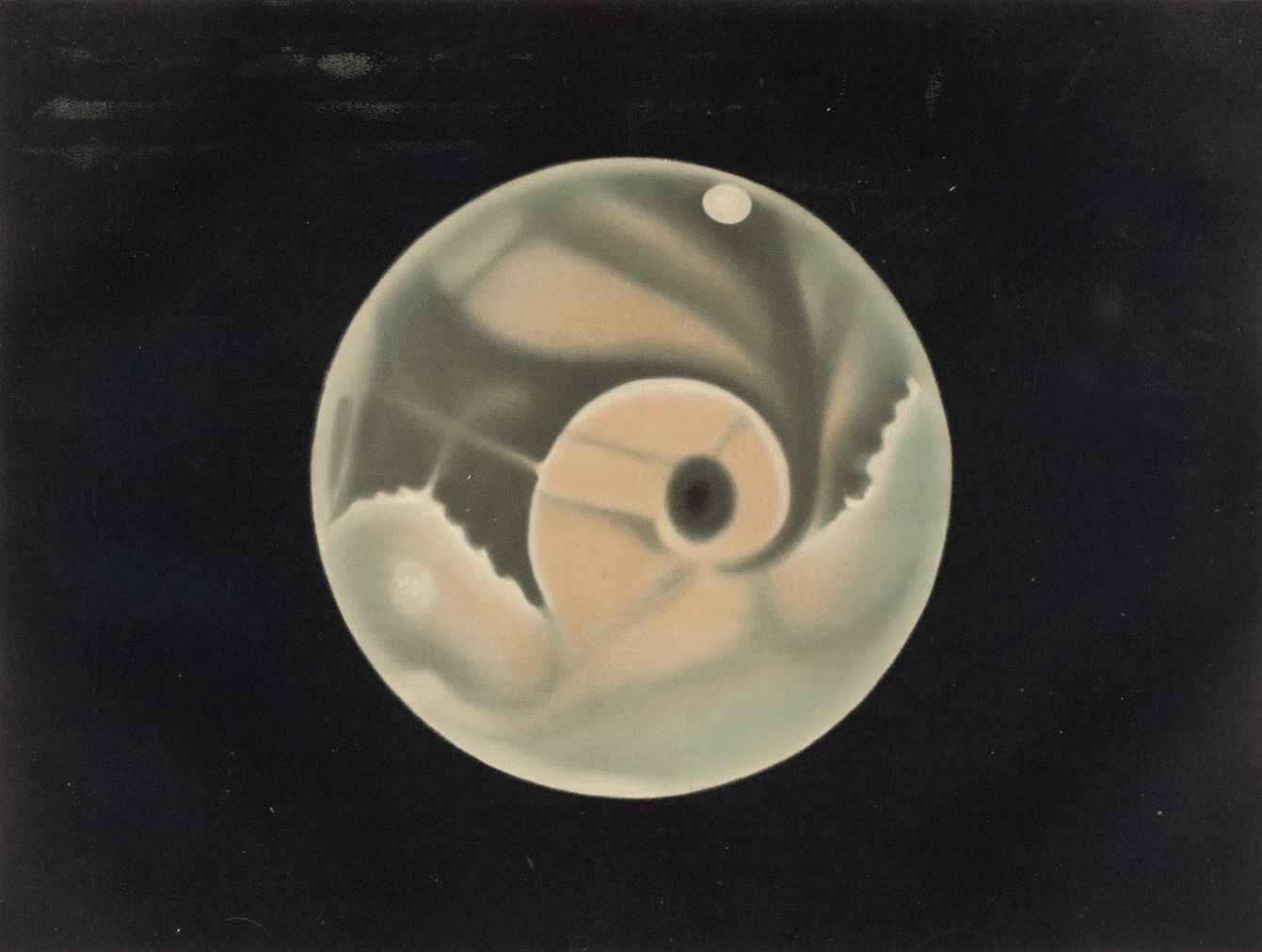
PLATE VIII.—THE PLANET MARS.
Observed September 3, 1877, at 11h. 55m. P.M.
Mars is a very difficult object to observe, the atmosphere surrounding it being sometimes so cloudy and foggy that the sight can hardly penetrate through its vapors. When this planet is observed under favorable atmospheric conditions, and with sufficient magnifying power, its surface, which is of a general reddish tint, is found to be diversified by white, gray and dark markings. The dark markings, which are the most conspicuous, almost completely surround the planet. They are of different forms and sizes, and very irregular, as can be seen on Plate VIII., which represents one of the hemispheres of this planet. Many of them, especially those situated in the tropical regions of the planet, form long narrow bands, whose direction is in the main parallel to the Martial equator.
The dusky spots differ very much, both from one another and in their several parts, as regards intensity of shade. Some appear almost black, while others which appear grayish, are so faint, that they can seldom be seen. In the southern hemisphere, the darkest part of the spots is generally found along their northern border; especially where there are deep indentations.
Some observers have described these spots as being greenish or bluish, but I have never been able to see the faintest trace of these colors in them, except when they were observed close to the limb, and involved in the greenish tinted ring which is always to be seen there. It is probably an effect of contrast, since green and red are complementary colors, and since this greenish tinge around the limb covers all kinds of spots, whether white or dark. When such dark spots, involved in the greenish tint, are carried by the rotation towards the centre of the disk, they no longer show this greenish color. To me, these spots have always appeared dark, and of such tints as would result from a mixture of white and black in different proportions; except that on their lighter portions they show some of the prevalent reddish tint of the Martial surface. It is to be remarked that in moments of superior definition of the telescopic image, the intensity of darkness of all the spots is considerably increased—some of them appearing almost perfectly black.
The markings on the surface of Mars are now tolerably well known—especially those of its southern hemisphere, which, owing to the greater proximity of the planet to our globe when this hemisphere is inclined towards the earth, have been better studied. Those of the northern hemisphere are not so well known, since when this hemisphere is inclined towards us, the distance of Mars from the Earth is 26,000,000 miles greater, so that the occasions for observing them are not so favorable.
Several charts of Mars are in existence, but as the same nomenclature has not been employed in all of them, some confusion has arisen in regard to the names given to the most remarkable features of the planet's surface. In order to give clearness to the subject, it will be necessary here to give a brief description of the principal markings represented on Plate VIII. In this the nomenclature will be employed which has been adopted by the English observers in the fine chart of Mr. Nath. Green. The large dark spot represented on the left-hand side of the plate is called De La Rue Ocean. The dark oval spot, isolated in the vicinity of the centre of the disk, is called Terby Sea; while the dark, irregular form on the right, near the border, represents the western extremity of Maraldi Sea.
The dusky spots of Mars seem to be permanent, and to form a part of the general surface of the planet. That several among them, at least, are permanent, is proved by the fact that they have been observed in the same position, and with the same general form, for over two centuries. Yet, if we are to depend upon the drawings made fifty years ago by Beer and Maedler, it would seem that the permanency of some of them does not exist, since a very large spot represented by these astronomers on their chart of Mars is not visible now. This object, which, on their map, has its middle at 270°, should be precisely under the prominent dark oval spot called Terby Sea, seen near the centre of the picture, and would extend down almost as far as the northern limb. This can hardly be attributed to an error of observation, since these observers were both careful, and had great experience in this class of work. It is a very singular fact that, at the very same place where Maedler represented the spot in question, I found a conspicuous dark mark on December 16, 1881, which was certainly not visible in 1877, during one of the most favorable oppositions which can ever occur. The object, which is still visible (Feb., 1882), consists of an isolated spot situated a little to the north of Terby Sea. During the memorable opposition of 1877, I investigated thoroughly the markings of Mars, and made over 200 drawings of its disk, 32 of which represent the Terby Sea; but this isolated spot was not to be seen, unless it be identified with the faint mark, represented on the plate, which occupied its place. There cannot be the slightest doubt that a change has occurred at that place. Changes in the markings have also been suspected on the other hemisphere of the planet.
The well-known fact that the continents, and especially the mountainous and denuded districts of our globe, reflect much more light than the surfaces covered by water, has led astronomers to suppose that the dark spots on Mars are produced by a liquid strongly absorbing the rays of light, like the liquids on the surface of the Earth. According to this theory the dark spots observed are supposed to be lakes, seas, and oceans, similar to our own seas and oceans, while the reddish and whitish surfaces separating these dark spots, are supposed to be islands, peninsulas, and continents. This supposition seems certainly to have a great deal of probability in its favor, although some of the lighter markings may have a different origin, and perhaps be due to vegetation; but no observer has yet seen in them any of the changes which ought to result from change of seasons. Some of the changes in the dark spots might also be attributed to the flooding or drying up of marshes and low land. The change which I have observed lately might be attributed to such a cause, especially as my observation was made shortly after the spring equinox of the northern hemisphere of Mars, which occurred on December 8th.
Besides the dark spots just described, there are markings of a different character and appearance. Among the most conspicuous are two very brilliant white oval spots, which always occupy opposite sides of the planet. These two bright spots, which correspond very closely with the poles of rotation of Mars, have been called "polar spots."
On account of the inclination of the axis of rotation of this planet to the ecliptic, it is rare that both of these spots are visible on the disk at the same time; and when this occurs, they are seen considerably foreshortened, as they are then both on the limb of the planet. Usually only one spot is visible, and it appears to its best advantage when the region to which it belongs attains its maximum of inclination towards the Earth.
The polar spots change considerably in size, as they do also in form. Sometimes they occupy nearly one-third of the disk, as is proved by many of my observations; while at other times they are so much reduced as to be totally invisible. It is to be remarked that the reduction of these spots generally corresponds with the summer seasons, and their enlargement with the winter seasons of the hemispheres to which they respectively belong. From these well-observed facts it would appear that a relation exists between the temperature of the two hemispheres of Mars and the variations of the white spots observed at its poles. A similar relation is known to exist on our globe between the progress of the seasons and the melting away and the accumulation of snow in the polar regions. Astronomers have been led, accordingly, to attribute the polar spots of Mars, with all their variations, to the alternate accumulation and melting of snows. On this account, the polar spots of Mars are sometimes also called "snow-spots."
Errors have certainly been made by astronomers in some of their observations of the so-called polar snow-spots, other objects occupying their place having been mistaken for them. A regular series of observations on this planet, which I have now continued for seven years, has revealed the fact that during the winter seasons of the southern hemisphere of Mars, the polar spots are most of the time invisible, being covered over by white, opaque, cloud-like forms, strongly reflecting light. In 1877, during more than a month, I, myself, mistook for the polar spots such a canopy of clouds, which covered at least one-fifth of the surface of the whole disk. I only became aware of my error when the opaque cloud, beginning to dissolve at the approach of the Martial summer, allowed the real polar spot to be seen through its vapors, as through a mist at first, and afterwards with great distinctness. In this particular case, the snow-spot was considerably smaller than the cloudy cap which covered it, and it is to be remarked that it was not situated at the centre of this cloudy cap, but was east of that centre; a fact which may account for the so-called polar spots not being always observed on exactly opposite sides of the disk. From my observations of 1877, 1878 and 1880, it appears that at the approach of the autumnal equinox of the southern hemisphere of Mars, large, opaque masses, like cumulus clouds in form, began to gather in the polar regions of that hemisphere, and continued through autumn and winter, dissolving only at the approach of spring. These clouds, which varied in form and extent, were very unsteady at first, but as the winter drew nearer they enlarged and became more permanent, covering large surfaces for months at a time.
That the large white spots under consideration are real clouds in the atmosphere of Mars, and are not due to a fall of snow, is proved by the fact that these spots covered both seas and continents with equal facility, even in the equatorial regions of the planet. Snow, of course, could not cover the seas of Mars, unless these were all frozen over, even in the equatorial zones; therefore, if the dark spots of Mars are assumed to be due to water, these large white spots cannot well be ascribed to snow.
The real polar spots of Mars seem to be in relief on the surface of the planet, since the southern spot often appeared slightly shaded on the side opposite to the Sun during my observations in 1877. In certain cases, when they are on or very near the limb, they have been observed, both by others and by myself, to project from the disk slightly.
The polar spots of Mars are doubtless composed of a material which, like our snow or ice, melts under the rays of the Sun; although it seems difficult to admit that the Martial snow is identical with our terrestrial snow, and that it melts at a like temperature. The south polar spot of Mars entirely disappeared from sight in its summer season in 1877, although the planet receives less than one-half as much heat as we receive from the Sun; yet on our globe the arctic or antarctic ices and snow are perpetual—never melting entirely. An important fact disclosed by the melting away of the southern polar spot is, that in melting it is always surrounded with a very dark surface, which takes the place of the melted portion of the spot, as observed by myself in 1877-78. When the polar spot had entirely disappeared, its place was occupied by a very dark spot. Now, if the polar spot is really ice, and the dark spots are actual seas, this polar spot must be situated in mid-ocean, since, on melting away, it is replaced by a dark spot. If the polar spots are composed of a white substance melting under the rays of the Sun, as seems altogether probable, its melting point must be above that of terrestrial snow.
Many of the dark spots of Mars, and especially those whose northern border forms an irregular belt upon the equatorial regions of this planet, are bordered on that side by a white luminous belt, following all their sinuosities. These white borders are variable. Sometimes they are very prominent and intensely bright, especially at some points, which occasionally almost equal the polar spots in brilliancy; while at other times they are so faint, that they can hardly be distinguished, or are even invisible; although the atmosphere is clear and the dark spots appear perfectly well defined. While these white borders were invisible, I have sometimes watched for several hours at a time to see if I could detect any traces of them in places where they usually appear the most prominent, but generally without success. On a few occasions, however, I had the good fortune to see some of these spots forming gradually in the course of one or two hours, at places where nothing of them could be seen before.
These whitish fringes forming and vanishing along the coasts of the Martial seas have been very little studied by astronomers. From my observations made during the last seven years, it appears very probable that this belt and its white spots are mainly due to the condensation of vapors around, and over high peaks, and extensive mountain chains, forming the Martial sea-coasts, as the Andes and Rocky Mountains form the sea-coasts of the Pacific Ocean. These high mountains on Mars, condensing the vapors into fogs or clouds above them, or at their sides, as often happens in our mountainous districts, would certainly suffice to produce the phenomena observed. Some of the highest peaks among these mountain chains may even have their summits covered with perpetual snow, or some substance partaking of the nature of snow. The temporary visibility and invisibility of the white spots seen on Mars, as well as the rapid transformations they sometimes undergo, may be explained as caused by clouds having a high reflective power and a liability to form and disappear quickly.
The assumption that these irregular whitish bands and spots are formed by the condensation of vapors on mountain chains, and elevated table lands, is supported by my observations made in 1877 and 1879. When such white spots were traversing the terminator at sunrise, they very often projected far into the night side, thus indicating that they were at a higher level than that of the general surface. Indentations in the terminator, corresponding to large dark spots crossing its line, also clearly indicated the depression of the dark spots below the general surface. The highest mountainous districts thus observed on Mars, are situated between 60° and 70° of south latitude, towards the western extremity of Gill Land. The mountain chain, which almost completely forms the surface of this land, is so elevated at some points, that they not only change the form of the terminator when they are seen upon it, but also the limb of the planet, as seen by myself. They then appear so brilliant, that the principal summit among them has been mistaken by several observers for the polar spot itself, as proved by the wrong position assigned to it on their drawings. It seems probable that this high peak, which appears always white, is constantly covered with snow, or the similar material replacing it on Mars. This high region is situated between longitudes 18o° and 190°.
The highest mountainous parts belonging to the hemisphere represented on Plate VIII., which are nearly always more or less visible as whitish spots and bands, form a coast line along the northern (lower) border of De La Rue Ocean. This great spot, which is not so simple as it has been represented by observers, is in fact divided by two narrow isthmuses, one in the north, the other in the east, both joining, in the interior of the great ocean, a peninsula heretofore known as Hall Island. Upon the south-eastern extremity of this peninsula, a white spot, called Dawes Ice Island, was observed in 1865, but it soon disappeared, and was after that seen only now and then. It is very probable that this so-called Ice Island was due to clouds forming around the summit of some high peak of this peninsula.
On the opposite hemisphere to that represented on Plate VIII., the white fringes bordering the dark spots are much more conspicuous than they are on this side. On the eastern side of a remarkable dark spot called Kaiser Sea, they are very bright, and almost always present, although they vary considerably, both in brightness and in extent. To the south of Kaiser Sea, they are very conspicuous on the eastern border of Lockyer Land, forming an elevated and deeply indented coast-line along Lambert Sea. There the white spots never disappear entirely, being always visible on the north side, where they turn westward along Dawes' Ocean—the mountain chain attaining there its greatest altitude. Very frequently Lockyer Land, which seems to be a vast plateau, appears throughout white and brilliant, this occurring usually towards the sunrise or sunset of that region, probably from the condensation of vapors and the formation of fogs, but generally this whiteness gradually disappears with the progress of the sun above this plateau. Inside of the great continents of Mars these temporary white spots are not so frequent, but when visible they occupy always the same positions—a fact which probably indicates that they occupy the culminating points of these continents. One of these temporary white spots inside of the continents is represented on Plate VIII., on the left-hand side, below De La Rue Ocean, on Maedler Continent.
Although large, opaque, cumulus-shaped, cloud-like forms are seen in the polar regions of Mars, such forms are very seldom seen in the tropical zones, or, at least, it appears so, from the fact that my observations, continued during the last seven years, have disclosed no real opaque cloudy forms there. Although the Martial sky is frequently overcast by dense vapors or thick fogs in these regions, yet no real opaque clouds were ever seen; the most prominent among the dusky spots being faintly visible through the vapory veil, when they approached the centre of the disk.
Besides these phenomena, which prove that Mars is surrounded by an atmosphere having a great deal of similarity to our own, a further proof is afforded by the fact that the dark spots, which appear sharply defined and black when they are seen near the centre, become less and less visible as they advance towards the limb, and are totally invisible before they reach it. Moreover, the spectroscope also indicates the existence of an atmosphere, and even the presence of watery vapor in it. A very curious state of the Martial atmosphere is revealed by my observations of 1877-78. During eight consecutive weeks, from December 12th to February 6th, a whole hemisphere of the planet—precisely that represented on Plate VIII.—was completely covered by dense vapors, or a thick fog which barely allowed the dark spots to be seen through it, even when they were in the centre of the disk. The opposite hemisphere of Mars appeared just as clear and calm as possible; there all the spots and their minutest details could be seen, and when the planet was observed at the proper time, the line separating the foggy from the clear side was plainly visible.
The reddish tint observed on the continents of Mars has been supposed by some astronomers to be the real color of the atmosphere of this planet. But, for many reasons, this explanation is not acceptable. Besides the fact that the border of the planet appears white, while it should be more red than the other part, owing to the greater depth of atmosphere there presented to us, the polar spots, the white bands along the sea-coasts, and the cloud-like forms appear perfectly white, not the slightest tint of red being visible on them, as would be the case if these objects were seen through an atmosphere tinted red. Other astronomers have supposed that the vegetation of this planet has a reddish color; but this is not supported by observation. It has been again supposed, with much more probability, that the surface of Mars is composed of an ochreous material which gives the planet its predominant ruddy color.
Until lately Mars was supposed to be without a satellite, but in August, 1877, Professor Hall, of the Washington Observatory, made one of the most remarkable discoveries of the time, and found two satellites revolving around this planet. These satellites are among the smallest known heavenly bodies, their diameter having been estimated at from 6 to 10 miles for the outer satellite, and from 10 to 40 miles for the inner one.
The most extraordinary feature of these bodies is the proximity of the inner satellite to the planet, and the consequent rapidity of its motion. The distance of the inner satellite from the centre of Mars is about 6,000 miles, and from surface to surface it is less than 4,000 miles, or a little more than the distance from New York to San Francisco. The shortest period of revolution of any satellite previously known, is that of the inner satellite of Saturn, which is a little more than 22½ hours; but the inner satellite of Mars accomplishes its revolution in 7h. 38m., or in 17 hours less than the period of rotation of the planet upon its axis. The period of revolution of the outer satellite is greater, of course, and equals 30h. 7m.
From this rapidity of motion of the inner satellite of Mars, a very curious result follows, which at first sight may appear in contradiction with the fact that this body has a direct motion, like that of all the planets of the solar system, and moves around Mars from west to east. While the outer satellite of this planet, in company with all the stars and planets, rises in the east and sets in the west, the inner satellite, on the contrary, rises in the west and sets in the east. Since the period of rotation of Mars is greater than is the period of revolution of this satellite, it necessarily follows that this last body must constantly be gaining on the rotation, and, consequently, that the satellite sets in the east and rises in the west, compassing the whole heavens around Mars three times a day, passing through all its phases in 11 hours, each quarter of this singular Moon lasting less than 3 hours.
It has been shown above that Mars has many points of resemblance to the Earth. It has an atmosphere constituted very nearly like ours; it has fogs, clouds, rains, snows, and winds. It has water, or at least some liquids resembling it; it has rivers, lakes, seas and oceans. It has also islands, peninsulas, continents, mountains and valleys. It has two Moons, which must create great and rapid tides in the waters of its seas and oceans. It has its days and nights, its warm and cold seasons, and very likely its vegetation, its prairies and forests, like the Earth. On the other hand, its year and seasons are double those of the Earth, and its distance from the Sun is greater.
Is this planet, which is certainly constituted very nearly like our globe, and seems so nearly fitted for the wants of the human race, inhabited by animals and intelligent beings?
To answer this question, either in the negative or in the affirmative, would be to step out of the pure province of science, and enter the boundless domain of speculation, since no observer has ever seen anything indicating that animal life exists on Mars, or on any other planet or satellite. So far as observation goes, Mars seems to be a planet well suited to sustain animal life, and we may reason from analogy that if animal life can exist at all outside of the Earth, Mars must have its flora and fauna; it must have its fishes and birds, its mammalia and men; although all these living beings must inevitably be very different in appearance from their representatives on the Earth, as can easily be imagined from the differences existing between the two planets. Although all this is possible, and even very probable, yet it must be remembered that we have not the slightest evidence that it is so; and until we have acquired this evidence, we may only provisionally accept this idea as a pleasing hypothesis, which, after all, may be wrong and totally unfounded.
THE PLANET JUPITER PLATE IX
Jupiter, the giant of the planetary world, is the fifth in order of distance from the Sun, and is next to Mars, our ruddy neighbor. To the naked eye, Jupiter appears as a very brilliant star, whose magnitude, changing with the distance of this planet from the Earth, sometimes approaches that of Venus, our bright morning and evening star.
The mean distance of Jupiter from the Sun is 475,000,000 miles, but owing to the eccentricity of its orbit, its distance varies from 452 to 498 millions of miles. The distance of this planet from the Earth varies still more. When nearest to our globe, or in opposition, its distance is reduced to 384,000,000 miles, and its apparent diameter increased to 50"; while when it is farthest, or in conjunction, its distance is increased to 567,000,000 miles, and its apparent diameter reduced to 30"; Jupiter being thus 183,000,000 miles nearer our globe while in opposition than when it is in conjunction.
This planet revolves around the Sun in 11 years, 10 months and 17 days, or in only 50 days less than 12 terrestrial years. Such is the year of this planet. The plane of its orbit is inclined 1° 19' to the ecliptic. No planet, except Uranus, has an orbit exhibiting a smaller inclination. The planet advances in its orbit at the mean rate of 8 miles a second; which is a little less than half the orbital velocity of the Earth.
Jupiter is of enormous proportions. Its equatorial diameter measures 88,000 miles, and its circumference no less than 276,460 miles, these dimensions being 11 times greater than those of the Earth. This planet, notwithstanding its huge size, rotates on its axis in not far from 9h. 55m. 36s., which period constitutes its day. Owing, however, to the changeable appearance of its surface, this period cannot be ascertained with very great exactitude. In consequence of its rapid rotation, the planet is far from spherical, its polar diameter being shorter than the equatorial by about ¹⁄₁₆, or 5,500 miles. Its surface is 124 times the surface of the earth; while its volume is 1,387 times as great. If Jupiter occupied the place of our satellite in the sky, it would appear 40 times as large as the Moon appears to us, and would cover a surface of the heavens 1,600 times that covered by the full Moon, and would subtend an angle of 21°. Jupiter's mass does not correspond with its great bulk, and is only ¹⁄₁₀₄₇ of the mass of the Sun, and 310 times the mass of the earth; its density being only ¼ of that of our globe. The force of gravitation at the surface of this planet is over 2½ times what it is on the Earth, so that a terrestrial object carried to the surface of Jupiter would weigh over two and a half times as much as on our globe.
Observed with a telescope, even of moderate aperture, Jupiter, with its four attending satellites and its dazzling brilliancy, appears as one of the most magnificent objects in the sky. The general appearance of the disk is white; but unlike that of Mars, it is brightest towards its central parts, and a little darker around the limb, especially on the side opposite to the Sun. Although an exterior planet, and so far from us, Jupiter shows faint traces of phases when observed near its quadratures, but this gibbosity of its disk is very slight, and is indicated only by a kind of penumbral shadow on the limb.
When observed with adequate power, the disk of Jupiter is found to be highly diversified. The principal features consist of a series of alternate light and dark streaks or bands, disposed most of the time parallel with the Jovian equator. These bands differ from each other in intensity as well as in breadth; those near the equator being usually much more prominent than those situated in higher latitudes north and south.
The equatorial zone of Jupiter is occupied most of the time by a broad, prominent belt 20° or 30° wide, limited on each side by a very dark narrow streak. Between these two dark borders, but seldom occupying the whole space between them, appears an irregular white belt, apparently composed of dense masses of clouds strongly reflecting the Sun's light, some of these cloudy masses being very brilliant. The spaces left between the cloudy belt and the dark borders, usually exhibit a delicate pink or rosy color, which produces a very harmonious effect with the varying grayish and bluish shades of some of the belts and streaks seen on the disk. Quite often the cloudy belt is broken up, and consists of independent cloudy masses, separated by larger or smaller intervals, these intervals disclosing the rosy background of this zone.
On each side of the equatorial belt there is usually a broad whitish belt, succeeded by a narrow gray band; the space left on each hemisphere between these last bands and the limb being usually occupied by two or three alternate white and gray bands. A uniform gray segment usually forms a sort of polar cap to Jupiter.
When observed under very favorable conditions, all the lighter belts appear as if composed of masses of small cloudlets, resembling the white opaque clouds seen in our atmosphere. This, as already stated, is particularly noticeable on the equatorial belt. It is not unusual, when Jupiter is in quadrature, to see some of the most conspicuous white spots casting a shadow opposite to the Sun; a fact which sufficiently indicates that these spots are at different levels. They probably form the summits of vast banks of clouds floating high up in the atmosphere of Jupiter.
What we see of Jupiter is chiefly a vaporous, cloudy envelope. If our sight penetrates anywhere deeper into the interior, it can only be through the narrow fissures of this envelope, which appear as gray or dark streaks or spots. That most of the visible surface of Jupiter is simply a cloudy covering, is abundantly proved by the proper motion of its spots, which sometimes becomes very great.
In periods of calm, very few changes are noticeable in the markings of the planet, except, perhaps, some slight modifications of form in the cloudy, equatorial belt which, in general, is much more liable to changes than the other belts. But the Jovian surface is not always so tranquil, great changes being observed during the terrific storms which sometimes occur on this mighty planet, when all becomes disorder and confusion on its usually calm surface; and nothing on the Earth can give us a conception of the velocity with which some of its clouds and spots are animated. New belts quickly form, while old ones disappear. The usual parallelism of the belts no more exists. Huge, white, cumulus-like masses advance and spread out, the rosy equatorial belt enlarges sometimes to two or three times its usual size, and occupies two-thirds, or more, of the disk, the rosy tint spreading out in a very short time. At times very dark bands extending across the disk are transformed into knots or dark spots, which encircle the planet with a belt, as it were, of jet black beads. Sometimes, also, a secondary but narrower rosy belt forms either in the northern or the southern hemisphere, and remains visible for a few days or for years at a time.