E. L. TROUVELOT, (continued 3)
Reading edition
On May 25, 1876, I witnessed one of the grandest commotions which can be conceived as taking place in an atmosphere. All the southern hemisphere of Jupiter, from equator to pole, was in rapid motion, the belts and spots being transported entirely across the disk, from the eastern to the western limb, in one hour's time, during which the equatorial belt swelled to twice its original breadth, towards the south.
Now, when one stops for a moment to think what is signified by that motion of the dark spots across the little telescopic disk of Jupiter in an hour's time, he may arrive at some conception of the magnitude of the Jovian storms, compared with those of our globe. The circumference of Jupiter's equator, as stated above, is 276,460 miles; half this number, or 138,230 miles, represents the length of the equatorial line seen from the Earth. Now, after taking into account the rotation of the planet, which somewhat diminishes the apparent motion, we arrive at the astonishing result that the spots and markings were carried along by this Jovian storm, at the enormous rate of 110,584 miles an hour, or over 30.7 miles a second. On our globe, a hurricane or tornado, which blows at the rate of 100 miles an hour, sweeps everything before it. What, then, must be expected from a velocity over 1,105 times as great? Enormous as this motion may appear, its occurrence cannot be doubted, since it is disclosed by direct observation.
The surface of Jupiter, it would seem, has its periods of calm and activity like that of the Sun, although it is not yet known, as it is for the latter, that they recur with approximate regularity.
My observations of this planet, which embrace a period of ten years, seem to point in that direction, for they show, at least, that Jupiter has its years of calm and its years of disturbances. The year 1876 was a year of extraordinary disturbance on Jupiter. Changes in the markings were going on all the time, and no one form could be recognized the next day, or even sometimes the next hour, as shown above. The cloudy envelope of the planet was in constant motion, the equatorial belt, especially, showing the signs of greatest disturbance, being, for the most part, two or three times as wide as in other years. After 1876 the calm was very great on the planet, only a slight change now and then being noticeable, the same forms being recognized day after day, month after month, and even year after year. In one case the same marking has been observed for seventeen consecutive months, and in another for twenty-eight months. This state of quietude lasted until October, 1880, when considerable commotion occurred on the northern hemisphere, where large round black spots, somewhat resembling the Sun-spots, formed in the cloudy atmosphere, and finally changed, towards the end of December, into a narrow pink belt, which still exists.
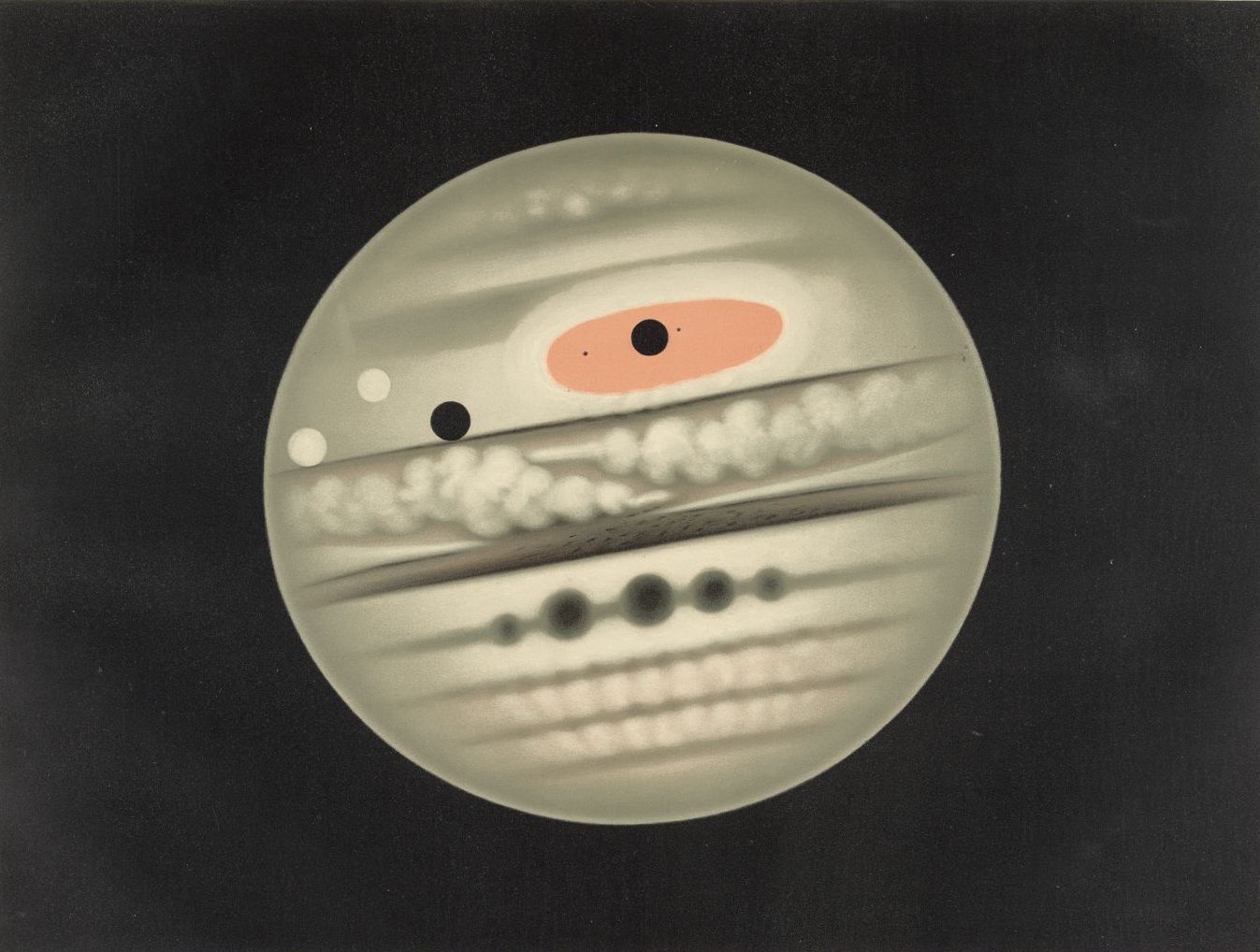
PLATE IX.—THE PLANET JUPITER.
Observed November 1, 1880, at 9h. 30m. P.M.
The most curious marking ever seen on Jupiter is undoubtedly the great Red Spot, observed on the southern hemisphere of this planet for the last three years. This interesting object, seen first in July, 1878, disappeared for a time, reappeared on September 25 of the same year, and has remained visible until now. When seen by me in September, it was much elongated, and sharply pointed on one side, like a spear-head, but it subsequently acquired an irregular form, with short appendages protruding from its northern border. At first, the changes were great and frequent, but at length it acquired the regular oval form, which, with but slight modifications, it has retained until now. During the month of November, 1880, I noticed two small black specks upon this Red Spot, and they were seen again in January of the succeeding year, by Mr. Alvan Clark, Jr. When the spot had attained its oval shape, it appeared part of the time surrounded with a white luminous ring of cloudy forms which, however, was changing more or less all the time, being sometimes invisible. The color of this curious spot is a brilliant rosy red, tinged with vermilion, and altogether different in shade from the pinkish color of the equatorial belt. The size of the spot varies, but of late its changes have been slight. Its longer diameter may be estimated at 8,000 miles, and the shorter at 2,200 miles. The Red Spot is represented on Plate IX. with its natural color, and as it appears at the moments most favorable for observation. In ordinary cases its color does not appear so brilliant, but paler.
It is difficult to account for the color of the equatorial belt and that of the Red Spot; but it is known, at least, that the material to which they are due cannot be situated at the level of the general surface visible to us, and especially that of the cloudy forms of the equatorial zone. Undoubtedly the red layer lies deeper than the superficial envelope of the planet, although it does not seem to be very deeply depressed.
Jupiter is attended by four satellites, which revolve around the planet at various distances, and shine like stars of the 6th and 7th magnitude. It is said that under very favorable circumstances, and in a very clear sky, the satellites can be seen with the naked eye, but this requires exceptionally keen eyes, since the glare of the planet is so strong as to overpower the comparatively faint light of the satellites. However, I myself have sometimes seen, without the aid of the telescope, two or three of the satellites as a single object, when they were closely grouped on the same side of Jupiter.
The four moons of Jupiter are all larger than our Moon, except the first, which has about the same diameter. They range in size from 2,300 to 3,400 miles in diameter, the third being the largest; the determination of their diameter is by no means accurate, however, as it is difficult to measure such small objects with precision. Their mean distance from the centre of Jupiter varies from 267,000 to 1,192,000 miles, the first satellite, the nearest to the planet, being a little farther from Jupiter then our satellite is from us. The four satellites revolve around the planet in orbits whose planes have a slight inclination to the equator of Jupiter, and consequently to the ecliptic. The diameter of the largest satellite is nearly half that of the Earth, or 3,436 miles; while its volume is five times that of our Moon. The period of revolution of these satellites varies from 1d. 18h. for the first, to 16d. 16h. for the last.
Owing to the slight inclination of the plane of their orbits to that of the planet, the three first satellites, and generally the fourth, pass in front of the disk and also through the shadow of the planet at every revolution, and are accordingly eclipsed. Their passages behind Jupiter's disk are called occultations; those in front of it, transits. The eclipses, the occultations and the transits of the moons of Jupiter are interesting and important phenomena; the eclipses being sometimes observed for the rough determination of longitudes at sea.
The satellites in transit present some curious phenomena. When they enter the disk, they appear intensely luminous upon its grayish border; but as they advance, they seem by degrees to lose their brightness, until they finally become undistinguishable from the luminous surface of Jupiter. It sometimes happens, however, that the first, the third and the fourth satellites, after ceasing to appear as bright spots, continue to be visible as dark spots upon the bright central portions of the planet's disk; but in these cases their disks appear smaller than the shadows they cast. Undoubtedly these satellites have extensive atmospheres, since they sometimes pass unperceived across the central parts of Jupiter, this being probably when their atmospheres are condensed into clouds, strongly reflecting light; while when these clouds are absent, we can see their actual surface, with traces of the dark spots upon them similar to those on Mars.
From the variation in the brightness of these satellites, which is said to be always observed in the same part of their orbit, William Herschel was led to suppose that these bodies, like our Moon, rotate upon their axes in the same period in which they move round the planet, so that they always present the same face to Jupiter; but these conclusions have been denied. From my observations it is apparent, however, that the light reflected by them varies in intensity as well as in color. But this is rather to be attributed to the presence of an atmosphere surrounding these bodies, which when cloudy reflects more light than when clear, with corresponding changes in the color of the light.
The satellites in transit are sometimes preceded or followed, according to the position of the Sun, by a round black spot having about the same size as the satellite itself. This black spot is the shadow of the satellite cast on the vapory envelope of Jupiter, similar to the shadow cast by the Moon on the Earth, during eclipses of the Sun; in fact, all the Jovian regions traversed by these shadows have the Sun totally eclipsed. Sometimes it happens that the shadow appears elliptical. This occurs either when it is observed very near the limb, or when entering upon a round, cloud-like spot. This effect is attributable to the perspective under which the shadow is seen on the spherical globe or spot.
The proper motion of the satellites in the Jovian sky is much more rapid than that of the Moon in our sky. During one Jovian day of ten hours, the first satellite advances 84°; the second, 42°; the third, 20° and the fourth, 9°. The first satellite passes from New Moon to its first quarter in a little more than a Jovian day, while the fourth occupies ten such days in attaining the same phase.
In density, as well as in physical constitution, Jupiter differs widely from the interior planets, and especially from the Earth; and, as has been shown, it is surrounded by a dense, opaque, cloudy layer, which is almost always impenetrable to the sight, and hides from view the nucleus, which we may conceive to exist under this vaporous envelope. In 1876, the year of the great Jovian disturbances, I observed frequently in the northern hemisphere of the planet a very curious phenomenon, which seems to prove that its cloudy envelope is at times partially absent in some places, its vapors being apparently either condensed, or transported to other parts of its surface, and that, therefore, a considerable part of the real globe of the planet was visible at these places. The phenomenon consisted in the deformation of the northern limb, which had a much shorter radius on all of this hemisphere situated northward of the white belt which adjoins the equatorial zone. The deformation of the limb on both sides, where it passed from a longer to a shorter radius, was abrupt, and at right angles to the limb, forming there a steplike indentation which was very prominent. The polar segment having a smaller radius, appeared unusually dark, and was not striped, as usual, but uniform in tint throughout. On September 27th, the third satellite passed over this dark segment, and emerged from the western border, a little below the place where the limb was abruptly deformed, as above described. When the satellite had fully emerged from this limb, it was apparent that if the portion of the limb having a longer radius had been prolonged a little below, and as far as the satellite, it would have enclosed it within its border, and thus retarded the time of emersion. The depth of deformation of the limb was accordingly greater than the diameter of the third satellite, and certainly more than 4,000 miles. That the phenomenon was real, is proved by the fact that the egress of this satellite occurred at least four minutes sooner than the time predicted for it in the American Ephemeris. Other observations seem to point in the same direction, since some of the satellites which were occulted have been seen through the limb of Jupiter by different astronomers, as if this limb was sometimes semi-transparent. Another observation of mine seems to confirm these conclusions. On April 24th, 1877, at 15h. 25m. the shadow of the first satellite was projected on the dark band forming the northern border of the equatorial belt, the shadow being then not far from the east limb. Close to this shadow, and on its western side, it was preceded by a secondary shadow, which was fainter, but had the same apparent size. This round dark spot was not the satellite itself, as I had supposed at first, since this object was yet outside of the planet, on the east, and entered upon it only at 16h. 4m. I watched closely this strange phenomenon, and at 16h. 45m., when the shadow had already crossed about ¾ of the disk, it was still preceded by the secondary, or mock shadow, as it may be called; the same relative distance having been kept all the while between the two objects, which had therefore traveled at the same rate. It is obvious that this dark spot could not be one of the planet's markings, since the shadow of the first satellite moves more quickly on the surface of Jupiter than a spot on the same surface travels by the effect of rotation, so that in this case the shadow would soon have passed over this marking, and left it behind, during the time occupied by the observation. From these observations it seems very probable that Jupiter has a nucleus, either solid or liquid, which lies several thousand mites below the surface of its cloudy envelope. It is also probable that the uniformly shaded dark segment seen in 1876, was a portion of the surface of this nucleus itself. When the cloudy envelope is semi-transparent at the place situated on a line with an occulted satellite and the eye of an observer, this satellite may accordingly remain visible for a time through the limb, as shown by observation. The phenomenon of the mock shadow may also be attributed to a similar cause, where semi-transparent vapors receive the shadow of a satellite at their surface, while at the same time part of this shadow, passing through the semi-transparent vapors, may be seen at the surface of the nucleus, or of a layer of opaque clouds situated at some distance below the surface.
Some astronomers are inclined to think that Jupiter is at a high temperature, and self-luminous to a certain extent. If this planet is self-luminous to any degree, we might expect that some light would be thrown upon the satellites when they are crossing the shadow cast into space by the planet; but when they cross this shadow they are totally invisible in the best telescopes, a proof that they do not receive much light from the non-illuminated side of Jupiter. It would, indeed, seem probable that some of the intensely white spots occasionally seen on the equatorial belt of the planet are self-luminous in a degree, yet not enough to render the satellites visible while they are immersed in Jupiter's shadow. It does not seem impossible that the planet should have the high temperature attributed to it, when we remember the terrific storms observed in its atmosphere, which, owing to the great distance of Jupiter from the Sun, do not seem to be attributable to this body, but rather to some local cause within the envelope of the planet.
Astronomy, which is a science of observation, is naturally silent with regard to the inhabitants of Jupiter. If there are any such inhabitants, they are confined to the domain of conjecture, under the dense cloudy envelope of the planet. The conditions of habitability on Jupiter must differ very widely from those of our globe. Comparatively little direct light from the Sun reaches the surface of the globe of Jupiter, except that which passes through the narrow openings forming the dark clouds. All the rest of the planet's surface, being covered perpetually by opaque clouds, receives only diffused light. On Jupiter there are practically no seasons, since its axis is nearly perpendicular to its orbit. The force of gravity on the surface of Jupiter being more than double what it is on the Earth, living bodies would there have more than double the weight of similar bodies on the Earth. Furthermore, Jupiter only receives 0.011 of the light and heat which we receive from the Sun; and its year is nearly equal to 12 of our years. If there are living beings on Jupiter, they must, then, be entirely different from any known to us, and they may have forms never dreamed of in our most fantastic conceptions.
The two round black spots represented towards the central parts of Plate IX. are the shadows of the first and second satellite; while the two round white spots seen on the left of the disk, are the satellites themselves, as they appeared at the moment of the observation. The first satellite and its shadow are the nearest to the equator; while the second satellite and its shadow are higher, the last being projected on the Great Red Spot.[2] The row of dark circular spots represented on the northern, or lower hemisphere, when they first appeared, had some resemblance to Sun-spots without a penumbra, with bright markings around them, resembling faculæ. These round spots subsequently enlarged considerably, until they united along the entire line, encircling the planet, and finally forming a narrow pink belt, which is still visible.
THE PLANET SATURN PLATE X
Saturn, which is next to Jupiter in order of distance from the Sun, while not the largest, is certainly the most beautiful and interesting of all the planets, with his grand and unique system of rings, and his eight satellites, which, like faithful servants, attend the planet's interminable journey through space.
Seen with the naked eye, Saturn shines in the night like a star of the first magnitude, whose dull, soft whiteness is, however, far from attaining the brilliancy of Venus or Jupiter, although it sometimes approaches Mars in brightness. Saturn hardly ever exhibits the phenomenon of scintillation, or twinkling, a peculiarity which makes it easily distinguishable among the stars and planets of the heavens.
The synodical period of Saturn occupies 1 year and 13 days, so that every 378 days, on an average, this planet holds the same position in the sky relatively to the Sun and the Earth.
The mean distance of Saturn from the Sun is a little over 9½ times that of our globe, or 872,000,000 miles. Owing to the orbital eccentricity, this distance may increase to 921,000,000 miles, when the planet is in aphelion; or decrease to 823,000,000 miles, when it is in perihelion; Saturn being therefore 98,000,000 miles nearer to the Sun when in perihelion than in aphelion. If gravitation were free to exert its influence alone, Saturn would fall into the Sun in 5 years and 2 months.
The distance of Saturn from the Earth varies, according to the position of the two planets in their respective orbits. At the time of opposition, when the Earth lies between the Sun and Saturn, this distance is smallest; while, on the contrary, at the time of conjunction, when the Sun lies between the Earth and Saturn, it is greatest. Owing, however, to the eccentricity of the orbits of Saturn and our globe, and the inclination of their planes to each other, and owing also to the variable heliocentric longitude of the perihelion, the distance of the two planets from each other at their successive conjunctions and oppositions is rendered extremely variable. At present it is when the oppositions of Saturn occur in December that this planet comes nearest to us; while when the conjunctions take place in June, the distance of Saturn from the Earth is the greatest possible. In the former case the distance of the planet from our globe is only 730,000,000 miles; while in the last it is 1,014,000,000 miles, the difference between the nearest and farthest points of Saturn's approach to us being no less than 284,000,000 miles, or over three times the mean distance of the Sun from the Earth.
From the great variations in the distance of Saturn from the Earth, necessarily result corresponding changes in the brightness and apparent diameter of this body. When it is farthest from us, its angular diameter measures but 14"; while, when it is nearest, it measures 20".
The orbit of Saturn is inclined 2°30' to the ecliptic, and its eccentricity, which equals 0,056, is over three times that of the Earth's orbit.
This planet revolves around the Sun in a period of 29 years and 5½ months, or 10,759 terrestrial days, which constitutes its sidereal year. The extension of the immense curve forming the orbit of this planet, is no less than 5,505,000,000 miles, which is traversed by the planet with a mean velocity of a little less than 6 miles per second, or three times less than the motion of our globe in space.
The real dimensions of the globe of Saturn are not yet known with accuracy, and the equatorial diameter has been variously estimated by observers, at from 71,000 to 79,000 miles. If we adopt the mean of these numbers, 75,000 miles, the circumference of the Saturnian equator would measure 235,620 miles, or 9½ times the circumference of our globe; the surface of Saturn would be 86 times, and its volume over 810 times that of the Earth.
However great the volume of Saturn, its mass is proportionally small, being only 90 times greater than that of our globe; the mean density of the materials composing this planet being less than that of cork, and only 0.68 the density of water. The force of gravitation at the surface of Saturn is greater, by a little over ⅑, than it is at the surface of the Earth; a body falling in a vacuum at its surface, would travel 17.59 feet during the first second.
From observations of markings seen on the surface of Saturn, and from the study of their apparent displacements on the disk, William Herschel found that the planet rotated upon its axis in 10h. 16m. 0.24s. Since Herschel's determination, new researches have been made, and lately, Professor Hall, noticing a bright spot, followed it for nearly a month, observing its transits across the central meridian of the disk. From these observations he has obtained for the rotation period 10h. 14m. 23.8s., a result which agrees very closely with that obtained 82 years earlier by Herschel, considering the fact that the markings from which the period of rotation is ascertained are not fixed on the planet, but are always more or less endowed with proper motion. The velocity of rotation at the equator is 21,538 miles per hour, or nearly 6 miles per second.
The axis of rotation of Saturn is inclined 64° 18' to the plane of the orbit, so that its equator makes an angle of 25° 42' with the same plane. The seasons of this planet therefore present greater extremes of temperature than those of the Earth, but not quite so great variations as the seasons of Mars.
The globe of Saturn is not a perfect sphere, but its figure is that of an oblong spheroid, flattened at the poles. The polar compression of Saturn is greater than that of any other planet, surpassing even that of Jupiter. Though not yet determined with a great degree of accuracy, the compression is known to be between ²⁄₁₈ and ⅒ of the equatorial diameter; that is, a flattening of about 3,894 miles, at each pole, the polar diameter being 7,788 miles shorter than the equatorial.
The internal condition of the planet Saturn, whether solid, liquid or gaseous, cannot be discovered from the examination of its surface, as its globe is enwrapped in a dense opaque layer of vapors and cloud-like forms, through which the sight fails to penetrate. The appearance of this vapory envelope is like that of cumulus clouds, and one of its characteristics is to arrange itself into alternate bright and dark parallel belts, broader than those seen on Jupiter, and also more regular and dark. These belts, which are parallel to the equator of the planet, vary in curvature with the inclination of its axis of rotation to the line of sight.
The belts of Saturn, like those of Jupiter, are not permanent, but keep changing more or less rapidly. Sometimes they have been observed to be quite numerous; while at other times they are few. Occasionally conspicuous white or dark spots are seen on the surface, although the phenomenon is quite rare. It is from the observation of such spots that Saturn's period of rotation has been determined, as stated above. The equatorial zone of Saturn always appears more white and brilliant than the other parts, as it also appears more mottled and cloud-like. In late years the globe has been characterized, and much adorned, by a pale pinkish tint on its equatorial belt, resembling that of Jupiter, but somewhat fainter. On either side of the equatorial belt there is a narrower band, upon which the mottled appearance is visible. Below these, one or two dark belts, separated by narrow white bands, are usually seen; but, of late, the bands have been less numerous, being replaced in high latitudes by a dark segment, which forms a polar cap to Saturn. The globe of Saturn does not anywhere appear perfectly white, and when compared with its ring, it looks of a smoky yellowish tint, which becomes an ashy gray on its shaded parts. It usually appears darker near the limb than in its central portions; although on some occasions I have seen portions of the limb appear brighter, as if some white spots were traversing it.
Some observers have seen the limb deformed and flattened at different places, and W. Herschel even thought such a deformation to be a permanent feature of this globe, which he termed diamond-shaped, or "square shouldered." But this was evidently an illusion, since the planet's limb usually appears perfectly elliptical, although it occasionally appears as if flattened at some points, especially where it comes in apparent contact with the shadow cast by the globe on the ring, as observed by myself many times. But with some attention, it is generally found that this deformation is apparent rather than real, and is caused by the passage of some large dark spots over the limb, which is thus rendered indistinguishable from the dark background upon which it is projected.
What distinguishes Saturn from all known planets, or heavenly bodies, and makes it unique in our universe, is the marvelous broad flat ring which encircles its equator at a considerable distance from it. With a low magnifying power this flat ring appears single, but when carefully examined with higher powers, it is found to consist of several distinct concentric rings and zones, all lying nearly in the same plane with the planet's equator.
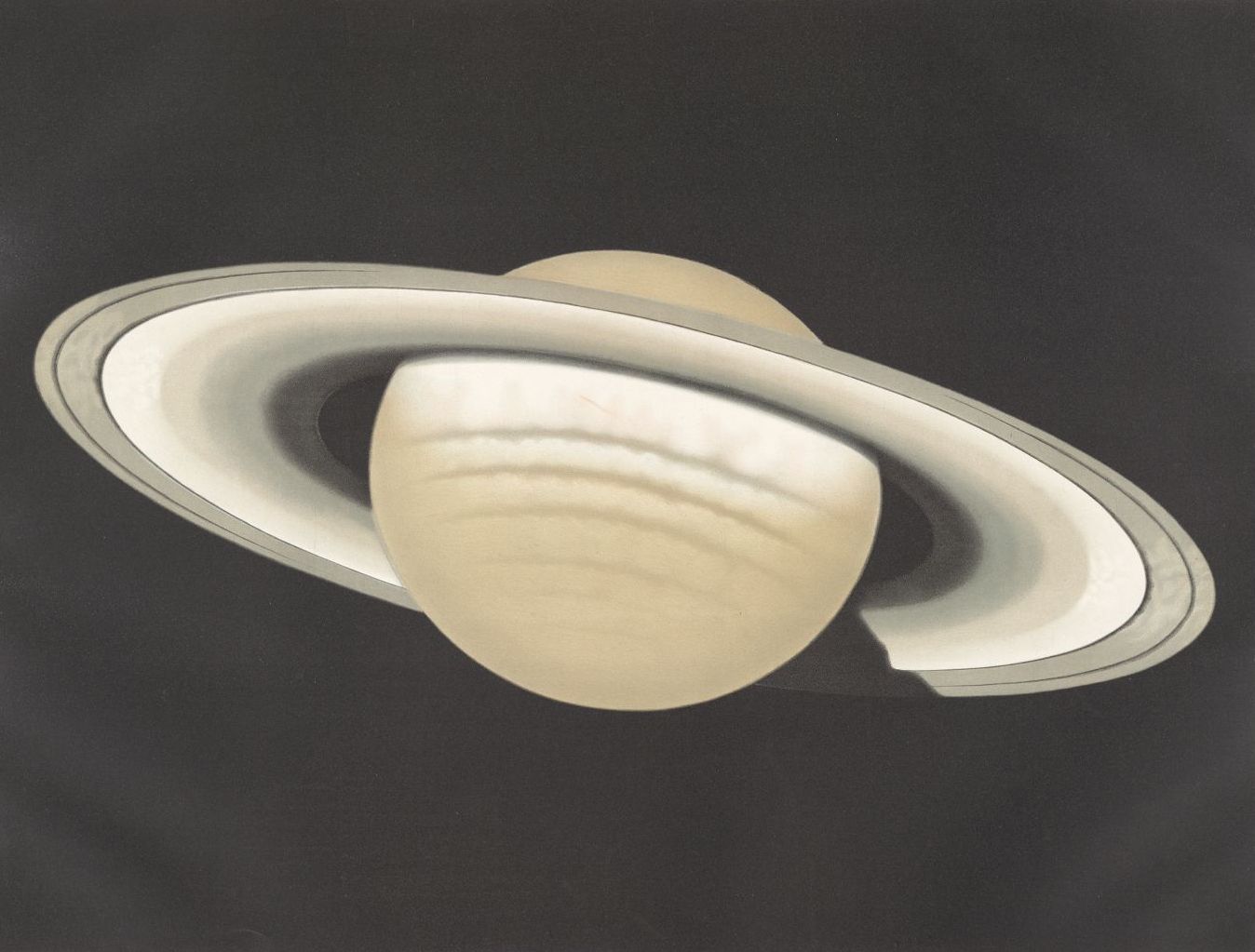
PLATE X.—THE PLANET SATURN.
Observed on November 30, 1874, at 5h. 30m. P.M.
At first sight only two concentric rings are recognized, the outer and the middle, or intermediary, which are separated by a wide and continuous black line, called the principal division. This line, and indeed all the features of the surface of the rings are better seen, and appear more prominent on that part of the ring on either side called the ansa, or handle. Besides these two conspicuous rings, a third, of very dark bluish or purplish color, lies between this middle ring, to which it is contiguous, and the planet. This inner ring, which is quite wide, is called the gauze or dusky ring. Closer examination shows that the outer ring is itself divided by a narrow, faint, grayish line called the pencil line, which, from its extreme faintness, is only visible on the ansæ. Moreover, the middle ring is composed of three concentric zones, or belts, which, although not apparently divided by any interval of space, are distinguished by the different shadings of the materials composing them. The outer zone of this compound middle ring is, by far, the brightest of all the system of rings and belts, especially close to its external border, where, on favorable occasions, I have seen it appear on the ansæ as if mottled over, and covered throughout with strongly luminous cloud-like masses. On the ansæ of the double outer ring, similar cloudy forms have also been seen at different times. The second zone of the middle ring is darker than the first, the innermost being darker still. All the characteristic points which have thus been described, are shown in Plate X.
Although suspected in 1838, the dusky ring was not recognized before 1850, when G. P. Bond discovered it with the 15-inch refractor of the Cambridge Observatory. It was also independently discovered the same year in England by Dawes and Lassell. The dusky ring differs widely in appearance and in constitution from the other rings, inasmuch as these last are opaque, and either white or grayish, while the former is very dark, and yet so transparent that the limb of the planet is plainly seen through its substance. On particularly favorable occasions, the appearance of this ring resembles that of the fine particles of dust floating in a ray of light traversing a dark chamber. Whatever may be the material of which this ring is composed, it must be quite rarefied, especially towards its inner border, which appears as if composed of distinct and minute particles of matter feebly reflecting the solar light. That the inner part of the dusky ring is composed of separate particles, is proved by the fact that the part of the ring which is seen in front of the globe of Saturn has its inner border abruptly deflected and curved inward on entering upon the disk, causing it to appear considerably narrower than it must be in reality, a peculiarity which is shown in the Plate. This phenomenon may be attributed to an effect of irradiation, due to the strong light reflected by the central parts of the ball, which so reduces the apparent diameter of the individual particles that they become invisible to us, especially those near the inner border, which are more scattered and less numerous than elsewhere.
The dusky ring, which was described by Bond, Lassell and other astronomers as being equally transparent throughout all its width, has not been found so by me in later years. The limb of the planet, seen by these observers through the whole width of the dusky ring in 1850, could not be traced through its outer half by myself in 1872 and 1874, and this with the very same instrument used by Bond in his observations of 1848 and 1850. Moreover, I have plainly seen that its transparency was not everywhere equal, but greatest on the inner border, from which it gradually decreases, until it becomes opaque, as proved by the gradual loss of distinctness of the limb, which vanishes at about the middle of the dusky ring. These facts, which have been well ascertained, prove that the particles composing this ring are not permanently located, and are undergoing changes of relative position. It will be shown that the surface of the other rings is also subject to changes, which are sometimes very rapid.
The globe of Saturn is not self-luminous, but opaque. It shines by the solar light, as is proved by the shadow it casts opposite the Sun upon the ring. Although receiving its light from the Sun, Saturn does not exhibit any traces of phases, like the other planets nearer to the Sun, owing to its great distance from the Earth. When near its quadratures, however, the limb opposite to the Sun appears much darker, and shows traces of twilight. As far as can be ascertained, the rings, with the exception of the inner one, are opaque, as proved by the strong shadow which they cast on the globe of Saturn.
The shadows cast by the planet on the ring, and by the ring on the planet, are very interesting phenomena, inasmuch as they enable the astronomer to recognize the form of the surface which receives them. The shadow cast by the ring on the ball is not quite so interesting as the other, although it has served to prove that the surface of this globe is not smooth, as is likewise suggested by its mottled appearance. I have sometimes found, as have also other observers, that the outline of this shadow upon the ball was irregular and indented, an observation which proves either that the surface of the ball is irregular, or that the border of the ring casting the shadow was jagged. The shadow of the globe on the rings has much more interest, as it enables us to get at some knowledge of the form of the surface of the rings, which otherwise is very difficult to discover, owing to the oblique position in which we always see them.
In general, the shadow of the ball on the middle ring has its outline concave towards the planet; while on the outer ring it is usually slanting, and at a greater distance from the limb than on the middle, and dusky rings. This form of the shadow evidently proves that the middle ring stands at a higher level than the two others, especially towards its outer margin. The system seems to increase gradually in thickness from the inner border of the dusky ring to the vicinity of the outer margin of the middle ring, after which it rapidly diminishes on this border, while the surface of the outer ring is almost level.
But this surface is by no means fixed, as its form sometimes changes, as proved by my observations and those of others. As may be noticed on Plate X., the outline of the shadow of the planet on the rings is strongly deviated towards the planet, near the outer margin of the middle ring; the notch indicating an abrupt change of level, and a rise of the surface at that point. Some observers have endeavored to explain these deviations by the phenomena of irradiation, from which it would follow that the maximum effect of deviation should be observed where the ring is the brightest, which does not accord with observation; as the deepest depression in the shadow is not to be found usually at the brightest part, which is towards the outer border of the middle ring, but occurs near its centre. From these observations it is undoubtedly established that the surface of the rings is far from being flat throughout, and is, besides, not permanent, but changes, as would, for instance, the surface of a large mass of clouds seen from the top of a high mountain. In general, the system is thickest not very far from the outer border of the intermediary ring.
Some interesting phenomena which I had occasion to observe before and after the passage of the Sun through the plane of the rings, on February 6th, 1878, conclusively show that the surface of this system cannot be of a uniform level, but must be thicker towards the outer border of the middle ring, thence gradually sloping towards the planet. Many of my observations irresistibly lead to this conclusion. As it would, however, be out of place to have them recorded here in detail, I will simply give one of the most characteristic among them.
From December 18th, 1877, when the Sun was about 41' above the plane of the rings, to February 6th, 1878, the day of its passage through their plane, the illuminated surface of this system gradually decreased in breadth with the lowering of the Sun, until it was lost sight of, February 5th, on the eve of the passage of the Sun through their plane. The phenomenon in question consisted in the gradual invasion of their illuminated surface by what appeared to be a black shadow, apparently cast by the front part of the outer portion of the middle ring the nearest to the Sun. On January 25th, when the elevation of the Sun above the plane of the rings was reduced to 15', the shadow thus cast had extended so far on their surface that it reached the shadow cast by the globe on the opposite part of the ring in the east, and accordingly the remaining portion of the illuminated surface of the eastern ansa then appeared entirely disconnected from the ball, by a large dark gap, corresponding in breadth to that of the globe's shadow on the rings. On February 4th, when the Sun was only 5' above the plane of the rings, their illuminated and only visible surface was reduced to a mere thread of light, which on the 5th appeared broken into separate points. It is evident that the phenomenon was not caused by the obliquity of the ring as seen from our globe, since the elevation of the Earth above the plane of the rings—which on December 18th was 3° 20'—was still 1° 20' on the 4th of February. In ordinary circumstances, when the Sun is a little more elevated, and the rings seen at this last angle, they appear quite broad and conspicuous, and even the dark open space separating the dusky ring from the planet is perfectly visible on the ansæ, where the Earth's elevation above their plane is reduced to 40'. It is also evident that the phenomenon was not to be attributed to the reduction of the light which they received from the Sun, although the illumination in February might be expected to be comparatively feeble, since the Sun then shone upon the rings so obliquely; yet (on the supposition that their surface is flat) they should have been illuminated throughout, and if not very brightly, sufficiently so, at least, to make them visible and as bright as was the narrow thread of light observed on the 4th of February. The phenomenon actually observed may be explained most readily by assuming, as other phenomena also indicate, that the surface of the ring is not flat, but more elevated towards, or in the vicinity of its outer border, from which place it slopes inwardly towards the planet. On this assumption, it is evident that the elevated part of the ring the nearest to the Sun would cast a shadow, which, with the increasing obliquity of the Sun, would gradually cover the whole surface comprised within the elevated part, and thus become invisible to us. Several observations made by Bond and other observers undoubtedly show the same phenomenon, and do not seem to be intelligible on any other supposition. From my observations made in 1881 it would appear, however, that the opposite surfaces of the rings do not exactly correspond in form, but this may not be a permanent feature, as the surface of this system is subject to changes, as already shown.
The dimensions of the rings are great, the diameter of the outer one being no less than 172,982 miles, the distance from the centre of the globe to the outer border of the system being, therefore, 86,491 miles. The breadth of the outer ring is 9,941 miles; that of the principal division, 2,131 miles; that of the middle ring, 19,902 miles, and that of the dusky ring, 8,772 miles. The breadth of all the rings taken together is, therefore, 40,746 miles. The interval between the surface of Saturn and the inner border of the dusky ring is 7,843 miles.
The thickness of the system of rings has been variously estimated by astronomers, on account of the great difficulties attending its determination. While Sir John Herschel estimated it at more than 250 miles, G. P. Bond reduces it to 40 miles. Both of these numbers are evidently too small, as so slight a thickness cannot explain the observed phenomenon of the shadow cast by a portion of the ring on its own surface, when the Sun is very low in its horizon, as shown above.
The plane of the system of rings is inclined 27° to the planet's orbit, and is parallel, or at least very nearly so, with the equator of the planet, passing, therefore, through its centre, and dividing its globe into northern and southern hemispheres. Seen from the Earth, a portion of the ring always appears projected in front of the planet, thus concealing a small part of its globe, while the opposite portion passes behind the globe, which hides it from sight.
As the plane of the ring is not affected by the motion of the planet around the Sun, but always remains parallel to itself, it follows that as Saturn advances in its orbit the rings must successively present themselves to us under various angles of inclination, appearing, therefore, more or less elliptical, and presenting two maxima and two minima of inclination in the course of one of its revolutions. As the revolution of Saturn is accomplished in 29½ years, the maxima and the minima must recur every 14 years and 9 months; the maxima being separated from the minima by an interval of 7 years and 4½ months.
When Saturn arrives at the two opposite points of its orbit, where the major axis of its ring is at right angles to the line joining its centre to that of the Sun, the ring, which is then viewed at an inclination of 27°, the greatest angle at which it can ever be seen, has reached its maximum opening, the smaller diameter of its ellipse being then about half that of the larger. At this moment the outer ring projects north and south beyond the globe, which is then completely enclosed in its ellipse. The maximum opening of the northern surface of the ring takes place, at present, when Saturn arrives in longitude 262°, in the constellation Sagittarius, and that of the southern surface when it arrives in longitude 82° in the constellation Taurus. When, on the contrary, Saturn reaches the two opposite points of its orbit, where the plane of its ring is parallel to the line joining its centre to that of the Sun, the opening vanishes, as only the thin edge of the ring is then presented to the Sun and receives its light, the rest being in darkness. At this moment the ring disappears, except in the largest telescopes, where it is seen as an exceedingly thin thread of light; and the Saturnian globe, having apparently lost its ring, appears solitary in the sky, like the other planets. The disappearance of the ring from this cause occurs now when Saturn arrives at 90° from either of the positions of maximum inclination, that is, in longitude 352° in the constellation Pisces, and in longitude 172° in the constellation Leo.
When the planet is in any other position than one of these last two, either the northern or the southern surface of the ring is illuminated by the Sun, while the opposite surface is in the night, and does not receive any direct sunlight. At the time of the passage of the plane of the ring through the Sun's centre, a change takes place in the illumination of the ring. If it is the northern surface which has received the rays of the Sun during the previous half of the Saturnian year, at the moment the plane has passed the centre of the Sun, the southern surface, after having been buried in darkness for 14¾ years, sees the dawn of its long day of the same length. Such a phenomenon will not occur until 1892, when the passage of the Sun from the northern to the southern side of the ring will close in twilight the day commenced in 1878.
Aside from the periodic disappearance of the ring, resulting from the passage of the Sun through its plane, the ring may also disappear from other reasons. Just before or just after the time of the passage of the Sun through the plane of the ring, the Earth and the Sun may occupy such positions, that while the one is north of the plane of the ring, the other is south of it, or vice versa, in which event the ring becomes invisible, because its dark and non-illuminated surface is presented to us. The ring may also become invisible to us when the Earth passes through its plane.
Since the distance from Saturn to the Sun is to the distance of the Earth from this last body as 9.54 is to 1; and since the circumference of a circle increases in the same proportion as its radius, it follows that the diameter of the Earth's orbit projected on the orbit of Saturn would occupy only part of the latter, or about 12° 2', this being 6° 1' on either side of the nodes of the rings. To describe such an arc on its orbit, it takes Saturn almost 360 days on an average, or almost a complete year; the Earth describing therefore almost a whole revolution around the Sun during the time it takes Saturn to advance 12° 2' on its orbit. Then, when Saturn occupies a position comprised within an arc 6° 1' from either side of the nodes of its ring, the Earth, by its motion, is liable to encounter the plane of the ring, when therefore it will only present its thin edge to us, and becomes invisible. At least one such encounter is unavoidable within the time during which Saturn occupies either of these positions on its orbit; while three frequently happen, and two are possible.
The natural impression received by looking at the rings, while seeing the ponderous globe of Saturn enclosed in its interior, is that this gigantic, but very delicate structure, in order to avoid destruction, must be endowed with a swift movement of rotation on an axis perpendicular to its plane, and that the centrifugal force thence arising counterbalances the powerful attraction of the planet, and thus keeps the system in equilibrium.
Theoretically, the rotation of the rings is admitted by every astronomer, as being an essential condition to the existence of the system, which otherwise, it is thought, would fall upon the planet. Although the rotation of the rings seems so probable that it is theoretically considered as certain, yet its existence has not been satisfactorily demonstrated by direct observation, which alone can establish it on a firm basis as a matter of scientific knowledge.
The determination of the period of rotation of the rings, which is supposed to be 10h. 32m. 15s., rests only on the observations of W. Herschel, made in 1790, from the apparent displacement of irregularities on the ring; but his results have been contradicted by other observations, and even by those of Herschel himself, made in later years.
Although the system of rings is very nearly concentric with the globe of Saturn, yet the coincidence is not considered as mathematically exact. It seems to have been satisfactorily demonstrated by direct observations that the centre of gravity of the system oscillates around that of the planet, thus describing a minute orbit. This peculiarity is in accordance with theory, which has shown it to be essential to the stability of the system.
Besides its system of rings, which makes Saturn the most remarkable planet of the solar system, this globe is attended by eight satellites, moving in orbits whose planes very nearly coincide with the plane of the rings, except that of the most distant one, which has an inclination of about 12° 14'. In the order of their distance from the planets, the satellites of Saturn are as follows: Mimas, Enceladus, Tethys, Dione, Rhea, Titan, Hyperion and Iapetus. The three first satellites are nearer to Saturn than the Moon is to the Earth; while Iapetus, the farthest, is 9½ times the distance of our satellite from us. All the satellites, with the exception of the farthest, move more rapidly around Saturn than the Moon moves around the Earth; while Iapetus, on the contrary, takes almost three times as long to make one revolution.
The period of revolution of the four inner satellites is accomplished in less than three days, that of Mimas being only a little more than 22 hours. From such swiftness of motion, it is easily understood how short must be the intervals between the different phases of these satellites. Mimas, for instance, passes from New Moon to First Quarter in less than 6 hours.
The distance of the nearest satellite from the planet's surface is 84,000 miles, and its distance from the outer ring only 36,000 miles. It is difficult to determine the diameter of objects so faint and distant as are some of these satellites, but the diameter of Titan, the largest of all, is pretty well known, and estimated to be ¹⁄₁₆ the diameter of the planet, or more than half the diameter of our globe.
Iapetus is subject to considerable variations in brilliancy, and as the maxima and minima always occur when this satellite occupies the same parts of its orbit, it was conjectured by W. Herschel that, like our Moon, it turns once upon its axis during each of its revolutions about the planet. It has been shown by my observations, that Iapetus attains its maximum brightness a little before it reaches its greatest western elongation, and its minimum on the opposite side.
As the planes of the orbits of the satellites are inclined to the planet's orbit, it follows that their transits, occultations and eclipses, are only possible when Saturn is near its equinoxes. Passages of the satellites and their shadows across the disk, although rare, have been observed, and they somewhat resemble the phenomena exhibited by the satellites of Jupiter in transit. When the Earth is very near the plane of the rings, the satellites, except the farthest, appear to be in a straight line nearly coincident with the plane of the rings, and are seen occasionally moving along the thin edge of the rings, appearing as luminous beads moving on a thread of light.
Owing to the considerable inclination of the axis of rotation of Saturn to its orbit, the seasons of this planet must have greater extremes of temperature than those of the Earth. As the year of Saturn consists of 25,217 Saturnian days, each season, on the average, is composed of 6,304 Saturnian days.
To an observer on Saturn, the immense arches formed by its rings would appear as objects of great magnificence, spanning the sky like soft colorless rainbows. Moreover, the eight moons, several of which are always visible, would be of the highest interest, with their swift motions and rapid phases. Mimas, traveling in its orbit at the rate of 16 of arc per minute of time, moves over a space equal to the apparent diameter of our Moon in two minutes, or at the rate of 16° an hour.
Owing to the globular form of Saturn, the rings would be invisible in latitudes situated above 65° from its equator, and their apparent form and breadth would naturally vary with the latitude. At 63° only a very small portion of the outer ring would be visible above the equatorial horizon, where it would appear as a small segment of a circle. At 62° the principal division would just graze the horizon. At 46° the outer portion of the dusky ring would become visible, while at 35° its inner edge would appear above the horizon. From 65° of latitude down to the equator, the arches of the rings would be seen more and more elevated above the equatorial horizon, but at the same time that they are seen higher up, their apparent breadth gradually diminishes, owing to the effect of foreshortening, and at the equator itself the system would only present its thin edge to view.
During the summer seasons of either hemisphere of Saturn, the surface of the rings turned towards such hemisphere, being fully illuminated by the Sun, is visible from these regions. In the day time its light must be feeble and similar to the light reflected by our Moon during sunshine; but at night the system would display all its beauty, and the different rings, with their divisions and their various reflective powers, must present a magnificent sight.
During the nights of the long winter seasons on Saturn, on the contrary, the surface of the rings turned towards the hemisphere undergoing winter, receives no light from the Sun, and is invisible, or very nearly so, except towards morning and evening, when it may be faintly illuminated by the secondary light which it receives from the illuminated globe of Saturn. Although dark and invisible, the rings may make their form apparent at night by the absence of stars from the region which they occupy in the sky. Again, in other seasons, the days present very curious phenomena. In consequence of the diurnal rotation of the planet, the Sun seems to move in circular arcs, which, owing to the inclination of Saturn's axis, are more or less elevated above its horizon, according to the position of the planet in its orbit. As such arcs described by the Sun in the sky of Saturn are liable to encounter the rings, the Sun in passing behind them becomes eclipsed. It must be a magnificent spectacle to witness the gradual disappearance of the fiery globe behind the outer ring, and its early reappearance, but for a moment only, through the narrow gap of the principal division; to see it vanish again behind the middle ring, to reappear a little later through the semi-transparent dusky ring, but very faint and red colored at first; and then, gradually brighten up, and finally emerge in all its beauty from the inner edge of the dusky ring.
It is in latitude 23° that the rings produce the most prolonged eclipses of the Sun. During a period equivalent to ten of our terrestrial years, such eclipses continually succeed each other with but very short periods of interruption; and even during a long series of rotations of Saturn, the Sun remains completely invisible in those regions where the apparent arcs which it describes coincide with the arcs of the rings. In neighboring latitudes, the eclipses of the Sun, although still frequent, would have a shorter and shorter duration as the observer should travel north or south. These eclipses of the Sun must produce a partial darkness of the regions involved in the shadow of the rings, which may be compared to the darkness produced on our globe by a total eclipse of the Sun. The frequent recurrence of these eclipses, and their comparatively long duration in some regions, must still further reduce the duration of the short Saturnian days.
The globe of Saturn, as already shown, casts a shadow on the rings, which, according to the position of the planet in its orbit, either extends across their whole breadth, or covers only a part of their surface. The shadow on the rings rising in the east after sunset, ascends to the culminating point of their arcs in the sky, in 2h. 34m., and as rapidly descends on the western horizon, to disappear with sunrise. This shadow, when projected on the rings in the sky, must be hardly distinguishable from the dark background of the heavens, except from the absence of stars in the regions which it occupies. It must appear as a large dark gap, separating the rings into two parts, and constantly moving from east to west. Possibly the refraction of the solar rays, in passing through Saturn's atmosphere, may cast some colored light on the rings, similar to that observed on the Moon during its eclipses.
An observer on the rings would behold phenomena still more curious, a long day of 14¾ years being followed by a long night of 14¾ years. The long days of Saturn's rings are, however, diversified by numerous eclipses of the Sun, which regularly occur every 10¼ hours; the phenomenon being due to the interposition of the globe of Saturn between the rings and the Sun. These eclipses produce partial obscurations of their surface, lasting from 1½ to 2 hours at a time. Although the surface of the rings never receives direct sunlight during their long nights, yet they are not plunged all the time in total darkness, as they receive some reflected light from that part of the globe of Saturn which is illuminated by the Sun. To the supposed observer on the rings, during every 10¼ hours, the immense globe would exhibit continually changing phases. At first he would see a point of light rapidly ascending from the horizon, and appearing under the form of a half crescent of considerable radius; 5⅛ hours later, the crescent having gradually increased, would appear as a half circle, covering ⅛ of the visible heavens, its surface being more than 20,000 times as large as the surface of the Moon. Upon this brilliantly illuminated semi-circle would be projected the shadows of the rings, appearing as black belts separated by a narrow luminous band.
It is very difficult for one to conceive how such a delicate structure, as the system of rings appears to be, can keep together in equilibrium and avoid destruction from the powerful attraction of the planet on one side and the disturbing influence of the satellites on the other. To explain it, several hypotheses have been advanced. The rings were first supposed to be solid, and upon this supposition Laplace determined the necessary conditions for their equilibrium; the most important of which require that the cross section of the rings should be an ellipse of irregular curvature, and having its major axis directed towards the centre of the planet, and also that the system should rotate upon an axis perpendicular to the plane of the rings. This theory was superseded by another, which supposed the rings to be fluid. This one was soon rejected for a third, assuming the system to be composed of vapors or gases; and more recently, all these theories were considered untenable, and replaced by a fourth, which supposes the system of rings to be made up of a congregation of innumerable small, independent bodies, revolving around Saturn in concentric zones. Naturally, such a divergence of opinion can only result from our comparative ignorance of the subject, and sufficiently indicates our inability to explain the phenomena; and it must be admitted that, so far, nothing is certainly known about this strange system. We shall probably remain in the same uncertainty until the rotation of the rings is ascertained by direct observations. It is pretty certain, however, that none of these theories account for the observed phenomena in their details, although a partial explanation may be obtained by borrowing something from each hypothesis.
It has been conjectured, and a theory has been advanced, that the breadth of the whole ring system is gradually increasing inwards, and that it will come in contact with the planet in about 2,150 years; but the question seems to have been settled in the negative by the elaborate measurements of the English observers. It is likely that the increase is only in the defining power of the instruments.
COMETS PLATE XI
Among the celestial phenomena, none are more interesting than those mysterious apparitions from the depths which unexpectedly display their strange forms in our familiar constellations, through which they wander for a time, until they disappear like phantoms.
A comet, with its luminous diffused head, whence proceeds a long vapory appendage gradually fading away in the sky, presents an extraordinary aspect, which may well astonish and deeply impress the observer. Although these visitors from infinite space do not now inspire dread, as in by-gone times, yet, owing to the mystery in which the phenomenon is still involved, the apparition of a large comet, even in our days, never fails to create a profound sensation, and in some cases that unconscious fear which results from the unknown.
The effect of such a spectacle largely depends upon its rarity; but since the telescope has been applied to the sounding of the heavens, it has been found that the appearance of comets is by no means an unusual occurrence. If so few comets, comparatively, are seen, it is because most of them are telescopic objects, and are therefore invisible to the naked eye. Most of the telescopic comets are not only too faint to be perceived by the unaided eye, but are insignificant objects, even when observed through the largest telescopes.
It was Kepler's opinion that comets are as numerous in the sky as fishes are in the ocean. Undoubtedly the number of these bodies must be great, considering that we can only see them when they come into the neighborhood of the Earth, and that many even here remain invisible, or at least pass unperceived. That many of them have passed unperceived heretofore, is proved by the fact that the number of those observed becomes greater every year, with the increase of the number of instruments used in their search. The number of comets observed with the naked eye during historic times is nearly 600, and that of telescopic comets, which, of course, all belong to the last few centuries, is more than 200, so that we have a total number of about 800 comets of which records have been kept. From theoretical considerations, Lambert and Arago estimated their entire number at several millions, but such speculations have generally no real value, since they cannot be established on a firm basis.
Comets remain visible for more or less time, according to their size and the nature and position of their orbits, but in general, the large ones can be followed with the telescope for several months after they have become invisible to the naked eye. The comet of 1861, for example, remained telescopically visible for a year, and that of 1811, for 17 months after disappearing from ordinary sight.
While a comet remains visible, it appears to revolve daily about us like the stars in general; but it also moves among the constellations, and from this movement its orbit may be computed like that of a planet. From the apparent diurnal motion of a comet with the heavens, result the changes of position which it seems to undergo in the course of a night. The direction of the head and tail of a comet, of course, has only changed in regard to the horizon, but not in regard to the sky, in which they occupy very nearly the same position throughout a given night, and even for many nights in succession.
The movements of the comets in their orbits are, like those of the planets, in accordance with Kepler's laws, the Sun occupying one of the foci of the orbit they describe; but the orbits of comets differ, however, in several points from those of the planets. Their eccentricity is always great, being sometimes apparently infinite, in which case the orbit is said to be parabolic, or hyperbolic; but the smallness of the portion of a cometary orbit which can ordinarily be observed, makes it difficult to determine this with certainty. Again, while the planetary orbits are usually near the plane of the ecliptic, those of comets frequently have great inclinations to that plane, and even when the inclination is less than 90°, the comet may have a retrograde movement, or, in other words, a movement contrary to the course in which all the planets revolve about the Sun.
Notwithstanding these differences between the elements of the orbits of the comets and those of the planets, the fact that each has the Sun in one focus indicates that the body moving in it is a member of the solar system, either for the time, or permanently, according to the nature of its orbit.
A distinction may accordingly be made between the comets which are permanent members of our solar system and those which are only accidental or temporary visitors. Those moving in elliptical orbits around the Sun, like the planets, and therefore having a determinate period of revolution, from which the time of their successive returns may be predicted, are permanent members of our system, and are called periodic comets. All comets moving in parabolical or hyperbolical curves, are only temporary members of the solar system, being apparently strangers who have been diverted from their courses by some disturbing influence. No comet is classed as periodical which does not follow a perceptibly elliptical orbit. Any comet passing around the Sun at the mean distance of the Earth from this body, with a velocity of 26 miles per second, will fly off into infinite space, to return to us no more.
The time of revolution of the different periodic comets thus far observed varies greatly, as do also the distances to which they recede from the Sun at aphelion. Whilst the period of revolution of Encke's comet, the shortest thus far known, is only 3½ years, that of the comet of 1844, II., is 102,000 years; and whilst the orbit of the first is comprised within the orbit of Jupiter, that of the last extends to a distance equal to 147 times the distance of Neptune from the Sun. But so vast an orbit cannot be accurately determined from the imperfect data at our disposal.
The periodic comets are usually divided into two classes. The comets whose orbits are within the orbit of Neptune are called interior comets, while those whose orbits extend beyond that of Neptune are called exterior comets. The known interior periodic comets are twelve in number, while, including all the cases in which there is some slight evidence of elliptic motion, the number of exterior comets observed is six or seven times as great. The periodic comets of short period are very interesting objects, inasmuch as by their successive returns they afford an opportunity to calculate their motions and to observe the physical changes which they undergo in their intervals of absence.
From observation of the periodic comets, it has been learned that the same comet never presents twice the same physical appearance at its different returns, its size, shape and brilliancy varying so greatly that a comet can never be identified by its physical characters alone. It is only when its elements have been calculated, and are found to agree with those of a cometary orbit previously known, that the two comets can be identified one with the other. There are reasons to believe that, in general, comets decrease in brightness and size at each of their successive returns, and that they are also continually losing some of their matter as they traverse their orbits.
When very far away from us, all comets appear nearly alike, consisting of a faint nebulosity, of varying dimensions. When a comet first appears in the depths of space, and travels towards the Sun, it generally resembles a faint, uniformly luminous nebulosity, either circular or slightly elongated in form. As it approaches nearer to the Sun, a slight condensation of light appears towards its centre, and as it draws still nearer, it becomes brighter and brighter, and in condensing forms a kind of diffused luminous nucleus. At the same time that the comet acquires this concentration of light, the nebulosity gradually becomes elongated in the direction of the Sun. These effects generally go on increasing so long as the comet is approaching the Sun; the condensation of light sometimes forms a bright nucleus, comparable to a very brilliant star, while the elongation becomes an immense appendage or tail. When the comet has passed its perihelion and recedes from the Sun, the inverse phenomena are observed; the comet, decreasing in brightness, gradually loses its nucleus and tail, resumes its nebulous aspect, and finally vanishes in space, to appear again in due course, if it chance to be a periodic comet. While all comets become brighter in approaching the Sun, they do not all, however, develop a large tail, some of them showing only a slight elongation.
When a comet is first discovered with the telescope at a great distance from the Sun, it is difficult to predict whether it will become visible to the naked eye, or will remain a telescopic object, as it is only in approaching the Sun that these singular bodies acquire their full development. Thus, Donati's comet, whose tail became so conspicuous an object at its full appearance in 1858, remained two months after its discovery by the telescope without any indication of a tail. The comet of Halley, which before and after its return in 1759, remained five years inside of the orbit of Saturn, showed not the least trace of its presence during the greater part of this time. Nothing but calculation could then indicate the position in the sky of this invisible object, which was so prominent when it approached the Sun.
Another curious phenomenon exhibited by comets, and first noticed by Valz, is that in approaching the Sun the nebulosity composing these bodies contracts, instead of dilating, as would be naturally supposed from the greater amount of solar heat which they must then receive. In receding from the Sun, on the contrary, they expand gradually. As comets approach the Sun, the tail and nucleus are developed, while the nebulosity originally constituting these comets contracts, as if its material had been partly consumed in this development. In a certain sense it may be said that the comets are partly created by the Sun; in more exact terms, the changes of form which they undergo are induced by the Sun's action upon them at different distances and under varying conditions. Moreover, they are rendered visible by its influence, without which they would pass unperceived in our sky. When a comet disappears from view, it is not because its apparent diameter is so much reduced by the distance that it vanishes, but rather on account of the diminution of its light, both that which it receives from the Sun, and its own light; these bodies being in some degree self-luminous, as will be shown below.
The large comets, such as can be seen with the naked eye, always show the following characteristics, on examination with the telescope. A condensation of light resembling a diffused star forms the brightest part of the comet, this condensation being situated towards the extremity the nearest to the Sun. It is this starlike object which is called the nucleus. The nucleus seems to be entirely enclosed in a luminous vapory envelope of the same general texture, called the coma. This envelope, which is quite variable in brightness and form, is brightest next to the nucleus, and gradually fades away as it recedes from it. The nucleus and the coma, considered as a whole, constitute the head of a comet. From the head of a comet proceeds a long trail of pale nebulous light, which usually grows wider, but fainter, as it recedes from the nucleus, and insensibly vanishes in the sky. This delicate appendage, or tail, as it is commonly called, varies very much in size and shape, not only in different comets, but in the very same comet, at different times. Its direction is generally opposite to that of the Sun from the head of the comet.
The nuclei vary very much in brightness, in size and in shape; and while in some telescopic comets they are either absent or barely distinguishable as a small condensation of light, in bright comets they may become plainly visible to the naked eye, and they sometimes even surpass in brightness the most brilliant stars of the heavens. But whatever may be the size of cometary nuclei, they are subject to sudden and rapid changes, and vary from day to day. Sometimes they appear exceedingly brilliant and sharply outlined, while at other times they are so dim and diffused that they are hardly distinguishable from the coma of which they seem then to form a part.
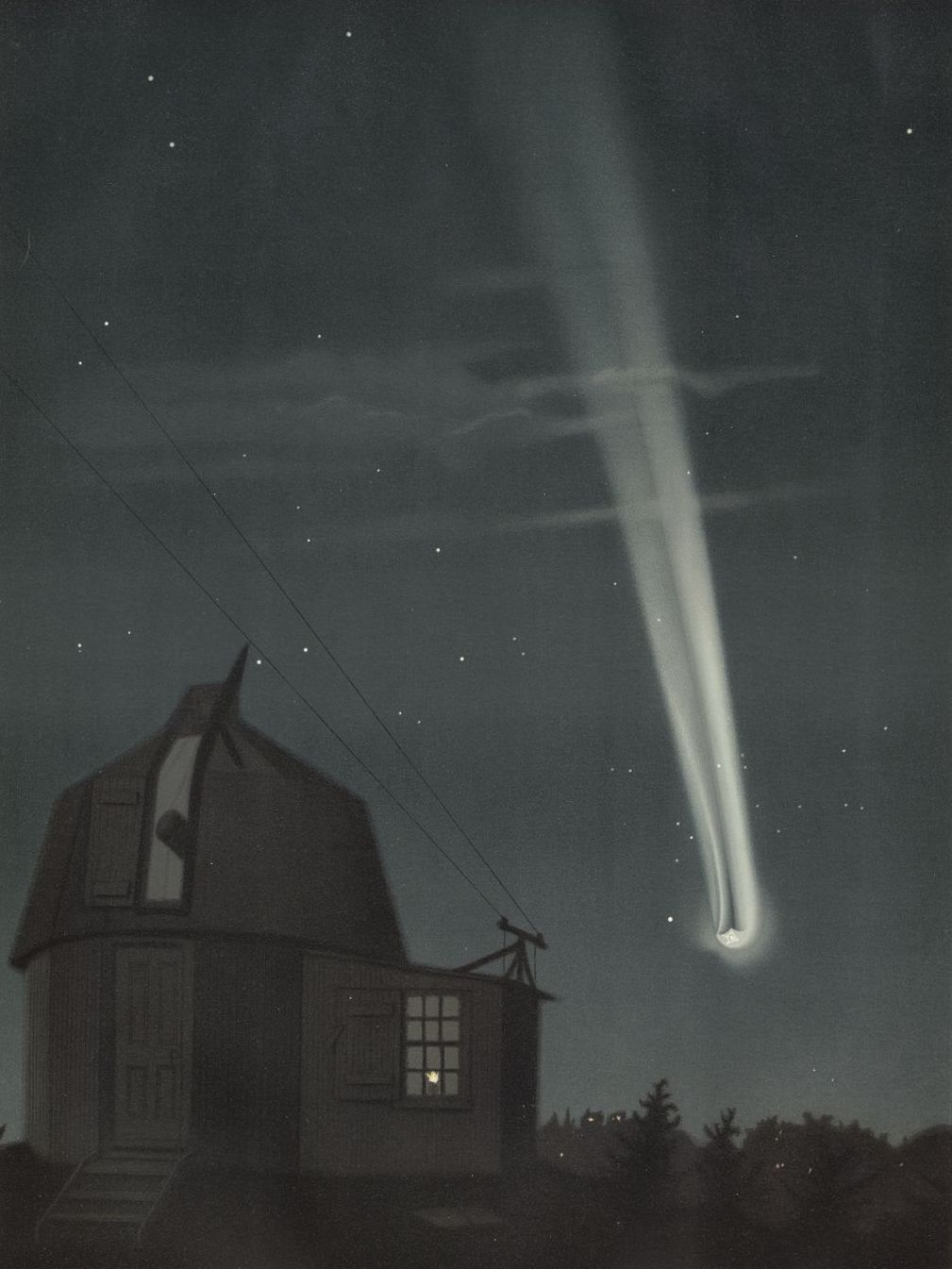
PLATE XI.—THE GREAT COMET OF 1881.
Observed on the night of June 25-26 at 1h. 30m. A.M.
From my observations upon the comets which have appeared since the year 1873, it is apparent that the changes in the nucleus, coma and tail, are due to a solar action, which contracts or expands these objects in such a manner that the nuclei become either bright and star-like, or dim and diffused, in a very short time. I had excellent opportunity, especially in the two large comets of 1881, to observe some of these curious changes, a description of which will give an idea of their extent and rapidity. On July 2d, 1881, at 9 o'clock, the nucleus of comet 1881, III., which is represented on Plate XI., appeared sharply defined, bright and considerably flattened crosswise; but half an hour later it had considerably enlarged and had become so diffused that it could hardly be distinguished from the coma, with which it gradually blended. It is perhaps worth mention that, at the time this last observation was made, an aurora borealis was visible. This comet 1881, III., underwent other very important changes of its nucleus, coma and tail. On June 25th, the nucleus, which was bright and clearly defined, was ornamented with four bright diverging conical wings of light, as shown on Plate XI. On the 26th these luminous wings had gone, and the nucleus appeared one-third smaller. On the 28th it had enlarged, but on the 29th its shape was considerably altered, the nucleus extending in one direction to three or four times its diameter on previous nights, and being curved, so as to resemble a comma. On the 6th of July the nucleus of this comet showed the greatest disturbances. The nucleus, which had appeared perfectly round on the evening of the 5th, was found much elongated at 10 o'clock on the 6th, forming then a straight, acute, and well-defined wedge of light, inclined upwards to the left. The length of the nucleus, at this time, was three or four times its ordinary diameter. At the same time rapid changes occurred; the strangely shaped nucleus soon became unsteady, extending and contracting alternately, and varying greatly in brightness. At 10h. 45m., the elongated nucleus, then gently curved, took the shape of a succession of luminous knots, which at times became so brilliant and distinct that they seemed to be about to divide and form separate nuclei; but such a separation did not actually occur, at least while I was observing. While these important changes were going on in the comet, a bright auroral arch appeared in the north, which lasted only a short time. On July 7th, the sky being cloudy, no observations were made, but on the 8th I observed the comet again. The nucleus had then resumed its circular form, but it was yet very unsteady, being sometimes small, bright and sharp, while a few seconds later it appeared twice as large, but dim in outlines; and sometimes an ill-defined secondary nucleus appeared at its centre. On several occasions the nucleus appeared as if it were double, one nucleus being apparently projected partly upon the other.
The nuclei of comets are sometimes very small, and in other cases very large. Among those which have been measured, the nucleus of the comet of 1798, I., was only 28 miles in diameter, but that of Donati's comet, in 1858, was 5,600 miles, and that of the comet of 1845 was 8,000 miles in diameter.
The coma of comets is found to be even more variable than the nucleus. The changes observed in the coma are generally in close connection with those of the nucleus and tail, the same perturbations affecting simultaneously the whole comet. While the coma of the comet of 1847 was only 18,000 miles in diameter, that of Halley's comet, in 1835, was 357,000 miles, and that of the comet of 1811 was 1,125,000 miles in diameter. In general, as already stated, the coma of a comet decreases in size in approaching the Sun. That of Encke's comet, which, on October 9th, 1838, had a diameter of 281,000 miles, gradually decreased at a daily mean rate of 4,088 miles in going towards the Sun; so that, on December 17th, when the distance of the comet from the Sun was more than four times less than it was on the first date, its diameter was reduced to 3,000 miles.
The form of the coma, in that part which is free from the tail, is in general a portion of a circle, but is sometimes irregular, with its border deformed. Thus, the border of the coma of Halley's comet was depressed at one point towards the Sun. I observed a similar phenomenon in Coggia's comet, with the great refractor of the Harvard College Observatory, on July 13th, 1874, when its border appeared deeply depressed on the side nearest to the Sun, as if repelled by this body. The coma of comet 1881, III., showed also very singular outlines on the nights of the 25th and 26th of June, when its border was so deeply depressed that the coma appeared as if it were double. Luminous rays and jets often radiate from the nucleus across the coma, and describe graceful lateral curves, falling backwards and gradually fading away into the tail, of which they then form a part. The rays and jets emitted by the nucleus seem at first to obey the solar attraction and travel towards the Sun; but they are soon repelled, and move backward towards the tail. It is a mystery, as yet unexplained, how these cometary jets, which at first seem to obey to the laws of attraction, are compelled to retreat apparently by superior opposing forces. Among the forces of nature, we know of no other than those of an electrical sort, which would act in a similar manner; but this explanation would require us to assume some direct electrical communication between the comet and the Sun. Considering the distance between the two bodies, and the probable absence or great tenuity of the gaseous material in interstellar space, such an assumption is a difficult one.
Under the action of the solar forces, the coma also very frequently forms itself into concentric luminous arcs, separated by comparatively dark intervals. These luminous semi-circles vary in number, but sometimes there are as many as four or five at a time. All great comets show these concentric curves more or less, but sometimes only a portion is visible, the rest of the coma having a different structure. When great comets approach near the Sun, their coma is generally composed of two distinct parts, an inner and an outer coma, the inner one being due to the luminous jets issuing from the nucleus, which, never extending very far, form a distinct, bright zone within the fainter exterior coma.
The tails of comets, which are in fact a prolongation of the coma, are likewise extremely variable in form. They are sometimes straight like a rod; again, are curved like a sabre, or even crooked like an S, as was that of the comet of 1769. They are also fan-shaped, pointed, or of the same width throughout. Many of these appendages appear longitudinally divided through their middle by a narrow, darkish rift, extending from the nucleus to the extremity. This peculiarity appears in the comet shown on Plate XI. Sometimes the dark rift does not commence near the nucleus, but at some distance from it, as I observed in the case of comet 1881, III., on June 26th. This dark rift is not a permanent feature of a comet's tail, but may be visible one day and not at all the next. Comet 1881, III., which had shown a dark rift towards the end of June, did not exhibit any such rift during July and August, when, on the contrary, its tail appeared brighter in the middle. Coggia's comet, which showed so prominent a dark rift in July, 1874, had none on June 10th. On the contrary, the tail was on that date very bright along its middle, as also along each of its edges.
The tail of a comet does not invariably point directly away from the Sun, as above mentioned, and sometimes the deviation is considerable; for instance, the tail of the comet of 1577 deviated 21° from the point opposite to the Sun.
In general, the tail inclines its extremity towards the regions of space which it has just left, always presenting its convex border to the regions towards which it is moving. It is also a remarkable fact that this convex border, moving first in space, always appears brighter and sharper than the opposite one, which is often diffused. From these peculiarities it would seem that in moving about the Sun the comets encounter some resistance to their motion, from the medium through which they pass, and that this resistance is sufficient to curve their tails away from the course in which they move, and to crowd their particles together on the forward side. It is especially when they approach their perihelion, and move more rapidly on a curve of a shorter radius, that the comets' tails show the greatest curvature, unless their position in regard to the observer prevents their being advantageously seen. The tail of Donati's comet presented a fair illustration of this peculiarity, its curvature having augmented with the velocity of the comet's motion about the Sun. But possibly this phenomenon has another cause, and may be found rather in the solar repulsion which acts on comets and is not instantaneously propagated throughout their mass.
Although, in general, comets have but one tail, it is not very rare to see them with multiple tails. The comets of 1807 and 1843 had each a double tail; Donati's comet, in 1858, showed several narrow, long rectilinear rays, issuing from its abruptly curved tail. The comet of 1825 had five branches, while that of 1744 exhibited no less than six distinct tails diverging from the coma at various angles. In general character the multiple and single tails are similar. When a comet has two tails, it is not rare for the second to extend in the general direction of the Sun, as was the case with the great comet of 1881, III., represented on Plate XI. From July 14th to the 21st it exhibited quite an extended conical tail, starting obliquely downwards from the right side of the coma, and directed towards the Sun. From the 24th of July to the 2d of August this secondary tail was exactly opposite in its direction from that of the primary tail, and gave to the head a very elongated appearance. Comet 1881, IV., also exhibited a secondary appendage, not directed towards the Sun, but making an angle of about 45° with the main tail.
These cometary appendages sometimes attain prodigious dimensions. The comets of 1680 and 1769 had tails so extended that, after their heads had set under the horizon, the extremities of these immense appendages were still seen as far up as the zenith. In a single day the tail of the comet of 1843 extended 100°, and it was thrust from the comet "as a dart of light" to the enormous distance of 48,500,000 miles, and yet of this immense appendage nothing was left on the following day. The tail of Donati's comet, in 1858, attained a real length of 42,000,000 miles, while that of the great comet of 1843 had the enormous length of 200,000,000 miles. If this last comet had occupied the position of the Sun, which it approached very nearly for a moment, the extremity of its tail would have extended 60,000,000 miles beyond the orbit of Mars.
In some cases the tails of comets have been seen undulating and vibrating in a manner similar to the undulations and coruscations of light characteristic of some auroras. Many observers report having seen such phenomena. The comet of 1769 was traversed by luminous waves and pulsations, comparable to those seen in the aurora borealis. I myself observed these curious undulations in Coggia's comet in 1874, while the head of this object was below the horizon. For an hour the undulations rapidly succeeded each other, and ran along the whole length of the tail.
Some of the brightest comets have shone with such splendor that they could be observed easily in full sunshine. Many comets, such as those of 1577 and 1744, have equaled Sirius and Venus in brilliancy. The great comet of 1843, which suddenly appeared in our sky, was so brilliant that it was seen by many observers at noon time, within a few degrees from the Sun. I remember that I myself saw this remarkable object in the day time, with a number of persons, who were gazing at the wonderful apparition. So brilliant was this comet, that besides its nucleus and head, a portion of its tail was also visible in the day time, provided the observer screened his eyes from the full sunlight by standing in the shadow of some building.
Of all the bodies revolving around the Sun, none have been known to approach so near its surface as did the comet of 1843. When it arrived at perihelion, the distance from the centre of its nucleus to the surface of the Sun's photosphere was only 96,000 miles, while the distance from surface to surface was less than 60,000 miles. This comet, then, went through the solar atmosphere, and in traversing it with its tremendous velocity of 366 miles per second, may very possibly have swept through some solar protuberances, many of which attain much higher elevations than that at which the comet passed. The comet of 1680 also approached quite near the surface of the Sun, and near enough to encounter some of the high solar protuberances, its distance at perihelion being about two-thirds of the Moon's distance from the Earth. The rapidity of motion of the comet of 1843 was such, when it approached the Sun, that it swept through all that part of its orbit which is situated north of the plane of the ecliptic in a little more than two hours, moving in this short time from one node to the other, or 1800.
But if some comets have a very short perihelion distance, that of others is considerable. Such a comet was that of 1729, whose perihelion distance was 383,000,000 miles, the perihelion point being situated between the orbits of Mars and Jupiter.
While some comets come near enough to the Sun at perihelion to be volatilized by its intense heat, others recede so far from it at aphelion that they may be said to be frozen. The shortest cometary aphelion distance known is that of Encke's comet, whose greatest distance from the sun is 388,000,000 miles. But that of the comet of 1844 is 406,000,000,000 miles from the Sun. The comets of 1863 and 1864 are so remote in space when they reach their aphelion points that light, with its velocity of 185,500 miles a second, would require 171 days in the first case, and 230 in the last, to pass from them to the Earth.
The period of revolution of different comets also varies immensely. While that of Encke's comet is only 3½ years, that of comet 1864, II., is 280,000 years.
Among the periodic comets of short period, some have exhibited highly interesting phenomena. Encke's comet, discovered in 1818, is remarkable for the fact that its period of revolution diminishes at each of its successive returns, and consequently this comet, with each revolution, approaches nearer and nearer to the Sun. The decrease of the period is about 2½ hours at each return. Although the decrease is small, if it go on in future as it does at present, the inevitable consequence will be that this comet will finally fall into the Sun. This curious phenomenon of retardation has been attributed by astronomers to the existence of a resisting medium filling space, but so rare and ethereal that it does not produce any sensible effect on the movements of the planets. But some other causes may retard this comet, as similar retardations have not been observed in the case of other periodic comets of short period. These, however, are not so near to the Sun, and perhaps our luminary may be surrounded by matter of extreme tenuity, which does not exist at a greater distance from it.
Another of the periodic comets which has exhibited a very remarkable phenomenon of transformation is Biela's comet, which divided into two distinct parts, moving together in the same direction. When this comet was first detected at its return in 1845, it presented nothing unusual, but in the early part of 1846 it was noticed by several astronomers to be divided into two parts of unequal brightness, forming thus a twin comet. At its next return in 1852, the two sister comets were still traveling in company, but their distance apart, which in 1846 was 157,000 miles, had increased to 1,500,000 miles. At the two next returns in 1859 and 1865, their position not being very favorably situated for observation, the comets were not seen. In 1872 the position should have been favorable for observation, and they were consequently searched for, but in vain; neither comet was found. An astronomer in the southern hemisphere, however, found a comet on the track of Biela's, but calculation has shown that the two objects are probably not identical, since this comet was two months behind the computed position for Biela's. It will be shown in the following chapter that our globe probably crossed the orbit of Biela's comet on November 27th, 1872, and the phenomena resulting from this passage will be there described.
It is seen from these observations that comets may be lost or dissipated in space by causes entirely unknown to us. Biela's comet is not the only one which has been thus disintegrated. Ancient historians speak of the separation of large comets into two or more parts. In 1661 Hevelius observed the apparent division of the comet of that year and its reduction to fragments. The return of this comet, calculated for 1790, was vainly waited for; the comet was not seen.
Other comets, whose periods of revolution were well known, have disappeared, probably never to return. Such is Lexell's comet, whose period was 5⁶⁄₁₀ years; also De Vico's comet, both of which are now lost. It is supposed that Lexell's comet, which passed twice very near the giant planet Jupiter, had its orbit changed from an ellipse to a parabola, by the powerful disturbing influence of this planet, and was thus lost from our system. Several other comets, in traveling over their different orbits, have approached near enough to Saturn, Jupiter and the Earth to have their orbits decidedly altered by the powerful attraction of these bodies.
But since comets are liable to pass near the planets, and several have orbits which approach that of the Earth, it becomes important for us to know whether an encounter of such a body with our globe is possible, and what would then be the result for us. Although that knowledge would not enable us to modify the possibilities of an encounter, yet it is better to know the dangers of our navigation through space than to ignore them. This question of a collision of the Earth with a comet has been answered in different ways, according to the ideas entertained in regard to the mass of these bodies. While some have predicted calamities of all kinds, such as deluges, conflagrations, or the reduction of the Earth to incandescent gases, others have asserted that it would produce no more effect than does a fly on encountering a railroad train. In our days astronomers entertain very little fears from such an encounter, because the probabilities of danger from an occurrence of this sort are very slight, the mass of an ordinary comet being so small compared with that of our globe. We know with certainty that the Earth has never had an encounter with a comet by which it has been transformed into gases, at least within the several millions of years during which animal and vegetable life have left their marks upon the stony pages of its history, otherwise these marks would not now be seen. If, then, such an accident has not happened during this long period, the chances for its occurring must be very small, so small indeed that they might almost be left out of the question. It is true that our globe shows signs of great perturbations of its surface, but we have not the slightest proofs that they resulted from an encounter with a celestial body. It seems very probable that our globe passed through the tail of the comet of 1861, before it was first seen on June 29th; but nothing unusual was observed, except perhaps some phosphorescent light in the atmosphere, which was afterwards attributed to this cause.
The density and mass of comets must be comparatively very small. Their tails consist of matter of such extreme tenuity that it affects but very little the light of the small stars over which they pass. The coma and nucleus, however, are not quite so transparent, and may have greater masses. On several occasions I have seen the light of stars reduced by the interposition of cometary matter, comet 1881, III., presenting remarkable cases of this sort. On July 8th, at 10h. 50m., several small stars were involved in this comet, one of which passed quite near the nucleus through the bright inner coma. At that time the comet was greatly disturbed, its nucleus was contracting and enlarging rapidly, and becoming bright and again faint in an instant. Every time that the nucleus grew larger, the star became invisible, but reappeared the moment the nucleus was reduced in size. This phenomenon could not be attributed to an atmospheric effect, since, while the nucleus was enlarging, a very small inner nucleus was visible within the large diffused one, the matter of which had apparently spread over the part of the coma in which the star was involved, making it invisible.
That the mass of comets is small, is proved by the fact that they have sometimes passed near the planets without disturbing them in any sensible manner. Lexell's comet, which in 1770 remained four months very near Jupiter, did not affect in the least the orbits, or the motions of its satellites. The same comet also came within less than 1,500,000 miles from the Earth, and on this occasion it was calculated that its mass could not have been the ¹⁄₅₀₀₀ part of that of our globe, since otherwise the perturbations which it would have caused in the elements of the Earth's orbit would have been sensible. There was, however, no change. If this comet's mass had been equal to that of our globe, the length of our year would have been increased by 2h. 47m. The comet of 1837 remained four days within 3,500,000 miles of the Earth, with no sensible effect.
It seems quite difficult to admit that the denser part of a comet forming the nucleus is solid, as supposed by some physicists, since it is so rapidly contracted and dilated by the solar forces, while the comet is yet at a too great distance from the Sun to allow these effects to be attributed to solar heat alone. This part of a comet, as indeed the other parts, seems rather to be in the gaseous than in the solid state; the changes observed in the intensity of its light and in its structure may be conceived as due to some solar action partaking of the nature of electricity.