Chapter VI · THE TREATY
Reading edition
Captain Hobson having now by his own efforts and the agency of those who were associated with him completed his negotiations with the native chiefs, it remains for us to examine briefly the nature of the compact into which the Maori and Pakeha had thus solemnly entered. The Treaty of Waitangi is a document of few clauses and precise terms. Yet under the conflicting interests which it was designed to harmonise few documents have been more generally misunderstood or more persistently misinterpreted. More than once in high places its utility has been denied, its simple contracts have been repudiated, and its existence has been ignored. Lawyers have repeatedly questioned its legality, courts have discussed its constitutional force, parliaments have debated its wisdom, but still it stands to-day—unaltered in text or spirit—the great charter of Maori rights. Its most virulent enemies have ever been the land speculators, and there are not wanting signs in these times of unsatisfied land hunger—of never-ceasing speculation—that the treaty has either been forgotten by those whose duty it is to remember it, or that its obligations have ceased to have their old-time moral value. Lest we forget that the treaty is still in force, and that native lands are not common plunder for the avaricious Pakeha, let us briefly review the circumstances which made the compact between the two nations a political virtue, if not a political necessity.
It is a principle recognised by the civilised nations of the Earth that the discovery of a waste and uninhabited land by a pioneering country confers on that country a right, as against all other civilised countries, to colonise its new discovery. In such a case the discovering nation may in fact go further, by immediately taking possession of the new-found territory, and assuming sovereignty over it. In this way Norfolk Island being found devoid of inhabitants by Captain Cook, his discovery of the sea-girt isle not only entitled Britain to colonise it, but automatically added it to the possessions of the Empire. This principle has thus been concisely stated by Vattel: "All men have an equal right to the things which have not yet fallen into the possession of any one; and these things appertain to the first occupant. Wherefore, when a nation finds a country uninhabited and without a master, it may lawfully seize upon the same, and after it has adequately denoted its will in this respect another cannot thereof despoil it. Thus navigators going on their voyages of discovery, provided with a commission from their sovereign, and falling in with desert islands, or other desert lands, have taken possession of them in the name of their nation, and commonly this title has been respected, provided that thereupon a real possession has closely followed."
It is equally an acknowledged maxim of the Law of Nations that should the newly discovered land not prove to be "waste and without a master," but that it should be inhabited and under government of any kind, then the mere fact of its discovery by a civilised nation confers upon the discoverer no title to the soil, but only the prior right to colonise as against other colonising nations. This is but the natural reward which belongs to the enterprise displayed in fitting out ships and expeditions destined to navigate unknown seas or to travel in unknown lands. Such prior right to colonise is, however, strictly limited by the important consideration that colonisation can only take place with the free will and consent of the savage or semi-civilised inhabitants of the newly discovered country. In no sense does the act of discovery confer the right of property in the land, or the right of sovereignty over its people. That is to say, in the abstract, no nation whatever can under any pretext violate the rights of any other independent nation. This was clearly the principle which guided those British Governments to whose lot fell the establishment of the first colonies in America. In all these cases was the property of the Indian tribes respected, and no land was acquired save by purchase, or by some other equitable arrangement made with the aboriginal owners.[156] Hence in the celebrated case of the Cherokee tribe against the State of Georgia, tried in 1832, before the late Chief-Justice Marshall, that eminent judge was able to declare that as the United States had only inherited its rights from Great Britain after the War of Independence, the individual States could not assume rights greater than Britain had claimed to possess prior to that event. No right in Cherokee lands therefore vested in the State until the Indian title had been honourably extinguished.
This equitable principle has not always been observed between so-called civilised nations and semi-barbarous peoples, but that it has long held a place amongst the ideals of men is suggested to us by the Phoenician legend, that when the merchant princes of Tyre and Sidon resolved to establish a trading factory on the site upon which subsequently rose the city of Carthage, they fairly bought the land from the natives of Northern Africa, the area being determined by the length of the thongs cut from a bullock's hide. Such a story, coming down to us as it does through the hoary mists of time, may or may not appeal to our practical present-day minds, but the fact that it was commonly told and commonly accepted amongst the ancients is at least an indication that the principles which govern the conduct of modern nations towards their less fortunate brethren are founded upon and have the sanction of great antiquity.
When we come to apply these principles to New Zealand it is of course necessary to remember that the first European discoverer[157] of this Dominion was not Cook, but Abel Tasman. The Dutchman's association with the country was, however, so cursory, and his nation's subsequent interest in it so nominal, that to the sailor it appeared only as "a great land uplifted high," while to his countrymen it was known only as a vague scrawl upon the chart. That Tasman's discovery of 1642 gave the Dutch a right to colonise in New Zealand had they been so disposed is undoubted; but whatever rights they had thus acquired, such were clearly exhausted by Holland's failure to assert them during the long period of 135 years that elapsed before Cook came to make a reality of what to Tasman had only been a shadow.
With his characteristic thoroughness Cook left no weak link in the claim which he made on behalf of his nation. He landed on our shores, held intercourse with the natives, he surveyed our coasts, he took formal possession of both Islands "in the name, and for the use of His Majesty King George III."
"A philosopher perhaps might enquire on what ground Lieutenant Cook could take formal possession of this part of New Zealand in the name and for the use of the King of Great Britain, when the country was already inhabited, and of course belonged to those by whom it was inhabited, and whose ancestors might have resided in it for many preceding ages. To this the best answer seems to be that the Lieutenant in the ceremony performed by him had no reference to the original inhabitants, or any intention to deprive them of their national rights, but only to preclude the claims of further European navigators, who under the auspices and for the benefit of their respective States, or Kingdoms, might form pretensions to which they were not entitled by prior discovery."
So wrote one of the great explorer's most friendly biographers, and in his dispassionate review of the facts we have a correct summation of the rights which Cook's discoveries did and did not confer upon our nation. Clearly New Zealand was not a country in which, or over which, Britain could, by Cook's act, acquire a bona fide possession, for it was inhabited by a strong and virile people, living under a system of government adequate in all respects for their social and military purposes.
In conferring upon New Zealand her charter of severance from New South Wales in 1840 Lord John Russell thus conveyed to Captain Hobson his view of the governmental state to which the Maori had risen: "They are not mere wanderers over an extended surface in search of a precarious existence; nor tribes of hunters, or of herdsmen, but a people among whom the arts of government have made some progress; who have established by their own customs a division and appropriation of the soil; who are not without some measure of agricultural skill, and a certain subordination of ranks, with usages having the character and authority of law." New Zealand then being an inhabited country and a country under a system of government at least so efficient as to subsequently induce the British authorities to recognise the Maori nation as an independent State, it becomes obvious that this could not be designated a land which could be lawfully seized upon by circumnavigators.
But such rights as Cook's discoveries did confer upon the nation, the Government of that day sought to conserve. Following upon his return to England with the accounts of his travels in strange waters, his contact with strange peoples, his finding of new lands, proclamations were issued which were not contested by other Powers. The Dutch title to these islands was thereby lawfully extinguished, and New Zealand, Van Dieman's Land, and Australia became for geographical and colonising purposes portions of the British Empire.
A laudable effort was made to render the claims of Britain even more explicit when in 1787 Captain Philip was appointed by Royal Commission Captain-General and Governor-in-Chief in and over the colony of New South Wales and its dependencies, which were claimed to include all the discoveries of Cook in the Southern Pacific. The territory over which the new Governor was authorised to exercise jurisdiction was described in his Commission as extending "from Cape York, the extremity of the coast to the northward in the latitude of 11° 37´ south, to the South Cape, the southern extremity of the coast in the latitude of 43° 30´ south, and inland to the westward as far as 135° of east longitude, comprehending all the islands adjacent in the Pacific Ocean within the latitudes of the above-mentioned capes."
Unfortunately, owing doubtless to imperfect geographical knowledge on the part of those responsible, these boundaries were but loosely defined, for if they had been strictly adhered to, then Britain was setting up a claim not only to Cook's valuable discoveries, but to all the islands eastward of Australia, as far as the western coast of South America, embracing many Spanish discoveries; while on the other hand they excluded not only Stewart's Island, but all that part of the Southern Island of New Zealand south of Bank's Peninsula. Governor Philip's Commission was therefore faulty, because it asserted excessive rights in the one direction and made insufficient claims on the other.
It is true that in later years these boundaries were abandoned and the position made even more anomalous. During the Governorship of Sir Thomas Brisbane it was deemed expedient to separate Van Dieman's Land from New South Wales, and more circumscribed limits were assigned to the Mother State. In this readjustment, whether by accident or design it is impossible now to say, not only Van Dieman's Land but New Zealand were excluded from amongst the dependencies of New South Wales. Then it became an arguable point whether the word "adjacent" had ever covered Islands so far distant from the parent colony, and much legal acumen was expended in the effort to justify the contention that New Zealand had always been beyond the pale of the dependencies.
Up to this point, however, the official mind had never been troubled by doubts as to the extent of its jurisdiction. Governor Philip not only believed that his authority extended to New Zealand, but far beyond it, and under this belief he actually colonised Norfolk Island as a part of the territory he had been commissioned to govern. In like manner the British Government believed it had a right to all that it claimed in Philip's Commission; and at the Congress of Vienna at the close of the Napoleonic wars in 1814, when the map of Europe was recast, it had its claims allowed, New Zealand being acknowledged by the Great Powers to be a portion of our then infant Empire. Even earlier in the century Ministers had seriously discussed a representation made by Lieutenant-Colonel Foveaux, of the New South Wales Corps, to appoint a Lieutenant-Governor in New Zealand, which under his scheme was to become a penal settlement subordinate to New South Wales. Fortunately for New Zealand that baneful suggestion was not entertained; but Governor Macquarie appointed Justices of the Peace and exercised the functions of Government within the Islands, as did his successor, Sir Thomas Brisbane, down to the time of his proclamation which excluded New Zealand from amongst the dependencies of New South Wales.
Thus far Britain would seem prima facie to have kept alive her right to colonise in these Islands as against any other nation, except, perhaps, in the important particular that she had not systematically occupied the land. It is not sufficient that discovery should take place, or that the free will and consent of the native inhabitants should be obtained to the introduction of colonisation. It is an essential factor in the acquisition of new territory that the sanction thus secured should be followed up by speedy emigration and effective settlement, for obviously no nation could be permitted to hold idle for an indefinite period vast tracts of waste country to the exclusion of another nation to whom the inhabitants might also be willing to concede the right to colonise. The principle upon which this view is based has thus been stated: "The Law of Nations, then, will recognise the proprietary rights, and the sovereignty of a nation over only uninhabited countries which it shall have occupied really and in fact, in which it shall have formed a settlement, or from which it shall be deriving an actual use."
In the case of inhabited countries the condition of occupation is no less exacting. It is, however, hedged about by the additional restriction that before occupation can take place the right to settle must be ceded by the inhabitants. Had the point ever become one of national importance as between ourselves and France, Britain might have pleaded that her occupation was at least as far advanced as that of her rival. She might have pointed to her Missionaries, her traders, and her whalers as evidences of an irregular settlement by no means inconsiderable. But whatever importance British jurists may have attached to such a form of occupation in the settlement of an international dispute, it cannot be denied that it loses much of its value from the fact that the settlement was irregular, and that British Ministers would have been put in the anomalous position of calling to their aid a condition of society which had arisen, not with the sanction of the Crown, but in spite of the Crown.
If these views be founded on the principles of justice, it will be seen that it is a popular fallacy to suppose that Britain acquired any rights of sovereignty in, or over New Zealand by virtue of Cook's discovery. Her position in 1770 was much less absolute than that, and whatever rights she had then acquired she subsequently proceeded to abrogate. In 1817 commenced a period of renunciation during which successive British Governments appeared only too anxious to absolve themselves from all further colonial responsibilities. Not only by neglect, but by direct Act and Ordinance did they repudiate the claim to New Zealand which their predecessors had been laboriously building up through all these years. These Acts of repudiation were specifically enumerated by Lord John Russell in the memorandum which he prepared for Lord Palmerston in reply to the protest of the New Zealand Company against the views on sovereignty adopted by Lord Normanby in his instructions to Captain Hobson, and it was the known abrogation in these statutes of whatever claim Britain may have had to New Zealand that led to the Declaration of Maori Independence in 1835.
It cannot be said that this Declaration of Independence was a serious bar to Britain's colonising scheme, for under the Confederation of Chiefs which grew out of it, no Government was founded stable enough to merit recognition by other established administrations. Indeed its own members were the first to acknowledge its failure in the face of the difficulties by which it was confronted. As useless and as harmless as the "paper pellet" to which it has been compared by the sarcastic Gipps, it was neither government for the Maori nor a controlling influence for the Europeans. It was therefore not that which the Maori had done which created difficulty for the Melbourne Cabinet when they had seriously to face the question of assuming responsibility in New Zealand—the obstacles to be overcome had, curiously enough, been raised by the acts of the British Parliament itself. This was why, at the critical hour, Britain stood in no better position towards New Zealand than did any of the other nations; why she had to run the gauntlet of their competition for sovereignty, and why more astute statesmanship on the part of France or the United States might have robbed her of "the fairest flower in all the field."
In bidding for the sovereignty of the country two courses were open to the British Government—force of arms, or honourable negotiation with the chiefs. It is not to be doubted that had Britain chosen to invade the country, she might, by pouring her battalions into it, in course of time have overcome the tribes by the slaughter of the sword. But who can estimate at what a cost the country would thus have been won?—while the crime of it would have been even more awful to contemplate than the sacrifice of blood and treasure. Happily it can never be suggested that Lord Melbourne's Ministers had ever contemplated such a mode of securing sovereignty. Their personal view was that it must be ceded if it was to be acquired at all, while the House of Commons had made it abundantly clear that it would accept it on no other terms.
Here then we have the genesis of the treaty. Discovery gave us no right of sovereignty. Force of arms was incompatible with the spirit of the times; possibly beyond the resources of the nation. Negotiation on the other hand had been made easy by the labours of the Missionaries, and the repeated expressions of good-will which had passed between the British Sovereigns and the chiefs. It was the line of least resistance; a mode agreeable to the national conscience, and approved by the laws of civilisation. For these all-sufficient reasons then Captain Hobson was despatched to New Zealand, charged with the mission of securing for the British Crown the sovereignty of the country by the "free and intelligent consent of the natives, according to their established usages."
In proceeding to an analysis of the treaty itself it will not be necessary to refer to the preamble, which is but an abridged recital of all that has appeared in the previous chapters of this work. It asserts no principle, and is remarkable only for the fact that it reflects in dignified terms the spirit of justice and equity in which its promoters desired to approach the Maori people.
In the first clause the chiefs both within and without the Confederation were invited to "cede to Her Majesty Queen Victoria absolutely and without reservation all the rights and powers of sovereignty which the said Confederation or individual chiefs respectively exercise or possess, or may be supposed to exercise or possess, over their respective territories as the sole sovereigns thereof."
It has been said that this was a condition which the natives never did, and could not possibly understand, seeing that they had neither sovereignty amongst themselves, nor any word in their language to express the idea of sovereignty. Their tribal system, it is true, was fatal to the principle of sovereignty in its broadest sense, and until the formation of the Confederation of Chiefs there was no force amongst them capable of exercising absolute authority over any great number of the people, the sovereignty of each chief being limited to his own tribe. No real sovereignty, however, vested even in the Confederation. From the first it was impotent as a national Government, because it lacked the requisite cohesion. Mutual tribal jealousies still prevailed, making it a Confederation only in name; and so far as is known it did not pretend to exercise any sort of dominion over the people after the excitement consequent upon the advent of Baron de Thierry had subsided. The native mind had therefore learned nothing of what was meant by sovereignty as we understand it, from the union of their chiefs. All that they knew of a paramount authority which it was their duty habitually to obey was the mana[158] of their personal chiefs. That they understood perfectly, and that conveyed to them all that they required to understand. Each chief was a sovereign over his own people, and the people were not so lacking in intelligence as not to perceive that the treaty meant the passing of this mana from the chief to the Queen. It would, of course, be radically unsound to pretend that every native who signed the treaty had perfectly grasped its provisions, and knew with even moderate certainty what he was retaining and what he was conceding. In many instances, particularly where the land had already been sold, it might not be incorrect to say that some of the chiefs did not even attempt to comprehend it. The red blanket[159] or the juicy plug of tobacco was an irresistible bait to many who felt they had no longer a "name," and so far as they were concerned, sovereignty and all else might fly to the four winds so long as their personal wants and their love of colour were gratified. The predicament in which those natives found themselves who afterwards alleged they had signed the treaty without a full appreciation of its terms and its obligations was poignantly put by Paora (Paul) Tuahaere, who, speaking at the Kohimarama Conference[160] in 1860, said the treaty had come "in a time of ignorance," and upbraided the elder chiefs for being caught thus unwarily. "Blankets were brought by Mr. Williams. These I call the bait. The fish did not know there was a hook within. He took the bait and was caught. When he came to a chief Mr. Williams presented his hook and drew out a subject for the Queen."
In less figurative, but not less pointed speech, Paora was supported by Heme Parae, who declared that the only law he heard of in 1840 was the law of God. "As to what is called the Treaty of Waitangi, I have heard nothing about it. It is true I received one blanket from Mr. Williams, but I did not understand what was meant by it. It was given to me without explanation by Mr. Williams and Reihana."
Twenty-three years after the event, when discussing the mental attitude of the Maori towards the treaty, the Rev. John Warren, one of the Wesleyan Missionaries, wrote: "I was present at the great meeting at Waitangi when the celebrated treaty was signed, and also at a meeting which took place subsequently on the same subject at Hokianga. There was a great deal of talk by the natives, principally on the subject of securing their proprietary right in the land, and their personal liberty. Everything else they were only too happy to yield to the Queen, as they said repeatedly, because they knew they could only be saved from the rule of other nations by sitting under the shadow of the Queen of England. In my hearing they frequently remarked, "Let us be one people. We had the Gospel from England, let us have the law from England." My impression at the time was that the natives perfectly understood that by signing the treaty they became British subjects, and though I lived among them more than fifteen years after that event, and often conversed with them on the subject, I never saw the slightest reason to change my opinion. The natives were at that time in mortal fear of the French, and justly thought they had done a pretty good stroke of business when they had placed the British lion between themselves and the French eagle. We have heard indignation expressed at the way in which the natives were, in the treaty, overreached by the Government, especially in the matter of securing to the Queen the right of pre-emption in the purchase of their lands. There is a native proverb which says, with reference to a man of great keenness and sagacity, 'He was born with his teeth,' and in the matter of making bargains the New Zealanders may be said to be a people who were born with their teeth. I believe it is a very long time since it was possible to overreach the natives much in a bargain. I know that their particular clause of the treaty was there by their own urgent request, and that it met with the universal and unqualified approbation of the chiefs."
In adopting this view Mr. Warren is not singular, for we find that his impression is confirmed by many equally competent authorities. It would therefore be an undeserved reflection upon the well-established intelligence of the Maori race to suppose that these indifferents constituted any large section of the people, there being amongst them a wide comprehension of the two great principles embodied in the treaty—that they were surrendering the magisterial control of the country to the Queen, and retaining the possession of the land to themselves.[161] The speeches of its opponents were eloquent of this fact. This was what Te Kemara meant when he exclaimed, "If thou stayest as Governor then perhaps Te Kemara will be judged and condemned. Yes, indeed and more than that—even hung by the neck." This surely was what the great Te Heuheu of Taupo meant when, addressing some natives who had signed the treaty, he said: "You are all slaves now. Your dignity and power are gone, but mine is not. Just as there is one man in Europe, King George, so do I stand alone in New Zealand; the chief over all others; the only free man left. Look at me, for I do not hide when I say I am Te Heuheu. I rule over you all just as my ancestor Tonga-Riro, the mountain of snow, stands over all this land."
The forms by which our sovereignty was exercised were doubtless new and strange to them, as witness their amazement at the pains the Crown took to prove a crime against a prisoner who had already confessed his guilt.[162] In some instances the degree of authority parted with may also have exceeded their anticipations, for we are told that it came as a shock to some of the chiefs when they discovered that they were not free to kill their slaves under the new regime as they had been under the old. Failure to comprehend such details is understandable in the peculiarity of the circumstances. Indeed complete clarity of mental vision could not have been expected, and would not have been attained in all particulars had civilised men instead of savages been concerned. The natives, however, understood clearly enough that for the advantages they hoped to reap from the treaty they were yielding much of their existing power to the Pakeha Governor, and whether it was much or little they were the more willing to surrender it because they realised that the advent of the European had so altered their social conditions that rule by the old method was no longer possible.
To these convictions must be added the indispensable persuasions of the Missionaries, in whose word and advice the Maoris placed implicit trust; but the thing which proved the determining influence in the negotiations—more than the inducements offered by the Crown, or the persuasions of the Missionaries—was that the chiefs had acquired a clear grip of the primal fact that whatever it took from them, the treaty left them in secure possession of their lands.
The sovereignty was the shadow, the land was the substance; and since the shadow was already passing from them by force of circumstances over which they were powerless to exercise control, they consented to its surrender with all the less regret. Once having determined upon this course, and given effect to their determination, there was no wavering, even though in its early stages the rule of the Pakeha must have clashed harshly with their ideas of individual authority. The Maori people were a people capable of delegating their sovereign rights, and they did so delegate them. The Treaty of Waitangi therefore became what it professed to be, a yielding of the supreme political power in the country to the British Crown,[163] and when the last signature had been put to it, Britain's right to colonise and govern in New Zealand was incontestable before all the world.
That is why it has always appeared to the writer that there was at the time, and has been for many years since, much beating of the air by the importance given to the so-called race to Akaroa, between the British sloop Britomart and the French frigate L'Aube, when, soon after the consummation of the treaty, the sovereignty of the South Island was supposed to be in danger. As this incident is the leading historical event which seems to challenge the value of the clause now under review it will be convenient to discuss it here.
Major Bunbury had returned from his southern mission on July 4, and at midnight of the 10th the French corvette, L'Aube, cast anchor in the Bay of Islands. From the pilot who went out to bring her in, Captain Lavaud heard that British sovereignty had been proclaimed over the country by Captain Hobson, and that the Union Jack was flying over his residence as an evidence of the fact.
This was serious intelligence for the Frenchman, who saw in it a circumstance that would render discreet a material modification of the instructions under which he had sailed from France. He had been commissioned to hoist the French flag at Akaroa, where a colony of his countrymen was to be established under his protection. These instructions had been given to him by the French Ministry in ignorance of the British Government's intentions, and Captain Lavaud now saw that to carry them out in their strict and literal sense must inevitably plunge the two countries into a distressful and useless war. The French Commander thus found himself in a position of great delicacy, but fortunately he was an officer blessed with a healthy frankness of spirit, and he lost no time in communicating to Captain Hobson the real nature of his mission. So soon as he had satisfied himself by an examination of the treaty and the proclamations that British sovereignty had been procured in a manner such as could be approved by other nations, and was effectual in its operation, he readily agreed to respect the rights thus acquired without committing himself so far as to formally acknowledge them until he should hear further from his own Government. At the same time he undertook, upon the first opportunity, to communicate with his Minister, and he entertained little doubt that on his representation of the altered conditions he would be instructed to recognise British sovereignty, and honour the British flag. It is at least certain that at the conferences between the two officers, an amicable arrangement was arrived at by which the French commander was able to preserve the honour of his own flag, while avoiding the tragedy of a conflict between their respective countries. There is even colour for the suggestion that the subsequent despatch of H.M.S. Britomart, followed by L'Aube, was only a part of a preconcerted plan, and that the much-paraded race to Akaroa between the French corvette and the British sloop was not a serious contest for sovereignty, but merely a little piece of theatrical play, promoted for the purpose of saving the Frenchman's face. Certain it is that before he left the Bay of Islands, Captain Lavaud had realised that it would be impossible to carry out his instruction at Akaroa without rupturing the national peace, and he was equally determined that he would not accept the responsibility of firing the first shot until he had been further advised from Paris. When this is understood it is all that is necessary to explain the conciliatory manner in which he met the British demands at Akaroa, and participated with our officers in the preservation of order at the southern settlement.
During their stay at the Bay of Islands the officers of L'Aube were entertained with the utmost cordiality by Captain Hobson, who in conversation with their Commander learned something of the proceedings of the Nantes-Bordelaise Company, a colonising corporation organised in France for the purpose of establishing a settlement of their own countrymen at Banks's Peninsula, and whose vessel, the Comte de Paris, was now within a few days' sail of the coast. In 1838 a Captain L'Anglois, as master of a French whaler, had visited Banks's Peninsula, and there, for some articles of European manufacture valued at £6, together with some agreeable promises, had secured the signatures of several chiefs to a deed conveying to him an estate of 30,000 acres of the Peninsula's finest land.[164] This document, composed in French, provided the basis of a negotiation which L'Anglois arranged between two mercantile firms in Nantes, two in Bordeaux, and three Parisian gentlemen, by which they agreed to promote the Nantes-Bordelaise Company whose purpose was to promote a French colony in New Zealand. Their project received the sanction and support of Louis Philippe, who undertook to sustain their enterprise by the presence of one or two ships of war in the South Pacific. Meanwhile the French King had repeatedly assured the British Foreign Office that he had no designs towards territorial aggrandisement in New Zealand. This, in a qualified sense, may have been perfectly true, because while it had been agreed that the Nantes-Bordelaise Company was to cede certain lands to the French Crown in consideration of the protection afforded them, there is every reason to suppose that the French colonising design did not extend beyond Banks's Peninsula, and that there never was any serious intention to annex the South Island. This position was made clear to Captain Hobson by Captain Lavaud, and if it was not secretly agreed upon as a means of strengthening the latter's hands in making his representations to his Government, the sending of the Britomart south with two Magistrates can only have been a precautionary measure on the part of Hobson, who hoped by this means to make the assurance of his former act doubly sure. It has long been a cherished conviction in our history that by his strategetical move Captain Hobson cleverly outwitted the French. It is more probable that he was acting in concert with them, and that what has hitherto passed as a popular historical fact must now be relegated to the realm of historical fiction. Be that as it may, it is a fact that on the night of July 30, while L'Aube lay at her anchors, the old and weather-worn Britomart sailed for Akaroa, carrying with her Messrs. Robinson and Murphy, who were instructed to open courts at all the settlements on the Peninsula, where the British flag was also to be displayed by Captain Stanley. The manner in which that officer, and those associated with him, executed their mission, is told in the Commander's Despatch, written while the Britomart was returning to the Bay of Islands.
Her Majesty's Ship "Britomart," September 17, 1840.
Sir—I have the honour to inform Your Excellency that I proceeded in Her Majesty's sloop under my command to the port of Akaroa, in Banks's Peninsula, where I arrived on August 10, after a very stormy passage, during which the stern-boat was washed away, and one of the quarter boats stove. The French frigate L'Aube had not arrived when I anchored, nor had any French emigrants been landed. On August 11 I landed, accompanied by Messrs. Murphy and Robinson, Police Magistrates, and visited the only two parts of the Bay where there were houses. At both places the flag was hoisted, and a court, of which notice had been given the day before, was held by the Magistrates. Having received information that there were three whaling stations on the Southern side of the Peninsula the exposed positions of which afforded no anchorage for the Britomart, I sent Messrs. Murphy and Robinson to visit them in a whale boat. At each station the flag was hoisted and a court held. On August 15 the French frigate L'Aube arrived, having been four days off the port. On the 16th the French whaler Comte de Paris, having on board 57 French emigrants, arrived.[165] With the exception of Mr. Bellegui, from the Jardin des Plantes, who is sent out to look after the emigrants, and who is a good botanist and mineralogist, the emigrants are all of the lower order, and include carpenters, gardeners, stone-masons, labourers, a baker, and a miner, in all 30 men, 11 women, and the rest children. Captain Lavaud, on the arrival of the French emigrants, assured me on his word of honour that he would maintain the most strict neutrality between the British residents and the emigrants, and that should any difference arise between them he would settle matters impartially. Captain Lavaud also informed me that as the Comte de Paris had to proceed to sea, whaling, that he would cause the emigrants to be landed in some unoccupied part of the Bay, where he pledged himself he would do nothing that could be considered as hostile to our Government; that the emigrants would merely build themselves houses for shelter, and clear away what little land they might require for gardens. Upon visiting the Comte de Paris I found that she had on board, besides agricultural tools for the settlers, six long 24-pounders, mounted on field carriages. I immediately called upon Captain Lavaud to protest against the guns being landed. Captain Lavaud assured me he had been much surprised at finding the guns had been sent out in the Comte de Paris, but that he had already given the most positive orders that they should not be landed. On August 19 the French emigrants having landed in a sheltered, well-chosen part of the Bay, where they could not interfere with any one, I handed over to Messrs. Murphy and Robinson the instructions entrusted to me by Your Excellency to meet such a contingency. Mr. Robinson, finding that he could engage three or four Englishmen as constables, and having been enabled through the kindness of Captain Lavaud to purchase a boat from a French whaler, decided upon remaining. Captain Lavaud expressed much satisfaction when I informed him that Mr. Robinson was to remain, and immediately offered him the use of his cabin and table as long as L'Aube remained at Akaroa. Mr. Robinson accepted Captain Lavaud's offer until he could establish himself on shore. On August 27 I sailed from Akaroa for Pigeon Bay, when finding no inhabitants I merely remained long enough to survey the harbour, which, though narrow and exposed to the northward, is well sheltered from every other wind and is much frequented by whalers, who procure great numbers of pigeons. From Pigeon Bay I went to Port Cooper, where Mr. Murphy held a Court; several chiefs were present, and seemed to understand and appreciate Mr. Murphy's proceedings in one or two cases that came before him. Between Port Cooper and Cloudy Bay I could hear of no anchorage whatever from the whalers who frequent the coast. I arrived at Port Nicholson on September 2, embarked Messrs. Shortland and Stuart, and sailed for the Bay of Islands on September 16.
Much has been said and written concerning this incident, and in the discussion it has been invested with an importance which it does not deserve. In no sense can it rightly be elevated into the crisis of a great international dispute, for the simple and sufficient reason that no dispute existed. Whatever Captain Hobson may have understood as the result of his conversation with Captain Lavaud, the amiable manner in which that officer complied with every request made by Captain Stanley, together with his conciliatory despatch to his own immediate Minister in France, indicate that he at least had no views in the direction of taking forcible possession of any territory in New Zealand, since British sovereignty over it had been officially declared. The pleasure he expressed when he learned that the British Magistrate had determined to remain amongst the settlers; the ready hospitality he extended to him; his refusal to allow the master of the Comte de Paris to land the artillery brought in that vessel; and his promise to do even-handed justice to both English and French should disputes arise, were not the acts of a man who felt that he had been forestalled and worsted in a race involving the sacrifice of new territory and the loss of national prestige.
That Captains Hobson and Lavaud understood each other perfectly is abundantly clear from the letter which the latter wrote to the former over twelve months (September 17, 1841) after the events just narrated. In the month of October 1840 Mr. Robinson, the Magistrate stationed at Akaroa, had intimated his intention of hoisting the British flag, against which Captain Lavaud had successfully protested, as being, in the peculiar circumstances, calculated to inflame the prejudices of the colonists, and to destroy his influence as a keeper of the peace between his own people and the whalers. When Governor Hobson paid his first official visit to Akaroa in September 1841, Captain Lavaud interviewed him and subsequently wrote to him, explaining the incident, and asked that his action might be sustained. During the course of his communication he said:
You have been good enough to promise me that you will give orders to Mr. Robinson that nothing shall be changed in the already established position at Akaroa, upon which we were agreed at the Bay of Islands, until I should receive fresh instructions. I have received nothing since my arrival in New Zealand, but I learned when you arrived that the corvette L'Allier was being fitted out at Brest in February last, to come to relieve me, and would consequently bring the instructions which I now await with so much impatience. This vessel must now soon arrive, and any day I ought to see it make its appearance. From the note of our chargé d'affaires at London, which you were good enough to send to me, I have no doubt as to the recognition by the French Government of British sovereignty over these Islands, and that is all the more reason why I should appeal to Your Excellency to maintain the position we are in to-day, until the arrival of the vessel which will take the place of L'Aube in the protection of the fisheries. My conduct at Akaroa should have sufficiently proved to the British Government that I have no idea of opposing the rights of Her Majesty the Queen of Great Britain to the sovereignty, or in any way impeding it, upon the land. There has been no act on my part, other than with the idea of maintaining order in this place, and preventing friction between the two races. It is not without some trouble and firmness that I have been able, up to the present, to maintain order and satisfy the colonists. I have told them that I have taken all the responsibility upon myself until I receive fresh instructions, and that then I would inform them definitely as to the position in which they would be placed with regard to the British Government. If so soon before the time when my promise should be fulfilled some aggressive action on the part of the British Government were to take place my honour would be seriously compromised. The authority which I exercise over my countrymen has, up to the present, been as advantageous to the interests of Great Britain as to the colonists, seeing that it has only been used for the maintenance of order. More than once I have been asked by the Magistrate appointed by Your Excellency to interfere in a quarrel between some Englishmen and the police who had been driven back and beaten by the first named. The corvette which I command, in giving its protection to the authorities, detained the law-breakers for a few days, and since it was proved that the war-ship was a protection for British authority, order has been maintained. Last October, however, this influence which has been exercised only for good by me, was on the point of being destroyed, when Mr. Robinson announced that he was going to hoist the British flag. Upon representations from me he consented to postpone these proceedings. The following were the grounds upon which I based my objection: The hoisting of the flag in the present state of affairs would add nothing to British rights, the flag having already been hoisted and saluted by the corvette Herald before my arrival. The proclamations in the name of the Queen had quite another effect, as also had the acts and presence of the Magistrate to enforce the British sovereignty. Nothing on my part could have caused the English authorities to doubt in any way the purity and sincerity of my intentions, and of the arrangements between myself and Captain Stanley, to whom I promised that no arms or projectiles of war should be landed. If the British flag were to be hoisted at Akaroa so shortly before the day when I shall doubtless receive orders from my Government to recognise the British sovereignty, the authority which I exercise over my countrymen would come to an end. I should be unable to interfere in any manner whatever on land for the maintenance of peace and order. I should confine myself to my functions as captain of my ship, and should regard myself merely as the protector of my nation's subjects in case of trouble or judicial proceedings, as in the case of all foreign countries where there is no Consul. From such a state of affairs serious evils might result, and before long, so you may be assured from the experience of my fourteen months' sojourn here, consternation and disgust would take possession of the colonists; work would not be proceeded with; there would be widespread drunkenness, and most complete disorder. If on the other hand you may think fit to order Mr. Robinson to await the arrival of my instructions, which certainly cannot fail to be in agreement with the spirit of the note of our chargé d'affaires, in London, you will at the same time prevent the colony being placed in the undesirable position which I have shown you is possible, and you will give me the pleasure of according to your flag, the day it is hoisted, the honours which are due to it, without any disturbance taking place, as I shall inform the colonists that my Government, having recognised the Queen's sovereignty, they must, like myself, submit to the orders I have received.
This letter Captain Hobson acknowledged with becoming courtesy, and promised that as, under existing circumstances, no question could arise respecting the sovereign rights of Her British Majesty over every part of the colony of New Zealand, he would willingly forego the exhibition of any authority that could have a tendency to weaken Captain Lavaud's influence over the minds of his countrymen. He would therefore not display the British flag or publish any proclamation at Akaroa, unless some pressing and unforeseen event should render such measures necessary.[166]
Fortunately no such exceptional circumstances did arise before the formal acknowledgment was made by France, and in the following November Hobson, when penning his despatch to the Home authorities, was able to assure them that Captain Lavaud's attitude had been consistent throughout; that he had frankly disclaimed any national intentions on the part of his Government, but had vigilantly supported the claims of the French emigrants as private individuals. As a matter of fact, since he had satisfied himself as to the validity of Britain's pretensions, Captain Lavaud had taken up the position that he was in these waters for no other purpose than to see his countrymen peaceably settled on the estate of 30,000 acres to which the Nantes-Bordelaise Company believed they had secured a title by one of those loose transactions so common in the history of New Zealand. He was determined to preserve the peace until he should be instructed to make war.
But had his intentions been other than peaceable, Captain Hobson's precautions in sending Magistrates to Akaroa could not have made the British title more secure than it already was. The Treaty of Waitangi was a compact such as no civilised nation could, or would ignore, and when Major Bunbury, by virtue of that treaty, hoisted the British flag at the Cloudy Bay pa on June 17, 1840, he put the sovereignty in the South Island beyond all question of doubt until it could be wrested from Britain by force of arms.
The most that can be said for the sudden despatch of the Britomart to Akaroa, and the proceedings of her Captain and his associates there, is that the presence of British authority on the Peninsula may have prevented the growth of any false ideas concerning national interests in the minds of the emigrants, and so obviated possible friction at a later date. In no sense did it give anew to Britain a right that had already been ceded to her by the only people who were capable of ceding it—the natives. That the official mind of France had no delusions on this point was demonstrated during the discussion which engaged the Chamber of Deputies after the receipt of Captain Lavaud's despatch, when M. Guizot, as Foreign Minister, maintained in the face of the sharpest opposition that the British proclamation read at Cloudy Bay determined by the highest principles known to nations in whom the right of sovereignty lay.
It is both interesting and instructive to observe that during this debate M. Guizot declined to seriously discuss the proclamation issued by Captain Hobson on May 21, declaring the Queen's sovereignty over the South Island, "by right of discovery," although the point was warmly pressed by MM. Billault and Berryer. Captain Hobson had always favoured this mode of dealing with the South Island, he being under a grave misapprehension both as to the number and character of the natives residing there. Before he left England he felt that his instructions were meagre in this regard, and in seeking more explicit direction from the Chief Secretary of State he drew the attention of Lord Normanby to what he regarded as a material distinction between Britain's position in the two Islands. In August (1839) he wrote to his Lordship:
The first paragraph (of the original instructions) relates to the acquisition of the sovereign rights by the Queen over the Islands of New Zealand. Under this head I perceive that no distinction is made between the Northern and Southern Islands, although their relations with this country, and their respective advancement towards civilisation are essentially different. The Declaration of Independence of New Zealand was signed by the United chiefs of the Northern Island only (in fact only of the Northern part of that Island) and it was to them alone that His late Majesty's letter was addressed on the presentation of their flag; and neither of these instruments had any application whatsoever to the Southern Islands. It may be of vast importance to keep this distinction in view, not as regards the natives, towards whom the same measure of justice must be dispensed, however their allegiance may have been obtained, but as it may apply to British settlers, who claim a title to property in New Zealand as in a free and independent State. I need not exemplify here the uses that may hereafter be made of this difference in their condition; but it is obvious that the power of the Crown may be exercised with much greater freedom in a country over which it possesses all the rights that are usually assumed by first discoverers, than in an adjoining State which has been recognised as free and independent. In the course of my negotiations, too, my proceedings may be greatly facilitated by availing myself of this disparity, for with the wild savages in Southern Islands, it appears scarcely possible to observe even the form of a treaty, and there I might be permitted to plant the British flag in virtue of those rights of the Crown to which I have alluded.
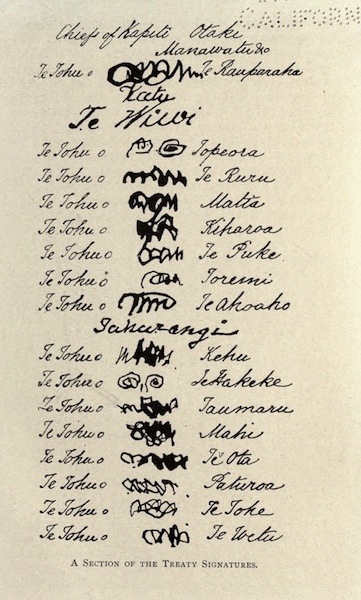
A Section of the Treaty Signatures.
To this Lord Normanby replied that Captain Hobson had correctly interpreted his instructions when he limited his Lordship's remarks concerning the independence of the New Zealanders to the tribes inhabiting the Northern Island. His knowledge respecting the Southern Island was too imperfect to allow of his laying down any definite course of action to be pursued there. If it were really as Captain Hobson supposed, uninhabited, or peopled only by a small number of tribesmen in a savage state, incapable from their ignorance of entering intelligently into any treaties with the Crown, then the ceremonial of entering into any such engagements with them would be a mere illusion and pretence which ought to be avoided, and discovery might be made the basis of the Crown's claim. Still he had a marked predilection in favour of a treaty as the only means of affording an effective protection to the natives; "but," he continued, "in my inevitable ignorance of the real state of the case I must refer the decision in the first instance to your own discretion, aided by the advice you will receive from the Governor of New South Wales."
The frankness with which Lord Normanby admitted his "inevitable ignorance" of native conditions in the South Island is in striking contrast to Hobson's confident assurance that they were "wild savages with whom it was scarcely possible to observe even the form of a treaty," for at this time his intercourse with the southern tribes was as limited as that of the Chief Secretary's. Nor was his knowledge of them any more complete when he issued his proclamation on May 21. He was then clearly under the impression that the southern tribes were a people physically, intellectually, and socially much inferior to those whom he had met in the North; in fact, so much inferior that he did not believe them capable of understanding the spirit or the letter of a treaty. Such an opinion could only have been founded upon information conveyed to him at the Bay of Islands, and that by chiefs who, glorying in the pride of conquest, were no doubt wont to look upon their southern enemies as the siftings of the race; as "the remnant of their meal." It is therefore open to doubt whether Hobson ever anticipated any great measure of success when he despatched Major Bunbury to the South, and it is conceivable that the results achieved by that ambassador were as pleasing to the Lieutenant-Governor as the information was surprising that the Southern Island and the southern people had been much misunderstood. The falsity of the impression under which Captain Hobson acted, together with all that had gone before, completely undermines the value of his proclamation of May 21, and M. Guizot was only stating the fact when in answer to his critics he declared in the Chamber of Deputies that "this method of taking possession (by right of discovery) has never had any serious consequences. It could not be regarded as having constituted rights, and that is so true that the English Government has been the first to proclaim it."
The second clause of the treaty proved to be the storm centre of the compact. By those natives who took the trouble to reason out the purpose and effect of the negotiation it was unanimously approved; by the land-jobbers it was as unanimously condemned. Guaranteeing as it did to the tribes the full and complete possession of their lands, fisheries, and forests, it complied with the one condition that made the treaty tolerable to them; yet by reserving to the Crown the right, by pre-emption,[167] to become the medium of purchase between the natives and the settlers, it provided the contentious point upon which all who were interested in the acquisition of land concentrated their attacks. Nor was this opposition shown merely because by a broad sweep of the pen the speculator's sphere of operations had been materially limited for the future, but the hostility became the more vehement because by an equally bold assertion of a great principle of law, the treaty called under review all that they had done in the past. The acknowledgment by the British Crown of the native title to all the land in New Zealand, whether waste or cultivated, was in the opinion of many a blunder grievous enough; but that the Crown should claim the right to scrutinise all titles which had been acquired before sovereignty was declared, was an excess of zeal which they regarded as nothing short of preposterous.
This feeling of indignation was rampant amongst those who were deeply implicated in land speculations when the proclamations were issued at Sydney and the Bay of Islands, declaring null and void all titles which were not derived from the Crown; and their ideas of British enterprise were even further outraged when on May 28, 1840, Sir George Gipps introduced to his Legislative Council, "A Bill[168] to empower the Governor of New South Wales to appoint Commissioners to examine and report on claims to grants of land in New Zealand."
In addition to the gigantic pretensions put forward by the New Zealand Company there were 1200 claimants whose demands upon the soil of the country varied from a single rood to over 20,000,000 acres. Three of these exceeded 1,000,000 acres each; three others were claiming 1,500,000 acres between them; three others comprised more than 25,000 acres each, while upwards of thirty persons expected to be placed in possession of more than 20,000 acres each, the aggregation of alleged purchases amounting to 45,976,000 acres. "Some of these claimants," says one writer, "had nothing more to show for their purchases than an ornamental scrawl on a deed which was so phrased as to be unintelligible to the chiefs who signed it." To reduce these wholesale purchases to some principle regulated by justice was the purpose of the Government; to let the dead past bury its dead was the fervent wish of all those who had entrenched themselves behind Maori signatures.
By the following June 25 the provisions of the Bill had been widely circulated, on which date a spirited protest against its enactment was received from a number of gentlemen claiming to be landowners in the new colony. This document, which was presented to the Legislative Council by Mr. H. H. Macarthur, set out that the petitioners having perused certain proclamations in the New South Wales Government Gazette of January 22, as well as the Bill introduced by the Governor, they submitted that their rights and privileges as subjects of the Queen and as landowners in New Zealand would be unwarrantably and unconstitutionally invaded by the provisions of the said measure. They therefore prayed that they might be heard by the Council in protest against such unjust legislation.
So reasonable a request was readily acceded to by the members of the Legislature, and on June 30 Mr. Busby, the former British Resident, Mr. William Charles Wentworth, Mr. A'Beckett, and Mr. Darvall, barristers-at-law, were introduced to the Council, and on that and several subsequent days addressed the members in opposition to the Bill.
The burden of Mr. Busby's contention in defence of his claim to 50,000 acres, including the site of a township, was that the Bill sought to legalise confiscation, and that therefore the principles which it was designed to enact were at variance with and in excess of all that was sanctioned by the British constitution.[169] No doubt, he said, there were many claims to land in New Zealand which would not bear investigation; but contrariwise there were many respectable settlers on the banks of the rivers and shores of the harbours who would be deeply injured were the proposed Bill to become law. This injury would be all the more ruthless because no attempt had been made by the Government, now become so paternal, to prevent British subjects acquiring property in New Zealand, as had been done in the case of those settlers who had come over from Van Dieman's land to originate the settlement at Port Philip. No sooner did it become known that these speculators had purchased extensive tracts of country from the aborigines than a proclamation was issued declaring the illegality of their proceedings. No such prohibition had, however, been put upon the acquisition of property in New Zealand, where the settlers, relying upon certain acts of repudiation by the British Government, had purchased from the natives in the belief that they were negotiating with an independent people. Mr. Busby proceeded to review the various stages of New Zealand's history in order to emphasise the events by which the independence of the chiefs and people had been repeatedly acknowledged, and concluded by asking why the chiefs had been induced under the Treaty of Waitangi to surrender the pre-emptive right of purchase to the Queen if they had never had the right as an independent people to dispose of their lands as they pleased?
Mr. Busby was followed by Mr. Wentworth, one of the local Magistrates, who was claiming 100,000 acres in the North Island, and practically the whole of the South Island except some 3,000,000 acres which he magnanimously conceded had been already sold to other purchasers. The history of Mr. Wentworth's claim, which to say the least, was one of the most scandalous in the long list of extraordinary transactions with the natives, is thus told by Sir George Gipps in his despatch to the Chief Secretary for the Colonies,[170] in which he intimated that in consequence of the part Mr. Wentworth had played in this flagrant attempt to flout the Government, he desired to withdraw a recommendation he had previously made in favour of this gentleman's appointment to the Legislative Council.
"In the month of February last" (1840), wrote Sir George, "seven[171] chiefs from the Middle Island of New Zealand happening to be in Sydney, it was suggested to me by the persons who had brought them here, and under whose protection they were living, that they should be invited to sign a declaration of willingness to receive Her Majesty as their sovereign, similar in effect to the declaration which Captain Hobson was then engaged in obtaining from the chiefs of the Northern Island. The chiefs in question were accordingly brought to the Government house, and, through the medium of an interpreter, the nature of the document they were required to sign was fully explained to them in the presence of myself, the Colonial Secretary, and several persons who claimed to have purchased land in the Middle Island; and amongst other things it was expressly declared to them that only such purchases of land as should be approved by Her Majesty would ultimately be confirmed. At the conclusion of this conference a present of ten sovereigns was made to each of the chiefs, and they all promised to attend on the next day but one to sign the paper which was to be prepared for them. On the day appointed, however, none of them appeared; and in reply to a message that was sent to them, a short answer was received by one of the Englishmen, under whose protection they were, that they had been advised to sign no treaty which did not contain full security for the possession by the purchasers of all lands acquired from the natives.
"It subsequently appeared that it was by the advice of Mr. Wentworth that they adopted this course of proceeding; and Mr. Wentworth, when before the Council, acknowledged that he had not only given the advice, but also that he had subsequently and after the issue of my proclamation, in conjunction with four or five persons, purchased the whole of the Middle Island (or all the unsold portion of it) from these very natives, paying them for it £200 in ready money, with a promise of a like sum as long as they should live.[172]
"Such was the origin of Mr. Wentworth's claim to twenty millions of acres in the Middle Island," continued Sir George, "and it was the legality and validity of this transaction that he appeared before the Council to defend."
The magnitude of the property at stake naturally excited Mr. Wentworth to his most eloquent effort, and in an address of considerable length and subtlety he argued that before the proclamations issued by Sir George Gipps and Captain Hobson, nullifying all titles to land not derived from the Queen, could be binding upon British subjects, they must be founded upon some law previously existing; and if they were so founded then it was the duty of those who had issued them to satisfy the Council what that law was. The principle contained in the preamble of the Bill—that no chiefs, or other individuals of tribes of uncivilised savages had any right to dispose of the lands occupied by them—was, he contended, at variance with British law and with the Law of Nations. Numerous authorities were marshalled in support of this view, and also to prove that it mattered nothing whether the New Zealanders were an independent nation or only a few errant tribes scattered over the country; they still possessed the demesne of the soil to do with as they pleased. This being so, those who purchased land from them were only acting in accordance with the natural rights of the natives and in compliance with the Law of Nations. According to Vattel—one of the world's most eminent authorities upon the relation of one nation to another—individuals landing in an uninhabited country might not only establish colonies, but also erect a government and an empire, and he argued that if such a proceeding was permissible in an uninhabited country, it resulted a fortiori, that it might be done in a country that was peopled, provided the natives of that country gave their consent thereto. The story of the first New England Settlement under Davenport and others, in 1620, was urged as conclusive proof that British subjects, unsupported by a Royal Charter, might form colonies and erect governments, as had been done in Connecticut, where the government so established had lasted for over two centuries. He denied that there was any merit in the official assumption that the Crown had derived sovereignty over the Islands of New Zealand by right of discovery. Discovery gave no right of occupation in an inhabited country, nor would the Law of Nations acknowledge the property and sovereignty of any nation unless its possession were real, unless its settlements were actual, or it had in some way made practical use of the soil. The Bill rested upon the principle that the native was incompetent to sell his own land, and the British subject was incompetent to buy—a principle which he thought he had clearly disproved. Confiscation was the key-note of the measure. It was a Bill designed to take away property, annul grants, and to forfeit all landed possessions acquired by British subjects in New Zealand. He condemned the Bill absolutely, because he claimed to have established on incontestable grounds, and by the aid of indisputable authorities, the right of British subjects to buy land from the New Zealanders, a right which could not be taken away until the Council passed an Act to restrain it. Under these circumstances it was highly illegal to proceed to divest parties of their possessions without adequate compensation, such as was given in England when land was required for public purposes. The compensation to be given in such cases must always be awarded by a jury; therefore the proposed Bill was clearly repugnant to the laws of England. Only a few days previously the Council had passed an Ordinance, making all the laws of England and of the colony of New South Wales applicable to New Zealand. Amongst these was the right of trial by jury of which the proposed Bill was completely subversive; it took away the right of trial by jury; and therefore, declared Mr. Wentworth, the Council could not pass it, or if they did, the Judges could not certify to it.
These arguments were reiterated and amplified by the two barristers, Messrs. A'Beckett and Darvell, and on July 9 their official refutation was placed before the Council by Sir George Gipps, who on that day delivered in reply a speech remarkable for its broad grasp of constitutional history, as well as for its fearless declaration of the attitude adopted by the Crown. It was during the development of this smashing rebuttal that the objectors were enlightened as to the three great principles of law upon which the second clause of the treaty was founded; "principles, which, until I heard them here controverted," said Sir George, "I thought were fully admitted, and indeed received as political maxims." Briefly these were:
1. That the uncivilised inhabitants of any country have but a qualified domain over it, or a right of occupancy only; and that, until they establish amongst themselves a settled form of government, and subjudicate the ground to their own uses by the cultivation of it, they cannot grant to individuals, not of their own tribe, any portion of it, for the simple reason that they have not themselves any individual property in it.
2. That if a settlement be made in any such country by a civilised power, the right of pre-emption to the soil, or in other words, the right of extinguishing the native title, is exclusively in the Government of that power, and cannot be enjoyed by individuals without the consent of the Government.
3. That neither individuals nor bodies of men belonging to any nation can form colonies, except with the consent and under the direction and control of their own Government, and that from any settlement which they may form without the consent of their Government they may be ousted. That is, so far as British subjects are concerned, they cannot form colonies without the consent of the Crown.
It is not necessary to closely analyse the first of these declarations, as whatever may be said of it as a principle of law it was not in any sense applicable to New Zealand. Logicians may amuse themselves discussing why a people who are capable of granting titles to individuals of their own tribes are yet incapable of granting similar rights or concessions to individuals of other nations; or how the Government of another nation can acquire from those natives a title to land which it has already declared the natives do not possess and have no power to give. In other words, it may form sport to the mental speculator to discover how a Government can extinguish a native title which that Government has affirmed does not exist, for that is what this declaration of principle means if it is to be invested with any meaning at all.
Such reasoning is at this juncture foreign to our purpose, because, however true it may be that the native lands of New Zealand being held in common, it was not competent for individual natives to grant titles to Europeans, seeing that no individual interests had been ascertained, the right of the tribes of New Zealand to dispose of their lands as they pleased was incontestable. As has already been pointed out, they were by no means in such an uncivilised state as to be devoid of a form of government adequate in all respects for their primitive purposes. Especially was their occupancy and ownership of land highly systematised. It may be true that they had not "subjudicated the ground to their own uses by the cultivation of it," as the term cultivation is freely understood by us, but the waste spaces were just as valuable, just as necessary to them as the garden patches. Their forests, their open plains, their wild mountain sides were as much the sources of their food-supply as were their kumara fields, the streams, or the open sea, and so definitely was this understood amongst them that every hill and valley was known, named, and owned under one of their various tenures. There was, in fact, no side of his tribal life about which the Maori held such clear conceptions, or was so fixed and determined as the occupancy and ownership of the soil, for which in olden days, as in Pakeha days, he was ever ready to fight and, if necessary, to die.
If then Sir George Gipps desired to convey to his Council the impression that the New Zealanders were incompetent to deal with their own lands, he was setting up an entirely false hypothesis, an error into which he was no doubt led through not being clearly seized of all that Maori land tenure implied, the full meaning of which was afterwards to be debated on many a hard-fought field.
That the right of extinguishing the native title rested solely with the Crown was a sounder contention, based upon principles deep set in constitutional law, and supported by the practice of all colonising nations. It was the endeavour of Mr. Wentworth, and those associated with him, to depreciate the principle of pre-emption by casting at it the cheap sneer that it was "American law," and so it was. But it was British law before it was American law, and has only been heard of in American courts more frequently than in English tribunals, because questions incidental to the settlement of the New World have called it more frequently into prominence there. Broadly put the principle rests upon the assumption, dating from feudal times, that the King was the original proprietor of all the land in the kingdom, and the true and only source of title. Therefore all valid individual titles must be derived from the Crown. With the development of constitutional government the personality of the King has disappeared, but still no nation will suffer either its own subjects or the subjects of another nation to set up a title superior to its own. It has thus become a right exclusively belonging to the Government in its sovereign capacity, to extinguish the native title to a country which it may be colonising, "to perfect its own domain over the soil, and to dispose of it at its own good pleasure."
Once admitting that the natives of New Zealand had a valid title to the soil of the country, and were competent to deal with that title, the prerogative of the Crown in exercising the pre-emptive right to extinguish it under the terms of an equitable treaty was not difficult to maintain. But the buttress[173] behind the attitude which the Government adopted towards the New Zealand land purchasers was to be found in the third declaration of principle enunciated by Sir George Gipps. Here it was laid down "that neither individuals nor bodies of men belonging to any nation can form colonies, except with the consent, and under the direction and control of their own Government."
The fundamental reason which induces nations to hedge its subjects about with this restriction, was thus concisely stated by the Select Committee of the House of Commons in 1844. Although this Committee roundly condemned the Treaty of Waitangi as "a part of a series of injudicious proceedings," it was yet as hostile to the New Zealand Company in seeking to set up a settlement independent of Imperial authority, thereby imperilling their own position and prejudicing that of the Crown.
When large numbers of British subjects have established themselves in distant regions, inhabited only by barbarous tribes, it is impossible for Her Majesty's Government to leave them exposed without protection to the dangers which their own rashness may draw down upon them, or to allow them to exercise, without control, and perhaps to abuse the power which their superior civilisation gives them over the rude natives of the soil. Hence every new establishment of this kind involves a new demand upon the naval and military resources of the Empire, but the undue anticipation of such demands must occasion a very heavy burden upon the nation, and it therefore follows that the enterprises of colonisation should only be entered upon with the sanction and under the authority of the Government.
On this ground and on this ground alone the British Government was justified in calling a halt in the irregular settlement of New Zealand, and if a mistake was made it was not in that the Government now interposed their authority,[174] but in that they had not asserted their rights at a much earlier period. In support of this portion of his argument Sir George Gipps quoted the opinions of four of the most eminent lawyers in England of that day, Mr. William Burgh, Mr. Thomas Pemberton, Sir William Follett, and Dr. Lushington. He was even uncharitable enough to use against the New Zealand Company the opinion of their own legal adviser, Sergeant Wilde, the crushing nature of these authorities completely breaking down the pretensions of his opponents.
"I leave the Honourable Members of this Council," declared Sir George, "to say whether they will take the law from the authorities which I have produced or from the learned gentlemen who have been heard at their table; remembering, moreover, that the former were giving their opinions against their clients, the latter arguing, as they were bound to do, in favour of them."
Sir George also claimed for the British Government the right to intervene in New Zealand affairs, so far as land titles were concerned, on the ground of its immediate contiguity to the colony of New South Wales, in support of which claim he quoted an opinion expressed by a Committee of the House of Commons in 1837, and in further appeal he might have advanced the fact that in the previous fifty years Great Britain had expended no less a sum than £8,000,000 upon colonisation in the South Pacific, a fact which was surely substantial enough to create the peculiar rights which are inseparably associated with those intimate relations which grow out of neighbourhood. Finally, he thus summarised the powers which were sought for in his measure and those which it did not seek:
The Bill, gentlemen, is not a Bill of spoliation as it has been described; it is not a Bill to destroy titles, but rather to bestow titles on persons who at present have none, and who cannot get any but from the Crown. It is not a Bill to take away any man's tenementum, but to give him a tenementum, provided he can show that he has a fair and equitable claim to it, though not indeed a tenementum to any one in the lands which were purchased, or pretended to be purchased, after the issue of my proclamation and in defiance of it, for not one acre of such land shall any one ever acquire under it. Nor is it, gentlemen, a Bill to give Her Majesty any power that she does not already possess; for her power to disallow these titles is vested in her by virtue of her prerogative, and of that principle of English law which derives all landed property from the gift of the Crown. Her Majesty's prerogative in this matter is about to be exercised, not for the love of power, not for the lust of patronage, but for the good of her subjects, for which alone it is given to her; and the exercise of it in this case will be an additional proof that the prerogative is what it was elegantly described to be in the course of the pleadings in the Grenada case, of which we have heard so much, the decus et tutamen regni, the grace, the ornament, the safeguard, not regis, of the King, but regni, of the realm. I have not heard one reasonable and disinterested person object to the main purpose of this Bill. Of all the witnesses examined before the Committee of the House of Lords in 1838, no one was so wild as to say that all purchases from the natives of New Zealand were to be acknowledged; no one pretended, because the Narraganset Indians sold Connecticut, as we have been told they did, for a certain number of old coats and pairs of breeches, or because they sold Rhode Island (as I find they did), for a pair of spectacles, that therefore Her Majesty is bound to acknowledge as valid purchases of a similar nature in New Zealand. The witnesses to whom I have alluded all considered the New Zealanders as minors, or as wards of Chancery, incapable of managing their own affairs, and therefore entitled to the same protection as the law of England affords to persons under similar or analogous circumstances. To set aside a bargain on the ground of fraud, or of the incapacity of one of the parties to understand the nature of it, or his legal inability to execute it, is a proceeding certainly not unknown to the law of England; nor is it in any way contrary to the spirit of equity. The injustice would be in confirming any such bargain; there would indeed be no excuse for Her Majesty's advisers, if, by the exercise of her prerogative, she were to confirm lands to persons who pretend to have purchased them at the rate of 400 acres for a penny; for that is, as near as I can calculate it, the price paid by Mr. Wentworth and his associates for their twenty millions of acres in the Middle Island. A great deal was said by this gentleman, in the course of his address to the Council, of corruption and jobbery, as well as the love which men in office have for patronage. But, gentlemen, talk of corruption! talk of jobbery! Why, if all the corruption which has defiled England since the expulsion of the Stuarts was gathered into one heap, it would not make up such a sum as this; if all the jobs which have been done since the days of Sir Robert Walpole were collected into one job, they would not make so big a job as the one which Mr. Wentworth asks me to lend a hand in perpetrating; the job, that is to say, of making to him a grant of twenty millions of acres at the rate of 100 acres for a farthing! The Land Company of New South Wales has been said to be a job; one million of acres at eighteen pence per acre has been thought to be a pretty good job, but it absolutely vanishes into nothing by the side of Mr. Wentworth's job. In the course of this gentleman's argument, he quoted largely from Vattel and the Law of Nations to prove the right of independent people to sell their lands; and he piteously complained of the grievous injustice which we should do to the New Zealanders if we were to deny them the same right; and the Council may recollect that when I reminded him that he was here to maintain his own rights and not those of the New Zealanders, he replied, not unaptly, that as his was a derivative right, it was necessary for him to show that it had previously existed in the persons from whom he had derived it; it was, in fact, necessary for him to show that the right existed in the nine savages, who were lately in Sydney, to sell the Middle Island, in order to show his own right to purchase it from them at the rate of 400 acres for a penny! Lastly, gentlemen, it has been said that the principles on which this Bill is founded are derived from the times of Cortez and Pizarro—times when not only the rights of civilised nations, but the rights also of humanity, were disregarded. To this I answer, that whatever changes (and thank Heaven they are many) which the progress of religion and enlightenment have produced amongst us, they are all in favour of the savage, and not against him. It would be indeed the very height of hypocrisy in Her Majesty's Government to abstain, or pretend to abstain, for religion's sake, from despoiling these poor savages of their lands, and yet to allow them to be despoiled by individuals being subjects of Her Majesty. It is in the spirit of that enlightenment which characterises the present age, that the British Government is now about to interfere in the affairs of New Zealand. That it interferes against its will, and only under the force of circumstances, is evident from Lord Normanby's despatch; the objects for which we go to New Zealand are clearly set forth in it, and amongst the foremost is the noble one of rescuing a most interesting race of men from that fate which contact with the nations of Christendom has hitherto invariably and unhappily brought upon the uncivilised tribes of the earth. One of the gentlemen who appeared before you did not scruple to avow at this table, and before this Council, that he can imagine no motive Her Majesty's Ministers can have in desiring the acquisition of New Zealand but to increase their own patronage. The same gentleman is very probably also unable to imagine any other reason for the exercise of Her Majesty's prerogative than the oppression of her subjects. These, gentlemen, may be Mr. Wentworth's opinions. I will not insult you by supposing they are yours. You, I hope, still believe that there is such a thing as public virtue, and that integrity is not utterly banished from the bosoms of men in office. To your hands, therefore, I commit this Bill. You will, I am sure, deal with it according to your consciences, and with that independence which you ought to exercise, having due regard for the honour of the Crown and the interests of the subject; whilst for myself, in respect to this occupation of New Zealand by Her Majesty, I may, I trust, be permitted to exclaim, as did the standard-bearer of the Tenth Legion when Caesar first took possession of Great Britain, Et ego certe officium meum Reipublicae atque Imperatori praestitero, fearlessly alike of what people may say or think of me, I will perform my duty to the Queen and to the public.
This forceful presentation of the case for the Crown left the Council but one course open to it, and on the following August 4 the Bill had passed through all its stages and became a colonial statute. Under its provisions Commissioners in the persons of Messrs. Francis Fisher, William Lee Godfrey, and Matthew Richmond were appointed and commenced their investigation of land claims at the Bay of Islands. The separation of New Zealand from the colony of New South Wales in April 1841, however, put an end to the functions of the Commissioners under the measure, and it became necessary to revive their powers under a New Zealand statute. In his instructions covering the granting of a new Charter to New Zealand as an independent colony, Lord John Russell, the new Chief Secretary, had sustained the attitude adopted by his predecessor, Lord Normanby, on the land question. Accordingly, on June 9, 1841, under advice from Lord John, an ordinance was passed by the Legislative Council assembled at Auckland, repealing the previous Act of New South Wales and furnishing Captain Hobson, the now Governor of New Zealand, with the requisite power to appoint their successors. Intelligence had also been received in the meantime that Mr. Spain, an English lawyer, had been appointed Chief Commissioner of land claims; and under the New Zealand statute only two of the original Commissioners were reappointed, Mr. Fisher having accepted the office of Attorney-General to the colony.
With the deliberations and adjustments of this Commission we are not particularly concerned. What is of importance is that its proceedings led to a voluminous, and at times acrimonious correspondence between the New Zealand Company and Lord Stanley, who, in 1841, succeeded Lord John Russell as Secretary of State for the Colonies in Sir Robert Peel's cabinet. During the course of this correspondence the Company boldly maintained that, under an arrangement made with his predecessor,[175] they were so situated as to be beyond the pale of the Commission's enquiries which they said would shake every title in their settlements. They declared that the circumstances in which they had acquired the land they were now claiming were such as could not be affected by the Treaty of Waitangi, they even repudiated the validity of the treaty itself. On January 24, 1843, Mr. Joseph Somes, as Governor of the Company, despatched that celebrated letter to Lord Stanley in which occurred this significant passage: "We have always had very serious doubts whether the Treaty of Waitangi, made with naked savages by a Consul invested with no plenipotentiary powers, without ratification by the Crown, could be treated by lawyers as anything but a praiseworthy device for amusing and pacifying savages for the moment."
On the 15th of the following month a further letter was received from Mr. Somes, in which he specifically denied the application of the treaty to the particular possessions of the Company; and in order to give a verisimilitude of truth to his argument deliberately made light of the historical facts connected with the signing of the treaty:
"We have not," he wrote, "thought proper, hitherto, to advert to the Treaty of Waitangi except incidentally. But as we observe that it has occasionally been dwelt upon by your Lordship as being of some importance to the view taken by you in opposition to our claims, it is well that we should not quit the subject without remarking that your Lordship appears always to speak of that treaty as bearing on the entire claim of the Company. Now, your Lordship ought to be apprised of the fact that the Treaty of Waitangi itself applies to no part of the vast extent of country over which we claim the right of selection. The chiefs who signed the treaty neither could, nor did, pretend to cede anything but the northern corner of the Northern Island. Subsequently, it is true, Captain Hobson procured the accession to the treaty of chiefs further south. But the alleged accession of the chiefs within the limits of the Company's possessions in the Northern Island rests merely on evidence far too slight and loose to be taken as establishing a fact of such grave public character; at any rate, half at least of the 20,000,000 affected by our claim lie in the Middle (South) Island; and the Middle and Stewart's Islands, it is obvious, cannot be affected by the Treaty of Waitangi, inasmuch as Her Majesty's title to them was 'asserted' on the grounds of discovery without pretence to any treaty or cession."
This attempt to mislead the Minister by a flagrant disregard for the proceedings of Major Bunbury and all that those proceedings implied, was unfortunately but too characteristic of the methods pursued by the Company at this time, whose officers had now developed a dexterity in conjuring with facts against the subtlety of which the Minister could not too jealously guard the public interests.
To the equivocal attitude adopted by the Company Lord Stanley replied through his Under-Secretary, Mr. Hope, in one of the noblest passages ever penned by a British Minister,—a passage in which he sternly refused to sacrifice official integrity to mere commercialism or national honour to ambitious personal ends:
"Lord Stanley," wrote Mr. Hope, "is not prepared, as Her Majesty's Secretary of State, to join with the New Zealand Company in setting aside the Treaty of Waitangi, after obtaining the advantages guaranteed by it, even though it might be made with 'naked savages,' or though it might be treated by lawyers as 'a praiseworthy device for amusing and pacifying savages for the moment.' Lord Stanley entertains a different view of the respect due to the obligations contracted by the Crown of England, and his final answer to the demands of the New Zealand Company must be that, so long as he has the honour of serving the Crown, he will not admit that any person, or any Government acting in the name of Her Majesty, can contract a legal, moral, or honorary obligation to despoil others of their lawful and equitable rights."
Foiled in their efforts to induce the Colonial Minister to award them the full measure of their enormous claim without question or enquiry, the Company then preferred a claim for compensation against the State on the grounds that the policy of the Colonial Office and the proceedings of the Government in New Zealand had brought them to the verge of financial ruin. Still powerful in the House of Commons they were able to exert considerable influence there, and in April 1844 a Select Committee was set up, with Lord Howick, now one of the Company's warmest friends, as Chairman, and an order of reference which authorised them "to enquire into the State of the Colony of New Zealand, and into the proceedings of the New Zealand Company."
The Committee sat until July, taking voluminous evidence from many persons who had some previous knowledge of the country, and when they met to formulate their report it was found that they were sharply divided on material points. A section of the Committee, led by Messrs. Cardwell and Hope, Lord Stanley's Under-Secretary, endeavoured to so frame the report as to make amongst others the following acknowledgments:
That from the time of the discovery by Captain Cook to the beginning of the year 1840, the independence of New Zealand had never been questioned by this country, and in 1832 was recognised by the British Government in a very peculiar and formal manner.
That the urgent applications made by private individuals from time to time to the Colonial Office for the adoption of these islands as a British colony, were reluctantly acceded to by the British Government in 1839, with a view to preventing the evils arising and apprehended from irregular and unauthorised settlement.
That this adoption was effected in the early part of 1840 by an agreement called the Treaty of Waitangi, made by Captain Hobson with upwards of 500 chiefs and other natives, claiming and admitted on the part of this country, to represent the whole population, so far as regarded the Northern Island; while the other islands, which contained no population capable of entering into anything resembling a civil contract, were assumed to the British Crown by the right and title of discovery.[176]