Chapter V · IN SEARCH OF SIGNATURES
Reading edition
Although Captain Hobson had every reason to be gratified with the result of his mission at Waitangi, it was perfectly obvious that the signatures obtained there were only sufficient to give him jurisdiction over a very circumscribed area of country. It was equally evident that if the full intentions of the British Government were to be given effect to, it would be necessary to put into practice the Mahomedan principle and go to the mountain, since the mountain had failed to come to him. He accordingly arranged a campaign by which the districts north of the Bay of Islands would be visited, either by himself personally, or by his duly accredited officers. Pursuant to this arrangement on the morning of the 10th, the Lieutenant-Governor (accompanied by Captain Nias) and his suite left the Bay of Islands and rode over to the Mission station at Waimate, where on the 12th they held a meeting and obtained the signatures of all the chiefs present. With two of the Church Missionaries, Messrs. Taylor and Clarke, added to his company, Captain Hobson left Waimate next day and continued his journey to Hokianga, where it was anticipated a great meeting would be held. On arriving at Waihou, a settlement on the banks of the river about seven miles above the Wesleyan Mission station,—for he was now within the Wesleyan sphere of influence,—the Governor was met by the members of the Mission and all the principal European settlers in the neighbourhood. Here he received, probably in the form of an address, the warmest assurances of the settlers' fidelity to the Queen, and the most hearty congratulations to himself upon his selection as her representative.
From this point the journey was continued by boats supplied by the settlers, and the progress down the river was marked by frequent evidences of cordiality and even enthusiasm. On passing the settlement at Hauraki a salute of thirteen guns was fired from a miniature fort of European construction, and on arrival at the Mission station the Governor was again the recipient of congratulations from the settlers and the Missionaries.
In response to these graceful felicitations Captain Hobson delivered a brief address, in which he expressed the high sense he entertained of this earnest of their loyal zeal in forwarding the views of Her Majesty's Government, and of the honour they had conferred upon him personally by their flattering attention. At the same time Captain Hobson took occasion to announce that in accordance with notices already published, he proposed to hold a meeting of the chiefs there next day, to which a cordial invitation was extended to the European population of every class and nation.
The novelty of the occasion was not without its influence upon the natives, and upon a careful estimate it is computed that there were not less than 3000 at the station next morning, of whom between 400 and 500 were chiefs of varying rank and importance. Thus everything promised well. But at the hour appointed for the assembly it was observed that there was a great disinclination on the part of the chiefs to associate themselves with the movement. Some were reticent, others morose, more were openly hostile, and that to such an extent it was manifest they were not approaching the subject with unprejudiced minds, and it required no keen observer to detect that an unfavourable spirit prevailed amongst them. By the exercise of a little judicious manœuvring, however, they were at length induced to admit that there could be nothing derogatory in at least hearing what message the Governor had to deliver, and after some delay they were induced to form into procession and march to the place of meeting.
The business of the day commenced in much the same manner as it had done at Waitangi and Waimate, the Rev. Mr. Hobbs, of the Wesleyan Mission, acting as interpreter. After a short address to the Europeans, Captain Hobson entered into a full explanation to the chiefs of the views and motives of Her Majesty in proposing to extend to New Zealand her powerful protection. He then, as on previous occasions, read the treaty, expounded its provisions, offered to elucidate all doubtful points, and invited the freest discussion. "This undisguised manner of proceeding," wrote Captain Hobson to Sir George Gipps, "defeated much of the opposition, but did not, to the extent of my wish or expectation, remove the predetermination to oppose me that had already been manifested. The New Zealanders are passionately fond of declamation, and they possess considerable ingenuity in exciting the passions of the people. On this occasion all the best orators were against me,[94] and every argument they could devise was used to defeat my object."
The debate was opened by Aperahama Taonui, who rose and said: "We are glad to see the Governor. Let him come to be a Governor to the Pakehas. As for us we want no Governor; we will be our own Governor. How do the Pakehas behave to the black fellows at Port Jackson? They treat them like dogs! See a Pakeha kills a pig; the black fellow comes to the door and eats the refuse."
"What is the Governor come for?" exclaimed Papahia. "He, indeed! He to be high, very high, like Maungataniwha (a high hill near Hokianga) and we low on the ground; nothing but little hills. No, no, no! Let us be equal; why should one hill be high and another low? This is bad."
Moses (Mohi Tawhai)—"How do you do, Mr. Governor? All we think is that you come to deceive us. The Pakehas tell us so, and we believe what they say; what else?"
Taonui—"We are not good (or willing) to give up our land. It is from the earth we obtain all things. The land is our Father; the land is our chieftainship; we will not give it up."
"No, no," cried Kaitoke; "no, Mr. Governor, you will not square out our land and sell it. See there, you came to our country, looked at us, stopped, came up the river, and what did we do? We gave you potatoes, you gave us a fish-hook; that is all. We gave you land, you gave us a pipe, that is all. We have been cheated, the Pakehas are thieves. They tear a blanket, make two pieces of it, and sell it for two blankets. They buy a pig for one pound in gold, and sell it for three. They get a basket of potatoes for sixpence, sell it for two shillings. This is all they do; steal from us, this is all."
Here the voluble Taonui again broke in upon the proceedings with some observations which were so clearly not of native origin as to convince Captain Hobson that he had not only the natural Maori ignorance and suspicion to contend with, but powerful counter-influences originating with the Europeans.
"Ha, ha, ha, this is the way you do," cried Taonui. "First your Queen sends Missionaries to New Zealand to put things in order, gives them £200 a year. Then she sends Mr. Busby to put up a flag, and gives him £500 a year, and £200 to give to us natives. Now she sends a Governor."[95]
"Speak your own sentiments, not what bad men have told you," retorted Captain Hobson.
"I do," replied Taonui. "I have not been to Port Jackson, but I know Governors have salaries."
The Governor again felt compelled to interpose, and accused the speaker of being prompted by designing Europeans.
This fact Taonui frankly admitted, and, turning to the assembly, called for his Pakeha adviser to come forward and sustain his allegations. "This call was reiterated by me," says Captain Hobson, "when a person named Manning[96] presented himself. I asked him his motive for endeavouring to defeat the benevolent object of Her Majesty, whose desire it is to secure to these people their just rights, and to the European settlers peace and civil Government."
Manning's reply was that he conscientiously believed that the natives would be degraded under British rule and influence, and that therefore he had advised them to resist the persuasions of the Governor and the Missionaries in favour of the treaty, admitting at the same time that the laws of England were requisite to restrain and protect British subjects, but to British subjects alone should they be applicable.
"But are you not aware that English laws can only be exercised on English soil?" asked Captain Hobson.
"I am not aware," replied Manning, "I am not a lawyer."
"Then that will do. Resume your seat," commanded Hobson.
The Lieutenant-Governor then proceeded to tell the chiefs that their Pakeha friend had given them advice in utter ignorance of the most important principle that British laws could not be enforced on a foreign soil, and that their only hope of protection against unscrupulous Europeans was to become a party to the treaty.
"If you listen to such counsel," he continued, "and oppose me, you will be stripped of all your lands by a worthless class of British subject, who will consult no interest but their own, and who care not how much they will trample upon your rights. I am sent here to control such people, and to ask from you the authority to do so."
This spirited little speech was responded to by what Captain Hobson has called "a song of applause." Several chiefs who had been silently sympathetic with the Governor now sprang up actively in his support, and by their championship changed the whole spirit of the debate.
"Welcome, welcome, welcome, Governor!" cried Ngaro. "Here are the Missionaries; they come to the land, they bought and paid for it, else I would not have them. Come, Come! I will have the Governor. No one else perhaps will say 'Yes,' but I, Ngaro, I will have him. That is all I say."
Moses (Mohi Tawhai)—"Where does the Governor get his authority? Is it from the Queen? Let him come; what power has he? Well, let him come, let him stop all the lands from falling into the hands of the Pakehas. Hear, all ye Pakehas! Perhaps you are rum-drinkers, perhaps not; hear what is said by us. I want all to hear. It is quite right for us to say what we think; it is right for us to speak. Let the tongue of every one be free to speak; but what of it? What will be the end? Our sayings will sink to the bottom like a stone, but your sayings will float light, like the wood of the Whau-tree, and always remain to be seen. Am I telling lies?"
Kaitoke, who had previously delivered a hostile speech, again openly maintained his opposition by interjecting, "Let us choose our own Governor."
These sentences, democratic though they were to the last degree, found no sympathy with Rangatira Moetara, who followed with a brief speech.
"Welcome, Mr. Governor! How do you do? Who sold our land to the Pakehas? It was we ourselves by our own free will; we let it go, and it is gone, and what now? What good is there in throwing away our words? Let the Governor sit for us."
Moses (Mohi Tawhai)—"Suppose the land has been stolen from us, will the Governor enquire about it? Perhaps he will, perhaps he will not. If they have acquired the land by fair purchase, let them have it."
Taonui, upon whom the refutation of Manning by the Governor had evidently had a marked effect, again rose and said:
"Lo, now for the first time my heart has come near to your thoughts. I approach you with my whole heart. You must watch over my children; let them sit under your protection. There is my land too; you must take care of it, but I do not wish to sell it. What of the land that is sold? Can my children sit down on it? Can they—eh?"
Here the chiefs Waaka Nēne, his brother Patuone, Rangatira, and Taonui stepped forward and chanted a song of welcome to the Governor, after which Nēne made the following speech:
"Listen to me, Governor; all of you listen to me. This is my speech. If the Baron de Thierry wishes to claim my land, why is he not here to-day? No, no; it was never sold to him. Does he think he will have it? No, no; he shall not have any of it. This is all I have to say."
A chief, Hone Kingi Raumati, whose baptismal name was John King, next delivered a sympathetic address: "My speech is to the Governor. This is what I have to say. It was my father, it was Muriwai, told me to behave well to the Pakehas. Listen, this is mine; you came, you found us poor and destitute. We on this side say, 'Stay and sit here.' We say, 'Welcome, welcome'; let those on the other side say what they like. This is ours to you. Stay in peace. Great has been your trade with our land. What else do you come for but to trade? Here am I. I who brought you on my shoulders.[97] I say come; you must direct us, and keep us in order; that is all mine to you. If any one steal anything now there will be payment for it. I have done my speech."
A chief whose name does not seem to have been preserved by the chronicler of the meeting, but who had support for the Governor in his words, said: "How do you do? Here am I, a poor man; and what is this place? A poor place, but this is why you have come to speak to us to-day. Let the Pakehas come and I have not anything to say against it. There is my place, it is good land; come and make it your sitting-place—you must stay with me. That is all."
The last speech was that of Daniel Kahika: "What indeed!" he said in indignant tones. "Do you think I will consent to other people selling my land? No, truly. If my land is to be sold I will sell it myself. But no, I will not sell my land. I do not like the Pakehas to tease me to sell my land. It is bad. I am quite sick with it. This is my speech."
So closed the debate at Hokianga. Apologies were freely offered by the opposing chiefs, the most prominent of whom at once came forward and signed the treaty.
"When the example had once been shown," wrote Captain Hobson, "it was with difficulty I could restrain those who were disentitled by their rank from inserting their names. Upwards of fifty-six signatures were given,[98] and at twelve o'clock at night the business closed. Before the last of the party were dismissed it was intimated to me that the chiefs were desirous I should attend their feast on the following morning, and in order to gratify them I relinquished a visit I had arranged to the lower part of the river. At ten o'clock on the 13th I went by appointment to the Hauraki, and there 1000 as fine warriors as were ever seen were collected in their best costume. The native war-dance, accompanied by those terrific yells which are so well qualified to exhibit the natural ferocity of the New Zealand character, was exhibited for my amusement, the guns from a small European battery were fired, and the natives discharged their muskets and dispersed under three hearty cheers for my party. The feast which I had ordered to be prepared, consisting of pigs, potatoes, rice, and sugar, with a small portion of tobacco to every man, was partaken of by all in perfect harmony. It was estimated that of men, women, and children there were 3000 persons present. The influence against me was entirely traceable to the foreign Bishop of the Roman Catholic persuasion, and to a set of escaped convicts and other low ruffians who have congregated on the river in considerable numbers. These parties, though actuated by different motives, were united in their proceedings, and many of the latter were agents of the former. Mr. Manning, whom I have before mentioned, though not of a degraded class, is an adventurer, who lives with a native woman, has purchased a considerable portion of land, and being an Irish Catholic is the active agent of the Bishop. Another person, altogether of a lower description, known under the name of 'Jackey Marmon,' who is married to a native woman, and has resided in this country since 1809, is also an agent of the Bishop. He assumes the native character in its worst form—is a cannibal—and has been conspicuous in the native wars and outrages for years past. Against such people I shall have to contend in every quarter, but I do not despair of arranging matters hereafter with comparative ease. The two points at which I have already met the natives were the strongholds of our most violent opponents, and notwithstanding the untiring efforts of the Bishop Pompallier and the convicts, I have obtained the almost unanimous assent of the chiefs. Of the whole of the Hokianga but two head chiefs refused their consent, and even from their tribes many chiefs have added their names to the treaty. On the morning of the 14th, when preparing to return here, I regret to say that, notwithstanding the universal good feeling which subsisted among the chiefs on the previous day, two tribes of the Roman Catholic Communion requested that their names might be withdrawn from the treaty. It is obvious that the same mischievous influence I before complained of had been exercised in this instance. I did not of course suffer the alteration, but I regret that the credulity of the chiefs should render them so susceptible of unfavourable impressions. I considered that on the conclusion of the treaty at Waitangi the sovereignty of Her Majesty over the whole of the northern district was complete. I can now only add that the adherence of the Hokianga chiefs renders the question beyond dispute. I therefore propose to issue a Proclamation announcing that Her Majesty's dominions in New Zealand extend from the North Cape to the 36th degree of longitude. As I proceed southward and obtain the consent of the chiefs I shall extend these limits by Proclamation until I can include the whole of the Island."
On the day that Captain Hobson had first met the Rev. Henry Williams on board the Herald one of the many subjects they had discussed was the purchasing of a site for the colonial Capital. In this respect the Missionary's geographical knowledge of the north was invaluable, and when asked for his opinion he immediately pronounced solidly against the Bay of Islands where the land was too confined for a potential city. He was, however, enthusiastic about the isthmus at the Waitemata, as being unoccupied by natives, and possessing topographical advantages far in excess of any other known site. It was, therefore, for the dual purpose of inspecting this promising locality, and of meeting the natives at Waitemata, that the Governor and Mr. Williams left the Bay of Islands on February 21 in the Herald. A considerable number of signatures were obtained at various points along the coast of the Hauraki Gulf, and on reaching the mouth of the Waitemata River in the Firth of Thames,[99] Mr. Williams was despatched to Maraetai to communicate with and collect the natives in that district. As he was returning to the ship four days later he met Captain Nias coming to meet him in his boat. The Captain conveyed to him the disquieting intelligence that on the previous Sunday (March 1) Captain Hobson had been attacked by a violent illness—due to the harassing nature of his duties and to long exposure to wet, resulting in a paralytic seizure[100]—so severe as to disable him, and to cause him to seriously contemplate his resignation and return to Sydney.
When the Missionary saw the invalid in his cabin he took a more optimistic view of the situation, and strongly urged Captain Hobson not to determine so hurriedly to relinquish his office as Governor. He further offered to find him comfortable quarters at the Mission station where he could rest and have every care it was possible to provide under the circumstances. These persuasions induced the Governor to fall in with the Missionary's views; the Herald returned to the Bay of Islands, and the patient was conveyed to the house of Mr. Richard Davis at Waimate, where he was attended by the ship's surgeon, Dr. Alexander Lane, and was for several months nursed with the utmost solicitude by the Missionary's family.
During this period of forced inactivity Captain Hobson displayed the greatest anxiety that the interests of his mission should not suffer because of his misfortune, and so far as his energies would permit he daily laid his plans for the carrying on of the campaign which had thus been suddenly interrupted so far as he was personally concerned.
Fortunately he was surrounded by a band of men who were loyal, and enthusiastic in the cause he had come to espouse, and he had no difficulty in enlisting the services of those who were prepared to continue the work where he had been compelled to lay it down. In this respect the Missionaries, confidently relying on the traditional justice of the British Government,[101] were particularly zealous, and to them more than to any one else does the ultimate success belong. Had they so much as whispered hostility, the treaty and all its professions would have been rejected and despised. So far from this, they not only lent it the influence of their word, but at this critical stage, when the Governor was lying a stricken man, they became the harbingers of its promises and the apostles of its principles.[102]
To the north went the Rev. Mr. Taylor with Mr. Shortland; to the east the Rev. William Williams, each bearing an authenticated copy of the treaty, and authorised to treat with the principal native chiefs, at properly constituted gatherings, for their signatures and their adherence to the provisions of the national compact.
The meeting in the north, which must rank next in importance to the gatherings at Waitangi and Hokianga, was that conducted by Lieutenant Shortland at Kaitaia. Indeed it is questionable whether in some respects it has not achieved a greater celebrity, for it was here that the eloquent chief Nopera (Noble) coined the phrase which has been more often quoted than any other in connection with the history of the treaty: "The shadow of the land goes to the Queen, but the substance remains with us."
On April 27 Mr. Shortland, who had now become Colonial Secretary, accompanied by the Rev. Mr. Taylor, Dr. Johnston, and Lieutenant Smart of the mounted police embarked on board the little schooner New Zealander, and steering for the far north, touched first at Mangonui, where they obtained the services of a native pilot, and on the following Saturday anchored in the Awanui River, fully sixteen miles from their destination. Mr. Taylor and the Doctor at once left the vessel, and pushed on to the Mission station, there to arrange the preliminaries with Mr. Puckey, the resident Missionary. The Colonial Secretary remained on board the schooner until the Monday, and then with Lieutenant Smart and the members of his force proceeded up the river to Kaitaia, where they were received with volleys of musketry, and the fearsome evolutions of the war dance. From an early hour on the following morning the chiefs and people were astir, busy with the preparations for the meeting, their demeanour being marked by a cordiality which had been so conspicuous by its absence at Waitangi and Hokianga.
At 10 o'clock the people—a motley and vivacious crowd—assembled on a large grass plot in front of Mr. Matthew's house, where they were addressed by the Colonial Secretary, with a solemnity befitting the occasion and a pomposity[103] which he deemed becoming his station. The illness of the Governor was touchingly referred to as a reason for the speaker's presence; the text of the treaty was read; the purpose of the compact explained; the machinations of the Queen's opponents were denounced, and a promise given that His Excellency would strictly perform all the solemn engagements which the treaty imposed upon him in the name of Her Majesty.
With this important difference, that there was but little opposition, there were few features to distinguish the debate from its predecessors. Several of the speakers boldly stated they had been told that the treaty was nothing but a cunning device to enslave them. There were also dark references to a Nga-Puhi plot to drive the Pakehas into the sea, but to which they unhesitatingly declared they were not prepared to give their countenance,[104] the speeches as a whole breathing deeply the influence of the Missionaries.
The first speaker was a chief who had accepted the baptismal name of Taylor,[105] who appeared to scent trouble, but subsequently signed the treaty under the name of Reihana Teira.
"This is my speech. We have always been gentlemen; we do not want a shepherd. We will not be hindered getting wood; we formerly cleared any spot of land we liked, burnt the wood; then some once came and built a house on it, and then we quarrelled."
"The Pakehas say the Governor comes to take the land," exclaimed a chief whose name has not been recorded. "This is the first time I ever heard the pukapuka (the treaty). The Pakehas explained it differently. Some people say plenty of Pakehas are coming to buy our land, but not for our good. They say the soldiers are come to shoot us, and that the Governor will not be a shepherd for us.[106] They say Mr. Puckey and Mr. Matthew know what is to become of us, but will not tell us. These are my sayings."
William (Wiremu Wirihana)—"They tell us you are come to murder all the Maoris, but if your works are good you will come to preserve us. If you are like the Missionaries that will be good. We fear the soldiers."
In clear and emphatic tones Te Rewiti, to whom has been given the English name of Davis, exclaimed, "I say 'Yes,' I say 'Yes' for the Queen. Although some men say 'No,' for the Governor, I say, 'Yes.' If the Governor come to be our shepherd that is good; but if he come to take our land I will not have him. If you say who makes me say, 'Yes,' I say my own heart. Much land has been bought by the Pakehas. Let it not be said it has been taken by the Governor. It has been taken before. I have nothing more to say. If you have anything to say, say it now, but do not go home and grumble."
"Let all our sayings be one, let none say 'No,'" was the counsel of Forde. "The Governor has not taken our land, it was taken before. My heart and my thoughts are with the Governor. I say, Yes, yes."
Marsden—"We shall not be slaves. Had we gone to other lands we might have been slaves; they have come to protect us. Let not our hearts be dark; let us not listen to words from afar; let us see first. Is it not sin to murder and commit adultery; to tell lies. If what we hear from our teachers is true then what we hear from the Governor is not a lie."
"I have no land to give the Governor," said Toketau (Tokitahi). "We were gentlemen before, we will be greater now. Now we have more blankets, shirts, and trousers. Our houses were once made of rushes; they are better now. I have made my speech."
Busby (Puhipi)—"Before the Pakehas came we loved our own people. We sometimes quarrelled and then made war; then we made peace again and rubbed noses, then we had another battle. I am glad you are come; let our hearts be one. If quarrels happen who will settle them? You are so far off. Murder and theft may be suppressed, but what shall be done with adultery? It is carried on privately; do not let it be said that I hide anything."
Pi (Pihere)—"It will be good to see all the adulterers hanged in a row."
"Will a man be taken up if he walk in the night?" was the pertinent question put by Matiu Tauhara (Mathew). "That is all I am afraid of. If a man steal it is right to punish him. This is all I have to say: Let all the Governors and Pakehas be like the Missionaries, that we be good. We have not been hurt by them."
"If your thoughts are as our thoughts in Christ, let us be one. We believe your hearts to be good. The Pakehas bought all our land, and we have no more," were the words of Matiu Huhu.
The speech of Paratene Waiora (Broughton) concluded those of the minor chiefs.
"There is only one great man," he said, "who cannot be killed, that is the tongue; it often stirs up great wars. My father, Nopera, was sitting in his house reading his Bible when they said he was gone to the north to kill the people. I say send away Pikopo (Bishop Pompallier). Send him back; he is the cause of strife amongst us."
Nopera Panakareao, the most powerful chief in the district, who had accepted the not inappropriate baptismal name of Noble,[107] then rose and delivered the great speech of the meeting—a speech if not the most influential in guiding the native mind at a critical moment it is at least so rich in worldly wisdom, so happy in poetic simile, so full of fervent loyalty, that it has become one of the Maori classics, and deserves to be preserved amongst the finest examples extant of old-time native oratory:
"Here all of you Pakehas and Maoris. This is my speech. My desire is that we should be all of one heart. Speak your words openly; speak as you mean to act; do not say one thing and mean another. I am at your head. I wish you all to have the Governor. We are saved by this. Let every one say 'Yes,' as I do. We have now some one to look up to. Some say it will be the Pakehas who will offend, I say no; it will be the Maoris. My grandfather brought the Pakehas to this very spot, and the chiefs agreed with what my grandfather did. He went on board the ship and got trade. He spread it through the land. Let us act right as my ancestors did. The Pakehas went to the Bay of Islands and were murdered. Let us do them no harm. What has the Governor done wrong? The shadow of the land goes to the Queen, but the substance remains with us. We will go to the Governor and get payment for our land as before. If the Nga-Puhi commit evil they will suffer. We have always been friendly with the Pakehas. We never went in ships to England or Port Jackson to buy arms to kill our countrymen. If you want to be cut off, go and fight the Governor. Do not, like the chiefs at Hokianga, wish to kill the Governor. Live peaceably with the Pakehas. We have now a helmsman, one said, 'Let me steer,' and another said, 'Let me steer,' and we never went straight. Be jealous: look well into your own hearts and commit no evil. The natives did wrong at the Bay and suffered. What man of sense would believe that the Governor would take our goods, and only give us half of it? If you have anything else to say, say it; but if not, finish, and all of you say, 'Yes'—say 'Yes.'"
This oration swept away all vestige of possible opposition as chaff before the wind. No one was bold enough to contend with the redoubtable Nopera, to agree with him were superfluous. The debate therefore abruptly closed with a general exclamation of "Ae, Ae" ("Yes, yes") and the assent and signatures of sixty of the principal chiefs were speedily obtained,[108] so that a few days later Captain Hobson was able to write from his sick-room to the Chief Secretary for the Colonies: "I am happy to report to your lordship that Mr. Shortland succeeded to the fullest extent."
The Ambassador to the west was Captain Symonds,[109] an officer of the British Army, who immediately on receipt of his instructions proceeded to Manakau and there, aided by Mr. Hamlin, a Catechist of the Church Missionary Society, summoned at short notice a meeting of the chiefs. The Missionary explained to the assembled warriors the views of the British Government, and solicited their adherence to the treaty, but the opponents of the measure had been in advance of its advocates, and prejudice was already in the air. Amongst the most active in his hostility was the vacillating Rewa, who having reluctantly signed the document at Waitangi, had speedily recanted.[110] He now sought to make up for his apparent desertion from the ranks of the opponents by the violence of his attacks upon the Government, and Captain Symonds found the chief had been so successful in his misrepresentations that he was not able to do more at the first meeting than to dispel some of the doubts which the ingeniousness of Rewa had created in the minds of all. A few days later the chiefs were again in council, when new forces were gathered from the Waikato, Taranaki, and Taupo. With these Rewa had less influence, with the result that some signatures, and several promises were obtained from amongst the most influential men.
But now a new species of opposition was developed. The haughty Te Wherowhero, the potential king of the Waikato, felt that he had been slighted in not being bidden to consult with the Pakeha Governor ere this. Why had he been left to this late hour, and who were these who had been placed before him? His dignity was severely wounded; his aristocratic soul rebelled against such scurvy treatment, and in a fit of pique he wrapped his blanket about him and refused to sign.
Feeling that he must be satisfied for the present with whatever measure of success he had achieved, Captain Symonds left Manukau on April 3, and hauling his boats across the portage which divides the Manakau from the waters of the Waikato, he proceeded down the Awaroa river to the Church Mission station at the Waikato Heads. Here he was received with the utmost cordiality by the Rev. Mr. Maunsell[111] who was waiting his coming with no small anxiety. Matters had almost reached a crisis with the Missionary, who in the previous month had taken advantage of a large gathering of natives for religious purposes to introduce the subject of the treaty, a copy of which had already been forwarded to him by the Lieutenant-Governor. The project had been received by the natives in the most friendly spirit, and signatures had been obtained with the utmost alacrity. One important feature, unobserved at the time, had, however, been omitted. No presents had been sent to the Missionary to distribute amongst the signatories. Exception had not been taken to this apparent lack of hospitality at the moment, but word had come into the settlement from the north that all who had signed the treaty at the Bay of Islands, and at Hokianga had been paid with the Governor's blanket. The insidious nature of this treatment had just dawned upon them when Captain Symonds arrived. The whole settlement was in a state of wildest excitement. Their Missionary had deceived them; payment had been withheld; their signatures had been wrongly obtained. To put matters right they loudly demanded the return of the offending paper that they might tear it to bits and scatter it to the winds. Symonds was, however, able to quieten the tumult with timely explanations, and, what was more to the purpose, distributed a number of blankets amongst the chiefs, promising a similar gift to all others who would subscribe to the terms of the treaty.
The expedition displayed by Mr. Maunsell, but which had come so perilously near wrecking his own influence, proved an unexpected boon to Captain Symonds, who on examination of the signatures thus obtained discovered that with few exceptions all the influential chiefs as far south as Mokau, had acknowledged the sovereignty of the Queen. These few were resident in the districts of Aotea and Kawhia, and were within the sphere wherein was labouring the Rev. John Whiteley,[112] of the Wesleyan Mission. To him accordingly Captain Symonds wrote, "being well assured of the disposition on the part of the Wesleyan Mission to support the Government by every exertion in its power," and confided to him the execution of that portion of his instructions which he deemed could be more expeditiously carried out by the Missionary than by himself.
On April 18 Captain Symonds returned to Manakau, and there obtained seven more signatures. Te Wherowhero[113] was still obdurate, though manifesting no ill-will towards the Government. His native pride had been hurt, and time had not yet healed his injured spirit.
In these latter negotiations Captain Symonds laboured under the considerable disadvantage that he was unable to procure the services of a competent interpreter, Mr. Hamlin[114] being absent on duties incidental to his station. The lack of all public ceremonial was also to his disadvantage, the pageant of which ever appeals with persuasive force to the impressionable mind of the savage; while the surroundings were not altogether without the suggestion that the crozier was still secretly opposing the Crown.
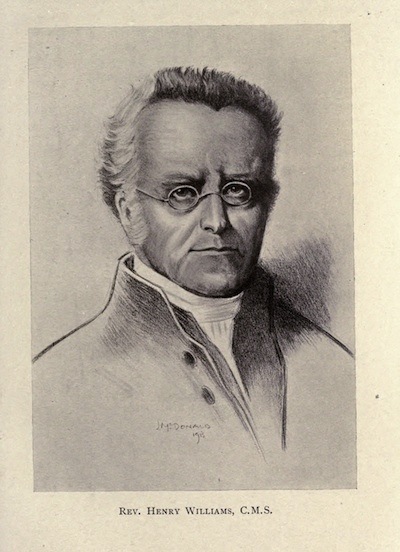
Rev. Henry Williams, C.M.S.
For the purpose of preserving the consecutive nature of our narrative it will be convenient at this point to digress for a moment, and in that time discuss a debatable point which must ere now have occurred to the reader, viz. what was Bishop Pompallier's attitude towards the treaty? To aid our judgment in this connection two classes of evidence are available,—that of the Protestant Missionaries and the official despatches of those engaged in the promotion of the treaty, on the one side, and the personal statement of his position by the Bishop on the other. Bishop Pompallier had landed at Hokianga in 1838 for the purpose of establishing a branch of the Roman Catholic Oceanic Mission, of which he had been appointed Vicar Apostolic. We have his assurance, which may be accepted without reservation, that he hoped to labour in a part of the country where he would not come into conflict with other Missions, and it came to him as a surprise, and probably as a deep disappointment, when he discovered that the existing Missions had so far covered the country that no such isolation was possible at Hokianga, upon which he had determined as the centre of his operations. But having come he decided to remain; and his advent was a bitter trial to the representatives of the Protestant Missions, who foresaw in it a serious interruption of their work by the introduction to the Maori of doubts and controversies which, while disturbing, were not essential either to their civilisation or to their soul's salvation.[115] Exactly what they anticipated would occur, did occur, with the result that the animosities of religious rivalry were kindled in a way that had never been known between the Anglican and Wesleyan Missions; and the absurdity was not infrequently witnessed of Maoris confidently discussing matters of dogma which for centuries have baffled solution at the hands of trained theologians. The effect of this was to sow the seeds of bitterness in the hearts of the Protestant Missionaries, and there is sometimes noticeable a dearth of charity in their references to the Bishop which unfortunately is not singular in Church history.
We may, therefore, discount on the grounds of prejudice their accusations against the "Catholic Bishop" as much as we please, but we have still to account for the awkward fact, to which Mr. Colenso has drawn pointed attention, that the most violent opposition to the treaty at Waitangi came from the chiefs living under the religious guidance of Bishop Pompallier. The same circumstance was noted by Captain Hobson at Hokianga, by Captain Symonds at Manakau, and by Major Bunbury at Tauranga. Was, then, this widespread disaffection amongst the Catholic converts merely a coincidence? or was it the fruit of suggestion?
It has to be admitted that whatever feelings animated the Protestant Missionaries, at least Captain Hobson was not the victim of religious prejudice. From the first he adopted an attitude of most respectful deference towards the Bishop, a partiality which the Frenchman was not slow to observe and comment upon. When, therefore, the Lieutenant-Governor, took the responsibility of stating in his despatch to Sir George Gipps (February 17, 1840), "The influence against me was easily traceable to the foreign Bishop of the Roman Catholic persuasion," he is at least entitled to the credit—considering the character of the man—of our believing that he would not have made so bold an assertion had he not been fortified by the conviction that there was evidence to support it. The same measure of confidence must be accorded to Captain Symonds, a military officer of, so far as we can judge, the highest integrity. In reporting the result of his mission at Manakau he records the fact that "Rewa the principal follower of the Roman Catholic Bishop, exerted all his influence against me," and that on his return to this settlement from the Waikato Heads a few days later, he was still unable to secure the signatures of certain chiefs, a failure which he attributed "partly to the Bishop's influence." Again bluff Major Bunbury tells us that when at the Otumoetai Pa, near Tauranga, "Another chief expressed some indignation because the Christian chiefs had not, as he said, met them. I presume he meant those from the other pa where Mr. Stack's influence was supposed to extend more than his own, and where a Roman Catholic Residency and the Catholic Bishop were supposed to have more influence."
Whether this failure on the part of the Christian natives to co-operate with the residents of Otumoetai in the consideration of the treaty meant their active hostility, or merely a negative indifference to the proposals of the Crown, is not clear, nor is it certain to what extent the influence of the Missionary Bishop and his assistant contributed to either of these conditions, if either existed. Certain it is, however, that neither exerted themselves to aid the consummation of the treaty. Of this fact Bishop Pompallier has made no secret so far as he himself was concerned, and it is unlikely that his clergy would adopt an attitude different to his own. Neutrality he makes the buttress of his position, professing a total disregard for politics; his whole concern being the spreading of the Church's influence and the refutation of heresy. Of this, a perusal of the Bishop's own statement is the least devious road to proof:
On January 1840 Captain Hobson arrived at the Bay of Islands with the qualification of English Consul and Vice-Governor of New Zealand, under the immediate control of the Governor of Sydney in New Holland. The corvette, the Herald, brought Captain Hobson and all the members of his approaching administration. The Protestant Missionaries spread the report amongst the natives that this time the Catholic Bishop was going to be taken out of the country by the English man-o'-war which lay at anchor off the coast. They said also that I would not dare to appear at the public meetings that the new Governor was going to hold with the Maori chiefs and the whites, to talk over with them his plans for the Colonial administration of New Zealand. All the natives in the country were astonished both at the arrival of a strange Governor, and at the strange reports that were flying about. The day after his arrival, the Maori chiefs received printed letters from Captain Hobson, inviting them to meet at a place in the Bay called "Waitangi," where a treaty was to be read to them in their own language, and afterwards signed by them. Many of the Catholic chiefs came to consult me, above all the great chief Rewa. They asked me what was to be done under the circumstances in which their country was placed, and whether they ought or not to sign. I answered them that these were political matters which were outside my province. I was only in this country to pasture souls in the word of God, and direct them in the faith, morality, and the Catholic discipline, confer the sacraments of salvation on persons of whatsoever nationality who should have recourse to my ministry in a proper disposition, and that there ended my divine mission. It was for them to determine what they might desire to do with their national sovereignty; whether to keep it or to transfer it to a foreign nation; they were therefore at liberty to sign or not, to sign the treaty which was going to be put before them; that for myself and my clergy we were prepared to exercise our ministry of salvation for those who signed in the same manner as for those who did not sign. In a word, we were prepared to instruct them in the faith whether they continued to be New Zealanders or became English. Now in this way I kept myself entirely aloof from politics, and the people were at liberty to do as seemed best to them, with regard to their social state of life, and I remained free in what concerned my ministry for the spiritual and Christian life they had to follow in the Catholic Church. I went dressed in my Episcopal cassock, to the great meeting of the chiefs of the Bay of Islands with the whites, over which Captain Hobson presided. His Excellency was surrounded by the officers of the corvette and by a number of Protestant Missionaries. My coming was a great surprise to the latter, and to the natives who had heard that I should never dare to appear there. Captain Hobson received me with much civility and respect, and caused me to be put in a place of distinction. A political treaty which the English Government wished to conclude with the Maoris was read and explained to them. By virtue of this treaty the Maoris became English subjects; they remained masters of their landed property, but they were not allowed to sell, as formerly to private purchasers. If they desired to sell any of their land they could only do so with the consent of the Colonial Government.
While the speeches were being made on behalf of Captain Hobson and the chiefs of the Maori tribes I remained silent; I had nothing to say; they were simply about political matters. One question, however, interested me deeply, it was that of religious freedom about which no one in any way seemed to trouble themselves. Before the last meeting broke up, and it became a question of signing the treaty I broke silence. I addressed Captain Hobson, begging him to make known to all the people the principles of European civilisation which obtain in Great Britain, and which would guarantee free and equal protection to the Catholics as to every other religion in New Zealand. My demand was immediately acceded to by Captain Hobson, who made a formal notification of it to all the assembled people, to the great satisfaction of all the Catholic chiefs and tribes, who triumphed in the fact of my presence in the face of the Protestant Missionaries, and at the speedy compliance with the few words I had spoken. As to the political treaty, was it or was it not understood by the natives? That is a mystery difficult to solve. The result was that some chiefs signed it and some did not. But the Catholic religion gained instead of losing its dignity and its influence over the minds of the people. When a certain number of natives had signed the treaty the sovereignty of England over the whole of New Zealand was declared by a salvo of artillery fired by the corvette Herald. The English flag floated over the country, and Mr. Hobson took the title of Vice-Governor of New Zealand. As for myself, I exercised my ministry as freely as before over all parts of this large archipelago. The Governor seemed to have a particular regard for the Catholic Bishop. His Excellency promised that my future missionary vessel should be free from all imposts, and that everything that came to me from beyond the country for the purpose of my labours should be free from duty. My position at this time disappointed not a little the ill-will of those who had spread sinister reports about myself and my clergy, some weeks before. The people became more and more confident in the idea that Protestantism had always been deceiving them. They saw, moreover, that we had come to New Zealand but for them and the ends of salvation, in favour of every soul that lived in the country, not troubling ourselves as to what national flag they belonged. They saw in our hands but one standard, that of the cross that leads to Heavenly glory. At one time they had said the Catholic had come to seize upon the sovereignty of New Zealand, and they beheld him remaining and working just as before, after possession had been taken. Many natives in their uprightness said, "It was all very well for the Protestant Ministers to tell us so much about the Catholic Bishop taking our country, but on the contrary, it was themselves, in their own nation who took it from us." From all these new circumstances there resulted on the part of the people, English and Maoris, but especially the latter, more esteem, more confidence, more attention for the Bishop and the Catholic Clergy.[116]
The Bishop's publicly expressed views receive valuable confirmation from Captain Lavaud, of the French frigate L'Aube which reached the Bay of Islands in July 1840. After paying his respects to the Lieutenant-Governor, the Captain proceeded to the Bishop's house and there had an interview with the prelate, the substance of which he subsequently reported in the following terms to the French Minister of Marine:
I arrived at the Bishop's only in the afternoon, so long is the passage from Russell-town to Kororareka against contrary winds and tide. I was curious and impatient to hear what he might have to communicate to me. Still I was reassured as to the situation in which he found himself placed with regard to the authorities, by the very pleasing manner in which Mr. Hobson[117] had just spoken of him to me: the feelings of esteem and consideration which he expressed; the respect his name evoked from all those present, and the well-deserved praise they gave to his character and his tolerance. Compared with the Anglican Missionaries he was the real good man, the friend of the poor and of the savages, having no other ambition than to call to the Catholic faith and to civilisation the natives, to whose happiness he consecrates his existence, hoping to receive in the other world a reward which his adversaries prefer to taste in this one. Their evangelic labours are thus always accompanied by schemes of aggrandisement of luxury, and of riches, things in which they have until now made considerable progress. To stop them nothing less was necessary than the prohibition of the Queen (of England) forbidding them henceforth to acquire land from the natives, and limiting the holdings to 2500 acres. These gentlemen were indeed not slow to notice that though they were occult instruments of British power in New Zealand, they were its first victims. One must not, however, believe that the Anglican, Wesleyan, Methodist, and other Missionaries occupy themselves exclusively, and all of them, with speculations and means of making their fortunes; they also occupy themselves with the instruction of the people, but I shall have opportunity later on of returning to this subject. On my arrival at Bishop Pompallier's I received the marks of kindness which that excellent pastor lavishes on all his fellow-countrymen. He thanked me more than it was necessary for him to do for all my care and attention towards the priests during the voyage, and he did not conceal from me that this little increase of subjects sent out to him by the Marist community had been so necessary for so long a time that it was no longer by twos, but by tens and even twenties that priests ought to be sent out to him to help him to save the people of New Zealand, of whom 25,000 were already on the way to Catholicism. He also told me how grateful he was to the French Government for the protection it granted him, as well as to his mission in these seas. He spoke to me of the acts of kindness of the King, of the Queen and the Royal family, and principally of the interest H.R.H. Madam Adelaide was taking in the success of his labours. I took great pleasure in listening to Monsignor Pompallier on this subject, but I had not lost sight of the fact that he must have other things whereof to inform me. I, too, since I had seen Captain Hobson, was rather eager for news, and curious to know the mission of the Herald. I therefore profited by the first opportunity I had to ask the Bishop to speak to me about the political events of this country, but Monsignor is like they all are, he loves his Mission, his successes, his hopes, and it was with difficulty he decided upon changing the subject of conversation, but at last he did it most graciously. I learned thus from him, that from the month of February 1839, Captain Hobson, who had arrived some days previously in the Bay of Islands, with the title of "Consul" had assumed the rank of Lieutenant-Governor of the Islands of New Zealand conferred on him by the gracious will of the Queen; that an assembly presided over by him, and attended by most of the great chiefs of the North Island, as well as several Europeans of distinction, Monsignor himself included, had taken place, the aim of which was to make known to the New Zealand chiefs that the Queen would grant her powerful protection to the New Zealand tribes who had solicited it, only under the condition that the treaty proposed to them would inform them that H.B.M. would extend her sovereignty over the Islands of New Zealand only as far as these chiefs would consent to sign it. I here transcribe this official document, yet but little known, and so singularly reproduced by some persons.[118]
It will be noticed that at the Assembly of which I have just spoken, which was held in Busby's in Wai-Tanghi, there was not one single Frenchman, except Monsignor. They thought by their absence (at least that was their intention) to protest against what was taking place. The Bishop who certainly was not obliged to inform me of the motives that made him act differently, told me, however, that having received a special invitation from Mr. Hobson, he thought he ought not to refuse his presence, inasmuch as his Mission was quite a spiritual one, and that his being an ecclesiast put him outside of all politics, and that it was most necessary for the success of Catholicism in this country that all should be convinced that in that respect he was perfectly indifferent, that every day he was trying to avoid giving his conduct the slightest doubt of the purity of his intentions, that besides in the assembly Captain Hobson had in his address to the New Zealand chiefs, of whom several were Catholics, informed them that Bishop Pompallier, pointing him out, would remain amongst them, that he would be protected there, as well as the religion he preached, in the same manner as the British Missionaries and their co-religionists. At this assembly the New Zealanders appeared uneasy and anxious to know how the meeting would end, during which several speeches were delivered by the chiefs, partly to the Governor and partly to the New Zealanders themselves. At one moment it was feared the treaty would be rejected. Several chiefs spoke against it, and one of the most prominent, Rewa-Rewa, went as far as to say, "Let us drive away the white chief. What does he come here for? To take away from us the liberty you are enjoying. Do not believe his words. Do you not see that, later on, he will use you to break stones on the roads?"
This chief belonged to the Catholic religion, but his allocution was opposed by two of the principal chiefs of the Island, and of the district of Hokiangha, as well as by Pomare the nephew of the celebrated chief of that name of Kawa-Kawa, in the Bay of Islands, all partisans of the Williams Mission. This allocution (Rewa's) did not have the success he expected for it, and the acceptance took place, although without enthusiasm, by the majority of the members of the assembly. Several gave their adhesion by signing the treaty, others retired without signing, and already on the following day, after a few small gifts, the sovereignty of H.M. the Queen of England was proclaimed over the North Island of New Zealand. Eye-witnesses report that this declared sovereignty is a conjuring trick on the part of Captain Hobson, but in that case, at least we must admit that the trick was played rapidly and skilfully enough. Other official declarations were made on the same subject.
Here then are the facts—conflicting it is true—from which no doubt conclusions equally conflicting will be drawn. Having regard to the high character of the Bishop it is inconceivable that he would desire to do anything but that which was right. It is, however, equally possible that he experienced a difficulty in completely suppressing his national feelings, and that he had unconsciously created for himself the paradoxical position of being neutral as an ecclesiastic, and yet hostile as a Frenchman.
Along the populous shores of the Bay of Plenty, and in the interior behind Tauranga, Hobson had as his allies the Revs. Brown and Stack, while William Williams[119] carried the treaty from hapu to hapu through the rugged country on the eastern coast between East Cape and Ahuriri.[120] In a like manner upon Missionaries Chapman and Morgan devolved the onerous task of bringing the turbulent Arawas at Rotorua into line. The manner in which these minor envoys laboured, and the extent to which they succeeded is modestly told in their letters to the Lieutenant-Governor; but this much must in justice be said, that though their proceedings were necessarily less picturesque in their setting, and less sensational in their climax, they were equally sincere with those who garnered in the wider fields, and who in consequence have loomed more prominently in the historical perspective.
A mission upon a more extensive scale and one fraught with more important issues was entrusted to the Rev. Henry Williams. To this virile Missionary was allotted the task of bearding the lion in his den, for the Lieutenant-Governor had every reason to believe that the officers of the New Zealand Company would use whatever influence they possessed to prevent the consummation of a policy which in its ultimate effects they surmised would be so prejudicial to their own. For this assumption events proved there was only too much justification. The Government had, however, put its hand to the plough; and in Mr. Williams, Colonel Wakefield found a match both in determination and diplomacy.
A small schooner, the Ariel, owned and sailed by Captain Clayton, was chartered for the journey, and late in March they set off, calling at Tauranga and Poverty Bay en route, leaving copies of the treaty for local circulation as they went. The Ariel reached Port Nicholson late in April, her coming being by no means a welcome circumstance to the principal agent of the Company. The first meeting between Colonel Wakefield and the Missionary took place on the Saturday after arrival, at the house of Mr. Hunter, and was more animated than friendly. The former had either not yet received—or chose to ignore—the private instructions of his superiors in England, to afford Captain Hobson all the aid and assistance in his power towards the attainment of British sovereignty.[121]
For ten days the Colonel doggedly held on his course of opposition, during which time there was a frequent clash of wordy weapons, the soldier seeking to vindicate the independence of his settlement on the ground that they had acquired their rights from the chiefs prior to the intervention of the Crown; the missionary maintaining that no such rights could be acquired by British subjects without the consent of the Sovereign.
Whether or not the constitutional nature of this argument appealed to the Colonel, it is impossible to say. In all probability it did not, but there are ample reasons for concluding that the governing influence in his conduct was a desire to obtain possession of a block of forty acres of land in what was then the most valuable portion of the infant settlement of Wellington, and to which Mr. Williams had acquired an undoubted title. Wakefield's subsequent actions at least indicate that his surrender did not carry with it his conversion to the treaty, which he still strove to persuade himself could not affect the purchases of the Company. But whatever the considerations that influenced him, just as the Missionary was preparing to depart in disgust, he at length[122] consented to withdraw his objections to the chiefs considering the treaty, and retracting what Mr. Williams has been pleased to designate as his "insolent" remarks.
The character of the terms in which the Colonel was likely to address the Missionary may be judged from a paragraph in a letter indicted by him to his directors on May 25, 1840, in which he declares: "I cannot express to you the feelings of repugnance entertained by the respectable colonists who came into contact with Mr. Williams, towards him, on account of his selfish views, his hypocrisy, and unblushing rapaciousness. He frequently said that finding I had been before him in the purchase of land in the Strait without consulting him, he had endeavoured to do the best for himself, and had disparaged the Company and its settlers to the natives. On the whole, it was only by a great effort, and in the hope of benefiting the colony that I could bring myself to hold any terms with this worst of land-sharks."[123]
The hostility of the Company's principal agent once removed, thirty-two of the chiefs signed the treaty readily enough on the 29th of the month, the impression made on Mr. Williams's mind being "that they were much gratified that protection was now afforded to them in common with Her Majesty's subjects."
In his marked antipathy to Mr. Williams and all that he did Colonel Wakefield has endeavoured to deprecate the value of these proceedings in his report to his superiors, wherein he takes the responsibility of saying, "The natives executed some paper, the purport of which they were totally ignorant," and insinuates that the whole transaction took place in an underhand way and had neither the countenance nor the assistance of the colonists.
The Ariel then crossed over to Queen Charlotte Sound, "where," says Mr. Williams in his Memoir, "we saw all who were to be seen there. We crossed over to Kapiti, Waikanae, and Otaki the stations of the Rev. O. Hadfield. The treaty was explained at all these places and signed.[124] On this visit I saw in the Bank at Wellington a map of New Zealand about six feet in length, and was told by the authorities of the New Zealand Company that the coloured portion was the property of the Company from the 38° to the 42° parallel of latitude. At this time there was no one in connection with their Company who knew anything of the language. A man named Barret could speak a few words in the most ordinary form. This man alone was the medium of communication between the Maoris and the Company in all their affairs, and the deeds of purchase were drawn up in English, not one word of which was understood by the Maoris."
It had been Mr. Williams's intention, after completing the collection of the signatures in the vicinity of Cook Strait, to proceed to the far South, soliciting the assent of the Ngai-Tahu tribe to the terms of the treaty. To this end he had already entered into an arrangement with Captain Clayton, who like the loyal sailor he was, readily agreed to forgo his more lucrative coastal trade in order that his vessel might remain at the disposal of the Government. Before this section of the voyage could be undertaken, however, it was ascertained that the Governor, deeming the mission worthy of some more ostentatious display of power than could be effected by a schooner, had commissioned Major Bunbury of the 80th Regiment to sail with Captain Nias in Her Majesty's frigate Herald,[125] for the purpose of visiting the more important Southern settlements.
On hearing of this, Mr. Williams returned with all expedition to his duties at Waimate, which place he reached on June 10, bringing with him the famous Ngati-Awa chief, Wiremu Kingi, whose anxiety to see the Governor had induced him to travel all the roadless miles which lay between Waikanae and the Bay of Islands.
On the submission of his report to the Governor, Mr. Williams was the recipient of the most hearty congratulations from Captain Hobson, who recognised in the service of the Missionary an arduous task well and faithfully performed in the interests of the Crown.
On the morning of April 28 the Herald left her anchorage in the outer harbour of the Bay of Islands, carrying with her Major Bunbury,[126] commissioned to accept the signatures of the Southern chiefs; Mr. Edward Marsh Williams engaged to act as interpreter, and a small company of marines whose presence it was thought would add somewhat to the impressiveness of the occasion. Captain Nias was authorised "to display the force of his ship along the coast," and Major Bunbury was furnished with complete instructions for the governance of his conduct in all his negotiations with the native people, which needless to say, were to be continued along the strictly honourable lines which had hitherto been observed by the Lieutenant-Governor. Pursuant to these instructions the Herald entered the Coromandel harbour next day (30th), and Major Bunbury, accompanied by Mr. Williams, landed at the house of Mr. Webster, an American whose claims to land in New Zealand have since been the subject of searching enquiry by his own country. The purpose of this visit was to arrange a time and place at which the chiefs might be invited to a korero. Monday May 4, and Mr. Webster's establishment were selected to fill these essentials, and messengers were accordingly despatched to the various surrounding pas to bid the chiefs to the conference. Hearing that the Scottish exile, Captain Stewart, the discoverer of the southern Island which bears his name, was at Mercury Bay, a special messenger was hurried off to him requesting that he would pilot the Herald in these waters, and likewise use his influence with the chiefs of Mercury Bay in the direction of securing their presence at the meeting, to both of which the sealer Captain gave a ready response.
"On the day appointed," so writes the Major, "Captain Nias, with several officers of the ship, together with Mr. Williams and myself, went on shore at 11 o'clock, but no native chiefs had at that hour assembled. A considerable number of Europeans appeared, however, to have been attracted by the report of the expected meeting. Subsequently a number of natives did assemble with six chiefs of different tribes. Mr. Williams explained the treaty; its object in consequence of the increasing influx of strangers; and that the claim for pre-emption on the part of the Crown was intended to check their imprudently selling their lands without sufficiently benefiting themselves or obtaining a fair equivalent. After a variety of objections on the part of the chiefs we succeeded in obtaining the signatures of four, one of these being the principal chief of the district the celebrated Horeta,[127] of Bannin's Island notoriety. The principal orator, an old chief named Piko, and another of inferior note, refused to sign, alleging as a reason that they wanted more time to assemble the different tribes of the Thames district, and to consult with them, when they would also sign; but that he could, for himself, see no necessity for placing himself under the dominion of any prince or queen, as he was desirous of governing his own tribe."
This policy of procrastination was obviously induced by the intelligence which had reached them of the arrest at the Bay of Islands of a native, Kiti, for the murder of Mr. Williams's shepherd, Patrick Macdonald, and of his trial and subsequent condemnation. They did not complain of the injustice of the punishment, but the whole proceeding was so novel in its character, and so dubious in its ultimate result that they felt prudence warranted a deeper reflection than the subject had yet received. They therefore hesitated before committing themselves to a policy, the end whereof they could not see.
There was also a passing difficulty with those chiefs who signed the treaty, for these gentlemen elected to entertain so exalted an idea of the Queen's munificence that they deemed the homely blanket offered to them as being altogether unworthy of so great a Sovereign's generosity, and expressed a decided preference for forage caps and scarlet cloaks. There was greater unanimity displayed over the feast of pork and potatoes which Major Bunbury had thoughtfully provided for their entertainment before he left.
After completing arrangements for securing the signatures of a few eligible chiefs who were living near the Mission station of the Rev. Mr. Preece, Major Bunbury, late in the evening of Friday the 8th, took his departure from Coromandel in the schooner Trent, chartered from Captain Bateman, and coasted round to Tauranga, a district where, in consequence of a war with the Rotorua people, the claims of the Crown had not been enthusiastically received. On Sunday, at nightfall, the vessel arrived at the entrance of the harbour, but prudent seamanship dictated the wisdom of remaining in the offing till the morning, when the treaty party landed at the Mission station and were welcomed by Mr. Stack.
"I was agreeably surprised," wrote Major Bunbury to Captain Hobson, "to learn that most of the native chiefs in this neighbourhood had already signed the treaty, the exception being the principal chief, and one or two of his friends at the Omimoetoi (Otumoetai) pa. This pa we visited the same evening, accompanied by Mr. Stack. It was a very extensive fortification, and appears to contain about one thousand men. The chief who had declined signing is a very young man, and his manner was timidly reserved and less prepossessing than most of those I had before seen. On our taking leave he made the usual remark, that he wanted to consult the other chiefs, and that he would meet us with them at the Mission station on the morrow. On the following day he did not speak until the close of the conference, and then only in private to Mr. Williams—after Mr. Stack and I had left them—to enquire how much he was to get for his signature.[128] Another chief expressed some indignation because the Christian chiefs had not—as he said—met them. I presume he meant those from the other pa where Mr. Stack's influence was supposed to extend more than to his own, and where a Roman Catholic European residentiary and the Catholic Bishop are supposed to have more influence."
A third chief, evidently of an enquiring mind, created some amusement by his quaint method of arriving at a complete analysis of the position. The debate had to all appearances closed—his own speech being no small contribution to the oratory of the day—and he was approached with a view to securing his signature, he firmly deprecated everything in the nature of hurry, and calmly taihoa-ed[129] the whole proceeding.
"Now first let us talk a little," he said. "Who was the first stranger who visited our shores?"
On being told it was Captain Cook, he continued, "And who was Cook's king, was he not Georgi?"
To this a reply was returned in the affirmative. "And who then," he asked, "is this Queen?"
Major Bunbury took some trouble to explain to him that the King George to whom he referred had been dead for some years, as also his two sons George IV. and William IV., who had succeeded him on the throne, and that the present Queen now reigned because she was the next in line to these dead monarchs.
This modest little dissertation on the Royal genealogy appeared to satisfy him on that point, for he immediately adverted to the native wars, and more particularly to their own hostilities with the Rotorua tribes. Major Bunbury assured him that one of the principal objects of his mission was to persuade all the tribes at present at war to accept the mediation of the Governor, and to induce them to abide by his decision.
"If then your nation is so fond of peace, why have you introduced into this country firearms and gunpowder?" was his pertinent rejoinder.
To this Major Bunbury replied that the effects of this traffic had been much deplored by Her Majesty's Government, who were most anxious to mitigate its consequences by substituting justice and a regular form of government in their country for the anarchy which had prevailed, but this could only be done by the surrender of the sovereign rights to the Queen as asked for in the treaty.
His next enquiry was whether the Queen governed all the white nations?
"Not all," replied Major Bunbury, "but she is the Queen of the most powerful white nation." The Major then went on to explain that Britain had acknowledged the Maoris as an independent nation, but that arrangement had proved abortive in consequence of the native wars and their want of cohesion. To themselves alone therefore were to be attributed the evils from which they suffered. As a corrective for these political troubles the Government had not leagued themselves with other white nations to force an unwelcome authority upon them, but they had come direct to the Maoris themselves, and asked them as a spontaneous gift to vest in Britain the power to avert the evils which were assuredly accumulating round them; evils due to the increasing influx of the Pakeha, and who must otherwise remain subject to no law and amenable to no control.
"On being told," continues Major Bunbury's report, "that I was a chief of a body of soldiers, and that I had served under the monarchs already named, he enquired should his tribe, agreeable to my request, abstain from making war upon the natives at Rotorua, would the Governor send a portion of my force to protect them? I told them Your Excellency desired rather to mediate between them, and only in cases of extreme emergency would you be prevailed upon to act in any other manner. If, however, your arbitration was applied for I had no doubt the custom of their country would be complied with, by your insisting on a compensation being made to the party injured, by the party offending."
Major Bunbury then dwelt upon the sale of native lands, and the right of pre-emption claimed for the Queen, explaining that this restriction was intended equally for their benefit, and to encourage industrious white men to settle amongst them to teach them arts, and how to manufacture those articles which were so much sought after and admired by them. This course, he pointed out, was preferable to leaving the sale of large tracts of country to themselves, when they would almost surely pass into the hands of men who would never come amongst them, but would by their speculations hamper the industrious. The Government being aware of the intentions of these men—many of whom had no doubt counselled them against signing the treaty—would nevertheless unceasingly exert themselves to mitigate the evils following in the train of the speculators, by purchasing the land directly from the natives at a more just valuation.
To this the Nestor of the tribe replied that there was but cold comfort in that for them, as their lands had already gone to the white men, but the land had been fairly sold and fairly bought.
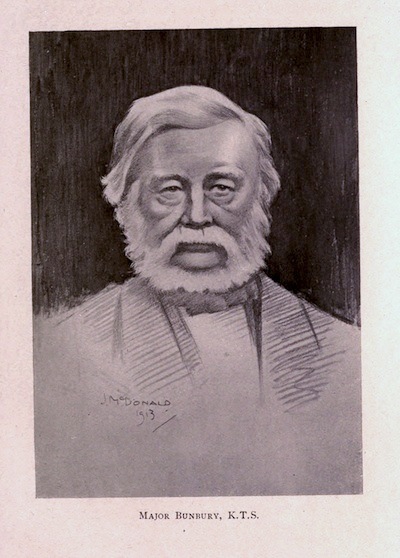
Major Bunbury, K.T.S.
Feeling that he had now said all that he could say of a nature likely to influence the chiefs, and knowing the constitutional abhorrence on the part of the Maori to hurry in such matters, Major Bunbury intimated that he had still another pa to visit, and departed, leaving Mr. Williams to answer any new points which might be evolved in the fertile brain of the men who spoke for the tribe. Their further deliberations, however, took a pecuniary rather than a legal turn. Presents were demanded, and when Mr. Williams indicated that Major Bunbury would doubtless arrange that Mr. Stack should distribute his gifts to those entitled to receive them the sceptical diplomat, who believed in having his bird in the hand, was candid enough to remark that he was not enamoured of prospects so remote.
Before leaving the district Major Bunbury visited the chiefs of the Maungatapu pa, a stronghold of great strength, peopled by a tribe of considerable importance. These men being well disposed towards the Government had, with two exceptions, previously signed the treaty, and their reception of the Governor's representative was most cordial. The hospitality of his table was offered by Nuka, the principal chief, whose engaging manners and admirable bearing so impressed the visitor that he estimated his good-will as worth securing at the cost of "some mark of distinction" if ever it came within the policy of the Government to so honour the more discerning of the chiefs.
"I have deemed it expedient to enter more fully into the detail of this conference," wrote the Major to the Lieutenant-Governor in rebuke of the disloyal speculators, "as one which not only shows fully the general character of the natives, but also the nature of the obstacles I may hereafter expect to meet when principles alien to the Government have been instilled by interested Europeans into their minds, as exemplified also at Coromandel Harbour. Neither will I disguise from Your Excellency my regrets that men professing Christianity should, in a country emerging from barbarity, whose inhabitants are scarcely able to comprehend the simplest doctrines of the Christian religion, endeavour to create distrust of its Ministers—of whatever persuasion—Christianity in any shape, with these people being better than the deplorable condition of many of them at present. It is not the specious professions of a religion which asserts itself unconnected with civil Government which should blind us to the political disunion it creates, but rather its sincerity should be tested by its acts and their effects whether it seeks to open a new field of labour before uncultivated, or to paralyse the efforts of those who have laboured to improve the soil by establishing themselves upon it. The latter I conceive is incompatible with such professions, while this country contains so vast a field untried, but still it is to be hoped reclaimable."
At the conclusion of the Tauranga conference Major Bunbury resumed his journey towards the south, the Missionaries being commissioned by him to continue their negotiations for signatures as opportunity offered. With the Arawa people at Rotorua, they had but poor success, for the reason that the members of that tribe were not altogether free to exercise their own will. Worsted in recent wars by Hongi and other victorious chiefs, the Arawas had in self-defence sought an alliance with the great Te Heuheu, of Taupo, whose protecting mana was at this time thrown over them, and fearful lest they might forfeit his good-will should they adopt a course to which they had every reason to believe their ally was hostile, they refused to subscribe to the treaty until the voice of Te Heuheu had been heard. This leads us to a point where it will be convenient to consider the attitude adopted towards the treaty by this remarkable man.
Te Heuheu Tukino was the second chief of that name, and was a leader endowed with exceptional power, being large of body and of brain. His home was on the shores of Lake Taupo, and by claiming certain geographical features as portions of his own body, he had thereby rendered his domain sacred, and so limited the right to dispose of it to himself. He was not amongst the chiefs present at Waitangi, for under the limited notice given by Captain Hobson, that was not possible. It is even within the bounds of probability that had the messengers of the Lieutenant-Governor reached him he would have dismissed them as they came, for of this he was firmly convinced—that he was "a law unto himself," asserting his own rangatiratanga as sufficiently strong to rule his own people, for which he neither needed nor desired foreign assistance. His first introduction to the treaty came to him through his younger brother Iwikau, who, together with another chief of Taupo, Te Korohiko, were at the then small settlement which has now grown into the city of Auckland, when they were met by Captain Hobson's messengers, and invited to Waitangi. Iwikau and his companion was in charge of a company of Taupo natives who had gone to the shores of Waitemata harbour for the purpose of acquiring European goods. They had packed bundles of flax fibre on the backs of their slaves, who had carried this medium of trade over trackless miles to the coast in order that it might be exchanged for guns and powder. While trafficking with the Pakehas news came of the projected meeting at Waitangi, and some of the Nga-Puhi chiefs—so we are told—thus addressed Iwikau: "Go you to Waitangi, for you are the fish of the stomach of the island.[130] The mana of Queen Victoria is about to be drawn as a cover over the island. All we chiefs of the native people will pass under her and her mana, that we may not be assailed by the other great nations of the world."
To this Iwikau answered: "I will not be able to attend that meeting if such is its object, namely consenting to the mana of Queen Victoria being placed over us. The right man to consent to or reject such a course is my elder brother, Te Heuheu, at Taupo; and any action on my part might be condemned by him."
This objection was combated by the messengers from Nga-Puhi, who replied: "By all means go, that you may acquire red blankets to take back to your elder brother at Taupo."
Iwikau was still obdurate, feeling that he had no authority to compromise his tribe in the absence of his superior chief, but the vision of the red blankets was more than Te Korohiko could resist, and he joined to those of the Nga-Puhi chiefs his own solicitations: "Oh, let us go that we may acquire the red blankets."
This appeal finally broke down the resistance of Iwikau. They attended the conference at Waitangi, and amongst others of influential rank were invited to sign the treaty. Before signing, Iwikau remarked to Captain Hobson, "I have heard the payment for the chiefs' consent to the Queen's rule consists of blankets." To which the Queen's officer, always anxious that his presents should not be misunderstood, replied, "No, not exactly. The blankets are not payment, but a friendly gift to you folks who have come from afar, and as a means of keeping you warm on your home journey."
The point of distinction was evidently neither so wide nor so fine as to cause Iwikau any alarm, and he signed the document with a portion of his moko, his clan being Ngati-Turumakina. Te Korohiko also signed, and when the gathering had broken up they returned to Taupo to report their proceedings. They met Te Heuheu at Rangiahua, his pa at Te Rapa, where he stood in the midst of the assembled people, a giant amongst men. When the self-constituted ambassadors had concluded their explanations, and produced their blankets the storm which Iwikau had secretly feared burst upon them.
"What amazing conduct is this of yours? Were you two, indeed, sent to perform such acts? O say! O say! is it for you to place the mana of Te Heuheu beneath the feet of a woman. I will not agree to the mana of a strange people being placed over this land. Though every chief in the island consent to it, yet I will not. I will consent to neither your acts nor your goods. As for these blankets, burn them."
Thus did Te Heuheu assert his prerogative, and scorn the interference of the stranger, but he was soon soothed into a more reasonable frame of mind, by Iwikau, who urged his angry brother to await future developments when he would himself see the treaty. "Be not so severe and you can state your thoughts to the Queen's official yourself, for he is travelling the islands of Ao-tea-roa and Wai-pounamu, seeking you, the surviving chieftains, that you may agree to that marking."[131]
Te Heuheu consented to wait, and the blankets were for the moment preserved. At length news arrived that Parore, a Nga-Puhi chief, and the Queen's official were on their way to Rotorua to bear the treaty to the Arawa chiefs. Then Te Heuheu thus instructed his people: "When the officer reaches the Arawa at Rotorua I shall attend. Let the tribe accompany me, armed, as trouble may arise over my declining to accept the Queen's rule."
There was much burnishing of rusty arms and snapping of fire-locks at Taupo for the next few days, in anticipation of possible contingencies, for these inland tribes had not yet fully realised the peaceful nature of Britain's mission. Living as they did in the centre of the Island, they were less corrupted by the influence of the degenerate whites, and had neither seen nor felt the need for the interposition of a correcting hand in the same way that the imperative necessity for a change had appealed to the residents of the coastal districts.
Neither were the tribesmen of Te Heuheu being influenced by the same considerations that were driving Nga-Puhi to accept the gospel from the Missionaries and the treaty from the Government. For many years the northerners had enjoyed almost a monopoly in the business of procuring guns, and this superiority in weapons had enabled them to levy a bloody toll upon their southern neighbours. With the increase of traders and the enlarged enterprise of the tribes less favourably situated, this advantage was rapidly receding. Others were securing guns as well as they, and the leaders of Nga-Puhi saw that the day was not far distant when their victims would retaliate, and they would perhaps receive as good as they had given. They therefore welcomed the gospel as a shield, and the intervention of British authority as a bulwark that would stand between them and their enemies whenever they should think fit to seek satisfaction for former injuries on something like equal terms. Not so the Taupo tribes, who were less controlled by such motives. Their position of greater isolation gave them the confidence begotten of a sense of greater security; they felt that they breathed the refreshing atmosphere of a wider independence, and were less subjected to the force of external considerations.
Moreover, the ceding of authority by treaty was an innovation dangerous in its novelty to a people who had known no method of acquiring or foregoing rights so effectual as conquest, and, confident in their own strength to maintain their position by the older method, they were less disposed to dabble in the subtleties of negotiation. With war and its consequences they were perfectly familiar. Diplomacy they did not understand so well; and when to the uncertainty of the procedure was added the supposed indignity of being asked to treat with a Queen, the haughty spirit of Te Heuheu rebelled against such a demeaning suggestion. To submit himself to the superior authority of a chief of his own aristocratic lineage would have been indignity enough, but to come under the dominion of a woman was beyond the limits of toleration.
In due course a messenger reached the pa with the intelligence that the Missionaries at Rotorua had received a copy of the treaty, whereupon Te Heuheu set off with five hundred picked men, prepared to resist to the uttermost should an attempt be made to compel his submission to the Queen. On reaching the Papai-o-Uru pa at Ohinemutu, the discussion began, after the ceremonial of welcoming the strangers had been concluded. The copy of the treaty which the Arawas were being invited to sign, had been entrusted to Messrs. Morgan and Chapman, the Church Missionaries, and to them Te Amohau and Te Haupapa addressed themselves on behalf of their tribe: "The Arawa people have nothing to say in regard to your object. The Arawa will await the word of Te Heuheu Tukino, and will abide by what he says to you."
Te Heuheu arose with stately grace, and repeated an ancient chant, revered amongst the sacred karakia of the Maori, and known as Hiremai. He repeated it to the end, all ears being strained to detect an error, the commitment of which would have boded evil, but he went on faultless to the finish. Leaping to their feet his warriors then indulged in mock passages-at-arms, and when this form of revelry had ended the great chief delivered his judgment upon the treaty: "Hau wahine e hoki i te hau o Tawhaki. I will never consent to the mana of a woman resting upon these islands. I myself will be a chief of these isles; therefore, begone! Heed this, O ye Arawa. Here is your line of action, the line for the Arawa canoe. Do not consent, or we will become slaves for this woman, Queen Victoria."
Te Pukuatua then rose and gave the final answer for his tribe: "Listen, O Parore, you and your Pakeha companions. The Arawa have nothing to add to the words of Te Heuheu. His words denying the mana of the Queen are also our words. As he is not willing to write his name upon your treaty, neither will the chiefs of the Arawa come forward to sign."
Then turning to Te Heuheu he added: "Hear me, O Heu. The Arawas have nothing to say, for you are the person of the Arawa canoe."
The blankets given to Iwikau, at Waitangi, were returned to the Missionaries by Te Heuheu, with the remark: "I am not willing that your blankets should be received as payment for my head and these Islands," and with this embargo put upon their operations, the agents of the Lieutenant-Governor were unable to secure a single Arawa signature to the treaty.
The fiat of Te Heuheu went even far beyond the steaming waters of Rotorua, for at Tauranga upon the coast there lived Tupaea, a chief of the Ngai-te-Rangi, whom because of his influence the Missionaries were particularly anxious to enlist as a subject of the Queen. He too hung upon the words of Te Heuheu, and when he was approached he made answer thus: "What did Te Heuheu say to you at Rotorua?"
The reply was: "Te Heuheu did not consent."
"And what of the Arawa chiefs?" asked Tupaea.
"They followed the word of Te Heuheu," replied the Missionaries.
"Then," said Tupaea, "I will not agree to the chiefs of Ngai-te-Rangi signing the treaty of Waitangi," a decision from which neither he nor his people could ever be induced to depart.[132]
In the meantime the Herald had left the Auckland waters, and made her way to the south, arriving off Banks's Peninsula during the night of the 24th. Calms and storms alternately intercepted her progress, and it was not until the 28th that Major Bunbury was able to disembark at Akaroa, accompanied by Mr. Edward Williams and Captain Stewart, whose personal acquaintance with the Southern chiefs and their altered dialect[133] was destined to be of great service in promoting a common understanding.
At Akaroa they found a native pa in which lived a remnant of the Ngai-Tahu people, broken by the last raid of Te Rauparaha, a whaling station, and a cattle run,[134] established by a Captain Lethart, who had arrived from Sydney as recently as the previous November. The visitors were more favourably impressed with the condition of Lethart's cattle than with the appearance of the natives, who were so dejected by their misfortunes as to consider themselves almost destitute of rights and without a name. The signature of Iwikau, a brother of Tamiaharanui, the chief who was conveyed captive by Te Rauparaha in the blood-stained Elizabeth, was obtained, as well as that of John Love, another native less highly born, but more richly endowed with intelligence. These two signatures Major Bunbury conceived to be of considerable consequence to his purpose, although from the diminished number of the tribe the men themselves scarcely laid claim to the rank of chief.
Southward the frigate again sailed, and on June 4 cast anchor in Zephyr Bay, a beautiful inlet at Southern Port, Stewart's Island. Accompanied by Captain Stewart, who was now in latitudes peculiarly his own, Major Bunbury landed next morning, and set out to visit a station in the harbour, distant four or five miles, where for some time Stewart had employed a number of boat-builders, and who, it was hoped, might still be there. Vestiges of their former residence were found but that was all. Their camp was deserted, their industry abandoned, and no sound broke the stillness of the primeval forest save the flick of a bird's wing, or the screech of the brightly plumaged parrakeet.
Several excursions were made to other parts of the island, but no natives were met with, either upon the shores of the sheltered coves, or within the generous shade of the bush, and Major Bunbury returned to the ship for the first time without having added a signature as a trophy in the cause of the Queen's sovereignty.
Aided by his own experience, and fortified by the local knowledge of Captain Stewart, Major Bunbury concluded that the prospect of meeting with any chief in the apparently deserted island was so slight as not to warrant the delay involved in the search. He therefore consulted with Captain Nias, and together they agreed that it would be advisable to proclaim without protraction the Queen's authority over a territory that had impressed them both as being singularly beautiful.[135] For this purpose, during the afternoon of the day after arrival, the marines were landed with a party of officers from the ship which had now been moved into Sylvan Bay. Here upon the apex of a small island which becomes a peninsula at low water, the ceremonial forms usual to such occasions were duly observed. The Union Jack was hoisted by Captain Nias and saluted by the marines. A salute was also fired from the guns of the Herald, and after the following declaration had been read by Major Bunbury to the assembled sailors, Stewart's Island became an outpost of the Empire.