Chapter VI · THE TREATY (continued 2)
Reading edition
That this treaty was made by Captain Hobson in pursuance of instructions previously received from Home, and that his proceedings obtained the subsequent approbation of the Government.
That the natives ceded to the Queen the sovereignty of the Northern Island, and the Crown secured, in return, to the chiefs and tribes of New Zealand, and to the respective families and individuals thereof, the full, exclusive, and undisturbed possession of their lands and estates, forests, fisheries, and other properties, which they may collectively and individually possess, so long as it is their wish and desire to retain the same in their possession.
That this treaty is binding, in conscience and policy, on the British Government and is highly valued by the native tribes.
That although the laws and usages of the natives with regard to the possession of and title to land are very obscure and complicated, yet evidence has been adduced to the Committee showing that these laws and usages are in some sense recognised by the natives, as well among themselves as in reference to European purchasers, and many instances have been proved in which they have voluntarily and fully recognised European titles.
That while it appears highly probable that much of the soil of New Zealand will ultimately rest in the British Crown, as land to which no proprietary title of any kind can be established by an individual, or by any tribe, yet it is impossible, by any fair construction of the treaty, to limit the native claims either to the pas or to the grounds in actual cultivation by the natives at any particular time.
That any attempt to carry out in practice any such construction must alienate the natives from every feeling either of confidence or affection towards the British Government, and would probably lead to conflicts of a sanguinary character, or even to an exterminating warfare between the races, for which the British power in these Islands is at present wholly inadequate and unprepared.
That it is not expedient to increase the military force in the colony, at great expense, for a purpose unjust in itself, and tending to retard the peaceful settlement of the colony and the civilisation of the native race.
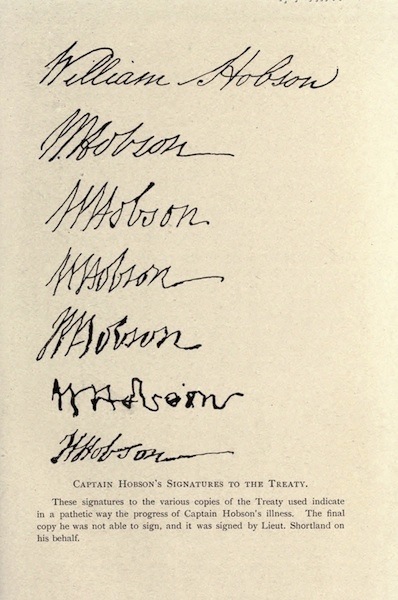
Captain Hobson's Signatures to the Treaty.
These signatures to the various copies of the Treaty used indicate in a pathetic way the progress of Captain Hobson's illness. The final copy he was not able to sign, and it was signed by Lieut. Shortland on his behalf.
These recommendations of Mr. Cardwell, which also largely reflected the opinions of the Government, were energetically opposed by Lord Howick and his friends, who put forward a counter series of suggestions, which just as strongly reflected the views and aspirations of the New Zealand Company, particularly upon the crucial point that no acknowledgment should be made of any proprietary rights on the part of the natives in the unoccupied lands of New Zealand. They affirmed amongst other things:
1. That the conclusion of the Treaty of Waitangi by Captain Hobson with certain natives of New Zealand, was a part of a series of injudicious proceedings which had commenced several years previous to his assumption of the local Government.
2. That the acknowledgment by the local authorities of a right of property on the part of the natives of New Zealand in all wild lands in those Islands, after the sovereignty had been assumed by Her Majesty, was not essential to the true construction of the "Treaty of Waitangi," and was an error which has been productive of very injurious consequences.
3. That means ought forthwith to be adopted for establishing the exclusive title of the Crown to all land not actually occupied and enjoyed by natives or held under grants from the Crown, such lands to be considered as vested in the Crown for the purpose of being employed in the manner most conducive to the welfare of the inhabitants, whether natives or Europeans.
When the Committee was asked to determine which of these two rival reports it would adopt, it was found that opinion was evenly divided, but on a division being taken Lord Howick succeeded in defeating his opponents by the narrow majority of one vote, the voting being as follows upon the question proposed by Mr. Roebuck: "That the Committee now proceed to the consideration of the resolutions proposed by the chairman as the basis of the report."
Ayes—7.
Mr. Milnes.
Mr. Roebuck.
Mr. Hawes.
Mr. Aglionby.
Mr. Charteris.
Lord Francis Egerton.
Lord Ebrington.
Noes—6.
Mr. Hope.
Mr. R. Clive.
Mr. Cardwell.
Lord Jocelyn.
Sir Robert Inglis.
Mr. Wilson Patten.
In vain did Mr. Hope endeavour by moving amendments to induce the Committee to adopt a view of the Treaty of Waitangi more favourable to the natives, but through the divisions of several days the Company held its majority, and on July 23 the Committee agreed to the draft report proposed by Lord Howick, and which was based on the resolutions previously approved. When this report was laid before the House of Commons it was found that the Committee had traversed the policy adhered to by the Melbourne and the Peel Governments in its interpretation of the Treaty of Waitangi, and that they had taken the responsibility of declaring that:
The evidence laid before your Committee has led them to the conclusion that the step thus taken (the promotion of the Treaty of Waitangi), though a natural consequence of previous errors of policy, was a wrong one. It would have been much better if no formal treaty whatever had been made, since it is clear that the natives were incapable of comprehending the real force and meaning of such a transaction, and it therefore amounted to little more than a legal fiction, though it has already in practice proved to be a very inconvenient one, and is likely to be still more so hereafter. The sovereignty over the Northern Island might have been at once assumed without this mere nominal treaty, on the ground of prior discovery, and on that of the absolute necessity of establishing the authority of the British Crown for the protection of the natives themselves, when so large a number of British subjects had irregularly settled themselves in these Islands, as to make it indispensable to provide some means of maintaining good order amongst them. This was the course actually pursued with respect to the Middle and Southern Islands, to which the Treaty of Waitangi does not even nominally extend, and there is every reason to presume that, owing to the strong desire the natives are admitted to have entertained for the security to be derived from the protection of the British Government and for the advantages of a safe and well-regulated intercourse with a civilised people, there would have been no greater difficulty in obtaining their acquiescence in the assumption of sovereignty than in gaining their consent to the conclusion of the treaty, while the treaty has been attended with the double disadvantage: first, that its terms are ambiguous, and in the sense in which they have been understood highly inconvenient; and next, that it has created a doubt which could not otherwise have existed, which, though not in the opinion of your Committee well founded, has been felt and has practically been attended with very injurious results, whether those tribes which were not parties to it are even now subject to the authority of the Crown.
Your Committee have observed that the terms of the treaty are ambiguous, and in the sense in which they have been understood, have been highly inconvenient; in this we refer principally to the stipulations it contains with respect to the right of property in land. The information that has been laid before us shows that these stipulations, and the subsequent proceedings of the Governor, founded upon them, have firmly established in the minds of the natives notions which they had but then very recently been taught to entertain, of their having a proprietary title of great value to land not actually occupied, and there is every reason to believe that, if a decided course had at that time been adopted, it would not have then been difficult to have made the natives understand that, while they were to be secured in the undisturbed enjoyment of the land they actually occupied, and of whatever further quantity they might really want for their own use, all the unoccupied territory of the Islands was to vest in the Crown by virtue of the sovereignty that had been assumed.
The findings of the Committee were thus so radically opposed to the established views of Lord Stanley upon the construction to be placed upon the treaty, that the Minister refused to countenance them in any way, or to ask the House of Commons to become a party to a policy which, had it been enforced, would inevitably have led Britain into one of her little wars, as inglorious as it would have been unjust.[177]
In transmitting a copy of the Committee's report to Governor Fitzroy, the Chief Secretary stressed in his Despatch of August 13 (1844) the narrow margin of votes by which the report had been adopted, and emphasised the high moral principle that it was still the duty of both the Governor and himself to administer the affairs of the colony "with a due regard to a state of things which we find, but did not create, and to the expectations founded, not upon what might have been a right theory of colonisation, but upon declarations and concessions made in the name of the Sovereign of England." The power of Parliament was, therefore, not invoked to aid the Company in evading its just obligations to the natives. Their land claims were still to be the subject of searching enquiry by the Chief Commissioner, Mr. Spain, and for the moment the Treaty of Waitangi was vindicated by the steadfastness of the Colonial Minister. But the battle was not over, the scene of the conflict only was changed. On June 17, 1845, Mr. Charles Buller, then representing Liskeard, and whose long association with Lord Durham and Mr. Gibbon Wakefield had more than once brought him into prominence in New Zealand affairs, sought to induce the Commons again to discuss both the policy and administration of the colony on the floor of the House. Then ensued the historic debate, during which New Zealand achieved the distinction of claiming the exclusive attention of Parliament for three consecutive nights.
It would be superfluous to recapitulate here the speeches delivered during this memorable discussion, embodied as they are in the records of the nation; it is, however, worthy of passing remark that for the sake of some party advantage several prominent members, notably Lord John Russell, chose to reverse all their previous professions on the subject of the Treaty of Waitangi, and threw the weight of their influence into the scale against the just recognition of the rights of the New Zealand natives. Well might Rusden exclaim: "On what plea could the Whigs abandon the construction put upon the treaty by their own leaders who made it?"
A division being taken, Mr. Buller's motion was defeated, and on receipt of this intelligence Governor Fitzroy[178] wrote with perfectly natural elation to Henry Williams: "Let me congratulate you on the result of the three nights' sharp debate in the House of Commons on New Zealand. The Company were beaten by fifty-one votes, the integrity of the Treaty of Waitangi being thus secured against all their infamous endeavours, for that was the point at issue."
While the events thus far narrated in this chapter had been evolving from the lap of time, Governor Hobson had died,[179] and had been buried at Auckland. Lieutenant Shortland's brief term of administration had been darkened by the Wairau Massacre, the first fruit of the contempt shown by the Wakefields for the landed rights of the natives. His successor, Governor Fitzroy, had long since been driven to distraction by the machinations of the Company and the failure of the Home authorities to give him needful support in either men or money. The crowning disaster of his administration was the attack upon the town of Kororareka at daylight on March 11, 1845, by Heke and Kawiti. The House of Commons had been ignorant of this happening when it had debated Mr. Buller's motion in the previous June, but when the ominous tidings reached England in July, that wary gentleman sprang once more alertly to the attack by moving: "That this House regards with regret and apprehension the state of affairs in New Zealand; and that those feelings are greatly aggravated by the want of any sufficient evidence of a change in the policy which has led to such disastrous results."
This debate was not less acrimonious than its predecessor, for not only was Lord Stanley attacked, but Mr. Stephen, the permanent head of the Colonial Department, was assailed with equal virulence. Stanley had ere this removed to the House of Lords, and Stephen was precluded by virtue of his position from defending himself. But for these two men, as well as for the honour of the nation, Sir Robert Peel stood in stalwart defence. He told the House that he was not enamoured of the policy which had resulted in the consummation of the Treaty of Waitangi. For his part he candidly admitted that in his opinion it was a mistake, but since the treaty was an indisputable political fact, its obligations must not be violated. Lord Melbourne's Government, he said, had with a full sense of their responsibility, entered into the compact and England was unquestionably bound by it.[180]
In vindication of Lord Stanley he declared that the real purpose behind Mr. Buller's motion was an insidious desire to unjustly censure his Minister for avowing his determination to carry honourably into effect the treaty made by his predecessor. Then reverting to the land question he continued: "After all the volumes of controversy which have appeared, the question really resolves itself into this: Shall the Government undertake to guarantee in this country, within certain limits in New Zealand, a certain amount of land without reference to the rights to that land vesting in the natives? This I tell you distinctly we will not do, and if the House entertains a different opinion, it is but right that it should give expression to it. We will not undertake, in the absence of surveys and local information as to the claims of the natives, to assign to you a million, or any other number of acres, and dispossess the natives by the sword."
In concluding he again entered upon a vigorous defence of his Colonial Minister, declaring his continued confidence in Lord Stanley in the following resolute words: "I will not do that which the New Zealand Company seem to think I might do—undertake to supersede a Minister who I believe has discharged his official duties with almost unexampled ability, and with a sincere desire to promote the interests of every colony over which he now presides."
Influenced by the Premier's strenuous advocacy, the House again rejected Mr. Buller's motion on July 23, but the friends of the Company derived some comfort from the knowledge that a despatch had been sent recalling Governor Fitzroy, who, in his anxiety to restore the bankrupt finances of the country, had disregarded the Royal instructions, and instituted a local currency as well as having taken the more serious responsibility of varying the inflexible policy of the Government by waiving the pre-emptive right of the Crown[181] to purchase land from the natives, in the hope of removing the growing discontent and of enhancing the revenue from increasing sales.
Defeated in Parliament, the Company's next proceeding was almost humorous in its hysteria. They procured an opinion from Mr. William Burge, in which that gentleman averred, on his reputation as a lawyer, that the British occupation of New Zealand was from the beginning unlawful, and based upon no sound constitutional foundation. This remarkable document they transmitted to Lord Stanley on July 7, in the hope that he would be so awed by it as to cause him to considerably modify the instructions which they were convinced he would, in his normal frame of mind, most certainly tender to Captain Grey, whom he had selected to succeed Governor Fitzroy. Lord Stanley was made of different stuff. He suffered no particular trepidation from Mr. Burge's startling discovery, but merely sent his opinion on to Fitzroy Kelly, Attorney-General, Sir Frederick Thesiger, Solicitor-General, and to Sir Thomas Wilde, who had been the Attorney-General in Lord Melbourne's Cabinet when Captain Hobson was sent out to negotiate the Treaty of Waitangi. These gentlemen averred with equal confidence that neither the reasons advanced by Mr. Burge, nor any other considerations which had occurred to them, furnished them with any well-founded doubt upon the question of Britain's sovereignty in New Zealand.
Reinforced by the opinion of this eminent trio, Lord Stanley sent a copy to the new Governor, telling him to be guided by it in his conduct, at the same time instructing him that if the Company attempted to make capital in the colony out of Mr. Burge's pronouncement, he was to counter the move by giving equal publicity to the joint opinion of the three legal advisers of the Crown.
When Captain Grey reached New Zealand on November 14, he found the country seething with discontent. The European population now numbered approximately 12,000, scattered over widely separated settlements, the natives probably numbered not less than 110,000, many of whom were in open revolt under Heke and Kawiti; many more were holding their allegiance in the balance.
The mischievous resolutions passed by the Select Committee of the House of Commons in the previous year had ere this percolated to the colony, and fired the doubts of the natives as to the sincerity of the Crown. Governor Fitzroy had used his best endeavours to reassure them, and in offering terms of peace to Heke he made it the first stipulation that the covenants of the Treaty of Waitangi should be binding upon both parties. To these advances Heke had sullenly refused to reply. With the rebels unyielding, obviously Grey's first duty was to ascertain where he stood with the friendlies and the neutrals. For this purpose he summoned a meeting at the Bay of Islands, and amidst the ruins of the wrecked town of Kororareka he delivered to the assembled chiefs one of his characteristic addresses, in which, after warning the people against treacherously assisting the rebels, he said:
In the meantime, I assure the whole of the chiefs that it is the intention of the Government, most punctually and scrupulously to fulfil the terms and provisions of the treaty which was signed at Waitangi on the arrival of Governor Hobson. I have heard that some persons, evil disposed both towards the Queen of England and the Chiefs of this country, have told you that by your signing that paper you lost your lands. This I deny. By that treaty the protection of the Queen and your possessions are made sure to you. Your lands shall certainly not be taken from you without your consent. You can sell your lands to the Crown, or not sell them, just as you think proper, but, remember, that when once you do sell them, they must be promptly and justly given up.
The professions of the Government's good-will to the natives were renewed, they were told of the Queen's solicitation for their material, moral, and religious welfare, and once more assurances were given that equal justice would be meted out to both Maori and European, to which Tamati Waaka Nēne replied: "It is just."
As the result of this conference Grey felt that he could rely upon the loyalty of the friendly natives, and that this adhesion to the Crown grew out of the fact that they were, as the Governor expressed it in his Despatch, "Unanimous in desiring protection and support from the Government; that they were quite aware of the advantages conferred upon them by the annexation of New Zealand to the British Empire, and that the large mass of the inhabitants sincerely desired to see peace and tranquillity restored, so that the Government might be invested with that weight and authority which is essentially necessary to enable it properly to perform its functions."[182]
With the position of parties both in England and in the colony thus firmly determined, it appeared that the Treaty of Waitangi would now be accepted as the basis of a settlement of the colony's affairs; but these sanguine expectations were speedily doomed to disappointment. By one of those inexplicable revolutions which not infrequently occur in the wheel of political fortune, Sir Robert Peel's Ministry was ousted from office in the latter part of June. Lord John Russell came back to power, and Lord Howick, who in the meantime had succeeded his father as Earl Grey, became Chief Secretary for the Colonies in the new administration.
As Lord John Russell had so recently modified his views upon the subject of the Treaty of Waitangi as to admit of his saying that Maori rights in land narrowed down to territory "in actual occupation by them," the way had been cleared by which his Secretary for the Colonies might put into operation his pet theories for the nullification of the Treaty of Waitangi.[183] This opportunity came to him when it fell to his lot to prepare a new Constitution for the youngest of Britain's possessions.
New Zealand had now been a colony independent of New South Wales for the better part of five years, during which time, under the advantages of a more or less settled government, she had made phenomenal progress. So rapid had been her development, so steadily had her population increased, that in the opinion of many of her most influential Colonists the time had arrived when they should be invested with all the privileges of responsible government. With this democratic movement the Governor was in entire sympathy and aided the aspirations of the people by the weight of his influence. The implicit confidence which the Home authorities at this period placed in Grey's discretion doubtless led them to more readily acquiesce in the liberalisation of the Charter granted in 1840, and in conveying to the Governor the determination of Parliament, the Colonial Secretary explained that the necessity of a fundamental change from the position created when Captain Hobson was appointed had been insisted on by all parties to the discussion, there being an almost equally unanimous concurrence among them that the change should be in the direction of calling the settlers to participate much more largely in the business of legislation and local self-government. He accordingly enclosed on December 23 (1846) the Imperial Act, and the Royal Instructions which were to give effect to this determination.
The functions of a governor in a Crown Colony are many and various, and Grey's receipt of this Despatch was perhaps as picturesque as any event in his romantic life. There was insurrection at Whanganui—a reflex of Heke's rebellion in the north—whither Grey had gone to aid in its quelling, and he was watching from a hill-side a skirmish between the troops and the insurgents when the Chief Secretary's communication was handed to him. He sat down upon the grassy bank, and with the crack of rifles and the hiss of bullets ringing in his ears he calmly read the fateful document. What the Governor's feelings were when he perused the Charter we need not stay to enquire. Fortunately he had been given a discretionary power as to when it should take effect, and he did not wait long before he determined that its indefinite suspension was inevitable. Grey's brief experience in New Zealand, as well as his innate love of justice, had taught him to regard the Treaty of Waitangi as the sheet-anchor of the colony's settlement, upon the faithful observance of which it was alone possible to maintain peace with the Maori.
In two vital particulars the new Charter fatally traversed the treaty, and one can only marvel, in the face of the obvious meaning which attaches to the plain words of the compact, how any British Minister could satisfy himself with the sophistry indulged in by the Colonial Secretary. A cardinal omission was detected by the Governor in the fact that no provision was made for the representation of the Maori race in the contemplated Parliament, to which, as British subjects, they were entitled; but worse than all, Earl Grey had again promulgated his strangely perverted opinions upon the subject of native ownership of lands. The Charter was covered by a lengthy Despatch in which the Chief Secretary elaborated his views, and in order that those views may not suffer by condensation they are here quoted at length. After adverting to the manner in which the various heads of his instructions had been classified, he proceeds:
Believing that the instructions, as thus prepared,[184] will be found to convey their meaning perspicuously and completely, I abstain from any attempt to recapitulate or explain their provisions. I turn to other topics on which it seems indispensable that on the present occasion I should convey to you explanations, for which, of course, no appropriate place could be found in the legal instruments already mentioned. I advert especially to what relates to the aborigines of New Zealand and the settlement of the public lands in those Islands. I cannot approach this topic without remarking that the protracted correspondence to which it has given rise, the public debates and resolutions which have sprung from it, and the enactments and measures of your predecessors in the Government, have all contributed to throw into almost inextricable confusion the respective rights and claims of various classes of individuals amongst the inhabitants of New Zealand, to render very embarrassing the enquiry in which you must doubtless be engaged respecting the line of conduct which Her Majesty's Government expect you to pursue, and at the same time to make it almost impossible for us to determine with any confidence what that conduct ought to be, and how far, in a state of affairs so complicated, it is possible now to act upon the principles to which, in the absence of these difficulties, I should have prescribed your adherence. I will not attempt any retrospect of those documents and proceedings; I should be but adding to the perplexity which I acknowledge and regret. It will be my attempt rather to explain, as briefly as the nature of the subject admits, what is the policy which, if we were unembarrassed by past transactions, it would be right to follow, and which (so far as any freedom of choice remains to us) ought still to be adopted, regarding the right of property in land which should be acknowledged or created, more especially as affecting the aborigines of New Zealand.
I enter upon this topic by observing that the accompanying statute, 9th & 10th Vict., ch. 104, sec. 11, repeals the Australian Land Sales Act, as far as relates to the lands situate in New Zealand. Thus there is a complete absence of statutory regulation on the subject. The Queen, as entitled in right of her Crown to any waste lands in the colony, is free to make whatever rules Her Majesty may see fit on the subject. The accompanying Charter accordingly authorises the Governor to alienate such lands. The accompanying instructions direct how that power is to be used. I proceed to explain the motives by which those instructions have been dictated.
The opinion assumed, rather than advocated, by a large class of writers on this and kindred subjects is, that the aboriginal inhabitants of any country are the proprietors of every part of its soil of which they have been accustomed to make any use, or to which they have been accustomed to assert any title. This claim is represented as sacred, however ignorant such natives may be of the arts or of the habits of civilised life, however small the number of their tribes, however unsettled their abodes, and however imperfect or occasional the uses they make of the land. Whether they are nomadic tribes depasturing cattle, or hunters living by the chase, or fishermen frequenting the sea-coasts or the banks of rivers, the proprietary title in question is alike ascribed to them all.
From this doctrine, whether it be maintained on the grounds of religion or morality, or of expediency, I entirely dissent. What I hold to be the true principle with regard to property in land is that which I find laid down in the following passage from the works of Dr. Arnold, which I think may safely be accepted as of authority on this subject, not only on account of his high character, but also because it was written, not with reference to passing events, or to any controversy which was at that time going on, but as stating a principle which he conceived to be of general application:
"Men were to subdue the earth: that is, to make it by their labour what it would not have been by itself; and with the labour so bestowed upon it came the right of property in it. Thus every land which is inhabited at all belongs to somebody; that is, there is either some one person, or family, or tribe, or nation who have a greater right to it than any one else has; it does not and cannot belong to anybody. But so much does the right of property go along with labour that civilised nations have never scrupled to take possession of countries inhabited by tribes of savages—countries which have been hunted over, but never subdued or cultivated. It is true, they have often gone further, and settled themselves in countries which were cultivated, and then it becomes a robbery; but when our fathers went to America, and took possession of the mere hunting grounds of the Indians—of lands on which man had hitherto bestowed no labour—they only exercised a right which God has inseparably united with industry and knowledge."
The justness of this reasoning must, I think, be generally admitted, and if so, it can hardly be denied that it is applicable to the case of New Zealand, and is fatal to the right which has been claimed for the aboriginal inhabitants of those islands to the exclusive possession of the vast extent of fertile but unoccupied lands which they contain. It is true the New Zealanders, when European settlement commenced amongst them, were not a people of hunters: they lived, in a great measure at least, upon the produce of the soil (chiefly perhaps its spontaneous produce) and practised to a certain extent a rude sort of agriculture. But the extent of land so occupied by them was absolutely insignificant when compared with that of the country they inhabited; the most trustworthy accounts agree in representing the cultivated grounds as forming far less than one-hundredth part of the available land, and in stating that millions of acres were to be found where the naturally fertile soil was covered by primeval forests or wastes of fern, in the midst of which a few patches planted with potatoes were the only signs of human habitation or industry. The islands of New Zealand are not much less extensive than the British Isles, and capable probably of supporting as large a population, while that which they actually supported has been variously estimated, but never, I believe, as high as 200,000 souls. To contend that under such circumstances civilised men had no right to step in and take possession of the vacant territory, but were bound to respect the proprietary title of the savage tribes who dwell in but were utterly unable to occupy the land, is to mistake the grounds upon which the right of property in land is founded. To that portion of the soil, whatever it might be, which they really occupied, the aboriginal inhabitants, barbarous as they were, had a clear and undoubted claim; to have attempted to deprive them of their patches of potato-ground, even so to have occupied the territory as not to leave them ample space for shifting, as was their habit, their cultivation from one spot to another, would have been in the highest degree unjust; but so long as this injustice was avoided, I must regard it as a vain and unfounded scruple which would have acknowledged their rights of property in land which they did not occupy; it is obvious that they could not convey to others what they did not themselves possess, and that claims to vast tracts of waste land, founded on pretended sales from them, are altogether untenable. From the moment that British dominion was proclaimed in New Zealand, all lands not actually occupied in the sense in which alone occupation can give the right of possession, ought to have been considered as the property of the Crown in its capacity of trustee for the whole community, and it should thenceforward have been regarded as the right, and at the same time the duty of those duly authorised by the Crown, to determine in what manner and according to what rules the land hitherto waste should be assigned and appropriated to particular individuals. There is another consideration which leads to the same conclusion. It has never been pretended that the wide extent of unoccupied land, to which an exclusive right of property has been asserted on behalf of the native inhabitants of New Zealand, belonged to them as individuals, it was only as tribes that they were supposed to possess it, and granting their title as such to have been good and valid, it was obviously a right which the tribes enjoyed as independent communities—an attribute of sovereignty, which, with the sovereignty, naturally and necessarily was transferred to the British Crown. Had the New Zealanders been a civilised people this would have been the case—if these islands, being inhabited by a civilised people, had been added either by conquest or by voluntary cession to the dominions of the Queen, it is clear, that according to the well-known principles of public law, while the property of individuals would have been respected, all public property, all rights of every description which have appertained to the previous sovereigns, would have devolved, as a matter of course, to the new sovereign who succeeded them. It can hardly be contended that these tribes, as such, possessed rights which civilised communities could not have claimed.
Such are the principles upon which, if the colonisation of New Zealand were only now about to begin, it would be my duty to instruct you to act; and though I am well aware that in point of fact you are not in a position to do so, and that from past transactions a state of things has arisen in which a strict application of these principles is impracticable, I have thought it right that they should be thus explicitly stated in this Despatch (as they are in the Royal instructions to which it refers), in order that you may clearly understand that, although you may in many respects be compelled to depart from them, still you are to look to them as the foundation of the policy which, so far as it is in your power, you are to pursue.
The imperfect information which alone at this distance I can hope to obtain as to the actual state of affairs in New Zealand, renders it impossible for me to venture to prescribe to you how far you are to go in attempting practically to act upon the principles I have laid down. I should infer from your own Despatches, as well as from those of your predecessors, that the right of the Crown could not now be asserted to large tracts of waste land which particular tribes have been taught to regard as their own. It appears that you have found it expedient to admit these pretentions to a considerable extent; and having done so, no apparent advantage could be suffered to weigh against the evil of acting in a manner either really or even apparently inconsistent with good faith. While, however, you scrupulously fulfil whatever engagements you have contracted, and maintain those rights on the part of the native tribes to land which you have already recognised, you will avoid as much as possible any further surrender of the property of the Crown. I trust also that the evil which would otherwise arise from the concessions already made, may to a great degree be neutralised by your strictly maintaining the exclusive right of the Crown to purchase land from the native tribes to which it has been assumed that it belongs. This right, resting as it does not only upon what has been called the "Treaty of Waitangi," but also upon the general and long-recognised principles of national law, is one so important that it ought almost at all hazards to be strictly enforced. To suffer it to be set aside would be to acquiesce in the ruin of the colony, since it would be fatal to the progressive and systematic settlement of the country. It is by the sale of land at more than a nominal price that its appropriation to individuals in allotments in proportion to their power of making use of it can alone be secured. It is the mode by which, with least inconvenience and difficulty, funds can be raised for emigration and for executing those public works which are necessary for the profitable occupation of the soil; in short, it is the very foundation on which systematic colonisation must be based. But if the native tribes are permitted to sell large tracts of land to individuals for a mere nominal consideration, it is obvious that so much land will be thrown upon the market as entirely to defeat the attempt to sell such lands as the Crown may still retain, at a price sufficient to answer the objects of the policy I have described.
The first and most important step which you will have to take with the view of introducing a regular system with respect to the disposal of land, will be to ascertain distinctly the ownership of all the land in the colony. The extent and limits of all which is to be considered as the property either of individuals, of bodies politic or corporate, or of the native tribes, must in the first instance be determined, and the whole of the remainder of the territory will then be declared to be the Royal demesne. The results of this enquiry must be carefully registered, and a regular record henceforth preserved, showing to whom all lands in New Zealand belong. This measure has been repeatedly and earnestly inculcated on your predecessors, and I cannot too strongly repeat the same injunction.
Chapter XIII. of the Royal Instructions was devoted to placing into legal phraseology the Minister's policy for "the Settlement of the waste lands of the Crown" and Clause 9 of that Chapter more particularly dealt with the method by which the native titles were to be ascertained and recognised.
(9) No claim shall be admitted in the said land Courts on behalf of the Aboriginal inhabitants of New Zealand to any lands situate within the said islands, unless it shall be established, to the satisfaction of such Court, that either by some Act of the Executive Government of New Zealand as hitherto constituted, or by the adjudication of some Court of competent jurisdiction within New Zealand, the right of such aboriginal inhabitants to such lands has been acknowledged and ascertained, or those from whom they derived the title, have actually had the occupation of the lands so claimed, and have been accustomed to use and enjoy the same, either as places of abode or tillage, or for the growth of crops, or for the depasturing of cattle, or otherwise for the convenience and sustentation of life, by means of labour expended thereon.
The newspapers in England which supported the New Zealand Company published with undisguised exultation Earl Grey's Despatch, and hailed him as a Daniel come to judgment.[185] The Maoris regarded the matter in quite a different light. Here they were being asked to submit for ratification, by an extraneous authority, their lands which they and their forefathers had fought for, and which they had ever guarded with a jealous care that only death itself could terminate; lands which they had been told by Captain Hobson and the Missionaries were to be theirs to loose or to hold as they pleased; lands of which the Treaty of Waitangi had solemnly recognised them as already the indisputable owners. Was this then the much vaunted honour of the Queen? was this to be the unhappy end of all her high-sounding promises? The fire of indignation ran through the Maori veins as they contemplated the deception; the rumble of discontent grew as the tidings spread; the breath of battle was in the air.
The position of the Governor was delicate in the extreme, and probably only two things stood at this critical juncture between the colony and war—the Maori confidence in Grey, and Grey's confidence in himself. "What was I to do indeed?" he afterwards said. "My instruction was not alone that of the Colonial Office; but the Constitution had been sanctioned by Parliament. A man's responsibility in the larger sense is, after adequate deliberation, to proceed as he determines to be just and wise. If he has to decide, not for himself only but for others, unto future generations, there lies his course all the more. There was one clear line for me, simply to hang up the Constitution, and intimate to the Home authorities my ideas about it." In accordance with this decision he wrote on August 20 (1847) to his chief, describing with that directness of which his pen was capable the ferment into which this impossible statesmanship had thrown the country.
I have to state to Your Lordship that within the last few days I have received alarming accounts from various quarters of the island regarding the excitement created in portions of the country most densely inhabited by natives, upon the subject of the introduction of the new Constitution into this country, and the steps that may be taken regarding the registration of their lands. I am not yet in a position that would enable me to state whether actual insurrection, upon an extensive scale is to be immediately apprehended; but I cannot entertain any doubt that the country is in a very critical state. I will lose no time in taking such measures as are in my power to quiet the apprehensions which at present exist, and I will also delay for some time the introduction of the proposed Constitution, but I beg again earnestly to press upon your Lordship the advantages which would result from in so far modifying the proposed Constitution as to leave the Governor the power of being able certainly to promise the natives that he will enact any measures which they may request as essential to their interests, and which the Governor may also consider to be absolutely requisite to secure the tranquillity of the country.
A portion of the Governor's measures to "quiet the apprehensions" of the Maoris was to despatch Captain Sotheby, then in command of H.M.S. Racehorse, to visit the northern chiefs, and aided by the ever loyal Waaka Nene he assured them, "on the authority of His Excellency the Governor, that there was no truth in the report that the Government claimed all land not under tillage." Subsequently this officer invited Earl Grey to reflect upon the rapidity with which this report had spread through the North Island, and the dissatisfaction which it had excited, "even in the minds of those chiefs who had hitherto been friendly to the British and who had fought on our side."
From old Te Wherowhero, of the Waikato, came the following characteristic protest to the Queen, whose honour he would not impugn, whose word he would accept:
O Madam the Queen, hearken to our words, the words of all the chiefs of Waikato.
May God grant that you may hold fast our word, and we your word for ever. Madam listen, news are going about here that your Ministers are talking of taking away the land of the Native without cause, which makes our hearts dark. But we do not believe this news, because we heard from the first Governor that the disposal of the land was with ourselves. And from the second Governor we heard the same words, and from this Governor. They have all said the same. Therefore we write to you that you may be kind to us, to your friends that love you. Write your thoughts to us, that peace may prevail amongst the natives of these Islands.[186]
In this dignified appeal the chief was joined by Bishop Selwyn, Archdeacon Maunsell, and Chief Justice Martin in the colony, and by the Wesleyan Mission Committee in England, who employed the searching pen of Dr. Beecham to voice their protest.
How the Bishop regarded the proposals of the Chief Secretary may be judged from the following passage in a letter which he subsequently wrote to his friend, the Rev. E. Coleridge, in England: "If Lord Grey's principles had been avowed by the Governor as the rule of his policy, the safety of the English settlements could not have been guaranteed for a single day."
Archdeacon Maunsell, who in 1840 had informed Captain Hobson that the Missionaries had committed themselves to the promotion of the Treaty of Waitangi only because of their unshaken faith in the integrity of the British Government,[187] was at least entitled to point out that ever since the treaty was signed the conduct of the Maori towards the British had been marked by a spirit of chivalry, of friendship, and of good faith. "Why, then," he asked, "does the statesman of a mighty nation seek to confiscate the guaranteed possessions of our friends and allies?" If such should ever happen, his letter concluded, there could be no alternative but for the Missionaries in sorrow to leave the country, broken and discredited men.
Nor was the kindly, conscientious Martin less emphatic. In a pamphlet, "England and the New Zealanders," he discusses the danger of thus shattering the native confidence in Britain's honour. "In particular," he states, "those who have received Christianity are disposed to look up to us for guidance and government. But let the plan of confiscation or seizure be once acted on, and all this will be at an end. The worst surmises of the natives will have become realities. To them we will appear to be a nation of liars."
The Wesleyan Mission Society embodied their views in a memorial, which they subsequently deemed worthy of publication,[188] wherein they justified their right to question the propriety of Earl Grey's policy, not only because of the prestige and influence of their Mission, but because that prestige and influence had been solicited in the interests of the Treaty of Waitangi by Captain Hobson, at a time when his success without it was impossible. They explained that their solicitude upon the subject had been greatly increased, if not wholly produced by the flood of letters they had received from their Missionaries in New Zealand, expressing the state of alarm into which they had been thrown by the publication of his Lordship's Despatch and Instructions, and which in their opinion affixed a meaning to the Treaty of Waitangi very different from that in which it was understood by the parties principally concerned in its execution. Being apprehensive that any attempt to carry what they regarded as a new interpretation of the treaty into effect, would result in the most disastrous consequences, they were constrained to make such representations upon the subject as they had reason to hope would avert the evils which they feared. They then proceeded to set out that at the commencement of the proceedings adopted by Her Majesty's Government for founding a colony in New Zealand, they distinctly understood that the previous recognition of the independence of New Zealand by the British Government having taken the country out of the category of barbarous tribes and people without a national character or national rights, the ordinary course pursued in colonisation would not be adopted in its case, but that New Zealand would be negotiated with as an Independent State, and that the British Crown would not take anything from the Aboriginal proprietors which was not ceded on their part by fair and honourable treaty. In support of this view, they quoted at length from Lord Normanby's instructions to Captain Hobson, in 1839 and from the subsequent correspondence with him, when that officer sought a greater amplification of important points. On the authority, then, of the noble gentleman formerly at the head of the Colonial Department, they claimed that they were not deceived when they understood that the cession of sovereignty in New Zealand was not to involve the surrender of territory, either in whole or in part; that the cession to the Crown of such waste lands as might be progressively required for the use of the settlers should be subsequently obtained by fair and equal contracts with the natives, and that no lands were to be claimed for the Crown in New Zealand, except such as might be obtained by purchase from the natives, or by their own free consent. They detailed the overtures which Captain Hobson made to their Missionaries in 1840, when, "in accordance with instructions he had received from the highest authority in the realm," he requested their assistance in effecting the negotiation with which he had been entrusted. The Missionaries at this time, the Committee pointed out, had not read Captain Hobson's instructions, for they had not then been published, but they fully understood the claims of the natives upon the soil of New Zealand, and the point upon which they had to satisfy themselves was whether the proposed treaty was designed to admit and confirm those claims in the full and unqualified sense in which they were made. The Missionaries knew that the Maoris claimed the entire soil of New Zealand.[189] They knew that the entire country was divided amongst the several tribes, that the boundaries of every property were accurately defined, and the proprietorship so vested in each tribe that all the members of the tribe had a beneficial interest therein. They therefore knew that at the time the Treaty of Waitangi was signed there was no land in New Zealand without an owner, and which would under the principles of public law, be automatically transferred to the Crown.
"In the view, therefore, of both the Missionaries and the natives," they said, "the sovereignty and the land were two entirely distinct things, and to preserve the latter intact, while they surrendered the former, was the great solicitude of the natives. From Captain Hobson the Missionaries received the most satisfactory explanation of the terms of the treaty. It dwelt explicitly on both the sovereignty and the land, and the interpretation which the Missionaries were authorised to give of it was that, while the entire sovereignty should be transferred to the British Crown, the entire land should be secured to the natives. Most certainly the Missionaries received the fullest assurance that, in surrendering the sovereignty, the natives would not by that act surrender their original claims upon any part of the soil. In this sense the chiefs themselves understood the treaty, as it was propounded to them. They clearly comprehended its two main features as explained in their own figurative style, that 'the shadow of the land,' by which they meant 'the sovereignty,' would pass to the Queen of England, but that the 'substance,' meaning the land itself, would remain with them."
But the Missionaries were not alone the source from which the Committee proved the correct interpretation of the treaty. The witnesses who had given evidence before Earl Grey's own Committee in 1844 were marshalled to their support, the official Despatches were quoted to the same end, even those of Lord John Russell being referred to as "warranting the conclusion that his Lordship designed the treaty should be faithfully observed, in the sense in which it was understood by the natives and Missionaries of both the Church and Wesleyan Societies." To these was added the invaluable testimony of Lieutenant Shortland, who had been in closest association with Captain Hobson during the treaty negotiations, who had been privileged to administer the affairs of the colony under it, and who from his close official connection with it was peculiarly the man able to say what it meant and what it did not mean. Shortly before his return to England, the Select Committee of the House of Commons had issued their report upon "the State of New Zealand and the proceedings of the New Zealand Company," and so completely did that report misrepresent, in Mr. Shortland's opinion, the true position of affairs, so harmful did he deem the resolutions which accompanied that report, that he felt in duty bound to protest to Lord Stanley against the needless perversion of the facts. During a lengthy and dispassionate statement of the circumstances surrounding the procuration of the treaty—than whom no one knew them better—Mr. Shortland, writing from his quiet retreat at Torquay, dealt with especial emphasis upon the relation of the sovereignty to the land:
Respecting the cession of the sovereignty to the Crown by the aborigines without a reciprocal guarantee to them of the perfect enjoyment of their territorial rights, I do not hesitate to say, such a proposition would not for a moment have been entertained by the natives, who, during the whole proceedings of the Government at the first establishment of the colony, manifested a feeling of great anxiety and mistrust in regard to the security of their lands. Of this I could produce many instances did space permit, but will content myself with noticing that the Church and Wesleyan Missionaries possessing, as they deservedly did before the assumption of sovereignty by Her Majesty, the unlimited confidence of the natives, incurred by their aiding the local Government to effect the peaceable establishment of the colony, the suspicion of the aborigines, who frequently upbraided the Missionaries with having deceived them, saying, "Your Queen will serve us as she has done the black fellows of New South Wales; our lands will be taken from us, and we shall become slaves." How then could the colony have been founded with the free and intelligent consent of the native owners of the soil, on any other terms than those laid down by the Treaty of Waitangi, viewed in the light in which it has always been understood and acted on by the local Government.
With these and many similar pieces of unimpeachable evidence did the Committee press upon the Colonial Secretary the conviction that their reading and understanding of the treaty was the only one which its "large words," as Lord Stanley had termed them, would bear. Earl Grey relied upon the astute pen of Mr. Herman Merivale, his new Under-Secretary to release him from the horns of the dilemma upon which the cold reasoning of the Committee had impaled him. This he did by referring the memorialists back to an obscure phrase in the Royal Instructions, which provided that no native claim to land would be recognised unless the title had previously been acknowledged and ascertained, "by some act of the Executive Government of New Zealand as then constituted or by the adjudication of some court of competent jurisdiction." The Treaty of Waitangi was now admitted, and even asserted by the Under-Secretary to be "unquestionably an act of the Executive Government," and therefore it followed that nothing that was guaranteed by the treaty was imperilled by the Instructions. With a wealth of argument upon phases of the issue which were not directly raised by the Memorial,[190] Mr. Merivale was at least able to assure the Committee that the Government intended and always had intended to recognise the treaty, as they believed, in the same sense in which the Committee recognised it. "They recognise it in both its essential stipulations, the one securing to those native tribes, of which the chiefs have signed the treaty, a title to those lands which they possess according to native usage (whether cultivated or not) at the time of the treaty, the other securing to the Crown the exclusive right of extinguishing such title by purchase." Considerable unction was claimed for his chief by the Under-Secretary, in that he had directed Governor Grey to proceed with all circumspection in giving effect to the instructions of the Department, but he failed to observe that even in his widened interpretation of the treaty, he still limited the rights in native lands to those tribes whose chiefs had signed the treaty. Those who like Te Heuheu, and Te Wherowhero had maintained their independence might still have been subject to spoliation had this view become the accepted interpretation of the Department, and those who were keenly interested in the fate of the colony were not slow to place this construction upon it. The immediate necessity for anxiety upon this point was, however, obviated by the prompt suspension of the Charter by Governor Grey, and upon the submission by him to Downing Street of a more liberal and flexible Constitution, drafted upon the slopes and amidst the snows of Ruapehu.
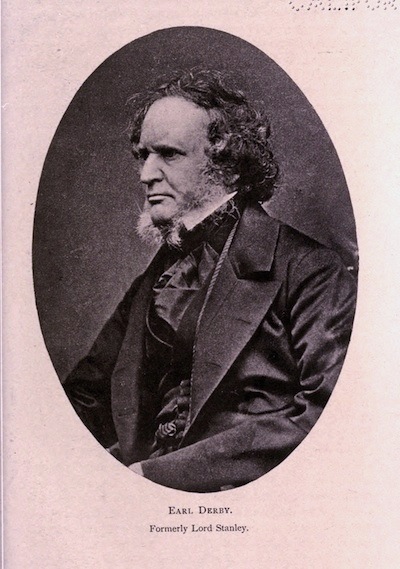
Earl Derby.
Formerly Lord Stanley.
Ere the brewing storm in New Zealand had burst, the crisis had come in the life of Lord John Russell's Ministry, who were defeated on their Militia Bill. They were succeeded by the Stanley of old, who in the person of Lord Derby, became Premier, with Sir John Pakington as his Colonial Secretary. To him fell the duty of giving legislative effect to the more workable and equitable Constitution drafted by Governor Grey, and when the Wesleyan Committee again approached the Colonial Office with the regretful assurance that the reply vouchsafed to them by the noble gentleman who had just vacated the Chief Secretaryship "was less satisfactory to the people of New Zealand than it had appeared to themselves," Sir John was able to convey to them through the Earl of Desart the gratifying intelligence that in the Bill then before the House there was every provision for the full and complete recognition of the principles for which they had so resolutely contended.
Concerning the Third Clause of the treaty, little need be said. By this covenant the Queen undertook, in consideration of the cession of sovereignty and the granting of the pre-emptive right of purchase of land, to extend to the Maori race her Royal protection, and impart to them all the rights and privileges of British subjects. Of the manner in which this undertaking has been fulfilled, the Maoris have never complained, and they have never had just grounds for complaint. There is no colour line drawn against the New Zealander in New Zealand. Our courts are as open to him as to anyone, and whether he be plaintiff or defendant, the same even-handed justice is meted out to him. He travels upon our railways, he rides upon our cars, he sits in our theatres on equal terms with his Pakeha friend. His children are educated in our schools and his sons are absorbed into our Civil Service, his chiefs sit at the Governor's table, and his elected representatives sit in Parliament, where their voice is respected and their vote is valued. The professions are open to him, and there is no position in Church or State which he may not fill. No more is demanded of a Maori than of a European. His passport to society is his good behaviour, his participation of civil rights is governed by his disposition to become a law-abiding citizen.
Only one question now remains to be discussed. In what relation did those chiefs stand to the Treaty of Waitangi who refused to sign it? It has never been contended that all the chiefs were invited to meet Captain Hobson at Waitangi, nor that all were solicited by his agents to sign the treaty, nor that all who were so solicited agreed to affix their signatures to the document. There was a residuum, which included some of the most powerful chiefs in the land, who either had no opportunity of subscribing their allegiance to the Crown, or who for reasons of their own held aloof. How were these non-participants affected by the compact?
This question was first raised in its practical application by Taraia, a Tauranga chief, who in December 1842 committed what is believed to have been the last act of cannibalism perpetrated in New Zealand. Taraia was not a signatory to the treaty, and the Government were sorely exercised as to whether they were justified in claiming jurisdiction over him. An effort had been made by the Aborigines' Protection Society in London to define the status of these independent chiefs, by submitting the question to Mr. Joseph Phillimore, an eminent English lawyer, and Mr. Phillimore had given them a qualified opinion that if there were any chiefs who had preserved their independence by refusing to become parties to the treaty, then such chiefs may not be bound by its obligations, and may be entitled to distinct and separate consideration. But clearly, in an abstract sense, there could be no such qualification to the unaltered status of these men. They were still chiefs of an Independent State so far as they were concerned, retaining inviolate their mana, and refusing to be compromised by the concessions made by their fellow chiefs.
The Government, then controlled by Captain Hobson, did not share even the qualified view entertained by Mr. Phillimore and those who thought with him. They presumed all natives of New Zealand now to be British subjects and determined that Taraia must be punished. This valiant determination was not, however, given final effect, not because the authorities were dubious of its justice, but because they had become uncertain as to its practicability; so much so that they subsequently deemed it prudent to limit their interference to a warning to that chief, that he might expect to incur the anger of the Governor upon a repetition of his offence. In Taraia's case this reprimand was sufficient to quiet him, but only a few months later Tongoroa, another Tauranga chief, made war upon his neighbours, and the sore which looked as though it had healed was suddenly reopened. Lieutenant Shortland, who had now assumed the post of Acting-Governor, proceeded to Tauranga to arrest the disturber of the peace, but before the apprehension could be effected his accumulating difficulties were further increased by an unexpected communication from Mr. Clarke, the chief Protector of the Aborigines, and Mr. Swainson, the Attorney-General. Both these gentlemen had previously endorsed the contemplated arrest of Taraia, but to the amazement of the Acting-Governor they informed him that more mature reflection had caused them to reverse their opinion, and that they now considered the arrest of Tongoroa would be illegal.
Hurrying back to Auckland, Shortland called a meeting of his Council, and there sought some enlightenment as to this new view-point of the Maori status under the treaty. Amongst those consulted was necessarily Mr. Clarke, the erstwhile Missionary, and now Chief Protector of the Aborigines, whose close and constant intercourse with all the tribes gave him the most favourable facilities for gauging the strength and direction of the native aspirations. In the course of his examination Mr. Clarke was asked:
(1) Do the natives who signed the Treaty of Waitangi acknowledge themselves to be British subjects?
To which he replied:—The natives who signed the Treaty of Waitangi, having been solemnly assured by Her Majesty's representative, the late Captain Hobson, that they should in the fullest sense of the term be entitled to all the privileges of British subjects, consented to be considered as such, with a full understanding that their allegiance depended upon the British Government fulfilling their engagements in that treaty.
(2) How far, and to what extent, do the various tribes in New Zealand acknowledge the Queen's sovereignty?
To this Mr. Clarke's answer was:—The natives alone who signed the treaty acknowledge the Queen's sovereignty, and that only in a limited sense. The treaty guaranteeing their own customs to them, they acknowledge a right of interference only in grave cases, such as war and murder, and all disputes and offences between themselves and Europeans, and hitherto they have acted on this principle. The natives who have not signed the treaty consider that the British Government, in common with themselves, have a right to interfere in all cases of dispute between their tribes and Europeans, but limit British interference to European British subjects.
(3) In your communications with the natives, have you asserted that they are British subjects, and the right of the Government to interfere with them as such? and (4) On making that assertion how far has it been acquiesced in?:—In all my communications with the natives I have been instructed to assert, and have always asserted, that they are British subjects, and amenable to British authority, in which very few, even those who signed the treaty, would acquiesce, save in matters relating to disputes or depredations upon each other (viz. differences between Europeans and natives).
(5) If the Government were to admit that any tribe or tribes of New Zealanders were not British subjects, and were not amenable to the laws, what effect do you think that admission would have on the peace and future colonisation of the colony?:—The admission that the tribes of New Zealanders were not amenable to British law, would, I am apprehensive, be destructive to the interests of the natives and the prosperity of the colony. It would be made use of by designing men to embarrass the Government, to embroil the natives with each other and with the Government, which must be alike injurious to both. Her Majesty's Government having seen fit to colonise New Zealand, it is now an act of humanity to both natives and Europeans to consider the whole of the tribes of New Zealand as British subjects, and to use every honourable and humane means of getting the tribes universally to cede the sovereignty where it has not been ceded.
(6) Supposing that we should treat as British subjects, by force, those tribes, who have uniformly refused to cede the sovereignty to Great Britain, should we be keeping faith with the principles we professed when we originally negotiated for the cession of the sovereignty?:—In treating those tribes as British subjects by force who have refused to cede the sovereignty to Great Britain, would not only be considered by the natives as a breach of faith with the principles originally professed when negotiating for the sovereignty, but would, I am apprehensive, lead to a destructive war, and although the result would be destructive to the native race, it would be inglorious to the British Government, and at variance with the designs of Her Most Gracious Majesty in adding this interesting people and country to her Dominions.
From the Protector of the Aborigines who only pretended to interpret Maori opinion as he gleaned it in his progress through their pas and settlements, the Executive turned to their Attorney-General, Mr. Swainson, for his more recent interpretation of the position as it appealed to the trained mind of a jurist, and Mr. Swainson only put into less direct language the pronouncement of Wiremu Tamihana, the King Maker, who during the hey-day of the King movement scorned the authority of the Queen over his land: "I am chief of Ngati-Haua, which is an independent tribe. My father, Te Waharoa, was chief before me. Neither he, I, or any of my people signed the treaty, therefore we are not bound by it." Mr. Swainson's opinion was as follows:
From the evidence given before the Council by the Protector of the Aborigines (Mr. Clarke), it appears that, as I have already stated, there are numerous tribes who have not ceded their sovereign rights to the Queen, and who do not yet acknowledge her sovereign authority. For the reasons already given, I think it would be consistent neither with justice nor with the principles we professed, viz. that we came here to treat for and not to assume sovereignty, to treat those tribes in all respects as British subjects, and to impose upon them our penal code; in this opinion, also, the Protector's opinion coincides. I am also of opinion that so numerous are these tribes, and many of them so distant, that were we disposed to do so we have not the power. At the same time, I am persuaded that the benefits of British protection, and the laws administered by British judges, would far more than compensate the natives for the sacrifice of their independence. These benefits, however, I am equally persuaded, can only be obtained on the voluntary surrender by them of their own sovereign rights, and on their "free and intelligent" submission to British authority. To subjugate them would require a large armed force; but by the employment of persuasion, the influence of example, and the general spread of civilisation among neighbouring tribes, there is ground to expect that they will gradually submit themselves to the operation of British laws. To constantly point out to them the benefits they will derive from doing so, and to impress upon them, to use the language of the Secretary of State, the impossibility of Her Majesty's extending to them an effectual protection unless the Queen be acknowledged as the Sovereign of their country, or at least of those districts within, or adjacent to which Her Majesty's subjects may acquire land or habitations "is the course, I believe, to be most calculated to effect the object of establishing an absolute sovereignty over the whole country."
Though doubtless giving to these expressions of opinion the respectful consideration which was their due, the Acting-Governor decided to assume the responsibility of setting them aside, and following the dictates of his own judgment. To him it seemed that it would be fatally weak to admit in the practical administration of the country the nice line of distinction drawn by the Attorney-General or subscribe to the opinion expressed by Mr. Clarke, "that every honourable and humane means should be used to prevail on tribes to cede the sovereignty where it has not been ceded," as in his judgment this would have been an over-ready admission that they were beyond the pale of the British Crown, and no more effectual means could have been adopted of disseminating the harmful acknowledgment. The troops were accordingly sent to Tauranga, but no arrests were made. Here prudence again prevailed and the officer in charge was instructed only to employ the soldiers "in the general preservation of peace." When these proceedings were reported in due course to Lord Stanley, he warmly endorsed the view adopted by Lieutenant Shortland[191] and as warmly censured Swainson, who was told in the plainest terms that he could not be permitted to entertain the views to which he had given expression, and hold a public office at the same time.
As a matter of abstract reasoning, Lord Stanley was probably wrong, as a matter of practical administration he was probably right, but the correctness of his attitude depended for its success upon the tactfulness of its application. Fortunately New Zealand has, in the main, been blessed with administrators of wide sympathies, and a paternal parliament has generally, though not always given the native race the most indulgent exposition of the treaty. Mistakes may have been made, misapprehensions may have occurred, even technical breaches of the treaty may have been committed, but since the administration of native affairs was handed over to the Colonial Government in 1863 there have been but few instances of flagrant violation of native rights. Prior to this date the care and control of the Maori still vested in the Imperial authorities, even after representative institutions had been granted to the country; and while that condition lasted there was, unhappily, an all too frequent clashing of the two races. With one or two exceptions these conflicts had a common origin in an over-anxious desire on the part of the Europeans to become possessed of native land, as opposed to the deep-founded pertinacity with which the chiefs clung to their ancestral domains. The first of these exceptions was the insurrection of Hone Heke in 1845, which was not in its inception a dispute regarding land, but an undisguised protest against the exercise of the Queen's sovereignty. Land did ultimately play its complicating part in the disruption, but in its initial stages it was the revolt of a volatile man who felt the treaty had carried him further than he intended it should lead him; it was the protest of an ambitious chief who loved notoriety as much as he loved his independence. Heke fell upon what now appears to have been the weak point in Hobson's negotiations; that while he may have, and doubtless did, convey to the natives a clear enough idea of what was meant by the sovereignty of the Queen, he does not appear to have taken sufficient care to explain with any detail what its possible effects might be. Assuredly he was not endowed with such a mental vision as to foresee all that was to happen, nor to conjure up within his mind all the changes that were inevitable in evolving a State from a condition of barbarism to one of civilisation. One thing, however, must have been obvious both to him and to those who were associated with him, that no government could be organised and carried on in a new country without a revenue adequate for all its varied purposes. Under Lord Normanby's instructions funds were to be temporarily provided from New South Wales, but the permanent revenue was to be raised within New Zealand itself, of which a large part, it was hoped, would be derived from the sale of land. Other sources of income in the way of customs duties and taxation in varied forms must also have been in contemplation, but we have no evidence that Captain Hobson ever took occasion to explain to the people that sovereignty would cost them something; that revenue which had been falling into the hands of the chiefs would be diverted into the coffers of the State, and that with the surrender of their independence they must also surrender the levies which they had been making upon the whalers.
It is conceivable that had this surrender of a means to opulence been clearly contemplated by the chiefs as a part of the colonising scheme those at the Bay of Islands would have been the more easily reconciled to it by the natural expectation that even larger sums would be flowing in to them from the sales of land. If these anticipations ever existed they were doomed to disappointment, for instead of entering upon an active campaign of land-buying the Governor suspended the purchases he should have made, and wasted his money on a site for a town, while the rigid enforcement of the pre-emptive right acquired by the Crown closed the market against the buyers of open country lands. This restriction was felt to be not without its element of injustice; for upon a more critical examination of the terms of the treaty it was found that though the Crown claimed the exclusive right to extinguish the native title, nothing had been determined as to the price to be paid or as to the time within which the purchase should be made. Thus, chiefs like Heke, who had been in receipt of substantial sums by way of anchorage money from the shipping found their perquisites appropriated by the State, while they derived no compensating benefit from the sale of land.
The first flush of disappointment which surged within the breast of Heke as he contemplated the unexpected effects of the new power was fed by the angry adventurers and thwarted speculators, who, in their chagrin at the interception of their schemes, had no compunction in inciting him to a course which ultimately led to a declaration of hostility against the Queen and to open war against the Crown.
Not so the Waitara war of 1860, which found its origin not so much in a desire to violate the treaty, as in a blundering endeavour to observe its most important provision. The taking up of arms by Wiremu Kingi was not in its spirit rebellion against the Queen's sovereignty, but a reply to the Governor's attempt to divest him of his rights by insisting upon purchasing land from one whom Wiremu contended could not by any application of native law be constituted the owner. There was on the part of the natives the greatest reluctance to resort to arms, their desire being to test the disputed point of ownership before a properly constituted Commission; but when these overtures were rejected and the Governor held on his headstrong way, they felt there was no course compatible with their high-strung sense of dignity, but to refer the momentous issue to the final arbitrament of war. The story of the Waitara campaign is too well known to need recapitulation here, but in the opinion of many of those skilled in the intricacies of Maori land tenure it was a blunder of the first magnitude, for which Governor Gore-Browne, and not the Colonial Parliament was wholly responsible. If, then, the war was unjust, the confiscation of native land which followed upon the suppression of what was called rebellion was branded with the same injustice.
And just as one wrong perpetuates itself in the form of others, this confiscation has ever since burned deep into the hearts of the Taranaki natives, and led in the early eighties to what is known as the Te Whiti movement. Like his predecessor, Wiremu Kingi, Te Whiti was a much-misunderstood man. For this state of misconception he may have himself been largely accountable, for as a concession to the Maori love of the mysterious he so combined religion with his politics, and dealt so freely in the mystic, that it was frequently difficult to separate intangible prophecy from the things that really mattered in his material policy. But shorn of all its grotesqueness the movement which centred round the Parihaka prophet and his uncle Tohu was not a repudiation of the Treaty of Waitangi, nor was it a revolt against the authority of the Queen. At its base lay the grievance, or the fancied grievance, which was before them every day in the shape of the confiscated lands. There upon the wide Waimate Plains they saw European homesteads whose occupancy was in their eyes a crime against Maori rights. Te Whiti felt he had two things to do. He had to assert his right to those lands, and he had to agitate for justice. He accordingly sent his faithfuls to plough up the fields of the farmers and the lawns of the settlers, in the mistaken hope that he would be able to force the issue before a competent tribunal and there determine who had broken the treaty—the Maori or the Pakeha.
The Government of that day saw things differently. They had no desire to exhume the remains of past mistakes with a possibility of being called upon to repair them at a cost of much treasure and more dignity. They preferred to stand upon the settled policy of their predecessors, and instead of sending a Commission to discover what was at the back of the prophet's mind, they sent troops and took him prisoner. Te Whiti may have been a dreamer, he may have been a babbler of vain things, but he was never a rebel, nor the maker of rebels; but for saying "I love my land" he was legislated into rebellion, and made to appear as a criminal.
In the same way the King movement of 1857 only became rebellion when the Crown made it so. Two primary causes operated to call into existence this political power, the creation of Wiremu Tamihana's[192] genius, which for over fifty years was a potent influence in the Maori life of the Waikato. For upwards of fifteen years the colony had been following with more or less exactitude the terms of the treaty, and during this time the State had exercised its power of pre-emption in a manner which the more enlightened Maoris now began to regard with disfavour. When Lord Normanby despatched Captain Hobson to found the colony he anticipated no opposition to the practice of buying land from the natives at a low price and selling it again to the colonists at a large advance on what the Crown had paid. For a time these anticipations were confirmed by results, but now the fathers of the race, jealous of the rapid increase of the Europeans, and alarmed at the equally rapid diminution of their lands, began to adopt a different view. Rather than part for a few shillings with property which they knew would be sold for as many pounds, they determined to exercise their right under the treaty, and refuse any longer to sanction the large transactions in which they had been engaged with the Crown.
Their eyes, too, had been opened by the Waitara war. Here a single individual had embroiled the whole of the Ngati-Awa tribe in a sanguinary conflict with the Government, by insisting upon selling land to which his title was contested. These unauthorised sales, said the chiefs, must cease, and no individual should, by his avarice, have the power to involve the people in war. To crystallise this determination into a practical act of statesmanship Wiremu Tamihana conceived the idea of a Maori King, who was to be, not antagonistic to, nor a substitute for the Queen, but the arbiter and judge in all internal disputes, as well as the mouthpiece as to land which the tribes as a whole were or were not prepared to sell. "I do not desire to cast the Queen from this Island, but from my piece of land. I am the person to overlook my piece" was how Wiremu Tamihana once publicly stated his attitude towards the Crown. The King movement was thus a Land League and not a rebellion, and as the Maoris had the right to withhold their land from sale if they so pleased, their adherence to this restrictive policy was no more illegal than the establishment of a Trades Union or a Political Association. The movement did not become militant until after the invasion of the Waitara by the British troops, when many of the Waikato natives rose in sympathy with Wiremu Kingi, and the battle followed them back to their gates. Then the authorities began to realise what a compelling truth there was in the maxim of Bishop Selwyn: "Nothing is easier than legally and peacefully to extinguish a native title; nothing is harder than to extinguish a native war."
Worsted, though not disgraced, in the field, the dissatisfied Maoris have since sought to secure the full measure of political justice to which they believe themselves entitled by more constitutional methods. Amongst their dreams has been a native Parliament sitting in the Treaty House, at Waitangi, to approve measures for the betterment of the race, which measures would be afterwards adopted by the Government and given the effect of law. This, however, has been nothing more than a dream. Little better was the Kotahitanga, or union, in 1892, of all the tribes in the north, exclusive of the Kingites who still remained loyal to their monarchal authority. The policy upon which this new union was founded was that of inducing the Government to cease purchasing native lands, and to set aside as a reserve for the benefit of the present and all future Maori generations the considerable areas of native land still unsold. Nor was this all. Legislation had been passed, not specially directed against, but not excepting the native race, placing restrictive conditions upon the oyster fisheries of the country, and this the leaders of the movement held to be a breach of the second clause of the treaty, which guaranteed to them not only the free use and control of their lands and their forests, but of their fisheries also. The deprivation of their right to freely gather food from the sea and the sea-shore was, together with other grievances, sufficient to galvanise them into political activity, and the Kotahitanga was formed with the meteoric Hone Heke[193] at its head. The Native Rights Bill was introduced by him and rejected by Parliament, but the movement was not without its fruits, for in 1900 part of their purpose was achieved in the concessions made by the Government in the Native Land Administration Act and the Maori Councils Act.
With the accomplishment of these aims, and the early death of Heke, the Kotahitanga has failed to preserve its former vitality; but brief as was its career, it must be recorded of it that in its inception and activities it was, as most Maori movements have been, not an organisation designed to aid in the evasion of the treaty, but rather to insist upon the due observance of its contracts.
Few Legislatures in the world have had a more difficult task than has fallen to the lot of that of New Zealand in legislating for the Maori so as to preserve his nationality, his rights, his liberties, and yet not bar the progress of the European state. That it has been embarrassed times without number by the treaty is undoubted, and therefore it is the more to its credit that the diplomatic bargain which has now held good for the better part of a century should have been so little violated. The treaty has been the broad foundation upon which the intricate structure of native legislation has been reared through all these years; and if there has ever been as there must have been under changing conditions trespass upon the strict letter of the compact, it is safe to assert that this variation has only occurred when Parliament has been honestly satisfied that the wider interests of the State as a whole demanded the departure. At no time has the Legislature been callously unmindful of the true spirit of the treaty, or careless of the great trust imposed upon it as the guardian of native rights.[194] This commendable endeavour to observe that "justice which is the paramount interest of all men and all Commonwealths" has finally led to a universal acceptance of the treaty by the native race as the basis of their civil and political privileges. So far is this the fact, that to-day the Maori is more insistent upon a due observance of its covenants than is the European. The present generation of natives accept it unquestioningly; and long before the "Old Guard" of objectors had passed away they, too, were beginning to realise that the sacrifice of their independence was more than compensated for by the protection of the British flag. They felt the irresistible sweep of the white tide that had surged upon their shores, and much as they might regret the passing of their ancient mana, they were compelled to acknowledge the force of truth in the figurative statement of their diminishing power once propounded to them by Mr. Busby: "How can the little pebble dam the stream? how can the single tree stand against the storm?"