W.H.G. Kingston (continued 7)
Reading edition
Directly afterwards the captain’s gig passed Adair’s boat. She was also soon lost to sight. Adair hailed and told them to look out for Ben; but whether or no they had succeeded in picking up the gallant fellow he could not tell, and with the rest was long left in doubt as to what had happened.
The accident had caused all caution to be forgotten, and Murray and the other officers expected that their cries and shouts must have been heard by any scouts which might have been sent out from the fort. He therefore warned the sentries to be on the alert, and ordered the men to keep their arms ready for immediate action.
The unaccountable and sad accident threw a gloom over the spirits both of officers and men, and but few went again to sleep during the remainder of the night. The next day they would probably be engaged with the enemy, and who could tell whose fate it might be to fall? To pass slowly up against the rapid stream with both its banks affording an almost impenetrable shelter to a concealed foe was likely to cost them many lives, and from the account they had heard of the strong position of the fort they were aware that it would give them severe work to capture. Still it was to be done, and no one doubted that it would be done, whatever might be the sacrifice. The more reflective had their minds fully occupied, and all were in a state of anxiety on account of their captain, and the persons he had risked his own safety to rescue from destruction. Adair, who heard what Ben had cried out, had little hopes that he would succeed, and was afraid also that his old shipmate had lost his life.
At dawn Murray had all hands roused up that they might get ready to start. Should the captain unfortunately have lost his life the command would devolve on him, and he resolved to do his best to secure the success of the expedition.
Chapter Sixteen.
The captain’s return—Boats approach the fort—Assailed on all sides—Hot fire—Passing the fort—Archy wounded—The landing—Fort attacked—Needham hauls down the flag—Enemy put to flight—The pursuit—Fall of Commander Babbicome—Prisoners captured—Fort destroyed—Re-embark—Passage down the river—Sail for Jamaica—Death of Commander Babbicome—Funeral—Murray promoted—Hastens to Saint David’s.
Alick Murray felt the full responsibility of the duty imposed on him, but he knew that he had trustworthy supporters in Jack and Terence, and that full reliance could be placed on the military officers and on the gallant marines and soldiers of the regiment.
As soon as day broke Higson dropped down the stream to rejoin the main body. He had heard the shouts and cries, and fancying that they had been caused by the appearance of another puma or jaguar in the camp, he had not thought it his duty to quit his post. As soon as he arrived, Murray, informing him of what had happened, ordered him to proceed down the river and ascertain, if possible, what had become of the captain and the two unfortunate gentlemen who had been carried away by the current. In the meantime every preparation was made for starting. The soldiers had re-embarked, the expedition was about to proceed, when two boats were seen rounding a point some way down the river. The seamen cheered heartily when they discovered that their captain’s gig was taking the lead: she having at length got near, Terence, who was looking out, with great satisfaction saw that his old shipmate, Ben Snatchblock was on board; as the gig came up alongside he inquired for the consul and his friend.
“They are lost,” answered the captain, “not a trace could we discover of them. They must both, poor fellows, have been drowned before they had been many minutes in the water, and this brave fellow here was nearly lost also in his attempt to save them. I cannot bear to think of their sad fate, while we shall much miss their assistance. We have, however, an unexpected addition to our force. I had gone some way down when I saw a fire on the shore, and putting in, found Commander Babbicome and his boat’s crew encamped, he having recovered sufficiently to enable him to come up and join us.”
“How was Snatchblock saved?” asked Terence.
“By catching hold of a big tree which rose out of the water when I was pretty nigh done for,” answered Ben. “Thanks also to Commander Babbicome and his boat’s crew, who hearing my shouts came and took me off.”
The corvette’s gig, with her perspiring commander (as Terence called him), soon afterwards came up. He was full of fight and valour, and burning with eagerness, as he said, to have a brush with the enemy. He looked but little able to undergo any exertion, and Captain Hemming, who thought him unfit for the work, regretted that he had joined the expedition, though he complimented him on his zeal and determination.
“I couldn’t bear the thought of being left behind, and though I knew that I should be reduced to a pancake, and bitten into one mass of blisters, I determined to follow you,” he answered, “but it has been trying work, I can assure you. I have lost three stone already, so Dick Spurling, my coxswain, who is a good judge of weight, declares, and I have made him hoist me up on his back every morning to try. And then those abominably greedy mosquitoes! I should have thought after feasting on the hides of two hundred fellows or more, they might have had the conscience to let me alone, the gluttons! I had to tell the men off into watches to wave branches over me at night, or there wouldn’t have been an ounce of blood left in the morning, even if they hadn’t carried me off bodily, and really, considering the size of their wings and the strength of their proboscises, I thought that more than probable. Now after all I have gone through, I only hope that the enemy will hold out and give us something to do.”
As Captain Hemming was unwilling to displace Murray, he directed the sorely-tried commander to take charge of the heavier boats, while he and the lieutenant proceeded on ahead with the lighter ones, to endeavour, before commencing hostilities, to try and settle matters by pacific measures. The order was now given to move ahead.
“Faith, it’s easy enough to say that same,” exclaimed Adair, “but it’s much harder to do it. However, give way, my lads; we shall see the noses of the Dons before long, if they stop to show them, and if not, we shall chance to get sight of their coat-tails.”
A hearty laugh from his boat’s crew, as they bent lustily to their oars, followed this sally.
As the crews of the heavier boats laboured with all their strength they made good way, and for some time kept the two light gigs in sight. They now entered a reach of a mile and a half in length, at the head of which, according to the consul’s description, the fort would be found.
The captain and Murray pulled on for some distance, though the mist which still hung over the river hid them from sight of the fort. Not a breath of air stirred the leaves of the forest; the monkeys, as before, chattered among the branches, and bright-coloured macaws flew screaming overhead. At length, far in the distance, on the summit of a bold point projecting into the river, the stockade they might have to attack came into sight.
The rays of the rising sun shining on the fort brought it into bold relief against the dark woods, and above the deep shadows cast across the stream.
No flag waved over it, and no sign of life appeared, not a canoe floated on the water, no sound was heard. Captain Hemming thought that had he not wished first to try pacific measures, he might have managed to surprise its garrison without resistance, but, like many another gallant man, he had no wish to fight if it could be avoided, and he only hoped to induce the Nicaraguans to yield without being compelled to resort to force.
The gigs proceeded but slowly as the current here ran even faster than in any part of the river. Still no notice was taken of the boats, and Murray, who shared his captain’s sentiments, had begun really to think that the matter would be settled without bloodshed, when two wreaths of smoke issued from the stockades, and a couple of shots whistled near them. At the same moment up went the flag of the Nicaraguan republic, and the next instant volleys of musketry came rattling by them from either side of the river.
“Colonel Salas evidently does not intend to receive us as friends,” observed Captain Hemming. “Order up the other boats, Murray, the sooner we give him and his followers the lesson they require the better. We will at once make a dash at the fort; it will not do to stop here and be shot down like dogs.”
As Dick Needham saw the flag run up he exclaimed—
“We’ll have that bit of bunting down before long, lads, and it won’t be my fault if I don’t get hold of the halliards.”
The crews cheered and pulled on with renewed vigour. Their strength, however, was taxed to the utmost, for the banks of the river closing in at this point, the water rushed down like a mill-stream, and at times the boats remained almost stationary. It was no easy task to urge even the light boats ahead. Though showers of shot came rattling about them from numerous concealed foes on either side, it would have been useless to return their fire, for not an enemy showed himself.
The marines and soldiers, however, got their muskets ready to pick off any more adventurous foes who might for an instant appear among the trees, but the enemy were too well accustomed to this sort of warfare to expose themselves, and kept well under cover. It was trying in the extreme, but their gallant leader had resolved not to be defeated in his object, and all hands willingly followed him. He and Murray took the lead in their respective gigs. Jack Rogers, with his brother Tom in the pinnace, which carried the lieutenant of the marines and a party of his men, were close astern. The frigate’s and corvette’s barges, with a detachment of the regiment and their captain, were not far off; the other boats were making the best of their way, but found it impossible to keep up with the lighter-built ones. Considering the showers of bullets which kept whizzing by them, it seemed wonderful that as yet no one had been wounded. They were not allowed, however, to proceed much farther with impunity. The boats had been repeatedly hit, and some of the oars had almost been cut in two. As the headmost boats neared the fort the fire became hotter.
The bowman of the pinnace was seen to relax his efforts, but still he pulled on, a red stream issuing from his breast showed that he had been hit; presently the oar slipped from his hands, and he sank down into the bottom of the boat. A marine immediately took his place. Directly afterwards another man was hit. Not a groan escaped him. Grasping his oar he attempted to make another stroke, but his eyes gazed wildly, blood issued from his mouth, the oar escaped from his hands, and he fell back on the thwart a lifeless corpse. Another man sprang to his place and with little ceremony, shoving the body aside, pulled lustily away. The crews of the other boats were treated in the same manner. Nothing daunted, other men took the places of those who were wounded; the gigs offering a smaller mark were less frequently hit, but the white splinters which flew from their gunwales and oars showed that the bullets of the enemy had found them out; one of the captain’s crew was hit, and directly afterwards Murray had another man hurt. It was a severe trial for the courage and patience of all, for eager as they were to get at the foe, they could do nothing but sit still and be fired at.
Short as the distance was, an hour passed by before they reached the fort. At length the leading gigs got up to it. As they did so the river appeared to decrease in width, while the stream, consequently, ran still faster, and the fire became even hotter than before. The gigs and pinnace, which kept well up with them, had now got close to the fort, the stockades rising on the projecting point, high above their heads. The marines, in the last-mentioned boat, took aim at any of the enemy who were seen for a moment on the fortifications, while the soldiers in the other boats did their best to clear the banks of their persevering foes. Still, however, they were exposed to a galling fire from all directions; from foes on the starboard hand, and other concealed enemies on the bows and quarter. Several more men were hit, but as long as they could pull a stroke they refused to quit their oars. The boats were almost riddled with shot; the gigs were struck several times between wind and water, the holes being filled up with handkerchiefs, or whatever first came to hand. Archy Gordon was employed in stopping one with his handkerchief, when Murray, to his dismay, saw him fall forward; steering with one hand he lifted the lad up with the other.
“Don’t mind me,” said Archy, in a faint voice, looking very pale; “a sharp blow made me topple over, but I don’t think that I am much hurt.”
“I trust not, my boy; but we will get a doctor to look to you as soon as possible,” answered Murray, placing him into the stern sheets by his side, so as to cover him as much as possible. Again and again the boats were hit, and half the oars were cut through. Some breaking off, others were immediately got out to supply their places.
The boats all this time were slowly working their way along against the stream. This was the most trying part of the whole voyage. Upwards of an hour they had been under fire, and for nearly forty minutes more they were passing the stockades exposed to it. At length the extreme point was neared; this they had to round, and then to pull some distance up the river, so as to be able to descend rapidly to the landing-place, which was on the other side of the point. The crews renewed their efforts, and the remainder of the flotilla now appeared, coming slowly up. As the leading gig at length rounded the point, her crew uttered a cheer; and as the river became wider, and the current ran with less force, they were able to make better way, and soon getting beyond the fire of the fort, they were exposed only occasionally to a shot from some of the more persevering of the enemy who had made their way along the banks.
Murray was thankful when he could at length examine poor Archy’s wound. The lad had fainted from loss of blood; the bullet, it appeared, had lodged in his side. McTavish, the assistant-surgeon, was fortunately in the pinnace, and when she came up he took the midshipman under his charge, as well as several other poor fellows severely wounded. Tom held him in his arms while the doctor probed his wound, and at length succeeded in extracting the bullet.
“He’ll not die, I hope,” said Tom, feeling very sick and sad.
“Not this time, I trust. He has a good constitution, and that’s everything in his favour,” answered McTavish.
There was no time, however, for sorrow or sentiment.
Most of the boats had now got up, and Captain Hemming not waiting for the rearmost ones, which he calculated would arrive in time to land the men after the first part had gained a footing on the banks, gave the order to attack.
With true British cheers the crews gave way, and the stream now being in their favour, the boats, still exposed to a warm fire, rapidly approached the landing-place.
In front of them was the principal stockade, guarding the landing-place, a gun on which opened fire. As the boats kept in line it did no damage, for missing one it missed all. Pulling quickly on, the leading boats of the flotilla soon reached the landing-place, when the captain, with Jack and Terence, were the first to leap on shore. Tom and Gerald, with Needham, came close behind them. The marines, led by their tall commander, followed, and formed quickly up. The bluejackets and soldiers immediately afterwards landed, and the captain, with his companions, again giving forth hearty cheers, rushed towards the stockade in which the gun was posted. The Nicaraguans, dark, stalwart fellows, stood their ground bravely, till they saw the cutlasses of the seamen waving about their heads, and the bayonets of the soldiers pointed at their breasts, when a well-directed volley of musketry laid many low, and as the seamen climbed over the stockade, the survivors abandoning their gun, fled for shelter within the fort. Here, rallied by their officers, they made another stand, but the English sailors, rushing forward, were soon climbing over the defences in spite of the showers of bullets which were flying past them.
The bluejackets and redcoats vied with each other as to who should be first over, and as they sprang down into the fort, the former began slashing and hewing away with their cutlasses, while the latter, forming as they got over, brought their weapons to the charge, and dashed forward against the main body of the enemy, who stood their ground.
Needham had not forgotten his resolve to haul down the Nicaraguan flag. Accompanied by the midshipmen and several men, having seen that it was flying at the further angle of the fort, he made a dash towards it. A dozen or twenty of the enemy, led by an officer, seeing him coming, and guessing his object, threw themselves in his way to cut him off. With a cheer, he and his companions dashed forward to the attack. The enemy withstood them for a few seconds, but a small party of marines made so vigorous a charge that they took to flight. Others of the garrison had, however, rallied in the neighbourhood of the flagstaff.
Still the dauntless seamen dashed on, and so well used their cutlasses that they forced their way through them, and Dick, with a loud shout, sprang up to the flagstaff. In another moment he had the halliards in his hand, and down came the Nicaraguan colours. Having tucked them under his arm, he again, with cutlass in hand, made a rush at the enemy. The fight, in the meantime, had been raging in all parts of the fort. Its issue was never for a moment doubtful, though the enemy, mustering nearly 200 strong, showed a bold front; but they could not withstand the charge now made by the gallant soldiers and bluejackets. Turning tail, off they scampered as fast as their legs could carry them, through the outlets in the rear of the fort.
“On lads! on!” was the cry, and after them dashed the whole body of their assailants uttering a ringing cheer which tended to increase the rapidity of their flight. Jack and Terence, and the other officers led the sailors. Captain Babbicome, though undoubtedly not as active as the rest, had managed to scramble into the fort, and now puffing and blowing was well in advance.
As soon as they gained the shelter of the wood, many of the fugitives turned and fired, but again fled as their pursuers came up with them. Tom and Gerald having assisted to capture the flag were somewhat behind the rest. As they ran on they saw the obese, though gallant, commander just before them, flourishing his sword and shouting, “On, lads, on! Tally ho! tally ho! We’ll have their brushes before long. Make mincemeat of the rascals! Tally ho, boys tally ho!”
His voice grew hoarser and hoarser. Some of the fugitives stopped, turned round, and fired. Suddenly, down he went on his face, his sword flying out of his hand.
“There’s old Babbicome knocked over,” cried Tom and Gerald in the same breath.
Though they would have preferred seeing the end of the “fun,” as they called it, they felt that it was their duty to stop and assist him. Having summoned some of the men near them to their aid, they lifted him up, but no wound could they discover.
“I’m done for,” he groaned out.
“Where are you hit, sir?” asked Tom.
“Nowhere that I know of, but I’m shaken to death. Running doesn’t suit my constitution. Carry me back to my boat.”
His groans and sighs showed that he was much hurt. His own men coming up obeyed his orders, and Tom and his companions continued the pursuit.
A Nicaraguan officer and several men had already been taken prisoners and sent down to the landing-place. Every now and then the pursuers caught sight of the enemy among the trees, who, as soon as they saw them coming, again darted off, easily finding concealment in the dense forest.
“I wish that Archy was here,” cried Gerald, “he would have enjoyed the fun.”
Needham, with several other sailors, were with the midshipmen. Just then they caught sight of a person trying to conceal himself behind a tree. By his uniform they knew that he was an officer.
“We must have that fellow,” cried Tom, dashing forward.
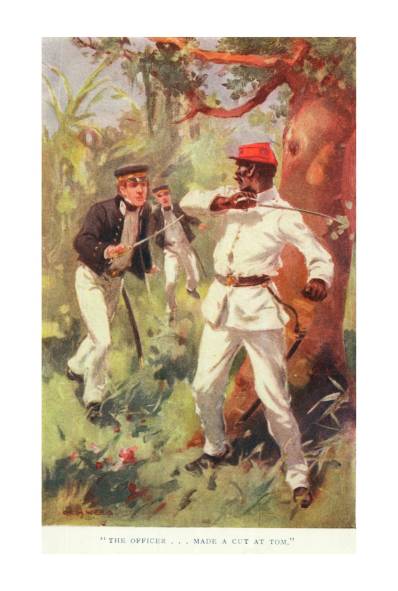
The officer, who had a sword in his hand, made a cut at Tom, which he parried with his cutlass. The Nicaraguan then seeing several of his enemies approaching, cried out for “quarter,” and presented the hilt of his sword.
“Come along,” cried Tom, highly delighted, “you’re my prisoner; no one shall hurt you now;” and he and Gerald, who was close at hand, grasping him by the arm, shouted to Needham and the rest to come and take charge of him.
Just at that moment the bugle echoing through the forest, sounded the “recall.” The summons was heard by the fugitives with more satisfaction probably than by the pursuers. The latter obeyed it, and bluejackets, marines, and soldiers began to assemble from all directions in which the flying enemy had led them.
Few prisoners only besides the officers had been taken, for the thickness of the forest favoured the flight of the Nicaraguans. Here and there the dead body of one of them was seen, shot in the pursuit, or who had fallen down after being wounded in the fort.
The midshipmen were excessively proud of their capture, and Needham not the less so at having the Nicaraguan flag to show as a trophy. At length the greater number of the pursuers returned to the fort. The remaining stragglers, who had been led by their ardour farther than the rest, came in soon afterwards, and the whole being mustered, it was found that not a man had been killed on shore and five only wounded.
Tom and Gerald now came up to the captain with their prisoner, and received due commendation for their zeal. Needham followed with the flag, which he had kept fast under his arm, and which he now produced in due form; the captain having heard the particulars, did not fail to promise that he should receive a reward for his bravery.
He then addressed the men, and expressed his satisfaction at the gallantry and good discipline they had displayed. “We have still some work to do, my lads, however, and the more quickly we set about it the sooner we shall get out of this broiling spot, and have our wounded men properly cared for on board ship,” he said. “We have to make the place untenable for some time to come by the rascals you have so soundly thrashed.”
All hands then set to work to spike the guns, to break the trunnions, and to gather together all the muskets and ammunition which the fugitives had left behind them. With many a cheer the sailors, who enjoyed the fun, then rolled the guns down the steep bank into the river. While one party was thus engaged, the other was employed in pulling up the posts of the stockades, and piling them in great heaps, with the muskets on the top. The heaps were then set on fire, and the place which a few hours before presented so formidable an appearance, was utterly destroyed.
The order was now given to embark. Murray had been directed by the captain to go over the ground and ascertain the number of the killed. Twenty dead bodies were found; several more having been seen in the forest, it was computed that twice that number had been wounded; the larger proportion of these had, however, been assisted off by their companions. Some of the prisoners proved to be boatmen, pressed into the service. Twelve of these were taken to act as pilots, a hint being given them that should they attempt to play tricks they would be forthwith shot.
The two officers looked very crestfallen. Jack had one of them in his boat, and Terence took charge of the other. They were not very attractive gentlemen, and did little else than bemoan their hard fate and smoke their cigarettes, which they assiduously employed themselves in rolling up. Jack’s prisoner, for most of the time, gave vent to his ill-humour by abusing the commandant who had been the cause of their misfortune. Jack knew but little of Spanish, but still he was able to make out what was said.
“What regular daredevils you English are, nothing can stop you,” cried the officer.
“You are right, my friend; trifles don’t hinder us when we have an object in view; and as we were going up with purely pacific intentions, merely to inquire why your colonel had carried off two of our countrymen, it was not pleasant to find ourselves fired at by you and your people, though you might have thought it good fun. We have made you pay pretty dearly, however, old fellow, for your amusement.”
“Yes, you have indeed,” replied the Don; “but you have not recovered the men you came to search for.”
“No; but still you are not likely to regain your liberty till you find them for us.”
“Then we shall be prisoners for ever,” sighed the Don.
“Why, what have become of the men?” asked Jack.
“They are ‘gastados,’ ‘expended,’” answered the Don.
“What would you say if we were to expend you and your brother officer, by running you up to the yardarm of one of our ships?” asked Jack.
The remark made the Don shake in his shoes.
The expedition remained for the night at the spot from which they had started in the morning. The wounded were as well cared for as circumstances would allow. Great anxiety was felt by all hands for Archy Gordon, the surgeon being unable to give a satisfactory report of his state. His two friends begged leave to assist in attending on him; he was frequently insensible, and when he returned to consciousness the groans which he uttered showed how severely he was suffering. The next morning the expedition got under way and, piloted by the boatmen, rapidly proceeded down the stream, performing the distance in a few hours which had taken them so many days of hard toil to accomplish in their ascent. Several men were also on the sick list from fatigue and exposure to the hot sun by day and the damps of night. None of the officers had suffered much except Commander Babbicome, who had remained unconscious from the time he had been carried on board his gig. The surgeon announced his case to be one of sunstroke; Captain Hemming, therefore, sent him down in his gig ahead that he might sooner obtain the assistance of his own doctor.
Archy Gordon was at once taken on board the frigate, that he might be under the care of the surgeon, who expressed great anxiety about him. Tom and Needham were his constant attendants; Tom, indeed, watched over him, when off duty, with the affection of a brother.
“Never fear, Rogers,” said the surgeon, observing how unhappy Tom looked, “Gordon will pull through if he keeps quiet, and is watched over with the care which you show him.”
Tom was somewhat consoled on hearing this; he sent off a despatch to Gerald, by the first opportunity, with a bulletin of their friend’s state.
The report from the corvette was not so favourable. The surgeon expressed his fears that the commander would not reach Jamaica alive.
For the sake of his wounded men Captain Hemming was anxious to return as soon as possible to Jamaica. Murray was walking the deck of the Supplejack, when a boat from the frigate came alongside, and Lieutenant Rogers stepped on board.
“Good news, Alick!” he exclaimed. “We are to get under weigh immediately the wind will allow us, and proceed at once to Jamaica, where the captain is anxious to land the sick and wounded. I knew you would be glad to hear this; you will receive, I hope on arrival, a due reward for your gallant deeds, for every one says that you are sure to be promoted.”
“I shall certainly prize that for many reasons,” answered Murray, “and thanks to you for cheering me up. Our energies have been taxed pretty severely for the last few days, and I feel more out of spirits than usual. What account do you bring me of poor Archy?”
“The doctor is more hopeful about him than at first. Young Highlander as he is, he thinks that there is every prospect of his getting round again in time by careful nursing, and I dare say your friends at Saint David’s will be happy to take charge of him when we get to Jamaica. He will afford an object of interest to Miss O’Regan, and draw her off from the thoughts of her own loss.”
“I trust that such may be the case,” said Murray. “But, my dear Jack, I have been oppressed with all sorts of evil forebodings about her. I cannot help dreading that she has been attacked by fever, or that she has met with some accident, or that—”
“Nonsense, Alick, that’s not like you,” interrupted Jack. “You say that your energies have been severely taxed: that alone is the cause of your forebodings of evil. After we have been at sea a day or two you will laugh at them. Good-bye, I must be off.”
Jack pulled on for the corvette, and delivered the welcome order to prepare for sea. The surgeon gave him a bad account of the commander. His mind was wandering, and he was every day becoming weaker. He was continually talking of his beloved beeves and his pigs, his orchard and his cabbage-garden, and sometimes he fancied that he was bestriding his trusty cob, setting off to market, and he would shout out to his old housekeeper, Martha, to have his dinner ready at his return.
“Poor fellow, he would have been wiser had he continued cultivating his little farm in Bedfordshire, instead of tempting again the treacherous deep,” thought Jack. “However, probably Alick will get the vacancy, so it’s all right.”
A short time afterwards a light breeze came off the land. The sails were let fall, and, the frigate leading the way, the small squadron shaped a course for Jamaica.
The Supplejack proved herself to be a fast craft, being well able to keep up with the frigate and corvette, so Murray considered that he could report favourably of her to the admiral.
When within about a day’s sail of Jamaica the corvette, which had separated during the night from her consort, was again seen approaching, with her flag halfmast high. The flags of the other two ships were lowered in compliment, and inquiries by signal were made as to when the melancholy event had occurred. The reply was, on the previous evening, and that the commander’s last request had been that he might be buried on shore.
The next day the squadron came to an anchor in Port Royal harbour.
Eager as Captain Hemming knew that Murray would be to proceed to Kingston, his first duty was to attend to the funeral of the late commander of the corvette, which could not be delayed.
The boats of the squadron being manned, followed the Tudor’s barge, which contained the coffin. On landing it was borne by a party of seamen to the burying ground of Port Royal, where the garrison chaplain performed the service, and the marines having fired a volley over the grave, the party returned on board.
The ceremony being over, the flags were hoisted up, and it must be confessed that very little more was thought of or said about poor Commander Babbicome and his eccentricities. Captain Hemming and Murray then proceeded up to Kingston, where they were received with warm congratulations and highly complimented by the admiral.
“I have already sent your despatch home,” he said, turning to Alick, “and I have secured your promotion, I hope. In the meantime I intend to give you an acting order to take command of the corvette, and I shall be glad, Captain Hemming, to appoint any officer you can recommend to the Supplejack.” The captain at once named Lieutenant Rogers. “I should have been glad to have suggested my first lieutenant, Mr Cherry, but I am unwilling to spare him, and I believe that he would rather continue as at present on board the frigate.”
On hearing that his young cousin was wounded, the admiral at once desired Murray to have him brought up to the Pen, if the doctor thought he could be moved, “and you, I suspect, will not object to a day or two’s leave to enjoy a trip into the country,” he added; “I shall be happy to see you on your return.”
Alick thanked the admiral, who advised him to set out forthwith, while he invited Captain Hemming to dinner. The boats were sent back, with directions that the wounded midshipman should be brought to the Pen the next day; and Murray, taking the admiral’s advice, set off for Saint David’s, hoping to arrive there before nightfall.
Chapter Seventeen.
Jack Rogers in command of the Supplejack—Alick’s letter to Jack—The Caymans—Shoal of turtle—Dolphins—Chases a slaver—Havannah—Scenes on shore—Slavers in harbour—Polite invitation from a slave-dealer—Jack accepts it—The Venus slips out of harbour.
Sometime after the events related in the last chapter, Jack Rogers walked the deck of the Supplejack as her commander, he having superseded Murray, who had been promoted, as every one acknowledged—a just reward for his gallantry at Carthagena.
Higson had been made a lieutenant, and appointed to the Tudor, while Terence Adair had rejoined the Plantagenet. The commander who had been appointed to the corvette in the place of poor Captain Babbicome had fallen sick, and as there was every probability of his having to return to England, Jack had hopes that the admiral would appoint Murray to the command.
“If I hadn’t the Supplejack I should have been delighted to serve under him,” said Jack to Adair, who had come on board to see him.
“I have no idea of a fellow being jealous of another’s good fortune, for no one deserved his more than Alick Murray. I only wish that I may get the chance of doing something in the Supplejack; I won’t throw it away if I can help it.”
“You will have more opportunity than I shall have aboard the frigate,” answered Terence; “and I only wish that I could be with you or Murray, if he gets the command of the Tudor.”
“I’m sure, at all events, to fall in with a slaver or two, or perhaps have some such work as that of Saint Juan cut out for me,” said Jack. “I am now, I believe, to be ordered to Havannah, so Johnny Ferong assured me yesterday, and as he is certain to be well informed, I expect every hour to receive my despatches from the admiral.”
While Jack was speaking, a boat was seen coming down the harbour, and in a short time he received from the officer who came in her an order to proceed at once to Havannah, and on his way to keep a sharp lookout for slavers, of which it was known there were a good many on the coast. He at the same time got a letter from Murray, who had been residing with his friends at Saint David’s since he gave up the command of the Supplejack. We may take a glance at its contents, which thus ran:—
“Dear Jack,—Since I cannot tear myself away from this Eden, though had I a pair of wings I would do so for a brief space, to see how you are getting on on board the little brig, I must beg you to be content with the few lines I have the time to write, before our sable ‘Mercury’ starts for Kingston. I am, as you may suspect, supremely happy. Stella has recovered her spirits, and every day becomes more attractive. It is beautiful to see her watch over my young kinsman Archy, who is slowly recovering from his dangerous wound. The doctor says that had it not been for her watchful care he would have succumbed to the fever, which attacked him after his arrival here.
“You ask me when our marriage is to take place. Stella will not hear of it; her father’s death is too recent; and she will not tempt me away from my duty, for she thinks that if I became a married man I shall wish to remain on shore; and I cannot help acknowledging that, in that respect, she is right. She wants me, at all events, to serve as a commander till I obtain a post-rank; and her kind friends here offer her a home till she has one of her own.
“I long for the time, however, when I may take her to Scotland as my bride and present her to my family. In truth, though I have often fancied that nothing would make me wish to leave the navy, I have begun to meditate doing so rather than be separated from her. Perhaps, however, I may be able to persuade her to yield to my wishes, and as the Tudor will probably remain on the station, I shall constantly be returning to port and be able to enjoy her society.
“I am sure, you say, to get command of the corvette, provided Grafton goes home; and the doctors say that there is no chance of his recovering out here.
“Stella desires to be kindly remembered to you, as do all your friends at Saint David’s. You have won their hearts, I assure you, and they will be happy to see you whenever you return to Jamaica.
“They press me to remain here till I am ordered to join the ship; and as you may suppose, I am perfectly happy to accept their hospitality.
“My cousin Archy desires to be remembered to those young reefers, your brother Tom and Desmond. I hope some day to be among them and assist in keeping them out of mischief. Give my kind regards to Terence, and believe me,
“Your very affectionate friend,
“Alexander Murray.”
Jack had no time to answer this letter, as, the breeze proving favourable, he was obliged to put to sea according to his instructions. During his run westward he kept a bright lookout for slavers in all directions. It was just daylight; a mist lay on the surface of the ocean, which completely shut out any object at a distance; while a light breeze from the South-east filled the brig’s sails and impelled her at the rate of two or three knots an hour through the water. Harry Bevan, who had joined from the frigate, was officer of the watch. The men, with trowsers tucked up and buckets in hand, were about to commence the operation of washing decks.
“I say,” exclaimed Tom, who had been sent forward on some duty, “I never believed in the great sea serpent, but, as sure as I’m alive, that must be the fellow right ahead, wriggling along at a tremendous rate! If you listen you’ll hear the noise he’s making!”
“Broken water ahead!” shouted the lookout forward.
“That I’m sure it cannot be!” said Bevan.
He, however, as a precaution, brought the brig to the wind, and directed Tom to call the commander. Jack was quickly on deck.
“Keep her away again!” he exclaimed, after he had examined the object which had so astonished Tom. “That is neither the head nor tail of the big sea serpent, but a shoal of turtles, which having come from the Bay of Honduras, are bound for the Cayman Islands, where they are going to lay their eggs?” he said, laughing heartily at Tom’s notion.
The brig was soon in the midst of them, their columns dividing to get out of her way. It was wonderful the noise they made, as their fins rapidly struck the water in their onward course. Soon afterwards the mist lifted, and the lofty trees which grew on the great Cayman could be seen rising out of the water some fifteen miles off, appearing like a grove of masts emerging from the ocean. Directly afterwards the mist, which still hung in the west, was swept away, exposing to view the sails of a square topsail schooner shining in the rays of the sun with snowy whiteness. Jack immediately ordered the brig to be kept away, and made all sail in chase. The schooner held her course for some time, but at length discovering that the brig had kept away, set also every stitch of canvas she could carry. This at once betrayed her character, for had she been an honest trader, she would have had no reason to run from an English brig.
The crew felt as eager to overtake her as did the commander. It was the first of this sort of work they had had, and they indulged with immense satisfaction in the idea of carrying back a prize full of slaves to Port Royal.
Long Tom was got ready for action, as it was not likely that the slaver, if such she was, would yield without making every effort to escape. The chase showed that she had a remarkably nimble pair of heels, for fast as the Supplejack was, after a couple of hours had passed by, she appeared to have gained little or nothing on her.
“Do you think we shall take her?” asked Tom of Needham, who had been appointed as gunner of the Supplejack.
“If the wind freshens, and we have the first of it before it reaches her, we may get her within range of Long Tom, and it then won’t be my fault if we don’t bring down some of her spars; but if night comes on before our shot can reach her, she may manage to slip out of our hands in the dark.”
“But we have most of the day before us, and we surely shall get up with her before then,” observed Tom.
“You see, we have run on already two hours, and are no nearer than at first,” said Needham. “If we were to chase her round the world, and she was to sail twelve knots to our ten, she would soon be out of sight, so I don’t feel very certain that we shall have her ladyship; but if we miss her this time we may fall in with her another.”
At the time the men were piped to dinner, the Supplejack had not gained more than at first on the chase. Still Jack persevered, trusting that something might happen to favour him.
The men in their eagerness to watch the chase hurried up on deck, and the officers remained below as short a time as possible. Every expedient that could be thought of was adopted to increase the speed of the brig. Every variation of the breeze was carefully watched by Jack’s vigilant eyes. Now he ordered a pull at the starboard, now at the larboard braces, while every inch of canvas that could be set was kept thoroughly wetted so that not a thimbleful of the precious wind could escape till it had done its duty.
The day wore on; it was tantalising in the extreme to see the stranger still keeping so far ahead. The breeze, however, at length freshened, and the stronger it blew the faster the brig sailed. She was evidently nearing the chase, but the sun, casting a ruddy glow over the western sky and across the laughing sea, was sinking rapidly towards the horizon, turning the sails of the schooner, which had hitherto appeared of snowy whiteness, into deep shadow. “Long Tom will reach her now, I’ve a hope, sir,” said Needham, “and if we can knock away some of her flying kites, she may be ours before the day is over.”
“Try, at all events,” answered Jack, and Needham, giving a friendly slap on the breech of the gun, while he cast his eye along the sight, brought it to a proper elevation, and the brig yawing slightly, he pulled the trigger. The shot flew straight for the chase, but as Jack watched its course, he saw that it fell into the water short of the mark.
“It was not far off, though, sir,” said Needham, “and if we hold on at the rate we are going, we shall soon have her within range.”
The gun was again loaded, and after another few minutes Jack ordered it once more to be fired, but with no better success than at first, and, as he saw, it would be useless to fire till he had gained still more on the chase.
The lower limb of the sun had now, however, reached the horizon, below which the glowing orb rapidly sank, and the shades of night came creeping over the ocean.
Still the shadowy outline of the schooner, like a dark phantom stalking over the deep, could be discerned ahead. A vigilant lookout was kept, but hour after hour went by and the brig appeared to have got no nearer to her than at first. Jack and most of his officers remained on deck. Towards morning the distance seemed somewhat lessened. He had his eyes on the chase, and could not help hoping that by daylight they might be near enough to try what Long Tom could do, when the sails of the schooner began to grow less and less distinct. He had a moment before seen her; he rubbed his eyes; she had disappeared! It was very provoking, still he could but hope that in the morning they would again get sight of her. Ordering the same course to be kept, he at length turned in, desiring to be immediately called should she be again seen.
When morning broke, a mist, similar to that which had risen the previous day, obscured all distant objects. A lookout was sent aloft, but he could see nothing; and when the sun rose in the sky, and the mist dispersed, the chase was nowhere visible.
“Better luck next time,” observed Jack, when he came on deck, and he ordered the brig to be kept on her proper course for Saint Antonio, the westernmost point of Cuba. Several vessels were sighted during the day, but they were too far off to make it worth while, Jack considered, to go out of his course to speak them.
The midshipmen employed themselves in a variety of ways. Tom had, of course, brought Spider, who assisted them to idle away many a spare hour.
Tom and Desmond one day amused themselves by making a target of a piece of canvas. It was painted in circles of different colours, with a yellow bull’s-eye in the usual fashion. This was suspended by a line at the end of a spar, rigged from the fore yardarm, on about a level with the bulwarks, and well answered the purpose intended. With half-a-dozen ship’s pistols they began blazing away, sometimes hitting the mark, though as often, it must be confessed, missing it. Tom proved himself decidedly the best shot. Desmond declared that his pistol somehow or other shot crooked whenever he failed to hit the target. They thus passed away many an hour in calm weather, and Jack considered that the powder was well expended, as it taught them how to handle their weapons.
McTavish and the purser in the meantime got out lines and hooks baited simply with pieces of canvas, the former wishing to obtain some dolphins for examination, which had been seen darting through the water on either side of the brig.
“Hurrah!” exclaimed McTavish, “I have got hold of a big fellow at last. Lend a hand to haul him in, Norris.” In another minute a good-sized fish was hauled on deck.
“Do you call that a dolphin?” said Tom. “I thought a dolphin was a fellow with a big head and large fins, of all the colours of the rainbow.”
“It is undoubtedly a dolphin,” answered McTavish. “If you haul it out of the shade of the bulwarks, you will see that it is of cerulean hue. There, it won’t retain that colour long; it’s changing already. Now it is purple, and before long, as its life ebbs, it will become black. But hurrah! I have another bite.”
Three other dolphins were hauled up in quick succession, and taken forward to be anatomised by the surgeon.
Several spectators watched the operation. “Hallo!” cried McTavish, as he cut open one of the fish. “This fellow has swallowed something very hard;” and to the astonishment of all, he pulled out two bullets. In another were found three, and inside a third a similar number. There could be no doubt that they had swallowed the bullets which fell into the water from the midshipmen’s pistols. The fact proved the rapidity with which dolphins are capable of swimming, as it could not be supposed that they had all been close to the spot where the bullets fell, nor could they have seen them till they reached the surface. As, however, many of the bullets had ricocheted for a considerable distance, the fish had probably caught sight of them as they first struck the water, and darting after them, caught them as they began to sink.
The brig continued her course, and having rounded Cape Saint Antonio sailed eastward for Havannah; keeping, however, at a respectful distance from the numerous low sandy islands, or keys as they are called, which lie off the northern shore of the island, and have brought many a tall ship to destruction. At length the irregular outline of the hills above the magnificent harbour of Havannah appeared in sight.
A fair and fresh breeze filled the sails of the brig, and carried her rapidly towards the mouth of the harbour. Presently a lateen-rigged craft, a pilot vessel, came sweeping out from behind the high, threatening rocks, on the summit of which the massive fortifications guarding the entrance of the port were now discernible.
The pilot vessel was soon close on board, but Jack waved her off, being very well able he considered to take in his small brig without assistance. The brig was now running through a channel between three or four hundred yards broad, and half a mile in length, which leads into the magnificent landlocked harbour.
High on the starboard side rose the massive fortress of El Moro and on the port, that of La Ponta extending from either side of which could be seen the encircling line of fortifications which protect the city and harbour.
The brig, passing through the narrow entrance, the whole panorama of the magnificent landlocked bay with its fleet of vessels, some at anchor, others moored with their heads to the quay, its numberless boats with lateen sails and hulls painted, some of a bright blue, others of a scarlet hue, and others again striped with green and white, darting about in all directions; its great square stone warehouses fronting the water; its many mansions, the residences of nobles and merchants; its beautiful-looking villas, and groves of palm-trees; the high-peaked roofs of its convents, and tall grey towers of its churches rising above the whole, now appeared in full view. The brig appeared in a complete lake, the fort of La Ponta high above, near which she had passed, completely shutting out the entrance of the harbour. On the shores around were seen numberless hamlets of every hue, the rich foliage of the tropical trees and shrubs, giving a cheerful aspect to the surrounding barren slopes, as did the bright green jalousies of most of the residences, and the flowering trees which rose among them, to the city. In every open space visible were seen slaves hurrying here and there with heavy loads, seamen of all nations strolling along intermixed with the far-famed volantes, brilliant with burnished metal, rolling in and out of gateways, the steed which drew it, bestrode by a postillion, six or eight feet from the body of the vehicle.
The brig was quickly surrounded by boats bringing off vegetables, fruit, and fish, some of them containing those persevering personages ever present in foreign ports, washerwomen and washermen, their laudable object being to solicit the honour of cleansing the dirty linen of the officers and crew.
Jack hoped to find some amusement on shore. Before, however, ordering his gig to be got ready, he was engaged for some time, not in examining the beauties of the harbour, but in casting searching glances around to discover such rakish, wicked-looking craft as were likely to be engaged in the slave-trade. He marked several of suspicious appearance.
“We must have some of these fellows, Bevan,” he observed, “keep a bright lookout on their movements; if we are off watch they will take the opportunity, depend on it, to slip out of the harbour; I have no doubt that the fellows cursed us in their hearts when they saw the little brig enter the harbour.”
Among the commercial cities of the western hemisphere, Havannah ranks next to New York; the harbour is the best in the West Indies, and is unequalled in beauty by any in the world. It is nearly three miles long, and a mile and a half in width. While completely sheltered from every wind by the surrounding heights, so great is the depth of water that the largest ships can come close up to the quays.
The city stands on the western shore of the bay. The streets of the old part within the walls are narrow and far from clean, but those of the suburbs, which cover a much larger space than the city itself, are broad and well laid out, many of them being handsome and tolerably free from dirt. Besides the two strong fortresses at the entrance, batteries run along both shores, while fortifications frown from all the surrounding heights.
The houses, which are in the Moorish style, have excessively thick walls, and are mostly of one storey. The windows, however, are unglazed, and, on account of the heat of the climate, always kept open.
The object of most interest in the city is the cathedral, not on account of its beauty, but because it contains the bones of Columbus, which were removed here from the church of Santa Domingo, in Hispaniola, at the end of the last century.
The chief attractions of the place are its paseos or public drives, of which it possesses three, two inside, and one outside the walls. Some of them are ornamented with statues of royal personages, more or less ugly, with rows of poplars on either side, and with fountains and gardens. Here, in the afternoon, the world of fashion resort, and they are thronged with young creoles in evening dress and round hats, employed in casting admiring glances at the fair dames, who drive slowly up and down the carriage-road in their wide and open volantes, their heads adorned as if for a ballroom, with natural flowers, and generally arrayed in costumes of all the colours of the rainbow.
Jack felt, at first, somewhat indignant as he observed the impudent glances, so he considered them, cast by the youths at the young ladies; but soon came to the conclusion that they had no objection to be so looked at, and would indeed have felt injured had they not received this style of homage from the opposite sex. As he passed through the streets, he could look with ease through the large open windows into the drawing-rooms of the houses, where in the evening, when not abroad, the ladies of the family are wont to assemble; the older dames seated in rocking-chairs, the younger in front of the iron bars, by which alone ingress from without is prevented. Here they can see every one passing and be seen in return.
The volante is as worthy of a description as the gondola of Venice. The dames of Cuba delight in it, for it is not only picturesque, but luxurious in the extreme. It is made to contain two sitters with comfort, but when a duenna is in attendance, she is seated on a middle seat between her charges. It has two enormous wheels, strong and thick; the body is supported on the axle-tree, and swings forward from it on springs; it is somewhat low down, and affords abundance of room for the feet, which are supported by a brightly polished metal bar, which runs across the footboard. It is most remarkable for the shafts, which are fourteen feet in length, the extreme ends resting on the saddle of the horse, who has thus entirely to support the whole weight of the vehicle; there is thus between the horse’s tail and the carriage a space of nearly seven feet. The postillion is generally a very heavy negro, who rides the unfortunate horse. Those used by people of fashion are drawn by two horses, one outside the shafts, on which the postillion sits. He is as remarkable an object as the vehicle itself. He wears a huge pair of footless boots, the top rising ten inches or so above his knees, so that they nearly touch his elbows, while, to the bottom are secured huge iron spurs, his breeches are white, and his jacket red, ornamented with gilt lace, while a broad-brimmed hat covering his woolly pate completes his costume. Still barbarous and awkward as the affair appears, it looks perfectly suitable to surrounding objects; the fair occupants seem also in their proper places, with their gaily-coloured costumes, and their dark hair fastened by a high comb, and ornamented generally with natural flowers. Jack did not consider their beauty so surpassing as he had been led to expect, while he thought the older dames perfectly hideous; but then the recollection of the lily and rose in the cheeks of his fair countrywomen was too recent to allow him to admire them as he might otherwise have done. He was highly amused at seeing in some of the dining-halls one of those silver ornamented vehicles placed at the farther end, its usual position when not in use.
As far as he could judge, the male portion of the population passed their evenings in smoking cigars and playing billiards, when not engaged in dancing or listening to music. Every evening, before the captain-general’s house in the Plaza, a military band played for an hour, when the men collected by hundreds, but a few ladies, however, appearing among them.
Gambling, in one form or another, appeared to be the occupation of all orders, encouraged considerably by the government, who had public lotteries, tickets and minute portions of tickets being daily vended in the streets.
Jack and his officers were overwhelmed with invitations, not only from English and Americans, but from Spaniards, some of whom, he was warned, might possibly have a motive in wishing to make their stay on shore agreeable, they being owners, or in some way interested in the rakish-looking craft in the harbour, and on which it was his special duty to keep an eye.
Picturesque and attractive as Havannah is in many respects, Jack came to the opinion that it would undoubtedly become a much finer place were it in the hands of the English or Americans.
Once upon a time it did become a British possession. When in the year 1762 the Spaniards and English went to war, as soon as hostilities had broken out, the British government despatched a fleet under Sir George Pocock, with an army of 1600 men, commanded by the Earl of Albemarle.
The fleet consisted of twenty-two sail of the line, four ships of fifty guns, ten frigates, and seventeen small vessels. That so powerful a force was sent out, showed the belief of the English in the strength of the fortifications. The Spaniards, however, had but little stomach for the fight.
While the fleet threatened them on the sea side, the troops landed to the east and west of the city, and attacking it in the rear quickly made themselves masters of the renowned fortifications. On the return of peace, a few months afterwards, it was once more placed under the fearful mismanagement of the Spaniards, and now only awaits a favourable opportunity to be taken possession of by the Yankees.
Whatever may be said of Havannah, Jack found it a very pleasant place, but he took good care never to sleep on shore, or indeed at any time to remain longer away from his ship than possible. He made several excursions round the harbour, not so much to enjoy its beauties, as to examine the before-mentioned rakish-looking craft which lay moored to the quays, apparently for the purpose of taking in cargo; he could never, however, observe anything going forward on board them during the daytime. Needham had, however, several times in the evening, taken a pull in the dinghy among the vessels. He reported that there was some bustle on board one of them in particular, and that he could hear the sound of hammering going on within her.
“It is my idea, sir, that they are fitting up slave-decks. Depend on it, before long some of them will be trying to get out, if they have the chance, without our seeing them. I marked a craft called the Venus which came in at sunset, when you were on shore, and if she is not the very schooner we chased, she is wonderfully like her. She is large, and to my mind faster than any of them; but if she can get whatever she wants, and her cargo shipped, we may be sure it won’t be long before she tries to slip out unknown to us.”
Jack thought that Needham was probably right in his conjectures, but one thing was certain, that while the commander of the Venus knew that he was watched and likely to be followed, he would not attempt to put to sea. Jack waited patiently. He knew that, at all events, he was of some service in thus locking up these traders in human flesh. If he could not catch them, he could, at all events, prevent them from doing harm. He had accepted several invitations, and had been seen at both English and Spaniards’ houses; at one of the latter, he had met a Spaniard, Don Matteo, who spoke English well, and paid him great attention. On inquiry, he found that he was a slave-merchant, the owner of a number of vessels employed in making frequent trips to the coast of Africa and back.
Jack had hitherto refused his invitations, though his parties were among the most brilliant, and his daughters the most attractive of the black-eyed damsels of Cuba. Jack, however, as every British officer engaged in the suppression of the slave-trade ought to be, was wide awake; and when Don Matteo, notwithstanding his former refusals, again invited him and as many of his officers as he could bring, to attend a dance to be given at his house the following evening, he accepted the invitation, and promised to bring all that could be spared from the ship; on making inquiries he found, as he suspected, that the Don was the owner of the Venus.
“He goes by the name of Don Matteo at present, but he was long known on the coast of Africa by that of Pepé the pirate,” added his informant. “Innumerable are the atrocities of which, there is not the slightest doubt, the fellow was guilty; but he managed to escape hanging, and having realised a large fortune, got whitewashed by the authorities, whom he still keeps in his pay, changed his name, and settled down in Havannah as a respectable merchant and shipowner; though to avoid the risk of personal inconvenience, he no more goes to sea, as was his wont formerly. He has a fleet of a dozen vessels or more employed in the middle passage. As he bribes the government officials, the captain of the port, and others, as well as the commanders of the Spanish ships of war, his vessels find no difficulty in getting in and out of harbour, even though completely fitted for the slave-trade, and the latter frequently convoy them till they are free from the risk of capture by the English cruisers on this station. On the other side of the Atlantic, they have to look after themselves, but they get pretty correct information, and three in four escape capture, so that his adventures pay him handsomely. Having, as I said, grown honest, he deals at present exclusively in blacks, but he is known to have committed not a few acts of piracy in his younger days, and the deaths of two or three British officers, and the crews of several merchantmen, are placed to his account.”
“The scoundrel!” exclaimed Jack. “I do not fancy partaking of his hospitality.”
“As you please, Mr Rogers; but I would advise you to put your feelings in your pocket,” was the answer. “Remember that you do not go to the fellow’s house for your own amusement, but for the good of the service in which you are engaged.”
“Yes, I see that you are right,” said Jack. “I will do my best to catch one of his craft, at all events.”
Accordingly, on his arrival on board, he sent Needham in the dinghy, as before, to take a quiet pull among the ships. The gunner came back about midnight, and reported that the people were as busy as bees on board the schooner, that the sails were being bent, and, according to his opinion, she was getting ready for sea.
“Then she intends to sail tomorrow night, while I am on shore,” observed Jack. “I’ll go, however, and try if we can play as good a game as she can.”
“That’s it, sir; you will have plenty of time to get on board after she slips out, and we can soon be after her.”
Jack accordingly ordered a boat to be in waiting for him and his officers, at one of the less-frequented landing-places, a couple of hours after dark, intending to remain at the party till that time, and then to return on board. He also gave directions to Needham to have the cable hove short, and everything to be ready for getting under weigh at a moment’s notice. He then told Bevan and the other officers who were to accompany him that they were to leave Don Matteo’s house, if possible, without being noticed, and that he himself would follow at the time he had fixed on.
It was still daylight when he and his officers, including three midshipmen in full rig, pulled on shore to attend the ball.
The sun was just setting as they arrived at the wide entrance of Don Matteo’s handsome mansion, to which numerous volantes, in rapid succession, were bringing up the fair dancers, while gentlemen were arriving either in various conveyances or on foot.
Passing through a courtyard, they were ushered upstairs into a spacious and well-lighted saloon, with enormous windows looking on one side into a courtyard, in the midst of which a fountain threw up jets of cooling water, and on the other, into a garden fragrant with sweet-scented flowers.
The dancing soon began. No people could be more polite and attentive than their host and hostess, to whose lovely daughters the English officers were immediately introduced. At first Jack found it somewhat difficult to get through the contradanza, the dance for which Havannah is especially celebrated, but his partner smiled graciously, and assured him that he performed it to perfection. When, however, he contrasted his own performance with that of the active-toed Spaniards, he could not help feeling that he was receiving undue flattery. As to his companions they soon had to give it up as a bad job, though they did their best to make themselves agreeable by tucking their partners’ arms under theirs, and chattering away in execrable Spanish. Tom noticed that their host and his spouse kept a bright lookout on them, and no sooner was a dance finished than they were taken up and introduced to other partners, who were quite ready to forgive their mistakes; the midshipmen, at all events, thought it very good fun, and Tom, on looking at his watch, felt very sorry that the hour was approaching at which Jack had directed them to leave; however, his orders were not to be disobeyed, so, giving a hint to Desmond and Morris, they made their way to the door, when, followed by Bevan, they slipped downstairs.
Jack, who watched them, hoped that their departure had not been observed, but Don Matteo begged to know why the midshipmen were gone. Jack replied that he considered early hours the best for such youngsters, as they had their duty to attend to in the morning, and that the elder one had gone to take care of them.
Soon afterwards the surgeon and purser made their bow: the former remarked that he must go on board and attend to his patients. Jack and Jos Green were the only officers remaining. The latter had very little notion of dancing, but that did not deter him from hauling his reluctant partner, shrieking with laughter, through the mazes of the dance; at length, losing his equilibrium, as might have been expected, down he came, dragging the lady with him. He managed, however, to save her from injury, though he himself was somewhat severely hurt. Jack, hastening up, apologised, explaining that the officer was but little accustomed to this sort of amusement, and, pretending to be very angry, ordered him forthwith to return on board. Green, who had received his instructions, putting on a sulky look, obeyed, and joined the surgeon and purser, who had been waiting for him outside.
Jack, who was in a hurry to be off, walked up to his host and hostess, and thanked them for their hospitality, observing that he felt it his duty to go and look after his officers. In vain Don Matteo pressed him to remain, and offered to send an escort with him to the harbour.
“It may be safer for you not to go alone, my dear friend,” observed the Don, with a bland smile. “There are villains of all sorts about in the streets at night, and you know that you English are not held in much love by those slaving gentry to whose business you are attempting to put a stop. They would not scruple to stick a knife into your back if they found you walking alone.”
“I am much obliged to you for the warning, and coming from you, who must be well acquainted with the proceedings of the rascals, it is of value; but I am not afraid of them,” answered Jack, laughing. “We are prepared for all the tricks they may attempt to play us. Good night, Don Matteo.”
Donna Isabella, the Don’s buxom wife, joined her solicitations to those of her husband and their fair daughters, who gathered round Jack, resolved to prevent him from leaving, but he was as determined as they were, and, making his best bow, hurried out of the room.
He found his officers, as had been agreed on, a short distance from the house, and, keeping their swords ready for defence should they be attacked, an event they were aware not at all unlikely to happen, they made their way down to the landing-place as quickly as possible. Bevan and the midshipmen had already reached the boat, and, jumping in, they pulled rapidly towards the Supplejack. As they did so, they caught sight of a vessel gliding across the harbour, which, having passed the brig, was soon lost to sight.
“She has slipped by us, sir, and is standing out to sea,” exclaimed Needham, as soon as they stepped on board. “She is the Venus, sir, I know, for I was not far from her in the dinghy as she began to haul out from the quay. I went away soon after dark to watch her, as I felt sure we were right in thinking that she was about to put to sea.”
The breeze was very light, and the schooner could still be discerned from the deck of the Supplejack. Jack waited till she had disappeared behind the rocks of the Moro: the anchor was then hove up, and sail being made on the brig, she slowly glided out of the harbour, the magnificent lighthouse on the west enabling her without difficulty to find her way through the narrow channel. The schooner could be dimly seen ahead, but it was doubtful whether she herself was aware that she was followed.
Chapter Eighteen.
Chase of the Venus—A tornado—Jack again sights her—Captures her and two more—Sails for Port Royal—A suspicious stranger—A prize despatched for assistance—Attacked—Hard pressed—Prisoners break loose—The corvette appears in the nick of time—Fall in with the frigate—Adair’s account of the way the slavers had done them.
The Supplejack, long after the chase had got out to sea, remained concealed under the dark shadow cast by the castle across the entrance. It then fell a dead calm, and the schooner was completely lost to sight. Boats were now sent ahead to tow. This was necessary, indeed, in order to keep the brig off the rocks. It was slow work, however, and Jack could only hope that with the rising sun the breeze would freshen, so that he might make chase after the schooner. The way in which she had crept out convinced him that she was a slaver; had he before entertained any doubt as to Don Matteo’s reasons for inviting him and his officers to the ball, they now completely vanished. It was evident that the old villain wanted to keep him and his officers on shore, that the slaver might take the opportunity of putting to sea and getting a good start, before it was discovered that she had gone. She must have got away, also, Jack very well knew with the connivance of the captain of the port, who had, of course, been bribed by her owner, as had likewise the officer in command at the Moro, who would not otherwise have allowed her to pass. Jack expected every instant to receive a shot from the castle, but probably the last-mentioned personage thought it prudent not to fire, lest he might have been asked why he allowed the schooner to pass.
When daylight returned, as Jack and Bevan swept their glasses round in every direction, several sail were seen dotting the horizon.
Jack handed his glass to Needham. “Which of them do you think is the Venus?” he asked.
“The centre one of those three vessels in the north-east, sir,” answered Needham promptly. “No doubt about that; I know her by the whiteness of her canvas. She must have had a pretty tidy breeze to get out so far while we lay becalmed.”
“You are right,” said Jack. “That is the one I take to be the Venus.”
“So do I,” observed Bevan. “Hurrah! here comes a breeze. We shall soon have the pleasure of making her better acquaintance, I hope!”
The boats were hoisted up, and every stitch of sail the brig could carry was packed on her. The breeze freshened, and away she flew over the blue ocean, leaving the white walls of the Moro far astern.
The question was whether the slaver would run for the Gulf of Florida, or attempt to make her way through the Bahama Channel.
“We must try, at all events, to get hold of her before nightfall,” observed Jack, “or she will be playing us another trick, and give us the go-bye in the dark.”
“We’ll try and do that same, sir,” said Needham; “if the wind holds with us as it does now, it won’t be a difficult job. She doesn’t seem to have much of it out there, and we are getting up fast with her.”
The Supplejack, indeed, was gaining rapidly on the schooner, but the treacherous wind soon gave indications of not being inclined to favour the British brig. Dark clouds gathering in the sky came sweeping rapidly over it.
“All hands, shorten sail,” shouted Jack, with startling energy; “be smart about it, lads.”
Every one saw that not a moment was to be lost. Royals and topgallant-sails were handed, two reefs taken in the topsails, the courses were clewed up, not an instant too soon, either—for over heeled the brig till the sills of her lee ports dipped into the water. One of those tornados, so frequent in the West Indies, had struck her, though on coming up to the wind she faced it bravely. Down came the rain, a real tropical torrent, the drops as they fell being of the size of marbles, leaping up again with a loud rattle, like that of hail, and literally deluging the deck.
In vain the sharpest eyes of those on the lookout endeavoured to pierce the watery veil. The rain completely hid the slaver and all the surrounding vessels. It was feared that she, taking advantage of the chance offered her, would do her best to escape. The question was, in what direction would she fly? She would have a clear passage through the Gulf of Florida, but then she well knew that she would be followed by the nimble Supplejack. Rogers, therefore, came to the conclusion that she would steer for the Bahama Channel, where, if she could not escape herself, she might hope to lead her pursuer to destruction. Needham was firmly of opinion that she would take that direction. Night was coming on, and she would have a long start, but Jack determined to chance it, and persevere.
“With the chart to help us, a bright look out, and the lead going, we may disappoint her ladyship,” he observed, laughing.
“It’s an ugly place, I’ll allow, sir,” said Needham; “but we must not be afraid of ugly places, or we shall not do much in catching these slaving gentry. It can’t be much worse than we have seen in the China Seas, and off the coast of Africa.”
The tornado having passed over, the brig’s head was again put to the south-west, and a bright lookout being of course kept, all hoped to fall in once more with the Venus. The night was an anxious one; the watch below turned in ready to spring on deck at a moment’s notice.
Neither Jack, Bevan, nor Needham lay down, the former constantly sweeping the horizon with their night-glasses, in the hopes of catching a glimpse of the schooner. As the first streaks of dawn tinged the eastern sky, all hands were roused up to make sail, and just as the orb of day, like a mountain of fire appeared above the horizon, the sails of the schooner were discerned on the port bow, standing, as was conjectured, for one of the numerous intricate passages among the dangerous Bahama shoals. Every stitch of canvas the brig could carry was immediately packed on her.
“Keep her away a couple of points,” cried Rogers; “that will do. We must get hold of Madam Venus before the day is many hours older. Fortunately there is still a good space of clear water before she can get in among the shoals, and once up with the lady, it won’t be long before she is ours.”
The wind held steady, and the Supplejack, as Tom declared, skipped along more nimbly than she had ever yet moved. Long Tom was got ready for action, although the schooner was not likely to show much fight; still he might be useful in bringing down her spars, and so prevent her from getting in among the shoals before she could be captured.
Though a fresh breeze was blowing, the sea was tolerably smooth, but on the north and eastward a line of white breakers, and here and there an interval of blue water which marked the channels between them could be seen. Farther to the eastward were two suspicious-looking schooners, evidently bent on making their way through one or other of the before-named channels.
“We must have the big one first, and then get hold of the other two,” said Jack to Bevan, who stood by his side.
The lead was kept going, and showed that the water was rapidly shoaling.
“Try her with Long Tom, Needham,” cried out Jack; “he may chance to reach her.”
“It’s as much as Long Tom will do, sir, but we’ll see,” answered Needham, bringing the gun to bear on the chase.
Away sped the shot, but, though well aimed, it fell short of its mark.
“We must have her at all cost,” cried Jack eagerly, “or in less than five minutes she will be among the breakers; and we shall be on shore. Give Long Tom a larger charge of powder, and see what that will do.”
Needham did as he was ordered, though it occurred to him that the dose he rammed down might chance to be too much for Long Tom’s strength; if so it would have the effect of blowing him and not a few of his shipmates out of the world; still, as he had faith in the gun’s power of endurance, he risked it without remark, and taking good aim once more fired. Never had he made a better shot. The missile swept the deck of the schooner, carrying off the heads of three of her crew, and killing and wounding others—though this was unknown at the time. The instant effect was to make her skipper haul down his colours and put the schooner about with her head off the bank, and in a short time she was hove-to near the brig-of-war, which had also gone about. Jack, jumping into a boat, which was instantly lowered with a well-armed crew, pulled on board.
The Spanish captain, whom he recognised as Don Lopez, a polished-looking gentleman he had met soon after his arrival at Havannah, at the house of Don Matteo, made a polite bow, and asked with an injured air why the English man-of-war had chased and fired at him.
“I shall be able to give you an answer by and by, my friend,” answered Jack. “In the meantime, Don Lopez, I am anxious to get hold of those two schooners before they make their way through the channels to the north-east; and as I do not wish to run the risk of casting away my brig, I must trouble you to stand where you are and take me up alongside them.”
As Jack spoke he presented a double-barrelled pistol at the Don’s head, as a sign that he was not to trifled with.
“You will not shoot me, surely!” exclaimed the Don.
“Not if you obey me,” answered Jack; “but you will understand that I am in earnest. Now, order the helmsman to keep the vessel away; your men will do what you tell them, I am very certain.”
The Don saw that there was no help for it, and directed his motley and somewhat ruffian-like crew to do as Jack told them.
“We will have the nearest first; and understand, if she escapes us, I intend to blow out your brains. I shall regret it, but necessity has no law.”
The breeze was freshening. Away dashed the Venus, sending the water bubbling up around her bows, while the brig stood rather more to the southward, keeping in deeper water to be ready to cut off either of the schooners which might attempt to escape in that direction. At first they probably fancied that the Venus had by some lucky chance got away from the brig-of-war; but they were very soon mistaken, when the British ensign which Tom, who had accompanied Jack, found on board flew out at her peak.
Jack ordered a gun to be run through the bow port, and one well directed shot from it made the first schooner haul down her colours. The second, on seeing what had happened, having no stomach for a fight, followed her example, and in half an hour Jack had his three prizes standing out from the dangerous vicinity of the shoals. He then ordered them all to heave to, that he might examine them at leisure.
Don Lopez showed some anxiety to go into his cabin.
“No, no, my friend,” said Jack quietly, “you will allow me to accompany you. I am sorry to be so uncourteous, but I must have an examination of your papers.”
He had ordered Bevan and Norris, who had gone on board the other vessels, not to allow anything to be thrown overboard or destroyed.
Don Lopez pulled his moustaches and accompanied his captor into the cabin, where he most unwillingly produced his writing-case. In it were found several documents, one of them from no less a person than Don Matteo Laguna, directing him how to proceed on his arrival on the coast of Africa. There were several other papers very clearly implicating two or three persons of wealth in Havannah. It was pretty clearly shown how these gentlemen obtained the fortunes which enabled them to hold so distinguished a place among the rank and fashion of that far-famed city. On board, also, was found a large assortment of swords, muskets, and slave-irons, while a slave-deck had been fitted up, ready to receive the expected cargo of human beings.
Jack took possession of the papers. “Ah, my friend, here is another,” he observed, as Don Lopez was endeavouring to shuffle back a document which had at first been overlooked. Jack examined it.
“Ah! I see that fine large black brig, which lay in shore near us, was to join you shortly with the dollars, and provisions you would require. What is her name? I should like to know all about her.”
“The Caterina,” answered Don Lopez. “She is to sail under American colours, and will have American papers; a regular charter-party, the ship’s roll, and instructions from her reputed owners. Ten of her crew are American seamen, the other twenty-five, who are Spaniards, will be called passengers. She has obtained all her papers from the American vice-consul, and I very much doubt that any of you men-of-war would have ventured to interfere with her, unless,” and Don Lopez smiled, “it had been for the information I so freely give you. I hope you will take this into consideration in your further dealings with me.”
“I shall see about that,” answered Jack, despising the Don, who had been so ready to betray his associates in the nefarious traffic. “At present you will please to accompany me on board my brig, as we are bound for Jamaica.”
The Don, with a grimace, stepped into the brig-of-war’s boat followed by his officers. Jack afterwards conveyed also the greater part of the crew to the brig, where they were less likely to play tricks than if left on board their own vessel; he sent also for the greater portion of the crews and all the officers of the other schooners.
The difficulty now, however, was how to man his prizes. He gave the command of the Venus to Bevan, with Tom as his mate, and six hands. Norris, and another midshipman, had charge of one of the other schooners, with five hands; and Jos Green, with Desmond to assist him, had charge of the third, with the same number of men.
He could ill spare so many hands, but he hoped by vigilance to keep the Spaniards in awe, and to navigate the Supplejack.
These arrangements being completed, he made sail for Port Royal. Should the weather continue fine, the task might be an easy one; but should it come on to blow, shorthanded as he was, he would have no little difficulty in working the brig and looking after his numerous prisoners, many of whom were desperate ruffians, and might possibly try to capture the brig, and cut the throats of every one on board. His only alternative, therefore, to avoid the risk of this would be to treat them as they intended to treat the slaves—clap them in irons, and shut them down under hatches, or to place a sentry with orders to shoot the first who might attempt to regain his liberty.
Needham highly approved of this plan. “It would serve them right, sir, if we were to do it at once, it would save us a great deal of trouble in looking after the beggars,” he observed.
“But Don Lopez considers himself a perfect gentleman, and will complain that he was barbarously treated if we were to do so without sufficient cause,” remarked Jack.
“I’d let him complain then, sir,” answered Needham. “He may consider himself fortunate that we don’t heave him and his villainous crew overboard.”
Jack only hoped that the necessity would not arise, and as neither the officers nor men had arms of any sort—for the knives even of the latter had been taken from them—he had no fears about the matter.
He resolved to keep a bright look out for the Caterina, which he thought would probably slip out of the harbour soon after him, her captain not suspecting the fate of her consorts. The wind was however, light and contrary, and he was much longer in making Cape Saint Antonio than he had hoped. The necessity for treating the prisoners as Needham had suggested came, however, sooner than Jack expected. He had allowed Don Lopez and his companions to enjoy as much fresh air and exercise as they wished for every day, though he took the precaution to have a sentry on the quarterdeck, who had received instructions to keep a watchful eye on the prisoners. Evening was coming on, a fresh breeze was blowing, and the little squadron, under easy sail, was standing to the westward. Just at that time a sail was sighted on the weather-bow; she was soon made out to be a large brig standing towards the little fleet. Jack observed that the prisoners were talking eagerly together, and were evidently much interested in the appearance of the stranger. On she came, and though she was near enough for her colours to be seen she showed none.
“What do you make her out to be?” asked Jack of Needham.
“I should have taken her to be a Spanish man-of-war; but if she is she ought to have showed her bunting by this time,” he answered. “You’ll pardon me, sir,” he continued, “but I don’t like the looks of the Dons, and I shouldn’t be surprised if that craft is the Caterina herself; if so, she will be trying to take some of our prizes; and may be have a slap at us, and I think it will be best to get these gentlemen out of the way, as quickly as possible.”
Jack agreed with Needham, and going up to Don Lopez he observed—
“I am sorry to inconvenience you, but I have to request that you and your companions will go below, and not return on deck till you receive my permission.”
The Don and his friends looked somewhat angry at hearing this, and seemed inclined to disobey, but a dozen stout seamen coming aft showed them that Jack was in earnest, and they, uttering maledictions on his head, were hurried below.
The sun had now reached the horizon, when the stranger came within gunshot, still without showing her colours. Jack had ordered the three schooners to keep close together under his stern. He now fired a gun ahead of the stranger of which she took no notice, but continued her course, intending apparently to get to windward, so as to be able to bear down at any time she might think fit on the captured slavers.
“She has guessed what has happened, sir,” observed Needham, “and hopes during the night to have a chance of cutting off one of the prizes or all of them; but she can’t quite make up her mind to attempt it in daylight.”
“We must keep a bright lookout and prevent her doing that same,” answered Jack. “Give her another shot from Long Tom, and we will see if that has a better effect than the first.”
The stranger took no notice further than “hauling her wind,” so as to increase her distance from the brig-of-war. Jack guessed that her intention was to draw him away, if possible, from his prizes, so that she might have a better chance of taking off one of them during the night; he had no fears of the result of a fight should she venture to attack him; at the same time, under the circumstances, he doubted whether it would be wise for him to become the assailant.
As the sun went down the stranger was still seen holding her former position on the weatherbow of the Supplejack. It was very provoking to be thus bearded, and he earnestly wished for daylight that he might have a better chance of success in attacking the daring craft, for he had at length made up his mind to bring her to action, and of course to capture her. His greatest difficulty, however, would be, should he succeed, in manning her, as she would require as many hands as the Supplejack, and he could ill spare any of his own crew; he thought the matter over, and called Needham aft to consult with him.
“Well, sir, I was thinking that it would be a good plan to send the Venus on to Jamaica, to get the assistance of the corvette. She wouldn’t be long in joining us, and we might keep the stranger in play till then, or if any accident was to happen to us she might come up in time to take her; not that I doubt, for a moment, that if we can get her within range of our guns, we should soon make her our prize. It’s rather a tough job I’ll allow, as the chase has forty hands or more on board, and six or eight guns, though it’s not likely they are very heavy metal.”