The corvette and brig part company—The former chases a suspicious sail—Captures a full slaver—Adair in charge—Takes prize to Bahia—An important warning—Preparations for an attack—Anecdote of Lieutenant Wasey—The slave-dealers attempt to retake the prize—Gallant defence—Enemy defeated—The Supplejack appears in good time. (continued 3)
Reading edition
“What is the squadron to do next? have you heard?” asked Jack.
“To proceed up the Parana to Santa Fé de Baxadar, and to convoy down a fleet of merchantmen which Rosas has shut up there,” answered Adair. “Whether or not he will let us pass peaceably up is the question. He has still got plenty of light artillery, which will prove excessively troublesome to us, as they can fire from the top of the cliffs right down on our decks, and, as we may probably be peppered pretty severely for the greater part of the way, it will not be altogether an amusing expedition, though we may get plenty ‘of the bubble reputation, e’en at the cannon’s mouth.’ Anything, however, is better than idleness.”
“We are not likely out here to meet with much besides fighting to amuse us,” observed Jack. “However, I am thankful to find that you are to join the brig, and am much obliged to the commodore for it.”
The two old shipmates sat talking for some time, and as soon as Terence returned to the corvette, Jack took out his writing materials and indited his letter for home. He made as light of Tom’s capture as possible, and spoke as if it was certain that he and Desmond would find their way back again before many days were over. He begged that his father would find out Murray through Admiral Triton, and from him learn where the Bradshaws, with Miss O’Regan, were staying, that his family might pay them any attention in their power; he expressed a hope that, after the Parana business was over, he himself should be sent home, and bring back Tom safe and sound.
He tried to make his letter appear cheerful, but in reality he never in his life before felt so much out of spirits.
Next morning he took it on board the Tudor and wished Murray farewell.
“You will do well, depend on it, Alick,” he said. “You already look better, and we shall meet again before long in old England.”
Murray smiled faintly; his wound was painful, though the surgeon assured him that it was going on favourably. The officer who was to supersede Adair having come on board the corvette, the latter accompanied Jack back to the brig.
He received an order directly afterwards to proceed in search of a schooner, supposed to be in one of the numerous passages which carries the waters of the Parana into the River Plate.
“It is very well to say go, but we must get a breeze first,” said Jack.
A breeze soon afterwards got up, but it came from the wrong direction; it was, however, favourable for the Tudor, and Jack and Terence watched her as her sails were let fall, and she glided away down the river. They would for many reasons have liked to have been on board her. Few men, after having spent several years on a foreign station, can look without concern on a homeward-bound ship, which carries away friends and acquaintances, while they themselves are left behind.
Their chief regret was, however, that Tom and Gerald had not been recovered before she sailed.
Previous to this, numerous merchantmen had been for some time collecting at the mouth of the river, awaiting the convoy of the men-of-war up the Parana. They now lay at anchor together, forming a large fleet, with the flags of all nations flying from their peaks, while fresh arrivals came gliding up to an anchorage, and boats were pulling about in all directions.
Jack and Terence employed the interval in visiting the shore, for the purpose of finding some one who would undertake to search for the midshipmen, and endeavour to obtain their liberation or assist them to escape.
They could not, however, be long absent from the brig, as a breeze might spring up, and not a moment was to be lost in looking after the Buenos Ayrian schooner.
They ran some risk in going on shore of being cut off by the enemy, who might possibly pounce upon them. The country people, however, very frequently came down to the beach with their provisions, for which they were sure to obtain a good price, and the two lieutenants hoped that through their means they might find some person willing to undertake the task about which they were so anxious.
At length, one evening after the market-people had taken their departure, just as they were about to step into their boat, a dark-skinned man, with a coloured poncho over his shoulder, leathern leggings, and a broad-brimmed hat, made his appearance from behind a bank, and fearlessly came up to them. Though both Jack and Terence by this time spoke a little Spanish, they could not clearly understand him; they made out, however, that he wished to accompany them on board the ship, and that he had some information of importance to give.
“Well, step in, my friend,” said Jack. “We will hear what you have got to say as we pull on board.”
By degrees they made out that he had heard of their inquiries about the two young midshipmen, and that he was willing to try and recover them, provided he was sufficiently rewarded; he confessed that he had lost his last real in gambling, and, being a ruined man, he set but little value on his life, or that he certainly would not have offered to undertake the task. As he only demanded a hundred dollars, they very willingly promised him the sum.
“And who have we the honour of addressing?” asked Jack.
“José Gonzalves, an hidalgo of pure blood,” answered the fellow, drawing himself up with an attempted exhibition of dignity. “Circumstances have brought me into my present condition.”
“Your purity of blood does not much matter to us, Don José Gonzalves, provided you bring back these young officers,” answered Jack. “What means have you for carrying out your plan?”
“My own talent and perseverance,” replied the Don, in a self-satisfied tone.
“Well, we must trust to that,” remarked Jack. “How soon can you commence the undertaking?”
“When I can be landed at a spot some miles higher up the river. I must depend on you for carrying me there.”
This was a disappointment to Jack and Terence, who thought that the man would at once have set out; but he explained that General Rosas had moved away to the northward, and that the young officers would have certainly been carried in that direction.
Just as they reached the deck of the brig, the long-wished-for breeze setting in, Jack gave the order to make sail.
The anchor had not left the ground, when a boat from the commodore’s ship came alongside, with a despatch for him. His directions were to hunt down any of the enemy’s vessels he could hear of, and then to follow the squadron, which was on the point of proceeding up the river.
The signal for the fleet to weigh was already flying from the commodore’s masthead, the steamers were getting up their steam, dense volumes of smoke issuing from their funnels, from the yards of the sailing-vessels folds upon folds of snowy canvas were being let fall in all directions, while the boats which had been absent were hurrying back to their respective ships. Two or three men-of-war alone were left at the mouth of the river, to prevent any of the enemy’s vessels from escaping, and to keep up the communication with the admiral at Monte Video.
“Come, this is something like work; I wish we were among them,” exclaimed Terence; “they will have rare fun going up the river.”
“Our turn will come, depend on that,” answered Jack; “Rosas is not likely to let us pass without giving us a taste of his flying artillery.”
The Supplejack was some hours in reaching the mouth of the river, in which it was reported that one of the enemy’s vessels, a schooner, had taken refuge. Darkness soon coming on, Jack was obliged to anchor, and await for daylight to proceed up it. A sharp lookout was kept, however, to prevent any vessel from passing down during the night, without his knowledge.
Two boats were in the water alongside, and their crews, with cutlasses in their hands, and pistols in their belts, were ready to start at a moment’s notice. The night was calm and clear, and the shores on either hand could be distinguished with the dark line of the forest, which extended down to the water. Silence reigned over the scene, though it was occasionally broken by strange cries which came out from among the tall trees, probably the death-shriek of some animal, seized by a prowling jaguar or puma.
Jack and Terence got all the information they could out of José Gonzalves, who had been frequently up the river, and felt pretty certain as to the locality where the schooner was likely to be found.
The brig was brought up in a bay or bend of the river, a point running out ahead, and concealing her from any vessel coming down the stream till close upon her. This was a disadvantage in one respect, as an approaching enemy could not, for the same cause, be seen from the Supplejack, and only a short time, therefore, could be allowed for getting under weigh. Jack had given orders that the bell should not be struck, lest, should the schooner, or any other vessel, attempt to slip out, it might give notice of the vicinity of the brig.
Jack and Terence had turned in just about the commencement of the morning watch. Needham, who was on the lookout, observed beyond the point above the trees a white spot, on which the light of the moon, just then emerging from behind a cloud, shone brightly. Guessing at once, that it was the head of the schooner’s fore-topgallant-sail, he sent to call the commander. Jack and Terence were on deck in an instant; the latter jumped into one of the boats and pulled across the stream to intercept the stranger, while Jack ordered the anchor to be got up, and sail to be made. The wind came off from the shore on the starboard side, so that though the schooner might manage to get out, the brig could also make her way up the stream.
“We shall catch her now, at all events—she is trapped,” said Jack to Needham. The schooner’s jib was seen coming round the point, which she was compelled to hug closely. Jack might have done better by remaining at anchor, as the schooner would not have so soon discovered the foe lying in wait for her. Directly the brig was perceived she put up her helm, and, quickly easing off her mainsheet, ran again up the river with the wind on her starboard quarter. Jack had to wait some time to pick up his boat, when making all sail, he stood after the schooner, with no little risk of getting on shore, though José Gonzalves affirmed that he knew every inch of ground. The lead, however, was kept going, and Jack hoped by keeping as much as possible in the middle of the stream to avoid such a catastrophe.
The chase had had a good start, and now getting into a reach where the wind blew right aft, she was able to set studding-sails, when being very light, she ran through the water even faster than before. She was too directly ahead to enable Jack to fire “Long Tom” at her, unless he yawed considerably. He got, however, at last to the end of a reach, which brought the schooner on his port bow. Needham had been eagerly on the watch for the opportunity. The shot flew through the lower sails of the chase, but no spars were carried away, and she stood on, rapidly increasing her distance from her pursuer.
There was great risk, however, that at any moment the brig might take the ground. Still Jack felt that it would not do to let the prize, almost within his grasp, escape; the wind might draw ahead or drop, and he might take her with the boats. But instead of falling, the breeze rather freshened and continued to favour the chase.
Dawn at length appeared, and as the light increased, the dangers of the navigation somewhat lessened. Three more shots were fired from “Long Tom.” The first struck the chase, but what damage it did could not be ascertained, while the second scarcely touched her, and the third fell considerably short. It was evidently of no use to fire again. Still as long as the chase could be kept in sight Jack had hopes of coming up with her, or at all events of discovering into what creek or passage she might run. Having the advantage of being able to make short cuts by channels through which the brig could not venture, she got farther and farther ahead, till she could only just be discerned in the far distance up the river, the dark trees appearing almost to close her in. As the sun rose the wind began to die away, the channel became narrower and narrower. At last it became perfectly calm, the brig was brought to an anchor.
“We must not let her escape,” cried Jack. “Out boats, and as the wind will no longer help her we shall find her before long.”
Three boats were at once manned, Jack, Terence, and Needham going in them while Bevan remained in charge of the brig.
José Gonzalves declined accompanying the expedition, on the plea that should a reverse be met with, he would be knocked on the head by his countrymen, which would have undoubtedly been the case, so Jack was obliged to dispense with his services. The men gave way with a will, hoping soon to overtake the chase. They pulled on, however, for some time without again catching sight of her.
Although the shore offered abundant shelter to an enemy they were allowed to pass without opposition, and concluded therefore that no force of armed men was in the neighbourhood. A sharp lookout was kept on either hand for any opening into which the schooner might have made her way.
At last they reached the mouth of a narrow channel which, perhaps, connected the river they were on with some other stream, or it might, they thought, possibly be a river falling into the first. It was a question whether the schooner had gone up it, and on the chance of her having done so, Needham volunteered to explore it, while the other two boats pulled up the main stream. Jack was at first unwilling to let him go, lest he might be overpowered. At last, however, he consented, ordering him not to attack the schooner, but should he catch sight of her to return immediately and follow the other boats with the information. Jack and Terence accordingly continued their course, while Needham pulled up the channel.
Jack did not believe that the schooner would have ventured into so narrow a place, and he fully hoped before long to catch sight of her. The two boats pulled on for nearly half an hour; the channel, as they advanced, narrowing, till the lieutenants became convinced that the schooner could not without wind have got so far ahead. They accordingly pulled round, being now satisfied that she must have gone up the channel into which Needham had entered. They had almost reached the mouth of it when distant shots were heard; the next instant there came the sound of regular volleys, fired in quick succession.
“Needham must have fallen into a trap, I fear,” said Jack, “we must hurry to his assistance. Give way, my lads!”
The men needed no urging, and in a few minutes they were entering the channel. Though narrower at the mouth, after they had gone some way up it widened, and on sounding, they found that there was water enough for a far larger vessel than the schooner. The sound of the firing now became more distinct; then it ceased. It was too probable that Needham had been cut off, and he and his boat’s crew destroyed.
Still Jack and Terence, though they might be exposed to a similar danger, felt it was their duty to go on and ascertain the fact. Jack was standing up in the sternsheets, so that he might obtain as far a view as possible up the river, when he caught sight of a boat in the distance.
On she came towards them.
“Hurrah! that must be Needham,” he said.
“No doubt about it,” answered Terence.
In a short time Needham’s boat reached them. The splintered oars, and the white marks along the gunwales and sides, showed the danger to which they had been exposed; though of all her crew, only two had been wounded. Needham said that he had pulled on, not meeting with a human being, and had begun to doubt that the schooner had gone up the channel, when he suddenly saw her, her sails furled, and close in with the shore, apparently being towed, either by men or horses, along the bank. He had gone on some little way further to ascertain this, when several shots were fired at him, and as there was no object to gain by going farther, he had pulled round and began to make the best of his way down the river. Immediately he did so, a whole volley was fired at him from one side, and directly after a second came peppering him from the other. He now discovered that he had been caught in an ambush, but as yet, no one having been killed, he hoped to get out of it. The men at the oars pulled away lustily, while the others returned the fire, and, as they believed, knocked over several fellows who incautiously showed themselves. After running the gauntlet for five or six minutes, they got out of range of the enemy’s muskets, and had since been unmolested, neither had they seen any one on the banks. Jack and Terence were unwilling to lose the chase, now that she appeared almost within their grasp, and yet they felt that it would be imprudent to expose their men and themselves to the fire of the numerous enemies posted under cover.
“It will not do to give her up, though!” exclaimed Terence; “let us ask Needham what he thinks.” Jack put the question.
“Well, sir, to my mind, we may have her, and yet run no risk,” was the answer. “I know the way up the river, and it’s not likely that she has got very far from where I saw her. Now, if we wait till dark, we may pull up with muffled oars, and as I do not think the enemy will expect us, we may be up to her before they find us out. The moon won’t rise for the next four hours, and we shall have time to board, and get her under weigh before then. The breeze, you see, is setting down the channel, and if it holds as at present, we shall have an easy job, or if she should take the ground, and we find that we cannot get her off, we can but set her on fire, and so have done with her.”
Jack and Terence thought Needham’s plan a good one, and resolved to carry it out, trusting to his sagacity to pilot them up to where they hoped to find the schooner.
A short distance off was a high bank which projected some way into the channel. As the trees which grew on it hung over the water it would afford shelter to the boats, and the men while there might take some refreshment, and snatch a couple of hours’ sleep. They accordingly pulled in, and found that the place fully answered their expectations. Jack was too wise, however, not to take precaution against surprise. He and Terence having landed, fixed on four spots at which they posted sentries, armed with muskets and cutlasses, leaving orders with them to fire should the enemy appear, and then to retreat to the boats. They had been so carefully concealed among the boughs, that even should any one pass up or down the channel, Jack felt sure that they were not likely to be discovered. Biscuit and beef, with grog, having been served out, the rest of the men lay down along the thwarts or at the bottom of the boats, to enjoy such rest as could be found. Jack and Terence, however, sat up; they were too anxious about the success of the expedition to sleep, indeed they rather doubted whether they were wise in venturing up the narrow channel, through which they might possibly have to run the gauntlet on their return, between two fires from a vastly superior number of foes.
“We have often had to encounter far greater dangers,” observed Terence.
“Yes, but then we did not knowingly run into them,” said Jack, “and that makes all the difference.”
Still neither of them liked to abandon the enterprise, they calculated that half an hour would carry them up to the schooner, and little more than that time, supposing the breeze should hold, would enable them to get clear of the channel.
“It won’t take us many minutes to capture her, so we need not allow much time for that,” observed Jack. “We may give the men, at all events, nearly three hours’ rest.”
Three hours went slowly by; at last they roused up the crew, called in the sentries, and shoved off. The oars were muffled as proposed, and by keeping in the centre of the channel they hoped not to be heard by the enemy, though, of course, they ran the risk of being seen should any one be on the lookout. No lights were, however, observed on the shore, or anything to indicate that the banks were inhabited; indeed, the brushwood came close down to the water. Needham, acting as pilot, led the way, Jack’s boat came next, and Terence brought up the rear.
Except the usual cry of the nightbirds and the quacking of frogs, which issued from the forest, no sound broke the silence which brooded over the water. The current was very slight, and scarcely impeded their progress. Never did a half-hour appear so long. Jack strained his eyes, hoping every instant to catch sight of the schooner, but Needham pulled on steadily, as if he knew that she was still some way ahead. At length Jack observed that his oars ceased to move, and he accordingly pulled up alongside his boat.
“There she is, sir,” he whispered. “I can just catch sight of her fore-topgallant-mast against the sky, over the trees.” Jack communicated the information to Terence, and then, silently as before, they pulled on. Were the crew of the schooner asleep, or had they abandoned her? In either case her capture would be easy. Closer and closer they got, till they could all see her with perfect distinctness, her yards across, and her sails bent. For a moment or two Jack expected to receive her broadside, or to have a volley of musketry opened on the boats. No movement, however, was perceived on board. He now took the lead, directing Adair to pull for the bow, and Needham for the quarter, while he intended to board her by the main chains.
It was evident that they were not expected. The boats’ crews gave way altogether. Jack was the first alongside; he quickly sprang on deck, followed by his men; Adair and Needham were a few seconds behind him. Scarcely had he gained the deck, than, looking down the main hatchway, he observed a bright light, a stilling column of smoke issuing immediately afterwards.
“Back, all of you! Back to the boats!” he shouted, and was in the act of springing after his men, who were jumping over the sides, when he felt his feet lifted up, and an instant afterwards he found himself in the water, amid fragments of wreck, several fathoms from the vessel, from every part of which bright flames were fiercely bursting forth. A few strokes carried him alongside his boat, and, his voice being heard by his men, he was speedily hauled on hoard.
“Is any one hurt?” was his first question.
“No, sir, only a little scratch or two,” was the satisfactory answer.
The part of the deck blown up had fortunately been carried right over the boat. The explosion had probably been produced by a small quantity of gunpowder. “Had there been more of it my career would have been cut short,” thought Jack. He heard Adair and Needham inquiring for him.
“All right,” he answered. “The rascals intended to play us a scurvy trick; but they have been disappointed, though we shall lose our prize.”
The schooner was now burning fiercely from stem to stern; the flames wreathing like snakes round her masts, having already reached her spars, compelled the boats to pull to a distance to avoid the risk of being crushed by them should they fall.
The instant they got beyond the shelter of the vessel, a volley of musketry was fired at them from the shore, the flames casting a bright light around, exposing them to view; the glare, however, at the same time, showing them their enemies, standing on an open space at the top of a bank, they apparently forgetting that they could be seen as well as see.
Jack’s boat, which carried a six-pounder in her bow, pulling round, he fired with good effect into their midst, while the other boats opened with musketry. Several of the enemy were knocked over, and the rest scampered off under cover, a few of them firing, however, as soon as they could reload from behind their shelter.
“There is very little honour or glory to be obtained by stopping to be peppered by these fellows,” observed Adair.
Jack agreed with him, and, giving the order to pull round, he setting the example, away went the boats down the channel. A few shots whistled by them as long as they remained within the glare of the blazing vessel. As she was already so much burnt, that even had the Spaniards succeeded in putting out the flames she would have been utterly useless, Jack did not think it worth while to remain to see what became of her. Even after they had got a considerable way down the passage they could see a bright glare in the sky, which showed them that she was still burning, and must inevitably be destroyed.
Adair congratulated his messmate on his escape. “Faith! my dear Jack, I thought for a moment that you had been shot into the other world, and that I should have had to take command of the Supplejack,” he exclaimed. “Believe me, however, it would have been the most unsatisfactory event in my life.”
“I am very sure of that,” answered Jack. “It’s a mercy, however, that no one was killed, though some of the men, I fear, have been severely hurt.”
“Yes, two or three were struck by splinters when the schooner blew up, and twice as many have been wounded by the bullets,” said Adair. “The sooner the poor fellows’ hurts can be looked to the better.”
Jack agreed with him, and the boats were accordingly steered for the bank under which they had before brought up.
Jack, recollecting that he was in an enemy’s country, did not neglect to place sentries on shore as before. The lanterns were then lit, and the hurts of the people as carefully bound up as circumstances would allow. Two men in Needham’s boat were suffering from wounds, while four in Jack’s had been more or less hurt. One man had his hat carried off and his hair singed by the explosion, though he had otherwise escaped.
As it was important to get back to the brig as soon as possible after provisions and grog had been served out, the boats recommenced their downward passage. The current being in their favour, and daylight soon appearing, the work was much easier, as they had no difficulty in finding their way. Jack, however, could not help feeling some anxiety lest the brig, left with so few hands on board, might have been attacked during his absence, though he was very sure, should such have been the case, that Bevan would make a good fight of it. His mind was relieved when he came in sight of her, and saw the British ensign flying at her peak; the boats were soon alongside, and the wounded placed under the care of McTavish.
Bevan informed him that José Gonzalves had gone on shore to obtain information, and that he expected him off every instant. This provoked Jack not a little, as the wind was fair, and though pretty well knocked up, he was anxious to get under weigh immediately. He was unwilling, however, to go without the man, as he hoped that he might be of use in recovering Tom and Gerald, though he sometimes doubted how far he could carry out his promises; indeed, he had his suspicions that Mr José might be a spy, and was as likely to carry information to Rosas as to help the midshipmen to escape.
“If we lose the breeze, we cannot tell how long we may be detained here,” he exclaimed, as he impatiently walked the deck. “We will give him another hour, however; if he does not then appear we must sail without him.”
The cable, in the meantime, was hove short, the topsails loosed and every preparation made for getting under weigh.
The hour had nearly passed, when Bevan exclaimed, “I see him, sir, at the end of the point. He is waving his handkerchief, as agreed on.”
A boat was accordingly despatched, and José came on board.
He excused himself by saying that he had fallen in with some people whom he took to be enemies, and that he had to conceal himself till they passed by.
“And what information do you bring us?” asked Jack.
“That another schooner and two gunboats have been destroyed, to prevent them from falling into the hands of your countrymen, and that not another vessel belonging to General Rosas remains afloat,” answered Jose.
This was satisfactory news, as Jack now considered that he might carry out the second part of his instructions and proceed up the Parana, to rejoin the squadron already some way ahead, searching for Tom and Gerald as he went along. The anchor was hove up, sail was made, and with a fair breeze he ran out of the river. He had not got far when he fell in with her Majesty’s sloop of war, Dashaway, which had just come from Monte Video, and from her he received despatches from the commodore.
He was still some distance below the place where José had desired to be put on shore. His patience was to be tried still further. After he had run on about twenty miles it fell calm, and he was compelled to bring up not far from Punta Obligado.
Completely knocked up, he and Terence at last turned in, desiring to be called should the wind change, or any occurrence of importance take place.
“At all events, Rosas must have had fighting enough for the present, and his people will not venture to attack us,” observed Terence, as they went below. “If they do, we must let Long Tom speak to them in return,” answered Jack, as he threw himself on his bed. In half a minute he was fast asleep.
Chapter Twenty Five.
The Supplejack proceeds up the Parana—Fired at from the shore—Meet with friendly natives—José goes in search of the midshipmen—Returns with tidings of them—José left behind—The brig sails on—Fired at from the shore—Passing batteries under a heavy fire—The brig frequently struck—Several people killed and wounded—Gets clear at last.
The night was calm, the brig lay on the Entre Rios shore, the inhabitants of which were friendly. Tall trees clothed the bank, towering high above her masts, while on the southern shore scarcely a tree was to be seen. A mist hung over the water, and, though the stars shone brightly from the sky overhead, partly obscured that side of the river, and rendered the night darker than usual. Jack and Terence had enjoyed a couple of hours of sound sleep, “not idling their time over it,” as Adair observed, when the sound of a gun made them both leap out of their berths. It was followed by another and another. The next moment Bevan came down.
“They are firing at us, sir, from the shore,” he said. “Shall we return it?”
“Not till the shots come unpleasantly near,” answered Jack. “The flash of our guns might show them the proper range, which at present they do not appear to have got. Turn up the hands, but show no lights.”
Meantime the enemy continued firing, the shot occasionally passing close ahead or astern. At last one cut the fore-topmast-stay, a second whistled between the masts, two others followed at a short distance ahead.
“They have got the range now,” cried Jack; “it is time to reply to them.”
Long Tom was brought to bear on the spot whence the flashes proceeded, for the guns themselves could not be seen. His first bark, as Needham called it, was replied to by several shots, but they did no damage.
“Depress the gun slightly; that shot went over them,” said Jack.
Long Tom gave a second bark; no reply came; a third and fourth followed. It was evident that the shot had told with considerable effect, and that the enemy had thought it wiser to beat a retreat.
“We have done with them at present,” observed Jack; “but we shall probably have a good deal of this sort of work going up the river. The rockets with which we have been supplied will come into play, I suspect.”
“At all events the trip is not likely to be a dull one,” observed Adair; “I only wish that we had the youngsters on board.”
As there appeared no probability of the brig being again attacked, the guns were secured, and the watch below turned in. Of course, every possible care was kept to prevent surprise, should the enemy venture to make another attack; which was not, however, at all likely to occur.
The next morning the wind again set up the river, and the Supplejack continued her course. No enemy appeared, but occasionally a few country people were seen on the banks, who seemed, simply from curiosity, to be watching the brig as she glided by.
A vigilant lookout was kept, on the bare possibility that the midshipmen might have made their escape, and gained the bank, in the hopes of being taken off by any passing vessel. José, however, was still confident that they had been carried off to the north, and were not likely to be found in that part of the country.
The current being strong, and the wind light, the Supplejack made but slow progress. At last she reached a place at which José had desired to be landed; he had friends in the neighbourhood, he said, and felt confident that he should gain tidings of the midshipmen.
The river was here wide, and as she kept close on the opposite shore, even should the enemy appear their field-pieces were not likely to do much harm to the brig. The wind had again fallen, and the delay, indeed, had there not been an important object to be obtained, could not have been avoided. Farther on, where the river narrowed at Rosario, José told them that they might expect to meet with considerable opposition. Perhaps that was his reason for not desiring to accompany them further. As soon as the brig had brought up, a boat was lowered, and Adair conveyed their very doubtful friend to the shore. He took ten men, armed with muskets, beside the crew, in case the boat should be attacked.
“Set your mind at ease on that point,” said José “they are my friends hereabouts, and bear no enmity to the English.”
As the boat approached, several country people were seen coming down the steep bank with fowls and vegetables, which they were perfectly ready to sell. José was recognised by several persons, who seemed surprised at seeing him, but he had a talk with them, after which they became thoroughly friendly and willing to communicate information. Terence learnt from them that the squadron had passed up, and had already got considerably higher than Rosario, where José had told Jack that he might expect to be attacked.
“Probably Rosas, after the lesson he received at Obligado, is unwilling again to interfere with us,” thought Terence. “Perhaps, however, he expects by allowing us to pass up, to catch us all in a net, and so prevent our return. If he does that same he will find that he is mistaken, and that he has not yet learnt what British seamen are made of.”
Terence, with his stock of fresh provisions, was heartily welcomed on board. He and Jack only hoped that they might be detained for want of wind where they were till the return of José, with any information he might collect; they had agreed at all events to wait for him till the following morning. He was, he had said, certain that Rosas must have passed either through the village, or at no great distance from the river, and he hoped to hear that the young midshipmen had been seen with his troops.
Next morning at daybreak, Terence taking the same precaution as before, returned to the shore. He had not been there long before several country people appeared, but nothing was seen of José Gonzalves. Adair, after waiting some time, began to fear that he had either been captured, or was playing them false. He was about to return on board, to let the men have their breakfasts, when the spy was seen, his horse, in a foam, galloping down the hill towards the boat.
“Any news of the young officers?” asked Adair, eagerly.
“Yes, señor, important news. They were alive a week ago, and though I don’t know what the general might have done with them, had his anger been aroused, they were not ill-treated, but I find that they made their escape at the time I mention, and have not since been heard of. I am afraid, therefore,” and José shook his head, “that they may have been overtaken by some of the gaucho cavalry, who would not scruple to run them through with their lances, or they may have been seized by a jaguar, and we have not a few man-eaters in these parts, fierce creatures, who would quickly put an end to a couple of lads. Not long since one leaped on board a vessel moored to the banks, and carried off a man asleep on the deck; there is no telling what they will not do, or, if the young officers have escaped the gauchos and jaguars, they may have wandered far away from any habitation, and have been starved to death. The country people would not hurt them, and would provide them with food, but as I say, I have been unable to obtain any further tidings of them, which makes me fear the worst.”
“Well, come on board, and give your information to the commander; we will then consult what is to be done,” said Adair; “you have taken a great deal of trouble without having gained your reward.”
José shrugged his shoulders. “Paciencia, señor, I am an unfortunate man, I know, but if you will excuse me, I will continue the search; it is possible, that none of the accidents I have mentioned may have happened to the young officers, and perhaps they are hiding in some rancho, or have managed to find subsistence by themselves. You Englishmen do wondrous things, only as they have no guns, and cannot, I conclude, use a lasso, even if they have one, they will have been unable to catch game, or obtain any other food.”
Terence, after due consideration, seeing that there would be no great use in taking José with him, and that he might be of more service by remaining on shore, returned on board with the unsatisfactory information, as he believed it, which he had obtained.
“As to its being unsatisfactory, I am not so sure of that,” observed Jack. “As the lads escaped being killed at first, and were not, as José said, ill-treated, we may hope that they have found the means of supporting themselves in their wanderings, and that they have either made their way back to Obligado, or have reached the banks of the river. As they decidedly have their wits about them, they may have found subsistence where others might have starved. Indeed, as I think of it, though you have to share my anxiety, I cannot help feeling glad that Desmond was with Tom; had he been alone, the case would have been different. Youngsters may occasionally lead one another into scrapes, but they are as sure to help each other out of them.”
The calm still continued, and thus a longer time was given to José to continue his search for the midshipmen. In the afternoon smoke was seen in the distance, up the river; Jack guessing that it proceeded from the funnel of a steamer, sent Terence in a boat to intercept her and learn the news.
She brought the satisfactory intelligence that the squadron had reached Baxadar de Santa Fé without molestation, with their convoy of merchantmen, of which there were upwards of one hundred sail, collected off the place.
The commodore had gone up the river some hundred miles farther, to Corrientes, the capital of the province of that name, to communicate with the government on diplomatic matters. The town is situated near the spot where the river Paraguay falls into the Parna.
“At first it was believed that Rosas, after the lesson which had just been given him at Obligado, would not venture to interfere with us again, and would be ready to sue for peace,” observed the commander of the steamer. “But he has made us no overtures, and from the information we have gained he seems as determined as at first to hold out.”
“I suppose there is but little chance of our being molested, however, as we go up?” said Adair.
“I am not quite so certain of that,” was the answer. “Rosas thinks he has got us in a trap; and as I passed the cliffs of San Lorenzo I observed a large number of men assembled, who quickly got out of the way as I came within shot of them; they were evidently at work throwing up batteries, and had their guns been ready, depend on it they would not have allowed me to pass so easily; I can promise that you will not get up without some warm work, here and there.”
“Well, we must be prepared for them,” said Adair; “we have a good supply of rockets, and our carronades will pepper them with grape and canister, while Long Tom will play his part as he always does.”
“I would advise you not to expose your men more than you can help,” observed the commander of the steamer; “a sailing vessel would have but a poor chance when going up the river, should the wind fail her under a battery.”
“We must run it at all events;” and wishing his friend goodbye, Adair returned on board with the information he had gained.
The calm still continued; but as a breeze might at any moment spring up, Jack and he anxiously looked out for José. They were indeed in a hurry to recommence the ascent of the river, for the longer they delayed, the greater risk they ran of being attacked.
The sun set, and still José had not made his appearance. Jack was just going below when Needham came aft. No one had showed more anxiety about the midshipmen than he had.
“It has come into my mind, sir, that if the young gentlemen are anywhere hereabouts they may have caught sight of the brig, and will be trying to make their way down to the shore abreast of us. If you will give me leave to take the jollyboat, I will pull in and have a look for them; and even if they don’t come, José may be wishing to get off, with any information he has picked up, though I have no great hopes that he will do much.”
“I am afraid not either,” said Jack, “but by all means take the boat and remain as long as it continues calm. Should a breeze spring up, you must, whether successful or not, return on board. It is my duty to proceed up the river as fast as I can, and my anxiety to recover my brother and Mr Desmond must not make me neglect that.”
Needham found no difficulty in obtaining volunteers for his expedition. They went well-armed in case any hostile natives might appear, though the country people in general showed a friendly disposition.
Jack and Terence while at their frugal supper of corn beef and biscuit, talked over a plan for protecting the men, should they be fired at as they ascended. They arranged to build a barricade of hammocks and bags to defend the helmsman on the port side while the crew were sent below, they of course intending to remain on deck.
“The fellows have not shown themselves to be good shots, and if the breeze holds we may run by them without much damage,” observed Jack.
“But if the wind should fall or blow down the river?” suggested Terence.
“Then we must go about and wait for a better opportunity for running up,” answered Jack. “We may try it at night and may slip by the more dangerous places without observation.”
They both talked hopefully of recovering the midshipmen, and yet they could not help occasionally feeling that the youngsters might after all have lost their lives.
At last they turned in, Bevan having the watch. Though very gallant British officers, they were not heroes of romance, and therefore required sleep as much as anybody else. Jack had left directions to be called should a breeze spring up or Needham return on board. It had gone two bells in the morning watch when Norris came into the cabin and awoke Jack.
“There is a light air from the south’ard, and it has been getting stronger for the last few minutes, but the boat has not come off yet,” he said.
Jack sprang up.
“We will make sail and stand over to the other shore to pick her up,” he answered; “we must not delay a moment.”
The anchor was hove up, and sail quickly made, the breeze rapidly increasing. She had got halfway across to the western shore when the boat was observed approaching and was soon alongside.
“We have seen nothing of the young gentlemen, sir, nor has the spy shown his face,” said Needham. “I waited till the last moment, hoping that some one would appear. I fancied I saw people moving about on the bank, and now and then heard voices close down to the boat. We pulled some way down the river and then back again as high up as we had gone down, every now and then shouting out the young gentlemen’s names, so that if they had been anywhere hereabouts they must have heard us.”
Jack agreed with Needham that Tom and Gerald were not likely to be in the neighbourhood, and the boat being dropped astern, to be in readiness should they or the spy appear, the Supplejack continued her course up the river. The increasing daylight enabled Jack to see his way, and of course a sharp lookout was kept on the shore.
The brig continued on for some distance, neither cavalry nor artillery being seen. A few foot soldiers were observed trudging along, and occasionally country people appeared on the high ground, but none of them came down to the beach.
The appearance of the banks varied considerably in different places; in some they were sloping and were covered with trees and shrubs, in others they consisted of high earthy cliffs with the open plains of the Pampas reaching to the edge of their summits. Frequently the telescope revealed projecting from the cliffs the bones of the megatherion, mastodon, milodon, and other huge antediluvian animals, of which, however, neither Jack nor Terence knew the names. Sometimes they were so distinct that they were remarked by the men, who wondered how such strange animals could have found their way there.
“They cannot have gone and buried themselves,” sagaciously observed Bill Lizard, the boatswain’s mate.
“For my part, howsomedever, I cannot think that anybody would have taken the trouble to bury them,” answered Needham. “It’s a pity we have not got Mr Scrofton on board; he would have told us all about it, no doubt.”
The ship’s company, however, had soon other matters to engage their attention. The brig was now approaching that part of the river where the deep channel runs under the lofty and perpendicular cliffs of San Lorenzo. The bed is as wide as in other places, but on the eastern side is a line of islands extending for several miles, and forcing the current over to the west. It was still doubtful, however, whether the enemy had observed the brig, or would venture to attack her if they had.
Terence had gone aloft to be able to get a better view over the plain, when he made out several horsemen, and what he at first took for carts in the far distance, but which as they emerged from a cloud of dust partially concealing them he discovered were field-pieces. There could be little doubt that the Supplejack would not escape without being fired at. Fortunately there was a good stiff breeze, and under all sail she stood boldly up the clearly defined channel. The ensign was flying at the peak, and Jack ordered one to be hoisted at each masthead, to show the enemy that he intended to fight as long as the masts stood, or his vessel remained above water.
The brig had not got far, however, when six field-pieces, dragged by horses, with a considerable body of men, were seen some way ahead approaching the edge of the cliffs. Jack was not left long in doubt as to their object, for bringing their guns to bear on the brig, the Spaniards opened fire, their shot whizzing over the brig, a few only passing through her sails.
Needham had got his beloved Long Tom elevated as much as possible, the two carronades loaded with canister, and the rockets were ready in their stands.
“Let them learn what Long Tom can do,” said Jack. Needham fired but the shot flew over the heads of the enemy; the gun was quickly again loaded. After the next shot two or three of the horses were seen plunging wildly, and one of the guns appeared to have received some damage—the distance was too great to ascertain what it was. The brig made rapid way, the next shot buried itself in the cliff; it was evident that Long Tom could do no more for the present. The carronades were now fired, and a flight of rockets sent the horsemen galloping out of the way, while the gunners scampered off or threw themselves on the ground; a second flight of rockets and another dose of canister kept them from returning till the brig had neared the cliffs; so close indeed was she that her mainyard almost touched them, while the enemy, who by this time had returned, could not sufficiently depress their guns to send a shot down on her decks, neither did the riflemen approach sufficiently near the edge to fire into her; probably having a wholesome dread of the rockets or bullets which might be sent in return from the daring little vessel.
As yet no one had been hit on board the brig, and Jack was beginning to hope that she might pass without damage beyond the dangerous point, when farther on appeared a line of batteries, and he had just reason to fear that they would cause him greater injury than he had hitherto received. He pointed them out to Terence.
“I would advise you to send the hands below while you and I and the helmsman remain on deck,” said Terence coolly. “We shall save the men, and should a few shots go through the ship’s side we shall have time to stop the holes before much water gets in; there would be no use replying to the batteries, and we must do our best to get by them as fast as possible.”
The order, which the men unwillingly obeyed, was given. Snatchblock came aft to the helm, and Terence walked forward, while Jack stood at his usual post to con the brig. Needham gave a fond look at Long Tom as he went below.
“I only wish, old fellow, that I could stop on deck and let you send a shot or two into those batteries ahead,” he exclaimed, apostrophising his gun.
Jack and Terence felt something like men leading a forlorn hope, but felt that they must of necessity expose themselves to the round shot and bullets of the enemy. They had not long to wait before the guns from the battery opened fire; the first shot struck the starboard bulwarks and went through them, the next plunged right down on the deck, and others followed in quick succession. The enemy now opened with grape and canister, numerous shots passing through the sails, and several others striking the deck and bulwarks. Had the crew not gone below many must have been killed or wounded; Jack and Terence, now the only two exposed, were still unhurt, though several missiles whistled close to their ears, and half a dozen lodged in the barricade erected for the protection of Snatchblock. All Jack’s attention was required for conning the brig, so that he could attend to nothing else. After a shot had gone through the deck, he heard cries proceeding up the hatchway as if some one had been hurt below, but he had no time to inquire who was the sufferer. Though from his natural temperament he took a pleasure in being under fire, still he never so heartily wished himself out of it as he did at present. It would have been a different matter had he been able to defend his ship instead of being compelled to glide slowly by and be peppered at without returning a shot. It was, indeed, extremely trying, and it seemed a wonder, considering the number of shots fired down into her, that she was not sent to the bottom. At length the brig had to stand farther out from the cliffs, in a direction where fewer guns could reach her, and Jack determined to try if he could not silence those likely to annoy him with a few rockets and a dose of canister from the carronades. Calling Needham and a dozen of hands on deck, he gave the order. Never did men spring up with greater alacrity. Terence directed the rockets, which pitched right into the fort, while the canister coming directly after, must have driven the Spaniards from their guns, for not a shot was returned till the brig was pretty well out of their reach.
The rest of the crew now came on deck, and gave a loud cheer at the success of their exploit; they had not, however, escaped altogether, one had been killed and two wounded below, a shot entering the gunroom had also killed the clerk in charge, and slightly wounded Jos Green.
Though the brig had passed the partly-formed batteries, she was not altogether free from danger. Troops of flying artillery were observed moving along at the top of the cliffs, accompanied by a body of infantry. Though the brig had a strong breeze, as the current was against her, she advanced but at a comparatively slow rate, the troops above getting along almost as fast as she did. A shower of grape from the carronades and a couple of rockets sent into their midst made them, however, sheer off to a respectful distance, and the gallant little Supplejack continued her course without being further molested.
The dead were sewn up in their hammocks with shot at their feet, and lowered into the deep stream, as there was no prospect of being able to bury them on shore. Jos Green made light of his wound, as he did of every other trouble in life, and Jack felt thankful, considering the hot fire to which the brig had been exposed, that more casualties had not occurred.
Chapter Twenty Six.
The midshipmen seen on the shore—A boat sent from the brig—The enemy appear on the cliffs and open fire—The brig returns it—The midshipmen rescued—The brig gets clear of the enemy—Tom recounts his and Gerald’s adventures.
Evening was approaching, all hands had been busy repairing damages, the carpenters below stopping shot-holes, the rest of the crew on deck knotting and splicing the rigging. Some way ahead was seen a lofty bluff with a range of cliffs, which, the chart showed, extended far along the shore; a shoal ran off it, so the brig had of necessity to steer some distance over to the opposite bank.
As had been done all along, a vigilant lookout was kept for any object moving on the western side. Needham’s keen eye was employed in the service; he felt a sincere affection for the youngsters, and longed to recover them almost as much as did their relatives. Just abreast of the brig appeared a shallow valley with a stream in the middle, and trees growing on either side, reaching down to the edge of the water; Needham was examining the spot with even more than his usual care.
“I am sure of it!” he exclaimed suddenly. “One of them is waving his handkerchief, or a bit of rag of some sort. It must be the young gentlemen!”
Jack and Terence brought their glasses to bear on the spot. The pinnace towing astern was hauled up alongside. Terence and Needham jumped into her with a ready crew. Just as she was shoving off a party of artillery and a body of infantry appeared on the cliffs above.
“Take six small-arm men, in case the enemy should see the lads and attempt to stop them,” exclaimed Jack; “the muskets will probably keep the Spaniards at a distance while they get on board.”
The men who had been called away having received their ammunition, were in a few seconds in the boat, which now pulled as fast as the crew could bend to their oars towards the shore.
The enemy must have been surprised at seeing her; for not having discovered the midshipmen, they probably did not conceive for what object she was approaching the shore. In the meantime the carronades had been turned towards the cliff, and the rockets got ready. Until fired on, however, Jack had determined not to fire; indeed his shot, at the distance he then was from the cliffs, could not have told with much effect. As it would have been unwise to heave to in so dangerous a position, the topsails were lowered on the caps, and topgallant sails and royals let fly, so as not to leave the boat behind. The midshipmen, for there was no doubt that it was they who were seen, in their eagerness to get on board the boat, came out from beneath the overhanging shrubs which had hitherto concealed them from the view of those on the cliffs, to the end of a point. The enemy caught sight of them, and now understanding the object of the boat, instantly began firing at her, while a party of men hurried down to try and cut them off.
“We must put a stop to that,” cried Jack, giving orders to open fire with Long Tom and the carronades. The enemy replied with their field-pieces. The brig, having edged over as close as she could venture, opened on them with rockets.
The boat by this time had scarcely got half way to the shore, while the two midshipmen, seeing the party coming to intercept them, threw themselves into the water and swam off to the boat, regardless of the bullets flying about their heads. They struck out boldly, the boat’s crew pulling with all their might to reach them, while the small-arm men kept up a sharp fire on the enemy at the top of the cliffs, which prevented them from taking so accurate an aim as they would otherwise have done.
Jack watched them with the deepest anxiety; he saw the shot splashing into the smooth water and bounding over them. One better aimed might send either of the lads to the bottom. He had not, however, forgotten that he had charge of the brig, and was obliged to turn his eyes away from them to look after her.
Tom being a better swimmer than Gerald might quickly have been on board, but in spite of the bullets which came flying around his head, he was seen to stop and support his companion.
“Just like him!” exclaimed Needham, “I would give every year I have to live to save the lads.”
Just then one of the small-arm men in the boat was hit, and dropping his musket he sank down across the thwarts. Needham seized it, and catching sight of a Spaniard aiming at the lads, he fired; the man dropped his piece, which went off in the air. A few more strokes and the boat was up to the midshipmen. Eager hands were stretched out to haul them on board.
“Take him first,” cried Tom, and Terence, grasping his nephew’s hands, lifted him on board; Needham hauled in Tom, and after the boat had been put round the crew pulled away for the brig. Several round shot were fired at her, but fell fortunately either ahead or astern; the musketry was most annoying, but as the summit of the cliff offered no shelter to the Spaniards, they were exposed to a sharp fire kept up by the small-arm men in the boat, and were obliged to retreat in order to reload their pieces every time they fired. They could thus as they ran forward to the edge take but an unsteady aim.
As soon as the midshipmen were in the boat, Needham gave up the helm to Terence, and, reloading his musket, continued to fire at every Spaniard who appeared.
Eager as Terence was to learn how the midshipmen escaped, there was no time just then to ask them questions. The boat was quickly alongside; Tom and Gerald managed to climb on deck without much assistance. Jack only gave Tom a short and hearty greeting; he then ordered him and Desmond at once to go below and stow themselves away.
“We must not have you hit now we have got you,” he said. “We will hear all about your adventures when we are out of fire, and that will be, I hope, before long.”
Though several shot had struck the brig no one was killed, and two men only slightly wounded, while, as far as could be seen from her deck, it was believed that the enemy had suffered pretty severely. The flying artillery continued along the edge of the cliffs and occasionally fired a shot, but at last, the ground sloping, and being rough and uneven, and covered with trees, they were unable to make way, and wheeling round, disappeared, a shot from Long Tom, which had been brought to bear on them, making them gallop off at the top of their speed.
As it was now growing dusk and the wind had fallen, the Supplejack came to an anchor. Tom and Gerald had, in the meantime, got a change of clothes and enjoyed a hearty meal, which they acknowledged they greatly wanted. Jack had desired them to go to his cabin, and by the time he could leave the deck he found them sitting there, laughing and talking if nothing very particular had occurred.
“Well, my boys, you don’t seem much the worse for your adventures,” he said, as he took his seat at the table.
“No, sir,” answered Gerald. “The swim was the worst part of them; indeed, had it not been for Tom, I believe I should have sunk before the boat could have picked us up.”
“I want you to tell me all that happened to you; how you escaped from the gauchos who, we heard, carried you off, and how you managed to make your way to the river, which we, by the bye, always thought that you would do if you could.”
“Are we to begin from the first?” asked Tom.
“Yes,” answered Jack. “I should like to hear all about it, and how the gauchos did not kill you at first.”
“I am sure I thought that they would when I found one of their long lassos round my waist, and myself hauled along till the breath was nearly squeezed out of my body. The fellow who caught hold of me, however, dragged me quickly upon his saddle, and galloped away like the wind. I saw that Gerald was treated in the same manner, and though I was sorry for him, I must confess that I was glad to have a companion in my misfortune. I fancy that the fellows thought they had got hold of two very important personages. Away we went for some twenty miles or so without drawing rein, when we found that we had reached the camp of General Rosas. Had he been at Obligado, I suspect that his troops would not have run away so soon. Our captors carried us at once into his presence, and were somewhat disappointed by finding that we were only a couple of midshipmen, and not the important personages they supposed.
“The general, however, told them to take care of us, and bring us along with him, as he was marching with the chief part of his army to the northward. I must say that our captors were not bad-tempered fellows, and we soon got into their good graces by talking and laughing, though they could not understand much more of what we said than we could of their language. They got us each a horse, which was much pleasanter than riding behind them, and at night we lay down to sleep with a horse-rug over us, and our saddles for pillows. We asked them to teach us how to use the lasso whenever there was a halt, and they were surprised to find how well we soon learnt to use it, though of course we could not equal them.
“Whenever we encamped, they and a good many others used to go out foraging in all directions, and as there was game of all sorts we never came back without a supply.
“Their mode of catching partridges is very curious. Each man supplies himself with a long thin stick, at the end of which a loop is attached; he rides on till he sees a covey of birds on the ground, and then, instead of darting at them, he circles round and round, the birds not attempting to fly, do nothing but run along the ground; the gaucho keeps narrowing his circle till he gets within reach of a bird, when he drops the loop over its head and whips it up a prisoner on his saddle. They used to catch a number of birds in this way, and in an hour or so a fellow would have a dozen or more hanging to his saddle. We imitated them, and after a little practice we also managed to catch a good many, though we did not equal them, of course. From the first we determined to make our escape, and we agreed that if we could catch birds in this way we might supply ourselves with food. In the wilder places we found a number of animals very much like rabbits, only with longer tails and larger teeth, which live in burrows close together. Before camping in an evening we saw hundreds of the creatures, sitting on their haunches in front of their burrows; they would look at us for some time, as if wondering who we were, and would then scamper off and pitch down head foremost into their holes, giving a curious flourish with their hind legs and tails before they disappeared. They are much more difficult to catch than the partridges, though we still hoped to get hold of some of them, should we be hard pressed for food.
“When the day’s march was over the gauchos amused themselves by horse-racing, gambling, either with cards, dominoes, or coin, a sort of pitch and toss game, and they would frequently make bets on the strength of their horses. To settle the point their plan was to fasten the two horses stern to stern by a short lasso, secured to the saddle, or girth of either animal, at a short distance from each other. The gauchos having mounted their respective horses, one being placed on one side of a line, drawn on the ground, and the other on the other side, then set to work to lash and spur their steeds in opposite directions until the strongest drew the weaker over the line, the former being thus declared the victor. Their custom of racing gave Desmond and me the idea that we might manage some evening to make our escape. We appeared always to watch their performances with great interest, and, at last, we proposed to race any of them who would like to try with us. None of the grown men would condescend to do so, but two lads came forward and agreed to start. Away we went to the westward, taking good care to let our competitors win. Next evening we had another race, when we were again beaten hollow. We complained that it was the fault of our horses, and that if they would give us better ones they should see that Englishmen were able to ride as well as they could. They agreed to this, and we started in the same direction as before. Gerald’s horse was the best, and reached the tree which was to be our goal before either of the young gauchos, who, however, got in before me. I had as long as I was in sight of the camp belaboured and spurred my steed, but as soon as our competitors got ahead of me I let the animal go at the pace he chose.
“We had now, we hoped, gained the confidence of our captors, and Gerald and I agreed that the next evening we would propose racing together.
“We had each of us some reals and smaller pieces of money in our pockets. We pulled several of them out as stakes, which, to assist in disarming suspicion, we gave to one of the gauchos to hold for us.
“This evening we were fortunately on the right of the camp, that is to say on the side nearest the river. We fixed on a tree which appeared on the outskirts of a wood in the south-east as our goal. We both pretended to be much interested in the race, and jabbered away in the same fashion as they do. We felt anxious enough, as you may suppose, about the result, though not in the way our captors fancied.
“We had managed to get hold of some line which we stowed in our pockets, as well as enough food to last us for a couple of days, at all events. The gauchos seemed to think it very good fun, not in the slightest degree suspecting our intentions. Having furnished us with whips, and fastened huge spurs to our feet, they assisted us to mount our somewhat fiery steeds. When once in our saddles we stuck on like wax, though the animals did their best to get rid of us. Our only fear was that some of the gauchos might take it into their heads to accompany us, which would have effectually prevented the success of our undertaking. We rode backwards and forwards several times among the men, and talked away to each other in the style they were accustomed to do, our object being to put off starting as long as possible, till darkness was approaching, that we might have a better chance of escaping. At last we could delay no longer, so riding up side by side to the natives we begged them to start us fairly, when off we set digging nor spurs into our horses’ flanks and whacking the unfortunate beasts with our whips. The tree, towards which we were directing our course, was fully half a mile off, and as the border of the wood was in shadow, we hoped that we should be able to get into it, and pass through on the other side before our flight was discovered. We dared not turn our heads to see if we were followed, but keeping close together urged on our steeds till the wood was reached.
“A narrow opening which we had not before perceived was before us. We dashed into it and to our satisfaction found that we were not compelled even to pull rein, but galloped on as fast as at first.
“We were now sorry that we had not started earlier, as we should have had more daylight to see our way. Another wide extent of open ground was before us; we urged on our steeds across it, their feet narrowly escaping the rabbit-holes, which existed in one or two parts. We escaped them, however, and reached a copse, through which we, in vain, tried to find a passage for our horses.
“Afraid at last of losing time, and being overtaken, we agreed to abandon them, and make our way on foot towards the river, which we thought must be at no great distance. Desmond proposed that we should fasten our silver spurs and whips to the saddles, to show the owners that we did not wish to steal their property. No sooner, however, had we dismounted, than having incautiously let go our reins, while we were unstrapping our spurs, our steeds galloped off and prevented us from putting our laudable intentions into execution. It was well that we did not do as we proposed, we agreed, because should our steeds return, the gauchos would know that we had intentionally made our escape, whereas now they might suppose we had tumbled off, and broken our necks, or, at all events, have been unable to remount.
“‘In either case the fellows will probably come to look for us,’ observed Desmond, ‘for they will not like to lose their spurs, on which they set high value.’
“‘Well then, we will fasten them and our whips on this branch, which will show them the honesty of our intentions, if they come to look for us,’ I said; ‘we shall have, at all events, several hours’ start, as they cannot get through the copse on horseback better than we can.’
“We did as I proposed, and then plunging into the copse tried to make our way through it. We tore our clothes and nearly scratched our eyes out, however, but still we made way, our chief fear being that we might fall in with a jaguar; but as we had heard that they are cowardly beasts, and will not attack two people together, we were not much troubled on the subject. Before it grew quite dark, therefore, we cut two sticks to defend ourselves, and two long wands, such as the gauchos use for catching birds; the thick sticks helped us also to make our way through the bushes.
“The stars soon came out brightly, and enabled us to keep a tolerably direct course towards the east, still we could not help wishing to get out of the wood as soon as possible. I had heard about jaguars tracking people; the unpleasant thought came across me, that one might at any moment pounce down upon us. I did not tell Desmond, not wishing to make him as uncomfortable as myself on the subject. I was afraid, had we shouted, which would have been the best means of keeping these creatures off, that we might be heard by the gauchos or any other enemies who might pursue us, and as that was the greatest risk of the two, I thought it would be wiser to make our way in silence. At last we again got into open ground, and fancied that we were going to make good progress, when suddenly we ran against an object which made us start back, with several severe pricks in our legs and hands; had we not had our sticks before us we should have been regularly impaled. On examination we found that they were those prickly plants which we used to call ‘puzzle monkeys’ in the West Indies, only these grew like so many swordblades, with thorns on both sides, sticking out of the ground. It was impossible to get through this bristling barrier, so we had to turn on one side, and run along it, hoping, at length, to double round the end.
“The hedge might, for what we knew, extend for miles, and we were almost in despair; for should the gauchos follow us we should lose all chance of escaping.
“At last, however, we came to a dip; our hopes revived; it was, we felt sure, the head of a valley, for we saw the ground rising on the other side, and that it must lead us down to the Parana itself, or to some stream running into it. Trees, instead of those abominable prickly pears, thinly covered the banks, and on reaching the bottom we found a rivulet, from which we thankfully quenched our thirst. We agreed that things were beginning to look brighter, the horsemen were not likely to find us, and we should have no difficulty in making our way either in the water, or along the edge of the stream. Gerald reminded me that Bruce, or some other Scotch hero of ancient days, when pressed by his enemies, had escaped from them by wading along the bed of a stream, so that all traces of his footsteps were lost. The only question was, whether our enemies would take the trouble to hunt us so far, and if they did not, we should have had all our pains for nothing. However, as it was the safest plan, we stepped into the stream; on we went down it, feeling with our sticks, for fear of tumbling into a hole. The water was fortunately shallow, and the bed tolerably smooth, so we got on better than we should have done on dry ground.
“At last the water, which had been growing deeper and deeper, came almost up to our hips, and we agreed that it would be safer to land and try and make our way through the bushes, or near the stream, which would serve as a guide. I cannot tell you how delighted we were after we had gone on in this way for a couple of hours to see before us, with the stars reflected on its smooth surface, the broad channel of the river; we could scarcely believe that we had reached it in so short a time. We forgot, indeed, how far we had galloped, and the distance we had come on foot. We at once began to look along the shore for a spot where we might hide ourselves while we rested, for, as you may suppose, we were very tired. For fear that the smoke would betray us we dared not light a fire, which we should have liked to do, to dry our wet clothes. However, we sat down and emptied our shoes of water, which we had been afraid of taking off for fear of hurting our feet, and wrung out our socks and trousers.
“Our hopes of ultimately escaping depended, we believed, on our being seen by some vessel going up or down the river, but before one should appear, we might, we knew full well, be overtaken by the gauchos. Sleepy as we both were, we agreed that one of us must be ever on the watch, while the other slept.
“We tossed up who should keep the first watch. It came to my lot, so Desmond lay down, and I sat by his side, trying hard to keep awake, and I must confess that it was about the most difficult job I ever had in my life. I winked at the stars till they all seemed winking at me, I pinched myself black and blue, I rubbed my hands, I kicked my feet, but all to no purpose; I kept blinking and nodding as much as ever. I should have been off in another moment, so I jumped up and took several short turns along the shore. The thought that a jaguar might spring on Gerald prevented me from going far. As I got to the farther end of the beat I had marked out for myself I stopped, for I fancied that I heard some curious squeaking and grunting, not unlike that made by a litter of very young pigs. I listened attentively, and crept silently towards the spot. The sounds came from beneath the roots of an old tree. I suspected that they must be produced by a litter of capybaras, or water-hogs, which creatures, as you know, frequent these shores in great numbers. I marked the spot so as not to mistake it. Should we not be able to catch the old animals we might secure the young ones if hard pressed for food. This raised my spirits, and I was able to keep awake, thinking of the best way to trap them.
“When my watch was over, I awoke Desmond, and told him what I had discovered; he agreed with me that we need have no fear of starving.
“‘Capital!’ he answered, ‘and I dare say that we shall find some roots and nuts.’
“‘I am afraid, however, that we shall have to eat our meat raw,’ I observed.
“‘That will be better than having no meat to eat, and I dare say a young capybara will be very tender.’
“Desmond let me sleep on till daylight, or, rather, he fell asleep, and neither of us awoke till the rising sun struck in our eyes. We then discovered that the spot where we lay was exposed to the view of any one coming up or down the river. To our left, rising directly out of the river, were some high cliffs, but we were concealed by the overhanging bushes from any one standing on their summit; while on our right, down the river beyond the mouth of the valley, the ground was broken, and covered with trees and shrubs. We could see no plantations or cottages, or any sign that the country was inhabited. We had, therefore, hopes that we should be able to conceal ourselves till we could get on board some passing vessel, provided we could, in the meantime, obtain food, but on that score we were not much troubled. Having hung up our shoes and trousers to dry in the sun, we had a bathe, which was very refreshing, and then sat down and breakfasted on the dried meat and biscuit we brought with us. The next most important thing we had to do was to find a secure hiding-place. After hunting about we found a regular cave, large enough to conceal half a dozen persons. The mouth was very narrow, which was all the better; it was formed partly by the roots of a large tree, the earth from beneath which had been washed away. There was a hole between the roots which would serve as a chimney, and we agreed, that though it might be dangerous to light a fire in the daytime, when the smoke would betray us, we might venture to do so at night. To hide the light we tore off a number of branches which we stuck into the ground in front of our cave. Having swept out and, levelled the ground, we considered that we had got a very comfortable abode. We did not forget the old capybara and the young ones. We had fitted nooses at the end of our wands, and armed with these we crept close to the tree I had marked. The squeaking was still going on within, so we knew that Dame Capybara and her family were at home. Before long, however, out she came, followed by five or six young ones in line. We should have liked to try and noose her, but she would have broken away from us, so we waited for the last small one of her progeny. I threw my noose over its head, and whipped it up in a moment, when Gerald, seizing hold of it, quickly stopped its cries. The old capybara turned round, but we having got behind a tree, she did not see us, and she, being unacquainted with arithmetic, did not discover that one of her young ones was missing. Feeling pretty sure that we should be able to capture the others in the same way, and perhaps catch her, we returned to our cave. Here we amused ourselves by skinning and preparing the young capybara for the spit. When it was ready we hung it up on a stick stuck in the wall. We then set to work and formed a fireplace of earth, and, as soon as it was finished, we went out again and collected a supply of firewood. When this was done, we were greatly tempted to light a fire and roast our capybara, but prudence prevailed. Instead of that we hunted about, and were rewarded by finding some berries and small plums, which were very ripe, and, as we saw the birds eating them, we had no doubt that they were wholesome.
“‘We need have no fear of starving now, faith,’ observed Gerald; ‘I am not certain but that I would rather live this Robinson Crusoe sort of life for a few weeks than go on board and have to keep watch.’
“Come, come, you ought not to tell the commander that, Tom,” exclaimed Gerald, interrupting Tom when he said this. “You know you agreed with me that it would be very jolly fun if it was not for the chance of being caught.”
“Yes, I know I did,” answered Tom, “but remember I added, if it were not for the anxiety we were causing my brother and Lieutenant Adair.”
“Well, youngsters,” observed Jack, “it was very natural, though you would have soon got tired of the life; but how did you get on for the remainder of the time?”
“Very well, considering all things,” continued Tom; “it was fortunate, however, that we did not light the fire, for as I went down to the river to get some water in my shoe, having nothing else to carry it in, as I looked up towards the cliff I caught sight of several people standing on the top. As their eyes were, however, directed further up the stream, I hoped that they had not caught sight of me, though I could not be sure. At all events, I quickly drew back and hurried to the cave to warn Desmond of the danger we were in. We at once went inside and covered up the entrance as well as we could with the boughs, so that even should any one come to look for us and pass the spot we might escape discovery.”
“We lay down anxiously listening for any sound, but none was heard, and at last we both dropped off to sleep.
“‘This must not happen again, though,’ I said to Gerald, when at length we awoke. ‘Perhaps a vessel may have passed down the river while we were snoozing, and we have lost our chance of getting on board. Those fellows were probably looking out for her.’
“This thought made us feel quite unhappy.”
“You certainly did lose your chance,” observed Jack, “for a steamer which I spoke came down about that time, and you might probably have got on board her.”
“I told you so, Gerald,” exclaimed Tom, “I was—”
“But it does not matter now,” answered Gerald, “all’s well that ends well.”
“You are right, but it might not have been so had we been shot by those fellows as we were swimming off to the Supplejack’s boat,” observed Tom. “Well, I suppose you want me to cut my yarn short. As soon as it was dark we lighted our fire, which we should have been puzzled to do, had not Gerald had some fusees in his pocket, which he carries, you will understand, to give a light to any one who wants to smoke a cigar.”
“I understand,” observed Jack, laughing. “You, of course, Mr Desmond, never dream of smoking one yourself?”
“Only occasionally, sir, and Tom and I had finished all I had when we were captured by the gauchos.”
“Our fires burned well,” continued Tom, “and we roasted our young capybara to perfection; we only wanted salt and pepper, and an onion or two to make it delicious. As it was, with the addition of a little brown bread we had remaining, we made a good meal, and slept like tops till daylight. One of us, you will understand, regularly kept watch on the river while the other searched for provisions, except when we wanted to catch another young capybara, when we had to assist each other. We captured the second in the same way we had the first, with our long wands and nooses; we also caught several birds after dark, roosting on the branches of the trees; we were afraid, however, to venture out as far as the plain above to look for partridges, lest we might have been seen by any of the country people or soldiers who might have been on their way to the cliff I spoke of; we found, indeed, that men were constantly on the watch for passing vessels, and we should to a certainty have been discovered.
“Our chief exploit was catching the big capybara, which we attempted when we had eaten nearly all her young ones. We were afraid if we took the last, that she might suspect that something was wrong and make off. We accordingly got up at night, when we thought that she would be asleep, and placed a couple of nooses at the mouth of her hole, securing the end to a part of the root of the tree which rose above the ground. We then went back to our cave, and roasted the last of the young ones we had caught. As usual, we kept watch by turns: we had become somewhat anxious at night, for we could not help thinking that the smell of our roast pig might attract some keen-scented jaguar to the spot, and I can tell you that the thought of being snatched up at any moment by one of those beasts made us keep our eyes about us, and prevented us from going to sleep. I know it did me, and I am pretty sure that Gerald was not more comfortable in his mind on the subject than I was.
“It was my morning watch, and as soon as daylight returned I called Gerald, and we crept carefully up to the capybara’s hole.
“We had not long to wait before we heard her barking, for strange to say, though she was like a pig she did not grunt. She was calling to her solitary young one to get up, I suppose. Presently we felt a pull on one of our lines, and directly afterwards the other was drawn taut. We gave each of them a jerk, and then springing forward with our sticks, we were just in time before the capybara drew back into her hole to give her a couple of stunning blows on the head. We quickly had her out, and a few more blows deprived her of life. It occurred to us that if we dragged her up to our cave, the track might lead any passer-by to it. We therefore fastened her legs together, and carried her on one of our sticks, the little one following, wondering, I dare say, why its mother had taken to move in so curious a fashion, and not seeming to notice us. Desmond proposed that we should tame it, but as we could not manage to find it food, we were obliged to kill it. Not being expert butchers, we were employed most of the day in skinning and cutting up the beasts. Our chief puzzle was to know what to do with the offal. At last we put it into the skin, and carrying it down at night threw it into the river. In the meantime our cave had the not over-pleasant odour of a butcher’s shop in hot weather, while we were in the constant apprehension of a visit from a jaguar. Our regret was that though we had a superabundance of meat we should soon be reduced to short commons, as it was not likely to keep, even when cooked, for more than a couple of days. We had just returned from the river, having accomplished the task I spoke of, and had lighted our fire, when we heard a rustling of the leaves at the entrance, the flames just then blazing up brightly; the next instant we caught sight of the savage-looking head of one of the monsters we dreaded, which had poked its way between the boughs, and was apparently about to spring on us. Desmond instinctively laid hold of the first thing which came to hand. This happened to be one of the capybara’s legs which we were about to spit.
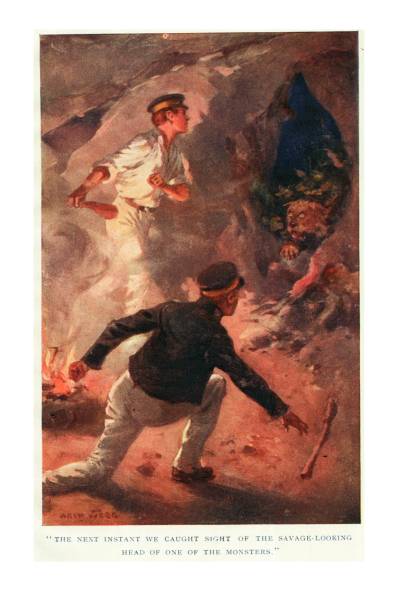
“We then seized our sticks to fight for our lives; but the jaguar having caught the tempting morsel, either satisfied with it, or frightened by the bright flames and our sticks, which we flourished in his face, sprang back and bounded away with the meat in his mouth.
“Having repaired our fence, and made it, as we hoped, more secure, we returned to cook and eat our supper. I confess that neither of us felt very comfortable on watch that night, lest the jaguar should come back for a further supply of capybara.
“That was only last night; we little thought at the time how soon our Robinson Crusoe life was coming to an end. Though pleasant in some respects, it was not, as you see, without its drawbacks. Directly the Supplejack hove in sight we recognised her; but having seen the enemy on the top of the cliffs, we were in great doubt whether we should succeed in getting off—it seems, indeed, a wonder to me that we were not killed, and I only hope we feel sufficiently grateful for our preservation.”