The corvette and brig part company—The former chases a suspicious sail—Captures a full slaver—Adair in charge—Takes prize to Bahia—An important warning—Preparations for an attack—Anecdote of Lieutenant Wasey—The slave-dealers attempt to retake the prize—Gallant defence—Enemy defeated—The Supplejack appears in good time.
Reading edition
The Tudor and Supplejack had crossed the line, and had got some way to the southward, when a heavy gale came on, such as is not often experienced in those latitudes. It blew with especial fury during the night. Murray hove the corvette to, and believed that Jack would have done the same, but when morning broke, and the brig was nowhere to be seen from the deck of the corvette, he could not help feeling somewhat anxious on the subject. During the day the weather moderated, and a lookout was kept for her from aloft. Two days passed, however, and she did not appear. The wind was from the north-east, and he hoped by a quick run to Rio to have his anxiety soon brought to an end by finding that the Supplejack had arrived before him.
Morning had just dawned, the breeze was fresh, the tops of the seas sparkled in the rays of the rising sun, when the lookout from aloft shouted, “A sail on the lee bow!”
“What is she?” asked Adair, who was officer of the watch.
“A brig, sir,” was the answer.
“Is she like the Supplejack?” he inquired.
“Can’t say, sir. She is anyhow running to the westward, and the Supplejack would be steering to the south.”
“You are right. Call the commander,” said Adair to Desmond. The youngster had rejoined the ship at Georgetown. He himself then went aloft with his glass, to have a look at the stranger. By the time he came down Murray was on deck.
“She is certainly not the Supplejack, and, as she is running in for some Brazilian port far to the northward of Rio, she may possibly be a slaver.”
“We will overhaul her, at all events,” said Murray, and the corvette, bearing up in chase, made all sail she could set.
The stranger did not at first discover that she was pursued, and by the time that she did so the corvette had gained considerably on her. She was then seen to be a large brigantine, and by her square yards and white canvas, lighted up by the rays of the sun, Murray was more than ever convinced that she was a slaver.
The chase had set all the sail she could carry, and still kept well ahead of the corvette. The weather, as the day advanced, gave signs of changing, dark clouds gathered in the sky, and squalls, not very strong at first, but sufficient to make the commander look with anxious eyes at his spars, swept across the ocean—the dark clouds as they rushed along changing the hitherto blue, laughing waves to a leaden hue. Still the corvette persevered. The crew were at their stations, ready to shorten sail the moment it became absolutely necessary. The eagerness of the chase to escape made it still more probable that she was a slaver. She was dead before the wind, carrying topgallant-sails and royals, and studding-sails on either side. A dark cloud passing over her threw her into shade; on it went, and once more the bright rays of the sun falling on her canvas brought her more clearly into view; another squall swept by, making the corvette’s studding-sail-booms crack and bend as if they were about to break away from the braces.
“Hold on, good sticks!” cried Murray, apostrophising them, “the toughest spars will win the day.”
The crew cast their eyes aloft, fully expecting to see them carried away, but they held on, and the trim corvette went dashing forward amid the dancing seas, which rose up, foam-crested, on either side.
“Hurrah!” exclaimed Terence, “she is ours!” At that moment the squall had reached the chase, and away flew her studding-sails, the booms breaking off at the irons. Still she held on her course. The corvette was now rapidly gaining on her; the attempt was made to rig another lower studding-sail, but that also was carried away almost as soon as set, and in less than half an hour the corvette had got her well within range of her long guns; but Murray refrained from firing as long as he found that he was gaining on her.
“It is useless to run the risk of injuring her spars,” he observed to Adair; “she will haul down her colours when she finds that she has no hope of getting away.”
“Those fellows are up to all sorts of dodges, and will make every effort to escape,” said Terence.
“We will take in the studding-sails at all events, and be ready for him should he haul his wind,” said Murray. The light canvas was taken in with a rapidity, which must have astonished the crew of the slaver. Just, however, as the operation was about to be commenced, she had put her helm to port, and braced her yards sharp up on the starboard tack; but a couple of shot from the corvette, one of which struck her starboard quarter, showed her that she was too late; and fearing that other iron missiles might overtake her, she immediately hauled down her colours. The corvette’s topgallant sails and royals having been handed, she also was brought to the wind and hove-to on the weather beam of the prize. Murray now directed Adair to go on board the brigantine with a midshipman and ten hands, and to carry her to Rio, unless, from a scarcity of provisions or want of water, he should find it necessary to put in to Bahia, or any other neighbouring port on the Brazilian coast.
Adair and Desmond were quickly ready with their carpet-bags, as were Snatchblock and nine other men with their bundles, and the boat which had, meantime, been lowered, pulled off for the prize, although there was some sea on; yet as she was low in the water, she was easily boarded. She proved to be the Donna Maria, a noted Brazilian slaver which had often before escaped capture. According to Murray’s directions, Adair sent back the captain and officers and some of her ill-looking crew, who were likely to prove troublesome if left in her.
He found that, though only measuring a hundred and fifty tons she had nearly five hundred slaves on board, stowed away as thick as they could be packed between decks.
Having had a remarkably quick run from the coast of Africa, the captain informed him that he had not lost more than twenty people. As he looked down the main hatchway, the haggard countenances of the mass of human beings packed close together—as Desmond observed, like herrings in a cask—showed him that had the voyage continued much longer, the number of deaths would have been greatly increased.
Although there was food enough and water for the slaves, either the crew had hove overboard some of their own provisions, or had brought but a small supply, so that Adair found but a scant allowance for himself and his men; he therefore sent on board the corvette for such articles as he thought would be required. Just as all arrangements had been completed, and he had put the brigantine on her course, he saw the corvette haul her wind, and stand away to the eastward. As she did so, Murray signalised that a strange sail, which he hoped to overhaul, had hove in sight in that direction.
A sufficient number of the slaver’s crew had been kept on board to attend to the unfortunate blacks, and carry them their provisions and water. Adair himself went round among them, and endeavoured to make them understand that he was their friend, and that as soon as possible they should be sent back to Africa. At first they looked on the Englishmen with an expression of terror in their countenances, many of them believing that they would be taken on shore to be killed and eaten, or to be offered up to the white man’s Fetish. Fortunately one of the seamen, who had been long on the coast, could make himself understood by some of them; and, by his means and kind treatment, Terence succeeded at length in banishing their fears. One of the Brazilians also spoke a little English, and so was able to act as interpreter. Pedro was a better-looking fellow than most of his companions, and by the kind way he treated the blacks Terence was inclined to trust him. He declared that poverty alone, and a wish to support his family, had induced him to ship on board the slaver, and that it was the last voyage he would ever make.
“These countrymen of mine are great rascals,” he observed; “you take care what they do, or they play you one great trick.”
Pedro then told Adair that the brigantine was somewhat leaky, and that it had been necessary to pump her out at every watch.
He at once ordered the well to be sounded, and Snatchblock reported “two feet of water in the hold;” he accordingly ordered the pumps to be rigged, and set some of his own people to work them. Pedro again came aft, and assured him that he felt certain he could pick out a score or more of blacks who could be trusted on deck, and that they would willingly take the duty, glad to escape from the confinement of the hold.
“We will try them,” said Terence, and in a short time Pedro sent up the number he had mentioned, all of them well-made, stalwart negroes. The scant clothing they wore exhibited, however, how much they had suffered by confinement, even during their comparatively short run across the Atlantic. Half of them quickly understanding what was required set to work with a will, being relieved by their companions. By their exertions the brigantine was at length almost freed from water. During the night it had, however, again gained on the pumps, and the weather coming on worse soon after daybreak Terence judged it prudent to bear up for Bahia.
He was thankful to believe that he would soon be in smooth water, for the poor slaves suffered dreadfully by the way the vessel tumbled about in the heavy seas, and several of the weak ones were found to have died during the night. The Brazilians hauled them out, without the slightest exhibition of feeling, and hove the bodies overboard as if they had been so many dead sheep. The heat and effluvium which arose from below were almost unbearable, the instant the hatches, which had necessarily been closed during the night, were taken off.
It was the first full slaver Desmond had ever been aboard.
“I have always heard the African coast abused, but I can only say that I should be ready to go and serve there, for the sake of catching some of these rascally slavers before they have had the opportunity of making the poor blacks suffer so horribly, as they must do during the middle passage,” he exclaimed, as he warmed with indignation at what he witnessed.
At last, a short time before nightfall, the brigantine entered the harbour of Bahia, which is easy of access, and came to an anchor at some distance from the town. Scarcely had she brought up than the weather moderated, and Terence began to regret that he had not continued his course for Rio; still he hoped that Murray, judging by the weather, would take it for granted that he had put in there, and would come and look for him.
It was too late that evening to communicate with the authorities; several boats, however, came alongside, though as no officer appeared among the people in them, Adair would not allow any one to come on board, with the exception of an official who was sent, he said, by the captain of the port to make inquiries about the vessel. At last all the boats took their departure. There was no moon, though the stars shone forth brightly overhead, reflected on the calm surface of the water. It was rather dark all around where the brig lay; here and there only, distant lights glimmering from the shore. The watch, of which Ben Snatchblock had charge, was set, and Adair and Desmond retired into a small cabin on one side of the deck to take supper.
“Well, I hope these poor fellows may be sent back safely to their homes,” said Desmond. “I am afraid a good many more will die before they get there, if they are not placed in some healthy spot and allowed to take exercise first.”
“Not one of them will ever get back to their homes,” answered Terence. “They are all brought some hundreds of miles from the interior, and would be quickly seized and carried back into slavery were the attempt to be made. They will be sent to Sierra Leone, or some of them may find their way to Liberia, a colony established some years ago for liberated blacks from the North American States.”
Adair was giving Desmond further information on the subject when Pedro put his head in at the door.
“Senhor Capitan, I want to have one word with you,” he said, putting his finger to his mouth. “You be on the watch; I heard things said by the people in de boats, and I make sure they come off and take all de slaves away, and knock you and your people on de head. Hist! hist! Don’t let my comrades know I tell you, or dey cut my troat as sure as I now a living man. No time to lose.”
Adair asked Pedro further questions, but he could elicit no more information. Pedro was evidently in a hurry to be gone, and again making a sign to show that caution was necessary he stole forward, keeping close under the bulwarks, as if afraid of being observed.
“The information Pedro has given us must not be neglected,” observed Adair. “He may be mistaken, but if the Brazilians think that they can get hold of the slaves they will try to do so without scruple, and will cut the throats of every one of us should they find it necessary to carry out their object. Go and turn out our people, and I will have a talk with Snatchblock on the subject.”
Desmond, making his way forward, roused up the prize crew, cautiously awaking each man separately, so that the slaver’s people should not hear them.
Adair followed him on deck, and told Snatchblock what he had heard.
“Well, sir, to my mind the first thing we have to do is to secure the Brazilian fellows we have on board, for if we are attacked by their friends from the shore, as Pedro thinks likely, we shall have them, may be, playing us some trick,” answered Ben. “Either they will let the slaves loose and set them up to murdering us; or if they can get hold of arms they will set on us themselves, should they see a chance of helping our enemies.”
Adair thought Ben’s advice good, and told him to get a sufficient number of lengths of rope to secure the fellows. This was quickly done, and Adair and his men went into the berth, and soon had all the Brazilians secured, almost before they were awake. He had Pedro lashed like the rest; Adair whispered, however, into his ear that he did so for his own sake, as should he be suspected of having given the Englishmen information he probably would be murdered by his countrymen. Pedro, indeed, seemed perfectly satisfied to be so treated.
“They no countrymen of mine, though,” he answered, in a low voice, “they Brazilians, I true-born Portuguese.”
“Well, whatever you are, I am much obliged to you, and hope to reward you some day for the assistance you have given us,” answered Adair.
“I should have taken the fellow to have a larger share of negro than white blood in him by his looks,” observed Adair to Desmond as they went aft; “however, I really believe that he is honest, and we should not despise his warning.”
He had all the arms and ammunition to be found on board collected, each of his crew being provided with a musket and a brace of pistols, in addition to their cutlasses; he and Desmond also armed themselves. A dozen spare muskets which he had carefully looked to and loaded were arranged, some aft, others midships and forward. There were also two small brass guns, used for signals rather than defence. No shot, however, could be found for them, so he sent a couple of men to collect all the nails and scraps of iron they could find in the carpenter’s store-room.
“These will make cruel wounds, but it will be the fellows’ own fault if they venture to attack us, should some of them stick in their bodies,” he observed, as the guns were loaded. A dozen boarding-pikes were also found and served out to the men.
“I rather suspect that these weapons will prove more serviceable in the hands of our stout fellows than muskets or pistols, which take time to load,” observed Adair. “They may serve us in good stead, should the Brazilians attempt to climb up the side.”
These arrangements being made, Adair and Desmond returned to the cabin to finish their supper, which they had just begun when Pedro came to them.
“Don’t you think after all that that Portuguese fellow may have been trying to frighten us for some object of his own, perhaps to ingratiate himself into your favour?” asked Desmond.
“No! no, I think not,” answered Adair, “the Brazilians have played similar tricks on captured vessels before, in this very port, and they are capable of any atrocity. There was an old friend of mine named Wasey, a capital fellow, kind-hearted and brave, as true a man as I ever met with. We were shipmates for a short time on the coat of Africa; Rogers and Murray knew him well, and liked him as much as I did. He was one of those quite unpretending characters who don’t know what is in them, except to those with whom they are intimate.
“We chased and captured a small schooner with a hundred and fifty slaves on board. He was put in charge of her with ten hands, and directed to take her to Sierra Leone, we having received on board her former crew, that he might not be troubled with them. Soon after he parted company from us a heavy gale sprang up from the eastward, and he was blown off the land. The schooner, one of those slightly put together craft, built expressly for slavers, sprang a leak, and the water gained so fast on them, that it was as much as the crew, with a few of the blacks who were to be trusted, could do to keep her afloat. His only chance of saving the lives of his crew, and himself, as well as of the blacks, was to run for the Brazilian coast. The schooner was also short of provisions and water, and had he attempted to beat up for Sierra Leone, he knew that most of the blacks must perish, even if he contrived to keep her afloat. The weather in no way moderated, and though he set an example to his men by taking his turn at the pumps, all hands working with a will, he scarcely expected to get across the Atlantic. Still, by attending to the unfortunate blacks, and by allowing a few to come on deck at a time, he managed to keep them alive. At length when he was about a week’s run from Bahia, he feel in with an American brig. He having hoisted a signal of distress, the American hove to, and he went on board her. He explained his condition to the master, who seemed to be a well-disposed, kind-hearted man.
“‘Well, I have no objection to receive you and your white crew on board my vessel,’ said the master, ‘but as to the blacks, I can have nothing to do with them, they must sink or swim if they can.’
“What! you don’t suppose that I would desert the unfortunate wretches?” exclaimed Wasey indignantly.
“‘Well, they are but negroes, and it is a fate which befalls many of them. They seem born to it,’ answered the master coolly.
“‘I am much obliged to you for your offer to receive me and my people, though I cannot accept it. If we are lost, our deaths will be at your door; that won’t be a pleasant recollection for you,’ said Wasey.
“‘Cannot help it, Mister Lieutenant,’ answered the skipper. ‘The blacks, as I say, must take their chance; and it seems to me that if you and your men refuse to come aboard my brig, when I offer to receive you, that your deaths will be at your own door.’
“‘I would rather die than desert the unhappy blacks, and I believe that my men will stick by me,’ answered Wasey. ‘Now, captain, I’ll tell you what I will do. I have a fortune of 7000 pounds, and on the word of a British officer—and you will take that I hope—I will put it in black and white, that I will pay over every farthing, if you will receive the blacks on board, and carry them to the nearest port you can make. Come, that is a better freight than you have every day for your brig, I suspect?’
“The skipper thought a minute, then shook his head. ‘No, if you were to give me 20,000 pounds down on the nail, I could not take the negroes aboard my brig. They would pollute her, we should probably have a fever break out, or if we escaped that every man of my crew would leave her directly we entered port.’
“In vain Wasey endeavoured to persuade the skipper to alter his resolution; he was determined not to take the negroes on board.
“At length Wasey saw there was no use in pressing him further. Perhaps the skipper thought that he might never touch the 7000 pounds, but I can answer for it, and so would every one who knew Wasey, that he would have religiously paid it to the last farthing.
“‘You have made up your mind not to receive the blacks, and I have made up mine not to desert them,’ said Wasey, wishing him good-bye. ‘A prosperous voyage to you, and I can only say that I hope for your sake as well as ours, that we may manage to get the schooner into Bahia. I should not wish to have my conscience troubled as yours will be if you hear that we are lost.’ Having purchased all the provisions and water the American could spare, Wasey returned to the schooner and made sail for the westward, while the American vessel stood away on her course. He divided the water and most of the provisions he had obtained among the starving blacks, and their strength renewed, they were able to assist better at the pumps than they were before. Still the powers of all on board were taxed to the uttermost; every one, however, knew that their lives depended on their exertions, and worked away till they were ready to drop. They could just keep the schooner afloat, and that was all. The wind continued fair, and by the time the last drop of water was expended and the farina and other food for the blacks was used up, they made this port of Bahia.
“Wasey now hoped that his chief troubles were over. The blacks had got to trust him, and so, when the schooner was brought to an anchor, they willingly laboured as before to keep her afloat. Believing that all was right he went on shore to communicate with the authorities, leaving the quarter-master in charge of the schooner. The officials detained him for some time, and sent him first to one person and then to another, thus keeping him employed till nightfall. At last he pulled off to the schooner; there she lay all right, and he hoped to be able to get the leaks stopped, and to carry the poor blacks to Sierra Leone, where they could be set free. When he stepped on board, he inquired if all had gone well during his absence.
“‘Yes, sir,’ was the quarter-master’s answer. ‘Some Brazilian officers came off in a number of boats, and told me that they had been sent to land the blacks. As all seemed right, I did not prevent them from coming on board. At once ordering the blacks up, they made every one of them get into the boats, which at once pulled away up the harbour. The officers were very polite, and seemed to be doing everything regular, though I was just a little suspicious when I saw three large boats full of men, with a good number of muskets among them close to us, watching, as it were, how matters were going. When the boats with the blacks on board pulled away, they followed, and no one since then has come near us. I hope it’s all right, sir?’
“‘Right!’ exclaimed Wasey, feeling confident that he had been duped, ‘I am afraid that it’s very wrong. I have made every arrangement with the authorities to have the blacks housed on shore while the schooner is under repair, and to receive them back whenever I may wish, and I cannot understand how any Government officers should venture to take them off till my return.’
“Next morning he went on shore, when the authorities declared that they knew nothing of the matter. He then found that some fellows, dressed up as officers, had been sent off by slave-dealers, to play the trick, and get possession of the unfortunate negroes.
“In vain he endeavoured to regain them, not a particle of information could he obtain as to where they had been carried, except that they had probably been immediately disposed of over the country. Thus, after his noble self-sacrifice and the exertions he had made to save the lives of his black-skinned fellow-creatures he had the mortification to find that they had been carried off into slavery, and that he had nothing but the bare hull of the schooner for his pains. Yes, by-the-bye, he had more than that, he had the satisfaction of his own conscience, and that was worth having. I did not hear the account from himself, but I got it from one of the men who was with him. I am pretty sure that I am right in all particulars. Now let us go on deck and hear what report Snatchblock has to make. Perhaps after all Pedro may be mistaken, and we shall not receive a friendly visit as he expects from the slavers. However, we will take care not to be the victims of a trick like that played on Wasey.”
“Anything stirring, Snatchblock?” asked Adair, as he and Desmond went on deck.
“Nothing that I can make out, sir, except that a little time back a small boat pulled across our bows and returned to the shore. We were all at the time as quiet as mice when the cat is about, and maybe the fellows in her thought that we were keeping no watch aboard the brigantine.”
“We will show them that we are wide awake enough if they come off to play us any trick,” answered Adair, laughing.
He found his men sitting down with their arms by their sides ready for action, and felt satisfied that they would do their best to beat off any enemies who might attempt to take the vessel.
The night continued perfectly calm, while a light mist somewhat obscured the shore and distant objects. He knew that sounds, though from a considerable distance, could be heard, and that he should thus have timely intimation of the approach of boats, even should they come off with muffled oars.
The captured slaver, with four hundred human beings stowed away in her hold, has not yet been described.
The slave-deck was divided into two parts: in the larger portion the men were packed away; in the smaller, the hapless women and children. When the slaves were first received on board on the African coast, the largest men had been picked out to act as head men or overseers of the rest, and having been threatened with punishment should they refuse to obey orders, they had not unwillingly taken the office imposed on them. They at first divided the slaves into gangs of about twenty men each, for whose good behaviour they were answerable; their first duty had been to stow away the slaves. The slave-deck was about four feet in height, with beams and bars running from side to side; on these beams the slaves were compelled to sit with their heads thrust between their knees, so close together that when one moved the whole mass had to move also. Care had been taken to place the largest slaves the farthest from the ship’s side, or from any position in which their strength might avail them to secure a larger space than their neighbours. One portion of the deck was much lower, being scarcely twenty inches in height, and in this the children were stowed away.
When the slaver was captured the hatches were found closed and all the larger men heavily ironed, and it may be imagined, had the chase continued long, what would have been the suffering of the unfortunate wretches.
The slaves were fed twice a day, and in order to give room, one half were allowed at a time to come on deck, the only opportunity they had to stretch their limbs. At meal-times they were arranged into messes, and when all was ready, at a signal from the head man, they commenced eating.
Their food consisted of rice, or farina, which is flour made from the cassada, a species of potato boiled, or calabancies, a kind of bean; occasionally a small quantity of salt beef, fish, or chillies, was served out to them as a relish. After each meal they were made to sing, not for their amusement, but to enable them, it was supposed, better to digest their food. Each black after this received about a pint of water, the whole allowance for the day.
Below the slave-deck were stowed the leaguers, which are huge water-casks, together with the provisions, wood for firing, etcetera. The upper deck was kept perfectly clear, to enable the crew to work the sweeps during calms. There was no poop, but on either side were two cabins, six or eight feet long, and three or four wide, to serve as sleeping places for the captain and officers; the crew lived forward, under the topgallant forecastle. The vessel had but one small boat, carried amidships, in which articles of all sorts were stowed, so that if a man had fallen overboard it would have been next to impossible to pick him up. This is a description of most slaving-vessels, though steamers have of late years been largely employed.
Adair and Desmond paced the deck for an hour or more, stopping every now and then to listen. No sound could be heard coming from any direction, and the town was too far off for the hum of its human hive to reach them.
It was now nearly ten o’clock. Adair had ordered Snatchblock not to strike the bell, as it might show the slavers, should any be meditating an attack, that those on board the prize were on the alert, and make them approach more cautiously than they might otherwise be inclined to do.
Adair had brought a stool from the cabin, and sat down, leaning against the outside.
“Go in and get some sleep,” he said to Desmond, “I will call you if you are wanted.”
“I am not tired, and if you will allow me I will go forward and try if I can hear anything. I fancied just now that I caught the sound of several splashes in the water, as if fish were leaping in the distance,” answered Desmond.
He made his way to the topgallant-forecastle, lay down and listened. The sound he had heard became more regular, though still very faint; he was certain, however, that it was the dip of oars in the water. He waited, however, before informing Adair, knowing that there would be time enough when the boats came in sight, as all hands were prepared for action.
“Perhaps, after all, they are not coming this way,” he thought; “yes, they must be, though,” he said to himself; “the sounds are much more distinct than when I first heard them.”
At length he made out several dark objects emerging from the mist. He at once hurried aft with the information.
“Be ready, lads!” said Adair; “the fellows I was warned would attack us are probably coming. Five of you remain on the starboard side, and five on the port side. Snatchblock and I will work the guns. Keep under shelter, and don’t fire till I give the word; then blaze away with muskets and pistols, and use your pikes as you may find necessary. Don’t let them discover that we are prepared till the last moment. I will call you where you may be most wanted; I know you will do your duty, and we shall beat them off, never fear that. Silence now, and go to your stations.”
Adair spoke in a low voice to the men gathered around him. He had arranged them at equal distances along the bulwarks, where they crouched down, with their muskets in their hands, and their pikes by their sides. He had lighted a couple of slow matches, and put them into tubs near the guns, ready for use.
Desmond remained by him and prepared to get whatever might be required. He and Snatchblock kept a lookout, one on either side, to watch for the boats. The sound of the oars was now distinctly heard, and in a short time they clearly made out six large boats, evidently pulling towards the brigantine. As they approached they closed with each other, and came up on the port side; they were still at a short distance from the vessel, when Adair hailed, in the best Portuguese he could command, and told them to keep off.
“We allow no boats from the shore to visit the vessel at night, and if you come nearer we shall fire into you,” he shouted.
Some loud chattering ensued, and in spite of the warning they had received, the Brazilians dashed up alongside. There must have been five and twenty men in each boat; a considerable force to be opposed by Adair’s small crew.
The Brazilians came on with threatening shouts and cries, evidently intended to intimidate the British seamen.
“Keep off,” again cried Adair, but his warning was unheeded. He sent Desmond to call all the men over the port side.
“Take the consequences, then,” he answered; “fire, lads.”
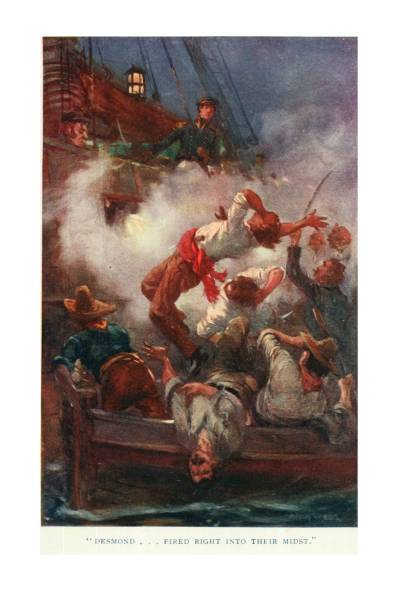
The bullets which came flying into their midst for a moment seemed to damp the courage of the Brazilians, but recovering themselves they let fly a volley in return. Adair wisely bobbed, and several bullets flew over his head. All attempt of concealment was now useless. The Brazilians dashed up alongside and attempted to get on board, but were met by the boarding pikes of the English crew; some using those weapons, others spare muskets, with which they blazed away, though there was no time to reload them. It was sharp work to attempt driving back one hundred and fifty men, at least, who were endeavouring to climb up the side, armed with cutlasses and pistols. The strongest party of the pirates were making a vigorous attempt to get on board on the quarter. Adair calling to Snatchblock, ran out one of the guns, and Desmond being ready with a match, fired right into their midst. The piercing groans and cries which followed showed the terrible effect produced. The boat drifted away, not having been hooked on, and the crew having deserted their oars. Another boat immediately took her place, and a big fellow, with cutlass in hand, springing to the side, and shouting to his companions to follow, attempted to climb on deck. Before Adair could defend himself, he had received an ugly cut on the head from the fellow, who was about to follow up the blow, when Desmond, seizing a pike, rushed at him with such good will, that the point entering the Brazilian’s breast, he fell backwards into the boat.
Adair, though hurt, was able to make good play with his cutlass. Snatchblock was keeping a dozen fellows at bay, while the rest of the crew were employed in a similar manner; bullets were flying and blows were rapidly given and taken. Though several of the Englishmen were wounded, and some very severely, not a man had been killed.
They could see that the Brazilians had suffered much more severely. Some had been knocked overboard into the water; others lay dead or dying at the bottom of the boats. Again, and again, however, the pirates came on, as if determined, at all costs, to take the prize with her five hundred blacks on board. Again Terence was wounded, and another big Brazilian, apparently the leader of the pirates, was levelling a pistol scarcely two feet from his breast, when Snatchblock, seeing the danger of his young commander, brought his cutlass with such force down on the fellow’s head, that he clove it in two, and sent him tumbling back into the boat out of which he had sprung.
The pirates, though they had met with a much warmer reception than they expected, were unwilling to abandon their object, and encouraged by their leaders, some twenty or more made a dash together at the fore-rigging. Several gained a footing on the chains, others caught hold of the shrouds and back-stays. Adair saw that a desperate effort must be made, or the enemy would after all gain the deck.
“Keep them off the after-part of the vessel, Snatchblock, whatever you do,” he shouted, and calling Desmond they together dragged over the other still loaded gun and ran it through the foremost port, with its muzzle pointed towards the mass of their assailants, who were prepared to follow those already climbing up the side. Desmond fired, springing out of the way of the gun as it ran back. The deadly missiles with which it was loaded, scattering among their assailants, knocked over several howling with pain, two at least dropping dead, when the British seamen with their cutlasses quickly cleared the rigging and sides of the remainder.
The tones in which the shouts and loud jabbering of the pirates were uttered showed that they were beginning to think that they had had enough of it. Adair and Snatchblock, with several of the men, set to work and reloaded the muskets, and just as the most daring of their assailants were about to make a fresh attack they let fly a volley. The pirates did not stop to receive another, but getting out their oars began to pull off, each boat seeming to be the most eager to get away from the daring little band who had so obstinately refused to have their throats cut, and the blacks in their charge taken from them.
The seamen, though bleeding and sore from many a cut and thrust, gave vent to their satisfaction in a triumphant cheer.
“I think we are clear of them for the present, sir,” said Snatchblock, “and I doubt whether they will be in a hurry to come back again.”
“We will be prepared at all events,” said Adair. “Get the guns and small arms reloaded and placed ready for action, and then see who is most hurt. It won’t do to let our blood flow till we grow weak.”
“Ay! ay! sir,” answered Ben. “I believe most of us have got a scratch or two, but I hope you are not hurt, sir.”
“As to that, I believe that I have not escaped scot free,” said Adair; “but I want to overhaul those who have suffered most, and bind up their wounds. You may release Pedro, and get his assistance, though it won’t do to cast the others loose just yet.”
Adair as he spoke felt very faint, and had not Snatchblock caught him he would have fallen on the deck. Desmond ran to his assistance, and while he sat on the stool outside the cabin brought a glass of strong grog, which quickly revived him; the men were in the meantime binding up each other’s hurts as well as they could, with their handkerchiefs, after having reloaded their arms.
Snatchblock released Pedro, who seemed pleased at the successful termination of the contest. His shipmates, he said, suspected him—the pirates would have undoubtedly cut his throat had they got on board. He helped Desmond very scientifically in dressing Adair’s wounds.
“Beg pardon, sir,” said Snatchblock, “if you will just lie down and get some rest, Mr Desmond and I will keep a look out, and call you if we get sight of our friends coming back to us. I am not much the worse for my scratches, and so five or six of those most hurt among us can turn in and try and get back their strength, in case we have more work to do to-night.”
Adair agreed to Ben’s proposal, and having ordered grog to be served out to the men, he himself lay down to obtain the rest he so greatly needed.
Except here and there where white marks in the bulwarks showed the spots the bullets had struck, and the cutlasses had hewn out notches, scarcely a sign of the late desperate struggle was visible. All was silent on deck. Desmond alone paced up and down turning his watchful eye on either side, while Snatchblock took a seat on the booms. Notwithstanding his assertion, that he had only received a few scratches, he felt, however, considerably the worse for them. For the rest of the watch he lay down, trying, however, to keep awake, and be ready to start up at a moment’s notice.
Pedro suspecting that food would benefit all hands, lighted the galley-fire, and began to prepare some broth. He had before this gone below, and quieted the blacks, who had naturally been alarmed at the noise of the firing, not knowing what was happening. He now sat down in a corner of the caboose with his arms folded, and fell asleep while watching the soup boiling.
The night grew on, and morning was approaching. A breeze had sprung up from the eastward with sufficient strength to disperse the mist, and to keep back the usual land wind, which blows from the opposite direction, while it ruffled the surface of the harbour into waves.
Just after the first streaks of dawn had appeared above the horizon, Desmond caught sight of a number of boats collected up the harbour. They appeared to be pulling towards the brigantine, but as the wind was against them, and the current was setting in, they made but slow progress. Desmond awoke Snatchblock, who had fallen asleep, and told him what he had seen.
“Maybe the same fellows as before are coming to pay us a visit,” he answered. “If they are we will treat them the same as the last time.”
“Don’t call Mr Adair, he wants rest, and there will be time enough when the boats get nearer.” Ben, however, got up to have a lookout, and then called the rest of the crew. He found Pedro still asleep in the caboose with the soup boiling over; he asked him what he would wish to do.
“Get the soup ready first,” said Pedro. “Then you lash me up as before, I no wish fight.”
The soup being ready, Desmond called Adair, who, as well as his crew, found it very welcome.
“I doubt much whether those fellows will venture to attack us, though it’s as well to be prepared,” he observed. “If they do, though there may be twice as many as at first, we must beat them off.”
Adair and the rest had been so engaged in watching the approaching boats, that no one thought of looking eastward with the exception of Desmond.
“There is a sail in the offing, and she is standing in for the harbour, as far as I can make out,” he exclaimed, as he held the glass still raised through which he had been looking. Adair took it from him, and eagerly watched the approaching vessel.
“You are right, my boy,” he answered. “She seems to me a brig about the size of the Supplejack, but we shall make her out more clearly in a short time; if she is a friend those slaving rascals will not dare to attack us.”
“But she may be a slaver herself, and then she will assist them,” whispered Desmond.
“And then we shall have to fight her as well, that is all I can say about it,” answered Adair.
“What do you make her out to be?” he asked of Ben, who just then came aft.
“She is scarcely large enough for the corvette, or I should have expected her to come in and look for us. That craft is a brig, and as like to be the Supplejack as any other,” said Ben. “I don’t think the people in the boats have made her out yet, or they would save themselves the trouble of a long pull against wind and tide.”
Some time elapsed before the matter could be decided. The boats made but slow progress, but the stranger standing on under all sail rapidly approached the mouth of the harbour. Still the former would be alongside, and if the Brazilians had sufficient determination, they might cut the cable and tow the brigantine up the harbour, before the brig could come to her assistance.
The Brazilians must have seen the stranger by this time, but probably they did not believe that she was a man-of-war. They had now come within musket-shot. Terence, on looking through the glass, saw that there were several officers in uniform in the boats, and began to suspect that they were really official characters, sent by the government to inquire into the cause of the firing in the early part of the night; he did not, therefore, wish to commence hostilities till he had ascertained, if possible, their real character.
The stranger had now slightly to alter her course, when the English flag blew out, and Adair had no longer any doubt that she was the Supplejack.
The flag at the same time had been seen by the people in the boats. Whatever were their intentions, they ceased pulling, apparently holding a consultation; then putting about they made the best of their way up the harbour. Terence felt very much inclined to let fly a volley at them, but mercy, or prudence, prevailed, though if they were the pirates they deserved any punishment he might inflict on them.
As the Supplejack rounded to under the stern of the brigantine, Adair hailed and said what had happened, when Rogers, accompanied by Tom and McTavish, instantly came on board.
“You always come in the nick of time, Jack,” exclaimed Adair, as they shook hands; “we had a hard tussle last night, and we might have had a harder this morning if you had not made your appearance, but how is it that you have come in here?”
Jack replied that after the gale he had chased a slaver, which had led him a long way out of his course, and having fallen in with the Tudor, Murray directed him to look for the prize, and then to escort her to Rio, whence she was to be sent to Sierra Leone.
McTavish doctored the wounded men, and Adair declared that he felt well enough to go on shore with Rogers to lay his complaint before the Government regarding the outrage which had been attempted in a friendly port.
The Governor, Senhor José da Silva Souza, declared that he knew nothing whatever about it; he had been astonished at hearing firing, and had sent the captain of the port, with his attendant officials, to ascertain the cause.
“They came in pretty strong force then, and I should have certainly fired at them had they attempted to come on board. What redress can you make us?” asked Adair.
“I will direct that the fellows be looked for, and if we catch them they shall be tried and hung immediately.”
“That will not be much satisfaction to us,” observed Adair.
The Governor shrugged his shoulders, and Terence observed that he should lay the matter before the admiral at Rio, who would certainly not allow it to pass unnoticed.
The British consul, of course, said he would have the matter looked into, but as there appeared to be no use in waiting longer, as soon as Adair could obtain provisions and water, he and Rogers got up anchor and sailed for Rio.
The only information the admiral was able to gain on the subject was, that the attack had been made by a party of slave-dealers, who hoped to surprise the brigantine, cut the throats of the prize-crew, and then make sail to another port, and land the slaves, trusting of course to the effects of bribery to escape detection.
Chapter Twenty One.
Rio—Expedition up the harbour—Yarns spun—Higson and the midshipmen captured by slave-dealers—Imprisoned—Tried—A friend in need—Sent back to prison—Escape—Pursued—Jack as usual appears—Again at sea—Chase a slaver—Run over her at night.
Every one knows that Rio de Janeiro is one of the most magnificent harbours in the world, with its Organ mountains in the distance, its surrounding heights covered with the richest foliage, its curiously-shaped rocks at the entrance, and its stately city scattered along its shores.
On entering, Jack and Terence, much to their satisfaction, found not only the corvette but the frigate also at anchor. Having gone on board the admiral’s ship to report their arrival and the occurrence which had taken place at Bahia, they paid a visit to Murray. Of course, Terence gained great credit for having beaten off the pirates. He was glad to find that he was to be relieved of the charge of the slaver, which he had been afraid he might have to carry over to Sierra Leone.
In the harbour lay a considerable squadron of steamers and sailing-vessels, for which a variety of work had been cut out.
The Brazilian Government had at last united with the English in the determination of putting a stop to the importation of slaves into the country, though they acknowledged that their own men-of-war could do little or nothing; the fact being that the Brazilian officers were more or less interested in supporting the abominable traffic.
Two or three other ships were in the harbour, taking in water and provisions before going for a long cruise in the Pacific, and an expedition was also to be sent to the Parana against General Rosas, who, setting all treaties at defiance, had stopped up the navigation of the river. As neither the corvette nor brig were likely to sail for some days, the officers made excursions on shore. Tom and Desmond were delighted to find that Archy Gordon had so greatly recovered that he was able to go to sea in the frigate—he was now nearly as well as ever, but still was not allowed to take exercise on shore.
They proposed making a trip up the harbour, and Higson got permission to take the corvette’s pinnace.
“You must take care of the youngsters better than you did once upon a time,” said Adair. “Don’t expend any of them if you can help it.”
“No fear,” answered Higson, “I will watch over them as carefully as a hen does her chickens, or a nurserymaid the half-dozen small children committed to her care.”
A good store of provisions in the way of substantials, with a proportionate amount of liquor, cigars, and tobacco, was laid in; fish and fruit might easily be obtained. Their uniform jackets being stowed away in their carpet-bags, all hands were dressed in white flannel jackets, white trousers, and straw hats or caps; while their only weapons were a couple of ships’ muskets, the same number of boarding-pikes, and a brace of pistols. Not that they expected to require them for their defence, but for the slaughter of any game they might meet.
The party mustered eight in all, including Snatchblock and Tim Brady, an Irishman, who was taken to act as cook. Tim’s only qualification for the post was that he professed to be able to boil praties with any man in the service. The midshipmen had forgotten that no potatoes were among their stores; but then Tim told a good story and sang a song in first-rate style, which made ample amends for his deficiency of knowledge in the culinary art.
Soon after daybreak Higson shoved off from the side of the corvette, calling on board the brig for the remainder of the party. Then making sail, they stood away up the harbour. The city was soon left astern as they glided over the calm waters. In the far distance could be seen the curiously-shaped Organ mountains, while on either hand rose conical hills amidst forests of lofty trees of every variety. Cocoa-nuts and orange groves, palms, and mangroves, and others, bearing a variety of nuts or blossoms of gorgeous hue, scarlet, orange, yellow, pink, and white. Gaily-plumaged birds, and beautifully-tinted butterflies, of wonderful size, flitted through the air. The party, though well accustomed to the rich vegetation of the West Indies, agreed that few scenes in the tropics could surpass this in beauty.
Curiously-rigged boats came floating by, some loaded with fruit and vegetables, others like haystacks gone adrift, and others of considerable size carrying cattle to the market at Rio. Several picturesque islets were passed, covered like the main land with rich vegetation and numberless flowers of various hues.
“Well, I think we shall have a jolly trip of it,” exclaimed Tom. “There is no necessity to bother ourselves by taking observations or keeping a dead reckoning, but, like the navigators of old, we shall never lose sight of land.”
“No; but we must stand by to lower the sail pretty sharply if a squall comes off one of those pointed hills there,” observed Higson, “and that is not at all unlikely to happen.”
“Who is after getting hungry?” sung out Desmond. “I suspect it must be past eight bells, and so I vote we land, and look out for a pleasant place to take our dinner.”
“There is one,” said Higson, pointing to a spot where the landing appeared easy, and there was a tolerably wide space of open ground backed by an orange grove, on the branches of which golden and green fruit, with white and pink blossoms, all hung together.
All hands were soon on shore, with such provisions as they required, and the greater number employed themselves in collecting wood for their proposed fire, which was soon blazing away. From the sparkling stream which rushed down from the mountains, they obtained a supply of water. The dark green leaves of the orange-trees overhead afforded sufficient shade, and they were soon all seated round a substantial repast, to which they were well inclined to do full justice.
“We have not far to go for our dessert,” said Tom, as he eyed the oranges hanging temptingly above his head. Archy Gordon was of opinion, however, that as they were not growing wild they must belong to somebody; and that unless the owner would consent to part with his fruit, they would not be right to take them. As may be supposed, however, he was in the minority, though Higson acknowledged that if the owner could be found he was entitled to payment should he demand it. In the meantime Snatchblock and his companion, who were not troubled with any scruples on the subject, collected their hats full and emptied them out on the ground by the side of the officers. On this all hands, including Archy himself, were soon employed in discussing the delicious fruit to their hearts’ content.
“I doubt whether I ever did eat such delicious oranges,” exclaimed Desmond, sucking away at orange after orange. “All the pips grow on the outside. What a convenient arrangement for a person in a hurry! I have seen many a black fellow with a mouth big enough to take in a whole one, though such a bolus would be apt to stick in his gullet if he were to swallow one before putting his teeth into it.”
“Well, youngsters, if we are to get far up the harbour before dark we must be off,” said Higson. “Come, let us pack up our traps, and take care not to leave any pots or pans on shore.”
The party soon got once more in the boat, but the wind failing them they had to depend on their oars in making headway. Wishing to go as far as they could before nightfall they pulled on cheerfully, amusing themselves, now by singing many a merry song, now shouting, now spinning yarns, some of them, it must be owned, oft-repeated tales. The scenery appeared as beautiful as at first. At length as evening was approaching, and Higson began to feel hungry, he once more put in for the shore at a spot somewhat resembling that on which they had landed for dinner. Here, too, was running water, a grove of orange-trees, and not far off several gigantic mangroves, with figs and grapes in abundance.
“Faith! we are in a regular paradise,” observed Desmond.
“We may revel in fruits, at all events,” said Higson.
They agreed, as no houses were to be seen, and as they were not likely to be interrupted, that they would bring up here for the night, and get a bathe in the morning before starting. The fire was lighted as usual; cocoa and coffee put on and made, while the provisions they had brought were spread on the ground. Not intending to proceed farther they were in no hurry, and fully enjoyed their meal, finishing off with an extra glass of grog or two, which naturally produced the usual songs and yarns, till they all declared that they felt remarkably happy. Snatchblock and Tim Brady presented them with a liberal supply of fruit, which was generous on the part of the two men, considering that it had cost them nothing. It was eaten, however, with not the less relish.
As the merry party smoked their cigars or pipes, sucked oranges, and sipped their grog, many a yarn of bygone days was told. Snatchblock and Tim Brady took their part. On such expeditions as these, steady men are permitted a familiarity not allowable on board. Higson had already told two or three stories, and had just described an amusing scene on the coast of Africa, when Ben Snatchblock chimed in.
“Do you mind, Mr Higson, when we were aboard the Corsair together on the coast? We saw many curious sights among the niggers; they seem altogether a different sort of people to those over here. You know, young gentlemen, we always ship a dozen or more black fellows aboard, to do the hard work, wooding, and watering, and such like, which would pretty nigh kill white men if they were to attempt it in the hot sun of the coast. The blacks we got were called Kroomen; they altogether beat any other niggers I have ever fallen in with in these parts—fine, big, active fellows, and strong as any Englishman, and stronger than most, and as brave as need be; in fact, we could not get on without them. The slavers never come near the Kroomen’s country. In the first place they are very hard to catch, as they fight desperately, and not one of them would ever consent to be turned into a slave. Most of those along the coast, who have served on board men-of-war or merchantmen, speak a little English; some speak it pretty well. They are neat and clean in their persons, and their houses are far better furnished than those of the blacks in general, with chairs, tables, looking-glasses, and china, and all sorts of things, just like civilised Christians. When a gang is engaged for a ship they always have a head man, with a mate under him, who is called his favourite man. You will remember, Mr Higson, sir, the fellow we had aboard the Corsair, who was called Dan Ropeyarn; a great big fellow he was, too—stood six feet six without his shoes, seeing he never wore such things. He could lift up me and Tim Brady here—and we are not chickens—one in each hand. Dan was a good-natured fellow, which was fortunate, for it would not have done to offend him. He was not what is called a beauty though; he had a mouth so wide that we used to declare he somehow or other managed to shift his ears farther back when he had a mind to grin, and show his white teeth. Dan’s mate or favourite man was called Tom Saucepan. He was a pretty strong fellow, but he was not equal to Dan, and in point of good looks there wasn’t much to make one jealous of the other, though maybe the black damsels of their own country have a different opinion from ours on the subject. One evening we were going down the Sheba river, which was pretty broad you mind, sir. The wind was light, and the water as smooth as glass. We had been on somewhat short commons for a month or two, for the slave-dealers prevented the people when they could from bringing off fresh provisions. Suddenly the lookout from the masthead, who had been in a South Sea whaler, shouted out—
“‘A turtle, floating down stream, sir.’
“The commander asked Dan Ropeyarn if he could catch the turtle.
“‘Oh, yes, sare; I do dat same,’ he answered, and calling Tom Saucepan he lowered his canoe, when taking a harpoon and a long line they shoved off. Dan, as Tom paddled him along, made the end of the line fast to the harpoon, but not to the canoe, for he knew well enough that if the turtle was to give but one pull, unless the line was directly over the bows, the canoe would be capsized in a moment. Away he went, and we all watched him eagerly from the deck, our mouths watering with the thoughts of the turtle soup we hoped to get for dinner next day.
“Dan was too wise to let the turtle know that he was coming, so he made Tom paddle up cautiously astern of the creature, while he stood in the bows with his harpoon raised in his hand, ready to strike. Not one of us could have stood upright in such a cranky sort of concern as she was; if we had tried it, we should have gone over in a moment; still, as we looked at Dan, so steadily he stood, we might have fancied that his feet were planted on firm ground. Some of us thought he would miss the turtle after all, but we were wrong. Away flew the harpoon right into the creature’s back. It did not stop quiet after this, but off it started, running out the line, which Dan had coiled away at the bottom of the canoe, like lightning. Somehow or other, however, the line caught Dan’s leg, and in an instant whisked him overboard and capsized the canoe. Away he was dragged, leaving the canoe astern; he did not let go of the rope though, not he, but catching the end he took it in his teeth, grinning tremendously, passing it as he did so between his legs. He must have found that wet rope a pretty hard saddle, I have a notion, as he had nothing on in the way of trowsers. Now up the stream he paddled with his hands, just as composedly as if he was taking a swim for his own amusement. Now and then, the turtle in its agony would dive or dash off at a great rate, and he would be drawn back, but the line was too long to let him be dragged under the water.
“Tom Saucepan had, in the meantime, caught hold of the stern of the canoe, and, seizing her by both hands, he gave her a violent rock, and in an instant righted her; another rock, and he had freed her of water; then in he sprang, legs first, over the stern, and began baling away with his hat. He had kept the paddle in his mouth all the time.
“The commander had ordered a boat to be lowered to assist Dan, but before even she reached the water Tom had not only righted the canoe, but had got up to Dan and taken him on board, and there was the nearly done-for turtle towing them quietly through the water. In a few minutes the turtle had lost its strength, and, instead of the turtle towing the canoe, the canoe was towing the turtle. We hoisted it on board, and I mind that it weighed two hundred pounds.
“I shall not forget that turtle, Mr Higson, for you and the other officers sent us three bottles of wine to mix with the soup. It was a rare good stuff, that it was,” and Ben smacked his lips at the recollection of the feast, which an alderman would not have despised.
“I shall not forget Dan’s face, as I saw it through the glass, while he held the rope in his mouth, paddling away up the river, with the turtle’s stern to his, or the wonderfully rapid way in which Tom Saucepan righted his canoe,” said Higson, laughing.
“We saw some curious sights aboard the old brig, sir,” observed Ben. “Do you remember the capsizing the commander got one day?”
“I am not quite certain, but I think that you, Ben, were the very man who did the deed.”
“Oh no, sir, it wasn’t me,” answered Ben; “it was Billy Blazes, as we used to call him.”
“What was it, Mr Higson?” asked Tom and Desmond.
“Well, you see, youngsters, we carried pretty taunt masts and square yards; and as several sister brigs of ours had been lost, with all hands, the commander considered it as well to be cautious, so that we might not go and keep them company. It became therefore necessary to make the men sharp when all hands were turned up to shorten sail; and he let it be understood that he intended on such occasions to punish the last man off the lower deck. He was a tall, thin man—so tall that he found his height very inconvenient in a ten-gun brig, and he used to put his looking-glass on deck and his head through the cabin skylight when he wanted to shave in the morning. Billy Blazes, who was a quartermaster, was about as short and stout as the commander was tall and thin. One day, just as the commander came on deck, and was standing near the companion hatchway, seeing a squall coming along the water, he shouted pretty sharply—
“‘All hands, shorten sail!’
“Now Billy—as I take it for granted that Snatchblock is right in saying it was he—was below, doing something or other, and guessing that he would be late if he came up the main hatchway, he bolted through the gunroom passage, thinking that no one would see him, and up he sprang by the companion hatchway. At that moment the commander turned round, and, receiving Billy’s head in the pit of his stomach, was doubled up, and sent sprawling over on the deck, the pain preventing him from seeing who had done the deed. Billy did not, you may be sure, stop to apologise; but up the rigging he sprang, before the commander or any of the officers knew who it was, and you may depend upon it he did not inform them. His messmates kept his secret, and it was not till the brig was paid off that the truth slipped out.”
“I remember the same system as that you speak of being carried on in a ship I once served in,” observed Norris. “The first lieutenant used to put down the name of the last man off the lower deck on a slip of paper, and at the end of three months he took out the slip, and counted who had been most frequently guilty, and they were invariably punished. However, as several good men got punished, the system became very unpopular, and as many deserted in consequence it was given up.”
On this Tom told some of the stories about black-listing which he had heard from Admiral Triton.
“I once served under a captain in that respect like Jerry Hawthorne,” said Higson. “Not that he was in general severe, I must own; but he used to come down pretty sharply on us midshipmen occasionally. We were in the Mediterranean, and brought up in Malta harbour. I and two other youngsters were greatly addicted to fishing. This the captain did not approve of, as he said that the bait and lines dirtied the ship’s side, and so he issued an order against it. Still fish we would, whenever we had a chance, and we three, knowing that the captain had gone on shore, were thus engaged one day, when he unexpectedly returned on board, and found us hauling up fish after fish, which left their scales sticking to the frigate’s polished sides. He sent for us aft.
“‘I will show you, my lads, how to fish,’ he said, with a bland smile, and thereon he ordered three boarding-pikes to be brought, to each of which he had about four feet of rope yarn secured, with a hand-lead at the end. ‘Now, come along, lads, and you shall begin your fishing,’ he said, with a quiet chuckle, and he then made each of us hold a boarding-pike straight out over the taffrail, at arm’s length, during the whole of the watch, telling the first lieutenant to keep an eye on us. You may be sure our arms ached; and when the lieutenant turned another way, we took the liberty of letting the pikes rest on the rail. Every now and then the captain would come up, and with that bland smile of his ask us in a cheerful voice—
“‘Have you caught any fish, my lads?’ and when we said ‘No, sir,’ he would answer—
“‘Try a little longer; you will have better luck by-and-by.’
“I can tell you, it was about as aggravating a punishment as I ever endured. It cured us, for the time at least, of our love of fishing.”
“You must have seen some wonderful things in the course of your career, Mr Higson,” observed Tom.
“I have indeed, youngster,” answered the lieutenant. “One of the most wonderful was in that brig we were speaking of, and Snatchblock was the man who played the most important part in the drama. It was a very short one, though.
“We were shortening sail when a young midshipman, very small for his age, fell from the fore-topgallant-yard. You must have thought that he must, to a certainty, have been dashed to pieces: so he would have been, but Snatchblock, who was on the fore-topsail-yard caught him as he fell in a vice-like grasp, and placed him on the yard, thus saving his life.”
“I cannot tell you how I did it, sir,” said Snatchblock. “All I can fancy is, I heard him coming, for it was but a moment after he let go his hold that I had him tight enough.”
“Do you mind, sir, Pat O’connor falling from aloft? He and another man were in the main-topmast-crosstrees when they took to quarrelling. What it was about I don’t know; but Pat said something which made the other hit him, and over went Pat, striking, as he fell, the mainsail with his head, which took the skin right off his face, and down he came on deck, his face all gory, and his shirt and trousers covered with blood. We ran to him, thinking that every bone in his body must have been broken, and expecting to find him dead, when up he jumped, and doubling his fists began swearing terribly at the other,—I don’t think I ever heard a fellow swear more,—telling him to come down, and he would fight him then and there. He was just as if he had gone mad, and he didn’t seem to think for a moment of the fearful danger he had escaped. I have known a man killed just falling a few feet, and others, like those we have been speaking about, falling from aloft, and yet not the worse for it. I remember once going round the Horn when a man fell from the fore-topsail-yard. The ship was running eight knots or so before a strong breeze, over a long, heavy swell, though the sea was not breaking. It was some time before she could be rounded to; but the man was a strong swimmer, and struck out bravely. While we were watching the poor fellow an immense albatross came sweeping down towards him. Several of us cried out that he would be killed. Those birds with their strong bills can drill a hole in a man’s skull in a moment. We shouted at the top of our voices, but the man could not hear us. Fortunately he saw the bird coming, and whipping off his shoe he held it in his hand to defend himself. Down swooped the albatross, when seizing the shoe in its beak off it flew again, and did not drop it for a minute or more. A boat was lowered, and the man picked up not much the worse; and the surgeon of the ship, who had got his rifle ready, shot the same albatross some minutes after. It measured, I mind, fourteen feet and a few inches from tip to tip of its wings.”
Yarn after yarn of a similar character was spun, till some of the party got up saying, that they must stretch their legs, and off they strolled along the shore to collect anything to be found, leaving Higson, Archy, and Tom, and Desmond still at the supper table.
While the rest were absent, Higson, who was leaning back enjoying his cigar, happening to look round, observed several men coming out of the orange grove.
“Hillo! what can those fellows want?” he said, sitting up.
“They seem friendly enough, but there are a good many others behind the trees,” observed Tom.
The strangers approached nearer. They appeared by their costumes to be country people, and except the long sticks they carried in their hands no weapons were observed among them. Stopping a few yards off they stood staring at the young officers without addressing them, though they made remarks to each other. Norris was the only one of the party who pretended to speak Portuguese.
“You must be our interpreter. Ask what they want,” said Higson.
Norris did his best to put the question, but the natives did not seem to understand him, as they made no reply. Seeing only the young lieutenant and his four companions the rest of the party being still at a distance, the strangers became more familiar. While some gathered close round them others went to the boat: one stooping down picked up a musket, while another got hold of a boarding-pike, which lay on the grass at a little distance, and began examining them.
“I don’t quite like the way these fellows are behaving,” said Higson. “Hang it all! I have left my pistols in the boat, or I would make them keep their distance.”
“Tell them, Norris, that we beg they will stand a little way off, and explain their object in paying us a visit.”
Norris thereon addressed the natives in the best Portuguese he could muster, but they did not apparently choose to understand him. Presently the men who had gone down to the boat scrambled into her, and shouting to the others shoved off, and began to make their way towards another landing-place some distance along the shore.
“Hillo! you fellows! come back. What are you about?” shouted Higson, darting forward.
Directly he did so four of the natives threw themselves upon him, and though he knocked over one, and gave another a black eye, they succeeded in tripping him up, and before he could strike another blow they had his arms fast behind his back. Norris and the three midshipmen were rushing to his assistance when they were treated in the same manner, two or three of the natives seizing each one of them, and quickly securing their arms.
“Well, you fellows, what are you going to do with us, I should like to know?” exclaimed Higson, feeling naturally very indignant. “We are British officers, and I can tell you that if you don’t set us at liberty, and bring back our boat, you will have to pay for it. Tell them what I say, Norris.”
The only reply made by the natives was, “Piratas! piratas!”
“They say we are pirates!” exclaimed Norris.
“I only hope they won’t take it into their heads to hang us before they find out their mistake, and from the rough way they are handling us, I should not be surprised if they do,” cried Desmond. “Set our arms free, you fellows. If you want us to go along with you, we will walk quietly enough, since we can’t help ourselves.”
The Brazilians, of course, not understanding this, only grinned, and having collected various articles scattered about on the grass, they prepared to leave the waterside. Just then, Snatchblock and the rest of the party from different directions, appeared, very much astonished at seeing the way in which their companions were being treated, and that their boat was carried off. Before they could unite, several more natives coming to the spot, rushed down on them and made them prisoners. Snatchblock showed fight, and two or three of his assailants bit the ground before they succeeded in capturing him. The whole naval party were then marched up the hill towards a village which appeared in the distance, their captors being joined on the way by several more people, who abused and threatened them with violent gestures.
“I can’t make out whom they take us for,” said Higson to Norris, who was dragged along near him. “Try and ascertain. There is surely some mistake.”
Norris expostulated as well as he could, but received the same reply as before, “Piratas! piratas!” while their captors pointed with significant gestures to some horizontal branches of trees which stretched across the path, intimating, as they all supposed, that the branches would be convenient for hanging them on.
“I say, Gerald, I don’t like this at all at all!” cried Desmond; “if the people are giving to practising Lynch law here abouts, they may hang us up as they threaten to do without ceremony.”
“I don’t think they will dare to do that, for they must guess who we really are,” answered Tom.
“Whatever they may think, they call us ‘pirates,’” said Desmond. “Arrah, now, you unmannerly brutes, just behave properly to a gentleman!” he exclaimed, turning round to the Brazilians, who were roughly hauling him on away from Tom. Snatchblock and his messmate walked along, abusing their captors for their own gratification, knowing pretty well that not a word they uttered could be understood.
At last they arrived in front of a building, with a door and a couple of strongly-barred windows on either side. The door being opened by an official-looking personage, who produced a huge key from his pocket, they were all unceremoniously thrust in one by one. Again Higson protested against the treatment they were receiving, but the Brazilians were utterly indifferent to what he or any of his companions said. Snatchblock, who had till then been walking on quietly, suddenly got his arms loose, and knocking aside, with some well-directed blows from his iron fists, two or three of the persons nearest to him, shouted out—
“Now is the time to get our liberty! We will soon send the fellows to the right about. Come on, Mr Higson, the coast is clear.”
The lieutenant and midshipmen having their arms lashed behind them could not quite so easily follow his advice, and the next instant the Brazilians making a rush together threw themselves on the brave sailor and brought him to the ground, when he was quickly bundled in after the rest, and the door shut. As, however, his arms were at liberty, he at once released his companions.
“This is very provoking,” exclaimed Higson, after they had somewhat recovered from the rough handling they had received. “We can soon set ourselves to rights, though, if we could manage to send on board one of our ships.”
“Easy enough, but we must get out first,” observed Desmond.
“Perhaps we might contrive to get through the roof, I have heard of such things being done,” said Tom. “The door and windows are evidently strong, and there is no chance of getting out through them.”
The building, which was about twenty-five feet long and fourteen wide, was carefully examined, but they soon discovered that the roof was strong and heavy, and there was but little prospect of making their way through it. Even should they get outside, how were they to reach Rio was the question, unless they could find their boat; and over that their captors would probably keep a strict watch.
There were some rough wooden benches fixed to the walls round the room, but no table or any place on which they could rest. The floor, which was excessively dirty, being strewed with the remains of the meals of other prisoners, they had no wish to lie down on it.
At last, Higson, seating himself on a bench, said, “Well, all we can do at present is to practise patience, and see what turns up next.”
It was now quite dark. Fortunately, having enjoyed a good supper just before they were captured, they were not hungry. The rest of the party followed the lieutenant’s example, and lay down on the benches. No one came into the prison, but they could hear voices outside and a great number of people apparently passing up and down before the door. Thus they passed the night.
Next morning, some time after daylight, they heard a number of people collecting outside. Presently the door opened, and a couple of men appeared with trays containing basins of broth, and some dark-looking loaves of Indian corn. Without speaking the men put the viands on the ground and hurried out of the room, afraid, apparently, the prisoners might set upon them.
“Come, at all events, they don’t intend to starve us; though I can’t say that this stuff looks very tempting,” remarked Higson.
However, as all hands were very hungry, they ate up the food. Fortunately, several of them having cigars or pipes in their pockets, they sat down to console themselves with a smoke.
An hour or two passed away, and they saw through their windows a larger crowd than before assembled, among whom were a number of armed men, though they were too irregularly dressed to be taken for soldiers.
“We shall get more kicks than ha’pence if we resist should they be come to take us anywhere, so it will be wiser to go quietly,” observed Higson. “I don’t suppose that they really intend to injure us.”
As he spoke the door opened, and the armed men entering, the whole party were dragged out and marched up, each of them between a couple of guards, through the village to a building which appeared to be a sort of courthouse. That it was so was evident on their entering, when they found themselves placed together on one side of a large room, at the end of which sat a burly-looking personage before a table, and two men on either hand, with paper and pens before them. Several persons whom they recognised as the leaders among their captors of the previous evening, now came forward and addressed the judge, or district magistrate, he might have been more properly called the Juiz da Fora, violently gesticulating, and occasionally pointing at the prisoners. What they said was put down on paper, the judge nodding and trying to look very wise, and sometimes frowning as he glanced towards the accused. At last their captors came to an end of what they had to say. The judge turned towards the Englishmen to hear what reply they had to make in their defence. Now arose a considerable difficulty. As Higson had not understood a word of the accusation brought against him and his companions, he was excessively bothered how to form a reply.
“Well, Norris, what did the fellows say?” he asked. “I must get you to be our spokesman.”
“As to what they said, I have not the slightest conception,” answered Norris; “but I will try and make the judge understand who we are, and that is the thing of most importance.”
With such Portuguese as he could command, Norris then tried to explain to the judge that they were a party of English officers on a pleasure excursion, that they had no intention of committing any illegal act; and that while he and his companions were quietly sitting on the ground they had been attacked by a number of people, who had carried them up to prison and made off with their boat.
The judge gave Norris to understand, that though he had caught a word here and there, he could not comprehend what had been said, except as to their being English officers, and that their very appearance contradicted such an assertion.
Norris fortunately understood this remark, and at once said that if their uniform jackets, which were on board the boat, were restored to them they would put them on.
“Very likely you may have the uniforms of British officers, which you may have stolen, perhaps after putting their owners to death,” observed the judge, an assertion which appeared to highly please their captors.
In vain Norris asserted that he spoke the truth. The judge evidently sided with their accusers, and he was about to order that they should be taken back to prison, when a negro from the farther end of the court made his way up to them.
“Me Sangaree Jack, understand all you say, sare; once serve on board English man-of-war. These here fellows say dey hang you up on de trees tomorrow if you no show who you are.”
“Well, Sangaree Jack, that is pleasant information,” observed Higson, “but how can you help us?”
“Me go down to English man-of-war, and tell all dat you say, and dey den send up armed boats to make dese fellows let you go,” answered the negro.
“I shall be very glad to accept your offer,” said Higson, “and the sooner you start the better.”
“All right, massa lieutenant, but me no go for nothing, you sabbe,” answered Sangaree Jack, with a knowing look.
“Well, then, we will give you ten dollars, that will be handsome, won’t it?” said Higson.
Sangaree Jack grinned till his mouth almost pushed back his ears to allow it full expansion, as he answered—
“Ten dollars! oh no! massa, dat not enough.”
“Then suppose we double it,” said Higson.
“Oh no! massa, twenty dollars not enough.”
At last, after a little more bargaining, Sangaree Jack agreed for thirty dollars to go down and carry information as to what had happened, on board the corvette.
“Well, massa lieutenant, where de dollars, though?” asked the black, with a cunning leer.
“The dollars! You will get them when we are set free, my friend,” said Higson.
“I neber do anyting of dat sort on trust, sare,” answered the negro, grinning.
“But suppose we have not got the dollars, you will lose them, and we shall remain in the prison?” observed Higson.
“Oh, Buccra officers always carry dollars,” answered the black. “Just try what the young gentlemens got in dare pockets.”
“Possibly we may have some of the money among us,” said Higson, not willing to trust the fellow altogether. “Suppose you take fifteen dollars, and then we will pay the remainder when the boats come up—come, fair play is a jewel.”
“Massa lieutenant know how to manage tings,” grinned blackie. “Come, I take fifteen dollars, and you see I true man. Honour bright among teves, you know; you trust me and I trust you—he! he! he!” and blackie grinned at his own wit.
The dollars were with some difficulty collected among them.
“Don’t let de people see what you give me,” said blackie, putting his fingers to his thick lips, and looking very wise. “I tell dese rascals that I got a little money to buy some wine, and oder tings. I tell dem too, dat I know you English officers, and dat dey better take care what dey do.”
The money was conveyed into Sangaree Jack’s large paws, without any remark being made by the people in court. Sangaree Jack then addressed the court, and though Norris could not make out exactly what he said, it had some effect, as the judge bowed to them as they left the court, and they were afterwards treated with more respect. Their new friend then hurried off, assuring them that he would lose no time in getting down the harbour.
The party were now marched back to prison amidst the cries and hooting of the populace.
“At all events they don’t intend to lynch us,” said Tom. “That’s one comfort.”
“If each of us had a good shillelah in our hands, we would be after making them sing a different tune,” exclaimed Desmond, turning round every now and then, and casting a contemptuous look on the mob. Higson and Archy Gordon walked on, however, in an unconcerned manner, thinking it more dignified to take no notice of the ill-feeling shown by the people.
They were thankful when at last they got back to their prison. Messes somewhat similar to those they had in the morning were again brought to them. Norris asked the man if they could not purchase something better, and offered a dollar if he would bring them some fruit.
“Stop a little, and I will see what can be done,” he answered in Portuguese.
An hour or two more passed, by which time the people had gone away, when the same man again appeared at the window, and bringing a large basket of oranges and other fruit, he asked for the dollar.
“You shall have it when you have given us its value in fruit, but not until then, my friend,” answered Norris, holding it up.
The man, knowing that they could not run away, thought that he might trust them, and threw the oranges, and limes, and grapes, and other fruit through the bars of the window, when they were eagerly caught by the thirsty prisoners.
The fruit was not worth a quarter the sum the man received, so he was well contented, and signified that he would bring some more next day.
For a second night they were shut up; they could only hope that Sangaree Jack would prove faithful, and inform their friends of the treatment they had received.
“But suppose he does not?” said Desmond; “we may be kept here till we starve.”
“No great fear of that,” said Higson. “Rogers and several others know that we were going up the harbour; and if we don’t appear, boats will be sent to look for us before long.”
The following morning better provisions were sent to them, and not long afterwards they were again marched up to the court-house. The same farce as on the previous day was gone through, and no interpreter appearing, the judge and his assistants left the court as wise as they entered it, while the prisoners were unable to make out of what crime they were accused. It was just possible that they might have been sent out and shot, had not the judge entertained some strong suspicions that their account of themselves was true, and that if they were ill-treated, he and the inhabitants of his village would be made seriously to suffer. However, once more they were sent back to prison, very naturally considerably indignant at the scandalous way in which they were being treated. Some of the party, indeed, began to entertain doubts whether Sangaree Jack would prove faithful. Perhaps being a cunning fellow, he might be contented with the fifteen dollars, and avoid the risk he might run of being punished by the Brazilians, should they discover that he had carried information to the English ships of what had taken place. Even Higson began to fear that they had been duped.
“I think that it’s high time that we should try and set ourselves free, at all events,” he said, after sitting silent for some time. “Though we may be unable to escape either through the window or roof, perhaps we may make our way under the walls, and, if we are once outside, we may get hold of the sentry’s arms, and manage to reach our boat.”
All agreed to Higson’s proposal. Archy Gordon and Desmond were stationed at the window to give notice should any one attempt to look in, while the rest carefully examined the ground round the walls. A soft spot was found, and they agreed that it would be easy to excavate it with their knives and pieces of the bench which had been easily wrenched off. Believing nobody would come in for the remainder of the day, they at once set to work, and before long had dug a tunnel through which Snatchblock could creep, and he declared that he could easily force the ground up on the outside. The earth, as they took it out, they rammed under the benches. They had observed that the hut in which they were confined stood in an open space by the side of a road, so that people only passed in front of it. This greatly assisted them, and prevented the risk of discovery, for the ground above their tunnel was so thin that any one stepping on it would have inevitably fallen through. The whole work was completed soon after nightfall. They then waited anxiously till the sounds in the village should have ceased.
“Now the sooner we are off the better,” said Higson. “Snatchblock and I will creep out first and seize the sentry, and the rest of you follow directly you find that we have got hold of him.”
“Let me go first, sir,” said Snatchblock; “my shoulders are best fitted for shoving up the earth.”
Higson agreed to this, and they crept into their tunnel. Snatchblock had taken a piece of board which he put on his shoulders, and, giving a hearty shove, up flew the earth, and out he came into the open air. Higson and the rest followed. While the two first crept cautiously round the hut, the remainder crouched down. Snatchblock waited till the sentry came close to the end of the wall, then, making a spring, he clapped his hands over the man’s mouth, while Higson seized his musket. They then dragged him back, and, putting a piece of wood, to serve as a gag, into his mouth, they secured his hands and feet with their handkerchiefs, and pulled him through the tunnel into the hut.