Front matter (continued 5)
Reading edition
"Oh, is that a game?"
"Only in the sense of giving us something to play. We can't just—just live it."
"Why can't we?"
With a quick movement she was on her feet, flinging out her hands.
"For all the reasons that I should think you'd see." She came and stood on the hearth-rug, confronting me. "Billy, I wonder if you have the faintest idea of what I'm doing for your sake?"
"I've more than the faintest idea, Vio. Some day, when we're able to talk more easily than we are as yet, I shall tell you how grateful I am. Just now I'm—I'm rather dazed. I have to get my bearings—"
She, too, had taken a cigarette, lighting it nervously, carelessly, puffing rapidly at the thing and moving about the room.
"And there's another thing," she began, taking no notice of what I was trying to say; "I don't mind your talking as you did just now, so long as it's—as it's through your hat; but if it isn't—"
"I can't say that it is."
"That's just what I was afraid of. In the places where you've been—I don't want to know anything about them," she interjected, with a passionate gesture of the hand that held the cigarette, "but in such places men do pick up revolutionary ideas, just as they do in prisons!"
"I don't know that it's a question of getting revolutionary ideas, Vio, so much as it's one of living in a revolutionary world."
"And that's what I want to warn you against. It won't go down, Billy, not from you."
"Why not from me, in particular?"
"Oh, why do you make me explain things? Isn't it perfectly clear? If you're coming back among your old friends you'll have to be, after what's happened, more—how shall I put it?—more conservative, more like everybody else—than any one. You can't afford to have wild ideas, because people will only say that you re trying to drag us along the way you went yourself."
I renounced this discussion to ask the question that was chiefly on my mind.
"Vio, who's that man that just went out?"
She threw me a look from the other side of the room.
"You heard. He's—where can you catch on? He's Emmy Fairborough's brother."
"Wasn't there—wasn't there a divorce?"
"Emmy's? Yes; Lord Fairborough and she are divorced, but what difference does that make?"
"I wasn't thinking of Lady Fairborough. I forgot she had been a Stroud. I meant—I meant him."
"Oh, he? Yes, I think he was."
"Divorced?"
"Yes, divorced. What of it?"
"To whom had he been married?"
"How should I know? It was to—to some low creature, an actress or something, the sort of thing men do when they're young and—and—"
"And wild?"
"Wild, if you like. Why are you asking?"
But I was not sure of being ready to tell her, so many things had to be formulated first. To gain more time I lighted another cigarette, and she spoke while I was doing it. Holding her own cigarette delicately, as if examining its spark, she said, with a staccato intonation that emphasized each word:
"Billy, you remember what I said earlier this afternoon? I can go back to our past and try to pick it up. I can't go back to anything that comes after that past and—and before to-day. Do you understand? It's more than three years since they told me your section was blown to pieces at Bourg-la-Comtesse. Most of your comrades were found—-and buried. You were missing; but missing with very little hope. As the weeks went by that little hope dwindled till there was none. Then came the news that—that all that time you had been—alive."
"And I suppose that Wolf told you..."
"He told me a story, or as much of it as I could listen to. But that's not what I meant to speak about now. I want to say that—that I bury all that, deep, deep; only that I can't do it unless you consent to bury—"
"Everything there's been on your side. Is that it, Vio?"
"I shall ask no questions."
"Not even if I'm ready to answer them?"
"Not even if you're ready to answer them; but I shall expect you not to ask questions of me."
"So that between us there will be a gulf of silence."
She inclined her head without speaking.
"But why, Vio? Why?"
She swept up to me, throwing away her cigarette, and laying both her hands on my shoulders.
"Because, old boy, I'm your wife, and I'm trying to help you. I'm trying to help you because—because—"
Her nearness, the scent of her person, the black-opal mystery and fire were like hypnotic enchantment.
"Because you used to—to care for me a little, Vio? Is it possible that—that I can think that?"
She nodded.
"That's part of it, of course. I don't forget it. But what I remember more is what I've told you already, that, whatever you did, I sent you to do it. Now, if there's expiation to be made, I come in for that as well as you."
"So that we make it together?"
"So that we make it together."
Having already been bold I grew bolder. Lifting my hands to my shoulders I laid them on hers.
"And will you—will you let me kiss you on that, Vio?"
"Once," she consented; "but—but don't—don't touch me."
PART III
CHAPTER I
So we began what Vio called the expiation, and what to me was no more than the attempt to persuade our friends that they didn't know what they knew. This, according to Vio's calculations, could be best achieved by never for an instant showing the white feather of an uncomfortable conscience. Our assurance was to be something like the Stroud aplomb on emerging from the courts of bankruptcy or divorce. To be unaware of anything odd in one's conduct helped others to be unaware of it, too. A high spirit, a high head, a high hand carried one through difficult situations regardless of the strife of tongues.
I didn't think it necessary to remind Vio that the strife of tongues could go on even if we didn't hear it. Nothing else was possible when Wolf's fatuity blew the trumpet and beat the drum if the clamor showed signs of dying down. It wasn't that he told the truth, but that he told lies so easy of detection. Alice Mountney did tell the truth as far as she knew it; but where she didn't know it she supplied the deficiency by invention. That those so near us should be in conflict naturally called for comment, especially when Vio refused to let me speak.
For the first few weeks I was too busily occupied to think of what any one was saying, seeing that the details I had to arrange were so unusual. Of the steps taken to become a living citizen again, and get back my property from my heirs, I give no account further than to say that they absorbed my attention. My standing in the community I was thus unable to compute till we were into the new year.
By this time I had taken part in a number of family events on which I shall touch briefly. At Christmas we had gone to Washington to spend the festival with Minna and Tom Cantley. There we had met Ernestine, in one of the intervals of her flag-raising, and on the way back to Boston my brother Dan's ship had unexpectedly arrived in New York. A series of domestic gatherings had therefore taken place, at all of which Vio had worked heroically. As she had generally hitherto ignored my family's existence this graciousness was not without its effect. Where she did so much for my rehabilitation, those close to me in blood could hardly do less than follow her example.
They followed it almost to the letter. That is to say, none of them asked me any questions, presumably wishing to spare both themselves and me embarrassment. Once or twice, when I attempted to speak of my experiences, the readiest plunged in with some topic that would lead us away from dangerous ground. If I yielded to this it was because speaking of myself at all was the deliberate exposure of nerves still raw and quivering. I could do it, but I couldn't do it willingly.
Between Minna and myself there had never been much sympathy, largely because I was of the dreamy temperament and she of the sharp and practical. That I should make beauty a career in life, and take advantage of the fact that our father had left me a modest sufficiency to give my services to a museum of fine arts, shocked her to the heart. A man should do a man's work, she said, not that of an old Miss Nancy. When I pointed out that many of the manufacturers in New England, whose work had to do with textiles, came to me for advice, she replied that she didn't believe it. Her attitude now was that I had done no worse than she had always foretold and any one might have expected.
Ernestine, to do her justice, was as tolerant of me as she was of any one who wasn't a flag. The Flag having become her idol and she its high-priestess, she could talk of nothing else. The nation had apparently gone to war in order that the cult of the Flag should be the more firmly established; and all other matters passed outside the circle of her consideration. She knew I had been dead and had somehow become alive again; but as the detail didn't call for the raising of a flag she couldn't give her mind to it. As she could give her mind in no greater measure to Minna's canteen-work or Vio's clothes, I profited by the generous nature of her exclusions.
For Dan, when I met him, I hardly existed, but that might have been so in any case, as we had never been really intimate. Recently he had been working with English naval officers and had taken on their manners and form of speech.
"Hello, old dear. Top-hole to see you looking so fit. I say, where can I find a barber? Got a mane on me like a lion."
That was our greeting, and the extent to which our confidences went. He sailed for Hampton Roads without a word as to my adventures.
This he did, I am sure, in a spirit of kindness. They were all moved by the spirit of kindness, and the axiom of the less said the better. I confess that I was mystified by this forbearance, and a little hurt. Though I had been a fool, I had not been a traitor; yet every one treated me as one. I should never have spoken of my two years of aberration of my own accord; yet when all avoided the subject, as if it opened the cupboard of the family dishonor, I resented the implication.
It was Tom Cantley with whom I was most at ease, perhaps because he was not a blood relation. A big, genial, boresome fellow, he found me useful as a listener. His rambling accounts of the doings and shortcomings of the War Trade Board, and what he would have accomplished there if given a free hand, I pretended to follow, because it left me free to pursue my own thoughts. As he never asked for comments on my part, being content when he could dribble out his own, the plan worked well.
And yet it was Tom who awakened me to the true meaning of my situation. That was on the day we left Washington, in the station, as Vio and I were about to take our train. Vio was ahead with Minna, when Tom suddenly clutched me by the arm.
"Say, old sport; what about clubs? Boston clubs I mean. I suppose you're a member of the Shawmut and the Beacon Hill just as before you went away. No action has ever been taken in the matter as far as I've heard. But I wouldn't press the point, if I were you, not for a while yet. Later ... when everything blows over ... we can ... we can see."
I nodded speechlessly. It was the most significant thing that had been said to me yet.
"Yes," I assented, weakly. "When everything blows over we can see."
What I saw at the minute was that if I attempted to resume my membership in either of my clubs there would be opposition. My case was as grave as that; though why it should be I hadn't an adequate idea. Annoyed hitherto, I became deeply troubled and perplexed.
Nevertheless, when we arrived in Boston again it was to experience nothing but the same widespread kindness. True, it was largely from relatives or from friends of Vio's as admired her pluck. The tragedy of her life being plain, those who appreciated it were eager to stand by her; and to stand by her meant courtesy to me. I could be invited to a dinner to which I went under my wife's banner; but I couldn't be admitted to a club where I should stand on my merit as a man. The distinction was galling.
Equally so I found my position with regard to Colonel Stroud. He made himself our social protector, filling in what might be considered unoccupied ground and defending anything open to attack. He did this even in our house. Without usurping my place as host, he fulfilled those duties which a companion performs for an invalid lady, passing the cigars and cigarettes after dinner, and seeing that our guests had their favorite liqueurs. Though our friends came nominally to lunch or dine with Vio and me, it seemed in effect to be with Vio and him. Every one knew, apparently, that he and she had been on the eve of a romantic act, which my coming back had frustrated. Something was due them, therefore, in the way of compensation; and considering what I had done they had the public sympathy.
That my mind was chiefly on this situation, however, I cannot truthfully say. I thought of it more than incidentally, and yet not so much as to make it a sole preoccupation. More engrossing than anything personal to myself was the plight of the world and the future immediately before us. With the gathering of the Conference round the table of the Quai d'Orsay, the new world, of which one of the phases had been war, was entering on still another phase even more momentous. To the mere onlooker, supposing oneself to be an onlooker and no more, it would be an exhibition of the grandeur and impotence of man on a scale of spectacular magnificence. The January of the armistice will be remembered as a month of dramatic occurrences illustrating the yearnings, passions, and fatalities of the human race with an almost theatrical vividness. In its very first days the old era sighed itself out in the death of Theodore Roosevelt, while on the soil over which the Cæsars had ridden in their Triumphs, a New World citizen and President was hailed as the herald of an epoch altogether new. Almost at the same moment, blood was flowing in the streets of Berlin, working up about the middle of the month to the assassination of Liebknecht and Rosa Luxembourg. The Americans in Paris, having secured on one day the right of way for their League of Nations, the antiphon of opposition burst forth from Washington on the next.
Events like these, and they were many, were as geysers springing from a caldron in which the passions and ideals of mankind were seething incoherently. The geysers naturally caught the eye, but if there had been no boiling sea they would not have spouted up. More than the geysers I watched the boiling sea, and that I saw all around me.
That others didn't see it, or saw it as less ebullient, made no difference to me, for the reason that I had been in its depths. Vio didn't see it; Wolf didn't see it; Stroud didn't see it. Of my family, only Tom Cantley had vague apprehensions of what he called "labor unrest"; but this he regarded as no more than a whirlpool in an ocean relatively smooth. In Boston generally, as probably throughout the Union, the issue was definite and concrete, expressing itself in the question as to whether America would back a league of nations or would not. That was the burning topic of debate; but to me it seemed like concentrating on the relative merits of a raft or a lifeboat when the ship is drifting on the rocks. That our whole system of labor, pleasure, religion, finance, and government was in process of transformation I had many reasons for believing; but I couldn't speak of that without being scouted as a Bolshevist, or laughed down as pessimistic.
I mention these circumstances in order that you may see that nothing personal could be wholly absorbing. His exact social status means little to a man on the deck of a ship that any minute may go down. His chief concern is to save himself and his fellow-passengers, with natural speculation as to the haven they will find when the rescued have scrambled to the shore.
Thus, during that month of January, I saw myself as the victim of circumstances that mattered less than they might have done had we not been on the eve of well-nigh universal change. The life I was leading with Vio was not satisfactory, but even that was not permanent. The thread of flame, I was convinced, had not led thus far without meaning to lead me farther still, and I counted on that to show me the way. I counted on that not merely in my own affairs, but in those of our disintegrating world. We should not be impelled to pull down our present house till the materials were at hand for building up a better one. Vio, Wolf, Stroud, and the bulk of the American people were right in not fearing disaster, though wrong in not anticipating a radical shifting of bases. Their desperate clinging to worn-out phases of existence might be futile; but the futility would become apparent in the ripeness of time. It was not an aspect of the case that troubled me.
What did trouble me was Vio's relation to Stroud. It troubled me the more for the reason that in proportion as the vapors cleared from my intelligence I saw myself with my old rights as her husband. The old passion was back with me, with the old longings and claims, even though she disregarded them. According to the judgment I was beginning to form, she disregarded them the more for seeing that her efforts to re-establish me in Boston hadn't been successful. As far as she could positively carry me, I went; but I could cover no ground by myself. The minute I was alone, I was let alone, simply, courteously, but unanimously dropped. It was the sort of general action it is useless to reason with or fight against; and Vio saw it. There came a day when I drew the conclusion that she was giving up the struggle, and that the offer I had meant to make on the first afternoon of my return would be accepted if renewed. I was not sure; she was not communicative, and the signs were all too obscure to give me more than a vacillating sense of guidance. My general impression was that she didn't know the way she was taking, while Stroud was sure of it. As an adroit player of a game of which she didn't know the elementary principles, he was leading her on to a point at which she would have to acknowledge herself beaten.
This, in the main, I could only stand by and watch, because I was under a cloud. It was a cloud that settled on me heavier and blacker as January passed and February came in. The world-seething had its counterpart in the seething within myself. There were days when my inner anguish was not less frenzied than that of Germany or Russia, in spite of my outward calm. I was still following Vio from house to house, with Stroud as our guide or showman; but the conviction was growing that I must soon have done with it. Not a day nor an hour but seared my consciousness with the fact that he was the man whom Vio loved.
"This is not a life," I began to tell myself, bitterly. It became my favorite comment. I made it when I got up in the morning, and when I went to bed at night. I made it when Vio and I engaged in polite conversation, and when she informed me of our engagements for the day. I made it when I entered other people's drawing-rooms, and when other people entered ours. A life was a reality; a life was work; a life involved above all what Mildred Averill called production. When one didn't produce there was no place for one. There was no place for me here. With Pelly, Bridget, and the Finn I had touched the genuine, the foundational; in lugging carpets I had done work of which the usefulness was in no wise diminished by the fact that any other man could have done it just as well. In my room with the fungi, on my eighteen dollars a week, I had slept soundly and lived complacently, in harmony with whatever was basic and elemental. It began to dawn in me as a hope that perhaps the windings of the thread of flame would lead me back to what was a life, with a new appreciation of its value.
And then one day, when I was on the stairs of our own house, coming down from the third to the second story, I saw Lydia Blair standing on the landing, outside of Vio's door. Boosey was beside her, and she was taking a parcel from his hands.
"Hello, kid," she said, nodding in my direction. "Thought I should see you round here some day. Wonder I didn't do it before." She addressed Boosey, with another nod toward me. "He and me were at school together. Weren't we?" she continued, with her enchanting smile, as I reached the lowest step.
"Yes," I managed to gasp, "the school of adversity."
"And a mighty good school, too, for a sport. Do you know it?"
"But, Lydia," I began, "what in the name of—?"
"Sh-h! Don't swear," was all she said, as taking Boosey's parcel she opened Vio's door. Going in softly she closed it behind her.
Once more Boosey's expression dramatized my situation. That the master of the house in which he exercised his functions—even such a master as I—should be called "kid" by a girl like Lydia created a social topsyturvydom defying all his principles. For perceptible seconds he stared in an astonishment mingled with disdain, after which he turned on his heel to tell the news in the kitchen.
But I was too puzzled by Lydia's reappearance to tear myself away. What had she to do with Vio? How did she get the right to go in and out of Vio's room with this matter-of-course authority?
In a corner of the hall, beside the window looking over the Common, was an armchair in which Vio often sat when taking her breakfast up-stairs and glancing over her correspondence. I sank into it now, and waited. Sooner or later Lydia must come out again.
This she did, some twenty minutes later, dainty and nonchalant.
"Lydia," I cried, springing to my feet, "what in the name of Heaven are you doing here?"
"You see."
The parcel she had taken from Boosey was now undone, revealing some three or four pairs of corsets. Laying the bundle on the table Vio used for her breakfast-tray the girl began to roll the corsets neatly.
There were so many questions I wanted to ask that I hardly knew where to begin.
"How long have you been coming to—to see my wife?"
"Oh, not so very long, a month perhaps."
"Did you know I was here?"
"Why, sure."
"Is that what brought you?"
She glanced up sidewise from her work, with one of those glances she alone could fling.
"Well, you have got a nerve. Suppose I said yes?"
"Who—who told you where to find me?"
"Who do you think?"
"Miss Averill?"
"No; it wasn't Miss Averill. As far as I can make out little old Milly doesn't give you a second thought, now that she knows you're in the bosom of your family."
"Is that true?"
"Why, of course it's true. Did you want to think she was pining away?"
"Well, who did tell you?"
"Why should I want any one to tell me? Ever since I've been with Clotilde I'm always on the lookout for new customers. I get a commission on every pair."
"But it wasn't for the commission you came to see Mrs. Harrowby."
"Well, what was it for then?"
"That's what I want you to tell me."
"How much did you tell me when you disappeared from the Barcelona over two years ago?"
"I told you as much as I could tell any one."
"You didn't tell me your name was Harrowby."
"I didn't know it."
She swung round from her work with the parcel. "You didn't—what?"
I tapped my forehead. "Shell-shock. I'd—I'd forgotten who I was."
A flip of her slender hand dismissed this explanation, as she resumed her task.
"Ah, go on!" And yet she veered back again, with a dash of tears in her blue eyes. "Say, kid, I know all about it. You needn't try to put anything over on me. I know all about it, and I'm sorry for you. That's what I want to say. Do you remember how I used to tell you I was your friend, and that Harry Drinkwater was your friend, too? Well, we are—even now. There's something about you we both—we both kind o' took to. I don't know what it is, but it's there. It was there when I thought you might be a swell crook; and if I didn't mind that I don't mind—this. The only thing I'm thinking is that you're up against it awful thick; and so I told Dick Stroud that whoever shook you the sad hand of farewell I'd be on the spot as the ministering angel."
There were so many points here that I could only seize the one lying, as it were, on top.
"So you—you know Dick Stroud?"
She had gone on with her work again.
"Know him? Well, I should say!"
"Have you known him long?"
"Known him ever since ... Say, I'll tell you when it was. It was after we all came back on that ship together, and I was still doing the stenog act for Boydie Averill, before I got Harry back on the job again. Well, one day that guy floated in, towed by little Lulu. He sure is her style for fair, or he used to be before he went to France."
"Did—did Mrs. Averill introduce him to you?"
"He didn't wait for that. He introduced himself with a look. I didn't need a second one before I'd read him like a headline. When I started to go home that evening he was waiting at the corner to take me in a taxi."
"Did you let him?"
"Sure I let him. It was a ride. When he asked me to dinner at the Blitz I let him do that, too. You saw us. Don't you remember that nut? that's what you called him afterward."
It came to me, that sleek mass of silver, distinguished and sinister at once.
"So that was he!"
"That was Dick, sure thing!"
"You call him Dick?"
"What else would I call him when he wants me to? But that's giving him away."
"Giving whom away?"
Vio had come out of her room without our having heard her. In a tea-gown of black and gold she stood before us in an almost terrifying dignity.
That is, it was almost terrifying to me, though Lydia was equal to the situation.
"Oh, madam, I didn't know you heard. Mr. Harrowby was just kidding me about Colonel Stroud."
"Indeed!" Moving forward with the air of an astonished queen, Vio seated herself in the armchair. "But why should Mr. Harrowby be—what was the word?—kidding you about anything?"
"Oh, we're old friends. Ain't we?" She turned to me for corroboration.
"Very good old friends," I said, with some warmth.
"Really! And you never told me."
"Madam never asked me. She never asked me if I knew Colonel Stroud, either. How could I tell that she wanted to know?"
"Oh, but I don't want to know. I'm only interested—" she looked toward me—"that you and—and this young lady should be so—so intimate."
"I hope madam doesn't mind."
"Let me see," Vio began to calculate. "It's about four or five weeks since Mrs. Mountney sent you to me."
"And Mrs. Averill had sent me to her. You see, madam, I get a commission on every pair, and so—"
"And so it was a good opportunity to—"
"To improve myself. Yes, madam."
Vio's brows came together in a frown. "To ... what? I don't understand you."
"You see, madam, it's this way. I've only taken this corset job to—to get an insight. I'm not really a saleswoman at all. I'm an adventuress."
It was the only moment at which I ever saw Vio nonplussed.
"Oh, you are!" was all she could find to say.
"Well, not exactly yet; but I'm going to be. Only, if you're an adventuress you've got to be a swell adventuress. There's only one kind, and it's that. But you see, madam, I've never had enough to do with ladies to be the real thing; and so when Clotilde put me on to this corset stunt, I thought it 'd give me a chance to study them."
"To study—ladies?"
"Yes, madam. An adventuress has got to be that much of a lady that she can put it over on a duchess or she might just as well stay out of the business. Any boob in the movie line would tell you that."
"You interest me," Vio said, almost beneath her breath.
"I generally interest people, madam, when I get a-going. Colonel Stroud says that if I was to go in for—"
"That's not what I want to hear. Tell me if—if your studies have taught you what you wanted to know."
Having completed her package, Lydia stood in the attitude of a neat French maid in a play.
"It's the model, madam. That's where the trouble is. An adventuress has got to be ... well, just so. Did madam ever see Agnes Dunham as the Russian Countess in 'The Scarlet Sin'? Well, she's it, only she's too old. She must be thirty-five if she's a day. I don't know how many times I didn't go see her; but I couldn't be that old, and then she talked with a French accent, so that settled it. Colonel Stroud said that if I was ever going to do the thing there was only one woman in the world—"
"He took a professional interest in you, then?"
"Oh, my, yes; professional and every other way. Still does. Awful kind he can be when he likes; but when he doesn't like! My!"
I was sorry for Vio. With bloodless lips and strained eyes she sat grasping the arms of her chair in the effort to keep her self-mastery. Had I loved her less I could have been glad of this minute, because it was giving me what might be called my revenge. But I loved her too much. It was clear to me, too, that I loved her more than I ever did. My return had been a shock to her, and she had made a strenuous effort to be game. She was game. She had not fallen short of the most sporting standard, except in matters over which she had no control.
"Stroud is always like that," I endeavored to smile, "giving every one a helping hand. He mayn't be the wisest old dog in the world, but no one can say that he isn't kind and faithful."
As it happened I had better have kept quiet. Vio sat upright, all the force of her anger turned upon me.
"Has this girl been anything to you?"
"Yes, madam; a mother."
In her endeavor to control herself Vio uttered a hard pant, eying the girl up and down.
"Oh? Indeed? You're young to be ... a mother!"
"Only a little younger than you, madam; and not half so beautiful. Madam knows that any woman worth her salt is mother to any man down on his luck. I don't care who he is, or who she is."
"Thank you for the information. I hope Mr. Harrowby has appreciated your maternal care."
"Well, he did and he didn't, madam. Just when I thought he was going to buck up he—he cleared out, and I thought he must be dead. Now, I find that—"
"That he's alive. If you had come to me I could have told you that—that clearing out was his specialty. You might say he had a genius for it, if you weren't compelled to call it by another name."
I took a long stride toward her.
"Vio, do you mean anything by that?"
"What should I mean but—but the fact? You're a mystery to me, Billy, just as you've evidently been to—to this young lady. At the very minute when we hope, as she so picturesquely puts it, that you're going to buck up, you—you clear out. You must have a marvelous eye for your opportunities in that respect. That's why I say it is like genius. No one who didn't have a genius for clearing out, still to call it that, could so neatly have seen his chance at Bourg-la-Comtesse!"
"Vio!"
I don't know what I was about to do, because with my own shout ringing in my ears I became aware that Lydia had caught me by the arm.
"Oh, kid, please don't!"
"Yes; let him." Vio's face was strained upward toward me, but otherwise she hadn't moved. "Men who run away from other men are always quick to strike women."
My arm fell. I bent till my face was close to hers.
"When did I ever run away?"
Her hand was thrown out in the imperious gesture of dismissal I had seen two or three times already.
"Please, Billy! We won't go into that. You'll—you'll spare me."
"Vio, you believe that?"
She inclined her head slowly.
"That I was a—a coward—a deserter?"
She inclined her head again.
"And that I—" the whole plan spread itself out before me—"that I pretended to commit suicide in order to cover up my tracks?"
Once more she bowed her head relentlessly.
"You believe that?"
"Billy, I know it. Every one knows it. I've stood by you right up to now. But now—" she rose with a kind of majesty from which I backed away—"now that you've brought this woman here, into my house, where I've been fighting your battles— Oh, Billy, what kind of a man are you to have—to have a wife like me?"
I made no attempt to respond to this. I could only stand amazed and speechless. Perhaps a minute had gone by, perhaps two or three before I found myself able to say:
"All right, Vio. Since it's—since it's that way, and with all the other things—"
But I couldn't go any farther. There was another speechless passage of time, during which we could only stare at each other, regardless of the white and wide-eyed spectator of the scene. Turning abruptly, I walked down the long hall toward the door of my own room. As I did so Vio said nothing, but Lydia uttered a little broken cry.
"Oh, kid, I don't believe it; Harry Drinkwater doesn't believe it either. Nobody will believe it when they've had a word with me."
But I didn't thank her. I didn't so much as look back. It was only by degrees that I learned, too, what the two women said to each other when I left them alone together.
I was packing in my room when Boosey brought me a letter. As letters had for so long been to me a thing of the past I took it with some curiosity, recognizing at once the hand of my friend Pelly.
DEAR SOAMES,—I suppose I ought to call you Mr. Harrowby now, but it don't somehow come natural. Soames you were to me and Soames you will be till I get used to the other thing, which I don't think I shall. I write you these few lines to let you know that I am well and going just the same as ever, though I miss our old times together something fierce. Would like to know how you are, if you ever get time to write. Expect you are having a swell time with all the gay guys in Boston. Friends say that Boston is some sporty town when you get with the inside gang, which I don't suppose you have any trouble in getting. Miss Smith has no one yet for your old room, which is all repapered and fine with a brand-new set of toadstools, real showy ones. Mrs. Leeming is sure some artist, and a nice old girl besides, when she doesn't cry. Had a very nice time at Jim's the other night; just a quart between him and Bridget and me; nothing rough-house, but all as a gentleman should. Bridget could come, as his wife was away burying an uncle at Bing Hampton. Hope you found your wife going strong as this leaves mine at present. Had a very nice letter from her the other day, and answered it on the spot telling her to be true to me and may God bring her and me together again after this long parting. Now no more from
your friend,
PELLY. Write soon.
It is impossible to tell you of the glow that warmed and lighted me on reading these friendly lines. They were all the more grateful owing to the fact that if Pelly believed of me what Vio and every one else believed, as quite possibly he did, it would have made no difference. Of the things taught me in my contact with the less sophisticated walks in life, the beauty of a world in which there is comparatively little judging was the most comforting. There were all kinds of jealousies there, bickerings, sulkings, puerilities, and now and then a glorious free fight; but condemnation was rare. The bruised spirit could be at peace in this large charity, and in the spaciousness of its tolerance the humiliated soul could walk with head erect. Its ideals and pleasures might be crude; but they were not pharisaical.
If I had any doubt as to my plans I had none any longer. The instinct that urged me back to the room with the new set of toadstools was like that of the poor bull baited in the ring to take refuge amid the dumb, sympathetic herd of its own kind. I asked only to be hidden there, to live and work, or, if necessary, die obscurely.
Not that I hadn't had a first impulse to try and clear my name; but the futility of attempting that was soon apparent. I had nothing to offer but my word, and my word had been rejected. In the course of the two or three hours since the scene with Vio and Lydia, while I had gone to the station to secure a berth on a night train for New York and dined at a hotel, I had come to the conclusion that the effort to explain would be folly. The mere fact that my doings between Bourg-la-Comtesse and the Auvergne were still blurred in my memory would make any tale I told incoherent and open to suspicion. In addition to that Vio knew, Wolf knew, and others knew that I had not offered my services to the Ambulance Corps of my own free will, while my letters had painted my horror of the sights I witnessed with no thought of reserve. My supposed suicide being ascribed to remorse, the discovery that I was alive and well and in hiding in New York—
No; the evidence against me was too strong. The one witness who might say something in my favor, Doctor Scattlethwaite, had himself not believed me. He could say that the claim I was putting forth now I had put forth two years previously; but there would be nothing convincing in that.
Besides, and there was much in the fact, I wanted to get away, to get back among those who trusted me, and to whom I felt I belonged. If the thread of flame had led me to my old life it was only to show me once for all that there was no place for me in it. Knowing that, I could take hold of the new life more whole-heartedly and probably do better work there. Already new plans were springing to my mind, plans which I could the more easily put into operation because of having some money at my disposal. Mildred Averill would help me in that and perhaps I could help her. If Vio secured a divorce, and I should put no obstruction in the way of that—
But Vio herself came into my room with the calm manner and easy movement which in no wise surprised me, as she was subject to such reactions after moments of excitement.
"What are you doing, Billy?"
She seated herself quietly.
A coat being spread before me on the bed, I folded the sleeves, and doubled the breasts backward.
"I'm packing."
"What for?"
"Because I'm going away."
"When?"
"To-night; in an hour or so."
"Where to?"
"New York first."
"And then?"
"I don't know yet. Possibly nowhere. I may stay in New York. Probably I shall."
"And not come back here any more?"
"That's my intention."
"What are you doing it for?"
Taking the coat I had folded I laid it in my suit-case.
"I should think you'd see."
"Is it—is it because of—of what was said this afternoon?"
"Partly."
"Not altogether?"
Pulling another coat from the closet I spread it on the bed.
"No; not altogether."
"What else is there?"
"Oh, nothing that you'd be interested in. I—I just want to get away."
"From me?"
"Only in the sense that—that you're part of the whole."
"The whole what?"
"The whole life. It's not a life for me any more."
She did not deny this or protest against it. For a minute or more she said nothing, though as I crossed the room from the bed to the closet for more clothes I saw in the glass that she furtively dashed away a tear. Yesterday I would have been touched by that; but now that I knew what she believed of me, what she had been believing of me during all the weeks since I had come home, my heart was benumbed. Besides, if she was in love with Dick Stroud there was no reason for my feeling pity.
I had begun on collars and neckties when she said:
"What kind of a girl was that who was here this afternoon?"
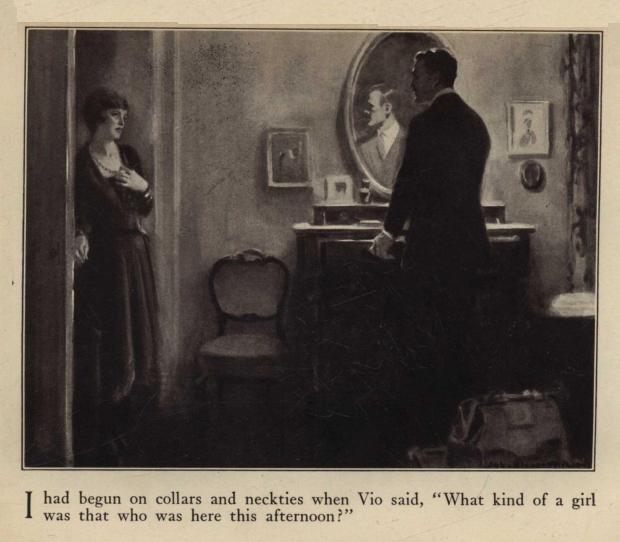
I had begun on collars and neckties when Vio said, "What kind of a girl was that who was here this afternoon?"
"You must have seen something of her for yourself. I understood from her that she'd been coming to see you."
"She's been here three times. Alice Mountney sent her, and I believe Lulu Averill sent her to her. I had no idea that she had anything in her mind than just to sell this new kind of corset."
"And had she?"
"Didn't she tell you?"
"She didn't tell me. If she's said anything to you, I don't know what it can be."
"She's not—she's not crazy, is she?"
"I shouldn't think so. Why do you ask?"
"Then she's extremely peculiar."
"We're all that in our different ways, aren't we?"
"I don't know now whether to take her seriously or not."
"What about?"
"About—about—Dick."
I went on with my packing without answering.
"What do you think?" she asked, at last. "I suppose you have an opinion."
"On what point?"
"The point she brought up ... as to her knowing him ... so well."
"I've no opinion about that. I know she knows him ... very well indeed. At least, I take it for granted."
"What makes you do that?"
"Oh, just having seen them together."
"Why didn't you tell me?"
"Why should I have done that? Men don't—don't give each other away."
"Then in his knowing her there was something to—to give away."
"Evidently."
"Then what about your knowing her yourself?"
"That was different."
"Different? How?"
Since she was pressing the question I decided not to spare her.
"I didn't wait for her at a street corner as a form of introduction."
Expecting the question, "And did he?" I was surprised that she should make it. "And would it be discreet to inquire what your form of introduction was?"
"I was presented to her in all propriety by a blind boy named Drinkwater, you heard her mention him, who was my cabin-mate on the Auvergne. He and Miss Blair and I, with some other people, happened to sit at the same table."
"And have you no interest in her besides that?"
"Yes: she's been a very good friend to me. I haven't seen her for two years and more; but that was my fault."
"So I understand."
"What do you mean by that?'
"That if you had no interest in her she had an interest in you, strong enough to—to impel her to make my acquaintance."
"With some good end in view, presumably."
"With the end in view of giving me the information that—that she knew Dick."
"And do you call that taking an interest in me?"
"What do you think yourself?"
Once more I declined to give my impressions. Where Stroud was concerned I had nothing to say. Now that Vio knew something of the truth concerning him I wished not to influence her in any way. The matter seemed oddly far away from me. The tie between Vio and myself being broken in fact, as it soon would be in law, I preferred to leave the subject of my successor where it was.
"Why do you say," she began after a brief pause, "that this is not a life for you any more?"
"Because it isn't."
"But why isn't it?"
"For one reason, because I don't like it."
"Oh!" She was not expecting this reply and it displeased her. "What's the matter with it?"
"For me, everything. But it's nothing that you would understand."
"I suppose I could understand if you explained to me."
"No, you couldn't. Or, rather, I couldn't. The language isn't coined that would give me the words to tell you. It's not the facts of the life I dislike; it's the spirit of it."
"Is there anything wrong with the spirit of it?"
"I'm not saying so. I merely dislike it for myself. For me it's not a real life any more. I belong to—to simpler people with less complex ideas."
"Less complex ideas about what?'
"About honor for one thing." In my goings and comings round the room I paused in front of her. "Among my friends, my real friends, you can be a coward or a deserter, just as you could be a murderer or a thief, and no one would pass judgment upon you."
"And is that ... a virtue?"
"I don't know anything about its being a virtue; but it is a consolation."
As I stood looking down on her she said, softly:
"Have I passed judgment upon you?"
"You've been a brick, Vio: you've been a heroine. The only difference I should note between you and the people to whom I'm going back is that you've suppressed your condemnation, and they didn't feel it."
"Did they ... know?"
"I can't tell you what they knew, for the reason that it wouldn't have mattered. They knew there was something wrong with me, that I was hiding something, that I was probably an outcast of good family; but they gave me a great, big affection to live in, and thought no more about it. You've given me—"
There was an extraordinarily brilliant flash of her dark eyes as she lifted them to mine.
"What?" she interjected. "Have you any idea of what I've given you?"
"You've given me," I repeated, "the great, big affection to live in, but with something in it that poisoned the air. I'm grateful to you, Vio, more grateful than I can begin to tell you, especially as I know now what you've been thinking all the time; but you can easily understand that I prefer not to live in an atmosphere laden with—"
"If we purified that, the atmosphere? What then?"
"It still wouldn't be everything. When I say I don't like the life, it isn't just because it's cast me out; it's because for me—mind you, I'm not speaking of any one else—it's become vapid and—and foolish, and—and a throwing away of time."
"And what do you find among the people you—you call your friends that's more worth while?"
"That's what it's hard to tell you. I find the simple and elemental, something basic and fundamental that the new crisis in existence is telling us to discover and—and rectify. You remember what I said a month or more ago to Stroud, that our building was collapsing?"
"Yes; and I hoped you were, as people say, talking through your hat."
"Well, I wasn't. The building is coming down, right to the foundations. Only the foundations will remain."
"They're awfully crude foundations, aren't they?"
"Exactly. That's just where the trouble is. The bases of our life are ugly and unclean, and so we've turned away and refused to look at them. I'm going back, Vio, to see what I can do to make them less ugly, less unclean, and more secure to build on. How can we erect a society on foundations that already have the element of decay in them before we've added the first layer of our superstructure?"
Rising, she went to a window, leaning against it as if tired, and looking out into the darkness.
"But what can you do, all by yourself?"
"Very little; but a little is something. It isn't altogether the success or the failure that I'm thinking about; it's the principle."
"Oh, if you're going to live by principles—"
"We've got to live by something. When the world is coming down about our heads."
"If it's doing that, one man can't hold it up."
"No; but a good many men may. I'm not the only one who's trying."
"I never heard of any one trying it like that ... by going back to the foundational, as you call it."
"Oh, I think you have. The Man who more than any other has helped the human race did just that thing. You're strict about going to church on Sunday."
She was slightly shocked. "I presume you're not going to try to be like Him."
"Perhaps not. I may not aim so high. I'm only pointing out the fact that going back to the foundational and beginning there again was His method. Others have followed it, a good many. All the work connected with what we call Settlements—"
"I never could bear them."
"Possibly; but that isn't the point. I'm only saying that in their way settlement workers have been feeling out the special weakness of our civilization, and doing their best to meet it. I suppose our politicians and clergymen and economists have been doing the same. The trouble with them is that they so generally nip the symptom while leaving the root of the disease that they don't accomplish much."
"Did you accomplish much yourself when you were—?"
"I didn't try. I didn't see what I was there for. It's only since coming back here that I've begun to understand why I was led the way I was."
Half turning round, she said over her shoulder:
"Do you call that being led?"
I replied with a distinctness which I tried to make significant:
"Yes, Vio; I call it being led. I didn't see it till I got back here; and even here I didn't see it till—till this afternoon. And now—now I've done with all this. I've done with the easy, gentlemanly life of spending money and being waited on. I'm not saying it isn't all right; it's only not all right for me. I've got something else to do. There was a time, you know it as well as I do, when a poor man was an offense to me, and an uncultivated person an abhorrence. I was a snob from every point of view, and I was proud of being one. And now—"
Pulling down the shade and turning completely round, she stood with her back to the window.
"Yes, Billy? And now?"
"It's no use. I can't tell you. I couldn't explain if I used up all the words in the dictionary. It's just a tugging in my heart to get back where—" I had a sudden inspiration. "Read that," I said, taking Pelly's letter from my pocket.
She stood under the central bunch of electrics while I closed the suit-case and fastened the straps. Having finished the letter, she handed it back to me.
"Well?" I asked.
"It's just—just a common person's letter, as far as I see, and rather coarse. Boosey might have written it, or Miles, the chauffeur."
"And that's all you see in it?"
"What more is there to see?"
"That's just it. That's just where the inexplicable thing lies. I see, or rather I feel, a tenderness in it that probably no one could detect but myself. Even the reference to drinking—"
"The quart."
"Yes; the quart. You've got to remember how small the margin for pleasure is in a life like Sam's, and how innocently he and Bridget and Jim can do what they had much better let alone. They're not vicious; they're only—how shall I say?—they're only undeveloped. We're not such saints ourselves, even with our development; and when all civilization has bent its efforts, church and state together, to keep their minds as primitive as possible so that they'll do the most primitive kinds of work, you can't blame them if they take their pleasures and everything else primitively. We've got to have another educational system."
"But they say our educational system is very good as it is."
"As far as it goes; but we still have one system for the rich and another for the poor, and we shall never get equality of mind till we have equality of educational opportunity. But that's only a detail. It all hangs together. As far as I'm concerned, it sums itself up in the urging that takes me back among simple people because—because I love them, Vio; that's the only word for it, and in their way they've loved me."
She crossed the room aimlessly.
"Other—other people have—have loved you, as you call it, who—who mayn't have been simple."
"Y-yes. But—but in the cup they handed to me there were bitter ingredients. In the cup I'm talking of there was only ... love. It was a blind, stumbling, awkward, mannish love, if you like; but it was ... love. It was the pure, unadulterated thing, as unconscious of itself as the air is. The girl who was here this afternoon is an example of it. For anything I know, she was an idiot to have come; but she came, poor soul, because she thought—"
"Well, what did she think?"
"That if Dick Stroud were out of the way I should have a better chance with you."
She was still moving aimlessly about the room, picking up small objects and putting them down again.
"She said—she said he'd been tagging around after her, it's her expression, for nearly three years."
"To my practically certain knowledge that is so."
"She said, too, that she could marry him if she liked, but that she didn't want to."
"I don't know anything about that."
"If she went with him at all, she said, it would probably be ... without marriage, as she didn't wish to be bound to him."
I looked up in curiosity.
"And did she say there was any possibility of her going with him at all?"
"I think she did. That's what made me think her touched in her mind or crazy. She said she hadn't decided, or something like that; but as she was going to be an adventuress she had to begin some time, and perhaps it might as well be with him as with any one else. She spoke as if it rested entirely with her to take him or throw him away."
Again I decided to be cruel.
"It very likely does."
She was standing now by my dressing-table, and as if my words had meant nothing to her she said:
"Aren't you going to take your hair-brush?"
"Oh, I was forgetting to put it in. Thanks."
When I went for it she was holding it in her hand.
"What a queer, cheap-looking thing! Where on earth did you get it?"
"I suppose it was at Tours, with the other things, when—"
"Oh yes! I remember." She moved toward the door. "Your other brushes, the ebony ones with the silver initials, that I gave you before—before we were married, are here. They were with the things found on the bank of that— They forwarded them to me. Shouldn't you—shouldn't you like them?"
"Thanks, no. This sort of common thing suits me better."
I was doing the last things about the room. She was standing with her hand on the knob of the door, which was half open.
"And when you're back in New York, Billy, doing that kind of thing you talk about, shall you be all alone?"
A second's reflection convinced me that it was best to be clear about everything.
"At first."
"And later?"
I pulled open a drawer from which I knew I had taken all the contents.
"You mean when we're both ... free?"
"Suppose I put it ... when you're free?"
"Oh, then there may be ... some one else."
"Some one ... I know?"
I delved into another drawer, hiding my face. "Some one you may have heard of; but I don't—I don't think you know her."
When I had pushed in the drawer I raised myself; but I was alone in the room. Ten minutes later I had left the house without a good-by on either side.
On the door-step, in my working-man's costume, and with the everlasting bag and suit-case in my hands, I looked up at a starry, windy sky, with the trees of the Common tossing beneath it.
"My God, what an end!" I cried, inwardly.
But, as far as my knowledge or purpose went, an end it was.
CHAPTER II
Noble intentions being easier to conceive than to carry out, it is hardly surprising that on settling again in New York I found myself "let down." The sense of adventure was out of it, while that of the mission had crept in. The old friends were still the old friends; but if my intercourse with them was not less spontaneous it was certainly more self-conscious. Back in my squint-eyed room, with the new paper and the more showy set of fungi, the knowledge that I was there because I chose to be there, and not because I couldn't help it, marked all my goings and comings with a point of interrogation.
In some measure, too, it was a point of disapproval. That is to say, those who welcomed me back took me somewhat in the spirit of a "returned empty."
"Why, yes, of course, if you want it," was Miss Smith's reply to my request to have my old room back again; but her intonation was not wholly that of pleasure. "We thought, my sister and I, that your social duties in Boston would restrict your movements for the future."
I had pricked their little bubble of romance, and they were disappointed. That one who had been their lodger was now with the Olympian gods was a tale to be told as long as they had a room to let, and to every one who rented one. I saw at once that I couldn't ask them to believe that I had come back of my own free will. The very magnitude of my hopes compelled me to be silent with regard to them.
"Punk!" was Pelly's comment, when I braced myself to tell him I had found home life disillusioning.
That was across the table of the familiar eating-house, as we took our first meal together. I was obliged to explain myself for the reason that in the back of his mind, also, I read the conviction that I hadn't "made good." Compelled to be more primitive than I should have liked, I had to base my dissatisfaction on the grounds of physical restriction rather than on those of divine discontent.
"Some of them Boston women will put the lid on a man and lock it down," he observed further. "Punk, I call it. Well, now that you've broken loose, and with your wad, I suppose you'll be givin' yourself a little run."
I allowed him to make this assumption, thankful that he should understand me from any point of view; but it was not the point of view of our former connection. That a man should be down on his luck was one thing; but that, having got on his feet, he should deliberately become a waster was another. In any light but that of a reversion to low tastes I could never have made Sam see my return to the house in Meeting-House Green. For low tastes he had the same toleration as for misdemeanors; but he did not disguise the fact that for a man who had got his chance he considered them low tastes.
At Creed & Creed's I received a similar tempered welcome.
"Sure here's Brogan," Bridget called out to the other men, on seeing me enter the cavern where four of them were at the accustomed work of sweeping a consignment that had just been unpacked. Burlap and sheepskins were still strewn about the floor, so that I had to restrain the impulse to pick things up and stack them.
Perhaps I can best compare my return to that of a spirit which has passed to a higher sphere and chooses to be for a short time re-embodied. Denis, the Finn, and a small wiry man, a stranger to me, all drew near to stare solemnly. My visit could only be taken as a condescension, not as a renewed incorporation into the old life. From that I had been projected forever by the sheer fact of not having to earn a living in this humble way.
"Aw, but it's well you're lookin'," Gallivan said, awesomely.
"And why shouldn't he be lookin' well," Bridget demanded, "and him with more butter than he's got bread to spread it on?"
"It's different with us," the Finn said, bitterly, "with no butter and not enough bread, and more mouths to feed than can ever be filled. I'll bet you Brogan doesn't think of them, now that he's got his own belly full."
It seemed to me an opening.
"Well, suppose I did? Suppose I'd come back to hand down some of the butter?"
"Aw, cut it out, Brogan," the Finn laughed, joylessly. "I was only kiddin' you. We don't pass the buck, none of us don't. What you got, keep; and if you don't, then the more fool you."
In Denis's yearning eyes were the only signs of remote comprehension in the company.
"Sure ye don't have to pass the buck just because y' ask the saints to pray for ye, do ye? Pray for us, Brogan. Ye've got nothing else to do."
It was another opening.
"I wish I had, Denis. I've found that I don't know how to loaf. If you hear of anything—"
He nodded, with beatified aspiration in his leathery old face.
"Aw, then, if it's that way you feel, the Holy Mother 'll find ye something, Protestant though y' are, just as sure as she showed ould Biddy Murphy, and her a Protestant too, that me mother knew in Ireland where there was two-and-sixpence lyin' in the mud, and she with the rent comin' due the next mornin': This is the new Brogan," he continued, with a wave of his hand toward the dark, wiry man, who responded with a grin. "He can't talk our talk hardly not at all, not no more than the monkey I used to tell you about. A Pole he calls hisself; but I nivver heard of no such nation as that till I come to this country. We nivver had them in Ireland at all—at all. There was Ulster men, and Munster men, and men from the County Monaghan; but I nivver heard tell of no Poles. Do you think they's have sowls like us? Or would they be like them Chinees and Japansey men?"
"For Gawd's sake, here's the Floater," Bridget warned, softly, and every man got back to his work.
Back at their work they had no time for further conversation; and in some way, impossible for me to tell you in words, I felt myself eliminated from their fellowship. They would always be friendly; but the knowledge that I was bone of their bone and flesh of their flesh, which had once been the outcome of a common need, was no longer theirs nor mine. I could look in at them in this non-committal way as often as I chose; but I should never get any farther.
Something of the sort was manifest when I next met Lydia Blair. Our standing toward each other was different. Little as she had understood me before, she understood me less in this new rôle than in any other.
"You sure are the queerest guy I ever met," she said, at one time in the course of the evening. "I sometimes wonder if you're all there."
But that was after I had been foolish enough to try to make her see my point of view toward life, and failed. Before that she had been sympathetic.
Our first conversation had been over the telephone, when I had called up Clotilde's to ask if Miss Blair had returned from Boston.
"Miss Blair at the 'phone," was the reply. "Who's this?"
Somewhat timidly I said I was Mr. Harrowby, repeating the name twice before she recognized it as mine. Having invited her to dine with me and go to the theater I got a quavering, "Sure!" which lacked her usual spontaneity.
"You don't seem pleased," I said.
"Oh, I'm pleased enough. I'm only wondering if—if you are."
"Why shouldn't I be, when I've asked you?"
"Well, I put my foot in it for fair, didn't I?"
"You mean in Boston? Oh, that was all right. I know you meant to do me a good turn; and perhaps you've done it."
"Oh, I meant to; but I sure did get a lesson. My mother used to tell me to keep my fingers out of other people's pies; and I'm going to from this time on."
In the evening, seated opposite me at the little table at Josephine's, with the din of a hundred diners giving us a sort of privacy, she told me more about it.
"You see, it was this way: He'd always been talking to me about this rich young Boston widow he'd met at Palm Beach, trying to get my mad up."
"What did he say of her?"
"Well, the sort of thing he would say. He's a good judge of a woman, you must admit; and he thought she was about the classiest. It was when I began to tell him what I wanted to be that he sprang that on me, said she was the model for me to study, and that when it came to the dressy vampire Agnes Dunham wasn't in it.
"Did he call this—this Boston lady a dressy vampire?"
"Oh, he didn't mean that. It was only that for any one who wanted to be a dressy vampire she was a smart style. A vampire mustn't look a vampire, or she might as well go out of business. The one thing I criticized in Agnes Dunham in 'The Scarlet Sin' was that a woman who advertised herself so much as an adventuress wouldn't get very far with her adventuring."
"I see. You'd go in for a finer art."
"I'd go in for pulling the thing off, whatever it was; but that's not what I want to tell you. To go back to what he was always saying about this Boston lady, it made me crazy to see her. In the corset business I'd got intimate with a good many society women, and most of them were gumps. For one good vampire there were a hundred with the kick of a boiled potato. That made me all the crazier to see, and I thought about it and thought about it. Then, one day, Harry called me on the 'phone to say— fxsYou see, he's living with the Averills, and when that Mrs. Mountney— Well, when he told me who you were, and that the lady wasn't a widow any more than I am, well, I simply laid down and passed away. To think that you, the fellow we'd been putting down as a mystery and a swell crook—"
"What did you put me down for then when you found out?"
"We didn't get a line on it all at once. That was later. Mrs. Mountney told Lulu, and Dick Stroud told me, and so—"
"Did you all believe what you heard?"
"It was pretty hard not to, wasn't it? after the queer things you'd been doing. There was just one person who stuck it out that it wasn't true; and that was little Milly. She didn't say much to the family; but to me she declared that if all the armies in France were to swear to it, she'd still know there was some mistake. She's another one I can't make out."
"What can't you make out about her?"
"Whether she's got a heart in her body, or only a hard-boiled egg."
"Oh, I fancy she has a heart all right."
"I used to fancy the same thing, or rather I took it for granted; but ever since— Well, she just stumps me."
She reverted to her errand in Boston and what came of it.
"It wasn't till I began to hear of what was going on there that it seemed to me—" the veil of tears to which her eyes were liable descended like a distant mist—"that it seemed to me a darned shame."
"What seemed to you a darned shame in particular?"
"Well, first that Dick Stroud should be pulling the wool over any other woman's eyes, especially a rich one, and then that he should be upsettin' your apple-cart when you'd had so much trouble already. After that it all came easy."
"What came easy?"
"Getting to know Mrs. Harrowby, and all the rest of it. The first once or twice I didn't see how to bring in Dick Stroud's name without seeming to do it on purpose; but after I met you in the up-stairs hall, why it was just natural. Say, you copped a peach when you got married; do you know it?"
"Why do you say that?"
"Because I've got eyes in my head; and, say, she's the one I saw you with that time I told you about, ever so long ago, and it must have been in New York. I suppose some guy had taken me to a swell restaurant to blow me in for a dinner; but anyhow she was the one. The minute I saw her back I knew there were not two such speaking backs in the world. As for me modeling myself on her, well, an old hour-glass pair of stays might as well try to be Clotilde's Number Three Coar Pearl. And, say, she's some sport, isn't she? When I told her more about Dick Stroud and me, after you'd gone away that afternoon, she never turned a hair. Mrs. Mountney says she was going to marry him if you hadn't turned up, and even now he's hoping to marry her; but when I let her have the whole bunch of truth, she took it like a rag doll will take a pin-prick. Never moved a muscle, or showed that it wasn't just my story, and not a bit her own. Of course I took my cue from that—it was my line all along—and was just the poor working-girl telling her life history to a sympathetic lady, just as they hand it out in books; but she carried the thing off something swell. In fact, she made me more than half think—"
"What?" I questioned, when she held her idea suspended there.
"I don't believe I'll tell you. There are things a man had better find out for himself; do you know it?"
"I sha'n't find out anything for myself," I said, "because—because I've given up the fight."
She stared at me with eyes wide open in incredulous horror.
"You've given up the fight for a peach like that! Well, of all the poor boobs!" Leaning back in her chair she scanned my appearance. "I thought there was something wrong when I saw you got up like that. You can beat Walter Haines, the quick-change man, when it comes to clothes, believe me. What have you got on now?"
I explained that it had been my Sunday suit during the time I had been working at Creed & Creed's.
"Then for Gawd's sake go and take it off, before we start for the theater. I'll wait for you here. You can go and come in a taxi. I've been looking at you all along, and thinking it must be the latest wrinkle from Boston. Boston has funny ways, now hasn't it? And so—"
It was here that I ventured on the exposition of my new scheme of life, getting no appreciation beyond the question as to my sanity quoted above. Later in the evening as, after the theater, I drove her back to Miss Flowerdew's in a taxi, she summed up the situation thus:
"Look-a-here! I never did take stock in that bum story of your being a quitter on the battlefield; but now I sure will if you walk out and hand the show over to Dick Stroud. Why, he's worth two of you! Look how he sticks! He'll get me one of these days, just by his sticking, if I'm not careful; and when it comes to a woman like that— Why, I'm ashamed to go round with such a guy. And say, the next time you ask me to dinner, you'll not be got up like the bogie-man dressed for his wife's funeral. You'll look like you did the other day in Boston, or the first time I saw you, or it will be nix on little Lydia."
Drinkwater's tone was similar and yet different. It was different in that while his premises as to "sticking" coincided with Lydia's, his conclusions were not the same.
Perhaps he was not the same Drinkwater. More than two years having passed since I had seen him, I found in him more than two years of development. A crude boy when last we had met, association with a man like Averill, combined with his own instinct for growth, had made him something of a man of the world not the less sympathetic for his honest pug-face and his blindness. The fact that he asked me to dine with him at his university club was an indication of progress in itself.
He gave me his confidences before I offered mine, sketching a career in which stenography figured as no more than the handmaid to a passion for biological research. From many of the details of research he was, of course, precluded by his blindness; but his methodical habits, his memory, and his faculty for induction had more than once put Averill on the track of one thing when looking for another. It was thus that they had discovered the ophida parotidea while experimenting for the germ of the Spanish influenza. Incidentally, his salary had been creeping upward in proportion as he made himself more useful.
"And Lydia's been a wonder," he declared, his face shining. "Talk about sticking! The way that girl's stuck to me in every kind of tight place! Always thinking of other people and how to pull them out of the holes they get into! In the Middle Ages she'd have been a saint. Now she's just an up-to-date New York girl."
By the time he had finished this rhapsody I was ready to tell him a part of my own life tale, on which I found him more responsive than any one I had met. As to my mental misfortunes in France he accepted the narrative without questioning. When I came to what I painted as domestic conditions outlived on both sides he passed the topic over with the lightness born of tact. You see it was an altogether older and more serious Drinkwater with whom I had to deal; and yet one not less enthusiastic.
I discovered this when, with much misgiving, I hinted at the task to which I wished to dedicate anything left in my life.
"You've got it, old boy," he half shouted, slapping his leg. "There are three or four big jobs through which we white Americans have got to save our country, and among them the free play of class-contribution is almost the first. Say, these fellows that go jazzing about class welfare get my goat. Class co-operation is what we want; and it's what classes come into existence to give. You can't suppress classes, not yet awhile at any rate, in a country full of inequalities; but what we can do is to get the classes that form themselves spontaneously to take their gifts and pass 'em on to each other. Each works out something that another doesn't, and so can benefit the bunch all round. Say, Jasper, you'll hit the nail of one of our biggest national weaknesses right on the head as soon as you've learned how to do it."
"Yes, but the learning how to do it is just where the hitch seems to come in. I've been in New York three weeks and I'm just where I was when I came."
"Say, I'll give you a line on that. Do you know how a young fellow in a country town—I don't know anything about swell places like New York—becomes a barber?"
I said I didn't, that I had never given a thought to the subject.
"Well, he doesn't learn, and nobody ever teaches him. He just sits round in the barber shop, brushing hats and hanging up overcoats, and wishing to the Lord he was a barber, and all of a sudden he is one. He's watched the shaves and hair-clips, hardly knowing he's been doing it, but wishing like blazes all the while, and at last it comes to him like song to a young bird. Now you've got to sit round. Sit tight and sit round. Wish and watch, and watch and wish, and the divine urge that turns a youngster into a barber, because that's what he's got his heart on, will steer you into the right way. This isn't going to be anything you can learn, as you'd learn to drive a motor or dissect a dead body. It won't be a profession, it'll be a life, that'll show you the trick. Don't try to hurry things, Jasper; and don't expect that three weeks or three months or three years are going to make this mum old world fork you out its secrets. Just stick, and if you don't do the thing you're aiming at you'll do another just as useful. Why, the doctor was going to chuck all his experiments on the influenza bug when I persuaded him to keep at it; and so he discovered the thing that scientists have been after since Dockendorff thought he'd tracked it down as long ago as 1893. All sticking!"
CHAPTER III
I confess that I was comforted by these hearty words, and braced in a determination that was beginning to splutter out. Drinkwater's divine urge was not unlike my own thread of flame and Denis's Holy Mother, who was a light even to the feet of Protestants. It was the same principle—that of a guide, an impulse, an illumination, which our own powers could generate when lifted up to, and associated with, the universal beneficence. I decided to take to formula, "Wish and watch, and watch and wish," as the device of my knight-errantry. As a matter of fact, by the sheer process of wishing I secured a secondary position for myself in the textile department of the Metropolitan Museum, while by that of watching I found that one of Bridget's boys and two of the Finn's had aptitudes highly worth developing right along this line. It wasn't much; but it was a beginning in the way in which I hoped to go, and might lead to something more.
In all this time, as you can imagine, Vio was my ruling thought, and guessing her intentions my daily occupation. Since she presumably wanted a divorce, there were doubtless grounds on which she could secure one by going the right way to work; but as to whether she was doing this or not nothing had yet been said to me. Nothing was said to me of any kind. I had not written to her, nor had she to me; and my other communication with Boston was only through my bankers. Even that was growing more irregular since I had changed my business address to Meeting-House Green.
What I was chiefly seeking was forgetfulness. Lydia had reproached me with being a "poor boob" in giving up the struggle for Vio's love; but Lydia hadn't known the wound Vio had inflicted. The more I thought of that the more I felt it due to the dignity of love to attempt neither explanation nor defense. On mere circumstantial evidence Vio had believed me guilty of the crime she would probably have rated as the blackest in the calendar. I couldn't forgive that. I had no intention of forgiving it. The more I loved her the less I could forget that she had returned my love in this way. The most chivalrous thing I could do, the most merciful toward her, and the most tender was what I was doing. I could leave her without a contradiction, so justifying tacitly whatever she may have thought, and putting no restraint on her future liberty of action.
I said so to Mildred Averill when we talked it over about the middle of March. I had not intended to renew this connection unless a sign was made from the other side; but it was given in the form of a line from Miss Averill begging me to come and see her in the apartment she had taken for herself in Park Avenue, where at last she had a little home. Knowing that my duties kept me at the Museum on week-days she had fixed the time for a Sunday afternoon.
It will be remembered that we had met in the previous December, so that I found little change in her now. As I had noticed then, she had grown more spiritual, with an expression of restfulness and peace.
"That's because I don't struggle so much," she explained, in answer to my remark on this change; "I don't fight so much. I'm not nearly the rebel I used to be."
"Does that mean that you've made up your mind to let things go?"
"No; to let things come. That's what I wouldn't do before. I wanted to hurry them, to force them, to drag them along. I begin to see that life has its own current upward, and that we succeed best by getting into it and letting it carry us onward."
"But doesn't that theory tend to take away one's own initiative?"
"I don't know that initiative is any good if it's directed the wrong way. Did you ever watch a leaf being carried down-stream? As long as it's in the current it goes swiftly and safely. Then something catches it and throws it into some little side-pool or backwater, where it goes fretting and swirling and tearing itself to pieces and never getting anywhere. Well, it's something like that. I was in a side-pool, lashing round and round and churning my spirit, such as it is, into nervous irritations of every kind, making myself the more furious because my efforts were to no purpose."
"And how did you get out into the current again?"
"By wishing, in the first place. It began to seem to me such a foolish thing that, being given all the advantages in the world, I could do nothing but frustrate them. I was like a person with a pack of cards in his hand, not knowing how to play any game. I longed to learn one, even the simplest; and I think it was the idea of the simplest that saved me."
"I'm not sure that I get that, the simplest."
"Oh, it's nothing abstruse or original. I suppose it's no more than the accepted principle of doing the duty that's nearest. Hitherto, I'd felt that nothing was a real duty but what was far away. Then I began to see that right under our own roof— You see, Boyd and Lulu weren't very happy, and I'd been leaving them to shift for themselves while I tried to do things for people like Lydia Blair and Harry Drinkwater, and a lot of others who were perfectly well able to take care of themselves. So I began to wonder if I couldn't ... and to wish.... And it's so curious! The minute I did that the things I could do were right there just as if they'd been staring me in the face for years, and I hadn't had the eyes to see them."
"What sort of things?"
"Oh, hardly worth naming when it comes to words. Not big things, little things. If Lulu wanted something she couldn't find in New York, a particular sort of scarf or piece of music, no matter what, I'd tell Boyd and he'd send for it; and, of course, you see! Or if Lulu said anything nice about Boyd, which she did now and then, I'd make it a point of telling him. That's the sort of thing, nothing when you come to talk about it, and yet in practice— That's what I mean by the simplest, the easiest, and most natural; and so I formed a kind of principle."
"Do you mind telling me what it is?"
"Only that, whoever you are, your work is given you; you don't have to go into the highways and hedges to look for it. That queer boy, Harry Drinkwater, gave me the secret of it first. I asked him one day how it was that, in spite of all his handicaps, he managed to get on so well. He said he had only one recipe for success, which was wishing and watching, and watching and wishing. He said there was no door that wouldn't open to you of its own accord if you stood before it long enough with that Sesame in your heart. I remember his saying, too, that in the matter of work, desire—desire that's not wrong, of course—was our first point of contact with the divine, since the thing that we urgently wish to do is the thing by which we re-express the God who has first expressed Himself in us. The most important duty, then, is to find out what we really want, and then to wish and watch. Most of us don't know what we want, or, if we do, we're not clear enough about it, and so we get lost in confusion, like travelers in a swamp. Of course he said it all much more quaintly than I'm doing it; but that was the gist, and it helped to put me into the line of thought in which I've—I've found content."
"That is, you analyzed first what it was you really wanted to do."
"Exactly; and I discovered two things: first, that I didn't want anything half so much as to help—I've told you that before—unless it was the happiness of the people to whom I was nearest. I found, too, that if I began at the beginning and followed the line of least resistance I'd get farther in the end. Up to that time I'd begun in the middle, and so could get neither backward nor forward, as I used to complain to you."
Having thought this over, I said:
"You're fortunate in having the people to whom you're nearest close enough to you for—for daily intercourse and influence."
There was distinct significance in her response.
"Perhaps I'm fortunate in never having turned my back on them as long as they were in need of me. Do you remember how I used to want a home of my own? Well, something kept me at least from that. Whenever I came face to face with doing what I've felt free to do at last, there was always a second thought that held me back. If Boyd and Lulu had had children it would have been different. But Lulu didn't want any till—till lately, and so I felt that something was needed to ease the grinding of the wheels between them. I did recognize that. But now that they've got the little boy—"
"Got a little boy?" I said, in astonishment.
"Why, yes. Didn't any one tell you? Two weeks old to-day, and such a darling! One day he looks like Lulu, and the next like Boyd, and they're both as happy as two children. That's why I've felt free to be my own mistress, to this extent, at least. Things do work out, you know, if you'll only give them half a chance, and stop fretting. That's another thing," she smiled; "it came to me one day in church when they were reading the Psalms, though I'd often heard the words before without paying them attention. 'Fret not thyself, else shalt thou be moved to do evil.' I suppose people worried three thousand years ago just as we do to-day; and had to be told not to. Well, I've tried not to fret myself, and I've got on, oh, so much better."
She was so serene that as I passed my cup for more tea I ventured on something from which otherwise I should have shrunk:
"I'm a little surprised that in your analysis of the things you really wanted you've forgotten the one most people crave for first."
She took this with her customary simple directness.
"Oh no, I haven't. It's only that something seems to have been left out of me that—that I don't demand it as much as many other women; and then—it's hard to put into words—the conviction has come to me that—that whenever I'm ready for it I shall get it. I'm not ready for it, yet." Her amber eyes rested on me with the utmost truthfulness. "It's odd; but I'm not. The very fact that I don't demand it yet, some women, you know, are like that, and I suppose some men, but that very fact shows that it's wiser not to congest one's life by tackling too many things at a time. The one thing I'm growing certain of is that it all depends on oneself as to whether or not the windows of heaven are open to pour us out blessings, and that whatever I want, within reason, I shall get in the long run."
It was partly this theory of life, and partly a sense of assurance and relief, that led me on to talk of my personal situation. As Drinkwater had done, she dismissed my mental misfortunes as incidental, interesting pathologically, but not morally decisive. As to my return to New York after having actually found my way home I felt obliged to give her some explanation. It was while I was doing this that she asked, as if casually:
"Do you like Colonel Stroud?"
"No," I said, bluntly. "Do you?"
"I can see that he has a sort of fascination ... for other women." She nodded, more thoughtfully, "I don't trust him."
"Neither do I."
"I thought not. That's what makes me wonder—"
She hesitated so long that I was compelled to say:
"Wonder, what?"
"Perhaps I had better not go on."
"Please do."
"I only will on condition that you authorize me."
"I authorize you to say anything you choose."
"Well, then, since you don't trust him, I wonder how you could expose any woman to—to his influence."
"Oh, but I don't. The—the events all took place while I was away, and I've no control over them."
"No control, perhaps; but there are other things in life besides control."
"I know that; but what things, for instance, do you mean?"
"Oh, lots of things." She looked about the room as if not attaching much importance to her words. "Love, for one."
"But in this case love has to be counted out."
"Can you ever count out love? I thought that was the one permanent factor in existence, though the skies were to fall."
"It may be a permanent factor, and yet have to remain in abeyance."
She laughed.
"Nonsense! Who ever heard of love remaining in abeyance? You might as well talk of fire remaining in abeyance when it's raging, or water when it's bursting a dam, or any other element in active operation. If I loved any one, no matter how little, I should want to save them from a man like Colonel Stroud."
"In spite of the fact that you'd been considered guilty of—"
"Oh, what does it matter what any one thinks of so poor a thing as oneself? I mean that oneself to oneself is so very unimportant."
"Oh, do you think so?"
"Of course I know that there are other points of view, and that from some of them oneself to oneself is the most vital of all considerations. But in the detail of what other people think of one—"
"Even when the other people are those of whom you think most in all the world?"