Front matter (continued 4)
Reading edition
So I settled down to the routine which, though I didn't know it then, was the mental rest that, according to Doctor Scattlethwaite, I needed for my recovery. The days were so much alike that I could no more differentiate between them than can a man in prison. On eighteen dollars a week I contrived to live with that humble satisfaction of humble needs which I learned to be all that a man requires. Little by little I accommodated myself to the outlook of my surroundings, and if I never thought exactly like my companions I found myself able to listen to their views complacently. With all three of my more important co-workers—Denis, Bridget, and the Finn—my relations were cordial, a fact due largely to their courteous respect for my private history, into which none of them ever pried. Like Lydia, Drinkwater, and every one else, they took it for granted that there was something I wanted to hide, and allowed me to hide it.
In this way I passed the end of the year 1916, the whole of 1917, and all of 1918 up to the beginning of December. Though the country had in the mean time gone to war it made little difference to us. Denis was too old to be drafted; Bridget and the Finn were exempted as fathers of large families; I was examined, and, for reasons I do not yet understand, rejected. I should have made a very good fighting man; but I think I was looked upon as of weak or uncertain mentality.
During all those months I courted the obscurity so easy to find. Between Creed & Creed's and my squint-eyed room with the fungi on the mantelpiece I went by what you might call the back ways, in order to risk no meeting with Mildred Averill or her family. Since they frequented the neighboring book store, one of the best known in New York, they might at some time see me going in or out, and so I kept to the direction of Sixth Avenue. Though I often drifted out into the midday throng of which I have spoken already there was little danger in that, because I was swallowed in the crowd. In company for the most part with Sam Pelly, I took my meals in places so modest that Lydia Blair was unlikely to run across me; and I had no one else to be afraid of.
Peace therefore stole into my racked soul, though it was the peace of death. While I had recurrences of the hope that my lost sense of identity would one day be restored to me, I dropped into the habit of not thinking much about it. I ate and drank; I had shelter and clothes. The narrow margin on which other working-people lived came to seem enough for me. Toward the great accidents of life, illness or incapacity, I learned to take the same philosophic attitude as they, trusting to luck, or to something too subtle and spiritual to put easily into words, to take care of me. If I developed any deep, strong principle of living it was along the lines of the wish that on a snowy December afternoon had led me to Meeting-House Green. I knew that the universe was filled with a great Will and tried to let myself glide along on it in simplicity, and harmony.
CHAPTER VI
On the morning of the eleventh of December, 1918, I had been in the basement helping to unpack a consignment just come in from India, as I had first done two years before. I had, therefore, not known what passed on the floor above during the forenoon, and should have been little interested had I been there. What I needed to know the Floater told me when I appeared after lunch to take my shift on the main floor with Bridget and the Finn.
"You're to go with the two lads down-stairs"—the two of our six porters who were always transient—"to this number in East Seventy-sixth Street, and show the big Chinee antique, 4792, and the modern Chinee, 3628, to a lady that's stayin' there, and explain to her the difference between them. She'll take the new one if she thinks it's just as good, and you're to show her that it isn't. She's not the lady of the house. Her name is Mrs. Mountney, and she comes from Boston. She saw them both this morning, but said she couldn't judge till she'd viewed 'em private."
It was not an unusual expedition, though it was new to me. For special customers, or in cases of big bits of business, we sent out rugs on approval or for private view, though I had never before been intrusted with the mission. I didn't wholly like the job; but we were accustomed to take both things we didn't like and things we did as all in the day's work.
At the house in East Seventy-sixth Street we found ourselves expected, the footman explaining that we were to carry our wares to the music-room and lay them out. The ladies were resting after lunch, but Mrs. Mountney would come to us as soon as she left her room. With the pleasant free-masonry of caste he confided to me, as with our burdens we made our way into the hall, that Mrs. Mountney was a nice little bit of fluff, though not so tony as he had looked for in an old girl out of Boston. When it came to class, the lady of the house, whom I thought he spoke of as Luke, could hang it all over her.
It was so long since I had been in a house of the kind that I took notes more acutely than was my habit, though my habit was always to be observant. What struck me chiefly was its resemblance on a larger scale to the last of its type I had visited. Perhaps the name Lulie had turned my thoughts backward; but there was certainly the same square hall, containing a few monumental bits of furniture because they were monumental, the same dining-room opening out of it, full of high-backed and Italian ... And then, across a corridor that ran to some region behind the dining-room, I thought I saw a stocky figure grope its way with the kind of movement I had not seen since the last time I had met Drinkwater. A door opened and closed somewhere, and before we reached the music-room I heard the distant click of a typewriter.
That I was nervous goes without saying, but there were so many chances of my fear being groundless that I did my best to dismiss it. The music-room was simple, spacious, white-and-gold, admirably adapted not only to the purpose it served but to that which had brought us there. When our carpets were spread they made a magnificent gold spot in the center of a sumptuous emptiness.
A few minutes later the nice little bit of fluff tripped in, justifying the description. She was one of those instances, of which we saw a good many among our customers, where a merciful providence had given a great deal of money to some one who would have been quite too insignificant without it. A worn fairness of complexion was supplemented by cosmetics, and an inadequate stock of very blond hair arranged in artistic disarray in order to make the most of it. To offset the laces and pearls of an elaborate negligée by a "democratic" manner, and so put poor working-men at their ease, she nodded to us in a friendly, offhand way, saying, briskly:
"Now then! Let's see! Which is the modern one and which is the antique? I can't tell; can you?" Looking at me archly, she changed her tone to the chaffing one which the French describe as blagueur. "But of course you'll say you can, because that's your business. You've got them marked with some sort of secret sign, like a conjurer with coins, so as to tell one from the other, without my knowing it."
Having said this, she began to march round the two great gold-covered oblongs with the movement of a prowling little animal. Keeping my eye on the main doorway, I pointed out that while the modern piece would please the ordinary eye only the antique would satisfy the elect. There was no question but that the Indian reproduction was good. Any one who took it would do more than get his money's worth, since it would tone down with the years, while the hard wool of which it was woven would make it stand comparatively rough usage. But—didn't madam see?—the antique, made on the old Chinese looms, was of the softer, richer sheen imparted by the softer, richer wool; and wasn't the heavenly turquoise-blue of the ornaments and border of a beauty which the modern dyes had not begun to reproduce?
As I explained this and some other characteristics of rugs, I was more or less talking against time. The suspicion that had seized me on entering the house began to deepen, without my knowing why.
"Y-yes; y-yes," the little lady agreed; "it is lovely, isn't it? And I suppose that if you're buying a good thing it's better to get the—"
She paused, looking out through the great doorway into the hall. I, too, looked out, to see Mrs. Averill in a tea-gown, gazing in at us distraitly.
"Oh, Lulu, do come here. This man, this gentleman, has just been telling me the most interesting things—"
She trailed into the music-room with the same graceful languor with which she had trailed into the drawing-room on the occasion when we had last met. The two other porters and myself being negligible figures in the room, her almond eyes rested listlessly on the rugs, which she studied without remark.
"Lulu," Mrs. Mountney began again, with animation, "did you know that in Persian rugs the designs are outlined in rows of knots, and in Chinese by clipping with the scissors? ciselé, this ma—this gentleman calls it, and you can feel a little line! Do put your hand down."
"Oh, I'm too tired," Mrs. Averill protested, in her sweet drawling voice, "and this room's so stuffy. Mildred said she'd have it aired; but I don't know what she's mooning over half her time. She's so dreamy. I often think she ought to be in a convent, or something like that."
The little bit of fluff was more interested in rugs than in Mildred.
"Do tell Mrs. Averill—I'm staying with her—what you've just been saying about the wool. Did you know, Lulu, that Indian wool is hard and Chinese soft?" She looked again toward the hallway, where a second figure had come into view. "Mildred, do come here. There's the most interesting things—I'm so glad I went to that place this morning—and they've sent me the most interesting man—Lulu's like ice, but you're artistic."
Miss Averill, too, advanced into the room; but though I was in full view she paid me and my comrades no particular attention. It was the easier for me not to speak, or to draw any one's glance to myself, for the reason that Mrs. Mountney chattered on, repeating for Mildred's benefit the facts I had just been giving her.
"Just think of having the patience to clip with the scissors round all these designs, and it's the same in the modern rug as in the antique. Do stoop down, Mildred, and let your fingers run along the ciseling; that's what this—this gentleman calls it."
As the girl stooped to satisfy Mrs. Mountney, I ventured to look at her more closely. She was perhaps not older than when I had last seen her two years before, but her face had undergone a change. It made you think of faces chastened, possibly purified, by suffering. Where there had been chiefly a sympathetic common sense there was now the beauty that comes of elevation.
Luckily for me Mrs. Mountney ran on, while we three men, with the lack of individuality of employees before customers, remained indistinguishable objects in the background.
"That's the modern and that's the antique; and I'm sure no one but a rug-man could tell the difference between them. This man—this gentleman—says they can, but that's only business. Hundreds of dollars difference in the price, almost as much as between a pair of real pearl ear-rings and imitation ones. What do you say, Mildred? Would anybody ever notice—?"
"I suppose you'd be buying the best because it's the best, and not because any one would notice—"
"I should be buying it for what every one would see. What's the good of having a thing if it doesn't show what it is? I hate the way some people have of calling your attention to every fine thing they've got in the house, as if you weren't used to fine things of your own. If I've got to tell every one that that's a genuine old Chinese masterpiece before they notice it—well, it isn't worth it. But at the same time the effect is richer; and some people do know, and talk about it to other people who know—there's that to consider."
By this time I was conscious of something else.
Having got through so many minutes without recognition I was beginning to hope that, by blotting myself out, as it were, between my fellow-workmen I might finally escape detection. No one had as yet dissociated any of us from another, the very absence of personality on our part reducing us to the place of mere machines. As a mere machine Mrs. Averill and Mildred might continue to overlook me, passing out of the room as unobservant as they had come in.
But Lulu had begun a curious movement round the square of the carpets. She seemed to be studying them; though with the long slits of her Mongolian eyes her glance might be traveling anywhere. Having had the opportunity to look me in the face, she moved to where she got me in profile, afterward passing behind me and returning to her original standpoint beside her sister and her friend. Without further reference to Mrs. Mountney, she slipped her arm through Mildred's, leading her toward the grand piano, against which they leaned.
For me there was nothing to do but to stand still. A word, a sign, might easily betray me, if I had not been betrayed already. As the conversation went on, Mildred kept her back to me, but Mrs. Averill stood sidewise, so as to be able to throw me an occasional appraising glance. Apparently she was in some doubt, my position and my clothes rendering absolute certainty difficult.
But Mildred turned away from the piano at last, and without examining me directly came slowly down the long room. Entirely mistress of herself she walked with sedateness and composure. The shyness and brusqueness which had given her a kind of aura in my thoughts during the past two years seemed to have been overcome by experience. In this self-command more than in any other detail I observed a change in her.
Not till she reached the corner of the long carpet did she give me the first clear, straightforward look. That recognition did not come instantly told me that I, too, must have changed. Laborious work and a rough way of living had doubtless aged and probably hardened me. I was dressed, too, like any other working-man, though with the tidiness which our position on the selling floor exacted. A working-man in his Sunday clothes would perhaps have described me, while my features must have adapted themselves to altered inward conditions with the facility which features possess.
"Is it really you?"
She was standing in front of me now, singling me out from the two boys who had fallen a little back. She didn't offer to shake hands; perhaps she wasn't sure enough of my identity; but that the circumstances in which she found me made no difference to her was the one fact apparent. Any emotion she may have felt was expressed in the quiver of a faint smile.
"I hoped you wouldn't recognize me," was all I found to say.
"Why?"
"Oh, for all the reasons that—that almost anybody would see at a glance."
"Perhaps I'm not—not almost anybody."
"No; you're not."
"Have you been doing this ever since—?"
I nodded. "It's the job I told you I might get. I did get it; and so—"
"Have you liked it?"
"Extremely."
"Is that true, or is it just—?
"No; it's true. I could have had better jobs. They offered two or three times to make me a salesman; you may remember that I knew a good deal about rugs already—; but I preferred to stay where I am."
"For what reason?"
"I hardly know that I can tell you, unless it was to—to—"
"To find your soul?"
"Possibly."
"And have you found it?"
"I've found—something. I'm not sure whether it's my soul or not."
All this was said within the space of perhaps two minutes, during which I watched Mrs. Averill and Mrs. Mountney, toward whom Mildred turned her back, putting their head together on a whispered conversation. That it was about me I could have gathered from their glances; but a little crow on the part of Mrs. Mountney left me no doubt about it.
"Jasper Soames! Why, that's the name—"
It was all I caught; but it was enough to put even Mildred Averill on a secondary plane.
"If you've found your soul—" she was saying.
"Oh, I'm not sure of that. I only feel that I've found—something. I mean that something has come, or gone, I'm not sure of which; only that—"
Mrs. Mountney wheeled suddenly from the piano, trotting back to the edge of the carpet, across which she spoke to me.
"Did you ever hear of Copley's great portrait of Jasper Soames?"
I nodded, speechlessly. I had heard of it. In my mind's eye I saw it, at the head of a great staircase, a full-length figure, wearing knee-breeches of bottle-green satin, a gold-embroidered waistcoat, and a long coat of ruby velvet with a Russian sable collar falling back almost to the shoulders. A plate let into the foot of the frame bore the name Jasper Soames, with the dates of a birth and a death. Somewhere in my life the picture had been a familiar object.
I had no time to follow up this discovery before Mrs. Mountney began again:
"Are you one of his descendants?"
"No; but my wife is."
The reply came out before I realized its significance. I hardly knew what I had said till I heard Lulu Averill exclaim with as much indignation as her indolent tones could carry:
"But you told my husband that you were not a married man! Didn't he, Mildred?"
The situation was so unexpected that I felt myself like a bird swinging in a cage. Nothing was steady; everything around me seemed to whirl. Then I heard Mildred speaking as if her voice reached me through a poor connection on a telephone.
"Oh, that didn't matter. I knew he was married all along—at least I was pretty sure of it. What difference could it make to us?
"It made the difference," Mrs. Averill drawled, peevishly, "that we believed him."
But Mrs. Mountney intervened, waving the others aside with a motion of the arm.
"Wait!" She looked at me again across the carpet. "If you married a descendant of Jasper Soames then it was Violet Torrance."
The mist that had hitherto enshrined two flaming eyes seemed to part as if torn by-lightning. The figure disclosed was not static like that of Jasper Soames, but alive as the sky is a ive in a storm. It was that of my wife as I had last seen her. My mind resumed its action at the point where its memory of Vio had been shut ott.
"And," Mrs. Mountney went on, pressing her facts, "you're Billy Harrowby."
I could only bend my head in assent.
"That's my name."
"Then why—why—?"
She flung her hands apart, unable to continue. Lulu Averill, moving with the tread of a tigress stalking silently, stole down from the piano to the edge of the carpet. Mildred's eyes as she still faced me were all amber-colored fire. I was like a man waking in the morning from a night of troubled dreams.
Little Mrs. Mountney dragged her laces across both the rugs to confront me face to face, standing beside Mildred.
"Do you know who I am?"
I shook my head.
"I'm Alice Tarporley."
"Oh yes! You were a friend of Vio's before we were married. I've heard her speak of you; but you lived in Denver."
"I went back to Boston only two years ago, when poor Vio was in such trouble because you were—" She cried out, with another wide motion of the arms: "In the name of God, man, what does it all mean?"
But I couldn't go into explanations. I didn't know where to begin.
"Tell me first how Vio is—where she is."
"She was perfectly well the day before yesterday, and at your own house in Boston. But don't you know, don't you know—? Why, this is too awful! The more I think of it the more awful it becomes. Don't you know—?"
"I—I don't know anything."
She got it out at last.
"Don't you know—Vio thinks you're—you're dead?"
Iron clampings seemed to press me round the ribs.
"No; I didn't know that. What made her think so?"
"Who wouldn't think so? You were reported missing—and when weeks went by—and no news of you—and then, when your uniform was found on the bank of that river, near Tours, wasn't it? and your papers in the pockets—and your letter of credit, and everything— And here you are in New York, going under another name, working like a stevedore, and looking like a tramp! Why, it's enough to drive anybody crazy!"
I could only stammer: "I shall explain everything, after I've seen Vio."
"You can't explain in such a way that—" She swung toward her hostess. "Lulu, I must go straight back to Boston to-night. There's a train that gets you there in the morning, isn't there? I hate night traveling. I never sleep, and I have a headache all the next day—but what's that when—? If Vio hears this from any one but—" She turned to me again. "Then it was true that you'd been seen in New York hotels?"
"Possibly; I don't know what you're referring to."
"Oh, every now and then some report went round in Boston that So-and-so had seen you in this hotel or that; but nothing of the sort has been said for a year or two, and we thought that it was just the kind of fake story that gets about. But now! Well, I must break the news to Vio—"
"Why shouldn't I break it myself? I could call her up by long distance."
"Man, if she heard your voice like that it would kill her. You don't know. No, I must go; there's no help for it, headache or no headache. Mildred dear, won't you call Annette? I told her she could go to the theater to-night, but now she'll have to get our tickets, and pack!" She wrung her hands. "Oh, dear! When a man's dead, he'd better stay dead!"
Mildred slipped from the room. A suspicion began to creep over me.
"Is there any special reason for my staying dead?"
"How can you when you're alive? That's the important point. Vio will never forgive you for being alive—and not telling her."
"She will when she's heard."
"She's got to hear right away, and I'm going to take charge of it. You may say it's none of my business, but I'm making it mine. I've known Vio Torrance since we were tots together."
I ventured to remind her that Vio might be her friend, but that she was my wife.
"Wife!" she crowed, scornfully. "Have you treated her like a wife—to be alive all this time and never let her know! When I tell you that she's been in mourning for you and out again—positively out again— Well, you can imagine!"
"I can imagine so many things—"
But she jerked her little person away from me toward the two fellows who were trying dully to follow the scene they were witnessing without being able to seize its drift.
"Take all this stuff back again to where you brought it from. I'm not going to buy any of it. The idea of Billy Harrowby—" She repeated the name with a squeal, "Billy Harrowby! of all people in the world! Why, it's enough to drive me out of my senses. I suppose you don't know," she continued, switching back to me again, "that they've put a new man in your place at the Museum, over a year ago, a Frenchman; and that Vio has given them all your prints and etchings for a William Harrowby Memorial—that's what she called it—she had to do something of the sort after your tragic end, in common decency; and you considered a hero, something like Rupert Brooke and Alan Seeger, and now what's it to be—and you alive?" A dramatic gesture seemed to claim this confusion as something for which Fate had made her specially responsible. "Lulu, take me away, for Heaven's sake! I shall never look at a Chinese rug again without thinking—"
When the two ladies, with arms around each other's waist, had passed into the hallway, and out of sight, I turned to my colleagues, saying merely:
"I think we'd better roll these up and beat it."
Neither made any comment till we were in the lorry on our way back to Creed & Creed's, when one of them said in an awe-stricken tone:
"For the love o' Mike, Brogan, ain't your name—Brogan?"
CHAPTER VII
Two mornings later I was in Boston, sitting in the lobby of one of the great hotels. I had come by order of a telegram from my brother-in-law, Wolf Torrance. A note handed me on my arrival, late the previous evening, requested me to wait for him before attempting to see Violet. From her I had had nothing.
I had come as I was, with the hundred and thirty dollars of my savings in my pocket, but without taking the time to dress otherwise than in my working-man's best. Examining myself closely, now that I was face to face with my old life again, I could see that by imperceptible degrees my whole appearance had taken on those shades which distinguish the working-man from men in more sophisticated walks in life. Vio Harrowby as the wife of a working-man, or of any one looking like a working-man, was an inconceivable image.
My leaving New York had been made simpler for me than I could have ventured to hope. Whatever the tale told by the lads who had accompanied me to East Seventy-sixth Street, it had awed the luggers, impressed the salesmen, and reached the ears of the Olympian gods. It was not often, I fancy, that Creed & Creed's was the scene of mystery. That there was a secret about me every one knew, of course; but it had been connected with vague romantic tales of squandering the family estate, of cheating at cards, or of other forms of aristocratic misdoings. So long as I didn't put on airs, and answered submissively to the name of Brogan, this was not laid up against me or treated otherwise than as a misfortune. Now that an explanation seemed to be coming to the light the effect, for that morning at least, was to strike my comrades dumb. They stared at me, but kept at a respectful distance, somewhat like school-boys with one of their number smitten by domestic calamity. Salesmen who, except for an order to pull out or put back a rug, had never taken the trouble to notice me, came and engaged me in polite conversation, while one or two of the partners made errands into the shop on purpose, as I surmised, to get a look at me. The single moment that could have been called dramatic fell to the Floater, who came in, during the forenoon, with a telegram and a special-delivery letter in his hand. They had been sent to Creed & Creed's, since that was my only known address.
"I suppose these wouldn't be for you," was the Floater's choice of words, as he offered them for my inspection.
The telegram was for William Harrowby, the letter to William Harrowby, Esquire.
"That's my name, my real name," I admitted, humbly.
It was natural for him to hide his curiosity under a veil of sputtering disdain.
"Thought it'd be. Never did take stock in that damfool name you give when you first come here. 'Twa'n't fit for a dog or a horse—and you goin' just as easy by the name o' Brogan. Couldn't any one see?"
As to what any one could see I didn't inquire, being too eager to open my telegram. Though I scarcely hoped that it could be from Vio my heart sank a little when I saw that it was not.
"Come at once. Stay at the Normandy. Wait for me before seeing Violet. Explanations expected. J. DEWOLFE TORRANCE."
The spirit of the letter was different. Bearing neither formal beginning nor signature, it was dated from the house in East Seventy-sixth Street.
"I am so glad for your sake. Though I do not understand, I have confidence. I have always had confidence—without understanding. Some day, perhaps, you will tell me; but that shall be as you please. Just now I only want you to know that almost from the beginning of our acquaintance I thought you had a wife. I can't tell you how or why the conviction was borne in on me; but it was. Possibly I was interested in you for her sake a little, with that kind of secret sisterhood which more or less binds all women together, and which is not inconsistent with the small mutual irritations we classify as feline. In any case I knew it—or I so nearly knew it as to be able to take it for granted. If you go back to your home, then, you will have more than my good wishes, you will both have them. Should there be anything to keep you apart you will have more than my good wishes still. Don't ask me why I say these things, because I scarcely know. Don't try to interpret me, either, for you are extremely likely to be wrong. In our talks together you must have seen that I am in rebellion against being bound by other people's rules of conduct, and as far as I have the courage I brave the inferences drawn from what I do. My weakness is that I have not much courage. All the same, as I want to give you a kind of blessing in this new turn in your life, I keep repeating of you some words which I think must come from Tennyson:
"'Go forth, and break through all,
Till one shall crown thee, far in the spiritual city.'"
This letter, too, made my leaving New York easier. Possibly it was written with that intent. "Don't try to interpret me," she had said, and I saw the wisdom of following the counsel. As a matter of fact the new turn to the wheel taxed my mental resources to the utmost.
As nearly as I could judge, those mental resources were normal again. My return to the old conditions I can only compare to waking from a drugged unconsciousness. The repair of a broken telegraphic or telephonic connection might also give an idea of what had taken place in me. Re-establishment effected, messages went simply; that was all I could say. The mental rest induced by two years of physical exertion, with little or no thought for the morrow from any point of view, had apparently given the ruptured brain cells the time to reconstruct themselves. Physiologically I may be expressing myself inexactly; but that is of no moment. What is important is the fact that from the instant when Alice Mountney said, "You're Billy Harrowby," the complete function of the brain seemed to be resumed. There was no more in the nature of a shock than there is in remembering anything else forgotten.
More difficult to become accustomed to were the outward conditions. Having accepted the habits of poverty, those of financial ease seemed alien. They were uncomfortable, too, like an outlandish style of dress. To sleep in a luxurious bed, to order whatever I chose for breakfast, was as odd for me as a reversion to laces and ruffles in my costume. There was a marvelous thrill in it, however, with a sense of trembling anticipation. A soul on the outer edge of paradise, after a life of vicissitude and stint, would doubtless have some such vision of abundance and peace as that which filled my horizon.
But before Christian arrives at the Celestial City which is in sight he is reminded that a few difficulties remain to be faced, and in some such light I regarded the interview with Wolf. He came at last, pushing round the revolving door, and standing on the threshold with a searching look in his silly, hungry eyes. Hatted and fur-coated, he had that air of divine right to all that was best on earth which was one of the qualities that, to me at least, had always made him unbearable. Perhaps because I had had the same conviction about myself I could tolerate it less in him.
Every one called him Wolf, partly because of his name, but more because he looked like the animal. With a jaw extraordinarily long and narrow, emphasized rather than concealed by a beard trimmed carefully to a point, his smile lit up a row of gleaming upper teeth best described as fangs. His small eyes were at once eager, greedy, and fatuous; and yet there was that in his personality which stamped him as of recognized social superiority. In the same way that a picture can be spoken of as a poor example of a good school, Wolf might have been reckoned as a second-rate specimen of a thoroughbred stock. Even as he stood you would have put him down as belonging to the higher strata in any community, and in sheer right of his forebears a member of the best among its clubs.
Instead of going forward and making myself known I allowed him to discover me. It was one more proof of my having changed that more than once his eye traveled over me without recognition. It must be remembered that I was no longer seedy; I was only different. It was not the degree but the kind that put him out of his reckoning.
When in the end he selected me from the crowd it was rather as a possibility than as his very man. Coming forward with that inquiring, and yet doubtful, air which people take on when scarcely able to believe what they see, he halted with a bland, incredulous smile.
"Well!"
With feelings in no wise different from those of a man charged with a crime of which he knows himself guilty, I struggled to my feet:
"Hello, Wolf!"
Wolfs small eyes roamed from my head to my feet and from my feet to my head before he spoke again:
"So you've decided to come back."
The grin that accompanied these words was partly nervous, but partly due to his pose of taking life as the kind of joke which he was man-of-the-world enough to appreciate.
"As you see," I responded, with a sickly grin on my own part.
In some lifeless manner we shook hands, after which I asked him to be seated.
On his taking off his hat I observed that during the three years and more since I had seen him last he had grown bald, while, with something of a pang, I wondered for the first time if I should find a change in Vio.
"Why didn't you come before?"
"I should have come if I could. As a matter of fact, I couldn't."
"Couldn't—why?"
"Didn't know where to go."
"What's that mean?"
"Exactly what it says."
"That you didn't know where to—?"
I tapped my forehead. "Had a—had a—shock—or something."
His gleaming smile was saved from ferocity only by being inane.
"Went dotty?"
"If you like."
"Great Scott! But why—why didn't some one let us know?"
"They couldn't. I—I seem to have taken care of that. Perhaps I'd better—better tell you all about it, that is, as far as I know."
He nodded, taking out his cigar-case and offering me a cigar. When I declined it he took one himself, bit off the end, lighted it, and in general carried himself as if my approaching confidences wouldn't matter much. I resented this the less, knowing it to be his attitude toward every one and everything. All that I cared for was that he should be in a position to give a correct account to Violet, in case she insisted on hearing his report before seeing me.
"You remember how I came to go over and join the American Ambulance Corps in France?"
He said he did not remember it.
"Well, I didn't do it of my own accord. I—I loathed the idea. If we'd been in the war at the time of course I should have done anything I could; but we were not in the war. As a matter of fact, if Vio had only let me wait I could have been of more use in my own particular line."
"You mean what we used to call the old-woman line."
"If you choose to put it that way."
"Didn't you put it in that way yourself?"
"As a feeble joke, yes. But we'll let that pass. All I mean is that as head of the Department of Textiles in the Museum of Fine Arts I knew a lot of a subject that became of great importance when we went into the war; so that, if Vio had waited—"
"Vio," he grinned, "was like a bunch of other women who'd caught the fever of sacrifice, what? When all their swell lady friends in England and France were giving up their dear ones, they didn't want not to be in the swim. Don't think I didn't go through it, old chap. Vio was simply crazy to give up a dear one. Before she'd got you she'd been after me. When Hilda Swain drove her two sons into being stokers in the navy, and killed one of them with the unaccustomed work, I thought Vio would go off her chump with a sense of her uselessness to a great cause. Those were days when to be Vio's dear one meant to go in danger of your life."
A hundred memories crowded in on me.
"Do you think that was it? It wasn't that—that she wanted to get rid of me?"
His answer struck me oddly.
"Not a bit of it, not then. Lord, no!"
I repressed the questions these words called up, taking a minute to think the situation over.
"At any rate, I went," I continued, with outward calm. "It was after a rather stormy scene with Vio, in which she said she thought she had married a man and not a nervous old lady."
"Oh, she said worse than that to me, lots cf times, what?"
"Yes, but you weren't her husband; and you were not desperately in love with her."
"Often thought Vio was like one of those queer-mixed cocktails that 'll set chaps off their nuts who'll take a tumbler of whisky neat and never turn a hair."
"There's something in that," I agreed; "but it makes the kind of woman whose contempt is the harder to put up with. When she began handing it out to me—well, I went. That's all there is to be said about it. You tell me that Vio wanted to sacrifice a dear one; and she did. I was no more fit for the job I undertook than—than little Bobby would have been if he'd lived till then."
"That's another thing. Vio should have had more children, what?"
"Ah, well! She didn't want them. When little Bobby went she said she couldn't go through it all a second time, and so— But I'm trying to tell you what happened."
"Well, go on."
I narrated my experiences in the Ambulance Corps in words that have been so often given in print that it is not worth while to repeat them. What has not so frequently been recorded, because not every one has felt it to the same degree, is the racking of spirit, soul, and body by the unrelieved horror of the days and nights. I suppose I must own to being in regard to all this more delicately constituted than the majority of men. There were others like me, but they were relatively not numerous. Of them, too, we hear little, partly because not all of those who survived like to confess the weakness, and few survived. If it were possible to get at the facts I think it would be found that among those who sickened and died a large proportion were predisposed by sheer inability to go on living any longer in this world of men. I could give you the names of not a few in whom the soul was stricken before the body was. They were for the most part sensitively organized fellows, lovers of the beautiful, and they simply couldn't live. Officially their deaths are ascribed to pneumonia or to something else; but the real cause, while right on the surface, was beyond the doctor's diagnosis.
I didn't sicken; and I didn't die; I wasn't even wounded. What happened was that at Bourg-la-Comtesse a shell came down in the midst of a bunch of us who were stretching our limbs and washing up after a night in a stifling dugout ... and some time during the following twenty-four hours I recovered consciousness, lying on my belly in the darkness, with my face buried in the damp grass of a meadow, like a dead man.
I lay for ten or fifteen minutes trying to reconstruct the happenings that had put me there, and to convince myself that I was unhurt. Except for a beast munching not far away, no living thing seemed to be near me. On the left the ruined walls of Bourg-la-Comtesse were barely visible through the starlight, while to my right a jagged row of tree-tops fringed the sky-line. In the velvety blackness in front of me the stars were dimmed by shells hanging over No Man's Land, Verey lights, darting upward, and radiant bursts of shrapnel. I remembered that our section had halted at an abri a little to the west of the village, and dragging myself from the ground forced my chilled limbs to carry me toward the spot where some of my comrades might be left alive.
But whether I mistook the way, or whether they had gone off leaving me for dead, I was unable to explain to Wolf. I only know that I walked and walked, and found no one. The world had been suddenly deserted. Except for an occasional horse or cow, that paused in its grazing to watch me pass, or the scurrying of some small wild thing through a hedge, I seemed the only creature astir. Dead villages, dead châteaux, dead farms, dead gardens, dead forests, dead lorries, dead tanks, dead horses, dead men, and a dead self, or a self that had only partially come back to life, were the features of that lonely tramp through the darkness.
With no other aim than a vague hope of joining up again with my section I plodded on till dawn. Though my watch had run down, and there was no change as yet in the light, I knew when dawn was approaching by a sleepy twitter in a hedge. Another twitter awoke a few yards farther on, and then another and another. Presently the whole countryside was alive, not with song, but with that chirrupy hymn to Light which always precedes the sunrise, and ceases before the sun has risen. Wandering away from the front, by instinct, not on purpose, I was now in a region relatively untouched by calamity, with grapes hard and green in the vineyards and poppies in the ripening wheat-fields.
Between eight and nine I reached a village, where I breakfasted at a wine-shop, explaining myself as an American charged with a mission that was taking me across country. Stray soldiers being common, I had no harder task than to profit by the sympathy accorded to my British-seeming uniform. So I tramped on again, and on, always with a stupefied half-idea of finding my section, but with no real motive in my mind. If I had a real motive it was in a dull, blind, animal instinct to get away from the brutality in which I had been living for the past six months, even though I knew I should be headed off and turned back again.
But I wasn't. In that land of agony I went my way unheeded. I also went my way unheeding. It was the beginning of the more or less pointless pilgrimages I made later in New York. To my anguished nervous system there was a soothing quality in being on the move. So on the move I kept, hardly knowing why, except that it was to get away from what was right behind me.
And yet I had clearly the impression that I was merely enjoying a breathing spell. I didn't mean to run away. I knew I was Billy Harrowby, and that for my very name's sake I must return to my task at the first minute possible. It was only not possible, because as I continued my aimless drifting along the roads I got farther away from my starting-point.
Absolute mental confusion must have come by such gradual transitions that I have no memory of the stages of the change. I do recall that at a certain time and place I came to an understanding with myself that Billy Harrowby had been blown to bits by a shell near Bourg-la-Comtesse, and that I, who wore his uniform and carried his letter of credit in my pocket, was no more than his astral shape stalking through a world from which he had departed. To get rid of this astral shape, to get rid of everything that pertained to the man who had passed through horrors that would turn all future living into nightmare, began to seem to me a necessary task. Only by doing this could Billy Harrowby's ghost be laid, and the phantasms that walked with it dispelled. By the time I reached Tours the hallucination had assumed the form of a consecrated duty, and to it I applied myself as to some holy ceremonial rite.
In narrating this to Wolf some of the old vividness came back to me. I saw myself again inspecting all the environs of Tours—Plessis-lès-Tours, Marmoutiers, Laroche-sur-Loire, and as far away as the junction at St.-Pierre—for suitable spots in which to lay Billy Harrowby down and become my real self. In the end I selected a small stream, the Padrille I think it is called, which flows into the Loire a mile or two beyond Plessis. There is a spot there where the stream flows through a wood, and there is a spot on the stream's bank where wood is denser than it is elsewhere.
Having selected this as the scene of Billy Harrowby's exit, the rest of my plans became easy. For two or three days I busied myself with discreetly purchasing a new outfit. I remember that it was a point of honor with me not to be too spendthrift with Billy Harrowby's cash, seeing that for the man who was to survive, anything, however modest, would be enough. Further than separating myself from the unhappy ambulance-driver who had seen such dreadful things since arriving in France I had no ambitions.
The purchases made, it was a simple matter to carry them to the bank of the Padrille and change completely. A soldier entered on one side of the Bois de Guènes, a civilian came out on the other. Neither soldier nor civilian was of interest to a people rejoicing in the news that the French had captured that morning the whole line of the Dent de la Ponselle.
From the Bois de Guènes I walked to the junction with the main line at St.-Pierre, and there the trail of my memories is lost. I have no recollection of taking the name of Jasper Soames, though I can see easily enough why I should have done it. When it became necessary to call myself something I seized the first bit of wreckage from the past that my mind could catch hold of. The name was there as a name, even when all its associations had disappeared beneath the waves that had swept over me.
Of the interval between taking the train at St.-Pierre, probably to go southward toward Bordeaux, and my waking on board the Auvergne I have as yet only such fragments of memory as one retains of dreams. Even that which stands out is shadowy, uncertain, evanescent. It is without context. No one fragment is substantial enough for me to be sure of it as pertaining to a fact.
Facts began for me anew at the instant when I opened my eyes in the cabin and saw Drinkwater shaving.
"Funny, isn't it?"
Wolf did not make this observation till some minutes after I had ceased. During the interval of silence, as during the half-hour of my narrative, his grin played on me like a searchlight. As I have already said, I didn't resent this because of knowing his smile to be a kind of nervous rictus of the lips which he was no longer able to control; and yet the silly comment nettled me.
"What's funny about it?" I asked, coldly.
"Oh, nothing! Just—just the whole thing."
"If you think the whole thing's funny—"
"Oh no, not in that sense, not comic."
"What is it then?"
"Nothing—nothing! I was only wondering—"
But I didn't find out what Wolf was wondering till later. In the mean while I gave him a brief account of my doings in New York, leading up to the day when Alice Mountney had "discovered" me. When I came to that he rose, eying me all over as he had done at first.
"That's a queer kind of rig—" he began, with his everlasting jocularity.
"It's the kind of rig I've been wearing," I replied, sharply. "Good enough for its purpose. I shall get something else as soon as I've had time to go to the tailor."
"I'd go soon," was his only remark, as he left me to repeat to Vio what he could remember of my tale.
CHAPTER VIII
It was after lunch before I was summoned to the telephone, to hear Wolf's voice at the other end. Vio would see me at three. I was to understand that my being alive had been a shock to her, and therefore all this ceremonial!
At a quarter to three I started to walk across the Common to the old Soames house on Beacon Hill. It occurred to me then that if for the living it is a strange sensation when the dead come back, for the dead it is a stranger sensation still. Not till I set out on this errand had I understood how dead I had been. I had been dead and buried; I had been mourned for and forgotten; Vio had finished her grieving and returned to every-day life. For anything I knew, she might be contemplating remarriage. Alice Mountney had said that when people were dead it was better for them to stay dead; and I began to fear it was.
Beacon Hill, as I drew near it, struck me as an illustration of that changing of the old order of which all the inner springs seemed to be within myself. It was no longer the Beacon Hill of my boyhood. It was not even the Beacon Hill of the year when I went away. To those who had stayed on the spot and watched the transformation taking place little difference might be apparent; but to me, with my newly awakened faculties, it was like coming back in autumn to a garden visited in spring. The historic State House had deployed a pair of huge white wings, to make room for which familiar landmarks round about it had for the most part disappeared. All down the slope toward the level land the Georgian and Early Victorian mansions were turning into shops and clubs. The old Soames house, with occasional panes of purple glass in otherwise normal windows, was flanked on one side by a bachelors' chambers and on the other by an antique-shop. One of the few old houses in Boston still in the hands of people connected with the original owners, it had been purchased by Vio's father from the heirs of his mother's family, while Vio's trustees had in their turn bought out Wolf's share in it. Four-square, red, with a fine white Doric portico over which a luxuriant wistaria trained, it suggested, as I approached it now, old furniture, old books, old pictures, old wines, old friendships, and all the easy, well-ordered life out of which we were called by the pistol-shot of Sarajevo.
My nervousness in crossing the street and ringing the door-bell was augmented by that sense, from which I was never free, of being guilty of a stupidity so glaring as almost to amount to crime. No ex-convict returning from the penitentiary could have had a more hangdog conviction of coming back to where he was no longer wanted than I in wiping my cheap boots on Vio's handsome door-mat. If I found any solace in the moments of waiting for an answer to my ring it was in noticing that the doorway needed paint and that nothing in the approach to the house was quite so spick and span as formerly. I call this a solace only because it helped to bring Vio nearer me by making her less supremely mistress than she used to be of everything best in the world. I noticed the same thing when the door was opened by a cheery English man-servant of sixty-odd, who was too gaily captain of his soul to be the perfect butler of the old regime.
"Couldn't see you," was his offhand response, when I had asked for Mrs. Harrowby.
"I think she'll see me."
"No, myte, and I'll tell you why. She's kind o' expectin' of 'er 'usband like. Excuse me."
The politeness was called forth by his shutting the door in my face, compelling me to speak plainly.
"I'm Mrs. Harrowby's husband."
The absurdities in my situation were dramatized in the expressions that ran successively over the man's face. Amazement having followed on incredulity, apology followed on amazement. As I was still too near to Pelly, Bridget, and the Finn to separate myself from the servants hall, my sympathy was with him.
"That's all right, old chap," I found myself saying, with a hand on the astonished henchman's shoulder. "Just tell Mrs. Harrowby I'm here. She'll find me in the library."
It was purely to convince Boosey, that was his name, of my right to enter that I tossed my hat on the hat-rack peg and walked to the coat-closet with my overcoat. With the same air of authority I marched into the long, dim library, where my legs began to tremble under me and my head to swim.
Perhaps because I had not yet had time to think of this room in particular, I experienced my first sensation of difficulty or unreality in getting back the old conceptions. It was not alone my head that swam, but the room. If you imagine yourself sailing through a fog and drawing an approaching ship out of the bank by sheer mental effort of your own, you will understand what I mean. In ordinary conditions you have only to watch the ship making itself more and more distinct; in my case the ship did nothing. It was as if I had to build it plank by plank and sail by sail in order to see it at all.
I could do this, even if I did it painfully. The room came into being, mistily, tremblingly, while my head ached with the effort. Taking a few steps here, there, gazing about me at haphazard, the remembered objects appeared one by one—the desks, the arm-chairs, the rows of books, the portraits, the fireplace, in which there was a slumbering fire. Over the mantelpiece hung Zuloaga's portrait of Vio, which always raised discussion wherever it was exhibited.
I had reached this point at the end of the room when a low stifled cry came from the corner by the fire.
"Oh, Billy, is this you?"
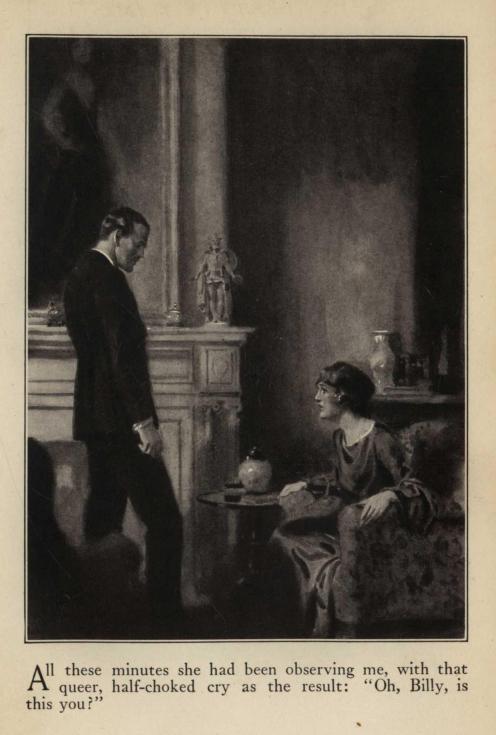
All these minutes she had been observing me, with that queer, half-choked cry as the result: "Oh, Billy, is this you?"
Vio had been sitting there watching me. Had I been able instantly to reconstruct the room I should have seen her instantly; but all these minutes she had been observing me, with that queer, half-choked cry as the result.
I cannot tell you now how long we stared at each other, she in the arm-chair, I on the hearth-rug; but once more the new brain-cells acted sluggishly I knew that this slender, picturesque creature, swathed in soft black satin, with a little white about the open throat line, was Vio, and that Vio was my wife. But I knew it as something remembered, not as an existing fact. I knew it as a ghost might know that another ghost had married him, and that they had once lived intimately side by side.
You must not think from this that there was no emotion. There was tremendous emotion, only it was not the emotion of love after long separation. If it was that there were too many elements in it to allow pent-up passion the immediate right of way. Pent-up passion was stemmed by the realization of what my coming back must mean to the woman before me. For her I had been three years in my grave. As Alice Mountney had put it, she had been in mourning for me—and out again. It was the out again that created this thickened atmosphere between her and me. What had been all over, finished and done with she had to begin again.
And I had not come back to her as I had gone away. I had come back—entirely to the outward eye and somewhat in my heart—not as the smart young fellow of Lydia Blair's recollection, but as a working-man. The metamorphosis rendered me in some ways more akin to Boosey the butler than to my former self. I had acquired an art that made it possible for me to go into the servants' sitting-room and be at home in the company I should find there. The people in the front of the house had to some extent become to me as the Olympian gods at Creed & Creed's, exalted beings with whom I had little to do outside the necessities of work and pay. This change in me was more than superficial; and whatever it was Vio saw it. For her the meeting was harder than for me; and for me it was like a backward revolution of the years.
But after she had clung to me and cried a little, the tensity was broken. As I analyze now, I see the impulse that urged us into each other's arms as one of memory. For her, I was the man who had been, as she was the woman who had been, for me. She, however, had the help of pity, while I was humble and overawed.
It was one of those moments when so many things begin again that it is hard to seize on any. The simplest being the easiest, she said, after having detached herself from me and got back some measure of her self-control:
"What about your things? Have you brought them?"
"The little I have is at the hotel."
Both question and answer came out absently while we looked at each other with a new kind of inspection. The first had been of the self within; now it was of the outer self. I should have shrunk from the way in which her eyes traveled over me had not my whole mind gone into the examination I was making.
Yes; she had changed, though I cannot say that it was in the way of looking older. Rather she had grown to resemble Zuloaga's portrait of her, which we had always considered too theatrical. Zuloaga had emphasized all her most startling traits—her slenderness, sinuousity, and fantastic grace—her immense black eyes, of which he alone of all the men who had painted her had caught the fire that had been compared to that of the black opal—the long, narrow face that was like Wolf's, except for being mysterious and baffling—the mouth, haunted by memories that might have survived from another incarnation, since there had been nothing in her present life to correspond to them. You could speak of her as being beautiful only in the sense of being strange, with an appeal less to the eye than to the imagination. More akin to fire than to flesh, she was closer to spirit than to fire. It might have been a perverse, tortured spirit, but it was far from the merely animal. Discriminating people called it her salvation to have married a humdrum chap like me, since, with a man of more temperament, she would have clashed too outrageously. High-handed and intense, she needed some one seemingly to yield to her caprices, correcting them under the guise of giving in.
Like others of tempestuous nature, when she was gentle her gentleness was heavenly. She was gentle in that way now.
"Sit down, Billy, and let me look at you. Why didn't you bring your things?"
"I didn't know that you wanted me to do that, or that—that we were to—to begin again."
"Of course we shall begin again. What made you think we shouldn't?"
"I didn't think so. I simply didn't know."
"Did Alice Mountney, or Wolf, tell you anything?"
There was a curious significance in the tone, but I let it pass.
"Only that you'd—you'd given me up."
"What else could I do?"
We were sitting half turned toward each other on one of the library sofas, and I seized both her hands.
"But now that I'm back, Vio, are you—are you—glad?"
Though she allowed her hands to remain in mine there was a flash of the black-opal fire.
"It's not so simple as being glad, Billy. The word isn't relevant."
"Relevant to what?"
"I mean that you can't sum up such a situation as this by being either glad or sorry. We've other things to consider."
"But surely that comes first.
"Neither first nor second. The only question we've got to ask for the minute is what we're to do."
"But I thought that was settled—that you wanted me to come back."
"It's settled in the way that getting up in the morning is settled; but that doesn't tell you the duties of the day."
"I suppose one can only meet the duties of the day by going on and seeing what they are."
"Exactly; and isn't that our first consideration—the going on? It doesn't matter whether we're glad or sorry, since we mean to go on, or try to go on—anyhow."
Releasing her hands I dropped back into my own corner of the sofa, scanning the refined features more at my ease, for the reason that her face was slightly averted and her eyes turned to the floor.
"I don't want you to go on, Vio, if—"
"I've thought everything over," she declared in her imperious way, "and made up my mind that it was the only thing for me to do."
"Then you had thought that—that perhaps you—you couldn't."
She nodded slowly, without looking up.
"You'd made other—plans."
"It wasn't that so much; it was—it was thinking of you."
"Thinking of me—from what point of view?"
"From the point of view of—of what you've done." She glanced at me now, quickly, furtively, as if trying to spare me the pain of scrutiny. "Oh, Billy, I'm so sorry for—for my share in it."
"And what do you take your share to be?"
"The share of responsibility. When I urged you to go—"
"As it happened, I should have gone anyhow. When this country had entered the war I should have been under the same obligation as any other man."
"That would have been different. When our men were taken there was discrimination. Each was selected for what he was best fitted to do. A great deal of pains was given to that, and I can't tell you how I suffered when I saw that if I'd only left you alone you could have contributed the thing you knew most about. That's why I feel so strongly that, now you've come back—even in this sort of disguise—"
"I'm not in disguise, Vio. The way you see me—"
The motion of her long, slender hand was partly of appeal and partly of dismissal.
"I don't want to hear about that, Billy. If we're to begin again there are things we mustn't talk about. Since you've done this extraordinary thing, and I may be said to have driven you into it, I want to stand by you. Isn't that enough?"
There was so much in this little speech that I couldn't do it justice at once. All I found myself able to say was:
"Tell me, Vio: Is the extraordinary thing my staying away—or my coming back?"
Again there was that pleading, commanding gesture.
"Oh, Billy, don't. I'm willing to try to pick up the past; but it must be the past, not what's happened in the mean time." She rose with that supple grace which suggested the Zuloaga pose. "Go back to the hotel and get your things. I—I can't bear to see you looking as you are. When you're more like yourself—"
I tried to smile, but I know the effort was no more than a twisted quivering.
"You'll have to see me looking as I am for a few days yet, Vio. My kit doesn't offer me much variety."
"Oh, well—!"
She accepted this as part of the inevitable strangeness in which she had become enveloped, making silent, desperate concessions. Because of this mood I was tempted to ask for five minutes' grace in order to look over the old house.
"You'll find things rather run down," she said, indifferently. "I've no good servants any more. They said that when the war was over it would be easier to get them; but it's a month now since the armistice was signed, and it's just as bad as ever."
"From that point of view, it will probably be worse," I remarked, when about to pass from the library into the hall. "The world isn't going back to what it was before the war. You can't stop an avalanche once it has begun to slide."
She watched me from where she stood before the fire, reproducing almost exactly the attitude of the fascinating woman overhead.
"Does that mean that you've come back a revolutionist, Billy? as well as everything else?"
"N-no; I haven't come back anything in particular. I'm just like you and all the rest of the world, a snowflake in the avalanche. I suppose I shall go tumbling with the mass."
A sense of something outlived came to me as I roamed through the house which Vio allowed me to visit by myself. After two years spent in a squint-eyed room of which the only decoration was three painted fungi this mellow beauty stirred me to a vague irritation. It was not a real dwelling for real people in the real world as the real world had become. It was too rich and soft and long established in its place. Three or four generations of Soameses and Torrances had stored its rooms with tapestries, portraits, old porcelains, and mahoganies; and for America that is much.
Over the landing where the stairway turned hung the famous Copley of Jasper Soames. For a good two minutes he and I faced each other in unspeakable communion. There was nothing between us but this stairway acquaintance, formed during the three years Vio and I had lived together; and yet somehow his being had stamped itself into mine.
On the floors above there was the same well-chosen abundance of everything, sufficiently toned down by use and time to merit the word shabby. That was the note that struck me first, and surprised me. Vio had never been what is commonly known as a good housekeeper; but she had commanded and been obeyed. What the house betrayed now was a diminution of the power of command. Doubtless money didn't go as far as it used to; and there was a new spirit in the world as to taking orders. I thought again of the garden revisited in autumn. The old house might be said to have fulfilled its long mission, and to be ready to pass away with the age of which it was a type.
To go into my own room and find it empty and swept of every trace of my habitation would have been a stranger experience than it was if every experience that day had not been strange. I looked into the wardrobes; I pulled open the drawers. There was not a garment, not a scrap of paper to indicate that I had ever been alive. Not till I saw this did I realize the completeness with which Vio had buried me.
And not till I saw this did I realize that Vio herself was up against the first big struggle of her life. She had never hitherto faced what might be called a moral situation. Her history had been that of any other well-off girl in a city like Boston, where money and position entitled her to whatever was best in the small realm. American civilization, like that of the Italy of the Middle Ages, being civic and not national, the boundaries of Boston, with its suburbs and seaside resorts, had formed the limits of Vio's horizon. True, she had spent a good deal of time in Europe—but always as a Bostonian. She had made periodical visits to Newport, Bar Harbor, Palm Beach, and White Sulphur Springs—but always as a Bostonian. Once she had traveled as far on the American continent as California—but still as a Bostonian.
Boston sufficed for Vio, seeing that it was big enough to give her variety, and swell enough to permit her to shine with little competition. Competition irked her, for the reason that she despised taking trouble. With the exception of a toilet exact to the last detail of refinement, her life was always at loose ends. She rarely answered letters; she rarely returned calls; she never kept accounts; if she began a book she didn't finish it. Adoring little Bobby during the months of his brief life, she found the necessities of motherhood unbearable. That she was as a rule picturesquely unhappy was due to the fact of having nothing on which to whet her spiritual mettle. Like a motor working while the motor-car stands still, she churned herself into action that got nowhere as a result.
But now for the first time in her life she was face to face with a great, big personal problem. How big and great the problem was I didn't at the time understand. All I could see was that she was meeting her baptism of fire, and that I was the means of the ministration.
Pushing open the door between her room and mine I received again the impression of almost awesome privilege I had got on our return from our honeymoon. I had never been at my ease in this room; it was Vio's sanctuary, her fastness. It was a Soames and Torrance sanctuary and fastness, and to it I had only been admitted, not given its freedom as a right. Possibly the feeling that always came to me on crossing its threshold, that I stepped out of my own domain, betokened the missing strand in the tie that had bound Vio and me together.
It had been a trial to me that she should be so much better off than I. Not only did it leave the less for me to do for her, but it created in her a spirit of detachment against which I chafed in vain. Out of the common fund of our marriage she made large reserves of herself, as she might have made reserves—which she did not—of her income. Our beings were allied, but they were not fused. For fusion she had too much that she prized to give away. In such quantity as I could give she made return to me; but having so much more than I to give, her reserves became conspicuous. Of what she withheld this room was the symbol. It was never my room. My comings and goings there had been made with a kind of reverence, as if the place were a shrine.
The only abiding note of my personality had been my photograph at the head of Vio's bed. There was a photograph there now, but I saw that the frame was different. Mine had been in a silver frame; this was in red-brown leather. If it was still mine...
But it was not mine. It was that of a colonel in an American uniform, wearing British and French decorations. Big, portly, handsome, bluff, with an empty left sleeve, he revealed himself as a hero. He was a hero, while I ... It occurred to me that death was not the only means of giving Vio her freedom, and that I ought to tell her so.
To do that I was making my way down-stairs with the words framing themselves on my lips.
"Vio," I meant to say, "if you don't want me back, if anything has happened to make it best for me to go away again forever, you've only to say the word and I'll do it."
But while I was still descending she swept into the hall. Her movements were always rapid, with a careless, commanding ease. She was once more the Zuloaga woman all on fire within.
"How long do you think it will be, Billy, before your tailor can make you look as you ought to?"
I paused where I was, some three steps above her. "It may hardly be worth while to consider that, Vio—"
"Oh, but it is," she interrupted. "If we're going to put this thing through we must do it with some dash. That's essential."
"Why—why the dash?"
"Because there's no other way of doing it. Don't you see? If you just come in by the back door—" She left this sentiment to continue in her own way. "Alice Mountney is going to give a big dinner and invite all your old friends."
My heart sank.
"Is that necessary?"
"Of course it's necessary. It isn't a matter of preference. As far as that goes it will be as hard for me as for you. If I took my own way I should never—" Once more she left me to divine her thought while she added, firmly: "It has simply got to be done. We must make people think—"
"What?" I challenged, when she paused, not apparently from lack of words but from fear of using them. A suspicion impelled me to say in addition, "How much did Wolf repeat to you of the story I told him?"
Her answer was made with the storm in the eyes that was always my warning of danger.
"As much as I'd let him. I didn't want to hear any more. I never shall. That part of it is closed. I've told you already that I accept the responsibility, and I do. You mayn't think it, but I have a conscience of a kind; and I know that if it hadn't been for me you wouldn't have done this thing; and so— But there we are again. There we shall always be if we allow ourselves to discuss it. You're my husband, Billy; I'm your wife. We can't get away from that, whatever has happened—"
"We could get away from it, if you preferred."
"What I prefer," she declared, with her old-time hauteur, "is what I'm asking you to do. If I didn't prefer it I shouldn't ask for it. Go back to the hotel and get your things. Go to the tailor and get more. Your room is waiting for you. It will be the next room to mine, just as before with only the door—"
"The closed door, Vio?"
"Between us," she finished, ignoring my question. "If other things arrange themselves we can—we can reopen it—in time."
So we left it, since it was useless to go on. That she should consider my mental lapse so terrible a disgrace was a surprise to me; but as I so considered it myself I could not blame another for taking the same point of view. After all, a man should show a man's nerve. Thousands, millions of men, had shown it to the limit and beyond. I hadn't; that was all that could be said about it. How could Vio, how could any one else, regard me as other than abnormal?
As she was making so brave an attempt to put all this behind her, it became my duty to help her. This I could do most easily by deflecting the conversation to the large family connection, as to which I was without news. She gave me this news as we stood at the foot of the stairway, or while I got ready to go out again.
It was a relief to learn that none of my brothers or sisters was in Boston. George, who was older than myself, was on General Pershing's staff, and had just been heard of from Luxembourg. Dan, my junior, had the rank of lieutenant-commander and was somewhere in European waters. Tom Cantley, who had married my sister Minna, was working on the War Trade Board in Washington, and he and Minna had a house there. Their eldest boy, Harrowby, had been killed at Château-Thierry, but as far as any one ever saw Minna hadn't shed a tear. Ernestine, my unmarried sister, being one of the founders of the Flag Raising League, had patriotic duties which took her all over the United States. Her last letter had been from Oklahoma or Spokane, Vio was not sure which, but it was "one of those places out there." At any rate, they were all a credit to a name the traditions of which I alone hadn't had the spirit to live up to. Vio didn't say this, of course; but it was the inference.
It was the inference, too, with regard to a host of cousins of the first, second, and third degrees, by blood and by marriage, who would have made a small army in themselves. Some were Vio's kin, and some were mine; some by the chances of Boston intermarriage were related to us both. Not one of them but had been modestly heroic, the women not less than the men. Some had given their lives, some their limbs or eyesight; all, their time and money. Even Wolf and Vio had subscribed to funds till reduced to what they considered indigence. It was a distinguished clan; and I its one pitiable member.
CHAPTER IX
Going back to the hotel, I had my first pang of regret for having waked up on that midnight at Bourg-la-Comtesse. It was the same reflection; the dead were so much wiser in staying dead. I guessed that during the weeks when I was missing Vio had mourned for me with a grief into which a new element had come when my clothes were found on the bank of the Padrille. That was a mistake, that my clothes should be found there. A missing man should be traced to a prison or a hospital, or remain gloriously missing. He should have no interval of safety in which to go in bathing, a hundred miles from the spot on which he had last been seen alive, not even to be drowned. There was a mystery in that which might easily become a flaw in a soldier's record, and which to a woman as proud as Vio would be equivalent to dishonor. That there should be a question of the kind with regard to her own husband...
So I began to do justice to the courage she displayed. Rising to the occasion in a way I could only call magnificent, she sank herself, her opinions, and her plans—I called them plans to avoid a more definite word—to meet the imperative in the situation. What lay in the back of her mind I didn't dare inquire, notwithstanding the signs that betrayed her.
And yet the more splendid her gesture the deeper my humility at having to call it forth. It made me like a man, once strong and active, reduced to living on the doles of the compassionate. I could never be independent again; I could never again have the mental freedom of one as to whom there is nothing unexplained. By a process of bluff I might carry the thing off; but to that I felt an unspeakable aversion. It was not that I was unwilling to second Vio; it was incapacity. Having been guilty of the indiscretion of waking at Bourg-la-Comtesse, I began to regret the long, dull, peaceful routine of Creed & Creed's.
I do not assert that these things were as clear in my mind on that day as they are on this; but they were there confusedly. Every impression I received that afternoon was either confused and painful or strikingly vivid, as to one waking from an anesthetic.
Of those more vivid one in particular stands out in my recollection.
Returning from the hotel with my suit-case and bag—the same with which I had landed from the Auvergne—I heard a man's voice in the drawing-room up-stairs. The deep, soft tones told me it was not Wolf's.
"Mrs. 'Arrowby said as you was to go right up, sir," Boosey informed me, relieving me of my bags. "I 'ear as you was a prisoner in Germany, sir," he continued, while making his way to the coat-closet with my coat. "That's why I didn't know as it 'd be you when you come this afternoon. Might I ask, sir, if they throwed beer in your face, or anything like that?"
With one foot on the stairs I looked after the waddling figure retreating down the hall.
"Who told you that I was a prisoner?"
"Mr. Wolf's man, sir; but"—I am sure there was a veiled taunt in what followed—-"but if you wasn't, sir, or if it's a secret—"
I lost the rest as he became engulfed in the closet, but I had heard enough. Wolf had taken his own way to protect the honor of the family.
It was not easy to enter the drawing-room and face one of Vio's friends; but it was the sort of thing to which I must learn to steel myself. Moreover, it might be one of my own friends come to welcome me back. Vio had informed me that Wolf had taken steps to keep any mention of my "discovery" and return out of the papers; but we were too well known in Boston not to have the word passed privately. To any friend's welcome there would be unspoken reserves; but that I must take for granted and become accustomed to.
But, as it happened, it was not a friend of mine; it was the colonel of the photograph, who had apparently dropped in for a cup of tea—and something more. What that something more might be I could only surmise from Vio's way of saying, "Here's Mr. Harrowby now." They had seemingly discussed me, it had seemingly been necessary for them to discuss me, and taken a definite attitude toward me. That my wife should do this with a man who was a stranger to me, that the circumstances should be such that it was a duty for them to do it, was the extraordinary cup of gall given me to drain. I drained it while Vio went on, with that ease which no one knew better than I to be sustained on nerve:
"Billy, I want you to know Colonel Stroud. He's just got back from France, and has been explaining to me how the Allies are to occupy the Rhineland. Our men are already reaching Mayence and Coblenz, and he has heard, too, that the President arrived this morning at Brest. I suppose it will be in the evening papers."
So we were launched in talk that couldn't hurt any one; and if my feelings were wounded it was only by drawing conclusions. They were the easier to draw from the fact, as I guessed, that Vio directed the talk in such a way that I could read between the lines.
What I gleaned from the give and take of banalities that dealt on the surface with the current gossip of the armistice was that Vio and her colonel had been intimate before he went to France, and now that he was back with medals and only a right arm, the friendship had taken the turn to which such friendships are liable. That he was one of the Strouds of the famous Stroud Valley in northern New York put him into the class with which people like ourselves made social alliances. When Vio, in the early days of her supposed widowhood, had met him at Palm Beach there was nothing to prevent their being sympathetic to each other. How far that sympathy had gone I could only conjecture; but it was easy to see it had gone pretty far.
As to what did not come so directly to the surface, vague recollections began to form themselves in my mind. I seemed to remember the Stroud Valley Strouds as a family with a record. Of the type which in America most nearly resembles the English or Irish country gentleman, they made the marrying of heiresses and the spending of the money thus acquired almost a profession. Horsy, convivial, and good-looking, they carried themselves with the cheery liveliness that acknowledges no account to be given to any one; and when they got into the divorce court, as they did somewhat often, women as well as men, they came out of it with aplomb. I seemed to recall a scandal that a few years before had diverted all the clubs....
But I couldn't be sure that this was the man, or of anything beyond the fact that the central figure of that romance had been a Stroud Valley Stroud. That this particular instance of the race had had a history was stamped all over him; but it was the kind of history which to a man of the world imparts fascination. It was easy to see that he had "done things" in many lines of life. A little the beau mâle of the French lady novelist, and a little the Irish sporting squire, he was possibly too conscious of his looks and his power of killing ladies. A bronzed floridness, due partly to the open air and partly to good living, was thrown into striking relief by the silver hair and mustache not incompatible with relative youth. He couldn't have been much over forty.
His reception to me was as perfect as if regulated by a protocol and rehearsed to the last shade. There was nothing in it I could complain of—and yet there was everything. A gentleman ignoring a disgraceful situation of which every one is conscious would have carried himself with just this air of bland and courteous contempt.
Perhaps it was to react against this and to assert myself a little that I ventured once to cross swords with him. We had exhausted the movements of troops on the Rhine, the possible reception of the President in Pans, and he had given the Peace Conference six months in which to prepare the treaty for signature.
"Then we shall see," he laughed, in his rich, velvety bass.
He brought out the statement so emphatically that I was moved to ask:
"What shall we see?"
"What Mrs. Harrowby and I have been talking about, the end of all this rot as to the war having created a new world."
"That's putting the cart before the horse, isn't it?" I asked, maliciously. "The war didn't create the new world; the new world created the war."
Vio's exquisite eyebrows went up a shade.
"Does that mean anything?"
"Only that the volcano creates the explosion; not the explosion the volcano. Given all the repressions and suppressions and injustices, the eruption had to come."
"The eruption had to come," the colonel declared, hotly, "because the Germans planned it."
"Oh, that was only a detail."
"You might call the whole war only a detail—"
"I do."
"I don't get you," he said, stiffly, leaning forward to place an empty cup on the table in front of Vio.
In her I read something surprised that didn't, however, disapprove of me. Thus encouraged, I went on. If I hadn't thought these things out in the monotonous, unoccupied hours at Creed & Creed's, my stunned brain would not have been master of them now.
"I only meant that the war was but one of the forces, one of the innumerable forces, which the new world in the making—it isn't made yet by any means—has put into operation. If a house collapses it shatters all the windows; but you can't say that the shattering of the windows made the house collapse."
I could see by his stare he was literally minded.
"But what—what house is collapsing?"
"The house all round us, the house of this particular form of civilization. It's sliding down. It's been sliding down for years. You might say that it began to slide down as soon as it was put up, because it was wrongly constructed. A building full of flaws begins to settle before they get the roof on, and though it may stand for years the ultimate crash is only a question of time. War came as soon as our building began to split; the building didn't begin to split because the war came. It was splitting anyhow."
"That seems to me—" he sought for a sufficiently condemnatory word—"that seems to me sheer socialism."
"Oh, I don't think it is. The Socialists wouldn't say so. It isn't anything in particular. It's just—just fact."
"Only?" Vio smiled, with her delicate, penetrating sarcasm.
"Only," I echoed. "But as we belong to a world that doesn't like fact it isn't of much importance."
Bewilderment brought a pained expression to the handsome, rather stupid, countenance.
"What the—what on earth do you mean by that?"
"Only that we've a genius for dodging issues and shutting our eyes to what's straight before us."
"Do you mean the ruin straight before us?"
"Not necessarily, Vio. The collapse of this particular form of civilization wouldn't mean ruin, because we'd get a better form. I suppose it's coming into existence now."
"I don't know about that," the colonel objected. "As far as I see, things are pretty much the same as they've always been, and they're getting more so."
"I suppose none of us sees more than we have our eyes open to. Things of the greatest importance to us happen, and we don't know that they're going on."
"I hope that that kind of song and dance isn't going on—the breakdown of our civilization. It wasn't for that we gave 'em hell at Château-Thierry."
"Oh, none of us knows what anything is for, except in the vaguest way. All we can do is to plod ahead and follow the thread of flame."
"Follow the thread of what?"
I was sufficiently master of myself to indulge in a mild laugh.
"That's just an expression that's been in my mind during the time when I've been—been floundering about. Name I invented for—for a principle."
In this, however, he was not interested.
"Yes, but your collapsing house—"
"It may not come down altogether. I'm neither a prophet nor a prophet's son. All I can see is what I suppose everybody sees, that our civilization has been rotten. It couldn't hold together. It hadn't the cohesive strength. Perhaps I was wrong in saying that it was falling down; it's more as if we were pulling it down, to build up something better. It's our blind instinct toward perfection—"
But refusing to listen to any more, he got up to go. A brave man in the presence of enemies of flesh and blood, intellectual foes frightened him. At the first sound of their shells he rushed for his mental dugout which he burrowed in the ground of denial. "I don't believe that" and "All tommyrot" seemed to him shelters from any kind of danger.
But the main point to me was that I had in a measure not only held my own but got on to superior ground. I had been able to talk; in doing so I had got him at a slight disadvantage. The bit of self-respect inspired by this achievement enabled me to play the host and accompany him to the door with the kind of informal formality to which I had been so long unaccustomed.
And in performing this small duty I made a discovery. As he preceded me down-stairs I remembered seeing the back of his head once before. It was the kind of head not easily forgotten. Moreover, I had seen it in circumstances that had caused me to note it in particular. Where and when and how were details that did not at once return to me; but I knew that the association was sinister.
As I returned from my mission in showing him to the door I heard Vio speaking.
"Come in here, Billy. There's something I want to say."
She was still behind the tea-table, pensive rather than subdued, resolute rather than unhappy.
"I liked your talking like that," she began at once, without looking up at me. "It's—it's the way we shall have to play the game."
A box of cigarettes stood on the tea-table. I took one and struck a match, the usual stage-trick for gaining a little time.
"What game do you mean?" I asked, when I had carefully blown out the match and deposited it in an ash-tray.
"What game can I mean but—but that of your coming back?"