Front matter (continued 2)
Reading edition
Having stopped thinking along one set of lines, I presently found myself off on another. I saw Harry Drinkwater sitting in the dark as I was sitting in the hall of a hotel. That is, he was idle and I was idle. He was eating his heart out as I was eating out mine.
It occurred to me that I might go back to Thirty-fifth Street and take him out to dinner. Alfonso, recommended by Miss Blair, might be no more successful as a host than the lady with tresses à la madone who had given me my lunch; but we could try. At any rate, the boy wouldn't be alone on this first evening in New York, and would feel that some one cared for him.
And then something else in me revolted. No! No! A thousand times no! I had cut loose from these people and should stay loose. On saying good-by to Drinkwater that morning I had disappeared without a trace. For any one who tried to follow me now I should be the needle in a haystack. What good could come of my going back of my own accord and putting myself on a level to which I did not belong?
Like many Americans, I was no believer in the equality of men. For men as a whole I had no respect, and in none but the smallest group had I any confidence. Looking at the faces as they passed me in the hall, I saw only those of brutes—and these were mostly people who had had what we call advantages. As for those who had not had advantages I disliked them in contact and distrusted them in principle. I described myself not only as a snob, but as an aristocrat. I had worked it out that to be well educated and well-to-do was the normal. To be poor and ill educated was abnormal. Those who suffered from lack of means or refinement did so because of some flaw in themselves or their inheritance. They were the plague of the world. They created all the world's problems and bred most of its diseases. From the beginning of time they had been a source of disturbance to better men, and would be to the end of it.
It was the irony of ironies, then, that I should have become a member of a group that included a lady's maid, a chauffeur, and two stenographers, and been hailed as one of them. The lady's maid and the chauffeur I could, of course, dismiss from my mind; but the two stenographers had seemingly sworn such a friendship for me that nothing but force would cut me free from it. Very well, then; I should use force if it was needed; but it wouldn't be needed. All I had to do was to refrain from going to take Drinkwater out to dinner, and they would never know where I was.
And yet, if you would believe it, I went. Within half an hour I was knocking at his bedroom door and hearing his cheery "Come in."
Why I did this I cannot tell you. It was neither from loneliness, nor kind-heartedness, nor a sense of duty. The feet that wouldn't take the horse to the stable took him back to that crimson rooming-house, and that is all I can say.
Drinkwater was sitting in the dark, which was no darker to him than daylight; but when I switched on the light his pug grin gave an added illumination to the room.
"Say, that's the darnedest! I knew you'd come in spite of the old lady swearing you wouldn't. I'd given you half an hour yet; and here you are, twenty-five minutes ahead of time."
The reception annoyed me. It was bad enough to have come; but it was worse to have been expected.
"How have you been getting on?" I asked, in order to relieve my first anxiety.
"Oh, fine!"
"Haven't you been—dull?"
"Lord, no!"
"What have you had to do?"
"Oh, enjoy myself—feeling my way about the house. I can go all round the room, and out into the hall, and up and down stairs just as easily as you can. It's a cinch."
"Have you heard anything of Miss Flair?"
"Sure! Called up about an hour ago to say she'd found the swellest place—in Forty-first Street. But, say, Jasper, what do you think of a girl who gives up the room she's reserved for a month and more, just to—"
I broke in on this to ask where he'd had his lunch.
"Oh, the old girl made me go down and have it with her. She's not half a bad sort, when you come to know her. I've asked her to come out to dinner with me at Alfonso's. Lydia Blair says it's a dandy place—and now you can join the party."
"No; I've come to take you out."
"Say, Jasper! Do you think I'm always going to pass the buck, just because ... You and little Goldie are coming to dinner with me."
Not to dispute the point, I yielded it, asking only:
"What made you think I was coming this evening?—because, you know, I didn't mean to."
"Oh, I dunno. Like you to do it. You're the sort. That's all."
So within another half-hour I found myself at Alfonso's, on Drinkwater's left, with little Goldie opposite. Little Goldie seemed somehow the right name for the Statue of the Commander, now that she wore a lingerie hat and a blouse of the kind which I believe is called peek-a-boo. She was well known at Alfonso's, however, her authority securing us a table in a corner, with special attentions from head and subordinate waitresses.
How shall I tell you of Alfonso's? Like the rooming-house, it was for me a new social manifestation. It was what you might call the home of the homeless, and the homeless were numerous and noisy. They were very noisy, they were very hot. The odor of food struck upon the nostrils like the smell of a whole burnt sacrifice when they offered up an ox. The perfume of wine swam on top of that food, and over and above both the smell of a healthy, promiscuous, perspiring humanity, washed and unwashed, in a festive hurtling together, hilarious and hungry.
The food was excellent; the wine as good as any vin ordinaire in France; the service rapid; and the whole a masterpiece of organization. I had eaten many a dinner for which I paid ten times as much which wouldn't have compared with it.
During the progress of the meal it was natural that Miss Flowerdew, whose eye commended the change in my appearance, should ask me what I had been doing through the day. I didn't, as you will understand, find it necessary to go into details; but I told her of my unsuccessful attempts to find a room.
"Did you try the Hotel Barcelona, in Fourth Avenue?"
I told her I had not.
"Then do so." Fumbling in her bag, she found a card and pencil. "Take that," she commanded, when she had finished scribbling, "and ask for Mr. Jewsbury. If he isn't in, show it to the room clerk, but keep it for Mr. Jewsbury to-morrow. I've told them you must have a room and bath, not over two-fifty a day—and clean. Tell them I said so."
"Is Mr. Jewsbury a friend of yours?" I asked, inanely, after I had thanked her.
"He used to be my husband—-the one before Mr. Crockett. I could be Mrs. Jewsbury again, if I so chose; but I do not so choose."
With this astonishing hint of the possibilities in Miss Goldie Flowerdew's biography I saw the value of discretion, and as soon as courtesy permitted took my leave to visit the Hotel Barcelona.
CHAPTER VIII
After a delicious night I woke in a room which gave the same shock to my fastidiousness as the first glimpse of my cabin on board ship. I woke cheerfully, however, knowing that I was in New York and that not many days could pass before some happy chance encounter would give me the clue of which I was in search. Cheerfully I dressed and breakfasted; cheerfully I sat down in the dingy hall to scan the morning's news.
It was the first paper I had opened since landing. It was the first I had looked at since...
I had no recollection of when I had read a newspaper last. It must have been long ago; so long ago that the history of my immediate time had lapsed into formlessness, like that of the ancient world. I knew there was a world; I knew there were countries and governments; I knew, as I have said, that there was a war. Of the causes of that war I retained about the same degree of information as of the origin of the Wars of the Roses.
Bewilderment was my first reaction now; the second was amazement. Reading the papers with no preparation from the day before, or from the day before that—with no preparation at all but the vague memory of horrors from which my mind retreated the minute they were suggested—reading the papers thus, the world seemed to me to have been turned upside down. Hindus were in France, Canadians in Belgium, the French in the Dobrudja, the Australians in Turkey, the British and Germans in East Africa, and New-Zealanders on the peninsula of Sinai. What madness was this? How had the race of men got into such a tragi-comic topsy-turvydom? A long crooked line slashed all across Europe showed the main body of the opponents locked in a mutual death embrace.
I had hardly grasped the meaning of it when, looking up, I saw a figure of light standing in the lobby before me. It was all in white serge, with a green sash about the waist, and the head wreathed in a white motor veil.
"Hello, kid!" The husky, comic, Third Avenue laugh was Lydia Blair's. I had just time to rehearse the series of irritations I knew I should feel at being tracked down, and to regret my folly for having gone back to Drinkwater on the previous evening. Then I saw the heavenly eyes surveying me with an air of approval. "Well, you look like a nice tailor's dummy at last. Takes me back to Seattle or Boston or Salt Lake City—and the lady." As she rattled on, a pair of dark eyes began to flash on me from the air. "We haven't got her to-day, but there's some one else who perhaps will fill the bill. Come on out."
Wondering what she could mean, and whether or not the longed-for clue might not be at hand, I suffered myself to be led by the arm to the door of the hotel.
At first I saw nothing but a large and handsome touring-car drawn up against the curb. Then I saw Drinkwater snuggled in a corner—and then a brown veil. I couldn't help crossing the pavement, since Lydia did the same, and the brown veil seemed to expect me.
"Miss Blair thought you might like a drive, Mr. Soames, so we came round to see if we could find you."
"Come on in, Jasper," Drinkwater urged; "the water's fine."
"Come on. Don't be silly," Miss Blair insisted, as I began to make excuses.
Before I knew what I was doing I had stumbled into the seat opposite Miss Averill. She sat in the right-hand corner, Drinkwater in the left, Miss Blair between the two. I occupied one of the small folding armchairs, going backward. In another minute we were on our way through one of the cross-streets to Fifth Avenue.
Having grasped the situation, I was annoyed. Miss Averill was taking the less fortunate of her acquaintance for an airing. Though I could do justice to her kindliness, I resented being forced again into a position from which I was trying to struggle out.
Then I saw something that diverted my attention even from my wrongs. The pavements in Fifth Avenue were thronged with a slowly moving crowd of men and women, but mostly men, that made progress up or down impossible. Looking closely, I saw that they were all of the nations which people like myself are apt to consider most alien to the average American. Of true Caucasian blood there was hardly a streak among them. Dark, stunted, oddly hatted, oddly dressed, abject and yet eager, submissive and yet hostile, they poured up and up and up from all the side-streets, as runlets from a mountain-side into a great stream. For the pedestrian, the shopper, the flâneur, there was not an inch of foot room. These surging multitudes monopolized everything. From Fourteenth Street to Forty-second Street, a distance of more than a mile along the most extravagantly showy thoroughfare in the world, these two dense lines of humanity took absolute possession, driving clerks back into their shops and customers from trade by the sheer weight of numbers.
"Good heavens! What's up?" I cried, in amazement.
Miss Averill, who was doubtless used to the phenomenon, looked mildly surprised.
"Why, it's always this way!" she smiled. "It's their lunch-hour. They come from shops and workshops in the side-streets to see the sights and get the air."
"But is it like this every day?"
"Sure it is!" laughed Miss Blair. "Did you never see the Avenue before?"
"I've never seen this before. I'm sure they didn't do it a few years ago."
Miss Averill agreed to this. It was a new manifestation, due to the changes this part of New York had undergone in recent years.
"But how do the people get in and out of the shops?"
Miss Blair explained that they couldn't, which was the reason why so many businesses were being driven up-town. There was an hour in the day when everything was at a standstill.
"And if during that hour this inflammable stuff were to be set ablaze—"
Miss Averill's comment did not make the situation better. "Oh, the same thing goes on in every city in the country, only you don't see it. New York is unfortunate in having only one street. Any other street is just a byway. Here the whole city, for every purpose of its life, has to pour itself into Fifth Avenue, so that if anything is going on you get it there."
We did not continue the subject, for none of us really wanted to talk of it. In its way it went beyond whatever we were prepared to say. It was disquieting; it might be menacing. We preferred to watch, to study, to wonder, as, in the press of vehicles, we slowly made our way between these banks of outlandish faces, every one of which was like a slumbering fire. If our American civilization were ever to be blown violently from one basis to another, as I had sometimes thought might happen, the social TNT was concentrated here.
But we were soon in the Park. Soon after that we were running along the river-bank. Soon after that we came to an inn by a stream in a dimple of a dell, and here Miss Averill had ordered lunch by telephone. It was a nice little lunch, in a sort of rude pavilion that simulated eating in the open air. I noticed that all the arrangements had been made with as much foresight as if we had been people of distinction.
So I began to examine my hostess with more attention than I had ever given her, coming to the conclusion that she belonged to the new variety of rich American whom I had somewhere had occasion to observe.
Sensible and sympathetic were the first words you applied to her, and you could see she was of the type to seek nothing for herself. Brown was her color, as it so often is that of self-renouncing characters—the brown of woodland brooks in her eyes, the brown of nuts in her hair, and all about her an air of conscientiousness that left no place for coquetry.
Conscientiousness was her aura, and among the shades of conscientiousness that in spending money easily came first. I was sure she had studied the whole question of financial inequality from books, and as much as she could from observation. Zeal to make the best use of her income had probably held her back from marriage and dictated her occupations. It had drawn her to working-girls like Lydia Blair, to struggling men like Harry Drinkwater, and now indirectly to me. It had suggested the drive of this morning, and had bidden her gather us round her table as if we were her equals. She knew we were not her equals, but she was doing her best to forget the fact, and to have us forget it, too. With Harry and Lydia I think she was successful. But with me...
She herself knew she was not successful with me, and when, after the coffee, the working-girl had taken the blind man and strayed with him for a few hundred yards into the woods, Miss Averill grew embarrassed. The more she tried to keep me from seeing it the more she betrayed it—not in words, or glances, or any trick of color, but in inner hesitations which only mind-reading could detect.
As we still sat at the table, but each a little away from it, she gathered all her resources together to be the lady in authority.
"I'm glad of a word alone with you because—" Apparently she could get no farther in this direction, and so took another line. "I think you said your business was with carpets, didn't you?"
"Somebody may have said it for me—especially after our little talk about the rug—but it didn't come from me."
Her hazel eyes rested on me frankly. "And it's not?"
"No, it's not."
"Oh, then—" Her tone was slightly that of disappointment.
"Did you want it to be?" I smiled.
"It isn't that; but my brother thought it was—"
"I'm sure I don't know why—except for the rug. But one can know about rugs and not have to sell them, can't one?"
"It's not a usual branch of knowledge, except among connoisseurs and artists—"
"Oh, well!"
"So my brother thought if you were in that kind of work he'd give you a note to a friend of his—-at the head of one of the big carpet establishments in New York—"
"It's awfully kind of him," I broke in, as she drew a letter from the bag she carried, "and if I needed it I'd take it; but—but I don't need it. It—it wouldn't be any good to me. I thank him none the less sincerely—and you, too, Miss Averill—"
She looked at the ground, her long black lashes almost resting on her cheek.
"I must seem to you very officious, but—"
"Not in the slightest. I'm extremely grateful. If I required help there's nobody—"
"You don't live in New York?"
"I'm going to stay here for—for the present."
"But not—not to work?"
"That I shall have to see."
"I suppose you're a—a writer—or one of those things."
"No, I'm not any of those things," I said, gravely; and at that we laughed.
CHAPTER IX
We got back to New York in time for me to begin the parade of the hotels. Taking this task seriously, I selected the biggest and made myself conspicuous by keeping on my feet.
For three days nothing happened except within myself. This focusing of men and women into vast assemblies from four to seven every afternoon began to strike me as the counterpart of the gatherings I was watching each day between twelve and one on the pavements of Fifth Avenue. Though the activities were different, the same obscure set of motives seemed to lie behind both. In both there was the impulse to crowd densely together, as if promiscuity was a source of excitement. In both there was a vacuity that was not purposeless. In both there was a suggestion of the sleeping wild beast. While in the one case the accompaniment was the inchoate uproar of the streets, in the other it was an orchestra that jazzed with the monotonous incitement of Oriental tom-toms, nagging, teasing, tormenting the wild beast to get up and show his wildness. Across tea-rooms or between arcades one could see couples dancing in a languorous semi-paralysis of which the fascination lay in a hint of barbaric shamelessness. Barbaric shamelessness marked the huge shaven faces of most of the men and the kilts of most of the women. I mention these details only to point out that to me, after my mysterious absence, they indicated a socially new America.
It was the fourth afternoon when, drifting with the crowd through a corridor lined with tables at which small parties were having tea, I felt the long-expected tap on my shoulder.
In the interval too brief to reckon before turning round two possibilities were clear in my mind. The unknown crime from which I was running away might have found me out—or some friend had come to my deliverance. Either event would be welcome, for even if it were arrest I should learn my name and history.
"Hello, old chap! Come and have some tea."
I was disappointed. It was only Boyd Averill. Behind him his wife and sister were seated at one of the little tables. It was the sort of invitation one couldn't refuse, especially as they saw I was strolling without purpose.
It was Mrs. Averill who talked, in the bored voix traînante of one who has everything the world can give, except what she wants most. I had seen before that she was a beautiful woman, but never so plainly as now—a woman all softness and dimpling curves, with the same suggestions of the honeyed and melting and fatigued in her glances that you got from the inflection of her sentences.
She explained that they had come from a song recital in the great hall up-stairs. It was given at this unusual time of the year by a well-known singer who was passing through New York on her way to Australia. With this interruption she continued the criticism she had been making when I sat down, and which dealt with certain phrases in a song—Goethe's "Ueber allen Gipfeln."
"The Schubert setting?" I asked, after informing Miss Averill as to how I should have my tea.
"No, the Hugo Wolff."
I began to hum in an undertone: "'Ueber allen Gipfeln ist Ruh; in allem Wipfeln hörest du kaum einen Hauch.' Is that the one?"
The ladies exchanged glances; Averill kept his eyes on my face.
"Yes, that's the one," Mrs. Averill said, as if nothing unusual had happened. "So you sing."
"No; I—I just know the song. I've—I've heard a good deal of music at one time and another."
"Abroad?"
"Yes—abroad—and here."
"Where especially here?"
"Oh, New York—Boston—Chicago—different places." I did my best to be vague.
I noticed for the first time then a shade of wistfulness in Mildred Averill's brown eyes as she said:
"You seem to have moved about a good deal."
"Oh yes. I wanted—I wanted to see what was happening."
"And you saw it?"
Averill asked me that, his gaze still fixed on me thoughtfully.
"Enough for the present."
There was a pause of some seconds during which I could hear the unuttered question of all three, "Why don't you tell us who you are?" It was a kindly question, with nothing but sympathy behind it. It was, in fact, a tacit offer of friendship, if I would only take it up. More plainly than they could have expressed themselves in words, it said: "We like you. We are ready to be your friends. Only give us the least little bit of encouragement. Link yourself up with something we know. Don't be such a mystery, because mystery breeds suspicion."
When I let it go by Mildred Averill began to talk somewhat at random. She didn't want that significant silence to be repeated. I had had my chance and I hadn't taken it. Very well, my reasons would be respected, but I couldn't keep people from wondering. That was what I knew she was saying, though her actual words referred to our expedition of a few days previously.
And of that she spoke with an intonation that associated me with herself. She and I had taken two nice young people of the working-classes for an outing. Let me hasten to say that there was no condescension in what she said; condescension wasn't in her; there was only the implication that whatever the ground she stood on, I stood on that ground, too. She threw out a hint that as New York in these September days was barely waking from its summer lethargy, and there was little to fill time, we might all four do the same again.
In this she was reserved, nunlike, yet—what shall I say? What is there to say when a woman betrays what very few people perceive and one isn't supposed to know to be there? There is a decoration on certain old Chinese porcelains which you can only see in special lights. A vase or a bowl may be of, let us say, a rich green monochrome. You may look at the thing a thousand times and nothing but the monochrome will be visible. Then one day the sun will strike it at a special angle, or the light may otherwise be what the artist did his work for, and beneath the green you will discern dragons or chrysanthemums in gold. Somewhat in that way the real Mildred Averill came out and withdrew, withdrew and came out, not so much according to changes in her as according to changes in the person observing her. When you saw her from one point of view she was diffident, demure, not colorless, but all of one color like a rare piece of monochrome. When you looked at her from another you saw the golden dragons and chrysanthemums. You might not have understood what they symbolized, but this much at least you would have known—that the gold was the gold of fire, all the more dangerous, perhaps, because it was banked down.
That in this company, with its batteries of tacit inquiry turned on me all the while I took my tea, I was uneasy will go without saying, and so I took the earliest possible opportunity to get up and slip away. I did not slip away, however, before Mrs. Averill had asked me to lunch on the following Sunday, and I had been forced into accepting the invitation. I had been forced because she wouldn't take no for an answer. She wanted to talk about music; she wanted to sing to me; in reality, as I guessed then, and soon came to know, she was determined to wring from me, out of sheer curiosity, the facts I wouldn't confide of my own accord.
But having accepted the invitation, I saw that there were advantages in doing so. Once back in the current to which I belonged, I should have more chances of the recognition for which I was working. The social life of any country runs in streams like those we see pictured on isothermal charts. The same kind of people move in the same kind of medium from north to south, and from east to west. If you know one man there you will soon know another, till you have a chain of acquaintances, all socially similar, right across the continent. That I had such a chain I didn't doubt for an instant; my only difficulty was to get in touch with it. As soon as I did that each name would bring up a kindred name, till I found myself swimming in my native channel, wherever it was, like a fish in the Gulf Stream, whether off the coast of Norway or off that of Mexico.
So I came to the conclusion that I had done right in ceding to Mrs. Averill's insistence, though it occurred to me on second thoughts that I should need another suit of clothes. That I had was well enough for knockabout purposes, especially when carried off with some amount of bluff; but the poverty of its origin would become too evident if worn on all occasions. I had seen at the emporium that by spending more money and putting on only a slightly enhanced swagger I could make a much better appearance in the eyes of those who didn't examine me too closely. I decided that the gain would warrant the extravagance.
Within ten days of my landing, therefore, my nearly four hundred dollars had come down to nearly two, though I had the consolation of knowing that my chances of soon getting at my bank-account were better. At any minute now my promenades in the hotels might be rewarded, while conversation with the Averills would sooner or later bring up names with which I should have associations.
It was disconcerting then, on the following Sunday, to be received with some constraint. It was the more disconcerting in that the coldness came from Averill himself. He strolled into the hall while I was putting down my hat and stick, shaking hands with the peculiar listlessness of a man who disapproves of what is happening. As hitherto I had found him interested and cordial, I couldn't help being struck by the change.
"You see how we are," he observed, pointing to an open packing-case. "Not up to the point of having guests; but Mrs. Averill—"
"Mrs. Averill was too kind to me to think of inconveniences to herself."
"Just come up to the library, will you, and I'll tell her you're here."
It was a way of getting rid of me till his wife could come and assume her own responsibilities.
So long a time had passed since I had seen the interior of an American house of this order that I took notes as I made my way up-stairs. Out of the unsuspected resources of my being came the capacity to do it. Most people on entering a house see nothing but its size. A background more or less elaborately furnished may be in their minds, but they have not the knowledge to enable them to seize details. The careful arrangement of taste is all one to them with some nondescript, haphazard jumble.
In this dwelling, in one of the streets off Fifth Avenue, on the eastern side of Central Park, I found the typical home of the average wealthy American. Money had been spent on it, but with a kind of helplessness. Helplessness had designed the house, as it had planned, or hadn't planned, the street outside.
A square hall contained a few monumental pieces of furniture because they were monumental. A dining-room behind it was full of high-backed Italian chairs because they were high-backed and Italian. The stairs were built as they were because the architect had not been able to avoid a dark spot in the middle of the house and the stairs filled it. On the floor above a glacial drawing-room in white and gold, with the furniture still in bags, ran the width of the back of the house, while across the front was the library into which I was shown, spacious, cheerful, with plenty of books, magazines, and easy-chairs. In the way of pictures there were but two—modern portraits of a man and a woman, whom I had no difficulty in setting down as the father and mother of Averill. Of the mother I knew nothing except that she had been a school-teacher; of the father Miss Blair had given me the detailed history as told in Men Who Have Made New Jersey.
Hubbard Averill was the son of a shoemaker in Elizabeth. On leaving school at fifteen he had the choice of going into a grocery store as clerk or as office-boy into a bank. He chose the bank. Ten years later he was teller. Five years after that he was cashier. Five years after that he had the same position in a bank of importance in Jersey City. Five years after that he was recognized as one of the able young financiers in the neighborhood of New York. Before he was fifty his name was honored by those who count in Wall Street. It was the history of most of the successful American bankers I had ever heard of.
There was no packing-case in the library, but a number of objects recently unpacked stood round about on tables, waiting to be disposed of. There was a little Irish glass, with much old porcelain and pottery, both Chinese and European. I had not the time to appraise the things with the eye before Miss Averill slipped in.
She wore a hat, and, dressed in what I suppose was tan-colored linens, she seemed just to have come in from the street.
"My sister will be down in a minute. She's generally late on Sunday. I've been good and have been to church."
We sat down together on a window-seat, with some self-consciousness on both sides. I noticed again that, though her hair was brown, her eyebrows and long curving lashes were black, striking the same discreet yet obscurely dangerous note as the rest of her personality. In the topaz of her eyes there were little specks of gold like those in her chain of amber beads.
After a little introductory talk she began telling me of the help Miss Blair was giving Drinkwater. She had begun to teach him what she called "big stenography." Shorthand and the touch system were included in it, as well as the knack of transcribing from the dictaphone. Boyd had bought a machine on purpose for them to practise with, looking forward to the day when Harry should resume his old job connected with laboratory work.
"And what's to become of Miss Blair?"
My companion lowered her fine lashes, speaking with the seeming shyness that was her charm.
"I'm thinking of asking her to come and live with me. You see, if I take a house of my own I shall need some one; and she suits me. She understands the kind of people I like to work among—"
"Oh, then you're not going to keep on living here."
"I've lived with my brother and sister ever since my father died; but one comes to a time when one needs a home of one's own. Don't you think so?"
"Oh, of course!"
"A man—like you, for instance—can be so free; but a woman has to live within exact limitations. The only way she can get any liberty at all is within her own home. Not that my brother and sister aren't angelic to me. They are, of course; but you know what I mean." The glance that stole under her lashes was half daring and half apologetic. "It must be wonderful to do as one likes—to experiment with different sorts of life—and get to know things at first hand."
So that was her summing up concerning me. I was one of those moderns with so keen a thirst for life that I was testing it at all its springs. She didn't know my ultimate intention, but she could sympathize with my methods and admire my courage and thoroughness. Almost in so many words she said if she had not been timid and hedged in by conventions it was what she would have liked herself.
Before any one came to disturb us there seeped through her conversation, too, the reason of Averill's coldness. They had discussed me a good deal, and while he had nothing to accuse me of, he considered that the burden of the proof of my innocence lay with me. I might be all right—and then I might not be. So long as there was any question as to my probity I was a person to watch with readiness to help, but not one to ask to luncheon. He would not have invited me to tea a few days before, and had allowed me to pass and repass before ceding to his wife's persistence. He had consequently been the more annoyed when she carried her curiosity to the point of bringing me there that day.
Miss Averill did not, of course, say these things; she would have been amazed to know that I inferred them. I shouldn't have inferred them had I not seen her brother and partially read his mind.
But my hostess came trailing in—the verb is the only one I can find to express her gracefully lymphatic movements—and I was obliged to submit to a welcome which was overemphasized for the benefit of the husband who entered behind her.
"We're really not equipped for having any one come to us," she apologized. "We're scarcely unpacked. We're going to move from this house anyhow when we can find another. It's so poky. If we're to entertain again—" She turned to her sister: "Mildred dear, couldn't some one have cleared these things away?" Waving her hand toward the array of potteries and porcelains, she continued to me: "One buys such a lot during two or three years abroad, doesn't one? I'm sure Mrs. Soames must feel the way I do, that she doesn't know where to put the things when she's got them home."
I knew the reason for the reference which others were as quick to catch as I, and, in the idiom of the moment, tried to "side-step" it by saying:
"That's a good thing—that Rouen saladier. You don't often pick up one of that shape nowadays."
"I saw it in an old shop at Dreux," Mrs. Averill informed me, in her melting tone. "I got this pair of Ming vases there, too. At least, they said they were Ming; but I don't suppose they are. One is so taken in. But I liked them, whatever they are, and so—"
She lifted one up and brought it to me—a dead-white jar, decorated with green foliage, violet-blue flowers, and tiny specks of red fruit.
Something in me leaped. I took the vase in my hand as if it had been a child of my flesh and blood. I was far from thinking of my hearers as I said:
"It's not Ming; but it's very good K'ang-hsi.'"
I had thrown another little bomb into their camp, but it surprised them no more than it did me. A trance medium who hears himself speaking in a hitherto unknown tongue could not have been more amazed at his own utterance. I went on talking, not to give them information, but to listen for what I should say next.
They had all three drawn near me. "How can you tell?" Miss Averill asked, partly in awe at my knowledge, and partly to give me the chance to display it.
"Oh, very much as you can tell the difference between a hat you wear this year and one you wore five years ago. The styles are quite different. Ming corresponds roughly to the Tudor period in English history, and K'ang-hsi to the earlier Stuarts—with much the same distinction as we get between the output of those two epochs. Ming is older, bolder, stronger, rougher, with a kind of primitive force in it; K'ang-hsi is the product of a more refined civilization. It has less of the instinctive and more deliberate selection. It is more finished—more self-conscious." I picked up the Rouen salad-dish and a Sèvres cup and saucer, putting them side by side. "It's something like the difference between these—strength and color and dash in the one, and in the other a more elaborately perfected art. You couldn't be in any doubt, once you'd been in the habit of seeing them."
Mrs. Averill's question was as natural and spontaneous as laughter.
"Where have you seen them so much, Mr. Soames?"
"Oh, a little everywhere," I managed to reply, just as we were summoned to luncheon.
At table we talked of the pleasures of making "finds" in old European cities. I had evidently done a lot of it, for I could deal with it in general quite fluently. When they pinned me down with a question as to details I was obliged to hedge. I could talk of The Hague and Florence and Strasbourg and Madrid as backgrounds, but I could never picture myself to myself as walking in their streets.
That, however, was not evident to my companions, and as Mrs. Averill's interests lay along the line of ceramic art I was able to bring out much in the way of connoisseurship which did not betray me. With Averill himself I scored a point; with Mildred Averill I scored many. With Mrs. Averill, beneath a seeming ennui that grew more languorous, I quickened curiosity to the fever-point.
"What a lot of things you must have, Mr. Soames."
My refuge being always in the negative, I said, casually: "Oh no! One doesn't have to own things just because one admires them."
"But you say yourself that you've picked them up—"
As she had nearly caught me here I was obliged to wriggle out. "Oh, to give away—and that kind of thing."
Averill's eyes were resting on me thoughtfully. "Sell?"
"No; I've never sold anything like that."
"But what's the use," Mrs. Averill asked, "of caring about things when you can't have them? I should hate it."
"Only that there's nothing you can't have."
"Do you hear that, Boyd?" I caught the impulse of the purring, velvety thing to vary the monotony of life by scratching. "Mr. Soames says there's nothing I can't have. Much he knows, doesn't he?"
"There's nothing you can't have—within reason, dear."
"Ah, but I don't want things within reason. I want them out of reason. I want to be like Mr. Soames—free—free—"
"You can't be free and be a married woman."
"You can when you have a vocation, can't you, Mr. Soames? I suppose Mr. Soames is a married man—and look at him." She hurried beyond this point, to add: "And look at Sydna, whom we heard the other afternoon! She's a married woman and her husband lives in London. He lets her sing. He lets her travel. He leads his life and lets her ... Mr. Soames, what do you think?"
I said, tactfully, "I shall be able to judge better when you've sung to me."
Miss Averill, taking up the thread of the conversation here, we got through the rest of the luncheon without treading in difficult places, and presently I was alone with Averill, who was passing the cigars.
The constraint which had partially lifted during the conversation at luncheon fell again with the departure of the ladies. I had mystified them more than ever; and mystery does not make for easy give and take in hospitality. To Averill himself his hospitality was sacred. To entertain at his own board a man with no credentials but those which an adventurer might present was the source of a discomfort that amounted to unhappiness. He couldn't conceal it; he didn't care to conceal it. While fulfilling all that courtesy required of a host, he was willing to let me see it. I saw it, and could say nothing, since he might easily be right; and an adventurer I might be.
As, with his back to the open doorway into the hall, he sat down with his own cigar, I felt that he was saying to himself, "I wish to God you were not in this house!" I myself was responding silently by wishing the same thing.
It was the obvious minute at which to tell him everything. I saw that as plainly as you do. Had I made a clean breast of it I should have become one of the most interesting cases of his experience. Such instances of shell-shock were just beginning to be talked about. The term was finding its way into the newspapers and garnishing common speech. Though I knew of no connection between my misfortunes and the Great War, I could have made shift to furnish an illustration of this new phase among its tragedies.
During a pause in our stilted speech I screwed myself up to the point. "There's something—" But his attention was distracted for the moment, and when it came back to me I couldn't begin again. No! I could fight the thing through on my own; but that would be my utmost. A confession of breakdown was impossible.
Then, all at once, I got a glimpse of what was in the back of his mind, though something else happened simultaneously, of which I must tell you first. Into the open space between the portieres behind him there glided a little figure clad in amber-colored linen, the monochrome with the sun-spots beneath it. She didn't speak, for the reason that Averill spoke first.
"You're—" He struck a match nervously to relight his cigar—"you're a—a married man?"
Once more negation had to be my refuge. If I admitted that I was he might ask me whom I had married, and when, and where. I spoke with an emphasis that sprang not from eagerness of denial, but from anxiety that the topic shouldn't be discussed.
"No."
The question and answer followed so swiftly on Mildred Averill's arrival on the threshold that she caught them both. Little sparks of gold shone in the brown pools of her eyes, and her smile took on a new shade of vitality.
"Boyd, Lulu wants you to bring your cigars up-stairs. The coffee is there, and she'd like to talk to Mr. Soames about the old Chinese things before she begins to sing."
He jumped to his feet. He was not less constrained, but some of his uneasiness had passed. I could read what was in his mind. If the worst came to the worst I was at least a single man; and the worst might not come to the worst. There might be ways of getting rid of me before his sister...
He led the way up-stairs. I followed with Miss Averill, saying I have forgotten what. I have forgotten it because, as we crossed the low-ceiled hall with its monumental bits of furniture, two gleaming eyes stood over me like sentinels in the air.
CHAPTER X
Within a fortnight my nearly two hundred dollars had come down to nearly one, and this in spite of my self-denials.
Self-denials were new to me. I knew that by my difficulties in beginning to practise them. Such economics as staying at the Barcelona instead of a more luxurious hotel, or as buying ready-made clothes instead of waiting for the custom-made, I do not speak of as self-denials, since they were no more than concessions to a temporary lack of cash. But the first time I made my breakfast on one egg instead of two; the first time I suppressed the eggs altogether; the first time I lunched on a cup of chocolate taken at a counter; the first time I went without a midday meal of any kind—these were occasions when the saving of pennies struck me as akin to humiliation. I had formed no habits to prepare me for it. The possibility that it might continue began at last to frighten me.
For none of my artful methods had been successful. I frequented the hotels; I hung about the entrances to theaters; I tramped the streets till a new pair of boots became a necessity; but no one ever hailed me as an old acquaintance. Once only, standing in the doorway of a great restaurant, did I recognize a face; but it was that of Lydia Blair, dining with a man. He was a big, round-backed, silver-haired man, with an air of opulence which suggested that Miss Blair might be taking the career of adventuress more seriously than I had supposed. Whether or not she saw me I couldn't tell, for, to avoid embarrassment both for herself and me, I withdrew to another stamping-ground. What the young lady chose to do with herself was no affair of mine. Since a pretty girl of facile temperament would have evident opportunities, it was not for me to interfere with her. Had she belonged to my own rank in life I might have been shocked or sorry; but every one knew that a beautiful working-girl...
As to my own rank in life a sense of going under false pretenses added to my anxieties, though it was through no fault of my own. Miss Averill persisted in giving me the rôle of romantic seeker for the hard facts of existence. She did it only by assumption; but she did it.
"There's nothing like seeing for oneself, is there? It's feeling for oneself, too, which is more important. I'm so terribly cut off from it all. I'm like a bird in a cage trying to help those whose nests are being robbed."
This was said during the second of the excursions for which Miss Blair captured me from the lobby of the Barcelona. Her procedure was exactly the same as on the first occasion, except that she came about the middle of the afternoon. Nothing but an unusual chance found me sitting there, idle but preoccupied, as I meditated on my situation while smoking a cigar. My first impulse to refuse Miss Averill's invitation point-blank was counteracted by the thought of escape from that daily promenade up and down the halls of hotels which had begun to be disheartening and irksome.
Of this the novelty had passed. The expectations that during the first week or two had made each minute a living thing had simmered away in a sense of futility. No old friend having recognized me yet, I was working round to the conviction that no old friend ever would. If I kept up the tramp it was because I could see nothing else to do.
But on this particular afternoon for the first time I revolted. The effect was physical, in that my feet seemed to be too heavy to be dragged along. They were refusing their job, while my mind was planning it.
Thus in the end I found myself sharing the outing given nominally for the blind boy, but really planned from a complication of motives which to Miss Averill were obscure. It did not help to make them clearer that her wistful, unuttered appeals to me to solve the mystery surrounding my personality passed by without result.
The high bank of an autumn wood, the Hudson with a steamer headed southward, more autumn woods covering the hills beyond, a tea-basket, tea—this was the decoration. We had alighted from the motor somewhere in the neighborhood of Tarrytown. Tea being over, Miss Blair and Drinkwater, with chaff and laughter, were clearing up the things and fitting them back into the basket.
"She's very clever with him," Miss Averill explained, as she led the way to a fallen log, on which she seated herself, indicating that I might sit beside her. "She seizes on anything that will teach him the use of his fingers, and makes a game of it. He's very quick, too. The next time he'll be able to take the things out of the tea-basket and put them back all by himself."
So we had dropped into her favorite theme, the duty of helping the helpless.
She was in brown, as usual, a brown-green, that might have been a Scotch or Irish homespun, which blended with the wine shades and russets all about us with the effect of protective coloration. The day was as still as death, so breathless that the leaves had scarcely the energy to fall. In the heavy, too-sweet scents there was suggestion and incitement—suggestion that chances were passing and incitement to seize them before they were gone.
I wish there were words in which to convey the peculiar overtones in Miss Averill's comparison of herself with a bird in a cage. There was goodness in them, and amusement, as well as something baffled and enraged. She had been so subdued when I had seen her hitherto that I was hardly prepared for this half-smothered outburst of fierceness.
"If you're like a bird in a cage," I said, "you're like the one that sings to the worker and cheers him up."
Her pleasure was expressed not in a change of color or a drooping of the lids, but in a quiet suffusion that might most easily be described as atmospheric.
"Oh, as for cheering people up—I don't know. I've tried such a lot of it, only to find that they got along well enough without me. A woman wants more than anything else in the world to feel that she's needed; and when she discovers she isn't—"
The sense of my own apparent superfluity in life prompted me to say:
"Oh, it isn't only women who discover that."
Her glance traveled down the steep wooded bank and over the river, to rest on the wine-colored hills on the other side.
"Did you—did you ever?"—she corrected herself quickly—"I mean—do men?"
"Some men do. It's—it's possible."
"Isn't it," she asked, tackling the subject in her sensible way, "primarily a question of money? If you have enough of it not to have to earn a living—and no particular duties—don't you find yourself edged out of the current of life? After all, what the world wants is producers; and the minute one doesn't produce—"
"What do you mean by producers?"
She reflected. "I suppose I mean all who contribute, either directly or indirectly, either mentally or physically, to the sum total of our needs in living. Wouldn't that cover it?"
I admitted that it might.
"And those who don't do that, who merely live on what others produce, seem to be excluded from the privilege of helpfulness."
"I can't see that. They help with their money."
"Money can't help, except indirectly. It's the great mistake of our philanthropies to think it can. We make a great many mistakes; but we can make more in our philanthropies than anywhere else. We've never taken the pains to study the psychology of help. We think money the panacea for every kind of need, when as a matter of fact it's only the outward and visible sign of an inward and spiritual grace. If you haven't got the grace the sign rings false, like an imitation coin."
"Well, what is the grace?"
"Oh, it's a good many things—a blend—of which, I suppose, the main ingredient is love." She gave me a wistful half-smile, as she added: "Love is a very queer thing—I mean this kind of big love for—just for people. You can always tell whether it's true or false; and the less sophisticated the people the more instinctively they know. If it's true they'll accept you; if it's only pumped up, they'll shut you out."
"I'm sure you ought to know."
"I do know. I've had a lot of experience—in being shut out."
"You?"
She nodded toward Drinkwater and Miss Blair. "They don't let me in. In spite of all I try to do for them, they're only polite to me. They'll accept this kind of thing; but I'm as far outside their confidence—outside their hearts—as a bird in a cage, as I've called myself, is outside a flock of nest-builders."
"And assuming that that is so—though I do not assume it—how do you account for it?
"Oh, easily enough! I'm not the real thing. I never was—not at the Settlement—not now—not anywhere or at any time."
"But how would you describe the real thing?"
"I can't describe it. All I know is that I'm not it. I'm not working for them, but for myself."
"For yourself—how?"
"To fill in an empty life. When you've no real life you seek an artificial one. As every one rejects the artificial, you get rejected. That's all."
"What would you call a real life—for yourself?"
The fierceness with which she had been speaking became intensified, even when tempered with her diffident half-smile.
"A life in which there was something I was absolutely obliged to do. I begin to wonder if parents know how much of the zest of living they're taking away from their children by leaving them, as we say, well provided for. When there's nothing within reason you can't have and nothing within reason you can't do—well, then, you're out of the running."
"Is that the way you look at yourself—as out of the running?"
"That's the way I am."
"And is there no means of getting into the running?"
"There might be if I wasn't such a coward."
"If you weren't such a coward what would you do?"
"Oh, there are things. You've—you've found them. I would do like you."
"And do you know what I'm doing?"
"I can guess."
"And you guess—what?"
"It's only a guess—of course."
"But what is it?"
She rose with a weary gesture. "What's the good of talking about it? A knight in disguise remains in disguise till he chooses to throw off his incognito."
"And when he has thrown it off—what does he become then?"
"He may become something else—but he's—he's none the less—a knight."
We stood looking at each other, in one of those impulses of mutual frankness that are not without danger.
"And if there was a knight who—who couldn't throw off his incognito?"
She shrugged her shoulders. "Then I suppose he'd always be a knight in disguise—something like Lohengrin."
"And what would Elsa think of that?"
Seeing the implication in this indiscreet question even before she did, I felt myself flush hotly.
I admired the more, therefore, the ease with which she carried the difficult moment off. Moving a few steps toward Drinkwater and Miss Blair, who were shutting up the tea-basket, she threw over her shoulder:
"If there was an Elsa I suppose she'd make up her mind when the time came."
She was still moving forward when I overtook her to say:
"I wish I could speak plainly."
She stopped to glance up at me. "And can't you?"
"Were you ever in a situation which you felt you had to swing alone? You know you could get help; you know you could count on sympathy; but whenever you're impelled to appeal for either something holds you back."
"I never was in such a situation, but I can imagine what it's like. May I ask one question?"
I felt obliged to grant the permission.
"Is it of the nature of what is generally called trouble?"
"It's of the nature of what is generally called misfortune."
"And I suppose I mustn't say so much as that I'm sorry."
"You could say that much," I smiled, "if you didn't say any more."
She repeated the weary gesture of a few minutes earlier, a slight tossing outward of both hands, with a heavy drop against the sides.
"What a life!"
As she began to move on once more I spoke as I walked beside her.
"What's the matter with life?"
Again she paused to confront me. In her eyes gold lights gleamed in the brown depths of the irises.
"What sense is there in a civilization that cuts us all off from each other? We're like prisoners in solitary confinement—you in one cell and Boyd in another and Lulu in another and I in another, and everybody else in his own or her own and no communication or exchange of help between us. It's—it's monstrous."
The half-choked passion of her words took me the more by surprise for the reason that she treated me as if the defects of our civilization were my fault. Joining Lydia Blair and taking her by the arm, she led the way back to the motor, while I was left to pilot Drinkwater, who carried the tea-basket. During the drive back to town our hostess scarcely spoke, and not once to me directly.
CHAPTER XI
But I was troubled by all this, and puzzled. That I couldn't afford the complication of a love-affair will be evident to any one; but that a love-affair threatened was by no means clear. As far as that went it was as fatuous on my part to think of it as it would have been for Drinkwater, except in so far as it involved danger to myself.
For a few hours that danger did not suggest itself. That is, I was so busy speculating as to Mildred Averill's meaning that I had no time to analyze the way I was taking it. Weighing her words, her impulses, her impatiences, I saw no more than that she might be offering her treasures at the feet of a wooden man, a carved and painted figment, without history or soul.
That is, unless I mistook her meanings as Malvolio mistook Viola's!
There was that side to it, too. It was the aspect of the case on which I dwelt all through my lonely dinner. I had not forgotten Boyd Averill's reception of me on the Sunday of the luncheon; I never should forget it. There is something in being in the house of a man who is anxious to get you out of it unlike any other form of humiliation. The very fact that he refrains from pointedly showing you the door only gives time for the ignominy to sink in. Nothing but the habit of doing certain things in a certain way carried me through those two hours and enabled me to take my departure without incivility. On going down the steps the sense that I had been kicked out was far more keen than if Averill had given way to the actual physical grossness.
Some of this feeling, I admit, was fanciful. It was due to the disturbed imagination natural to a man whose mental equipment has been put awry. Averill had been courteous throughout my visit. More than that, he was by nature kindly. Anywhere but in his own house his attitude to me would have been cordial, and for anything I needed he would have backed me with more than his good-will.
Nevertheless, that Sunday rankled as a poisoned memory, and one from which I found it impossible wholly to dissociate any member of his family. Though I could blame Mrs. Averill a little, I could blame Miss Averill not at all; and yet she belonged to the household in which I had been made to feel an unwelcome guest. That in itself might give me a clue to her sentiment toward me.
As I went on with my dinner I came to the conclusion that it did give me such a clue. I was the idiot Malvolio thinking himself beloved of Viola. Where there was nothing but a balked philanthropy I was looking for the tender heart. The dictionary teemed with terms that applied to such a situation, and I began to heap them on myself.
I heaped them on myself with a sense not of relief, but of disappointment. That was the odd discovery I made, as much to my surprise as my chagrin. Falling in love with anybody was no part of my program. It was out of the question for obvious reasons. In addition to these I was in love with some one else.
That is to say, I knew I had been in love; I knew that in the portion of my life that had become obscured there had been an emotional drama of which the consciousness remained. It remained as a dream remains when we remember the vividness and forget the facts—but it remained. I could view my personality somewhat as you view a countryside after a storm has passed over it. Without having witnessed the storm you can tell what it was from the havoc left behind. There was some such havoc in myself.
Just as I could look into the glass and see a face young, haggard, handsome, if I may use the word without vanity, that seemed not to be mine, so I could look into my heart and read the suffering of which I no longer perceived the causes. It was like looking at the scar of a wound received before you can remember. Your body must have bled from it, your nerves must have ached; even now it is numb or sensitive; but its history is lost to you. It was once the outstanding fact of your childish existence; and now all of which you are aware is something atrophied, lacking, or that shrinks at a touch.
In just that way I knew that passion had once flashed through my life, but had left me nothing but the memory of a memory. I could trace its path almost as easily as you can follow the track of a tornado through a town—by the wreckage. I mean by the wreckage an emotional weariness, an emotional distress, an emotional distaste for emotion; but above everything else I mean a craving to begin the emotion all over again.
I often wondered if some passional experience hadn't caused the shattering of the brain cells. I often wondered if the woman I had loved was not dead. I wondered if I might not even have killed her. Was that the crime from which I was running away? Were the Furies pursuing me? Was it to be my punishment to fall in love with another woman and suffer the second time because the first suffering had defeated its own ends in making me insensible?
All through the evening thoughts of this kind, now and then with a half-feverish turn, ran through my mind, till by the time I went to bed love no longer seemed impossible. It was appalling; and yet it had a fascination.
So for the next few days I walked with a vision pure, unobtrusive, subdued, holy in its way, which nevertheless broke into light and passion and flame that nobody but myself was probably aware of. I also gleaned from Lydia Blair, who had a journalistic facility in gathering personal facts, that Mildred Averill's place in New York life was not equal to her opportunities.
"There are always girls like that," Miss Blair commented. "They've got all the chances in the world, and don't know how to make use of them. She's not a bad looker, not when you come to study her; and yet you couldn't show her off with the dressiest models in New York."
I ventured to suggest that showing off might not be Miss Averill's ambition.
"And a good thing too, poor dear. If it was it would be the limit. She sure has the sense to know what she can't do. That's something. Look here, Harry," she continued, sharply, "I told you before that if you're going to take letters down from the dictaphone you've got to read them through to the end before you begin to transcribe. Then you'll know where the corrections come in. Now you've got to go back and begin all over again. See here, my dear. If you think I'm going to waste my perfectly good time giving you lessons that you don't listen to you've got your nerve with you."
It was one of my rare visits to Miss Flowerdew's dark front parlor, of which Drinkwater had the use, and I was making the call for a purpose. I knew there were certain afternoons when Miss Blair "breezed in," as she expressed it, to give some special lesson to her pupil; and I had heard once or twice that on such occasions Miss Averill, too, had come to lend him her encouragement. Nominally she brought a cylinder from which Drinkwater was to copy the letters her brother had dictated; but really her mission was one of sympathy. Seeing the boy in such good hands, and happy in his lot, I had the less compunction in leaving him alone. I left him alone, as I have said, in order not to be identified more than I could help with two stenographers.
My visit of this day was notably successful in that I obtained from Miss Blair her own summing up of the social position of the Averill family.
As far as they carried a fashionable tag it was musical. Mrs. Averill had a box at the opera, and was seen at all the great concerts. She entertained all the great singers and all wandering celebrities of the piano and violin. Before she went to Europe she had begun to make a place for herself with her Sunday afternoons, at which one heard the most renowned artists of the world singing or playing for friendship's sake. In her own special line she might by now have been one of the most important hostesses in New York had it not been for her constitutional weakness in "chucking things."
She had always chucked things just when beginning to make a success of them. She had chucked her career as a girl in good society in order to work for the concert stage. She had chucked the concert stage in order to marry a rich man. She had chucked the advantages of being a rich man's wife while in the full tide of social recognition. With immense ambitions, she lacked steadiness of purpose, and so, according to Miss Blair, she was always "getting left." Getting left implied that as far as New York was concerned Lulu Averill was nowhere when she might easily have been somewhere, with a consequent feeling on her part of boredom and disappointment.
It reacted on her husband in compelling him to work in unsettled conditions and without the leisure and continuity so essential to research. Miss Blair's expression was that the poor man never knew where he was at. Adoring his wife, he was the more helplessly at her beck and call, for the reason that he had long ago come to the knowledge that his wife didn't adore him. Holding her only by humoring her whims, he was just now struggling with her caprice to go back to the concert stage again.
To Mildred Averill all this made little difference because she had none of the aims commonly grouped as social. Miss Blair understood that from her childhood she had been studious, serious, living quietly with her elderly parents at Mornstown, and acquiring their elderly tastes. "Its fierce the way old people hamper a girl," Lydia commented. "Just because they're your father or mother they think they've a right to suck your life-blood like a leech. My mother died when I was sixteen," she added, in a tone of commendation. "Of course you're lonely-like at times—but then you're free." Freedom to Mildred Averill, however, was all the same as being bound. She didn't know how to make use of liberty or give herself a good time. When her father died she stayed on with her mother at Morristown, and when the mother "punched the clock for the next life"—the figure was Miss Blair's—she simply joined her brother and sister-in-law in New York. After she went out of mourning she was sometimes seen at a concert or the opera with Mrs. Averill. There was no more to her social life than that and an occasional dinner. "Gray-blooded, I call it," Miss Blair threw in again, "and a sinful waste of good chances. My! if I had them!"
"Perhaps you can have them," I suggested, Harry Drinkwater having gone for a minute to his room. "Miss Averill told me one day that she thought of taking a house and asking you to live with her."
"Me? Do you see me playing second fiddle to a girl as sure bound to be an old maid as I'm bound to be—"
"An adventuress."
"I'm bound to be an adventuress—if I like."
"Oh, then there's a modification to your program. The last time we talked about it you were going to do it. Now it's only—if you like."
Her lovely blue eyes shot me a look of protest. "You wouldn't want me to do it—if I didn't like. The worst of being an adventuress is the kind of guys you must adventure with. You don't mean to thrust them down my throat."
"Oh, I'm not urging you at all. I did happen to see you one evening at the restaurant Blitz—"
She nodded. "I saw you. What were you doing there? You don't feed at places like that."
"How do you know I don't?"
"Well, I don't know. That's just the trouble. Sometimes I think you're a—"
"I'm a—what?"
"See here! You give me the creeps. Do you know it?"
"How?"
"Well, you saw that guy I was with at the Blitz."
"Looked like a rich fathead."
"Yes; but you know he's a rich fathead. He's as clear as a glass of water. You're like"—she paused for a simile—"you're like something that might be a cocktail—and might be a dose of poison." She turned on me with a new flash in her blue eyes. "Look here! Tell me honest, now. Are you a swell crook—or ain't you?"
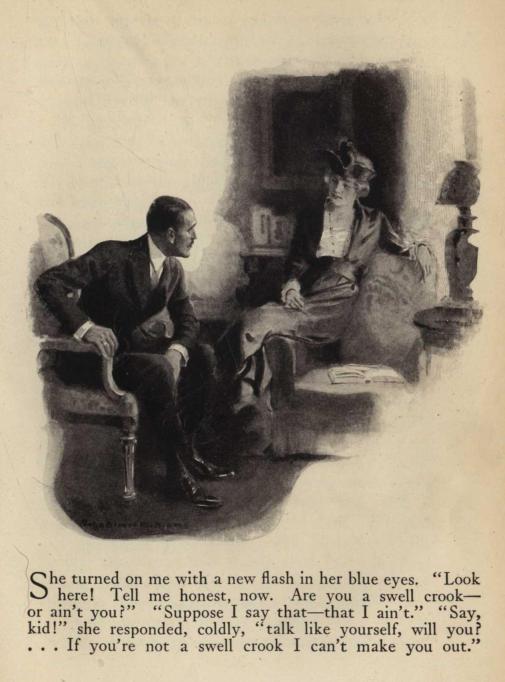
She turned on me with a new flash in her blue eyes. "Look here! Tell me honest, now. Are you a swell crook—or ain't you?" "Suppose I say that—that I ain't." "Say, kid!" she responded, coldly, "talk like yourself, will you? ... If you're not a swell crook I can't make you out.
"Suppose I say that—that I ain't."
"Say, kid!" she responded, coldly, "talk like yourself, will you?" She threw her hands apart, palms outward. "Well, if you're not a swell crook I can't make you out."
"But as a swell crook you could. Is that it?"
"Why do you keep hanging round Miss Averill?" she asked, bluntly. "What do you expect to get by that?"
"What do you expect to get by asking me?"
Her reply was a kind of challenge. "The truth. Do you know it?"
I felt uncomfortable. It was one of the rare occasions on which I had seen this flower-like face drop its bantering mask and grow serious. The voix de Montmartre had deepened in tone and put me on the defensive.
"I thought you told me on board ship that you looked on all people of Miss Averill's class as the prey of those in—in ours."
"I don't care what I told you on board ship. You're to keep where you belong as far as she's concerned—or I'll give the whole bloomin' show away, as they say in English vawdville."
"There again; it's what you said you wouldn't do. You said you'd be my friend—"
"I'll be your friend right up to there—but that's the high-water mark."
I thought it permissible to change my front. "If it comes to that, I've done no hanging round Miss Averill on my own account. It's you who've come for me to the Hotel Barcelona every time—"
"Harry made me do that; but even so—well, you don't have to fall in the water just because you're standing on a wharf."
"It doesn't hurt the water if you do. You can get soaked, and make yourself look ridiculous, but the beautiful blue sea doesn't mind."
"You can make it splash something awful, and send ripples all over the lot. Don't you be too sure of not being dangerous. You wouldn't be everybody's choice—but you have that romantic way—like a prince-guy off the level—and she not used to men—or having a lot of them around her all the time, like—"
"Like you."
"Like me," she accepted, composedly; "and so if I see anything that's not on the square I'll—I'll hand out the right dope about you without the least pity."
"And when you hand out the right dope about me what will it be?"
"You poor old kid, what do you think it will be? If you make people think you're a swell crook it's almost the same as being one."
"But do I make people think I'm a swell crook?"
"You make me."
"What do I do to—"
"It's not what you do, it's what you don't do—or what you don't say. Why don't you tell people who you are, or what your business is, or where you come from? Everybody can hitch on to something in a world, but you don't seem to belong anywhere. If any one asks you a question it's always No! No! No! till you can tell what your answer will be beforehand. Surely there's a Yes somewhere in your life! If you always hide it you can't blame people for thinking there's something to be hidden."
"And yet you'd be my friend."
"Oh, I've been friends to worse than that. I wasn't born yesterday—not by a lot. All I say is, 'Hands off little old Milly Averill!' but for the rest you can squeak along in your own way. I'm a good sort. I don't interfere with any one."
Drinkwater being on the threshold and the conversation having yielded me all I hoped to get, I made an excuse for going. Miss Averill had not appeared, and now I was glad of it. Had she come I could not have met her under Lydia's cold eye without self-consciousness. It began to strike me, too, that the best thing I could do was to step out from the circle of all their lives and leave no clue behind me.
CHAPTER XII
It was not a new reflection, as you know; and of late it had been growing more insistent. The truth is that I needed to find work. My nearly one hundred dollars was melting away with unbelievable rapidity. Expenses being reduced to a rule of thumb, I could count the days after which I shouldn't have a cent. Winter was coming. Already there were mornings with the nip of frost in them. I should require boots, clothes, warm things of all sorts. Food and shelter I couldn't do without.
It was the incredible, the impossible. Nebuchadnezzar driven from men and eating grass like an ox couldn't have been more surprised to see himself in such a state of want. Somewhere, out of the memories that had not disappeared, I drew the recollection that to need boots and not be able to afford them had been my summary of an almost inhuman degree of poverty. I could remember trying to picture what it would be like to find myself in such a situation and not being able to do so. I had bought a new pair since coming to New York, and they were already wearing thin.
It came to me again—it came to me constantly, of course—that I could save myself by going to some sympathetic person and telling him my tale. I rejected now the idea of making Boyd Averill my confidant; but there were other possibilities. There were doctors, clergymen, policemen. As a matter of fact, people who suffered from amnesia, and who didn't know their names, generally applied to the police.
In the end I opted for a clergyman as being the most human of these agencies. Vaguely I was aware that vaguely I belonged to a certain church. I had tested myself along the line of religion as well as along other lines, with the discovery that the services of one church were familiar, while those of others were not.
From the press I learned that the Rev. Dr. Scattlethwaite, the head of a large and wealthy congregation, was perhaps the best known exponent in New York of modern scientific beneficence, and by attendance at one of his services I got the information that at fixed hours of every day he was in his office at his parish house for the purpose of meeting those in trouble. It was a simple matter, therefore, to present myself, and be met on the threshold of his waiting-room by the young lady who acted as his secretary.
She was a portly young lady, light on her feet, quick in her movements, dressed in black, with blond fluffy hair, and a great big welcoming smile. The reception was much the same as in any doctor's office, and I think she diagnosed my complaint as the drug habit. Asking me to take a seat she assured me that Doctor Scattlethwaite would see me as soon as he was disengaged. When she had returned to her desk, where she seemed to make endless notes, I had leisure to look about me.
Except for a large white wooden cross between two doors, it might have been a waiting-room in a hospital. Something in the atmosphere suggested people meeting agonies—or perhaps it was something in myself. As far as that went, there were no particular agonies in the long table strewn with illustrated papers and magazines, nor in the bookrack containing eight or ten well-thumbed novels. Neither were agonies suggested by the Arundel print of the Resurrection on one bit of wall-space, nor by the large framed photograph of the Arch of Constantine on another. All the same there was that in the air which told one that no human being in the world would ever come into this room otherwise than against his will.
And yet in that I may be wrong, considering how many people there are who enjoy the luxury of sorrow. I guessed, for example, that the well-dressed woman in mourning who sat diagonally opposite me was carrying her grief to every pastor in New York and refusing to be comforted by any. Another woman in mourning, rusty and cheap in her case, flanked by two vacant-eyed children, had evidently come to collect a portion of the huge financial bill she was able to present against fate. An extremely thin lady, with eyes preternaturally wide open, was perhaps a sufferer from insomnia, while the little old man with broken boots and a long red nose was plainly an ordinary "bum." These were my companions except that a beaming lady of fifty or so, dressed partly like a Salvation Army lassie and partly like a nun, and whom I took to be Doctor Scattlethwaite's deaconess en litre, bustled in and out for conferences with the fluffy-haired girl at the desk.
I beguiled the waiting, which was long and tedious, by co-ordinating my tale so as to get the main points into salience. It was about ten in the morning when I arrived, and around half past ten the lady who had first claim on Doctor Scattlethwaite came out from her audience. She was young and might have been pretty if she hadn't been so hollow-eyed and walked with her handkerchief pressed closely to her lips. I put her down as a case of nervous prostration.
The lady with the inconsolable sorrow was next summoned by the secretary, and so one after another those who had preceded me went in to take their turns. Mine came after the old "bum," when it was nearly twelve o'clock.
The room was a kind of library. I retain an impression of books lining the walls, a leather-covered lounge, one or two leather-covered easy-chairs, and a large flat-topped desk in the center of the floor-space. Behind the desk stood a short, square-shouldered man in a dark-gray clerical attire, with a squarish, benevolent, clean-shaven face, and sharp, small eyes which studied me as I crossed the floor. His aspect and attitude were business-like, and business-like was his manner of shaking hands as he asked me to sit down. An upright arm-chair stood at the corner of the desk, and as I took it he resumed his seat in his own revolving-chair which he tilted slightly backward. With his elbows on the arms and fitting the tips of his fingers together, he waited for me to state my errand, eying me all the while.
Relieved and yet slightly disconcerted by this non-committal bearing, I stumbled through my story less coherently than I had meant to tell it. Badly narrated, it was preposterous, especially as coming from a man in seemingly full possession of his faculties. All that enabled me to continue was that my hearer listened attentively, with no outward appearance of disbelieving me.
"And you've come to me for advice as to the wise thing for you to do," he said, not unsympathetically, when I had brought my lame story to a close.
"That's about it," I agreed, though conscious of a regret at having come at all.
"Then the first thing I should suggest," he continued, never taking his penetrating eyes from my face, "is that you should see a doctor—a specialist—a neurologist. I'll give you a line to Doctor Glegg—"
"What would he do?" I ventured to question.
"That would depend on whether or not you could pay for treatment. I presume, from what you've said of your funds giving out, that you couldn't."
"No, I couldn't," I assented, reddening.
"Then he'd probably put you for observation into the free psychopathic ward at Mount Olivet—"
"Is that an insane-asylum?"
"We don't have insane-asylums nowadays; but in any case it isn't what you mean. It's a sanitarium for brain diseases—"
"I shouldn't want to go to a place like that."
"Then what would you suggest doing?"
"I thought—" But I was not sure as to what I had thought. Hazily I had imagined some Christian detective agency hunting up my family, restoring my name, and giving me back my check-book. It was probably on the last detail that unconsciously to myself I was laying the most emphasis. "I thought," I stammered, after a slight pause, "that—that you might be inclined to—to help me."
"With money?"
The question was so direct as to take me by surprise.
"I didn't know exactly how—"
"An average of about fifteen people come to see me every day," he said, in his calm, business-like voice, "and of the fifteen about five are men. And of the five men an average of four come, with one plausible tale or other, to get money out of me under false pretenses."
I shot out of my seat. The anger choking me was hardly allayed by the raising of his hand and his suave, "Sit down again." He went on quietly, as I sank back into my chair: "I only want you to see that with all men who come telling me strange tales my first impulse must be suspicion."
Indignation almost strangled me. "And—and—am I to understand that—that it's suspicion—now?"
"So long as money is a factor in the case it must be—till everything is explained."
"But everything is explained."
"To your satisfaction—possibly; but hardly to mine."
"Then what explanation would be satisfactory to you?"
"Oh, any of two or three. Since you decline to put yourself under Doctor Glegg, you might be able to offer some corroboration.
"But I can't. I've kept my secret so closely that no one has heard it but myself. The few people I know would be as incredulous as you are."
"I don't say that I'm incredulous; I'm only on my guard. Don't you see? I have to be."
"But surely when a man is speaking the truth his manner must carry some conviction."
"I wish I could think so; but I've believed so many false yarns on the strength of a man's manner, and disbelieved so many true ones on the same evidence, that I no longer trust my own judgment. But please don't be annoyed. If your mental condition is such as you describe, I'm proposing the most scientific treatment you can get in New York. In addition to that, I know that Doctor Glegg has had a number of such cases and has cured them."
"You know that?"
"Perhaps I ought to say that they've been cured while under his care. I think I've heard him say that as a matter of fact they've cured themselves. Without knowing much of the malady, I rather think it's one of those in which time restores the ruptured tissues, with the aid of mental rest."
"If that's all—"
"Oh, I don't say that it's all; but as far as I understand it's a large part of it. But then I don't understand very much. That's why I'm suggesting—"
"I could get mental rest of my own accord if—"
"Yes? If—what?"
"If I could find out who—who I am."
"And you've no clues at all?"
I shook my head.
"Have you heard no names that were familiar to you—?"
"Scores of them; but none with which I could connect myself."
"And did you think I could find out for you what you yourself have not been able to discover?"
"I didn't know but what you might have means."
"What means could I have? As far as I've ever heard, the only way of tracing a lost man is through the police—with detectives—and publicity—descriptions in the papers—photographs thrown on screens—that sort of thing. I don't think there's any other way."
I took perhaps two minutes, perhaps three, to ponder these possibilities. In the end they seemed to magnify my misfortune.
"Then, sir, that's all you can do for me?"
"Remember that I should be doing a great deal if I got you to put yourself under Doctor Glegg."
"In the free psychopathic ward of a sanitarium for diseases of the brain—to be watched."
"To be under observation. There's a difference."
"All the observation in the world wouldn't tell Doctor Glegg more than I'm telling you now."
"Oh yes, it would. It would tell him—it would tell me—you must excuse me, you know—but the situation obliges me to speak frankly—it would tell him—it would tell me—whether or not your story is a true one."
"So you don't believe me?"
"How can I believe you on the strength of this one interview?"
"But how could I convince you in a dozen interviews?"
"You couldn't. Nothing would convince me but something in the way of outside proof—or Doctor Glegg's report."
I rose, not as I did before, but slowly, and I hoped with dignity.
"Then I see no reason, sir, for taking your time any longer—"
He too rose, business-like, imperturbable.
"My dear young man, I must leave that to you. My time is entirely at your disposal and all my good-will."
"Thanks."
"And I'll go as far as to say this, that I think the probabilities are in your favor. I will even add that if I hadn't thought so in a hundred other cases, in which men whom I pitied—trusted—and aided—were making me a dupe— You see, I've been at this thing a good many years—"
Managing somehow to bow myself out, I got into the air again. I attributed my wrath to the circumstances of not being taken at my word; but the real pang lay in the thought of being watched, as a type of mild lunatic and a pauper.
PART II
CHAPTER I
I had made this experiment as a concession to what you will consider common sense. Ever since landing in New York the idea that the natural thing to do was to make my situation known had haunted me. Well, I had made it known, much against the grain, with results such as I had partly expected. I had laid myself open to the semi-accusation of trumping up a cock-and-bull story to get money under false pretenses.
So no one could help me but myself! I had felt that from the first, and now I was confirmed in the conviction. It was useless either to complain or to rebel. Certain things were to be done, and no choice remained with me but to do them in the heartiest way possible. I had the wit to see that the heartier the way the more likely I was to attain to the mental rest which was apparently a condition of my recovery.
From this point of view work became even more pressing than before, and I searched myself for things that I could do.
Of all my experiences this was the most baffling. In the same way that I knew I had enjoyed a generous income I knew I had never been an idler. That is, I knew it by the habit of a habit. I had the habit of a habit of occupation. I got up each morning with a sense of things to do. Finding nothing to be done, I felt thwarted, irritated, uneasy in the conscience. I must always have worked, even if pay had not been a matter of importance.
But what had I worked at? I had not been a doctor, nor a lawyer, nor a clergyman, nor a banker, nor a merchant, nor a manufacturer, nor a teacher, nor a journalist, nor a writer, nor a painter, nor an actor, nor a sculptor, nor a civil engineer. All this was easy to test by the things I didn't know and couldn't do. I could ride and drive and run a motor-car. I had played tennis and golf and taken an interest in yachting and aviation. I could not say that I had played polo, but I had looked on at matches, and had also frequented horse-races. These facts came to me not so much as memories, but as part of a general equipment. But I could find no sense of a profession.
Thrown back on the occupations I can only class as nondescript, I began looking for a job. That is, I began to study the advertised lists of "Wants" in the hope of finding some one in search of the special line of aptitude implied by cultivation. I had some knowledge of books, of pictures, of tapestries, of prints. Music was as familiar to me as to most people who have sat through a great many concerts, and I had followed such experiments as those of the Abbey Theater in Dublin and Miss Horniman's Manchester Players in connection with the stage.
Unfortunately, there was no clamor for these accomplishments in the press of New York and the neighboring cities, the end of a week's study finding me just where I began. For chauffeurs and salesmen there were chances; but for people of my order of attainment there were none. I thought of what Mildred Averill had said during our last conversation:
"After all, what the world wants is producers; and the moment one doesn't produce—"
She left her sentence there because all had been said. The world wanted producers and was ready to give them work. It would also give them pay, after a fashion. One producer might get much and another little, but every one would get something. The secret of getting most evidently lay in producing the thing most required.
I remembered, too, that Mildred Averill had defined the producer as he seemed to her: I suppose I mean all who contribute, either directly or indirectly, either mentally or physically, to the sum total of our needs in living.
There again, the more vital the need, the greater the contribution, and needs when you analyzed them were mostly elementary. The more elemental you were, the closer you lived to the stratum the world couldn't do without. That stratum was basic; it was bedrock. Wherever you went you had to walk on it, and not on mountain-peaks or in the air.
I was not pleased with these deductions. It seemed to me a gross thing in life that salesmen and chauffeurs should be more in demand than men who could tell you at a glance the difference between a Henri Deux and a Jacobean piece of furniture, or explain the weaves and designs of a Flemish tapestry as distinguished from a Gobelin or an Aubusson. I was eager to prove my qualifications for a place in life to be not without value. To have nothing to do was bad enough, but to be unfit to do anything was to be in a state of imbecility.