ILLUSTRATIONS by ODILON REDON (continued 4)
Lafcadio Hearn translation
(The Martichoras shoots forth the keen bristles of his tail, which irradiate in all directions like a volley of arrows. Drops of blood rain down, spattering upon the foliage.)
The Catoblepas
(A black buffalo with a pig's head, falling to the ground, and attached to his shoulders by a neck long, thin, and flaccid as an empty gut.
He wallows flat upon the ground, and his feet entirely disappear beneath the enormous mane of coarse hair which covers his face):
"Fat, melancholy, fierce—thus I continually remain, feeling against my belly the warmth of the mud. So heavy is my skull that it is impossible for me to lift it. I roll it slowly all around me, open-mouthed; and with my tongue I tear up the venemous plants bedewed with my breath. Once, I even devoured my own feet without knowing it!
"No one, Anthony, has ever beheld mine eyes,—or at least, those who have beheld them are dead. Were I to lift my eyelids—my pink and swollen eyelids, thou wouldst forthwith die!"
Anthony. "Oh, that one! Ugh! As though I could desire it?—Yet his stupidity fascinates me! No, no! I will not!"
(He gazes fixedly upon the ground.
But the weeds take fire; and amidst the contorsions of the flames, arises)—
The Basilisk
(A great violet serpent, with trilobate crest, and two fangs, one above, one below):
"Beware, lest thou fall into my jaws! I drink fire. I am fire!—and I inhale it from all things: from clouds, from flints, from dead trees, the fur of animals, the surface of marshes. My temperature maintains the volcanoes: I lend glitter to jewels: I give colours to metals!"
The Griffin
(A lion with a vulture's beak, and white wings, red paws and blue neck):
"I am the master of deep splendours. I know the secrets of the tombs wherein the Kings of old do slumber.
"A chain, issuing from the wall, maintains their heads upright. Near them, in basins of porphyry, the women they loved float upon the surfaces of black liquids. Their treasures are all arrayed in halls, in lozenge-shaped designs, in little heaps, in pyramids;—and down below, far below the tombs, and to be reached only after long travelling through stifling darkness, there are rivers of gold bordered by forests of diamonds, there are fields of carbuncles and lakes of mercury.
"Addossed against the subterranean gate I remain with claws uplifted; and my flaming eyes spy out those who seek to approach. The vast and naked plain that stretches away to the end of the horizon is whitened with the bones of travellers. But for thee the gates of bronze shall open; and thou shalt inhale the vapour of the mines, thou shalt descend into the caverns.... Quick! quick!"
(He burrows into the earth with his paws, and crows like a cock.
A thousand voices answer him. The forest trembles.
And all manner of frightful creatures arise:—The Tragelaphus, half deer, half ox; the Myrmecoles, lion before-and ant behind, whose genitals are set reversely; the python Askar, sixty cubits long, that terrified Moses; the huge weasel Pastinaca, that kills the trees with her odour; the Presteros, that makes those who touch it imbecile; the Mirag, a horned hare, that dwells in the islands of the sea. The leopard Phalmant bursts his belly by roaring; the triple-headed bear Senad tears her young by licking them with her tongue; the dog Cepus pours out the blue milk of her teats upon the rocks. Mosquitoes begin to hum, toads commence to leap; serpents hiss. Lightnings flicker. Hail falls.
Then come gusts, bearing with them marvellous anatomies:—Heads of alligators with hoofs of deer; owls with serpent tails; swine with tiger-muzzles; goats with the crupper of an ass; frogs hairy as bears; chameleons huge as hippopotami; calves with two heads, one bellowing, the other weeping; winged bellies flitting hither and thither like gnats.
They rain from the sky, they rise from the earth, they pour from the rocks; everywhere eyes flame, mouths roar, breasts bulge, claws are extended, teeth gnash, flesh clacks against flesh. Some crouch; some devour each other at a mouthful.
Suffocating under their own numbers, multiplying by their own contact, they climb over one another; and move about Anthony with a surging motion as though the ground were the deck of a ship. He feels the trail of snails upon the calves of his legs, the chilliness of vipers upon his hands:—and spiders spinning about him enclose him within their network.
But the monstrous circle breaks, parts; the sky suddenly becomes blue; and)—
The Unicorn (appears):
"Gallop! Gallop!
"I have hoofs of ivory, teeth of steel; my head is the colour of purple, my body the colour of snow; and the horn of my forehead is bestreaked with the tints of the rainbow.
"I travel from Chaldea to the Tartar desert,—upon the shores of the Ganges and in Mesopotamia. I overtake the ostriches. I run so swiftly that I draw the wind after me. I rub my back against the palm-trees. I roll among the bamboos. I leap rivers with a single bound. Doves fly above me. Only a virgin can bridle me.
"Gallop! Gallop!"
(Anthony watches him depart.
And as he gazes he beholds all the birds that nourish themselves with wind: the Gouith, the Ahuti, the Alphalim, the Iukneth, of the mountains of Kaf, the homai of the Arabs—which are the souls of murdered men. He hears the parrots that utter human speech; and the great Pelasgian palmipeds that sob like children or chuckle like old women.
A saline air strikes his nostrils. Now a vast beach stretches before him.
In the distance jets of water arise, spouted by whales; and from the very end of the horizon come)—
The Beasts of the Sea
(round as wineskins, flat as blades, denticulated like saws, dragging themselves over the sand as they approach):
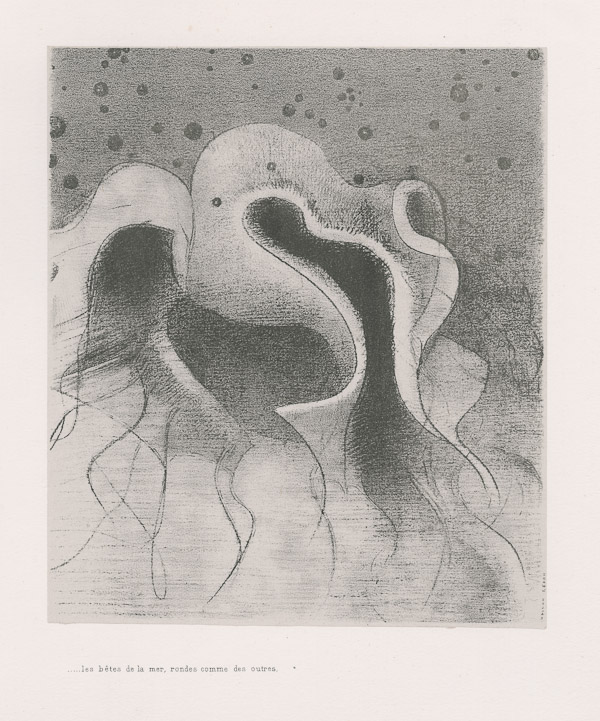
The beasts of the sea round as wineskins
"Thou wilt accompany us to our immensities, whither as yet no one has descended.
"Divers peoples inhabit the countries of the Ocean. Some dwell in the sojourn of tempests; others swim freely amid the transparency of chill waves;—or, like oxen, graze upon the coral plains, or suck in through their trunks the reflux of the tides,—or bear upon their shoulders the vast weight of the sources of the sea."
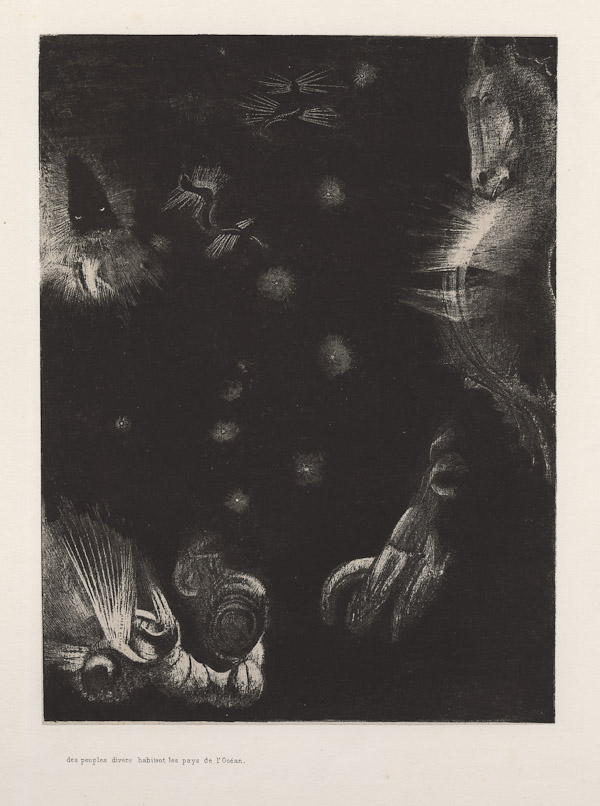
Divers peoples inhabit the countries of the Ocean
(Phosphorences gleam in the moustaches of the seals, shift in the scales of fish. Echini whirl like wheels; ammonites uncoil like cables; oysters make their shell hinges squeak; polypi unfold their tentacles; medusæ quiver like balls of crystal suspended; sponges float hither and thither, anemones ejaculate water; wrack and sea-mosses have grown all about.
And all sorts of plants extend themselves into branches, twist themselves into screws, lengthen into points, round themselves out like fans. Gourds take the appearance of breasts; lianas interlace like serpents.
The Dedaims of Babylon, which are trees, bear human heads for fruit; Mandragoras sing;—the root Baaras runs through the grass.
And now the vegetables are no longer distinguishable from the animals. Polyparies that seem like trees, have arms upon their branches. Anthony thinks he sees a caterpillar between two leaves: it is a butterfly that takes flight. He is about to step on a pebble: a grey locust leaps away. One shrub is bedecked with insects that look like petals of roses; fragments of ephemerides form a snowy layer upon the soil.
And then the plants become confounded with the stones.
Flints assume the likeness of brains; stalactites of breasts; the flower of iron resembles a figured tapestry.[2]
He sees efflorescences in fragments of ice, imprints of shrubs and shells—yet so that one cannot detect whether they be imprints only, or the things themselves. Diamonds gleam like eyes; metals palpitate.
And all fear has departed from him! He throws himself down upon the ground, and leaning upon his elbows, watches breathlessly.
Insects that have no stomachs persistently eat; withered ferns bloom again and reflower; absent members grow again.
At last he perceives tiny globular masses, no larger than pinheads, with cilia all round them. They are agitated with a vibratile motion):
Anthony (deliriously):
"O joy! O bliss! I have beheld the birth of life! I have seen the beginning of motion! My pulses throb even to the point of bursting! I long to fly, to swim, to bark, to bellow, to howl! Would that I had wings, a carapace, a shell,—that I could breathe out smoke, wield a trunk,—make my body writhe,—divide myself everywhere,—be in everything,—emanate with odours,—develop myself like the plants,—flow like water,—vibrate like sound—shine like light, squatting upon all forms—penetrate each atom—descend to the very bottom of matter,—be matter itself!"
(Day at last appears;—and, like tabernacle curtains uplifted, clouds of gold uprolling in broad volutes unveil the sky.
Even in the midst thereof, and in the very disk of the sun, beams the face of Jesus Christ.
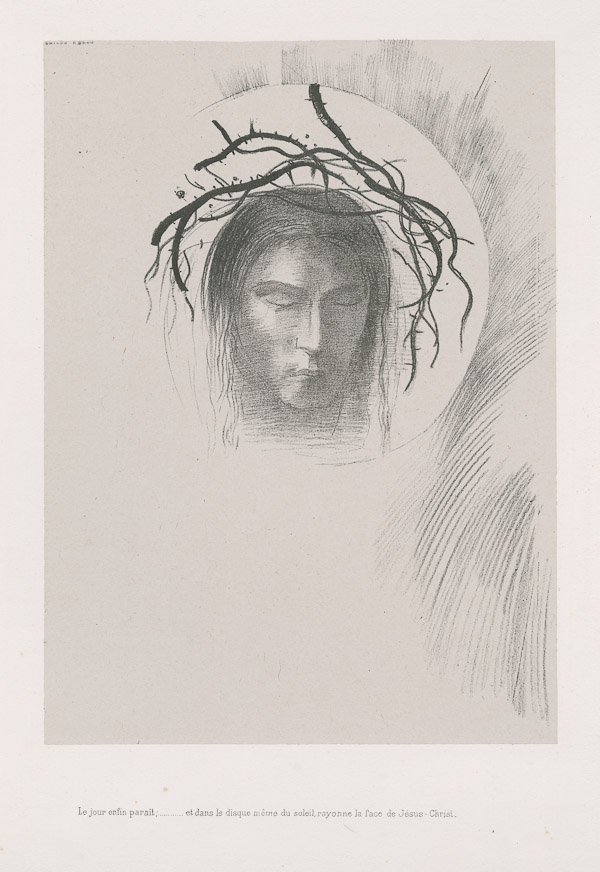
Day at last appears ... in the midst thereof and in the very disk of the sun, beams the face of Jesus Christ.
Anthony makes the sign of the cross, and resumes his devotions.)
FINIS
[NOTE
Those who compare this translation with the original will observe the omission of some few paragraphs on pages 77, 96 and 211. They are speeches put in the mouths of certain Heresiarchs, or complaints of certain of the minor Roman household gods. The translator relegated these to an addenda, which the publishers have omitted as being unnecessary. Those who are familiar with the original will be able to supply them, and will realize that while they might be offensive to some persons, they are in no respect an integral or important part of the great drama.]
(added by transcribers)
ADDENDA
A. Observation of Manes, pages 82-3, original text; page 89 of translation.
Manes
Ou plutôt, faites si bien qu'elle ne soit pas fécondes. Mieux vaut pour l'ame tomber sur la terre que de languir dans des entraves charnelles.
Probably a calumny against Manes; for the Eastern philosophy, especially that of Zoroaster, which is said to have inspired the tenets of Manichæism, advocated no such abominations.
B. Page 105 of original; page 108 translation. The realistic phraseology of the original passage is rather brutal. The French text reads: "Il souffrait de la maladie Bellerephontienne; et sa mère, la parfumeuse, s'est livrée à Pantherus, un soldat Romain, sur des gerbes de mais, un soir de moisson." C. Descriptive text, page 237 original, partly suppressed on page 223 translation: "Et il lui montre dans un bosquet d'aliziers Une Femme toute nue, à quatre pattes comme une bête, et saillie par un homme noir, tenant dans chaque main un flambeau."
D. Curious text of Crepitus, on page 228, pages 241-3 of original:
Crepitus
(——se fait entendre):
Moi aussi l'on m'honora jadis. On me faisait des libations. Je fus un Dieu!
L'Athénien me saluait comme un presage de fortune, tandis que le Romain dévot me maudissait les poings levés et que le pontife d'Egypte, s'abstinant des fèves, tremblait à ma voix et pâlissait à mon odeur.
Quand le vinaigre militaire coulait sur les barbes non rasées, qu'on se régalait de glands, de pois, et d'oignons crus, et que le bouc en morceau cuissait dans le beurre rance des pasteurs, sans souci du voisin, personne alors ne se gênait. Les nourritures solides faisaient digestions retentissantes. Au soleil de la campagne les hommes se soulageaient avec lenteur.
Ainsi, je passais sans scandale, comme les autres besoins de la vie, comme Mena, tourment des vierges, et la douce Rumina qui protège le sein de la nourrice, gonflé, des veines bleuâtres. J'étais joyeux. Je faisais rire. Et se dilatant d'aise à cause de moi, le convive exhalait toute sa gaieté par les ouvertures de son corps.
J'ai eu mes jours d'orgeuil. Le bon Aristophane me promena sur la scène, et l'empereur Claudius Drusus[1] me fit asseoir à sa table. Dans les laticlaves des patriciens j'ai circulé majestueusement! Les vases d'or, comme des tympanons, resonnaient sous moi; et, quand plein de murènes, de truffles, et de pâtés, l'intestin du maître se dégageait avec fracas, l'univers attentif apprenait que César avait diné!
Mais à présent, je suis confiné dans la populace[2] et l'on se récrie, même à mon nom!
Et Crepitus s'éloigne, en poussant un gémissement....
E. For descriptions of the Martichoras and other monsters, appearing page 287 in the original and 253 in the translation, see also Rabelais' Pantagruel, Book V, Chap. XXX.
CONTENTS INTRODUCTION ARGUMENT THE TEMPTATION OF ST. ANTHONY I II III IV V VI VII NOTE ADDENDA
LIST OF ILLUSTRATIONS
(by Odilon Redon, which were added especially for this PG e-book.)
... through the long hair half hiding her face, I thought that I could recognize Ammonaria ... 6
Saint Anthony: Help me, O my God! 16
And there are columns of basalt everywhere,... The light falls from the vaults above 38
there is a sweetness in my kisses as of a fruit dissolving within thy heart ... 58
... a long blood-colored chrysalis 100
... the flowers fall and the head of a python appears 105
... and in the darkness beside him people are praying... 107
... and he beholds an arid plain, mamillated with knolls 113
She drags a black sponge from her bosom, covers it with kisses ... 115
I have buried myself in solitude, like the rhinoceros. I dwelt in the tree behind me 119
Helena - Ennoia 125
... instantly arise three goddesses 157
Intelligence became mine! I became the Buddha. 165
... and eyes without heads were floating like mollusks 167
I, the first consciousness of Chaos, arose from the abyss that I might harden matter, and give a law unto forms 168
Here is the Good Goddess, the Idæan of the mountains 178
I am still the Great Isis!—none has yet lifted my veil! My fruit is the Sun! 188
... he falls head foremost into the abyss 206
Anthony: What is the purpose of all that? The Devil: There is no purpose. 224
The Old Woman: Of what art thou afraid?—a wide, black hole! Perhaps it is a void! 235
Death: Mine irony depasseth all others! 240
Death: It is I that make thee awful! Let us intertwine! 241
Anthony: Somewhere there must be primordial figures, whose bodily forms are only symbols 242
I myself have sometime beheld in the sky, as it were, forms of spirits 242
The Sphinx: ... and yet my gaze, which naught can deviate, remains fixed, gazing through all intervening things, upon a horizon that none may reach. The Chimera: I am light and joyous! 245
The Sciapods: The head as low as possible—That is the secret of happiness. 249
The beasts of the sea round as wineskins 258
Divers peoples inhabit the countries of the Ocean 258
Day at last appears ... in the midst thereof and in the very disk of the sun, beams the face of Jesus Christ. 260