ILLUSTRATIONS by ODILON REDON (continued 2)
Lafcadio Hearn translation
Anthony. "And those white hairs?"
Hilarion. "I have endured many woes!"
Anthony (aside). "Could it be possible?"
Hilarion. "I was not so far from thee as thou doest imagine. The hermit Paul visited thee this year, during the month of Schebar. It is just twenty days since the Nomads brought thee bread. Thou didst tell a sailor, the day before yesterday, to send thee three bodkins."
Anthony. "He knows all!"
Hilarion. "Know further more that I have never left thee. But there are long periods during which thou hast no knowledge of my presence."
Anthony. "How can that be? Yet it is true that my head is so much troubled—this night especially."
Hilarion. "All the Capital Sins came hither. But their wretched snares can avail nothing against such a Saint as thou."
Anthony. "Oh! no!—no! I fall at every moment! Why am I not of those whose souls are ever intrepid, whose minds are always firm,—for example, the great Athanasius?"
Hilarion. "He was illegally ordained by seven bishops."
Anthony. "What matter if his virtue...."
Hilarion. "Go to!—a most vainglorious and cruel man, forever involved in intrigues, and exiled at last as a monopolist."[1]
Anthony. "Calumny!"
Hilarion. "Thou wilt not deny that he sought to corrupt Eustates, the treasurer of largesses?"
Anthony. "It is affirmed, I acknowledge."
Hilarion. "Through vengeance he burned down the house of Arsenius."
Anthony. "Alas!"
Hilarion. "At the council of Nicæa he said in speaking of Jesus: 'The man of the Lord.'"
Anthony. "Ah! that is a blasphemy!"
Hilarion. "So limited in understanding, moreover, that he confesses he comprehends nothing of the nature of the "Word!"
Anthony (smiling with gratification). "In sooth his intelligence is not ... very lofty."
Hilarion. "Hypocrite! burying thyself in solitude only in order the more fully to abandon thyself to the indulgence of thy envious desires! What if thou dost deprive thyself of meats, of wine, of warmth, of bath, of slaves, or honours?—dost thou not permit thy imagination to offer thee banquets, perfumes, women, and the applause of multitudes? Thy chastity is but a more subtle form of corruption, and thy contempt of this world is but the impotence of thy hatred against it! Either this it is that makes such as thyself so lugubrious, or else 'tis doubt. The possession of truth giveth joy. Was Jesus sad? Did he not travel in the company of friends, repose beneath the shade of olive trees, enter the house of the publican, drink many cups of wine, pardon the sinning woman, and assuage all sorrows? Thou!—thou hast no pity save for thine own misery! It is like a remorse that gnaws thee, a savage madness that impels thee to repel the caress of a dog or to frown upon the smile of a child."
Anthony (bursting into tears). "Enough! enough! thou dost wound my heart deeply."
Hilarion. "Shake the vermin from thy rags! Rise up from thy filth! Thy God is not a Moloch who demands human flesh in sacrifice!"
Anthony. "Yet suffering is blessed. The cherubim stoop to receive the blood of confessors."
Hilarion. "Admire, then, the Montanists!—they surpass all others."
Anthony. "But it is the truth of the doctrine which makes the martyrdom."
Hilarion. "How can martyrdom prove the excellence of the doctrine, inasmuch as it bears equal witness for error?"
Hilarion. "Silence!—thou viper!"
Anthony. "Perhaps martyrdom is not so difficult as thou dost imagine! The exhortations of friends, the pleasure of insulting the people, the oath one has taken, a certain dizzy excitement, a thousand circumstances all aid the resolution of the martyrs...."
(Anthony turns his back upon Hilarion, and moves away from him. Hilarion follows him.)
" ... Moreover this manner of dying often brings about great disorders. Dionysius, Cyprian and Gregory fled from it. Peter of Alexandria has condemned it; and the council of Elvira...."
Anthony (stops his ears). "I will listen to thee no longer!"
Hilarion (raising his voice). "Lo! thou fallest again into the habitual sin, which is sloth! Ignorance is the foam of pride. One says, forsoth:—'My conviction is formed! wherefore argue further?'—and one despises the doctors, the philosophers, tradition itself, and even the text of the law whereof one is ignorant! Dost thou imagine that thou dost hold all wisdom in the hollow of thy hand?"
Anthony. "I hear him still! His loud words fill my brain."
Hilarion. "The efforts of others to comprehend God are mightier than all thy mortifications to move Him. We obtain merit only by our thirst for truth. Religion alone cannot explain all things; and the solution of problems ignored by thee can render faith still more invulnerable and noble. Therefore, for our salvation we must communicate with our brethren—otherwise the Church, the assembly of the faithful, would be a meaningless word—and we must listen to all reasoning, despising nothing, nor any person. The magician Balaam, the poet Aeschylus, and the Sybil of Cumæ—all foretold the Saviour. Dionysius, the Alexandrian, received from heaven the command to read all books. Saint Clement orders us to cultivate Greek letters. Hennas was converted by the illusion of a woman he had loved...."
Anthony. "What an aspect of authority! It seems to me thou art growing taller...."
(And, in very truth, the stature of Hilarion is gradually increasing; and Anthony shuts his eyes, that he may not see him.)
Hilarion. "Reassure thyself, good Hermit. Let us seat ourselves there, upon that great stone, as we used to do in other years, when, at the first dawn of day, I was wont to salute thee with the appellation, 'Clear star of morning'—and thou wouldst therewith commence to instruct me. Yet my instruction is not yet completed. The moon gives us light enough. I am prepared to hear thy words."
(He has drawn a calamus from his girdle, and seating himself cross-legged upon the ground, with the papyrus roll still in his hand, he lifts his face toward Saint Anthony, who sits near him, with head bowed down.
After a moment of silence Hilarion continues:—)
"Is not the word of God confirmed for us by miracles? Nevertheless the magicians of Pharaoh performed miracles; other imposters can perform them; one may be thereby deceived. What then is a miracle? An event which seems to us outside of nature. But do we indeed know all of Nature's powers; and because a common occurrence causes us no astonishment, does it therefore follow that we understand it."
Anthony. "It matters little! We must believe the Scriptures!"
Hilarion. "Saint Paul, Origen, and many others did not understand the Scriptures in a literal sense: yet if Holy Writ be explained by allegories it becomes the portion of a small number, and the evidence of the truth disappears. What must we do?"
Anthony. "We must rely upon the Church!"
Hilarion. "Then the Scriptures are useless?"
Anthony. "No! no! although I acknowledge that in the Old Testament there are some ... some obscurities. But the New shines with purest light."
Hilarion. "Nevertheless, the Angel of the annunciation, in Matthew, appears to Joseph; while, in Luke, he appears to Mary. The anointing of Jesus by a woman takes place, according to the first Gospel, at the commencement of his public life; and, according to the other three, a few days before his death. The drink offered to him on the cross, is, in Matthew, vinegar mixed with gall; in Mark, it is wine and myrrh. According to Luke and Matthew, the apostles should take with them neither money nor scrip for their journey—not even sandals nor staff; in Mark, on the contrary, Jesus bids them take nothing with them, except sandals and a staff. I am thereby bewildered!"
Anthony (in amazement). "Aye, indeed!... in fact...."
Hilarion. "At the contact of the woman who had an issue of blood, Jesus turned and said, 'Who hath touched my garments?' He did not know, then, who had touched him? That contradicts the omniscience of Jesus! If the tomb was watched by guards, the women need have felt no anxiety about finding help to roll away the stone from the tomb. Therefore there were no guards, or the holy women were not there. At Emmaus, he eats with his disciples and makes them feel his wounds. It is a human body, a material and ponderable object; and nevertheless it passes through walls! Is that possible?"
Anthony. "It would require much time to answer thee properly!"
Hilarion. "Why did he receive the Holy Spirit, being himself Son of the Holy Spirit? What need had he of baptism if he was the Word? How could the Devil have tempted him, inasmuch as he was God? Have these thoughts never occurred to thee?"
Anthony. "Yes!... often! Sometimes torpid, sometimes furious—they remain forever in my conscience. I crush them; they rise again, they stifle me; and sometimes I think that I am accursed."
Hilarion. "Then it is needless for thee to serve God?"
Anthony. "I shall always need to adore Him."
(After a long silence Hilarion continues:)
"But aside from dogma, all researches are allowed us. Dost thou desire to know the hierarchy of the Angels, the virtue of the Numbers, the reason of germs and of metamorphoses?"
Anthony. "Yes! yes! my thought struggles wildly to escape from its prison. It seems to me that by exerting all my force I might succeed. Sometimes, for an instant, brief as a lightning flash, I even feel myself as thought uplifted,—then I fall back again!"
Hilarion. "The secret thou wouldst obtain is guarded by sages. They dwell in a distant land; they are seated beneath giant trees; they are robed in white; they are calm as Gods! A warm air gives them sufficient nourishment. All about them, leopards tread upon grassy turf. The murmuring of fountains and the neighing of unicorns mingle with their voices. Thou shalt hear them; and the face of the Unknown shall be unveiled!"
Anthony (sighing). "The way is long; and I am old."
Hilarion. "Oh! oh! wise men are not rare! there are some even very nigh thee!—here! Let us enter!"
IV
(And Anthony beholds before him a vast basilica.
The light gushes from the further end, marvellous as a multi-colored sun. It illuminates the innumerable heads of the crowd that fills the nave, and that eddies about the columns toward the side-aisles—where can be perceived, in wooden compartments, altars, beds, little chains of blue stones linked together, and constellations painted upon the walls.
In the midst of the throng there are groups which remain motionless. Men standing upon stools harangue with fingers uplifted; others are praying, with arms outstretched in form of a cross; others are lying prostrate upon the pavement, or singing hymns, or drinking wine; others of the faithful, seated about a table, celebrate their agape;[1] martyrs are unbandaging their limbs in order to show their wounds; and aged men, leaning upon staffs, recount their voyages.
There are some from the country of the Germans, from Thrace also, and from the Gauls, from Scythia and from the Indies, with snow upon their beards, feathers in their hair; thorns in the fringe of their garments; the sandals of some are black with dust, their skins are burnt by the sun. There is a vast confusion of costumes, mantles of purple and robes of linen, embroidered dalmaticas, hair shirts, sailors' caps, bishops' mitres. Their eyes fulgurate strangely. They have the look of executioners, or the look of eunuchs.
Hilarion advances into their midst. All salute him. Anthony, shrinking closer to his shoulder, observes them. He remarks the presence of a great many women. Some of these are attired like men, and have their hair cut short. Anthony feels afraid of them.)
Hilarion. "Those are Christian women who have converted their husbands. Besides, the women were always upon the side of Jesus, even the idolatrous ones, for example, Procula, the wife of Pilate, and Poppæa, the concubine of Nero. Do not tremble!—come on."
(And others are continually arriving.
They seem to multiply, to double themselves by self-division, light as shadows—all the while making an immense clamour, in which yells of rage, cries of love, canticles and objurgations intermingle.)
Anthony (in a low voice). "What do they desire?"
Hilarion. "The Lord said: 'I have yet many things to say to you.... '[2] They possess the knowledge of those things."
(And he pushes Anthony forward to a golden throne approached by five steps, whereon—surrounded by ninety-five disciples, all very thin and pale, and anointed with oil—sits the prophet Manes. He is beautiful as an archangel, immobile as a statue; he is clad in an Indian robe; carbuncles gleam in his plaited hair; at his left hand lies a book of painted images; his right reposes upon a globe. The images represent the creatures that erst slumbered in Chaos. Anthony bends forward to look upon them. Then——)
Manes
(makes his globe revolve; and regulating the tone of his words by a lyre which gives forth crystalline sounds, exclaims:—)
"The celestial earth is at the superior extremity; the terrestrial earth at the inferior extremity. It is sustained by two angels—the Angel Splenditeneus, and Omophorus, whose faces are six.
"At the summit of the highest heaven reigns the impassible Divinity; below, face to face, are the Son of God and the Prince of Darkness.
"When the darkness had advanced even to his kingdom, God evolved from his own essence a virtue which produced the first man; and he environed him with the five elements. But the demons of darkness stole from him a part; and that part is the soul.
"There is but one soul, universally diffused, even as the waters of a river divided into many branches. It is this universal soul that sighs in the wind—that shrieks in the marble under the teeth of the saw—that roars in the voice of the sea—that weeps tears of milk when the leaves of the fig tree are torn off.
"The souls that leave this world emigrate to the stars, which are themselves animated beings."
Anthony (bursts into a laugh). "Ah! ah! what an absurd imagination!"
A Man (having no beard, and of a most austere aspect). "Wherefore absurd?"
(Anthony is about to reply when Hilarion tells him in a low voice that the questioner is none other than the tremendous Origen himself; and:—)
Manes (continues). "But first they remain awhile in the Moon, where they are purified. Then they rise into the sun."
Anthony (slowly). "I do not know of anything ... which prevents us ... from believing it."
Manes. "The proper aim of every creature is the deliverance of the ray of celestial light imprisoned within matter. It finds easier escape through the medium of perfumes, spices, the aroma of warmed wine, the light things which resemble thoughts. But the acts of life retain it within its prison. The murderer shall be born again in the form of a celephus; he that kills an animal shall become that animal; if thou plantest a vine, thou shalt be thyself bound within its boughs. Food absorbs the celestial light.... Therefore abstain! fast!"
Hilarion. "Thou seest, they are temperate!"
Manes. "There is much of it in meats, less of it in herbs. Moreover the Pure Ones, by means of their great merits, despoil vegetation of this luminous essence; and, thus liberated, it reascends to its source. But through generation, animals keep it imprisoned within the flesh! Therefore, avoid women!"
Hilarion. "Admire their continence."
Manes. "Or rather contrive that they shall not create..............[3]
Anthony. "Oh—abomination!"
Hilarion. "What signifies the hierarchy of turpitudes? The Church has, forsooth, made marriage a sacrament!"
Saturninus (in Syrian costume). "He teaches a most dismal system of the universe!... The Father, desiring to punish the angels who had revolted, ordered them to create the world. Christ came, in order that the God of the Jews, who was one of those angels...."
Anthony. "He an angel! the Creator!"
Cerdo. "Did he not seek to kill Moses, to deceive his own prophets, to seduce nations?—did he not sow falsehood and idolatry broadcast?"
Marcion. "Certainly, the Creator is not the true God!"
Saint Clement of Alexandria. "Matter is eternal!"
Bardesanes (in the costume of the Babylonian magi). "It was formed by the Seven Planetary Spirits."
The Hermians. "Souls were made by the angels."
The Priscillianists. "It was the Devil who made the world."
Anthony (rushing back from the circle). "Horror!"
Hilarion (supporting him). "Thou despairest too hastily!—thou dost misapprehend their doctrine! Here is one who received his teaching directly from Theodas, the friend of St. Paul. Hearken to him."
(And at a sign from Hilarion
Valentinus
appears in a tunic of cloth of silver; his skull is pointed at its summit; his voice has a wheezing sound.)
"The world is the work of a God in delirium!"
Anthony (bending his head down). "The work of a God in delirium!..."
(After a long silence): "How can that be?"
Valentine. "The most perfect of beings, and of the Æons, the Abyss; dwelt in the womb of the Deep together with Thought. By their union was begotten Intelligence, to whom Truth was given as a companion.
"Intelligence and Truth engendered the Word and Life, who in their turn begat Man and the Church; and that doth make eight Æons!"
(He counts upon his fingers.)
"The Word and Truth also produced ten other Æons—which is to say, five couples. Man and the Church had begotten twelve more—among these the Paraclete and Faith, Hope and Charity, Perfection and Wisdom—Sophia.
"The union of these thirty Æons constitutes the Pleroma, or Universality of God. Thus, even as the echo of a passing voice, as the effluvia of a perfume evaporating, as the fires of the setting sun, the Powers that emanated from the Principle, forever continue to grow weaker.
"But Sophia, desirous to know the Father, darted from the Pleroma; and the Word then made another couple, Christ and the Holy Ghost, who reunited all the Æons; and all together formed Jesus, the flower of the Pleroma.
"But the effort of Sophia to flee away had left in the void an image of her—an evil substance, Acharamoth.[4] The Saviour took pity upon her, freed her from all passion; and from the smile of Acharamoth redeemed, light was born; her tears formed the waters; by her sorrow was dark matter begotten.
"Of Acharamoth was born the Demiurgos,—the fabricator of worlds, the creator of the heaven and of the Devil. He dwells far below the Pleroma—so far that he cannot behold it—so that he deems himself to be the true God, and repeats by the mouths of his prophets—'There is no other God but I.' Then he made man, and instilled into his soul the immaterial Seed which was the Church—a reflection of the other Church established in the Pleroma.
"One day Acharamoth shall reach the highest region and unite herself with the Saviour; the fire that is hidden in the world shall annihilate all matter, and shall even devour itself and men, becoming pure spirits, shall espouse the angels!"
Origen. "Then shall the Demon be over-thrown and the reign of God commence!"
(Anthony expresses a cry, and forthwith)
Basilides (taking him by the elbow, exclaims:—)
"The Supreme Being with all the infinite emanations is called Abraxas; and the Saviour with all his virtues, Kaulakau—otherwise, line-upon-line, rectitude upon rectitude.
"The power of Kaulakau is obtained by the aid of certain words, which are inscribed upon this chalcedony to help the memory."
(And he points to a little stone suspended at his neck, upon which stone fantastic characters are graven.)
"Then thou wilt be transported into the Invisible and placed above all law; thou shalt contemn all things—even virtue!
"We, the Pure, must flee from pain, after the example of Kaulakau."
Anthony. "What! and the cross?"
The Elkhesaites (in robes of hyacinth answers him). "The woe and the degradation, the condemnation and oppression of my fathers[5] are blotted out, through the mission which has come.
"One may deny the inferior Christ, the man—Jesus; but the other Christ must be adored—whose personality was evolved under the brooding of the Dove's wings.
"Honor marriage; the Holy Spirit is feminine!"
(Hilarion has disappeared; and Anthony, carried along by the crowd, arrives in the presence of—)
The Carpocratians
(reclining with women upon scarlet cushions.)
"Before entering into the Only thou shalt pass through a series of conditions and of actions. To free thyself from the powers of darkness, thou must at once accomplish their works. The husband shall say to the wife: 'Have charity for thy brother'—and she will kiss thee."
The Nicolaitans
(gathered about a mass of smoking meats:)
"This is a portion of the meat offered to idols;—partake of it! Apostasy is permissible when the heart is pure. Gorge thy flesh with all that it demands. Seek to exterminate it by dint of debauchery! Prounikos, the Mother of Heaven, wallowed in ignominies."
The Marcosians
(wearing rings of gold, and glistening with precious balm and unguents:)
"Enter among us that thou mayst unite thyself to the Spirit! Enter among us that thou mayst quaff the draught of immortality!"
(And one of them shows him, behind a tapestry-hanging, the body of a man terminated by the head of an ass. This represents Sabaoth, father of the Devil. He spits upon the image in token of detestation.
Another shows him a very low bed, strewn with flowers, exclaiming:)
"The spiritual marriage is about to be consummated."
(A third, who holds a cup of glass, utters an invocation;—blood suddenly appears in the cup:)
"Ah! behold it! behold it!—the blood of Christ!"
(Anthony withdraws, but finds himself be-spattered by water splashed from a cistern.)
The Helvidians
(are flinging themselves into it head foremost, muttering:—)
"The man regenerated by baptism is impeccable!"
(Then he passes by a great fire at which the Adamites are warming themselves—all completely naked in imitation of the purity of Paradise; and he stumbles over)
The Messalines
(wallowing upon the pavement, half-slumbering, stupid:)
"Oh! crush us if thou wilt! we shall not move! Work is crime; all occupation is evil."
(Behind these, the abject)
Paternians
(—men, women, and children lying pell mell upon a heap of filth, lift their hideous faces, wine-besmeared, and they cry aloud:)
"The inferior parts of the body, which were created by the Devil, belong to him! Let us eat, drink, and sin!"
Ætius. "Crimes are necessities beneath the notice of God!"
(But suddenly—)
A Man (—clad in a Carthaginian mantle, bounds into their midst, brandishing a scourge of thongs in his hand; and strikes violently and indiscriminately at all in his path:)
"Ah! imposters! simonists, heretics and demons!—vermin of the schools!—dregs of hell! Marcion, there, is a sailor of Sinopus excommunicated for incest;—Carpocrates was banished for being a magician; Ætius stole his concubine; Nicholas prostituted his wife; and this Manes, who calls himself the Buddha, and whose real name is Cubricus, was flayed alive with the point of a reed, so that his skin even now hangs at the gates of Ctesiphon!"
Anthony (recognizing Tertullian, rushes to join him): "Master! help! help!"
Tertullian (continuing):
"Break the images! veil the virgins! Pray, fast, weep and mortify yourselves! No philosophy! no books! After Jesus, science is useless!"
(All have fled away; and Anthony beholds, in lieu of Tertullian, a woman seated upon a bench of stone.
She sobs; leaning her head against a column; her hair is loose; her body, weakened by grief, is clad in a long brown simar. Then they find themselves face to face and alone, far from the crowd; and a silence, an extraordinary stillness falls—as in the woods when the winds are lulled, and the leaves of the trees suddenly cease to whisper.
This woman is still very beautiful, although faded, and pale as a sepulcher. They look at one another; and their eyes send to each other waves, as it were, of thoughts, bearing drift of a thousand ancient things, confused, mysterious. At last—)
Priscilla (speaks:)
"I was in the last chamber of the baths; and the rumbling sounds of the street caused a sleep to fall upon me.
"Suddenly I heard a clamour of voices. Men were shouting—'It is a magician!—it is the Devil!' And the crowd stopped before our house, in front of the Temple Æsculapius. I drew myself up with my hands to the little window.
"Upon the peristyle of the temple, there stood a man who wore about his neck a collar of iron. He took burning coals out of a chafing-dish, and with them drew lines across his breast, the while crying out—'Jesus! Jesus!' The people shouted—'This is not lawful! let us stone him!' But he continued. Oh! those were unheard of marvels—things which transported men who beheld them! Flowers broad as suns circled before my eyes, and I heard in the spaces above me the vibrations of a golden harp. Day died. My hands loosened their grasp of the window-bars; my body fell back, and when he had led me away to his house...."
Anthony. "But of whom art thou speaking?"
Priscilla. "Why, of Montanus!"
Anthony. "Montanus is dead!"
Priscilla. "It is not true!"
A Voice. "No: Montanus is not dead!"
(Anthony turns; and sees upon the bench near him, on the opposite side, another woman sitting; she is fair, and even paler than the other; there are swellings under her eyes, as though she had wept a long time. She speaks without being questioned:)
Maximilla. "We were returning from Tarsus by way of the mountains, when, at a turn in the road, we saw a man under a fig tree.
"He cried from afar off: 'Stop! stop!' and rushed toward us, uttering words of abuse. The slaves ran up; he burst into a loud laugh. The horses reared; the molossi all barked.
"He stood before us. The sweat streamed from his forehead; his mantle napped in the wind.
"And calling us each by our names, he reproached us with the vanity of our work, the infamy of our bodies; and he shook his fist at the dromedaries because of the silver bells hanging below their mouths.
"His fury now filled my very entrails with fear and yet there was a strange pleasure in it which fascinated me, intoxicated me!
"First the slaves came. 'Master,' they said, 'our animals are weary.' Then the women said, 'We are frightened,' and the slaves departed. Then the children began to weep,—'We are hungry.' And as the women were not answered, they disappeared also from our view.
"He still spoke. I felt some one near me. It was my husband; but I listened only to the other. My husband crawled to me upon his knees among the stones, and cried—'Dost thou abandon me,' and I replied: 'Yes! go thy way!' that I might accompany Montanus."
Anthony. "A eunuch!"
Priscilla. "Ah! does that astound thee, vulgar soul! Yet Magdalen, Johanna, Martha and Susannah did not share the couch of the Saviour. Souls may know the delirium of embrace better than bodies. That he might keep Eustolia with impunity, the bishop Leontius mutilated himself—loving his love more than his virility. And then, it was no fault of mine. Sotas could not cure me; a spirit constrained me. It is cruel, nevertheless! But what matter? I am the last of the prophetesses; and after me the end of the world shall come."
Maximilla. "He showered his gifts upon me. Moreover, no one loves him as I, nor is any other so well beloved by him!"
Priscilla. "Thou liest! I am the most beloved!"
Maximilla. "No: it is I!"
(They fight. Between their shoulders suddenly appears the head of a negro.)
Montanus (clad in a black mantle, clasped by two cross-bones):
"Peace, my doves! Incapable of terrestrial happiness, we have obtained the celestial plentitude of our union. After the age of the Father, the age of the Son; and I inaugurate the third, which is that of the Paraclete. His light descended upon me during those forty nights when the heavenly Jerusalem appeared shining in the firmament, above my house at Pepuzza.
"Ah, how ye cry out with anguish when the thongs of the scourge lacerate! how your suffering bodies submit to the ardor of my spiritual discipline! how ye languish with irrealizable longing! So strong has that desire become that it has enabled you to behold the invisible world; and ye can now perceive souls even with the eyes of the body!"
Anthony. (Makes a gesture of astonishment.)
Tertullian (who appears again, standing beside Montanus):
"Without doubt; for the soul has a body, and that which is bodiless has no existence."
Montanus. "In order to render it yet more subtle, I have instituted many mortifications, three Lents a year, and prayers to be uttered nightly by the mind only, keeping the mouth closed, lest breathing might tarnish thought. It is necessary to abstain from second marriages, or rather from all marriage! The Angels themselves have sinned with women!"
The Archontics (wearing cilices of hair):
"The Saviour said: 'I come to destroy the work of the Woman!'"
The Tatianites (wearing cilices of reed):
"She is the tree of evil. Our bodies are but garments of skin."
(And continuing to advance along the same side, Anthony meets:—)
The Valesians (extended upon the ground, with red wounds below their bellies, and blood saturating their tunics. They offer him a knife.)
"Do as Origen did and as we have done! Is it the pain that thou fearest, coward? Is it the love of thy flesh that restrains thee, hypocrite?"
(And while he watches them writhing upon their backs, in a pool of blood—)
The Cainites (wearing knotted vipers as fillets about their hair, pass by, vociferating in his ear):—
"Glory to Cain! Glory to Sodom! Glory be to Judas!
"Cain made the race of the strong; Sodom terrified the earth by her punishment, and it was by Judas that God saved the world! Yes! by Judas: without him there would have been no death and no redemption!"
(They disappear beneath the horde of the—)
Circumcelliones (all clad in the skins of wolves, crowned with thorns, and armed with maces of iron).
"Crush the fruit! befoul the spring! drown the child! Pillage the rich who are happy—who cat their fill! Beat the poor who envy the ass his saddle-cloth, the dog his meal, the bird his nest,—and who is wretched at knowing that others are not as miserable as himself.
"We, the Saints, poison, burn, massacre, that we may hasten the end of the world.
"Salvation may be obtained through martyrdom only. We give ourselves martyrdom. We tear the skin from our heads with pincers; we expose our members to the plough; we cast ourselves into the mouths of furnaces!
"Out upon baptism! out upon the Eucharist! out upon marriage! universal damnation!"
(Then throughout all the basilica there is a redoubling of fury.
The Audians shoot arrows against the Devil; the Collyridians throw blue cloths toward the roof; the Ascites prostrate themselves before a waterskin; the Marcionites baptise a dead man with oil. A woman, standing near Appelles, exhibits a round loaf within a bottle, in order the better to explain her idea. Another, standing in the midst of an assembly of Sampseans distributes, as a sacrament, the dust of her own sandals. Upon the rose-strewn bed of the Marcosians, two lovers embrace. The Circumcellionites slaughter one another; the Valesians utter the death-rattle; Bardesanes sings; Carpocras dances; Maximilla and Priscilla moan; and the false prophetess of Cappadocia, completely naked, leaning upon a lion, and brandishing three torches, shrieks the Terrible Invocation.
The columns of the temple sway to and fro like the trunks of trees in a tempest; the amulets suspended about the necks of the Heresiarchs seem to cross each other in lines of fire; the constellations in the chapels palpitate; and the walls recoil with the ebb and flow of the crowd, in which each head is a wave that leaps and roars.
Nevertheless, from the midst of the clamor arises the sound of a song, in which the name of Jesus is often repeated, accompanied by bursts of laughter.
The singers belong to the rabble of the people; they all keep time to the song by clapping their hands. In their midst stands—)
Artus (in a deacon's vestments):
"The fools who declaim against me pretend to explain the absurd; and in order to confound them utterly, I have composed ditties so droll that they are learned by heart in all the mills, in the taverns and along the ports.
"No! a thousand times no!—the Son is not coeternal with the Father, nor of the same substance! Otherwise he would not have said: 'Father, remove this chalice from me! Why dost thou call me good? God alone is good! I go to my God, to your God!'—and many other things testifying to his character of creature. The fact is further demonstrated for us by all his names:—lamb, shepherd, fountain, wisdom, son-of-man, prophet; the way, the corner-stone!"
Sabelliusés. "I hold that both are identical."
Arius. "The Council of Antioch has decided the contrary."
Anthony. "Then what is the Word?... What was Jesus?"
The Valentinians. "He was the husband of Acharamoth repentant!"
The Sethianians. "He was Shem, the son of Noah!"
The Theodotians. "He was Melchisedech!"
The Merinthians. "He was only a man!"
The Apollinarists. "He assumed the appearance of one! He simulated the Passion!"
Marcel of Ancyra. "He was a development of the Father!"
Pope Calixtus. "Father and Son are but two modes of one God's manifestation!"
Methodius. "He was first in Adam, then in man!"
Cerinthus. "And He will rise again!"
Valentinus. "Impossible—his body being celestial!"
Paul of Samosata. "He became God only from the time of his baptism!"
Hermogenes. "He dwells in the sun!"
(And all the Heresiarchs form a circle about Anthony, who weeps, covering his face with his hands.)
A Jew (with a red beard, and spots of leprosy upon his shin, approaches close to Anthony, and, with a hideous sneer, exclaims):
"His soul was the soul of Esau! He suffered from the Bellephorentian sickness. Was not his mother, the seller of perfumes, seduced by a Roman soldier, one Pantherus?.......................... [6]
Anthony (suddenly raising his head, looks at them a moment in silence; then advancing boldly upon them, exclaims):
"Doctors, magicians, bishops, and deacons, men and phantoms, away from me! begone! Ye are all lies!"
The Heresiarchs. "We have martyrs more martyrs than thine, prayers that are more difficult, outbursts of love more sublime, ecstasies as prolonged as thine are."
Anthony. "But ye have no revelation! no proofs!"
(They all at once brandish in the air their rolls of papyrus, tablets of wood, scrolls of leather, rolls of woven stuff bearing inscriptions; and elbowing; and pushing each other, they all shout to Anthony.)
The Cerinthians. "Behold the Gospel of the Hebrews!"
The Marcionites. "Behold the Gospel of the Lord!"
The Marcosians. "The Gospel of Eve!"
The Eucratites. "The Gospel of Thomas!"
The Cainites. "The Gospel of Judas!"
Basilides. "The Treatise upon the Destiny of the Soul!"
Manes. "The Prophecy of Barkouf!"
(Anthony struggles, breaks from them, escapes them; and in a shadowy corner perceives—)
The Aged Ebionites
(withered as mummies, their eyes dull and dim, their eyebrows white as frost.
In tremulous voices they exclaim:—)
"We have known him, we have seen him! We knew the Carpenter's Son! We were then the same age as he; we dwelt in the same street. He used to amuse himself by modelling little birds of mud; aided his father at his work without fear of the sharp tools, or selected for his mother the skeins of dyed wool. Then he made a voyage to Egypt, from whence he brought back wondrous secrets. We were at Jericho when he came to find the Eater of Locusts. They talked together in a low voice, so that no one could hear what was said. But it was from that time that his name began to be noised abroad in Galilee, and that men began to relate many fables regarding him."
(They reiterate, tremulously:)
"We knew him! we others, we knew him!"
Anthony. "Ah, speak on, speak! What was his face like?"
Tertullian. "His face was wild and repulsive; forasmuch as he had burthened himself with all the crimes, all the woes, all the deformities of mankind."
Anthony. "Oh! no, no! I imagine, on the contrary, that his entire person must have been glorious with a beauty greater than the beauty of man!"
Eusebius of Cæsarea. "There is indeed, at Paneades, propped up against the walls of a crumbling edifice surrounded by a wilderness of weeds and creeping plants, a certain statue of stone which, some say, was erected by the Woman healed of the issue of blood. But time has gnawed the face of the statue, and the rains have worn the inscription away."
(A woman steps forward from the group of the Carpocratians.)
Marcellina. "I was once a deaconess at Rome, in a little church, where I used to exhibit to the faithful, the silver images, of Saint Paul, Homer, Pythagoras and Jesus Christ.
"I have only kept that of Jesus."
(She half opens her mantle.)
"Dost thou desire it?"
A Voice. "He reappears himself when we call upon him! It is the hour!—come!"
(And Anthony feels a brutal hand seize him by the arm, and drag him away.
He mounts a stairway in complete darkness; and after having ascended many steps, he finds himself before a door.
Then the one who is leading him—(is it Hilarion?—he does not know)—whispers in the ear of another: "The Lord is about to come!"—and they are admitted into a chamber, with a very low ceiling, and without furniture.
The first object which attracts his attention is a long blood-colored chrysalis, with a human head surrounded by rays, and the word Knouphus inscribed all around it in Greek characters. It is placed upon the shaft of a column, which is in turn supported by a broad pedestal. Hanging upon the walls of the chamber are medallions of polished iron representing the heads of various animals:—the head of an ox, the head of a lion, the head of an eagle, the head of a dog, and the head of an ass—again!
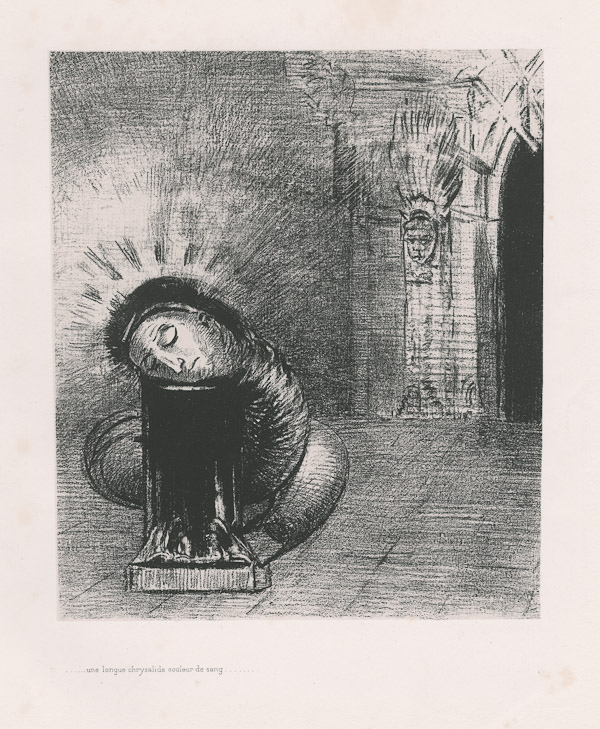
... a long blood-colored chrysalis
Earthen lamps, suspended below these images, create a vacillating light. Through a hole in the wall, Anthony can see the moon shining far off upon the waves; he can even hear the feeble regular sound of lapping water; together with the heavy thud occasionally caused by the bumping of a ship's hull against the stones of the mole.
There are men crouching down, with their faces hidden by their mantles. From time to time they utter sounds resembling a smothered bark. There are women also, sleeping with their foreheads resting upon their arms, and their arms supported by their knees; they are so hidden by their garments as to resemble heaps of cloth piled up at intervals against the wall. Near them are half naked children, whose persons swarm with vermin. They watch with idiotic stare the burning of the lamps; and nothing is done: all are waiting for something.
They talk in undertones about family matters, or recommend to each other various remedies for their ailments. Some of them must embark at earliest daylight; the persecution is becoming too terrible to be endured. Nevertheless, the pagans are easily enough deceived:—"The fools imagine that we are really adoring Knouphus!"
But one of the brethren, feeling himself suddenly inspired, takes his place before the column, where a basket has already been placed, filled with fennel and aristolochia. On the top of the basket is placed a loaf.)
The Inspired Brother
(unrolling a placard covered with designs representing cylinders blending with and fitting into one another, commences to pray:)
"The ray of the Word descended upon the darknesses; and there arose a mighty cry, like unto the voice of Light."
All (swaying their bodies in unison, respond):
"Kyrie eleison!"
The Inspired Brother. "Then was Man created by the infamous God of Israel, aided by those who are these (pointing to the medallions)—Astophaios, Oraios, Sabaoth, Adonai, Eloi, Iao!
"And Man, hideous, feeble, formless and thoughtless, lay upon the slime of the earth."
All (in plaintive accents):
"Kyrie eleison!"
The Inspired Brother. "But Sophia, compassionating him, vivified him with a spark of her own soul.
"Then God, beholding Man so beautiful, waxed wroth; and imprisoned him within His own kingdom, forbidding him to touch the Tree of Knowledge.
"Again did the other succor him. She sent to him the Serpent, who, by many long subterfuges, made him disobey that law of hate.
"And Man, having tasted knowledge, understood celestial things."
All (raising their voices):
"Kyrie Eleison!"
The Inspired Brother. "But Iabdalaoth through vengeance cast down man into the world of matter, and the Serpent with him."
All (in a very low tone):
"Kyrie Eleison!"
(Then all hold their peace, and there is silence.
The odors of the port mingle with the smoke of the lamps in the warm air. The lamp-wicks crepitate; their flames are about to go out, long mosquitoes flit in rapid circlings about them. And Anthony groans in an agony of anguish, as with the feeling that a monstrosity is floating about him, as with the fear of a crime that is about to be accomplished.
But—)
The Inspired Brother (stamping his heel upon the floor, snapping his fingers, tossing his head wildly, suddenly chants to a furious rhythm, with accompaniment of cymbals and a shrill flute:—)
"Come! come! come!—issue from thy cavern!
"O swift one, who runneth without feet, captor who seizeth without hand!
"Sinuous as the rivers, orbicular as the sun, black, with spots of gold, like the firmament star-besprinkled! Like unto the intertwinings of the vine, and the circumvolutions of entrails!
"Unengendered! eater of earth! immortally young! unfailing perspicacious! honored at Epidaurus! Kindly to man! thou who didst heal King Ptolemy, and the warriors, of Moses, and Glaucus, son of Minos!
"Come! come! come!—issue from thy cavern!"
All (repeat):
"Come! come! come!—issue from thy cavern!"
(Nevertheless, nothing yet appears.)
"Why? What aileth him?"
(And they concert together, devise means.
An old man presents a clod of turf as an offering. Then something upheaves within the basket. The mass of verdure shakes; the flowers fall, and the head of a python appears.
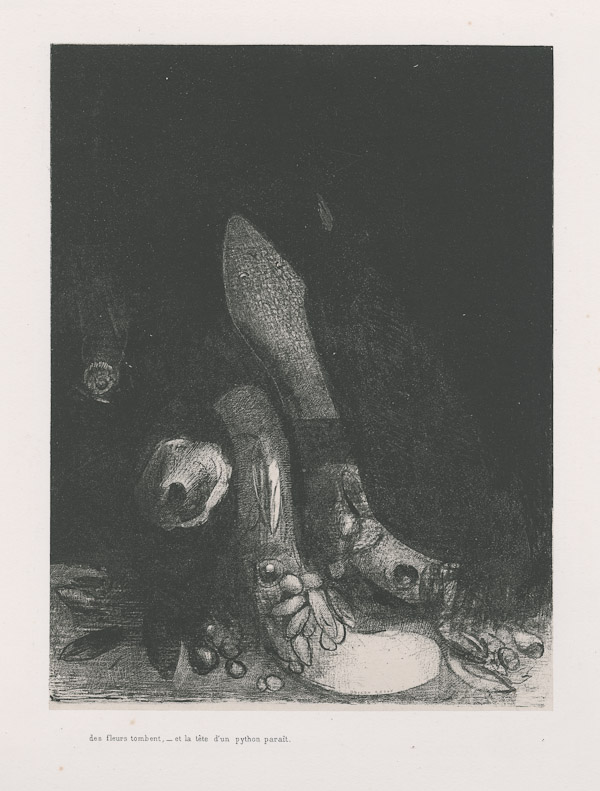
... the flowers fall and the head of a python appears
It passes slowly around the edge of the loaf, like a circle moving around an immovable disk;—then it unfolds itself, lengthens out; it is enormous and of great weight. Lest it should touch the floor, the men uphold it against their breasts, the women support it upon their heads, the children hold it up at arms' length; and its tail, issuing through the hole in the wall, stretches away indefinitely to the bottom of the sea. Its coils double; they fill the chamber; they enclose Anthony.)
The Faithful (press their mouths against its skin, snatch from one another the loaf which it has bitten, and cry aloud:—)
"It is thou! it is thou!
"First raised up by Moses, broken by Ezechias, re-established by the Messiah. He drank thee in the waters of baptism; but thou didst leave him in the Garden of Olives; and then indeed he felt his own weakness!
"Writhing about the arms of the cross, and above his head, while casting thy slime upon the crown of thorns, thou didst behold him die! For thou art not Jesus, thou!—thou art the Word! thou art the Christ!"
(Anthony faints with horror, and falls prostrate in front of his hut upon the splinters of wood, where the torch that had slipped from his hand, is burning low.
The shock arouses him. Opening his eyes again, he perceives the Nile, brightly undulating under the moon, like a vast serpent winding over the sands; so that the hallucination returns upon him again; he has not left the company of the Ophites; they surround him, call him; he sees them carrying baggage, descending to the port. He embarks along with them.
An inappreciable time elapses.
Then the vaults of a prison environ him. Iron bars in front of him make black lines against a background of blue; and in the darkness beside him people are praying and weeping surrounded by others who exhort and console.
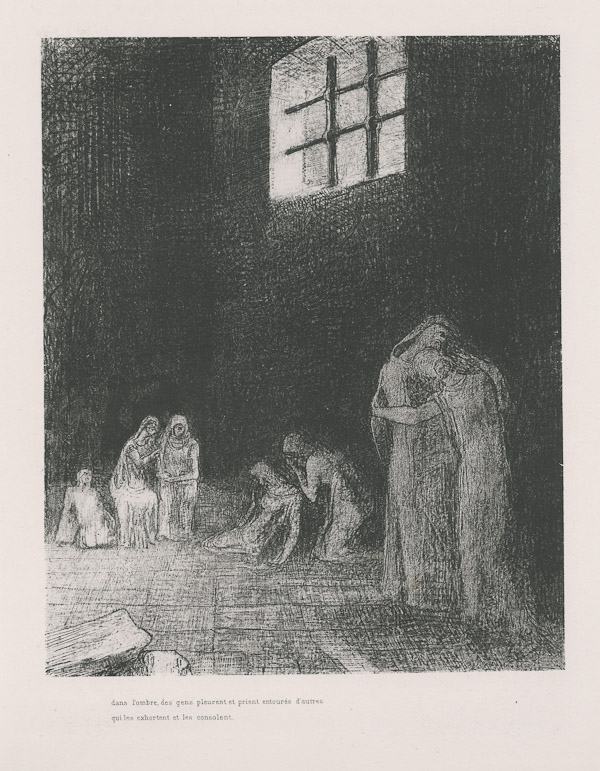
... and in the darkness beside him people are praying
Without, there is a murmur like the deep humming of a vast crowd, and there is splendour as of a summer's day.
Shrill voices announce watermelons for sale, iced drinks, and cushions of woven grass to sit upon. From time to time there are bursts of applause. He hears the sound of footsteps above his head.
Suddenly a long roar is heard, mighty and cavernous as the roar of water in an aqueduct.
And he sees, directly opposite, behind the bars of another compartment across the arena a lion walking to and fro, then a line of sandals, bare legs, and purple fringes. Beyond are the vast circling wreaths of people, in symmetrical tiers, enlarging as they rise, from the lowest which hems in the arena to the uppermost above which masts rise to sustain a hyacinth-colored awning, suspended in air by ropes. Stairways radiating toward the centre, divide these huge circles of stone at regular intervals. The benches disappear under a host of spectators—knights, senators, soldiers, plebeians, vestals, and courtesans—in woollen hoods, in silken maniples, in fallow-colored tunics; together with aigrettes of precious stones, plumes of feathers, the fasces of lictors; and all this swarming multitude deafens and stupefies Anthony with its shoutings, its tumultuous fury, as of an enormous boiling vat. In the middle of the arena, a vase of incense smokes upon an altar.
Anthony thus knows that the people with him are Christians condemned to be thrown to the wild beasts. The men wear the red mantle of the pontiffs of Saturn; the women, the bandellettes of Ceres. Their friends divide among themselves shreds of their garments, and rings. To obtain access to the prison, they say, costs a great deal of money. But what matter! They will remain until it is all over.
Anthony notices among these consolers, a certain bald-headed man, in a black tunic: Anthony has seen that face somewhere before. The consoler discourses to them concerning the nothingness of this world, and the felicity of the Elect. Anthony feels within him a transport of celestial love; he longs for the opportunity to lay down his life for the Saviour—not knowing as yet whether he himself is to be numbered among the martyrs.
But all—except a certain Phrygian, with long hair, who stands with his arms uplifted—have a look of woe. One old man is sobbing upon a bench; a youth standing close by, with drooping head, abandons himself to a reverie of sorrow.
The Old Man had refused to pay the customary contribution before the statue of Minerva, erected at the angle of the cross-roads; and he gazes at his companions with a look that signifies:—)
"Ye ought to have succored me! Communities can sometimes so arrange matters as to insure their being left in peace. Some among ye also procured those letters which falsely allege that one has sacrificed to idols."
(He asks aloud:—)
"Was it not Petrus of Alexandria who laid down the rule concerning what should be done by those who have yielded to torture?"
(Then, to himself:—)
"Ah! how cruel this at my age! My infirmities make me so weak! Nevertheless, I might easily have lived until the coming winter, or longer!"
(The memory of his little garden makes him sad, and he gazes toward the altar.)
The Young Man (who disturbed the festival of Apollo by violence and blows, murmurs:—)
"Yet it would have been easy for me to have fled to the mountains!"
(One of the brothers answers:—)
"But the soldiers would have captured thee!"
The Young Man. "Oh! I would have done as Cyprian did—I would have returned, and the second time I would surely have had more force!"
(Then he thinks of the innumerable days that he might have lived, of all the joys that he might have known, but will never know; and he gazes toward the altar.
But—)
The Man in the Black Tunic (rushes to his side.)
"What scandal! What! Thou! a victim of God's own choice! And all these women here who are looking at thee! Nay, think what thou art doing! Moreover, remember that God sometimes vouchsafes to perform a miracle. Pionius numbed and made powerless the hands of his executioners; the blood of Polycarp extinguished the fire of the stake."
(Then he turns to the Old Man:—)
"Father, father! it behooves thee to edify us by thy death! By longer delaying it, thou wouldst doubtless commit some evil action that would lose thee the fruit of all thy good works. Remember, also, that the power of God is infinite; and it may come to pass that all the people will be converted by thy example."
(And in the great den opposite, the lions stride back and forth, ceaselessly, with a rapid continuous motion. The largest suddenly looks at Anthony and roars, and a vapour issues from his jaws.
The women are huddled against the men.)
The Consoler (goes from one to the other.)
"What would ye say, what wouldst thou say if thou wert to be burned with red-hot irons, if thou wert to be torn asunder by horses, if thou hadst been condemned to have thy body smeared with honey, and thus exposed to be devoured by flies! As it is, thou wilt only suffer the death of a hunter surprised by a beast in the woods."
(Anthony would prefer all those things to death by the fangs of the horrible wild beasts; he fancies already that he feels their teeth and their claws, that he hears his bones cracking between their jaws.
A keeper enters the dungeon; the martyrs tremble.
Only one remains impassable, the Phrygian, who prays standing apart from the rest. He has burned three temples; and he advances with arms uplifted, mouth open, face turned toward heaven, seeing nothing around him, like a somnambulist.)
The Consoler (shouts). "Back! back! lest the spirit of Montanus might come upon you."
All (recoil from the Phrygian, and vociferate)
"Damnation to the Montanist!"
(They insult him, spit upon him, excite each other to beat him.
The rearing lions bite each other's manes;)
The People "To the beasts with them, to the beasts."
The Martyrs burst into sobs, and embrace each other passionately. A cup of narcotic wine is offered them. It is passed from hand to hand, quickly.
Another keeper, standing at the door of the den, awaits the signal. The den opens; a lion comes out.
He crosses the arena with great oblique strides. Other lions follow in file after him; then a bear, three panthers, and some leopards. They scatter through the arena like a flock in a meadow.
The crack of a whip resounds. The Christians stagger forward; and their brethren push them, that it may be over the sooner.
Anthony closes his eyes.
He opens them again. But darkness envelopes him.
Soon the darkness brightens; and he beholds an arid plain, mamillated with knolls, such as might be seen about abandoned quarries.
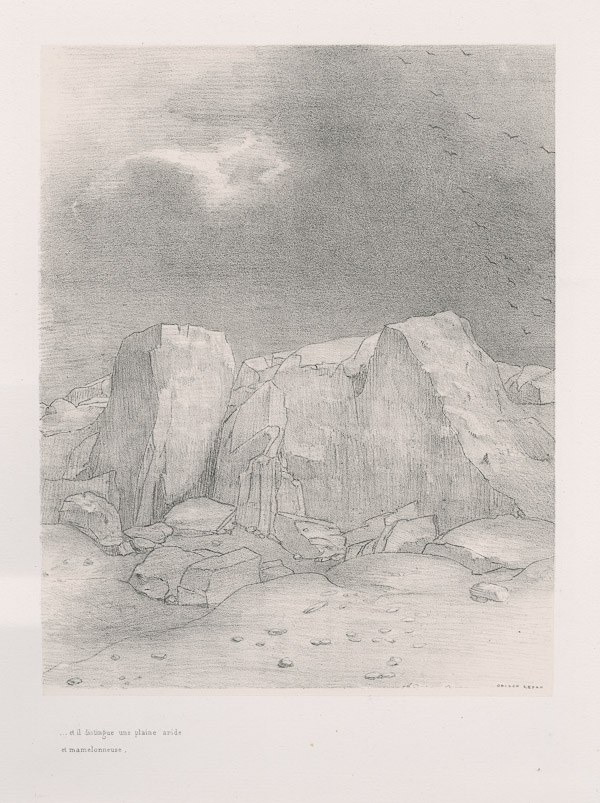
... and he beholds an arid plain, mamillated with knolls
Here and there a tuft of shrubbery rises among the slabs of stone, level with the soil; and there are white figures, vaguer than clouds, bending over the slabs.
Others approach, softly, silently. Eyes gleam through the slits of long veils. By the easy indifference of their walk, and the perfumes exhaled from their garments, Anthony knows they are patrician women. There are men also, but of inferior condition; for their faces are at once simple-looking and coarse.
(One of the Women, taking a long breath:)
"Ah! how good the cool air of night is, among the sepulchers! I am so weary of the softness of beds, the turmoil of days, the heavy heat of the sun!"
(Her maid-servant takes from a canvas bag, a torch which she ignites. The faithful light other torches by it, and plant them upon the tombs.)
A Woman (panting).
"I am here at last! Oh how wearisome to be the wife of an idolator!"
Another. "These visits to the prisons, interviews with our brethren, are all matters of suspicion to our husbands! And we must even hide ourselves in order to make the sign of the cross; they would take it for a magical conjuration!"
Another. "With my husband it was a quarrel every day. I would not submit myself to his brutal exactions; therefore he has had me prosecuted as a Christian."
Another. "Do you remember Lucius, that young man who was so beautiful, who was dragged like Hector, with his heels attached to a chariot, from the Esquiline Gate to the mountains of Tibur?—and how his blood spattered the bushes on either side of the road? I gathered up the drops of his blood. Behold it!"
(She drags a black sponge from her bosom, covers it with kisses, and flings herself down upon the slabs, crying aloud:—)
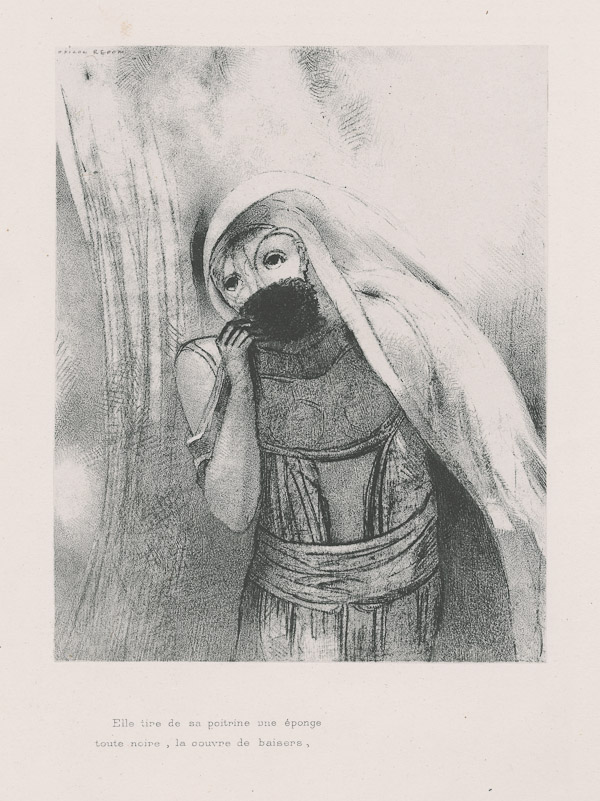
She drags a black sponge from her bosom, covers it with kisses ...
"Ah! my friend! my friend!"
A Man. "It is just three years to-day since Domitilla died. They stoned her at the further end of the Grove of Proserpine. I gathered her bones, which shone like glowworms in the grass. The earth how covers them."
(He casts himself down upon a tomb.)
"O my betrothed! my betrothed!"
(And all the others scattered over the plain:—)
"O my sister! O my brother! O my daughter! O my mother!"
(Some kneel, covering their faces with their hands; others lie down upon the ground with their arms extended; and the sobs they smother shake their breasts with such violence as though their hearts were breaking with grief. Sometimes they look up to heaven, exclaiming:—)
"Have mercy upon her soul, O my God! She languishes in the sojourn of Shades; vouchsafe to admit her to thy Resurrection, that she may enjoy Thy Light!"
(Or, with eyes fixed upon the gravestones, they murmur to the dead:—)
"Be at peace, beloved! and suffer not! I have brought thee wine and meats!"
A Widow. "Here is pultis, made by my own hands, as he used to like it, with plenty of eggs and a double measure of flour! We are going to eat it together as in other days, are we not?"
(She lifts a little piece to her lips, and suddenly bursts into an extravagant and frenzied laugh.
The others also nibble a little bit as she does and drink a mouthful of wine.
They recount to each other the stories of their martyrs; grief becomes exalted! libations redouble. Their tear-swimming eyes are fixed upon each other's faces. They stammer with intoxication and grief; gradually hands touch hands, lips join themselves to lips, and they seek each other upon the tombs, between the cups and the torches.
The sky begins to whiten. The fog makes damp their garments; and, without appearing even to know one another, they depart by different ways and seek their homes.
The sun shines; the weeds and the grass have grown higher; the face of the plain is changed.
And Anthony, looking between tall bamboos, sees distinctly a forest of columns, of bluish-grey color. These are tree-trunks, all originating from one vast trunk. From each branch of the colossal tree descend other branches which may bury themselves in the soil; and the aspect of all these horizontal and perpendicular lines, indefinitely multiplied, would closely resemble a monstrous timber-work, were it not that they have small figs[7] growing upon them here and there, and a blackish foliage, like that of the sycamore.
He perceives in the forkings of their branches, hanging bunches of yellow flowers, violet flowers also, and ferns that resemble the plumes of splendid birds.
Under the lowest branches the horns of a bubalus gleam at intervals, and the bright eyes of antelopes are visible; there are hosts of parrots; there are butterflies flittering hither and thither; lizards lazily drag themselves up or down; flies buzz and hum; and in the midst of the silence, a sound is audible as of the palpitation of a deep and mighty life.
Seated upon a sort of pyre at the entrance of the wood is a strange being—a man—besmeared with cow-dung, completely naked, more withered than a mummy; his articulations form knots at the termination of bones that resemble sticks. He has bunches of shells suspended from his ears; his face is very long, and his nose like a vulture's beak. His left arm remains motionlessly erect in air, anchylosed, rigid as a stake; and he has been seated here so long that birds have made themselves a nest in his long hair.
At the four corners of his wooden pyre flame four fires. The sun is directly in front of him. He gazes steadily at it with widely-opened eyes; and, then without looking at Anthony, asks him:—)
"Brahmin from the shores of the Nile, what hast thou to say regarding these things?"
(Flames suddenly burst out on all sides of him, through the intervals between the logs of the pyre; and—)
The Gymnosophist (continues).
"Lo! I have buried myself in solitude, like the rhinoceros. I dwelt in the tree behind me."
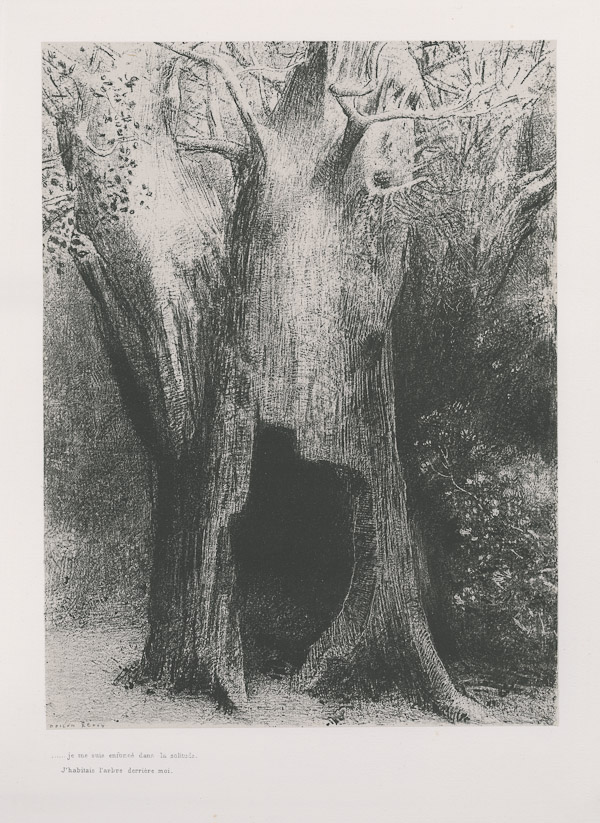
I have buried myself in solitude, like the rhinoceros. I dwelt in the tree behind me
(The vast fig-tree, indeed, shows in one of its groves, a natural excavation about the size of a man.)
"And I nourished me with flowers and fruits, observing the precepts so rigidly that not even a dog ever beheld me eat.
"Inasmuch as existence originates from corruption, corruption from desire, desire from sensation, sensation from contact, I have ever avoided all action, all contact, and perpetually—motionless as the stela of a tomb, exhaling my breath from my two nostrils, fixing my eyes upon my nose, and contemplating the ether in my mind, the world in my members, the moon in my heart—I dreamed of the essence of the great Soul whence continually escape the principles of life, even as sparks escape from fire.
"Thus at last I found the supreme Soul in all beings, and all beings in the supreme Soul; and I have been able to make mine own soul all my senses.
"I receive knowledge directly from heaven, like the bird Tchataka, who quenches his thirst from falling rain only.
"Even by so much as things are known to me, things no longer exist.
"For me now there is no more hope, no more anguish, there is neither happiness nor virtue, nor day nor night, nor Thou nor I—absolutely nothing!
"My awful austerities have made me superior to the Powers. A single contraction of my thought would suffice to kill a hundred sons of kings, to dethrone gods, to overturn the world."
(He utters all these things in a monotonous voice.
The surrounding leaves shrivel up. Fleeing rats rush over the ground.
He slowly turns his eyes downward toward the rising flames, and then continues:—)
"I have loathed Form, I have loathed Perception, I have loathed even Knowledge itself, for the thought does not survive the transitory fact which caused it; and mind, like all else, is only an illusion.
"All that is engendered will perish; all that is dead must live again; the beings that have even now disappeared shall sojourn again in wombs as yet unformed, and shall again return to earth to serve in woe other creatures.
"But inasmuch as I have rolled through the revolution of an indefinite multitude of existences, under the envelopes of gods, of men, and of animals, I renounce further wanderings; I will endure this weariness no more! I abandon the filthy hostelry of this body of mine, built with flesh, reddened with blood, covered with a hideous skin, full of uncleanliness; and, for my recompense, I go at last to slumber in the deepest deeps of the Absolute—in Annihilation."
(The flames rise to his chest, then envelope him. His head rises through them as through a hole in the wall. His cavernous eyes still remain icicle open, gazing.)
Anthony (rises).
(The torch, which had fallen to the ground, has ignited the splinters of wood; and the flames have singed his beard.
With a loud cry, Anthony tramples the fire out; and, when nothing remains but ashes, he exclaims:—)
"Where can Hilarion be? He was here a moment ago. I saw him!
"What! No; it is impossible; I must have been mistaken!
"Yet why?... Perhaps my cabin, these stones, this sand, have no real existence. I am becoming mad! Let me be calm! Where was I? What was it that happened?
"Ah! the gymnosophist!... Such a death is frequent among the sages of India. Kalanos burned himself before Alexander; another did likewise in the time of Augustus. What hatred of life men must have to do thus! Unless, indeed, they are impelled by pride alone?... Yet in any event they have the intrepidity of martyrs.... As for the latter, I can now well believe what has been told me regarding the debauchery they cause.
"And before that? Yes: I remember now! the host of the Heresiarchs! What outcries! What eyes! Yet why so much rebellion of the flesh, so much dissoluteness, so many aberrations of the intellect.
"They claim, nevertheless, to seek God through all those ways! What right have I to curse them—I, who stumble so often in mine own path? I was perhaps about to learn more of them at the moment when they disappeared. Too rapid was the whirl; I had no time to answer. Now I feel as though there were more space, more light in my understanding. I am calm. I even feel myself able to.... What is this? I thought I had put out the fire!"
(A flame flits among the rocks; and soon there comes the sound of a voice—broken, convulsed as by sobs—from afar off, among the mountains.)
"Can it be the cry of a hyena, or the lamentation of some traveler that has lost his way?"
(Anthony listens. The flame draws nearer.
And he beholds a weeping woman approach, leaning upon the shoulder of a white-bearded man.
She is covered with a purple robe in rags. He is bareheaded like lier, wears a tunic of the same color, and carries in his hands a brazen vase, whence arises a thin blue flame.
Anthony feels a fear come upon him, and wishes to know who this woman may be.)
The Stranger Simon. "It is a young girl, a poor child that I lead about with me everywhere."
(He uplifts the brazen vase.
Anthony contemplates the girl, by the light of its vacillating flame.
There are marks of bites upon her face, traces of blows upon her arms; her dishevelled hair entangles itself in the rents of her rags; her eyes appear to be insensible to light.)
Simon. "Sometimes she remains thus for a long, long time without speaking; then all at once she revives, and discourses of marvellous things."
Anthony. "In truth?"
Simon. "Ennoia; Ennoia! Ennoia!—tell us what thou hast to say!"
(She rolls her eyes like one awaking from a dream, slowly passes her fingers over her brows, and in a mournful voice, speaks:—)
Helena[8] (Ennoia).
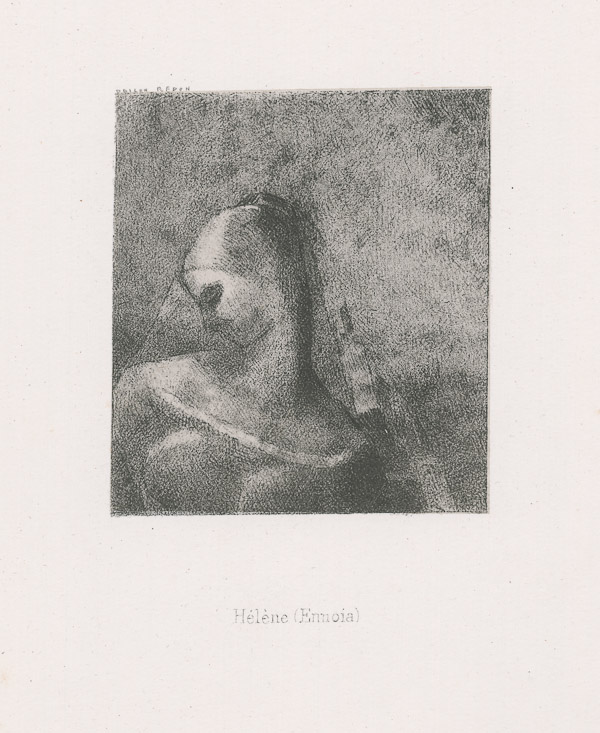
Helena - Ennoia
"I remember a distant land, of the color of emerald. Only one tree grows there.
(Anthony starts).
"Upon each of its tiers of broad-extending arms, a pair of Spirits dwell in air. All about them the branches intercross, like the veins of a body; and they watch the eternal Life circulating, from the roots deep plunging into darkness even to the leafy summit that rises higher than the sun. I, dwelling upon the second branch, illuminated the nights of Summer with my face."
Anthony, (tapping his own forehead:—)
"Ah! ah! I comprehend! her head!..."
Simon (placing his finger to his lips:—)
"Hush!"
Helena. "The sail remained well filled by the wind; the keel cleft the foam. He said to me: 'What though I afflict my country, though I lose my kingdom! Thou wilt belong to me, in my house!'
"How sweet was the lofty chamber of his palace! Lying upon the ivory bed, he caressed my long hair, singing amorously the while.
"Even at the close of the day I beheld the two camps, the watchfires being lighted, Ulysses at the entrance of his tent, armed Achilles driving a chariot along the sea-beach."
Anthony. "Why! she is utterly mad! How came this to pass?..."
Simon. "Hush! hush!"
Helena. "They anointed me with unguents, and sold me to the people that I might amuse them.
"One evening I was standing with the sistrum in my hand, making music for some Greek sailors who were dancing. The rain was falling upon the roof of the tavern like a cataract, and the cups of warm wine were smoking.
"A man suddenly entered, although the door was not opened to let him pass."
Simon. "It was I! I found thee again!
"Behold her, Anthony, she whom they call Sigeh, Ennoia, Barbelo, Prounikos! The Spirits governing the world were jealous of her; and they imprisoned her within the body of a woman.
"She was that Helen of Troy, whose memory was cursed by the poet Stesichorus. She was Lucretia, the patrician woman violated by a king. She was Delilah, by whom Samson's locks were shorn.... She has loved adultery, idolatry, lying and foolishness. She has prostituted herself to all nations. She has sung at the angles of all cross-roads. She has kissed the faces of all men.
"At Tyre, she, the Syrian, was the mistress of robbers. She caroused with them during the nights; and she concealed assassins amidst the vermin of her tepid bed."
Anthony. "Ah! what is this to me?..."
Simon (with a furious look:—)
"I tell thee that I have redeemed her, and re-established her in her former splendor; insomuch that Caius Cæsar Caligula became enamoured of her, desiring to sleep with the Moon!"
Anthony. "What then?..."
Simon. "Why this, that she herself is the Moon! Has not Pope Clement written how she was imprisoned in a tower? Three hundred persons surrounded the tower to watch it; and the moon was seen at each of the loop-holes at the same time, although there is not more than one moon in the world, nor more than one Ennoia!"
Anthony. "Yes ... it seems to me that I remember...."
(He falls into a reverie.)
Simon. "Innocent as the Christ who died for men, so did she devote herself for women. For the impotence of Jehovah is proven by the transgression of Adama, and we must shake off the yoke of the old law, which is antipathetic to the order of things.[9]
"I have preached the revival in Ephraim and in Issachar by the torrent of Bizor, beyond the Lake of Houleh, in the valley of Maggedo, further than the mountains, at Bostra and at Damascus. Let all come to me who are covered with wine, who are covered with filth, who are covered with blood! and I shall take away their uncleanliness with the Holy Spirit, called Minerva by the Greeks. She is Minerva! she is the Holy Spirit! I am Jupiter, Apollo, the Christ, the Paraclete, the great might of God, incarnated in the person of Simon!"
Anthony. "Ah! it is thou!... so it is thou! But I know thy crimes!
"Thou wast born at Gittoi near Samaria, Dositheas, thy first master, drove thee from him. Thou didst execrate Saint Paul because he converted one of thy wives; and, vanquished by Saint Peter, in thy rage and terror thou didst cast into the waves the bag which contained thy artifices!"
Simon. "Dost thou desire them?"
(Anthony looks at him, and an interior voice whispers hi his heart:—"Why not?")
Simon (continues).
"He who knows the forces of Nature and the essence of Spirits must be able to perform miracles. It has been the dream of all sages; it is the desire which even now gnaws thee!—confess it!"
"In the sight of the multitude of the Romans, I flew in the air so high that none could behold me move. Nero ordered that I should be decapitated; but it was the head of a sheep which fell upon the ground in lieu of mine. At last they buried me alive; but I rose again upon the third day. The proof is that thou dost behold me before thee!"
(He presents his hands to Anthony to smell. They have the stench of corpse-flesh. Anthony recoils with loathing.)
"I can make serpents of bronze writhe; I can make marble statues laugh; I can make dogs speak. I will show thee vast quantities of gold; I will reestablish kings; thou shalt see nations prostrate themselves in adoration before me! I can walk upon the clouds and upon the waves, I can pass through mountains, I can make myself appear as a youth, as an old man, as a tiger, or as an ant; I can assume thy features; I can give thee mine; I can make the thunder follow after me. Dost hear it?"
(The thunder rumbles; flashes of lightning succeed.)
"It is the voice of the Most High; for 'the Lord thy God is a fire;' and all creations are accomplished by sparks from the fire-centre of all things.
Thou shalt even now receive the baptism of it—that second baptism announced by Jesus, which fell upon the apostles on a day of tempest when the windows were open!"
(And stirring up the flame with his hand, slowly, as though preparing to sprinkle Anthony with it, he continues:—)
"Mother of mercies, thou who discoverest all secrets, in order that we may find rest in the eighth mansion...."
Anthony (cries out:—)
"Oh! that I had only some holy water!..."
(The flame goes out, producing much smoke.
Ennoia and Simon have disappeared.
An exceedingly cold, opaque and fœtid mist fills the atmosphere.)
Anthony (groping with his hands like a blind man:—)
"Where am I?... I fear lest I fall into the abyss! And the cross, surely, is too far from me. Ah! what a night! what a terrible night!"
(The mist is parted by a gust of wind; and Anthony sees two men covered with long white tunics.
The first is of lofty stature, with a gentle face, and a grave mien. His blond hair, parted like that of Christ, falls upon his shoulders. He has cast aside a wand that he had been holding in his hand; his companion takes it up, making a reverence after the fashion of the Orientals.
The latter is small of stature, thick set, flat-nosed; his neck and shoulders expresses good natured simplicity.
Both are barefooted, bareheaded, and dusty, like persons who have made a long journey.)
Anthony (starting up:—)
"What do ye seek? Speak!... Begone from here!"
Damis (who is a little man).
"Nay! nay! be not angered, good hermit. As for that I seek, I know not myself what it is! Here is the Master!"
(He sits down. The other stranger remains standing. Silence.)
Anthony (asks).
"Then ye come?..."
Damis. "Oh! from afar off—very far off!"
Anthony. "And ye go?..."
Damis (pointing to the other)
"Whithersoever he shall desire!"
Anthony. "But who may he be?"
Damis. "Look well upon him!"
Anthony (aside).
"He looks like a saint! If I could only dare...."
(The mist is all gone. The night is very clear. The moon shines.)
Damis. "Of what art thou dreaming, that thou dost not speak?"
Anthony. "I was thinking.... Oh! nothing!"
Damis (approaches Apollonius, and walks all round him several times, bending himself as he walks, never raising his head:—)
"Master, here is a Galilean hermit who desires to know the beginnings of wisdom."
Apollonius. "Let him approach!" (Anthony hesitates.)
Damis. "Approach!"
Apollonius (in a voice of thunder:—)
"Approach! Thou wouldst know who I am, what I have done, and what I think,—is it not so, child?"
Anthony. "Always supposing that these things can contribute to the salvation of my soul."
Apollonius. "Rejoice! I am about to inform thee of them!"
Damis (in an undertone, to Anthony:—)
"Is it possible? He must surely have at the first glance discerned in thee extraordinary aptitude for philosophy. I shall also strive to profit by his instruction."
Apollonius. "First of all, I shall tell thee of the long course which I have followed in order to obtain the doctrine; and if thou canst discover in all my life one evil action, thou shalt bid me pause, for he who hath erred in his actions may well give scandal by his words."
Damis (to Anthony).
"How just a man? Is he not?"
Anthony. "Indeed I believe him to be sincere."
Apollonius. "Upon the night of my birth, my mother imagined that she was gathering flowers by the shore of a great lake. A flash of lightning appeared; and she brought me into the world to the music of the voices of swans singing to her in her dream.
"Until I had reached the age of fifteen I was plunged thrice a day into the fountain, Asbadeus, whose waters make perjurers hydropical; and my body was rubbed with the leaves of the onyza, that I might be chaste.
"A Palmyrian princess came one evening to seek me, offering me treasures that she knew to be in the tombs. A hierodule of the temple of Diana, slew herself in despair with the sacrificial knife; and the governor of Cilicia, finding all his promises of no avail, cried out in the presence of my family that he would cause my death; but it was he that died only three days after, assassinated by the Romans."
Damis (nudging Anthony with his elbow).
"Eh? did I not tell thee? What a man!"
Apollonius. "For the space of four successive years I maintained the unbroken silence of the Pythagoreans. The most sudden and unexpected pain never extorted a sigh from me; and when I used to enter the theatre, all drew away from me, as from a phantom."
Damis. "Wouldst thou have done so much?—thou?"
Apollonius. "After the period of my trial had been accomplished, I undertook to instruct the priests regarding the tradition they had lost."
Anthony. "What tradition?"
Damis. "Interrupt him not! Be silent!"
Apollonius. "I have conversed with the Samaneans of the Ganges, with the astrologers of Chaldea, with the magi of Babylon, with the Gaulish Druids, with the priests of the negroes! I have ascended the fourteen Olympii; I have sounded the Scythian lakes; I have measured the breadth of the Desert!"
Damis. "It is all true! I was with him the while!"
Apollonius. "But first I had visited the Hyrcanian Sea; I made the tour of it; and descending by way of the country of the Baraomati, where Bucephalus is buried, I approached the city of Nineveh. At the gates of the city, a man drew near me...."
Damis. "I—even I, good master! I loved thee from the first. Thou wert gentler than a girl and more beautiful than a god!"
Apollonius (without hearing him).
"He asked me to accompany him, that he might serve as interpreter."
Damis. "But thou didst reply that all languages were familiar to thee, and that thou couldst divine all thoughts. Then I kissed the hem of thy mantle, and proceeded to walk behind thee."
Apollonius. "After Ctesiphon, we entered upon the territory of Babylon."
Damis. "And the Satrap cried aloud on beholding a man so pale."
Anthony (aside).
"What signifies this?..."
Apollonius. "The king received me standing, near a throne of silver, in a hall constellated with stars; from the cupola hung suspended by invisible threads four great birds of gold, with wings extended."
Anthony (dreamily).
"Can there be such things in the world?"
Damis. "Ah! that is a city! that Babylon! everybody there is rich! The houses, which are painted blue, have doors of bronze, and flights of steps descending to the river."
(Drawing lines upon the ground, with his stick:)
"Like that, seest thou? And then there are temples, there are squares, there are baths, there are aqueducts! The palaces are roofed with red brass; and the interior ... ah! if thou only knewest!"
Apollonius. "Upon the north wall rises a tower which supports a second, a third, a fourth, a fifth, and there are also three others! The eighth is a chapel containing a bed. No one enters it save the woman chosen by the priests for the God Belus. I was lodged there by order of the King of Babylon."
Damis. "As for me, they hardly deigned to give me any attention! So I walked through the streets all by myself. I informed myself regarding the customs of the people; I visited the workshops; I examined the great machines that carry water to the gardens. But I soon wearied of being separated from the Master."
Apollonius. "At last we left Babylon; and as we travelled by the light of the moon, we suddenly beheld an Empusa."
Damis. "Aye, indeed! She leaped upon her iron hoof; she brayed like an ass; she galloped among the rocks. He shouted imprecations at her; she disappeared."
Anthony (aside).
"What can be their motive?"
Apollonius. "At Taxilla, the capital of five thousand fortresses, Phraortes, King of the Ganges, showed us his guard of black men, whose stature was five cubits, and under a pavilion of green brocade in his gardens, an enormous elephant, which the queens amused themselves by perfuming. It was the elephant of Porus which had taken flight after the death of Alexander."
Damis. "And which had been found again in a forest."
Anthony. "Their speech is superabundant, like that of drunken men!"
Apollonius. "Phraortes seated us at his own table."
Damis. "How strange a country that was! During their drinking carousels, the lords used to amuse-themselves by shooting arrows under the feet of a dancing child. But I do not approve...."
Apollonius. "When I was ready to depart, the king gave me a parasol, and he said to me: 'I have a stud of white camels upon the Indus. When thou shalt have no further use for them, blow in their ears. They will come back.'
"We descended along the river, marching at night by the light of the fire-flies, which glimmered among the bamboos. The slave whistled an air to drive away the serpents; and our camels bent down in passing below the branches of the trees, as if passing under low gates.
"One day a black child, who held a golden caduceus in his hand, conducted us to the College of the Sages. Iarchas, their chief, spoke to me of my ancestors, told me of all my thoughts, of all my actions, of all my existences. In former time he had been the River Indus; and he reminded me that I had once been a boatman upon the Nile, in the time of King Sesostris."
Damis. "As for me, they told me nothing; so that I know not who or what I have been."
Anthony. "They have a vague look, like shadows!"
Apollonius. "Upon the shores of the sea we met with the milk-gorged Cynocephali, who were returning from their expedition to the Island Taprobana. The tepid waves rolled blond pearls to our feet. The amber crackled beneath our steps. Whale-skeletons were whitening in the crevasses of the cliffs. At last the land became narrow as a sandal; and after casting drops of ocean water toward the sun, we turned to the right to return.
"So we returned through the Region of Aromatics, by way of the country of the Gangarides, the promontory of Comaria, the country of the Sachalites, of the Adramites and of the Homerites; then, across the Cassanian mountains, the Red Sea, and the Island Topazos, we penetrated into Ethiopia through the country of the Pygmies."
Anthony (to himself).
"How vast the world is!"
Damis. "And after we had returned home, we found that all those whom we used to know, were dead."
(Anthony lowers his head. Silence.)
Apollonius (continues).
"Then men began to talk of me the world over.
"The plague was ravaging Ephesus; I made them stone an old mendicant there."
Damis. "And forthwith the plague departed."
Anthony. "What! Does he drive away pestilence?"
Apollonius. "At Cnidos, I cured the man that had become enamored of Venus."
Damis. "Aye! a fool who had even vowed to espouse her! To love a woman is at least comprehensible; but to love a statue—what madness! The Master placed his hand upon the young man's heart; and the fire of that love was at once extinguished."
Anthony. "How! does he also cast out devils?"
Apollonius. "At Tarentum they were carrying the dead body of a young girl to the funeral pyre."
Damis. "The Master touched her lips; and she arose and called her mother."
Anthony. "What! he raises the dead!"
Apollonius. "I predicted to Vespasian his accession to power."
Anthony. "What! he foretells the future!"
Damis. "At Corinth there was a ..."
Apollonius. "It was when I was at table with him, at the waters of Baia ..."
Anthony. "Excuse me, strangers—it is very late ..."
Damis. "At Corinth there was a young man called Menippus ..."
Anthony. "No! no!—go ye away!"
Apollonius. "A dog came in, bearing a severed hand in his mouth."
Damis. "One evening, in one of the suburbs, he met a woman."
Anthony. "Do ye not hear me? Begone!"
Apollonius. "He wandered in a bewildered way around the couches ..."
Anthony. "Enough!"
Apollonius. "They sought to drive him out."
Damis. "So Menippus went with her to her house; they loved one another."
Apollonius. "And gently beating the mosaic pavement with his tail, he laid the severed hand upon the knees of Flavius."
Damis. "But next morning, during the lessons in the school, Menippus was pale."
Anthony (starting up in anger).
"Still continuing! Ah! then let them continue till they be weary, inasmuch as there is no ..."
Damis. "The Master said to him: 'O beautiful youth, thou dost caress a serpent; by a serpent thou art caressed! And when shall be the nuptials?' We all went to the wedding."
Anthony. "Assuredly I am doing wrong, to hearken to such a story!"
Damis. "Servants were hurrying to and fro in the vestibule; doors were opening; nevertheless there was no sound made either by the fall of the footsteps nor the closing of the doors. The Master placed himself beside Menippus. And the bride forthwith became angered against the philosophers. But the vessels of gold, the cupbearers, the cooks, the panthers disappeared; the roof receded and vanished into air; the walls crumbled down; and Apollonius stood alone with the woman at his feet, all in tears. She was a vampire who satisfied the beautiful young men in order to devour their flesh, for nothing is more desirable for such phantoms than the blood of amorous youths."
Apollonius. "If thou shouldst desire to learn the art ..."
Anthony. "I do not wish to learn anything!"
Apollonius. "The same evening that we arrived at the gates of Rome ..."
Anthony. "Oh! yes!—speak to me rather of the City of Popes!"
Apollonius. "A drunken man accosted us, who was singing in a low voice. The song was an epithalamium of Nero; and he had the power to cause the death of whosoever should hear it with indifference. In a box upon his shoulders he carried a string taken from the Emperor's cithara. I shrugged my shoulders. He flung mud in our faces. Then I unfastened my girdle and placed it in this hand."
Damis. "In sooth, thou wert most imprudent!"
Apollonius. "During the night the Emperor summoned me to his house. He was playing at osselets with Sporus, supporting his left arm upon a table of agate. He turned and, knitting his brows, demanded: 'How comes it that thou dost not fear me?' 'Because,' I replied, 'the God who made thee terrible, also made me intrepid."
Anthony (to himself).
"There is something inexplicable that terrifies me!"
(Silence.)
Damis (breaking the silence with his shrill voice).
"Moreover, all Asia can tell thee ..."
Anthony (starting up).
"I am ill! let me be!"
Damis. "But listen! At Ephesus, he beheld them killing Domitian, who was at Rome."
Anthony (with a forced laugh). "Is it possible?"
Damis. "Yes: at the theatre at noon-day, the fourteenth of the Kalenda of October, he suddenly cried out: 'Cæsar is being murdered!' and from time to time he would continue to ejaculate: 'He rolls upon the pavement ... Oh! how he struggles ... He rises ... He tries to flee ... The doors are fastened ... Ah! it is all over! He is dead!' And in fact Titus Flavius Domitianus was assassinated upon that very day, as thou knowest."
Anthony. "Without the aid of the Devil ... certainly ..."
Apollonius. "He had purposed putting me to death, that same Domitian! Damis had taken flight according to my order, and I remained alone in my prison."
Damis. "A terrible hardihood on thy part, it must be confessed!"
Apollonius. "About the fifth hour, the soldiers led me before the tribunal. I had my harangue all ready hidden beneath my mantle."
Damis. "We others were then upon the shores of Puteoli, we believed thee dead; we were all weeping, when all of a sudden about the sixth hour, thou didst suddenly appear before us, exclaiming: 'It is I.'"
Anthony (to himself). "Even as He...!"
Damis (in a very loud voice). "Precisely!"
Anthony. "Oh! no! ye lie! is it not so?—ye lie!"
Apollonius. "He descended from heaven. I rise thither, by the power of my virtue that has lifted me up even to the height of the Principle of all things!"
Damis. "Thyana, his natal city, has established in his honor a temple and a priesthood!"
Apollonius (draws near Anthony, and shouts in his ear:—)
"It is because I know all gods, all rites, all prayers, all oracles! I have penetrated into the cave of Trophonius, son of Apollo! I have kneaded for Syracusan women the cakes which they carry to the mountains. I have endured the eighty tests of Mithra! I have pressed to my heart the serpent of Sabasius! I have received the scarf of Kabiri! I have laved Cybele in the waters of the Campanian gulfs! and I have passed three moons in the caverns of Samothracia!"
Damis (with a stupid laugh).
"Ah! ah! ah! at the mysteries of the good Goddess!"
Apollonius. "And now we recommence our pilgrimage.
"We go to the North to the land of Swans and of snows. Upon the vast white plains, the blind hippopodes break with the tips of their feet the ultramarine plant."
Damis. "Hasten! it is already dawn. The cock has crowed, the horse has neighed, the sail is hoisted!"
Anthony. "The cock has not crowed! I hear the locusts in the sands, and I see the moon still in her place."
Apollonius. "We go to the South, beyond the mountains and the mighty waters, to seek in perfumes the secret source of love. Thou shalt inhale the odor of myrrhodion which makes the weak die. Thou shalt bathe thy body in the lake of Rose-oil which is in the Island Junonia. Thou shalt see slumbering upon primroses that Lizard which awakes every hundred years when the carbuncle upon its forehead, arriving at maturity, falls to the ground. The stars palpitate like eyes; the cascades sing like the melody of lyres; strange intoxication is exhaled by blossoming flowers; thy mind shall grow vaster in that air; and thy heart shall change even as thy face."
Damis. "Master! it is time! The wind has risen, the swallows awaken, the myrtle leaves are blown away."
Apollonius. "Yes! let us go!"
Anthony. "Nay! I remain here!"
Apollonius. "Shall I tell thee where grows the plant Balis, that resurrects the dead?"
Damis "Nay; ask him rather for the audrodamas which attracts silver, iron and brass!"
Anthony. "Oh! how I suffer! how I suffer!"
Damis. "Thou shalt comprehend the voices of all living creatures, the roarings, the cooings!"
Apollonius. "I shall enable thee to ride upon unicorns and upon dragons, upon hippocentaurs and dolphins!"
Anthony (weeping). "Oh ... oh!... oh!"
Apollonius. "Thou shalt know the demons that dwell in the caverns, the demons that mutter in the woods, the demons that move in the waves, the demons that push the clouds!"
Damis. "Tighten thy girdle, fasten thy sandals!"
Apollonius. "I shall explain to thee the reason of divine forms—why Apollo stands, why Jupiter is seated, why Venus is black, at Corinth, square-shaped at Athens, conical at Paphos."
Anthony (clasping his hands).
"Let them begone! let them begone!"
Apollonius. "In thy presence I will tear down the panoplies of the Gods; we shall force open the sanctuaries, I will enable thee to violate the Pythoness!"
Anthony. "Help! O my God!"
(He rushes to the cross.)
Apollonius. "What is thy desire? What is thy dream? Thou needst only devote the moment of time necessary to think of it ..."
Anthony. "Jesus! Jesus! Help me!"
Apollonius. "Dost thou wish me to make him appear, thy Jesus?"
Anthony. "What? How!"
Apollonius. "It shall be He!—no other! He will cast off his crown, and we shall converse face to face!"
Damis (in an undertone).
"Say thou dost indeed wish it! say thou dost desire it!"
(Anthony kneeling before the cross, murmurs prayers. Damis walks around him, with wheedling gestures.)
"Nay, nay! good hermit. Be not horrified! These are only exaggerated forms of speech, borrowed from the Orientals. That need in no way ..."
Apollonius. "Let him alone, Damis!
"He believes, like a brute, in the reality of things. The terror which he entertains of the Gods prevents him from comprehending them; and he debases his own God to the level of a jealous king!
"But thou, my son, do not leave me!"
(He moves to the edge of the cliff, walking backward, passes beyond the verge of the precipice, and remains suspended in air.)
"Above all forms, further than the ends of the earth, beyond the heavens themselves, lies the world of Idea, replete with the splendor of the Word! With one bound we shall traverse the impending spaces, and thou shalt behold in all his infinity, the Eternal, the Absolute, the Being! Come! give me thy hand! Let us rise."
(Side by side, both rise up through the air, slowly. Anthony, clinging to the cross, watches them rise. They disappear.)
V.
Anthony (walking to and fro, slowly).
"That one, indeed, seems in himself equal to all the powers of Hell!
"Nebuchadnezzar did not so much dazzle me with his splendours;—the Queen of Sheba herself charmed me less deeply.
"His manner of speaking of the gods compels one to feel a desire to know them.
"I remember having beheld hundreds of them at one time, in the island of Elephantius, in the time of Diocletian. The emperor had ceded to the Nomads a great tract of country, upon the condition that they should guard the frontiers; and the treaty was concluded in the name of the 'Powers Invisible.' For the gods of each people were unknown unto the other people.
"The Barbarians had brought theirs with them. They occupied the sand-hills bordering the river. We saw them supporting their idols in their arms, like great paralytic children;—others, paddling through the cataracts upon trunks of palm tree, displayed from afar off the amulets hung about their necks, the tattooings upon their breasts; and these things were not more sinful than the religion of the Greeks, the Asiatics, and the Romans!
"When I was dwelling in the temple of Heliopolis I would often consider the things I beheld upon the walls:—vultures bearing sceptres, crocodiles playing upon lyres, faces of men with the bodies of serpents, cow-headed women prostrating themselves before ithyphallic gods:—and their supernatural forms attracted my thoughts to other worlds. I longed to know that which drew the gaze of all those calm and mysterious eyes.
"If matter can exert such power, it must surely contain a spirit. The souls of the Gods are attached to their images ...
"Those possessing the beauty of forms might seduce. But the others ... those of loathsome or terrible aspect ... how can men believe in them?..."
(And he beholds passing over the surface of the ground,—leaves, stones, shells, branches of trees,—then a variety of hydropical dwarfs: these are gods. He bursts into a laugh. He hears another laugh behind him;—and Hilarion appears, in the garb of a hermit, far taller than before, colossal.)
Anthony (who feels no surprise at seeing him).
"How stupid one must be to worship such things!"
Hilarion. "Aye!—exceedingly stupid!"
(Then idols of all nations and of all epochs—of wood, of metal, of granite, of feathers, of skins sewn together,—pass before them.
The most ancient of all anterior to the Deluge are hidden under masses of seaweed hanging down over them like manes. Some that are too long for their bases, crack in all their joints, and break their own backs in walking. Others have rents torn in their bellies through which sand trickles out.
Anthony and Hilarion are prodigiously amused. They hold their sides for laughter. Then appear sheep-headed idols. They totter upon their bandy-legs, half-open their eye-lids, and stutter like the dumb, "Ba! ba! ba!"
The more that the idols commence to resemble the human forms, the more they irritate Anthony. He strikes them with his fist, kicks them, attacks them with fury. They become frightful,—with lofty plumes, eyes like balls, fingers terminated by claws, the jaws of sharks.
And before these gods men are slaughtered upon altars of stone; others are brayed alive in huge mortars, crushed under chariots, nailed upon trees. There is one all of red-hot iron with the horns of a bull, who devours children.)
Anthony. "Horror!"
Hilarion. "But the gods always demand tortures—and suffering. Even thine desired ..."
Anthony (weeping). "Ah! say no more!—do not speak to me!"
(The space girdled by the rocks suddenly changes into a valley. A herd of cattle are feeding upon the short grass.
The herdman who leads them, observes a cloud;—and in a sharp voice, shouts out words of command, as if to heaven.)
Hilarion. "Because he needs rain, he seeks by certain chants to compel the King of heaven to open the fecund cloud."
Anthony (laughing).
"Verily, such pride is the extreme of foolishness!"
Hilarion. "Why dost thou utter exorcisms?"
(The valley changes into a sea of milk, motionless and infinite. In its midst floats a long cradle formed by the coils of a serpent, whose many curving heads shade, like a dais, the god slumbering upon its body.
He is beardless, young, more beautiful than a girl, and covered with diaphanous veils. The pearls of his tiara gleam softly like moons; a chaplet of stars is entwined many times about his breast, and with one hand beneath his head, he slumbers with the look of one who dreams after wine.
A woman crouching at his feet, awaits the moment of his awaking.)
Hilarion. "Such is the primordial duality of the Brahmans,—the Absolute being inexpressible by any form."
(From the navel of the god has grown the stem of a lotus flower; it blossoms, and within its chalice appears another god with three faces.)
Anthony. "How strange an invention!"
Hilarion. "Father, Son, and Holy Spirit are but one and the same Person!"
(The three faces separate; and three great gods appear.
The first, who is pink, bites the end of his great toe.
The second, who is blue, uplifts his four arms.
The third, who is green, wears a necklace of human skulls.
Before them instantly arise three goddesses—one is enveloped in a net; another offers a cup; the third brandishes a bow.