ILLUSTRATIONS by ODILON REDON (continued 3)
Lafcadio Hearn translation
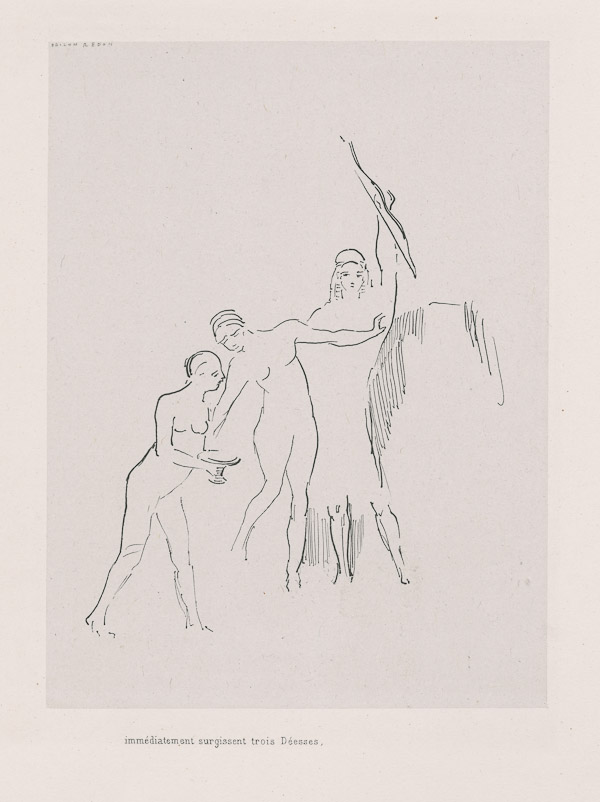
... instantly arise three goddesses
And these gods, these goddesses, decuple themselves, multiply. Arms grow from their shoulders; at the end of these arms hands appear bearing standards, axes, bucklers, swords, parasols and drums. Fountains gush from their heads, plants grow from their nostrils.
Riding upon birds rocked in palanquins, enthroned upon seats of gold, standing in ivory niches,—they dream, voyage, command, drink wine, respire the breath of flowers. Dancing girls whirl in the dance; giants pursue monsters; at the entrances of grottoes solitaries meditate. Eyes cannot be distinguished from stars; nor clouds from banderolles; peacocks quench their thirst at rivers of gold dust; the embroidery of pavilions seems to blend with the spots of leopards; coloured rays intercross in the blue air, together with flying arrows, and swinging censers.
And all this develops like a lofty frieze, resting its base upon the rocks, and rising to the sky.)
Anthony (dazzled by the sight).
"How vast is their number! What do they seek?"
Hilarion. "The god who rubs his abdomen with his elephant-trunk, is the solar Deity, the inspiring spirit of wisdom.
"That other whose six heads are crowned with towers, and whose fourteen arms wield javelins,—is the prince of armies,—the Fire-Consumer.
"The old man riding the crocodile washes the soul of the dead upon the shore. They will be tormented by that black woman with the putrid teeth, who is the Ruler of Hell.
"That chariot drawn by red mares, driven by one who has no legs, bears the master of the sun through heaven's azure. The moon-god accompanies him, in a litter drawn by three gazelles.
"Kneeling upon the back of a parrot, the Goddess of Beauty presents to Love, her son, her rounded breast. Behold her now, further off, leaping for joy in the meadows. Look! Look! Coiffed with dazzling mitre, she trips lightly over the ears of growing wheat, over the waves; she rises in air, extending her power over all elements.
"And among these gods are the Genii of the winds, of the planets, of the months, of the days,—a hundred thousand others;—multiple are their aspects, rapid their transformations. Behold, there is one who changes from a fish into a tortoise: he assumes the form of a boar, the shape of a dwarf."
Anthony. "Wherefore?"
Hilarion. "That he may preserve the equilibrium of the universe, and combat the works of evil. But life exhausts itself; forms wear away; and they must achieve progression in their metamorphoses."
(All upon a sudden appears a Naked Man seated in the midst of the sand, with legs crossed.)
(A large halo vibrates, suspended in air behind him. The little ringlets of his black hair in which blueish tints shift symmetrically surround a protuberance upon the summit of his skull. His arms, which are very long, hang down against his sides. His two hands rest flat upon his thighs, with the palms open. The soles of his feet are like the faces of two blazing suns; and he remains completely motionless—before Anthony and Hilarion—with all the gods around him, rising in tiers above the rocks, as if upon the benches of some vast circus. His lips, half-open; and he speaks in a deep voice):
"I am the Master of great charities, the succor of all creatures; and not less to the profane than to believers, do I expound the law.
"That I might deliver the world, I resolved to be born among men. The gods wept when I departed from them.
"I sought me first a woman worthy to give me birth: a woman of warrior race, the wife of a king, exceedingly good, excessively beautiful, with body firm as adamant;—and at time of the full moon, without the auxiliation of any male, I entered her womb.
"I issued from it by the right side. Stars stopped in their courses."
Hilarion (murmurs between his teeth).
"And seeing the star, they rejoiced with exceeding great joy!"[1]
(Anthony watches more attentively.)
The Buddha[2] (continuing).
"From the furthest recesses of the Himalayas, a holy man one hundred years of age, hurried to see me."
Hilarion. "A man named Simeon ... who should not see death, before he had seen the Christ of the Lord."[3]
The Buddha. "I was led unto the schools; and it was found that I knew more than the teachers."
Hilarion. "... In the midst of the doctors ... and all that heard him were astonished at his wisdom!"[4]
(Anthony makes a sign to Hilarion to be silent.)
The Buddha. "Continually did I meditate in the gardens. The shadows of the trees turned with the turning of the sun; but the shadow of that which sheltered me turned not.
"None could equal me in the knowledge of the Scriptures, the enumeration of atoms, the conduct of elephants, the working of wax, astronomy, poetry, pugilism, all the exercises and all the arts!
"In accordance with custom, I took to myself a wife; and I passed the days in my kingly palace;—clad in pearls, under a rain of perfumes, refreshed by the fans of thirty thousand women,—watching my peoples from the height of my terraces adorned with fringes of resonant bells.
"But the sight of the miseries of the world turned me away from pleasure. I fled.
"I begged my way upon the high roads, clad myself in rags gathered within the sepulchres;—and, hearing of a most learned hermit, I chose to become his slave. I guarded his gate! I washed his feet.
"Thus I annihilated all sensation, all joy, all languor.
"Then, concentrating my thoughts within vaster meditation, I learned to know the essence of things, the illusion of forms.
"Soon I exhausted the science of the Brahmans. They are gnawed by covetousness and desire under their outward aspect of austerity; they daub themselves with filth, they live upon thorns,—hoping to arrive at happiness by the path of death!"
Hilarion.... "Pharisees, hypocrites, whited sepulchres, generation of vipers!"
The Buddha. "I also accomplished wondrous things,—eating but one grain of rice each day (and the grains of rice in those times were no larger than at present)—my hair fell off; my body became black; my eyes receding within their sockets, seemed even as stars beheld at the bottom of a well.
"During six years I kept myself motionless, exposed to the flies, the lions and the serpents; and the great summer suns, the torrential rains, lightnings and snows, hails and tempests,—all of these I endured without even the shelter of my lifted hand.
"The travellers who passed by, believing me dead, cast clods of earth upon me!
"Only the temptation of the Devil remained!
"I summoned him.
"His sons came,—hideous, scale-covered, nauseous as charnel-houses,—shrieking, hissing, bellowing; interclashing their panoplies, rattling together the bones of dead men. Some belched flame through their nostrils; some made darkness about me with their wings; some wore chaplets of severed fingers; some drank serpent-venom from the hollows of their hands;—they were swine-headed; they were rhinoceros-headed or toad-headed; they assumed all forms that inspire loathing or affright."
Anthony (to himself).
"I also endured all that in other days!"
The Buddha. "Then did he send me his daughters—beautiful with daintily painted faces, and wearing girdles of gold. Their teeth were whiter than the jasmine-flower; their thighs round as the trunk of an elephant. Some extended their arms and yawned, that they might so display the dimples of their elbows; some winked their eyes; some laughed; some half-opened their garments. There were blushing virgins, matrons replete with dignity, queens who came with great trains of baggage and of slaves."
Anthony (aside). "Ah! he too ..."
The Buddha. "Having vanquished the Demon, I nourished myself for twelve years with perfumes only;—and as I had acquired the five virtues, the five faculties, the ten forces, the eighteen substances, and had entered into the four spheres of the invisible world, Intelligence became mine! I became the Buddha."
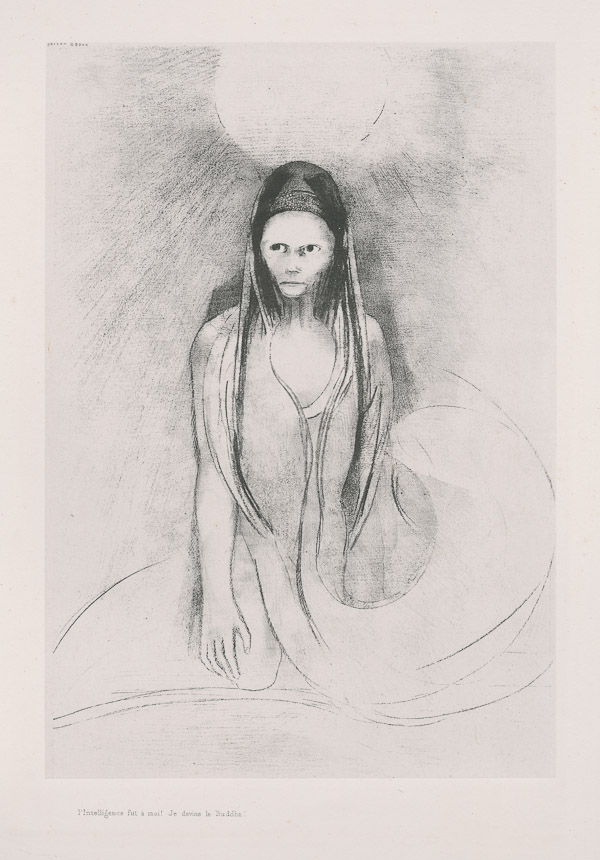
Intelligence became mine! I became the Buddha.
(All the gods bow themselves down. Those having several heads, bend them all simultaneously. He lifts his mighty hand aloft, and resumes:)
"That I might effect the deliverance of beings, I have made hundreds of thousands of sacrifices! To the poor I gave robes of silk, beds, chariots, houses, heaps of gold and of diamonds. I gave my hands to the one-handed, my legs to the lame, my eyes to the blind;—even my head I severed for the sake of the decapitated. In the day that I was King, I gave away provinces;—when I was a Brahman I despised no one. When I was a solitary, I spake kindly words to the robber who slew me. When I was a tiger I allowed myself to die of hunger.
"And having, in this last existence, preached the law, nothing now remains for me to do. The great period is accomplished! Men, animals, the gods, the bamboos, the oceans, the mountains, the sand-grains of the Ganges, together with the myriad myriads of the stars,—all shall die;—and until the time of the new births, a flame shall dance upon the wrecks of worlds destroyed!"
(Then a great dizziness comes upon the gods. They stagger, fall into convulsions, and vomit forth their existences. Their crowns burst apart; their banners fly away. They tear off their attributes, their sexes, fling over their shoulders the cups from which they quaffed immortality, strangle themselves with their serpents, vanish in smoke;—and when all have disappeared ...)
Hilarion (solemnly exclaims):
"Thou hast even now beheld the belief of many hundreds of millions of men."
(Anthony is prostrate upon the ground, covering his face with his hands. Hilarion, with his back turned to the cross, stands near him and watches him.
A considerable time elapses.
Then a singular being appears—having the head of a man upon the body of a fish. He approaches through the air, upright, beating the sand from time to time with his tail; and the patriarchal aspect of his face by contrast with his puny little arms, causes Anthony to laugh.)
Oannes (in a plaintive voice):
"Respect me! I am the contemporary of beginnings.
"I dwelt in that formless world where hermaphroditic creatures slumbered, under the weight of an opaque atmosphere, in the deeps of dark waters—when fingers, fins, and wings were blended, and eyes without heads were floating like mollusks, among human-headed bulls, and dog-footed serpents.
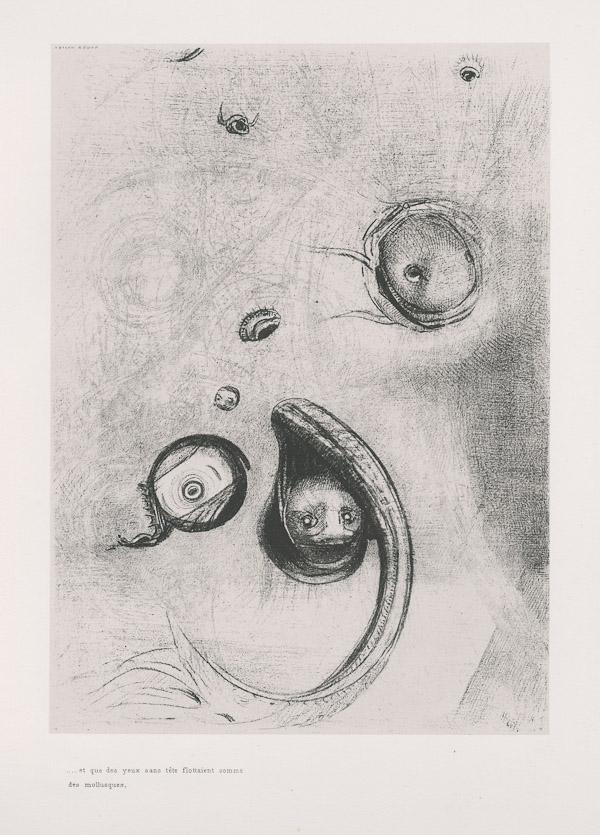
... and eyes without heads were floating like mollusks
"Above the whole of these beings, Omoroca, bent like a hoop, extended her woman-body. But Belus cleft her in two halves; with one he made the earth; with the other, heaven;—and the two equal worlds do mutually contemplate each other.
"I, the first consciousness of Chaos, arose from the abyss that I might harden matter, and give a law unto forms:—also I taught men to fish and to sow: I gave them knowledge of writing, and of the history of the gods.
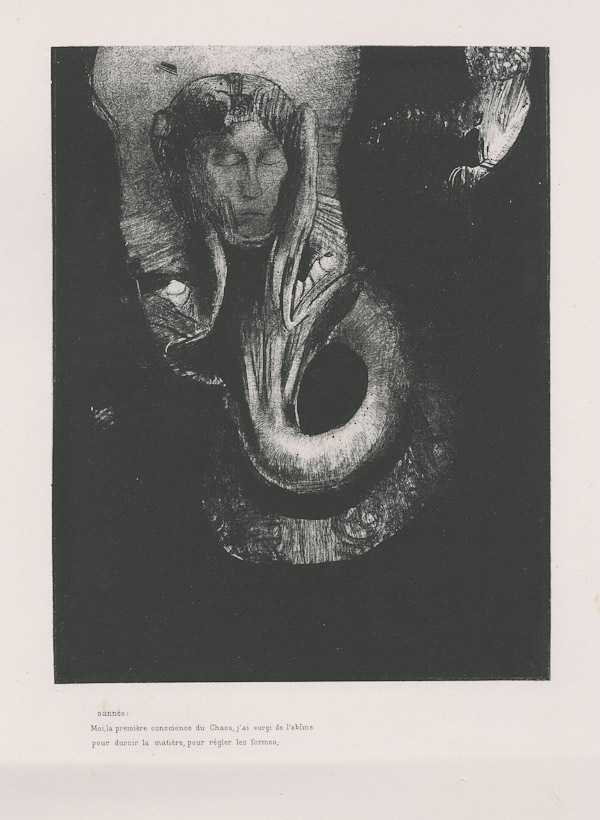
I, the first consciousness of Chaos, arose from the abyss that I might harden matter, and give a law unto forms
"Since then I have dwelt in the deep pools left by the Deluge. But the desert grows vaster about them; the winds cast sand into them; the sun devours them;—and I die upon my couch of slime, gazing at the stars through the water. Thither I return!"
(He leaps and disappears in the Nile.)
Hilarion. "That is an ancient God of the Chaldæans!"
Anthony (ironically). "What, then, were those of Babylon?"
Hilarion. "Thou canst behold them!"
(And they find themselves upon the platform of a lofty quadrangular tower dominating six other towers, which, narrowing as they rise, form one monstrous pyramid. Far below a great black mass is visible—the city, doubtless—extending over the plains. The air is cold; the sky darkly blue; multitudes of stars palpitate above.
In the midst of the platform rises a column of white stone. Priests in linen robes pass and repass around it, so as to describe by their evolutions a moving circle; and with faces uplifted, they gaze upon the stars. ...)
Hilarion. (pointing out several of these stars to Anthony):
"There are thirty principal stars. Fifteen look upon the upper side of the earth; fifteen below. At regular intervals one shoots from the upper regions to those below; while another abandons the inferior deeps to rise to sublime altitudes ...
"Of the seven planets, two are beneficent; two evil; three ambiguous:—all things in the world depend upon the influence of these eternal fires. According to their position or movement presages may be drawn;—and here thou dost tread the most venerable place upon earth. Here Pythagoras and Zoroaster have met;—here for twelve thousand years these men have observed the skies that they might better learn to know the gods."
Anthony. "The stars are not gods."
Hilarion. "Aye, they say the stars are gods; for all things about us pass away;—the heavens only remain immutable as eternity."
Anthony. "Yet there is a master!"
Hilarion (pointing to the column):
"He! Belus!—the first ray, the Sun, the Male! The Other, whom he fecundates, is beneath him!"
(Anthony beholds a garden, illuminated by lamps: He finds himself in the midst of the crowd, in an avenue of cypress-trees. To right and left are little pathways leading to huts constructed within a wood of pomegranate trees, and enclosed by treillages of bamboo.
Most of the men wear pointed caps, and garments bedizened like the plumage of a peacock. But there are also people from the North clad in bearskins, nomads wearing mantles of brown wool, pallid Gangarides with long earrings;—and there seems to be as much confusion of rank as there is confusion of nations; for sailors and stone-cutters elbow the princes who wear tiaras blazing with carbuncles and who carry long canes with carven knobs. All proceed upon their way with dilated nostrils, absorbed by the same desire.
From time to time, they draw aside to make way for some long covered wagon drawn by oxen, or some ass jolting upon his back a woman bundled up in thick veils, who finally disappears in the direction of the cabins.
Anthony feels afraid; he half-resolves to turn back. But an unutterable curiosity takes possession of him, and draws him on.
At the foot of the cypress-trees there are ranks of women squatting upon deerskins, all wearing in lieu of diadem, a plaited fillet of ropes. Some, magnificently attired, loudly call upon the passers-by. Others, more timid, seek to veil their faces with their arms, while some matron standing behind them, their mother doubtless, exhorts them. Others, their heads veiled with a black shawl, and their bodies entirely nude, seem from afar off to be statues of flesh. As soon as a man has thrown some money upon their knees, they arise.
And the sound of kisses is heard under the foliage,—sometimes a great sharp cry.)
Hilarion. "These are the virgins of Babylon, who prostitute themselves to the goddess."
Anthony. "What goddess?"
Hilarion. "Behold her!"
(And he shows him at the further end of the avenue, upon the threshold of an illuminated grotto, a block of stone representing a woman.)
Anthony. "Ignominy!—how abominable to give a sex to God!"
Hilarion. "Thou thyself dost figure him in thy mind as a living person!"
(Anthony again finds himself in darkness.
He beholds in the air a luminous circle, poised upon horizontal wings. This ring of light, girdles like a loose belt, the waist of a little man wearing a mitre upon his head and carrying a wreath in his hand. The lower part of his figure is completely concealed by immense feathers outspreading about him like a petticoat.
It is—Ormuzd—the God of the Persians. He hovers in the air above, crying aloud:)
"I fear! I can see his monstrous jaws! I did vanquish thee, O Ahriman! But again thou dost war against me.
"First revolting against me, thou didst destroy the eldest of creatures, Kaiomortz, the Man-Bull. Then didst thou seduce the first human couple, Meschia and Meschiané; and thou didst fill all hearts with darkness, thou didst urge thy battalions against heaven!
"I also had mine own, the people of the stars; and from the height of my throne I contemplated the marshalling of the astral hosts.
"Mithra, my son, dwelt in heavens inaccessible. There he received souls, from thence did he send them forth; and he arose each morning to pour forth the abundance of his riches.
"The earth reflected the splendour of the firmament. Fire blazed upon the crests of the mountains,—symbolizing that other fire of which I had created all creatures. And that the holy flame might not be polluted, the bodies of the dead were not burned; the beaks of birds carried them aloft toward heaven.
"I gave to men the laws regulating pastures, labour, the choice of wood for the sacrifices, the form of cups, the words to be uttered in hours of sleeplessness;—and my priests unceasingly offered up prayers, so that worship might be as the eternity of God in its endlessness. Men purified themselves with water; loaves were offered upon the altars, sins were confessed aloud.
"Homa[5] gave himself to men to be drank, that they might have his strength communicated to them while the Genii of heaven were combating the demons, the children of Iran were pursuing the serpents. The King, whom an innumerable host of courtiers served upon their knees, represented me in his person, and wore my coiffure. His gardens had the magnificence of a heaven upon earth; and his tomb represented him in the act of slaying a monster,—emblem of Good destroying Evil.
"For it was destined that I should one day definitely conquer Ahriman, by the aid of Time-without-limits.
"But the interval between us disappears;—the deep night rises! To me! ye Amschaspands, ye Izeds, ye Ferouers! Succor me, Mithra! seize thy sword! And thou, Kaosyac, who shall return for the universal deliverance, defend me! What!—none to aid! Ah! I die! Thou art the victor, Ahriman!"
(Hilarion, standing behind Anthony, restrains a cry of joy;—and Ormuzd is swallowed up in the darkness.)
(Then appears:)
The Great Diana of Ephesus
(black with enamelled eyes, her elbows pressed to her side, her forearms extended, with hands open.
Lions crawl upon her shoulders; fruits, flowers, and stars intercross upon her bosom; further down three rows of breasts appear; and from her belly to her feet she is covered with a tightly fitting sheath from which bulls, stags, griffins, and bees, seem about to spring, their bodies half-protruding from it. She is illuminated by the white light emanating from a disk of silver, round as the full moon, placed behind her head.)
"Where is my temple? Where are my Amazons?
"What is this I feel?—I, the Incorruptible!—a strange faintness comes upon me!"...
(Her flowers wither, her over-ripe fruits become detached and fall. The lions and the bulls hang their heads; the deer foam at the mouth, with a slimy foam, as though exhausted; the buzzing bees die upon the ground.
She presses her breasts, one after the other. All are empty! But under a desperate effort her sheath bursts. She seizes it by the bottom, like the skirt of a robe, throws her animals, her fruits, her flowers, into it,—then withdraws into the darkness.
And afar off there are voices, murmuring, growling, roaring, bellowing, belling. The density of the night is augmented by breaths. Drops of warm rain fall.)
Anthony. "How sweet the odour of the palm trees, the trembling of leaves, the transparency of springs! I feel the desire to lie flat upon the Earth that I might feel her against my heart; and my life would be reinvigorated by her eternal youth!"
(He hears the sound of castanets and of cymbals; and men appear, clad in white tunics with red stripes,—leading through the midst of a rustic crowd an ass, richly harnessed, its tail decorated with knots of ribbons, and its hoofs painted.
A box, covered with a saddle-cloth[6] of yellow material shakes to and fro upon its back, between two baskets,—one receives the offerings contributed,—eggs, grapes, pears, cheeses, fowls, little coins; and the other basket is full of roses, which the leaders of the ass pluck to pieces as they walk before the animal, shedding the leaves upon the ground.
They wear earrings and large mantles; their locks are plaited, their cheeks painted, olive-wreaths are fastened upon their foreheads by medallions bearing figurines;—all wear poniards in their belts, and brandish ebony-handled whips, having three thongs to which osselets are attached.[7]
Those who form the rear of the procession, place upon the soil,—so as to remain upright as a candelabrum,—a tall pine, which burns at its summit, and shades under its lower branches a lamb.
The ass halts. The saddle-cloth is removed. Underneath appears a second covering of black felt. Then one of the men in white tunics begins to dance, rattling his crotali;—another, kneeling before the box, beats a tambourine and—)
The Oldest of the Band, begins:—
"Here is the Good Goddess, the Idæan of the mountains, the Great Mother of Syria! Come ye hither, good people all!
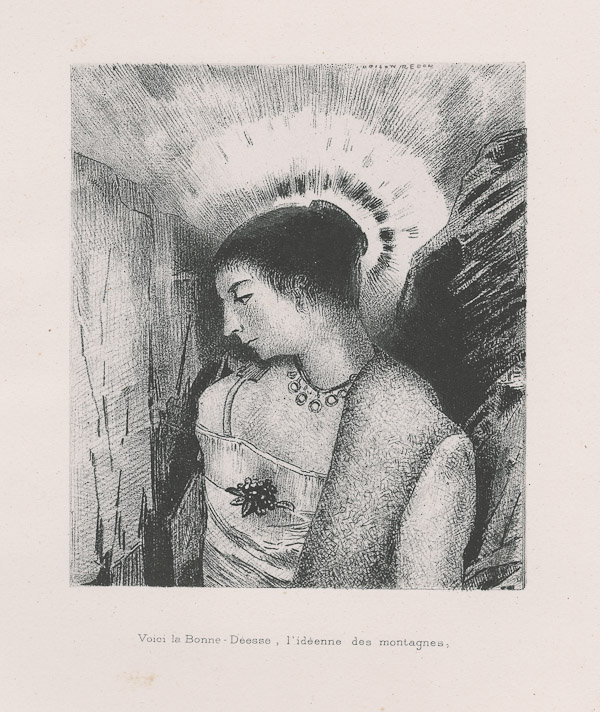
Here is the Good Goddess, the Idæan of the mountains
"She gives joy to men, she heals the sick; she sends inheritances; she satisfies the hunger of love!
"We bear her through the land, rain or shine, in fair weather, or in foul.
"Oft times we lie in the open air, and our table is not always well served. Robbers dwell in the woods. Wild beasts rush from their caverns. Slippery paths border the precipices. Behold her! behold her!"
(They lift off the covering; and a box is seen, inlaid with little pebbles.)
"Loftier than the cedars, she looks down from the blue ether. Vaster than the wind she encircles the world. Her breath is exhaled by the nostrils of tigers; the rumbling of her voice is heard beneath the volcanoes; her wrath is the tempest; the pallor of her face has whitened the moon. She ripens the harvest; by her the tree-bark swells with sap; she makes the beard to grow. Give her something; for she hates the avaricious!"
(The box opens; and under a little pavilion of blue silk appears a small image of Cybele—glittering with spangles, crowned with towers, and seated in a chariot of red stone, drawn by two lions, with uplifted paws.
The crowd presses forward to see.)
THE ARCHIGALLUS (continues):
"She loves the sound of resounding tympanums, the echo of dancing feet, the howling of wolves, the sonorous mountains and the deep gorges, the flower of the almond tree, the pomegranate and the green fig, the whirling dance, the snoring flute, the sugary sap, the salty tear,—blood! To thee, to thee!—Mother of the mountains!"
(They scourge themselves with their whips; and their chests resound with the blows;—the skins of the tambourines vibrate almost to bursting. They seize their knives; they gash their arms.)
"She is sorrowful; let us be sorrowful! Thereby your sins will be remitted. Blood purifies all—fling its red drops abroad like blossoms! She, the Great Mother, demands the blood of another creature—of a pure being!"
(The Archigallus raises his knife above the head of a lamb.)
Anthony (seized with horror):
"Do not slay the lamb!"
(There is a gush of purple blood. The priest sprinkles the crowd with it; and all—including Anthony and Hilarion—standing around the burning tree, silently watch the last palpitations of the victim.
A Woman comes forth from the midst of the priests; she resembles exactly the image within the little box.
She pauses, perceiving before her a Young Man wearing a Phrygian cap. His thighs are covered with a pair of narrow trousers, with lozenge-shaped openings here and there at regular intervals, closed by bow knots of coloured material. He stands in an attitude of languor, resting his elbow against a branch of the tree, holding a flute in his hand.)
Cybele (flinging her arms about his waist).
"I have traversed all regions of the earth to join thee—and famine ravaged the fields Thou hast deceived me! It matters not! I love thee! Warm my body in thine embrace! Let us be united!"
Atys. "The springtime will never again return, O eternal Mother! Despite my love, it is no longer possible for me to penetrate thy essence! Would that I might cover myself with a painted robe like thine! I envy thy breasts, swelling with milk, the length of thy tresses, thy vast flanks that have borne and brought forth all creatures! Why am I not thou?—Why am I not a woman?—No, never! depart from me! My virility fills me with horror!"
(With a sharp stone he dismembers himself, and runs furiously from her ...
The priests imitate the god; the faithful do even as the priests. Men and women exchange garments, embrace;—and the tumult of bleeding flesh passes away, while the sound of voices remaining, becomes even more strident,—like the shrieking of mourners, like the voices heard at funerals.
... A huge catafalque, hung with purple, supports upon its summit an ebony bed, surrounded by torches and baskets of silver filagree, in which are verdant leaves of lettuce, mallow and fennel. Upon the steps of the construction, from summit to base, sit women all clad in black, with loosened girdles and bare feet, holding in their hands with a melancholy air, great bouquets of flowers.
At each corner of the estrade urns of alabaster, filled with myrrh, slowly send up their smoke.
Upon the bed can be perceived the corpse of a man. Blood flows from his thigh. One of his arms hangs down lifelessly;—and a dog licks his finger nails and howls.
The row of torches placed closely together, prevents his face from being seen; and Anthony feels a strange anguish within him. He fears lest he should recognize some one.
The sobs of the women cease—and after an interval of silence,)
All (psalmody together):
"Fair! fair!—all fair he is! Thou hast slept enough!—lift thy head!—arise!
"Inhale the perfume of our flowers—narcissus—blossoms and anemones, gathered in thine own gardens to please thee. Arouse thee! thou dost make us fear for thee!
"Speak to us! What dost thou desire? Wilt thou drink wine?—wilt thou lie in our beds?—dost wish to eat the honeycakes which have the form of little birds?
"Let us press his lips,—kiss his breast! Now!—now!—dost thou not feel our ring-laden fingers passing over thy body?—and our lips that seek thy mouth?—and our tresses that sweep thy thighs? O faint God, deaf to our prayers!"
(They cry aloud, and rend their faces with their nails; then all rush,—and the howling of the dog continues in the silence.)
"Alas! alas! Woe!—the black blood trickles over his snowy flesh! See! his knees writhe!—his sides sink in! The bloom of his face hath dampened the purple. He is dead, dead! O weep for him! Lament for him!"
(In long procession they ascend to lay between the torches the offerings of their several tresses, that seem from afar off like serpents, black or blond;—and the catafalque is lowered gently to the level of, a grotto,—the opening of a shadowy sepulchre that yawns behind it.
Then—)
A Woman (bends over the corpse. Her long hair, uncut, envelopes her from head to feet. She sheds tears so abundantly that her grief cannot be as that of the others, but more than human—infinite!
Anthony dreams of the Mother of Jesus. She speaks:—)
"Thou didst emerge from the Orient, and didst take me, all trembling with the dew, into thy arms, O Sun! Doves fluttered upon the azure of thy mantle; our kisses evoked low breezes among the foliage; and I abandoned myself wholly to thy love, delighting in the pleasure of my weakness.
"Alas! alas—Why didst thou depart, to run upon the mountains! A boar did wound thee at the time of the autumnal equinox!
"Thou art dead; and the fountains weep,—the trees bend down. The wind of winter whistles through the naked brushwood.
"My eyes are about to close, seeing that darkness covers them! Now thou dwellest in the underworld near the mightiest of my rivals.
"O Persephone, all that is beautiful descends to thee, never to return!"
(Even while she speaks, her companions lift the dead, to place him within the sepulchre. He remains in their hands! It was only a waxen corpse.
Wherefore Anthony feels something resembling relief.
All vanish;—and the hut, the rocks, and the cross reappear.
But upon the other side of the Nile, Anthony beholds a Woman, standing in the midst of the desert.
She retains in her hand the lower part of a long black veil that hides all her face; supporting with her left arm a little child to whom she is giving suck. A great ape crouches down in the sand beside her.
She uplifts her head toward heaven; and in spite of the great distance, her voice is distinctly heard:)
Isis. "O Neith, Beginning of all things! Ammon, Lord of Eternity; Pthah, demiurgos; Thoth, his intelligence; gods of the Amenthi, particular triads of the Nomes,—falcons in the azure of heaven, sphinxes before the temples, ibises perched between the horns of oxen, planets, constellations, shore, murmurs of the wind, gleams of the light,—tell me where I may find Osiris.
"I have sought him in all the canals and all the lakes—aye, further yet, even to Phœnician Byblos. Anubis, with ears pricked up, leaped about me, and yelped, and thrust his muzzle searchingly into the tufts of the tamarinds.
"Thanks, good Cynocephalos—thanks to thee!"
(She gives the ape two or three friendly little taps upon the head.)
"Hideous Typhon, the red-haired slew him, tore him in pieces! We have found all his members. But I have not that which rendered me fecund!"
(She utters wild lamentations.)
Anthony (is filled with fury. He casts stones at her, reviles her.)
"Begone! thou shameless one!—Begone!"
Hilarion. "Nay! respect her! Her religion was the faith of thy fathers!—thou didst wear her amulets when thou wert a child in the cradle!"
Isis. "In the summers of long ago, the inundation drove the impure beasts into the desert. The dykes were opened, the boats dashed against each other; the panting earth drank the river with the intoxication of joy. Then, O God, with the horns of the bull, thou didst lie upon my breast, and then was heard, the lowings of the Eternal Cow!
"The seasons of sowing and reaping, of threshing and of vintage, followed each other in regular order with the years. In the eternal purity of the nights, broad stars beamed and glowed. The days were bathed in never-varying splendour. Like a royal couple the Sun and the Moon appeared simultaneously, at either end of the horizon.
"Then did we both reign above a sublimer world, twin-monarchs, wedded within, the womb of eternity—he bearing a concupha-headed sceptre; I, the sceptre that is tipped with a lotus-flower; both of us erect with hands joined; and the crumblings of empires affected not our attitude.
"Egypt extended, below us, monumental and awful, long-shaped like the corridor of a temple; with obelisks on the right, pyramids on the left, and its labyrinth in the midst. And everywhere were avenues of monsters, forests of columns, massive pylons flanking gates summit-crowned with the mysterious globe—the globe of the world, between two wings.
"The animals of her Zodiac also existed in her pasture lands; and filled her mysterious writing with their forms and colours. Divided into twelve regions as the year is divided into-twelve months—each month, each day also having its own god—she reproduced the immutable order of heaven. And man even in dying changed not his face; but saturated with perfumes, invulnerable to decay, he lay down to sleep for three thousand years in another and silent Egypt.
"And that Egypt, vaster than the Egypt of the living, extended beneath the earth.
"Thither one descended by dark stairways leading into halls where were represented the joys of the good, the tortures of the wicked, all that passes in the third and invisible world. Ranged along the wall the dead in their painted coffins awaited their turn; and the soul, exempted from migrations, continued its heavy slumber until the awakening into a new life.
"Nevertheless, Osiris sometimes came to see me. And by his ghost I became the mother of Harpocrates."
(She contemplates the child.)
"Aye! it is he. Those are his eyes; those are his locks, plaited into ram horns! Thou shalt recommence his works. We shall bloom again like the lotus. I am still the Great Isis!—none has yet lifted my veil! My fruit is the Sun!
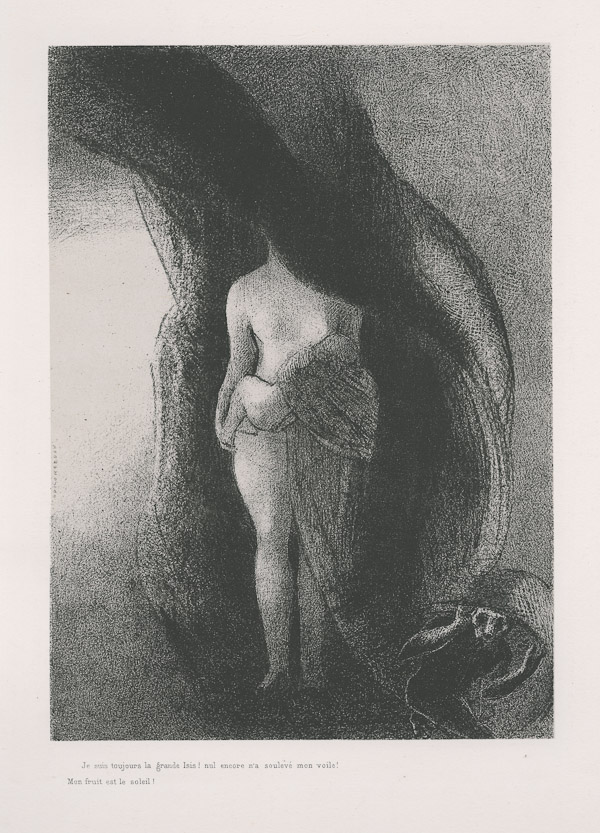
I am still the Great Isis!—none has yet lifted my veil! My fruit is the Sun!
"Sim of Springtime, clouds now obscure thy face! The breath of Typhon devours the pyramids. But a little while ago I beheld the Sphinx flee away. He was galloping like a jackal.
"I look for my priests,—my priests clad in mantles of linen, with their great harps, and bearing a mysterious bark, adorned with silver pateras. There are no more festivals upon the lakes!—no more illuminations in my delta!—no more cups of milk at Philæ! Apis has long ceased to reappear.
"Egypt! Egypt! thy great motionless gods have their shoulders already whitened by the dung of birds; and the wind that passes over the desert rolls with it and the ashes of thy dead!—Anubis, guardian of ghosts, abandon me not!"
(The Cynocephalos has vanished. She shakes her child.)
"But ... what ails thee ... thy hands are cold, thy head droops!"
(Harpocrates expires. Then she cries aloud with a cry so piercing, funereal, heart-rending, that Anthony answers it with another cry, extending his arms as to support her.
She is no longer there. He lowers his face, overwhelmed by shame.
All that he has seen becomes confused within his mind. It is like the bewilderment of travel, the illness of drunkenness. He wishes to hate; but a vague and vast pity fills his heart. He begins to weep, and weeps abundantly.)
Hilarion. "What makes thee sorrowful?"
Anthony (after having long sought within himself for a reply):
"I think of all the souls that have been lost through these false gods!"
Hilarion. "Dost thou not think that they ... sometimes ... bear much resemblance to the True?"
Anthony. "That is but a device of the Devil to seduce the faithful more easily. He attacks the strong through the mind, the weak through the flesh."
Hilarion. "But luxury, in its greatest fury, has all the disinterestedness of penitence. The frenzied love of the body accelerates the destruction thereof,—and proclaims the extent of the impossible by the exposition of the body's weakness."
Anthony. "What signifies that to me! My heart sickens with disgust of these beautiful bestial gods, forever busied with carnages and incests!"
Hilarion. "Yet recollect all those things in the Scripture which scandalize thee because thou art unable to comprehend them! So also may these Gods conceal under their sinful forms some mighty truth. There are more of them yet to be seen. Look around!"
Anthony. "No, no!—it is dangerous!"
Hilarion. "But a little while ago thou didst desire to know them! Is it because thy faith might vacillate in the presence of lies? What fearest thou?"
(The rocks fronting Anthony have become as a mountain. A line of clouds obscures the mountain half way between summit and base; and above the clouds appears another mountain, enormous, all green, unequally hollowed by valleys nestling in its slopes, and supporting at its summit, in the midst of laurel-groves a palace of bronze, roofed with tiles of gold, and supported by columns having capitals of ivory.
In the centre of the peristyle Jupiter,—colossal, with torso nude,—holds Victory in one hand, his thunderbolts in the other; and his eagle, perched between his feet, rears its head.
Juno, seated near him, rolls her large eyes, beneath a diadem whence her wind-blown veil escapes like a vapour.
Behind them, Minerva, standing upon a pedestal, leans on her spear. The skin of the Gorgon covers her breast, and a linen peplos falls in regular folds to the nails of her toes. Her glaucous eyes, which gleam beneath her vizor, gaze afar off, attentively.
On the right of the palace, the aged Neptune bestrides a dolphin beating with its fins a vast azure expanse which may be sea or sky, for the perspective of the Ocean seems a continuation of the blue ether: the two elements are interblended.
On the other side weird Pluto in night-black mantle, crowned with diamond tiara and bearing a sceptre of ebony, sits in the midst of an islet surrounded by the circumvolutions of the Styx;—and this river of shadow empties itself into the darknesses, which form a vast black gulf below the cliff,—a bottomless abyss!
Mars, clad in brass, brandishes as in wrath his broad shield and his sword.
Hercules, leaning upon his club, gazes at him from below.
Apollo, his face ablaze with light, grasps with outstretched right arm the reins of four white horses urged to a gallop; and Ceres in her ox-drawn chariot advances toward him with a sickle in her hand.
Behind her comes Bacchus, riding in a very low chariot, gently drawn by lynxes. Plump and beardless, with vine leaves garlanding his brow, he passes by holding in his hand an overflowing cup of wine. Silenus riding beside him reels upon his ass. Pan of the pointed ears, blows upon his syrinx; the Mimalonæides beat drums; the Mænads strew flowers; the Bacchantes turn in the dance with heads thrown back and hair dishevelled.
Diana, with tunic tucked up, issues from the wood together with her nymphs.
At the further end of a cavern, Vulcan among his Cabiri, hammers the heated iron; here and there the aged Rivers leaning recumbent upon green rocks pour water from their urns; the Muses stand singing in the valleys.
The Hours, all of equal stature, link hands; and Mercury poses obliquely upon a rainbow, with his caduceus, winged sandals, and winged petasus.
But at the summit of the stairway of the Gods,—among clouds soft as down, from whose turning volutes a rain of roses falls,—Venus Anadyomene stands gazing at herself in a mirror:—her eyes move languorously beneath their slumbrous lids.
She has masses of rich blond hair rolling down over her shoulders; her breasts are small; her waist is slender; her hips curve out like the sweeping curves of a lyre; her thighs are perfectly rounded; there are dimples about her knees; her feet are delicate: a butterfly hovers near her mouth. The splendour of her body makes a nacreous-tinted halo of bright light about her; while all the rest of Olympus is bathed in a pink dawn, rising gradually to the heights of the blue sky.)
Anthony. "Ah! my heart swells! A joy never known before thrills me to the depths of my soul! How beautiful, how beautiful it is!"
Hilarion. "They leaned from the heights of cloud to direct the way of swords; one used to meet them upon the high roads; men had them in their houses—and this familiarity divinized life.
"Life's aim was only to be free and beautiful. Nobility of attitude was facilitated by the looseness of garments. The voice of the orator, trained by the sea, rolled its sonorous waves against the porticoes of marble. The ephebus, anointed with oil, wrestled all naked in the full light of the sun. The holiest of actions was to expose perfection of forms to all.
"And these men respected wives, aged men, suppliants.
"Behind the temple of Hercules there was an altar erected to Pity.
"Victims were immolated with flowers wreathed about the fingers of the sacrificer. Even memory was exempted from thoughts of the rottenness of death. Nothing remained but a little pile of ashes. And the Soul, mingling with the boundless ether, rose up to God."
(Bending to whisper in Anthony's ear:—)
"And they still live! The Emperor Constantine adores Apollo. Thou wilt find the Trinity in Samothracian mysteries,—baptism in the religion of Isis,—redemption in the faith of Mithra,—a martyrdom of a God in the festivals of Bacchus. Prosperpine is the Virgin!... Aristæus is Jesus!"
Anthony (remains awhile with downcast eyes, as if in deep thought; then suddenly repeats aloud the Symbol of Jerusalem, as he remembers it, uttering a long sigh between each phrase):—
"I believe in one only God, the Father,—and in one only Lord, Jesus Christ,—the first born son of God, who was incarnated and made man,—who was crucified, and buried,—who ascended into Heaven,—who will come to judge the living and the dead,—of whose Kingdom there shall be no end;—and in one Holy Spirit,—and in one baptism of repentance,—and in one Holy Catholic Church,—and in the resurrection of the flesh,—and in the life everlasting!"
(Immediately the cross becomes loftier and loftier; it pierces the clouds, and casts its shadow upon the heaven of the gods.
All grow pale;—Olympus shudders.
And at its base Anthony beholds vast bodies enchained, sustaining the rocks upon their shoulders,—giant figures half buried in the deeps of caverns. These are the Titans, the Giants, the Hecatonchires, the Cyclops.)
A Voice
(rises, indistinct and awful, like the far roar of leaves, like the voice of forests in time of tempest, like the mighty moaning of the wind among the precipices):
"We knew these things!—we knew them! There must come an end even for the Gods! Uranus was mutilated by Saturn,—Saturn by Jupiter. And Jupiter himself shall be annihilated. Each in his turn;—it is Destiny!"
(And little by little they sink into the mountain, and disappear.
Meanwhile the golden tiles of the palace rise and fly away.)
Jupiter (has descended from his throne. At his feet the thunderbolts lie, smoking like burning coals about to expire;—and the great eagle bends its neck to pick up its falling feathers):
"Then I am no longer the master of all things,—most holy, most mighty, god of the phatrias and Greek peoples,—ancestor of all the Kings,—Agamemnon of heaven.
"Eagle of apotheoses, what wind from Erebus has wafted thee to me? or, fleeing from the Campus Martins, dost thou bear me the soul of the last of the Emperors?
"I no longer desire to receive those of men. Let the Earth keep them; and let them move upon the level of its baseness. Their hearts are now the hearts of slaves;—they forget injuries, forget their ancestors, forget their oaths,—and everywhere the folly of crowds, the mediocrity of individuals, the hideousness of races, hold sway!"
(He pants with such violence that his sides seem ready to burst asunder; he clenches his hands. Weeping, Hebe offers him a cup. He seizes it.)
"No, no! So long as there shall be a brain enclosing a thought, in whatsoever part of the world;—so long as there shall exist a mind hating disorder, creating Law,—so long will the spirit of Jupiter live!"
(But the cup is empty. He turns its edge down over his thumbnail.)
"Not one drop left! When the ambrosia fails, the Immortals must indeed depart!"
(The cup drops from his hands; and he leans against a column, feeling himself about to die.)
Juno. "Thou shouldst not have had so many amours! Eagle, bull, swan, rain of gold, cloud and flame, thou didst assume all forms,—dissipate thy light in all elements,—lose thy hair upon all beds! This time the divorce is irrevocable; and our domination, our very existence, dissolved."
(She passes away in air.)
Minerva (has no longer her spear; and the ravens nesting among the sculptures of the friezes, wheel about her, peeking at her helmet.)
"Let me see whether my vessels cleave the bright sea, returning to my three ports,—let me discover why the fields are deserted, and learn what the daughters of Athens are now doing.
"In the month of Hecatombeon my whole people came to worship me, under the guidance of their magistrates and priests. Then, all in white robes and wearing chitons of gold, they advanced the long line of virgins bearing cups, baskets, parasols; then the three hundred sacrificial oxen, and the old men having green boughs, the soldiers with clashing of armour, the ephebi singing hymns, flute players, lyre players, rhapsodists, dancing women;—and lastly attached to the mast of a trireme mounted upon wheel, my great veil embroidered by virgins who had been nourished in a particular way for a whole year. And when it had been displayed in all the streets, in all the squares, and before the temples, in the midst of the ever-chanting procession, it was borne step by step up the hill of the Acropolis, grazed the Propylæa, and entered the Parthenon....
"But a strange feebleness comes upon me,—me the Industrious One! What! what! not one idea comes to me! Lo! I am trembling more than a woman!"
(She turns, beholds a ruin behind her, utters a cry, and stricken by a fallen fragment, falls backward upon the ground.)
Hercules (has flung away his lion-skin; and with feet firmly braced, back arched, teeth clenched, he exhausts himself in immeasurable efforts to bear up the mass of crumbling Olympus.)
"I vanquished the Cercopes, the Amazons, and the Centaurs. Many were the kings I slew. I broke the horn of the great river, Achelous. I cut the mountains asunder; I freed nations from slavery; and I peopled lands that were desolate. I travelled through the countries of Gaul; I traversed the deserts where thirst prevails. I defended the gods from their enemies; and I freed myself from Omphale. But the weight of Olympus is too great for me. My arms grow feebler:—I die!"
(He is crushed beneath the ruins.)
Pluto. "It is thy fault, Amphytrionad;—wherefore didst thou descend into my empire?
"The vulture that gnaws the entrails of Tityus lifted its head;—the lips of Tantalus were moistened;—the wheel of Ixion stopped.
"Meanwhile the Kæres extended their claws to snatch back the escaping ghosts; the Furies tore the serpents of their locks; and Cerberus fettered by thee with a chain, sounded the death rattle in his throat, and foamed at all his three mouths.
"Thou didst leave the gate ajar; others have come. The daylight of men has entered into Tartarus!"
(He sinks into the darkness.)
Neptune. "My trident can no longer call up the tempests. The monsters that terrified of old, lie rotting at the bottom of the sea.
"Amphitrite whose white feet tripped lightly over the foam, the green Nereids seen afar off in the horizon, the scaly Sirens who stopped the passing vessels to tell stories, and the ancient Tritons mightily blowing upon their shells, all have passed away. All is desolate and dead; the gaiety of the great Sea is no more!"
(He vanishes beneath the azure.)
Diana (clad in black and surrounded by her dogs, which have been changed into wolves).
"The freedom of the deep forests once intoxicated me; the odours of the wild beasts and the exhalations of the marshes made me as one drank with joy. But the women whose maternity I protected, now bring dead children into the world. The moon trembles with the incantations of witches. Desires of violence, of immensity, seize me, fill me! I wish to drink poisons,—to lose myself in vapours, in dreams...!"
(And a passing cloud carries her away.)
Mars (unhelmed and covered with blood).
"At first I fought alone;—singlehanded I would provoke a whole army by my insults,—caring nothing for countries or nations, demanding battle for the pleasure of carnage alone.
"Afterward I had comrades. They marched to the sound of flutes, in good order, with equal step, respiring above their bucklers, with plumes loftily nodding, lances oblique. Then on rushed to battle with mighty eagle cries. War was joyous as a banquet. Three hundred men strove against all Asia.
"But the Barbarians are returning;—by myriads they come, by millions! Ah! since numbers, and engines, and cunning are stronger than valour, it were better that I die the death of the brave!"
(He kills himself.)
Vulcan (sponging the sweat from his limbs):
"The world is growing cold. The source of heat must be nourished, the volcanoes and rivers of flowing metal underground. Strike harder!—with full swing of the arms,—with might and main!"
(The Cabiri wound themselves with their hammers, blind themselves with sparks, and groping, lose themselves in the darkness.)
Ceres (standing in her chariot, impelled by wheels having wings at their hubs):
"Stop! Stop! Ah! it was with good reason that the exclusion of strangers, atheists, Epicureans, and Christians was commended! Now the mystery of the basket has been unveiled; the sanctuary profaned: all is lost!"
(She descends a precipitous slope—shrieking, despairing, tearing her hair.)
"Ah! lies, lies! Daira has not been restored to me. The voice of brass calls me to the dead. This is another Tartarus, whence there is no return! Horror!"
(The abyss engulfs her.)
Bacchus (with a frenzied laugh).
"What matters it? The Archon's wife is my spouse! The law itself reels in drunkenness! To me the new song, the multiplied forms!
"The fire by which my mother was devoured, flows in my veins! Let it burn yet more fiercely, even though I perish!
"Male and female, complaisant to all, I abandon myself to you, Bacchantes! I abandon myself to you, Bacchanalians!—and the vine shall twine herself about the tree-trunks! Howl! dance! writhe! Loosen the tiger and the slave!—rend flesh with ferocious bitings!"
(And Pan, Silenus, the Bacchantes, the Mimalonæides, and the Mænads,—with their serpents, torches, sable masks,—cast flowers at each other ... shake their tympanums, strike their thyrsi, pelt each other with shells, devour grapes, strangle a goat, and tear Bacchus asunder.)
Apollo (furiously whipping his coursers, while his blanching locks are falling from his head):
"I have left far behind me stony Delos, so pure that all now there seems dead; and I must strive to reach Delphi ere its inspiring vapour be wholly lost. The mules browse in its laurel groves. The Pythoness has wandered away, and cannot be found.
"By a stronger concentration of my power, I will obtain sublime hymns, eternal monuments; and all matter will be penetrated by the vibrations of my cithara!"
(He strikes the strings of the instrument. They burst, lashing his face with their broken ends. He flings the cithara away; and furiously whipping his quadriga, cries):
"No! enough of forms!—Further, higher!—to the very summit!—to the realm of pure thought!"
(But the horses back, rear, dash the chariot to pieces. Entangled by the harness, caught by the fragments of the broken pole, he falls head foremost into the abyss.
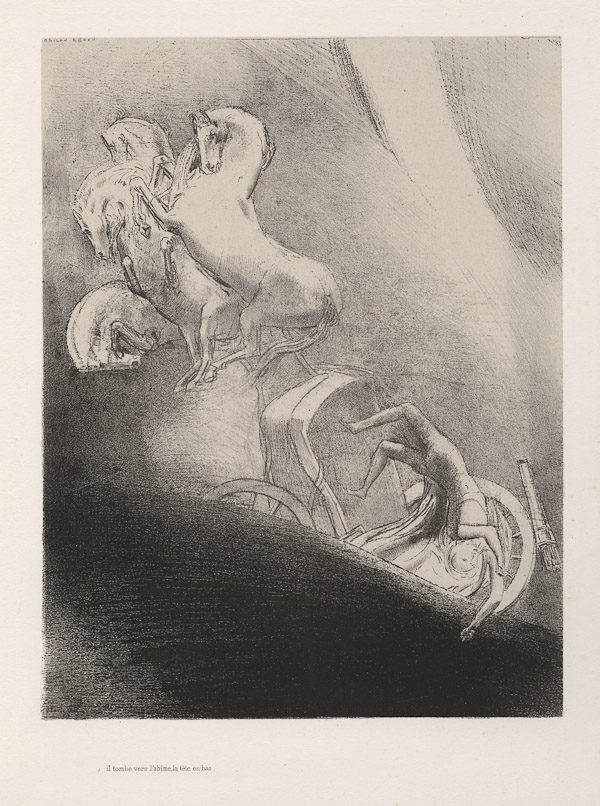
... he falls head foremost into the abyss
The sky is darkened.)
Venus (blue with cold, shivering):
"Once with my girdle I made all the horizon of Hellas.
"Her fields glowed with the roses of my cheeks; her shores were outlined after the fashion of my lips; and her mountains, whiter than my doves, palpitated beneath the hands of the statuaries. My spirit's manifestation was found in the ordinances of the festivals, in the arrangement of coiffures, in the dialogues of philosophers, in the constitution of republics. But I have doted too much upon men! It is Love that has dishonoured me!"
(She casts herself back weeping):
"This world is abominable;—there is no air for me to breathe!
"O Mercury, inventor of the lyre, conductor of souls, take me away!"
(She places one finger upon her lips, and describing an immense parabola, falls into the abyss.
Nothing is now visible. The darkness is complete.
Only, that from the eyes of Hilarion escape two flashes, two rays of lurid light.)
Anthony (begins at last to notice his immense stature):
"Already several times, while thou wert speaking, it seemed to me thou wert growing taller; and it was no illusion! How? Explain to me ... Thy aspect terrifies me!"
(Footsteps are heard approaching.)
"What is that?"
Hilarion (extending his arm):
"Look!"
(Then, under a pale beam of moonlight, Anthony distinguishes an interminable caravan defiling over the summit of the rocks;—and each voyager, one after the other, falls from the cliff into the gulf below.
First comes the three great gods of Samothrace,—Axieros, Axiokeros, Axiokersa,—united together as in a fascia, purple-masked, all with hands uplifted.
Æsculapius advances with a melancholy air, not even perceiving Samos and Telesphorus, who question him with gestures of anguish. Elean Sosipolis, of python-form, rolls his coils toward the abyss. Dosipoena, becomes dizzy, leaps in of her own accord. Britomartis, shrieking with fear, clutches fast the meshes of her net. The Centaurs come at a wild gallop, and roll pell-mell into the black gulf.
Behind them, all limping, advance the bands of the mourning Nymphs. Those of the meadows are covered with dust; those of the woods moan and bleed; wounded by the axes of the woodcutters.
The Gelludes, the Strygii, the Empusæ, all the infernal goddesses, form one pyramid of blended fangs, vipers, and torches;—and seated upon a vulture-skin at its summit, Eurynome, blue as the flies that corrupt meat, devours her own arms.
Then in one great whirl simultaneously disappear the bloody Orthia, Hymina of Orchomenus, the Laphria of the Patræns, Aphia of Agina, Bendis of Thrace, Stymphalia with thighs like a bird's. Triopas, in lieu of three eyes, has now but three empty orbits. Erichthonius, his legs paralysed, crawls upon his hands like a cripple.)
Hilarion. "What a pleasure, is it not!—to see them all in the abjection of their death-agony! Climb up here beside me, on this rock; and thou shalt be even as Xerxes, reviewing his army.
"Beyond there, very far, dost thou behold that fair-bearded giant, who even now lets fall his sword crimsoned with blood?—that is the Scythian Zalmoxis between two planets,—Artimpasa, Venus, and Orsiloche, the Moon.
"Still further away, now emerging from pallid clouds, are the gods whom the Cimmerians adore, even beyond Thule.
"Their huge halls were warm, and by the gleam of swords that tapestried the vault, they drank their hydromel from horns of ivory. They ate the liver of the whale in dishes of brass wrought by the hammers of demons; or, betimes, they listened to captive sorcerers whose fingers played upon harps of stone.
"They are feeble! They are cold! The snow makes heavy their bearskins; and their feet show through the rents in their sandals.
"They weep for the vast fields upon whose grassy knolls they were wont to draw breath in pauses of battle; they weep for the long ships whose prows forced a way through the mountains of ice;—and the skates wherewith they followed the orb of the poles, upbearing at the length of their mighty arms all the firmament that turned with them."
(A gust of frosty wind carries them off. Anthony turns his eyes another way. And he perceives—outlined in black against a red background—certain strange personages, with chinbands and gauntlets, who throw balls at one another, leap over each other's heads, make grimaces, dance a frenzied dance.)
Hilarion. "Those are the divinities of Etruria, the innumerable Æsars.
"There is Tages, by whom augury was invented. With one hand he seeks to augment the divisions of the sky; with the other he supports himself upon the earth: let him sink therein!
"Nortia gazes at the wall into which she drave nails to mark the number of the passing years. Its whole surface is now covered; and the period is accomplished.
"Like two travellers overtaken by a storm, Kastur and Pulutuk, trembling, seek to shelter themselves beneath the same mantle."
Anthony (closes his eyes):
"Enough! Enough!"
(But with a mighty noise of wings, all the Victories of the Capitol pass through the air,—hiding their faces with their hands, dropping the trophies hanging upon their arms.
Janus,—lord of crepuscules,—flees upon a black ram; and one of his two faces is already putrified; the other slumbers with fatigue.
Summanus, the headless god of the dark heavens, presses against his heart an odd cake shaped like a wheel.
Vesta, beneath a ruined cupola, tries to relight her extinguished lamp.
Bellona gashes her cheeks,—without being able to make that blood flow by which her devotees were purified.)
Anthony. "Mercy!—they weary me!"
Hilarion. "Before, they amused thee!"
(And he shows him in a grove of bean-trees, A Woman, naked ............. and a black man, holding in each hand a torch.[8])
"It is the goddess of Aricia, with the demon Virbius. Her sacerdote, the King of the grove, had to be an assassin;[9] and the fugitive slaves, the despoilers of corpses, the brigands of the Via Salaria, the cripples of the Pons Sublicius, all the human vermin of the Suburra worshipped no deities so fervently.
"In the time of Marcus Antonius the patrician women preferred Libitina."
(And he shows him under the shadow of cypresses and rose-trees, Another Woman, clad in gauze. Around her lie spades, litters, black hangings, all the paraphernalia of funerals. She smiles. Her diamonds shine afar off through spiders' webs. The Larvæ, like skeletons, show their bones through the branches; and the Lemures, who are phantoms, extend their bat-like wings.
At the end of a field lies the god Terminus, uprooted, and covered with ordures.
In the centre of a furrow, the great corpse of Vertumnus is being devoured by red dogs.
The rustic deities all depart, weeping:—Sartor, Sarrator, Vervactor, Collina, Vallona, Hostilinus—all wearing little hooded mantles, and carrying either a hoe, a pitchfork, a hurdle, or a boar-spear.)
Hilarion. "Their spirits made prosperous the villa,—with its dovecots, its parks of dormice, its poultry-yards protected by nets, its warm stables fragrant with odours of cedar.
"Also they protected all the wretched population who dragged the irons upon their legs over the flinty ways of the Sabine country,—those who called the swine together by sound of horn,—those who were wont to gather the bunches at the very summits of the elms,—those who drove the asses, laden with manure, over the winding bypaths. The panting labourer, leaning over the handle of his plough, prayed them to give strength to his arms; and under the shade of the lindens, beside calabashes filled with milk, the cow-herds were wont, in turn, to sound their praises upon flutes of reed."
Anthony (sighs.)
(And in the centre of a chamber, upon a lofty estrade, an ivory bed is visible, surrounded by persons bearing torches of pine.)
"Those are the deities of marriage. They await the coming of the bride.
"Domiduca should lead her in,—Virgo unfasten her girdle,—Subigo place her in the bed,—and Præma open her arms, and whisper sweet words into her ear.
"But she will not come!—and they dismiss the others:—Nona and Decima who watch by sick-beds; the three Nixii who preside over child-birth; the two nurses, Educa and Potina; and Carna, guardian of the cradle, whose bouquet of hawthorne keeps evil dreams from the child.
"Afterwards, Ossipago should strengthen his knees;—Barbatus give him his first beard; Stimula inspire his first desires; Volupia grant him his first enjoyment; Fabulimus should have taught him to speak, Numera to count, Camœna to sing, Consus to reflect."
(This chamber is empty; and there remains only the centenarian Nænia beside the bed,—muttering to herself the dirge she was wont to howl at the funerals of aged men.
But her voice is soon drowned by sharp cries. These are uttered by—
The Lares Domestici, crouching at the further end of the atrium, clad in dog-skins, with flowers wreathed about their bodies,—pressing their clenched hands against their cheeks, and weeping as loudly as they can.)
"Where is the portion of food we received at each repast, the kindly care of the maid-servant, the smile of the matron, the merriment of the little boys playing at knuckle-bones on the mosaic pavement of the court-yard? When grown up, they used to hang about our necks their bullæ of gold or leather!
"What happiness it was, when on the evening of a triumph, the master, entering, turned his humid eyes upon us! He would recount his combats; and the little house would be prouder than a palace; sacred as a temple!
"How sweet were the family repasts, above all on the morrow of the Feralia! Tenderness for the dead appeased all discords; all kissed each other, while drinking to the glories of the past, and the hopes of the future.
"But the ancestors, of painted wax, locked up behind us, are slowly becoming covered with mold. The new races, visiting their own deceptions upon us, have shattered our jaws; our wooden bodies are disappearing piece-meal under the teeth of rats."
(And the innumerable gods, watching over doors, kitchens, cellars, baths, disperse in every direction—under the form of enormous ants running over the pavement, or great butterflies soaring away.
Then a roll of thunder is heard.)
A Voice:
"I was the God of Armies, the Lord, the Lord God! I pitched the tents of Jacob on the hills; and in the midst of the sands I nourished my chosen people in their flight.
"It was I who consumed the city of Sodom with fire! It was I who overwhelmed the world with the waters of the Deluge! It was I that drowned Pharaoh, with all the princes, sons of Kings,—making the sea to swallow up his chariots of war, and his charioteers!
"I, the Jealous God, held all other gods in abomination. I brayed the impure in my anger; the mighty I cast down; and swiftly the desolation of my wrath ran to the right and to the left, like a dromedary loosened in a field of maize.
"I chose the humble to deliver Israel. Angels, flame-winged, spake to them from out the bushes.
"Perfumed with spikenard, with cinnamon and myrrh, clad in transparent robes, and shod with high-heeled sandals,—women of valiant heart went forth to slay captains. The passing wind carried my prophets with it.
"My law I graved upon tables of stone. Within that law my people were enclosed, as within a strong citadel. They were my people. I was their God! The land was mine; the men also belonged to me, together with their every thought, and all their works, and the tools they wrought with, and their prosperity.
"My ark reposed within a triple sanctuary,—surrounded by curtains of purple and lighted candelabra. I had a whole tribe to serve me as servants, swinging censers; and the high-priest, robed in robes of hyacinth, wore upon his breast precious stones disposed in symmetrical order.
"Woe! Woe! the Holy of Holies is open, the veil is rent, the perfumes of the holocaust are dissipated by all the winds of heaven! The jackal whines in the sepulchres; my temple is destroyed; my people dispersed!
"The priests have been strangled with the girdles of their robes. The women languish in captivity; the holy vessels have all been melted!"
(The voice, becoming more distant):
"I was the God of Armies; the Lord, the Lord God!"
(An enormous silence follows,—and deepest night.)
Anthony. "All have passed away!"
Some One (replies):
"I remain!"
(And Hilarion stands before him—but transfigured wholly,—beautiful as an archangel, luminous as a sun, and so lofty that in order to behold his face—
Anthony
is compelled to throw back his head, to look up as though gazing as a star):
"Who art thou?"
Hilarion. "My kingdom is vast as the universe; and my desire knows no limits. I go on forever,—freeing minds, weighing worlds,—without hatred, without fear, without pity, without love, and without God. Men call me Science!"
Anthony (recoiling from him):
"Say, rather, that thou art ... the Devil!"
Hilarion (fixing his eyes upon him:)
"Wouldst thou behold him?"
Anthony (cannot detach his eyes from that mighty gaze:—the curiosity of the Devil comes upon him. His terror augments; yet his wish grows even to boundlessness):
"Yet if I should see him ... if I were to see him!"
(Then in a sudden spasm of wrath):
"The horror that I have of him will free me from his presence forever!... Yes!"
(A cloven foot appears. Anthony regrets his wish.
But the Devil flings him upon his horns and bears him away.)
VI
(He flies beneath him, outstretched like a swimmer; his vast-spreading wings, wholly concealing him, seem like one huge cloud.)
Anthony. "Whither do I go? But a little while ago I beheld in a glimpse the form of the Accurst. Nay!—'tis a cloud that upbears me! Perhaps I am dead, and am ascending to God....
"How freely I respire. The immaculate air seems to vivify my soul. No sense of weight!—no more suffering.
"Far below me the lightning breaks,—the horizon broadens, widens,—the rivers cross each other. That blond-bright spot is the desert; that pool of water the ocean!
"And other oceans appear!—vast regions of which I knew nothing! There are the countries of the blacks, which seem to smoke like brasiers!—then is the zone of snows always made dim by fog! Would I might behold those mountains where the sun, each evening, sinks to rest!"
The Devil. "The sun never sinks to rest; the sun never rests!"
(Anthony is not surprised at this voice. It seems to him an echo of his own thought—a response made by his own memory.
Meanwhile the earth gradually assumes the shape of a ball; and he beholds it in the midst of the azure, turning upon its poles, and revolving with the sun.)
The Devil. "So it does not form the centre of the universe! Pride of man! humiliate thyself!"
Anthony. "Now I can scarcely distinguish it. It mingles confusedly with other glowing worlds. The firmament itself is but one tissue of stars."
(And they still rise.)
"No sound!—not even the hoarse cry of eagles! Nothing? I listen for the harmony of the spheres."
The Devil. "Thou wilt not hear them! Nor wilt thou behold the antichtonus of Plato,—or the central furnace of Philolaüs,—or the spheres of Aristotle, or the seven heavens of the Jews, with the great waters above the vault of crystal!"
Anthony. "Yet from below the vault seemed solid as a wall!—on the contrary I penetrate it, I lose myself in it!"
(And he beholds the moon,—like a rounded fragment of ice filled with motionless light.)
The Devil. "Formerly it was the sojourn of souls! Even the good Pythagoras adorned it with magnificent flowers, populated it with birds!"
Anthony. "I can see only desolate plains there, with extinct craters yawning under a black sky!
"Let us go towards those milder-beaming stars, that we may contemplate the angels who uphold them at arms' length, like torches!"
The Devil (bears him into the midst of the stars):
"They attract at the same time that they repel each other. The action of each one results from that of others, and contributes thereunto,—without the aid of any auxiliary, by the force of a law, the virtue of order alone!"
Anthony. "Yes!... yes! My intelligence grasps the great truth! It is a joy greater than all tender pleasures! Breathless I find myself with astonishment at the enormity of God!"
The Devil. "Even as the firmament ever rises as thou dost ascend, so with the expansion of thy thought will He become greater to thee; and after this discovery of the universe thou wilt feel thy joy augment with the broadening and deepening of the infinite."
Anthony. "Ah! higher!—higher still!—- forever higher!"
(Then the stars multiply, scintillate. The Milky Way develops in the zenith like a monstrous belt, with holes at intervals; through these rents in its brightness stretches of prolonged darkness are visible. There are rains of stars, long trains of golden dust, luminous vapours that float and dissolve.
At times a comet suddenly passes by; then the tranquillity of innumerable lights recommences.
Anthony, with outstretched arms, supports himself upon the Devil's horns, and thus occupies all the space between them.
He remembers with disdain the ignorance of other days, the mediocrity of his dreams. And now those luminous globes he was wont to gaze upon from below, are close to him. He distinguishes the intercrossing of the lines of their orbits, the complexity of their courses. He beholds them coming from afar,—and, like stones suspended in a sling, describe their circles, form their hyperbolas.
He perceives, all within the field of his vision at once, the Southern Cross and the Great Bear, the Lynx and the Centaur, the nebula of Dorado, the six suns in the constellation of Orion, Jupiter with his four satellites, and the triple ring of the monstrous Saturn!—all the planets, all the stars that men will discover in the future. He fills his eyes with their light; he over-burthens his mind with calculation of their distances: then, bowing his head, he murmurs):
"What is the purpose of all that?"
The Devil. "There is no purpose. How could God have a purpose? What experience could have instructed him?—what reflection determined him?
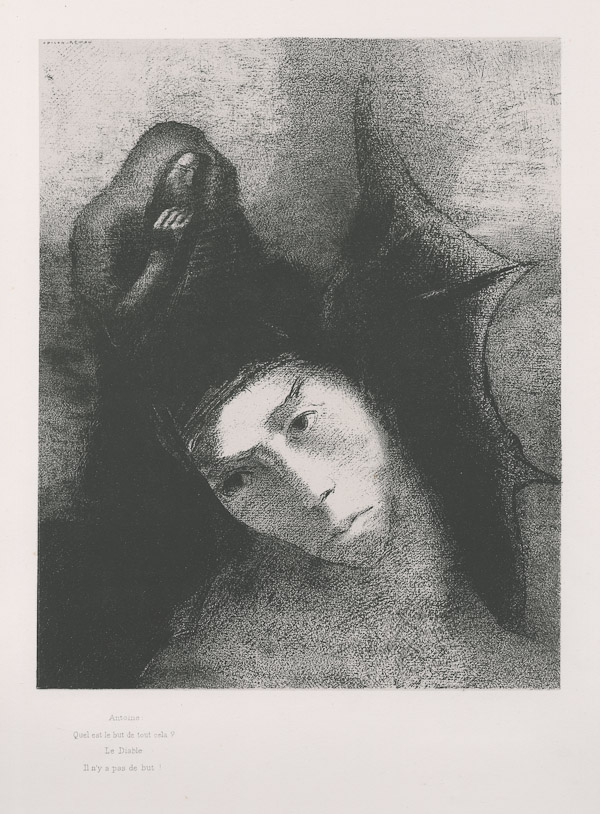
Anthony: What is the purpose of all that? The Devil: There is no purpose.
"Before the beginning he could not have acted;—and now his action would be useless."
Anthony. "Yet he created the world, at one time, by his word only."
The Devil. "But the beings that people the earth come upon it successively. So also, in heaven, new stars arise—different effects of varying causes."
Anthony. "The varying of causes is the will of God!"
The Devil. "But to admit several acts of will in God is to admit various causes, and therefore to deny his unity.
"His will is inseparable from his essence. He can have but one will, having but one essence; and inasmuch as he externally exists, he acts eternally.
"Contemplate the sun! From its surface leap vast jets of flame, casting forth sparks that disperse beyond to become worlds here-after;—and further than the last, far beyond those deeps where thou seest only night, whirl other suns,—and behind them others again, and beyond those yet others ... without end!"
Anthony. "Enough! Enough! I fear!—I will fall into the abyss!"
The Devil (pauses, and rocks Anthony gently in the midst of space).
"Nothingness is—not—there is no void! Everywhere and forever bodies move upon the immovable deeps of space! Were there boundaries to space, it would not be space, but a body only: it is limitless!"
Anthony (stupefied by wonder):
"Limitless!"
The Devil. "Ascend skyward forever and forever,—yet thou wilt not attain the summit. Descend below the earth for billions of billions of centuries: never wilt thou reach the bottom. For there is no summit, there is no bottom; there is no Above, no Below—nor height, nor depth as signified by the terms of human utterance. And Space itself is comprised in God, who is not a portion thereof of such or such a size,—but is Immensity itself!"
Anthony (slowly):
"Matter..., then,... must be a part of God?"
The Devil. "Why not? Canst thou know the end of God?"
Anthony. "Nay: on the contrary, I prostrate, I crush myself beneath his mightiness!"
The Devil. "And yet thou dost pretend to move him! Thou dost speak to him,—thou dost even adorn him with virtues,—with goodness, justice, mercy,—in lieu of recognising that all perfections are his!
"To conceive aught beyond him is to conceive God above God, the Being above the Being. For He is the only being, the only substance.
"If the Substance could be divided, it would not be the Substance, it would lose its nature: God could not exist. He is therefore indivisible as infinite;—and if he had a body, he would be composed of parts, he would not be One—he would not be infinite. Therefore he is not a Person!"
Anthony. "What? my prayers, my sobs, my groans, the sufferings of my flesh, the transports of my love,—have all these things gone out to a lie,—to emptiness, unavailingly—like the cry of a bird, like a whirl of dead leaves?"
(Weeping):
"Oh, no!—there is Some One above all things,—a great Soul, a Lord, a Father whom my heart adores and who must love me!"
The Devil. "Thou dost desire that God were not God;—for did he feel love, or anger, or pity,—he would abandon his perfection for a greater or a lesser perfection. He can stoop to no sentiment, nor be contained in any form."
Anthony. "One day, nevertheless, I shall see him!"
The Devil. "With the blessed, is it not?—when the finite shall enjoy the infinite in some restricted place, containing the Absolute!"
Anthony. "Matters not!—there must be a paradise for the good, as there is a hell for the wicked."
The Devil. "Can the desire of thy mind create the law of the universe? Without doubt evil is indifferent to God,—forasmuch as the Earth is covered with it!
"Is it through impotence that he endures it, or through cruelty that he maintains it?
"Dost thou fancy that he is eternally readjusting the world, like an imperfect machine?—that he is forever watching the movements of all beings, from the flight of a butterfly to the thought of a man?
"If he have created the universe, his providence is superfluous. If Providence exists, then creation is defective.
"But evil and good concern only thee—even like night and day, pleasure and pain, death and birth, which are relative only to one corner of space, to a special centre, to a particular interest. Since the Infinite is permanent, the Infinite is;—and that is all."
(The Devil's wings have been gradually expanding: now they cover all space.)
Anthony (now perceives nothing: a great faintness comes upon him):
"A hideous cold freezes me, even to the depths of my soul! This is beyond the extreme of pain! It is like a death that is deeper than death! I roll in the immensity of darkness; and the darkness itself enters within me. My consciousness bursts beneath this dilation of nothingness!"
The Devil. "Yet the knowledge of things comes to thee only through the medium of thy mind. Even as a concave mirror, it deforms the objects it reflects; and thou hast no means whatever of verifying their exactitude."
"Never canst thou know the universe in all its vastness; consequently it will never be possible for thee to obtain an idea of its cause, to have a just notion of God, nor even to say that the universe is infinite,—for thou must first be able to know what the Infinite is!"
"May not Form be, perhaps, an error of thy senses,—Substance a figment of thy imagination?"
"Unless, indeed, that the world being a perpetual flux[1] of things, appearance, on the contrary, be wholly true; illusion the only reality."
"But art thou sure thou dost see?—art thou even sure thou dost live? Perhaps nothing exists!"
(The Devil has seized Anthony, and, holding him at arms' length, glares at him with mouth yawning as though to devour him):
"Adore me, then!—and curse the phantom thou callest God!"
(Anthony lifts his eyes with a last effort of hope.
The Devil abandons him.)
VII
Anthony (finds himself lying upon his back, at the verge of the cliff.
The sky commences to blanch.)
"Is it the glow of dawn, or only an effect of moonlight?"
(He tries to rise, falls back,—his teeth chattering):
"I feel such a helplessness of weakness, as though all my bones were broken!
"Why?
"Ah! the Devil!—I remember!—he even repeated to me all that I learned from the aged Didymus respecting the opinions of Xenophanes, Heraclitus, of Melissus, of Anaxagoras,—concerning the infinite, the creation, the impossibility of knowing anything!
"And yet I believed that I could unite myself to God!"
(Laughing bitterly):
"Ah! madness! madness! Is the fault mine? Prayer has become intolerable to me! My heart is dry as a rock! Once, it was wont to overflow with love!...
"The sand used to smoke of mornings like the odourous dust of a censer;—at sunset flowers of fire used to bloom upon the cross; and in the middle of the night, it often seemed as though all beings and all things, lying under the same awful silence, were adoring the Lord with me. O charms of prayer, felicities of ecstasy, gifts of heaven,—what have become of you?
"I remember a voyage I made with Ammon in search of a solitary place suited for the establishment of a monastery. It was the last evening; we hastened our steps, walked side by side, murmuring hymns, without conversing. As the sun sank, the shadows of our bodies lengthened like two obelisks, continually growing taller, and moving before us. Here and there we planted crosses, made with fragments of our sticks, to mark the site of a future cell. Night was tardy in her coming; and waves of darkness overspread the earth, even while a vast rose-coloured light still glowed in heaven.
"When I was a child, I used to amuse myself by building hermitages with pebbles. My mother sitting beside me would watch me so attentively!
"Will she not have cursed me for having abandoned her?—will she not have plucked out her white hair by handfuls in the despair of her grief? And her corpse remains lying on the floor of the hut, under the roof of reeds, between the crumbling walls. Through an orifice a hyena, snuffing, thrusts his head, advances his mouth ... horror! horror!"
(Sobbing):
"No: Ammonaria will not have abandoned her! Where is she now,—Ammonaria?
"Perhaps at the further end of a bathroom, she removes her garments one after the other: first the mantle, then the girdle, then the first tunic, the second lighter tunic, all her necklaces,—and the vapour of cinnamon envelops her naked limbs. At last she lies down upon the tepid mosaic. Her long hair spreading below the curve of her hips, seems like a sable fleece; and the oppressiveness of the heated air causes her to pant; her waist arched, her breasts standing out ... What! my flesh rebels again! Even in the midst of grief am I tortured by concupiscence. To be subjected thus unto two tortures at once is beyond endurance! I can no longer bear myself!"
(He leans over, and gazes into the abyss.)
"The man who should fall would be killed. Nothing easier: it were only necessary to roll over upon my left side:—only one movement—one!"
(Then suddenly appears—An Aged Woman. Anthony starts to his feet in affright. It seems to him that he beholds his mother arisen.
But this woman is far older, and prodigiously thin.
A shroud, knotted about her head, hangs down, together with her white hair, so as to cover her legs, slender as crutches. The brilliancy of her ivory-coloured teeth make her earthy skin darker still. The orbits of her eyes are full of shadow; and far back within them two flames vacillate, like the lamps of sepulchres.
She exclaims):
"Advance! What hinders thee?"
Anthony (stammering):
"I fear ... to commit a sin!"
She (replies):
"But King Saul killed himself! Razias, a just man, killed himself! Saint Pelagia of Antioch killed herself! Dommina of Aleppo and her two daughters—all three saints—killed themselves: and remember also how many confessors delivered themselves up to the executioner in their impatient longing for death! That they might enjoy death more speedily, the virgins of Miletus strangled themselves with their girdles. At Syracuse the philosopher Hegesias preached so eloquently upon death that men deserted the lupanars to go hang themselves in the fields. The patricians of Borne sought for death as a new form of debauch."
Anthony. "Aye! the love of death is strong; and many a anchorite has succumbed to it."
The Old Woman. "To do that which will make thee equal unto God—think! He created thee: thou wilt destroy his work—thou! and by thy courage,—of thy own free will! The enjoyment that Erostratus knew was not greater than this. And moreover thy body has so long mocked thy soul that it is full time thou shouldst take vengeance upon it. Thou wilt not suffer. It will soon be over. Of what art thou afraid?—a wide, black hole! Perhaps it is a void!"
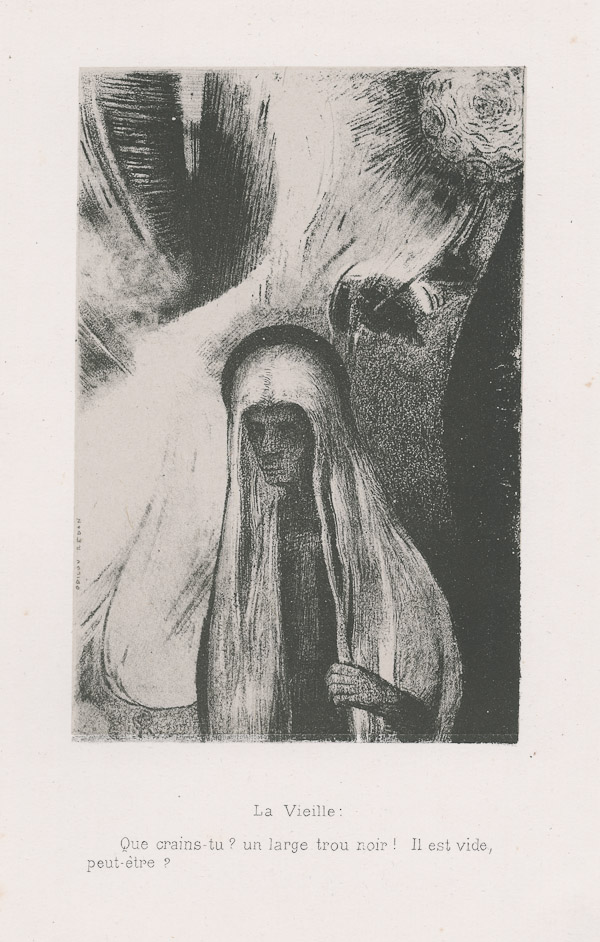
The Old Woman: Of what art thou afraid?—a wide, black hole! Perhaps it is a void!
(Anthony hearkens without replying; and upon the other side appears—
Another Woman—young and marvellously beautiful. At first he takes her to be Ammonaria. But she is taller, blond as honey, very plump, with paint upon her cheeks and roses upon her head. Her long robe, weighty with spangles, gleams with metallic lustre;—her fleshy lips are sanguinolent; and her somewhat heavy eyelids are so drowned with languor that one would almost take her to be blind.
She murmurs):
"Nay, live! enjoy! Solomon counsels joy! Follow the guiding of thy heart and the desire of thine eyes!"
Anthony. "What joy is there for me? My heart is weary; my eyes are dim!"
She (answers):
"Seek the suburb of Racotis; push open a door that is painted blue;—and when thou shalt be in the atrium where a fountain jet murmurs unceasingly, a woman will present herself before thee—in peplos of white silk striped with gold; her hair is unloosed, her laugh like the clatter of crotali. She is skilful. In her caress thou wilt taste the pride of initiation and the appeasement of desire.
"Hast ever pressed to thy bosom a virgin who loved thee? Dost remember the surrenders of her modesty,—the passing away of her remorse in a sweet flow of tears?
"Thou canst even now imagine thyself walking with her—canst thou not?—in the wood by the light of the moon? At each pressure of your joined hands, a sweet shuddering passes through you both,—looking closely into each other your eyes seem to outpour into one another something like immaterial fluid;—and thy heart fills: it bursts: it is a suave whirl of eddying passion, an overflowing of intoxication...."
The Old Woman. "One need not possess joys in order to taste their bitterness! Even to view them from afar off begets loathing of them. Thou must be fatigued by the monotony of the same actions, the length of the days, the hideousness of the world, the stupidity of the sun?"
Anthony. "Aye, indeed!—I loathe all that he shines upon."
The Young Woman. "Hermit! hermit! thou wilt find diamonds among the flints, fountains beneath the sand, a delectation in all the hazards thou dost despise; and there are even upon earth places of such beauty that the sight of them would make thee desire to press the whole world against thy heart with love!"
The Old Woman. "Each evening that thou liest down upon the earth to slumber, thou dost hope that it may soon lie upon thee and cover thee."
The Young Woman. "Yet thou dost believe in the resurrection of the flesh—which is but the translation of life into eternity!"
(Even as she speaks, the Old Woman becomes still more fleshless; and above her skull, from which the white hair has disappeared, a bat circles in the air.
The Young Woman has become fatter. Her robe gleams with shifting colours; her nostrils palpitate, her eyes roll softly.)
The Former (opening her arms, exclaiming):
"Come to me!—I am Consolation, repose, oblivion, eternal calm!"
The Other.
"I am the sleep-giver, life, happiness inexhaustible!"
(Anthony turns to fee from them. Each lays a hand on his shoulder.
The Shroud parts, exposes the Skeleton of Death.
The robe splits asunder, and leaves the whole body of Lust exposed:—her waist is slender; her long and undulating hair flutters in the wind.
Anthony stands motionless between the two, considering them):
Death (says to him):
"What matters it, whether now or at another time! Thou art mine,—like suns, nations, cities, kings, mountain-snows, and the grasses of the fields. I fly higher than the hawks of heaven. I run more swiftly than the gazelle; I overtake even Hope; I vanquished the Son of God!"
Lust. "Resist not! I am the Omnipotent! The forests re-echo with my sighs; the waters tremble with my agitations. Virtue, courage, piety, dissolve in the perfume of my mouth. Man I accompany in every step that he makes; and even from the threshold of the tomb he turns to me!"
Death. "I will find for thee that which thou hast vainly sought for, by the gleam of torches, upon the faces of the dead,—or among those awful sands that are formed of human remains, where thou wast wont to wander beyond the Pyramids. From time to time, the fragment of a skull rolled under thy sandal. Thou didst take up the dust: thou didst let it trickle through thy fingers; and thy thought, blending with it, sank into nothingness."
Lust. "My gulf is deeper! Marbles have inspired loves. Men rush to conjunctures that terrify. Fetters are riveted that the fettered curse. Whence the bewitchment of courtesans, the extravagance of dreams, the immensity of my sadness?"
Death. "Mine irony depasseth all others! There are convulsions of delight at the funerals of kings, at the extermination of a whole people; and war is made with music, with plumes, with harness of gold,—with vast display of ceremony that my due of homage may be greater!"
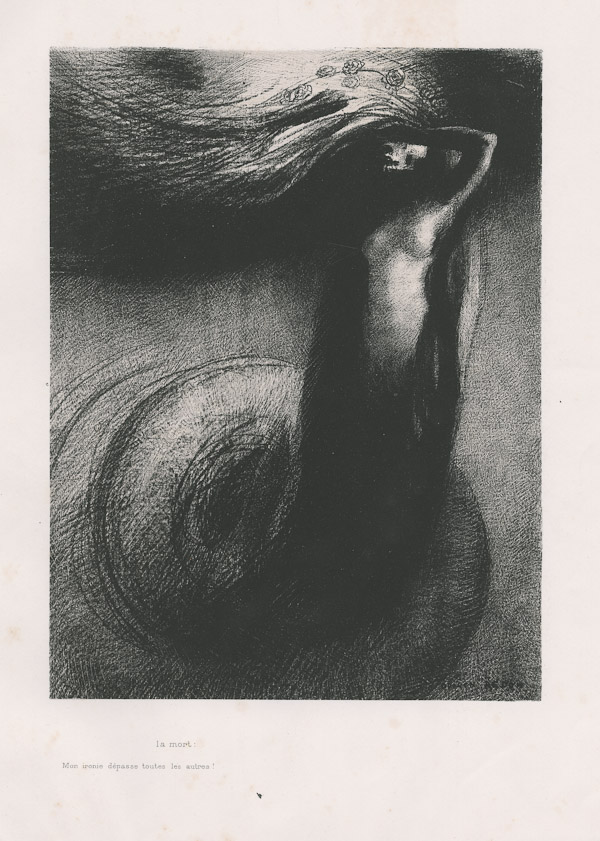
Death: Mine irony depasseth all others!
Lust. "My rage equals thine! I also yell; I bite! I, too, have sweats of agony, and aspects cadaverous!"
Death. "It is I that make thee awful! Let us intertwine!"
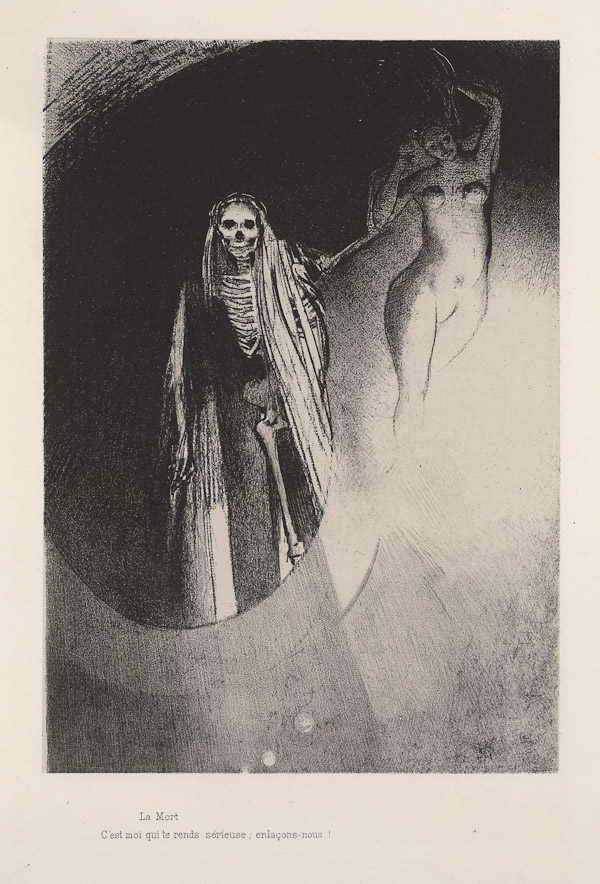
Death: It is I that make thee awful! Let us intertwine!
(Death laughs mockingly; Lust roars. They clasp each other about the waist, and chant alternately):
"I hasten the dissolution of matter!"
"I facilitate the dispersion of germs!"
"Thou dost destroy for my renovations!"
"Thou dost engender for my destructions!"
"Ever-active my power!"
"Fecund, my putrefaction!"
(And their voices, whose rolling echoes fill the horizon, deepen and become so mighty that Anthony falls backward as if thunder-stricken. A shock from time to time causes him to reopen his eyes; and he perceives in the midst of the darkness a manner of monster before him.
It is a skull, crowned with roses, dominating the torso of a woman nacreously white. Below, a shroud starred with specks of gold forms something like a tail; and the whole body undulates, after the fashion of a gigantic worm erect on end.
The vision attenuates,—disappears.)
Anthony (rising to his feet):
"The Devil yet again, and under his two-fold aspect: the spirit of fornication, and the spirit of destruction.
"Neither affrights me! I repel happiness; and I know myself to be eternal.
"Thus death is only an illusion, a veil-masking betimes the continuity of life.
"But Substance being unique, wherefore should forms be varied?
"Somewhere there must be primordial figures, whose bodily forms are only symbols. Could I but see them, I would know the link between matter and thought; I would know in what Being consists.
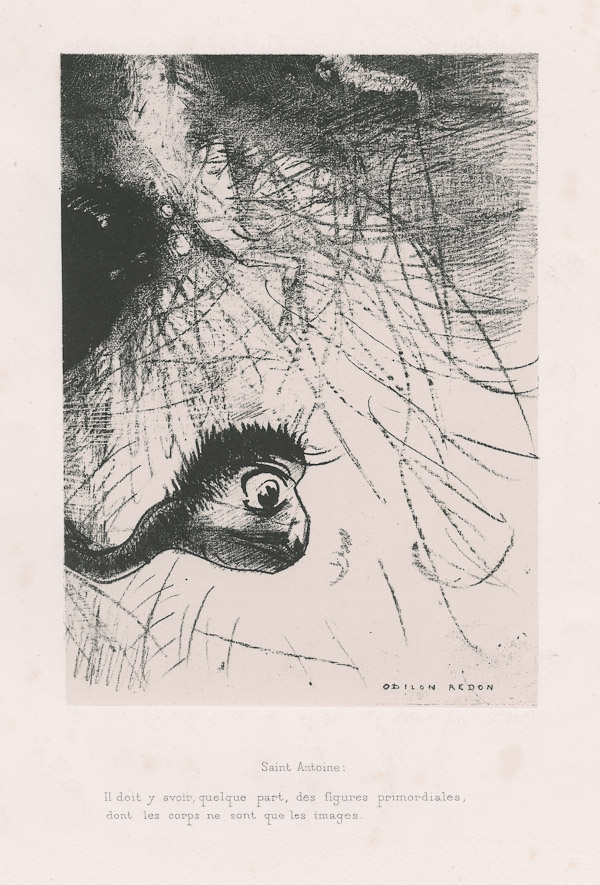
Anthony: Somewhere there must be primordial figures, whose bodily forms are only symbols
"Such were the figures painted at Babylon upon the walls of the temple of Belus; and others like them covered a mosaic in the port of Carthage. I myself have sometime beheld in the sky, as it were, forms of spirits. Those who cross the desert meet with animals surpassing all conception...."
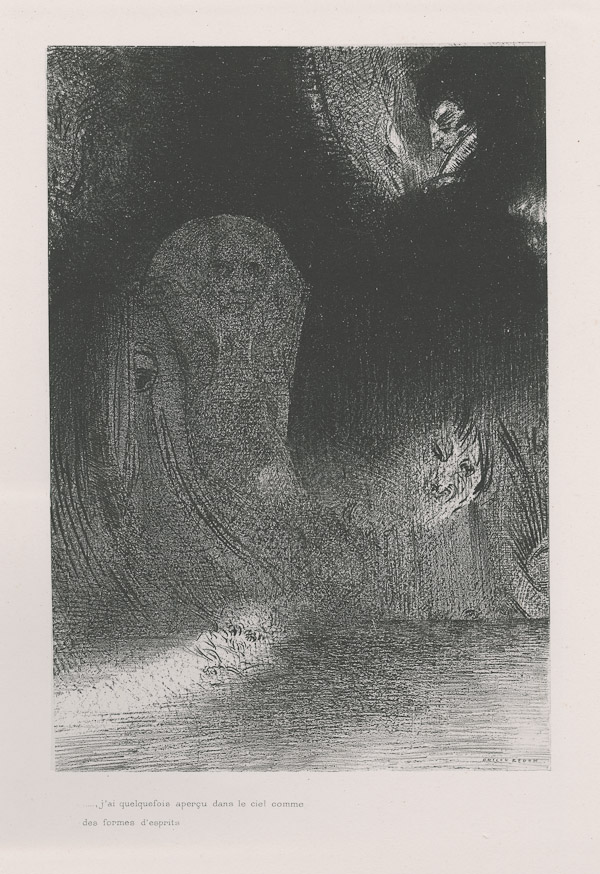
I myself have sometime beheld in the sky, as it were, forms of spirits
(And opposite, upon the further side of the Nile, suddenly appears the Sphinx.[1] He stretches his paws, shakes the bandelets upon his forehead, and crouches upon his belly.
Leaping, flying, spitting fire through her nostrils, lashing her winged sides with her dragon-tail, the green-eyed Chimera circles, barks.
The thick curls of her head tossed back upon one side mingle with the hair of her loins; on the other side they hang down to the sand, quivering with the swinging of her body, to and fro.)
The Sphinx (remaining motionless, and gazing at the Chimera):
"Hither, Chimera! rest awhile!"
The Chimera. "No! never!"
The Sphinx. "Do not run so fast, do not fly so high, do not bark so loudly!"
The Chimera. "Do not call me!—call me no more; since thou must remain forever dumb."
The Sphinx. "Cease casting thy flames in my face, and uttering thy yells in my ear: thou canst not melt my granite."
The Chimera. "Thou shalt not seize me, terrible sphinx!"
The Sphinx. "Thou art too mad to dwell with me!"
The Chimera. "Thou art too heavy to follow me!"
The Sphinx. "Yet whither goest thou, that thou shouldst run so fast?"
The Chimera. "I gallop in the corridors of the Labyrinth—I hover above the mountains—I graze the waves in my flight—I yelp at the bottom of precipices—I suspend myself with my mouth from the skirts of clouds—I sweep the shores with my dragging tail; and the curves of the hills have taken their form from the shape of my shoulders! But thee I find perpetually immobile, or perhaps making strange designs with thy claws upon the sand."
The Sphinx. "It is because I keep my secret;—I dream and calculate.
"The sea returns to its bed; the wheat bends back and forth in the wind; the caravans pass by; the dust flies; cities crumble; and yet my gaze, which naught can deviate, remains fixed, gazing through all intervening things, upon a horizon that none may reach."
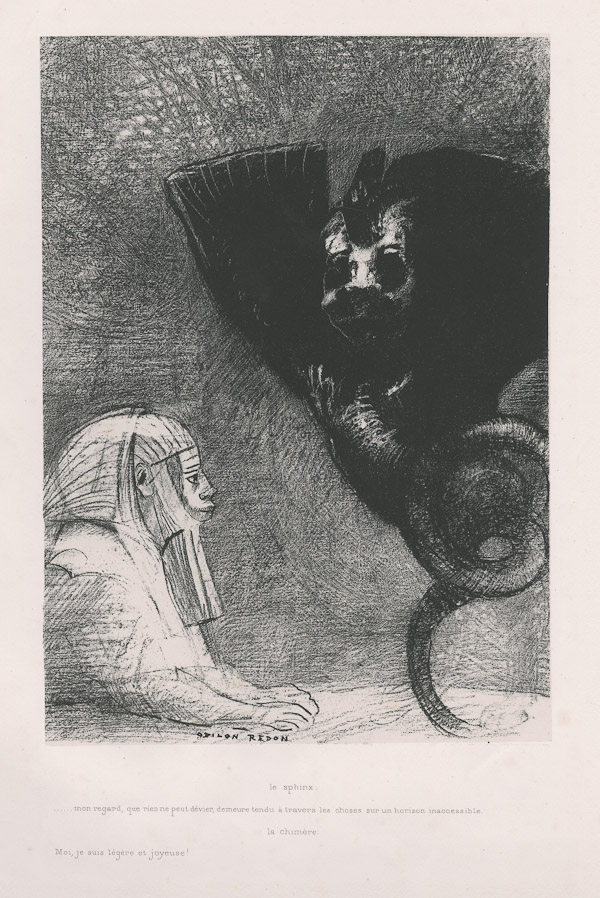
The Sphinx: ... and yet my gaze, which naught can deviate, remains fixed, gazing through all intervening things, upon a horizon that none may reach. The Chimera: I am light and joyous!
The Chimera. "I am light and joyous! I offer to the eyes of men dazzling perspectives with Paradise in the clouds above, and unspeakable felicity afar off. Into their souls I pour the eternal madnesses; projects of happiness, plans for the future, dreams of glory and vows of love, and all virtuous resolutions.
"I urge men to perilous voyages and great enterprises. I have chiselled with my claws the wonders of architecture. It was I who suspended the little bells above the tomb of Porsenna, and surrounded the quays of Atlantis with a wall of orichalcum.
"I seek for new perfumes, for vaster flowers, for pleasures never felt before. If I perceive in any place a man whose mind reposes in wisdom, I fall upon him, and strangle him."
The Sphinx. "All those tormented by the desire of God, I have devoured.
"In order to climb up to my royal brow, the strongest ascend upon the flutings of my bandelets as upon the steps of a stairway. Then a great lassitude comes upon them, and they fall backward."
(Anthony begins to tremble.
He is no longer before his cabin, but in the desert itself, with those two monsters beside him, whose breath is hot upon his shoulders.)
The Sphinx. "O thou Fantasy, bear me away upon thy wings that my sadness may be lightened!"
The Chimera. "O thou Unknown, I am enamoured of thine eyes! Like a hyena in heat I turn about thee, soliciting those fecundations whereof the desires devour me!
"Ope thy mouth, lift thy feet—mount upon my back!"
The Sphinx. "My feet, since they have been outstretched, can move no more. The lichen, like an eruption, has formed upon my jaws. By dint of long dreaming I have no longer aught to say."
The Chimera. "Thou liest, hypocrite Sphinx! Wherefore dost thou always call me and always disown me!"
The Sphinx. "It is thou, indomitable caprice, that dost forever pass and repass, whirling in thy course!"
The Chimera. "Is the fault mine? What? Let me be!"
(She barks.)
The Sphinx. "Thou movest away! thou dost escape me!"
(He growls.)
The Chimera. "Essay!—Thou crushest me!"
The Sphinx. "Nay!—impossible!"
(And gradually sinking down he disappears in the sand; while the Chimera, ramping with tongue protruding, departs, describing circles on her way.
The breath of her mouth has produced a fog.
Through this mist Anthony perceives wreathings of clouds, undecided curves.
At last he can distinguish something like the appearance of human bodies.
And first:—
The Astomi—approach, like bubbles of air traversed by sunlight. They cry):
"Do not breathe too hard! The drops of rain bruise us, false notes excoriate us, darknesses blind us! Composed wholly of breezes and of perfumes, we float along, we roll along:—a little more than Dreams, yet not quite beings...."
The Nisnas
(have only one eye, one cheek, one hand, one leg, half a body, half a heart. They say):
"We live quite in our halves of houses, with our halves of wives and our halves of children!"
The Blemmyes
(who have no head at all):
"Our shoulders are all the broader;—and there is no ox, rhinoceros, or elephant able to carry what we carry.
"Something dimly resembling features—as it were a vague face—imprinted upon our breasts: that is all! We think digestions; we subtleize secretions. God, in our belief, floats peacefully within the interior chyles.
"We go straight upon our way, through all mires, crossing all morasses, skirting the edges of all abysses: and we are the most laborious, the most happy, the most virtuous of all peoples!"
The Pygmies:
"We, good little men, swarm upon the world like vermin upon the hump of a dromedary.
"We are burned, drowned, crushed; and we always reappear, more vivacious and countless than before—terrible by reason of our numbers!"
The Sciapods:
"Fettered to the earth by our hair, long as lianas, we vegetate beneath the shelter of our feet, broad as parasols; and the light comes to us through the thickness of our heels. No annoyances for us, no work! The head as low as possible—That is the secret of happiness."
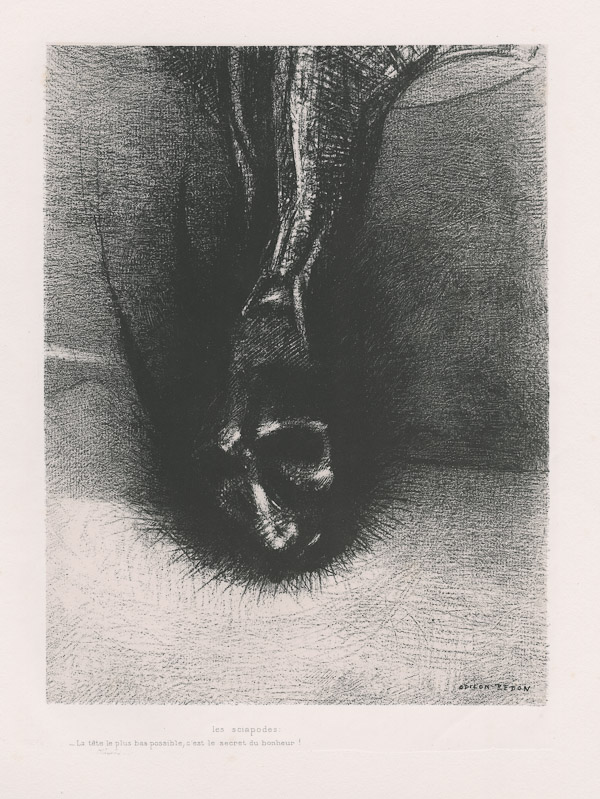
The Sciapods: The head as low as possible—That is the secret of happiness.
(Their lifted thighs,—resembling the trunks of trees,—multiply.
And a forest appears. Great apes clamber through it on all fours:—these are men with the heads of dogs.)
The Cynocephali:
"We leap from branch to branch in search of eggs to suck; and we pluck the little fledglings alive; then we put their nests upon our heads in lieu of caps.
"We tear off the teats of cows; and we put out the eyes of lynxes: we let fall our dung from the heights of the trees—we parade our turpitude in the full light of the sun.
"Lacerating the flowers, crushing the fruits, befouling the springs, violating women, we are the masters of all,—by the strength of our arms, and the ferocity of our hearts.
"Ho! companions!—gnash with your jaws!"
(Blood and milk pour down their chops. The rain streams over their hairy backs.
Anthony inhales the freshness of the green leaves.
There is a movement among them, a clashing of branches; and all of a sudden appears a huge black stag, with the head of a bull, having between his ears a thicket of white horns.)
The Sadhuzag:
"My seventy-four antlers are hollow like flutes.
"When I turn me toward the wind of the South, there issue from them sounds that draw all the ravished animals around me. The serpents twine about my legs; the wasps cluster in my nostrils; and the parrots, the doves, the ibises, alight upon the branches of my horns.
"Listen!"
(He throws back his horns, whence issues a music of sweetness ineffable.
Anthony presses both hands upon his heart. It seems to him as though his soul were being borne away by the melody.)
The Sadhuzag:
"But when I turn me toward the wind of the North, my antlers, more thickly bristling than a battalion of lances, give forth a sound of howlings: the forests are startled with fear; the rivers remount toward their sources; the husks of fruits burst open; and the bending grasses stand erect on end, like the hair of a coward.
"Listen!"
(He bends his branching antlers forward: hideous and discordant cries proceed from them. Anthony feels as though his heart were torn asunder.
And his horror augments upon beholding)—
The Martichoras
(A gigantic red lion, with human face, and three rows of teeth):
"The gleam of my scarlet hair mingles with the reflection of the great sands. I breathe through my nostrils the terror of solitudes. I spit forth plague. I devour armies when they venture into the desert.
"My claws are twisted like screws, my teeth shaped like saws; and my curving tail bristles with darts which I cast to right and left, before and behind!
"See! see!"