COMPENSATION FOR OCCUPATIONAL DISEASES
Reading edition
JOHN B. ANDREWS
SECRETARY AMERICAN ASSOCIATION FOR LABOR LEGISLATION
The introduction in Congress of a bill which extends the workmen's compensation principle to embrace occupational diseases places before the American people an entirely new range of problems in the field of social insurance.
The federal government since 1908, and fifteen states during the past two years, have recognized the wisdom and justice of the compensation principle in dealing with the victims of industrial accidents. Now comes the demand that the American people, through Congress, adopt exactly the same principle in dealing with federal employees who are incapacitated for work by occupational diseases.
What is the present situation?
"The government gives no compensation for lead poisoning because, technically, it is not an accident, which is true, for under the circumstances it is a dead certainty."
—This quotation from the report of an investigator for the New York State Factory Investigating Commission is neither a playful nor an exaggerated statement. On the contrary, we now have complete confirmation of its truth in the official report and in the sober legal phrase of the solicitor for the Department of Commerce and Labor.[6]
It all came about in this way. A man named Schroeder went to work in the federal navy yard at Brooklyn. One of our big war ships, the Ohio, came to the dock and Schroeder was sent down into the water-tight compartments called "coffer-dams" to burn off the old coat of paint in preparation for a new. As a result of breathing the fumes of the lead paint, Schroeder was incapacitated for work by acute lead poisoning. He lost thirty-seven days on this account, and he applied to the government for the payment of compensation equal to the wages he had lost.
This statement was made by the attorney for the United States government:
"The question in this case is whether acute lead poisoning contracted in the course of employment is an injury within the meaning of the compensation act. If the inhalation of noxious gases is a necessary incident to the workman's employment, there can be nothing accidental in the injury resulting therefrom. This latter consideration disposes of the present case....
"It cannot be said that these fumes were inhaled by accident. The fumes were necessarily produced by the work he was engaged upon. The inhalation of such fumes was to have been expected and probably could not have been avoided. Lead poisoning, under the circumstances, was the natural, if not the inevitable, result."
Schroeder got not one penny.
Aside from the fact that lead poisoning in this case was really preventable; aside from the fact that several enlightened nations have absolutely prohibited the use of poisonous lead paints for the interior of their war ships, and aside from the fact that there was no one to warn Schroeder of the dangerous nature of his occupation, there is one big final reason why this decision of Uncle Sam's Attorney was even more unfortunate than it was necessary. The financial cost of this unnecessary case of acute lead poisoning, in addition to the personal suffering, fell upon poor Schroeder. Most men will agree that such financial losses should fall upon the employer. In this case the employer was the nation, which means all of us, you and me.
We owe Schroeder something more than an apology. While the federal government is publishing excellent reports on lead poisoning in the factories of private employers and is translating and distributing in fat volumes the workmen's compensation laws of European countries, can the United States afford to do less than make provision for reasonably safe work places in the government service? And can this country afford to ignore the good example of these European laws which provide compensation for such victims of occupational diseases?
A few months after the unfortunate Schroeder case a man named Hill was employed at placing floor plates in the engine room of the war ship St. Louis in the Puget Sound Navy Yard. Meantime, red and white lead paint was being applied in the bilges of the vessel.
"As a result of this exposure to lead fumes, a sufficient amount of lead was taken into claimant's system to produce 'toxic amblyopia, both eyes,'"
which means
"disease of vision from imperfect sensation of the retina, without organic lesion of the eye."
This disease incapacitated Hill on the thirteenth day after his first exposure to the poison. The exposure lasted only seven days. Said the solicitor:
"It is accordingly possible to refer the claimant's injury to an event capable of being fixed in point of time. In the second place, the injury to the claimant's eyes was neither reasonably to be expected, nor the natural or inevitable consequence of the work he personally was engaged upon. The injury must therefore be ascribed to accident. The claimant's particular work had nothing to do with the painting operations going on about him. His work as a ship fitter related to the laying of places in the boiler room; the painting was being done by others."
And this claim was approved.
But if, instead of Hill, one of the painters had been poisoned and incapacitated by the fumes of lead paint, a similar claim would not have been allowed by the solicitor. This is made perfectly clear by his decision in the John Freiman case.
John was a laborer in the Boston Navy Yard, and it was his duty to scale off lead-painted compartments on ships. He became incapacitated by "lead poisoning contracted in the course of his employment," and his superior officer certified that the injury was not due to negligence or misconduct. After John had suffered several weeks as a result of "painter's colic" and chronic lead poisoning, his claim was submitted. It was necessary to decide whether the law applies to disease due to the occupation. The solicitor declared:
"There is no such special provision made, and I can find nothing which would, in my judgment, justify its application to a case of lead poisoning or 'painter's colic.'"
The difficulties involved in legal technicalities become apparent. The following story, verbatim from the government report (page 201), about William Murray, who suffered with compressed air illness, strikingly illustrates the point:
"The claimant in this case is a laborer employed by the Reclamation Service, at Arizona shaft, Colorado River siphon. The claimant's duties required him to work in compressed air. In consequence, he was attacked with 'a severe case of bends,' which 'settled in nearly all parts of the body.' When originally presented the claim was disallowed on the ground that the bends is a disease, and diseases contracted in the course of employment as distinguished from injuries of an accidental nature are not within the operation of the compensation act. A reconsideration of this action 'with a view to the allowance of the claim, if the same is deemed to come within the letter of the statute as it seems to come within its spirit,' is now requested by the secretary of the interior, who writes that a refusal to approve this claim may cause a number of men to leave the work, as, on account of the bends, it is generally regarded as very hazardous."
And the former decision was reversed!
The solicitor has passed upon other cases of occupational disease, with some decidedly interesting results.
Mary A. Crellin was a folder of heavy paper at the Government Printing Office. Continuous strain upon her fingers and wrist caused a degeneration of the tendon sheath. A tumor or cystic growth developed. Mary was obliged to have it surgically removed. Then she thought the government, and not she, ought to stand the loss of wages due to her incapacity. This attracted attention. Said the medical officer of the Government Printing Office:
"This is the first case that I ever observed or noticed among folders, until I examined a number of skilled female laborers employed in this office upon the same vocation—that of folding sheets of paper—of which five presented a similar condition, but of such size as not to interfere with the manipulation of the hand."
The solicitor decided that in this tendon degeneration there was "no accidental element." It was "not due to injury." It was "due to excessive use" in the service of Uncle Sam. Mary's claim was denied.
Another case—a plate printer, J. B. Irving, who was on the night force in the Bureau of Engraving and Printing. In the course of a night he printed 900 sheets, and as he handled each sheet he looked for a few seconds at a bright engraved plate which reflected into his eyes. One night last March the bureau tried out some new electric lights, and their use was continued three successive nights. Irving thereupon stopped work, and the doctor diagnosed his case as "Retinitis conjunctivitis, both eyes." He was unable to keep his eyes open in a bright light. After investigation, the solicitor decided that in this case compensation should be granted on the ground that the injury was not anticipated, nor was it the result of any slow accumulation of trifling injuries.
Sunstroke, which is known as a disease, is compensated under the act. The straining of the ligaments about the wrist, known as "synovitis of the wrist" and scheduled as a disease under the British act, has been compensated. "Vaccinia" from vaccination is compensated. A long-standing case of flat-foot was compensated, even though the use of a simple wedge made the injured one better than before.
John Sheeran, who contracted pneumonia due to exposure at the Soo Canal, was denied compensation. But J. B. Atkinson, who fell from a ladder and continued to work 181 days thereafter, until typhoid fever took him off within a week, "died by reason of his injury," because the fall "lowered his vitality, ... which rendered him peculiarly susceptible to typhoid infection, ... which resulted in his death."
The question may fairly be raised as to whether it is not a bit unfair to an administrative official to place him under the embarrassment of interpreting a statute so as to cover, for example, some but not all cases of industrial lead poisoning. Would it not be much better plainly to include occupational diseases in the law?
After more than four years of experience under the present law the government recently published the first official report upon its operation. Sixty-six closely printed pages of this report are devoted to embarrassing questions which have arisen because of claims arising out of occupational diseases. The administration in its awards has been as liberal as could be expected under the unfortunate legislative restrictions. The solicitor for the department has taken a keen interest in its operation. He has been faithful and alert. One of his most urgent recommendations for a change in the law is that it be extended to embrace occupational diseases.
The present federal law is known as the Workmen's Compensation Act of May 30, 1908, and is America's pioneer compensation law. It was a step forward, but only a step. Fortunately, state legislatures have not copied its main provisions, for they are totally inadequate. This federal law applies to only about one-third of our 350,000 civilian employees. It grants no relief for incapacity lasting less than fifteen days, it makes no provision for medical treatment, and one year's wages is the maximum benefit even for total blindness or death. In fact, the present law is so deficient that its original sponsors now waste no words in its defense, but frankly apologize for its shortcomings. "Not a revision," says one in a position to know, "but a new law is needed."
The draft of a new law, prepared after months of careful investigation of experience of this and all other compensation acts, and drafted with infinite care at the instigation of the Association for Labor Legislation, has been introduced in Congress by Senator Kern. Surely the United States should now provide for its own government employees incapacitated by industrial accidents and occupational diseases a system of safety and sanitation coupled with compensation at least equivalent to that furnished by the most progressive nations of the world. The bill now before Congress offers this immediate opportunity.
Nor can the state legislatures longer ignore the injustice of this arbitrary distinction between accidents and diseases due to the peculiar conditions of employment.
In a pamphlet on Industrial Diseases and Occupational Standards, published in May, 1910, the writer urged immediate consideration of this problem, and said:
"No intelligent person can go far in the study of compensation for industrial accidents without realizing that a logical consideration of the facts must lead likewise to compensation for industrial diseases."
Since then three momentous years have passed. One state after another is preparing to meet this problem, which becomes steadily more pressing. One of the three great national political parties now pledges itself to work unceasingly in state and nation for trade disease compensation. Wisconsin has the promise of relief in the political platform of the present administration; Ohio, by recent constitutional amendment, is prepared for action; Pennsylvania is following this example; several states, including Massachusetts and Michigan, by a liberal interpretation of present laws, are coquetting with the issue; New Hampshire has boldly introduced specific legislation on the subject.[7]
Leading countries of Europe have already taken this step. Great Britain in her Workmen's Compensation Act of 1906, in addition to accidents, included in the first schedule six diseases of occupation. That schedule has been extended until it now includes no less than twenty-four distinct maladies due to peculiar conditions of employment. Germany, as a result of the experience of a quarter of a century, in her new imperial code expressly has declared for similar action. Switzerland, in her system accepted by referendum vote in February, 1912, makes like provision for insurance against occupational diseases. The government of Holland, in November, 1912, laid before Parliament a bill to regulate the insurance of workmen against industrial diseases in connection with the proposed sickness insurance.
DOUBLE WRIST-DROP Hands of workman paralyzed for sixteen years as result of lead poisoning. Five of his fellow workmen were killed by lead poisoning before they were forty. Victims of lead poisoning are not compensated under American laws because technically an occupational disease is "not an injury."
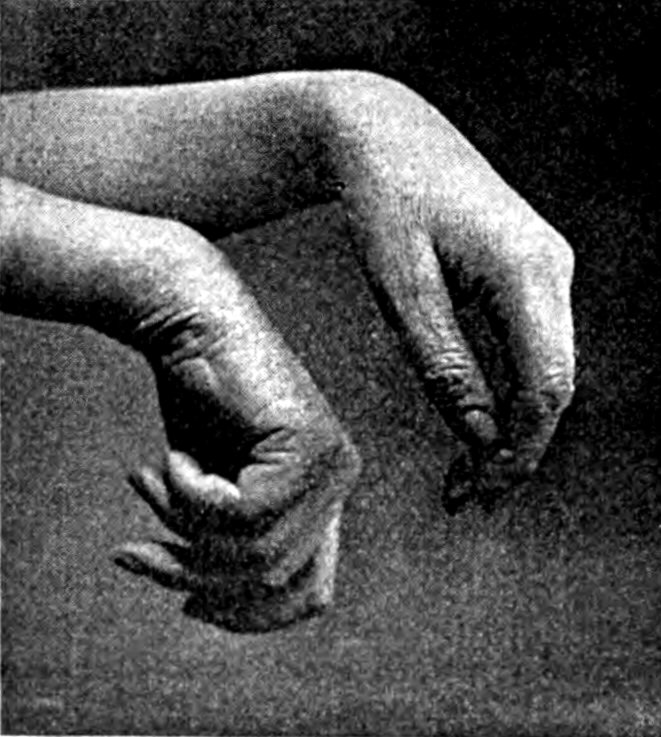
The arguments used so effectively by advocates of compensation for accidents, and now so generally accepted by all men, apply with even greater force in the consideration of relief for the victims of occupational diseases. No one will doubt, for example, that placing the financial cost of lead poisoning upon the lead industry will promote greater cleanliness in the lead trades. It will pay to clean up. A considerable part of the money now paid to employers' liability companies and to ambulance chasers could, under a just system of compensation, go where it belongs—to the injured workman or his family. Expensive, annoying, and unsatisfactory litigation could be reduced to a minimum. Information concerning special danger points in industry would be automatically pointed out to the factory inspectors in a manner both prompt and sure. Unnecessary occupational diseases would then be prevented, and that is the real problem.
The principle is admitted that workmen should be compensated for injuries by accident arising out of their employment. It is only consistent that incapacity caused by diseases due to the employment should also be included. Some diseases are, in the ordinary use of the term, accidental. But many people work where trade diseases of an insidious nature are contracted and where there is constant risk of illness on that account. These diseases are as serious as accidents. There is no social justification for drawing an arbitrary line of distinction—the principle of compensation is no longer in an experimental stage. A compensation law should include, says Sir Thomas Oliver, the leading English authority on the subject, "industrial diseases, the consequences of which may be immediate or remote, and which are often more severe than accidents."
It must be admitted that even our discredited system of employers' liability has afforded occasional relief to the victims of accidents. But even this uncertain and irregular protection, poor as it is, has in most instances been denied to workers exposed to the creeping horror of industrial disease. The exact occupational cause of the affliction is, of course, more difficult to prove. The employee is thus placed at still greater disadvantage in dealing with his employer. American judges, basing their opinions on outgrown decisions of the British House of Lords, have declared that "industrial injuries" include only those afflictions of an accidental nature whose cause can be ascribed to a definite point of time, and have thus almost universally barred even from the occasional and expensive relief of employers' liability the victims of such typical maladies as the match maker's "phossy jaw," the lead worker's "wrist-drop" and painter's colic, the boiler maker's deafness, the glass worker's cataract, the potter's palsy, the hatter's shakes, and the compressed air worker's bends.
The public has not yet forgotten pitiful cases where match manufacturers, through the work of their attorneys, were able to deny all financial relief to their victims of "phossy jaw." And there are cases now pending in the courts where men totally blinded by the fumes of wood alcohol have year after year sued in vain for some financial relief from brewery companies which employed them to varnish the inside of beer vats.
Occasionally, however, large awards have been made. But they, as in the case of damage suits arising out of accidents, encourage further expensive litigation. One case of wood alcohol poisoning in Ohio (Joseph Frank vs. The Herancourt Brewing Co., 82 O. S., 424) is now a matter of record. The Supreme Court compelled the employer to pay $12,500, with interest and costs, aggregating over $15,000.
"After five years of litigation, six hearings in three different courts, including two trips to the Supreme Court, printing of several thousand pages of record testimony and briefs, taking voluminous depositions in different parts of the country involving great expense, during which the injured workman—in this instance rendered blind—was totally unable to support his wife and family, the wife being obliged to work at nights in downtown cafes, scrubbing floors after midnight, in order to provide scant food for herself and babies while the latter slept."
This verdict is of peculiar interest, according to the well-known Cincinnati law firm which prosecuted the case, because it is the first instance so far as they have been able to ascertain in which there has been a recovery from injuries resulting from the poisonous influence of wood alcohol.
But do not be misled by this rare case. And do not hastily conclude that the new state insurance law in Ohio has rendered justice in such cases more certain, for the contrary is true. A victim of industrial lead poisoning appealed to the state board under that law, and the attorney general, on October 26, 1912, ruled that disability due to lead poisoning was an occupational disease and "not an injury" under the act. Similar decisions have been made by the Washington State Insurance Department.
In fact, with the exception of occasional instances in two or three states, where claims have been paid by employers without protest, the victims of occupational diseases in America are still practically without relief.