A JUDGE LINDSEY OF THE "IDLE FORTIES"
Reading edition
LAURA B. EVERETT
Under the colorless title Three Years in California was published in 1850 the diary of Walter Colton, elected Alcalde of Monterey in 1846, who, during his term of office presented what was, for that day, a singular spectacle of tolerance, humanity and purity of administration. He can, indeed, be reasonably compared with Judge Lindsey in the courage and originality displayed in his dealings with the criminal cases brought before him.
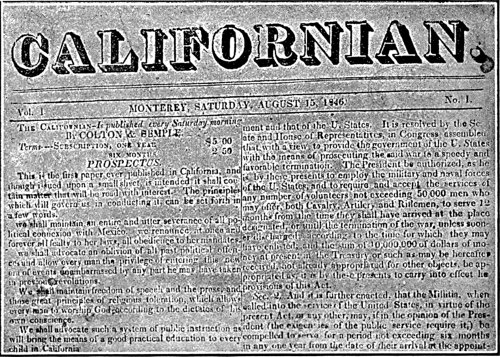
Colton's work in Monterey succeeded a period spent as editor of the Philadelphia North American, and he established later The Californian, the first newspaper published in California.
The office of the Alcalde combined administrative and judicial functions and, not seldom, even legislative ones. Colton was oppressed by his power and its responsibility. "Such absolute disposal of questions affecting property and personal liberty," he observes, "never ought to be confided to one man. There is not a judge on any bench in England or the United States whose power is so absolute as that of the Alcalde of Monterey." But he brought to his work in all its details an unflagging zeal and constant personal attention which made his administration unique in the history of the time.
In minor matters, where, as he says, "the Alcalde is himself the law," Colton devised methods of appealing to the better instincts of the wrongdoer. "There is a string in every man's breast," he writes, "which, if you can rightly touch, will 'discourse music.'" Colton, we see from his diary, put a sensitive finger on this string in many a heart.
His ideas of punishment belong to the present. "It is difficult," he says, "to discriminate between offences which flow from moral hardihood and those which result in a measure from untoward circumstances. There is a wide difference between the two; and an Alcalde under the Mexican law has a large scope in which to exercise his sense of moral justice. Better to err a furlong with mercy than a fathom with cruelty. Unmerited punishment never yet reformed its subject; to suppose it is a libel on the human soul."
The following extracts from his account of cases brought before him are representative:
"A lad of fourteen years was brought before me today charged with stealing a horse. The evidence of the larceny was conclusive, but what punishment to inflict was the question. We have no house of correction, and to sentence him to the ball and chain on the public works, among hardened culprits, was to cut off all hope of amendment and inflict an indelible stigma on the youth; so I sent for the father, who had no good reputation himself, and placing a riata in his hand, directed him to inflict twenty-four lashes on his thieving boy. He proceeded as far as twelve, when I stopped him; they were enough. They seemed inflicted by one attempting to atone in this form for his own transgressions. 'Inflict the rest, Soto, on your own evil example; if you had been upright yourself, you might expect truth and honesty in your boy. You are more responsible than this lad for his crime; you can never chastise him into the right path, and continue yourself to travel in the wrong.'"
"Today I remitted the sentence of my prison cook. He is a Mulatto, a native of San Domingo; had drifted into California, was attached in a subordinate capacity to Colonel Fremont's battalion; and while the troops were quartered in town had robbed the drawer of a liquor shop of two hundred dollars. For this offence I had sentenced him to two years on the public works. Discovering early some reliable traits about the fellow, ... I soon made him cook to the rest of the prisoners, and allowed him the privilege of the town, so far as his duties in that capacity were required.... I have trusted him with money to purchase provisions, and he has faithfully accounted for every shilling. He has always been kind and attentive to the sick. For these faithful services I have remitted the remainder of his sentence, which would have confined him nine months longer, and have put him on a pay of thirty dollars per month as cook."
The Alcalde settled family difficulties of all varieties, from the case of the grown son who struck his mother to that of the man who wanted a divorce because of suspicions he entertained of his wife's conduct during his absence in Mexico. The judge questioned the plaintiff severely as to his own behavior during the stay in Mexico, and convinced him that the wife, though indiscreet, was too good for him.
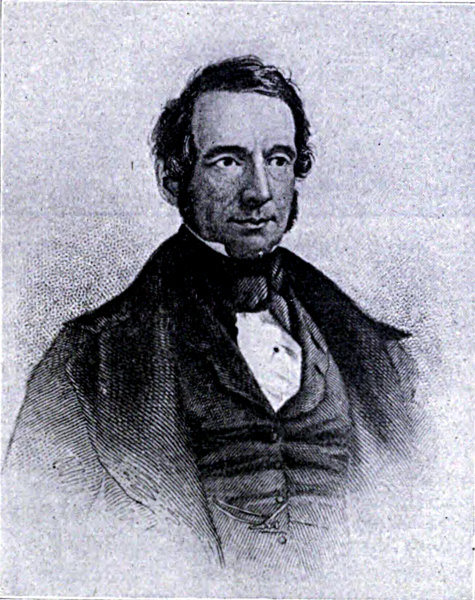
From "Sea and Shore" WALTER COLTON Alcalde of Monterey in 1846. The position combined administrative, judicial and even legislative duties.
After nearly six months as Alcalde, Colton writes:
"Of the women I have had to deal with here the washerwomen are the most unmanageable. Two of them entered my office today as full of fight as the feline antagonists of Kilkenny. It seems they had been washing in one of the pools created by the recent showers, when one had taken that part of the margin previously occupied by the other. War offensive and defensive immediately commenced. One drew a knife which had a blade two mortal inches in length, and the other a sharp ivory bodkin. But what their weapons wanted in terror, their ungentle anger supplied.
"At last one cried out: 'The Alcalde'; the other echoed it, and both rushed to the office to have their difficulties settled. Their stories ran together like two conflicting rivulets forced into the same channel. When the tumult and bubble had a little subsided, I began cautiously to angle for the truth—a difficult trout to catch in such waters. But one darter after another was captured, till I had enough to form some opinion of those that had escaped. These we discussed till bitter feeling, like biting hunger, became appeased. Both went away declaring either margin of the pool good enough, and each urging on the other the first choice."
One deficiency which Colton had to supply was the absence of a penitentiary system. To quote:
"There are no workhouses here, no buildings adapted to the purpose, no tools and no trades. The custom has been to fine Spaniards and whip Indians. The discrimination is unjust, and the punishment ill-suited to the ends proposed. I have substituted labor, and now have eight Indians, three Californians, and one Englishman at work making adobes [sun-dried bricks]. They have all been sentenced for stealing horses or bullocks. I have given them their task; each is to make fifty adobes a day, and for all over this they are paid. They make seventy-five, and for the additional twenty-five each one gets as many cents. This is paid to them every Saturday night, and they are allowed to get with it anything but rum. They are comfortably lodged and fed by the government. I have appointed one of their number captain. They work in the field; require no other guard; not one of them has attempted to run away."
Later, Colton had to deal with runaways; two Mexicans each telling him that the devil incited their flight, while one fellow who stayed behind in a jail delivery explained that he would not be seen running from Tophet in such company.
Of a convict who escaped and was brought back Colton says:
"If he will only stop stealing he may run to earth's utmost verge. He is rather a hardened character, but if he has a good vein in him I will try to find it. I always like to see a fellow get out of trouble, and sometimes I half forget his crimes in his misfortunes. This is not right, perhaps, in one situated as I am; but I cannot help it."
THE FIRST PAPER PUBLISHED IN CALIFORNIA It measured only about 8x12 inches. The paper was established by Walter Colton who had had journalistic experience as editor of the Philadelphia North American. This issue was published scarcely a month after the American occupation.
Colton decided that a new school house was necessary—"to be sixty feet by thirty, two stories, with a handsome portico. The labor of the convicts, the taxes on rum, and the banks of the gamblers must put it up," he writes. "Some think my project impracticable; we shall see,"—and he gives the following account of how some gamblers were made to contribute to this enterprise:
"A nest of gamblers arrived in town yesterday, and last evening, opened a Monte at the hotel."
After stationing a file of soldiers at the outer doors, Colton entered to find no one, "save one Sonoranian, composedly smoking his cigarito. I desired the honor of an introduction to his companions. At this moment a feigned snore broke on my ear from a bed in the corner of the apartment."
"'Ha! Dutre, is that you? Come, tumble up, and aid me in stirring out the rest.' He pointed under the bed, where I discovered a multitude of feet and legs radiating as from a common center."
"'Hallo there, friends—turn out.'... Their plight and discovery threw them into a laugh at each other." He and his secretary found others "in every imaginable position—some in the beds, some under them, several in the closets, two in a hogshead, and one up a chimney. Mr. R—— from Missouri—known here as the 'prairie-wolf'—I found between two bed-ticks, half smothered with the feathers. He was the ringleader, and raises a Monte table wherever he goes, as regularly as a whale comes to the surface to blow. All shouted as he tumbled out from his ticks. Among the rest I found the Alcalde of San Francisco, a gentleman of education and refinement, who never plays himself, but who, on this occasion, had come to witness the excitement. I gathered them all, some fifty in number, into the large saloon, and told them the only speech I had to make was in the shape of a fine of twenty dollars each. The more astute began to demur on the plea of not guilty, as no cards and no money had been discovered, and as for beds, a man had as good a right to sleep under one as in it. I told them that was a matter of taste, misfortune often made strange bedfellows, and the only way to get out of the scrape was to pay up. Dr. W—— was the first to plank down.
"'Come, my good fellows,' said the doctor, 'pay up, and no grumbling: this money goes to build a school house, where I hope our children will be taught better principles than they gather from the examples of their fathers.'"
Of how the labor of the prisoners united with the money of gamblers to build the needed school, he writes:
"One of the prisoners, an Englishman, ventured a criticism of the stonework of another prisoner, which revealed the fact of his being a stonecutter himself. I immediately set him at work at his old trade. But he feigned utter ignorance of it, and spoiled several blocks in making his feint good. I then ordered him into a deep well where the water had given out, to drill and blast rocks.... Finding that the well was to be sunk some twenty feet deeper, ... he requested that he might be permitted to try his chisel again. Permission was given, and he is now shaping stones fit to be laid in the walls of a cathedral. He was taken up for disorderly conduct, and he is now at work on a school house, where the principles of good order are the first things to be taught."
Colton gives an instance of trust justified on an occasion when, pressed for funds, he created a "trusty."
"The most faithful and reliable guard that I have ever had over the prisoners is himself a prisoner. He had been a lieutenant in the Mexican army, and was sentenced, for a flagrant breach of the peace, to the public works for one year. I determined to make an experiment with this lieutenant; had him brought before me; ordered the ball and chain to be taken from his leg, and placed a double-barrelled gun, loaded and primed, in his hands.
"'Take that musket and proceed with the prisoners to the stone quarry; return them to their cells before sunset, and report to me.'
"'Your order, Señor Alcalde, shall be faithfully obeyed.'
"A constable reconnoitered and found all well. At sunset the lieutenant entered the office, and reported the prisoners in their cells, and all safe.
"'Very well, José, now make yourself safe, and that will do.' He accordingly returned to his prison, and from that day to this has been my most faithful and reliable guard."
"If there is anything on earth besides religion for which I would die," Colton declares, "it is the right of trial by jury." And he impanelled the first jury ever summoned in California. One-third were Mexicans, one-third Californians, and the other third Americans. The plaintiff spoke in English, the defendant in French, the jury, save the Americans, Spanish—"and the witnesses all the languages known to California."
"The inhabitants said it was what they liked—that there could be no bribery in it—that the opinion of twelve honest men should set the case forever at rest. And so it did, though neither party completely triumphed." He gives the credit for the satisfactory termination of this polyglot case to "the tact of Mr. Hartnell, the interpreter, and the absence of young lawyers."
When Colton Hall, the first state capitol and the pride to this hour of Old Monterey, was completed, Colton writes:
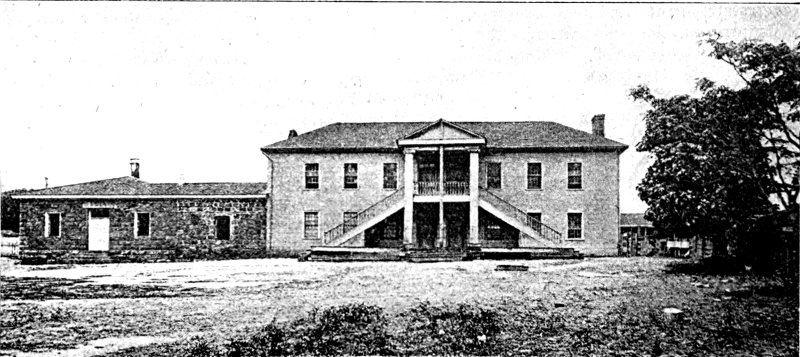
"The town hall on which I have been at work for more than a year is at last finished. It is built of a white stone"—now a beautiful deep cream—"quarried from a neighboring hill, and easily shaped. The lower apartments are for schools, the hall over them—seventy feet by thirty—is for public assemblies. It is not an edifice that would attract any attention among public buildings in the United States; but in California it is without a rival. It has been erected out of the slender proceeds of town lots, the labor of convicts, taxes on liquor shops, and fines on gamblers. The scheme was regarded with incredulity by many; but the building is finished, and the citizens have assembled in it and christened it with my name, which will go down to posterity with the odor of gamblers, convicts and tipplers. I leave it as an humble evidence of what may be accomplished by rigidly adhering to one purpose, and shrinking from no personal efforts necessary to its achievements. A prison has also been built, and mainly through the labor of convicts. Many a joke the rogues have cracked while constructing their own cage; but have worked so diligently I shall feel constrained to pardon out the less incorrigible."
COLTON HALL The Capitol of California in 1849.
THE RIVER ROAD, KEENE VALLEY, NEW YORK