REAR-ADMIRAL SIR FREDERICK LEWIS MAITLAND, K.C.B. (continued 3)
Reading edition
As soon as the Admiral had left the ship, Buonaparte sent for me, and showed me the same paper Lord Keith had communicated to me in the morning. When I had read it, he complained vehemently of his treatment in being sent to St Helena, saying, "The idea of it is perfect horror to me. To be placed for life on an island within the Tropics, at an immense distance from any land, cut off from all communication with the world, and every thing that I hold dear in it!—c'est pis que la cage de fer de Tamerlan. (It is worse than Tamerlane's iron cage.) I would prefer being delivered up to the Bourbons. Among other insults," said he,—"but that is a mere bagatelle, a very secondary consideration,—they style me General! they can have no right to call me General; they may as well call me Archbishop, for I was head of the church, as well as the army. If they do not acknowledge me as Emperor, they ought as First Consul; they have sent Ambassadors to me as such; and your King, in his letters, styled me brother. Had they confined me in the Tower of London, or one of the fortresses in England, (though not what I had hoped from the generosity of the English people,) I should not have so much cause of complaint; but to banish me to an island within the Tropics! They might as well have signed my death-warrant at once, as it is impossible a man of my habit of body can live long in such a climate."
He then expressed a desire to write another letter to the Prince Regent; and I carried it the same afternoon to Lord Keith, by whom it was immediately forwarded to London.
Generals Savary and Lallemand this day made many appeals to me on the injustice of our Government delivering them up to France; saying they had not a doubt it was intended, else why except them from accompanying the Emperor, as they were both married men, and Savary the father of a large family:—it was not the wish of either to have gone to St Helena; but their being expressly excepted, and their names appearing in the list of proscribed, was but too sure a proof of their intended fate. Savary added, "Were I to be allowed a fair and impartial trial, I should have nothing to fear, never having accepted a situation under Louis; but at present, when faction runs so high, I should inevitably be sacrificed to the fury of party. Lallemand's case is quite different: he held a command under the King, and, on Napoleon's return from Elba, joined him with his troops; therefore, his situation would at any time be a dangerous one:—but I lived in the country all the time Louis was in France, and did not come forward until Buonaparte's arrival in Paris, when he directed me to take the command of the Gendarmerie."
Lallemand said, "My reason for coming on board the Bellerophon with Las Cases on the morning of the 14th, was to ascertain whether there would be a risk of any of the Emperor's followers being delivered up to the French Government, in the event of their accompanying him to England; when you assured me there could be no danger of it." I replied, "My answer to you was, that I was of opinion there could be no risk of the British Government taking such a step; and I see no reason now to alter that opinion. As I have received you on board the Bellerophon, I consider you under the protection of the British flag, and myself, in a great measure, responsible for your personal safety; and under that impression I will write on the subject to Lord Melville, as the Minister under whose immediate control I act, that your minds may be set at rest, though, I repeat, you run no hazard of being sent to France." The same evening, before I went to bed, I wrote the letter which follows:—
"H.M.S. Bellerophon, Plymouth Sound, 31st July, 1815.
"My Lord,
"I am induced to address your Lordship in consequence of having observed, in the intimation delivered to Napoleon Buonaparte of the number of persons allowed to accompany him to the Island of St Helena, that the names of Savary and Lallemand are expressly excepted, which, together with their being proscribed in the French newspapers, has created in them a belief that it is the intention of His Majesty's Government to deliver them up to the King of France. Far be it from me to assume such an idea; but I hope your Lordship will make allowance for the feelings of an officer who has nothing so dear to him as his honour, and who could not bear that a stain should be affixed to a name he has ever endeavoured to bear unblemished. These two men, Savary and Lallemand (what their characters or conduct in their own country may be I know not), threw themselves under the protection of the British flag; that protection was granted them with the sanction of my name. It is true, no conditions were stipulated for; but I acted in the full confidence that their lives would be held sacred, or they should never have put foot in the ship I command, without being made acquainted that it was for the purpose of delivering them over to the laws of their country.
"I again beg leave to repeat to your Lordship, that I am far from supposing it to be the intention of His Majesty's Government to deliver these men over to the laws of their country; but, as they are strongly impressed with that belief, and I look upon myself as the cause of their being in their present situation, I most earnestly beg your Lordship's influence may be exerted that two men may not be brought to the scaffold who claimed and obtained at my hands the protection of the British flag.
"I have the honour to be, &c. &c. &c. "Fred. L. Maitland."
"The Viscount Melville, &c. &c. &c."
I felt convinced that Buonaparte, after the notification he had received, would be too much depressed in spirits to make his appearance on deck this day; and sent a boat to some of my friends, who were waiting in hopes of seeing him, to say there was no chance of his coming out, as he was much distressed at the communication which had been made to him. I was, therefore, a good deal surprised, on turning round, to find him standing at my elbow; and I can only account for his showing himself as usual, by supposing either that he was not in fact so much annoyed as I had believed him to be, or that he was actuated by a desire of creating a feeling of commiseration among the English people in his behalf.
At dinner he conversed as usual; and, indeed, it was quite astonishing with what elasticity his spirits regained their usual cheerfulness, after such trials and disappointments. He never, in my hearing, threatened to commit suicide; nor do I believe he did on any occasion: the only expression I ever heard him make use of, that could in any way be construed into such a threat, was, that he would not go to St Helena,—"Je n'irai pas à St Hélène."
As Buonaparte always retired early to bed, it was the custom for the French ladies and officers to assemble every evening in the ward-room, and partake of wine and water, punch, or bishop—a mixture consisting of Port, Madeira, nutmeg, and other ingredients, well known to sailors, and much relished by our foreign guests.
I was sitting this evening next Montholon, when Madame Bertrand entered; I said to her, "Will you not sit down and take something?" She gave an answer which I took for No; and passed rapidly into the first lieutenant's cabin, which she had occupied since she came on board. Montholon, who had observed her with more attention than I had done, immediately rose and followed her. There was instantly a shriek from the cabin, and a great uproar; and some one called out 'The Countess is overboard.' I ran upon deck, that, in the event of its being so, a boat might be lowered down, or the guard-boats called to her assistance. On looking over the quarter, and seeing no splash in the water, I felt satisfied it was a false alarm, and returned to the ward-room. Madame Bertrand had by this time been placed on her bed, where she was lying in strong hysterics, at intervals abusing the English nation and its Government, in the most vehement and unmeasured terms; sometimes in French and sometimes in English. Lallemand was walking up and down the ward-room much agitated, joining in the abuse; saying, among other things, "that it was horrible to bring a set of people on board the ship for the purpose of butchering them." I turned to him, and said, "Monsieur Lallemand, what a woman says in the state of violent irritation that Madame Bertrand at present is, I consider of little consequence, and am willing to make every allowance for the situation you are placed in; but I cannot stand by and hear such terms used of the Government of my country; and if you do not desist, or make use of more respectful language, I shall be under the necessity of taking measures that will be very unpleasant both to you and myself."
This had the effect of silencing him. When the bustle had subsided, I retired to my cabin, and was employed in writing the foregoing letter to Lord Melville, in behalf of Messrs Savary and Lallemand; when the latter, attended by Generals Montholon and Gourgaud, came in. They immediately entered into conversation with me about the cruelty of their situation: among many other things, they said, "You may depend upon it, the Emperor never will go to St Helena; he will sooner put himself to death; he is a man of determined character, and what he says he will do." "Has he ever said he will put himself to death?" I asked. They answered, "No; but he has said he will not go, which amounts to the same thing; and were he to consent himself, here are three of us who are determined to prevent him." I told them they had better consider the consequences well, before they ventured on a measure of that kind.
The next day, August 1st, 1815, I waited on Lord Keith, and reported all that had occurred during the preceding day. I also showed him the letter I had written and meant to send to Lord Melville, respecting Generals Savary and Lallemand; he read it, and said, "that though he did not agree with me in opinion as to my honour or character being implicated, yet that he saw no harm in the letter." He then said, "You may tell those gentlemen who have threatened to be Buonaparte's executioners, that the law of England awards death to murderers, and that the certain consequence of such an act will be finishing their career on a gallows."
After quitting his Lordship, I had an interview with Sir Henry Bunbury, previous to his setting out for London, and stated to him my feelings respecting the cruelty of delivering up to the French Government, men who had been received under the protection of the British flag. I said that I had no belief myself that any such intention existed; but that they were so strongly impressed with the conviction of it, that I had been induced to write to Lord Melville, and now begged to state to him, that I should consider myself dishonoured for ever, if they suffered death through my means. He listened, but did not speak till I had finished; when he told me he would repeat what I had said to his Majesty's Ministers.
Madame Bertrand kept her bed the whole of this day, and did not appear at dinner. When Buonaparte came upon deck, he asked Mr O'Meara, the surgeon, after her health; and then said, with an incredulous smile, "Do you really think, Doctor, she meant to drown herself?" I put the same question to Montholon; who said he had not a doubt of it, for, when he followed her into the cabin, she was in the act of throwing herself out of the gallery window; that he rushed forward and caught hold of her, and that she continued suspended by the bar that goes across the window, with the greater part of her body hanging out, until he received assistance to drag her in. The bar above-mentioned had been placed there for the purpose of preventing people from falling overboard when the window was open and the ship had much motion at sea.
Nothing of importance occurred during the 2nd of August. Buonaparte did not appear upon deck; nor would he consent to nominate the people who were to accompany him to St Helena; he still seemed to indulge a hope, that the Government might be induced to reconsider the decision. I had half an hour's conversation with him in the cabin: it consisted, on his part, of complaints of the cruelty of sending him to St Helena. He likewise asked me many questions about that island, as to its extent, climate, and productions, whether it would be possible to take exercise on horseback, if there was game of any kind upon it, &c.: to all of which I could only answer from report, never having visited the island myself. He conversed very little at dinner, and appeared unwell. In the evening, General Bertrand informed me that the sentinel's calling out "All's well!" during the night disturbed him, and prevented his sleeping; upon which I gave directions they should not do so while he remained on board.
During the 3rd of August Buonaparte kept his cabin. When I went to the Admiral, I met him escorting some ladies, in company with Sir William Lemon, to the Ville de Paris's barge. On being introduced to Sir William, he told me that a report was in circulation that a boat was to have been under the Bellerophon's stern the night before, at ten o'clock, for the purpose of effecting Buonaparte's escape. Although I gave no credit to the report, I immediately returned on board, and asked the first lieutenant if Buonaparte had been seen that morning; he informed me that he had not attended breakfast, and that no person had seen him but his own people. I then sent to the Eurotas, which lay astern of the ship, to enquire if he had appeared at the stern windows; but was answered in the negative: upon which I desired one of the young gentlemen to go out on the spanker-boom and look into the cabin windows, to ascertain if he was sitting on the sofa; but he could not discover him in any part of the cabin. I then became extremely uneasy, and sent my servant in to bring some paper out, who on entering found the object of my anxiety stretched out on his bed with his clothes on, and the curtains drawn close round him, with every appearance of being unwell. I had before asked Count Bertrand about him, who said he had passed a bad night, and was too ill to leave his apartment.
Instead of retiring to his bed this evening between eight and nine o'clock, as was his usual custom, I heard him and another person (I believe General Bertrand) pacing up and down the cabin until past eleven; and in consequence gave directions to the officer of the watch and the sentries to be particularly vigilant; and ordered one of the guard-boats to remain under the ship's stern all night. He had still declined all this day giving a list of those that he wished to attend him to St Helena.
At three in the morning of the 4th of August, the officer of the watch brought me a letter from Lord Keith, informing me that a courier had just arrived from London, and that it was probable the ship would be required to put to sea at a moment's notice. In consequence of this order, we unmoored at daylight, bent the top-gallant sails, and made other preparations for getting under weigh. The Frenchmen were very watchful of all our motions, appeared much alarmed and annoyed, and questioned me frequently as to the cause. I told them, what was literally the fact, that I had received directions to be ready to put to sea, but had no orders to carry it into effect; and that was all I knew.
Between seven and eight o'clock, I waited on Lord Keith, who said he had received information that a habeas corpus had been taken out for the purpose of bringing Buonaparte on shore, and that a lawyer was on his way down to serve it; desiring me, therefore, to be ready to put to sea whenever the signal might be made.
On returning on board, I had an interview with Buonaparte, who was very urgent to know why the ship was preparing for sea. I told him, by Lord Keith's directions, that it was the intention of our Government, his removal should take place at sea; and that we were going out to meet the Northumberland, the ship which was to convey him to St Helena.
He begged I would write to Lord Keith, and say he wished very much to see him; and Count Bertrand told me he was also desirous of having the newspapers. I accordingly wrote to his Lordship, who was then on board the Tonnant: who, however, declined visiting him, but sent me a note, of which the following is an extract.
Extract of a Note from Admiral Viscount Keith, addressed to Captain Maitland, of H.M.S. Bellerophon, dated Tonnant, 4th August.
"I send you the paper, and shall be glad to hear the determination of the General, whom you may inform that the answer is arrived from London, and that I have no authority to alter, in any degree, any part of the former communication; which induces me to wish the selection of the persons he is inclined should attend him."
I communicated the contents to General Bertrand, who made his report to Buonaparte. On his coming out of the cabin, I pressed him on the subject of nominating those that were to go with him to St Helena; but the only answer he returned was, "L'Empereur n'ira pas à St Hélène;"—the Emperor will not go to St Helena.
While the ship was working out of the Sound, two well-dressed women in a boat kept as close to her as the guard-boat would allow, and, whenever Buonaparte appeared at the stern windows, stood up and waved their handkerchiefs.
On joining the Prometheus off the Ramehead, where Lord Keith's flag was then flying, I received the following note from his Lordship.
No date; received August 4th, in the Afternoon.
"I have been chased all day by a lawyer with a Habeas Corpus: he is landed at Cawsand, and may come off in a sailing-boat during the night; of course, keep all sorts of boats off, as I will do the like in whatever ship I may be in.
Keith."
"Captain Maitland."
Buonaparte wrote another letter this evening to the Prince Regent, which I carried to Lord Keith, who again told me of his having been chased all day by a lawyer: who had first started him out of his own house, then followed him to the Tonnant, where he attempted to get in at one side, as his Lordship left her on the other; he afterwards pursued him towards Cawsand, but the Admiral being in a twelve-oared barge, out-rowed him, and gave him the slip round the Ramehead. It was on his return from this chase that he attempted to get on board the Bellerophon.
Buonaparte now confined himself entirely to his cabin, never coming on deck, or appearing at breakfast or dinner. He was not served from the table, but what he ate was prepared and carried in to him by Marchand, his favourite valet de chambre. Messrs Bertrand and Las Cases passed much time with him; and this evening the protest was prepared, which will appear in the sequel.
On the morning of the 5th of August, the weather was overcast, with a strong breeze of wind, and the sea began to rise, much to the discomposure of my poor French guests. Soon after breakfast, my signal being made from the Tonnant, where Lord Keith had now hoisted his flag, I told General Bertrand that I was going to the Admiral, and would convey anything Buonaparte had to say to him. He requested I would wait until a letter or paper, then under preparation, was finished, which was intended for me, but a copy to be presented to Lord Keith. I waited nearly an hour, when he brought me Buonaparte's protest. I delivered it to the Admiral, stating at the same time that I wished to have a copy; and was afterwards furnished with one by his Lordship's secretary. I insert it here.
Buonaparte's Protest.
"Je proteste solennellement ici, à la face du Ciel et des hommes, contre la violence qui m'est faite, contre la violation de mes droits les plus sacrés, en disposant par la force, de ma personne et de ma liberté.
"Je suis venu librement à bord du Bellerophon; je ne suis point prisonnier; je suis l'hôte de l'Angleterre. J'y suis venu à l'instigation même du Capitaine qui a dit avoir des ordres du Gouvernement de me recevoir, et de me conduire en Angleterre avec ma suite, si cela m'étoit agréable. Je me suis présenté de bonne foi pour venir me mettre sous la protection des loix d'Angleterre. Aussitôt assis à bord du Bellerophon, je fus sur le foyer du peuple Britannique. Si le Gouvernement, en donnant des ordres au Capitaine du Bellerophon, de me recevoir ainsi que ma suite, n'a voulu que tendre une embûche, il a forfait à l'honneur et flêtri son pavillon. Si cet acte se consommoit, ce seroit en vain que les Anglais voudroient parler à l'Europe de leur loyauté, de leur loix, et de leur liberté. La foi Britannique s'y trouvera perdue dans l'hospitalité du Bellerophon. J'en appelle à l'histoire; elle dira qu'un ennemi qui fit vingt ans la guerre aux peuples Anglois, vint librement, dans son infortune, chercher un asile sous ses loix. Quelle plus éclatante preuve pouvait-il lui donner de son estime et de sa confiance? Mais comment répondit-on en Angleterre à une telle magnanimité?—On feignit de tendre une main hospitalière à cet ennemi, et quand il se fut livré de bonne foi, on l'immola.
"Signé, Napoléon."
À bord du Bellerophon, 4 Août, 1815.
TRANSLATION.
Buonaparte's Protest.
"I hereby solemnly protest, in the face of Heaven and of men, against the violence done me, and against the violation of my most sacred rights, in forcibly disposing of my person and my liberty. I came voluntarily on board of the Bellerophon; I am not a prisoner, I am the guest of England. I came on board even at the instigation of the Captain, who told me he had orders from the Government to receive me and my suite, and conduct me to England, if agreeable to me. I presented myself with good faith to put myself under the protection of the English laws. As soon as I was on board the Bellerophon, I was under shelter of the British people.
"If the Government, in giving orders to the Captain of the Bellerophon to receive me as well as my suite, only intended to lay a snare for me, it has forfeited its honour and disgraced its flag.
"If this act be consummated, the English will in vain boast to Europe of their integrity, their laws, and their liberty. British good faith will be lost in the hospitality of the Bellerophon.
"I appeal to History; it will say that an enemy, who for twenty years waged war against the English people, came voluntarily, in his misfortunes, to seek an asylum under their laws. What more brilliant proof could he give of his esteem and his confidence? But what return did England make for so much magnanimity? They feigned to stretch forth a friendly hand to that enemy; and when he delivered himself up in good faith, they sacrificed him.
"Signed, Napoleon."
"On board the Bellerophon, 4th August 1815."
On the above I shall only observe, that no snare had been laid, either on the part of His Majesty's Government or mine. I was placed before Rochefort for the open purpose of preventing Buonaparte from making his escape from that port; and the exertions of myself and those under my command had been so completely successful, that the intention of forcing past the ships under my orders, as well as every other plan proposed, of which there appear to have been several, were abandoned as utterly hopeless. And so far was I from seeking communication with Napoleon, that all the flags of truce proceeding from him, were strongly reprobated by me, as improper, except in extraordinary cases, and were only resorted to when, as appears from Lord Keith's letter of the 23rd of July, orders had been sent from Paris for his arrest, and when (as has since been proved) one or more intimations had been given by the officer commanding in Isle d'Aix, that, if he did not depart, he would be under the necessity of detaining him. Besides, it is now perfectly ascertained, that the determination of repairing to England was adopted at a consultation held by Buonaparte on the night of the 13th of July, when his letter to the Prince Regent was written; and Messrs Las Cases and Lallemand were sent on the morning of the 14th to discover if I would receive him on board the Bellerophon, and convey him to that country.
On the morning of the 6th of August, when walking the deck with Monsieur Las Cases, he for the first time mentioned, that he understood me to have assured him that the Emperor would be well received in England, and allowed to reside there. I replied, "I cannot conceive how you could so far misunderstand me, as I constantly, in my communications with you, stated that I could make no promises whatever: that I thought my orders would bear me out in receiving him on board, and conveying him to England; but even in doing that, I acted very much upon my own responsibility. You questioned me frequently, as to my private opinion; and as I was quite ignorant upon the subject, I could only say I had no reason to believe he would be ill received." It did not, however, require my assistance to raise the hopes of those about Buonaparte, respecting the manner in which he was to be received in England; as one of his followers, on the passage home, asked me if I thought the Prince Regent would confer the order of the Garter upon him. If there was any misunderstanding, (which I cannot allow to have been the case,) Monsieur Las Cases has himself to blame. When he came on board of the Bellerophon for the purpose of treating, he concealed his knowledge of the English language; which, as I had considerable difficulty in expressing myself in French, could only be intended for the purpose of throwing me off my guard, that he might take advantage of any expressions that fell from me, or the officers I had always present at our meetings. Even after he was on board with Buonaparte, though he acknowledged he could read English, and always translated the newspapers for his master, he affected not to be able to speak it. What his actual knowledge of the language was, the following extract of a letter, from a friend of mine on board the Northumberland, dated at sea, August the 22nd, 1815, will show:
"I do not know, whether Las Cases ever let you know he could speak English; but this I can assure you, that he speaks it very near as well as Madame Bertrand, and can hold a conversation, or maintain an argument in it, with as much fluency as she can."
This forenoon, I had a long conversation with Buonaparte. He complained bitterly of the conduct of the British Government; and entered, at considerable length, into the state of his affairs when he determined upon the measure of repairing on board the Bellerophon. "There still," said he, "was a large party in the South, that wished me to put myself at its head; the army behind the Loire was also desirous of my return. At ten o'clock of the night before I embarked, a deputation from the garrison of Rochelle waited upon me, with an offer to conduct me to the army; in addition to which, the troops that were in Rochefort, Bourdeaux, and Isle d'Aix, amounting to twelve thousand men, were at my disposal. But I saw there was no prospect of ultimate success, though I might have occasioned a great deal of trouble and bloodshed, which I did not choose should take place on my account individually;—while the Empire was at stake, it was another matter."
In the afternoon, Mr O'Meara, the surgeon, informed me that General Savary had made a proposal to him to accompany Buonaparte to St Helena as his medical attendant; Monsieur Maingaut, his surgeon, being a young man with whom he was little acquainted, having suffered so much from seasickness in the passage from Rochefort, that he felt averse to undertaking another sea voyage. He consulted me as to the propriety of accepting the offer. I told him it must depend very much upon his own feelings; but if he had no dislike to it, he had better accept the proposal, on condition that our Government consented, and agreed to pay his salary; but, in that case, an official communication must pass, through me, to the Admiral on the subject. This was the first intimation I received of Buonaparte having made any arrangement towards complying with the notification he had received from our Government.
About nine A.M. a large ship was seen to leeward, which, on closing, proved to be the Northumberland. The whole squadron then stood in, and anchored to the westward of Berryhead. I went on board the Tonnant, and reported to Lord Keith that Buonaparte had at last made up his mind to move from the Bellerophon without force being used; and that Count Bertrand was desirous of seeing his Lordship, that he might make the necessary arrangements about the people who were to accompany him. By the Admiral's directions, I returned to my ship and brought Monsieur Bertrand to him. Soon after Sir George Cockburn arrived, and they were shut up together for nearly two hours.
When I first went on board the Tonnant, I received a memorandum from Lord Keith, from which I give an extract; and at the same time a verbal intimation, that I should receive an order in writing the next day, to, remove Buonaparte, and such part of his suite as he might select, to the Northumberland.
Extract of a Memorandum from Admiral Viscount Keith, G.C.B., addressed to Captain Maitland, of H.M.S. Bellerophon, dated Tonnant, off the Start, 6th August, 1815.
"All arms of every description are to be taken from the Frenchmen of all ranks on board the ship you command; and they are to be carefully packed up and kept in your charge, while they remain on board the Bellerophon; and afterwards in that of the captain of the ship to which they may be removed."
While we were at dinner, Generals Bertrand and Montholon were employed making out lists of what would be required by the French officers and the ladies, to render them comfortable during their voyage to St Helena, which were despatched to Plymouth by Sir George Cockburn's secretary.
In the course of the evening Lord Keith and Sir George Cockburn came on board the Bellerophon; when the latter was introduced to Buonaparte.
As soon as General Bertrand was at leisure, I told him I had orders to remove Napoleon to the Northumberland the following day, and also to take away the arms from him and his attendants, giving him to understand that they would be returned on their arrival at their destination. He seemed much hurt at being deprived of his arms, but said he would give directions for their being delivered; and I received them the next morning, with the exception of Buonaparte's sword, which, by an order I subsequently received from Lord Keith, he was permitted to wear, when quitting the ship.
About half-past nine in the evening, Mons. Bertrand told me that Buonaparte was desirous of seeing me. On going into his cabin, he said, "Bertrand informs me you have received orders to remove me to the Northumberland; is it so?" I answered in the affirmative. "Have you any objection," he said, "to writing a letter to Bertrand, acquainting him of it; that I may have a document to prove that I was forced to quit the ship, and that my inclinations were not consulted." I replied, "I can have no objection to write such a letter, and shall do it this evening." I was then going to retire, when he requested me to remain, having more to say. "Your Government," he continued, "has treated me with much severity, and in a very different way from what I had hoped and expected, from the opinion I had formed of the character of your countrymen. It is true I have always been the enemy of England, but it has ever been an open and declared one; and I paid it the highest compliment it was possible for man to do in throwing myself on the generosity of your Prince: I have not now to learn, however, that it is not fair to judge of the character of a people by the conduct of their Government." He then went on, (alluding to the Government,) "They say I made no conditions. Certainly I made no conditions; how could an individual enter into terms with a nation? I wanted nothing of them but hospitality, or, as the ancients would express it, 'air and water.' My only wish was to purchase a small property in England, and end my life there in peace and tranquillity. As for you, Capitaine," (the name by which he always addressed me) "I have no cause of complaint; your conduct to me has been that of a man of honour; but I cannot help feeling the severity of my fate, in having the prospect of passing the remainder of my life on a desert island. But," added he with a strong emphasis, "if your Government give up Savary and Lallemand to the King of France, they will inflict a stain upon the British name that no time can efface." I told him, in that respect, they were under an erroneous impression; that I was convinced it was not the intention of his Majesty's Ministers to deliver them up. "Je l'espère," "I hope so;" was his only reply.—I then took my leave of him for the night.
That I may not break in upon the occurrences of the 7th, I shall here insert the letter I wrote at Buonaparte's request, and a copy of the orders under which I acted in removing him from the Bellerophon to the Northumberland.
"H.M.S. Bellerophon, Start Bay, 7th August, 1815.
"Sir,
"I beg to acquaint you that I have this day received orders from Lord Keith, Commander in Chief of the Channel Fleet, to remove General Buonaparte from the ship I command, to his Majesty's ship Northumberland; and I have to request you will intimate the above to the General, that he may prepare for the removal.
"I likewise enclose a copy of an order respecting the arms of General Buonaparte and the whole of his attendants, and request you will give directions for their being delivered to me, that they may be disposed of as the order directs.
"I have the honour to be, &c. &c. &c. Fred. L. Maitland."
"Lieut. General Count Bertrand."
Copy of the order alluded to.
"By the Right Hon. Viscount Keith, G.C.B., &c. &c. &c.
"You are hereby required and directed to deliver the persons, named below, into the charge of Rear Admiral Sir George Cockburn.
"Given on board the Tonnant, At anchor under Berryhead, 7th August, 1815. Keith, Admiral.
"By command of the Admiral, "James Meek, Secretary."
"To F. L. Maitland, Esq.
Captain of H.M.S. Bellerophon."
General Buonaparte.
Count Bertrand, his Wife, three children, one female servant, and her child.
General Montholon, his Wife, one child, and one female servant.
General Gourgaud.
Le Comte de Las Cases, and his son.
Marchand, Premier Valet de Chambre.
St Denis, ditto.
Novarra, ditto.
Piéron, Chef d'Office.
Le Page, Cuisinier.
Archambaud, Premier Valet de Pied.
Gentilini, Valet de Pied.
Bernard, domestique du Comte Bertrand.
The four domestics underneath, who had come to England in the Myrmidon, also accompanied him:—
Cipriani, Maître d'Hôtel.
Santini, Huissier.
Rousseau, Lampiste.
Archambaud, Valet de Pied.
Extract of a Letter from Admiral Viscount Keith, G.C.B., addressed to Captain Maitland, of H.M.S. Bellerophon, dated Tonnant, off Berryhead, 7th August, 1815.
"When the General quits the ship, it is not intended to take his sword from him, but to let him wear it, but not the others. Pistols, guns, &c. must, as in all instances, be removed for the safety of the ship, but the arms are carefully to be kept, and restored at a proper occasion."
On the morning of the 7th of August, 1815, Count Las Cases made an application to me for permission to wait on Lord Keith, having a communication to make to him. I, in consequence, went to his Lordship, and obtained leave to send him. When the Admiral came on board the Bellerophon, in the forenoon, to attend Buonaparte in his removal to the Northumberland, he informed me that Monsieur Las Cases had represented to him, that I had promised Buonaparte should be well received in England, and allowed to remain there; and the same day he wrote a letter to me containing the above statement, and directing me to report upon it, which I afterwards did, as will hereafter appear.
Count Bertrand was employed, during the morning, making out a list of those that were to proceed to St Helena with Buonaparte, in which General Gourgaud's name was omitted, and Colonel Planat was nominated his Secretary. This offended Monsieur Gourgaud so much, that he made use of some very strong language to General Bertrand; and after a good deal of altercation, it was arranged, I believe by Buonaparte himself, that Gourgaud should take Planat's place. There was also another cause of disagreement. The number of domestics allowed to go to St Helena being only twelve, did not admit of all the officers taking their personal attendants; General Montholon was obliged to leave a servant who had been with him many years, and Count Bertrand's was the only exception.
General Bertrand had been so much employed all the morning making preparations for their removal, that he did not come to breakfast until every one had finished; his wife remained at the table, as I did also, as a mark of attention to him. She soon commenced an attack on her husband, to induce him to quit Buonaparte and remain in England. He seemed much distressed, but remained silent. At last, she turned to me, and begged I would give an opinion, and use my influence in favour of her proposal. I said, "Madame Bertrand, I have from the beginning endeavoured to avoid meddling in the very unpleasant discussions that have been going on for some days; but, as you demand my opinion, and force me to give it, I must acquaint you that I think, if your husband quits his master at such a time as the present, he will forfeit the very high character he now bears in this country." I then rose from the table and went upon deck.
A short time after, Madame Bertrand came on deck, and, addressing me with much indignation in her countenance, said, "So, Captain Maitland, I hear the Emperor is not to have the whole of the after-cabin on board the Northumberland." I told her, I understood that Sir George Cockburn had received orders to that effect. "They had better treat him like a dog at once," said she, "and put him down in the hold." I had for several days been kept in a state of irritation that cannot be described, and such as few people have had an opportunity of experiencing. Madame Bertrand had, it will be readily understood, some share in causing this; and on her making the above remark, I am sorry to say, the little self-possession that still remained gave way, and I answered in these words, "Madam, you talk like a very foolish woman; and if you cannot speak more to the purpose, or with more respect of the Government I have the honour to serve, I request you will not address yourself to me." Just before she went out of the ship, however, she came up to me in a conciliatory and friendly manner, that did her the highest honour, and said, "Captain Maitland, you called me a very foolish woman this morning, but I should be sorry to part with you on bad terms; have you any objection to shake hands with me? as God knows if we shall ever meet again." "Very far from it," I answered; "I should be extremely sorry you left the ship without receiving my good wishes for your happiness and prosperity; and if, in the warmth of my temper, and under the harassing circumstances of my situation, I have said anything unpleasant, I most sincerely beg your pardon, and hope you will forgive and forget it."
Soon after breakfast, Marchand came and said the Emperor wished to see me: I went into the cabin. "I have requested to see you, Captain," said he, "to return you my thanks for your kindness and attention to me whilst I have been on board the Bellerophon, and likewise to beg you will convey them to the officers and ship's company you command. My reception in England has been very different from what I expected; but it gives me much satisfaction to assure you, that I feel your conduct to me throughout has been that of a gentleman and a man of honour." He then said, he was desirous of having Mr O'Meara, the surgeon of the Bellerophon, to accompany him; and asked my opinion of him in his medical capacity, as well as of his principles. I replied, that I had the highest opinion of him, both for his skill and attention; that he had given me so much satisfaction while under my command, that I had procured his removal from two different ships in which he had served with me previous to my appointment to the Bellerophon, that he might accompany me; and that I was convinced he was a man of principle and integrity. After conversing some time longer with him, during which he spoke in the warmest terms of affection of General Bertrand, and the obligations he felt to him for his remaining with him during his adversity, when he knew strong efforts had been used to induce him to abandon him, I took my leave; and this was the last time I was ever alone with him.
Soon after, Sir George Cockburn came on board, attended by Mr Byng as his secretary, for the purpose of examining Buonaparte's baggage: he had directions to apply to some person of his suite to attend at the search. The proposal was made to Count Bertrand; but he was so indignant at the measure, that he positively refused either to be present himself or to direct any other person to superintend. General Savary, however, consented, and was present, as well as Marchand. The covers of the trunks were merely opened, and Mr Byng passed his hand down the side, but the things were not unpacked. Once or twice, when the door of the after-cabin was opened, Buonaparte expressed his obligation to Mr Byng for the delicate manner in which he conducted the search, by bowing to him. When they came to the boxes containing the money, of which there were two, Marchand was permitted to take out such sum as was considered necessary for paying the wages of the servants that were to be left behind, and for other contingent expenses. One box, containing four thousand gold Napoleons, was retained and put under my charge, where it remained until my arrival in London, when I delivered it to Sir Hudson Lowe to be restored to its owner, as will be seen by the following order, receipts, &c.
"By the Right Hon. Viscount Keith, G.C.B., &c. &c. &c.
"You are hereby required and directed to receive into your custody such a sum of money belonging to General Buonaparte, as will be delivered into your charge by Rear-Admiral Sir George Cockburn, granting proper receipts for the same.
"Given on board the Tonnant, At anchor under Berryhead, 7th August, 1815, "Keith, Admiral."
"To F. L. Maitland, Esq. Captain of H.M.S. Bellerophon."
"J'ai laissé le sept d'août, à bord du Bellerophon, à Monsieur le Capitaine Maitland, une somme de quatre vingt mille francs, en quatre mille Napoleons d'or.
"Marchand, Premier Valet de Chambre."
On the 7th of August, I have left on board the Bellerophon, in charge of Captain Maitland, the sum of eighty thousand francs, in four thousand gold Napoleons.
Marchand, 1st Valet de Chambre.
"I acknowledge to have received a box with four paper packages, said to contain four thousand gold Napoleons, the property of Napoleon Buonaparte.
"August 7th, 1815, "Fred. L. Maitland."
"Approved, George Cockburn."
As I shall not have to revert to the subject of the money, I shall here subjoin the receipt I obtained on delivering it at the Admiralty Office, though it is of a date some time posterior.
"Admiralty, September 14, 1815.
"Received from Captain Maitland a box, containing four packages, marked each 20,000 francs, and said to contain four thousand Napoleons d'or."
"H. Lowe, Major General."
About eleven A.M., Lord Keith came on board in the Tonnant's barge, to accompany Buonaparte from the Bellerophon to the Northumberland. Count Bertrand immediately went into the cabin to inform him of his Lordship's arrival: it was, however, full two hours before it was reported that he was ready to attend him. About one o'clock, the barge of the Admiral was prepared; a Captain's guard turned out, and by Lord Keith's direction, as Napoleon crossed the quarter-deck to leave the ship, the guard presented arms, and three ruffles of the drum were beat, being the salute given to a General Officer.
He walked out of the cabin with a steady, firm step, came up to me, and, taking off his hat, said, "Captain Maitland, I take this last opportunity of once more returning you my thanks for the manner in which you have treated me while on board the Bellerophon, and also to request you will convey them to the officers and ship's company you command:" then turning to the Officers, who were standing by me, he added, "Gentlemen, I have requested your Captain to express my gratitude to you for your attention to me, and to those who have followed my fortunes." He then went forward to the gangway; and before he went down the ship's side, bowed two or three times to the ship's company, who were collected in the waist and on the forecastle; he was followed by the ladies and the French Officers, and lastly by Lord Keith. After the boat had shoved off, and got the distance of about thirty yards from the ship, he stood up, pulled his hat off, and bowed first to the Officers, and then to the men; and immediately sat down, and entered into conversation with Lord Keith, with as much apparent composure as if he had been only going from one ship to the other to pay a visit.
About a quarter of an hour before Buonaparte quitted the Bellerophon, Montholon came to me on the quarter-deck, and said, "I am directed by the Emperor to return you his thanks for the manner in which you have conducted yourself throughout the whole of this affair; and he desires me to say, that the greatest cause of disappointment he feels in not being admitted to an interview with the Prince Regent is, that he had intended to ask as a favour from his Royal Highness, that you should be promoted to the rank of Rear Admiral." I answered, "that although the request could not have been complied with under any circumstances, as it was contrary to the regulations of our naval service, yet I do not the less feel the kindness of the intention." "He meant also," he said, "to have presented you with a box containing his portrait, but he understands you are determined not to accept it." I replied, "In the situation I am placed, it is quite impossible I can receive any present from him." "He is perfectly aware," said he, "of the delicacy of your situation, and approves of your conduct." I then said, "I feel much hurt that Count Las Cases should have stated to Lord Keith, that I had promised Buonaparte should be well received in England, or indeed made promises of any sort. I have endeavoured to conduct myself with integrity and honour throughout the whole of this transaction, and therefore cannot allow such an assertion to go uncontradicted." "Oh!" said he, "Las Cases negotiated this business; it has turned out very differently from what he and all of us expected. He attributes the Emperor's situation to himself, and is therefore desirous of giving it the best countenance he can; but I assure you, the Emperor is convinced your conduct has been most honourable": then taking my hand, he pressed it, and added, "and that is my opinion also."
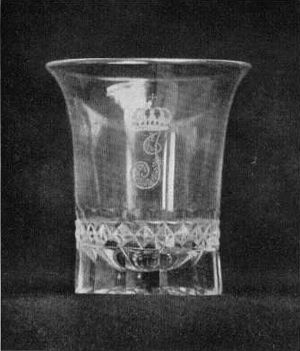
Tumbler given to Captain Maitland by Napoleon
In the course of the afternoon, I attended General Savary and Lallemand on board the Northumberland, where they went for the purpose of taking a last farewell of their master. I had very little conversation with him myself, but they remained with him a considerable time. When I was about to return to my ship, I went into the cabin to tell them they must accompany me. They approached him in the after-cabin, where he was standing, when he embraced each of them most affectionately, after the French manner, putting his arms round them, and touching their cheeks with his. He was firm and collected; but, in turning from him, the tears were streaming from their eyes. On getting on board, all the squadron got under weigh, the Tonnant and Bellerophon to return to Plymouth, the Northumberland, with two troop ships in company, to proceed to St Helena. The following day she was joined by a frigate and several sloops of war from Plymouth, when she made sail to the westward.
Having now brought my narrative down to the period of Buonaparte's quitting the ship, it only remains for me to give some account of his person and character, as far as it fell under my view. In doing so, I shall endeavour, as far as possible, in the same spirit with which the foregoing narrative is written, to avoid being biassed, either by favourable or unfavourable feelings towards him. What he may have been when at the head of the French Empire, with the destiny of the greater part of Europe under his control, I have no peculiar means of knowing; all I can pretend to do is, to describe him as he was on board the Bellerophon; adding a few anecdotes, which have been omitted in the course of the narrative, as serving to throw some further light upon his character.
I shall here relate a circumstance that occurred during the passage to England, which will show in a strong point of view the freedom that subsisted between him and those of his attendants in whom he had confidence. A conversation took place respecting the relative state of cultivation in France and in England. My opinion being asked, I said, that though the climate of France was much superior to that of England, I believed that agriculture had arrived at a greater state of perfection with us than in France. Most of the Frenchmen treated the idea with ridicule; upon which I said, let us refer to Monsieur Las Cases, who has lived several years in England. "You are right," said he; "there can be no doubt, that agriculture has arrived to much greater perfection in England than in France; but what I admire most in England, are the country-seats of your noblemen and gentlemen; there you surpass France very much." General Bertrand then took up the conversation, and said, that he was assured, that thirty thousand pounds sterling was annually expended on the park and grounds of Blenheim. Buonaparte immediately reduced that sum into livres; and observed, "The thing is impossible: the English people are not fools; they know the value of money, and no individual either could or would expend such a sum for such a purpose." He then spoke of the expense of keeping up Malmaison, one of the country palaces in France; stating the sum it cost annually, which did not exceed five thousand pounds. Bertrand still persisted in his statement, and made a reference to me. I, however, could give no information further than saying, that from what I had heard of the Duke of Marlborough's finances, he could not possibly lay out any such sum on Blenheim. Monsieur Bertrand would not give up the point, but repeated his assertion. On which Buonaparte said, with quickness, "Bah! c'est impossible." "Oh!" said Bertrand, much offended, "if you are to reply in that manner, there is an end of all argument;" and for some time would not converse with him. Buonaparte, so far from taking umbrage, did all he could to soothe him and restore him to good-humour, which was not very difficult to effect.
One morning he began to talk of his wife and child, and desired Marchand to bring two or three miniature pictures to show me: he spoke of them with much feeling and affection. "I feel," said he, "the conduct of the allied sovereigns to be more cruel and unjustifiable towards me in that respect than in any other. Why should they deprive me of the comforts of domestic society, and take from me what must be the dearest objects of affection to every man—my child, and the mother of that child?" On his expressing himself as above, I looked him steadily in the face, to observe whether he showed any emotion: the tears were standing in his eyes, and the whole of his countenance appeared evidently under the influence of a strong feeling of grief.
There were two pictures of young Napoleon: one in the dress of a Polish lancer, and the other with long curly flowing ringlets: they both represented a fair, strong, chubby boy, with features very much resembling those of his father. That of his mother, a very fair woman, with good features, but by no means handsome.
From the observations I was enabled to make, I very much doubt Monsieur Savary's statement, that the passion of ambition was so completely overcome in his bosom, "that had it been proposed to him again to ascend the throne of France, he would have declined it"; and I do think, that if he had succeeded in eluding the British cruisers and arrived in America, he would always have looked forward to returning to France. In all his conversations, he spoke of ambition as a quality absolutely necessary to form the character of a soldier. On one occasion, Savary spoke of Kleber, (who was left by Napoleon in command of the army when he quitted Egypt,) in terms of high encomium; this brought on a discussion upon the respective merits of that officer and Dessaix, whose aid-de-camp Savary had been during the negotiation of the convention of El Arish. Buonaparte, speaking of Kleber, bestowed upon him great praise as an officer; but he added, "He was deficient in one of the most necessary qualifications of a soldier,—ambition. He was indolent, and required constant spurring. Dessaix, on the contrary, had all his abilities, which were kept in constant activity by a mind whose ambition there was no satisfying; and, had they both lived to the present period, he would have been much the greater man of the two."
Buonaparte's carriage, which was taken at the battle of Waterloo by the Prussian cavalry, contained many articles of great value. In it was a necessaire, in which all the instruments, bason, &c. were composed of gold; a sword set with diamonds, and a diamond necklace, estimated at a very large sum of money, which one of his sisters (I think, the Princess of Borghese) put round his neck the night he took leave of her at Paris, on his setting out to join the army previous to the battle of Waterloo, and which he had taken off and deposited in a secret place in the carriage; Marchand, his valet de chambre, being so nearly taken by the Prussian hussars, that he quitted the carriage without having time to secure it. But I have since learned from Las Cases's Memoirs, that the necklace alluded to was saved, and that Las Cases had it concealed about his person all the time he was on board the Bellerophon.
It has been stated in many of the public prints, that had not the Marquis of Anglesea received a wound when he was leading on a charge, Buonaparte must have fallen into his hands. In consequence of observing this assertion, I asked Generals Bertrand and Gourgaud whether they knew if any such occurrence had taken place: both of whom replied, "Certainly not; the Emperor was frequently in the midst of the British troops (pêle-mêle avec les troupes Angloises); but at no time during the battle was he in danger of being captured by a charge of cavalry."
The midshipmen of the Bellerophon were in the habit of occasionally performing plays, to amuse themselves and the officers during the tedious operations of a blockade. Buonaparte being told of it by Savary, requested that they would oblige him by acting one for his amusement. During the performance, Madame Bertrand sat next to him, and interpreted. He appeared much amused, and laughed very heartily at our ladies, who were personated by great strapping fellows dressed in women's clothes, and not in the most tidy fashion. He had the patience to remain to the end of the third act, though, when attending the Opera at Paris, he had always retired at the end of the first.
I heard several of the French officers discussing the merits of the British troops. One of them said, "The cavalry is superb." I observed, "In England we have a higher opinion of our infantry." "You are right," said he; "there is none such in the world: there is no making an impression on them: you may as well attempt to charge through a wall: and their fire is tremendous." Another of them observed: "A great fault in your cavalry is their not having their horses sufficiently under command: there must be something wrong in the bit, as on one or two occasions in a charge, they could not stop their horses: our troops opened to the right and left, let them pass through, and then closed their ranks again, when they were either killed or taken prisoners."
I never heard Buonaparte speak of the battle of Waterloo, or give an opinion of the Duke of Wellington; but I asked General Bertrand what Napoleon thought of him. "Why," replied he, "I will give you his opinion nearly in the words he delivered it to me. 'The Duke of Wellington, in the management of an army, is fully equal to myself, with the advantage of possessing more prudence.'"
During the time that Buonaparte was on board the Bellerophon, we always lived expressly for his accommodation—entirely in the French manner; that is to say, a hot meal was served at ten o'clock in the morning, and another at six in the evening; and so nearly did they resemble each other in all respects, that a stranger might have found difficulty, in coming into the cabin, to distinguish breakfast from dinner. His maître d'hôtel took the joints off the table, cut them up in portions, and then handed them round. Buonaparte ate a great deal, and generally of strong solid food: in drinking he was extremely abstemious, confining himself almost entirely to claret, and seldom taking more than half-a-pint at a meal. Immediately after dinner, strong coffee was handed round, and then some cordial; after which he rose from table, the whole meal seldom lasting more than twenty or twenty-five minutes: and I was told, that during the time he was at the head of the French Government, he never allowed more than fifteen minutes for that purpose.
After he had quitted the ship, being desirous to know the feeling of the ship's company towards him, I asked my servant what the people said of him. "Why, Sir," he answered, "I heard several of them conversing together about him this morning; when one of them observed, 'Well, they may abuse that man as much as they please; but if the people of England knew him as well as we do, they would not hurt a hair of his head;' in which the others agreed." This was the more extraordinary, as he never went through the ship's company but once, immediately after his coming on board, when I attended him, and he did not speak to any of the men; merely returning their salute by pulling off his hat; and in consequence of his presence, they suffered many privations, such as not being allowed to see their wives and friends, or to go on shore, having to keep watch in port, &c.; and when he left the ship, the only money he distributed was twenty Napoleons to my steward, fifteen to one of the under-servants, and ten to the cook.
It may, perhaps, be interesting to give a slight sketch of the principal persons who accompanied Buonaparte to the Bellerophon; premising, that I do not pretend to be minutely correct in the view I took of them: the trying circumstances in which these unfortunate men were placed, being such as required more than common temper; and I think it very doubtful, whether, in the same situation, Englishmen would have maintained equal forbearance.
Count Bertrand was a man of about forty-four years of age, five feet ten inches in height, of a slight make and prepossessing appearance: his manners extremely placid and gentle, though evidently of a warm temper; and showed himself rather hasty in his conduct to Sir George Cockburn, about searching the baggage; as Sir George was not acting upon his own authority, but by the directions of his superiors, and was inclined to conduct himself with as much consideration as his orders would admit. He was an affectionate attentive husband, and much attached to his children.
General Savary, Duc de Rovigo, was a tall handsome man, then about forty-six years of age, of a cheerful disposition; and notwithstanding the alarm he was in lest he should be given up to the French Government, he never forgot himself so far as to make use of a rude expression in my presence. He was Minister of Police after Fouché. As a great deal had been said about Captain Wright's death, I spoke to him one day upon the subject, and told him it was generally believed in England that he had been murdered: he said, "I took much pains in investigating that matter, and in ascertaining the cause of his death; and I have not a doubt that he cut his own throat in a fit of delirium." Neither Savary nor Lallemand were allowed to accompany Buonaparte to St Helena; but on the Bellerophon's return to Plymouth, after transferring Napoleon to the Northumberland, both of them, together with Planat and the other officers with the exception of three, were, by an order from the Admiralty, sent on board the Eurotas frigate, which conveyed them to Malta, from whence, after remaining some time as prisoners in Fort St Angelo, they were allowed to proceed to Smyrna.
Madame Montholon was a quiet unassuming woman, gave no trouble, and seemed perfectly satisfied, provided she were allowed to accompany her husband. She had with her one fine little boy, about four years old, and I believe left another child at nurse in France.
Count Las Cases, though he bore the title of Counsellor of State, held no official situation with Buonaparte; nor did I perfectly understand how he came to accompany him on his departure from France, as he was not with him in Elba: but the intimacy appeared to have been formed since his return from that island. Napoleon was fond of his conversation. He was of small stature, being little more than five feet high, and slightly made. He always spoke of his master in terms of enthusiasm, and resisted every application from his wife and family to remain behind, being determined to follow wherever Buonaparte might be sent. He took with him his eldest son, a quick intelligent boy of thirteen.
Monsieur Maingaut, the surgeon, with all the domestics beyond the twelve who went to St Helena, were conveyed in the Bellerophon to Portsmouth, and from thence sent to Cherbourg, and landed there. Monsieur Saint Catharine, a lad about sixteen, nephew to the Empress Josephine, and a native of Martinique, was provided with a passage to that island in one of our sloops of war.
Captain Prontowski, a Pole, was allowed to proceed to St Helena, some time after the Northumberland sailed. Why this indulgence was granted to him, I never clearly understood; but it was said to be in consequence of the representations he made to the British Government, of the very strong attachment he entertained to his fallen master,—a feeling, as far as I could judge, which prevailed with equal force in the breasts of all those who accompanied him from France, without excepting Madame Bertrand, who, when not influenced by the horror she entertained of being banished to St Helena, always spoke of him not only with affection, but in the language of respect and enthusiasm.
[Sir Walter Scott adds at the end of his notes:—
I declare against abridgement. You are publishing a great and interesting national document, in which accuracy is everything, and abridgement takes greatly from its authenticity. Anything that can be pointed out as what might be personally injurious to these individuals whose attachment to a fallen master renders them objects of interest ought of course to be retrenched. But on no other account would I in Capt. M.'s place consent to alter a word of a narrative written down at the time; and this you may depend upon, that the more minute the narrative is the more it will be interesting to the public. Minuteness is in itself the voucher for authenticity. I presume to press this general remark.
The whole narrative is as fine, manly, and explicit an account as ever was given of so interesting a transaction. It is one in which Captain Maitland not only vindicates his own character, but guarantees that of the British nation. I really, since an opportunity is given me by Capt. Maitland's confidence, protest against its being snipped and clipped like the feet of the ladies who wished to qualify themselves for the glass slipper.
The corrections in point of mere style are generally for the better, and, I think, ought to be adopted. But let an idea get abroad that your narrative has been altered and modified to suit existing times, and the public suspicion will greatly outrun the fact and suppose that material cancels or alterations have been made.]
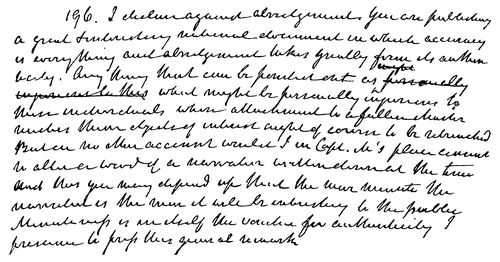
Facsimile of part of Sir Walter Scott's Notes on the "Narrative"
APPENDIX.
So many erroneous statements have gone abroad, as to the terms of Buonaparte's reception on board the Bellerophon, that I conceive it right to give the following correspondence, although at the expense of some repetition; in order to its being distinctly seen, that the good faith of the British nation was not compromised on that occasion, but that His Majesty's Government were at perfect liberty, as far as those terms were concerned, to act as they thought best.
"Tonnant, at anchor under Berryhead, 7th August, 1815.
"Sir,
"Count Las Cases having this morning stated to me that he understood from you, when he was on board the Bellerophon in Basque Roads, on a mission from General Buonaparte, that you were authorized to receive the General and his suite on board the ship you command, for conveyance to England; and that you assured him, at the same time, that both the General and his suite would be well received there; you are to report for my information, such observations as you may consider it necessary to make upon these assertions.
"I am, Sir, Your most obedient, humble servant, Keith, Admiral."
"Captain Maitland, Bellerophon."
"H.M.S. Bellerophon, Plymouth Sound, 8th August, 1815.
"My Lord,
"I have to acknowledge the receipt of your Lordship's letter of yesterday's date, informing me that Count Las Cases had stated to you, that he had understood from me when he was on board the Bellerophon in Basque Roads, on a mission from General Buonaparte, that I was authorized to receive the General and his suite on board the ship I command, for a conveyance to England, and that I assured him at the same time, that both the General and his suite would be well received there; and directing me to report for your Lordship's information such observations as I may consider it necessary to make upon these assertions. I shall, in consequence, state, to the best of my recollection, the whole of the transaction that took place between Count Las Cases and me, on the 14th of July, respecting the embarkation of Napoleon Buonaparte, for the veracity of which I beg to refer your Lordship to Captain Sartorius as to what was said in the morning, and to that officer and Captain Gambier (the Myrmidon having joined me in the afternoon) as to what passed in the evening.
"Your Lordship being informed already of the flag of truce that came out to me on the 10th of July, as well as of every thing that occurred on that occasion, I shall confine myself to the transactions of the 14th of the same month.
"Early in the morning of that day, the officer of the watch informed me, a schooner, bearing a flag of truce, was approaching: on her joining the ship, about seven A.M. the Count Las Cases and General Lallemand came on board, when, on being shown into the cabin, Las Cases asked me if any answer had been returned to the letter sent by me to Sir Henry Hotham respecting Napoleon Buonaparte being allowed to pass for America, either in the frigates or in a neutral vessel. I informed him no answer had been returned, though I hourly expected, in consequence of those despatches, Sir Henry Hotham would arrive; and, as I had told Monsieur Las Cases, when last on board, that I should send my boat in when the answer came, it was quite unnecessary to have sent out a flag of truce on that account:—there, for the time, the conversation terminated. On their coming on board, I had made the signal for the Captain of the Slaney, being desirous of having a witness to all that might pass.
"After breakfast (during which Captain Sartorius came on board) we retired to the after-cabin, when Monsieur Las Cases began on the same subject, and said, 'The Emperor was so anxious to stop the further effusion of blood, that he would go to America in any way the English Government would sanction, either in a neutral, a disarmed frigate, or an English ship of war.' To which I replied, 'I have no authority to permit any of those measures; but if he chooses to come on board the ship I command, I think, under the orders I am acting with, I may venture to receive him and carry him to England; but, if I do so, I can in no way be answerable for the reception he may meet with (this I repeated several times); when Las Cases said, 'I have little doubt, under those circumstances, that you will see the Emperor on board the Bellerophon.' After some more general conversation, and the above being frequently repeated, Monsieur Las Cases and General Lallemand took their leave: and I assure your Lordship that I never, in any way, entered into conditions with respect to the reception General Buonaparte was to meet with; nor was it, at that time, finally arranged that he was to come on board the Bellerophon. In the course of conversation, Las Cases asked me whether I thought Buonaparte would be well received in England; to which I gave the only answer I could do in my situation—'That I did not at all know what was the intention of the British Government; but I had no reason to suppose he would not be well received.' It is here worthy of remark, that when Las Cases came on board, he assured me that Buonaparte was then at Rochefort, and that it would be necessary for him to go there to report the conversation that had passed between us (this I can prove by the testimony of Captain Sartorius, and the first Lieutenant of this ship, to whom I spoke of it at the time), which statement was not fact; Buonaparte never having quitted Isle d'Aix, or the frigates, after the 3rd.
"I was, therefore, much surprised at seeing Monsieur Las Cases on board again before seven o'clock the same evening; and one of the first questions I put to him was, whether he had been at Rochefort. He answered, that on returning to Isle d'Aix, he found that Buonaparte had arrived there.
"Monsieur Las Cases then presented to me the letter Count Bertrand wrote concerning Buonaparte's intention to come on board the ship (a copy of which has been transmitted to your Lordship by Sir Henry Hotham); and it was not till then agreed upon that I should receive him; when either Monsieur Las Cases, or General Gourgaud (I am not positive which, as I was employed writing my own despatches), wrote to Bertrand to inform him of it. While paper was preparing to write the letter, I said again to Monsieur Las Cases, 'You will recollect I have no authority for making conditions of any sort.' Nor has Monsieur Las Cases ever started such an idea till the day before yesterday. That it was not the feeling of Buonaparte, or the rest of his people, I will give strong proof, drawn from the conversations they have held with me.
"As I never heard the subject mentioned till two days ago, I shall not detail every conversation that has passed, but confine myself to that period.
"The night that the squadron anchored at the back of Berryhead, Buonaparte sent for me about 10 P.M. and said he was informed by Bertrand, that I had received orders to remove him to the Northumberland, and wished to know if that was the case; on being told that it was, he requested I would write a letter to Bertrand, stating I had such orders, that it might not appear that he went of his own accord, but that he had been forced to do so. I told him, I could have no objection, and wrote a letter to that effect (a copy of which is here annexed), which your Lordship afterwards sanctioned, and desired me, if he required it, to give him a copy of the order.
"After having arranged that matter, I was going to withdraw, when he requested me to remain, as he had something more to say: he then began complaining of his treatment in being forced to go to St Helena: among other things, he observed, 'They say I made no conditions: certainly, I made no conditions: how could a private man (un particulier) make conditions with a nation? I wanted nothing from them but hospitality, or (as the ancients would express it) air and water. I threw myself on the generosity of the English nation; I claimed a place sur leurs foyers, and my only wish was to purchase a small estate and end my life in tranquillity.' After more of the same sort of conversation I left him for the night.
"On the morning he removed from the Bellerophon to the Northumberland, he sent for me again, and said, 'I have sent for you to express my gratitude for your conduct to me, while I have been on board the ship you command. My reception in England has been very different from what I expected; but you throughout have behaved like a man of honour; and I request you will accept my thanks, as well as convey them to the officers, and ship's company of the Bellerophon.'
"Soon afterwards Montholon came to me from Buonaparte; but, to understand what passed between him and me, I must revert to a conversation that I had with Madame Bertrand on the passage from Rochefort.
"It is not necessary to state how the conversation commenced, as it does not apply to the present transaction; but she informed me, that it was Buonaparte's intention to present me with a box containing his picture set with diamonds. I answered, 'I hope not, for I cannot receive it.' 'Then you will offend him very much,' she said. 'If that is the case,' I replied, 'I request you will take measures to prevent its being offered, as it is absolutely impossible I can accept of it; and I wish to spare him the mortification, and myself the pain, of a refusal.' There the matter dropt, and I heard no more of it, till about half an hour before Buonaparte quitted the Bellerophon, when Montholon came to me, and said he was desired by Buonaparte to express the high sense he entertained of my conduct throughout the whole of the transaction: that it had been his intention to present me with a box containing his portrait, but that he understood I was determined not to accept it. I said, 'Placed as I was, I felt it impossible to receive a present from him, though I was highly flattered at the testimony he had borne to the uprightness of my conduct throughout.' Montholon then added, 'One of the greatest causes of chagrin he feels in not being admitted to an interview with the Prince Regent, is, that he had determined to ask as a favour, your being promoted to the rank of Rear-Admiral.' To which I replied, 'That would have been quite impossible, but I do not the less feel the kindness of the intention.' I then said, 'I am hurt that Las Cases should say I held forth any assurances as to the reception Buonaparte was to meet with in England.' 'Oh!' said he, 'Las Cases is disappointed in his expectations; and as he negotiated the affair, he attributes the Emperor's situation to himself: but I can assure you, that he (Buonaparte) feels convinced you have acted like a man of honour throughout.'
"As your Lordship overheard part of a conversation which took place between Las Cases and me on the quarter-deck of the Bellerophon, I shall not detail it; but on that occasion, I positively denied having promised anything as to the reception of Buonaparte and his suite; and I believe your Lordship was of opinion he could not make out the statement to you.
"It is extremely unpleasant for me to be under the necessity of entering into a detail of this sort; but the unhandsome representation Monsieur Las Cases has made to your Lordship of my conduct, has obliged me to produce proofs of the light in which the transaction was viewed by Buonaparte as well as his attendants.
"I again repeat, that Captains Gambier and Sartorius can verify the principal part of what I have stated, as far as concerns the charge made against me by Count Las Cases.
"I have the honour to be, Your Lordship's Most obedient humble servant, Frederick L. Maitland."
"To the Right Hon. Viscount Keith, G.C.B. &c. &c. &c."
"Slaney, in Plymouth Sound, 15th August, 1815.
"My Lord,
"I have read Captain Maitland's letter to your Lordship, of the 8th instant, containing his observations upon the assertions made on the preceding day by Count Las Cases; and I most fully attest the correctness of the statement he has made, so far as relates to the conversations that took place in my presence.
"I have the honour to be, Your Lordship's Most obedient humble servant, G. R. Sartorius, Capt. of H.M.S. Slaney."
"To the Right Hon. Viscount Keith, G.C.B. &c. &c. &c."
A letter to the same effect as the foregoing was written to Lord Keith, by Captain Gambier, of the Myrmidon, and forwarded by his Lordship to the Admiralty, with my report; of which, by some accident, the Admiral's secretary did not furnish me with a copy.
ADDITIONAL APPENDIX.
I.
LIST OF OFFICERS borne on the Books of H.M.S. Bellerophon in July 1815.
Captain Fred. L. Maitland.
" William Walford.
" John Bowerbank.
" Gabriel Christie.
" Edward William Ramsay.
Captain of Marines, George Marshall.
Lieutenant of Marines, J. W. Simpson.
" Henry Smith.
Master, Stephen Vale.
Surgeon, Barry O'Meara.
Assistant-Surgeon, A. Milne.
" E. Graebke.
Chaplain, J. W. Wynne.
Purser, George Jackson.
II.
Letter from Ephraim Graebke, assistant-surgeon on board H.M.S. Bellerophon, to his mother, giving an account of Napoleon's surrender (British Museum, Additional MSS. 34,710, f. 81).
H.M.S. Bellerophon, Plymouth Sound, Tuesday, July 30, 1815.
My dear Mother,
You will be surprised at not hearing from me, and knowing the Bellerophon's arrival in England, but when I tell you no private letters were allowed to leave the ship before to-day, that will cease. It's unnecessary to say that we have got Buonaparte and suite on board, as it was known in England previous to our arrival, which took place on the 24th instant in Torbay. The circumstances which led to his surrender were his defeats in all points, and was it not for the strict blockade we kept up would [sic] have escaped to America. We heard of his being on board the French frigate Saale off Rochfort, from which moment we watched his movements if possible more closely than before. On the morning of the 14th instant, observing a schooner bearing a flag of truce on board standing towards us, we hove to for her, when Count Lascazas and General Lallemande came on board with proposals from Buonaparte, in consequence of which we came to anchor in the evening in the roads off Rochelle. Next morning, 15th instant, at 4 a.m. observed a man-of-war brig standing out and beating towards us, we immediately dispatched all our boats. Lieut. Mott in the barge brought Buonaparte on board at 7, the boats were busily employed in bringing his retinue and baggage, and I never saw men exert themselves so much as ours did that day, lest Admiral Hotham should take him, as he was off the harbour in the Superb, and saw him coming on board here, and did all in his power to get in, but did not come to anchor before 11 in the forenoon. Buonaparte is a fine-looking man, inclined to corpulency, is five feet six inches in height, his hair turning grey, and a little bald on the crown of the head, no whiskers, complexion French yellow, eyes grey, Roman nose, good mouth and chin, neck short, big belly, arms stout, small white hands, and shews a good leg. He wears a cocked hat somewhat like our old-fashioned three cornered ones, with the tri-coloured cockade in it, plain green coat, cape red, and cuffs the same, plain gold epaulets, and a large star on the left breast, white waistcoat and breeches and white silk stockings, thin shoes and buckles. Eats but two meals in the day, breakfast and dinner, and these are sumptuous, fish, flesh, and fowl, wines, fruit, various French dishes &c. &c. He breakfasts about eleven and dines at six, is about half an hour at each, when he generally comes on deck or goes into the after-cabin to study. We do not know what's to be done with him yet, he remains on board until we hear from the allies. In his suite are Marshal Bertrand, Duc de Rovigo [Savary] once the French minister of police, Counts Lascazas and Montholon, Generals Lallemande and Gourgou, several Lieut.-Colonels and Captains, to enumerate them would be tedious. We have 33 on board, 17 were sent on board the Myrmidon, Captn. Gambier. There are two Countesses on board, but not to be compared even to our English ladies. Their children are handsome.... We performed the comedy of the "Poor Gentleman" before Buonaparte and suite. I acted the part of Corporal Foss. It went off very well, our scenery was excellent. The female dresses were badly suited for Midshipmen. I long to hear from you and will expect to hear all the news.... I wish you were all here to see Buonaparte, the curiosity of all ranks to see him is excessive. There are Admiralty orders not to allow any person whatever on board, but they crowd in boats round the ship, and he very condescendingly stands looking at them through a spyglass. There are two frigates, one on each side of us, the Eurotas and Liffey, and their boats are constantly rowing about the ship to keep off the boats. We prisoners have no other amusement than to look at them contending for places. I hope we will soon be allowed to go ashore, as I want to see Captain Sandys. You must be tired reading this long epistle. We took some prizes, one ship laden with Buonaparte's soldiers, one chasse marée laden with resin, and the Cephulus man-of-war brig sent in a West Indiaman laden with sugar, coffee, &c. from Martinique bound to France, and for which we will share by mutual agreements. Give my affectionate love to Ally, Anne, Wilhelmina, Sophia and Jane. I know the want of not being near them as my shirts are going to pieces, as soon as I can afford the sum I will get some new ones. I have the old number the same as when I left you and bought none since.... I remain, my dear mother, your affectionate son,
Ephraim Graebke.
P.S.—I think myself very lucky to belong to the old Bellerophon at this important time. Lose no time in answering this letter.
Mrs Graebke, Midleton, Co. Cork.
III.
Extracts from Memoirs of an Aristocrat, and Reminiscences of the Emperor Napoleon, by a Midshipman of the Bellerophon [George Home]. London, Whittaker & Co., and Bell & Bradfute, Edinburgh, 1838.
About six in the morning, the look-out man at the mast-head announced a large ship of war standing direct in for the roadstead, which Captain Maitland, suspecting to be the Superb, bearing the flag of Admiral Sir Henry Hotham, he gave immediate orders to hoist out the barge, and dispatched her, under the command of the first lieutenant, to the French brig, being apprehensive that if the Admiral arrived before the brig got out, that Napoleon would deliver himself up to the Admiral instead of us, and thus have lost us so much honour.
As our barge approached, the brig hove to, and from the moment she came alongside, we watched every motion with deep anxiety. Like all Napoleon's movements, he was not slow even in this, his last free act. The barge had not remained ten minutes alongside, before we saw the rigging of the brig crowded with men, persons stepping down the side into the boat, and the next moment she shoved off, and gave way for the ship; while the waving of the men's hats in the rigging, and the cheering which we heard faintly in the distance, left no doubt that the expected guest was approaching. A general's guard of marines was ordered aft on the quarter-deck, and the boatswain stood, whistle in hand, ready to do the honours of the side. The lieutenants stood grouped first on the quarter-deck, and we more humble middies behind them, while the captain, evidently in much anxiety, kept trudging backwards and forwards between the gangway and his own cabin, sometimes peeping out at one of the quarter-deck ports, to see if the barge was drawing near.
It is a sin to mix up any trifling story with so great an event; but a circumstance occurred so laughable of itself, rendered more so from the solemnity of the occasion, that I cannot resist mentioning it. While in this state of eager expectation, a young midshipman, one of the Bruces of Kennet, I think, walked very demurely up to Manning, the boatswain, who was standing all importance at the gangway, and after comically eyeing his squat figure and bronzed countenance, Bruce gently laid hold of one of his whiskers, to which the boatswain good-naturedly submitted, as the youngster was a great favourite with him.
"Manning," says he, most sentimentally, "this is the proudest day of your life; you are this day to do the honours of the side to the greatest man the world ever produced or ever will produce."
Here the boatswain eyed him with proud delight.
"And along with the great Napoleon, the name of Manning, the boatswain of the Bellerophon, will go down to the latest posterity; and, as a relic of that great man, permit me, my dear Manning, to preserve a lock of your hair."
Here he made an infernal tug at the boatswain's immense whisker, and fairly carried away a part of it, making his way through the crowd, and down below with the speed of an arrow. The infuriated boatswain, finding he had passed so rapidly from the sublime to the ridiculous, through the instrumentality of this imp of a youngster, could vent his rage in no way but by making his glazed hat spin full force after his tantalizer, with a "G—d d——n your young eyes and limbs." The hat, however, fell far short of young Bruce, and the noise and half burst of laughter the trick occasioned drew the attention of the Captain, who, coming up, with a "What, what's all this?" the poor boatswain was glad to draw to his hat and resume his position.
The barge approached, and ranged alongside. The first lieutenant came up the side, and to Maitland's eager and blunt question, "Have you got him?" he answered in the affirmative. After the lieutenant came Savary, followed by Marshal Bertrand, who bowed and fell back a pace on the gangway to await the ascent of their master. And now came the little great man himself, wrapped up in his gray greatcoat buttoned to the chin, three-cocked hat and Hussar boots, without any sword, I suppose as emblematical of his changed condition. Maitland received him with every mark of respect, as far as look and deportment could indicate; but he was not received with the respect due to a crowned head, which was afterwards insidiously thrown out against Maitland. So far from that, the captain, on Napoleon's addressing him, only moved his hat, as to a general officer, and remained covered while the Emperor spoke to him. His expressions were brief, I believe only reiterating what he had stated the day previous in his letter to the Prince Regent, "That he placed himself under the protection of the British nation, and under that of the British commander as the representative of his sovereign." The captain again moved his hat, and turned to conduct the Emperor to the cabin. As he passed through the officers assembled on the quarter-deck, he repeatedly bowed slightly to us, and smiled. What an ineffable beauty there was in that smile, his teeth were finely set, and as white as ivory, and his mouth had a charm about it that I have never seen in any other human countenance. I marked his fine robust figure as he followed Captain Maitland into the cabin, and, boy as I was, I said to myself, "Now have I a tale for futurity."
. . . . . . . . . . . . . .
I shall never forget that morning we made Ushant. I had come on deck at four in the morning to take the morning watch, and the washing of decks had just begun, when, to my astonishment, I saw the Emperor come out of the cabin at that early hour, and make for the poop-ladder. Had I known what human misery is as well as I do now, when I have myself experienced the most cruel injustice and persecution on a lesser scale, the restlessness of Napoleon, or his being unable to close an eye, would have in no way surprised me. If a petty care can break our sleep, what must have been his feeling who had lost the fairest empire on the face of the globe; nay, who had lost a world? From the wetness of the decks, he was in danger of falling at every step, and I immediately stepped up to him, hat in hand, and tendered him my arm, which he laid hold of at once, smiling, and pointing to the poop, saying in broken English, "the poop, the poop"; he ascended the poop-ladder leaning on my arm; and having gained the deck, he quitted his hold and mounted upon a gun-slide, nodding and smiling thanks, for my attention, and pointing to the land he said, "Ushant, Cape Ushant." I replied, "Yes, sire," and withdrew. He then took out a pocket-glass and applied it to his eye, looking eagerly at the land. In this position, he remained from five in the morning to nearly mid-day, without paying any attention to what was passing around him, or speaking to one of his suite, who had been standing behind him for several hours.
No wonder he thus gazed, it was the last look of the land of his glory, and I am convinced he felt it such. What must have been his feelings in those few hours, how painful the retrospect, and how awful the look forward!—there still lay before him that land which he had made so famous, where his proud name had risen until it "o'ershadowed the earth with his fame"; there had he been worshipped almost as a god, and bowed to by every servile knee, that now, in the hour of bitter adversity, had basely deserted and betrayed him. Never man was read such a lesson as must have passed before him in that brief space, unless, really, that the greatness of the change, the suddenness of the fall had benumbed all feeling, and left him only a mass of contending passions which combated and stilled each other by the very violence of their working. But this was not the case with Napoleon, his emotion was visible, he hung upon the land until it looked only a speck in the distance, and then, turning, stepped from the gun-slide into the arms of his faithful Bertrand, who stood ready to receive his fallen master. He uttered not a word as he tottered down the poop-ladder, his head hung heavily forward, so as to render his countenance scarcely visible, and in this way he was conducted to his cabin.