REAR-ADMIRAL SIR FREDERICK LEWIS MAITLAND, K.C.B. (continued 2)
Reading edition
"In case you should arrive at a port where there is a flag-officer, you are to send to acquaint him with the circumstances, strictly charging the officer sent on shore with your letter, not to divulge its contents: and if there should be no flag-officer at the port where you arrive, you are to send one letter express to the Secretary of the Admiralty, and another to Admiral Lord Keith, with strict injunctions of secrecy to each officer who may be the bearer of them."
Messrs Savary and Las Cases, who came on board, from the Schooner above mentioned, at seven o'clock on the 10th of July, presented the following letter to me:—
"Le 9 Juillet, 1815.
"Monsieur l'Amiral,
"L'Empereur Napoléon ayant abdiqué le pouvoir, et choisi les États Unis d'Amérique pour s'y réfugier, s'est embarqué sur les deux frégates qui sont dans cette rade, pour se rendre à sa destination. Il attend le sauf conduit du Gouvernement Anglais, qu'on lui a annoncé, et qui me porte à expédier le présent parlementaire, pour vous demander, Mons. l'Amiral, si vous avez connoissance du dit sauf conduit; ou si vous pensez qu'il soit dans l'intention du Gouvernement Anglais de se mettre de l'empêchement à notre voyage aux États Unis. Je vous serai extrêmement obligé de me donner là-dessus les renseignemens que vous pouvez avoir.
"Je charge les porteurs de la présente lettre de vous faire agréer mes remercîmens et mes excuses, pour la peine qu'elle a pu vous donner.
"J'ai l'honneur d'être, Monsieur l'Amiral, de Votre Excellence, &c. &c. Le Grand Maréchal Cte. Bertrand."
"À Monsieur l'Amiral commandant les Croisières avant Rochefort."
TRANSLATION.
"Sir,
"The Emperor Napoleon having abdicated the throne of France, and chosen the United States of America as a retreat, is, with his suite, at present embarked on board the two frigates which are in this port, for the purpose of proceeding to his destination. He expects a passport from the British Government, which has been promised to him, and which induces me to send the present flag of truce, to demand of you, Sir, if you have any knowledge of the above-mentioned passport, or if you think it is the intention of the British Government to throw any impediment in the way of our voyage to the United States. I shall feel much obliged by your giving me any information you may possess on the subject.
"I have directed the bearers of this letter to present to you my thanks, and to apologise for the trouble it may cause.
"I have the honour to be, Your Excellency's most obedient, &c. &c. Grand Marshal Count Bertrand."
"To the Admiral commanding the Squadron before Rochefort."
The bearers of the letter had instructions to demand of me, whether I would prevent Buonaparte from proceeding in a neutral vessel, provided I could not permit the frigates to pass with him on board. Having received, in my orders, the strictest injunctions to secrecy, and feeling that the force on the coast, at my disposal, was insufficient to guard the different ports and passages from which an escape might be effected, particularly should the plan be adopted of putting to sea in a small vessel; I wrote the following reply to the above communication; hoping, by that means, to induce Napoleon to remain for the Admiral's answer, which would give time for the arrival of reinforcements.
"H.M.S. Bellerophon, off Rochefort, July 10th, 1815.
"Sir,
"I have to acknowledge the receipt of your letter of yesterday's date, addressed to the Admiral commanding the English cruisers before Rochefort, acquainting me that the Emperor, having abdicated the throne of France, and chosen the United States of America as an asylum, is now embarked on board the frigates, to proceed for that destination, and awaits a passport from the English Government; and requesting to know if I have any knowledge of such passport; or if I think it is the intention of the English Government to prevent the Emperor's voyage.
"In reply, I have to acquaint you, that I cannot say what the intentions of my Government may be; but, the two countries being at present in a state of war, it is impossible for me to permit any ship of war to put to sea from the port of Rochefort.
"As to the proposal made by the Duc de Rovigo and Count Las Cases, of allowing the Emperor to proceed in a merchant vessel; it is out of my power,—without the sanction of my commanding officer, Sir Henry Hotham, who is at present in Quiberon Bay, and to whom I have forwarded your despatch,—to allow any vessel, under whatever flag she may be, to pass with a personage of such consequence.
"I have the honour to be, Sir, Your very humble servant, Fred. L. Maitland, Captain of H.M.S. Bellerophon."
"Le Grand Maréchal Comte Bertrand."
The Duke of Rovigo and Count Las Cases remained on board between two and three hours, during which time I had a great deal of conversation with them, on the state of affairs in France; in which they did all they could to impress me with the idea that Buonaparte was not reduced to the necessity of quitting Europe; but that, in doing so, he was actuated solely by motives of humanity; being unwilling, they said, that any further effusion of blood should take place on his account. They declared also, that his party was still very formidable in the centre and south of France, and that, if he choose to protract the war, he might still give a great deal of trouble; and that, although his ultimate success might not be probable, there was still a possibility of fortune turning in his favour, and therefore they argued it was the interest of England to allow him to proceed to America. To all this I could give little or no reply, being quite ignorant of what had occurred in France, further than the decisive victory obtained by the Duke of Wellington at Waterloo. During the time the Frenchmen were with me, I received some French newspapers from Sir Henry Hotham; but my time was so fully occupied in writing to him, and in discussions with my visitors, that it was not in my power to read them: I therefore drew them back to the subject that had occasioned their visit, and said, "Supposing the British Government should be induced to grant a passport for Buonaparte's going to America, what pledge could he give that he would not return, and put England, as well as all Europe, to the same expense of blood and treasure that has just been incurred?"
General Savary made the following reply: "When the Emperor first abdicated the throne of France, his removal was brought about by a faction, at the head of which was Talleyrand, and the sense of the nation was not consulted: but in the present instance he has voluntarily resigned the power. The influence he once had over the French people is past; a very considerable change has taken place in their sentiments towards him, since he went to Elba; and he could never regain the power he had over their minds: therefore he would prefer retiring into obscurity, where he might end his days in peace and tranquillity; and were he solicited to ascend the throne again, he would decline it."
"If that is the case," I said, "why not ask an asylum in England?" He answered, "There are many reasons for his not wishing to reside in England: the climate is too damp and cold; it is too near France; he would be, as it were, in the centre of every change and revolution that might take place there, and would be subject to suspicion; he has been accustomed to consider the English as his most inveterate enemies, and they have been induced to look upon him as a monster, without one of the virtues of a human being."
This conversation took place while I was writing my despatches to Sir Henry Hotham; and the Frenchmen were walking in the cabin, frequently interrupting me, to enforce their statement of Buonaparte's situation being by no means so desperate as might be supposed; from which I took the liberty of drawing a conclusion directly opposite to the one they were desirous of impressing on my mind.
Captain Knight, of the Falmouth, who carried my despatches to the Admiral, was present during the whole of this conversation, but did not join in it. This was the first certain information I had received of Buonaparte's position since the battle of Waterloo.
Tuesday, the 11th.—About noon, a small boat came off from the Island of Oleron, to where the ship was at anchor in Basque Roads, rowed by four men, in which sat two respectable-looking countrymen, who asked for the Captain; and upon my being pointed out to them, requested to speak with me in private. When shown into the cabin, where I went accompanied by Captain Gambier, of the Myrmidon, they acquainted me, that a message had been sent from Isle d'Aix, early that morning, for a man who was considered the best pilot on the island for the Mamusson passage, being the only person that had ever taken a frigate through; that a large sum of money had been offered to him to pilot a vessel to sea from that passage, and that it certainly was Buonaparte's intention to escape from thence; either in the corvette, which had moved down some days before, or in a Danish brig, which was then lying at anchor near the entrance.
On receiving this information, I immediately got under weigh, and though the flood-tide had just made in, beat the ships out of the Pertuis d'Antioche before it was dark, when I sent the Myrmidon off the Mamusson, with orders to anchor close in with the entrance, when the weather would admit of it; while I remained with the Bellerophon and Slaney, which rejoined me that evening, under weigh between the light-houses.
On the 12th of July, the Cyrus being seen in the offing, I ordered her by telegraph to take a position close in with the Baleine light-house, and to examine strictly every vessel that might attempt to put to sea from the Pertuis de Breton, as Buonaparte was on the spot, endeavouring to escape to America.
The same evening, the white flag made its appearance for the first time on the towers of Rochelle; on seeing which, I felt it my duty to run into Basque Roads, accompanied by the Slaney; and having anchored, I hoisted the Bourbon colours at the main-top-gallant mast-head, and fired a royal salute. During the whole of this afternoon, however, two tri-coloured flags were kept flying in Rochelle; and before sunset all the white flags were struck, and every where replaced by those of Buonaparte.
On the 13th of July, nothing of importance occurred, except the white flag being once more hoisted all over Rochelle, as well as on the Isle of Oleron, to the entire exclusion of the tri-coloured ensign. We could plainly perceive, that the frigates, from whom we were distant about three miles, were perfectly ready to put to sea, should an opportunity offer; having their sterns covered with vegetables, their top-gallant yards across, studding sail gear rove, and numerous boats passing between them and the island the whole day:—all indications, well known to professional men, of preparing for sea.
The ships under my command were accordingly kept with slip buoys on their cables, and, as soon as it was dark, the top-sail and top-gallant yards were swayed to the mast-heads, the sails stopt with rope yarns, and every thing kept ready to make sail at a moment's warning. Guard-boats were also kept rowing all night, as near the frigates as they could venture, having signals established to show in the event of the enemy getting under sail.
On the 14th of July, at daybreak, the officer of the watch informed me, that the Mouche was standing out from Isle d'Aix, bearing a flag of truce, which I ordered to be accepted. Here it is necessary to mention, that the British flag of truce, being a white flag at the fore-top-gallant mast-head, which was also hoisted as a matter of course when Buonaparte was received on board, has by some persons been construed into the Bourbon flag, and thence into an intentional insult to him. It never was my intention, nor do I believe it could have been that of any British officer, to treat with insult any fallen enemy, much less one who had shown such confidence as to throw himself on the protection of his former foe.
When the schooner, the Mouche, reached the ship, Count Las Cases came on board, attended by General Count Lallemand. This meeting was highly interesting to me, as Lallemand had been a prisoner for three weeks in the Camelion under my command in Egypt, with Junot, whose Aid-de-Camp he then was; and General Savary, who accompanied Count Las Cases in his first visit to the Bellerophon, had lived nearly as long at Sir Sydney Smith's table with me, at the Turkish camp at El Arish, when the convention, which takes its name from that place, was under discussion, being Aid-de-Camp to General Dessaix, who negotiated on the part of the French.
On their coming on board, I made the signal for the Captain of the Slaney, being desirous of having a witness to any conversation that might pass, as our communications were chiefly verbal: he arrived while we were at breakfast.
When Count Las Cases came on the quarter-deck, he informed me that he was sent off to learn whether I had received an answer from the Admiral to the letter he had brought off on the 10th instant. I told him that I had not, but, in consequence of the despatch which I had forwarded to him, I had not a doubt he would immediately repair here in person, and I was hourly in expectation of seeing him, adding, "If that was the only reason you had for sending off a flag of truce, it was quite unnecessary, as I informed you, when last here, that the Admiral's answer, when it arrived, should be forwarded to the frigates by one of the Bellerophon's boats; and I do not approve of frequent communications with an enemy by means of flags of truce." I then went into the cabin and ordered breakfast, to prevent further discussion until the arrival of Captain Sartorius.
When breakfast was over, we retired to the after-cabin. Count Las Cases then said, "The Emperor is so anxious to spare the further effusion of human blood, that he will proceed to America in any way the British Government chooses to sanction, either in a French ship of war, a vessel armed en flute, a merchant vessel, or even in a British ship of war." To this I answered, "I have no authority to agree to any arrangement of that sort, nor do I believe my Government would consent to it; but I think I may venture to receive him into this ship, and convey him to England: if, however," I added, "he adopts that plan, I cannot enter into any promise, as to the reception he may meet with, as, even in the case I have mentioned, I shall be acting on my own responsibility, and cannot be sure that it would meet with the approbation of the British Government."
There was a great deal of conversation on this subject, in the course of which Lucien Buonaparte's name was mentioned, and the manner in which he had lived in England alluded to; but I invariably assured Las Cases most explicitly, that I had no authority to make conditions of any sort, as to Napoleon's reception in England. In fact, I could not have done otherwise, since, with the exception of the order inserted at page 24, I had no instructions for my guidance, and was, of course, in total ignorance of the intention of His Majesty's ministers as to his future disposal. One of the last observations Las Cases made before quitting the ship was, "Under all circumstances, I have little doubt that you will see the Emperor on board the Bellerophon;" and, in fact, Buonaparte must have determined on that step before Las Cases came on board, as his letter to his Royal Highness the Prince Regent is dated the 13th of July, the day before this conversation.
During the above-mentioned conversation, I asked Las Cases where Buonaparte then was? He replied, "At Rochefort; I left him there yesterday evening." General Lallemand then said, "The Emperor lives at the Hotel in the Grand Place, and is now so popular there, that the inhabitants assemble every evening in front of the house, for the purpose of seeing him, and crying, 'Vive l'Empereur!'"
I then asked how long it would take to go there: Las Cases answered, "As the tide will be against us, it will require five or six hours." Why these false statements were made, I cannot pretend to say; but it is very certain that Buonaparte never quitted the frigates or Isle d'Aix, after his arrival there on the 3rd of July.
General Lallemand took occasion to ask me if I thought there would be any risk of the people, who might accompany Buonaparte, being given up to the Government of France: I replied, "Certainly not; the British Government never could think of doing so, under the circumstances contemplated in the present arrangement."
They left me about half-past nine A.M. In the course of the day, I was joined by the Myrmidon, Captain Gambier, who had been sent to me by Captain Green, of the Daphne, with a letter he had received from Captain Aylmer, of the Pactolus, in the Gironde, bringing information that it was the intention of Buonaparte to escape from Rochefort in a Danish sloop, concealed in a cask stowed in the ballast, with tubes so constructed as to convey air for his breathing. I afterwards inquired of General Savary, if there had been any foundation for such a report; when he informed me that the plan had been thought of, and the vessel in some measure prepared; but it was considered too hazardous; for had we detained the vessel for a day or two, he would have been obliged to make his situation known, and thereby forfeited all claims to the good treatment he hoped to ensure by a voluntary surrender.
The two Captains dined with me, and afterwards went on board the Myrmidon, to take up a position to the north-east of the Bellerophon, to prevent vessels from passing close in shore, and thus to render the blockade of the port more complete.
Soon after they left me, a barge was perceived rowing off from the frigates towards the Bellerophon with a flag-of-truce up; on which I recalled Captains Sartorius and Gambier, by signal, that they might be present at any communication that was to be made. The boat got alongside about seven P.M. and brought Count Las Cases, accompanied by General Baron Gourgaud, one of Buonaparte's Aid-de-Camps. On their coming on deck, I immediately addressed Las Cases, saying, "It is impossible you could have been at Rochefort, and returned, since you left me this morning." He replied, "No; it was not necessary; I found the Emperor at Isle d'Aix, on my arrival there." He then told me, he was charged with a letter from General Bertrand. We walked into the cabin, when he delivered it to me; it was as follows:—
"Le 14 Juillet, 1815.
"Monsieur le Commandant,
"Monsieur le Comte de Las Cases a rendu compte à l'Empereur de la conversation qu'il a eue ce matin à votre bord. S. M. se rendra à la marée de demain, vers quatre ou cinq heures du matin, à bord de votre vaisseau. Je vous envoye Monsieur le Comte de Las Cases, Conseiller d'État, faisant fonction de Maréchal de Logis, avec la liste des personnes composant la suite de S. M. Si l'Amiral, en conséquence de la demande que vous lui avez adressée, vous envoye le sauf conduit demandé pour les États Unis, S. M. s'y rendra avec plaisir; mais au défaut du sauf conduit, il se rendra volontiers en Angleterre, comme simple particulier, pour y jouir de la protection des loix de votre pays.
"S. M. a expédié Monsieur le Maréchal de Camp Baron Gourgaud auprès du Prince Régent, avec une lettre, dont j'ai l'honneur de vous envoyer copie, vous priant de la faire passer au Ministre auquel vous croyez nécessaire d'envoyer cet officier général, afin qu'il ait l'honneur de remettre au Prince Régent la lettre dont il est chargé.
"J'ai l'honneur d'être, Monsieur le Commandant, Votre très humble et très obéissant Serviteur, Le Grand Maréchal, Comte Bertrand."
"À Monsieur le Commandant des Croisières devant Rochefort."
TRANSLATION.
"Sir,
"Count Las Cases has reported to the Emperor the conversation which he had with you this morning. His Majesty will proceed on board your ship with the ebb tide to-morrow morning, between four and five o'clock.
"I send the Count Las Cases, Counsellor of State, doing the duty of Maréchal de Logis, with the list of persons composing His Majesty's suite.
"If the Admiral, in consequence of the despatch you forwarded to him, should send the passport for the United States therein demanded, His Majesty will be happy to repair to America; but should the passport be withheld, he will willingly proceed to England, as a private individual, there to enjoy the protection of the laws of your country.
"His Majesty has despatched Major General Baron Gourgaud to the Prince Regent with a letter, a copy of which I have the honour to enclose, requesting that you will forward it to such one of the ministers as you may think it necessary to send that general officer, that he may have the honour of delivering the letter with which he is charged to the Prince Regent.
"I have the honour to be, Sir, Your very humble servant, Count Bertrand."
"To the Officer commanding the Cruizers off Rochefort."
List of persons composing the suite of Napoleon Buonaparte, enclosed in the above Letter, and the manner in which they were distributed during the passage to England.
Bellerophon.
Généraux.
Le Lieutenant Général Comte Bertrand, Gd. Maréchal.
Le Lieutenant Général Duc de Rovigo.
Le Lieutenant Général Baron Lallemand Aide de Camp de S. M.
Le Maréchal de Camp Comte de Montholon Aide de Camp de S. M.
Le Comte de Las Cases Conseiller d'État.
Dames.
Madame la Comtesse Bertrand.
Madame la Comtesse de Montholon.
Enfans.
3 Enfans de Madame la Comtesse Bertrand.
1 Enfant de Madame la Comtesse de Montholon.
Officiers.
M. de Planat, Lieutenant-Colonel.
M. Maingaut, Chirurgien de S. M.
M. Las Cases, Page.
Service de la Chambre.
M. M. Marchand 1 Valet de Chambre.
Gilli Valet de Chambre.
St Denis Valet de Chambre.
Novarra Idem.
Denis Garçon de Garderobe.
Livrée.
Archambaud 1 Valet de pied.
Gaudron Valet de pied.
Gentilini Id.
Service de la Bouche.
M. M. Fontain 1 Maître d'Hôtel.
Piéron Chef d'Office.
La Fosse Cuisinier.
Le Page Idem.
2 Femmes de Chambre de Madame la Comtesse Bertrand.
1 Femme de Chambre de Madame la Comtesse de Montholon.
Suite des personnes qui accompagnent S. M.
1 Valet de Chambre du Duc de Rovigo.
1 do. du Comte Bertrand.
1 do. du Comte de Montholon.
1 Valet de pied du Comte Bertrand.
Total 7.
Recapitulation.
Généraux 5
Dames 2
Enfans 4
Officiers 3
Service de la Chambre de S. M. 5
Livrée de S. M. 3
Service de la Bouche 4
Suite des personnes qui accompagnent S. M. 7
—
Total 33
—
La Corvette.
Officiers.
Le Lieutenant Colonel Resigni.
Le Lieutenant Colonel Schultz.
Le Capitaine Autrie.
Le Capitaine Mesener.
Le Capitaine Prontowski.
Le Lieutenant Rivière.
Le Sous Lieutenant Ste Catherine.
Suite de S. M.
Santini Huissier.
Chauvin Id.
Rousseau Lampiste.
Archambaud Valet de pied.
Joseph Id.
Le Charron Id.
Lisiaux Garde d'Office.
Ortini Valet de pied.
Fumeau Idem.
Recapitulation.
Officiers 7
Suite 10
—
Total 17
—
Enclosed was likewise a copy of the well-known letter addressed by Buonaparte to His Royal Highness the Prince Regent.
"Altesse Royale,
"En butte aux factions qui divisent mon pays et à l'inimitié des plus grandes puissances de l'Europe, j'ai terminé ma carrière politique, et je viens comme Thémistocle m'asseoir sur le foyer du peuple Britannique. Je me mets sous la protection de ses loix, que je réclame de votre Altesse Royale, comme au plus puissant, au plus constant, et au plus généreux de mes Ennemis."
"Rochefort, 13 Juillet, 1815, "Signé, Napoleon."
TRANSLATION.
"Rochefort, July 13th, 1815.
"Your Royal Highness,
"A victim to the factions which distract my country, and to the enmity of the greatest powers of Europe, I have terminated my political career, and I come, like Themistocles, to throw myself upon the hospitality of the British people. I put myself under the protection of their laws; which I claim from your Royal Highness, as the most powerful, the most constant, and the most generous of my enemies.
Napoleon."
On reading the above, I told Monsieur Las Cases that I would receive Buonaparte on board, and immediately forward General Gourgaud to England by the Slaney, along with my despatches to the Admiralty; but that he would not be allowed to land until permission was received from London, or the sanction of the Admiral at the port he might arrive at obtained. I assured him, however, that the copy of the letter with which he was charged would be forwarded without loss of time, and presented by the Ministers to his Royal Highness. Count Las Cases then asked for paper, that he might communicate by letter to Bertrand my acquiescence in the proposal he had brought, for my receiving, and conveying to England, Buonaparte and his suite.
When General Gourgaud was about to write the letter, to prevent any future misunderstanding, I said, "Monsieur Las Cases, you will recollect that I am not authorised to stipulate as to the reception of Buonaparte in England, but that he must consider himself entirely at the disposal of his Royal Highness the Prince Regent." He answered, "I am perfectly aware of that, and have already acquainted the Emperor with what you said on the subject."
It might, perhaps, have been better if this declaration had been given in an official written form; and could I have foreseen the discussions which afterwards took place, and which will appear in the sequel, I undoubtedly should have done so; but as I repeatedly made it in the presence of witnesses, it did not occur to me as being necessary; and how could a stronger proof be adduced, that no stipulations were agreed to respecting the reception of Buonaparte in England, than the fact of their not being reduced to writing? which certainly would have been the case had any favourable terms been demanded on the part of Monsieur Las Cases, and agreed to by me.
The French boat was soon after despatched with the letter to Bertrand, in charge of a French naval officer, who had attended Las Cases on board; and as soon as I had finished the following despatch to the Secretary of the Admiralty, I sent Captain Sartorius, of the Slaney, to England, accompanied by General Gourgaud.
Extract of a Letter from Captain Maitland, of His Majesty's ship Bellerophon, addressed to the Secretary of the Admiralty, dated in Basque Roads, 14th July, 1815.
"For the information of the Lords Commissioners of the Admiralty, I have to acquaint you that the Count Las Cases and General Lallemand this day came on board His Majesty's ship under my command, with a proposal from Count Bertrand for me to receive on board Napoleon Buonaparte, for the purpose of throwing himself on the generosity of the Prince Regent. Conceiving myself authorised by their Lordships' secret order, I have acceded to the proposal, and he is to embark on board this ship to-morrow morning. That no misunderstanding might arise, I have explicitly and clearly explained to Count Las Cases, that I have no authority whatever for granting terms of any sort, but that all I can do is to carry him and his suite to England, to be received in such manner as his Royal Highness may deem expedient.
"At Napoleon Buonaparte's request, and that their Lordships may be in possession of the transaction at as early a period as possible, I despatch the Slaney (with General Gourgaud, his Aide de Camp), directing Captain Sartorius to put into the nearest port, and forward this letter by his first Lieutenant, and shall in compliance with their Lordships' orders proceed to Torbay, to await such directions as the Admiralty may think proper to give.
"Enclosed, I transmit a copy of the letter with which General Gourgaud is charged, to his Royal Highness the Prince Regent, and request that you will acquaint their Lordships, that the General informs me, he is entrusted with further particulars, which he is anxious to communicate to his Royal Highness."
When these gentlemen had left the ship, as well as the Saale's barge, I said to Monsieur Las Cases, I propose dividing the after-cabin in two, that the ladies may have the use of one part of it. "If you allow me to give an opinion," said he, "the Emperor will be better pleased to have the whole of the after-cabin to himself, as he is fond of walking about, and will by that means be able to take more exercise." I answered, "As it is my wish to treat him with every possible consideration while he is on board the ship I command, I shall make any arrangement you think will be most agreeable to him."
This is the only conversation that ever passed on the subject of the cabin; and I am the more particular in stating it, as Buonaparte has been described, in some of the public Journals, as having taken possession of it in a most brutal way, saying, "Tout ou rien pour moi:"—All or nothing for me. I here therefore, once for all, beg to state most distinctly, that, from the time of his coming on board my ship, to the period of his quitting her, his conduct was invariably that of a gentleman; and in no one instance do I recollect him to have made use of a rude expression, or to have been guilty of any kind of ill-breeding.
As the ship had for some time been kept clear for action, with all the bulkheads down, it became necessary to prepare for the reception of so many guests, by putting the cabins up again: in consequence of making the requisite arrangements, it was past one o'clock in the morning before I could get to bed. About ten at night, the officer of the watch informed me that a boat from the shore had asked permission to come alongside. A man being allowed to come on board from her; "I am sent off from Rochelle," said he, "to inform you that Buonaparte this morning passed that town in a chasse-marée, with another in company, for the purpose of escaping to sea by the Pertuis de Breton: he is now in that passage, and means to set sail this night." I told him, "that I doubted his information, having at that moment one of his attendants on board, who had come with a proposal for me to receive him into the ship." I then asked him how he came by his intelligence? He answered, "The vessels passed close to a boat that I was in; and I saw a man wrapt up in a sailor's great coat, whom one of the people with me asserted to be him: for my part, I am not acquainted with his appearance, never having seen him; but when the owner of the vessels attempted to go on board of them, he was kept off, and told that they were required for two or three days, when they would be restored with ample payment." He told his story so circumstantially, and with such confidence, that I feared there must be grounds for what he stated; and the anxiety of my situation may be easily conceived, when it is recollected that I had sent off a ship to England with despatches, announcing the intention of Buonaparte to embark the following morning in the Bellerophon. After a little consideration, I determined to inform Las Cases abruptly of the intelligence I had received, and endeavour to judge by the effect it had on his countenance, whether there was any truth in the report or not. I accordingly went into the cabin and did so; he seemed perfectly calm and collected, saying, "Pray at what hour does your informant state the Emperor to have passed Rochelle?" "At ten A.M." "Then I can safely assert, on my honour, that he was not in either of those vessels. I left him at half-past five this evening, when it was his full intention to come on board this ship to-morrow morning; what he may have done since that hour, I cannot be responsible for." I answered, "As you give your word of honour that Buonaparte had not left Isle d'Aix when you quitted it, I shall trust to what you say, and take no steps in consequence of the information that has been brought to me, but conclude it has originated in some mistake."
After I had determined to abide by Las Cases' assurance, that Buonaparte had not quitted Isle d'Aix, I enquired of the person who brought off the information in the evening, "What was the state of Rochelle, and whether I might with safety send a boat there to purchase refreshments?" as the white flag was then hoisted all over the town; he said, "he would not recommend it, as, though the towns-people were well inclined towards the Bourbon family, the garrison, consisting of four thousand men, were all attached to Buonaparte; but if he were once on board the ship, there would be no risk in doing so, as their fear of his meeting with bad treatment would keep the soldiers in awe."
At break of day, on the 15th of July, 1815, l'Épervier French brig of war was discovered under sail, standing out towards the ship, with a flag of truce up; and at the same time the Superb, bearing Sir Henry Hotham's flag, was seen in the offing. By half-past five the ebb-tide failed, the wind was blowing right in, and the brig, which was within a mile of us, made no further progress; while the Superb was advancing with the wind and tide in her favour. Thus situated, and being most anxious to terminate the affair I had brought so near a conclusion, previous to the Admiral's arrival, I sent off Mr Mott, the First Lieutenant, in the barge, who returned soon after six o'clock, bringing Napoleon with him.
On coming on board the Bellerophon, he was received without any of the honours generally paid to persons of high rank; the guard was drawn out on the break of the poop, but did not present arms. His Majesty's Government had merely given directions, in the event of his being captured, for his being removed into any one of his Majesty's ships that might fall in with him; but no instructions had been given as to the light in which he was to be viewed. As it is not customary, however, on board a British ship of war, to pay any such honours before the colours are hoisted at eight o'clock in the morning, or after sunset, I made the early hour an excuse for withholding them upon this occasion.
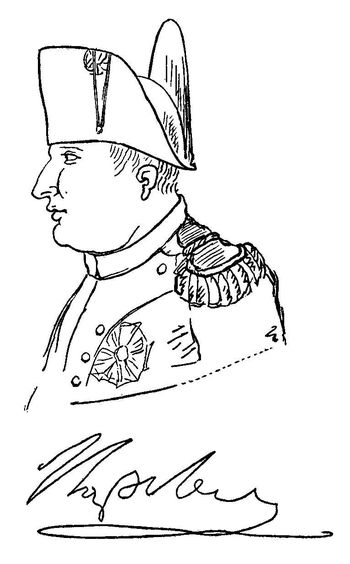
Portrait of Napoleon
Buonaparte's dress was an olive-coloured great coat over a green uniform, with scarlet cape and cuffs, green lapels turned back and edged with scarlet, skirts hooked back with bugle horns embroidered in gold, plain sugar-loaf buttons and gold epaulettes; being the uniform of the Chasseur à Cheval of the Imperial Guard. He wore the star, or grand cross of the Legion of Honour, and the small cross of that order; the Iron Crown; and the Union, appended to the button-hole of his left lapel. He had on a small cocked hat, with a tri-coloured cockade; plain gold-hilted sword, military boots, and white waistcoat and breeches. The following day he appeared in shoes, with gold buckles, and silk stockings—the dress he always wore afterwards, while with me.
On leaving the Épervier, he was cheered by her ship's company as long as the boat was within hearing; and Mr Mott informed me that most of the officers and men had tears in their eyes.
At this time I proposed to him to allow me to address him in English, as I had heard he understood that language, and I had considerable difficulty in expressing myself in French. He replied in French, "The thing is impossible; I hardly understand a word of your language:" and from the observations I had an opportunity of making afterwards, I am satisfied he made a correct statement, as, on looking into books or newspapers, he frequently asked the meaning of the most common word. He spoke his own language with a rapidity that at first made it difficult to follow him; and it was several days before I got so far accustomed to his manner of speaking, as to comprehend his meaning immediately.
In about a quarter of an hour, he again intimated a desire to go round the ship; and although I told him he would find the men rubbing and scouring, he persisted in his wish of seeing her in the state she then was. He accordingly went over all her decks, asking me many questions; more particularly about any thing that appeared to him different from what he had been accustomed to see in French ships of war. He seemed most struck with the cleanliness and neatness of the men, saying "that our seamen were surely a different class of people from the French; and that he thought it was owing to them we were always victorious at sea." I answered, "I must beg leave to differ with you: I do not wish to take from the merit of our men; but my own opinion is, that perhaps we owe our advantage to the superior experience of the officers; and I believe the French seamen, if taken as much pains with, would look as well as ours. As British ships of war are constantly at sea, the officers have nothing to divert their attention from them and their men; and in consequence, not only is their appearance more attended to, but they are much better trained to the service they have to perform."
"I believe you are right," said he. He then went on to talk of several naval actions; adding, "Your laws are either more severe, or better administered, than ours; there are many instances of French officers having conducted themselves ill in battle, without my being able to punish them as they deserved:" among others, he mentioned the names of two naval officers; and speaking of one of them, said, "He ought to have suffered death, and I did all I could to bring it about, but he was tried by a French naval court-martial, which only dismissed him the service." I observed, "The laws appear sometimes to be administered with more than sufficient severity. I commanded a frigate in the affair of Basque Roads; and in my opinion, the sentence of death on the Captain of the Calcutta was unjust: he could do no more to save his ship, and she was defended better and longer than any one there." He answered, "You are not aware of the circumstances that occasioned his condemnation; he was the first man to quit his ship, which was fought some time by her officers and crew after he had left her."
On seeing the additional supply of wads for each deck made up along with the shot-boxes, in the form of sophas, with neat canvass covers, he observed, "The French ships of war have all the preparations for action that you have, but they have not the way of combining appearance with utility."
We had breakfast about nine o'clock, in the English style, consisting of tea, coffee, cold meat, &c. He did not eat much, or seem to relish it; and when, on enquiry, I found he was accustomed to have a hot meal in the morning, I immediately ordered my steward to allow his Maître d'Hôtel to give directions, that he might invariably be served in the manner he had been used to; and after that we always lived in the French fashion, as far as I could effect that object.
During breakfast he asked many questions about English customs, saying, "I must now learn to conform myself to them, as I shall probably pass the remainder of my life in England."
The Superb, as I before observed, had been seen in the offing early in the morning, and was now approaching with a light breeze: he asked two or three times how soon she would anchor, seemed very anxious to know whether the Admiral would approve of my having received him; and when I went to wait on Sir Henry Hotham, requested I would say he was desirous of seeing him.
The Superb anchored about half-past ten, and I immediately went on board, and gave the Admiral an account of all that had occurred, adding, "I trust I have done right, and that the Government will approve of my conduct, as I considered it of much importance to prevent Buonaparte's escape to America, and to get possession of his person." Sir Henry Hotham said, "Getting hold of him on any terms would have been of the greatest consequence; but as you have entered into no conditions whatever, there cannot be a doubt that you will obtain the approbation of his Majesty's Government."
He then said, "How do you feel as to keeping him? would you like to part with him?" "Certainly not," was my answer: "as I have had all the anxiety and responsibility of conducting this matter to an issue, I am of course desirous of taking him to England; but, as I do not wish to keep him, or any man, in my ship against his will, if he desires to remove into another, I shall certainly not object."
I then delivered Buonaparte's message, that he was desirous of receiving a visit from the Admiral, who said he would wait upon him with much pleasure.
I soon after returned to the Bellerophon, and told Buonaparte that the Admiral meant to wait on him; upon which he desired Count Bertrand to go and pay his respects to Sir Henry. I accompanied him, and while the Admiral was preparing for his visit, Captain Senhouse attended General Bertrand through the ship.
In the afternoon, Sir Henry Hotham, accompanied by Captain Senhouse, and Mr Irving, his secretary, came on board the Bellerophon. They were introduced to Buonaparte by General Bertrand, in the after-cabin, where he had a good deal of conversation with them: he showed his portable library, which was laid out in small travelling cases round the cabin; asked various questions, principally relative to the discipline and regulation of our ships of war, and finally invited them all to remain to dinner.
Dinner was served about five o'clock upon Buonaparte's plate. This was arranged by his Maître d'Hôtel, whom I had told to regulate every thing in the manner most likely to be agreeable to his master.
When dinner was announced, Buonaparte, viewing himself as a Royal personage, which he continued to do while on board the Bellerophon, and which, under the circumstances, I considered it would have been both ungracious and uncalled for in me to have disputed, led the way into the dining-room. He seated himself in the centre at one side of the table, requesting Sir Henry Hotham to sit at his right hand, and Madame Bertrand on his left. For that day I sat as usual at the head of the table, but on the following day, and every other, whilst Buonaparte remained on board, I sat by his request at his right hand, and General Bertrand took the top. Two of the ward-room officers dined daily at the table, by invitation from Buonaparte, conveyed through Count Bertrand.
When dinner was over, a cup of strong coffee was handed round; he then rose and went into the after-cabin, asking the Admiral and all the party to accompany him, the ladies among the rest. This was the only time I ever saw them in the apartment in which he slept.
After some conversation, he said, in a cheerful and playful way, that he would show us his camp bed; and sent for Marchand, his premier valet de chambre, who received his order, and soon returned with two small packages in leather cases; one of which contained the bedstead, which was composed of steel, and, when packed up, was not above two feet long and eighteen inches in circumference; the other contained the mattress and curtains, the latter of green silk. In three minutes the whole was put together, and formed a very elegant small bed, about thirty inches wide.
He then went out, and walked the quarter-deck for some time, and retired to his cabin about half-past seven o'clock. Soon after, when the Admiral was going to return to his ship, he proposed to Bertrand to take leave of him. He went into the cabin, but returned immediately with an apology, saying he was undressed, and going to bed.
In the course of the afternoon, the Admiral invited Buonaparte, with the ladies and all his principal officers, to breakfast, the following day: which invitation was accepted, apparently, with much satisfaction.
When I went on deck, early the next morning, (the 16th of July) I observed that the Superb had the tompions out of her guns, and the man ropes on her yards, as if for the purpose of saluting and manning ships; and as I had received Buonaparte without even the guard presenting arms, I felt that he might conceive I had intentionally treated him with disrespect. I therefore sent the officer of the watch with my compliments to Sir Henry Hotham, and begged to know if it was his intention to salute Buonaparte on his going on board, and to receive him with manned yards; and, if so, whether I was to do the same, on his quitting the Bellerophon. He sent for answer, that it was not his intention to salute, but he meant to man ship; that I was not to do so on his quitting the Bellerophon, but was at liberty to man yards on his return. I likewise received directions from the Admiral to hoist a signal, when the boat with his visitors was ready to leave the ship, that he might have time to make the necessary preparations.
About ten A.M. the barge was manned, and a captain's guard turned out. When Buonaparte came on deck, he looked at the marines, who were generally fine-looking young men, with much satisfaction; went through their ranks, inspected their arms, and admired their appearance, saying to Bertrand, "How much might be done with a hundred thousand such soldiers as these." He asked which had been longest in the corps; went up and spoke to him. His questions were put in French, which I interpreted, as well as the man's answers. He enquired how many years he had served; on being told upwards of ten, he turned to me and said, "Is it not customary in your service, to give a man who has been in it so long some mark of distinction?" He was informed that the person in question had been a sergeant, but was reduced to the ranks for some misconduct. He then put the guard through part of their exercise, whilst I interpreted to the Captain of Marines, who did not understand French, the manœuvres he wished to have performed. He made some remarks upon the difference of the charge with the bayonet between our troops and the French; and found fault with our method of fixing the bayonet to the musquet, as being more easy to twist off, if seized by an enemy when in the act of charging.
On getting into the boat, he looked at the barge's crew, and said, "What a very fine set of men you have got!" He then turned to Las Cases, who had come on board the ship in plain clothes, but now appeared in a naval uniform, and said jocularly, "Comment, Las Cases, vous êtes militaire?" "What, Las Cases, are you a military man? I have never till now seen you in uniform." He answered, "Please your Majesty, before the revolution I was a lieutenant in the navy; and as I think an uniform carries more consideration with it in a foreign country, I have adopted it."
His attention was now drawn to the men on the Superb's yards, as well as to the appearance of the ship, about which he made some observations, and asked several questions; among others, whether she was French or English; what her age was; the number of guns she carried, and the weight of metal on each deck.
On going alongside, General Bertrand went up and announced to the Admiral, that the Emperor, for they always gave him that title, was in the boat. He then went up, and was received by Sir Henry Hotham on the quarter-deck, where a captain's guard was turned out to him. He was immediately shown into the cabin, and, after looking round him, requested to have the officers presented, which was done; when he asked nearly the same questions of each, that he had put to those of the Bellerophon the day before. He then expressed a wish to go through the ship; and did so, accompanied by several of his own suite, the Admiral, Captain Senhouse, and myself. The men were drawn up at divisions, and every thing was in the nicest order. He appeared much pleased with all he saw, and drew many comparisons between French and English ships of war. On going through the wings and storerooms, he said to General Savary, "Our ships have nothing of this sort:" who answered, "All the new ones, built at Antwerp, were constructed on this plan." When he returned to the quarter-deck, he questioned the Admiral and myself very minutely, about the clothing and victualling of the seamen. It was then, on being told that all that department was under the charge of the purser, he said in a facetious way, "Je crois que c'est quelquefois chez vous, comme chez nous, le commissaire est un peu coquin." "I believe it happens sometimes with you, as it does with us, that the purser is a little of a rogue." This was addressed to the Admiral and me, with whom he was conversing, and not to the people, as has been represented; nor was there a man that could have understood it, as it was spoken in French, and not within their hearing. He asked to see the Chaplain, put a few questions to him as to the number of Catholics and foreigners in the ship, and whether any of them spoke the French language. A Guernsey man was pointed out to him, but he had no conversation with him.
He was then shown into the cabin, where breakfast was prepared: during which meal he talked a good deal, but ate little, the breakfast being served in the English manner. I observed, during the whole time of breakfast, that Colonel Planat, who was much attached to him, and of whom Buonaparte always expressed himself in terms of affection, had tears running down his cheeks, and seemed greatly distressed at the situation of his master. And, from the opportunities I afterwards had of observing this young man's character, I feel convinced he had a strong personal attachment to Buonaparte;—and this, indeed, as far as I could judge, was the case also with all his other attendants, without exception.
On rising from the breakfast-table, the whole party went into the after-cabin, where a discussion took place about Buonaparte's horses and carriages, which had been left at Rochefort, and which he was desirous of having forwarded to England. I had formerly agreed, in the event of their arriving, to receive two carriages, and five or six horses, as many as the ship could conveniently stow; but as they had not come, the Admiral now consented to give a passport for a vessel to transport the whole of them, consisting of six carriages and forty-five horses: which was accordingly made out, and forwarded to Monsieur Philibert, the senior naval officer at Isle d'Aix, but I believe it was never acted upon.
We all returned to the Bellerophon about noon, when the ships present manned their yards, the boat was immediately hoisted in, and the ship got under weigh, in pursuance of orders from the Admiral, of which the following is an extract.
Extract of an Order from Rear Admiral Sir Henry Hotham, K.C.B., addressed to Captain Maitland of H.M.S. Bellerophon, dated Superb, in Basque Roads, July 15th, 1815.
"You are hereby required and directed to take the Myrmidon under your orders, and, putting on board her such persons composing a part of the suite of Napoleon Buonaparte as cannot be conveyed in the Bellerophon, you are to put to sea in H.M.S. under your command, in company with the Myrmidon, and make the best of your way with Napoleon Buonaparte and his suite to Torbay, and there landing the officer of the ship bearing my flag, whom I have charged with a despatch addressed to the Secretary of the Admiralty, as well as an officer of the ship you command, for the purpose of proceeding express to Plymouth with the despatch you will herewith receive, addressed to Admiral Lord Keith, and a copy of these instructions (which you will transmit to his Lordship,) await orders from the Lords Commissioners of the Admiralty, or his Lordship, for your further proceedings."
During the time we were heaving the anchor up, and setting the sails, Buonaparte remained on the break of the poop; and was very inquisitive about what was going on. He observed, "Your method of performing this manœuvre is quite different from the French;" and added, "What I admire most in your ship, is the extreme silence and orderly conduct of your men:—on board a French ship, every one calls and gives orders, and they gabble like so many geese." Previous to his quitting the Bellerophon he made the same remark, saying, "There has been less noise in this ship, where there are six hundred men, during the whole of the time I have been in her, than there was on board the Épervier, with only one hundred, in the passage from Isle d'Aix to Basque Roads."
Soon after the ship was under weigh, the Mouche joined, with three or four sheep, a quantity of vegetables, and other refreshments,—a present from the French Commodore to Buonaparte. After receiving them on board, we made sail, accompanied by the Myrmidon, for England.
In working out, we passed within about a cable's length of the Superb. He asked me if I considered that was near enough for a naval engagement: I answered, that half the distance, or even less, would suit much better; as it was a maxim in our navy, not to be further from our enemy than to give room for working the yards, and manœuvring the ship.
He remained upon deck all the time the ship was beating out of the Pertuis d'Antioche. Having cleared the Chasseron shoal about six P.M., dinner was served. He conversed a great deal at table, and seemed in very good spirits; told several anecdotes of himself; among others, one relating to Sir Sydney Smith. Knowing that I had served under that officer on the coast of Syria, he turned to me and said, "Did Sir Sydney Smith ever tell you the cause of his quarrel with me?" I answered he had not. "Then," said he, "I will.—When the French army was before St Jean d'Acre, he had a paper privately distributed among the officers and soldiers, tending to induce them to revolt and quit me; on which I issued a proclamation, denouncing the English commanding-officer as a madman, and prohibiting all intercourse with him. This nettled Sir Sydney so much, that he sent me a challenge to meet him in single combat on the beach at Caiffa. My reply was, that when Marlborough appeared for that purpose, I should be at his service; but I had other duties to fulfil besides fighting a duel with an English commodore." He pursued the subject of Syria, and said, patting me (who was sitting next him) on the head; "If it had not been for you English, I should have been Emperor of the East; but wherever there is water to float a ship, we are sure to find you in our way."
During the 17th and 18th of July, the weather was very fine, and nothing of note occurred. Several strange vessels were seen, about which Buonaparte and his attendants were very inquisitive, in order, I presume, that they might judge whether they would probably have escaped or not, had they put to sea. The only ship of war fallen in with on those days was the Bacchus sloop, which I pointed out; and at the same time informed him, that we had several frigates cruising in this position, for the purpose of intercepting him, had he got past the ships stationed close in with the land. This, as it afterward appeared, was not the case: the Endymion having gone into the Gironde, the Liffey having sprung her bowsprit and returned to England, and the others, from various causes, having quitted the station; so that, had he passed the squadron off Rochefort, there can be little doubt he would have made his voyage in safety to America.
About this time, Buonaparte amused himself by playing at cards after breakfast: the game was vingt-un, in which all the party joined, except myself. He proposed that I should play with them, but I told him I had no money, making it a rule to leave it all with my wife before I went to sea: on which he laughed, and good-humouredly offered to lend me some, and trust me until we arrived in England: I, however, declined his offer, having the numerous duties of the ship to attend to.
As my despatch of the 14th instant to the Secretary of the Admiralty had been very short, and written in great haste,—being desirous that his Majesty's Ministers should be made acquainted with the important arrangements agreed upon, as early as possible,—I considered it right to make a more detailed report to the Commander in Chief; and therefore wrote a despatch to Lord Keith, of which the following are extracts, intending to send it by the officer who should announce to him the Bellerophon's arrival in Torbay.
Extract of a Letter From Captain Maitland, Addressed To Admiral Viscount Keith, G.C.B., Dated on Board H.M. Ship Bellerophon, at Sea, July 18th, 1815.
"Having received directions from Sir Henry Hotham to forward the accompanying despatch to your Lordship by an officer, I avail myself of the opportunity to explain the circumstances under which I was placed when induced to receive Napoleon Buonaparte into the ship I command.
"After the first communication was made to me by Count Bertrand (a copy of which, with my answer, has been forwarded to your Lordship by Sir Henry Hotham) that Buonaparte was at Isle d'Aix, and actually embarked on board the frigates for the purpose of proceeding to the United States of America, my duty became peculiarly harassing and anxious, owing to the numerous reports, that were daily brought from all quarters, of his intention to escape in vessels of various descriptions, and from different situations on the coast, of which the limited means I possessed, together with the length of time requisite to communicate with Sir Henry Hotham at Quiberon Bay, rendered the success at least possible, and even probable. Thus situated, the enemy having two frigates and a brig, while the force under my command consisted of the Bellerophon and Slaney (having detached the Myrmidon to reinforce the Daphne off the Mamusson passage, where the force was considerably superior to her, and whence one of the reports stated Buonaparte meant to sail,) another flag of truce was sent out, for the ostensible reason of enquiring whether I had received an answer to the former, but I soon ascertained the real one to be a proposal from Buonaparte to embark for England in this ship.
"Taking into consideration all the circumstances of the probability of the escape being effected, if the trial was made either in the frigates, or clandestinely in a small vessel, as, had this ship been disabled in action, there was no other with me that could produce any effect on a frigate, and, from the experience I have had in blockading the ports of the bay, knowing the impossibility of preventing small vessels from getting to sea, and looking upon it as of the greatest importance to get possession of the person of Buonaparte; I was induced, without hesitation, to accede to the proposal, as far as taking him on board, and proceeding with him to England: but, at the same time, stating in the most clear and positive terms, that I had no authority to make any sort of stipulation as to the reception he was to meet with.
"I am happy to say, that the measures I have adopted have met with the approbation of Sir Henry Hotham, and will, I trust and hope, receive that of your Lordship, as well as of his Majesty's Government."
On the 29th, a conversation took place between Madame Bertrand and myself, about Buonaparte's voyage to Elba. She asked me if I was acquainted with Captain Usher. On my answering in the negative, she said, "The Emperor is very fond of him: he gave him his portrait set with diamonds, and has another which he intends for you." I replied, "I hope not, as I cannot accept of it. Captain Usher's situation and mine were very different, and what might be proper in him would not be so in me." She rejoined, "If you do not accept of it, you will offend him very much." "If that is the case," I said, "I shall be obliged to you to take steps to prevent its being offered, as I wish to save him the mortification, and myself the pain, of a refusal; and I feel it absolutely impossible, situated as I am, to take a present from him. In receiving him on board, I had no direct authority from my Government, and I have yet to learn whether my conduct will be approved of. Besides, were I to receive a present of such value, it might possibly be said, that I was actuated by selfish motives; whereas all the measures I have taken were dictated solely by the desire of serving my country to the best of my judgment: if, therefore, I am to receive any reward, it must come from that quarter."
On the 20th of July, early in the morning, we spoke the Swiftsure, on her way from England to reinforce me in the blockade of Rochefort. The astonishment of Captain Webley can scarcely be conceived, when, on his entering the ship, I said, "Well, I have got him." "Got him! got whom?" "Why, Buonaparte; the man that has been keeping all Europe in a ferment these last twenty years." "Is it possible?" said he; "well, you are a lucky fellow." We had some further conversation; but Captain Webley was not introduced to Buonaparte, who had not then left his cabin; and as the Swiftsure was going to the southward, and I was desirous of getting to England as quickly as possible, we soon parted company.
During the 21st and 22nd of July, we exchanged signals with two or three others of our ships, which I took care to explain were on the look-out for my guest; and he seemed by this time pretty well convinced that an attempt to elude our cruisers would have been fruitless. On the latter day, the Prometheus showed her number, while we were at dinner: when Buonaparte expressed a wish to know whether the ships at Brest had hoisted the white flag or not. I sent for the officer of the watch, and desired him to ask the question by telegraph. In a few minutes he returned, with an answer in the affirmative. Buonaparte made no remark upon this information; but asked, with apparent indifference, how the question and answer had been conveyed; and when I explained it to him, he approved highly of the usefulness of the invention.
During meals, he always entered very freely and familiarly into conversation with those about him, addressing himself frequently to Las Cases and me; asking many questions about the manners, customs, and laws of the English; often repeating the observation he had made on first coming on board, that he must gain all the information possible on those subjects, and conform himself to them, as he should probably end his life among that people. Monsieur Las Cases, it appears, had emigrated from France early in the revolution, and remained in England until the peace of Amiens, when he was allowed to return to his own country.
Sunday, the 23rd of July, we passed very near to Ushant: the day was fine, and Buonaparte remained upon deck great part of the morning. He cast many a melancholy look at the coast of France, but made few observations on it. He asked several questions about the coast of England; whether it was safe to approach; its distance, and the part we were likely to make. About eight in the evening, the high land of Dartmoor was discovered, when I went into the cabin and told him of it: I found him in a flannel dressing-gown, nearly undressed, and preparing to go to bed. He put on his greatcoat, came out upon deck, and remained some time looking at the land; asking its distance from Torbay, and the probable time of our arrival there.
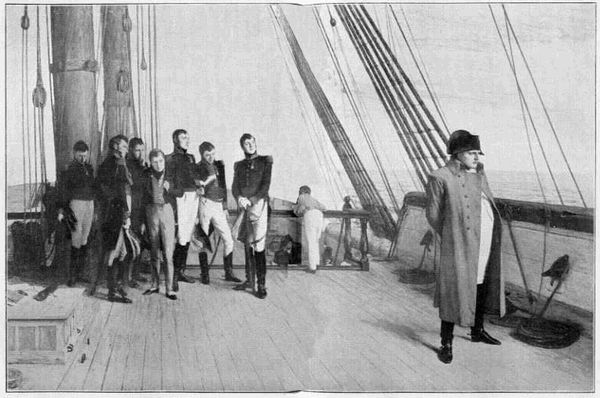
Napoleon on Board the Bellerophon
At daybreak of the 24th of July, we were close off Dartmouth. Count Bertrand went into the cabin, and informed Buonaparte of it, who came upon deck about half-past four, and remained on the poop until the ship anchored in Torbay. He talked with admiration of the boldness of the coast; saying, "You have in that respect a great advantage over France, which is surrounded by rocks and dangers." On opening Torbay, he was much struck with the beauty of the scenery; and exclaimed, "What a beautiful country! it very much resembles the bay of Porto Ferrajo, in Elba."
The ship was scarcely at anchor, when an officer came alongside, bringing an order from Lord Keith; of which I give an extract.
Extract of an Order from Admiral Viscount Keith, G.C.B., addressed to Captain Maitland, of H.M.S. Bellerophon, dated Ville de Paris, Hamoaze, 23rd July, 1815.
"Captain Sartorius, of His Majesty's ship Slaney, delivered to me last night, at eleven o'clock, your despatch of the 14th instant, acquainting me that Buonaparte had proposed to embark on board the ship you command; and that you had acceded thereto, with the intention of proceeding to Torbay, there to wait for further orders. I lost no time in forwarding your letter by Captain Sartorius to the Lords Commissioners of the Admiralty, in order that their Lordships might, through him, be acquainted with every circumstance that had occurred on an occasion of so much importance; and you may expect orders from their Lordships for your further guidance. You are to remain in Torbay until you receive such orders; and in the mean time, in addition to the directions already in your possession, you are most positively ordered to prevent every person whatever from coming on board the ship you command, except the officers and men who compose her crew; nor is any person whatever, whether in His Majesty's service or not, who does not belong to the ship, to be suffered to come on board, either for the purpose of visiting the officers, or on any pretence whatever, without express permission either from the Lords Commissioners of the Admiralty, or from me. As I understand from Captain Sartorius, that General Gourgaud refused to deliver the letter with which he was charged for the Prince Regent, to any person except his Royal Highness, you are to take him out of the Slaney, into the ship you command, until you receive directions from the Admiralty on the subject, and order that ship back to Plymouth Sound, when Captain Sartorius returns from London."
Along with the above order, I received a letter from Lord Keith, of which I give some extracts.
"You will perceive by the newspapers, that the intelligence had reached London before Captain Sartorius, owing to his long passage. I have a letter from Lord Melville to-day, enforcing in the strongest manner the former orders,—even that no person, myself or Sir John Duckworth excepted, shall be suffered to come on board the ship, till orders are sent from Government; which you will be so good as strictly to comply with. Let him and his want for nothing; and send to me for any thing Brixham cannot furnish; I will send it to you by a small vessel. You may say to Napoleon, that I am under the greatest personal obligations to him for his attention to my nephew, who was taken and brought before him at Belle Alliance, and who must have died, if he had not ordered a surgeon to dress him immediately, and sent him to a hut. I am glad it fell into your hands at this time, because a Frenchman had been sent from Paris on the mission, a Monsieur Drigni."
Buonaparte recollected the circumstance alluded to, and seemed much gratified with Lord Keith's acknowledgments.
Napoleon and all his attendants were very anxious to see as many newspapers as possible, but particularly the Courier, which they considered the Ministerial paper, and most likely to contain the intentions of Government respecting them. They received little encouragement from any of them, but least of all from those which are supposed to take the Ministerial side in politics, as they not only contained a great deal that was personally offensive, but stated, in very plain terms, that none of the party would be allowed to land in England, and that St Helena was the probable place of their ultimate destination. Buonaparte himself always affected to consider this as a mere newspaper report, though I believe it gave him a good deal of uneasiness. His followers received it with much irritation and impatience, frequently endeavouring to convince me that our Government could have no right to dispose of them in that way, and talking to me, as if I had been one of his Majesty's Ministers, and had influence in determining on their future destination. All I could say on the subject did not prevent them from frequently recurring to it, and appealing against the injustice of such a measure.
This morning General Gourgaud returned from the Slaney, which we found lying here, not having been permitted to land, and having refused to deliver the letter he had been charged with for the Prince Regent to any person except his Royal Highness himself.
When I was conversing with Madame Bertrand, she said, "Had the Emperor gained the battle of Waterloo, he would have been firmly seated on the throne of France." I answered, "It certainly might have protracted his downfall, but, in all probability, he would have been overthrown at last, as the Russians were fast advancing, and he never could have resisted the combined forces of the Allies." To which she replied, "If your army had been defeated, the Russians never would have acted against him." "That I cannot believe," I said, "as they were using every effort to join and support the Allies; and the assertion is ridiculous." "Ah," said she, "you may laugh at it, and so may other people, nor will it, perhaps, now be discovered; but remember what I say, and be assured that at some future period it will be proved, that it never was Alexander's intention to cross the frontiers of France, in opposition to him."
In the course of the day I received many applications for admittance into the ship: among others a note from a lady residing in the neighbourhood, accompanied by a basket of fruit, requesting a boat might be sent for her next morning. I returned a civil answer, informing her that my instructions would not admit of her request being complied with: no more fruit was sent from that quarter. Lord Gwydir and Lord Charles Bentinck also applied for admittance, but with no better success.
No sooner was Buonaparte's arrival known in the neighbourhood, than the ship was surrounded by a crowd of boats, people being drawn from all quarters to see this extraordinary man. He came often upon deck, and showed himself at the gangways and stern windows, apparently for the purpose of gratifying their curiosity, of which, as he observed to me, the English appeared to have a very large portion.
In the evening, the officer who had been sent to Plymouth, on the ship's arrival, with despatches for Lord Keith, returned, bringing letters, from which I give the following extracts:—
Extract of a Letter from Admiral Viscount Keith, G.C.B., addressed to Captain Maitland, of H.M.S. Bellerophon, dated Ville de Paris, Hamoaze, July 24, 1815.
"The officer of the ship you command has just delivered to me your letter of this date, reporting your arrival in Torbay, with the Bellerophon and Myrmidon, having on board Napoleon Buonaparte and his suite. I have also received your other letter, explaining the circumstances under which you were placed, when you were induced to receive Napoleon on board; and I shall transmit the same to the Lords Commissioners of the Admiralty, in confident expectation, that his Majesty's Government will fully approve of your conduct."
Extract of a Letter from Admiral Viscount Keith, G.C.B., addressed to Captain Maitland, of H.M.S, Bellerophon, dated 24th July, 1815.
"I take the opportunity of your officer's return, to congratulate you and the nation, and to thank you for the perfect manner in which you entered into my views on the subject, and for the management of the blockade, about which I was most anxious. It will not be long ere you are instructed by the Government: the first express would arrive about four o'clock this morning, and I attempt a telegraph message, but it is cloudy. I beg you will send for any thing you may want, to me, and it shall be sent instantly; and I beg to present my respects to Napoleon, and if I can render him any civility, I will consider it my duty, as well as in gratitude for Captain Elphinstone's report of the attention he received from him on the field of battle."
During the 25th of July, the concourse of people round the ship was greater than the day before, and the anxiety of the Frenchmen was considerably augmented by the confidence with which the newspapers spoke of the intention to remove Buonaparte to St Helena. In the afternoon, he walked above an hour on deck, frequently stood at the gangway, or opposite to the quarter-deck ports, for the purpose of giving the people an opportunity of seeing him, and, whenever he observed any well-dressed women, pulled his hat off, and bowed to them.
At dinner he conversed as usual, was inquisitive about the kinds of fish produced on the coast of England, and ate part of a turbot that was at table, with much relish. He then spoke of the character of the fishermen and boatmen on our coast, saying, "They are generally smugglers as well as fishermen; at one time a great many of them were in my pay, for the purpose of obtaining intelligence, bringing money over to France, and assisting prisoners of war to escape. They even offered, for a large sum of money, to seize the person of Louis, and deliver him into my hands; but as they could not guarantee the preservation of his life, I would not give my consent to the measure."
At three in the morning of the 26th of July, Captain Sartorius returned from London; having carried my despatch announcing Buonaparte's intention to embark in the Bellerophon, and brought with him orders for me to proceed to Plymouth Sound. We immediately got under weigh, accompanied by the Myrmidon and Slaney. While heaving the anchor up, Las Cases came upon deck, when I told him the ship was ordered to Plymouth, supposing, if he thought it requisite, he would acquaint his master. Soon after the ship was at sea, Madame Bertrand made her appearance, when she attacked me with some warmth for having neglected to acquaint Buonaparte with the orders I had received, and told me he was excessively offended. As she had once or twice before, when every thing did not go exactly as she wished, held the same language, I determined to ascertain whether Buonaparte had expressed any dissatisfaction, and, if so, to come to an explanation with him, as, though I was inclined to treat him with every proper consideration, it never was my intention to be looked upon as responsible to him for my movements; I therefore told Las Cases what she had said, and requested he would ascertain whether Napoleon really had felt displeased. He immediately went into the cabin, and on his return assured me that there must have been some mistake, as nothing of the kind had taken place.
The ship's removal to the westward was by no means an agreeable event to the suite of my guest: they naturally reasoned, that, had it been the intention of the British Government to allow him to land in England, he would not have been removed further from the Metropolis. He, however, made no observations on the subject himself; still affecting to consider the reports in the newspapers as the surmises of the editors.
We had, during the forenoon of the 26th of July, to beat up from the Start to Plymouth Sound, against a strong northerly wind. Buonaparte remained upon deck the greater part of the day. When going into the Sound, I pointed out the Breakwater to him, and described the manner in which they were forming it. He said, it was a great national undertaking, and highly honourable to the country; enquired the estimated expense, and seemed surprised, when I told him it was expected to be finished for something less than a million sterling. He added, "I have expended a large sum of money on the port of Cherbourg, and in forming the Boyart Fort, to protect the anchorage at Isle d'Aix; but I fear now, those and many other of my improvements will be neglected, and allowed to go to ruin."
When the ship had anchored, I informed him I was going to wait on the Commander-in-chief, and requested to know if I could convey any message from him. He desired me to return his thanks to Lord Keith, for the kind intentions he had expressed towards him in his letters to me, and to say he was extremely anxious to see his Lordship, if it could be done with propriety. On delivering his message to Lord Keith, he answered, "I would wait upon him with much pleasure, but, to tell you the truth, I have as yet received no instructions as to the manner in which he is to be treated; and until I do receive these, I cannot well visit him." He then gave me some precautionary orders to prevent his escape, or any attempt to effect it. From which I give the extracts below.
Extract of an Order from Admiral Viscount Keith, G.C.B., to Captain Maitland, of H.M.S. Bellerophon, dated Hamoaze, July 26, 1815.
"In addition to the orders already received, you are to pay the strictest regard and attention to the directions contained in the enclosed extract of a letter from the Secretary of the Admiralty. If General Gourgaud has not already been taken out of the Slaney, you are to cause him to be removed immediately into the ship you command. I enclose, for your information, a copy of a general order that I have issued, forbidding communication with the ship you command; and it is my intention to order the Liffey and Eurotas to anchor near you, and to row guard."
Extract of a Letter from the Secretary of the Admiralty to Admiral Viscount Keith, G.C.B., dated 24th July, 1815, enclosed in the foregoing.
"Referring your Lordship to Mr Croker's letter of the 1st instant, respecting Buonaparte, I am to signify their Lordships' directions to you, to give the most positive orders to Captain Maitland to prevent all communication whatever with the shore but through him, and by him through your Lordship; and on no account to permit any person whatsoever to go on board the ship, without your Lordship's permission given in writing for that purpose; which permission, for obvious reasons, will only be granted in such cases as the public service may require: and proper measures are to be taken to prevent boats and small craft from crowding near the Bellerophon.
"Your Lordship will restrict the captains and commanders of your squadron from communicating, until further orders, with the Bellerophon."
There was also enclosed the following copy of a Memorandum, addressed to the respective Captains of H.M. Ships Liffey and Eurotas.
"Ville de Paris, in Hamoaze, 26th July, 1815.
"Memo:
"The Liffey and Eurotas are to take up an anchorage on each side of the Bellerophon, at a convenient distance, and observe the following directions, as well for the purpose of preventing the escape of Buonaparte, or any of his suite, from that ship, as for restraining shore-boats and others from approaching too close to her, either from curiosity or any other motive.
"A constant watch of an officer, a quarter-watch, and double sentinels, are to be kept by day, as well as a boat manned and armed alongside, in constant readiness, as a guard-boat: the same precaution is to be observed all night, with the exception, that one of the boats, in charge of a lieutenant, is to row guard, and to be relieved every hour.
"No shore-boats, or others, are to be suffered, either by night or by day, to approach nearer the Bellerophon than one cable's length; and no boats are to be permitted to loiter about the ship, even at that distance, either from curiosity or any other motive: neither the captains of the Liffey or Eurotas, nor any other officer belonging to those or any other ships, are to go on board the Bellerophon, either to visit, or on any pretence whatever, without permission from me in writing."
Signed, Keith, Admiral.
A Copy.
Keith, Admiral. To the respective Captains of the Liffey and Eurotas.
When I returned on board, I found the frigates had taken their positions as directed in the last order, and their boats were endeavouring as much as possible to keep the shore-boats at the specified distance from the ship. I stated to Buonaparte what Lord Keith had said; to which he answered, "I am extremely anxious to see the Admiral, and therefore beg he will not stand upon ceremony: I shall be satisfied to be treated as a private person, until the British Government has determined in what light I am to be considered." He then complained of the two frigates being placed as guard-ships over him, "as if," said he, "I were not perfectly secure on board a British line-of-battle ship;" and added, "The guard-ships' boats have been firing musquetry all the evening, to keep the shore-boats at a distance: it disturbs and distresses me, and I shall be obliged to you to prevent it, if it lies in your power." I immediately sent to the Captains of the frigates, to put a stop to the firing.
On the 27th of July, I received a letter from the Secretary of the Admiralty, of which I give an extract:—
Extract of a Letter from the Secretary of the Admiralty, addressed to Captain Maitland, of H.M.S. Bellerophon, dated 25th July, 1815.
"I have received and laid before my Lords Commissioners of the Admiralty, your letter of yesterday's date, reporting your arrival in the Bellerophon in Torbay, accompanied by the Myrmidon, having on board Napoleon Buonaparte and suite, and transmitting a copy of a letter you had addressed to Admiral Lord Keith, reporting your proceedings, under the various circumstances which occurred prior to his embarkation, of which their Lordships have been pleased to direct me to signify their approval."
I waited on Lord Keith in the morning, and carried with me Buonaparte's original letter to the Prince Regent, which General Gourgaud had refused to deliver to Captain Sartorius: finding that one of his own officers would not be allowed to proceed with it, he now consented to its being forwarded through the Admiral. I reported to his Lordship all the occurrences of the previous day; and that, in consequence of the frequent repetition in the newspapers of its being the intention of his Majesty's Government to send Buonaparte to St Helena, he, as well as the officers of his suite, had expressed much uneasiness. I also carried a message from him, stating his desire to see his Lordship, and that he would willingly waive all ceremony, and be considered as a private person. To which Lord Keith answered, "I shall now have no difficulty whatever, having received full instructions as to the manner in which he is to be treated: he is to be considered as a General Officer, and have the respect due to that rank paid him, and no more: you may therefore say I shall wait on him to-morrow forenoon." He then put into my hands the following additional orders.
Extract of a Letter from Admiral Viscount Keith, G.C.B., addressed to Captain Maitland, of H.M.S. Bellerophon, dated Ville de Paris, Hamoaze, 27th July, 1815.
"I herewith transmit an extract of an order, containing certain directions relative to Buonaparte and his suite, and you are forthwith to carry the same into execution; sending on board the Liffey or Myrmidon, with directions similar to those that have been addressed to yourself, such of his suite as are to be withdrawn from the ship you command."
Extract of an Order from the Lords Commissioners of the Admiralty, to Admiral Viscount Keith, G.C.B., dated July 25th, 1815.
"That he should give immediate orders, that, upon the arrival of the Bellerophon, Napoleon Buonaparte should remain, until the Prince Regent's further pleasure shall be signified, on board of that, or such other ship of war as we shall appoint, and shall not be permitted on any account to come on shore; or to hold communication with the shore, or with other vessels, either personally, or by writing. Not more than four or five persons of his suite (exclusive of menial servants) are to remain on board the same ship with himself: the remainder of his suite are to be kept under similar restraint, on board of other vessels of war. Napoleon Buonaparte is to be considered and addressed as a General Officer."
In consequence of those orders, several of the officers of inferior rank, and some of the servants, were sent to the frigates appointed to guard us.
In the afternoon Sir Richard and Lady Strachan, accompanied by Mrs Maitland, came alongside the ship. Buonaparte was walking the deck, and, when I told him my wife was in the boat, he went to the gangway, pulled off his hat, and asked her if she would not come up and visit him. She shook her head; and I informed him, that my orders were so positive, I could not even allow her to come on board. He answered, "C'est dur, ça." "That is very hard." And addressing himself to her, "Milord Keith est un peu trop sevère; n'est-ce pas, Madame?" "Lord Keith is a little too severe; is he not, Madam?" He then said to me, "Ma foi, son portrait ne la flatte pas; elle est encore plus jolie que lui." "I assure you her portrait is not flattering; she is handsomer than it is." I told him Sir Richard Strachan was in the boat with her, and that he was second in command of the Channel fleet: he bowed to him, and said, "He appears a very young man to hold so high a rank."
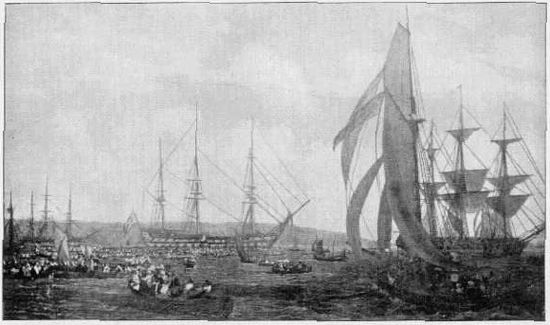
H.M.S. Bellerophon at Plymouth.
There were this day a great many boats round the ship, full of people, among which were a number of well-dressed females. He expressed himself in strong terms of admiration of the beauty of the English women, and was desirous of knowing which were the ladies,—"les dames comme il faut," as he termed it; as they were all so well dressed that he could not distinguish them.
In the evening a letter was sent to me by Lord Keith, of which I subjoin an extract:—
Extract of a Letter from Admiral Viscount Keith, G.C.B., addressed to Captain Maitland of H.M.S. Bellerophon, dated Ville de Paris, Hamoaze, 27th July, 1815.
"From the representation you have made to me of the dissatisfaction expressed by Buonaparte, on observing by the newspapers that he was to be sent to St Helena; it will be necessary that you redouble your vigilance to prevent his escape; and you are therefore to station double sentinels, and resort to every other means that may be necessary for frustrating any such intention."
On the 28th of July, Lord Keith came on board, between eleven and twelve o'clock, and was shown by me into the cabin, where Count Bertrand introduced him to Buonaparte. I immediately withdrew, and cannot therefore state what passed between them; but Lord Keith afterwards informed me, that Buonaparte had been very anxious to know whether the Government had come to any determination with regard to his disposal; of which his Lordship professed total ignorance.
After Lord Keith came out of the cabin, he remained some time with Buonaparte's suite, who were collected in the state room. Madame Bertrand drew him aside, and entered into conversation with him, saying what she had repeated to me a hundred times, that it would be the height of injustice to send them to St Helena, and endeavouring to persuade him to interfere in preventing her husband at least from going, should Napoleon be sent there.
During the whole of the 29th of July it rained incessantly, and nothing worth relating took place: the Frenchmen were deprived of their usual amusement of admiring the ladies, and being admired in return, not a boat having made its appearance. They often remarked, with the characteristic vivacity of their nation, that they were placed in the situation of Tantalus,—so many beauties in view, without the possibility of approaching them.
On Sunday, the 30th of July, the crowd of boats was greater than I ever remember to have seen at one time. I am certain I speak within bounds when I state, that upwards of a thousand were collected round the ship, in each of which, on an average, there were not fewer than eight people. The crush was so great, as to render it quite impossible for the guard-boats to keep them off; though a boat belonging to one of the frigates made use of very violent means to effect it, frequently running against small boats, containing women, with such force as nearly to upset them, and alarming the ladies extremely. The French officers were very indignant at such rude proceedings, saying, "Is this your English liberty? Were such a thing to happen in France, the men would rise with one accord and throw that officer and his crew overboard."
I this day informed him, that Lord Keith had received an intimation, that Sir Henry Bunbury, one of the Under Secretaries of State, was to arrive in the course of the day with the decision of the British Government as to his future disposal. He asked me many questions, but, although Lord Keith had acquainted me that Buonaparte was to go to St Helena, he had at the same time desired me not to communicate this information, and I was therefore obliged to evade his interrogatories as I best could.
In the newspapers of this day there appeared the lists of persons proscribed by the Government of France. Among the first class were the names of Bertrand, Savary, and Lallemand: the first treated it with derision, the two others appeared much alarmed, and often asked me if I thought it possible the British Government would deliver them up to Louis. I said, "Decidedly not; you have been received on board an English man of war, and it never can be the intention of the Ministers to deliver you over to punishment." They were not, however, satisfied by any means; and a French frigate, bearing the white flag, which lay in Hamoaze, was an object of much jealousy to them.
When I waited on Lord Keith, the morning of the 31st of July, he acquainted me that Sir Henry Bunbury had arrived, and was to accompany him on board at ten o'clock. He also showed me a notification of the decision of Government respecting Buonaparte, in which he was styled General throughout. It stated, that he was to be sent to St Helena, and to be permitted to take with him three of the higher class of those that had accompanied him from France, and twelve domestics, who were to be selected by himself, with the exception of Savary and Lallemand, who were not on any account to be permitted to go with him. I immediately returned on board, to be in readiness to receive Lord Keith and Sir Henry Bunbury; and informed Buonaparte, that he might expect them. He asked me if I knew what they were to communicate; and having then received his Lordship's sanction for doing so, I told him, I understood it was determined he was to be sent to St Helena. His mind had, by this time, been so much prepared by the newspapers for that event, that he did not show any very strong emotion at receiving the intimation; though he complained, in strong terms, of the injustice of such a measure. As, however, the Admiral's barge was seen approaching, and I was obliged to go upon deck to receive him, I had very little conversation with him at that time.
Lord Keith and Sir Henry Bunbury arrived about half-past ten in the forenoon, when I showed them into the cabin, where Buonaparte was attended by Count Bertrand. I then withdrew, leaving them shut up with him for about half an hour, when Lord Keith called me into the fore-cabin, where all the suite were assembled, and I presented each of them to the Admiral and Sir Henry. They all appeared very much distressed, but particularly Savary and Lallemand; who were extremely urgent to know how they were to be disposed of; protesting, most vehemently, against their being given up to France, as a breach of all faith and honour. Madame Bertrand again tried to induce Lord Keith to use his influence with our Government, to prevent Bertrand from accompanying Buonaparte to St Helena.